The Evolution of Plants and Animals Through Geological Time Pre-Cambrian Era began 4.5 billion years ago and ended 570 million years ago Dominant life form was single-celled organisms that lived in water. The earliest life forms appear
"The Evolution of Plants and Animals Through" is the property of its rightful owner. Permission is granted to
download and print the materials on this website for personal, non-commercial use only, and to display it
on your personal computer provided you do not modify the materials and that you retain all copyright
notices contained in the materials. By downloading content from our website, you accept the terms of this
agreement.
Presentation Transcript
01
The Evolution of Plants and Animals Through Geological Time Pre-Cambrian Era – began 4.5 billion years ago and ended 570 million years ago
Dominant life form was single-celled organisms that lived in water.
The earliest life forms appear about 3.2 billion years ago
Multi-celled organism evolve by the end of the era including invertebrates
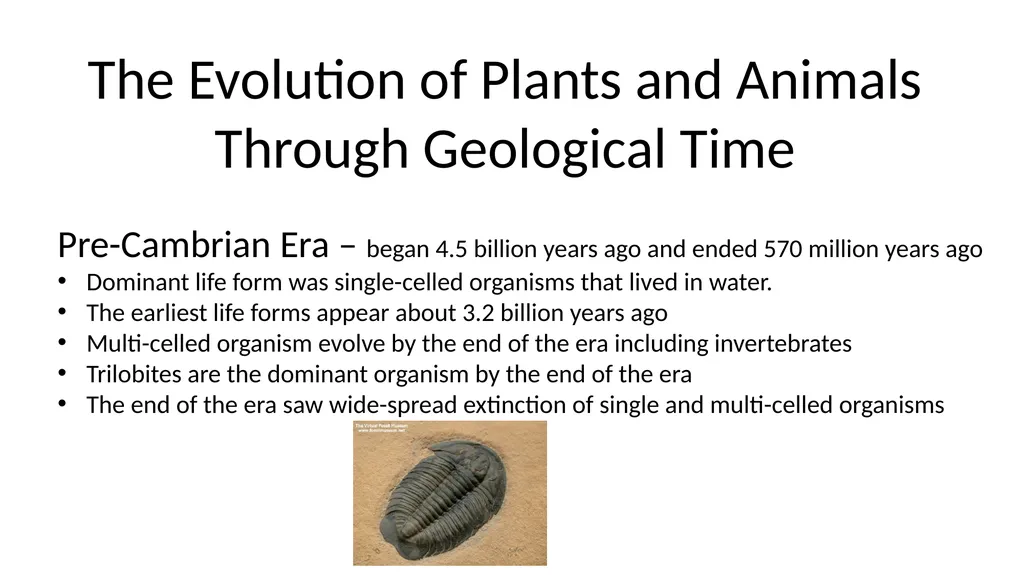
Trilobites are the dominant organism by the end of the era
The end of the era saw wide-spread extinction of single and multi-celled organisms<br>
02
Paleozoic Era – 570 million years ago to 230 million years ago
Cambrian Period – 570 MY-500MY
The dominant life form is the invertebrate (trilobites)
There are no vertebrates or land plants
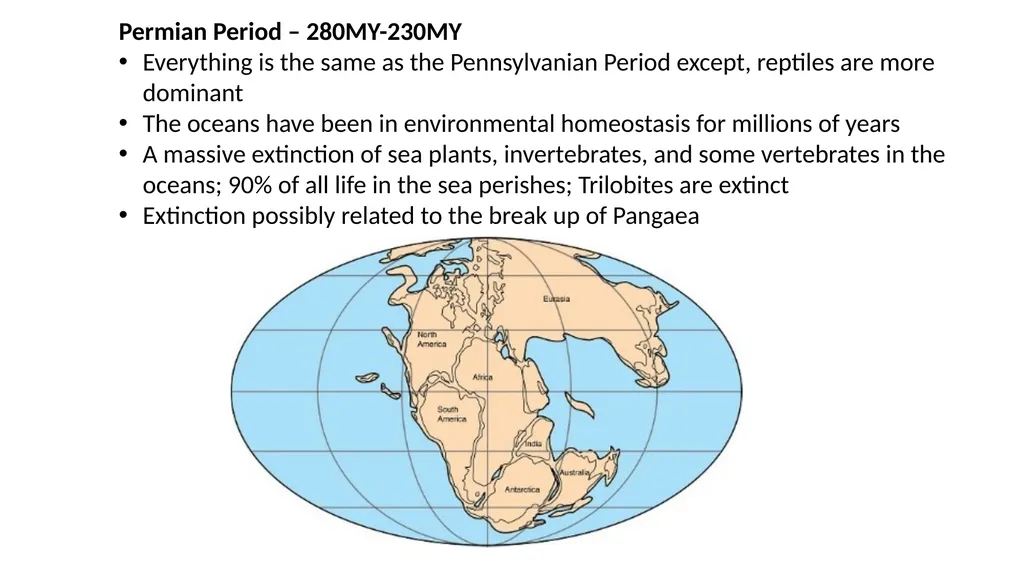
The land is one giant land mass (Pangaea)
Ordivician Period – 500MY-435MY
The dominant life form is still the invertebrate
Competition for food in the oceans is getting fierce
First vertebrates appear
There are still no land plants or land animals
Sillurian Period – 435MY-395 MY
Invertebrates are still dominant
Fish have become abundant
Competition for food in the ocean is still fierce, plants are being eaten moreso
First land plants appear<br>
03
Devonian Period – 395MY-345MY
Fish are becoming dominant
Land plants are now abundant
Competition in the water is fierce again
First carnivorous fish appear
First amphibians appear
Mississippian Period – 345MY-305MY
Fish, land plants and amphibians are abundant
Competition on land becoming intense
First trees appear
Possibly the first insect (no true fossils)
Pennsylvanian Period – 305MY-280MY
Fish, amphibians, forest trees, and insects are dominant
First reptiles appear<br>
04
Permian Period – 280MY-230MY
Everything is the same as the Pennsylvanian Period except, reptiles are more dominant
The oceans have been in environmental homeostasis for millions of years
A massive extinction of sea plants, invertebrates, and some vertebrates in the oceans; 90% of all life in the sea perishes; Trilobites are extinct
Extinction possibly related to the break up of Pangaea<br>
05
Mesozoic Era – 230 million years ago to 65 million years ago
Known as the Age of Reptiles
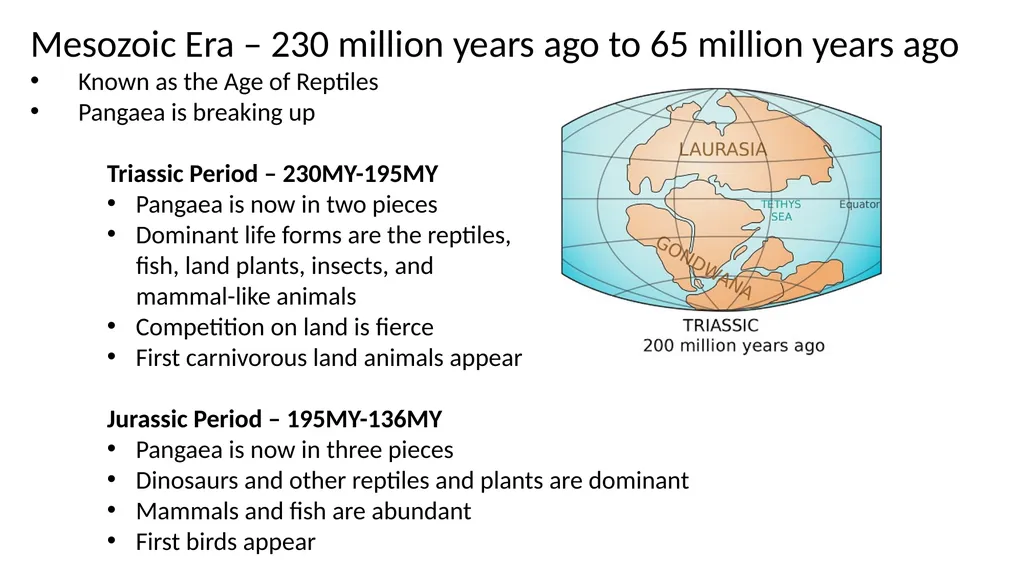
Pangaea is breaking up
Triassic Period – 230MY-195MY
Pangaea is now in two pieces
Dominant life forms are the reptiles,
fish, land plants, insects, and
mammal-like animals
Competition on land is fierce
First carnivorous land animals appear
Jurassic Period – 195MY-136MY
Pangaea is now in three pieces
Dinosaurs and other reptiles and plants are dominant
Mammals and fish are abundant
First birds appear<br>
06
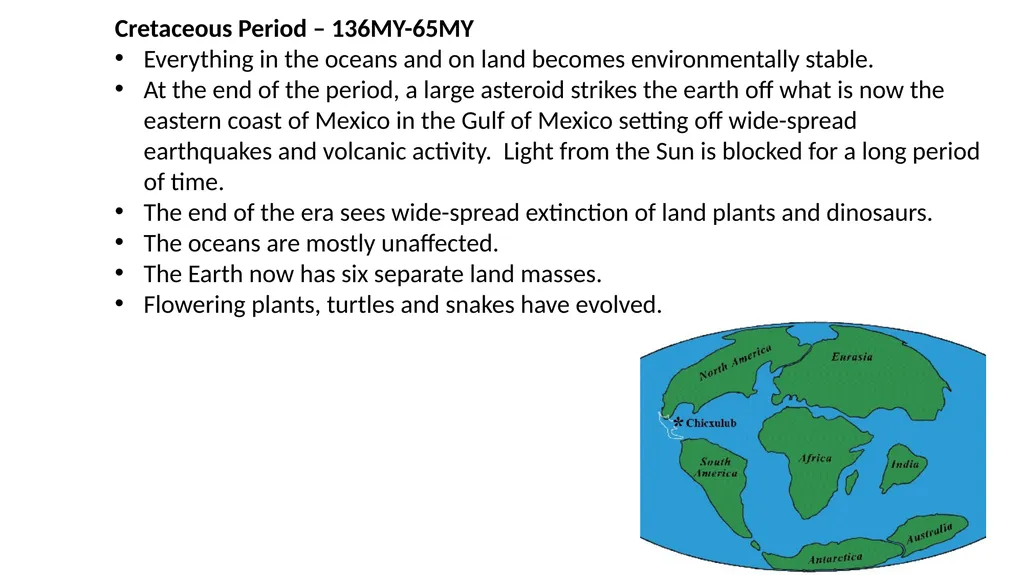
Cretaceous Period – 136MY-65MY
Everything in the oceans and on land becomes environmentally stable.
At the end of the period, a large asteroid strikes the earth off what is now the eastern coast of Mexico in the Gulf of Mexico setting off wide-spread earthquakes and volcanic activity. Light from the Sun is blocked for a long period of time.
The end of the era sees wide-spread extinction of land plants and dinosaurs.
The oceans are mostly unaffected.
The Earth now has six separate land masses.
Flowering plants, turtles and snakes have evolved.<br>
07
Cenozoic Era – 65 million years ago to the present
Known as the Age of Mammals
Tertiary Period – 65MY-2.5MY
All the time before the last major ice age
Paleocene Epoch – 65MY-60MY
Evolution of several new mammals
First carnivorous mammals
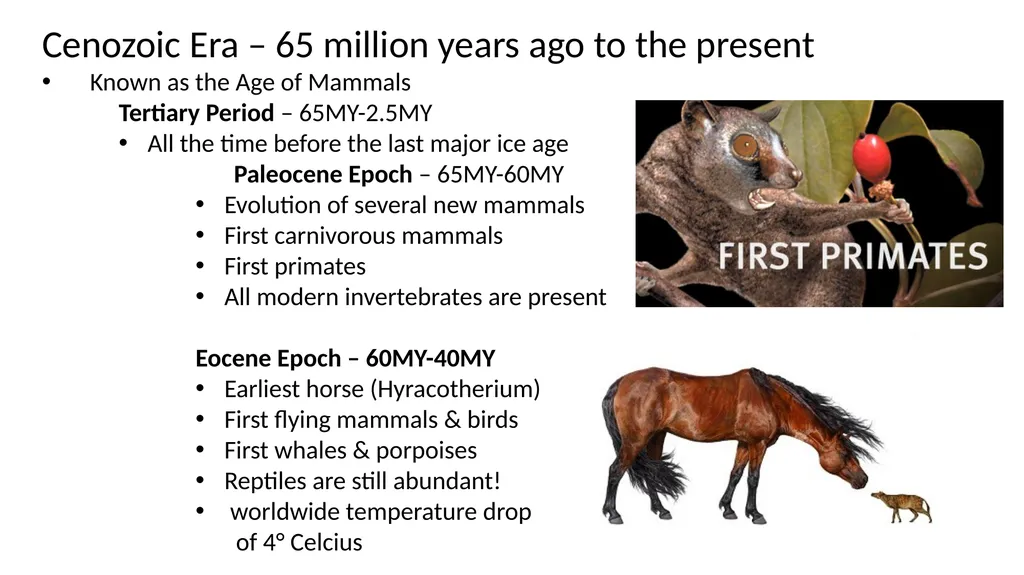
First primates
All modern invertebrates are present
Eocene Epoch – 60MY-40MY
Earliest horse (Hyracotherium)
First flying mammals & birds
First whales & porpoises
Reptiles are still abundant!
worldwide temperature drop
of 4° Celcius<br>
08
Oligocene Epoch – 40MY-25MY
Climate got colder and drier
The Mediterranean Sea dried up
Grasses and conifer flourish
Many early mammals become extinct
Miocene Epoch – 25MY-11MY
Herding mammals flourish
The largest land mammal, called
Baluchiterium, existed
Saber-toothed cats existed
Known as the Golden Age of Mammals
Pliocene Epoch – 11MY-2.5MY
Hunting mammals evolve (lions, tigers, bears, & wolves)
Modern horse evolves
Ice caps enlarge, ocean levels drop
Land bridges form between Asia and N. America and the Americas<br>
09
Quaternary Period – 2.5MY-Present
Pleistocene Epoch – 2.5MY-11,000 years ago
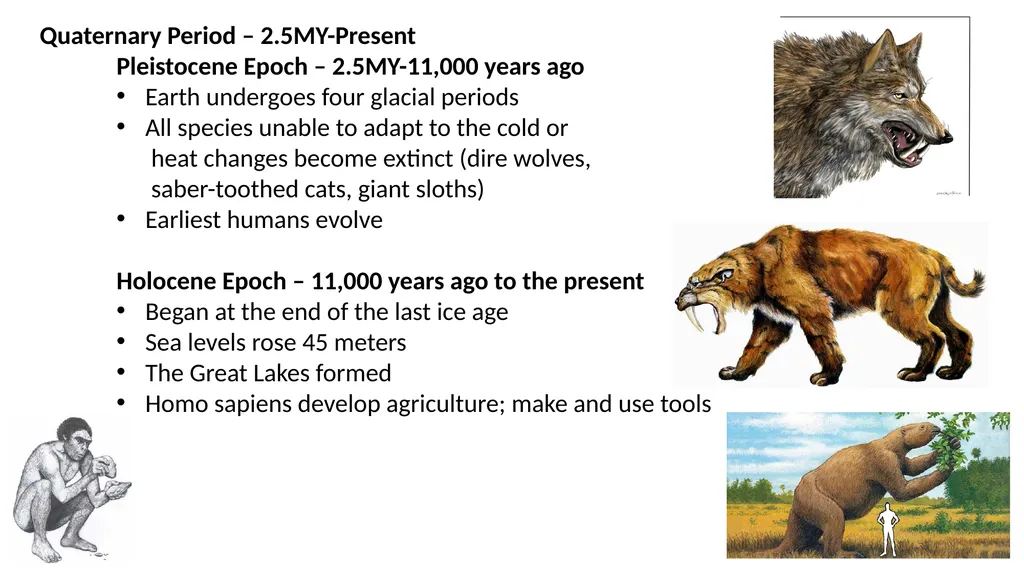
Earth undergoes four glacial periods
All species unable to adapt to the cold or
heat changes become extinct (dire wolves,
saber-toothed cats, giant sloths)
Earliest humans evolve
Holocene Epoch – 11,000 years ago to the present
Began at the end of the last ice age
Sea levels rose 45 meters
The Great Lakes formed
Homo sapiens develop agriculture; make and use tools<br>