The four humours Shakespeare in context Elizabethans believed that health and temperament were connected to four fluids that were contained within the human body. These fluids were known as humours and consisted of yellow bile (choler),
"The four humours Shakespeare in context" is the property of its rightful owner. Permission is granted to
download and print the materials on this website for personal, non-commercial use only, and to display it
on your personal computer provided you do not modify the materials and that you retain all copyright
notices contained in the materials. By downloading content from our website, you accept the terms of this
agreement.
Presentation Transcript
01
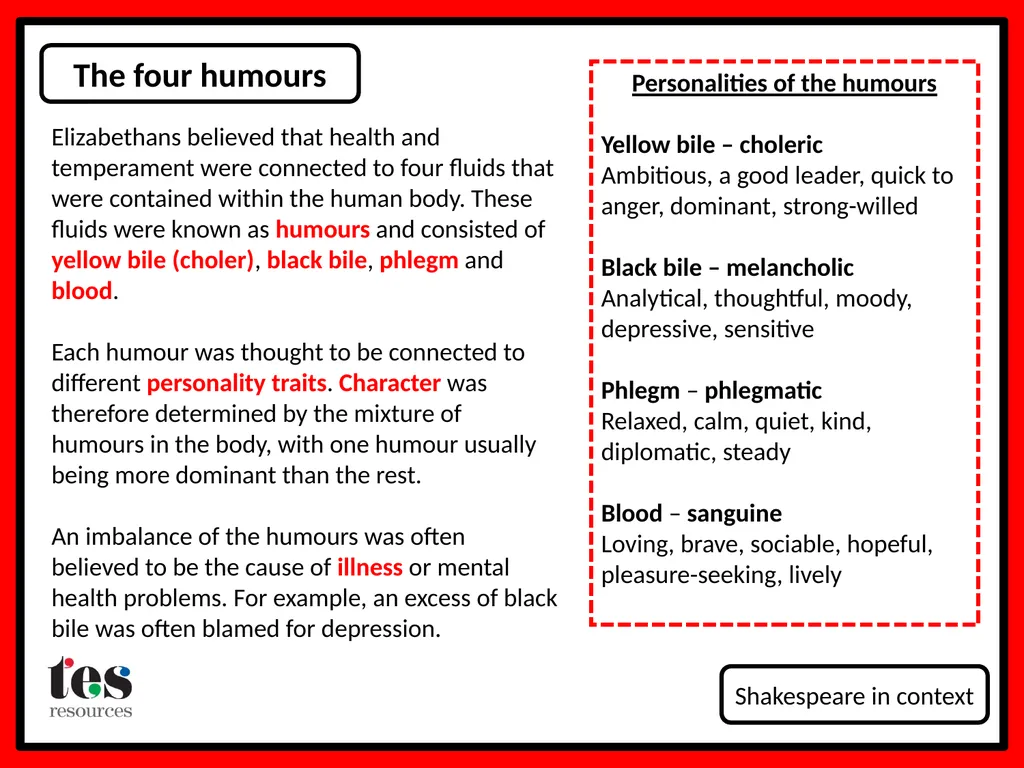
The four humours Shakespeare in context Elizabethans believed that health and temperament were connected to four fluids that were contained within the human body. These fluids were known as humours and consisted of yellow bile (choler), black bile, phlegm and blood.
Each humour was thought to be connected to different personality traits. Character was therefore determined by the mixture of humours in the body, with one humour usually being more dominant than the rest.
An imbalance of the humours was often believed to be the cause of illness or mental health problems. For example, an excess of black bile was often blamed for depression. Personalities of the humours
Yellow bile – choleric
Ambitious, a good leader, quick to anger, dominant, strong-willed
Black bile – melancholic
Analytical, thoughtful, moody, depressive, sensitive
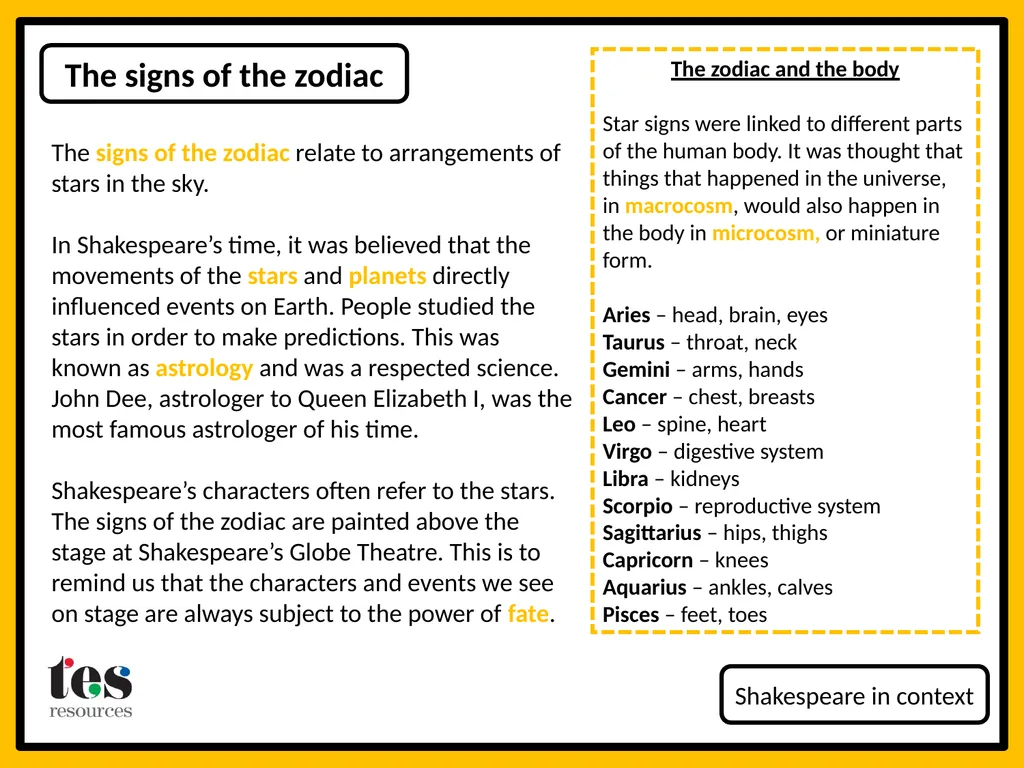
The signs of the zodiac Shakespeare in context The signs of the zodiac relate to arrangements of stars in the sky.
In Shakespeare’s time, it was believed that the movements of the stars and planets directly influenced events on Earth. People studied the stars in order to make predictions. This was known as astrology and was a respected science. John Dee, astrologer to Queen Elizabeth I, was the most famous astrologer of his time.
Shakespeare’s characters often refer to the stars. The signs of the zodiac are painted above the stage at Shakespeare’s Globe Theatre. This is to remind us that the characters and events we see on stage are always subject to the power of fate. The zodiac and the body
Star signs were linked to different parts of the human body. It was thought that things that happened in the universe, in macrocosm, would also happen in the body in microcosm, or miniature form.
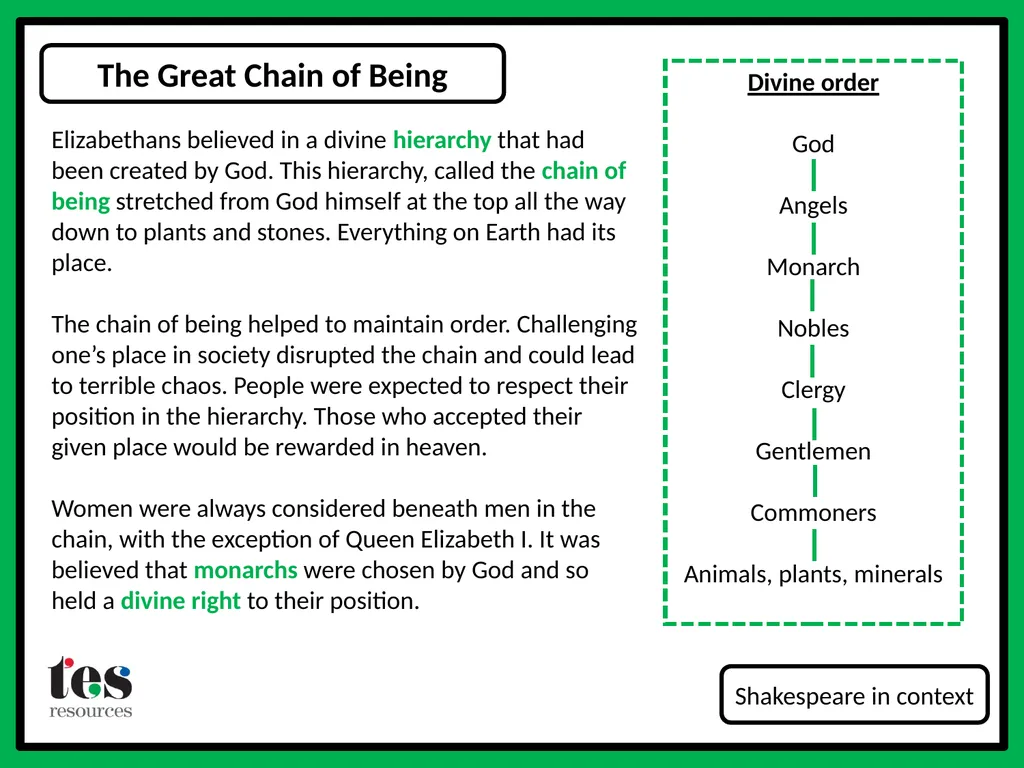
The Great Chain of Being Shakespeare in context Elizabethans believed in a divine hierarchy that had been created by God. This hierarchy, called the chain of being stretched from God himself at the top all the way down to plants and stones. Everything on Earth had its place.
The chain of being helped to maintain order. Challenging one’s place in society disrupted the chain and could lead to terrible chaos. People were expected to respect their position in the hierarchy. Those who accepted their given place would be rewarded in heaven.
Women were always considered beneath men in the chain, with the exception of Queen Elizabeth I. It was believed that monarchs were chosen by God and so held a divine right to their position. Divine order
God
Angels
Monarch
Nobles
Clergy
Gentlemen
Commoners
Animals, plants, minerals<br>
04
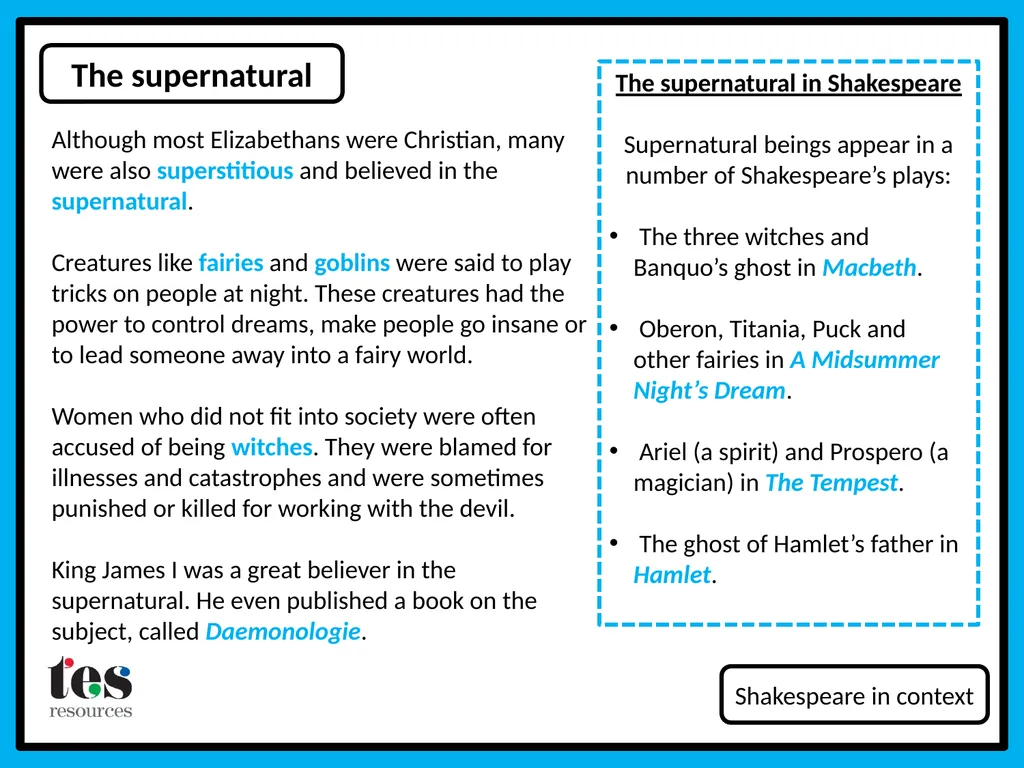
The supernatural Shakespeare in context Although most Elizabethans were Christian, many were also superstitious and believed in the supernatural.
Creatures like fairies and goblins were said to play tricks on people at night. These creatures had the power to control dreams, make people go insane or to lead someone away into a fairy world.
Women who did not fit into society were often accused of being witches. They were blamed for illnesses and catastrophes and were sometimes punished or killed for working with the devil.
King James I was a great believer in the supernatural. He even published a book on the subject, called Daemonologie. The supernatural in Shakespeare
Supernatural beings appear in a number of Shakespeare’s plays:
The three witches and Banquo’s ghost in Macbeth.
Oberon, Titania, Puck and other fairies in A Midsummer Night’s Dream.
Ariel (a spirit) and Prospero (a magician) in The Tempest.
The ghost of Hamlet’s father in Hamlet.<br>
05
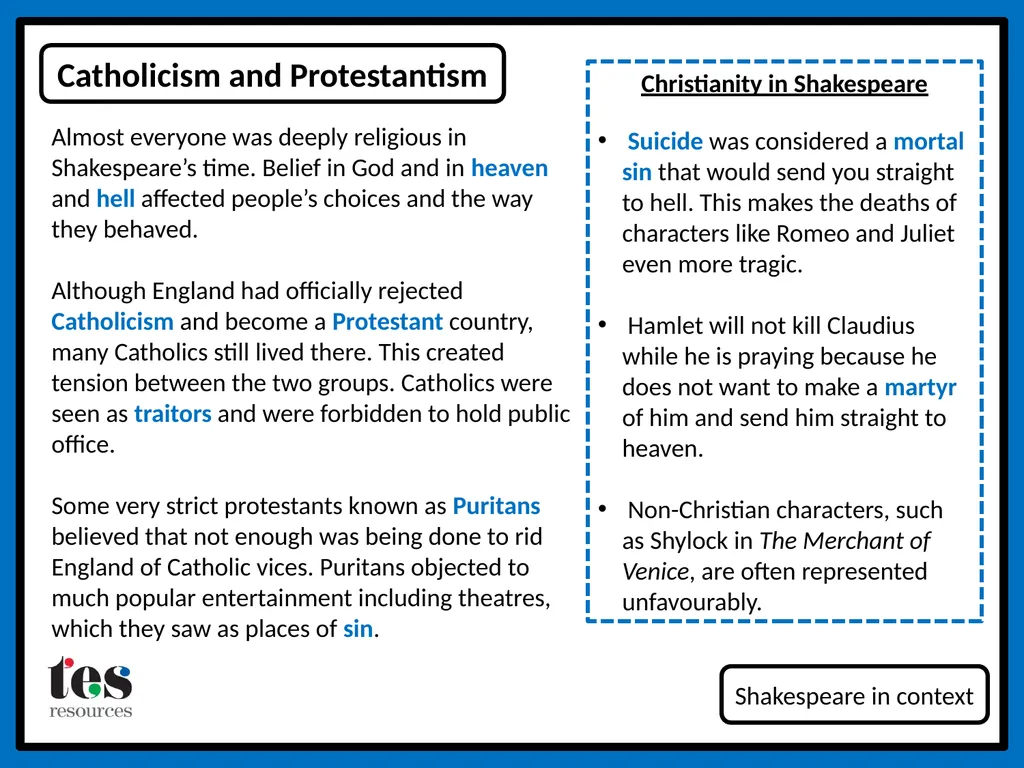
Catholicism and Protestantism Shakespeare in context Almost everyone was deeply religious in Shakespeare’s time. Belief in God and in heaven and hell affected people’s choices and the way they behaved.
Although England had officially rejected Catholicism and become a Protestant country, many Catholics still lived there. This created tension between the two groups. Catholics were seen as traitors and were forbidden to hold public office.
Some very strict protestants known as Puritans believed that not enough was being done to rid England of Catholic vices. Puritans objected to much popular entertainment including theatres, which they saw as places of sin. Christianity in Shakespeare
Suicide was considered a mortal sin that would send you straight to hell. This makes the deaths of characters like Romeo and Juliet even more tragic.
Hamlet will not kill Claudius while he is praying because he does not want to make a martyr of him and send him straight to heaven.
Non-Christian characters, such as Shylock in The Merchant of Venice, are often represented unfavourably.<br>
06
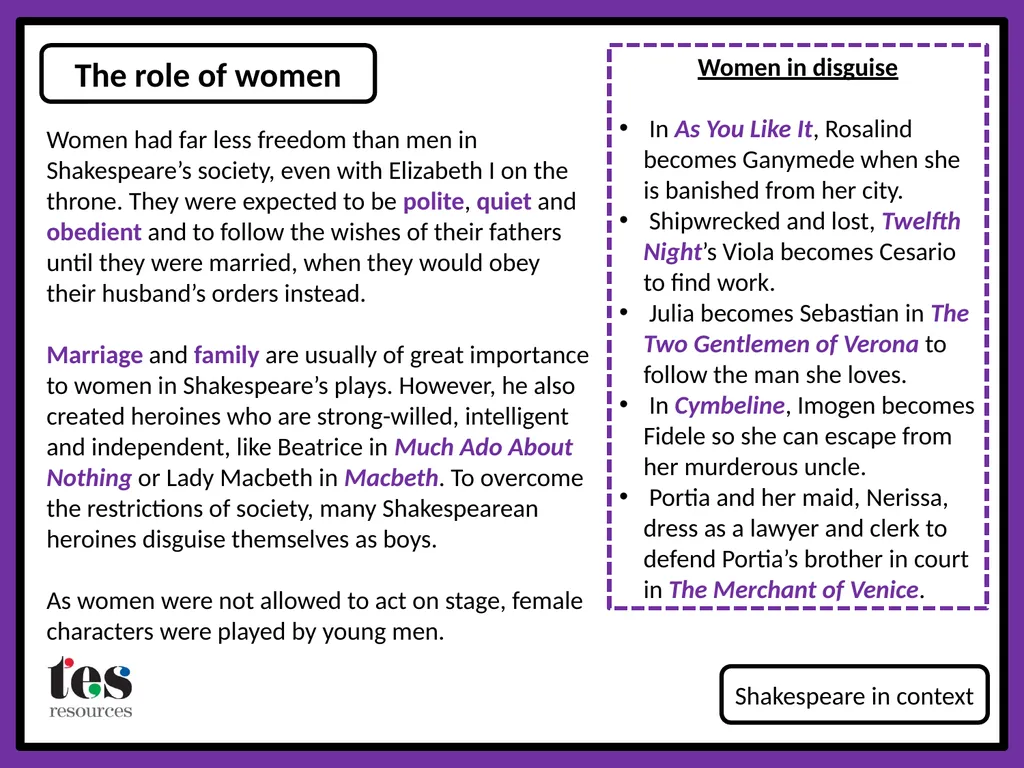
The role of women Shakespeare in context Women had far less freedom than men in Shakespeare’s society, even with Elizabeth I on the throne. They were expected to be polite, quiet and obedient and to follow the wishes of their fathers until they were married, when they would obey their husband’s orders instead.
Marriage and family are usually of great importance to women in Shakespeare’s plays. However, he also created heroines who are strong-willed, intelligent and independent, like Beatrice in Much Ado About Nothing or Lady Macbeth in Macbeth. To overcome the restrictions of society, many Shakespearean heroines disguise themselves as boys.
As women were not allowed to act on stage, female characters were played by young men. Women in disguise
In As You Like It, Rosalind becomes Ganymede when she is banished from her city.
Shipwrecked and lost, Twelfth Night’s Viola becomes Cesario to find work.
Julia becomes Sebastian in The Two Gentlemen of Verona to follow the man she loves.
In Cymbeline, Imogen becomes Fidele so she can escape from her murderous uncle.
Portia and her maid, Nerissa, dress as a lawyer and clerk to defend Portia’s brother in court in The Merchant of Venice.<br>