The impact of digital tools on students learning of geometry Anatoli Kouropatov, Regina Ovodenko Sara Hershkovitz The Center for Educational Technology (CET) Israel Kouropatov, Ovodenko Hershkovitz CADGME 2016 1 CADGME 2016 2 The story
Related Topics
Share
Embed code
Download this presentation From Below
"The impact of digital tools on students' learning" is the property of its rightful owner. Permission is granted to
download and print the materials on this website for personal, non-commercial use only, and to display it
on your personal computer provided you do not modify the materials and that you retain all copyright
notices contained in the materials. By downloading content from our website, you accept the terms of this
agreement.
Presentation Transcript
01
The impact of digital tools on students' learning of geometry Anatoli Kouropatov, Regina Ovodenko & Sara Hershkovitz
The Center for Educational Technology (CET)
Israel Kouropatov, Ovodenko & Hershkovitz CADGME 2016 1 CADGME 2016<br>
02
2 The story The Center for Educational Technology (CET) developed a one-year course devoted to the subject of studying geometry using an interactive online geometry environment.
The course includes all necessary study material according to the curriculum for the ninth grade. The course is rich with activities, demonstrations, tools and dynamic labs (Geogebra's applets), allowing exploration of ideas.
The design of the course is based on blended instruction (Horn & Staker, 2015) and includes different didactic elements like individual work, work in groups, classroom discussions, flip-lessons, etc. The teacher can track student performance.
We also used this course for teaching pre-service teachers who specialize in teaching mathematics in middle school. Kouropatov, Ovodenko & Hershkovitz CADGME 2016<br>
03
3 Kouropatov, Ovodenko & Hershkovitz CADGME 2016 Students' learning of definitions In this course, we were expecting students to
develop skills with using a certain technology
tool, while developing mental images coherent
with the mathematical concepts (Hershkowitz, R.,
1988) that we strive to teach them - in this case
"geometry definition, geometry proof, and
geometric construction."<br>
04
4 Kouropatov, Ovodenko & Hershkovitz CADGME 2016 The questions: 1. How does the process of concept definition construction occur in a student's mind?
What is the cognitive path from concept image to concept definition?
2. What are the tools students use on the path and how do they use these tools in an
interactive dynamic environment?<br>
05
5 Kouropatov, Ovodenko & Hershkovitz CADGME 2016 What do we know from research? 1. Geometrical concepts are specific ones – figurative concepts (Fischbein, 1995). 2. Students’ well-known difficulties with learning geometry can be theorized using Concept Image – Concept Definition theory (Tall, & Vinner, 1981). 3. The professional literature indicates that combined mathematics teaching technology tools help in the process of constructing an abstract knowledge of mathematics, and geometry in particular (Jones, 2002; Lagrange, J.B. et al., 2003).<br>
06
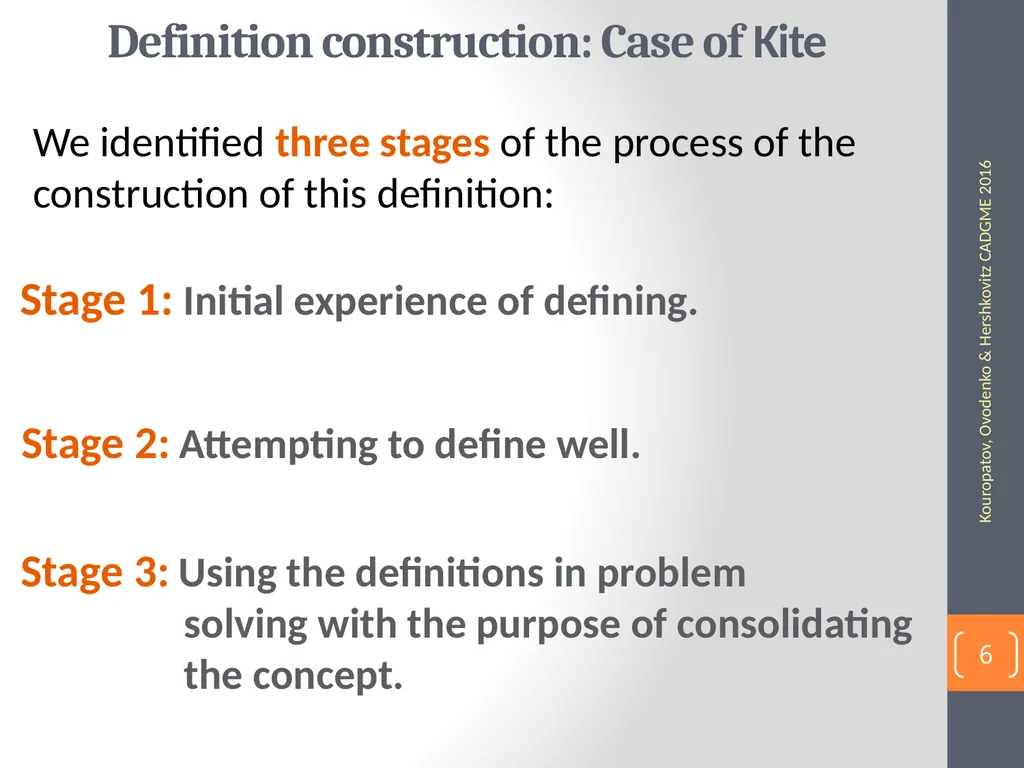
6 Kouropatov, Ovodenko & Hershkovitz CADGME 2016 Definition construction: Case of Kite Stage 3: Using the definitions in problem solving with the purpose of consolidating the concept. We identified three stages of the process of the construction of this definition: Stage 1: Initial experience of defining. Stage 2: Attempting to define well.<br>
07
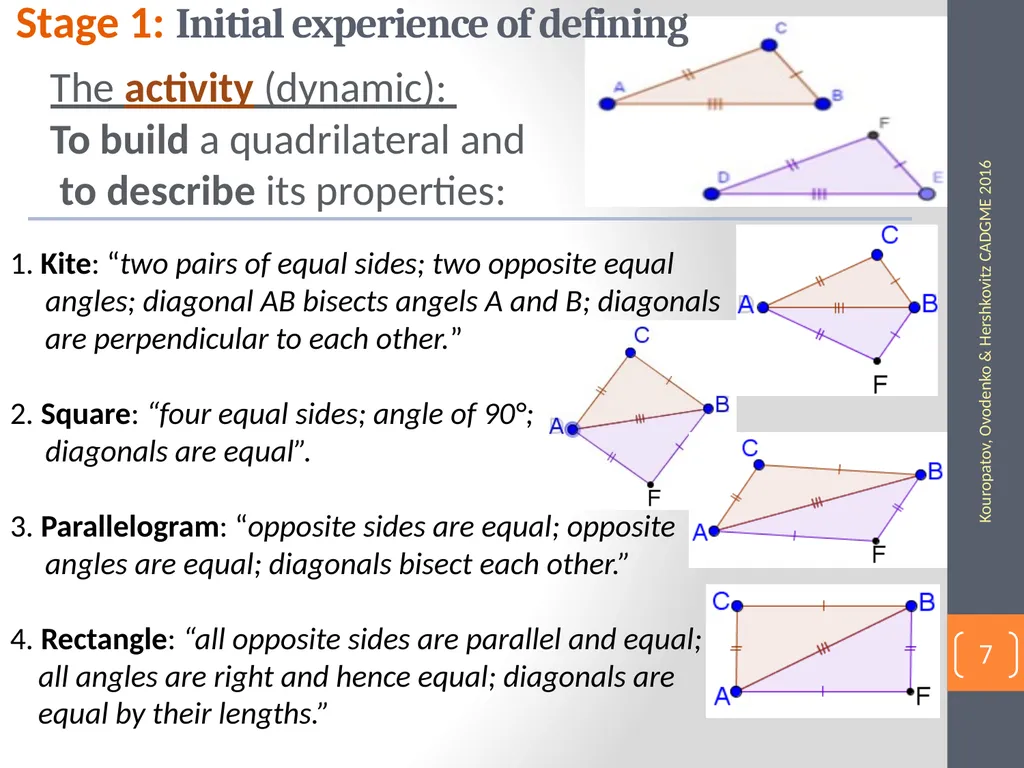
7 Kouropatov, Ovodenko & Hershkovitz CADGME 2016 The activity (dynamic):
To build a quadrilateral and
to describe its properties: Kite: “two pairs of equal sides; two opposite equal
angles; diagonal AB bisects angels A and B; diagonals are perpendicular to each other.”
2. Square: “four equal sides; angle of 90°;
diagonals are equal”.
3. Parallelogram: “opposite sides are equal; opposite angles are equal; diagonals bisect each other.”
4. Rectangle: “all opposite sides are parallel and equal;
all angles are right and hence equal; diagonals are equal by their lengths.” Stage 1: Initial experience of defining<br>
08
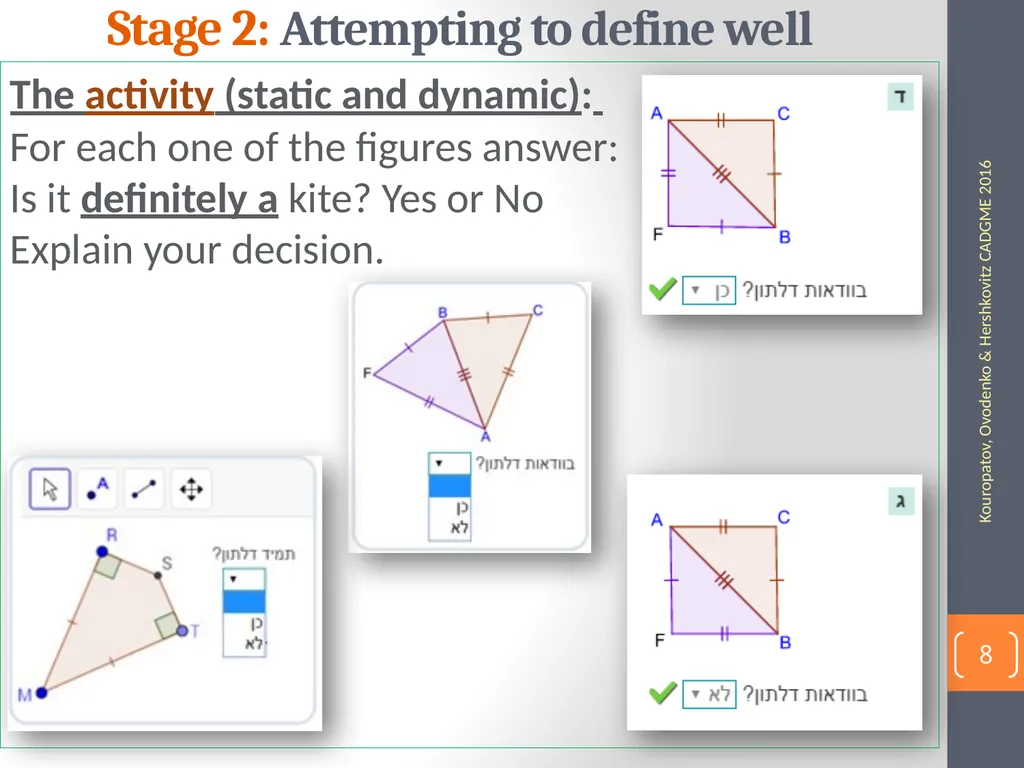
8 Kouropatov, Ovodenko & Hershkovitz CADGME 2016 Stage 2: Attempting to define well The activity (static and dynamic):
For each one of the figures answer:
Is it definitely a kite? Yes or No
Explain your decision.<br>
09
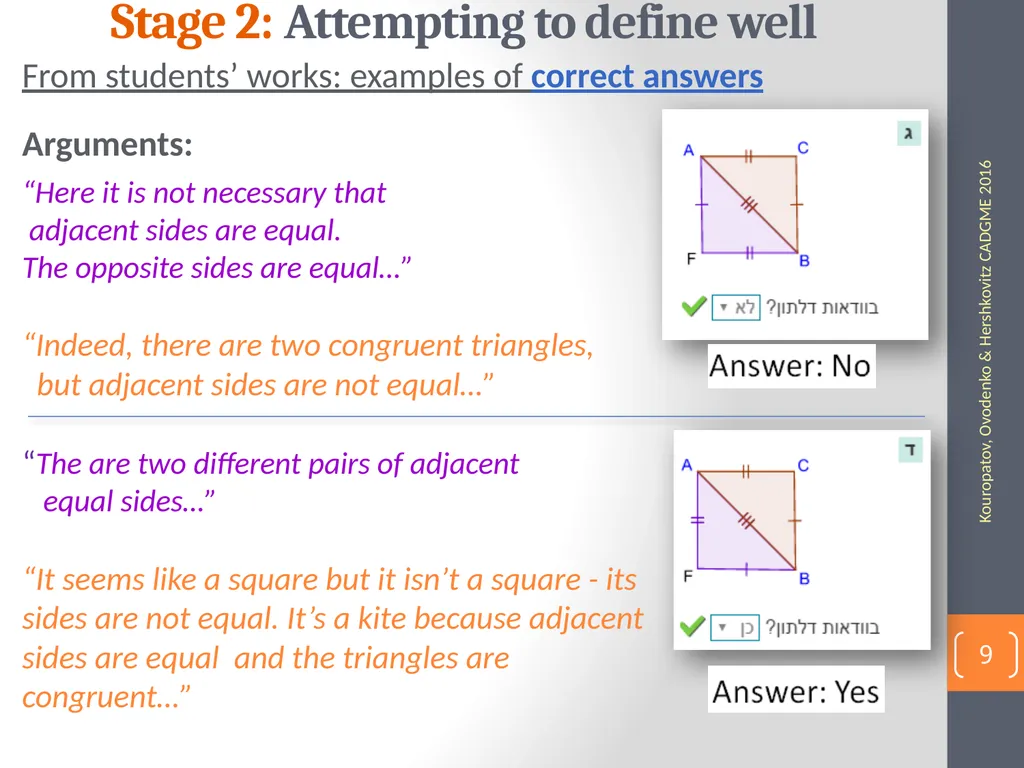
9 Kouropatov, Ovodenko & Hershkovitz CADGME 2016 From students’ works: examples of correct answers
Arguments:
“Here it is not necessary that adjacent sides are equal. The opposite sides are equal…”
“Indeed, there are two congruent triangles, but adjacent sides are not equal…”
“The are two different pairs of adjacent equal sides…”
“It seems like a square but it isn’t a square - its
sides are not equal. It’s a kite because adjacent
sides are equal and the triangles are
congruent…” Stage 2: Attempting to define well<br>
10
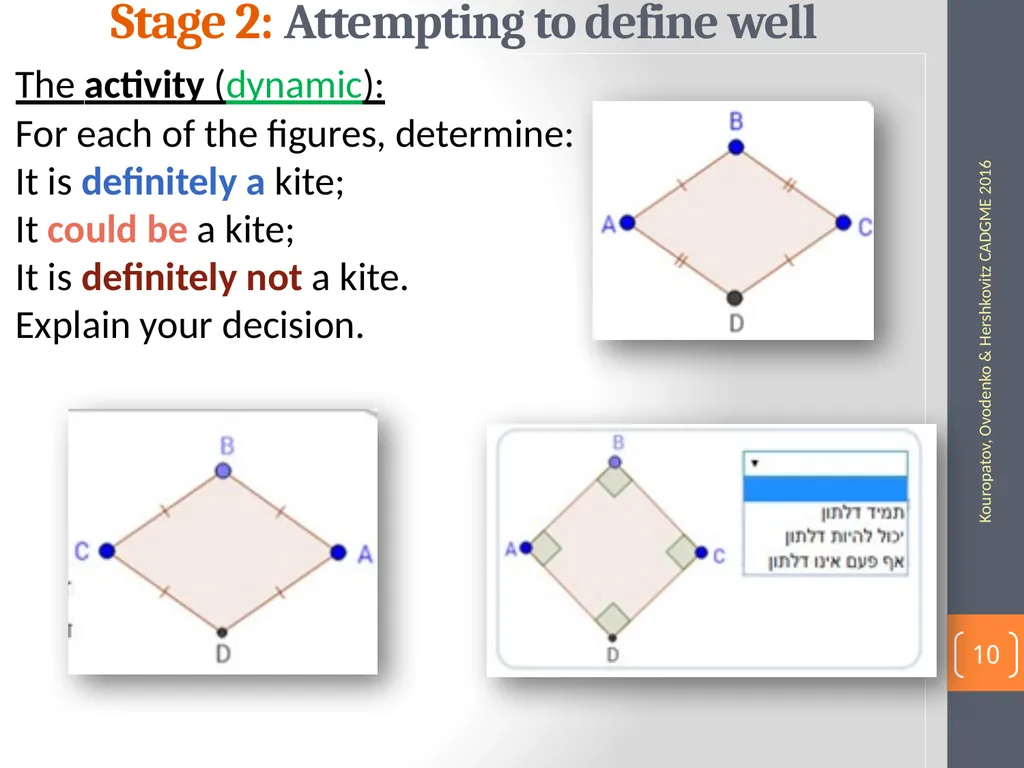
10 Kouropatov, Ovodenko & Hershkovitz CADGME 2016 The activity (dynamic):
For each of the figures, determine:
It is definitely a kite;
It could be a kite;
It is definitely not a kite.
Explain your decision. Stage 2: Attempting to define well<br>
11
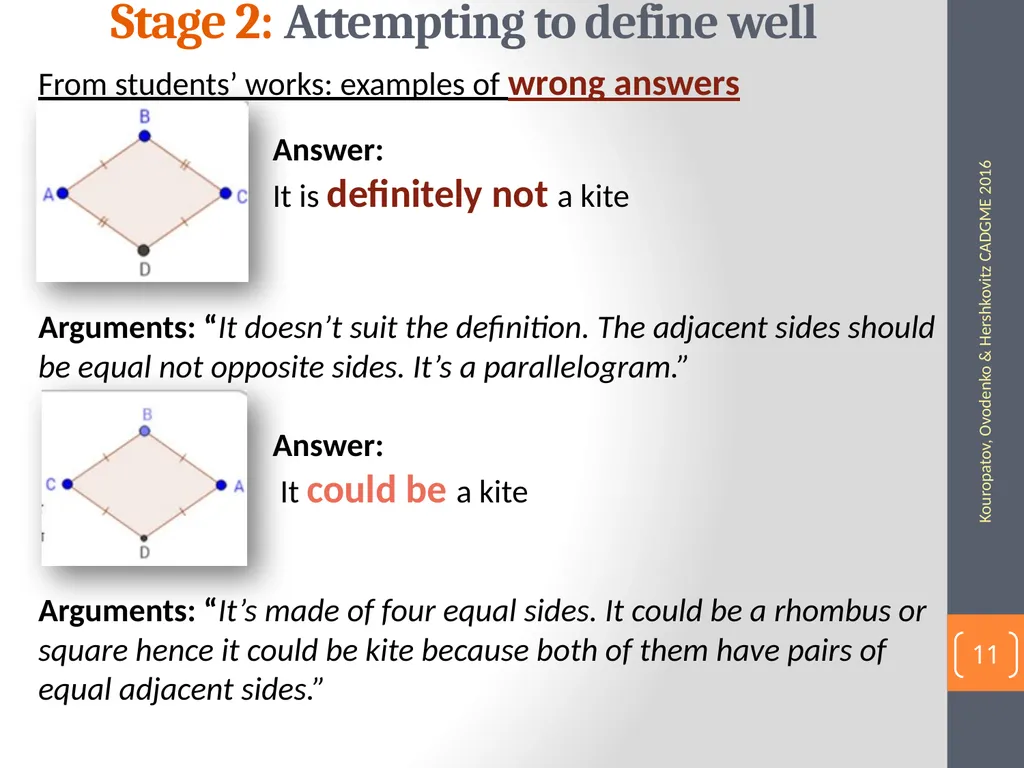
11 Kouropatov, Ovodenko & Hershkovitz CADGME 2016 From students’ works: examples of wrong answers
Answer:
It is definitely not a kite
Arguments: “It doesn’t suit the definition. The adjacent sides should be equal not opposite sides. It’s a parallelogram.”
Answer:
It could be a kite
Arguments: “It’s made of four equal sides. It could be a rhombus or square hence it could be kite because both of them have pairs of equal adjacent sides.” Stage 2: Attempting to define well<br>
12
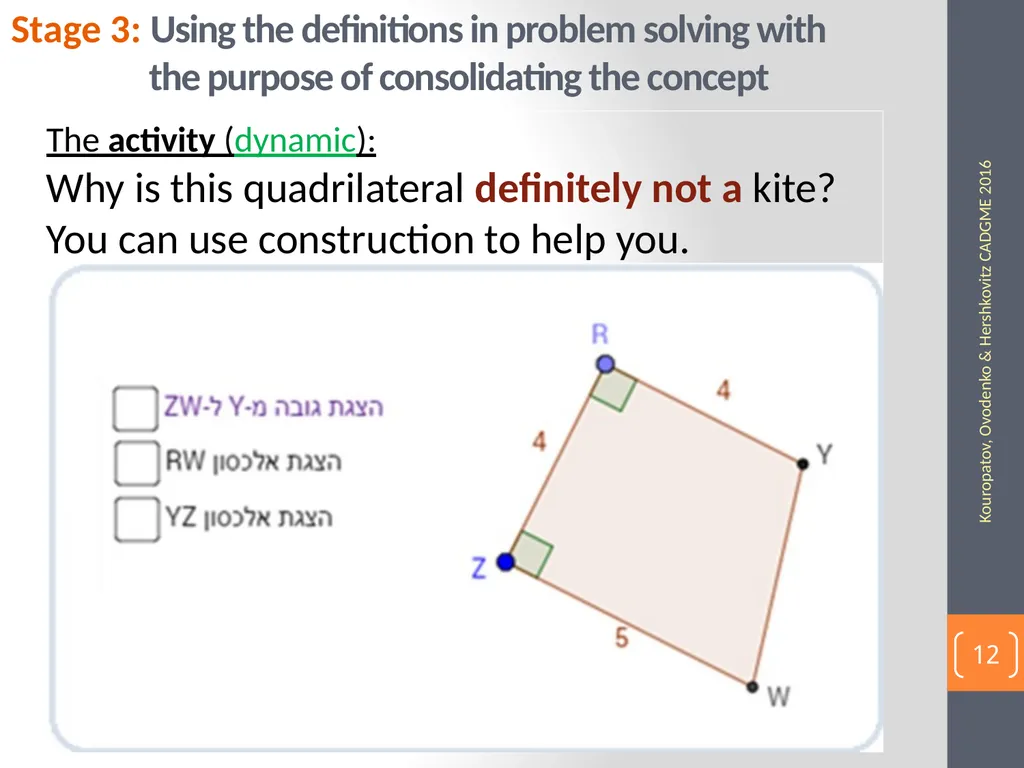
12 Kouropatov, Ovodenko & Hershkovitz CADGME 2016 Stage 3: Using the definitions in problem solving with
the purpose of consolidating the concept The activity (dynamic):
Why is this quadrilateral definitely not a kite?
You can use construction to help you.<br>
13
13 Kouropatov, Ovodenko & Hershkovitz CADGME 2016 Conclusions 1. How does the process of concept definition construction occur in a student's mind?
What is the cognitive path from concept image to concept definition?
2. What are the tools students use on the path and how do they use these tools in an
interactive dynamic environment?<br>
14
Thank you very much anatoliko@gmail.com reginao@cet.ac.il<br>