The logical problem of evil Michael Lacewing enquiriesalevelphilosophy.co.uk (c) Michael Lacewing The problem of evil If God is supremely good, then he has the desire to eliminate evil. If God is omnipotent, then he is able to eliminate
"The logical problem of evil Michael Lacewing" is the property of its rightful owner. Permission is granted to
download and print the materials on this website for personal, non-commercial use only, and to display it
on your personal computer provided you do not modify the materials and that you retain all copyright
notices contained in the materials. By downloading content from our website, you accept the terms of this
agreement.
Presentation Transcript
01
The logical problem of evil Michael Lacewing
enquiries@alevelphilosophy.co.uk (c) Michael Lacewing<br>
02
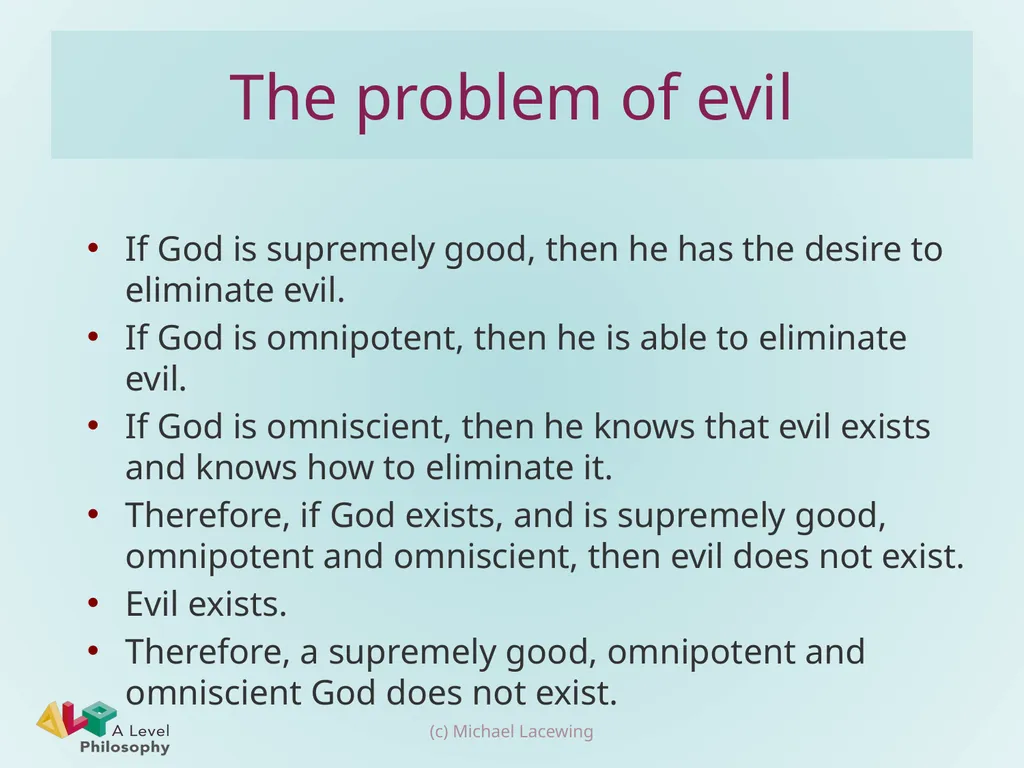
The problem of evil If God is supremely good, then he has the desire to eliminate evil.
If God is omnipotent, then he is able to eliminate evil.
If God is omniscient, then he knows that evil exists and knows how to eliminate it.
Therefore, if God exists, and is supremely good, omnipotent and omniscient, then evil does not exist.
Evil exists.
Therefore, a supremely good, omnipotent and omniscient God does not exist. (c) Michael Lacewing<br>
03
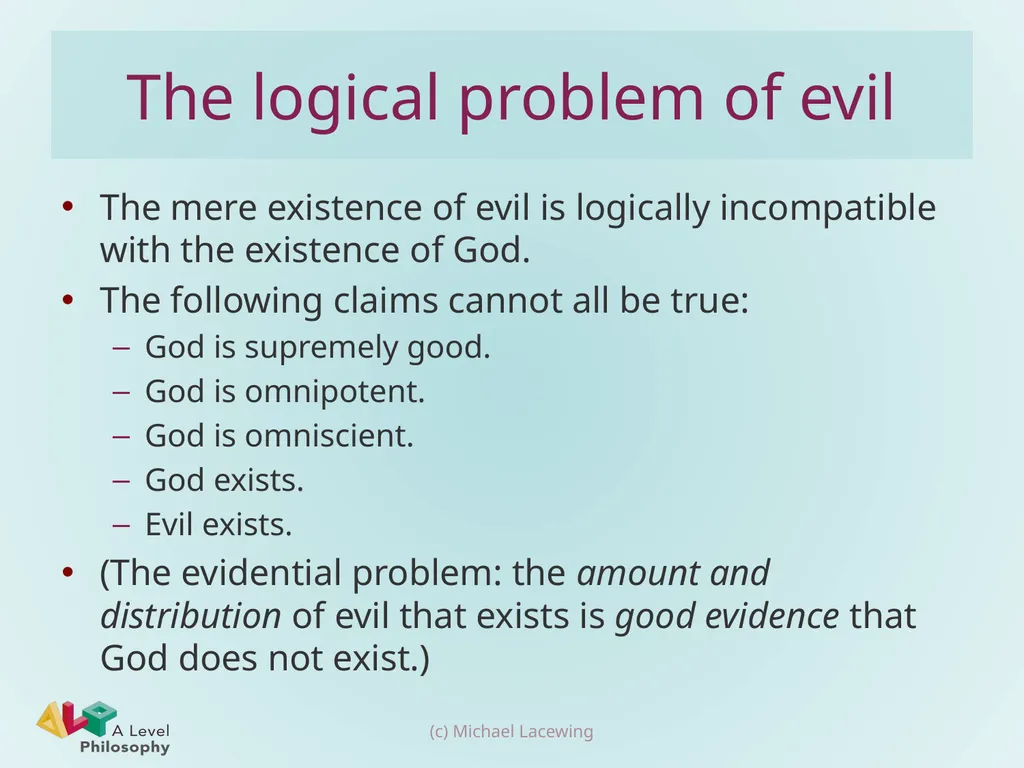
The logical problem of evil The mere existence of evil is logically incompatible with the existence of God.
The following claims cannot all be true:
God is supremely good.
God is omnipotent.
God is omniscient.
God exists.
Evil exists.
(The evidential problem: the amount and distribution of evil that exists is good evidence that God does not exist.) (c) Michael Lacewing<br>
04
Two types of evil Moral evil: evil caused by moral agents through choice
Natural evil: pain and suffering caused by natural processes, e.g. earthquakes, predation etc.
Some responses to the problem of evil may deal with one type of evil, but not the other. (c) Michael Lacewing<br>
05
A free will theodicy Free will is very valuable
Without it, we could have no meaningful relationship with God
Without it, we could not have morally significant lives
We sometimes freely choose to do evil
A world without evil would be a world without free will
Therefore, evil is compatible with the existence of an omnipotent, omniscient, supremely good God (c) Michael Lacewing<br>
06
Objection Why doesn’t God make us choose the good?
Because this is logically impossible – to be free, our choices can’t be determined (c) Michael Lacewing<br>
07
Theodicy v. defence To try to answer the question ‘Why does God allow evil?’, to give a reason, is to offer a theodicy
To try to show only that God’s existence is logically compatible with evil is to offer a defence
This doesn’t require that we discover the true explanation for why evil exists – perhaps we can’t know (c) Michael Lacewing<br>
08
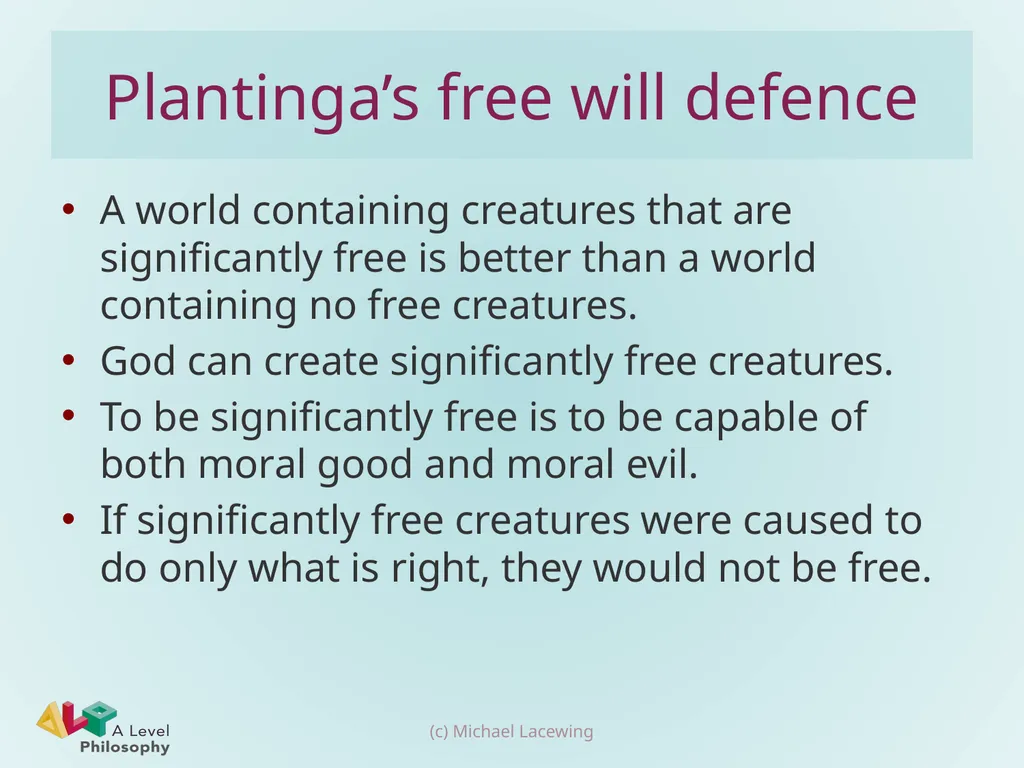
Plantinga’s free will defence A world containing creatures that are significantly free is better than a world containing no free creatures.
God can create significantly free creatures.
To be significantly free is to be capable of both moral good and moral evil.
If significantly free creatures were caused to do only what is right, they would not be free. (c) Michael Lacewing<br>
09
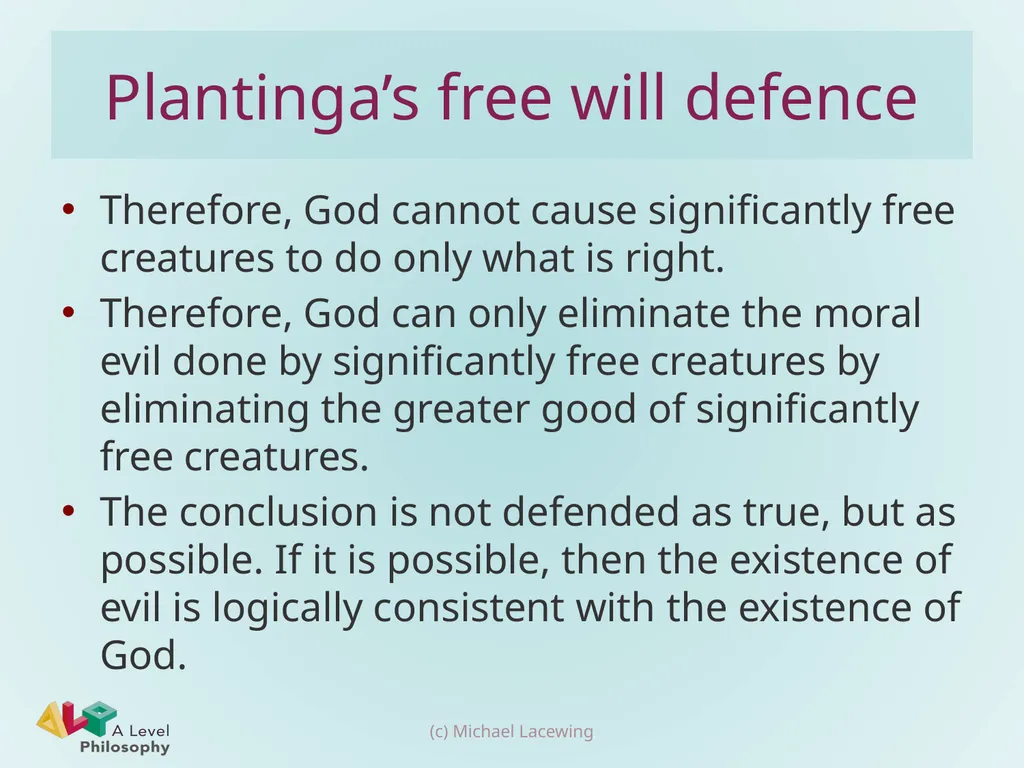
Plantinga’s free will defence Therefore, God cannot cause significantly free creatures to do only what is right.
Therefore, God can only eliminate the moral evil done by significantly free creatures by eliminating the greater good of significantly free creatures.
The conclusion is not defended as true, but as possible. If it is possible, then the existence of evil is logically consistent with the existence of God. (c) Michael Lacewing<br>
10
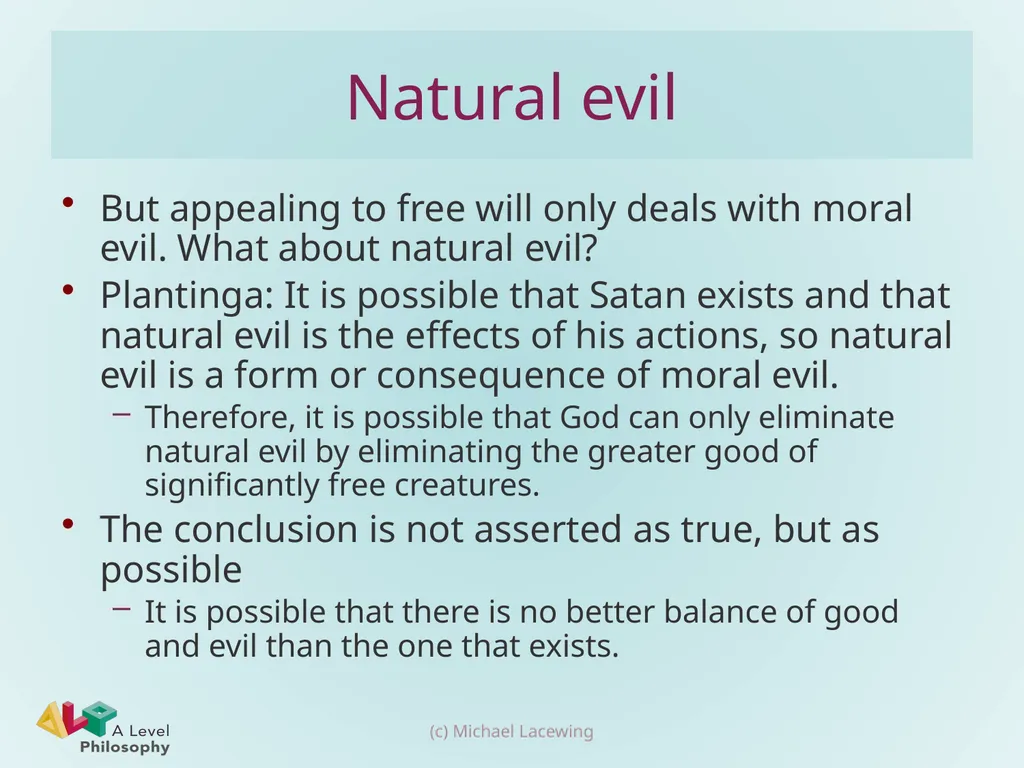
Natural evil But appealing to free will only deals with moral evil. What about natural evil?
Plantinga: It is possible that Satan exists and that natural evil is the effects of his actions, so natural evil is a form or consequence of moral evil.
Therefore, it is possible that God can only eliminate natural evil by eliminating the greater good of significantly free creatures.
The conclusion is not asserted as true, but as possible
It is possible that there is no better balance of good and evil than the one that exists. (c) Michael Lacewing<br>
11
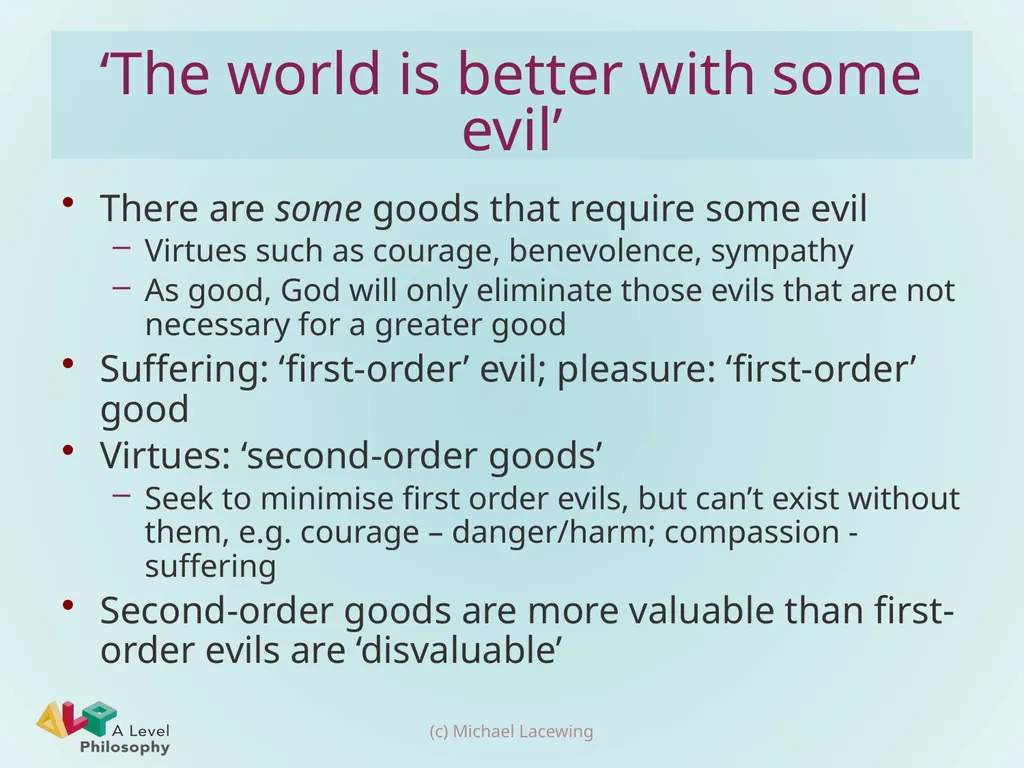
‘The world is better with some evil’ There are some goods that require some evil
Virtues such as courage, benevolence, sympathy
As good, God will only eliminate those evils that are not necessary for a greater good
Suffering: ‘first-order’ evil; pleasure: ‘first-order’ good
Virtues: ‘second-order goods’
Seek to minimise first order evils, but can’t exist without them, e.g. courage – danger/harm; compassion - suffering
Second-order goods are more valuable than first-order evils are ‘disvaluable’ (c) Michael Lacewing<br>
12
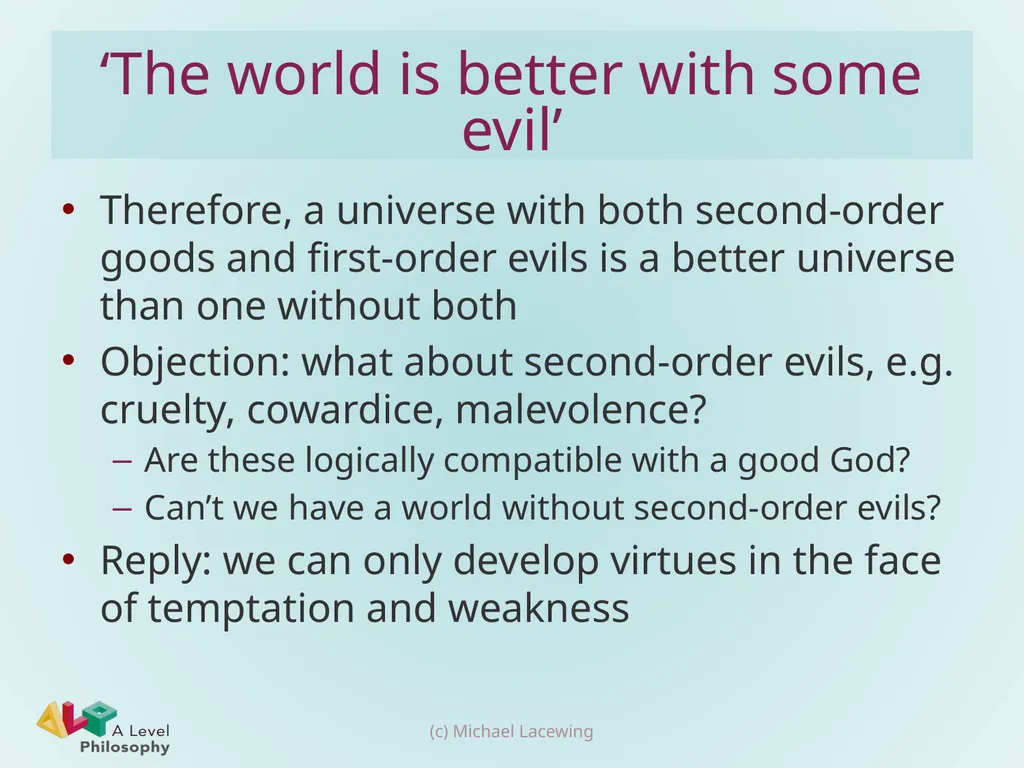
‘The world is better with some evil’ Therefore, a universe with both second-order goods and first-order evils is a better universe than one without both
Objection: what about second-order evils, e.g. cruelty, cowardice, malevolence?
Are these logically compatible with a good God?
Can’t we have a world without second-order evils?
Reply: we can only develop virtues in the face of temptation and weakness (c) Michael Lacewing<br>