The Mind-Brain Type Identity Theory Michael

Published  . 0 views
↓ Download
The Mind-Brain Type Identity Theory Michael
1 / 1
The Mind-Brain Type Identity Theory Michael - slide 1 of 8 The Mind-Brain Type Identity Theory Michael - slide 2 of 8 The Mind-Brain Type Identity Theory Michael - slide 3 of 8 The Mind-Brain Type Identity Theory Michael - slide 4 of 8 The Mind-Brain Type Identity Theory Michael - slide 5 of 8 The Mind-Brain Type Identity Theory Michael - slide 6 of 8 The Mind-Brain Type Identity Theory Michael - slide 7 of 8 The Mind-Brain Type Identity Theory Michael - slide 8 of 8
Description: The Mind-Brain Type Identity Theory Michael Lacewing enquiriesalevelphilosophy.co.uk Michael Lacewing Dualism and materialism Cartesian dualism: there are two sorts of substance, mind (or soul) and matter Minds can exist independent of

Related Topics

Download Presentation

"The Mind-Brain Type Identity Theory Michael" is the property of its rightful owner. Permission is granted to download and print the materials on this website for personal, non-commercial use only, and to display it on your personal computer provided you do not modify the materials and that you retain all copyright notices contained in the materials. By downloading content from our website, you accept the terms of this agreement.

Presentation Transcript

slide1. The Mind-Brain Type Identity Theory Michael Lacewing
enquiries@alevelphilosophy.co.uk © Michael Lacewing<br>
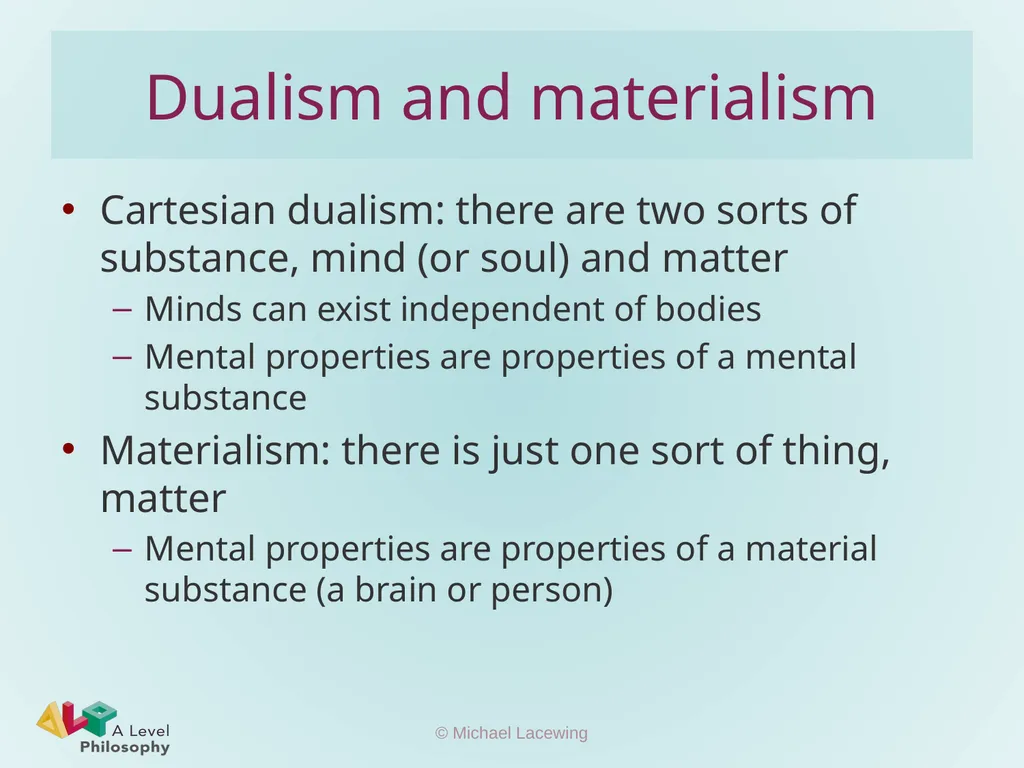
slide2. Dualism and materialism Cartesian dualism: there are two sorts of substance, mind (or soul) and matter
Minds can exist independent of bodies
Mental properties are properties of a mental substance
Materialism: there is just one sort of thing, matter
Mental properties are properties of a material substance (a brain or person) © Michael Lacewing<br>
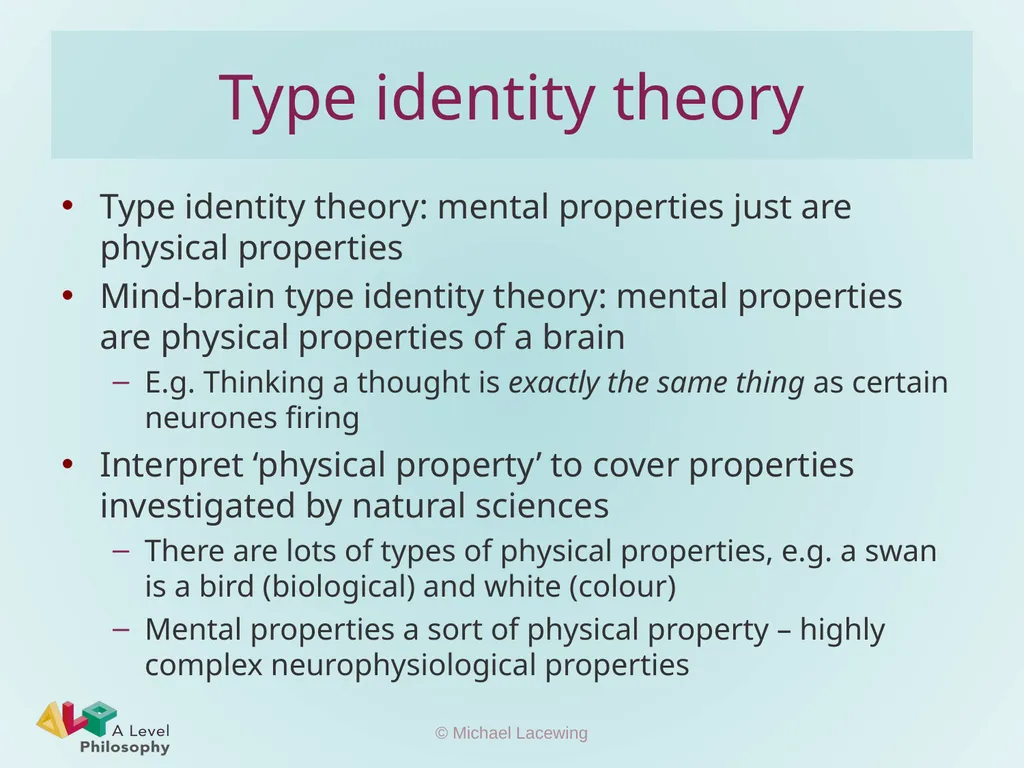
slide3. Type identity theory Type identity theory: mental properties just are physical properties
Mind-brain type identity theory: mental properties are physical properties of a brain
E.g. Thinking a thought is exactly the same thing as certain neurones firing
Interpret ‘physical property’ to cover properties investigated by natural sciences
There are lots of types of physical properties, e.g. a swan is a bird (biological) and white (colour)
Mental properties a sort of physical property – highly complex neurophysiological properties © Michael Lacewing<br>
slide4. Type identity theory ‘Type’ identity
Mental types of thing are actually physical types of thing
They don’t seem the same because we have different ways of knowing about them
Science throws up some surprising claims © Michael Lacewing<br>
slide5. Identity v. correlation Identity is not correlation
Hearts and kidneys; size and shape
Neuroscience can only establish correlations
This is not enough to support identity theory
Philosophy: Appeal to Ockham’s razor: don’t multiply entities beyond necessity
The identity claim is not analytic or conceptual
The claim is not that ‘pain’ means ‘the firing of nociceptors’
But that two distinct concepts pick out just one property (like water and H2O) © Michael Lacewing<br>
slide6. Reduction Ontological reduction: the things in one domain (e.g. mental things) are identical with some of the things in another domain.
Heat is mean molecular kinetic energy
There is nothing more to a mental property than being a particular physical property © Michael Lacewing<br>
slide7. Multiple realizability Putnam: Mental properties are not identical to physical properties because the same mental property can be ‘realized by’ different physical properties
‘Realise’: ‘to give actual form to’, ‘to make real’
e.g. the brain states that relate to pain are different in different species, but pain is the same mental state.
Suppose pain = N1 in humans, but pain = N2 in dogs. Since pain = pain, then N2 = N1. If N2 ≠ N1, then the dog is not in pain!
The dog is in pain. So either N1 or N2 can realise pain, but because N2 ≠ N1, neither N2 = pain nor N1 = pain © Michael Lacewing<br>
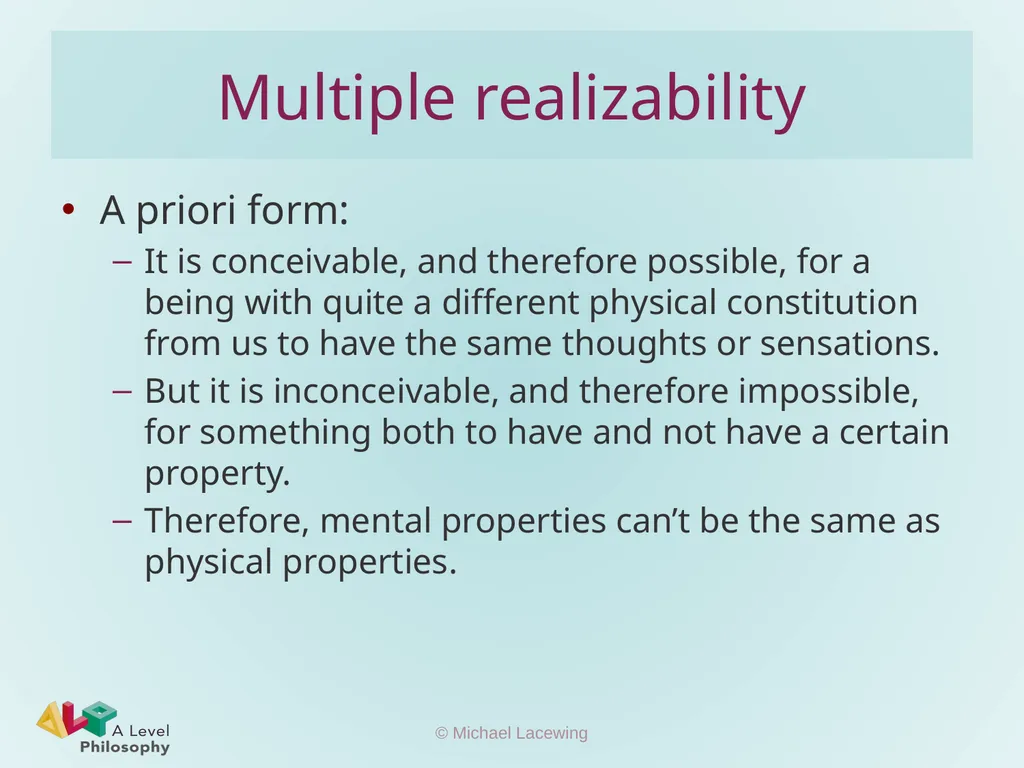
slide8. Multiple realizability A priori form:
It is conceivable, and therefore possible, for a being with quite a different physical constitution from us to have the same thoughts or sensations.
But it is inconceivable, and therefore impossible, for something both to have and not have a certain property.
Therefore, mental properties can’t be the same as physical properties. © Michael Lacewing<br>