The Problem of Evil The Logical Problem Epicurus Greek philosopher who founded the Epicurean School of philosophy in Athens. Epicurus formulation of the Problem of Evil is probably the oldest. If a perfectly good god exists, then there is
"The Problem of Evil The Logical Problem Epicurus" is the property of its rightful owner. Permission is granted to
download and print the materials on this website for personal, non-commercial use only, and to display it
on your personal computer provided you do not modify the materials and that you retain all copyright
notices contained in the materials. By downloading content from our website, you accept the terms of this
agreement.
Presentation Transcript
01
The Problem of Evil The Logical Problem<br>
02
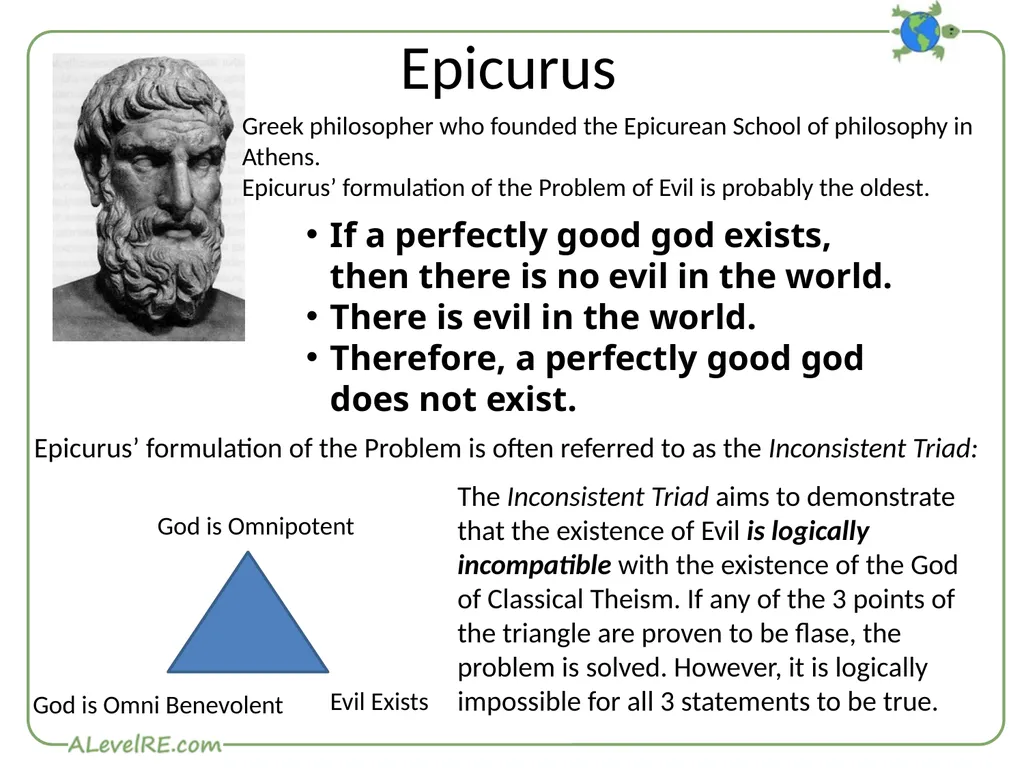
Epicurus Greek philosopher who founded the Epicurean School of philosophy in Athens.
Epicurus’ formulation of the Problem of Evil is probably the oldest. If a perfectly good god exists, then there is no evil in the world.
There is evil in the world.
Therefore, a perfectly good god does not exist. Epicurus’ formulation of the Problem is often referred to as the Inconsistent Triad: God is Omnipotent God is Omni Benevolent Evil Exists The Inconsistent Triad aims to demonstrate that the existence of Evil is logically incompatible with the existence of the God of Classical Theism. If any of the 3 points of the triangle are proven to be flase, the problem is solved. However, it is logically impossible for all 3 statements to be true.<br>
03
Task 1 Explain why the 3 statements of Epicurus’ Triad are logically inconsistent.
Make sure you have said what “logically inconsistent” means.<br>
04
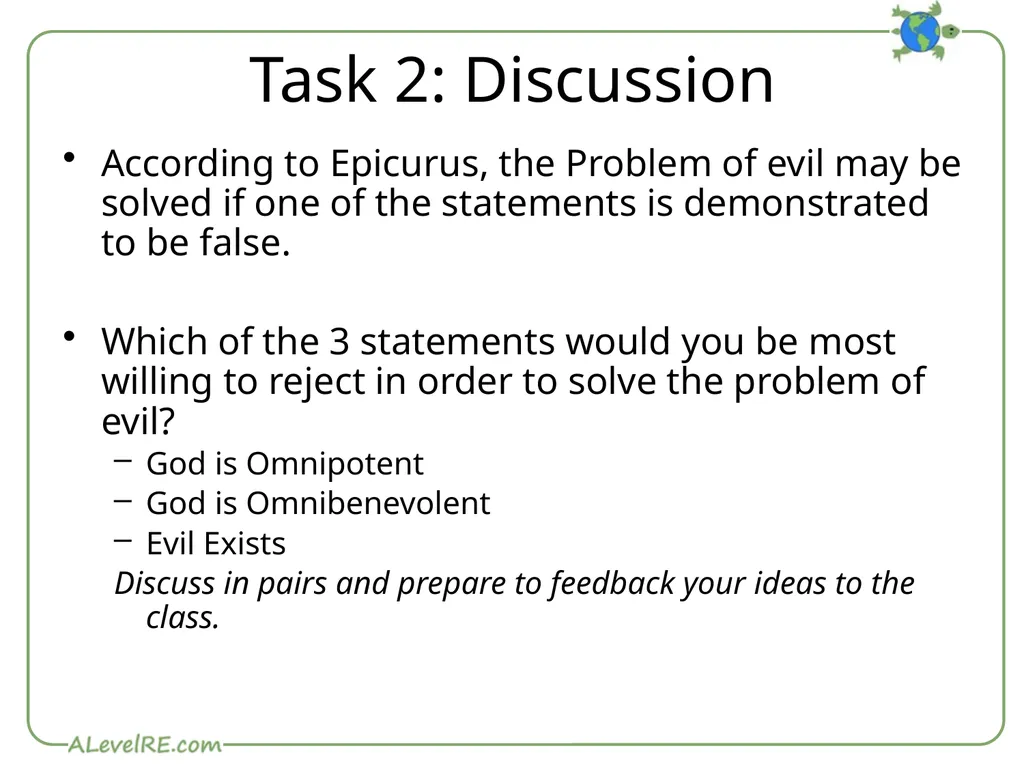
Task 2: Discussion According to Epicurus, the Problem of evil may be solved if one of the statements is demonstrated to be false.
Which of the 3 statements would you be most willing to reject in order to solve the problem of evil?
God is Omnipotent
God is Omnibenevolent
Evil Exists
Discuss in pairs and prepare to feedback your ideas to the class.<br>
05
Rejecting the statements? “God is omnipotent”
Is a God that is not omnipotent worthy of worship? Is such a god rightly referred to as “God”? If God is not omnipotent, does this imply there could be a being greater than God? (what might St Anselm have to say about this?)
Surely, an omniscient creator god would be capable of preventing evils.<br>
06
Rejecting the statements? “God is omni benevolent”
Is a God who is not loving worthy of worship? Is a sadistic God in keeping with the Judeo-Christian view of God?
Surely if God loves humans and created them for the purpose of entering into a relationship with him, he would not let them suffer<br>
07
Rejecting the statements? “Evil exists”
Is evil a thing? If evil is relative then we can argue that “evil” does not exist, as what is evil to one person, may not be evil to another.
However, suffering certainly does exist.<br>
08
The Significance of the Problem The logical problem of evil has posed a serious threat to classical theistic belief and has been re-formulated by numerous philosophers over the centuries, including JL Mackie and David Hume.
In trying to solve the logical problem, we are forced to re-asses our understanding of the attributes of the God of Classical Theism, or we need to examine what we mean when we say “evil exists”.<br>