
The Sea Module 1 Lessons 1-9 Why do people explore





















Description: The Sea Module 1 Lessons 1-9 Why do people explore the sea? Module 1 Focusing Question Lessons 1-9 How do artists explore the sea? Lesson 1 Content Framing Question: Distill: What is the central message of The Sea Wind? What does the word
Related Topics
Download Presentation
"The Sea Module 1 Lessons 1-9 Why do people explore" is the property of its rightful owner. Permission is granted to download and print the materials on this website for personal, non-commercial use only, and to display it on your personal computer provided you do not modify the materials and that you retain all copyright notices contained in the materials. By downloading content from our website, you accept the terms of this agreement.
Presentation Transcript
slide1. The Sea
Module 1
Lessons 1-9 Why do people explore the sea?<br>
slide2. Module 1 Focusing Question
Lessons 1-9 How do artists explore the sea?<br>
slide3. Lesson 1 Content Framing Question:
Distill: What is the central message of “The Sea Wind?”<br>
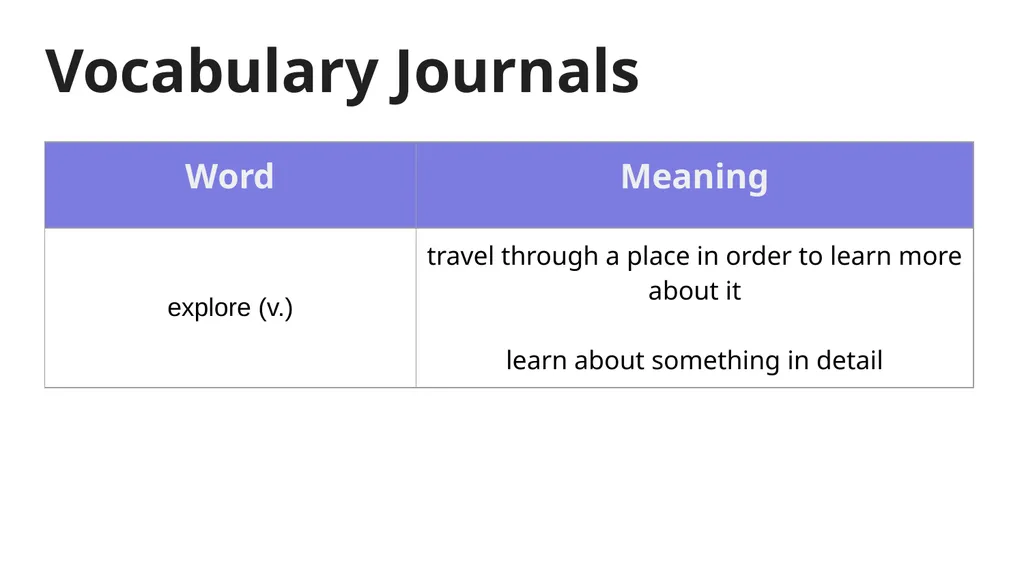
slide4. What does the word EXPLORE mean? travel through a place in order to learn more about it
learn about something in detail<br>
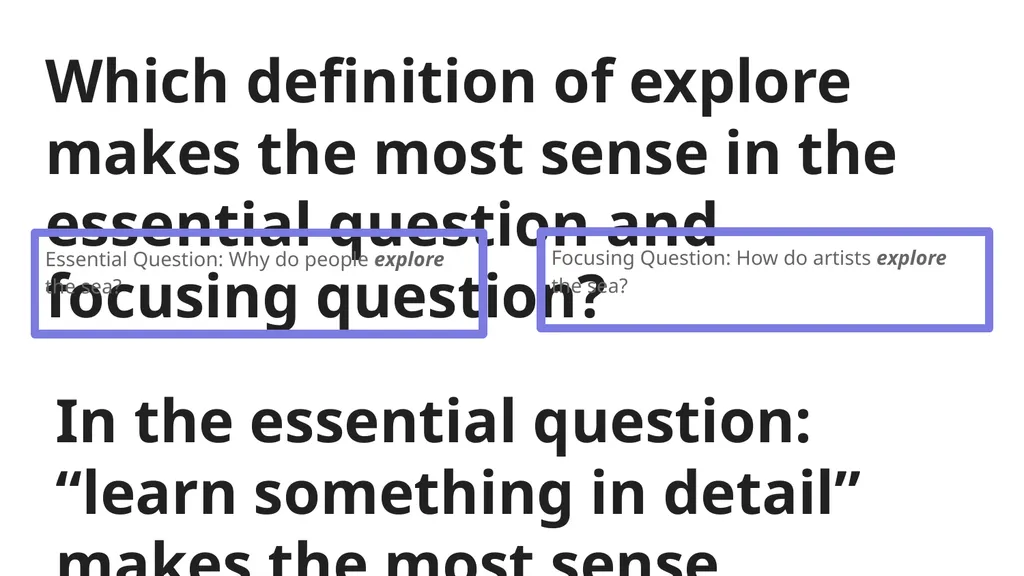
slide5. Which definition of explore makes the most sense in the essential question and focusing question? Essential Question: Why do people explore the sea? Focusing Question: How do artists explore the sea? In the essential question: “learn something in detail” makes the most sense<br>
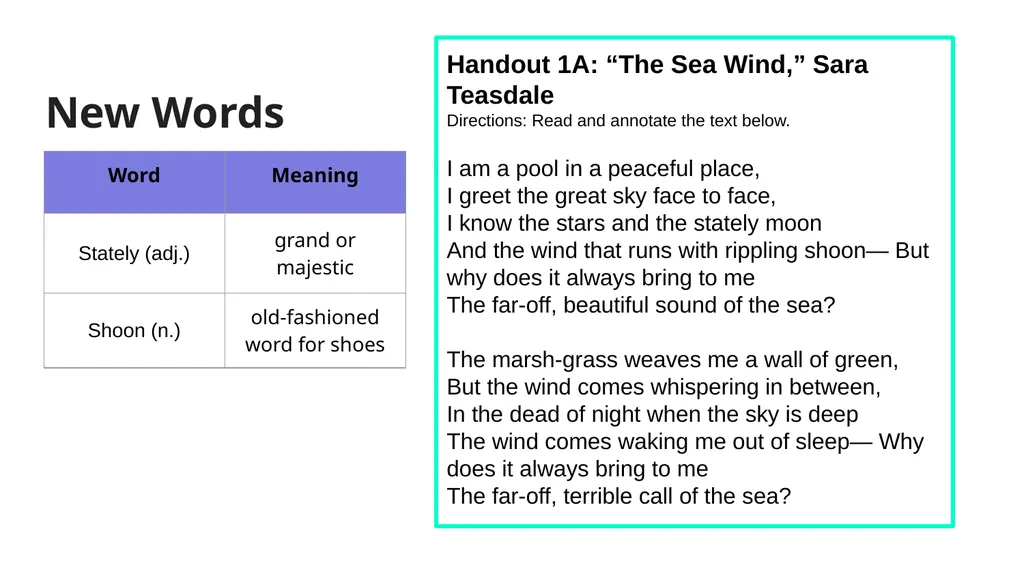
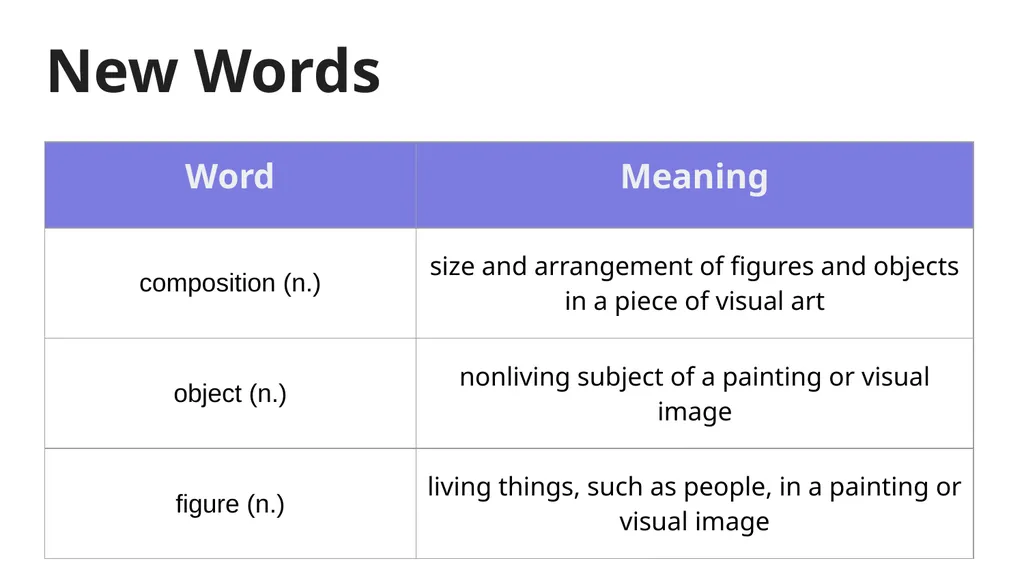
slide6. New Words Handout 1A: “The Sea Wind,” Sara Teasdale
Directions: Read and annotate the text below.
I am a pool in a peaceful place,
I greet the great sky face to face,
I know the stars and the stately moon
And the wind that runs with rippling shoon— But why does it always bring to me
The far-off, beautiful sound of the sea?
The marsh-grass weaves me a wall of green,
But the wind comes whispering in between,
In the dead of night when the sky is deep
The wind comes waking me out of sleep— Why does it always bring to me
The far-off, terrible call of the sea?<br>
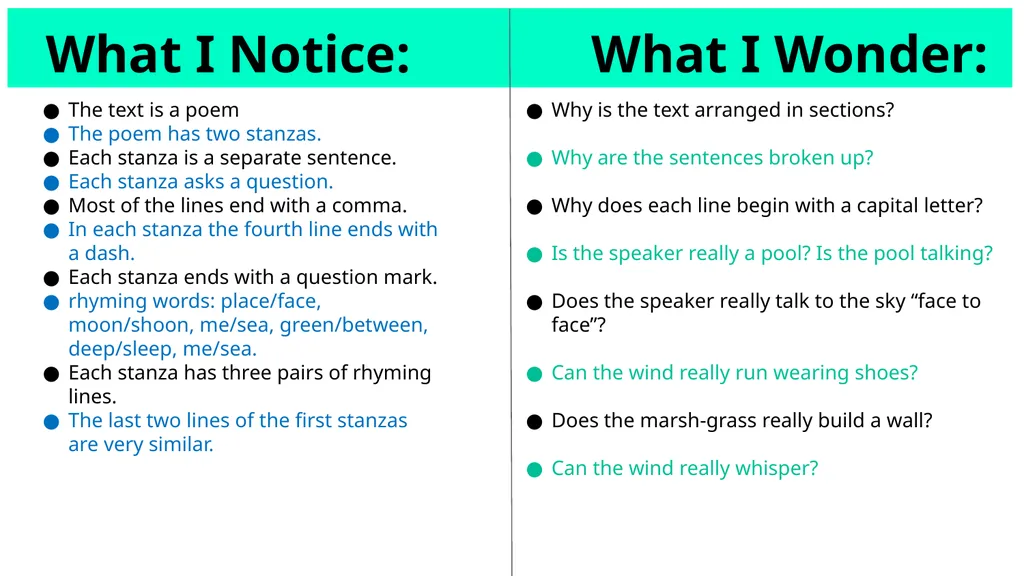
slide7. What I Notice: What I Wonder: The text is a poem
The poem has two stanzas.
Each stanza is a separate sentence.
Each stanza asks a question.
Most of the lines end with a comma.
In each stanza the fourth line ends with a dash.
Each stanza ends with a question mark.
rhyming words: place/face, moon/shoon, me/sea, green/between, deep/sleep, me/sea.
Each stanza has three pairs of rhyming lines.
The last two lines of the first stanzas are very similar. Why is the text arranged in sections?
Why are the sentences broken up?
Why does each line begin with a capital letter?
Is the speaker really a pool? Is the pool talking?
Does the speaker really talk to the sky “face to face”?
Can the wind really run wearing shoes?
Does the marsh-grass really build a wall?
Can the wind really whisper?<br>
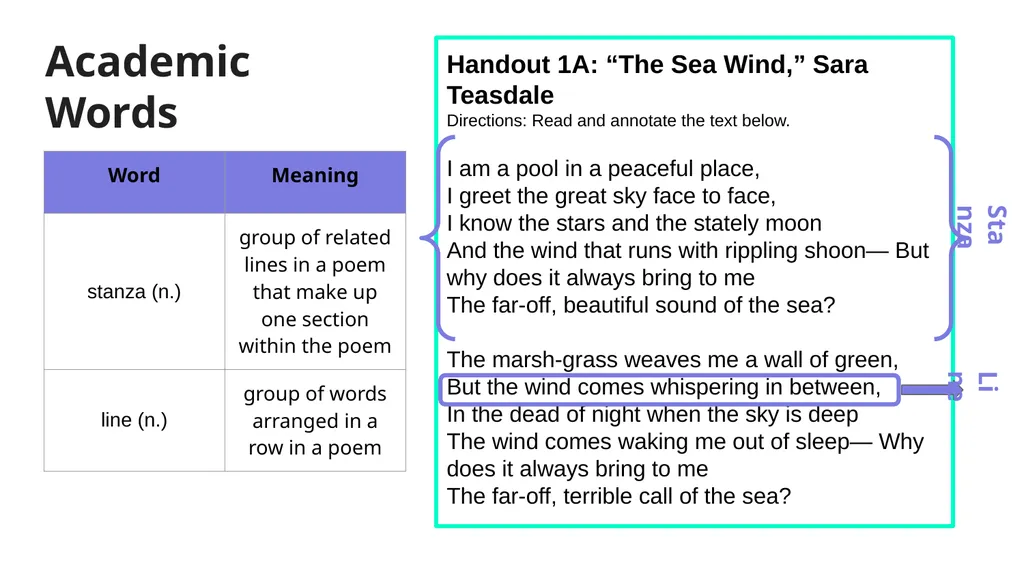
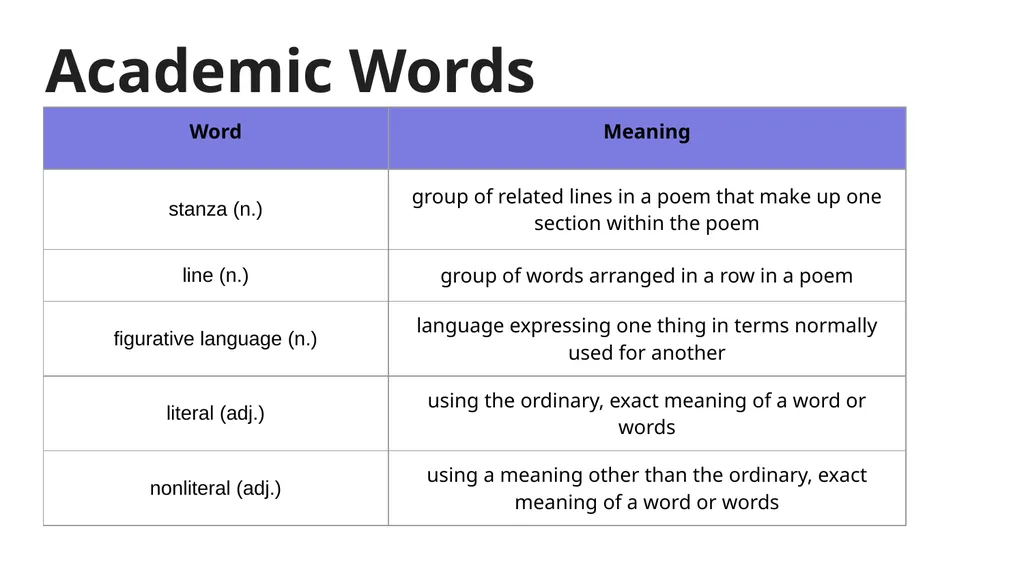
slide8. Academic Words Handout 1A: “The Sea Wind,” Sara Teasdale
Directions: Read and annotate the text below.
I am a pool in a peaceful place,
I greet the great sky face to face,
I know the stars and the stately moon
And the wind that runs with rippling shoon— But why does it always bring to me
The far-off, beautiful sound of the sea?
The marsh-grass weaves me a wall of green,
But the wind comes whispering in between,
In the dead of night when the sky is deep
The wind comes waking me out of sleep— Why does it always bring to me
The far-off, terrible call of the sea?<br>
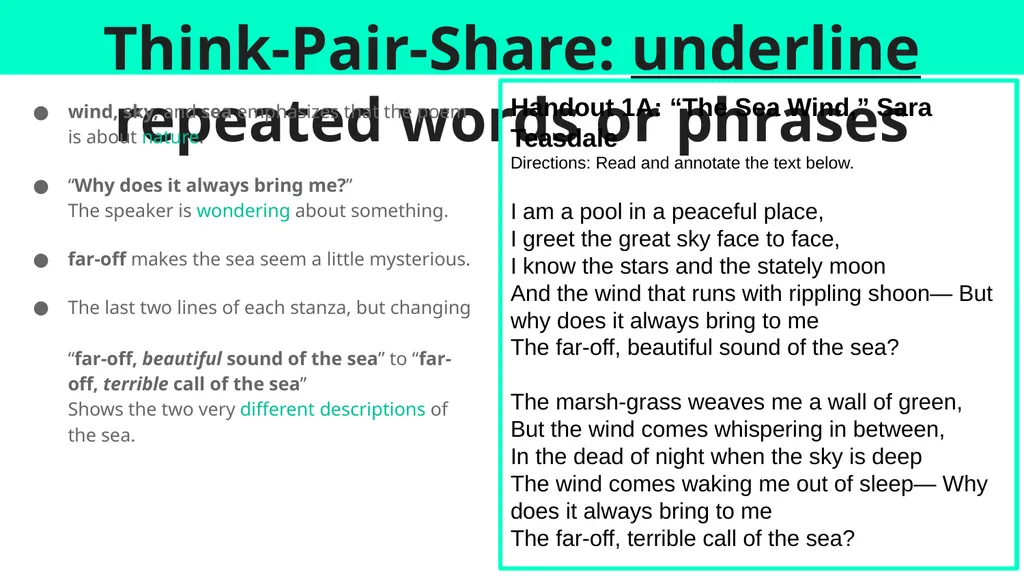
slide9. Think-Pair-Share: underline repeated words or phrases wind, sky, and sea emphasizes that the poem is about nature.
“Why does it always bring me?” The speaker is wondering about something.
far-off makes the sea seem a little mysterious.
The last two lines of each stanza, but changing “far-off, beautiful sound of the sea” to “far-off, terrible call of the sea” Shows the two very different descriptions of the sea. Handout 1A: “The Sea Wind,” Sara Teasdale
Directions: Read and annotate the text below.
I am a pool in a peaceful place,
I greet the great sky face to face,
I know the stars and the stately moon
And the wind that runs with rippling shoon— But why does it always bring to me
The far-off, beautiful sound of the sea?
The marsh-grass weaves me a wall of green,
But the wind comes whispering in between,
In the dead of night when the sky is deep
The wind comes waking me out of sleep— Why does it always bring to me
The far-off, terrible call of the sea?<br>
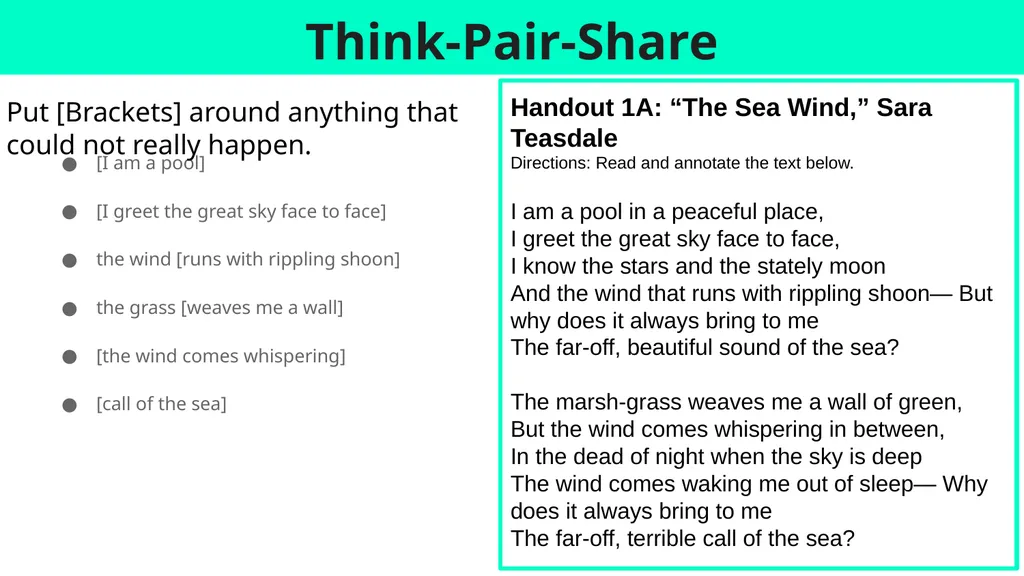
slide10. Think-Pair-Share [I am a pool]
[I greet the great sky face to face]
the wind [runs with rippling shoon]
the grass [weaves me a wall]
[the wind comes whispering]
[call of the sea] Handout 1A: “The Sea Wind,” Sara Teasdale
Directions: Read and annotate the text below.
I am a pool in a peaceful place,
I greet the great sky face to face,
I know the stars and the stately moon
And the wind that runs with rippling shoon— But why does it always bring to me
The far-off, beautiful sound of the sea?
The marsh-grass weaves me a wall of green,
But the wind comes whispering in between,
In the dead of night when the sky is deep
The wind comes waking me out of sleep— Why does it always bring to me
The far-off, terrible call of the sea? Put [Brackets] around anything that could not really happen.<br>
slide11. Academic Words<br>
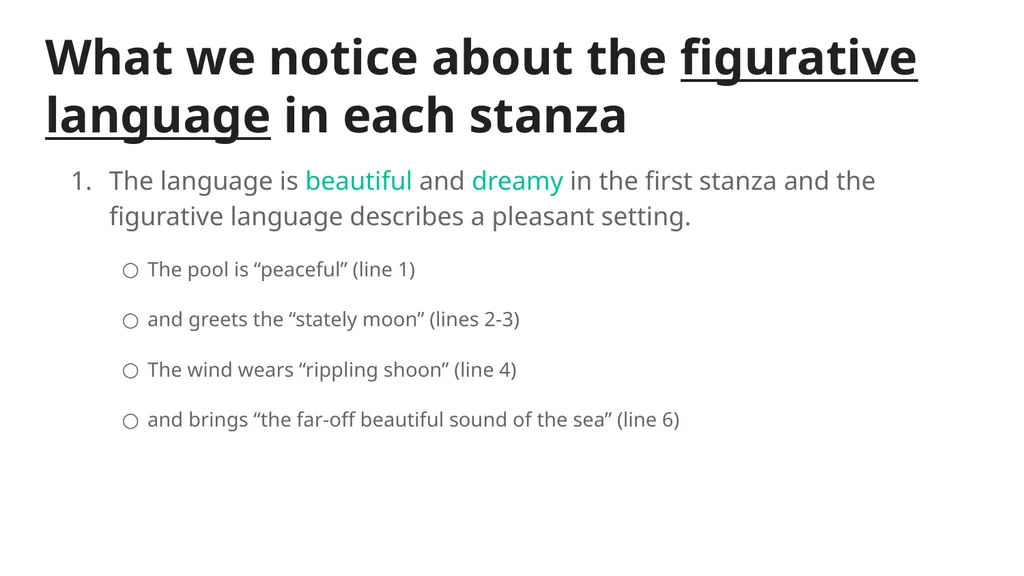
slide12. What we notice about the figurative language in each stanza The language is beautiful and dreamy in the first stanza and the figurative language describes a pleasant setting.
The pool is “peaceful” (line 1)
and greets the “stately moon” (lines 2-3)
The wind wears “rippling shoon” (line 4)
and brings “the far-off beautiful sound of the sea” (line 6)<br>
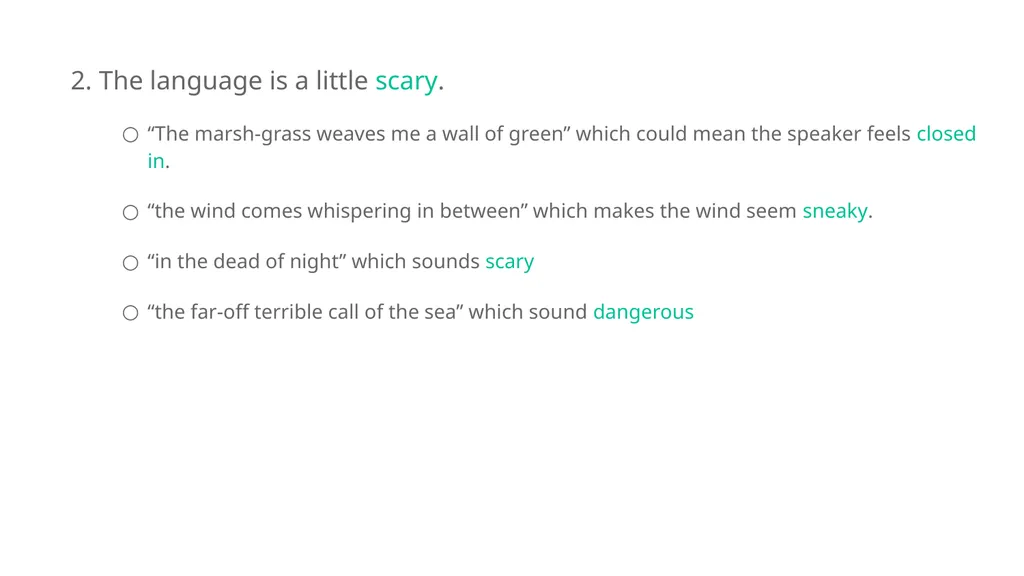
slide13. 2. The language is a little scary.
“The marsh-grass weaves me a wall of green” which could mean the speaker feels closed in.
“the wind comes whispering in between” which makes the wind seem sneaky.
“in the dead of night” which sounds scary
“the far-off terrible call of the sea” which sound dangerous<br>
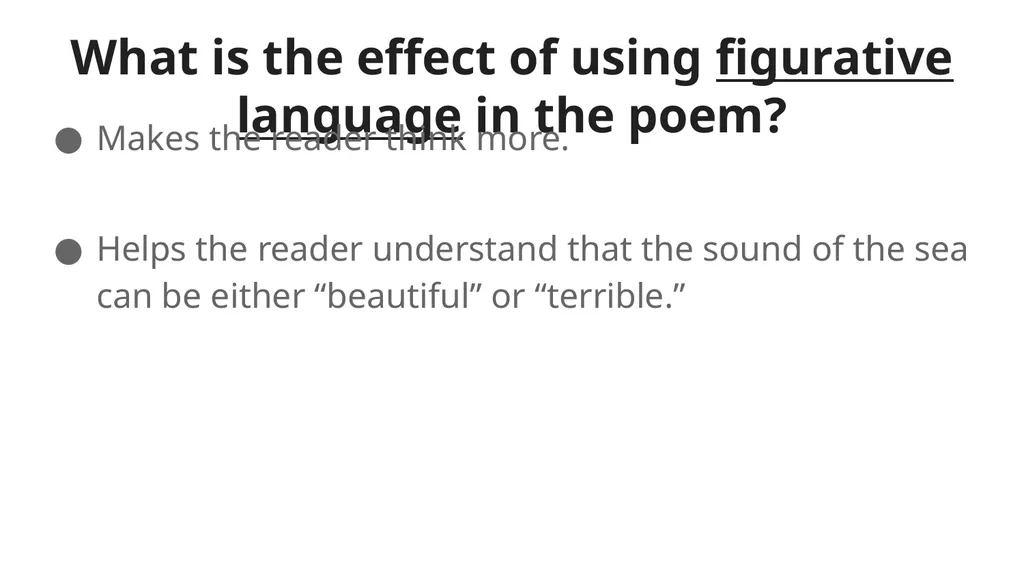
slide14. What is the effect of using figurative language in the poem? Makes the reader think more.
Helps the reader understand that the sound of the sea can be either “beautiful” or “terrible.”<br>
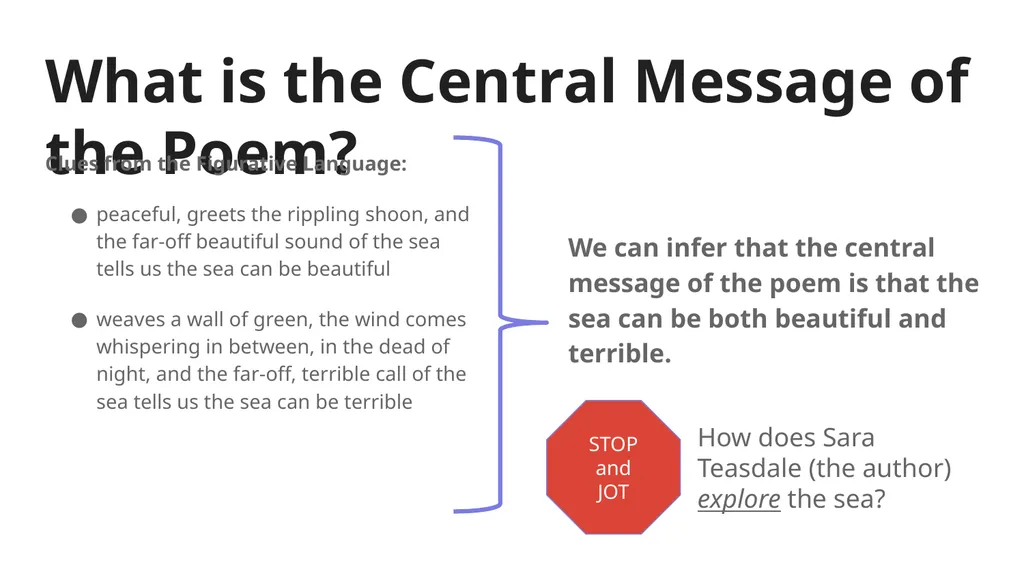
slide15. What is the Central Message of the Poem? Clues from the Figurative Language:
peaceful, greets the rippling shoon, and the far-off beautiful sound of the sea tells us the sea can be beautiful
weaves a wall of green, the wind comes whispering in between, in the dead of night, and the far-off, terrible call of the sea tells us the sea can be terrible We can infer that the central message of the poem is that the sea can be both beautiful and terrible.<br>
slide16. Craft Question:
Why is it important to write in complete sentences?<br>
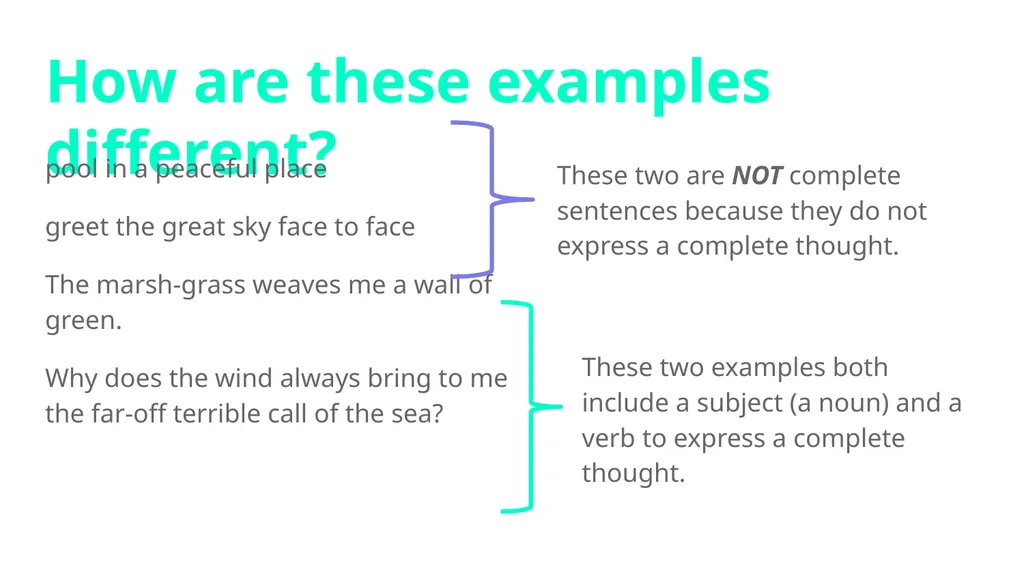
slide17. How are these examples different? pool in a peaceful place
greet the great sky face to face
The marsh-grass weaves me a wall of green.
Why does the wind always bring to me the far-off terrible call of the sea? These two are NOT complete sentences because they do not express a complete thought. These two examples both include a subject (a noun) and a verb to express a complete thought.<br>
slide18. Language Skills<br>
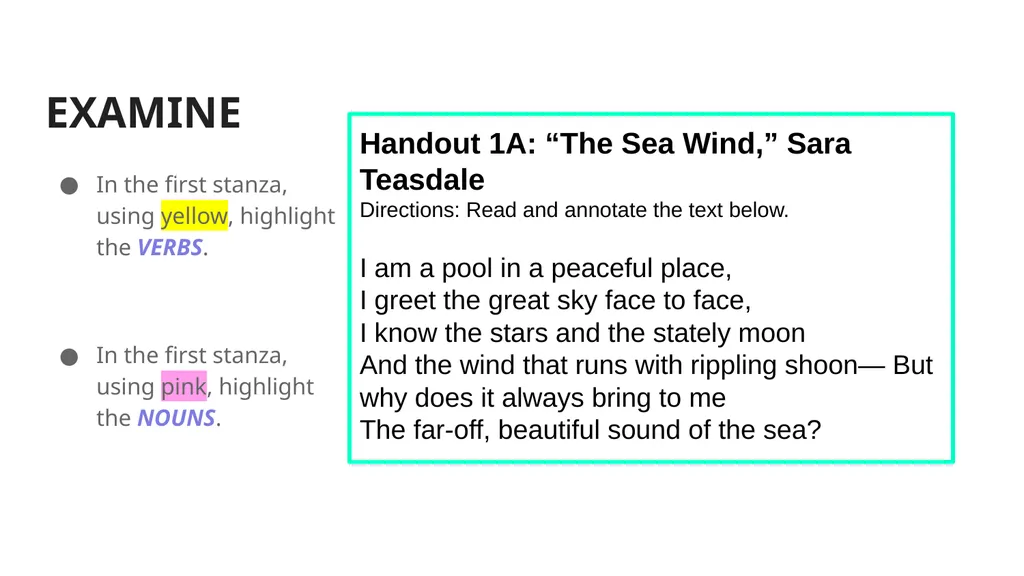
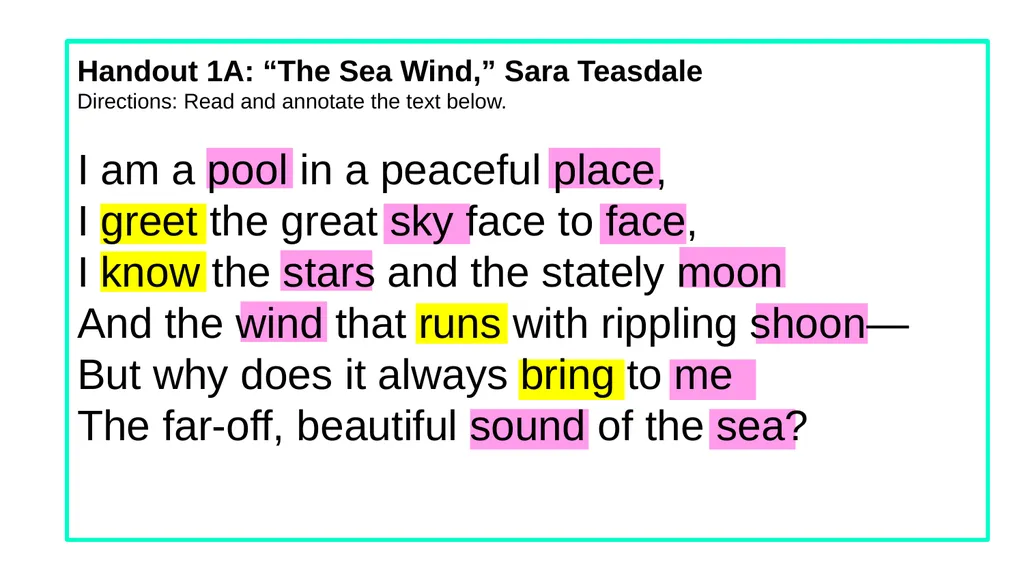
slide19. EXAMINE In the first stanza, using yellow, highlight the VERBS.
In the first stanza, using pink, highlight the NOUNS. Handout 1A: “The Sea Wind,” Sara Teasdale
Directions: Read and annotate the text below.
I am a pool in a peaceful place,
I greet the great sky face to face,
I know the stars and the stately moon
And the wind that runs with rippling shoon— But why does it always bring to me
The far-off, beautiful sound of the sea?<br>
slide20. Handout 1A: “The Sea Wind,” Sara Teasdale
Directions: Read and annotate the text below.
I am a pool in a peaceful place,
I greet the great sky face to face,
I know the stars and the stately moon
And the wind that runs with rippling shoon— But why does it always bring to me
The far-off, beautiful sound of the sea?<br>
slide21. Language Skills<br>
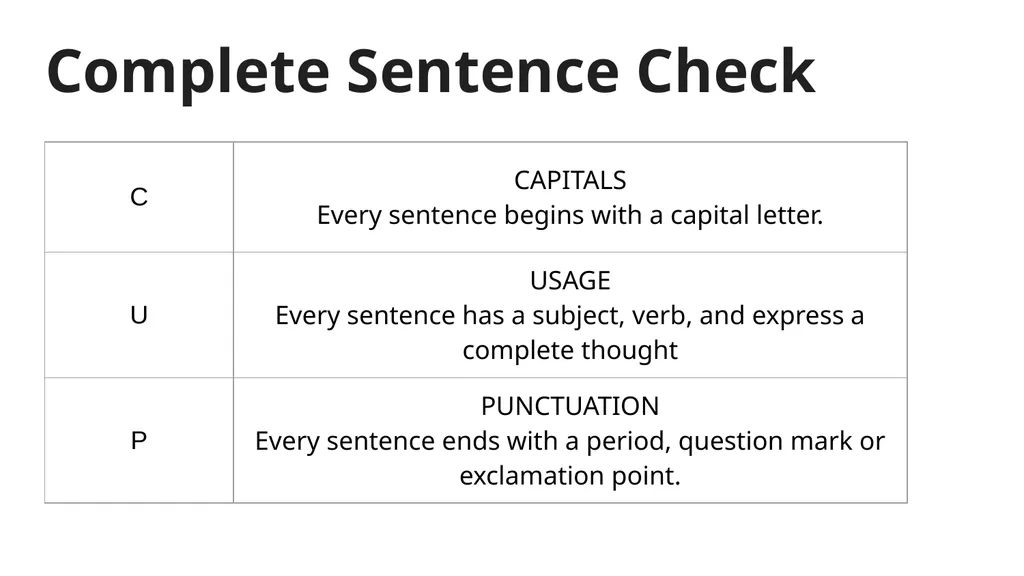
slide22. Complete Sentence Check<br>
slide23. The marsh-grass weaves me a wall of green.<br>
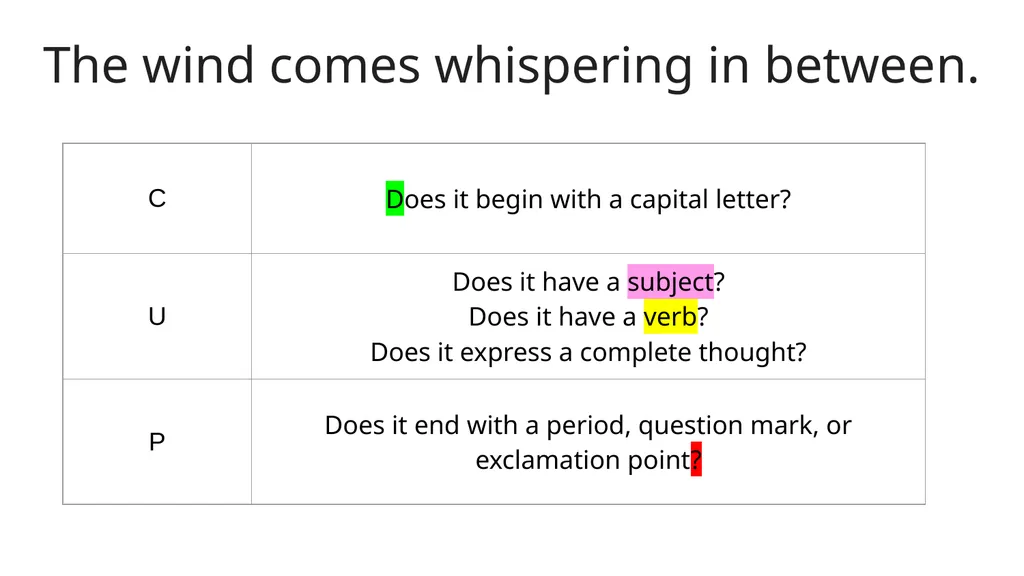
slide24. The wind comes whispering in between.<br>
slide25. Quick Write What is the central message of “The Sea Wind” and how do you know? Explain what elements of the poem helped you identify the central message.<br>
slide26. Dive Deep Vocabulary:
Why do people EXPLORE the sea?<br>
slide27. Give-One, Get-One, Move-On On your index card list 2-3 examples of ways people learn about a subject, place, or idea.
Move on to give one example to a peer.
Get another example from your peer. How else can people learn about a subject, place or idea?<br>
slide28. Vocabulary Journals<br>
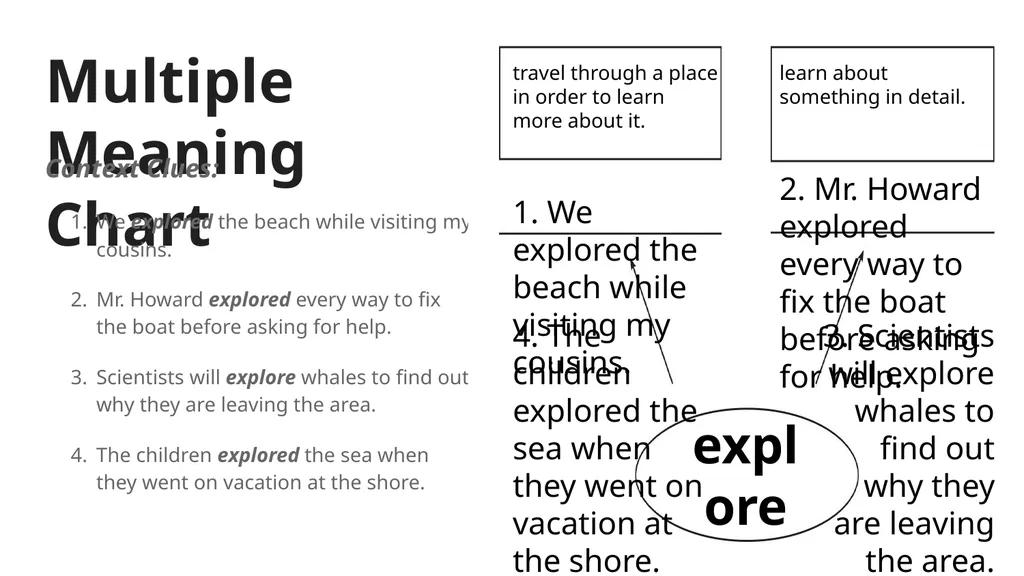
slide29. Multiple Meaning Chart Context Clues:
We explored the beach while visiting my cousins.
Mr. Howard explored every way to fix the boat before asking for help.
Scientists will explore whales to find out why they are leaving the area.
The children explored the sea when they went on vacation at the shore. travel through a place in order to learn more about it. learn about something in detail. explore 1. We explored the beach while visiting my cousins. 4. The children explored the sea when they went on vacation at the shore. 2. Mr. Howard explored every way to fix the boat before asking for help. 3. Scientists will explore whales to find out why they are leaving the area.<br>
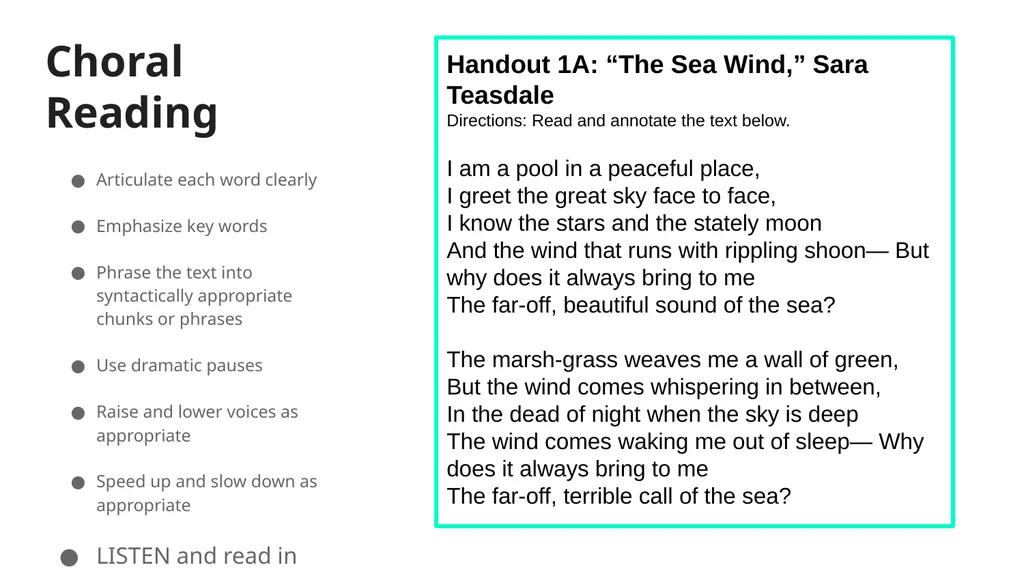
slide30. Choral Reading Articulate each word clearly
Emphasize key words
Phrase the text into syntactically appropriate chunks or phrases
Use dramatic pauses
Raise and lower voices as appropriate
Speed up and slow down as appropriate
LISTEN and read in UNISON Handout 1A: “The Sea Wind,” Sara Teasdale
Directions: Read and annotate the text below.
I am a pool in a peaceful place,
I greet the great sky face to face,
I know the stars and the stately moon
And the wind that runs with rippling shoon— But why does it always bring to me
The far-off, beautiful sound of the sea?
The marsh-grass weaves me a wall of green,
But the wind comes whispering in between,
In the dead of night when the sky is deep
The wind comes waking me out of sleep— Why does it always bring to me
The far-off, terrible call of the sea?<br>
slide31. Exit Slip Which definition of explore best reflects how the speaker of the poem explores the sea? Use text evidence to support your answer.<br>
slide32. Lesson 2 Content Framing Question:
Distill: What is the central message of a woodblock print?<br>
slide33. Think-Pair-Share
What choices did you make when deciding what and how to illustrate the poem?<br>
slide35. I See I Think I Wonder<br>
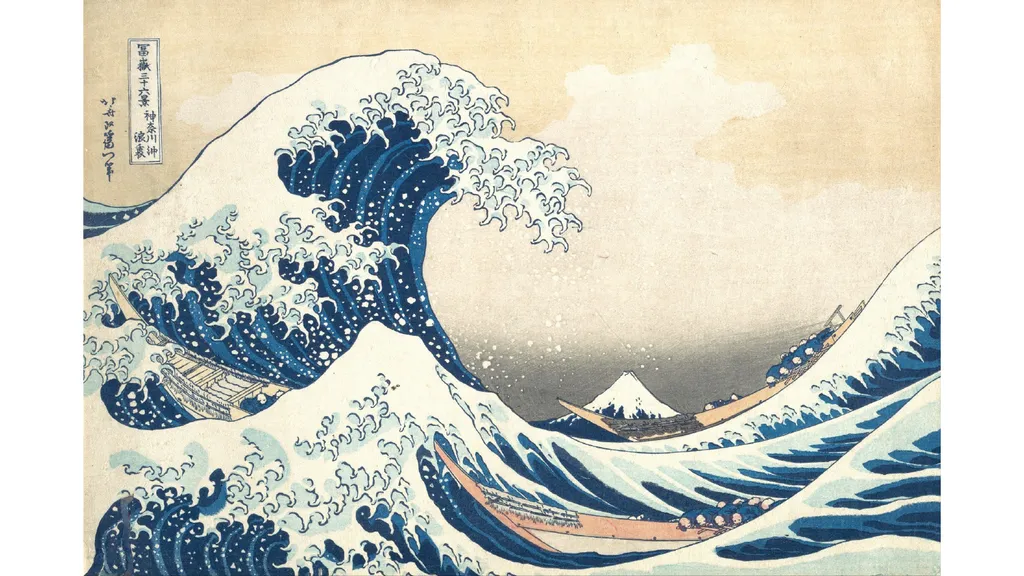
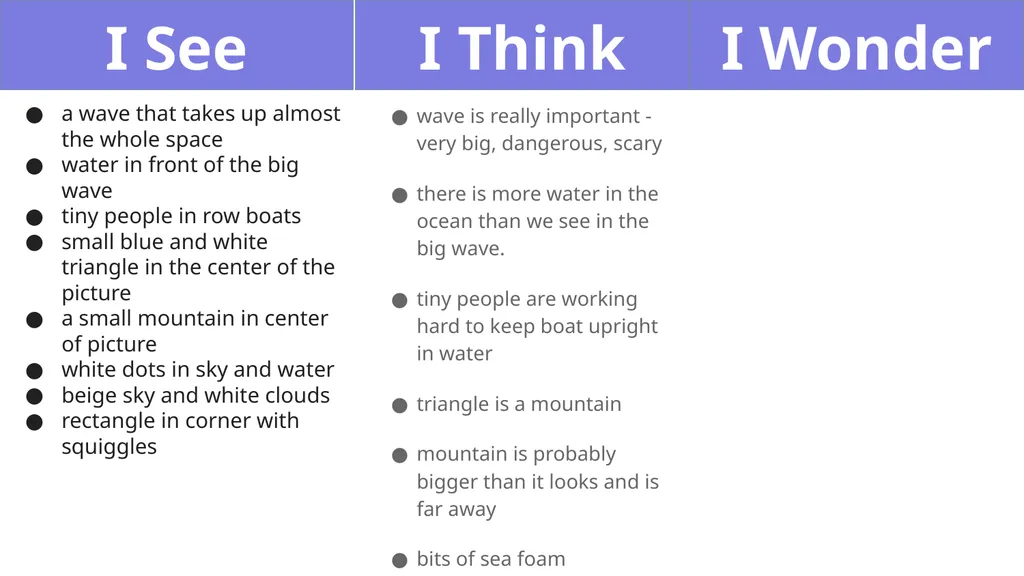
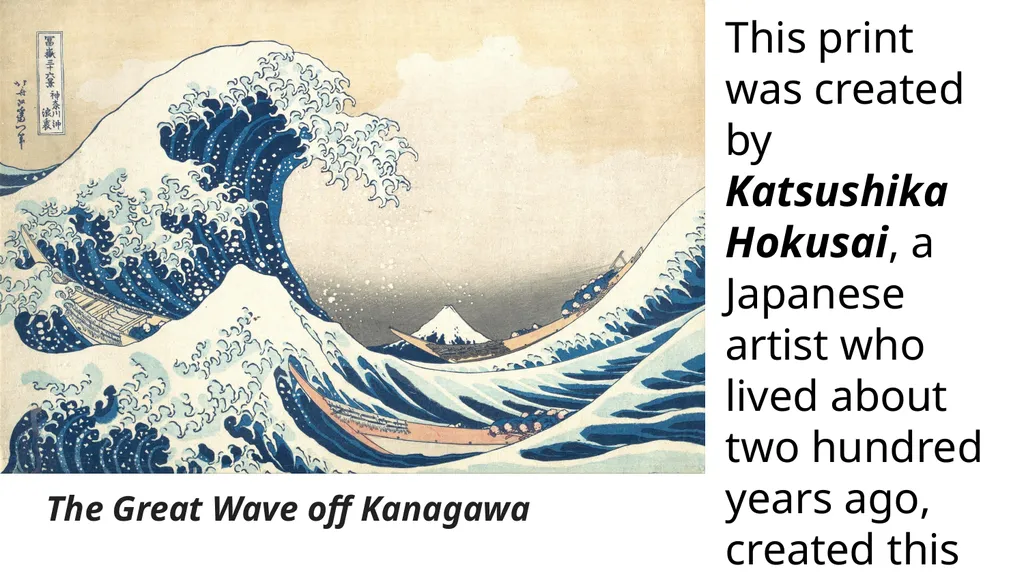
slide36. What do you see in this painting? I See a wave that takes up almost the whole space
water in front of the big wave
tiny people in row boats
small blue and white triangle in the center of the picture
a small mountain in center of picture
white dots in sky and water
beige sky and white clouds
rectangle in corner with squiggles<br>
slide37. I See a wave that takes up almost the whole space
water in front of the big wave
tiny people in row boats
small blue and white triangle in the center of the picture
a small mountain in center of picture
white dots in sky and water
beige sky and white clouds
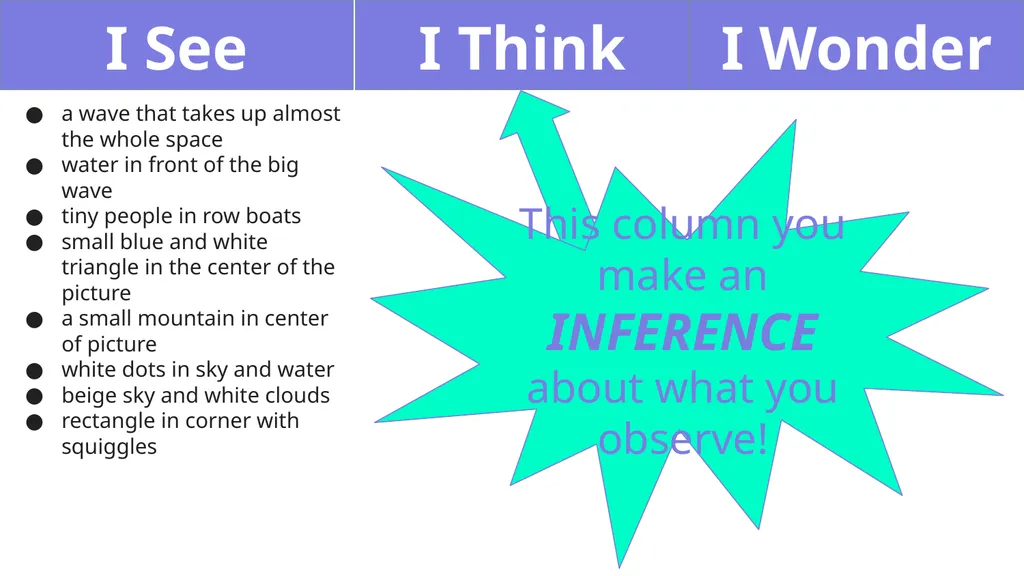
rectangle in corner with squiggles I Think I Wonder This column you make an INFERENCE about what you observe!<br>
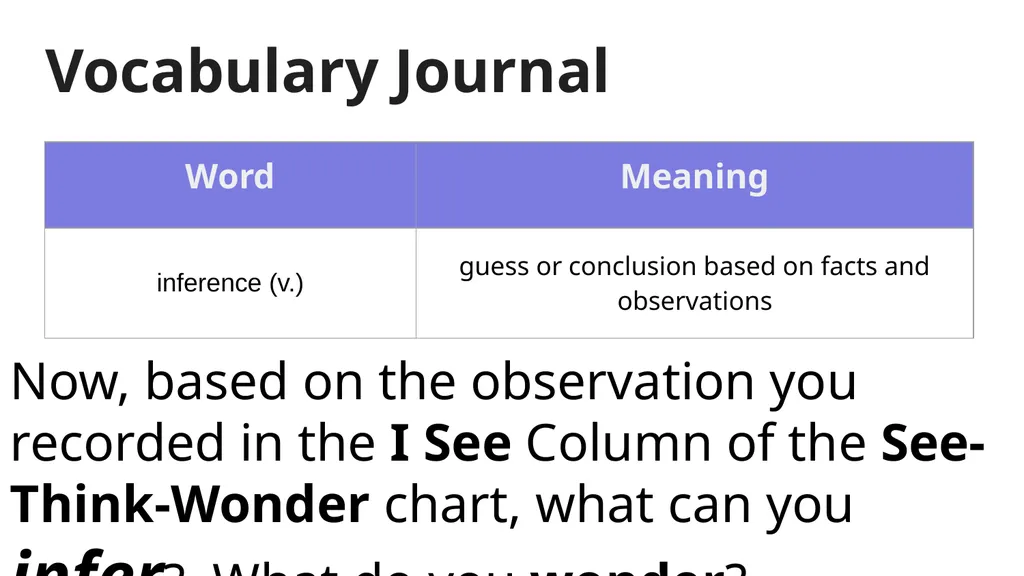
slide38. Vocabulary Journal Now, based on the observation you recorded in the I See Column of the See-Think-Wonder chart, what can you infer? What do you wonder?<br>
slide39. I See a wave that takes up almost the whole space
water in front of the big wave
tiny people in row boats
small blue and white triangle in the center of the picture
a small mountain in center of picture
white dots in sky and water
beige sky and white clouds
rectangle in corner with squiggles I Think I Wonder wave is really important - very big, dangerous, scary
there is more water in the ocean than we see in the big wave.
tiny people are working hard to keep boat upright in water
triangle is a mountain
mountain is probably bigger than it looks and is far away
bits of sea foam
cloudy day
might be writing<br>
slide40. I See a wave that takes up almost the whole space
water in front of the big wave
tiny people in row boats
small blue and white triangle in the center of the picture
a small mountain in center of picture
white dots in sky and water
beige sky and white clouds
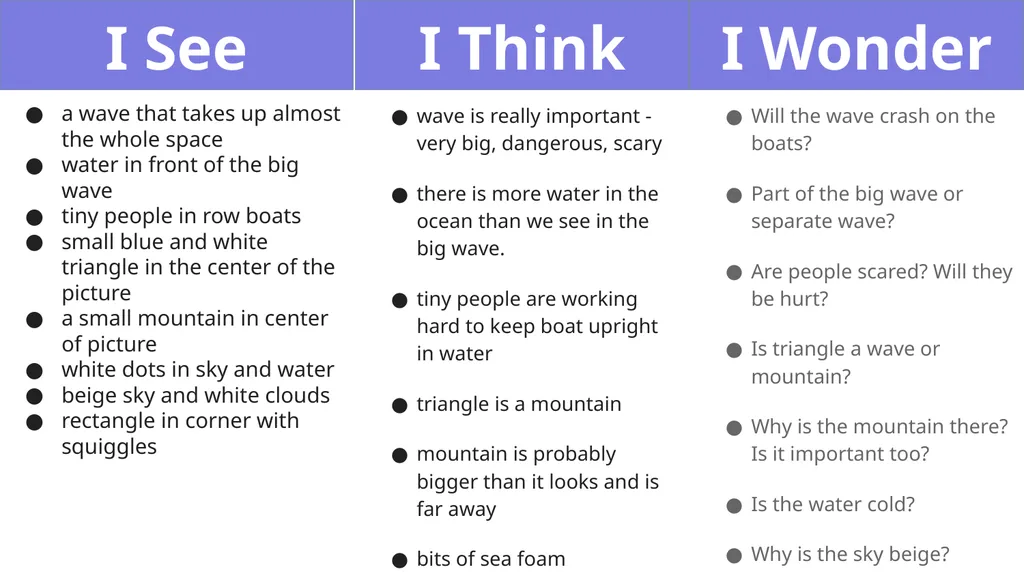
rectangle in corner with squiggles I Think I Wonder wave is really important - very big, dangerous, scary
there is more water in the ocean than we see in the big wave.
tiny people are working hard to keep boat upright in water
triangle is a mountain
mountain is probably bigger than it looks and is far away
bits of sea foam
cloudy day
might be writing Will the wave crash on the boats?
Part of the big wave or separate wave?
Are people scared? Will they be hurt?
Is triangle a wave or mountain?
Why is the mountain there? Is it important too?
Is the water cold?
Why is the sky beige?
What language is this?<br>
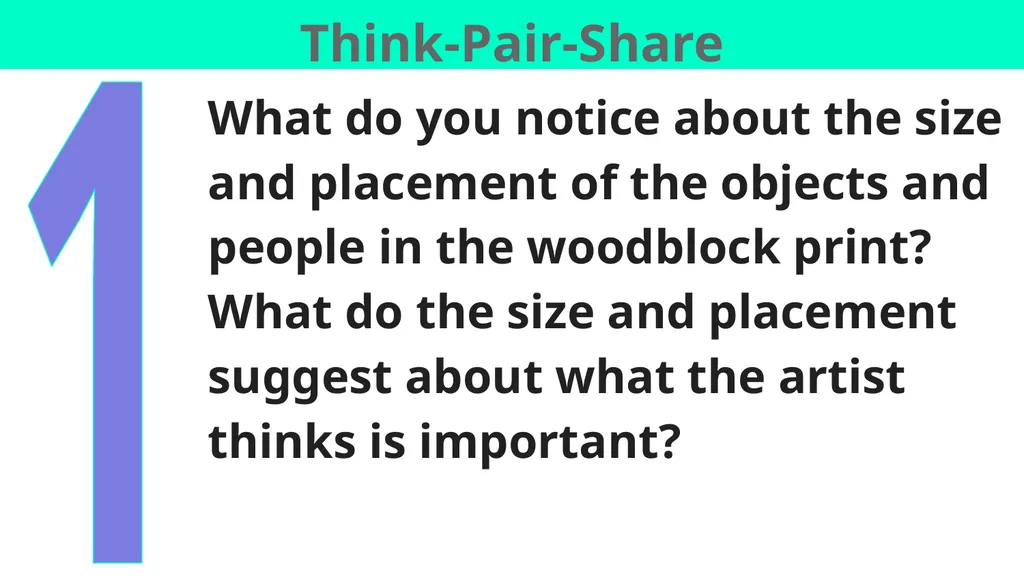
slide41. Think-Pair-Share 1 What do you notice about the size and placement of the objects and people in the woodblock print? What do the size and placement suggest about what the artist thinks is important?<br>
slide42. New Words<br>
slide43. Think-Pair-Share 2 How does the artist arrange the figures in the boats? What does the arrangement suggest about an important idea in the image?<br>
slide44. Think-Pair-Share 3 What do you notice and think about the lines in the woodblock print? What do the lines suggest about an important idea in the image?<br>
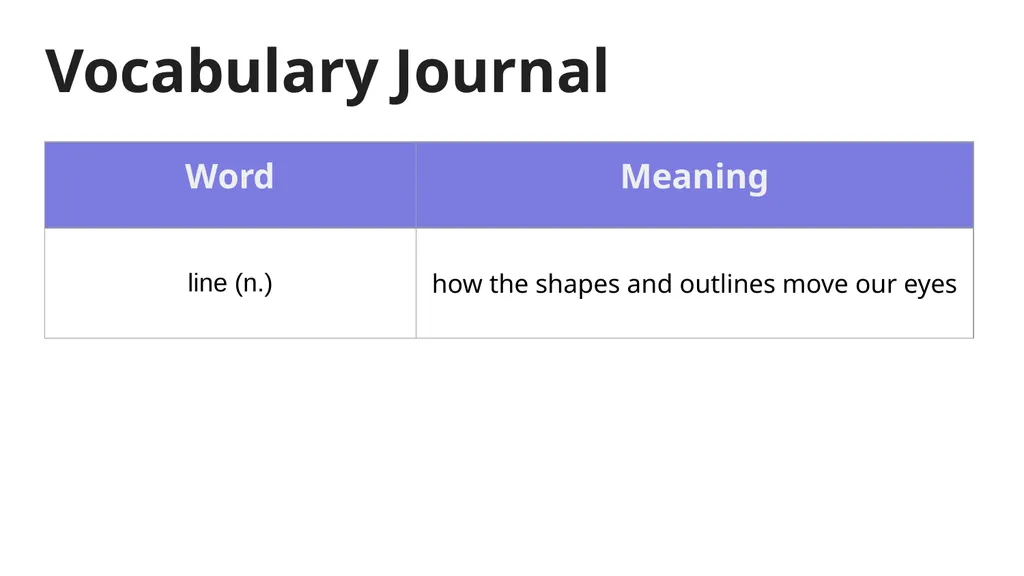
slide45. Vocabulary Journal<br>
slide46. Think-Pair-Share 4 What colors does the artist use in the painting? What do the colors suggest about an important idea in the image?<br>
slide47. Vocabulary Journal<br>
slide48. Think-Pair-Share 5 What decisions did the artist make about composition, line, and color? How do those decisions help you understand the main subject of the woodblock print?<br>
slide49. Vocabulary Journal<br>
slide50. The Great Wave off Kanagawa This print was created by Katsushika Hokusai, a Japanese artist who lived about two hundred years ago, created this woodblock print almost two hunered year ago (1830-1832)<br>
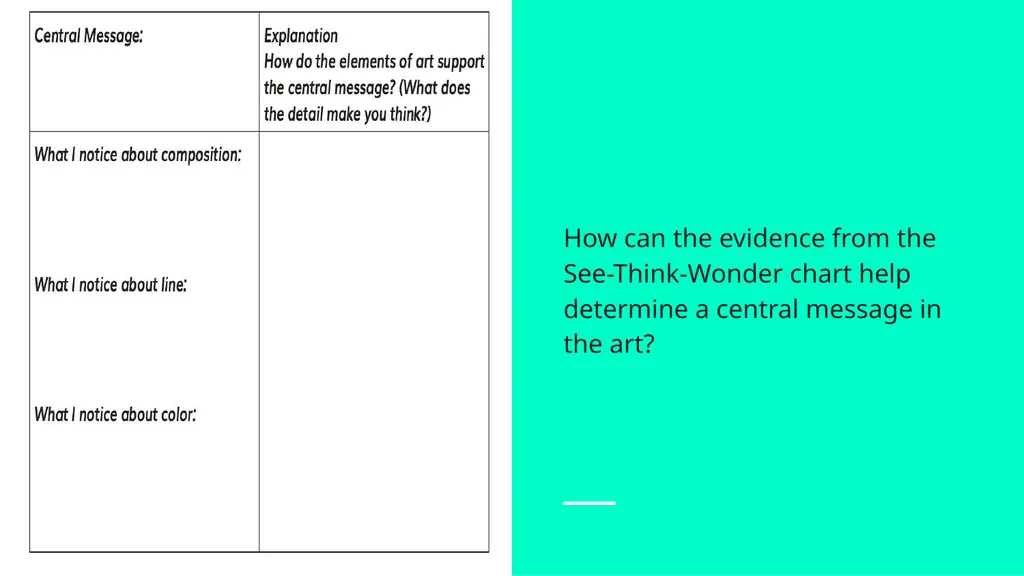
slide51. How can the evidence from the See-Think-Wonder chart help determine a central message in the art?<br>
slide52. Craft Question:
Why is a topic statement important?<br>
slide53. What do you know about topic statements? tells the reader what the paragraph is about.
is often the first sentence in the paragraph.
contains the main idea of the paragraph.
should state one main topic and include important ideas.<br>
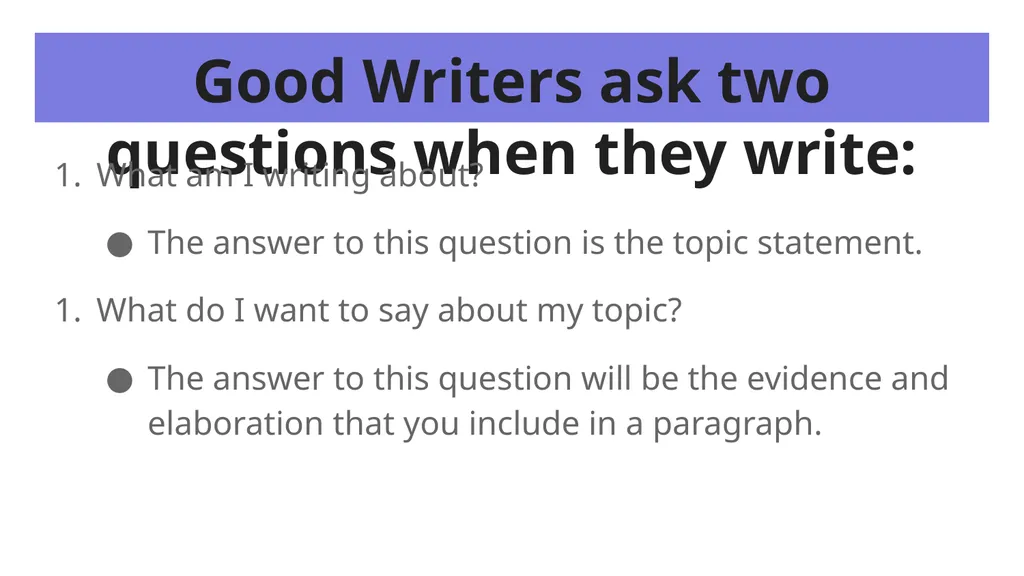
slide54. Good Writers ask two questions when they write: What am I writing about?
The answer to this question is the topic statement.
What do I want to say about my topic?
The answer to this question will be the evidence and elaboration that you include in a paragraph.<br>
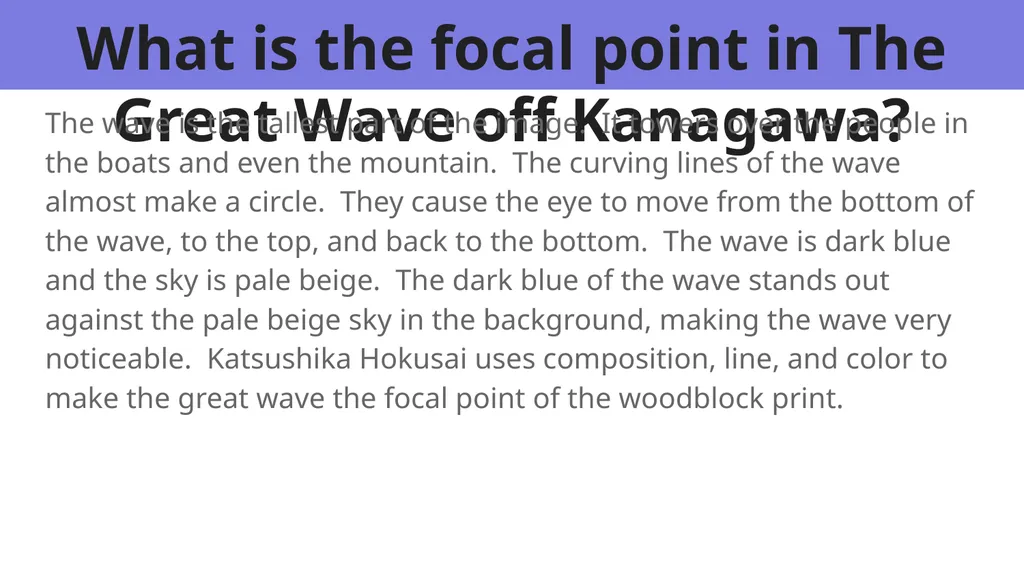
slide55. What is the focal point in The Great Wave off Kanagawa? The wave is the tallest part of the image. It towers over the people in the boats and even the mountain. The curving lines of the wave almost make a circle. They cause the eye to move from the bottom of the wave, to the top, and back to the bottom. The wave is dark blue and the sky is pale beige. The dark blue of the wave stands out against the pale beige sky in the background, making the wave very noticeable. Katsushika Hokusai uses composition, line, and color to make the great wave the focal point of the woodblock print.<br>
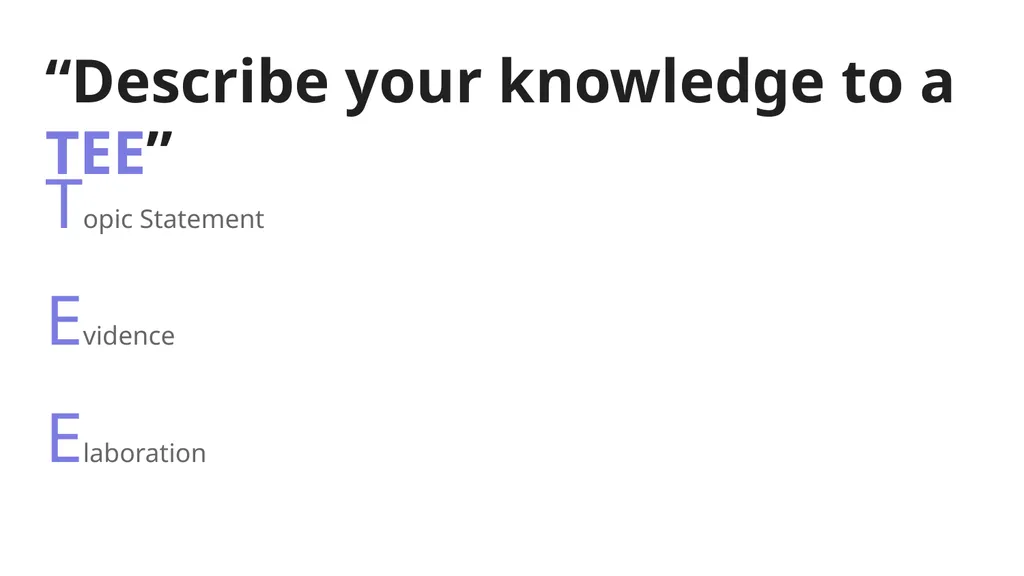
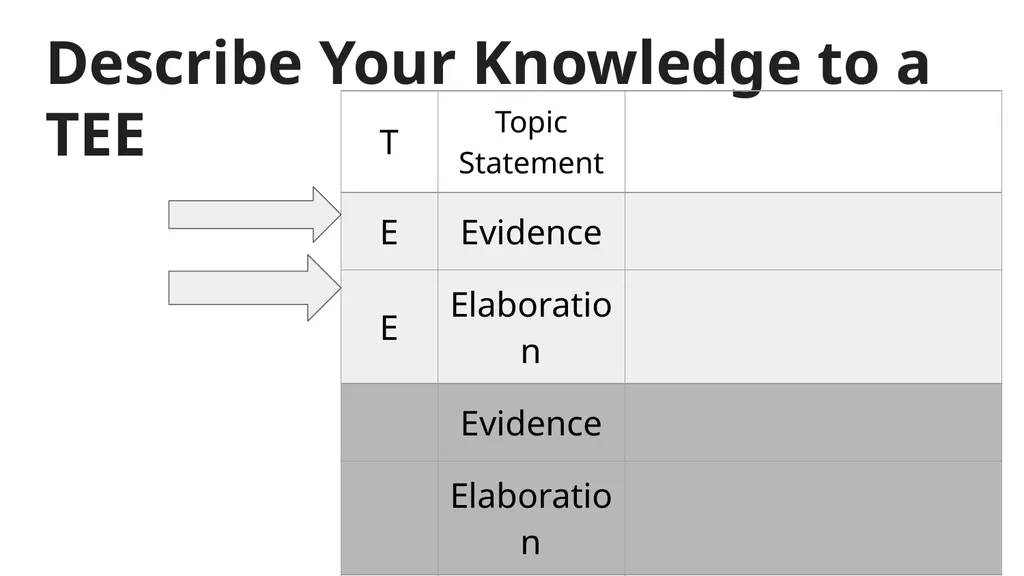
slide56. “Describe your knowledge to a TEE” Topic Statement
Evidence
Elaboration<br>
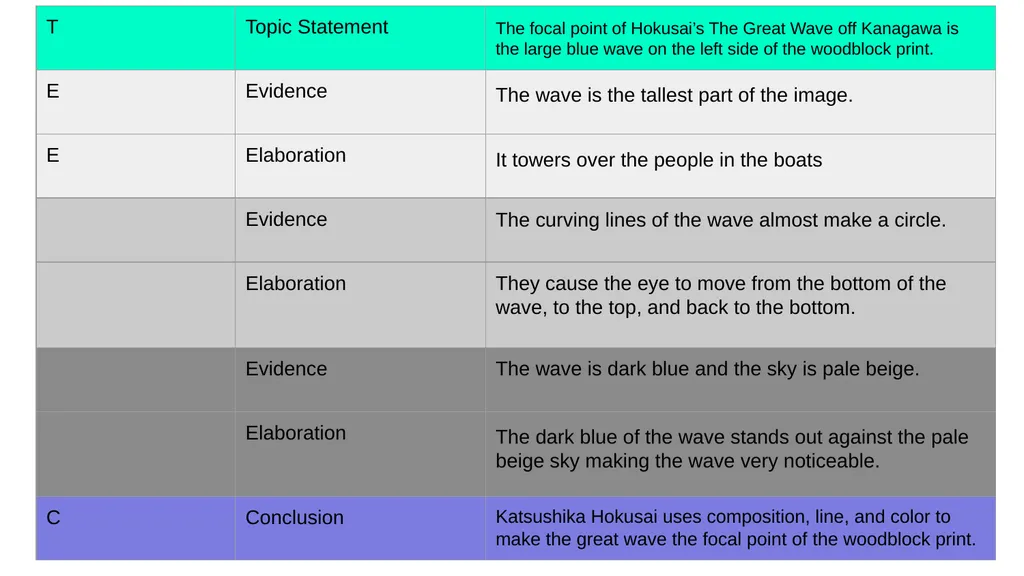
slide57. The wave is the tallest part of the image. It towers over the people in the boats The curving lines of the wave almost make a circle. They cause the eye to move from the bottom of the wave, to the top, and back to the bottom. The wave is dark blue and the sky is pale beige. The dark blue of the wave stands out against the pale beige sky making the wave very noticeable. Katsushika Hokusai uses composition, line, and color to make the great wave the focal point of the woodblock print. The focal point of Hokusai’s The Great Wave off Kanagawa is the large blue wave on the left side of the woodblock print.<br>
slide58. Quick Write Answer the Framing Question Use domain-specific vocabulary from the lesson to explain how key details help express a central message in The Great Wave off Kanagawa.<br>
slide59. Dive Deep Style & Conventions:
Examine and Define Nouns and Verbs<br>
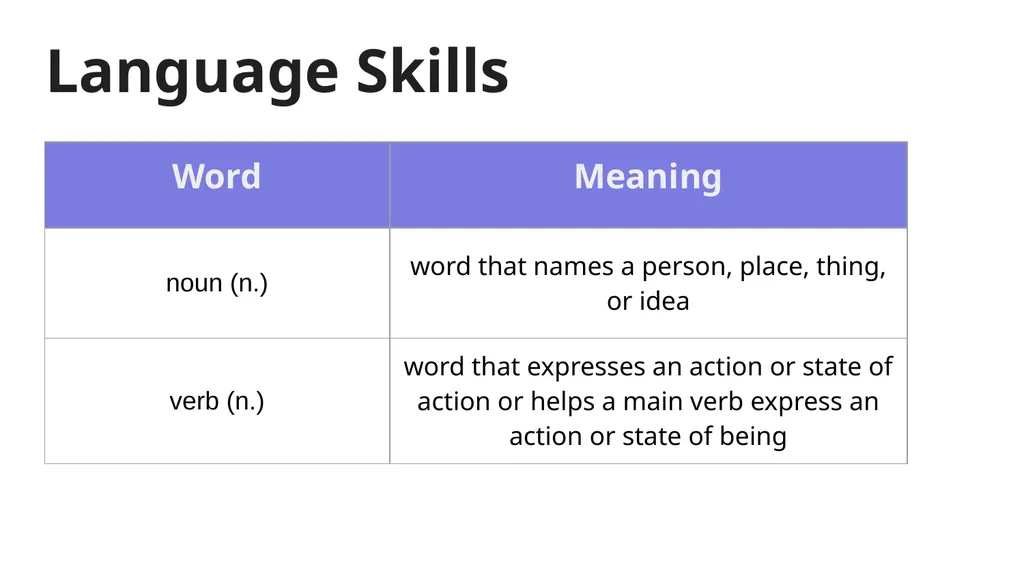
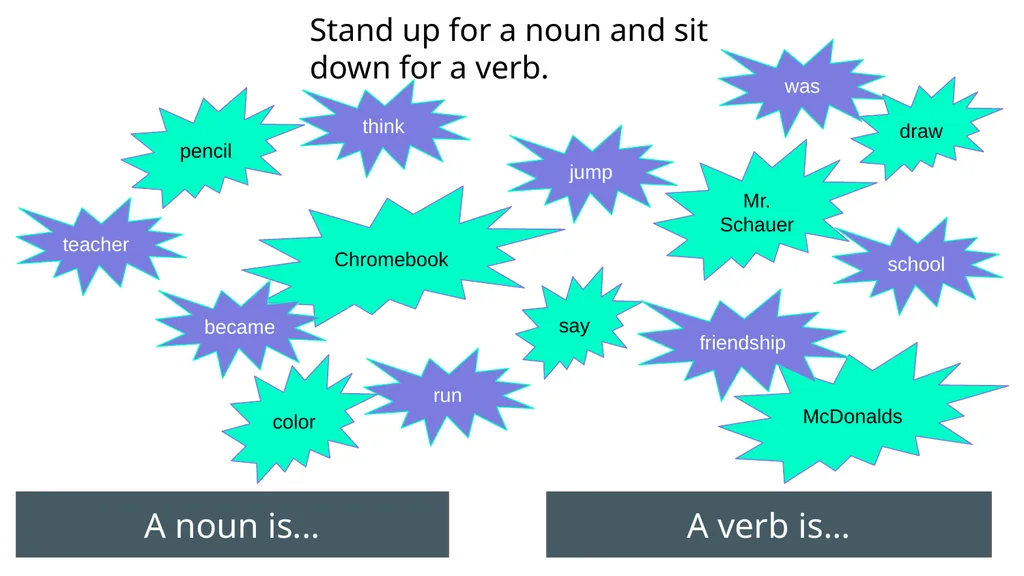
slide60. teacher Mr. Schauer think school jump run draw pencil say McDonalds Chromebook color became was friendship Stand up for a noun and sit down for a verb. is a person, place, thing or idea. A noun is... a word that expresses an action or a state of being. A verb is...<br>
slide61. Craft Question:
Why is a topic statement important?<br>
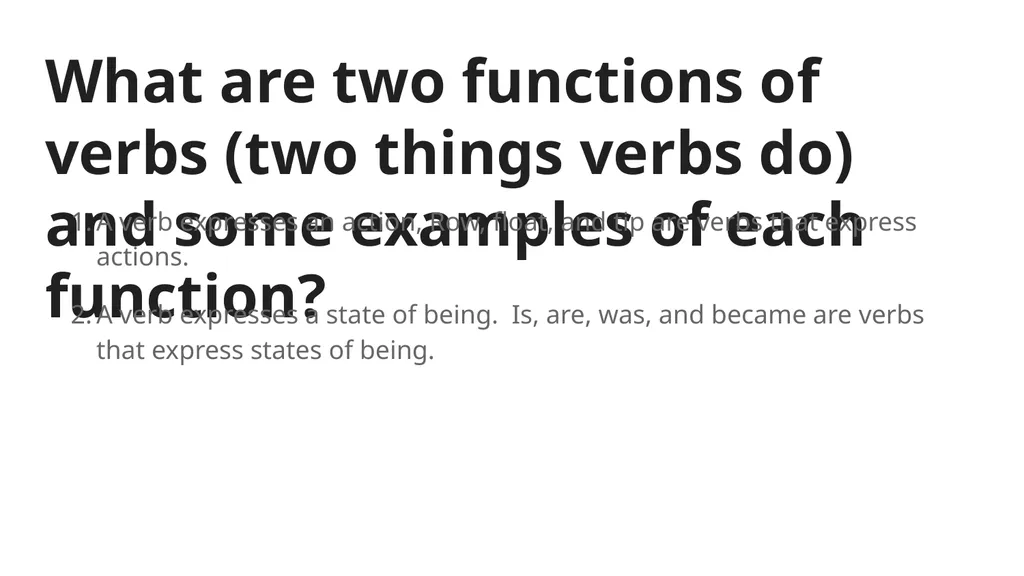
slide62. What are two functions of verbs (two things verbs do) and some examples of each function? A verb expresses an action, Row, float, and tip are verbs that express actions.
A verb expresses a state of being. Is, are, was, and became are verbs that express states of being.<br>
slide63. The people row the boat. What is the verb and what is its function in the sentence above?
The verb row expresses an action. Who rows the boat?
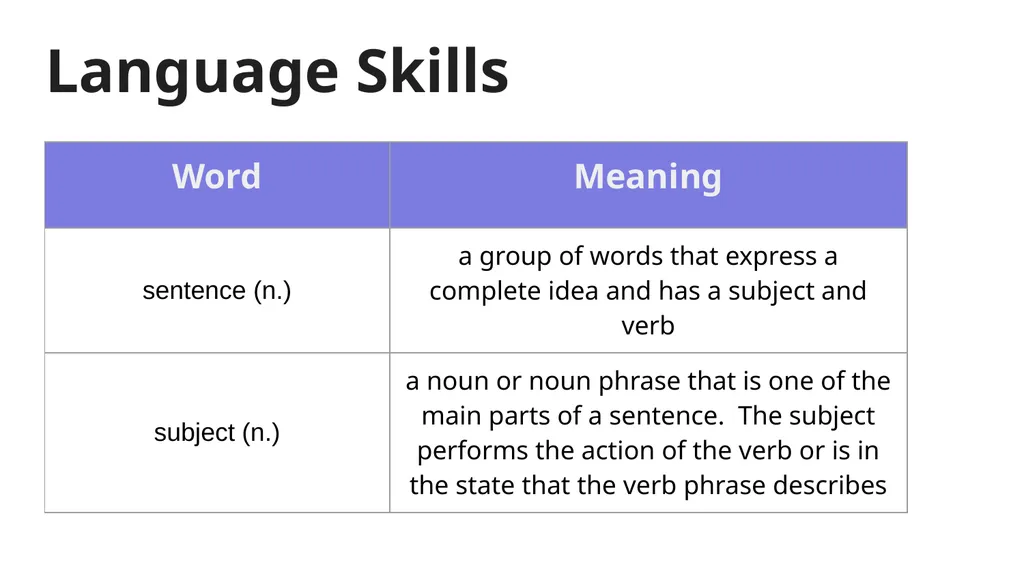
The people row the boat. The noun people is the subject of the sentence because the people are doing the rowing.<br>
slide64. The boat floats on the ocean. What is the verb and what is its function in the sentence above?
The verb floats expresses an action. What floats?
The boat floats. The noun boat is the subject of the sentence. What is the subject of a sentence?
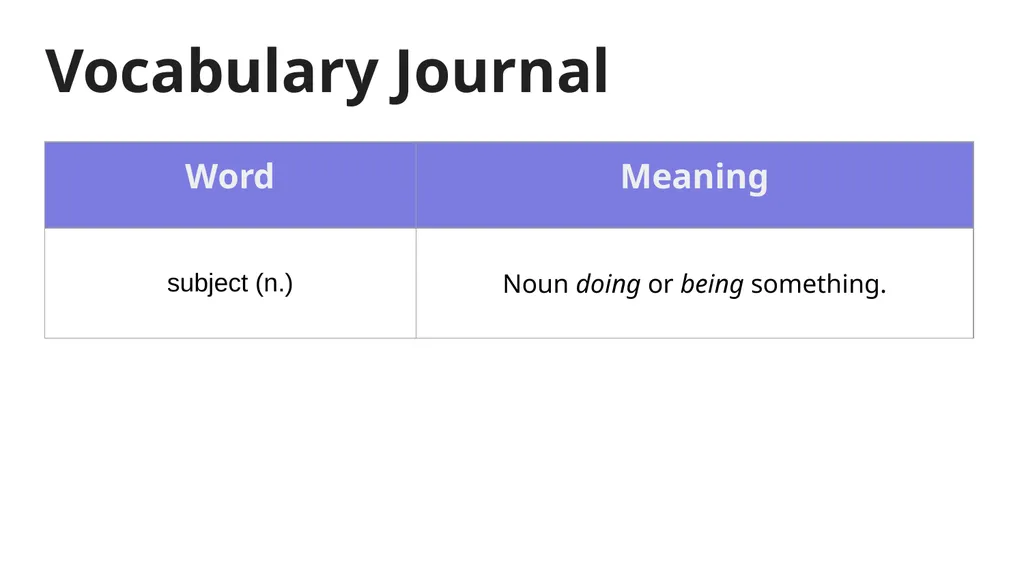
The subject of the sentence is the noun doing or being something.<br>
slide65. Vocabulary Journal<br>
slide66. Complete the exit ticket and turn it in. Exit Ticket<br>
slide67. Lesson 3 Content Framing Question:
Distill: What is the central message of a painting?<br>
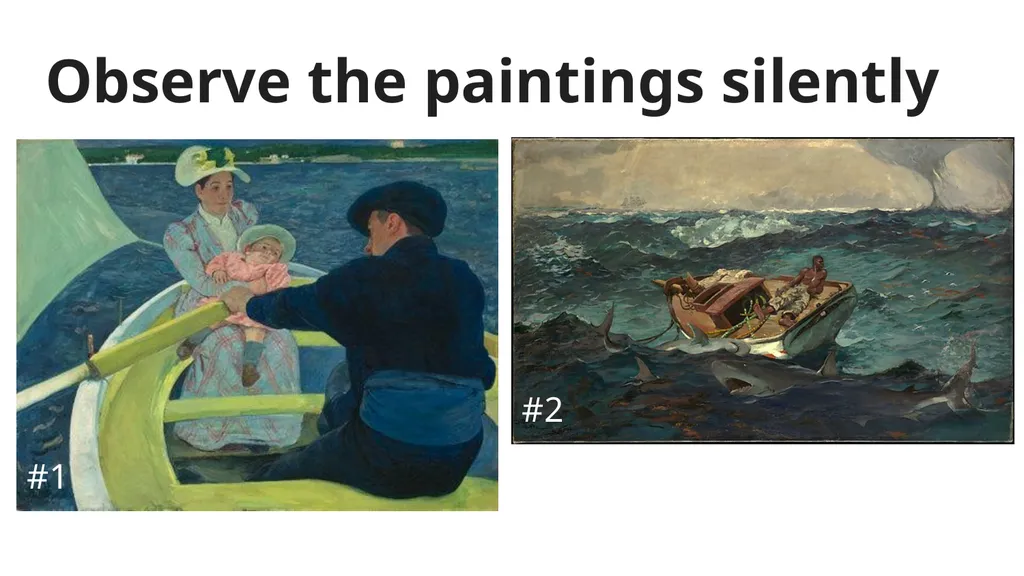
slide68. Observe the paintings silently #1 #2<br>
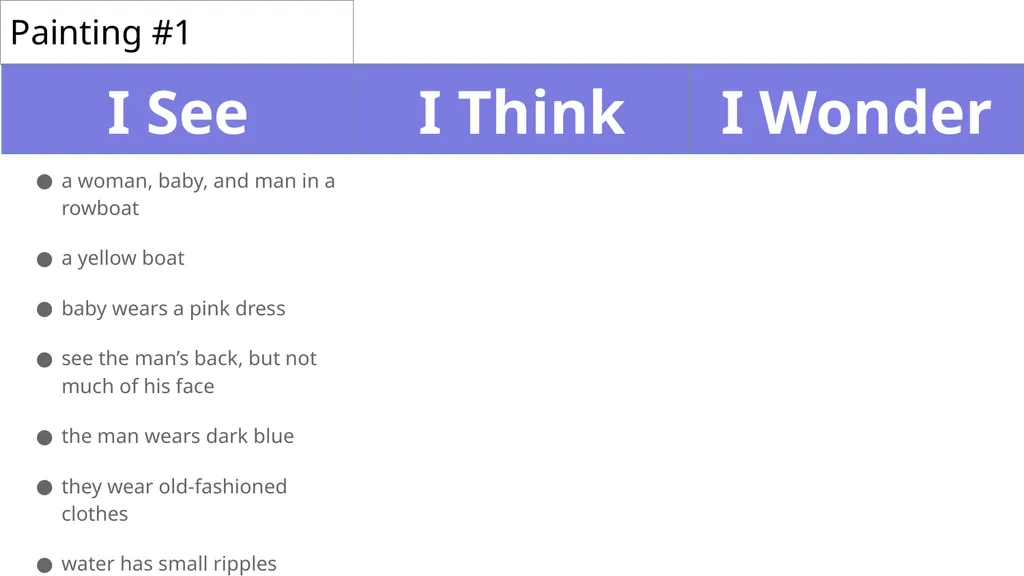
slide69. I See a woman, baby, and man in a rowboat
a yellow boat
baby wears a pink dress
see the man’s back, but not much of his face
the man wears dark blue
they wear old-fashioned clothes
water has small ripples
small buildings on shore
man is rowing
woman is holding the baby I Think I Wonder Painting #1<br>
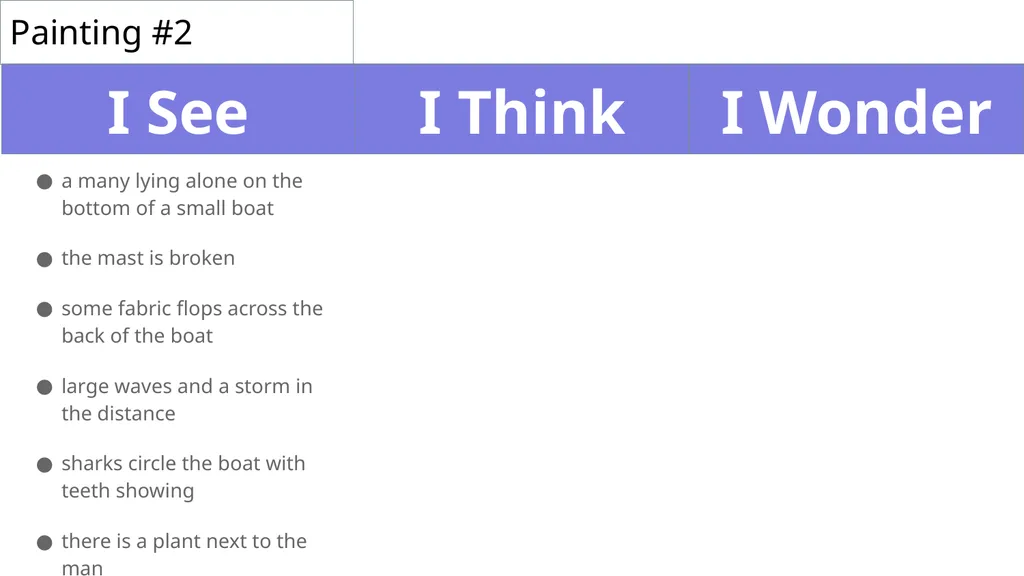
slide70. I See a many lying alone on the bottom of a small boat
the mast is broken
some fabric flops across the back of the boat
large waves and a storm in the distance
sharks circle the boat with teeth showing
there is a plant next to the man
tiny ship in the distance I Think I Wonder Painting #2<br>
slide71. Why is it important to agree and disagree respectfully?<br>
slide72. What do you think it means to agree and disagree during an academic conversation? sharing an opinion without interrupting
being polite and using a pleasant tone of voice
acknowledging someone else’s idea before sharing your own<br>
slide73. Examples of agreeing or disagreeing respectfully Nonverbal signs for Agreeing: nodding your head, smiling, or giving a thumbs-up sign, to show agreement
Nonverbal signs for a different opinion: shaking your head or holding up a finger Sentence Stems “I agree with _______ because _____”
“I disagree with ______ because ______”<br>
slide74. What elements of art did you learn about in lesson 2 and how did they help you analyze The Great Wave off Kanagawa? Composition is the way an artist arranges people (figures) and things (objects) in an image.
Line is how shapes and outlines move our eyes around an image.
Color is an artist’s choice about which colors to use, how bright to make them, whether to use warm or cool colors, and whether to use colors that blend together or stand out against each other.<br>
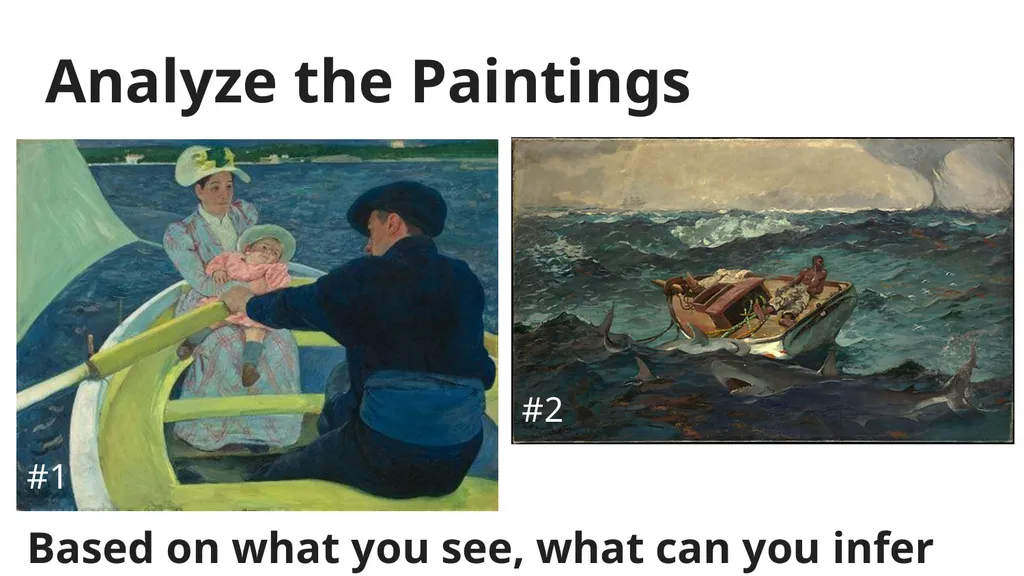
slide75. Analyze the Paintings Based on what you see, what can you infer and wonder? #1 #2<br>
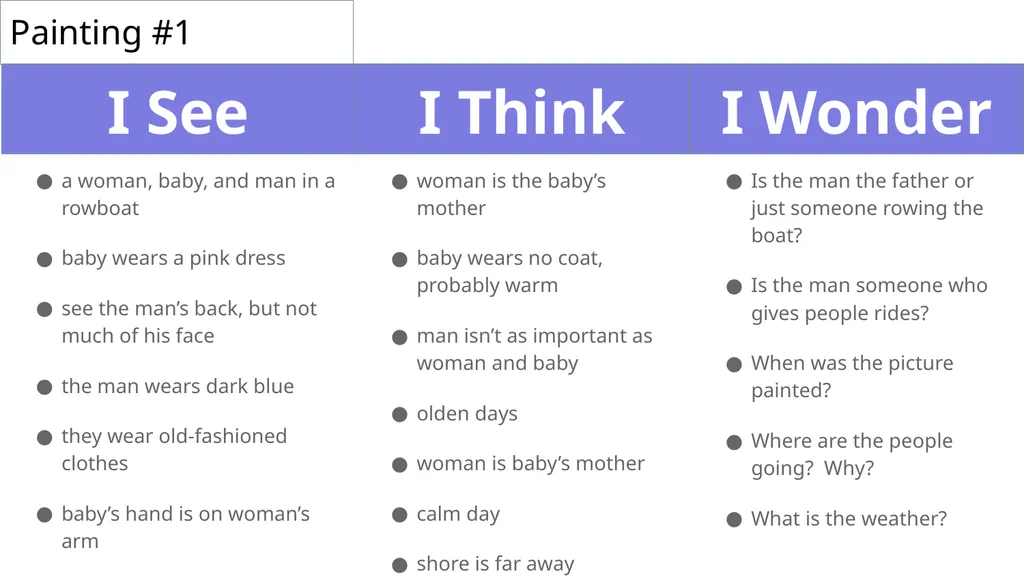
slide76. I See a woman, baby, and man in a rowboat
baby wears a pink dress
see the man’s back, but not much of his face
the man wears dark blue
they wear old-fashioned clothes
baby’s hand is on woman’s arm
water has small ripples
small buildings on shore
woman is holding the baby I Think I Wonder woman is the baby’s mother
baby wears no coat, probably warm
man isn’t as important as woman and baby
olden days
woman is baby’s mother
calm day
shore is far away
woman is the baby’s mother Is the man the father or just someone rowing the boat?
Is the man someone who gives people rides?
When was the picture painted?
Where are the people going? Why?
What is the weather? Painting #1<br>
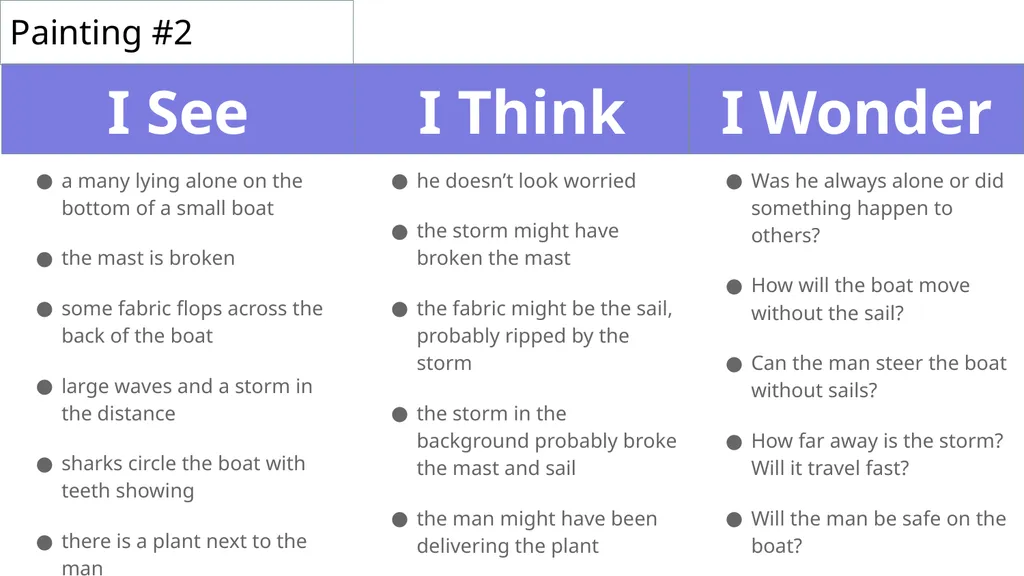
slide77. I See a many lying alone on the bottom of a small boat
the mast is broken
some fabric flops across the back of the boat
large waves and a storm in the distance
sharks circle the boat with teeth showing
there is a plant next to the man
tiny ship in the distance I Think I Wonder he doesn’t look worried
the storm might have broken the mast
the fabric might be the sail, probably ripped by the storm
the storm in the background probably broke the mast and sail
the man might have been delivering the plant
the ship might help Was he always alone or did something happen to others?
How will the boat move without the sail?
Can the man steer the boat without sails?
How far away is the storm? Will it travel fast?
Will the man be safe on the boat?
Will the ship rescue the man? Painting #2<br>
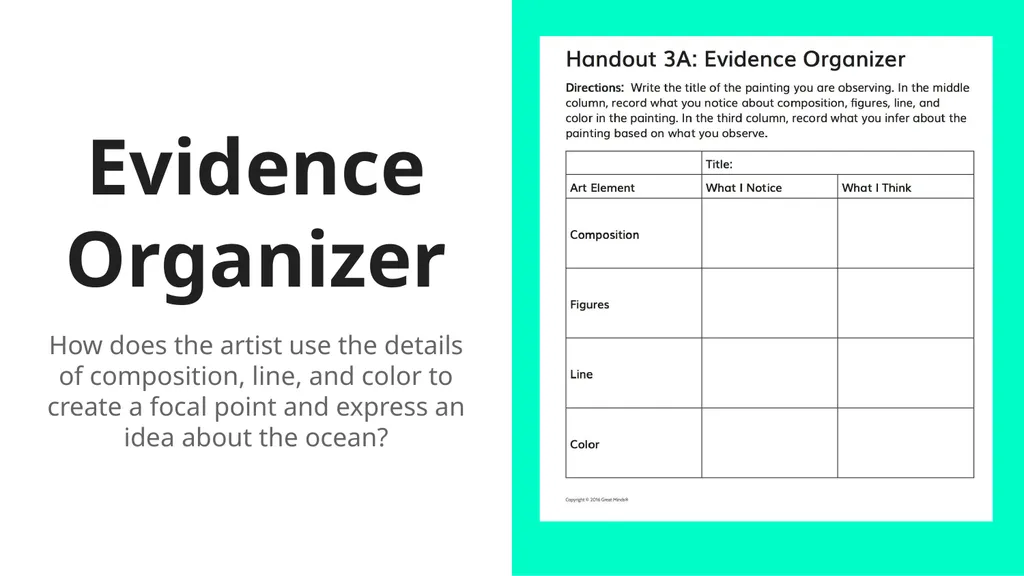
slide78. Evidence Organizer How does the artist use the details of composition, line, and color to create a focal point and express an idea about the ocean?<br>
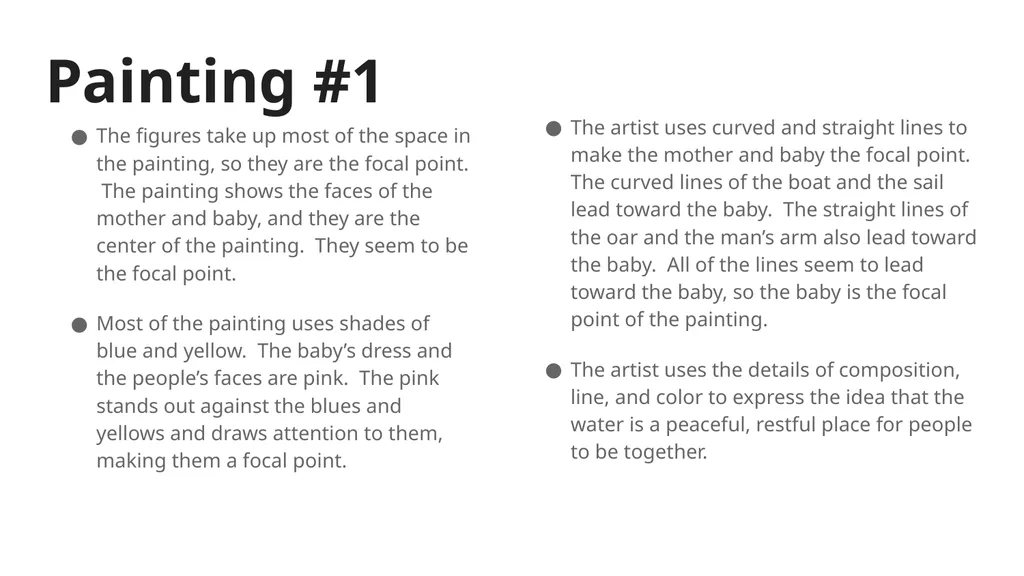
slide79. Painting #1 The figures take up most of the space in the painting, so they are the focal point. The painting shows the faces of the mother and baby, and they are the center of the painting. They seem to be the focal point.
Most of the painting uses shades of blue and yellow. The baby’s dress and the people’s faces are pink. The pink stands out against the blues and yellows and draws attention to them, making them a focal point. The artist uses curved and straight lines to make the mother and baby the focal point. The curved lines of the boat and the sail lead toward the baby. The straight lines of the oar and the man’s arm also lead toward the baby. All of the lines seem to lead toward the baby, so the baby is the focal point of the painting.
The artist uses the details of composition, line, and color to express the idea that the water is a peaceful, restful place for people to be together.<br>
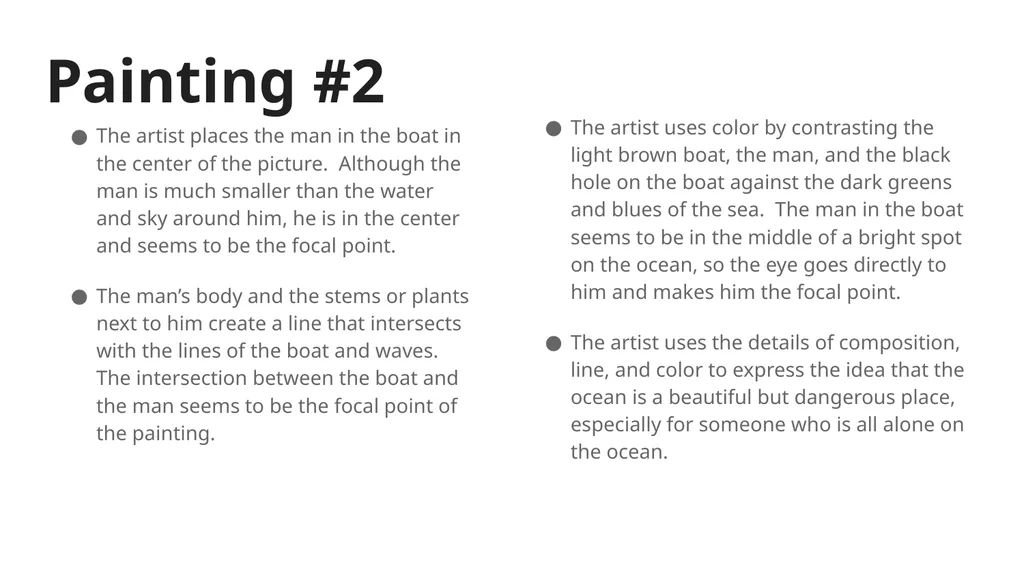
slide80. Painting #2 The artist places the man in the boat in the center of the picture. Although the man is much smaller than the water and sky around him, he is in the center and seems to be the focal point.
The man’s body and the stems or plants next to him create a line that intersects with the lines of the boat and waves. The intersection between the boat and the man seems to be the focal point of the painting. The artist uses color by contrasting the light brown boat, the man, and the black hole on the boat against the dark greens and blues of the sea. The man in the boat seems to be in the middle of a bright spot on the ocean, so the eye goes directly to him and makes him the focal point.
The artist uses the details of composition, line, and color to express the idea that the ocean is a beautiful but dangerous place, especially for someone who is all alone on the ocean.<br>
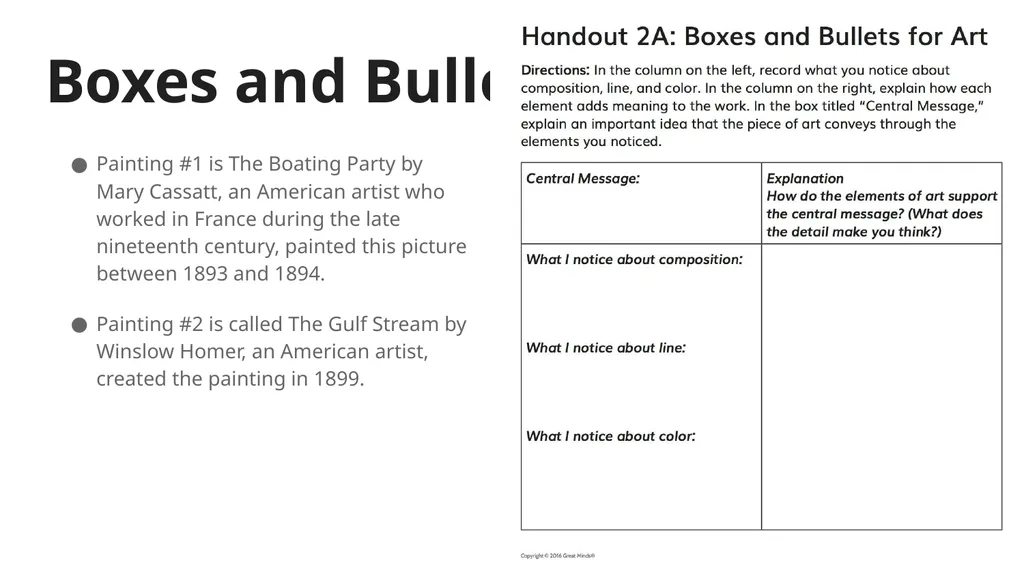
slide81. Boxes and Bullets for Art Painting #1 is The Boating Party by Mary Cassatt, an American artist who worked in France during the late nineteenth century, painted this picture between 1893 and 1894.
Painting #2 is called The Gulf Stream by Winslow Homer, an American artist, created the painting in 1899.<br>
slide82. Craft Question:
How does using a topic statement work?<br>
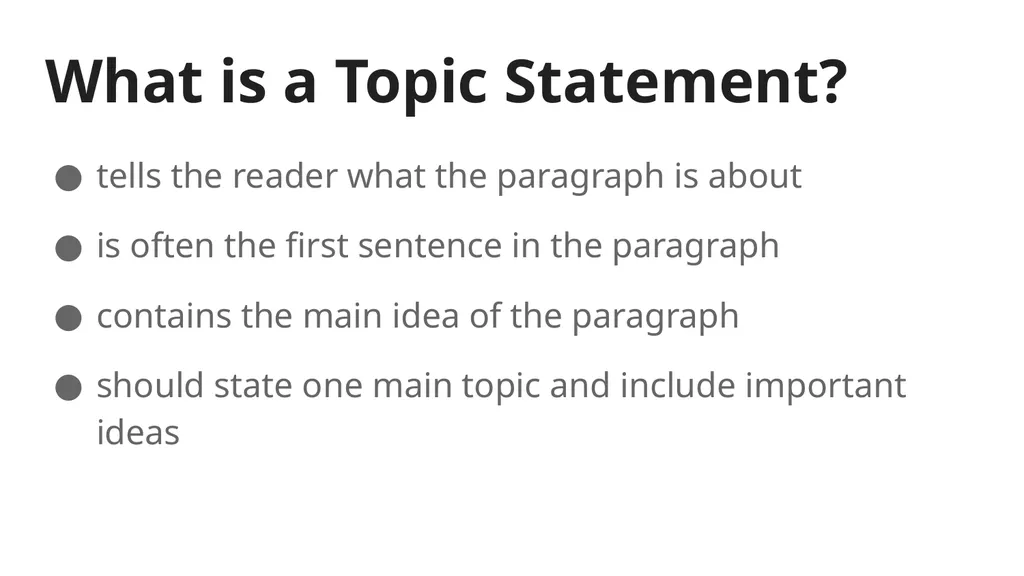
slide83. What is a Topic Statement? tells the reader what the paragraph is about
is often the first sentence in the paragraph
contains the main idea of the paragraph
should state one main topic and include important ideas<br>
slide84. Record the prompt in your Response Journal Explain how the elements of art help convey a central message of Mary Cassatt’s The Boating Party.<br>
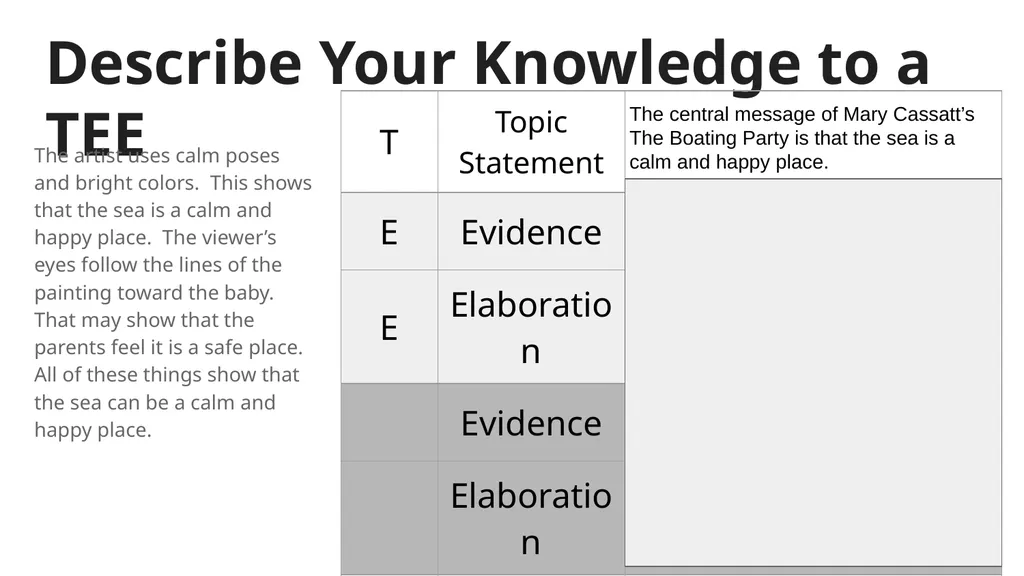
slide85. Describe Your Knowledge to a TEE The artist uses calm poses and bright colors. This shows that the sea is a calm and happy place. The viewer’s eyes follow the lines of the painting toward the baby. That may show that the parents feel it is a safe place. All of these things show that the sea can be a calm and happy place. The central message of Mary Cassatt’s The Boating Party is that the sea is a calm and happy place.<br>
slide86. Framing Question:
What is the central message of a painting?<br>
slide87. Quick Write Answer the Framing Question How did Mary Cassatt or Homer Winslow use the elements of art to explore the sea?<br>
slide88. Dive Deep Style & Conventions:
Experiment with the Function of Nouns and Verbs in Sentences<br>
slide89. Subjects and Verbs Refresher Writers use subjects and verbs to express complete thoughts.
Subjects and verbs are the main parts of every sentence.
Subjects (nouns) tell what or who is performing an action or who exists in a state of being.
Verbs express the action or state of being.
The predicate of a sentence uses a verb to describe the action or state of the subject.<br>
slide90. The family sat in a boat on the sea. Nouns (people, places, things, or ideas): family, boat, and sea.
Verbs (actions or states of being): sat
Subject of the sentence: The family is the subject because the family is sitting.<br>
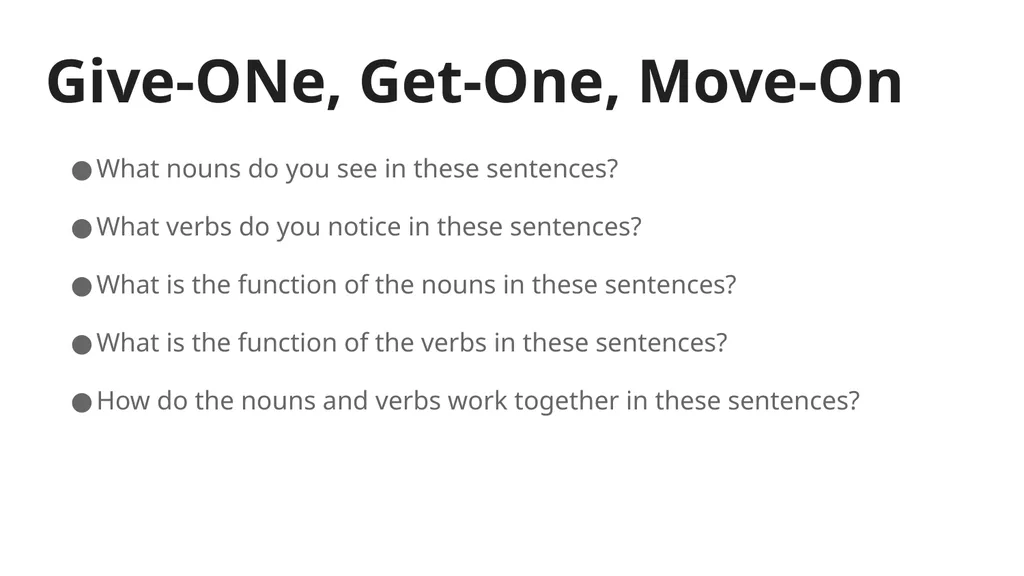
slide91. Give-ONe, Get-One, Move-On What nouns do you see in these sentences?
What verbs do you notice in these sentences?
What is the function of the nouns in these sentences?
What is the function of the verbs in these sentences?
How do the nouns and verbs work together in these sentences?<br>
slide92. Academic Vocabulary<br>
slide93. Lesson 4 Content Framing Question:
Wonder: What do I notice and wonder about Amos & Boris?<br>
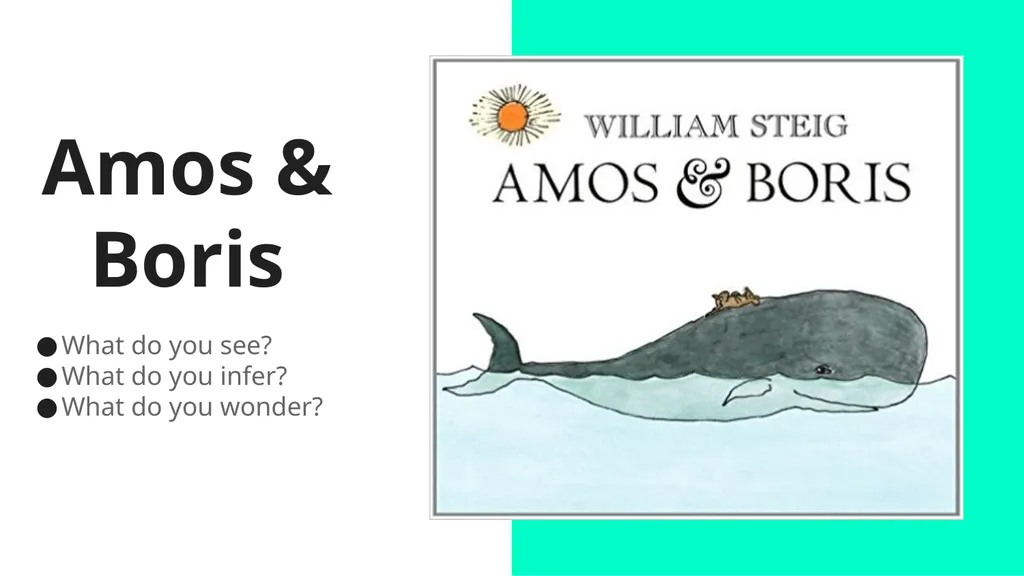
slide94. Amos & Boris What do you see?
What do you infer?
What do you wonder?<br>
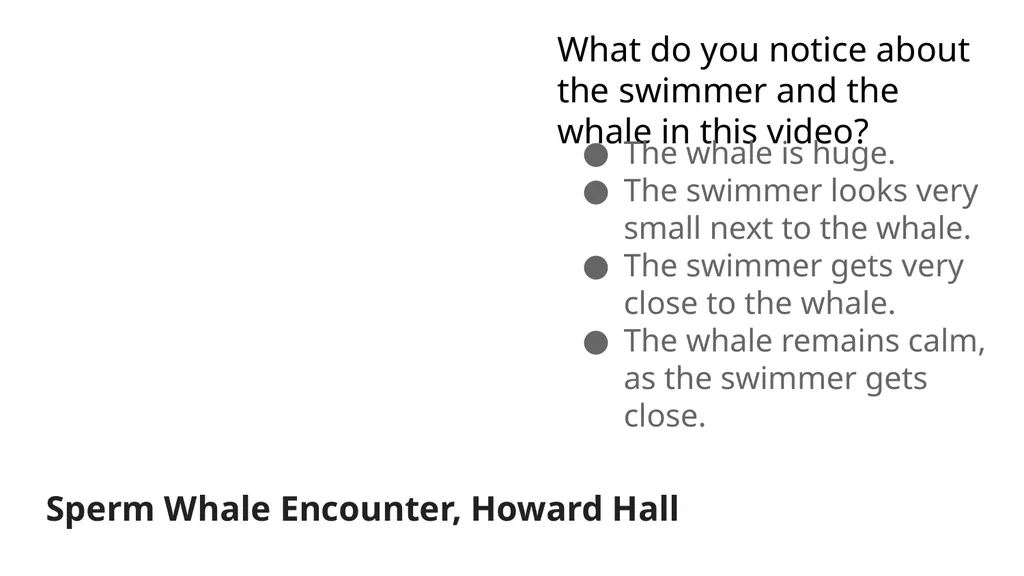
slide95. Sperm Whale Encounter, Howard Hall What do you notice about the swimmer and the whale in this video? The whale is huge.
The swimmer looks very small next to the whale.
The swimmer gets very close to the whale.
The whale remains calm, as the swimmer gets close.<br>
slide96. Think-Pair-Share Focusing Question: How do artists explore the sea?
Content Framing Question: What do I notice and wonder about Amos & Boris? How might the knowledge I learned earler help me to understand Amos & Boris?<br>
slide97. Craft Question:
Why is it important to listen and wonder?<br>
slide98. Listen & Wonder What do you think it means to listen and wonder when hearing a story or having a conversation? listening carefully to a story, without interrupting.
listening for new ideas
being curious about what you hear
really paying attention so I don’t miss anything<br>
slide99. Listen & Wonder What does listening and wondering LOOK like? Keep your eyes on the speaker.
Show you are interested through facial expressions.
Sit quietly when the speaker is expressing ideas.
Use nonverbal signals, like nodding, to express agreement.
Ask thoughtful questions after the reader finishes.<br>
slide100. Listen & Wonder Why is it important to listen and wonder? Shows respect to the reader and to the people around me
helps me because I can learn new ideas from other people
helps me ask questions<br>
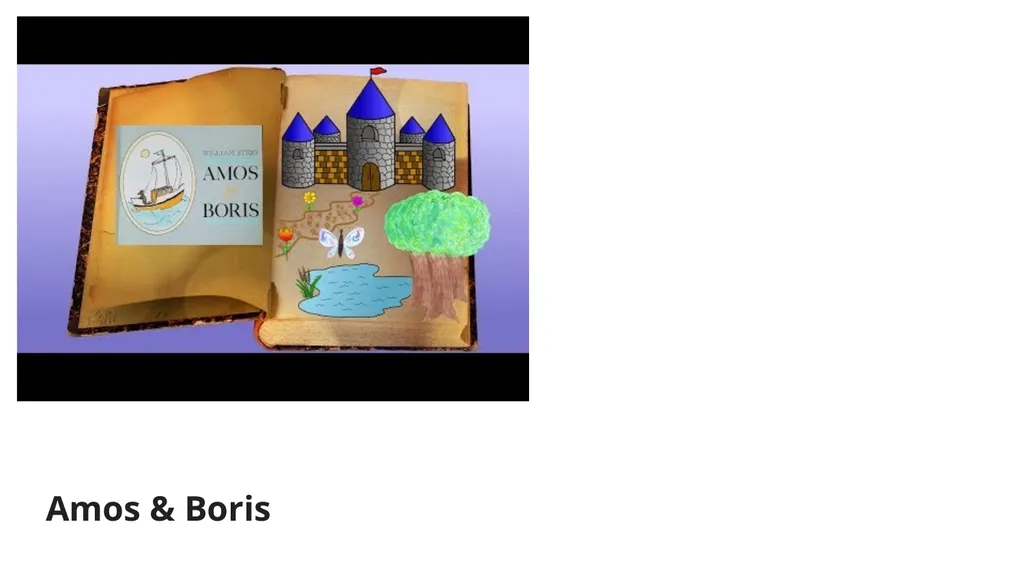
slide101. Amos & Boris<br>
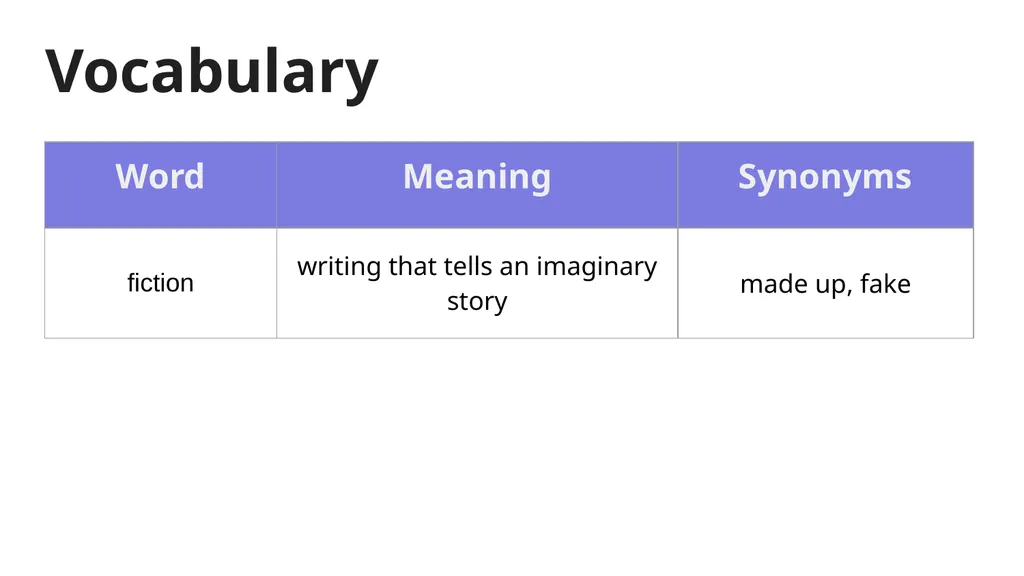
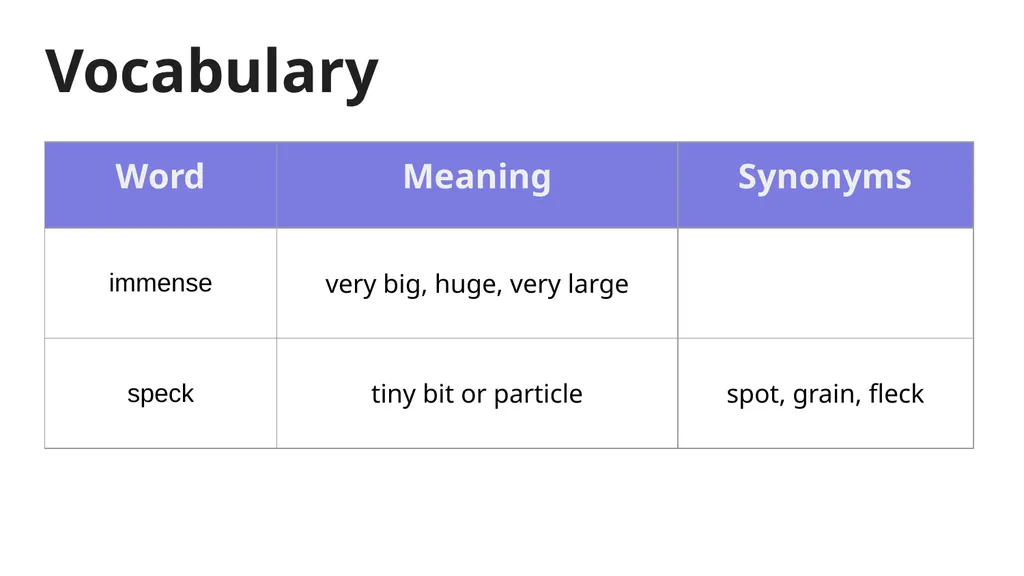
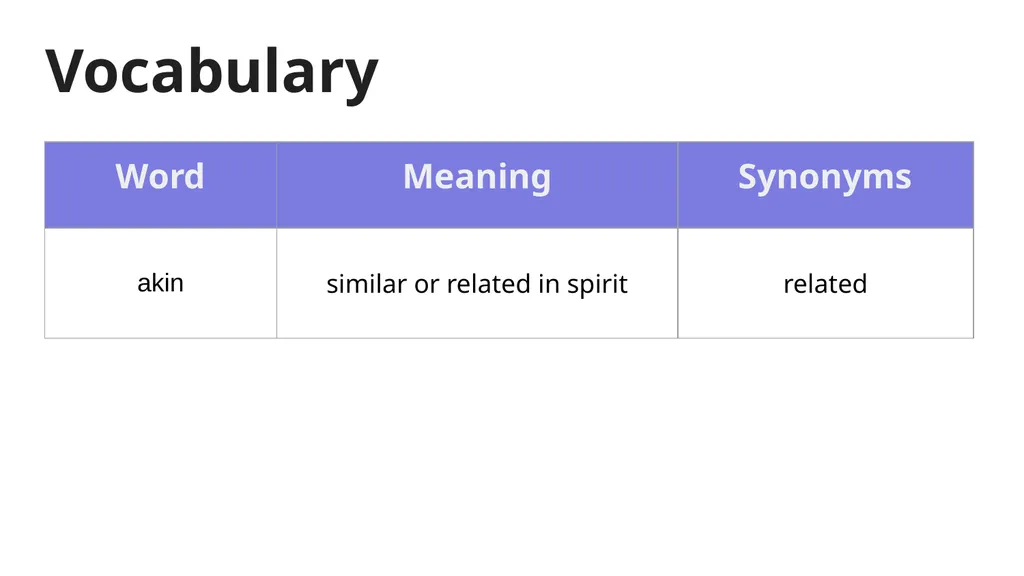
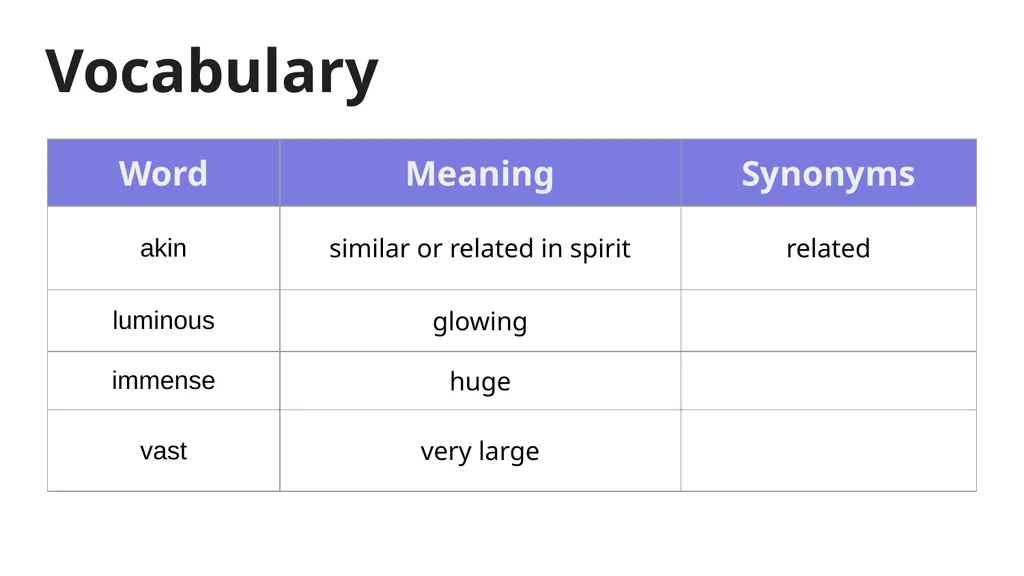
slide102. Vocabulary<br>
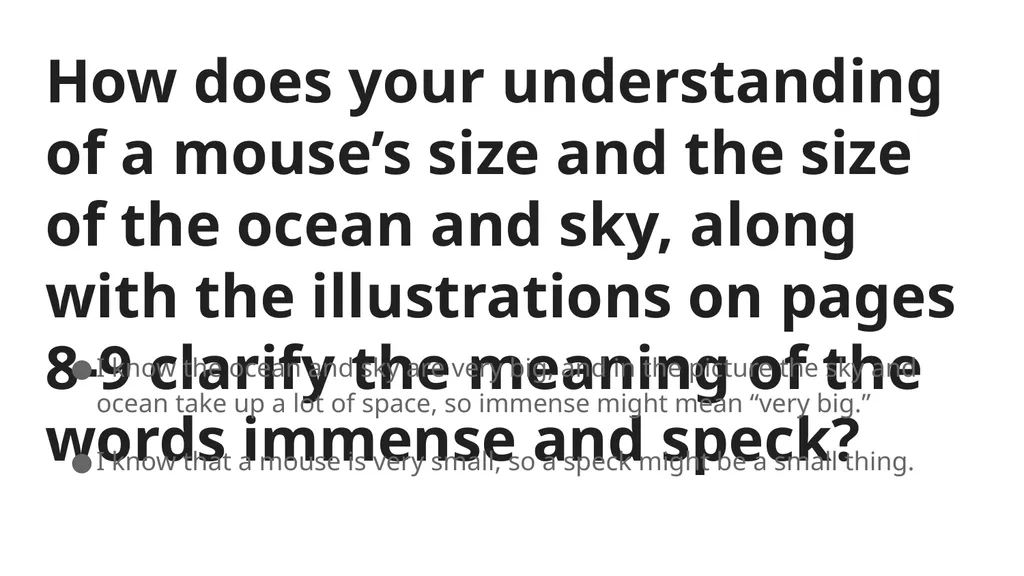
slide103. How does your understanding of a mouse’s size and the size of the ocean and sky, along with the illustrations on pages 8-9 clarify the meaning of the words immense and speck? I know the ocean and sky are very big, and in the picture the sky and ocean take up a lot of space, so immense might mean “very big.”
I know that a mouse is very small, so a speck might be a small thing.<br>
slide104. Vocabulary<br>
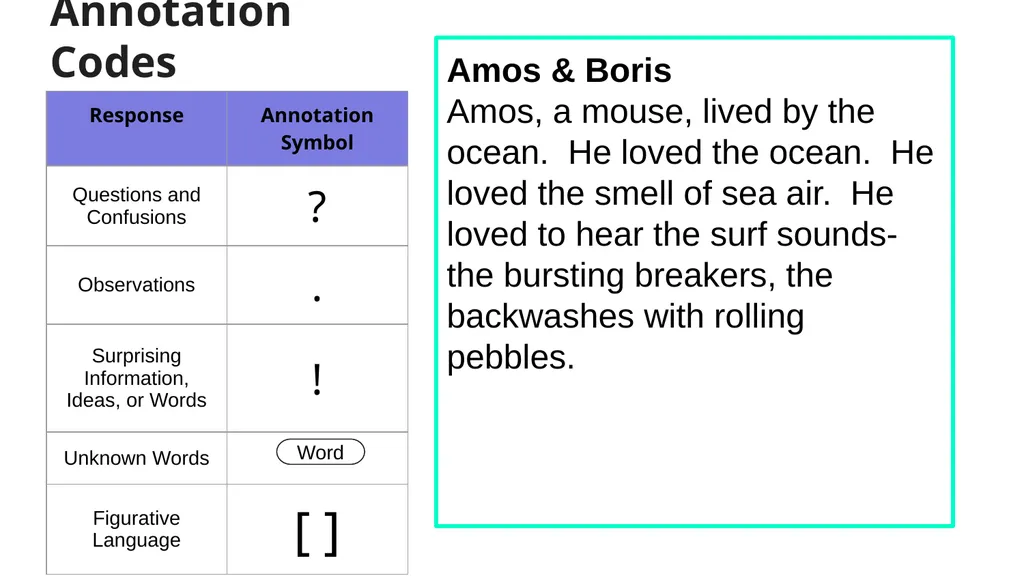
slide105. Annotation Codes Amos & Boris
Amos, a mouse, lived by the ocean. He loved the ocean. He loved the smell of sea air. He loved to hear the surf sounds- the bursting breakers, the backwashes with rolling pebbles. Word<br>
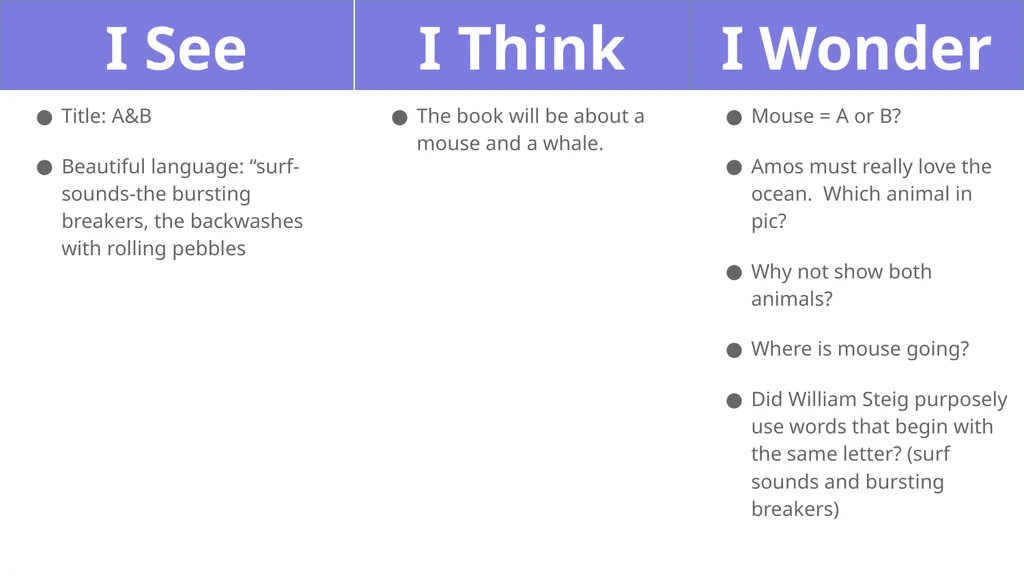
slide106. I See Title: A&B
Beautiful language: “surf-sounds-the bursting breakers, the backwashes with rolling pebbles I Think I Wonder The book will be about a mouse and a whale. Mouse = A or B?
Amos must really love the ocean. Which animal in pic?
Why not show both animals?
Where is mouse going?
Did William Steig purposely use words that begin with the same letter? (surf sounds and bursting breakers)<br>
slide107. Craft Question:
Why is reading fluently and accurately important?<br>
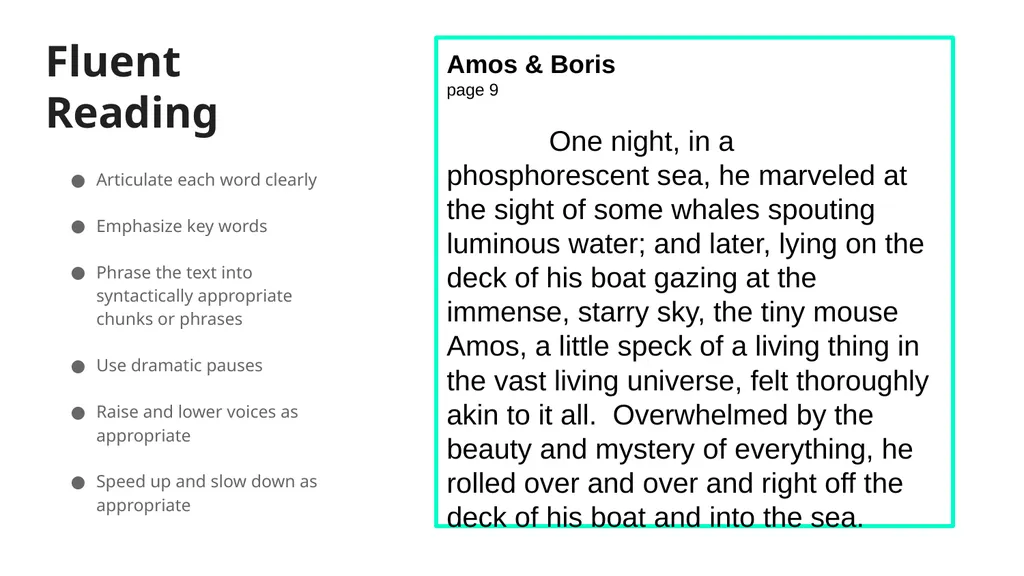
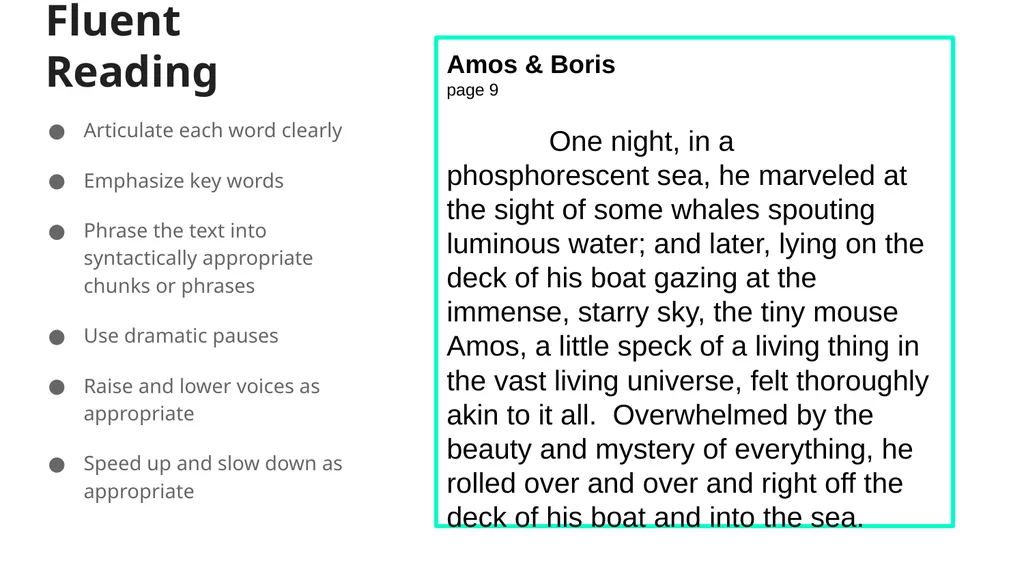
slide108. Fluent Reading Articulate each word clearly
Emphasize key words
Phrase the text into syntactically appropriate chunks or phrases
Use dramatic pauses
Raise and lower voices as appropriate
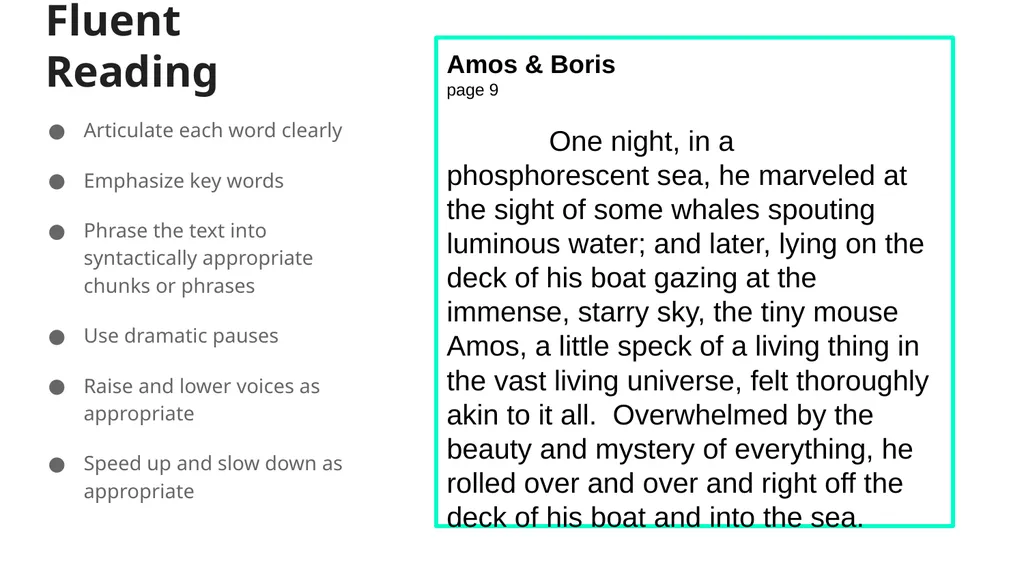
Speed up and slow down as appropriate Amos & Boris
page 9
One night, in a phosphorescent sea, he marveled at the sight of some whales spouting luminous water; and later, lying on the deck of his boat gazing at the immense, starry sky, the tiny mouse Amos, a little speck of a living thing in the vast living universe, felt thoroughly akin to it all. Overwhelmed by the beauty and mystery of everything, he rolled over and over and right off the deck of his boat and into the sea.<br>
slide109. Exit Ticket Answer the framing question. What do I notice and wonder about Amos & Boris?<br>
slide110. Dive Deep Style & Conventions:
Explore the Function of Nouns and Verbs in Sentences<br>
slide111. Craft Question:
How do nouns and verbs function in sentences?<br>
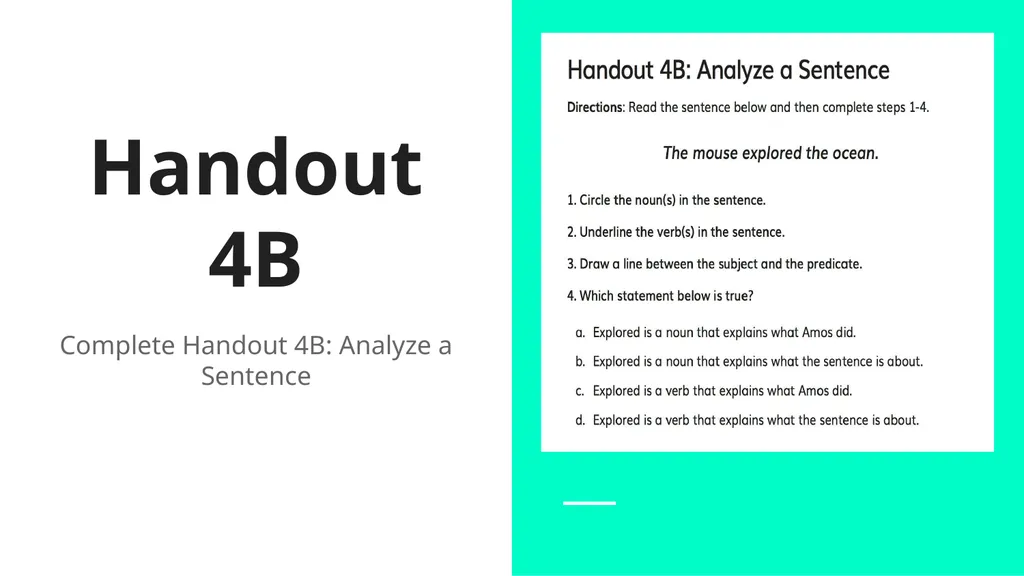
slide112. Handout 4B Complete Handout 4B: Analyze a Sentence<br>
slide113. Lesson 5 Content Framing Question:
Organize: What’s happening in Amos & Boris?<br>
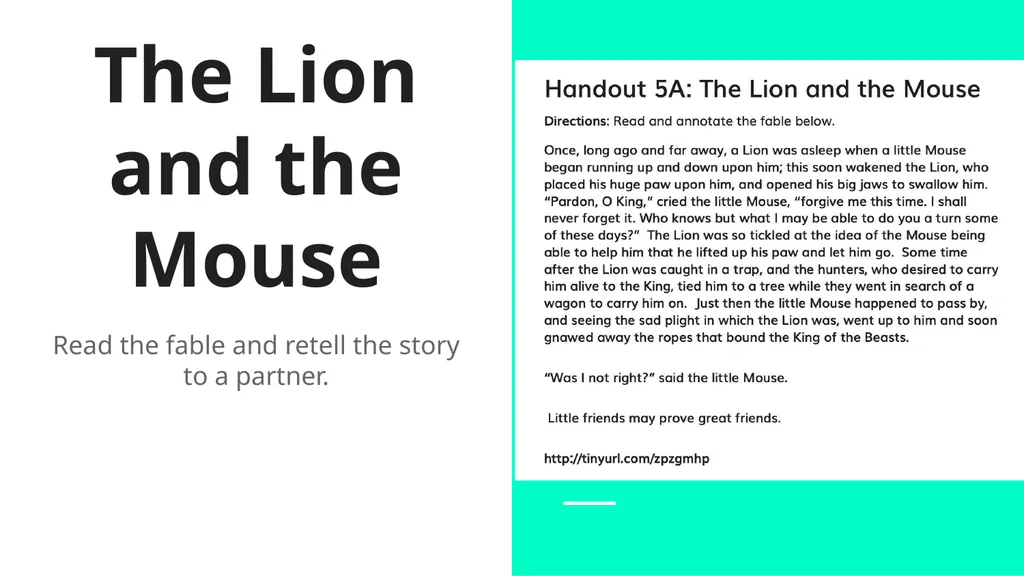
slide114. The Lion and the Mouse Read the fable and retell the story to a partner.<br>
slide115. What details from the story did you include in your retelling? Characters
Setting
Sequence of events in the correct order
Problem and Solution
Central Message<br>
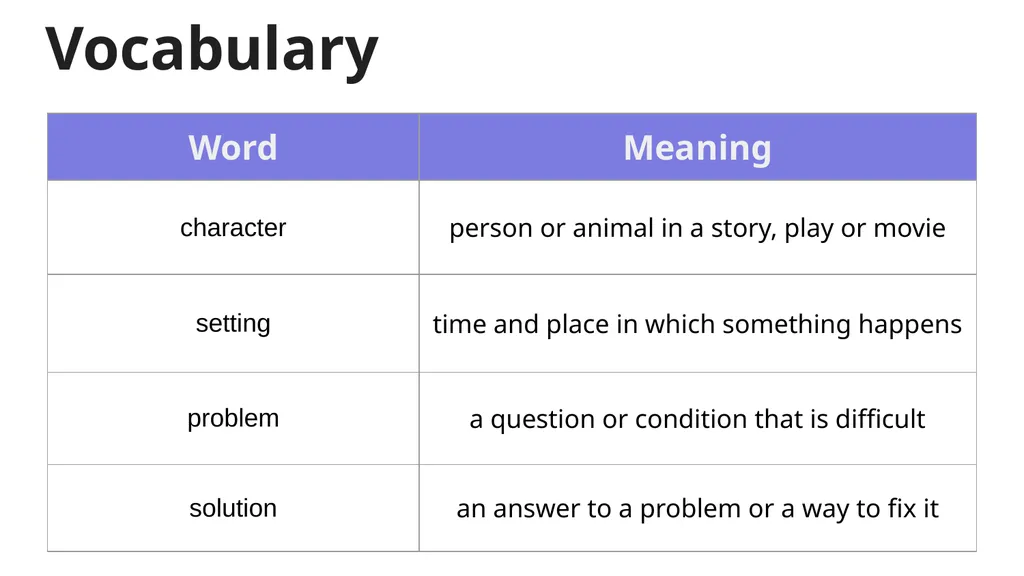
slide116. Vocabulary<br>
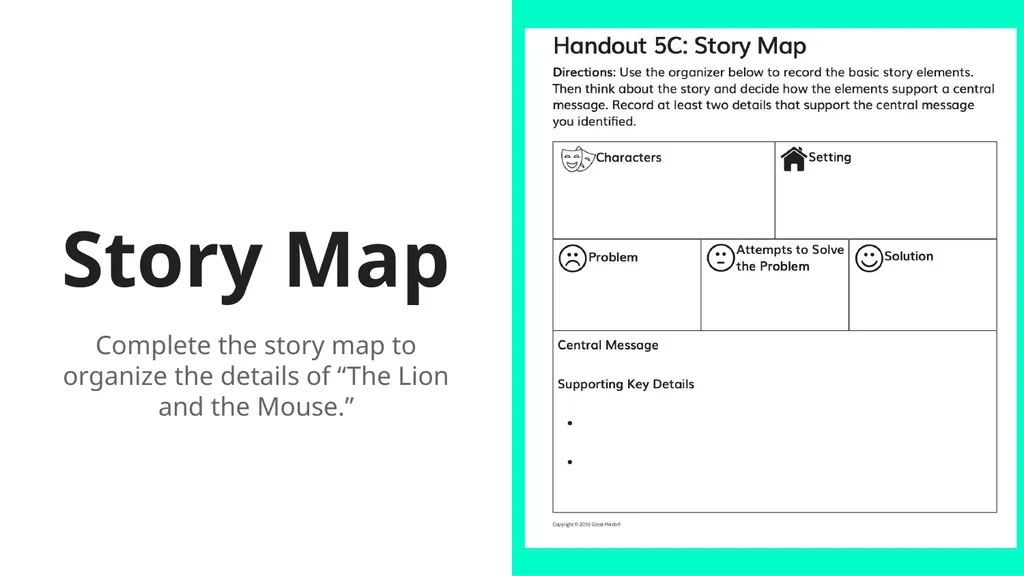
slide117. Story Map Complete the story map to organize the details of “The Lion and the Mouse.”<br>
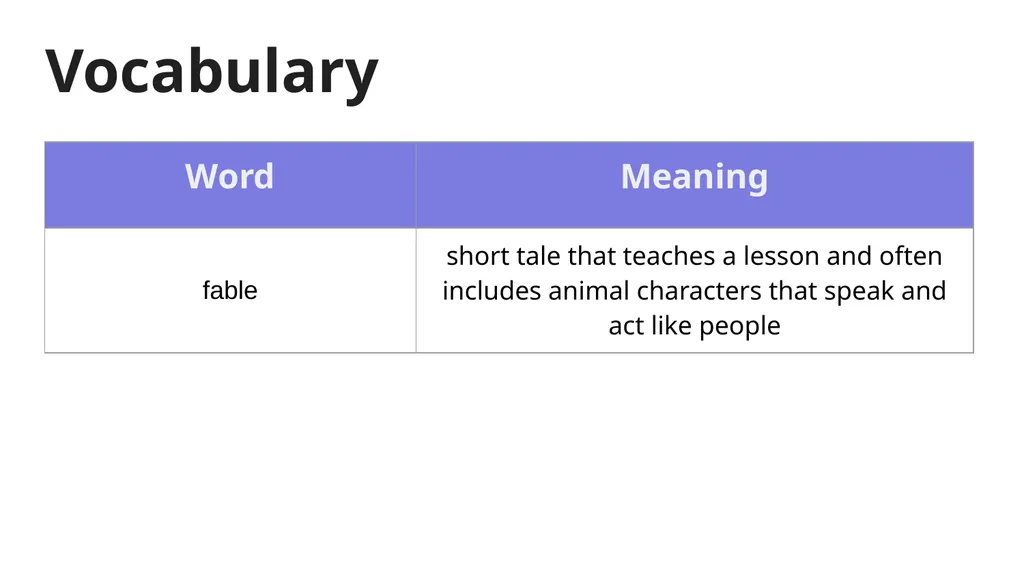
slide118. Vocabulary<br>
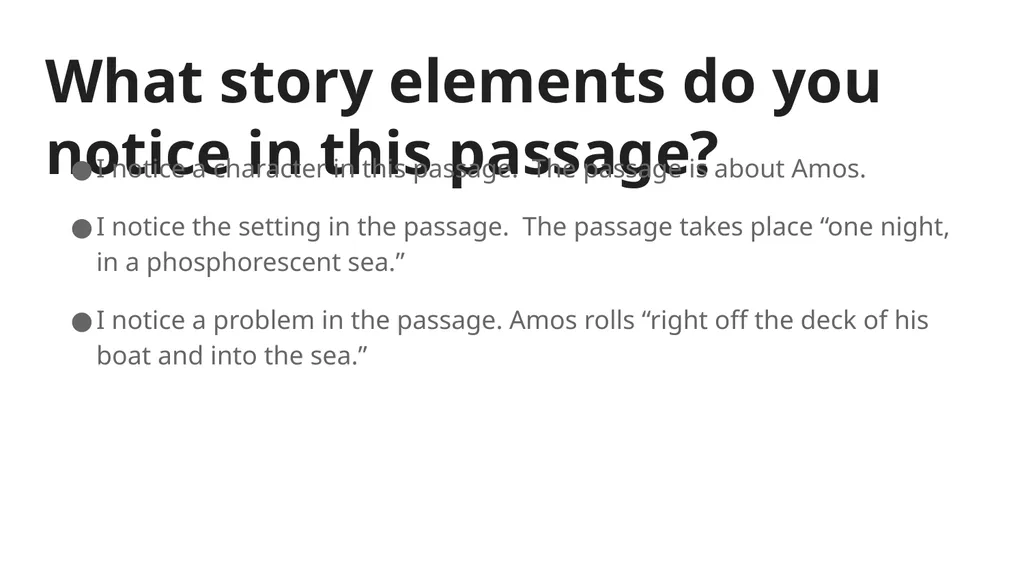
slide119. What story elements do you notice in this passage? I notice a character in this passage. The passage is about Amos.
I notice the setting in the passage. The passage takes place “one night, in a phosphorescent sea.”
I notice a problem in the passage. Amos rolls “right off the deck of his boat and into the sea.”<br>
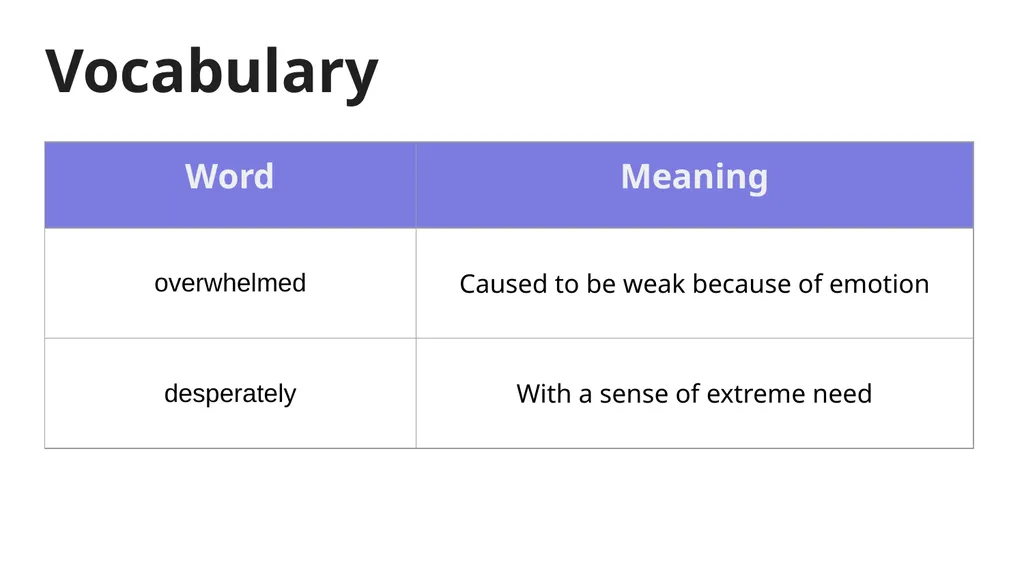
slide120. How does your knowledge of Amos’ character and the setting help clarify the meaning of the word overwhelmed? The sea and sky are very large and beautiful, so Amos pays attention to them instead of where he is on the deck.
Overwhelmed might mean “cause to be weak because of emotion.”<br>
slide121. How do the words and illustrations explaining Amos’ attempts to catch the Rodent clarify the meaning of the word desperately? The text says Amos was squeaking “Help!” and trying to grab the boat, so desperately might mean “in a way that shows great need.”
The illustration shows Amos looking a little scared as he tries to grab the rope, so desperately might mean “in great need.”<br>
slide122. Vocabulary<br>
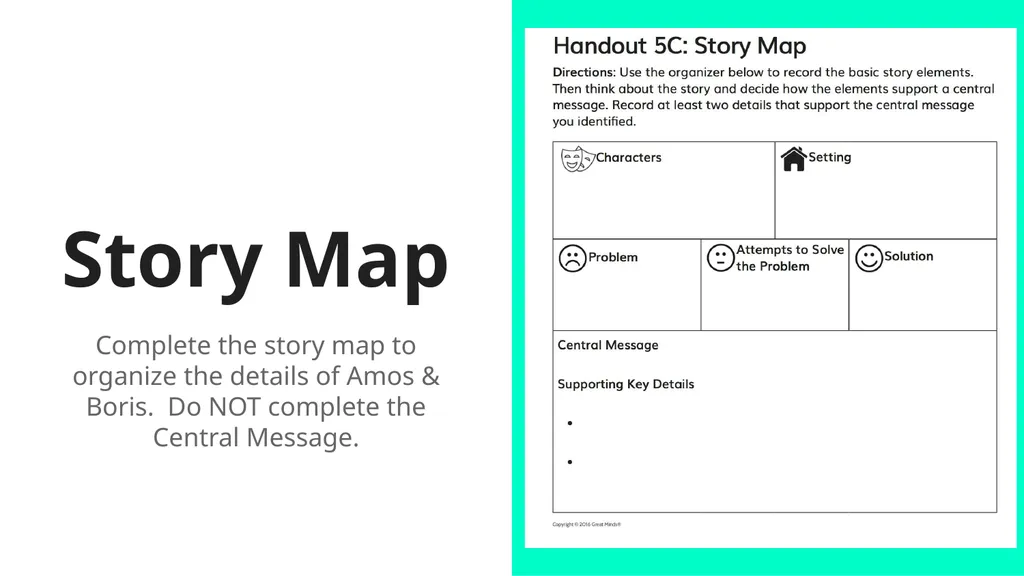
slide123. Story Map Complete the story map to organize the details of Amos & Boris. Do NOT complete the Central Message.<br>
slide124. Craft Question:
Why is grouping related information together important?<br>
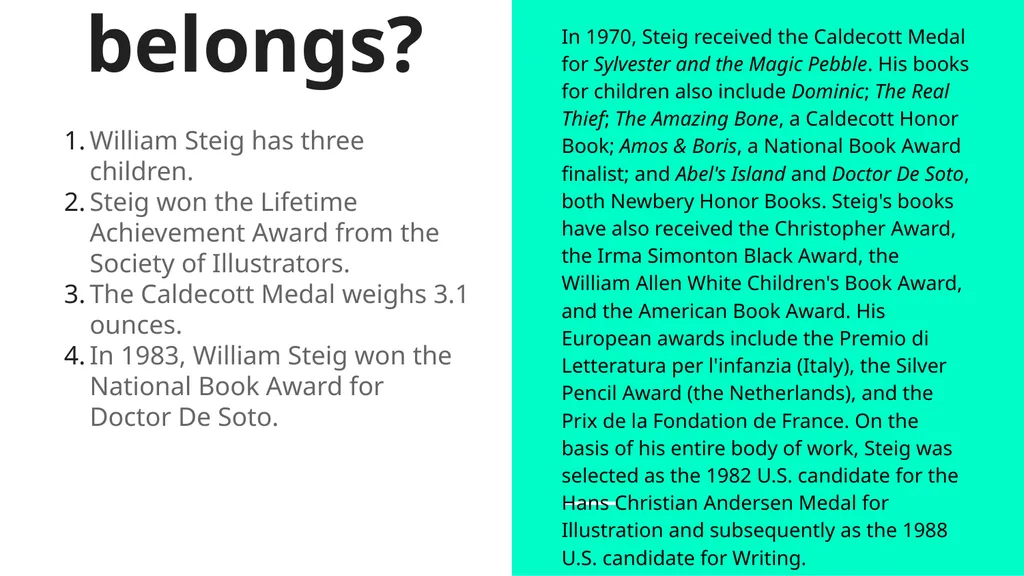
slide125. William Steig, Author and Illustrator William Steig (1907-2003) was a cartoonist, illustrator and author of award-winning books for children, including Shrek!, on which the DreamWorks movies are based. Steig was born in New York City. Every member of his family was involved in the arts, and so it was no surprise when he decided to become an artist. He attended City College and the National Academy of Design. In 1930, Steig's work began appearing in The New Yorker, where his drawings have been a popular fixture ever since. He published his first children's book, Roland the Minstrel Pig, in 1968.
In 1970, Steig received the Caldecott Medal for Sylvester and the Magic Pebble. His books for children also include Dominic; The Real Thief; The Amazing Bone, a Caldecott Honor Book; Amos & Boris, a National Book Award finalist; and Abel's Island and Doctor De Soto, both Newbery Honor Books. Steig's books have also received the Christopher Award, the Irma Simonton Black Award, the William Allen White Children's Book Award, and the American Book Award. His European awards include the Premio di Letteratura per l'infanzia (Italy), the Silver Pencil Award (the Netherlands), and the Prix de la Fondation de France. On the basis of his entire body of work, Steig was selected as the 1982 U.S. candidate for the Hans Christian Andersen Medal for Illustration and subsequently as the 1988 U.S. candidate for Writing.
Stieg also published thirteen collections of drawings for adults, beginning with About People in 1939, and including The Lonely Ones, Male/Female, The Agony in the Kindergarten, and Our Miserable Life.
He died in Boston at the age of 95.<br>
slide126. Which one belongs? William Steig has three children.
Steig won the Lifetime Achievement Award from the Society of Illustrators.
The Caldecott Medal weighs 3.1 ounces.
In 1983, William Steig won the National Book Award for Doctor De Soto. In 1970, Steig received the Caldecott Medal for Sylvester and the Magic Pebble. His books for children also include Dominic; The Real Thief; The Amazing Bone, a Caldecott Honor Book; Amos & Boris, a National Book Award finalist; and Abel's Island and Doctor De Soto, both Newbery Honor Books. Steig's books have also received the Christopher Award, the Irma Simonton Black Award, the William Allen White Children's Book Award, and the American Book Award. His European awards include the Premio di Letteratura per l'infanzia (Italy), the Silver Pencil Award (the Netherlands), and the Prix de la Fondation de France. On the basis of his entire body of work, Steig was selected as the 1982 U.S. candidate for the Hans Christian Andersen Medal for Illustration and subsequently as the 1988 U.S. candidate for Writing.<br>
slide127. Craft Question:
Why is using phrasing important?<br>
slide128. Fluent Reading Articulate each word clearly
Emphasize key words
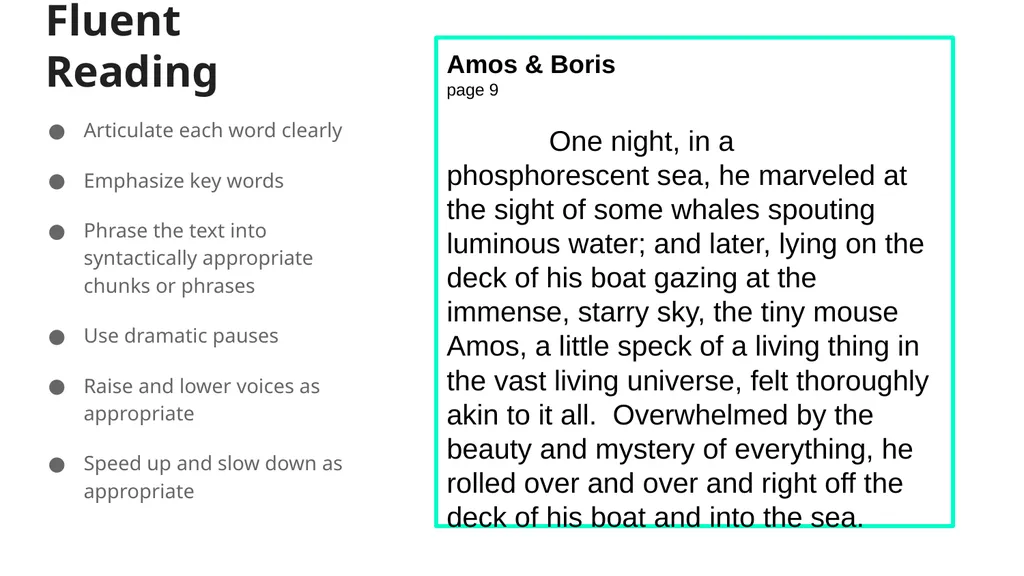
Phrase the text into syntactically appropriate chunks or phrases
Use dramatic pauses
Raise and lower voices as appropriate
Speed up and slow down as appropriate Amos & Boris
page 9
One night, in a phosphorescent sea, he marveled at the sight of some whales spouting luminous water; and later, lying on the deck of his boat gazing at the immense, starry sky, the tiny mouse Amos, a little speck of a living thing in the vast living universe, felt thoroughly akin to it all. Overwhelmed by the beauty and mystery of everything, he rolled over and over and right off the deck of his boat and into the sea.<br>
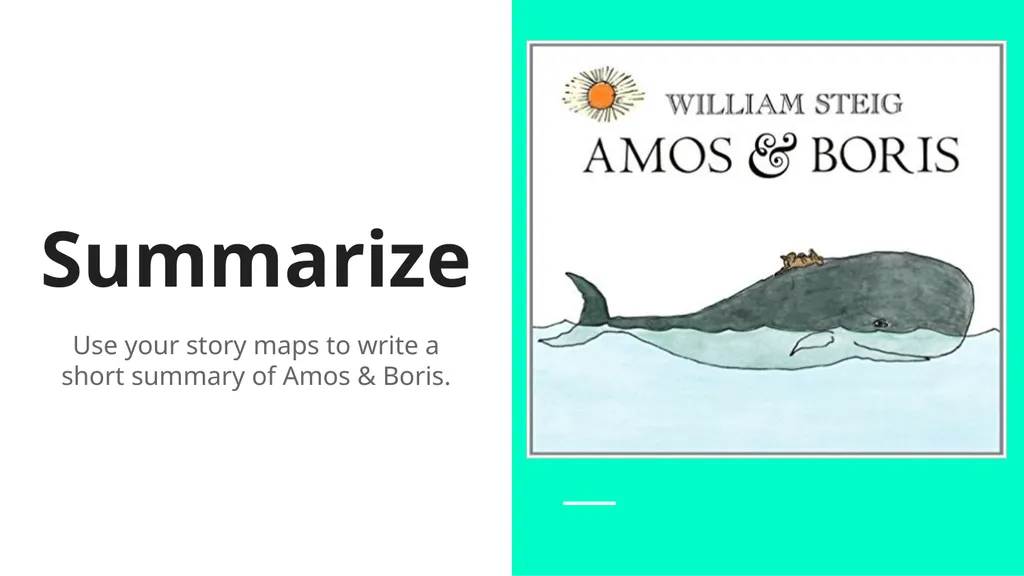
slide129. Summarize Use your story maps to write a short summary of Amos & Boris.<br>
slide130. Dive Deep Style & Conventions:
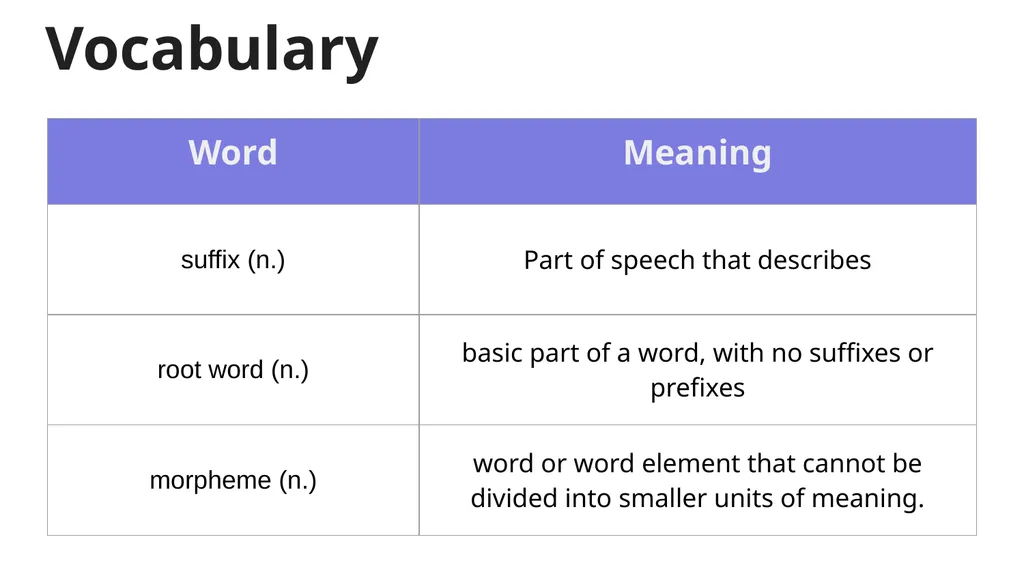
Examine the Meaning and Function of Adverbs?<br>
slide131. “Help!” he squeaked as he grabbed desperately at the Rodent. What word in the sentence describes HOW Amos grabbed for the boat?<br>
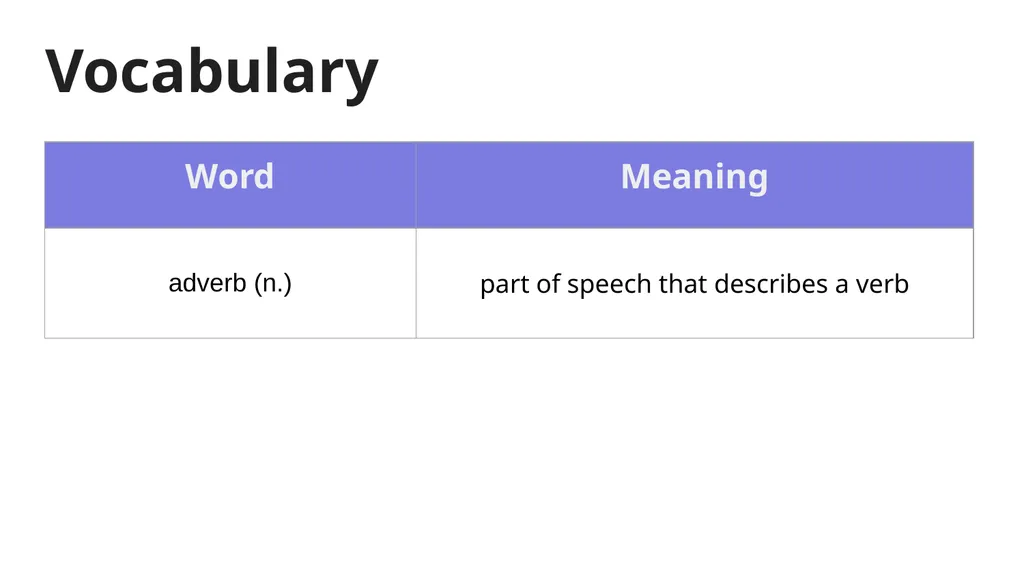
slide132. Vocabulary<br>
slide133. Vocabulary<br>
slide134. Craft Question:
Why are morphemes important?<br>
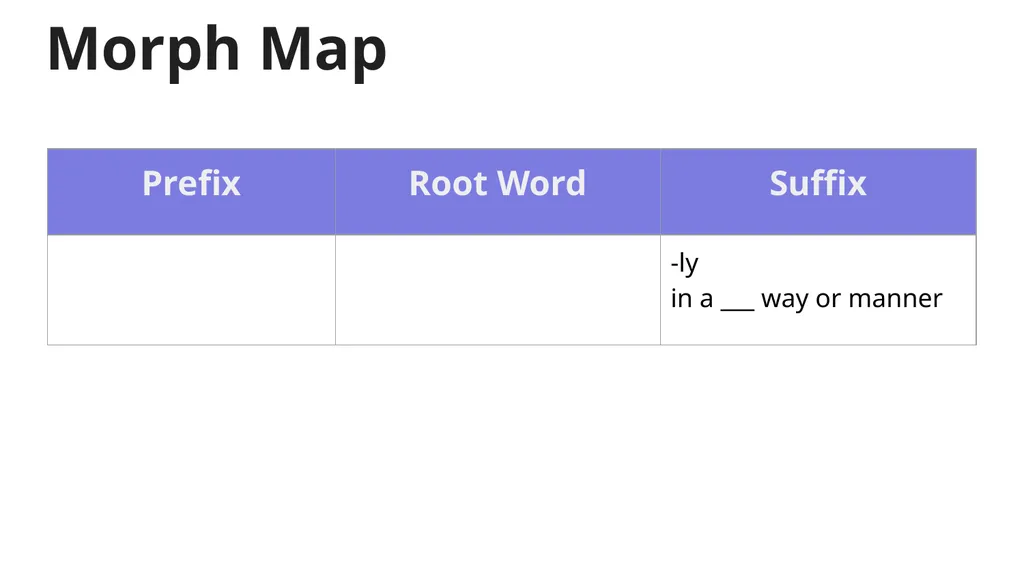
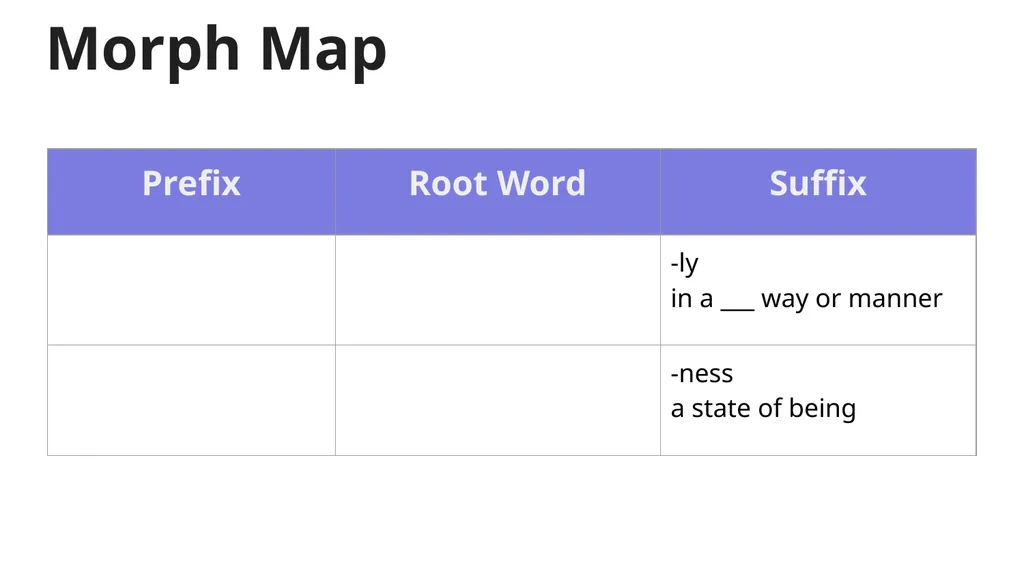
slide135. Morph Map<br>
slide136. Words with the -ly suffix immensely (pg.7)
thoroughly (pg. 9)
desperately (pg. 10, 25)
terribly (pg. 12, 21)
quickly (pg. 17)
quietly (pg. 17)
slowly (pg. 18)
leisurely (pg. 18)
suddenly (pg. 25) word
root and part of speech
definition
formula
word in context from book
explain the context of the sentence in your own words (summarize) Handout 5D:
Words with -ly suffix<br>
slide137. Lesson 6 Content Framing Question:
Reveal: What does a deeper exploration of William Steig’s word choices and illustrations reveal in Amos & Boris?<br>
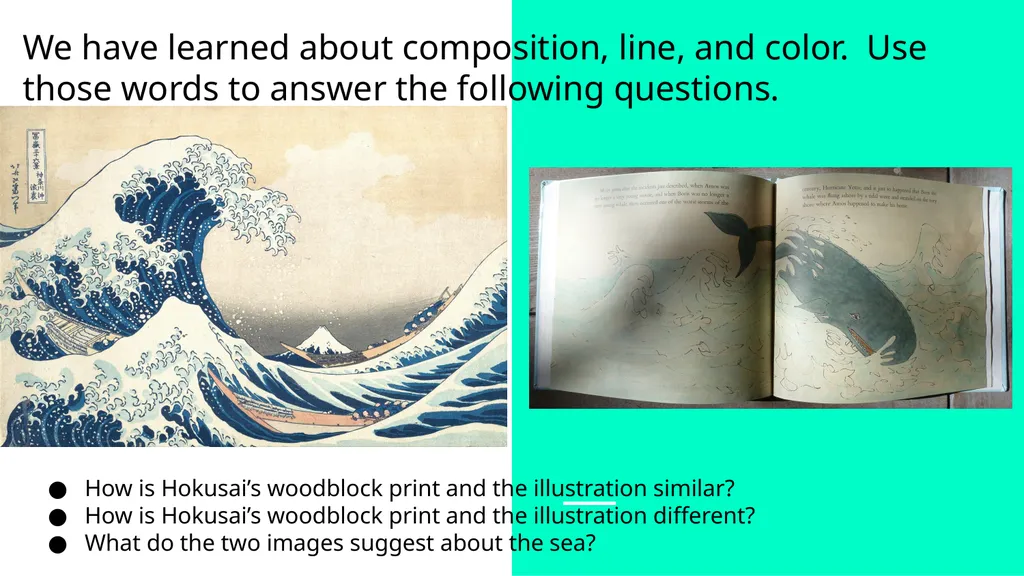
slide138. We have learned about composition, line, and color. Use those words to answer the following questions. How is Hokusai’s woodblock print and the illustration similar?
How is Hokusai’s woodblock print and the illustration different?
What do the two images suggest about the sea?<br>
slide139. Focusing and Content Framing Question How do artists explore the sea? Reveal: What does a deeper exploration of William Steig’s word choices and illustrations reveal in Amos& Boris?<br>
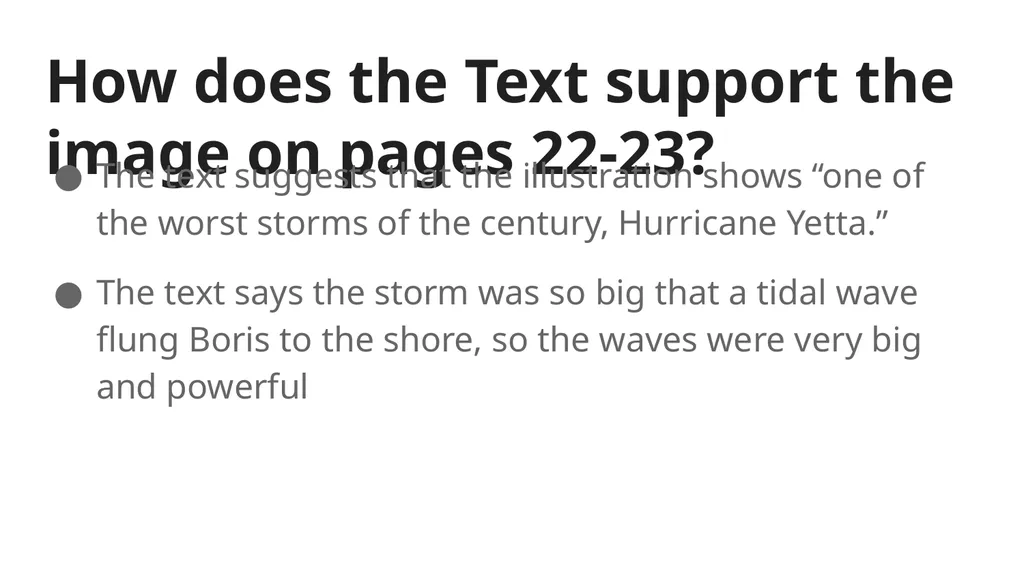
slide140. How does the Text support the image on pages 22-23? The text suggests that the illustration shows “one of the worst storms of the century, Hurricane Yetta.”
The text says the storm was so big that a tidal wave flung Boris to the shore, so the waves were very big and powerful<br>
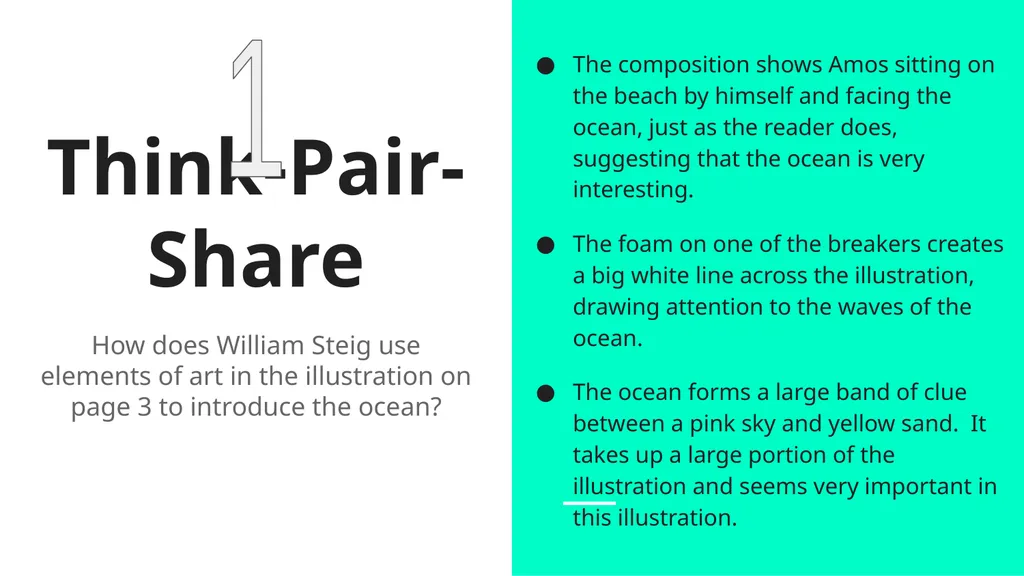
slide141. Think-Pair-Share How does William Steig use elements of art in the illustration on page 3 to introduce the ocean? The composition shows Amos sitting on the beach by himself and facing the ocean, just as the reader does, suggesting that the ocean is very interesting.
The foam on one of the breakers creates a big white line across the illustration, drawing attention to the waves of the ocean.
The ocean forms a large band of clue between a pink sky and yellow sand. It takes up a large portion of the illustration and seems very important in this illustration. 1<br>
slide142. Think-Pair-Share How does William Steig use word choices on page 3 to introduce the ocean? The text says that Amos “loved the ocean,” suggesting that the ocean is very special.
The text says, “He [Amos] loved the smell of the sea air. He loved to hear the surf sounds - the bursting breakers, the backwashes with rolling pebbles.” The details explain some of the reasons the ocean is special. 2<br>
slide143. Think-Pair-Share How does William Steig use word choices on page 3 to introduce the ocean? The text says that Amos “loved the ocean,” suggesting that the ocean is very special.
The text says, “He [Amos] loved the smell of the sea air. He loved to hear the surf sounds - the bursting breakers, the backwashes with rolling pebbles.” The details explain some of the reasons the ocean is special. 3<br>
slide144. Think-Pair-Share What words do you notice on page 9 that are important, interesting, or confusing? phosphorescent
marveled
spouting
luminous
gazing
thoroughly
akin 4<br>
slide145. Think-Pair-Share How does William Steig’s use of language and the elements of art on pages 8 and 9 help you understand the meaning of the word akin? William Steig says Amos “felt thoroughly akin” to the universe, so akin must describe a relationship of some sort.
The sky, the water, and the whales are all the shades of blue and make them seem all part of one element.
A line showing an ocean wave moves from Amos’s boat to a whale in the middle of the picture on page 9, making it seem as though the boat and the whale are connected in some way.
The word choices and images suggest that akin means similar or related in spirit 5<br>
slide146. Vocabulary<br>
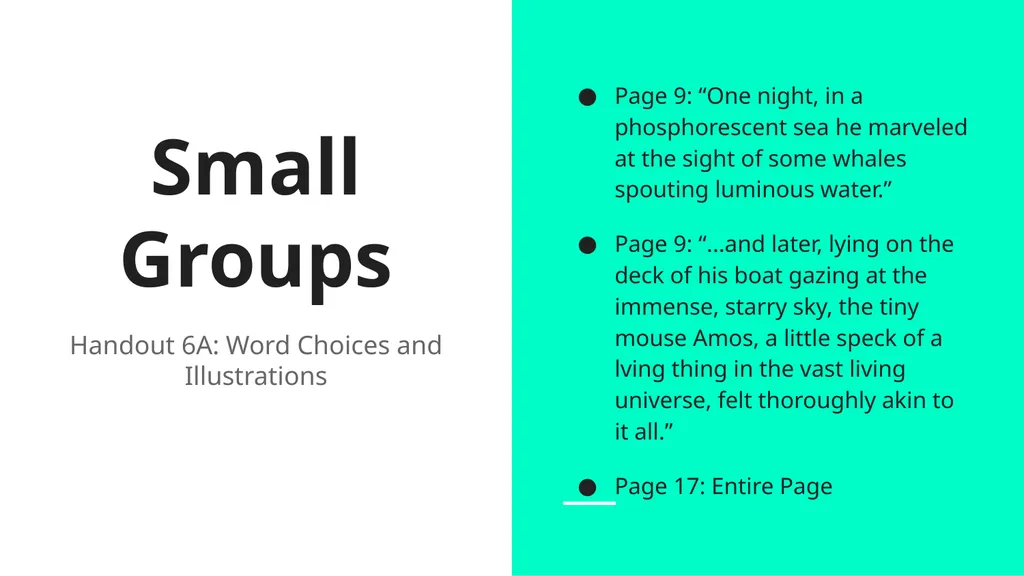
slide147. Small Groups Handout 6A: Word Choices and Illustrations Page 9: “One night, in a phosphorescent sea he marveled at the sight of some whales spouting luminous water.”
Page 9: “...and later, lying on the deck of his boat gazing at the immense, starry sky, the tiny mouse Amos, a little speck of a lving thing in the vast living universe, felt thoroughly akin to it all.”
Page 17: Entire Page<br>
slide148. Vocabulary<br>
slide149. Craft Question:
How does grouping related information together work?<br>
slide150. Describe Your Knowledge to a TEE<br>
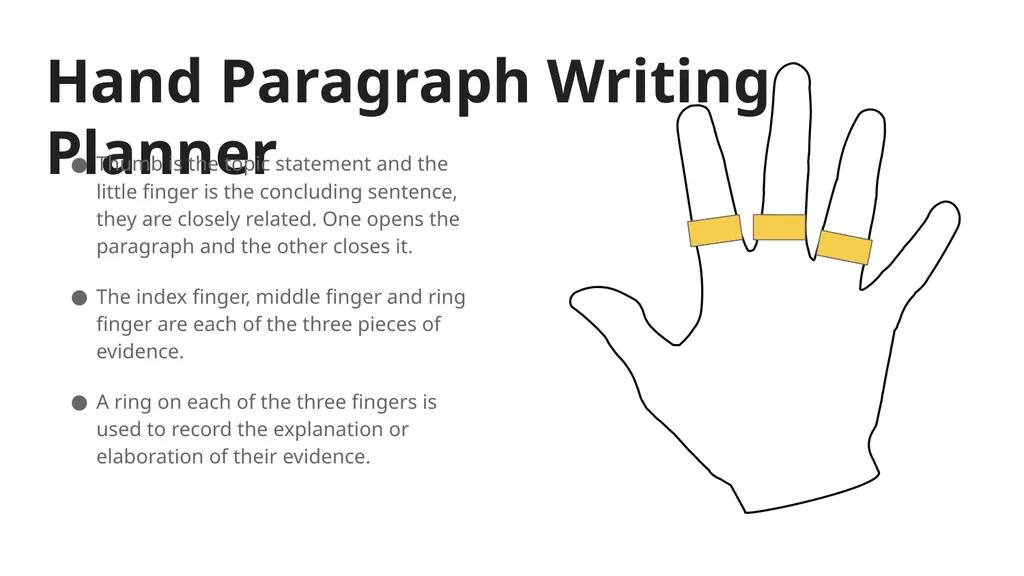
slide151. Hand Paragraph Writing Planner Thumb is the topic statement and the little finger is the concluding sentence, they are closely related. One opens the paragraph and the other closes it.
The index finger, middle finger and ring finger are each of the three pieces of evidence.
A ring on each of the three fingers is used to record the explanation or elaboration of their evidence.<br>
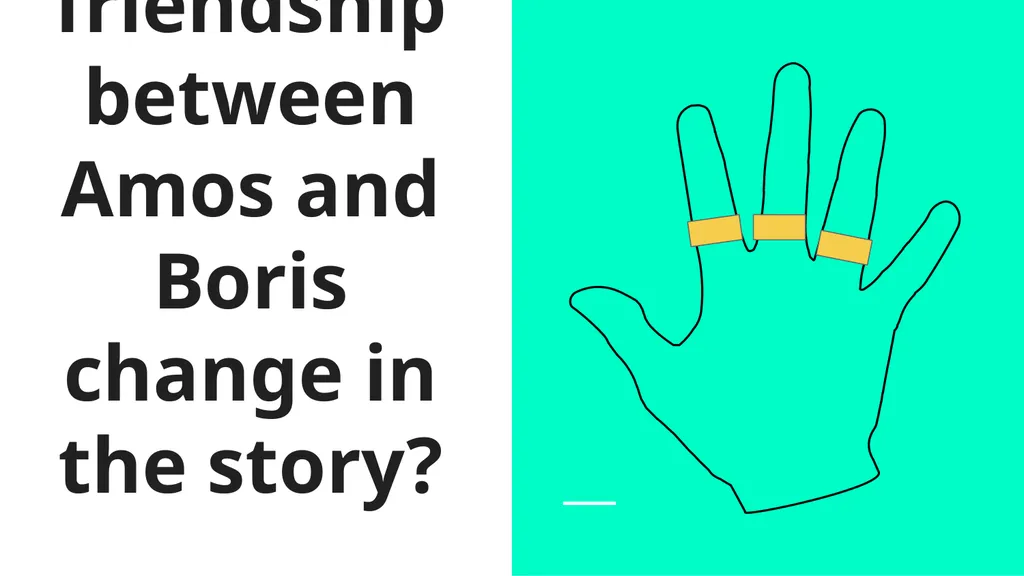
slide152. How does the friendship between Amos and Boris change in the story?<br>
slide153. Craft Question:
Why is reading with expression important?<br>
slide154. Fluent Reading Articulate each word clearly
Emphasize key words
Phrase the text into syntactically appropriate chunks or phrases
Use dramatic pauses
Raise and lower voices as appropriate
Speed up and slow down as appropriate Amos & Boris
page 9
One night, in a phosphorescent sea, he marveled at the sight of some whales spouting luminous water; and later, lying on the deck of his boat gazing at the immense, starry sky, the tiny mouse Amos, a little speck of a living thing in the vast living universe, felt thoroughly akin to it all. Overwhelmed by the beauty and mystery of everything, he rolled over and over and right off the deck of his boat and into the sea.<br>
slide155. Dive Deep Style & Conventions:
Examine Capital Letters in Titles<br>
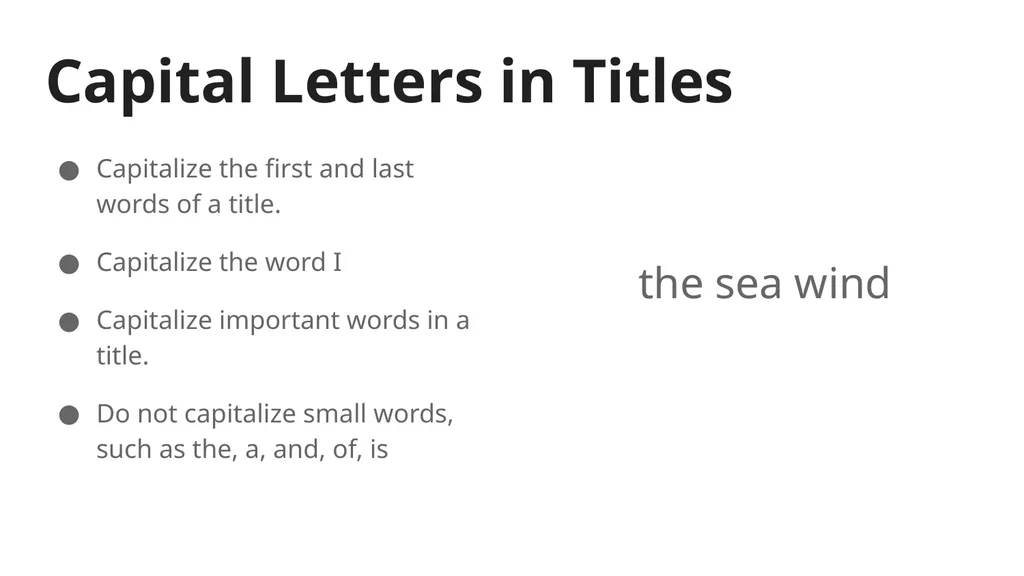
slide156. Capital Letters in Titles Capitalize the first and last words of a title.
Capitalize the word I
Capitalize important words in a title.
Do not capitalize small words, such as the, a, and, of, is the sea wind<br>
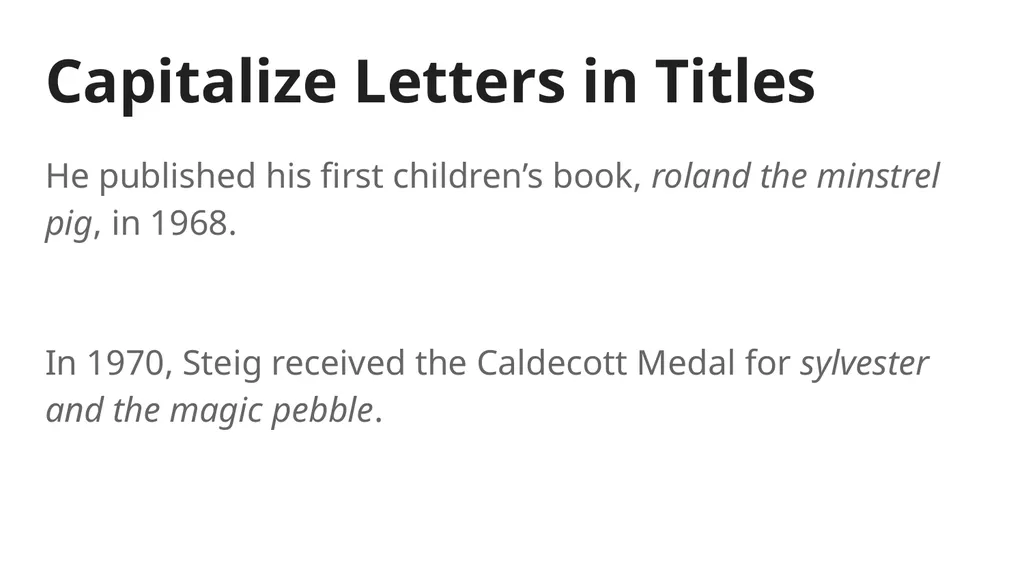
slide157. Capitalize Letters in Titles He published his first children’s book, roland the minstrel pig, in 1968.
In 1970, Steig received the Caldecott Medal for sylvester and the magic pebble.<br>
slide158. Lesson 7 Content Framing Question:
Distill: What is the central message of Amos & Boris?<br>
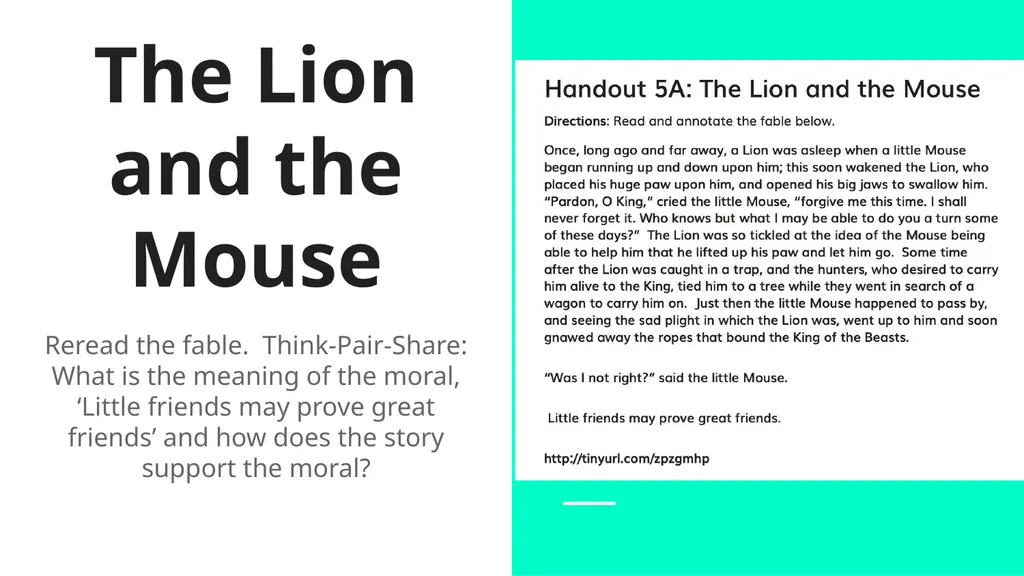
slide159. The Lion and the Mouse Reread the fable. Think-Pair-Share:
What is the meaning of the moral, ‘Little friends may prove great friends’ and how does the story support the moral?<br>
slide160. The Lion and the Mouse
Story Map How do the events support the fable’s moral, “Little friends may prove great friends.”?<br>
slide161. Agreeing and Disagreeing Respectfully Choose a cue card with a sentence stem.
Discuss a text-dependent question while the other students practice carrying out the role on their card.
When students start a new text-dependent question, other students pass their role card to the right.<br>
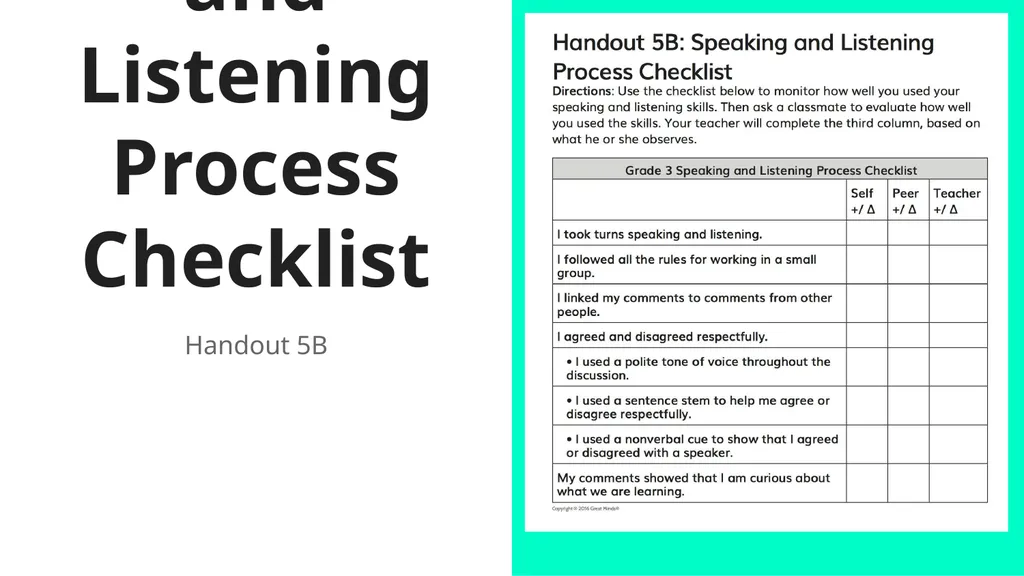
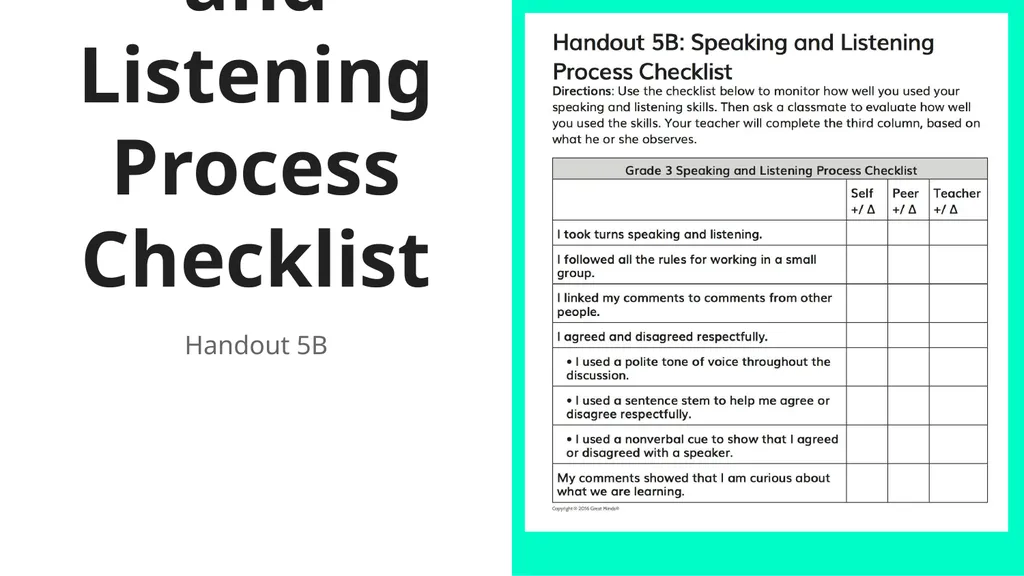
slide162. Speaking and Listening Process Checklist Handout 5B<br>
slide163. How did you identify a central message in ‘The Sea Wind,’ in the pieces of art, and in ‘The Lion and the Mouse’? Use your notes in your journals and handouts. noticed repeated words and ideas in the poem
thought about the poet’s word choice and figurative language
noticed the composition, line, and color of the art
noticed how the events of a story showed how a small friend could make a big difference<br>
slide164. Amos & Boris
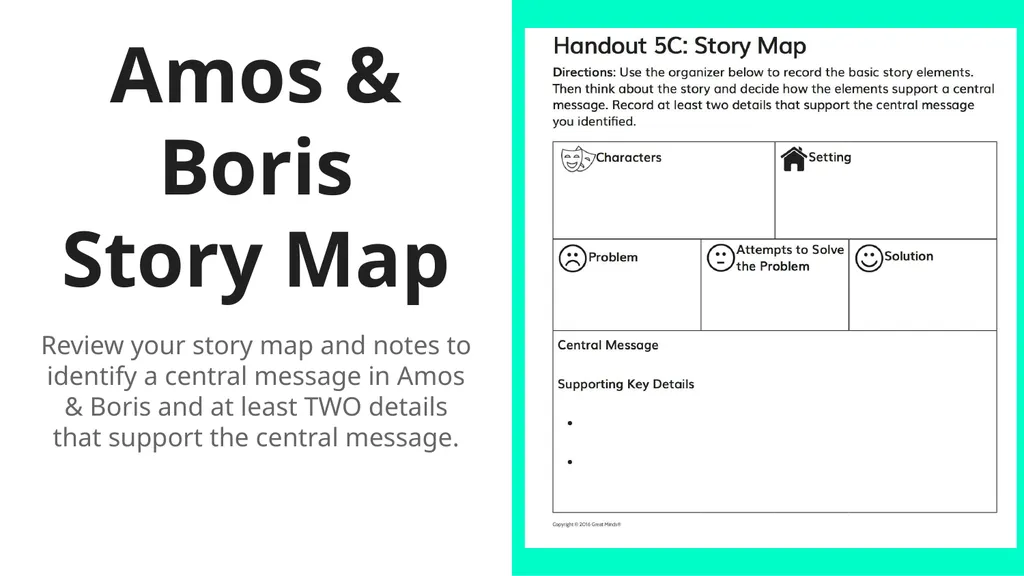
Story Map Review your story map and notes to identify a central message in Amos & Boris and at least TWO details that support the central message.<br>
slide165. Speaking and Listening Process Checklist Handout 5B<br>
slide166. Fluent Reading Articulate each word clearly
Emphasize key words
Phrase the text into syntactically appropriate chunks or phrases
Use dramatic pauses
Raise and lower voices as appropriate
Speed up and slow down as appropriate Amos & Boris
page 9
One night, in a phosphorescent sea, he marveled at the sight of some whales spouting luminous water; and later, lying on the deck of his boat gazing at the immense, starry sky, the tiny mouse Amos, a little speck of a living thing in the vast living universe, felt thoroughly akin to it all. Overwhelmed by the beauty and mystery of everything, he rolled over and over and right off the deck of his boat and into the sea.<br>
slide167. Respond to a Prompt Reread page 30 of Amos & Boris. Then review the central message you identified on your story map. Explain how the conclusion of the book supports the central message you identified?<br>
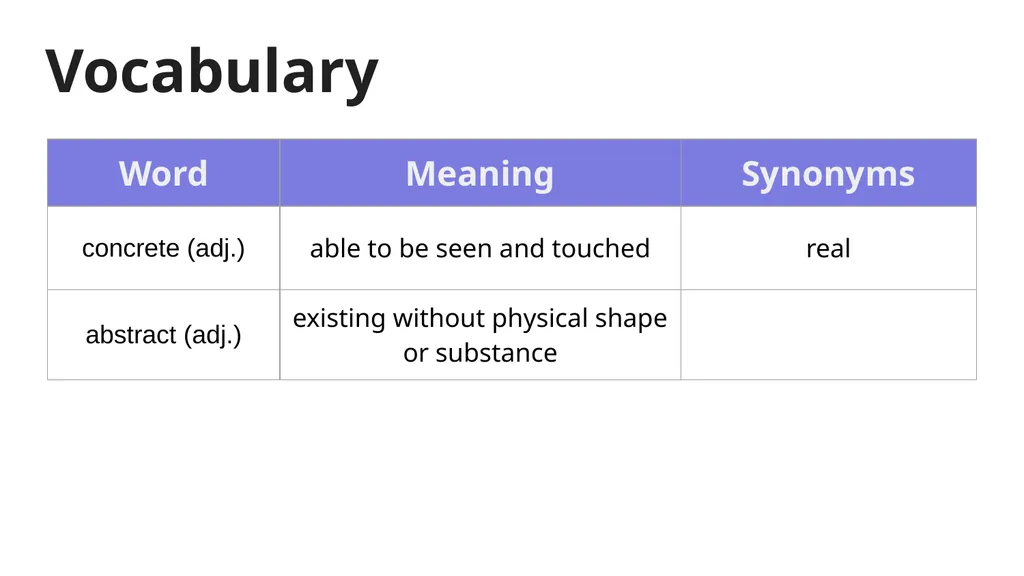
slide168. Dive Deep Vocabulary:
Experiment with Abstract Nouns<br>
slide169. What do you notice about the nouns in these sentences? “And Amos, after one miserable day of seasickness, proved to be a natural sailor, very well suited to the ship.”
“At last the rain stopped and the noonday sun gave him a bit of cheer and warmth in the vast loneliness; but his strength was giving out.”
“Boris admired the delicacy, the quivering daintiness, the light touch, the small voice, the gemlike radiance of the mouse.”
“Amos admired the bulk, the grandeur, the power, the purpose, the rich voice and the abounding friendliness of the whale.”<br>
slide170. Vocabulary<br>
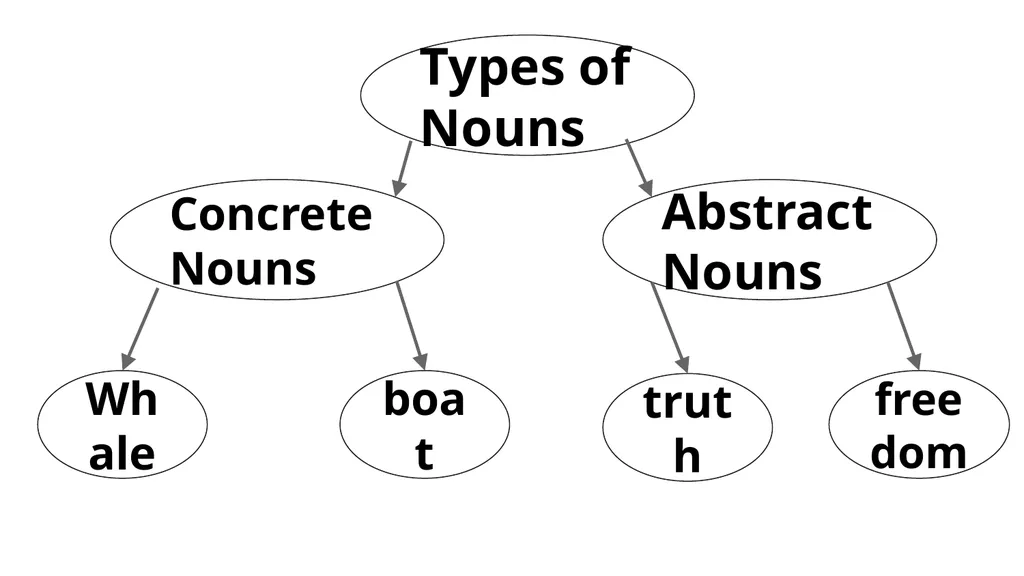
slide171. Types of Nouns<br>
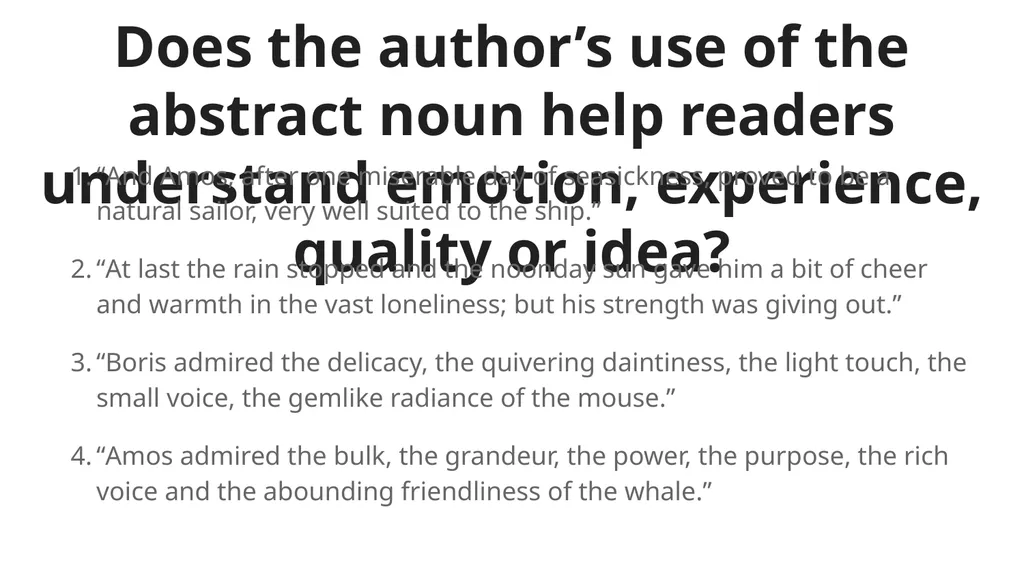
slide172. Does the author’s use of the abstract noun help readers understand emotion, experience, quality or idea? “And Amos, after one miserable day of seasickness, proved to be a natural sailor, very well suited to the ship.”
“At last the rain stopped and the noonday sun gave him a bit of cheer and warmth in the vast loneliness; but his strength was giving out.”
“Boris admired the delicacy, the quivering daintiness, the light touch, the small voice, the gemlike radiance of the mouse.”
“Amos admired the bulk, the grandeur, the power, the purpose, the rich voice and the abounding friendliness of the whale.”<br>
slide173. Morph Map<br>
slide174. Lesson 8 Content Framing Question:
Knowledge: How does poetry and art build my knowledge of the sea?<br>
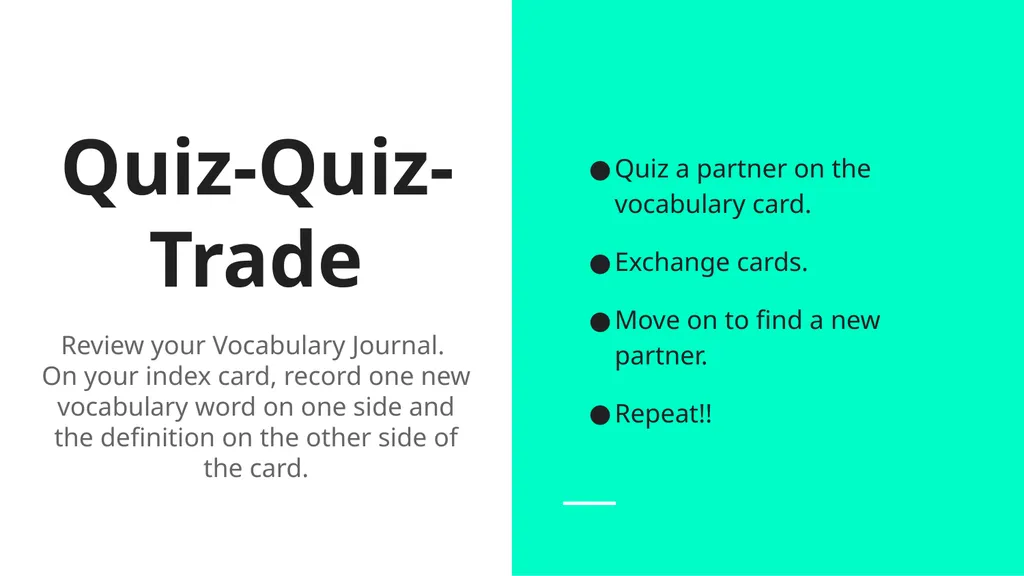
slide175. Quiz-Quiz-Trade Review your Vocabulary Journal. On your index card, record one new vocabulary word on one side and the definition on the other side of the card. Quiz a partner on the vocabulary card.
Exchange cards.
Move on to find a new partner.
Repeat!!<br>
slide176. Essential Question: Why do people explore the sea? Focusing Question:
How do artists explore the sea? Content Framing Question: Knowledge: How does poetry and art build my knowledge of the sea?<br>
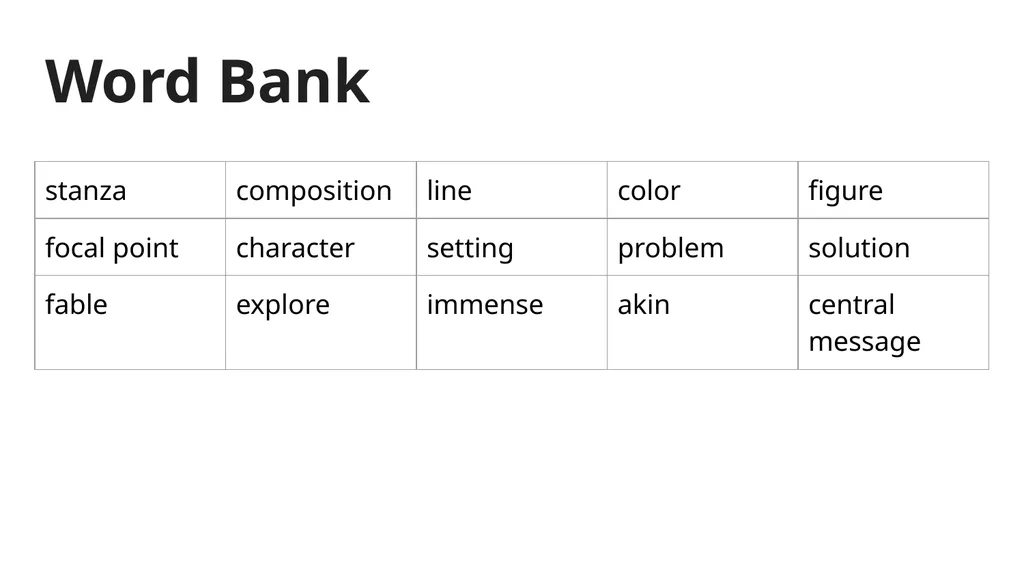
slide177. Word Bank<br>
slide178. Gallery Walk At each station, groups record on the chart paper how the artwork or poem adds to their understanding of the sea.
Try not to duplicate something another group said.
Use words from the word bank to analyze the pieces of art.<br>
slide179. Craft Question:
How do I agree and disagree respectfully in a Socratic Seminar?<br>
slide180. What are some ways you can agree or disagree in a class discussion? Use a polite tone of voice, even when I disagree.
Use nonverbal signals to show I agree with someone instead of interrupting.
Raise a finger to show I’d like to disagree.
Use sentence frames.<br>
slide181. How do artists explore the sea?<br>
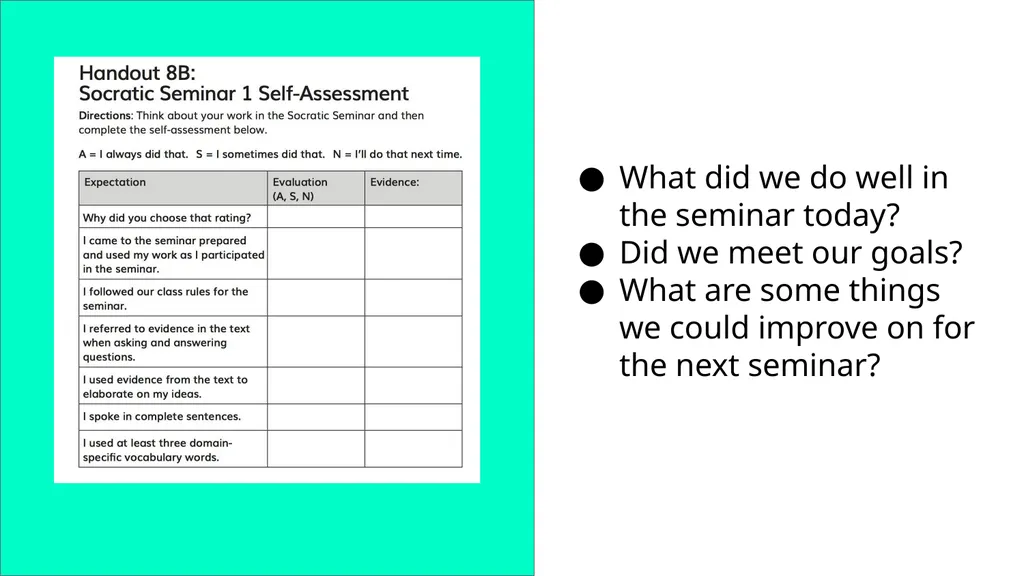
slide182. What did we do well in the seminar today?
Did we meet our goals?
What are some things we could improve on for the next seminar?<br>
slide183. Craft Question:
How do I group related information together in an explanatory paragraph?<br>
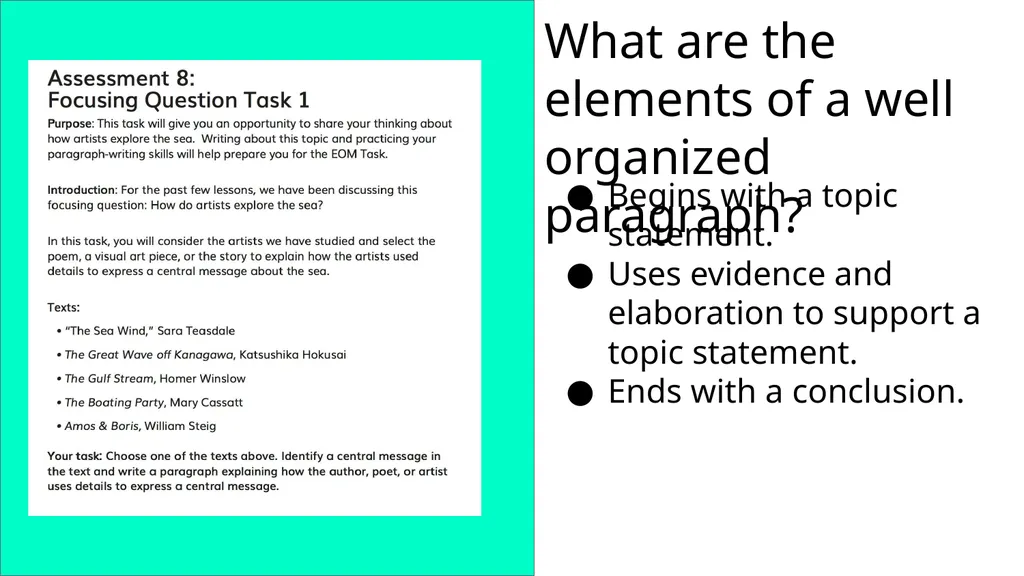
slide184. What are the elements of a well organized paragraph? Begins with a topic statement.
Uses evidence and elaboration to support a topic statement.
Ends with a conclusion.<br>
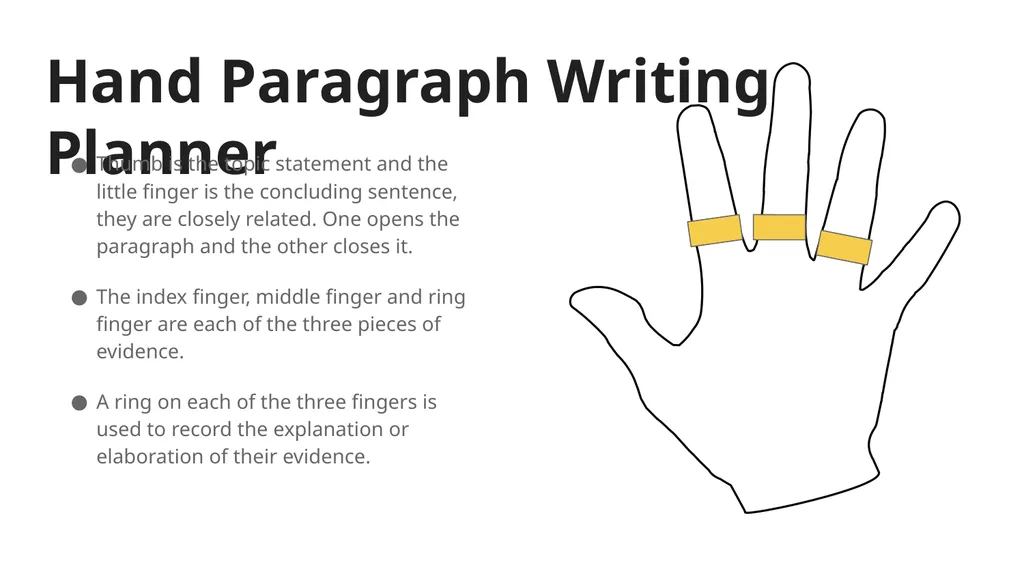
slide185. Hand Paragraph Writing Planner Thumb is the topic statement and the little finger is the concluding sentence, they are closely related. One opens the paragraph and the other closes it.
The index finger, middle finger and ring finger are each of the three pieces of evidence.
A ring on each of the three fingers is used to record the explanation or elaboration of their evidence.<br>
slide186. Fluent Reading Articulate each word clearly
Emphasize key words
Phrase the text into syntactically appropriate chunks or phrases
Use dramatic pauses
Raise and lower voices as appropriate
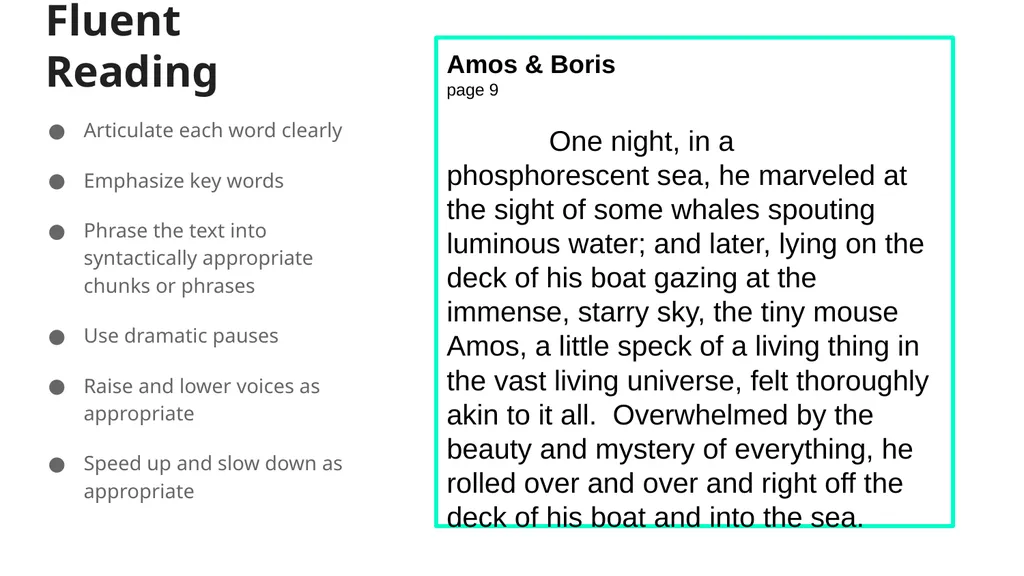
Speed up and slow down as appropriate Amos & Boris
page 9
One night, in a phosphorescent sea, he marveled at the sight of some whales spouting luminous water; and later, lying on the deck of his boat gazing at the immense, starry sky, the tiny mouse Amos, a little speck of a living thing in the vast living universe, felt thoroughly akin to it all. Overwhelmed by the beauty and mystery of everything, he rolled over and over and right off the deck of his boat and into the sea.<br>
slide187. How does poetry and art build my knowledge of the sea? Record at least three things you have learned so far.<br>
slide188. Deep Dive Style and Conventions:
Examine forming and using possessives<br>
slide189. Who has?<br>
slide190. Craft Question:
Why are possessives important? Possessive nouns show ownership or possession.<br>
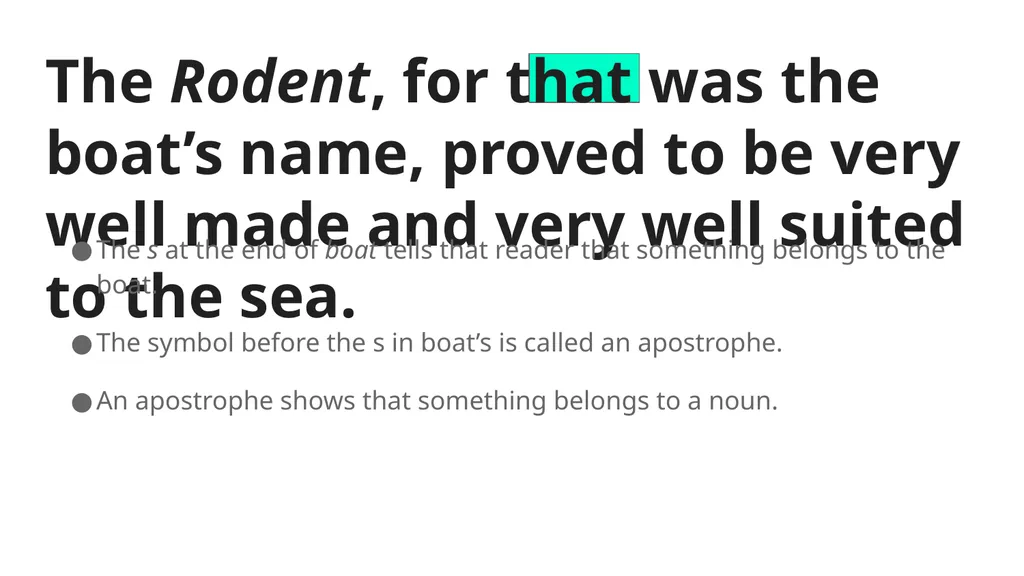
slide191. The Rodent, for that was the boat’s name, proved to be very well made and very well suited to the sea. The s at the end of boat tells that reader that something belongs to the boat.
The symbol before the s in boat’s is called an apostrophe.
An apostrophe shows that something belongs to a noun.<br>
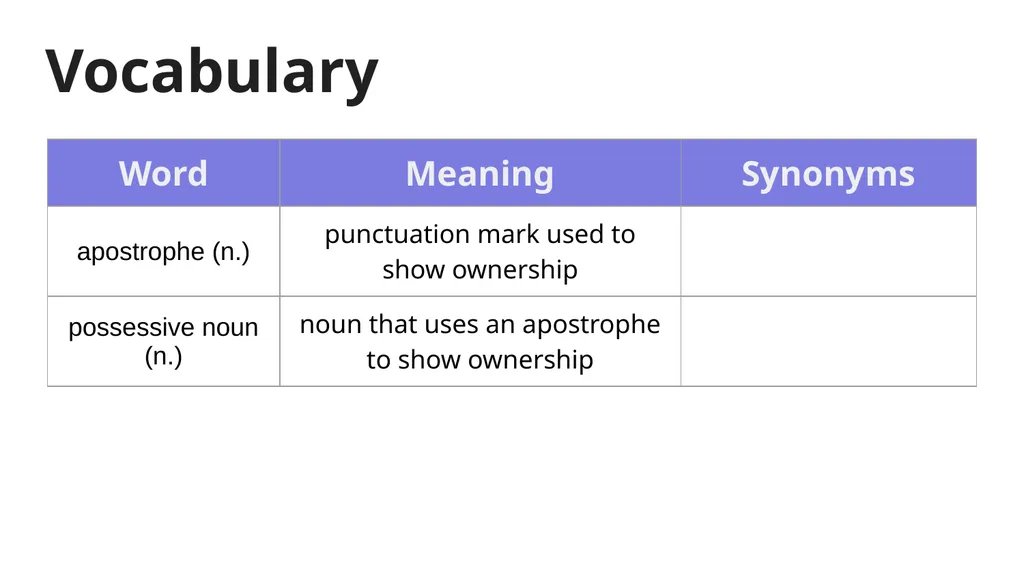
slide192. Vocabulary<br>
slide193. Amos & Boris, page 18 Swimming along, sometimes at great speed, sometimes slowly and leisurely, sometimes resting and exchanging ideas, sometimes stopping to sleep, it took them a week to reach Amos’s home shore.<br>
slide194. Identify a Singular Possessive noun. They became the closest possible friends. They told each other about their lives, their ambitions. They shared their deepest secrets with each other. The whale was very curious about life on land and was sorry that he could never experience it. Amos was fascinated by the whale’s accounts of what went on deep under the sea. Amos sometimes enjoyed running up and down on the whale’s back for exercise. When he was hungry, he ate plankton. The only thing he missed was fresh, unsalty water. Explain how you know it is a singular possessive noun and what is being owned or possessed?<br>
slide195. Lesson 9 Content Framing Question:
Knowledge: How do art and literature build my knowledge of the world?<br>
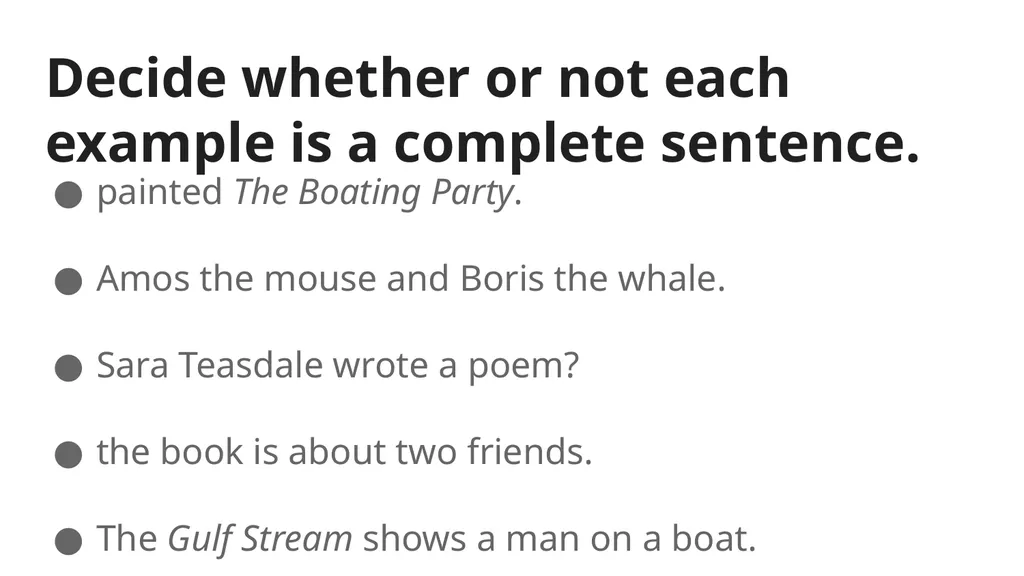
slide196. Decide whether or not each example is a complete sentence. painted The Boating Party.
Amos the mouse and Boris the whale.
Sara Teasdale wrote a poem?
the book is about two friends.
The Gulf Stream shows a man on a boat.<br>
slide197. Why did you change some of the examples? Some of the examples were not complete sentences; some did not have a subject and some did not have a verb.
Some of the examples did not have the correct punctuation.
Some of the examples did not begin with a capital letter.<br>
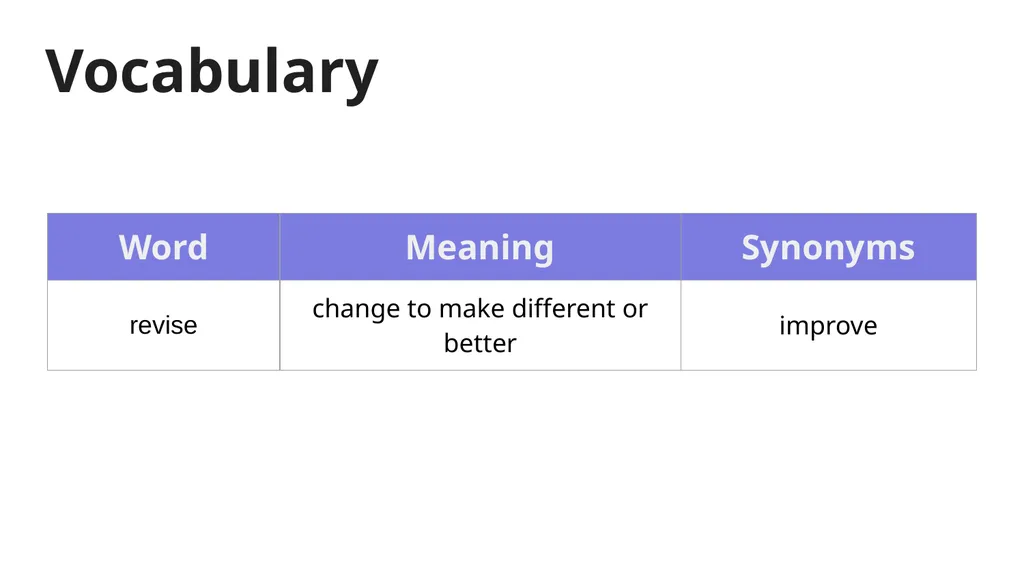
slide198. Vocabulary<br>
slide199. Craft Questions:
How do I use topic statements and group related information together in an explanatory paragraph?
How do I improve my writing by using topic statements and grouping related information together in an explanatory paragraph?<br>
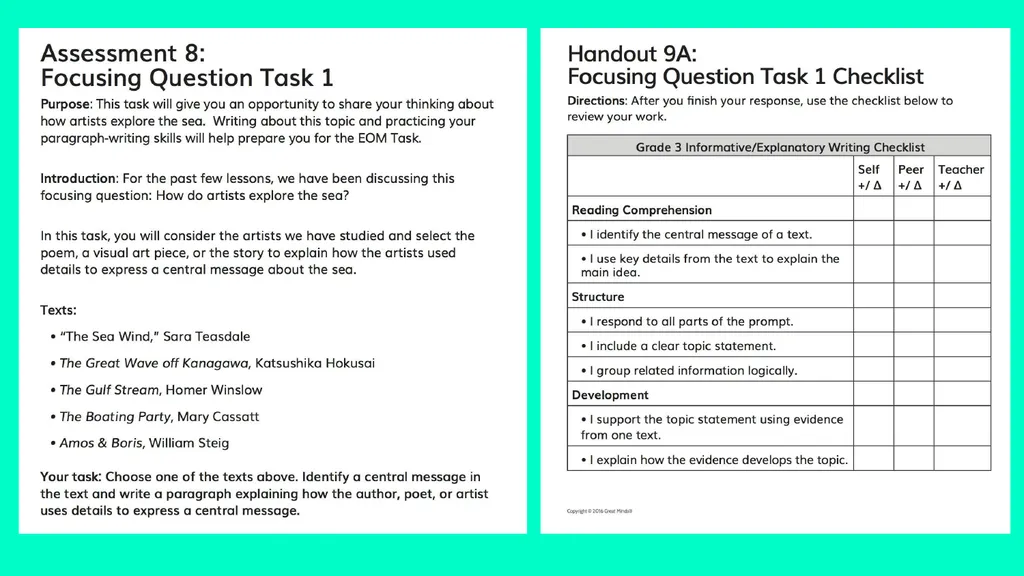
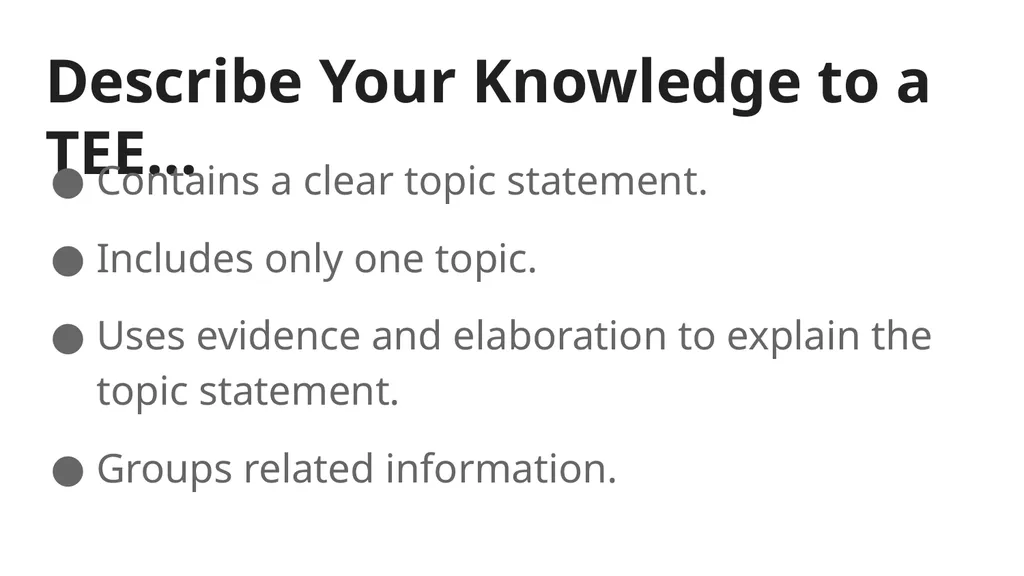
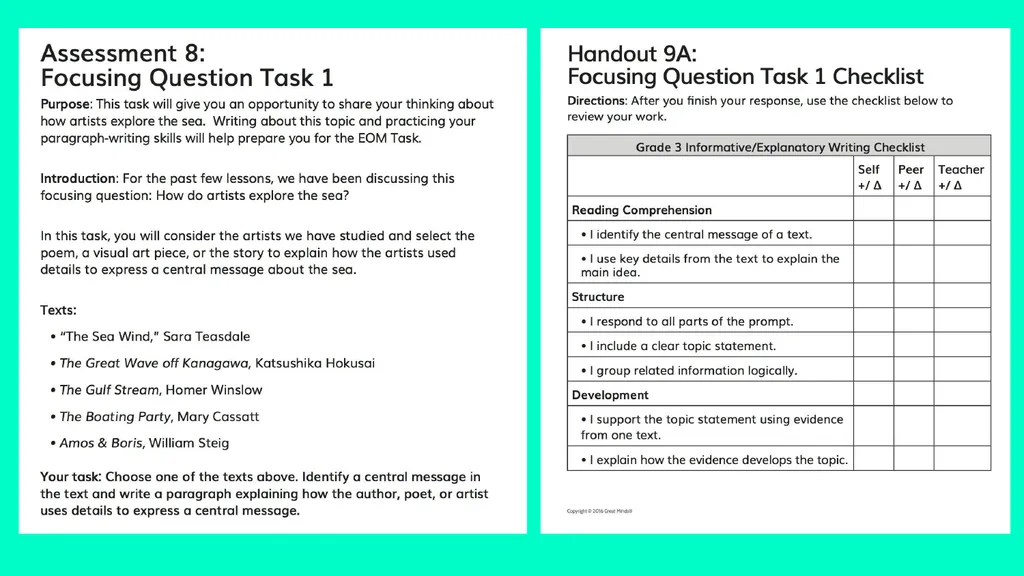
slide201. Describe Your Knowledge to a TEE... Contains a clear topic statement.
Includes only one topic.
Uses evidence and elaboration to explain the topic statement.
Groups related information.<br>
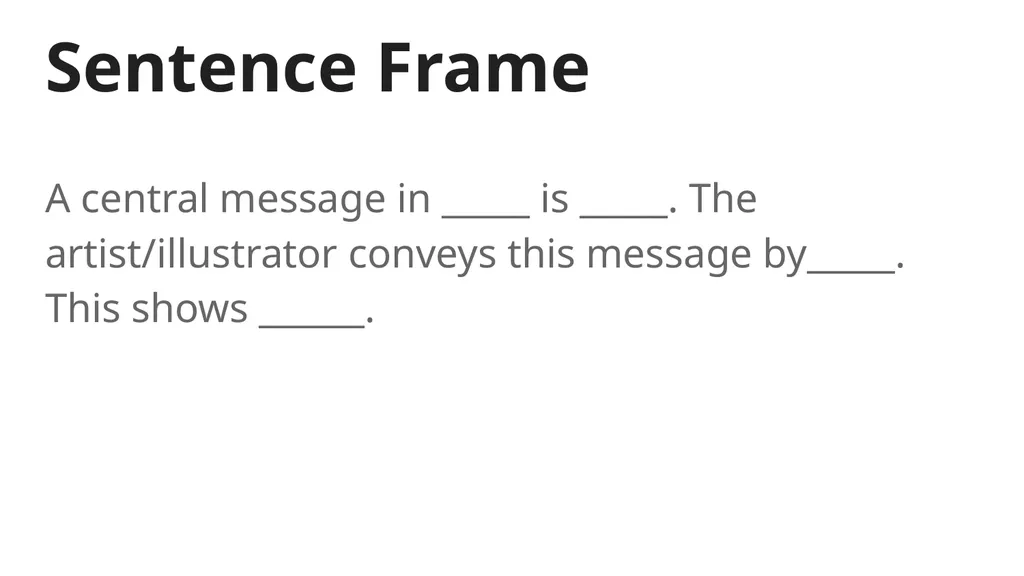
slide202. Sentence Frame A central message in _____ is _____. The artist/illustrator conveys this message by_____. This shows ______.<br>
slide204. Praise-Question-Suggestion You did a good job with ________.
Why did you _____?
One suggestion I have is to ______.<br>
slide205. What I Know What I Can Do<br>
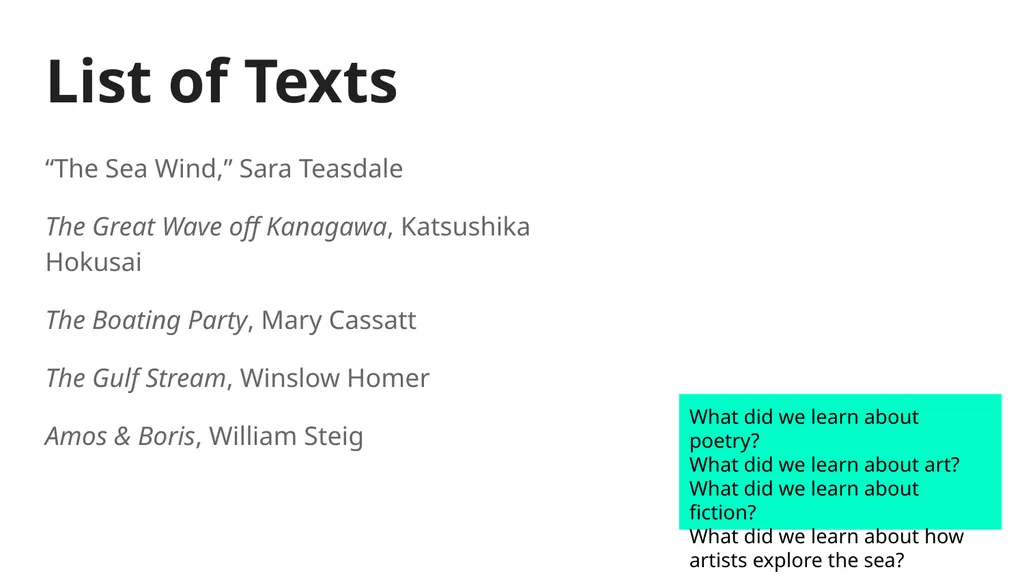
slide206. List of Texts “The Sea Wind,” Sara Teasdale
The Great Wave off Kanagawa, Katsushika Hokusai
The Boating Party, Mary Cassatt
The Gulf Stream, Winslow Homer
Amos & Boris, William Steig What did we learn about poetry?
What did we learn about art?
What did we learn about fiction?
What did we learn about how artists explore the sea?<br>
slide207. Deep DIve Vocabulary:
Examine the Morphology of the Revision<br>
slide208. Revision Does the word revision contain any recognizable morphemes? re-
-ion<br>
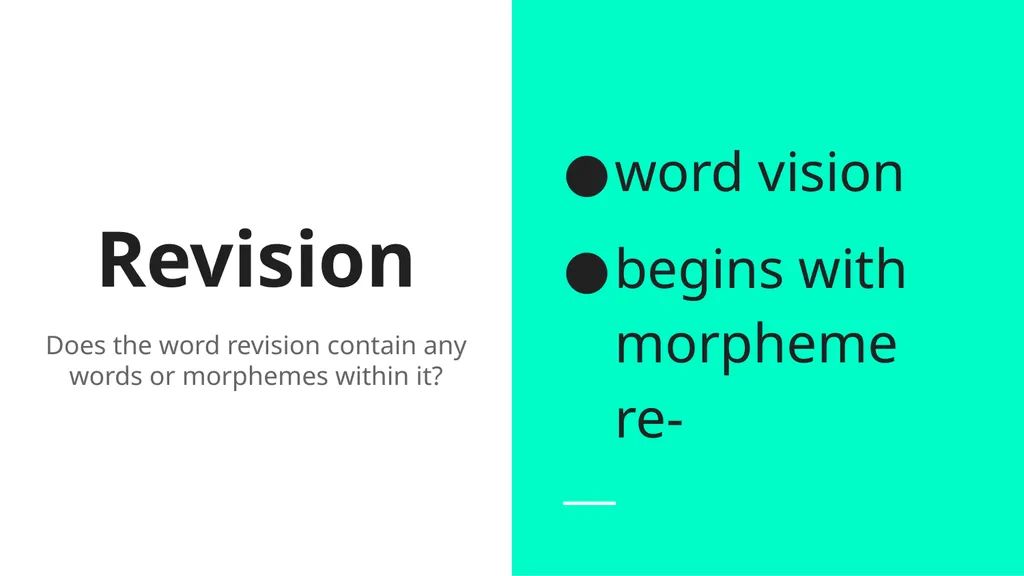
slide209. Revision Does the word revision contain any words or morphemes within it? word vision
begins with morpheme re-<br>
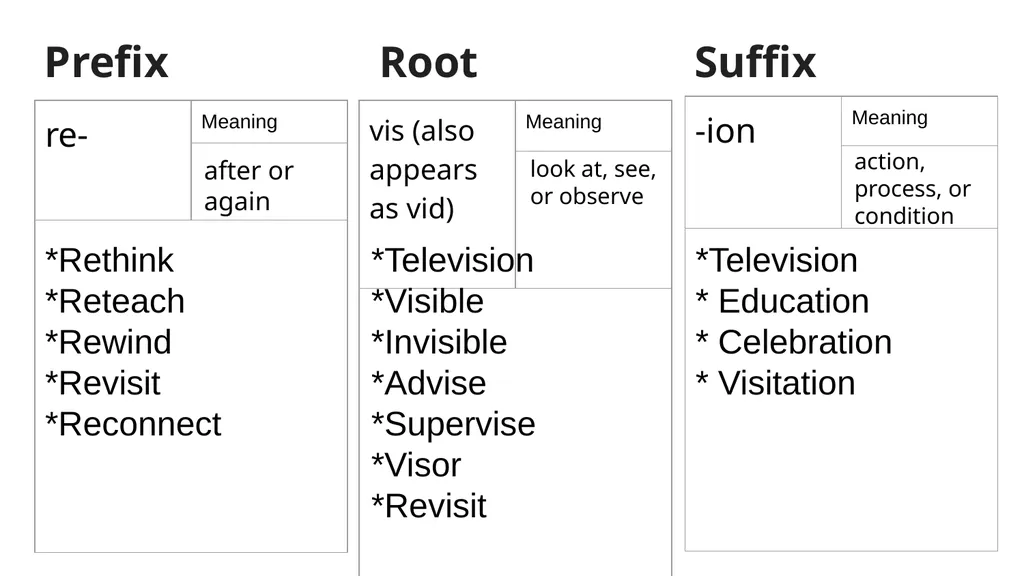
slide210. Prefix Root Suffix *Rethink
*Reteach
*Rewind
*Revisit
*Reconnect *Television
*Visible
*Invisible
*Advise
*Supervise
*Visor
*Revisit *Television
* Education
* Celebration
* Visitation after or again action, process, or condition look at, see, or observe<br>
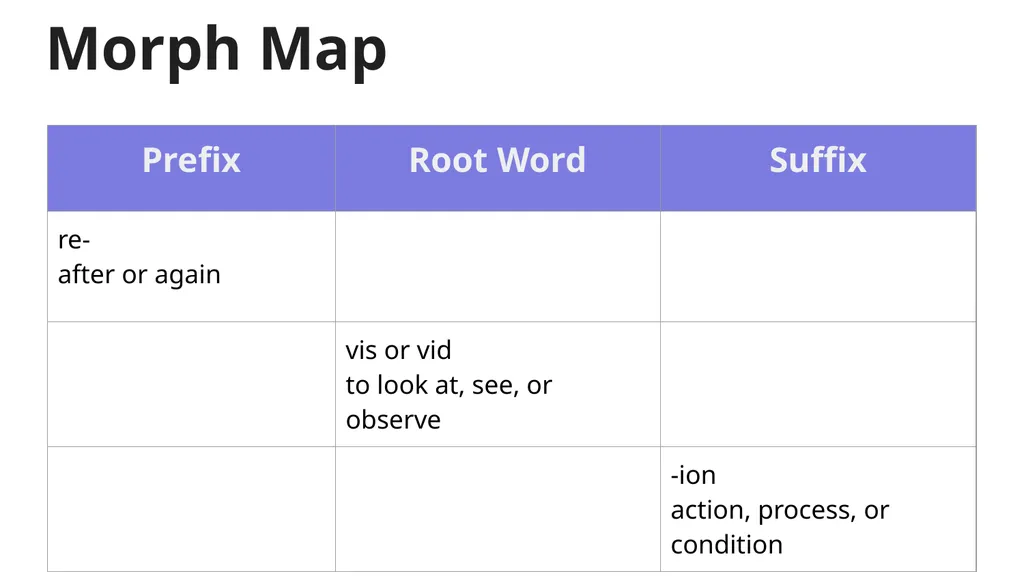
slide211. Morph Map<br>
Module 1
Lessons 1-9 Why do people explore the sea?<br>
slide2. Module 1 Focusing Question
Lessons 1-9 How do artists explore the sea?<br>
slide3. Lesson 1 Content Framing Question:
Distill: What is the central message of “The Sea Wind?”<br>
slide4. What does the word EXPLORE mean? travel through a place in order to learn more about it
learn about something in detail<br>
slide5. Which definition of explore makes the most sense in the essential question and focusing question? Essential Question: Why do people explore the sea? Focusing Question: How do artists explore the sea? In the essential question: “learn something in detail” makes the most sense<br>
slide6. New Words Handout 1A: “The Sea Wind,” Sara Teasdale
Directions: Read and annotate the text below.
I am a pool in a peaceful place,
I greet the great sky face to face,
I know the stars and the stately moon
And the wind that runs with rippling shoon— But why does it always bring to me
The far-off, beautiful sound of the sea?
The marsh-grass weaves me a wall of green,
But the wind comes whispering in between,
In the dead of night when the sky is deep
The wind comes waking me out of sleep— Why does it always bring to me
The far-off, terrible call of the sea?<br>
slide7. What I Notice: What I Wonder: The text is a poem
The poem has two stanzas.
Each stanza is a separate sentence.
Each stanza asks a question.
Most of the lines end with a comma.
In each stanza the fourth line ends with a dash.
Each stanza ends with a question mark.
rhyming words: place/face, moon/shoon, me/sea, green/between, deep/sleep, me/sea.
Each stanza has three pairs of rhyming lines.
The last two lines of the first stanzas are very similar. Why is the text arranged in sections?
Why are the sentences broken up?
Why does each line begin with a capital letter?
Is the speaker really a pool? Is the pool talking?
Does the speaker really talk to the sky “face to face”?
Can the wind really run wearing shoes?
Does the marsh-grass really build a wall?
Can the wind really whisper?<br>
slide8. Academic Words Handout 1A: “The Sea Wind,” Sara Teasdale
Directions: Read and annotate the text below.
I am a pool in a peaceful place,
I greet the great sky face to face,
I know the stars and the stately moon
And the wind that runs with rippling shoon— But why does it always bring to me
The far-off, beautiful sound of the sea?
The marsh-grass weaves me a wall of green,
But the wind comes whispering in between,
In the dead of night when the sky is deep
The wind comes waking me out of sleep— Why does it always bring to me
The far-off, terrible call of the sea?<br>
slide9. Think-Pair-Share: underline repeated words or phrases wind, sky, and sea emphasizes that the poem is about nature.
“Why does it always bring me?” The speaker is wondering about something.
far-off makes the sea seem a little mysterious.
The last two lines of each stanza, but changing “far-off, beautiful sound of the sea” to “far-off, terrible call of the sea” Shows the two very different descriptions of the sea. Handout 1A: “The Sea Wind,” Sara Teasdale
Directions: Read and annotate the text below.
I am a pool in a peaceful place,
I greet the great sky face to face,
I know the stars and the stately moon
And the wind that runs with rippling shoon— But why does it always bring to me
The far-off, beautiful sound of the sea?
The marsh-grass weaves me a wall of green,
But the wind comes whispering in between,
In the dead of night when the sky is deep
The wind comes waking me out of sleep— Why does it always bring to me
The far-off, terrible call of the sea?<br>
slide10. Think-Pair-Share [I am a pool]
[I greet the great sky face to face]
the wind [runs with rippling shoon]
the grass [weaves me a wall]
[the wind comes whispering]
[call of the sea] Handout 1A: “The Sea Wind,” Sara Teasdale
Directions: Read and annotate the text below.
I am a pool in a peaceful place,
I greet the great sky face to face,
I know the stars and the stately moon
And the wind that runs with rippling shoon— But why does it always bring to me
The far-off, beautiful sound of the sea?
The marsh-grass weaves me a wall of green,
But the wind comes whispering in between,
In the dead of night when the sky is deep
The wind comes waking me out of sleep— Why does it always bring to me
The far-off, terrible call of the sea? Put [Brackets] around anything that could not really happen.<br>
slide11. Academic Words<br>
slide12. What we notice about the figurative language in each stanza The language is beautiful and dreamy in the first stanza and the figurative language describes a pleasant setting.
The pool is “peaceful” (line 1)
and greets the “stately moon” (lines 2-3)
The wind wears “rippling shoon” (line 4)
and brings “the far-off beautiful sound of the sea” (line 6)<br>
slide13. 2. The language is a little scary.
“The marsh-grass weaves me a wall of green” which could mean the speaker feels closed in.
“the wind comes whispering in between” which makes the wind seem sneaky.
“in the dead of night” which sounds scary
“the far-off terrible call of the sea” which sound dangerous<br>
slide14. What is the effect of using figurative language in the poem? Makes the reader think more.
Helps the reader understand that the sound of the sea can be either “beautiful” or “terrible.”<br>
slide15. What is the Central Message of the Poem? Clues from the Figurative Language:
peaceful, greets the rippling shoon, and the far-off beautiful sound of the sea tells us the sea can be beautiful
weaves a wall of green, the wind comes whispering in between, in the dead of night, and the far-off, terrible call of the sea tells us the sea can be terrible We can infer that the central message of the poem is that the sea can be both beautiful and terrible.<br>
slide16. Craft Question:
Why is it important to write in complete sentences?<br>
slide17. How are these examples different? pool in a peaceful place
greet the great sky face to face
The marsh-grass weaves me a wall of green.
Why does the wind always bring to me the far-off terrible call of the sea? These two are NOT complete sentences because they do not express a complete thought. These two examples both include a subject (a noun) and a verb to express a complete thought.<br>
slide18. Language Skills<br>
slide19. EXAMINE In the first stanza, using yellow, highlight the VERBS.
In the first stanza, using pink, highlight the NOUNS. Handout 1A: “The Sea Wind,” Sara Teasdale
Directions: Read and annotate the text below.
I am a pool in a peaceful place,
I greet the great sky face to face,
I know the stars and the stately moon
And the wind that runs with rippling shoon— But why does it always bring to me
The far-off, beautiful sound of the sea?<br>
slide20. Handout 1A: “The Sea Wind,” Sara Teasdale
Directions: Read and annotate the text below.
I am a pool in a peaceful place,
I greet the great sky face to face,
I know the stars and the stately moon
And the wind that runs with rippling shoon— But why does it always bring to me
The far-off, beautiful sound of the sea?<br>
slide21. Language Skills<br>
slide22. Complete Sentence Check<br>
slide23. The marsh-grass weaves me a wall of green.<br>
slide24. The wind comes whispering in between.<br>
slide25. Quick Write What is the central message of “The Sea Wind” and how do you know? Explain what elements of the poem helped you identify the central message.<br>
slide26. Dive Deep Vocabulary:
Why do people EXPLORE the sea?<br>
slide27. Give-One, Get-One, Move-On On your index card list 2-3 examples of ways people learn about a subject, place, or idea.
Move on to give one example to a peer.
Get another example from your peer. How else can people learn about a subject, place or idea?<br>
slide28. Vocabulary Journals<br>
slide29. Multiple Meaning Chart Context Clues:
We explored the beach while visiting my cousins.
Mr. Howard explored every way to fix the boat before asking for help.
Scientists will explore whales to find out why they are leaving the area.
The children explored the sea when they went on vacation at the shore. travel through a place in order to learn more about it. learn about something in detail. explore 1. We explored the beach while visiting my cousins. 4. The children explored the sea when they went on vacation at the shore. 2. Mr. Howard explored every way to fix the boat before asking for help. 3. Scientists will explore whales to find out why they are leaving the area.<br>
slide30. Choral Reading Articulate each word clearly
Emphasize key words
Phrase the text into syntactically appropriate chunks or phrases
Use dramatic pauses
Raise and lower voices as appropriate
Speed up and slow down as appropriate
LISTEN and read in UNISON Handout 1A: “The Sea Wind,” Sara Teasdale
Directions: Read and annotate the text below.
I am a pool in a peaceful place,
I greet the great sky face to face,
I know the stars and the stately moon
And the wind that runs with rippling shoon— But why does it always bring to me
The far-off, beautiful sound of the sea?
The marsh-grass weaves me a wall of green,
But the wind comes whispering in between,
In the dead of night when the sky is deep
The wind comes waking me out of sleep— Why does it always bring to me
The far-off, terrible call of the sea?<br>
slide31. Exit Slip Which definition of explore best reflects how the speaker of the poem explores the sea? Use text evidence to support your answer.<br>
slide32. Lesson 2 Content Framing Question:
Distill: What is the central message of a woodblock print?<br>
slide33. Think-Pair-Share
What choices did you make when deciding what and how to illustrate the poem?<br>
slide35. I See I Think I Wonder<br>
slide36. What do you see in this painting? I See a wave that takes up almost the whole space
water in front of the big wave
tiny people in row boats
small blue and white triangle in the center of the picture
a small mountain in center of picture
white dots in sky and water
beige sky and white clouds
rectangle in corner with squiggles<br>
slide37. I See a wave that takes up almost the whole space
water in front of the big wave
tiny people in row boats
small blue and white triangle in the center of the picture
a small mountain in center of picture
white dots in sky and water
beige sky and white clouds
rectangle in corner with squiggles I Think I Wonder This column you make an INFERENCE about what you observe!<br>
slide38. Vocabulary Journal Now, based on the observation you recorded in the I See Column of the See-Think-Wonder chart, what can you infer? What do you wonder?<br>
slide39. I See a wave that takes up almost the whole space
water in front of the big wave
tiny people in row boats
small blue and white triangle in the center of the picture
a small mountain in center of picture
white dots in sky and water
beige sky and white clouds
rectangle in corner with squiggles I Think I Wonder wave is really important - very big, dangerous, scary
there is more water in the ocean than we see in the big wave.
tiny people are working hard to keep boat upright in water
triangle is a mountain
mountain is probably bigger than it looks and is far away
bits of sea foam
cloudy day
might be writing<br>
slide40. I See a wave that takes up almost the whole space
water in front of the big wave
tiny people in row boats
small blue and white triangle in the center of the picture
a small mountain in center of picture
white dots in sky and water
beige sky and white clouds
rectangle in corner with squiggles I Think I Wonder wave is really important - very big, dangerous, scary
there is more water in the ocean than we see in the big wave.
tiny people are working hard to keep boat upright in water
triangle is a mountain
mountain is probably bigger than it looks and is far away
bits of sea foam
cloudy day
might be writing Will the wave crash on the boats?
Part of the big wave or separate wave?
Are people scared? Will they be hurt?
Is triangle a wave or mountain?
Why is the mountain there? Is it important too?
Is the water cold?
Why is the sky beige?
What language is this?<br>
slide41. Think-Pair-Share 1 What do you notice about the size and placement of the objects and people in the woodblock print? What do the size and placement suggest about what the artist thinks is important?<br>
slide42. New Words<br>
slide43. Think-Pair-Share 2 How does the artist arrange the figures in the boats? What does the arrangement suggest about an important idea in the image?<br>
slide44. Think-Pair-Share 3 What do you notice and think about the lines in the woodblock print? What do the lines suggest about an important idea in the image?<br>
slide45. Vocabulary Journal<br>
slide46. Think-Pair-Share 4 What colors does the artist use in the painting? What do the colors suggest about an important idea in the image?<br>
slide47. Vocabulary Journal<br>
slide48. Think-Pair-Share 5 What decisions did the artist make about composition, line, and color? How do those decisions help you understand the main subject of the woodblock print?<br>
slide49. Vocabulary Journal<br>
slide50. The Great Wave off Kanagawa This print was created by Katsushika Hokusai, a Japanese artist who lived about two hundred years ago, created this woodblock print almost two hunered year ago (1830-1832)<br>
slide51. How can the evidence from the See-Think-Wonder chart help determine a central message in the art?<br>
slide52. Craft Question:
Why is a topic statement important?<br>
slide53. What do you know about topic statements? tells the reader what the paragraph is about.
is often the first sentence in the paragraph.
contains the main idea of the paragraph.
should state one main topic and include important ideas.<br>
slide54. Good Writers ask two questions when they write: What am I writing about?
The answer to this question is the topic statement.
What do I want to say about my topic?
The answer to this question will be the evidence and elaboration that you include in a paragraph.<br>
slide55. What is the focal point in The Great Wave off Kanagawa? The wave is the tallest part of the image. It towers over the people in the boats and even the mountain. The curving lines of the wave almost make a circle. They cause the eye to move from the bottom of the wave, to the top, and back to the bottom. The wave is dark blue and the sky is pale beige. The dark blue of the wave stands out against the pale beige sky in the background, making the wave very noticeable. Katsushika Hokusai uses composition, line, and color to make the great wave the focal point of the woodblock print.<br>
slide56. “Describe your knowledge to a TEE” Topic Statement
Evidence
Elaboration<br>
slide57. The wave is the tallest part of the image. It towers over the people in the boats The curving lines of the wave almost make a circle. They cause the eye to move from the bottom of the wave, to the top, and back to the bottom. The wave is dark blue and the sky is pale beige. The dark blue of the wave stands out against the pale beige sky making the wave very noticeable. Katsushika Hokusai uses composition, line, and color to make the great wave the focal point of the woodblock print. The focal point of Hokusai’s The Great Wave off Kanagawa is the large blue wave on the left side of the woodblock print.<br>
slide58. Quick Write Answer the Framing Question Use domain-specific vocabulary from the lesson to explain how key details help express a central message in The Great Wave off Kanagawa.<br>
slide59. Dive Deep Style & Conventions:
Examine and Define Nouns and Verbs<br>
slide60. teacher Mr. Schauer think school jump run draw pencil say McDonalds Chromebook color became was friendship Stand up for a noun and sit down for a verb. is a person, place, thing or idea. A noun is... a word that expresses an action or a state of being. A verb is...<br>
slide61. Craft Question:
Why is a topic statement important?<br>
slide62. What are two functions of verbs (two things verbs do) and some examples of each function? A verb expresses an action, Row, float, and tip are verbs that express actions.
A verb expresses a state of being. Is, are, was, and became are verbs that express states of being.<br>
slide63. The people row the boat. What is the verb and what is its function in the sentence above?
The verb row expresses an action. Who rows the boat?
The people row the boat. The noun people is the subject of the sentence because the people are doing the rowing.<br>
slide64. The boat floats on the ocean. What is the verb and what is its function in the sentence above?
The verb floats expresses an action. What floats?
The boat floats. The noun boat is the subject of the sentence. What is the subject of a sentence?
The subject of the sentence is the noun doing or being something.<br>
slide65. Vocabulary Journal<br>
slide66. Complete the exit ticket and turn it in. Exit Ticket<br>
slide67. Lesson 3 Content Framing Question:
Distill: What is the central message of a painting?<br>
slide68. Observe the paintings silently #1 #2<br>
slide69. I See a woman, baby, and man in a rowboat
a yellow boat
baby wears a pink dress
see the man’s back, but not much of his face
the man wears dark blue
they wear old-fashioned clothes
water has small ripples
small buildings on shore
man is rowing
woman is holding the baby I Think I Wonder Painting #1<br>
slide70. I See a many lying alone on the bottom of a small boat
the mast is broken
some fabric flops across the back of the boat
large waves and a storm in the distance
sharks circle the boat with teeth showing
there is a plant next to the man
tiny ship in the distance I Think I Wonder Painting #2<br>
slide71. Why is it important to agree and disagree respectfully?<br>
slide72. What do you think it means to agree and disagree during an academic conversation? sharing an opinion without interrupting
being polite and using a pleasant tone of voice
acknowledging someone else’s idea before sharing your own<br>
slide73. Examples of agreeing or disagreeing respectfully Nonverbal signs for Agreeing: nodding your head, smiling, or giving a thumbs-up sign, to show agreement
Nonverbal signs for a different opinion: shaking your head or holding up a finger Sentence Stems “I agree with _______ because _____”
“I disagree with ______ because ______”<br>
slide74. What elements of art did you learn about in lesson 2 and how did they help you analyze The Great Wave off Kanagawa? Composition is the way an artist arranges people (figures) and things (objects) in an image.
Line is how shapes and outlines move our eyes around an image.
Color is an artist’s choice about which colors to use, how bright to make them, whether to use warm or cool colors, and whether to use colors that blend together or stand out against each other.<br>
slide75. Analyze the Paintings Based on what you see, what can you infer and wonder? #1 #2<br>
slide76. I See a woman, baby, and man in a rowboat
baby wears a pink dress
see the man’s back, but not much of his face
the man wears dark blue
they wear old-fashioned clothes
baby’s hand is on woman’s arm
water has small ripples
small buildings on shore
woman is holding the baby I Think I Wonder woman is the baby’s mother
baby wears no coat, probably warm
man isn’t as important as woman and baby
olden days
woman is baby’s mother
calm day
shore is far away
woman is the baby’s mother Is the man the father or just someone rowing the boat?
Is the man someone who gives people rides?
When was the picture painted?
Where are the people going? Why?
What is the weather? Painting #1<br>
slide77. I See a many lying alone on the bottom of a small boat
the mast is broken
some fabric flops across the back of the boat
large waves and a storm in the distance
sharks circle the boat with teeth showing
there is a plant next to the man
tiny ship in the distance I Think I Wonder he doesn’t look worried
the storm might have broken the mast
the fabric might be the sail, probably ripped by the storm
the storm in the background probably broke the mast and sail
the man might have been delivering the plant
the ship might help Was he always alone or did something happen to others?
How will the boat move without the sail?
Can the man steer the boat without sails?
How far away is the storm? Will it travel fast?
Will the man be safe on the boat?
Will the ship rescue the man? Painting #2<br>
slide78. Evidence Organizer How does the artist use the details of composition, line, and color to create a focal point and express an idea about the ocean?<br>
slide79. Painting #1 The figures take up most of the space in the painting, so they are the focal point. The painting shows the faces of the mother and baby, and they are the center of the painting. They seem to be the focal point.
Most of the painting uses shades of blue and yellow. The baby’s dress and the people’s faces are pink. The pink stands out against the blues and yellows and draws attention to them, making them a focal point. The artist uses curved and straight lines to make the mother and baby the focal point. The curved lines of the boat and the sail lead toward the baby. The straight lines of the oar and the man’s arm also lead toward the baby. All of the lines seem to lead toward the baby, so the baby is the focal point of the painting.
The artist uses the details of composition, line, and color to express the idea that the water is a peaceful, restful place for people to be together.<br>
slide80. Painting #2 The artist places the man in the boat in the center of the picture. Although the man is much smaller than the water and sky around him, he is in the center and seems to be the focal point.
The man’s body and the stems or plants next to him create a line that intersects with the lines of the boat and waves. The intersection between the boat and the man seems to be the focal point of the painting. The artist uses color by contrasting the light brown boat, the man, and the black hole on the boat against the dark greens and blues of the sea. The man in the boat seems to be in the middle of a bright spot on the ocean, so the eye goes directly to him and makes him the focal point.
The artist uses the details of composition, line, and color to express the idea that the ocean is a beautiful but dangerous place, especially for someone who is all alone on the ocean.<br>
slide81. Boxes and Bullets for Art Painting #1 is The Boating Party by Mary Cassatt, an American artist who worked in France during the late nineteenth century, painted this picture between 1893 and 1894.
Painting #2 is called The Gulf Stream by Winslow Homer, an American artist, created the painting in 1899.<br>
slide82. Craft Question:
How does using a topic statement work?<br>
slide83. What is a Topic Statement? tells the reader what the paragraph is about
is often the first sentence in the paragraph
contains the main idea of the paragraph
should state one main topic and include important ideas<br>
slide84. Record the prompt in your Response Journal Explain how the elements of art help convey a central message of Mary Cassatt’s The Boating Party.<br>
slide85. Describe Your Knowledge to a TEE The artist uses calm poses and bright colors. This shows that the sea is a calm and happy place. The viewer’s eyes follow the lines of the painting toward the baby. That may show that the parents feel it is a safe place. All of these things show that the sea can be a calm and happy place. The central message of Mary Cassatt’s The Boating Party is that the sea is a calm and happy place.<br>
slide86. Framing Question:
What is the central message of a painting?<br>
slide87. Quick Write Answer the Framing Question How did Mary Cassatt or Homer Winslow use the elements of art to explore the sea?<br>
slide88. Dive Deep Style & Conventions:
Experiment with the Function of Nouns and Verbs in Sentences<br>
slide89. Subjects and Verbs Refresher Writers use subjects and verbs to express complete thoughts.
Subjects and verbs are the main parts of every sentence.
Subjects (nouns) tell what or who is performing an action or who exists in a state of being.
Verbs express the action or state of being.
The predicate of a sentence uses a verb to describe the action or state of the subject.<br>
slide90. The family sat in a boat on the sea. Nouns (people, places, things, or ideas): family, boat, and sea.
Verbs (actions or states of being): sat
Subject of the sentence: The family is the subject because the family is sitting.<br>
slide91. Give-ONe, Get-One, Move-On What nouns do you see in these sentences?
What verbs do you notice in these sentences?
What is the function of the nouns in these sentences?
What is the function of the verbs in these sentences?
How do the nouns and verbs work together in these sentences?<br>
slide92. Academic Vocabulary<br>
slide93. Lesson 4 Content Framing Question:
Wonder: What do I notice and wonder about Amos & Boris?<br>
slide94. Amos & Boris What do you see?
What do you infer?
What do you wonder?<br>
slide95. Sperm Whale Encounter, Howard Hall What do you notice about the swimmer and the whale in this video? The whale is huge.
The swimmer looks very small next to the whale.
The swimmer gets very close to the whale.
The whale remains calm, as the swimmer gets close.<br>
slide96. Think-Pair-Share Focusing Question: How do artists explore the sea?
Content Framing Question: What do I notice and wonder about Amos & Boris? How might the knowledge I learned earler help me to understand Amos & Boris?<br>
slide97. Craft Question:
Why is it important to listen and wonder?<br>
slide98. Listen & Wonder What do you think it means to listen and wonder when hearing a story or having a conversation? listening carefully to a story, without interrupting.
listening for new ideas
being curious about what you hear
really paying attention so I don’t miss anything<br>
slide99. Listen & Wonder What does listening and wondering LOOK like? Keep your eyes on the speaker.
Show you are interested through facial expressions.
Sit quietly when the speaker is expressing ideas.
Use nonverbal signals, like nodding, to express agreement.
Ask thoughtful questions after the reader finishes.<br>
slide100. Listen & Wonder Why is it important to listen and wonder? Shows respect to the reader and to the people around me
helps me because I can learn new ideas from other people
helps me ask questions<br>
slide101. Amos & Boris<br>
slide102. Vocabulary<br>
slide103. How does your understanding of a mouse’s size and the size of the ocean and sky, along with the illustrations on pages 8-9 clarify the meaning of the words immense and speck? I know the ocean and sky are very big, and in the picture the sky and ocean take up a lot of space, so immense might mean “very big.”
I know that a mouse is very small, so a speck might be a small thing.<br>
slide104. Vocabulary<br>
slide105. Annotation Codes Amos & Boris
Amos, a mouse, lived by the ocean. He loved the ocean. He loved the smell of sea air. He loved to hear the surf sounds- the bursting breakers, the backwashes with rolling pebbles. Word<br>
slide106. I See Title: A&B
Beautiful language: “surf-sounds-the bursting breakers, the backwashes with rolling pebbles I Think I Wonder The book will be about a mouse and a whale. Mouse = A or B?
Amos must really love the ocean. Which animal in pic?
Why not show both animals?
Where is mouse going?
Did William Steig purposely use words that begin with the same letter? (surf sounds and bursting breakers)<br>
slide107. Craft Question:
Why is reading fluently and accurately important?<br>
slide108. Fluent Reading Articulate each word clearly
Emphasize key words
Phrase the text into syntactically appropriate chunks or phrases
Use dramatic pauses
Raise and lower voices as appropriate
Speed up and slow down as appropriate Amos & Boris
page 9
One night, in a phosphorescent sea, he marveled at the sight of some whales spouting luminous water; and later, lying on the deck of his boat gazing at the immense, starry sky, the tiny mouse Amos, a little speck of a living thing in the vast living universe, felt thoroughly akin to it all. Overwhelmed by the beauty and mystery of everything, he rolled over and over and right off the deck of his boat and into the sea.<br>
slide109. Exit Ticket Answer the framing question. What do I notice and wonder about Amos & Boris?<br>
slide110. Dive Deep Style & Conventions:
Explore the Function of Nouns and Verbs in Sentences<br>
slide111. Craft Question:
How do nouns and verbs function in sentences?<br>
slide112. Handout 4B Complete Handout 4B: Analyze a Sentence<br>
slide113. Lesson 5 Content Framing Question:
Organize: What’s happening in Amos & Boris?<br>
slide114. The Lion and the Mouse Read the fable and retell the story to a partner.<br>
slide115. What details from the story did you include in your retelling? Characters
Setting
Sequence of events in the correct order
Problem and Solution
Central Message<br>
slide116. Vocabulary<br>
slide117. Story Map Complete the story map to organize the details of “The Lion and the Mouse.”<br>
slide118. Vocabulary<br>
slide119. What story elements do you notice in this passage? I notice a character in this passage. The passage is about Amos.
I notice the setting in the passage. The passage takes place “one night, in a phosphorescent sea.”
I notice a problem in the passage. Amos rolls “right off the deck of his boat and into the sea.”<br>
slide120. How does your knowledge of Amos’ character and the setting help clarify the meaning of the word overwhelmed? The sea and sky are very large and beautiful, so Amos pays attention to them instead of where he is on the deck.
Overwhelmed might mean “cause to be weak because of emotion.”<br>
slide121. How do the words and illustrations explaining Amos’ attempts to catch the Rodent clarify the meaning of the word desperately? The text says Amos was squeaking “Help!” and trying to grab the boat, so desperately might mean “in a way that shows great need.”
The illustration shows Amos looking a little scared as he tries to grab the rope, so desperately might mean “in great need.”<br>
slide122. Vocabulary<br>
slide123. Story Map Complete the story map to organize the details of Amos & Boris. Do NOT complete the Central Message.<br>
slide124. Craft Question:
Why is grouping related information together important?<br>
slide125. William Steig, Author and Illustrator William Steig (1907-2003) was a cartoonist, illustrator and author of award-winning books for children, including Shrek!, on which the DreamWorks movies are based. Steig was born in New York City. Every member of his family was involved in the arts, and so it was no surprise when he decided to become an artist. He attended City College and the National Academy of Design. In 1930, Steig's work began appearing in The New Yorker, where his drawings have been a popular fixture ever since. He published his first children's book, Roland the Minstrel Pig, in 1968.
In 1970, Steig received the Caldecott Medal for Sylvester and the Magic Pebble. His books for children also include Dominic; The Real Thief; The Amazing Bone, a Caldecott Honor Book; Amos & Boris, a National Book Award finalist; and Abel's Island and Doctor De Soto, both Newbery Honor Books. Steig's books have also received the Christopher Award, the Irma Simonton Black Award, the William Allen White Children's Book Award, and the American Book Award. His European awards include the Premio di Letteratura per l'infanzia (Italy), the Silver Pencil Award (the Netherlands), and the Prix de la Fondation de France. On the basis of his entire body of work, Steig was selected as the 1982 U.S. candidate for the Hans Christian Andersen Medal for Illustration and subsequently as the 1988 U.S. candidate for Writing.
Stieg also published thirteen collections of drawings for adults, beginning with About People in 1939, and including The Lonely Ones, Male/Female, The Agony in the Kindergarten, and Our Miserable Life.
He died in Boston at the age of 95.<br>
slide126. Which one belongs? William Steig has three children.
Steig won the Lifetime Achievement Award from the Society of Illustrators.
The Caldecott Medal weighs 3.1 ounces.
In 1983, William Steig won the National Book Award for Doctor De Soto. In 1970, Steig received the Caldecott Medal for Sylvester and the Magic Pebble. His books for children also include Dominic; The Real Thief; The Amazing Bone, a Caldecott Honor Book; Amos & Boris, a National Book Award finalist; and Abel's Island and Doctor De Soto, both Newbery Honor Books. Steig's books have also received the Christopher Award, the Irma Simonton Black Award, the William Allen White Children's Book Award, and the American Book Award. His European awards include the Premio di Letteratura per l'infanzia (Italy), the Silver Pencil Award (the Netherlands), and the Prix de la Fondation de France. On the basis of his entire body of work, Steig was selected as the 1982 U.S. candidate for the Hans Christian Andersen Medal for Illustration and subsequently as the 1988 U.S. candidate for Writing.<br>
slide127. Craft Question:
Why is using phrasing important?<br>
slide128. Fluent Reading Articulate each word clearly
Emphasize key words
Phrase the text into syntactically appropriate chunks or phrases
Use dramatic pauses
Raise and lower voices as appropriate
Speed up and slow down as appropriate Amos & Boris
page 9
One night, in a phosphorescent sea, he marveled at the sight of some whales spouting luminous water; and later, lying on the deck of his boat gazing at the immense, starry sky, the tiny mouse Amos, a little speck of a living thing in the vast living universe, felt thoroughly akin to it all. Overwhelmed by the beauty and mystery of everything, he rolled over and over and right off the deck of his boat and into the sea.<br>
slide129. Summarize Use your story maps to write a short summary of Amos & Boris.<br>
slide130. Dive Deep Style & Conventions:
Examine the Meaning and Function of Adverbs?<br>
slide131. “Help!” he squeaked as he grabbed desperately at the Rodent. What word in the sentence describes HOW Amos grabbed for the boat?<br>
slide132. Vocabulary<br>
slide133. Vocabulary<br>
slide134. Craft Question:
Why are morphemes important?<br>
slide135. Morph Map<br>
slide136. Words with the -ly suffix immensely (pg.7)
thoroughly (pg. 9)
desperately (pg. 10, 25)
terribly (pg. 12, 21)
quickly (pg. 17)
quietly (pg. 17)
slowly (pg. 18)
leisurely (pg. 18)
suddenly (pg. 25) word
root and part of speech
definition
formula
word in context from book
explain the context of the sentence in your own words (summarize) Handout 5D:
Words with -ly suffix<br>
slide137. Lesson 6 Content Framing Question:
Reveal: What does a deeper exploration of William Steig’s word choices and illustrations reveal in Amos & Boris?<br>
slide138. We have learned about composition, line, and color. Use those words to answer the following questions. How is Hokusai’s woodblock print and the illustration similar?
How is Hokusai’s woodblock print and the illustration different?
What do the two images suggest about the sea?<br>
slide139. Focusing and Content Framing Question How do artists explore the sea? Reveal: What does a deeper exploration of William Steig’s word choices and illustrations reveal in Amos& Boris?<br>
slide140. How does the Text support the image on pages 22-23? The text suggests that the illustration shows “one of the worst storms of the century, Hurricane Yetta.”
The text says the storm was so big that a tidal wave flung Boris to the shore, so the waves were very big and powerful<br>
slide141. Think-Pair-Share How does William Steig use elements of art in the illustration on page 3 to introduce the ocean? The composition shows Amos sitting on the beach by himself and facing the ocean, just as the reader does, suggesting that the ocean is very interesting.
The foam on one of the breakers creates a big white line across the illustration, drawing attention to the waves of the ocean.
The ocean forms a large band of clue between a pink sky and yellow sand. It takes up a large portion of the illustration and seems very important in this illustration. 1<br>
slide142. Think-Pair-Share How does William Steig use word choices on page 3 to introduce the ocean? The text says that Amos “loved the ocean,” suggesting that the ocean is very special.
The text says, “He [Amos] loved the smell of the sea air. He loved to hear the surf sounds - the bursting breakers, the backwashes with rolling pebbles.” The details explain some of the reasons the ocean is special. 2<br>
slide143. Think-Pair-Share How does William Steig use word choices on page 3 to introduce the ocean? The text says that Amos “loved the ocean,” suggesting that the ocean is very special.
The text says, “He [Amos] loved the smell of the sea air. He loved to hear the surf sounds - the bursting breakers, the backwashes with rolling pebbles.” The details explain some of the reasons the ocean is special. 3<br>
slide144. Think-Pair-Share What words do you notice on page 9 that are important, interesting, or confusing? phosphorescent
marveled
spouting
luminous
gazing
thoroughly
akin 4<br>
slide145. Think-Pair-Share How does William Steig’s use of language and the elements of art on pages 8 and 9 help you understand the meaning of the word akin? William Steig says Amos “felt thoroughly akin” to the universe, so akin must describe a relationship of some sort.
The sky, the water, and the whales are all the shades of blue and make them seem all part of one element.
A line showing an ocean wave moves from Amos’s boat to a whale in the middle of the picture on page 9, making it seem as though the boat and the whale are connected in some way.
The word choices and images suggest that akin means similar or related in spirit 5<br>
slide146. Vocabulary<br>
slide147. Small Groups Handout 6A: Word Choices and Illustrations Page 9: “One night, in a phosphorescent sea he marveled at the sight of some whales spouting luminous water.”
Page 9: “...and later, lying on the deck of his boat gazing at the immense, starry sky, the tiny mouse Amos, a little speck of a lving thing in the vast living universe, felt thoroughly akin to it all.”
Page 17: Entire Page<br>
slide148. Vocabulary<br>
slide149. Craft Question:
How does grouping related information together work?<br>
slide150. Describe Your Knowledge to a TEE<br>
slide151. Hand Paragraph Writing Planner Thumb is the topic statement and the little finger is the concluding sentence, they are closely related. One opens the paragraph and the other closes it.
The index finger, middle finger and ring finger are each of the three pieces of evidence.
A ring on each of the three fingers is used to record the explanation or elaboration of their evidence.<br>
slide152. How does the friendship between Amos and Boris change in the story?<br>
slide153. Craft Question:
Why is reading with expression important?<br>
slide154. Fluent Reading Articulate each word clearly
Emphasize key words
Phrase the text into syntactically appropriate chunks or phrases
Use dramatic pauses
Raise and lower voices as appropriate
Speed up and slow down as appropriate Amos & Boris
page 9
One night, in a phosphorescent sea, he marveled at the sight of some whales spouting luminous water; and later, lying on the deck of his boat gazing at the immense, starry sky, the tiny mouse Amos, a little speck of a living thing in the vast living universe, felt thoroughly akin to it all. Overwhelmed by the beauty and mystery of everything, he rolled over and over and right off the deck of his boat and into the sea.<br>
slide155. Dive Deep Style & Conventions:
Examine Capital Letters in Titles<br>
slide156. Capital Letters in Titles Capitalize the first and last words of a title.
Capitalize the word I
Capitalize important words in a title.
Do not capitalize small words, such as the, a, and, of, is the sea wind<br>
slide157. Capitalize Letters in Titles He published his first children’s book, roland the minstrel pig, in 1968.
In 1970, Steig received the Caldecott Medal for sylvester and the magic pebble.<br>
slide158. Lesson 7 Content Framing Question:
Distill: What is the central message of Amos & Boris?<br>
slide159. The Lion and the Mouse Reread the fable. Think-Pair-Share:
What is the meaning of the moral, ‘Little friends may prove great friends’ and how does the story support the moral?<br>
slide160. The Lion and the Mouse
Story Map How do the events support the fable’s moral, “Little friends may prove great friends.”?<br>
slide161. Agreeing and Disagreeing Respectfully Choose a cue card with a sentence stem.
Discuss a text-dependent question while the other students practice carrying out the role on their card.
When students start a new text-dependent question, other students pass their role card to the right.<br>
slide162. Speaking and Listening Process Checklist Handout 5B<br>
slide163. How did you identify a central message in ‘The Sea Wind,’ in the pieces of art, and in ‘The Lion and the Mouse’? Use your notes in your journals and handouts. noticed repeated words and ideas in the poem
thought about the poet’s word choice and figurative language
noticed the composition, line, and color of the art
noticed how the events of a story showed how a small friend could make a big difference<br>
slide164. Amos & Boris
Story Map Review your story map and notes to identify a central message in Amos & Boris and at least TWO details that support the central message.<br>
slide165. Speaking and Listening Process Checklist Handout 5B<br>
slide166. Fluent Reading Articulate each word clearly
Emphasize key words
Phrase the text into syntactically appropriate chunks or phrases
Use dramatic pauses
Raise and lower voices as appropriate
Speed up and slow down as appropriate Amos & Boris
page 9
One night, in a phosphorescent sea, he marveled at the sight of some whales spouting luminous water; and later, lying on the deck of his boat gazing at the immense, starry sky, the tiny mouse Amos, a little speck of a living thing in the vast living universe, felt thoroughly akin to it all. Overwhelmed by the beauty and mystery of everything, he rolled over and over and right off the deck of his boat and into the sea.<br>
slide167. Respond to a Prompt Reread page 30 of Amos & Boris. Then review the central message you identified on your story map. Explain how the conclusion of the book supports the central message you identified?<br>
slide168. Dive Deep Vocabulary:
Experiment with Abstract Nouns<br>
slide169. What do you notice about the nouns in these sentences? “And Amos, after one miserable day of seasickness, proved to be a natural sailor, very well suited to the ship.”
“At last the rain stopped and the noonday sun gave him a bit of cheer and warmth in the vast loneliness; but his strength was giving out.”
“Boris admired the delicacy, the quivering daintiness, the light touch, the small voice, the gemlike radiance of the mouse.”
“Amos admired the bulk, the grandeur, the power, the purpose, the rich voice and the abounding friendliness of the whale.”<br>
slide170. Vocabulary<br>
slide171. Types of Nouns<br>
slide172. Does the author’s use of the abstract noun help readers understand emotion, experience, quality or idea? “And Amos, after one miserable day of seasickness, proved to be a natural sailor, very well suited to the ship.”
“At last the rain stopped and the noonday sun gave him a bit of cheer and warmth in the vast loneliness; but his strength was giving out.”
“Boris admired the delicacy, the quivering daintiness, the light touch, the small voice, the gemlike radiance of the mouse.”
“Amos admired the bulk, the grandeur, the power, the purpose, the rich voice and the abounding friendliness of the whale.”<br>
slide173. Morph Map<br>
slide174. Lesson 8 Content Framing Question:
Knowledge: How does poetry and art build my knowledge of the sea?<br>
slide175. Quiz-Quiz-Trade Review your Vocabulary Journal. On your index card, record one new vocabulary word on one side and the definition on the other side of the card. Quiz a partner on the vocabulary card.
Exchange cards.
Move on to find a new partner.
Repeat!!<br>
slide176. Essential Question: Why do people explore the sea? Focusing Question:
How do artists explore the sea? Content Framing Question: Knowledge: How does poetry and art build my knowledge of the sea?<br>
slide177. Word Bank<br>
slide178. Gallery Walk At each station, groups record on the chart paper how the artwork or poem adds to their understanding of the sea.
Try not to duplicate something another group said.
Use words from the word bank to analyze the pieces of art.<br>
slide179. Craft Question:
How do I agree and disagree respectfully in a Socratic Seminar?<br>
slide180. What are some ways you can agree or disagree in a class discussion? Use a polite tone of voice, even when I disagree.
Use nonverbal signals to show I agree with someone instead of interrupting.
Raise a finger to show I’d like to disagree.
Use sentence frames.<br>
slide181. How do artists explore the sea?<br>
slide182. What did we do well in the seminar today?
Did we meet our goals?
What are some things we could improve on for the next seminar?<br>
slide183. Craft Question:
How do I group related information together in an explanatory paragraph?<br>
slide184. What are the elements of a well organized paragraph? Begins with a topic statement.
Uses evidence and elaboration to support a topic statement.
Ends with a conclusion.<br>
slide185. Hand Paragraph Writing Planner Thumb is the topic statement and the little finger is the concluding sentence, they are closely related. One opens the paragraph and the other closes it.
The index finger, middle finger and ring finger are each of the three pieces of evidence.
A ring on each of the three fingers is used to record the explanation or elaboration of their evidence.<br>
slide186. Fluent Reading Articulate each word clearly
Emphasize key words
Phrase the text into syntactically appropriate chunks or phrases
Use dramatic pauses
Raise and lower voices as appropriate
Speed up and slow down as appropriate Amos & Boris
page 9
One night, in a phosphorescent sea, he marveled at the sight of some whales spouting luminous water; and later, lying on the deck of his boat gazing at the immense, starry sky, the tiny mouse Amos, a little speck of a living thing in the vast living universe, felt thoroughly akin to it all. Overwhelmed by the beauty and mystery of everything, he rolled over and over and right off the deck of his boat and into the sea.<br>
slide187. How does poetry and art build my knowledge of the sea? Record at least three things you have learned so far.<br>
slide188. Deep Dive Style and Conventions:
Examine forming and using possessives<br>
slide189. Who has?<br>
slide190. Craft Question:
Why are possessives important? Possessive nouns show ownership or possession.<br>
slide191. The Rodent, for that was the boat’s name, proved to be very well made and very well suited to the sea. The s at the end of boat tells that reader that something belongs to the boat.
The symbol before the s in boat’s is called an apostrophe.
An apostrophe shows that something belongs to a noun.<br>
slide192. Vocabulary<br>
slide193. Amos & Boris, page 18 Swimming along, sometimes at great speed, sometimes slowly and leisurely, sometimes resting and exchanging ideas, sometimes stopping to sleep, it took them a week to reach Amos’s home shore.<br>
slide194. Identify a Singular Possessive noun. They became the closest possible friends. They told each other about their lives, their ambitions. They shared their deepest secrets with each other. The whale was very curious about life on land and was sorry that he could never experience it. Amos was fascinated by the whale’s accounts of what went on deep under the sea. Amos sometimes enjoyed running up and down on the whale’s back for exercise. When he was hungry, he ate plankton. The only thing he missed was fresh, unsalty water. Explain how you know it is a singular possessive noun and what is being owned or possessed?<br>
slide195. Lesson 9 Content Framing Question:
Knowledge: How do art and literature build my knowledge of the world?<br>
slide196. Decide whether or not each example is a complete sentence. painted The Boating Party.
Amos the mouse and Boris the whale.
Sara Teasdale wrote a poem?
the book is about two friends.
The Gulf Stream shows a man on a boat.<br>
slide197. Why did you change some of the examples? Some of the examples were not complete sentences; some did not have a subject and some did not have a verb.
Some of the examples did not have the correct punctuation.
Some of the examples did not begin with a capital letter.<br>
slide198. Vocabulary<br>
slide199. Craft Questions:
How do I use topic statements and group related information together in an explanatory paragraph?
How do I improve my writing by using topic statements and grouping related information together in an explanatory paragraph?<br>
slide201. Describe Your Knowledge to a TEE... Contains a clear topic statement.
Includes only one topic.
Uses evidence and elaboration to explain the topic statement.
Groups related information.<br>
slide202. Sentence Frame A central message in _____ is _____. The artist/illustrator conveys this message by_____. This shows ______.<br>
slide204. Praise-Question-Suggestion You did a good job with ________.
Why did you _____?
One suggestion I have is to ______.<br>
slide205. What I Know What I Can Do<br>
slide206. List of Texts “The Sea Wind,” Sara Teasdale
The Great Wave off Kanagawa, Katsushika Hokusai
The Boating Party, Mary Cassatt
The Gulf Stream, Winslow Homer
Amos & Boris, William Steig What did we learn about poetry?
What did we learn about art?
What did we learn about fiction?
What did we learn about how artists explore the sea?<br>
slide207. Deep DIve Vocabulary:
Examine the Morphology of the Revision<br>
slide208. Revision Does the word revision contain any recognizable morphemes? re-
-ion<br>
slide209. Revision Does the word revision contain any words or morphemes within it? word vision
begins with morpheme re-<br>
slide210. Prefix Root Suffix *Rethink
*Reteach
*Rewind
*Revisit
*Reconnect *Television
*Visible
*Invisible
*Advise
*Supervise
*Visor
*Revisit *Television
* Education
* Celebration
* Visitation after or again action, process, or condition look at, see, or observe<br>
slide211. Morph Map<br>