The Stolen Child LO: To explore the central metaphor of the poem and consider Yeats key concerns Celtic Culture and Faeries The poem was written in 1886, and published in 1889. Yeats was 21 when he wrote it, and at the beginning of his
"‘The Stolen Child’ LO: To explore the central" is the property of its rightful owner. Permission is granted to
download and print the materials on this website for personal, non-commercial use only, and to display it
on your personal computer provided you do not modify the materials and that you retain all copyright
notices contained in the materials. By downloading content from our website, you accept the terms of this
agreement.
Presentation Transcript
01
‘The Stolen Child’ LO: To explore the central metaphor of the poem and consider Yeats’ key concerns<br>
02
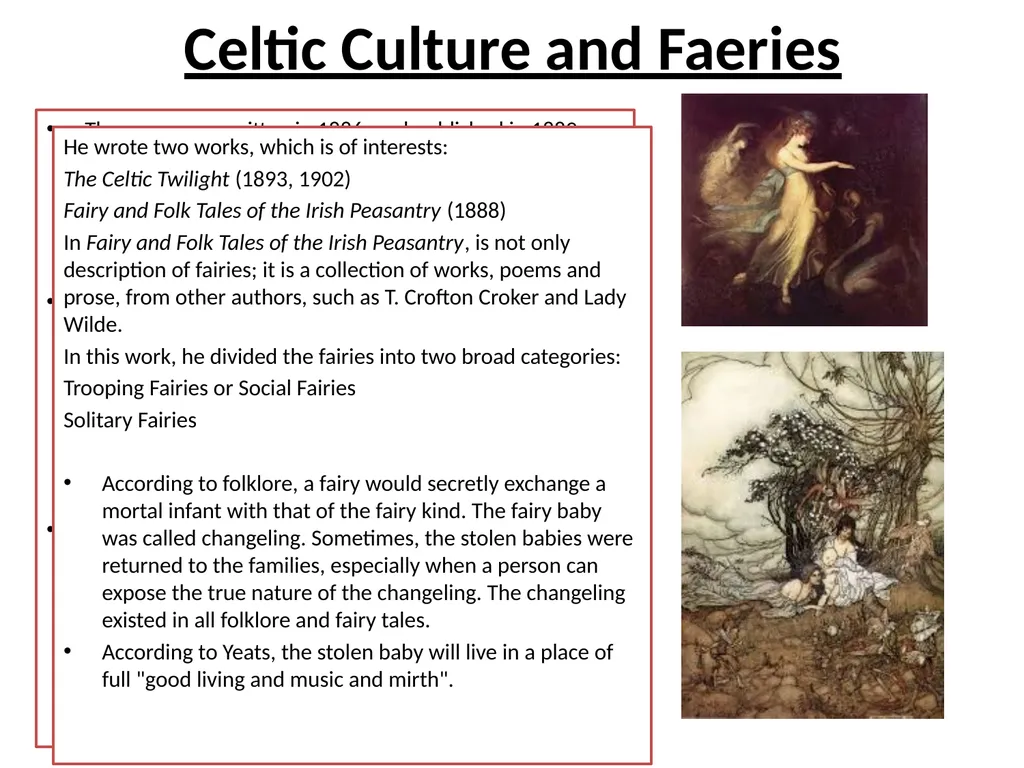
Celtic Culture and Faeries The poem was written in 1886, and published in 1889. Yeats was 21 when he wrote it, and at the beginning of his career. It celebrates the stories of Ireland that his mother loved. The images are consciously quaint. Yeats would later compile books of Irish fairy lore.
Yeats was a dreamer and visionary who was fascinated by folk-lore, ballad and superstitions about the Irish peasantry. His poetry has Celtic flavour mixed with mysticism and melancholy. His aim in writing poetry was to make the world conscious about the beauties of Celtic literature. As he grew older, he deviated from pleasant lyrics to verses with sterner discipline and deeper thought.
As he did though, his style grew grand and austere, moving away y from the lush, folkloric description of this lovely early poem. Yeats may have loved Ireland in the abstract, and expressed its spirit more than well enough to win a Nobel Prize, but in this poem he loved the actual place in all its reality, and with all the intense enthusiasm of his youth. He wrote two works, which is of interests:
The Celtic Twilight (1893, 1902)
Fairy and Folk Tales of the Irish Peasantry (1888)
In Fairy and Folk Tales of the Irish Peasantry, is not only description of fairies; it is a collection of works, poems and prose, from other authors, such as T. Crofton Croker and Lady Wilde.
In this work, he divided the fairies into two broad categories:
Trooping Fairies or Social Fairies
Solitary Fairies
According to folklore, a fairy would secretly exchange a mortal infant with that of the fairy kind. The fairy baby was called changeling. Sometimes, the stolen babies were returned to the families, especially when a person can expose the true nature of the changeling. The changeling existed in all folklore and fairy tales.
According to Yeats, the stolen baby will live in a place of full "good living and music and mirth".<br>
03
A Reading https://www.youtube.com/watch?v=Xf1xBx7JIs4&safe=active
Highlight the following:
Key images you think are powerful or important
Key events in the narrative of the poem<br>
04
Summary This poem is based on Irish legends in which fairies entice a child to go away with them and then replace it with a changeling. Changelings were considered comparatively ugly and wooden.
In your pairs, write a short summary of each stanza detailing exactly what happens. (This will be typed up and added to our anthology)<br>
05
‘The Stolen Child’ Lesson 2 LO: Close analysis of language, form and structure.
Homework: Learn the key poetic terms for a subject knowledge test on Monday<br>
06
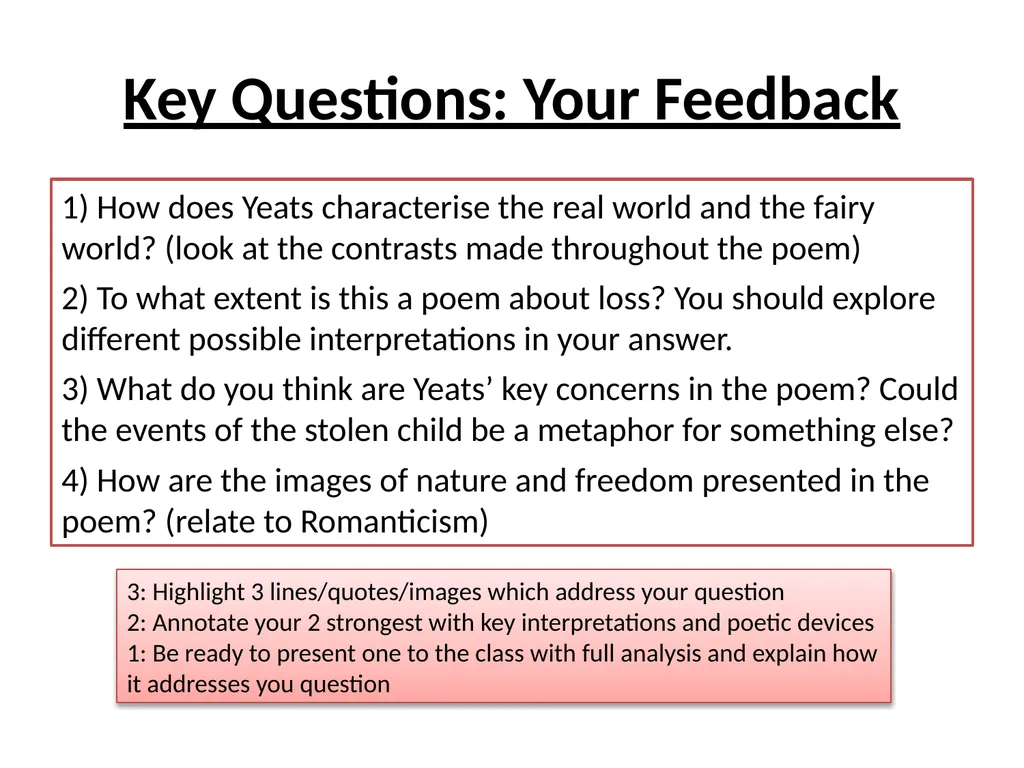
Key Questions: Your Feedback 1) How does Yeats characterise the real world and the fairy world? (look at the contrasts made throughout the poem)
2) To what extent is this a poem about loss? You should explore different possible interpretations in your answer.
3) What do you think are Yeats’ key concerns in the poem? Could the events of the stolen child be a metaphor for something else?
4) How are the images of nature and freedom presented in the poem? (relate to Romanticism) 3: Highlight 3 lines/quotes/images which address your question
2: Annotate your 2 strongest with key interpretations and poetic devices
1: Be ready to present one to the class with full analysis and explain how it addresses you question<br>
07
Group Work In your groups discuss and answer the key questions.
Be ready to feedback to the whole class.<br>
08
The Transition from Romanticism to Modernism Yeats started his long literary career as a romantic poet and gradually evolved into a modernist poet. When he began publishing poetry in the 1880s, his poems had a lyrical, romantic style, and they focused on love, longing and loss, and Irish myths. His early writing follows the conventions of romantic verse, utilizing familiar rhyme schemes, metric patterns, and poetic structures. Although it is lighter than his later writings, his early poetry is still sophisticated and accomplished.<br>
09
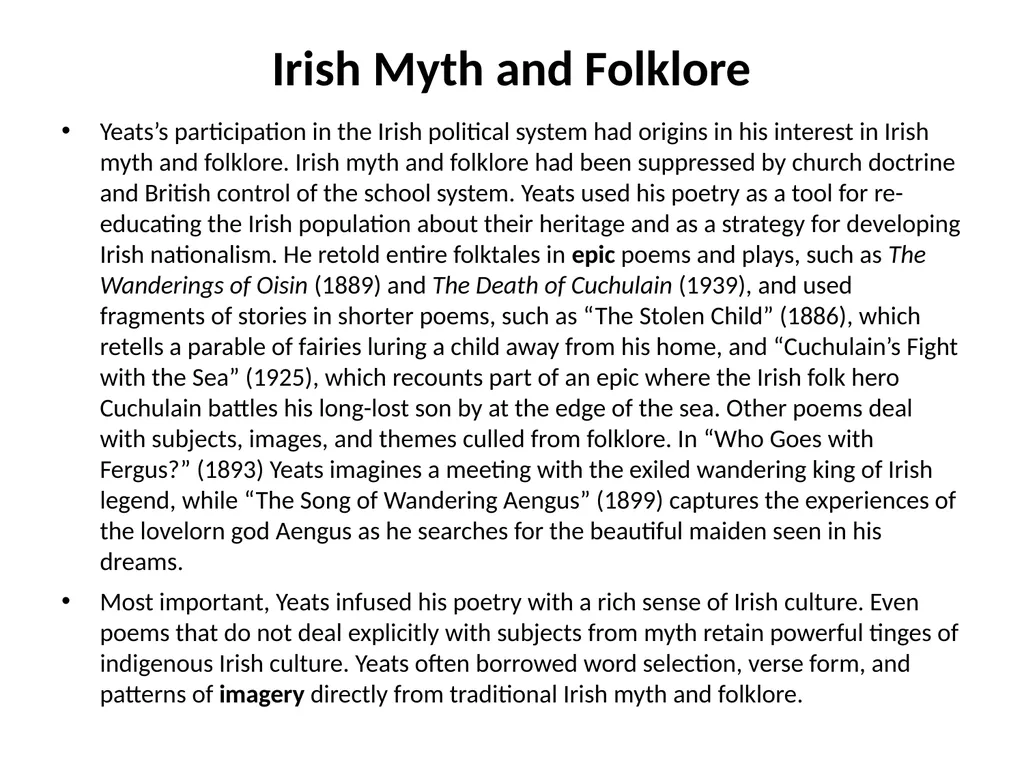
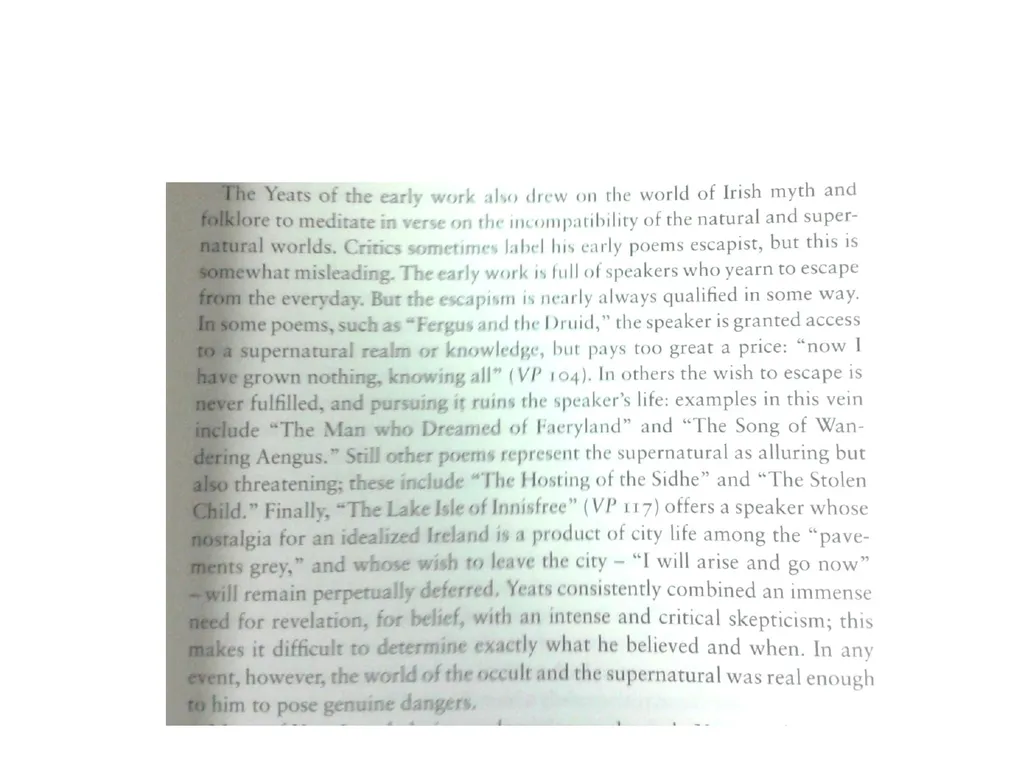
Irish Myth and Folklore Yeats’s participation in the Irish political system had origins in his interest in Irish myth and folklore. Irish myth and folklore had been suppressed by church doctrine and British control of the school system. Yeats used his poetry as a tool for re-educating the Irish population about their heritage and as a strategy for developing Irish nationalism. He retold entire folktales in epic poems and plays, such as The Wanderings of Oisin (1889) and The Death of Cuchulain (1939), and used fragments of stories in shorter poems, such as “The Stolen Child” (1886), which retells a parable of fairies luring a child away from his home, and “Cuchulain’s Fight with the Sea” (1925), which recounts part of an epic where the Irish folk hero Cuchulain battles his long-lost son by at the edge of the sea. Other poems deal with subjects, images, and themes culled from folklore. In “Who Goes with Fergus?” (1893) Yeats imagines a meeting with the exiled wandering king of Irish legend, while “The Song of Wandering Aengus” (1899) captures the experiences of the lovelorn god Aengus as he searches for the beautiful maiden seen in his dreams.
Most important, Yeats infused his poetry with a rich sense of Irish culture. Even poems that do not deal explicitly with subjects from myth retain powerful tinges of indigenous Irish culture. Yeats often borrowed word selection, verse form, and patterns of imagery directly from traditional Irish myth and folklore.<br>
10
Key Question How does Yeats demonstrate his early Romantic style and interest in Irish national identity through his poem ‘The Stolen Child’?<br>
11
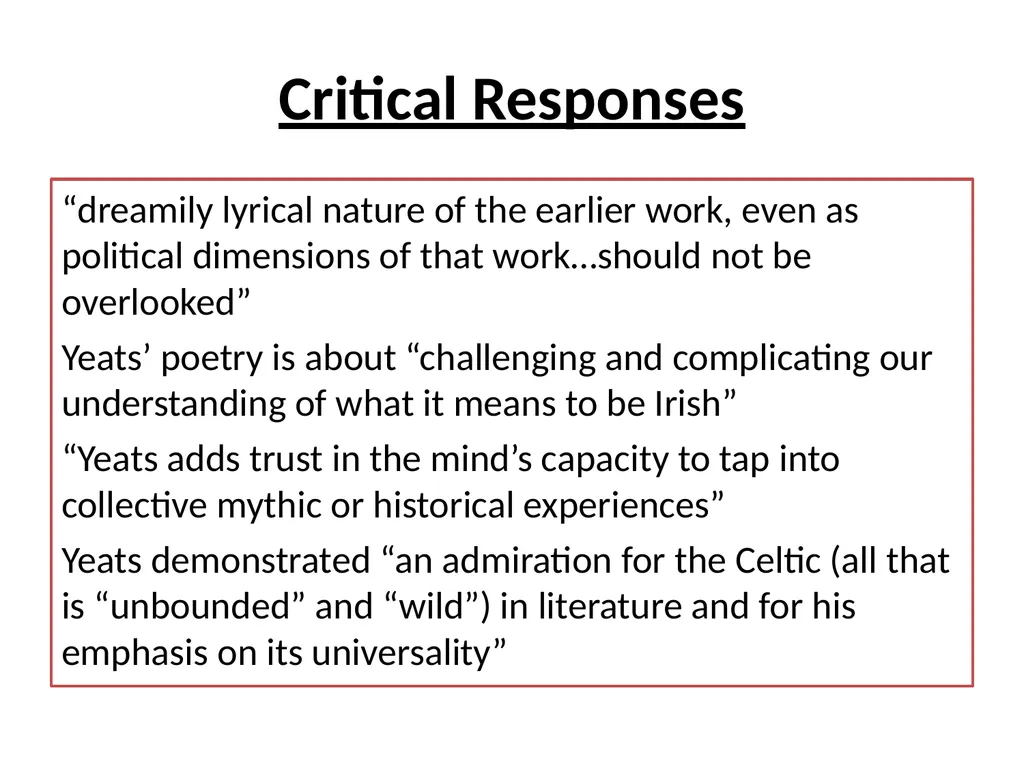
Critical Responses “dreamily lyrical nature of the earlier work, even as political dimensions of that work…should not be overlooked”
Yeats’ poetry is about “challenging and complicating our understanding of what it means to be Irish”
“Yeats adds trust in the mind’s capacity to tap into collective mythic or historical experiences”
Yeats demonstrated “an admiration for the Celtic (all that is “unbounded” and “wild”) in literature and for his emphasis on its universality”<br>
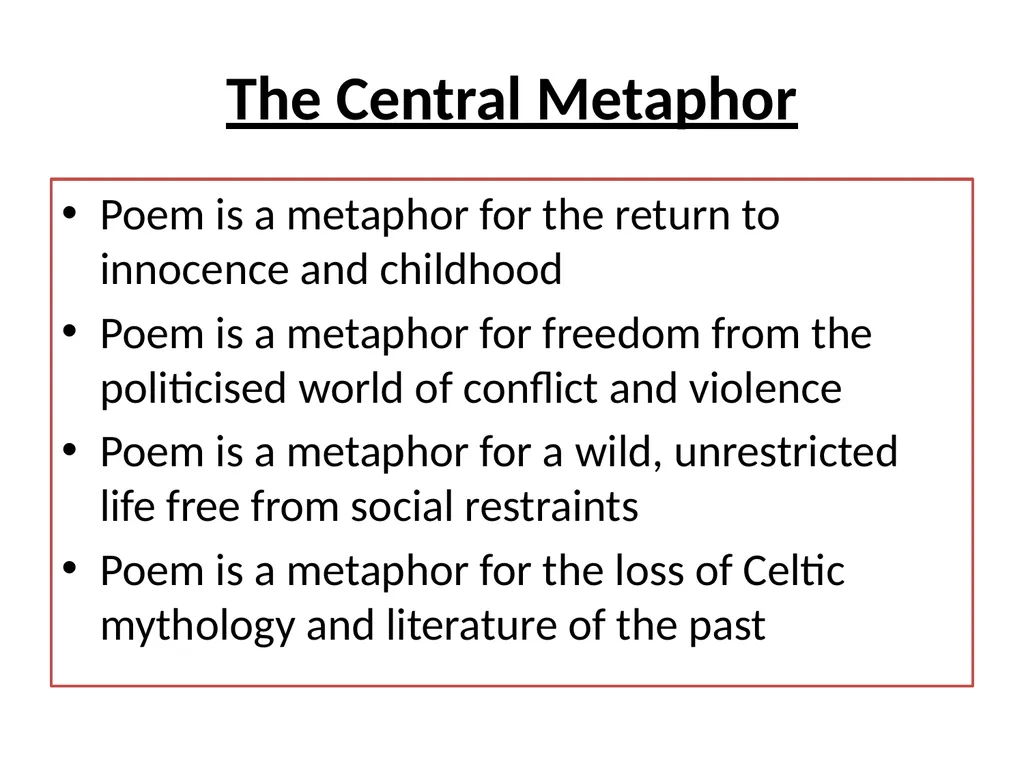
The Central Metaphor Poem is a metaphor for the return to innocence and childhood
Poem is a metaphor for freedom from the politicised world of conflict and violence
Poem is a metaphor for a wild, unrestricted life free from social restraints
Poem is a metaphor for the loss of Celtic mythology and literature of the past<br>
14
Matthew Arnold – On the Study of Celtic Literature<br>