The Teacher Clarity Playbook Module 1. Identifying
Description: The Teacher Clarity Playbook Module 1. Identifying Concepts and Skills Copyright 2019 Corwin Objectives for Today Copyright 2019 Corwin 2 Participants will: Differentiate between concepts and skills in standards Examine examples of
Related Topics
Download Presentation
"The Teacher Clarity Playbook Module 1. Identifying" is the property of its rightful owner. Permission is granted to download and print the materials on this website for personal, non-commercial use only, and to display it on your personal computer provided you do not modify the materials and that you retain all copyright notices contained in the materials. By downloading content from our website, you accept the terms of this agreement.
Presentation Transcript
slide1. The Teacher Clarity Playbook Module 1. Identifying Concepts and Skills Copyright © 2019 Corwin<br>
slide2. Objectives for Today Copyright © 2019 Corwin 2 Participants will:
Differentiate between concepts and skills in standards
Examine examples of concepts and skills in four grade levels
Complete a guided learning exercise to check for understanding
Apply the process to identify concepts and skills in the selected standard<br>
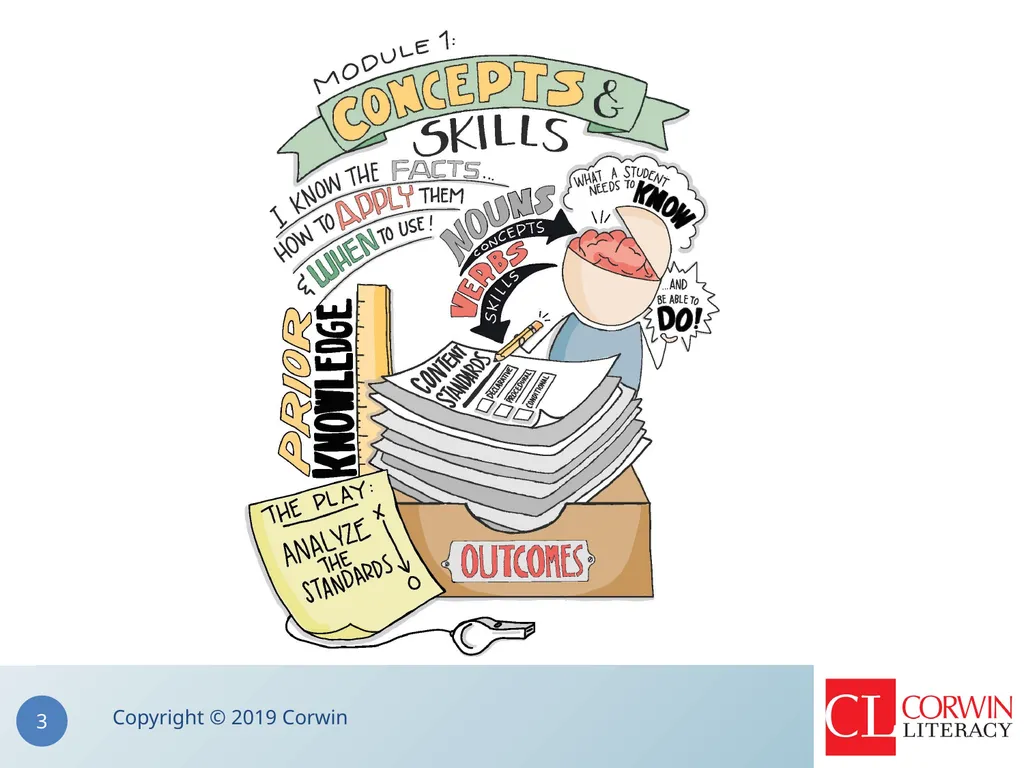
slide3. Copyright © 2019 Corwin 3<br>
slide4. Modeling 4 Read and discuss the four examples on page 4-5.
Are there points of divergence?
How might we come to consensus? Copyright © 2019 Corwin<br>
slide5. Guided Practice 5 Use the two examples on page 6 to apply this process.
Follow the detailed instructions to complete the exercise.
Check for understanding by viewing the possible answers in the appendix of The Teacher Clarity Playbook. Copyright © 2019 Corwin<br>
slide6. On Your Own Copyright © 2019 Corwin 6 Individually or in teams, use the same process with your selected standard.
Complete this on chart paper, or using digital collaboration tools.<br>
slide7. PLC Conversations Copyright © 2019 Corwin 7 What challenged you in this module?
How will you package and pace the standards? Would a pacing guide for all of the standards be useful?
How will you know if you analyzed the standard(s) correctly?<br>
slide8. Wrap Up: Why Are We Doing This? Copyright © 2019 Corwin 8 “Knowing the standards well allows teachers to identify the necessary prior knowledge and to determine the expectations for students’ success. In nearly all cases, the standards themselves articulate outcomes of learning and often call upon students to apply what they have learned to an ever-widening set of situations and texts.” (p. 9)<br>
slide2. Objectives for Today Copyright © 2019 Corwin 2 Participants will:
Differentiate between concepts and skills in standards
Examine examples of concepts and skills in four grade levels
Complete a guided learning exercise to check for understanding
Apply the process to identify concepts and skills in the selected standard<br>
slide3. Copyright © 2019 Corwin 3<br>
slide4. Modeling 4 Read and discuss the four examples on page 4-5.
Are there points of divergence?
How might we come to consensus? Copyright © 2019 Corwin<br>
slide5. Guided Practice 5 Use the two examples on page 6 to apply this process.
Follow the detailed instructions to complete the exercise.
Check for understanding by viewing the possible answers in the appendix of The Teacher Clarity Playbook. Copyright © 2019 Corwin<br>
slide6. On Your Own Copyright © 2019 Corwin 6 Individually or in teams, use the same process with your selected standard.
Complete this on chart paper, or using digital collaboration tools.<br>
slide7. PLC Conversations Copyright © 2019 Corwin 7 What challenged you in this module?
How will you package and pace the standards? Would a pacing guide for all of the standards be useful?
How will you know if you analyzed the standard(s) correctly?<br>
slide8. Wrap Up: Why Are We Doing This? Copyright © 2019 Corwin 8 “Knowing the standards well allows teachers to identify the necessary prior knowledge and to determine the expectations for students’ success. In nearly all cases, the standards themselves articulate outcomes of learning and often call upon students to apply what they have learned to an ever-widening set of situations and texts.” (p. 9)<br>