01
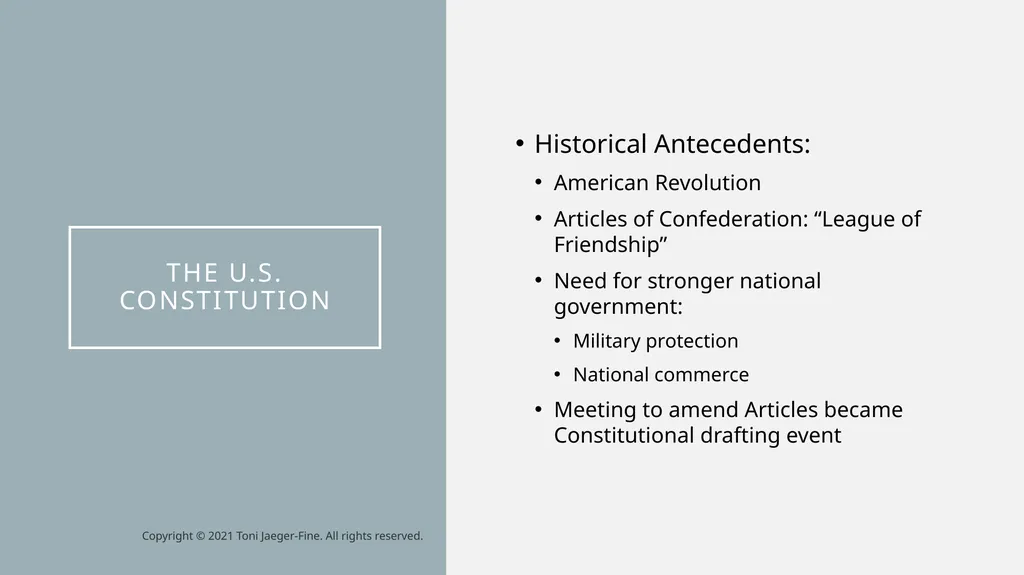
The u.s. constitution Historical Antecedents:
American Revolution
Articles of Confederation: “League of Friendship”
Need for stronger national government:
Military protection
National commerce
Meeting to amend Articles became Constitutional drafting event Copyright © 2021 Toni Jaeger-Fine. All rights reserved.<br>
02
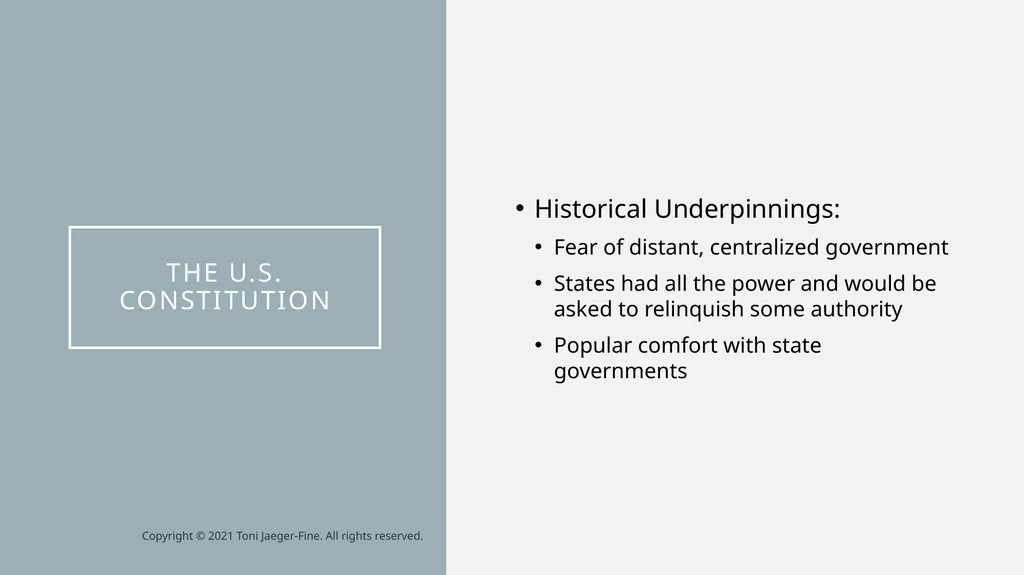
The u.s. constitution Historical Underpinnings:
Fear of distant, centralized government
States had all the power and would be asked to relinquish some authority
Popular comfort with state governments Copyright © 2021 Toni Jaeger-Fine. All rights reserved.<br>
03
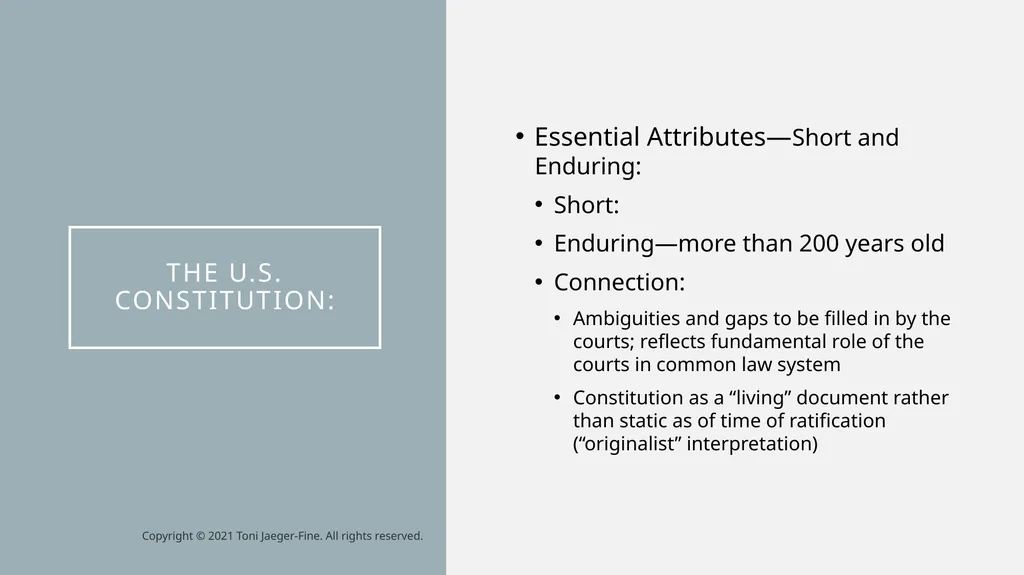
The u.s. constitution: Essential Attributes—Short and Enduring:
Short:
Enduring—more than 200 years old
Connection:
Ambiguities and gaps to be filled in by the courts; reflects fundamental role of the courts in common law system
Constitution as a “living” document rather than static as of time of ratification (“originalist” interpretation) Copyright © 2021 Toni Jaeger-Fine. All rights reserved.<br>
04
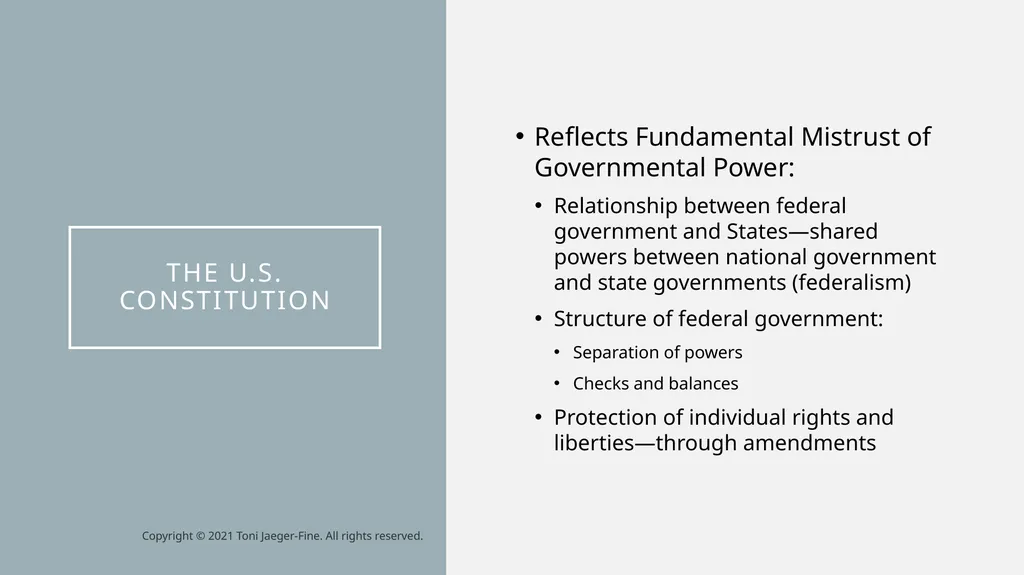
The u.s. constitution Reflects Fundamental Mistrust of Governmental Power:
Relationship between federal government and States—shared powers between national government and state governments (federalism)
Structure of federal government:
Separation of powers
Checks and balances
Protection of individual rights and liberties—through amendments Copyright © 2021 Toni Jaeger-Fine. All rights reserved.<br>
05
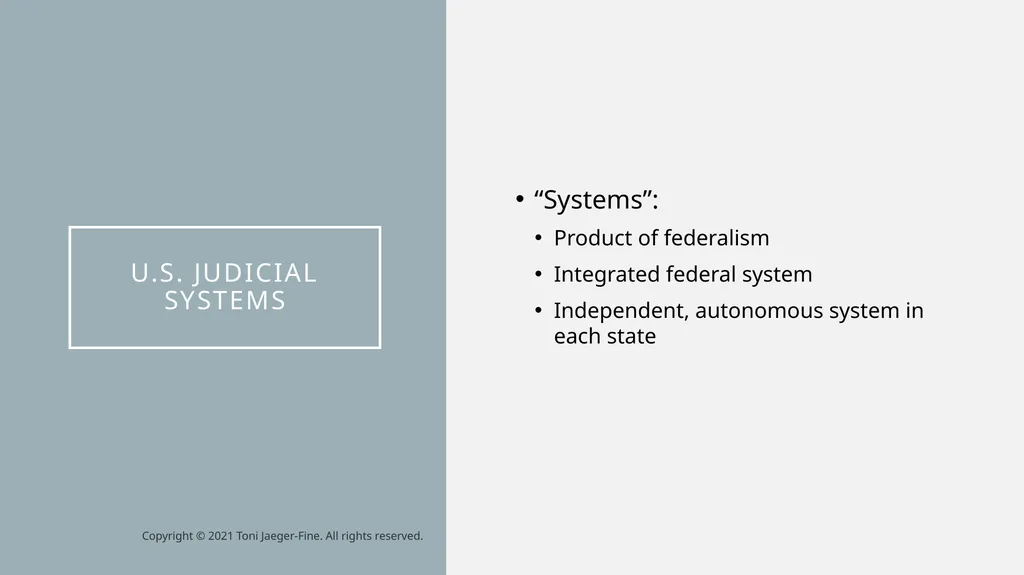
u.s. judicial systems “Systems”:
Product of federalism
Integrated federal system
Independent, autonomous system in each state Copyright © 2021 Toni Jaeger-Fine. All rights reserved.<br>
06
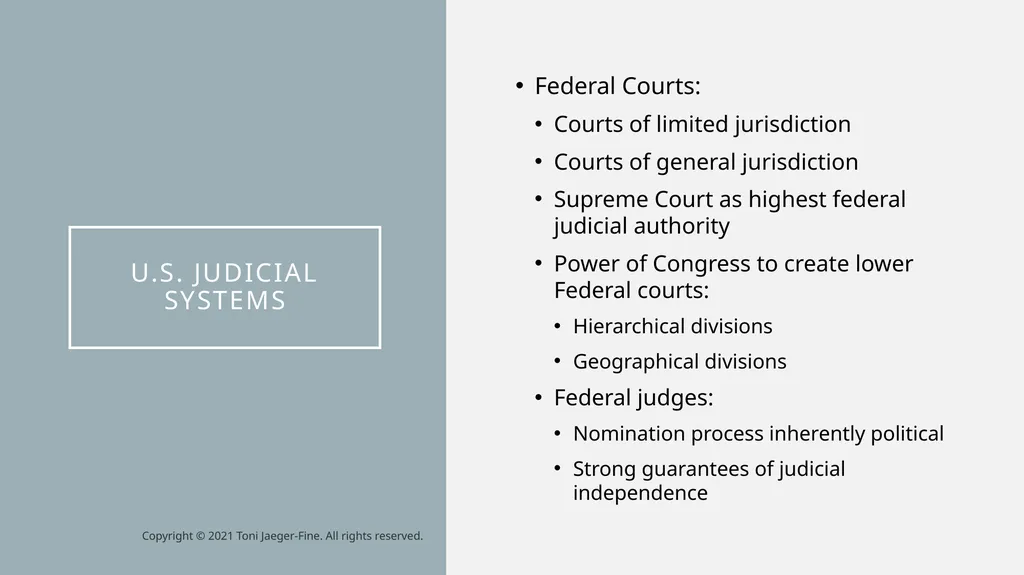
U.S. Judicial Systems Federal Courts:
Courts of limited jurisdiction
Courts of general jurisdiction
Supreme Court as highest federal judicial authority
Power of Congress to create lower Federal courts:
Hierarchical divisions
Geographical divisions
Federal judges:
Nomination process inherently political
Strong guarantees of judicial independence Copyright © 2021 Toni Jaeger-Fine. All rights reserved.<br>
07
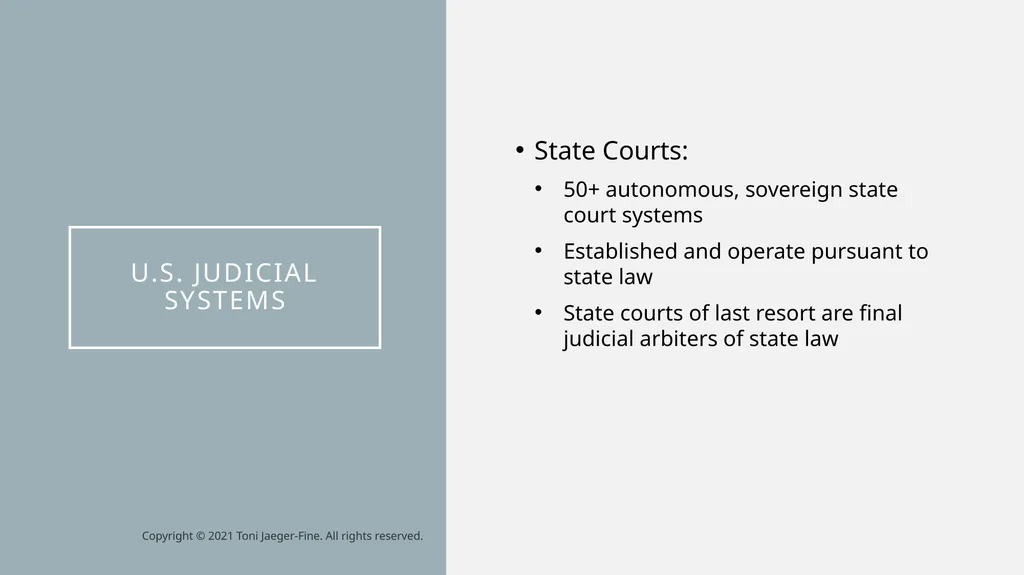
U.S. Judicial Systems State Courts:
50+ autonomous, sovereign state court systems
Established and operate pursuant to state law
State courts of last resort are final judicial arbiters of state law Copyright © 2021 Toni Jaeger-Fine. All rights reserved.<br>
08
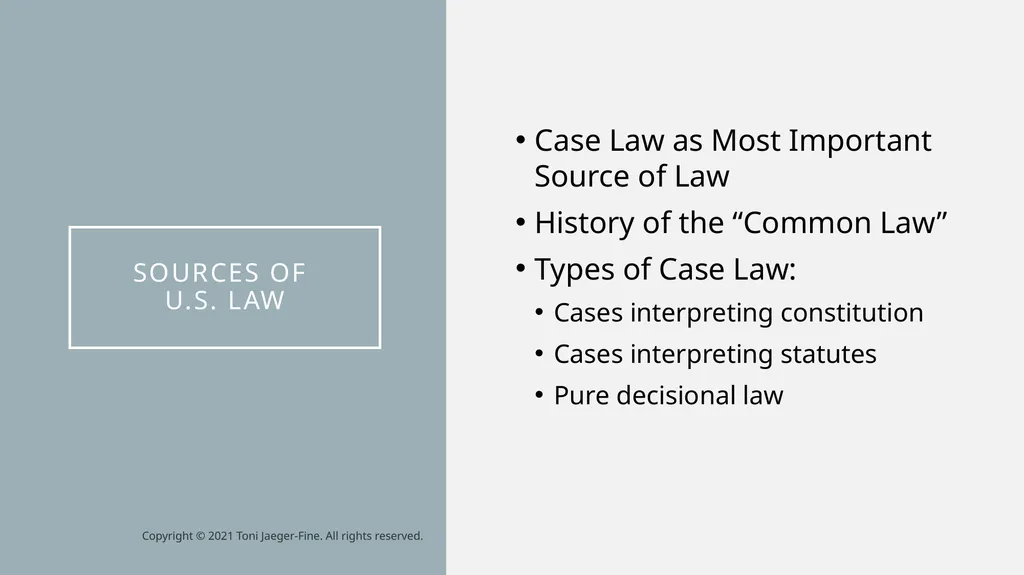
Sources of u.s. law Case Law as Most Important Source of Law
History of the “Common Law”
Types of Case Law:
Cases interpreting constitution
Cases interpreting statutes
Pure decisional law Copyright © 2021 Toni Jaeger-Fine. All rights reserved.<br>
09
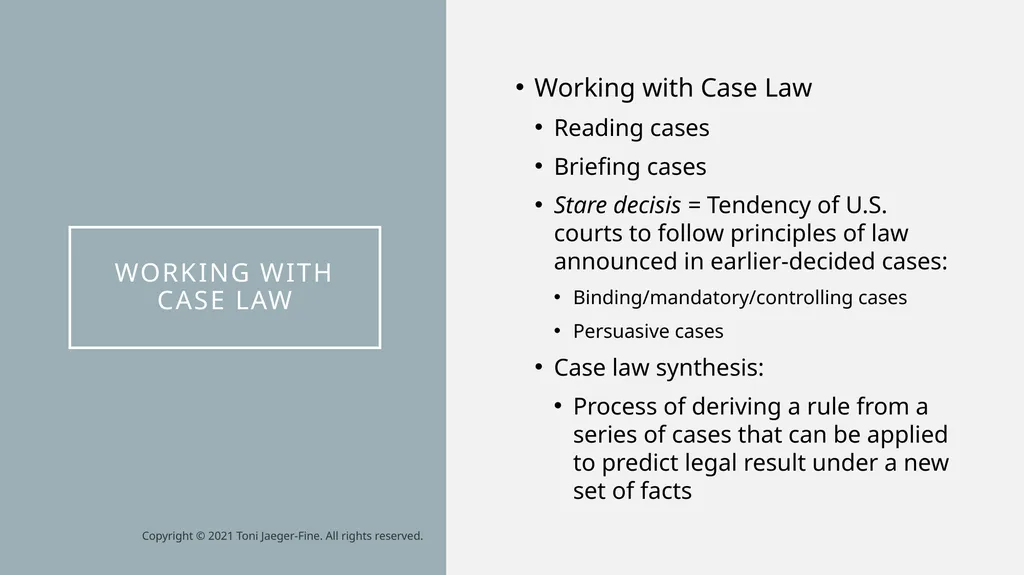
Working with case law Working with Case Law
Reading cases
Briefing cases
Stare decisis = Tendency of U.S. courts to follow principles of law announced in earlier-decided cases:
Binding/mandatory/controlling cases
Persuasive cases
Case law synthesis:
Process of deriving a rule from a series of cases that can be applied to predict legal result under a new set of facts Copyright © 2021 Toni Jaeger-Fine. All rights reserved.<br>
10
The full set of 205 slides is available upon adoption. If you are a professor using this book for a class, please contact Rachael Meier at remeier@cap-press.com to request your slides. Copyright © 2021 Toni Jaeger-Fine. All rights reserved.<br>
Show all 10 slides