
The Unit Organizer Routine The Content Enhancement
LV
Published · 56 slides · 0 views

1 / 1
Description
The Unit Organizer Routine The Content Enhancement Series 2006 The University of Kansas Center for Research on Learning Lawrence, Kansas 2 University of Kansas Center for Research on Learning 2006 Content Enhancement A way of teaching an
Related Topics
Share
Embed code
Download this presentation From Below
"The Unit Organizer Routine The Content Enhancement" is the property of its rightful owner. Permission is granted to download and print the materials on this website for personal, non-commercial use only, and to display it on your personal computer provided you do not modify the materials and that you retain all copyright notices contained in the materials. By downloading content from our website, you accept the terms of this agreement.
Presentation Transcript
01
The Unit
Organizer Routine The Content Enhancement Series
2006
The University of Kansas
Center for Research on Learning
Lawrence, Kansas<br>
2006
The University of Kansas
Center for Research on Learning
Lawrence, Kansas<br>
02
2 University of Kansas Center for Research on Learning 2006 Content Enhancement A way of teaching an academically diverse group of students in which:
Both group and individual needs are valued and met;
The integrity of the content is maintained;<br>
Both group and individual needs are valued and met;
The integrity of the content is maintained;<br>
03
3 University of Kansas Center for Research on Learning 2006 Content Enhancement A way of teaching an academically diverse group of students in which:
Critical features of the content are selected and transformed in a manner that promotes student learning; and
Instruction is carried out in a partnership with students.<br>
Critical features of the content are selected and transformed in a manner that promotes student learning; and
Instruction is carried out in a partnership with students.<br>
04
4 University of Kansas Center for Research on Learning 2006 Guidebooks in the
Content Enhancement Series Routines for planning and leading learning
Course Organizer Routine
Unit Organizer Routine
Lesson Organizer Routine<br>
Course Organizer Routine
Unit Organizer Routine
Lesson Organizer Routine<br>
05
5 University of Kansas Center for Research on Learning 2006 Guidebooks in the
Content Enhancement Series Routines for exploring text, topics, and details
Clarifying Routine
Framing Routine
Survey Routine
ORDER Routine<br>
Clarifying Routine
Framing Routine
Survey Routine
ORDER Routine<br>
06
6 University of Kansas Center for Research on Learning 2006 Guidebooks in the
Content Enhancement Series Routines for teaching concepts
Concept Anchoring Routine
Concept Comparison Routine
Concept Mastery Routine<br>
Concept Anchoring Routine
Concept Comparison Routine
Concept Mastery Routine<br>
07
7 University of Kansas Center for Research on Learning 2006 Guidebooks in the
Content Enhancement Series Routines for increasing performance
Quality Assignment Routine
Question Exploration Routine
Recall Enhancement Routine
Vocabulary LINCing Routine<br>
Quality Assignment Routine
Question Exploration Routine
Recall Enhancement Routine
Vocabulary LINCing Routine<br>
08
8 University of Kansas Center for Research on Learning 2006 The Challenge Many students have difficulty:
Relating new information to known information.
Seeing the "big ideas" among the details.
Translating the "big ideas" into words, phrases, and concepts that make sense to them.
Identifying the structure of information.<br>
Relating new information to known information.
Seeing the "big ideas" among the details.
Translating the "big ideas" into words, phrases, and concepts that make sense to them.
Identifying the structure of information.<br>
09
9 University of Kansas Center for Research on Learning 2006 The Challenge Many students have difficulty:
Seeing the relationships between different sets of information.
Generating questions to help them focus their learning.
Projecting and managing time in order to complete tasks.
Keeping the "big ideas" and structure of a unit in mind as they progress through the unit.<br>
Seeing the relationships between different sets of information.
Generating questions to help them focus their learning.
Projecting and managing time in order to complete tasks.
Keeping the "big ideas" and structure of a unit in mind as they progress through the unit.<br>
10
10 University of Kansas Center for Research on Learning 2006 Responding to the Challenge The Unit Organizer Routine helps students to:
Relate unit content to previous and future units and to bigger course ideas.
Understand the main idea of the content through the use of a meaningful paraphrase of the "big idea" of the unit.
See the structure of the unit's content.
Focus attention on important relationships in the content of the unit.<br>
Relate unit content to previous and future units and to bigger course ideas.
Understand the main idea of the content through the use of a meaningful paraphrase of the "big idea" of the unit.
See the structure of the unit's content.
Focus attention on important relationships in the content of the unit.<br>
11
11 University of Kansas Center for Research on Learning 2006 Responding to the Challenge The Unit Organizer Routine helps students to:
Generate questions that relate to learning the big ideas of the unit.
Build a schedule to plan time and task completion.
Keep the "big ideas" and structure of the unit in mind as unit content is learned.<br>
Generate questions that relate to learning the big ideas of the unit.
Build a schedule to plan time and task completion.
Keep the "big ideas" and structure of the unit in mind as unit content is learned.<br>
12
12 University of Kansas Center for Research on Learning 2006 Supporting Research Field tests took place in 7th-12th grade classes.
Teachers learned the routine easily.
Students gained an average of at least 10 to 20 percentage points on unit tests.
Teachers continued using the routine after the studies were completed.<br>
Teachers learned the routine easily.
Students gained an average of at least 10 to 20 percentage points on unit tests.
Teachers continued using the routine after the studies were completed.<br>
13
13 University of Kansas Center for Research on Learning 2006 Supporting Research Positive results were achieved when teachers:
received 2-3 hours of instruction in the routine
discussed the routine with colleagues
spent the necessary time to plan use of the routine<br>
received 2-3 hours of instruction in the routine
discussed the routine with colleagues
spent the necessary time to plan use of the routine<br>
14
14 University of Kansas Center for Research on Learning 2006 Supporting Research Positive results were achieved when teachers:
taught students how to participate in and use the routine
used the routine regularly over time
held the highest expectations for student learning<br>
taught students how to participate in and use the routine
used the routine regularly over time
held the highest expectations for student learning<br>
15
15 University of Kansas Center for Research on Learning 2006 Components of
The Unit Organizer Routine The
Unit Organizer
Teaching Device
The
Craft
Linking Steps
The
Cue-Do-Review
Sequence<br>
Unit Organizer
Teaching Device
The
Craft
Linking Steps
The
Cue-Do-Review
Sequence<br>
16
16 University of Kansas Center for Research on Learning 2006 The Unit Organizer
Teaching Device Is a visual device that:
is used under teacher guidance
focuses attention on critical outcomes
identifies critical unit content
prompts elaboration on critical points
helps make relationships concrete<br>
is used under teacher guidance
focuses attention on critical outcomes
identifies critical unit content
prompts elaboration on critical points
helps make relationships concrete<br>
17
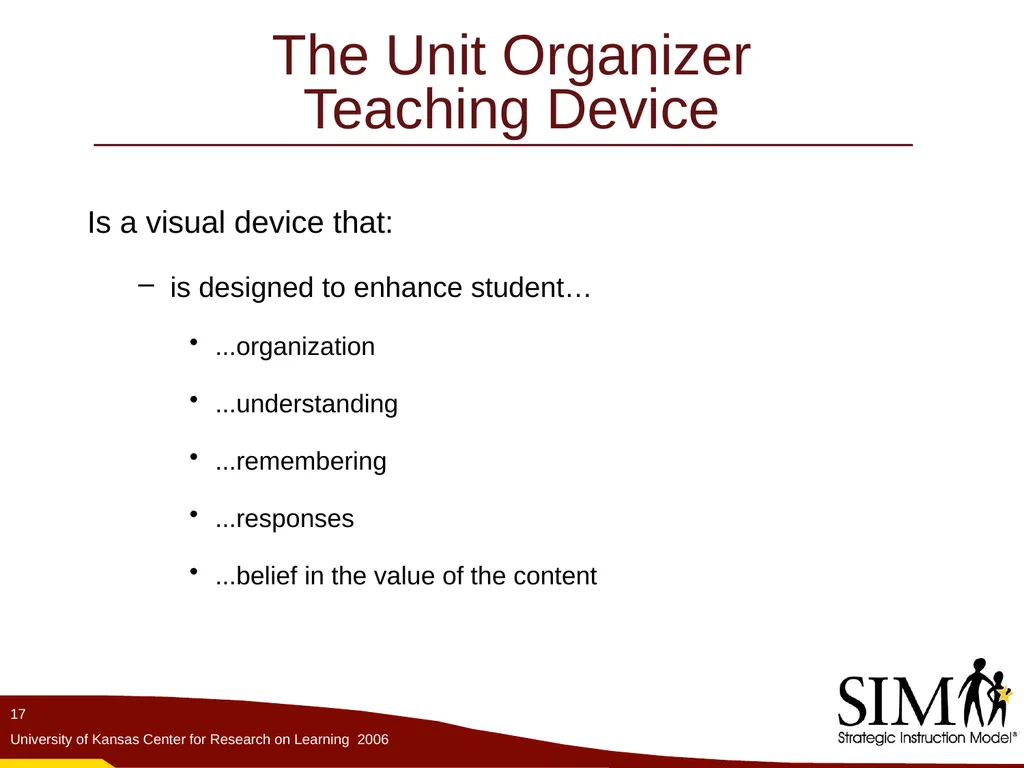
17 University of Kansas Center for Research on Learning 2006 The Unit Organizer
Teaching Device Is a visual device that:
is designed to enhance student…
...organization
...understanding
...remembering
...responses
...belief in the value of the content<br>
is designed to enhance student…
...organization
...understanding
...remembering
...responses
...belief in the value of the content<br>
18
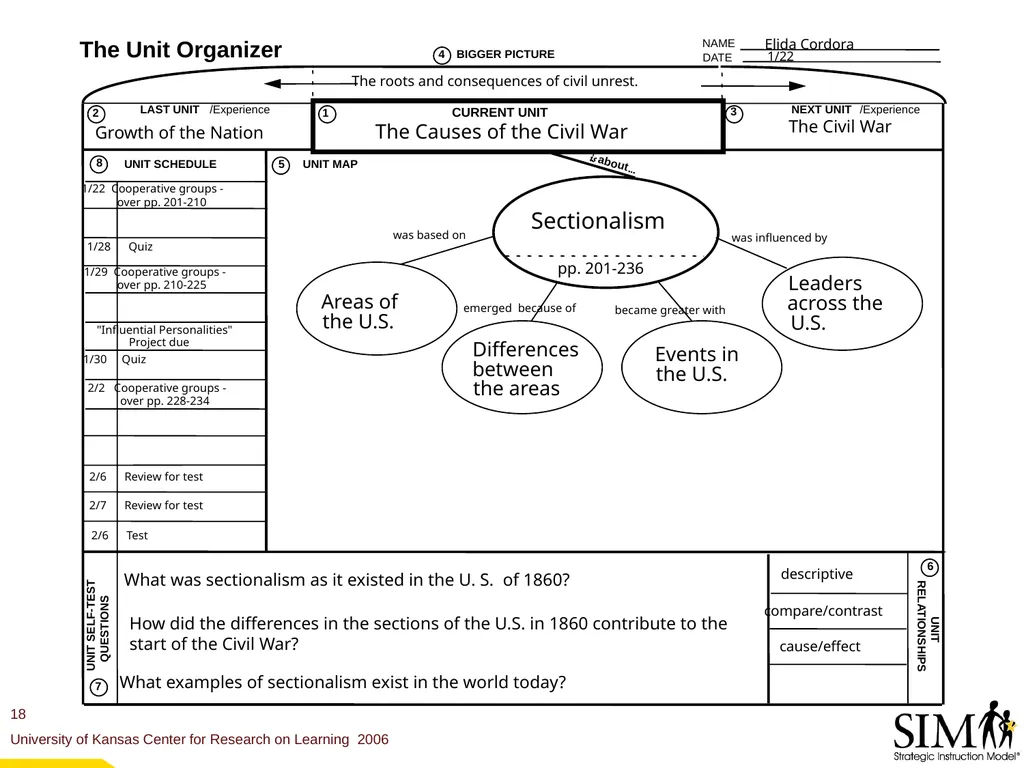
18 University of Kansas Center for Research on Learning 2006<br>
19
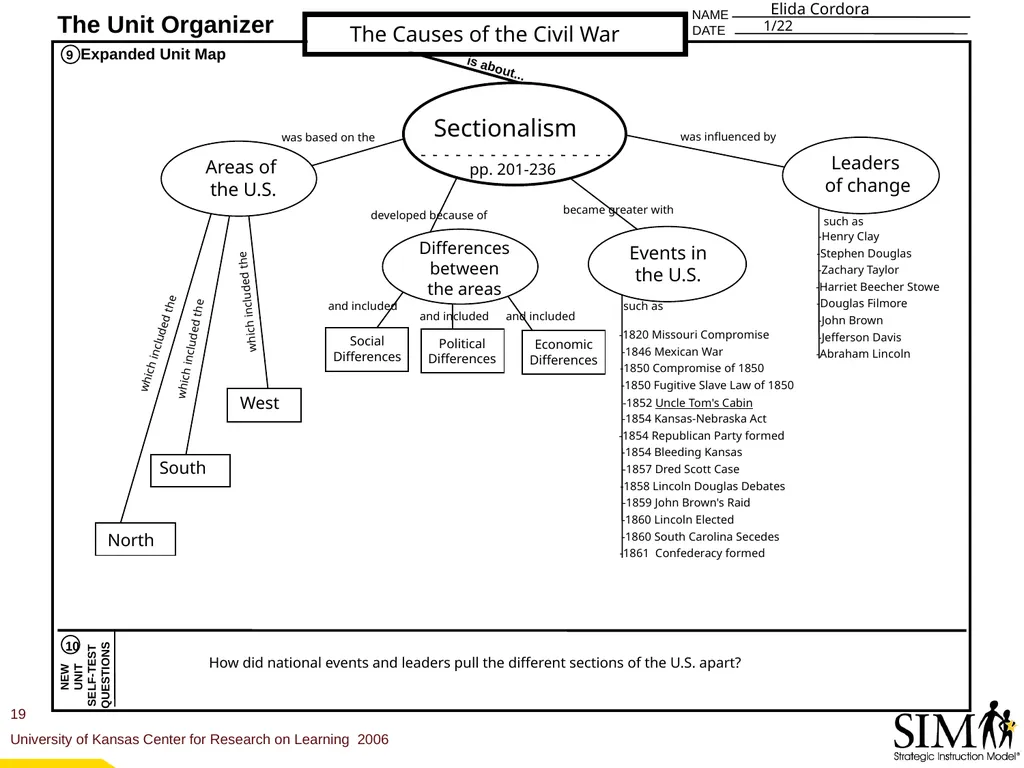
19 University of Kansas Center for Research on Learning 2006<br>
20
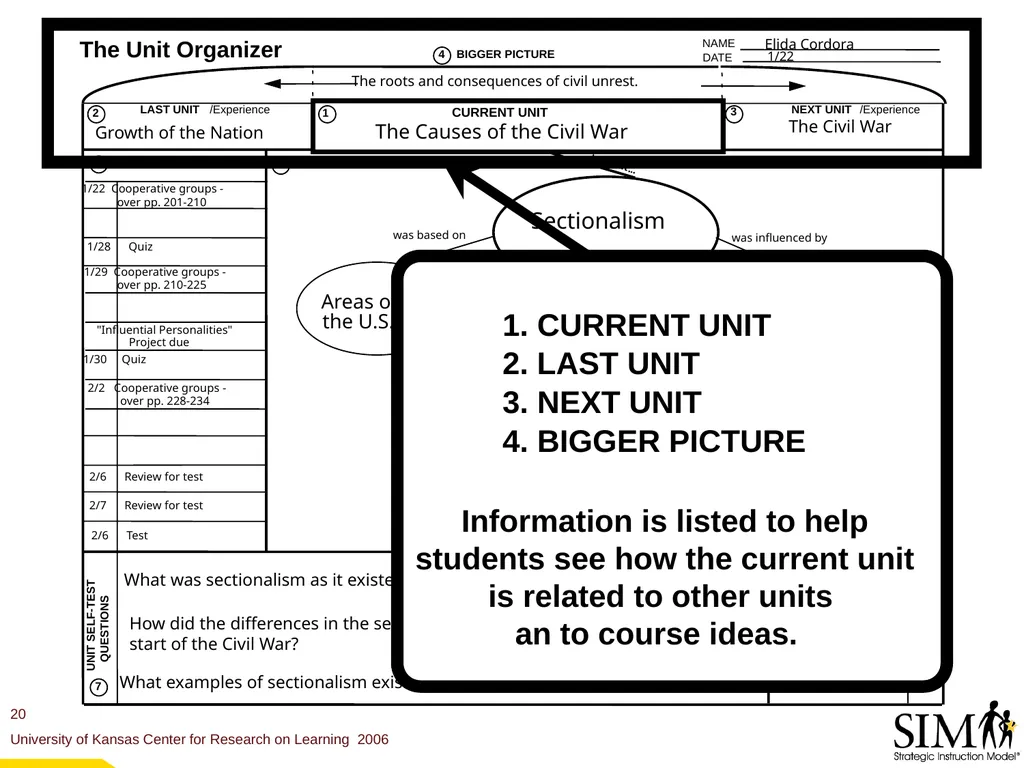
20 University of Kansas Center for Research on Learning 2006<br>
21
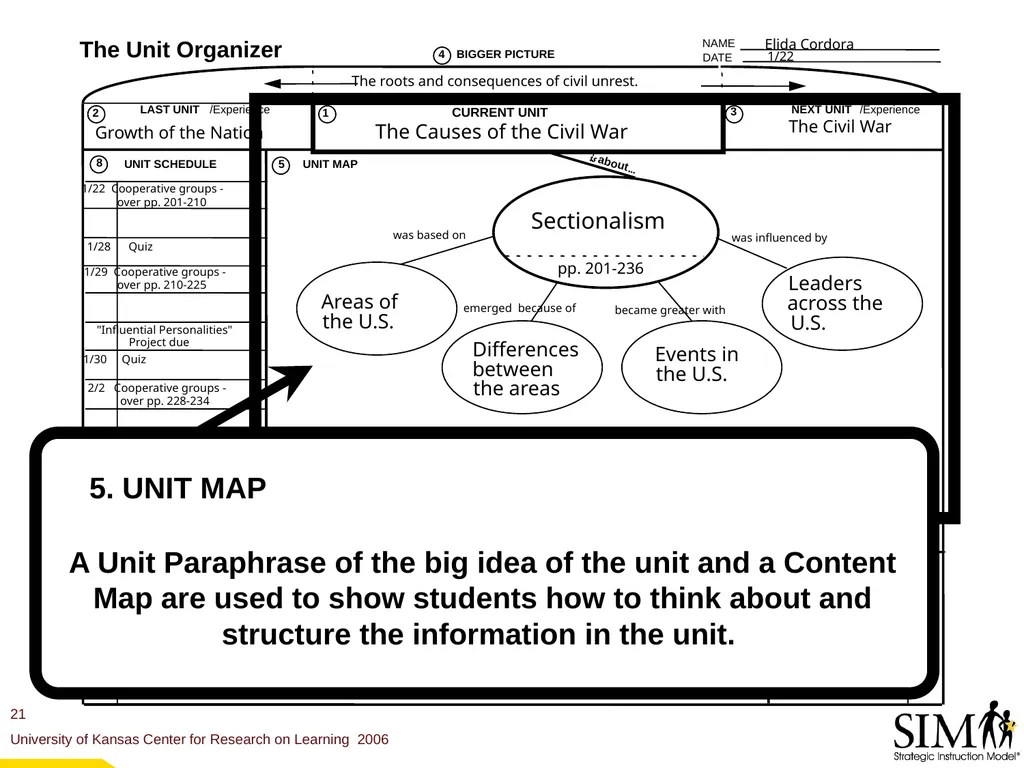
21 University of Kansas Center for Research on Learning 2006<br>
22
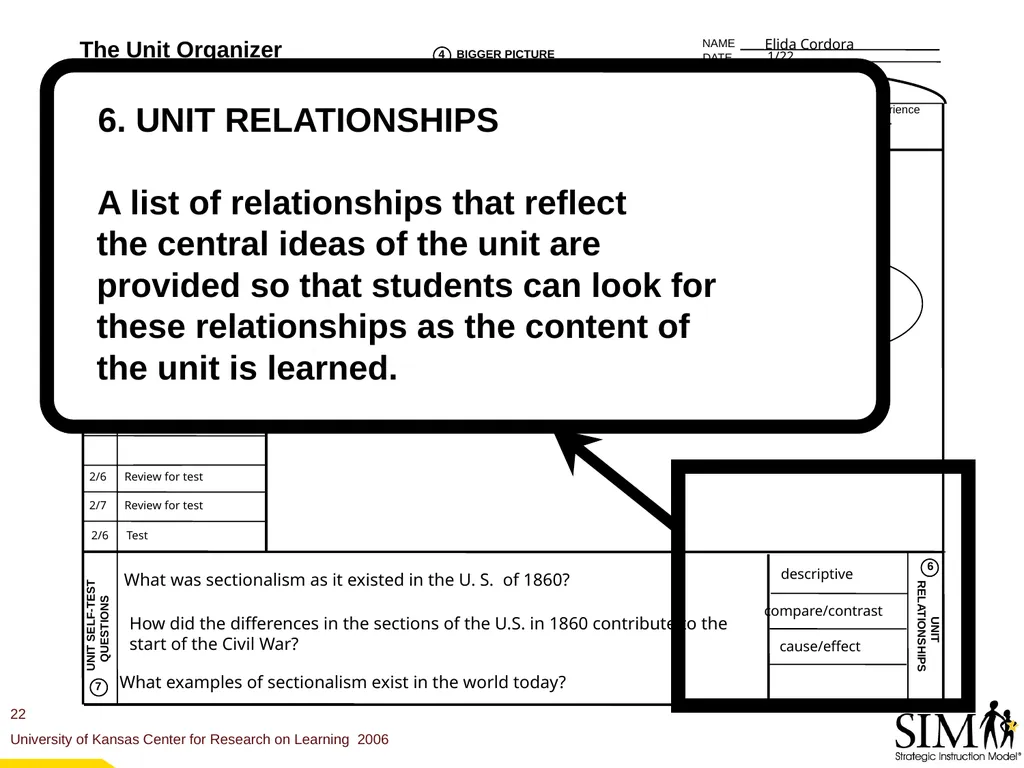
22 University of Kansas Center for Research on Learning 2006<br>
23
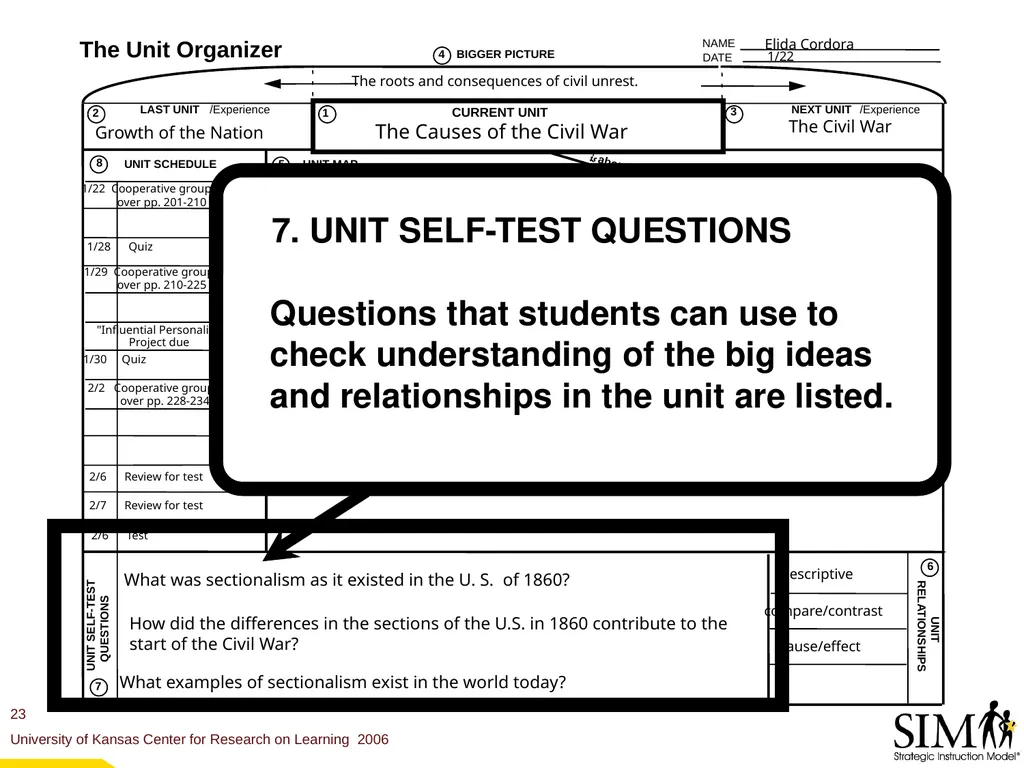
23 University of Kansas Center for Research on Learning 2006<br>
24
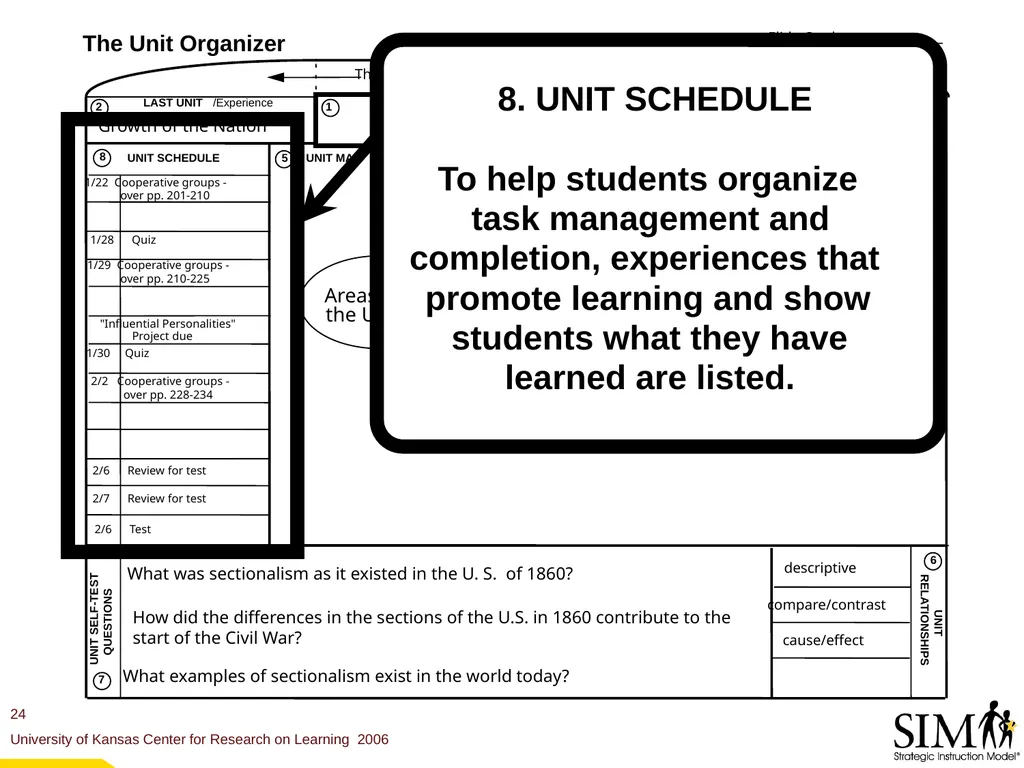
24 University of Kansas Center for Research on Learning 2006<br>
25
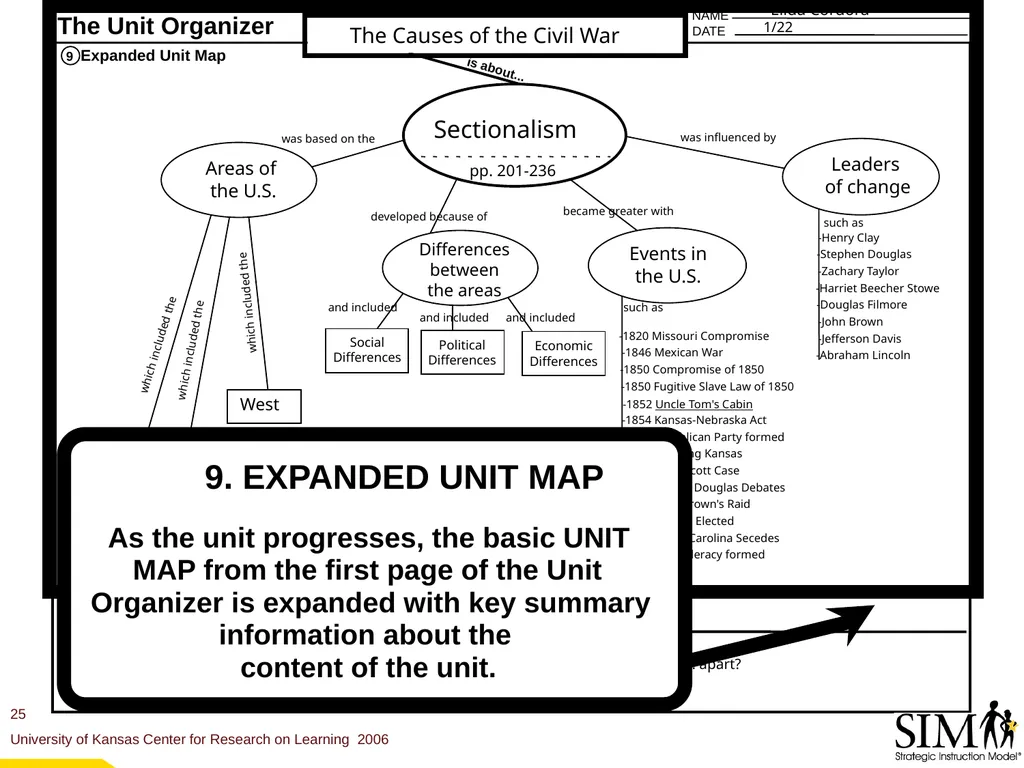
25 University of Kansas Center for Research on Learning 2006<br>
26
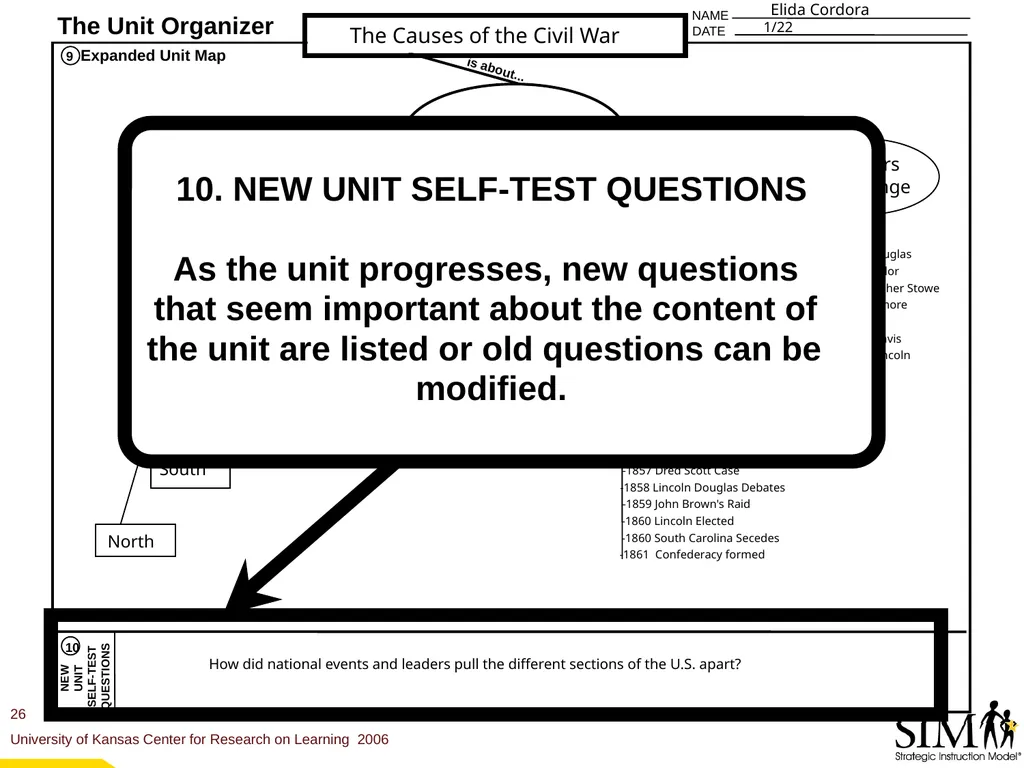
26 University of Kansas Center for Research on Learning 2006<br>
27
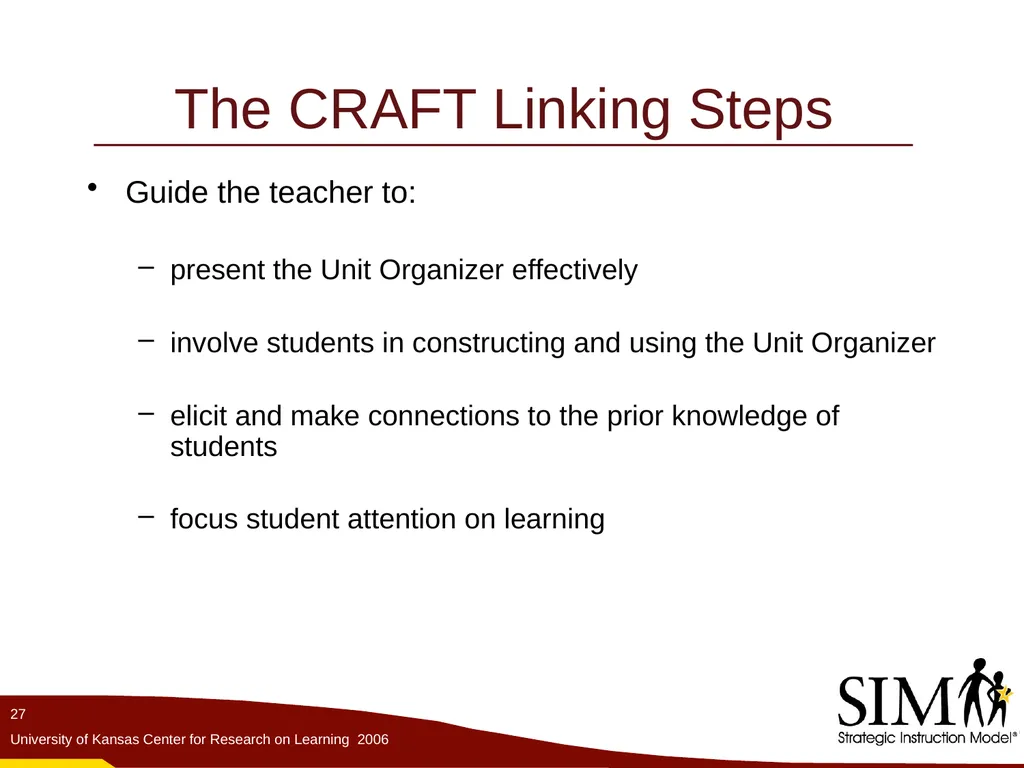
27 University of Kansas Center for Research on Learning 2006 The CRAFT Linking Steps Guide the teacher to:
present the Unit Organizer effectively
involve students in constructing and using the Unit Organizer
elicit and make connections to the prior knowledge of students
focus student attention on learning<br>
present the Unit Organizer effectively
involve students in constructing and using the Unit Organizer
elicit and make connections to the prior knowledge of students
focus student attention on learning<br>
28
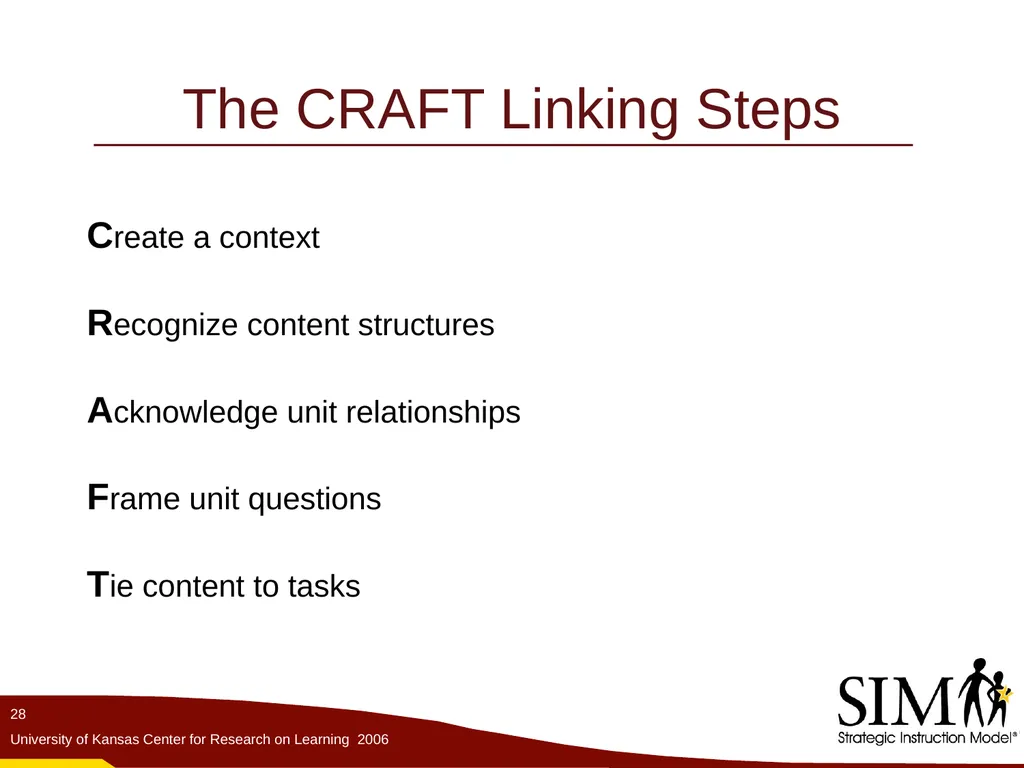
28 University of Kansas Center for Research on Learning 2006 The CRAFT Linking Steps Create a context
Recognize content structures
Acknowledge unit relationships
Frame unit questions
Tie content to tasks<br>
Recognize content structures
Acknowledge unit relationships
Frame unit questions
Tie content to tasks<br>
29
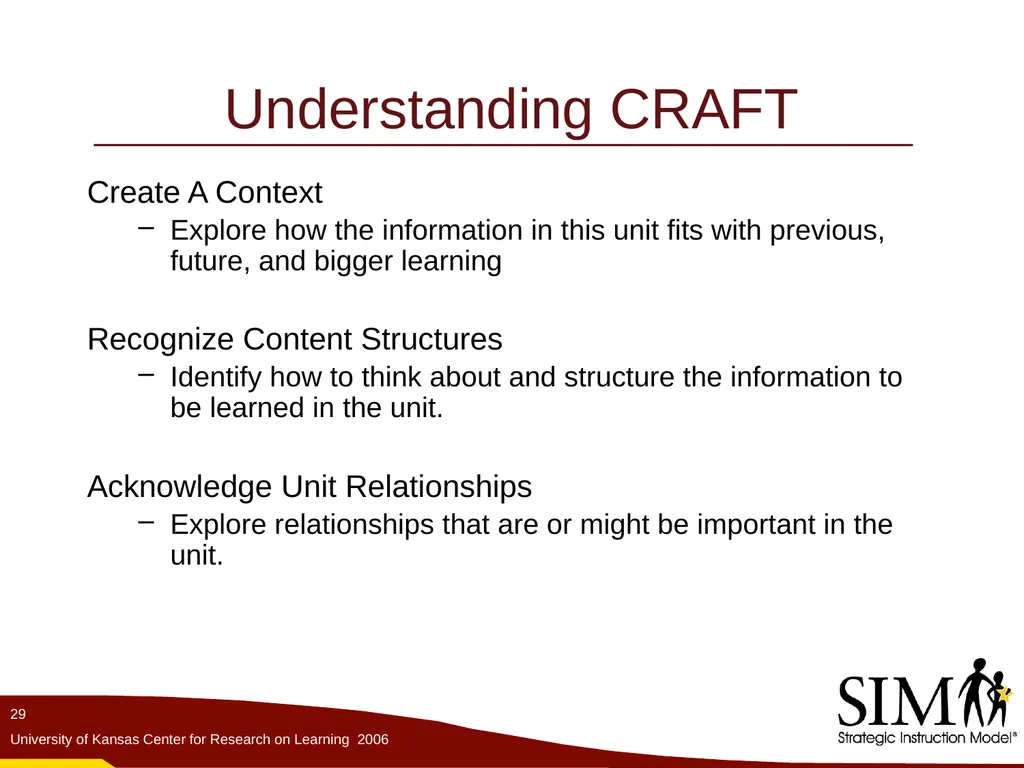
29 University of Kansas Center for Research on Learning 2006 Understanding CRAFT Create A Context
Explore how the information in this unit fits with previous, future, and bigger learning
Recognize Content Structures
Identify how to think about and structure the information to be learned in the unit.
Acknowledge Unit Relationships
Explore relationships that are or might be important in the unit.<br>
Explore how the information in this unit fits with previous, future, and bigger learning
Recognize Content Structures
Identify how to think about and structure the information to be learned in the unit.
Acknowledge Unit Relationships
Explore relationships that are or might be important in the unit.<br>
30
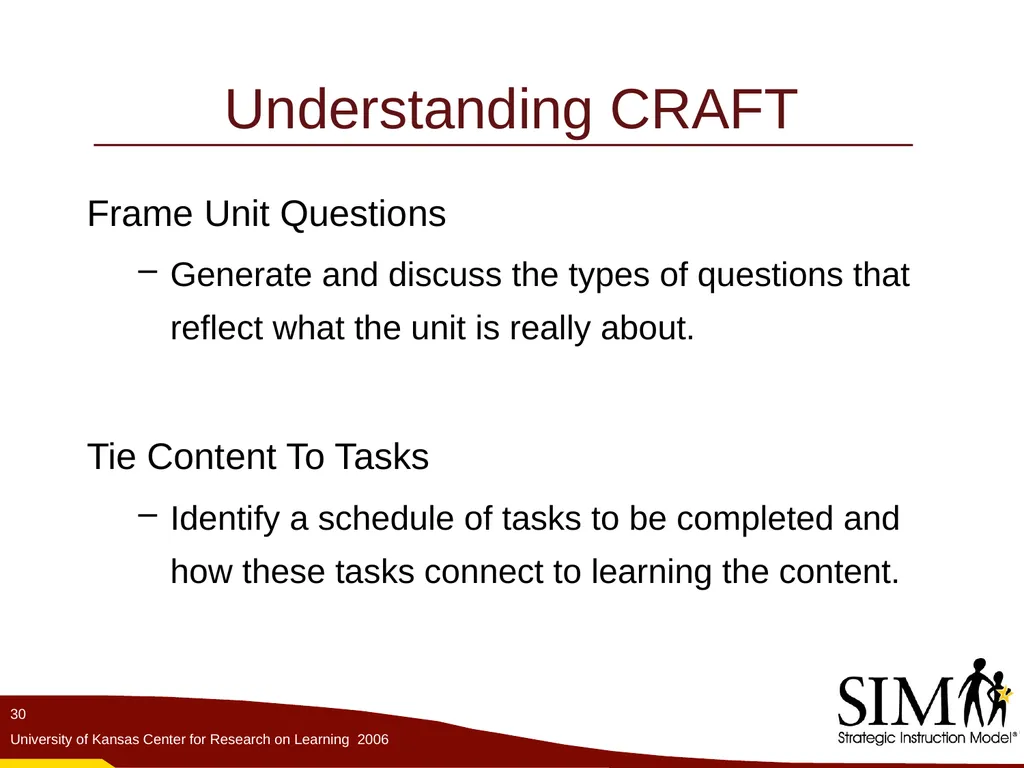
30 University of Kansas Center for Research on Learning 2006 Understanding CRAFT Frame Unit Questions
Generate and discuss the types of questions that reflect what the unit is really about.
Tie Content To Tasks
Identify a schedule of tasks to be completed and how these tasks connect to learning the content.<br>
Generate and discuss the types of questions that reflect what the unit is really about.
Tie Content To Tasks
Identify a schedule of tasks to be completed and how these tasks connect to learning the content.<br>
31
31 University of Kansas Center for Research on Learning 2006 The Cue-Do-Review Sequence Cue
Students that the routine will be used.
Do
The routine.
Review
The information and process.<br>
Students that the routine will be used.
Do
The routine.
Review
The information and process.<br>
32
32 University of Kansas Center for Research on Learning 2006 The Cue-Do-Review Sequence Cue
The teacher announces the Unit Organizer and explains its use.<br>
The teacher announces the Unit Organizer and explains its use.<br>
33
33 University of Kansas Center for Research on Learning 2006 The Cue-Do-Review Sequence Do
The teacher and class collaboratively construct the Unit Organizer device using the CRAFT Linking Steps such that the content is connected or "linked" to the needs and goals of students.<br>
The teacher and class collaboratively construct the Unit Organizer device using the CRAFT Linking Steps such that the content is connected or "linked" to the needs and goals of students.<br>
34
34 University of Kansas Center for Research on Learning 2006 The Cue-Do-Review Sequence Review
Information presented in the Unit Organizer is reviewed and confirmed.<br>
Information presented in the Unit Organizer is reviewed and confirmed.<br>
35
35 University of Kansas Center for Research on Learning 2006 Get Ready Decide when to use the routine.
Collect needed materials.
Construct a draft.
Prepare presentation notes<br>
Collect needed materials.
Construct a draft.
Prepare presentation notes<br>
36
36 University of Kansas Center for Research on Learning 2006 Get Ready Construct a draft.
Enter the name of the Current Unit.
Enter the name of the Last Unit.
Enter the name of the Next Unit.
Identify the Bigger Picture.<br>
Enter the name of the Current Unit.
Enter the name of the Last Unit.
Enter the name of the Next Unit.
Identify the Bigger Picture.<br>
37
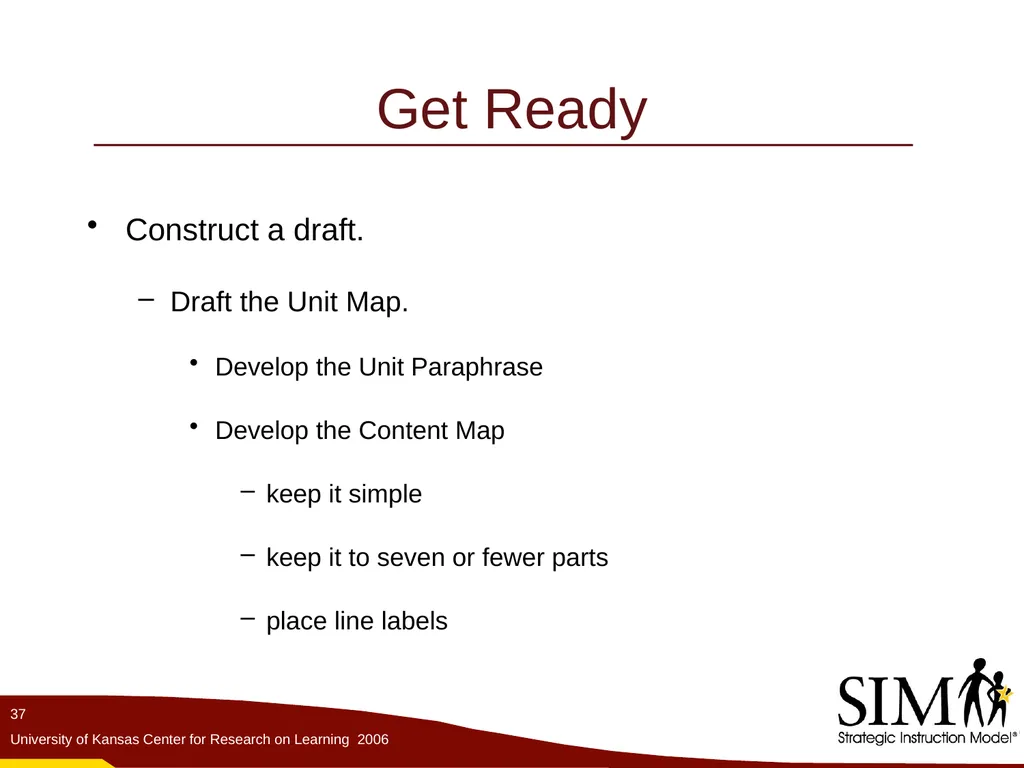
37 University of Kansas Center for Research on Learning 2006 Get Ready Construct a draft.
Draft the Unit Map.
Develop the Unit Paraphrase
Develop the Content Map
keep it simple
keep it to seven or fewer parts
place line labels<br>
Draft the Unit Map.
Develop the Unit Paraphrase
Develop the Content Map
keep it simple
keep it to seven or fewer parts
place line labels<br>
38
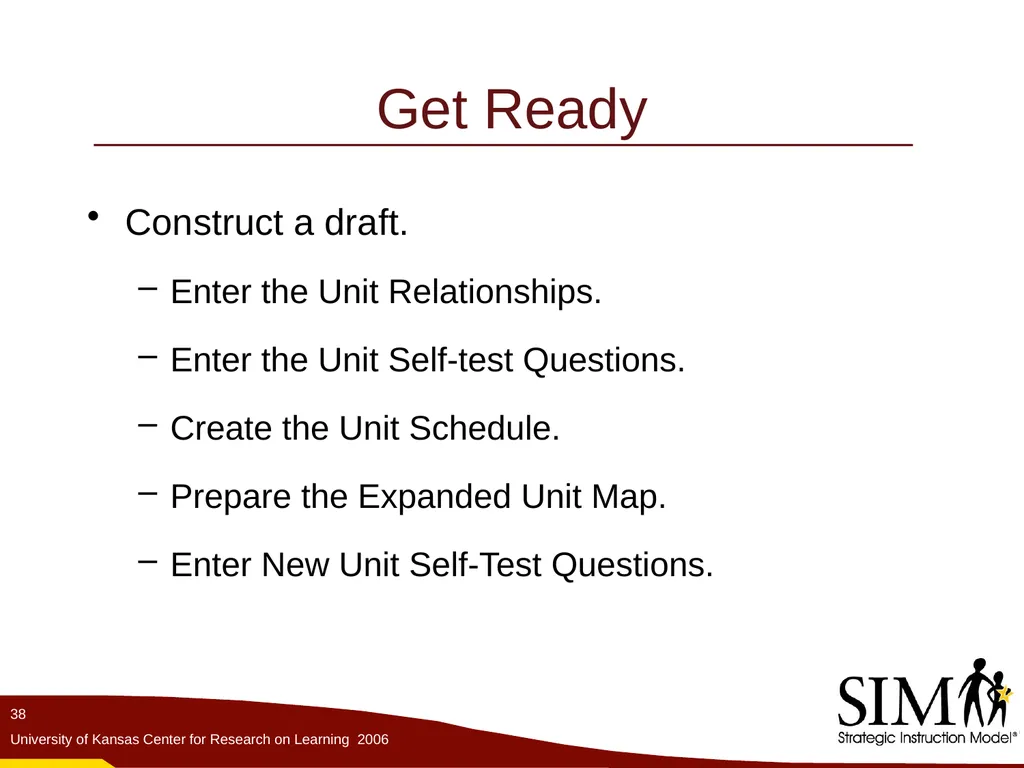
38 University of Kansas Center for Research on Learning 2006 Get Ready Construct a draft.
Enter the Unit Relationships.
Enter the Unit Self-test Questions.
Create the Unit Schedule.
Prepare the Expanded Unit Map.
Enter New Unit Self-Test Questions.<br>
Enter the Unit Relationships.
Enter the Unit Self-test Questions.
Create the Unit Schedule.
Prepare the Expanded Unit Map.
Enter New Unit Self-Test Questions.<br>
39
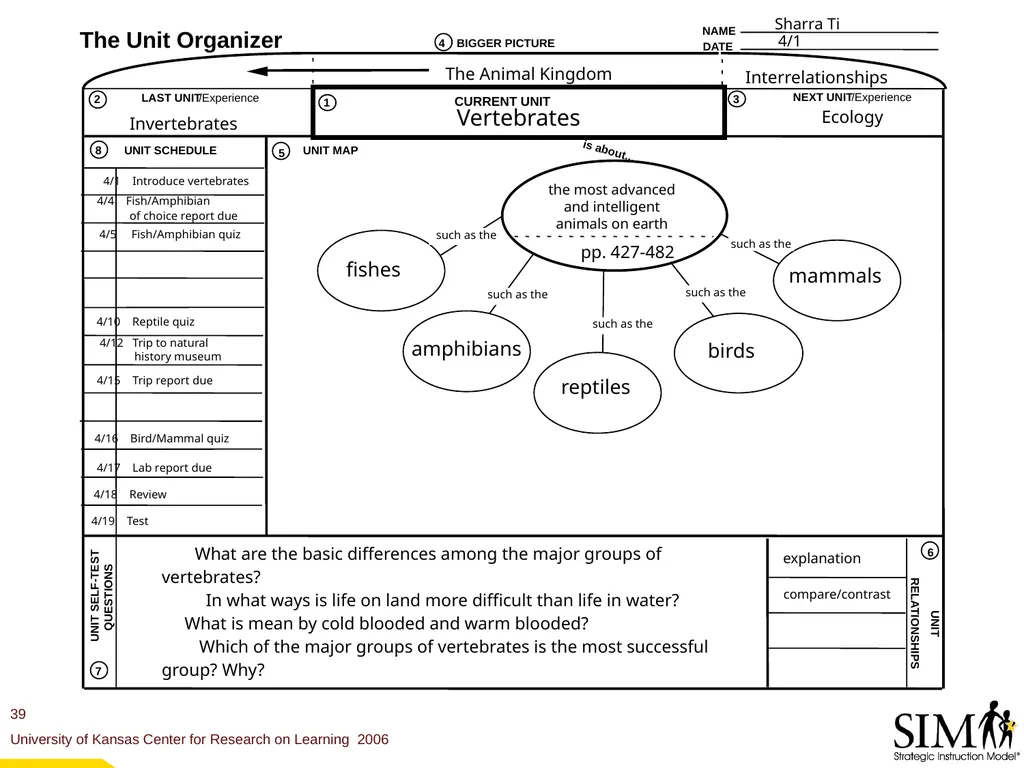
39 University of Kansas Center for Research on Learning 2006<br>
40
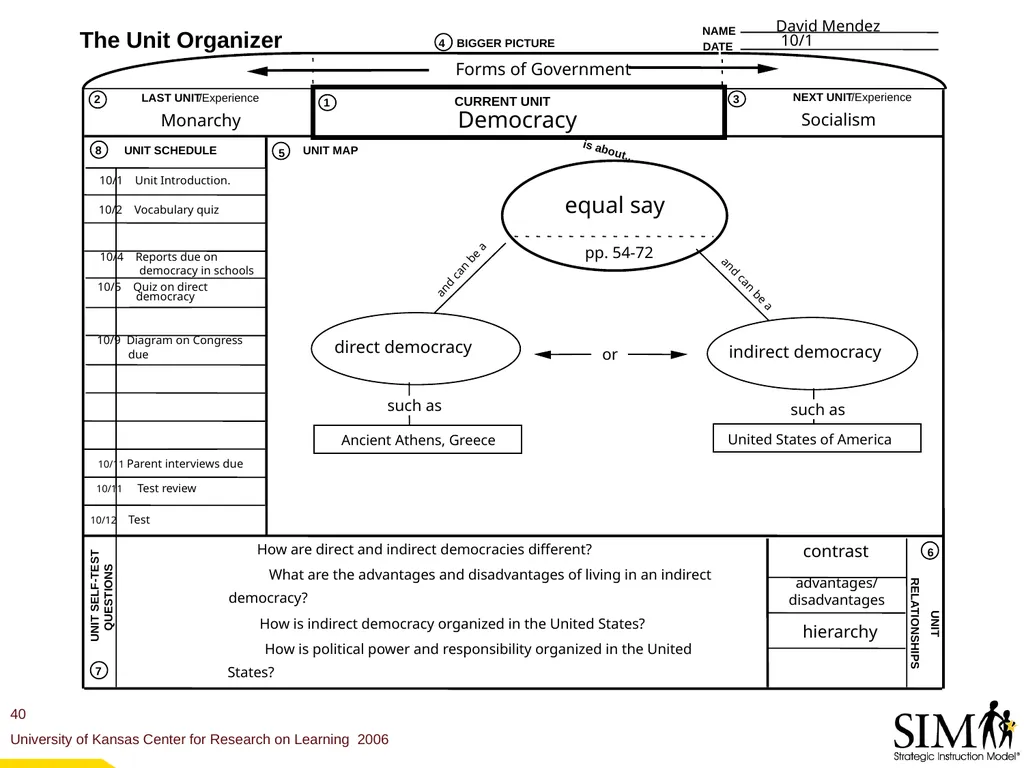
40 University of Kansas Center for Research on Learning 2006<br>
41
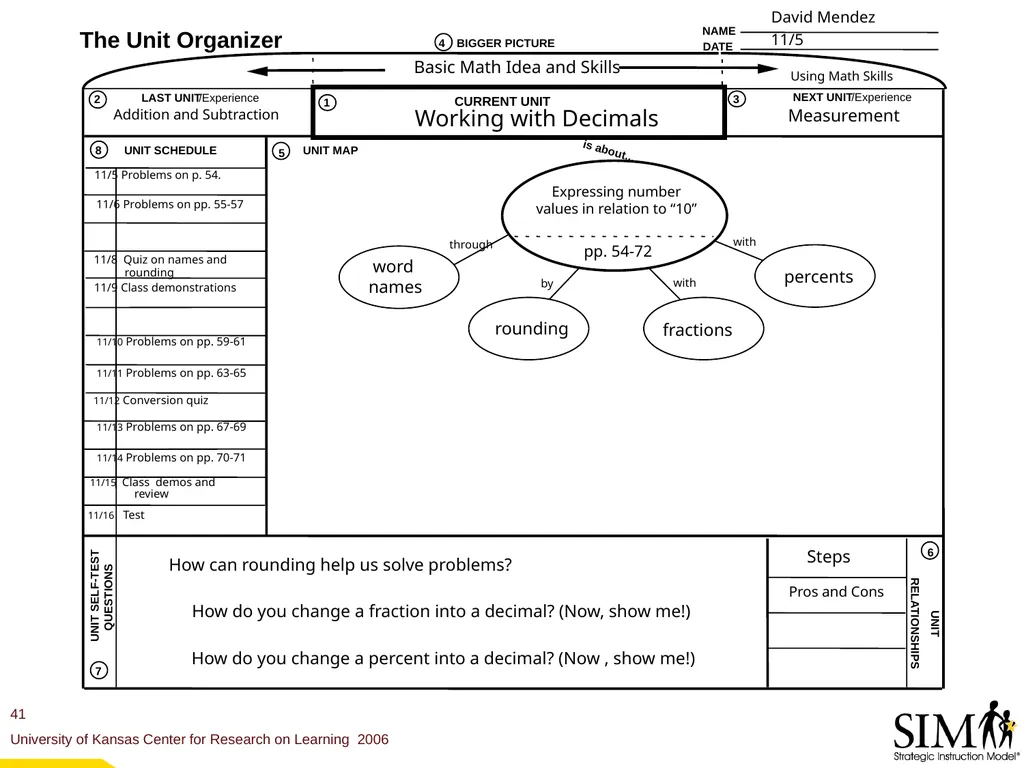
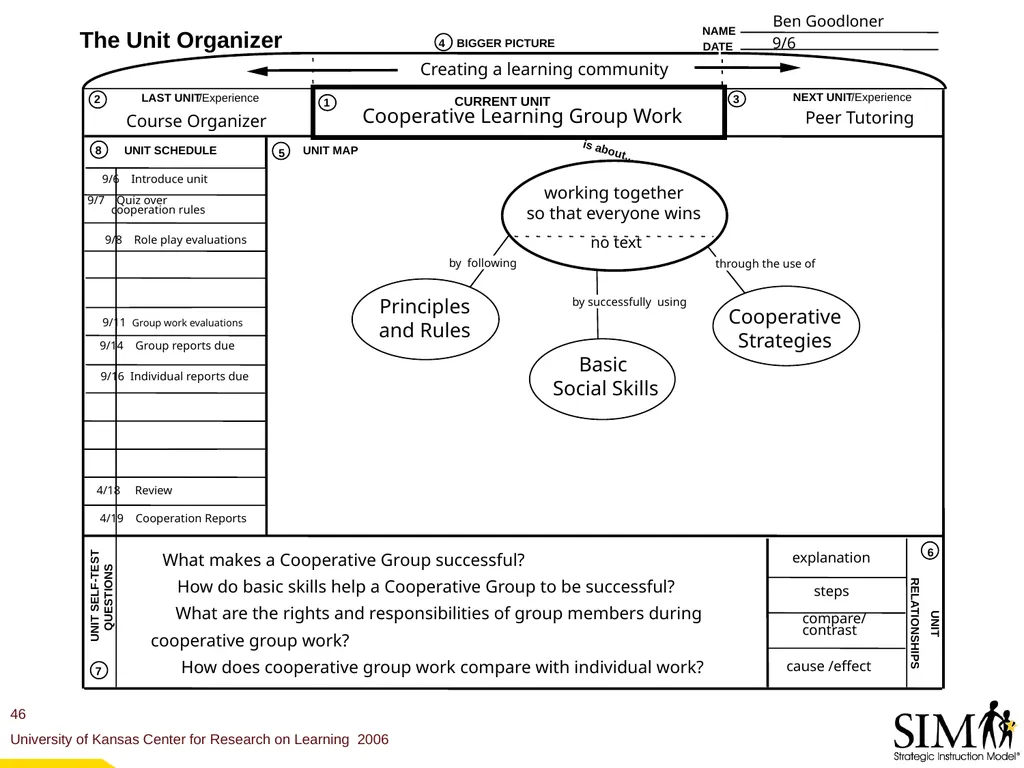
41 University of Kansas Center for Research on Learning 2006 NAME DATE The Unit Organizer BIGGER PICTURE LAST UNIT /Experience CURRENT UNIT NEXT UNIT /Experience UNIT SELF-TEST QUESTIONS is about... UNIT RELATIONSHIPS UNIT SCHEDULE UNIT MAP CURRENT UNIT 1 3 2 4 5 6 7 8 Working with Decimals Expressing number
values in relation to “10” pp. 54-72 word
names rounding fractions percents through by with with How can rounding help us solve problems? How do you change a fraction into a decimal? (Now, show me!) How do you change a percent into a decimal? (Now , show me!) Steps Pros and Cons Addition and Subtraction Measurement Basic Math Idea and Skills Using Math Skills David Mendez 11/5 11/5 Problems on p. 54. 11/6 Problems on pp. 55-57 11/8 Quiz on names and rounding 11/9 Class demonstrations 11/10 Problems on pp. 59-61 11/11 Problems on pp. 63-65 11/12 Conversion quiz 11/13 Problems on pp. 67-69 11/14 Problems on pp. 70-71 11/15 Class demos and review 11/16 Test<br>
values in relation to “10” pp. 54-72 word
names rounding fractions percents through by with with How can rounding help us solve problems? How do you change a fraction into a decimal? (Now, show me!) How do you change a percent into a decimal? (Now , show me!) Steps Pros and Cons Addition and Subtraction Measurement Basic Math Idea and Skills Using Math Skills David Mendez 11/5 11/5 Problems on p. 54. 11/6 Problems on pp. 55-57 11/8 Quiz on names and rounding 11/9 Class demonstrations 11/10 Problems on pp. 59-61 11/11 Problems on pp. 63-65 11/12 Conversion quiz 11/13 Problems on pp. 67-69 11/14 Problems on pp. 70-71 11/15 Class demos and review 11/16 Test<br>
42
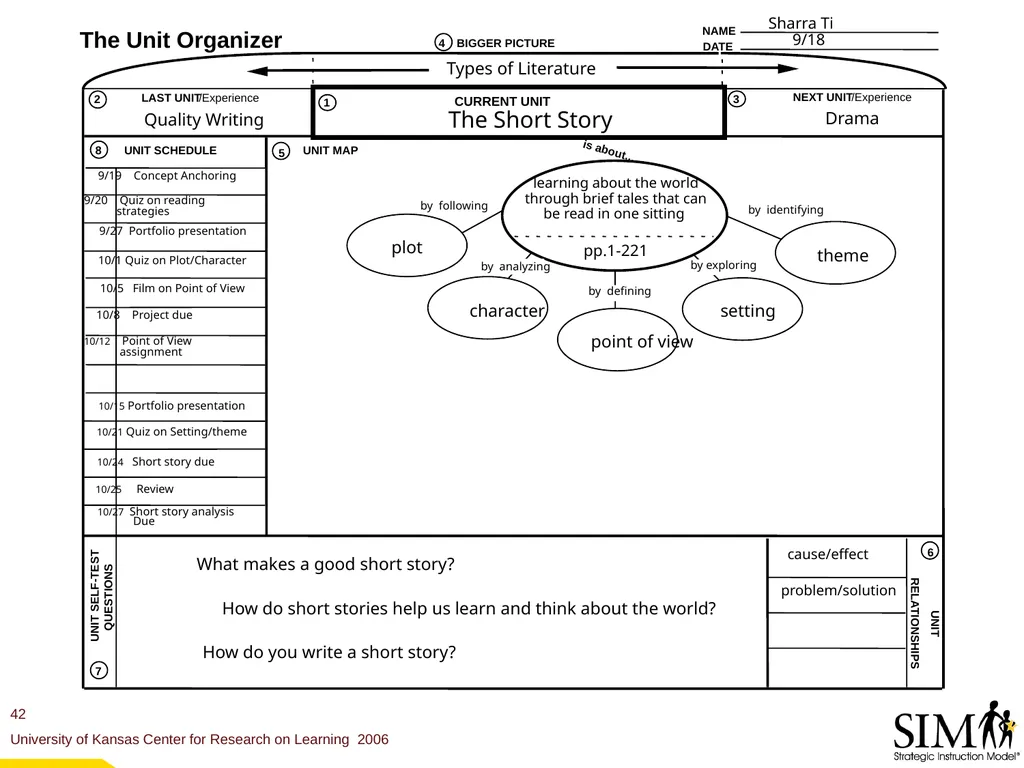
42 University of Kansas Center for Research on Learning 2006<br>
43
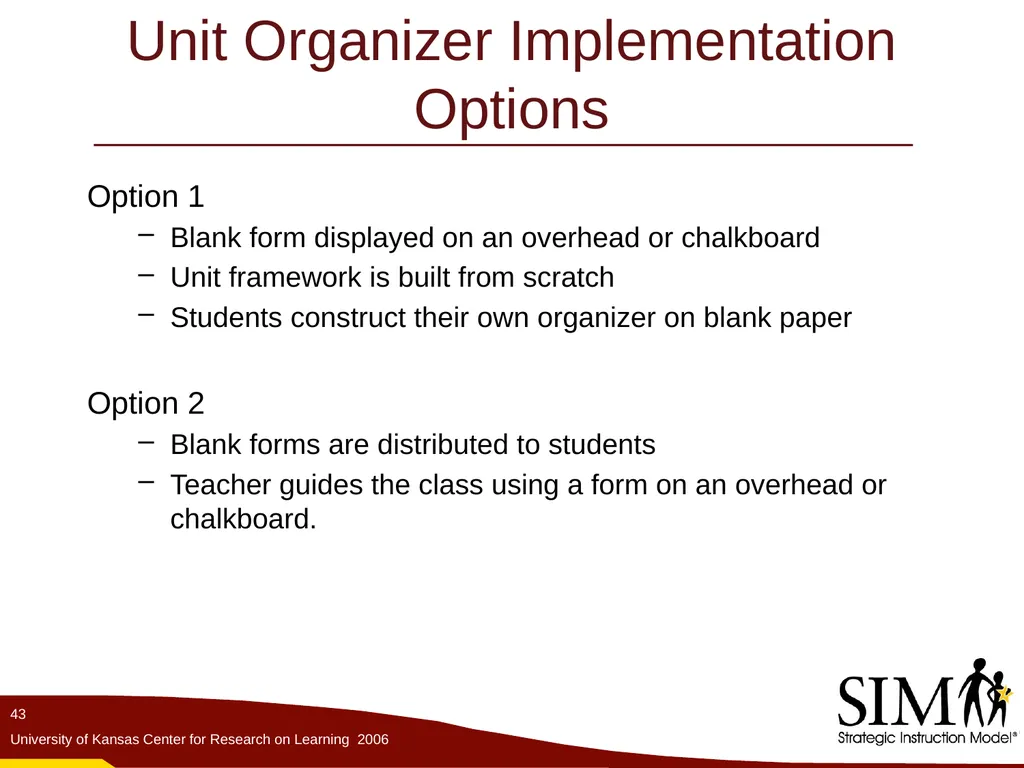
43 University of Kansas Center for Research on Learning 2006 Unit Organizer Implementation Options Option 1
Blank form displayed on an overhead or chalkboard
Unit framework is built from scratch
Students construct their own organizer on blank paper
Option 2
Blank forms are distributed to students
Teacher guides the class using a form on an overhead or chalkboard.<br>
Blank form displayed on an overhead or chalkboard
Unit framework is built from scratch
Students construct their own organizer on blank paper
Option 2
Blank forms are distributed to students
Teacher guides the class using a form on an overhead or chalkboard.<br>
44
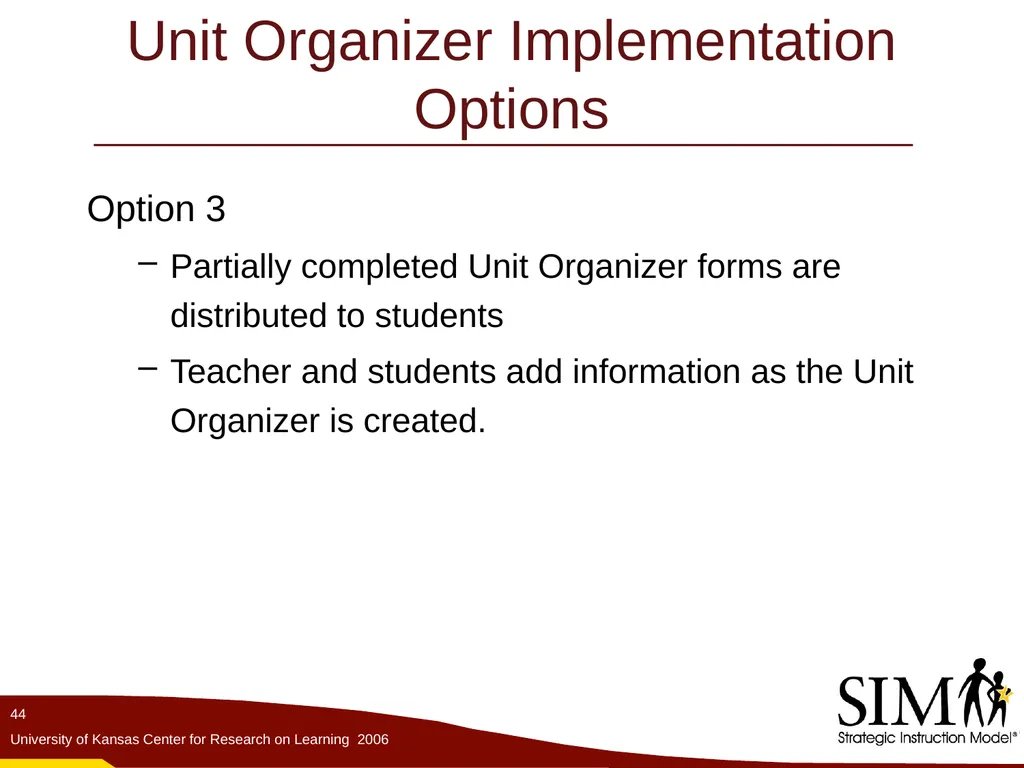
44 University of Kansas Center for Research on Learning 2006 Unit Organizer Implementation Options Option 3
Partially completed Unit Organizer forms are distributed to students
Teacher and students add information as the Unit Organizer is created.<br>
Partially completed Unit Organizer forms are distributed to students
Teacher and students add information as the Unit Organizer is created.<br>
45
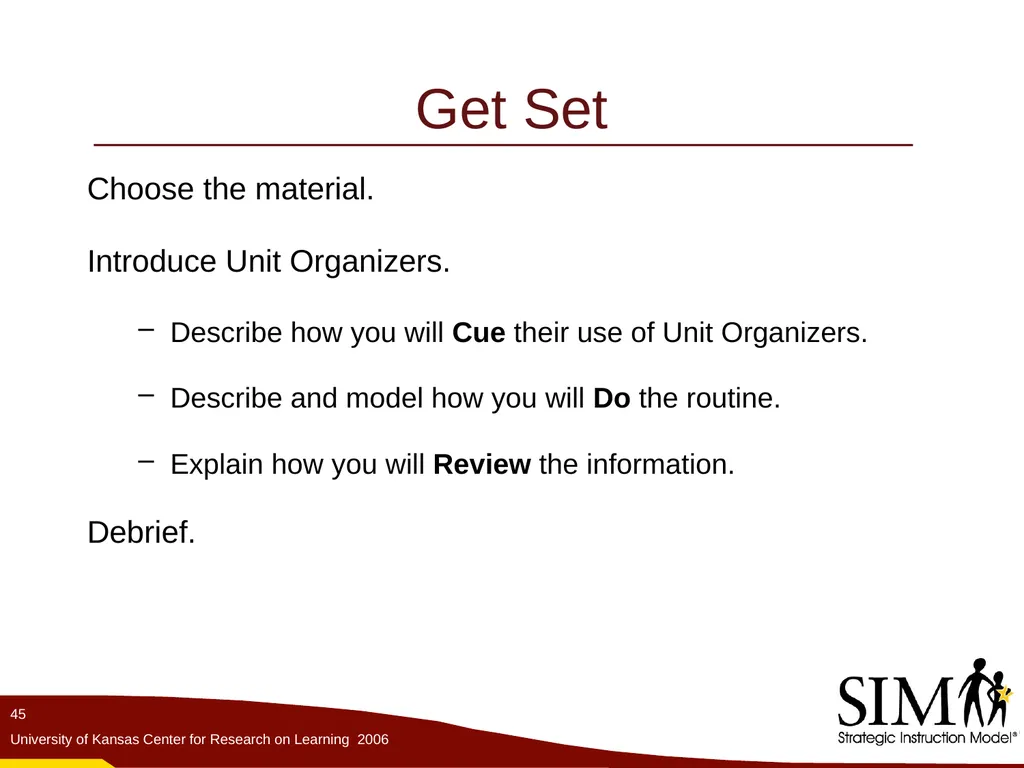
45 University of Kansas Center for Research on Learning 2006 Get Set Choose the material.
Introduce Unit Organizers.
Describe how you will Cue their use of Unit Organizers.
Describe and model how you will Do the routine.
Explain how you will Review the information.
Debrief.<br>
Introduce Unit Organizers.
Describe how you will Cue their use of Unit Organizers.
Describe and model how you will Do the routine.
Explain how you will Review the information.
Debrief.<br>
46
46 University of Kansas Center for Research on Learning 2006<br>
47
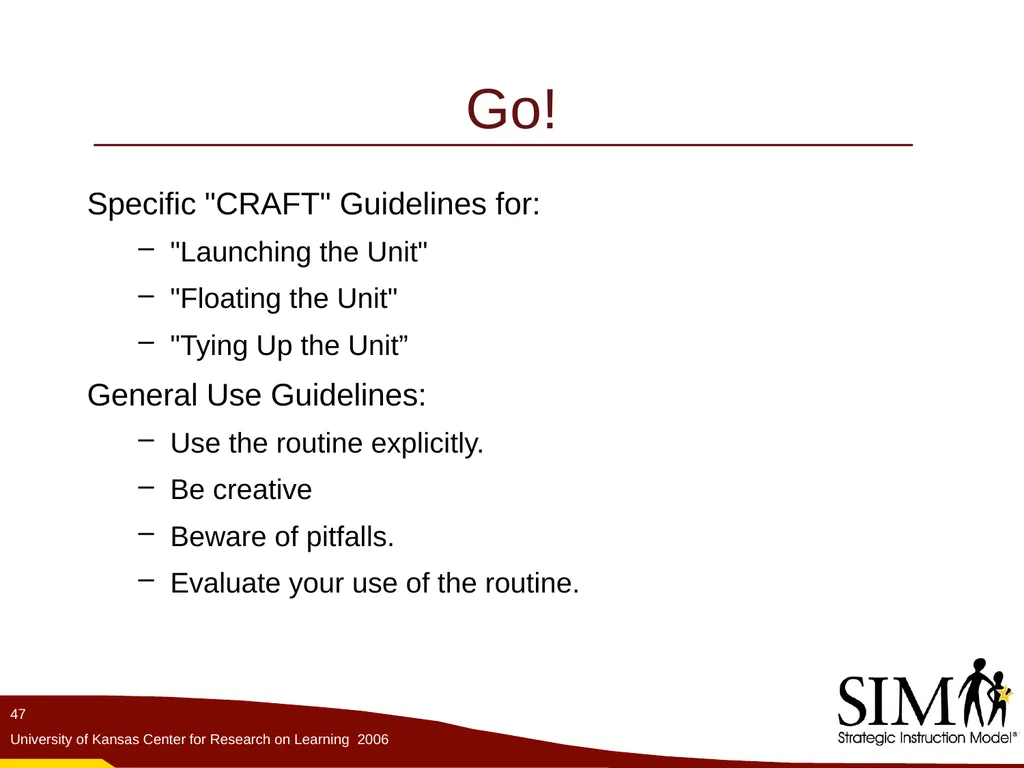
47 University of Kansas Center for Research on Learning 2006 Go! Specific "CRAFT" Guidelines for:
"Launching the Unit"
"Floating the Unit"
"Tying Up the Unit”
General Use Guidelines:
Use the routine explicitly.
Be creative
Beware of pitfalls.
Evaluate your use of the routine.<br>
"Launching the Unit"
"Floating the Unit"
"Tying Up the Unit”
General Use Guidelines:
Use the routine explicitly.
Be creative
Beware of pitfalls.
Evaluate your use of the routine.<br>
48
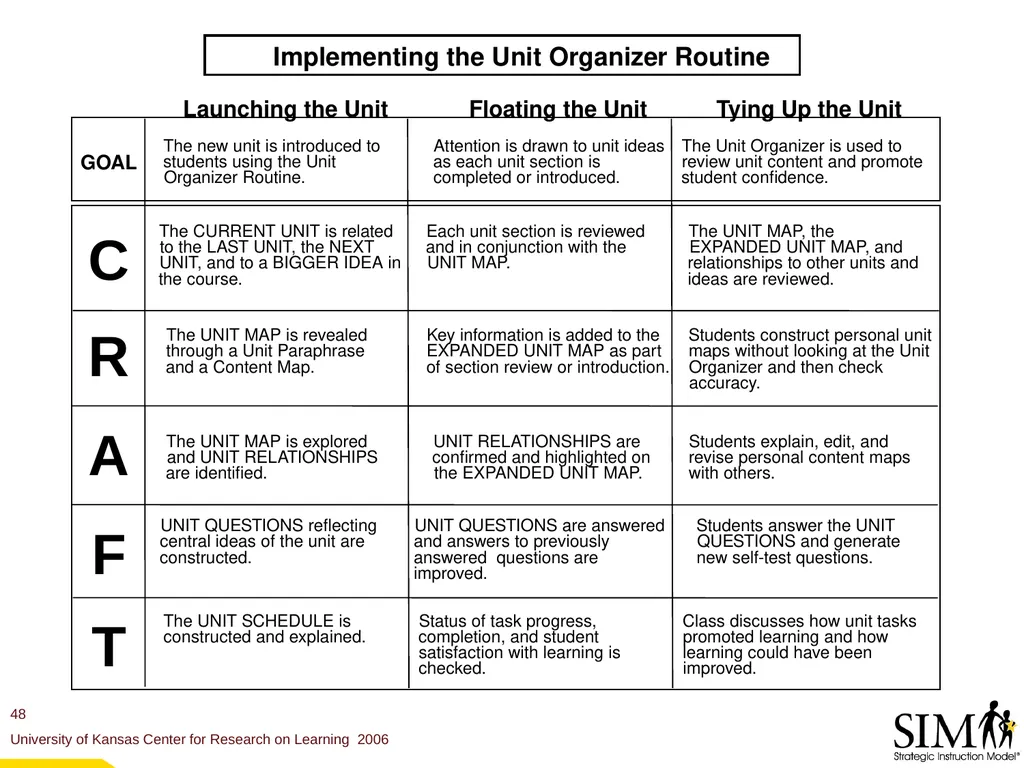
48 University of Kansas Center for Research on Learning 2006<br>
49
49 University of Kansas Center for Research on Learning 2006 General Use Tips Use fine or extra-fine tip overhead transparency pens.
Vary the colors to distinguish parts or levels.
Use different geometric shapes to distinguish levels of information.<br>
Vary the colors to distinguish parts or levels.
Use different geometric shapes to distinguish levels of information.<br>
50
50 University of Kansas Center for Research on Learning 2006 General Use Tips Draw empty geometric shapes on a blank Unit Organizer and make copies for students. Students fill in the geometric shapes with appropriate unit content.
Have a stack of blank Unit Organizers available for students use in other situations.<br>
Have a stack of blank Unit Organizers available for students use in other situations.<br>
51
51 University of Kansas Center for Research on Learning 2006 Presentation Checks The Unit Organizer:
Is it large enough to see from the back of the class?
Are words, symbols, and lines legible?
Are relationships clearly depicted?
Are ideas presented concisely and meaningfully?
Are ideas adequately separated with space and symbols?
Can students read and explain its parts?<br>
Is it large enough to see from the back of the class?
Are words, symbols, and lines legible?
Are relationships clearly depicted?
Are ideas presented concisely and meaningfully?
Are ideas adequately separated with space and symbols?
Can students read and explain its parts?<br>
52
52 University of Kansas Center for Research on Learning 2006 Presentation Checks Did you ...
Point to the important parts of the visual?
Cue students to take notes about the Unit Organizer?
Make complete statements about each Unit Organizer part?
Explain the relationships in the content map?<br>
Point to the important parts of the visual?
Cue students to take notes about the Unit Organizer?
Make complete statements about each Unit Organizer part?
Explain the relationships in the content map?<br>
53
53 University of Kansas Center for Research on Learning 2006 The Double Win! Students Win!
Are students learning what they are supposed to be learning?
Are students personally satisfied with what and how they are learning?
Do students' grades reflect what they have really learned?<br>
Are students learning what they are supposed to be learning?
Are students personally satisfied with what and how they are learning?
Do students' grades reflect what they have really learned?<br>
54
54 University of Kansas Center for Research on Learning 2006 The Double Win! You Win!
Select a "growth target."
Choose a way to learn.
Choose a support system.
Plan for confidence building.
Debug.
Maximize the challenge.
Take ownership of the routine.<br>
Select a "growth target."
Choose a way to learn.
Choose a support system.
Plan for confidence building.
Debug.
Maximize the challenge.
Take ownership of the routine.<br>
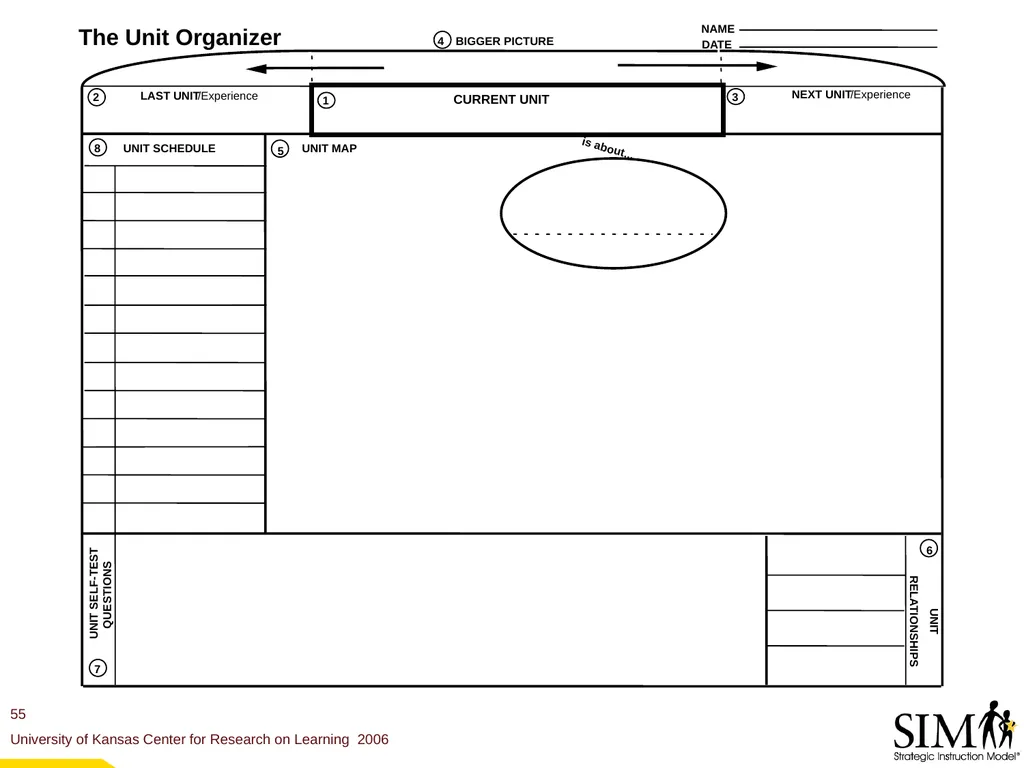
55
55 University of Kansas Center for Research on Learning 2006<br>
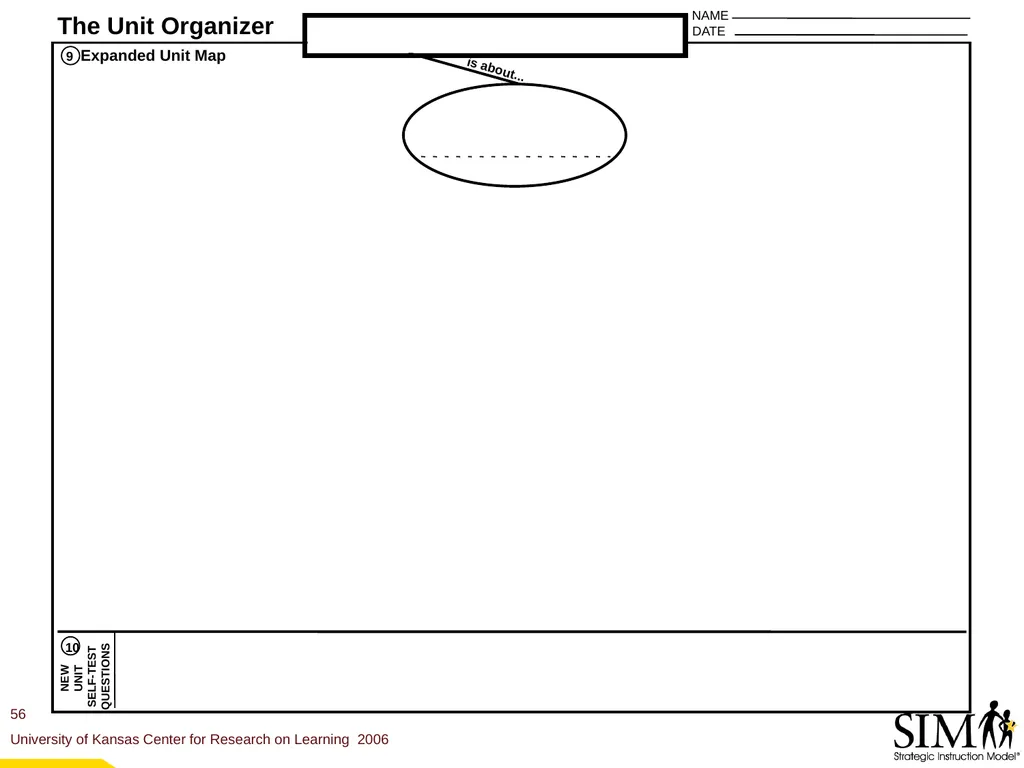
56
56 University of Kansas Center for Research on Learning 2006<br>