
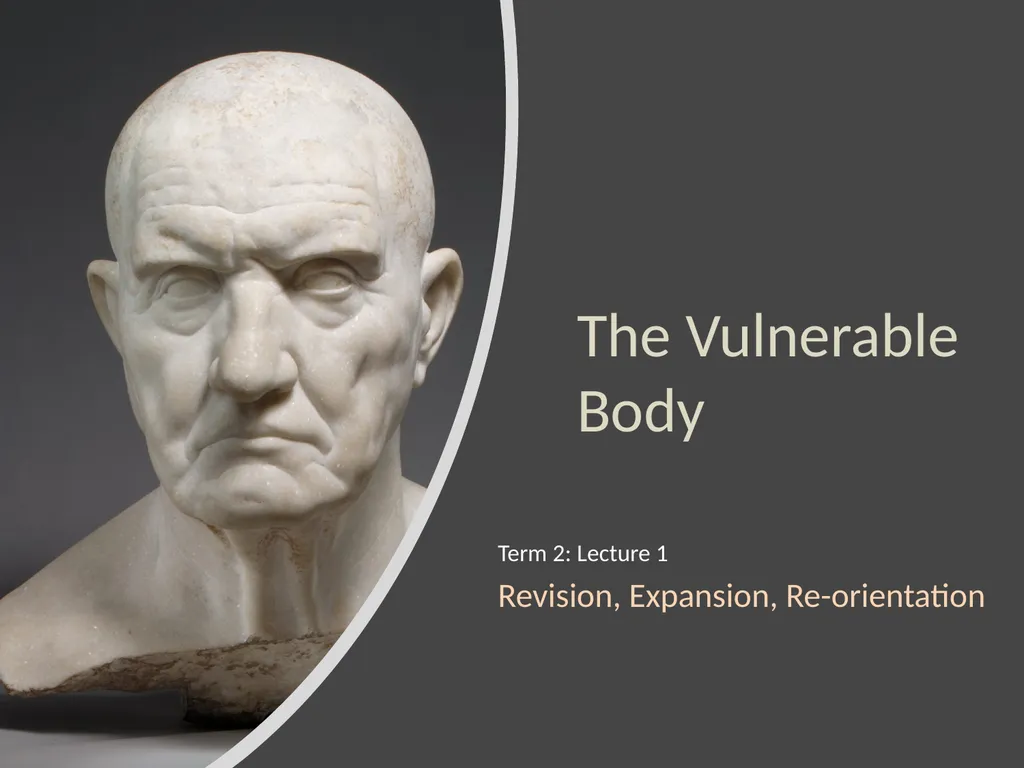
The Vulnerable Body Term 2: Lecture 1 Revision,




Description: The Vulnerable Body Term 2: Lecture 1 Revision, Expansion, Re-orientation The body in Rome livedimagined As metaphor, for the body politic the cosmos parts of rhetoric poetry terrain The body is not (just) an unproblematic fact of nature
Related Topics
Download Presentation
"The Vulnerable Body Term 2: Lecture 1 Revision," is the property of its rightful owner. Permission is granted to download and print the materials on this website for personal, non-commercial use only, and to display it on your personal computer provided you do not modify the materials and that you retain all copyright notices contained in the materials. By downloading content from our website, you accept the terms of this agreement.
Presentation Transcript
slide1. The Vulnerable Body Term 2: Lecture 1
Revision, Expansion, Re-orientation<br>
slide2. The body in Rome lived/imagined As metaphor, for…
the body politic
the cosmos
parts of rhetoric
poetry
terrain<br>
slide3. The body is…
not (just) an unproblematic fact of nature<br>
slide4. Taking the body for granted As something we own?
As distinct from the mind/soul?
As natural?
As gendered?
As excluding ‘other’ bodies? Women, babies and children, the elderly, slaves, animals, foreigners, non-citizens?<br>
slide5. The vulnerable subject Martha Nussbaum, Frontiers of Justice (2006) p132:
The Kantian split between personhood and animality is deeply
problematic. First, it denies a fact that ought to be evident to
one who thinks clearly about this issue: namely, the fact that our dignity just is the dignity of a certain sort of animal. It is the animal sort of dignity, and that very sort of dignity could not be possessed by a being who was not mortal and vulnerable, just as the beauty of a cherry tree in bloom could not be possessed by a diamond.<br>
slide6. Fineman, The vulnerable subject: anchoring equality in the human condition’ Yale Journal of Law and Feminism, 20.1 (2008), pp1-2: I argue that vulnerability is – and should be understood to be – universal and constant, inherent in the human condition. The vulnerability approach I propose is an alternative to traditional equal protection analysis; it is a ‘post-identity’ inquiry in that it is not focused only on discrimination against defined groups, but concerned with privilege and favour conferred on limited segments of the population by the state and broader society through their institutions….<br>
slide7. To richly theorize a concept of vulnerability is to develop a more complex subject around which to build social policy and law; this new complex subject can be used to redefine and expand current ideas about state responsibility toward individuals and institutions. In fact, I argue that the ‘vulnerable subject’ must replace the autonomous and independent subject asserted in the liberal tradition. Far more representative of actual lived experience and the human condition, the vulnerable subject should be at the centre of our political and theoretical endeavours.<br>
slide8. Butler, Precarious Life (2004) 42-3 By insisting on a ‘common’ corporeal vulnerability, I may seem to be positing a new basis for humanism. That might be true, but I am prone to consider this differently. A vulnerability must be perceived and recognized in order to come into play in an ethical encounter, and there is no guarantee that this will happen. Not only is there always the possibility that a vulnerability will not be recognized and that it will be constituted as the ‘unrecognizable’, but when a vulnerability is recognized, that recognition has the power to change the meaning and structure of the vulnerability itself…<br>
slide9. Butler (2006) p43 ...In this sense, if vulnerability is one precondition for humanization, and humanization takes place differently through variable norms of recognition, then it follows that vulnerability is fundamentally dependent on existing norms of recognition if it is to be attributed to any human subject. true; but it is true, in part, precisely because our utterance enacts the very recognition of vulnerability and so shows the importance of recognition itself for sustaining vulnerability. We perform the recognition by making the claim, and that is surely a very good ethical reason to make the claim. We make the claim, however, precisely because it is not taken for granted, precisely because it is not, in every instance, honored. Vulnerability takes on another meaning at the moment it is recognized, and recognition wields the power to reconstitute vulnerability.’<br>
slide10. The vulnerable subject as relational subject Butler (2006) p44 ‘When we recognize another, or when we ask for recognition for ourselves, we are not asking for an Other to see us as we are, as we already are, as we have always been, as we were constituted prior to the encounter itself. Instead, in the asking, in the petition, we have already become something new, since we are constituted by virtue of the address, a need and desire for the Other that takes place in language in the broadest sense, one without which we could not be. To ask for recognition, or to offer it, is precisely not to ask for recognition for what one already is. It is to solicit a becoming, to instigate a transformation, to petition the future always in relation to the Other. It is also to stake one's own being, and one's own persistence in one's own being, in the struggle for recognition.’<br>
slide11. Are vulnerable bodies ‘good to think with’? ‘Vulnerable bodies’ lie at the fault-lines of Roman identity and imperial power<br>
slide12. Looking at power from sideways on/from below… The view of the…
Slave (Phaedrus, Ovid)
Freedman (Phaedrus, Horace)
The (free/enslaved, rich/poor) woman or effeminate man (Ovid, Horace)
The old or decrepit (Horace)<br>
slide13. This term we might add… From the point of view of…
the exiled
the retired, rejected old man
the emotional subject-as-slave
the Greek
the tortured
the sick/depressed
the mother
the boy made to live as a girl<br>
slide14. Revision quiz How do Roman poets imagine poetic metre as corporeal? Give two examples
Think of two sites in Latin literature where vulnerability is marked as ‘Greek’ or ‘Eastern’.
Translate the following key Latin terms:
Libertas vulnus imbecillitas mollitia
flaccus servitium amoris militia amoris
recusatio mollis<br>
slide15. Where can we go in Latin imperial literature to see slaves getting one up on their masters?
Where can we go in Latin imperial literature to see aristocratic women mocked by men of a lower social standing?
Is vulnerability necessarily a lack of power? What text might show or perform this?
Think of an example in the Latin texts we have studied where economic vulnerability and power are not mutually exclusive.<br>
slide16. Put the following figures in chronological order (using known or estimated birth date), beginning with the earliest:
Ovid, Catullus, Horace, Phaedrus, Propertius, Tiberius, Augustus, Virgil
Name the metre of Horace Epodes 1-10
How does iambic verse imagine itself attacking and getting inside bodies, even those of its readers?<br>
slide17. Vulnerability and literary form: a (bodily) hierarchy of genres Muscular, hairy epic (e.g. Prop.4.1 on Ennius)
Grandiose tragedy
Loose, fleshy satire
The intimate philosophical epistle
Delicate, refined lyric
Spiky, hard-to-swallow iambic
Castrated, effeminate, weepy elegy
Measly, bite-sized epigram
The lowly fable (for busy slaves’ mouths/bodies)<br>
slide18. What’s particular about literature? Latin literature is intensely interested in the corporeality of literary form and of literary interactions
poetics ---- ontology<br>
slide19. Related concepts Metamorphosis/transformation
Growth
instability<br>
slide20. Vulnerability and literary tradition: past and future The father figure (borrow/downgrade his authority, acknowledge/deny your dependency on predecessors)
E.g.: Horace – Lucilius, Hipponax, Archilochus
Ovid – Propertius, Tibullus, Virgil
Phaedrus - Aesop
Acknowledge/deny vulnerability (of text/authorial fame) in the future<br>
slide21. The vulnerable subject as vulnerable reader? Is the joke on you?
Does literature have the power to change us when we ‘consume’ it, or ‘take it in’?
Are we (ethically, politically) implicated in ‘reading out’ the representations/perspectives of a text?<br>
Revision, Expansion, Re-orientation<br>
slide2. The body in Rome lived/imagined As metaphor, for…
the body politic
the cosmos
parts of rhetoric
poetry
terrain<br>
slide3. The body is…
not (just) an unproblematic fact of nature<br>
slide4. Taking the body for granted As something we own?
As distinct from the mind/soul?
As natural?
As gendered?
As excluding ‘other’ bodies? Women, babies and children, the elderly, slaves, animals, foreigners, non-citizens?<br>
slide5. The vulnerable subject Martha Nussbaum, Frontiers of Justice (2006) p132:
The Kantian split between personhood and animality is deeply
problematic. First, it denies a fact that ought to be evident to
one who thinks clearly about this issue: namely, the fact that our dignity just is the dignity of a certain sort of animal. It is the animal sort of dignity, and that very sort of dignity could not be possessed by a being who was not mortal and vulnerable, just as the beauty of a cherry tree in bloom could not be possessed by a diamond.<br>
slide6. Fineman, The vulnerable subject: anchoring equality in the human condition’ Yale Journal of Law and Feminism, 20.1 (2008), pp1-2: I argue that vulnerability is – and should be understood to be – universal and constant, inherent in the human condition. The vulnerability approach I propose is an alternative to traditional equal protection analysis; it is a ‘post-identity’ inquiry in that it is not focused only on discrimination against defined groups, but concerned with privilege and favour conferred on limited segments of the population by the state and broader society through their institutions….<br>
slide7. To richly theorize a concept of vulnerability is to develop a more complex subject around which to build social policy and law; this new complex subject can be used to redefine and expand current ideas about state responsibility toward individuals and institutions. In fact, I argue that the ‘vulnerable subject’ must replace the autonomous and independent subject asserted in the liberal tradition. Far more representative of actual lived experience and the human condition, the vulnerable subject should be at the centre of our political and theoretical endeavours.<br>
slide8. Butler, Precarious Life (2004) 42-3 By insisting on a ‘common’ corporeal vulnerability, I may seem to be positing a new basis for humanism. That might be true, but I am prone to consider this differently. A vulnerability must be perceived and recognized in order to come into play in an ethical encounter, and there is no guarantee that this will happen. Not only is there always the possibility that a vulnerability will not be recognized and that it will be constituted as the ‘unrecognizable’, but when a vulnerability is recognized, that recognition has the power to change the meaning and structure of the vulnerability itself…<br>
slide9. Butler (2006) p43 ...In this sense, if vulnerability is one precondition for humanization, and humanization takes place differently through variable norms of recognition, then it follows that vulnerability is fundamentally dependent on existing norms of recognition if it is to be attributed to any human subject. true; but it is true, in part, precisely because our utterance enacts the very recognition of vulnerability and so shows the importance of recognition itself for sustaining vulnerability. We perform the recognition by making the claim, and that is surely a very good ethical reason to make the claim. We make the claim, however, precisely because it is not taken for granted, precisely because it is not, in every instance, honored. Vulnerability takes on another meaning at the moment it is recognized, and recognition wields the power to reconstitute vulnerability.’<br>
slide10. The vulnerable subject as relational subject Butler (2006) p44 ‘When we recognize another, or when we ask for recognition for ourselves, we are not asking for an Other to see us as we are, as we already are, as we have always been, as we were constituted prior to the encounter itself. Instead, in the asking, in the petition, we have already become something new, since we are constituted by virtue of the address, a need and desire for the Other that takes place in language in the broadest sense, one without which we could not be. To ask for recognition, or to offer it, is precisely not to ask for recognition for what one already is. It is to solicit a becoming, to instigate a transformation, to petition the future always in relation to the Other. It is also to stake one's own being, and one's own persistence in one's own being, in the struggle for recognition.’<br>
slide11. Are vulnerable bodies ‘good to think with’? ‘Vulnerable bodies’ lie at the fault-lines of Roman identity and imperial power<br>
slide12. Looking at power from sideways on/from below… The view of the…
Slave (Phaedrus, Ovid)
Freedman (Phaedrus, Horace)
The (free/enslaved, rich/poor) woman or effeminate man (Ovid, Horace)
The old or decrepit (Horace)<br>
slide13. This term we might add… From the point of view of…
the exiled
the retired, rejected old man
the emotional subject-as-slave
the Greek
the tortured
the sick/depressed
the mother
the boy made to live as a girl<br>
slide14. Revision quiz How do Roman poets imagine poetic metre as corporeal? Give two examples
Think of two sites in Latin literature where vulnerability is marked as ‘Greek’ or ‘Eastern’.
Translate the following key Latin terms:
Libertas vulnus imbecillitas mollitia
flaccus servitium amoris militia amoris
recusatio mollis<br>
slide15. Where can we go in Latin imperial literature to see slaves getting one up on their masters?
Where can we go in Latin imperial literature to see aristocratic women mocked by men of a lower social standing?
Is vulnerability necessarily a lack of power? What text might show or perform this?
Think of an example in the Latin texts we have studied where economic vulnerability and power are not mutually exclusive.<br>
slide16. Put the following figures in chronological order (using known or estimated birth date), beginning with the earliest:
Ovid, Catullus, Horace, Phaedrus, Propertius, Tiberius, Augustus, Virgil
Name the metre of Horace Epodes 1-10
How does iambic verse imagine itself attacking and getting inside bodies, even those of its readers?<br>
slide17. Vulnerability and literary form: a (bodily) hierarchy of genres Muscular, hairy epic (e.g. Prop.4.1 on Ennius)
Grandiose tragedy
Loose, fleshy satire
The intimate philosophical epistle
Delicate, refined lyric
Spiky, hard-to-swallow iambic
Castrated, effeminate, weepy elegy
Measly, bite-sized epigram
The lowly fable (for busy slaves’ mouths/bodies)<br>
slide18. What’s particular about literature? Latin literature is intensely interested in the corporeality of literary form and of literary interactions
poetics ---- ontology<br>
slide19. Related concepts Metamorphosis/transformation
Growth
instability<br>
slide20. Vulnerability and literary tradition: past and future The father figure (borrow/downgrade his authority, acknowledge/deny your dependency on predecessors)
E.g.: Horace – Lucilius, Hipponax, Archilochus
Ovid – Propertius, Tibullus, Virgil
Phaedrus - Aesop
Acknowledge/deny vulnerability (of text/authorial fame) in the future<br>
slide21. The vulnerable subject as vulnerable reader? Is the joke on you?
Does literature have the power to change us when we ‘consume’ it, or ‘take it in’?
Are we (ethically, politically) implicated in ‘reading out’ the representations/perspectives of a text?<br>