Theme 3: Religious Experience E Different definitions of miracles E: Different definitions of miracles Has a miracle taken place? St Thomas Aquinas St Augustine: Miracles are not contrary to nature as they are placed by God. St Thomas
"Theme 3: Religious Experience –E Different" is the property of its rightful owner. Permission is granted to
download and print the materials on this website for personal, non-commercial use only, and to display it
on your personal computer provided you do not modify the materials and that you retain all copyright
notices contained in the materials. By downloading content from our website, you accept the terms of this
agreement.
Presentation Transcript
01
Theme 3: Religious Experience –E Different definitions of miracles<br>
02
E: Different definitions of miracles – Has a miracle taken place? St Thomas Aquinas St Augustine: Miracles are not contrary to nature as they are placed by God.
St Thomas Aquinas: ‘That which has a divine cause, not whose cause a human person fails to understand’. A miracle is an event beyond natural power, it has a divine cause and so not part of the natural order of things, There are three miracles:
Events in which God does something that nature can never do- Sun going back on its course
Events in which God does something that nature can do but not in order, someone living after death
Events in which God does something that the working nature usually does, but without the operation of the principles of nature – someone being instantly cured.<br>
03
David Hume Hume’s book Enquiry Concerning Human Understanding , miracle is a violation of natural law. For Hume a miracle not only had to be an event that broke the laws of nature but also had to express divine cause. For example the raising of the dead is a break with nature and demands intervention by God.<br>
04
David Hume – The Laws of Nature Hard interpretation – Laws nature are unalterably uniform. If miracles are a violation of what cannot be altered then miracles are impossible.
Soft view: Natural laws are not fixed, can have exceptions. They are altered natural events.<br>
05
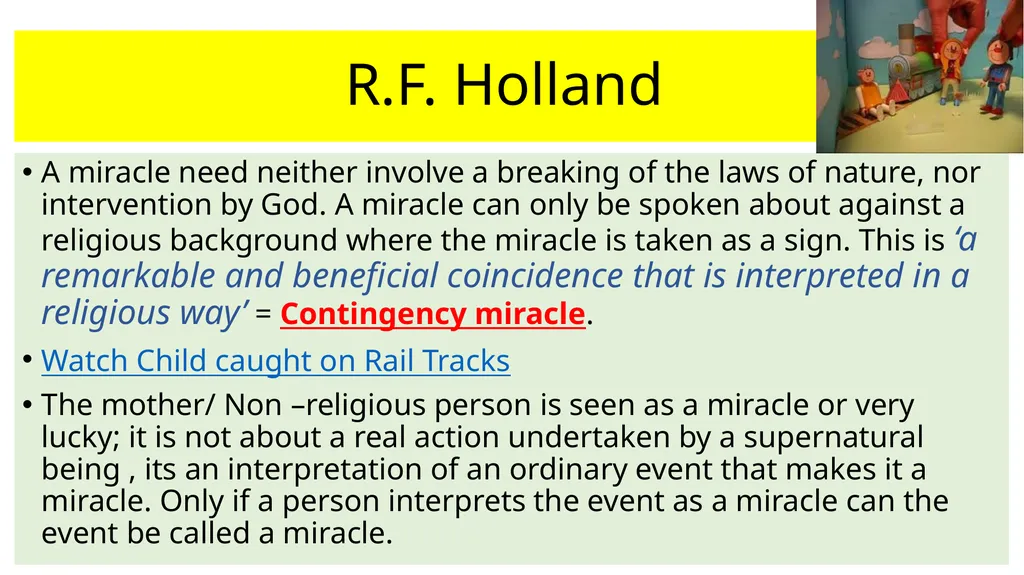
R.F. Holland A miracle need neither involve a breaking of the laws of nature, nor intervention by God. A miracle can only be spoken about against a religious background where the miracle is taken as a sign. This is ‘a remarkable and beneficial coincidence that is interpreted in a religious way’ = Contingency miracle.
Watch Child caught on Rail Tracks
The mother/ Non –religious person is seen as a miracle or very lucky; it is not about a real action undertaken by a supernatural being , its an interpretation of an ordinary event that makes it a miracle. Only if a person interprets the event as a miracle can the event be called a miracle.<br>
06
Richard Swinburne Swinburne endorses Hume’s definition and accepts the miracle is an objective event in which God intervenes but he makes two significant additions:
‘occurrence of a non repeatable law of nature’
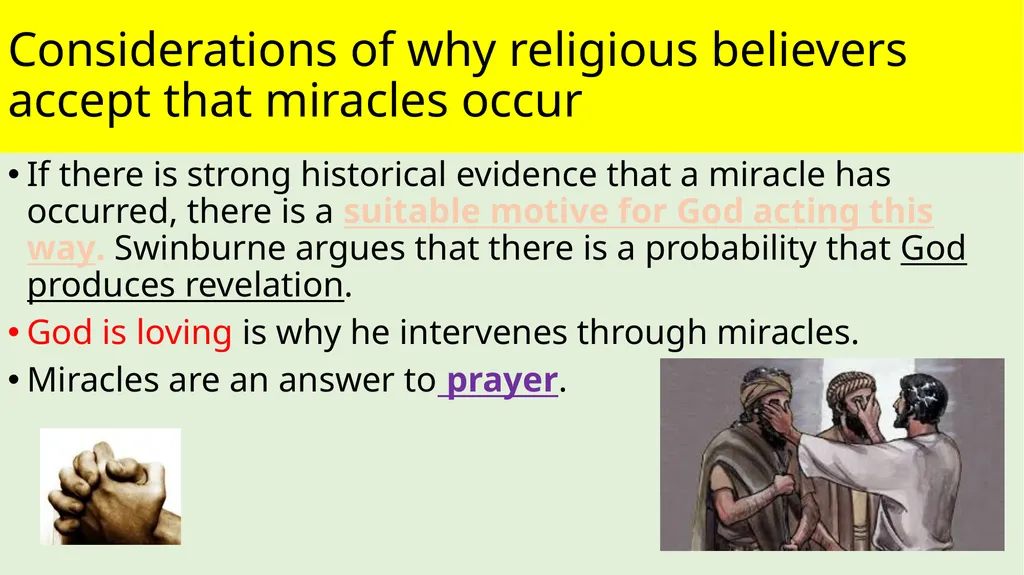
To be a miracle holds religious significance, a divine purpose of the world. John’s Gospel refers to Jesus miracles which always seem to point to something beyond the event.<br>
07
Considerations of why religious believers accept that miracles occur If there is strong historical evidence that a miracle has occurred, there is a suitable motive for God acting this way. Swinburne argues that there is a probability that God produces revelation.
God is loving is why he intervenes through miracles.
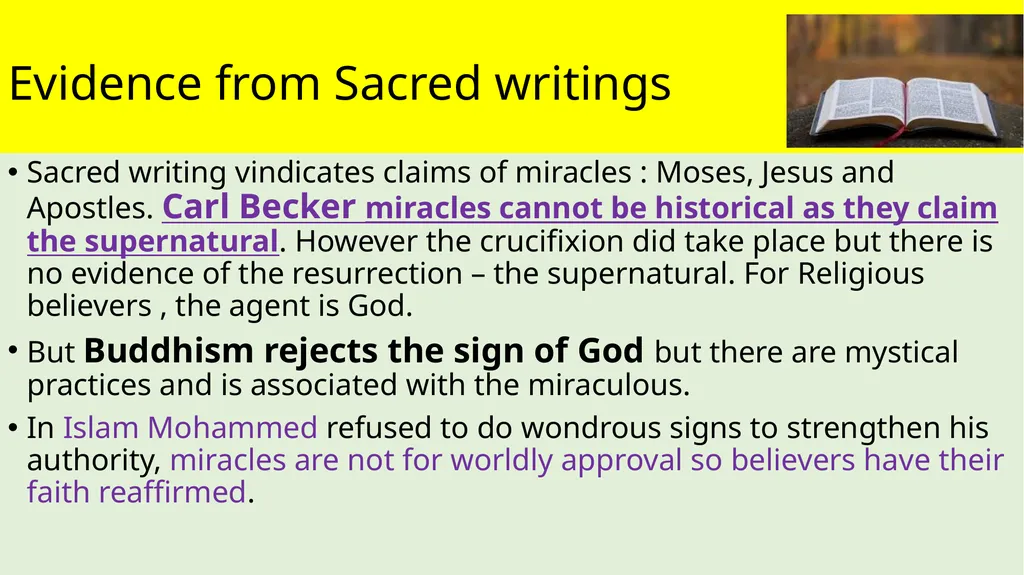
Miracles are an answer to prayer.<br>
08
Evidence from Sacred writings Sacred writing vindicates claims of miracles : Moses, Jesus and Apostles. Carl Becker miracles cannot be historical as they claim the supernatural. However the crucifixion did take place but there is no evidence of the resurrection – the supernatural. For Religious believers , the agent is God.
But Buddhism rejects the sign of God but there are mystical practices and is associated with the miraculous.
In Islam Mohammed refused to do wondrous signs to strengthen his authority, miracles are not for worldly approval so believers have their faith reaffirmed.<br>
09
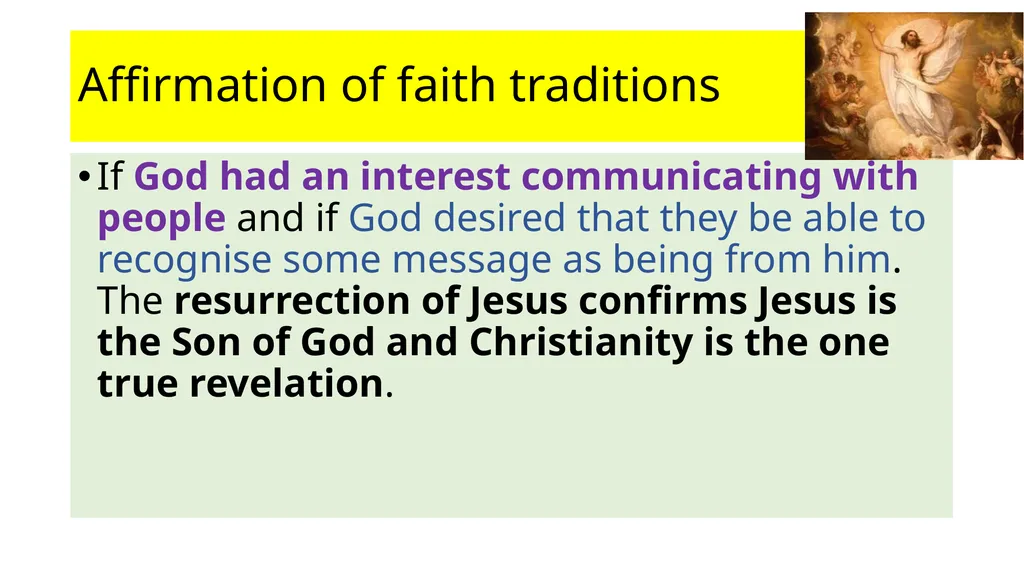
Affirmation of faith traditions If God had an interest communicating with people and if God desired that they be able to recognise some message as being from him. The resurrection of Jesus confirms Jesus is the Son of God and Christianity is the one true revelation.<br>
10
Personal Experience Miracles can generate support/faith – Lourdes Shrine , there are unexplained scientific evidence that miracles have occurred.
Personal reason that God has answered their prayers. God is active in the world .<br>
11
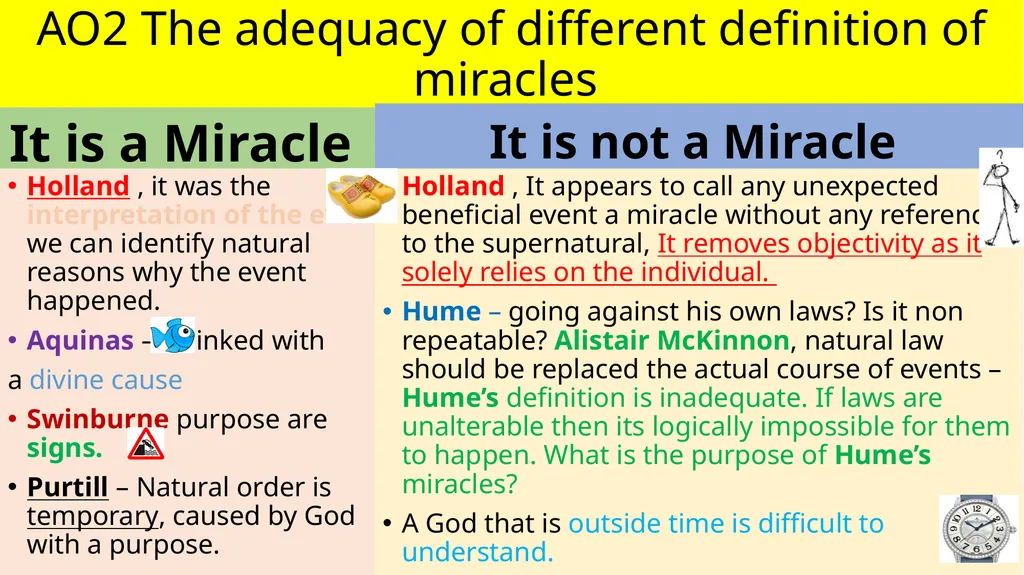
AO2 The adequacy of different definition of miracles It is a Miracle Holland , it was the interpretation of the event, we can identify natural reasons why the event happened.
Aquinas – linked with
a divine cause
Swinburne purpose are signs.
Purtill – Natural order is temporary, caused by God with a purpose. It is not a Miracle Holland , It appears to call any unexpected beneficial event a miracle without any reference to the supernatural, It removes objectivity as it solely relies on the individual.
Hume – going against his own laws? Is it non repeatable? Alistair McKinnon, natural law should be replaced the actual course of events – Hume’s definition is inadequate. If laws are unalterable then its logically impossible for them to happen. What is the purpose of Hume’s miracles?
A God that is outside time is difficult to understand.<br>
12
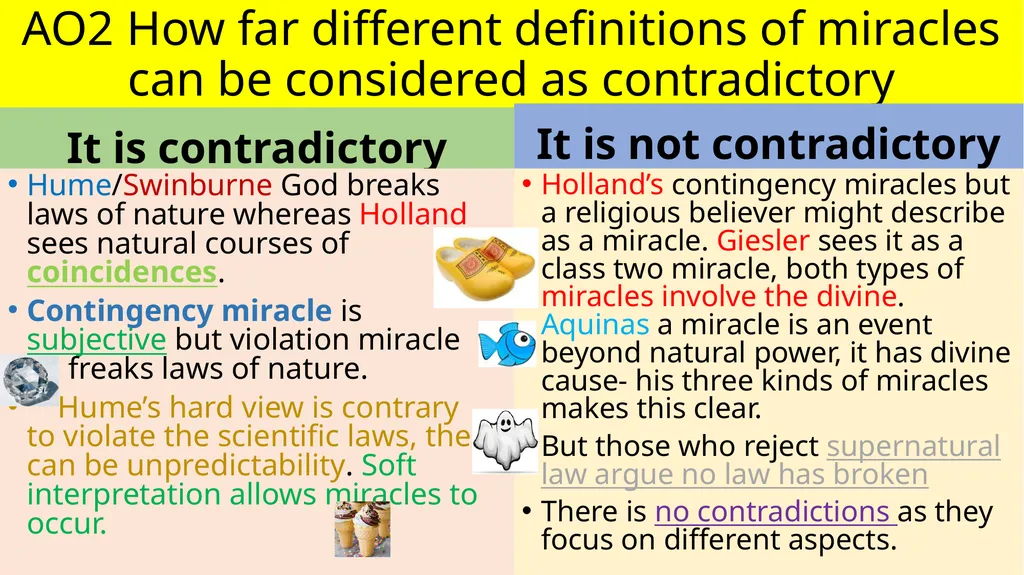
AO2 How far different definitions of miracles can be considered as contradictory It is contradictory Hume/Swinburne God breaks laws of nature whereas Holland sees natural courses of coincidences.
Contingency miracle is subjective but violation miracle b freaks laws of nature.
Hume’s hard view is contrary to violate the scientific laws, there can be unpredictability. Soft interpretation allows miracles to occur. It is not contradictory Holland’s contingency miracles but a religious believer might describe as a miracle. Giesler sees it as a class two miracle, both types of miracles involve the divine. Aquinas a miracle is an event beyond natural power, it has divine cause- his three kinds of miracles makes this clear.
But those who reject supernatural law argue no law has broken
There is no contradictions as they focus on different aspects.<br>