Theoretical approaches to understanding comparative politics Key points Theoretical approaches are Ways of studying politics, and help in identifying the right questions to ask and how to go about answering them; The institutional
"Theoretical approaches to understanding" is the property of its rightful owner. Permission is granted to
download and print the materials on this website for personal, non-commercial use only, and to display it
on your personal computer provided you do not modify the materials and that you retain all copyright
notices contained in the materials. By downloading content from our website, you accept the terms of this
agreement.
Presentation Transcript
01
Theoretical approaches to understanding comparative politics<br>
02
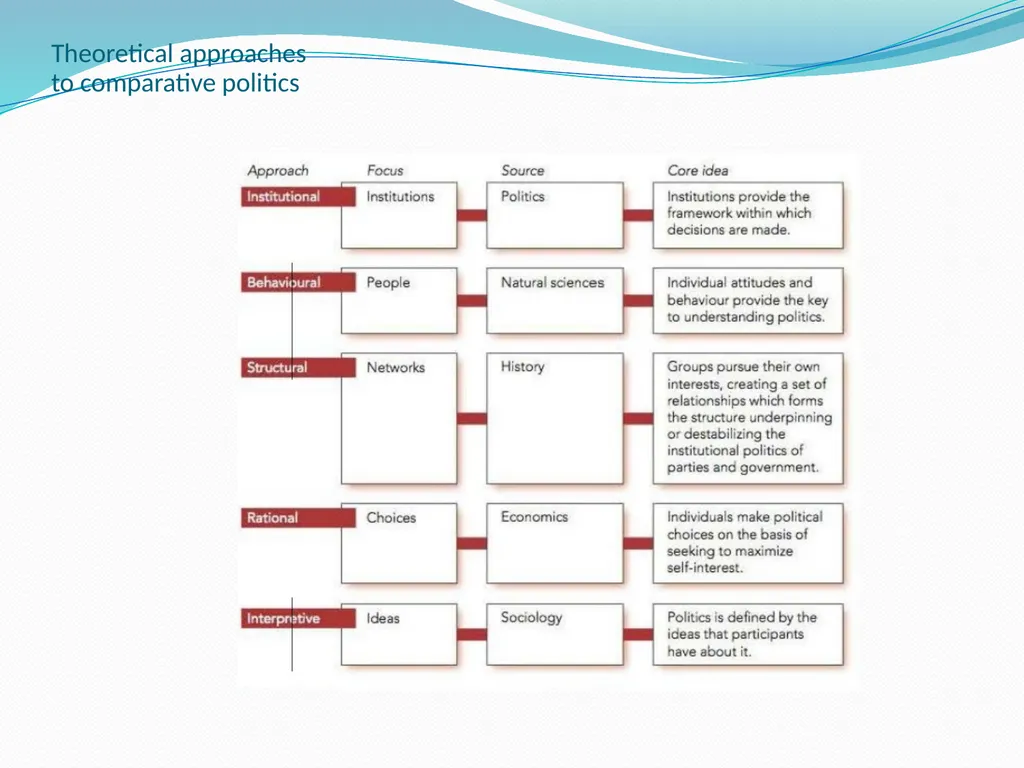
Key points Theoretical approaches are Ways of studying politics, and help in identifying the right questions to ask and how to go about answering them;
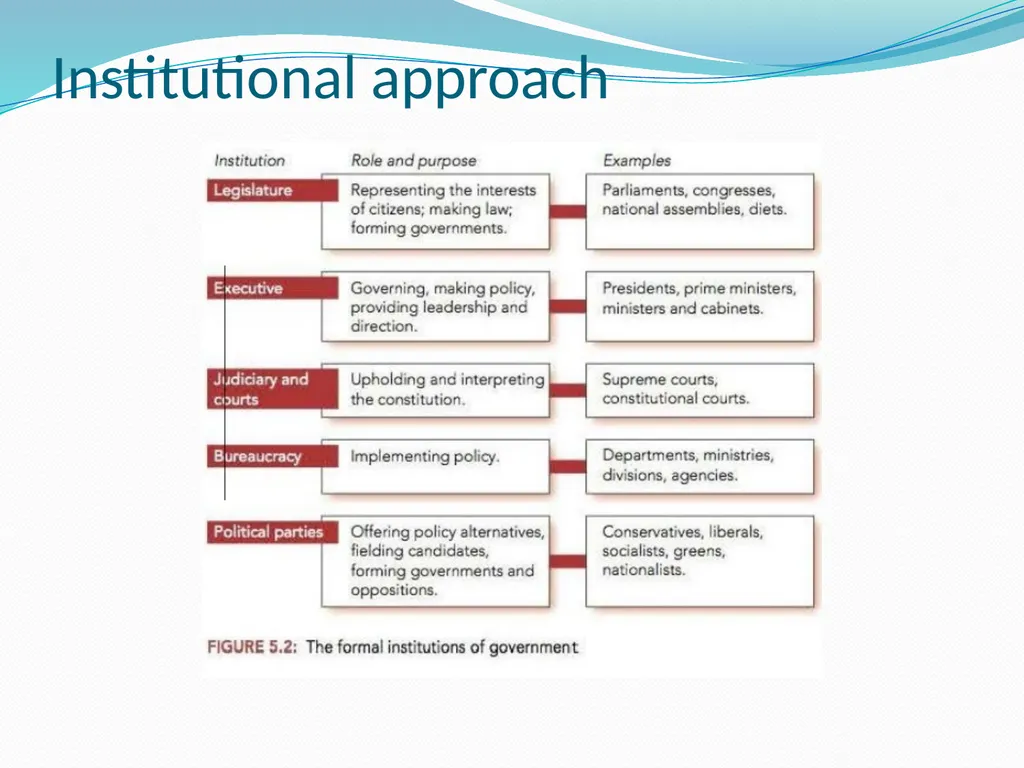
The institutional perspective has done most to shape the development of politics as a discipline and remains an important tradition in comparative politics;
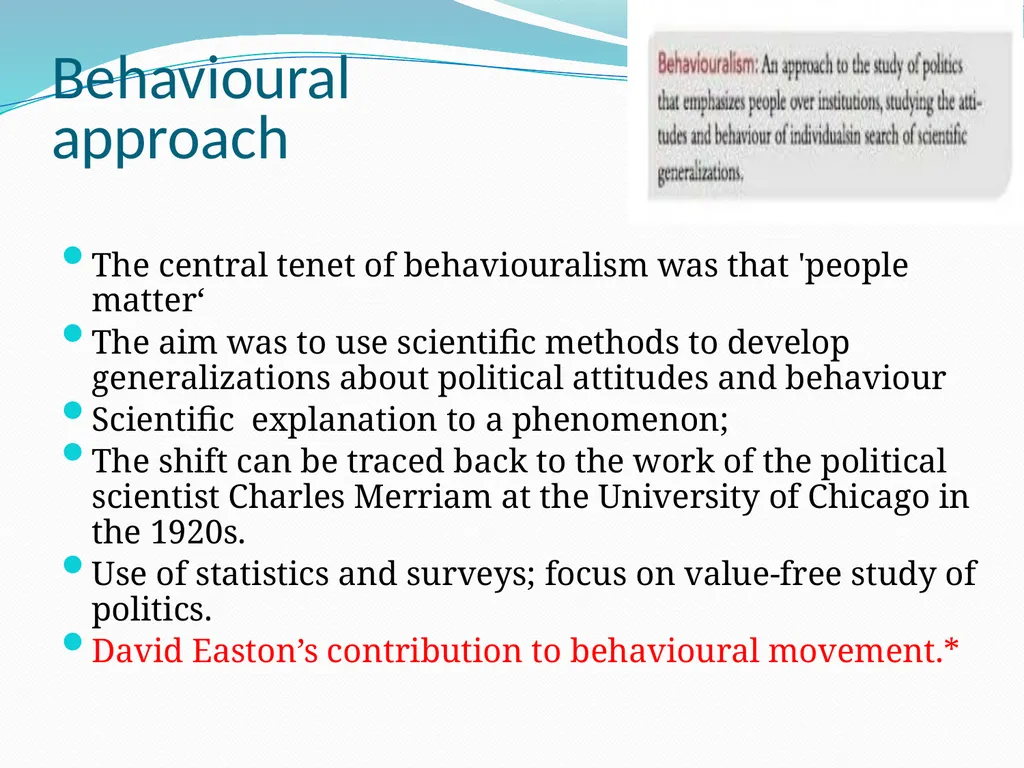
The behavioural approach examines politics at the level of the individual relying primarily on quantitative analysis of sample surveys;<br>
03
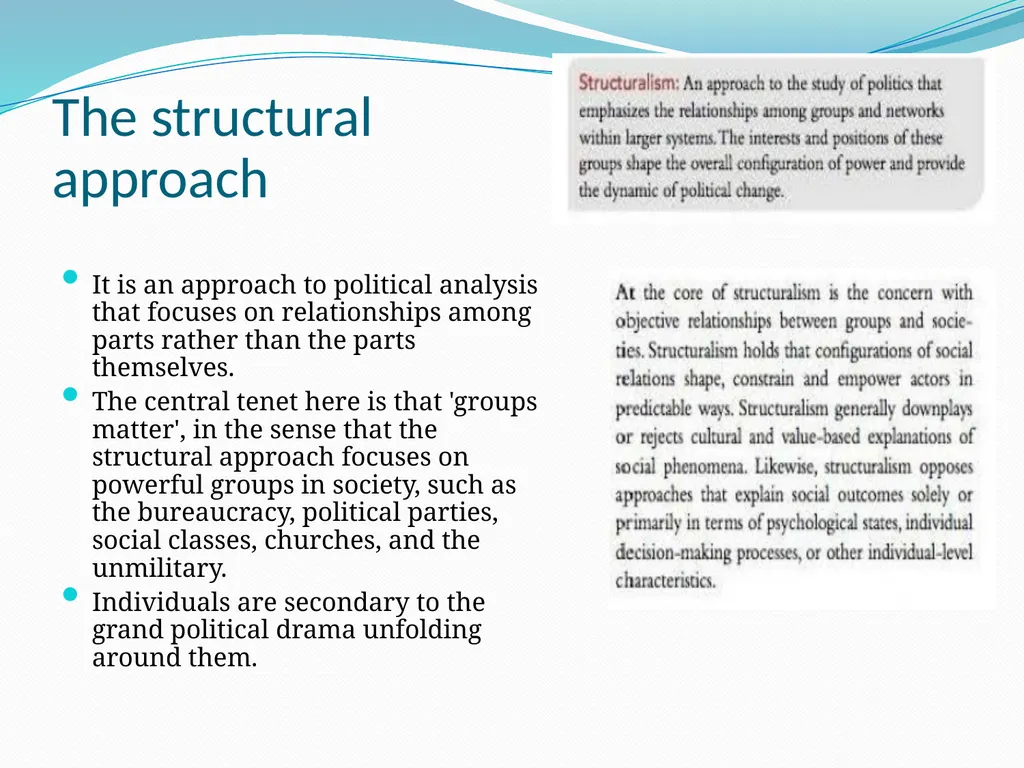
The structural approach focuses on networks, and looks at the past to help understand the present. In this way. it helps bridge politics and history.
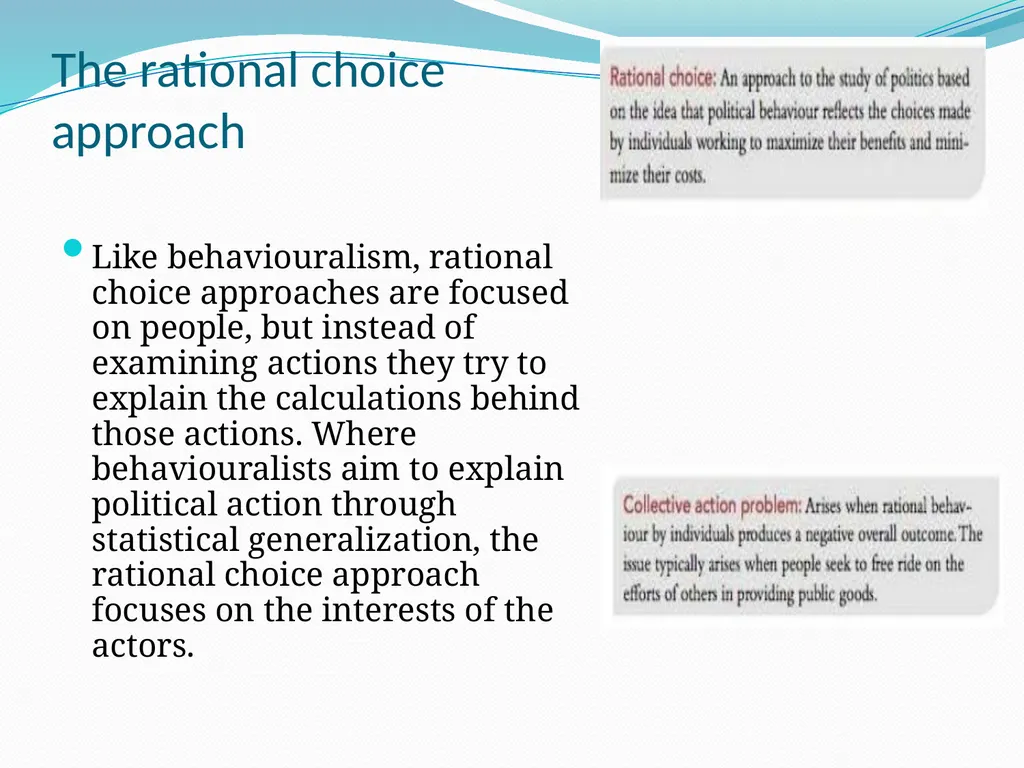
The rational choice approach seeks to explain political outcomes by exploring interactions between political actors as they pursue their particular interests and goals.
The interpretive approach, viewing politics as the ideas people construct about it in the course of their interaction, offers a contrast to more mainstream approaches.<br>
04
Overview Theory: An abstract or generalised approach to explaining or understanding a phenomenon.
For comparative politics it means-
Developing and using principles and concepts that can be used to explain everything from the formation of states to questions of national identity, the character of institutions, the process of democratisation , and the dynamics of political instability, political participation and public policy.<br>
05
Complicating factors For some, there are so many choices that diversity can sometimes seem to border on anarchy prompting comparative politics to lose (or even lack) direction.
Comparative politics has been criticised for focusing too much on ideas emerging from the western tradition.<br>
06
It can sometimes seem as though the debate about theory is more about competing explanations than about their practical, real-world applications.
The social sciences suffer greater uncertainties; generation of laws and predicting outcome more difficult.<br>
07
Theoretical approaches to comparative politics<br>
08
Institutional approach<br>
09
Understanding political institutions<br>
10
Behavioural approach The central tenet of behaviouralism was that 'people matter‘
The aim was to use scientific methods to develop generalizations about political attitudes and behaviour
Scientific explanation to a phenomenon;
The shift can be traced back to the work of the political scientist Charles Merriam at the University of Chicago in the 1920s.
Use of statistics and surveys; focus on value-free study of politics.
David Easton’s contribution to behavioural movement.*<br>
11
The structural approach It is an approach to political analysis that focuses on relationships among parts rather than the parts themselves.
The central tenet here is that 'groups matter', in the sense that the structural approach focuses on powerful groups in society, such as the bureaucracy, political parties, social classes, churches, and the unmilitary.
Individuals are secondary to the grand political drama unfolding around them.<br>
12
The rational choice approach Like behaviouralism, rational choice approaches are focused on people, but instead of examining actions they try to explain the calculations behind those actions. Where behaviouralists aim to explain political action through statistical generalization, the rational choice approach focuses on the interests of the actors.<br>
13
A major contribution of the approach lies in highlighting collective action problems. These arise in coordinating the actions of individuals so as to achieve the best outcome for each person.<br>
14
The interpretive approach The focus of the interpretive approach is on the interpretations within which politics operates, including assumptions, codes, constructions, identities, meanings. norms, narratives, and values.
The approach is also sometimes known as 'constructivism‘. In short, 'ideas matter' .<br>
15
Starting point is not behaviour but action - that is, meaningful behaviour.
Ideas , beliefs, norms important.
In short, unpacking the meaning of political action is best regarded as the start, but not the end, of political analysis.<br>