
These slides are provided for educational purposes
LS
Published · 17 slides · 0 views

1 / 1




Description
These slides are provided for educational purposes as of March 2026 Note: These slides are made available to any appropriately requesting individual, regardless of the manner in which they cover, recommend, or participate in the ordering of
Related Topics
Share
Embed code
Download this presentation From Below
"These slides are provided for educational purposes" is the property of its rightful owner. Permission is granted to download and print the materials on this website for personal, non-commercial use only, and to display it on your personal computer provided you do not modify the materials and that you retain all copyright notices contained in the materials. By downloading content from our website, you accept the terms of this agreement.
Presentation Transcript
01
These slides are provided for educational purposes as of March 2026 Note:
These slides are made available to any appropriately requesting individual, regardless of the manner in which they cover, recommend, or participate in the ordering of any Exact Sciences product.
Individuals may use these slides for scientific or educational purposes only.
Exact Sciences does not grant permission to modify the slides or their content and therefore is not responsible for any edits or changes made by a user. This includes, but not limited to, edits or changes to the contents, order, format, and/or incorporation or adoption of these slides or their content into other materials.
The information on these slides may not constitute the most up-to-date data information or data. It is the user’s responsibility to verify the accuracy of these slides for the desired use to comply with applicable rules, laws, or regulations (e.g., event organizer or accrediting body standards/requirements, copyright laws, institutional requirements, etc.).
These slides and their contents are provided: (1) with any faults AS IS AND AS AVAILABLE; and (2) without any assurance, warranty, condition, or duty of or regarding the slides and/or their contents: accuracy, availability, adequacy, validity, reliability, completeness, performance, or compatibility. Exact Sciences disclaims any liability associated with the use of these slides. © 2026 Exact Sciences Corporation. All rights reserved.<br>
These slides are made available to any appropriately requesting individual, regardless of the manner in which they cover, recommend, or participate in the ordering of any Exact Sciences product.
Individuals may use these slides for scientific or educational purposes only.
Exact Sciences does not grant permission to modify the slides or their content and therefore is not responsible for any edits or changes made by a user. This includes, but not limited to, edits or changes to the contents, order, format, and/or incorporation or adoption of these slides or their content into other materials.
The information on these slides may not constitute the most up-to-date data information or data. It is the user’s responsibility to verify the accuracy of these slides for the desired use to comply with applicable rules, laws, or regulations (e.g., event organizer or accrediting body standards/requirements, copyright laws, institutional requirements, etc.).
These slides and their contents are provided: (1) with any faults AS IS AND AS AVAILABLE; and (2) without any assurance, warranty, condition, or duty of or regarding the slides and/or their contents: accuracy, availability, adequacy, validity, reliability, completeness, performance, or compatibility. Exact Sciences disclaims any liability associated with the use of these slides. © 2026 Exact Sciences Corporation. All rights reserved.<br>
02
Colorectal Cancer Screening
Recommendations March 2026 / MED-CG-2200264 (v3.0)<br>
03
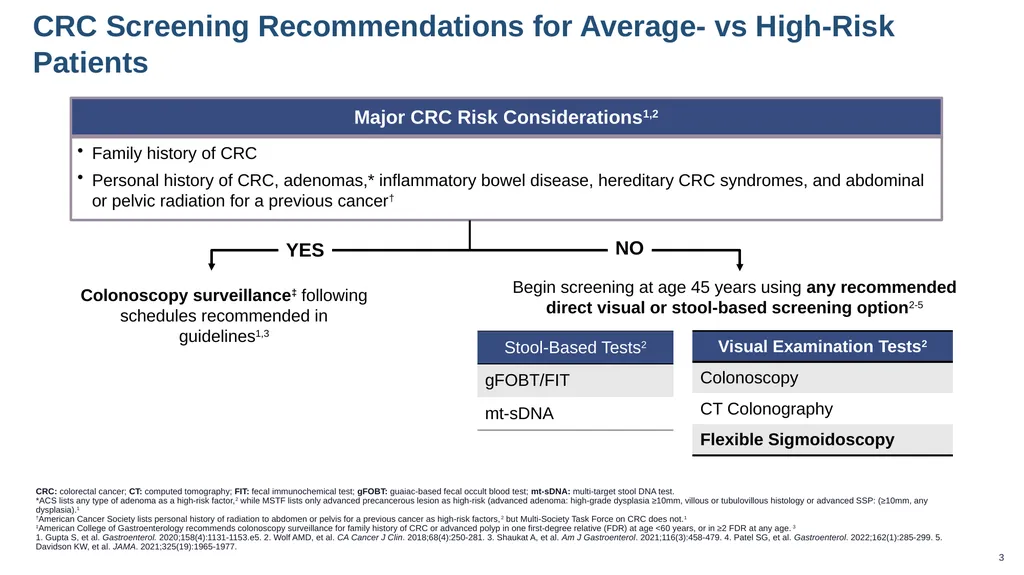
CRC Screening Recommendations for Average- vs High-Risk Patients CRC: colorectal cancer; CT: computed tomography; FIT: fecal immunochemical test; gFOBT: guaiac-based fecal occult blood test; mt-sDNA: multi-target stool DNA test.
*ACS lists any type of adenoma as a high-risk factor,2 while MSTF lists only advanced precancerous lesion as high-risk (advanced adenoma: high-grade dysplasia ≥10mm, villous or tubulovillous histology or advanced SSP: (≥10mm, any dysplasia).1
†American Cancer Society lists personal history of radiation to abdomen or pelvis for a previous cancer as high-risk factors,2 but Multi-Society Task Force on CRC does not.1
‡American College of Gastroenterology recommends colonoscopy surveillance for family history of CRC or advanced polyp in one first-degree relative (FDR) at age <60 years, or in ≥2 FDR at any age.3
1. Gupta S, et al. Gastroenterol. 2020;158(4):1131-1153.e5. 2. Wolf AMD, et al. CA Cancer J Clin. 2018;68(4):250-281. 3. Shaukat A, et al. Am J Gastroenterol. 2021;116(3):458-479. 4. Patel SG, et al. Gastroenterol. 2022;162(1):285-299. 5. Davidson KW, et al. JAMA. 2021;325(19):1965-1977. Begin screening at age 45 years using any recommended direct visual or stool-based screening option2-5 Major CRC Risk Considerations1,2 Family history of CRC
Personal history of CRC, adenomas,* inflammatory bowel disease, hereditary CRC syndromes, and abdominal or pelvic radiation for a previous cancer† Colonoscopy surveillance‡ following schedules recommended in guidelines1,3 NO YES<br>
*ACS lists any type of adenoma as a high-risk factor,2 while MSTF lists only advanced precancerous lesion as high-risk (advanced adenoma: high-grade dysplasia ≥10mm, villous or tubulovillous histology or advanced SSP: (≥10mm, any dysplasia).1
†American Cancer Society lists personal history of radiation to abdomen or pelvis for a previous cancer as high-risk factors,2 but Multi-Society Task Force on CRC does not.1
‡American College of Gastroenterology recommends colonoscopy surveillance for family history of CRC or advanced polyp in one first-degree relative (FDR) at age <60 years, or in ≥2 FDR at any age.3
1. Gupta S, et al. Gastroenterol. 2020;158(4):1131-1153.e5. 2. Wolf AMD, et al. CA Cancer J Clin. 2018;68(4):250-281. 3. Shaukat A, et al. Am J Gastroenterol. 2021;116(3):458-479. 4. Patel SG, et al. Gastroenterol. 2022;162(1):285-299. 5. Davidson KW, et al. JAMA. 2021;325(19):1965-1977. Begin screening at age 45 years using any recommended direct visual or stool-based screening option2-5 Major CRC Risk Considerations1,2 Family history of CRC
Personal history of CRC, adenomas,* inflammatory bowel disease, hereditary CRC syndromes, and abdominal or pelvic radiation for a previous cancer† Colonoscopy surveillance‡ following schedules recommended in guidelines1,3 NO YES<br>
04
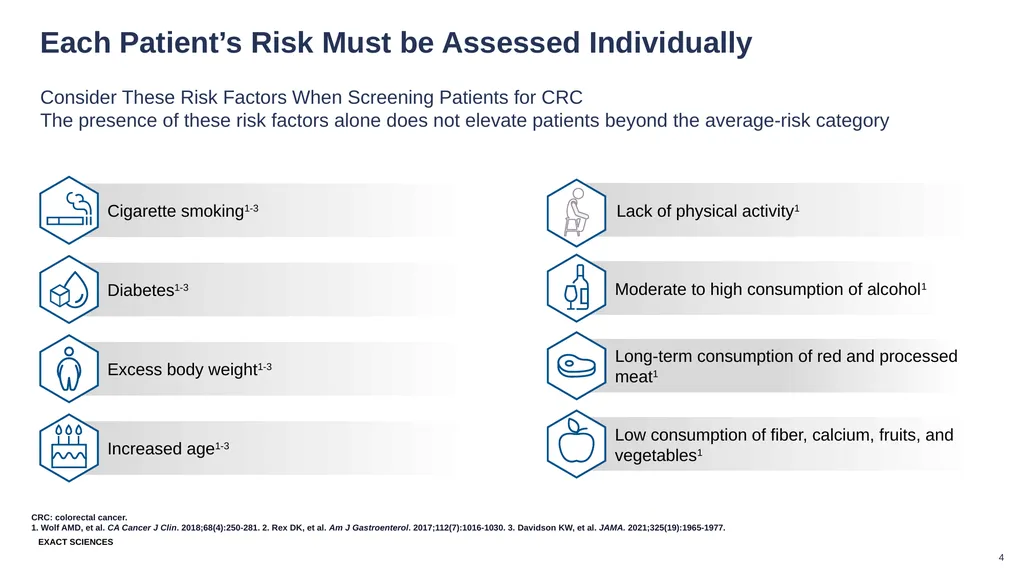
Each Patient’s Risk Must be Assessed Individually Consider These Risk Factors When Screening Patients for CRC
The presence of these risk factors alone does not elevate patients beyond the average-risk category CRC: colorectal cancer.
1. Wolf AMD, et al. CA Cancer J Clin. 2018;68(4):250-281. 2. Rex DK, et al. Am J Gastroenterol. 2017;112(7):1016-1030. 3. Davidson KW, et al. JAMA. 2021;325(19):1965-1977. Diabetes1-3 Cigarette smoking1-3 Excess body weight1-3 Increased age1-3 Moderate to high consumption of alcohol1 Lack of physical activity1 Low consumption of fiber, calcium, fruits, and vegetables1 Long-term consumption of red and processed meat1<br>
The presence of these risk factors alone does not elevate patients beyond the average-risk category CRC: colorectal cancer.
1. Wolf AMD, et al. CA Cancer J Clin. 2018;68(4):250-281. 2. Rex DK, et al. Am J Gastroenterol. 2017;112(7):1016-1030. 3. Davidson KW, et al. JAMA. 2021;325(19):1965-1977. Diabetes1-3 Cigarette smoking1-3 Excess body weight1-3 Increased age1-3 Moderate to high consumption of alcohol1 Lack of physical activity1 Low consumption of fiber, calcium, fruits, and vegetables1 Long-term consumption of red and processed meat1<br>
05
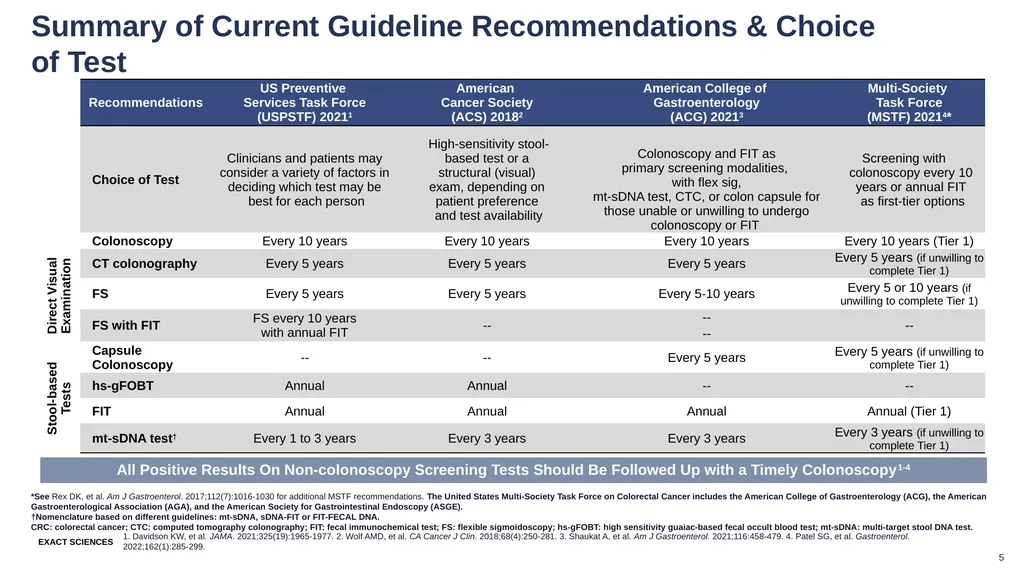
Summary of Current Guideline Recommendations & Choice
of Test *See Rex DK, et al. Am J Gastroenterol. 2017;112(7):1016-1030 for additional MSTF recommendations. The United States Multi-Society Task Force on Colorectal Cancer includes the American College of Gastroenterology (ACG), the American Gastroenterological Association (AGA), and the American Society for Gastrointestinal Endoscopy (ASGE).
†Nomenclature based on different guidelines: mt-sDNA, sDNA-FIT or FIT-FECAL DNA.
CRC: colorectal cancer; CTC: computed tomography colonography; FIT: fecal immunochemical test; FS: flexible sigmoidoscopy; hs-gFOBT: high sensitivity guaiac-based fecal occult blood test; mt-sDNA: multi-target stool DNA test. All Positive Results On Non-colonoscopy Screening Tests Should Be Followed Up with a Timely Colonoscopy1-4 Direct Visual Examination Stool-based Tests 1. Davidson KW, et al. JAMA. 2021;325(19):1965-1977. 2. Wolf AMD, et al. CA Cancer J Clin. 2018;68(4):250-281. 3. Shaukat A, et al. Am J Gastroenterol. 2021;116:458-479. 4. Patel SG, et al. Gastroenterol. 2022;162(1):285-299.<br>
†Nomenclature based on different guidelines: mt-sDNA, sDNA-FIT or FIT-FECAL DNA.
CRC: colorectal cancer; CTC: computed tomography colonography; FIT: fecal immunochemical test; FS: flexible sigmoidoscopy; hs-gFOBT: high sensitivity guaiac-based fecal occult blood test; mt-sDNA: multi-target stool DNA test. All Positive Results On Non-colonoscopy Screening Tests Should Be Followed Up with a Timely Colonoscopy1-4 Direct Visual Examination Stool-based Tests 1. Davidson KW, et al. JAMA. 2021;325(19):1965-1977. 2. Wolf AMD, et al. CA Cancer J Clin. 2018;68(4):250-281. 3. Shaukat A, et al. Am J Gastroenterol. 2021;116:458-479. 4. Patel SG, et al. Gastroenterol. 2022;162(1):285-299.<br>
06
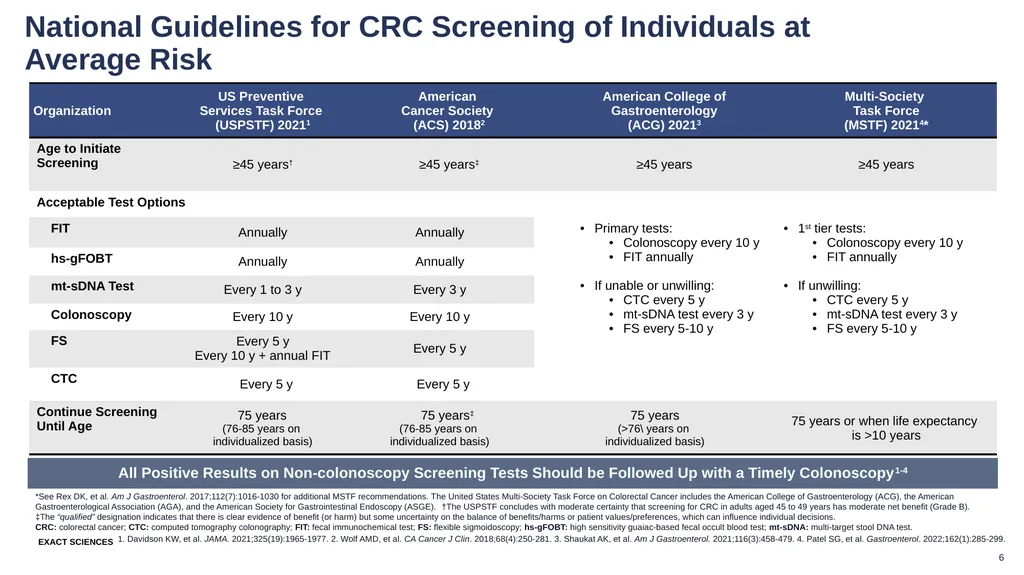
National Guidelines for CRC Screening of Individuals at
Average Risk All Positive Results on Non-colonoscopy Screening Tests Should be Followed Up with a Timely Colonoscopy1-4 *See Rex DK, et al. Am J Gastroenterol. 2017;112(7):1016-1030 for additional MSTF recommendations. The United States Multi-Society Task Force on Colorectal Cancer includes the American College of Gastroenterology (ACG), the American Gastroenterological Association (AGA), and the American Society for Gastrointestinal Endoscopy (ASGE). †The USPSTF concludes with moderate certainty that screening for CRC in adults aged 45 to 49 years has moderate net benefit (Grade B).
‡The “qualified” designation indicates that there is clear evidence of benefit (or harm) but some uncertainty on the balance of benefits/harms or patient values/preferences, which can influence individual decisions.
CRC: colorectal cancer; CTC: computed tomography colonography; FIT: fecal immunochemical test; FS: flexible sigmoidoscopy; hs-gFOBT: high sensitivity guaiac-based fecal occult blood test; mt-sDNA: multi-target stool DNA test. 1. Davidson KW, et al. JAMA. 2021;325(19):1965-1977. 2. Wolf AMD, et al. CA Cancer J Clin. 2018;68(4):250-281. 3. Shaukat AK, et al. Am J Gastroenterol. 2021;116(3):458-479. 4. Patel SG, et al. Gastroenterol. 2022;162(1):285-299.<br>
‡The “qualified” designation indicates that there is clear evidence of benefit (or harm) but some uncertainty on the balance of benefits/harms or patient values/preferences, which can influence individual decisions.
CRC: colorectal cancer; CTC: computed tomography colonography; FIT: fecal immunochemical test; FS: flexible sigmoidoscopy; hs-gFOBT: high sensitivity guaiac-based fecal occult blood test; mt-sDNA: multi-target stool DNA test. 1. Davidson KW, et al. JAMA. 2021;325(19):1965-1977. 2. Wolf AMD, et al. CA Cancer J Clin. 2018;68(4):250-281. 3. Shaukat AK, et al. Am J Gastroenterol. 2021;116(3):458-479. 4. Patel SG, et al. Gastroenterol. 2022;162(1):285-299.<br>
07
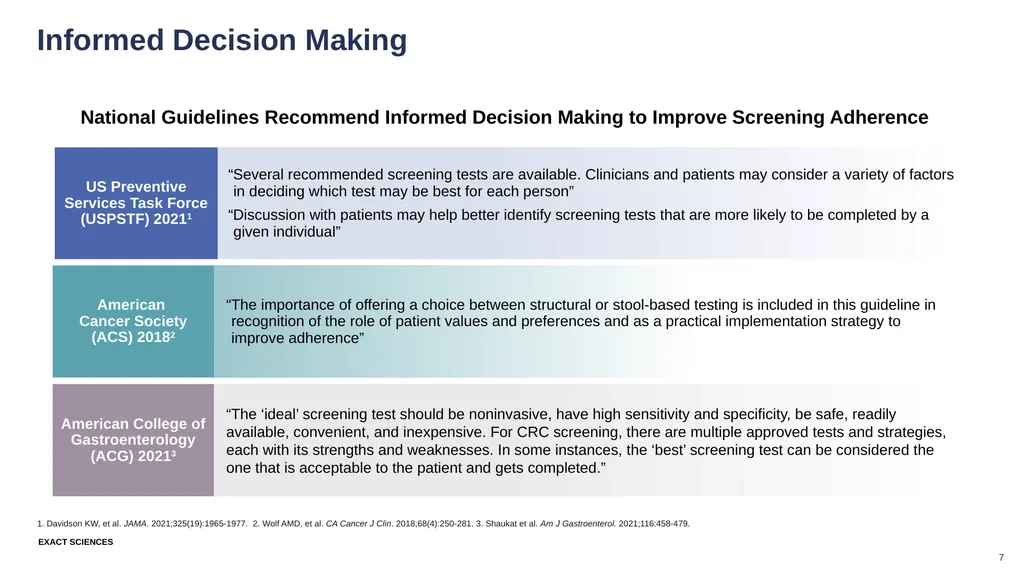
Informed Decision Making 1. Davidson KW, et al. JAMA. 2021;325(19):1965-1977. 2. Wolf AMD, et al. CA Cancer J Clin. 2018;68(4):250-281. 3. Shaukat et al. Am J Gastroenterol. 2021;116:458-479. National Guidelines Recommend Informed Decision Making to Improve Screening Adherence<br>
08
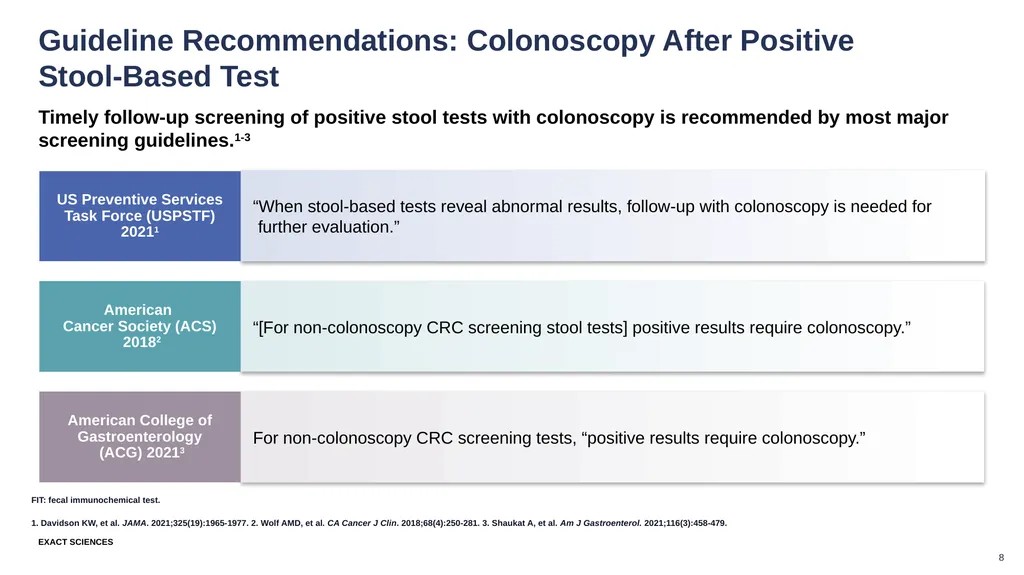
Guideline Recommendations: Colonoscopy After Positive
Stool-Based Test FIT: fecal immunochemical test.
1. Davidson KW, et al. JAMA. 2021;325(19):1965-1977. 2. Wolf AMD, et al. CA Cancer J Clin. 2018;68(4):250-281. 3. Shaukat A, et al. Am J Gastroenterol. 2021;116(3):458-479. Timely follow-up screening of positive stool tests with colonoscopy is recommended by most major screening guidelines.1-3 “When stool-based tests reveal abnormal results, follow-up with colonoscopy is needed for further evaluation.” US Preventive Services Task Force (USPSTF) 20211 “[For non-colonoscopy CRC screening stool tests] positive results require colonoscopy.” American
Cancer Society (ACS)
20182 For non-colonoscopy CRC screening tests, “positive results require colonoscopy.” American College of Gastroenterology
(ACG) 20213<br>
1. Davidson KW, et al. JAMA. 2021;325(19):1965-1977. 2. Wolf AMD, et al. CA Cancer J Clin. 2018;68(4):250-281. 3. Shaukat A, et al. Am J Gastroenterol. 2021;116(3):458-479. Timely follow-up screening of positive stool tests with colonoscopy is recommended by most major screening guidelines.1-3 “When stool-based tests reveal abnormal results, follow-up with colonoscopy is needed for further evaluation.” US Preventive Services Task Force (USPSTF) 20211 “[For non-colonoscopy CRC screening stool tests] positive results require colonoscopy.” American
Cancer Society (ACS)
20182 For non-colonoscopy CRC screening tests, “positive results require colonoscopy.” American College of Gastroenterology
(ACG) 20213<br>
09
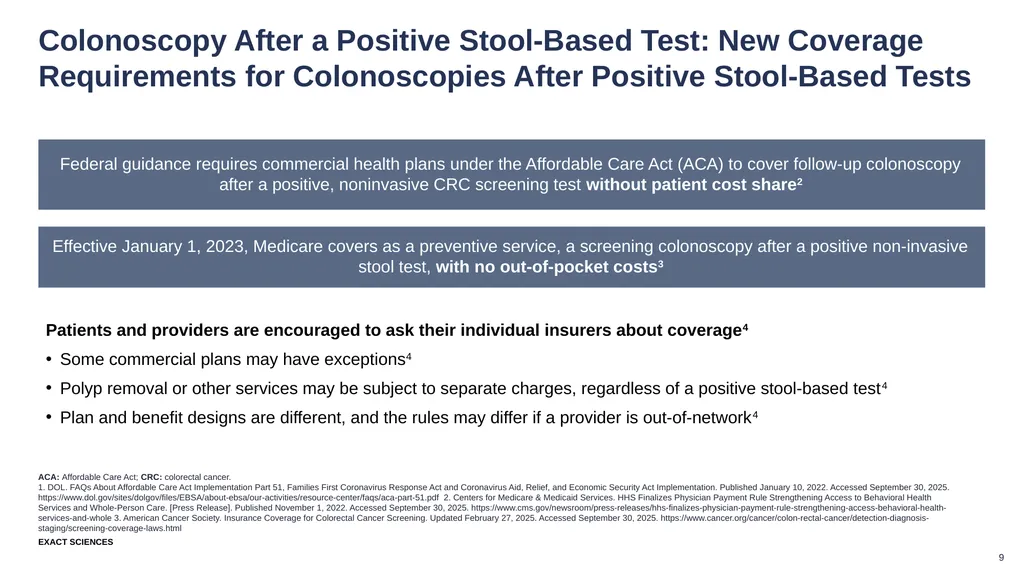
Colonoscopy After a Positive Stool-Based Test: New Coverage Requirements for Colonoscopies After Positive Stool-Based Tests ACA: Affordable Care Act; CRC: colorectal cancer.
1. DOL. FAQs About Affordable Care Act Implementation Part 51, Families First Coronavirus Response Act and Coronavirus Aid, Relief, and Economic Security Act Implementation. Published January 10, 2022. Accessed September 30, 2025. https://www.dol.gov/sites/dolgov/files/EBSA/about-ebsa/our-activities/resource-center/faqs/aca-part-51.pdf 2. Centers for Medicare & Medicaid Services. HHS Finalizes Physician Payment Rule Strengthening Access to Behavioral Health Services and Whole-Person Care. [Press Release]. Published November 1, 2022. Accessed September 30, 2025. https://www.cms.gov/newsroom/press-releases/hhs-finalizes-physician-payment-rule-strengthening-access-behavioral-health-services-and-whole 3. American Cancer Society. Insurance Coverage for Colorectal Cancer Screening. Updated February 27, 2025. Accessed September 30, 2025. https://www.cancer.org/cancer/colon-rectal-cancer/detection-diagnosis-staging/screening-coverage-laws.html Federal guidance requires commercial health plans under the Affordable Care Act (ACA) to cover follow-up colonoscopy after a positive, noninvasive CRC screening test without patient cost share2 Effective January 1, 2023, Medicare covers as a preventive service, a screening colonoscopy after a positive non-invasive stool test, with no out-of-pocket costs3 Patients and providers are encouraged to ask their individual insurers about coverage4
Some commercial plans may have exceptions4
Polyp removal or other services may be subject to separate charges, regardless of a positive stool-based test4
Plan and benefit designs are different, and the rules may differ if a provider is out-of-network4<br>
1. DOL. FAQs About Affordable Care Act Implementation Part 51, Families First Coronavirus Response Act and Coronavirus Aid, Relief, and Economic Security Act Implementation. Published January 10, 2022. Accessed September 30, 2025. https://www.dol.gov/sites/dolgov/files/EBSA/about-ebsa/our-activities/resource-center/faqs/aca-part-51.pdf 2. Centers for Medicare & Medicaid Services. HHS Finalizes Physician Payment Rule Strengthening Access to Behavioral Health Services and Whole-Person Care. [Press Release]. Published November 1, 2022. Accessed September 30, 2025. https://www.cms.gov/newsroom/press-releases/hhs-finalizes-physician-payment-rule-strengthening-access-behavioral-health-services-and-whole 3. American Cancer Society. Insurance Coverage for Colorectal Cancer Screening. Updated February 27, 2025. Accessed September 30, 2025. https://www.cancer.org/cancer/colon-rectal-cancer/detection-diagnosis-staging/screening-coverage-laws.html Federal guidance requires commercial health plans under the Affordable Care Act (ACA) to cover follow-up colonoscopy after a positive, noninvasive CRC screening test without patient cost share2 Effective January 1, 2023, Medicare covers as a preventive service, a screening colonoscopy after a positive non-invasive stool test, with no out-of-pocket costs3 Patients and providers are encouraged to ask their individual insurers about coverage4
Some commercial plans may have exceptions4
Polyp removal or other services may be subject to separate charges, regardless of a positive stool-based test4
Plan and benefit designs are different, and the rules may differ if a provider is out-of-network4<br>
10
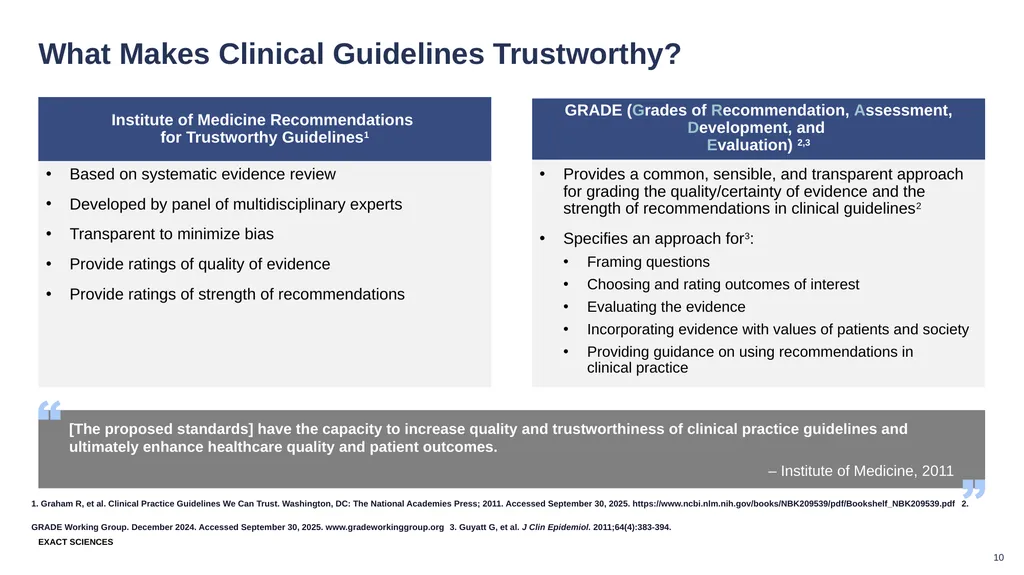
What Makes Clinical Guidelines Trustworthy? 1. Graham R, et al. Clinical Practice Guidelines We Can Trust. Washington, DC: The National Academies Press; 2011. Accessed September 30, 2025. https://www.ncbi.nlm.nih.gov/books/NBK209539/pdf/Bookshelf_NBK209539.pdf 2. GRADE Working Group. December 2024. Accessed September 30, 2025. www.gradeworkinggroup.org 3. Guyatt G, et al. J Clin Epidemiol. 2011;64(4):383-394. Institute of Medicine Recommendations
for Trustworthy Guidelines1 GRADE (Grades of Recommendation, Assessment, Development, and
Evaluation) 2,3 Based on systematic evidence review
Developed by panel of multidisciplinary experts
Transparent to minimize bias
Provide ratings of quality of evidence
Provide ratings of strength of recommendations Provides a common, sensible, and transparent approach for grading the quality/certainty of evidence and the strength of recommendations in clinical guidelines2
Specifies an approach for3:
Framing questions
Choosing and rating outcomes of interest
Evaluating the evidence
Incorporating evidence with values of patients and society
Providing guidance on using recommendations in clinical practice [The proposed standards] have the capacity to increase quality and trustworthiness of clinical practice guidelines and ultimately enhance healthcare quality and patient outcomes.
– Institute of Medicine, 2011<br>
Developed by panel of multidisciplinary experts
Transparent to minimize bias
Provide ratings of quality of evidence
Provide ratings of strength of recommendations Provides a common, sensible, and transparent approach for grading the quality/certainty of evidence and the strength of recommendations in clinical guidelines2
Specifies an approach for3:
Framing questions
Choosing and rating outcomes of interest
Evaluating the evidence
Incorporating evidence with values of patients and society
Providing guidance on using recommendations in clinical practice [The proposed standards] have the capacity to increase quality and trustworthiness of clinical practice guidelines and ultimately enhance healthcare quality and patient outcomes.
– Institute of Medicine, 2011<br>
11
2021 United States Preventive Services Task Force (USPSTF) Final Recommendation Statement 1. Davidson KW, et al. JAMA. 2021;325(19):1965-1977. 2. US Preventive Services Task Force. Grade definitions. Current as of June 2018. Accessed September 30, 2025. https://www.uspreventiveservicestaskforce.org/uspstf/about-uspstf/methods-and-processes/grade-definitions<br>
12
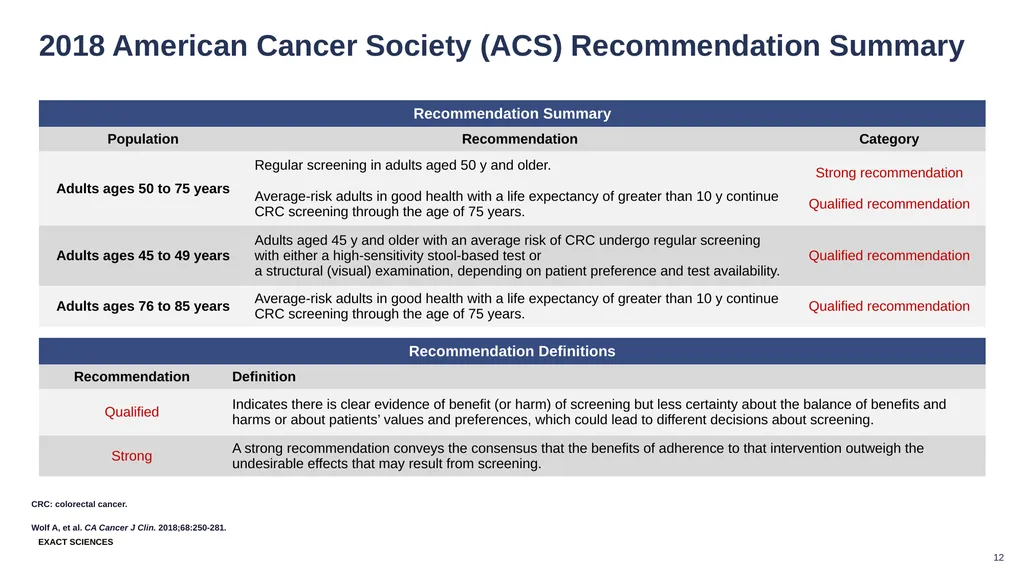
2018 American Cancer Society (ACS) Recommendation Summary CRC: colorectal cancer.
Wolf A, et al. CA Cancer J Clin. 2018;68:250-281.<br>
Wolf A, et al. CA Cancer J Clin. 2018;68:250-281.<br>
13
2021 American College of Gastroenterology (ACG)
Recommendation Statement Shaukat A, et al. Am J Gastroenterol. 2021;116:458-479.<br>
14
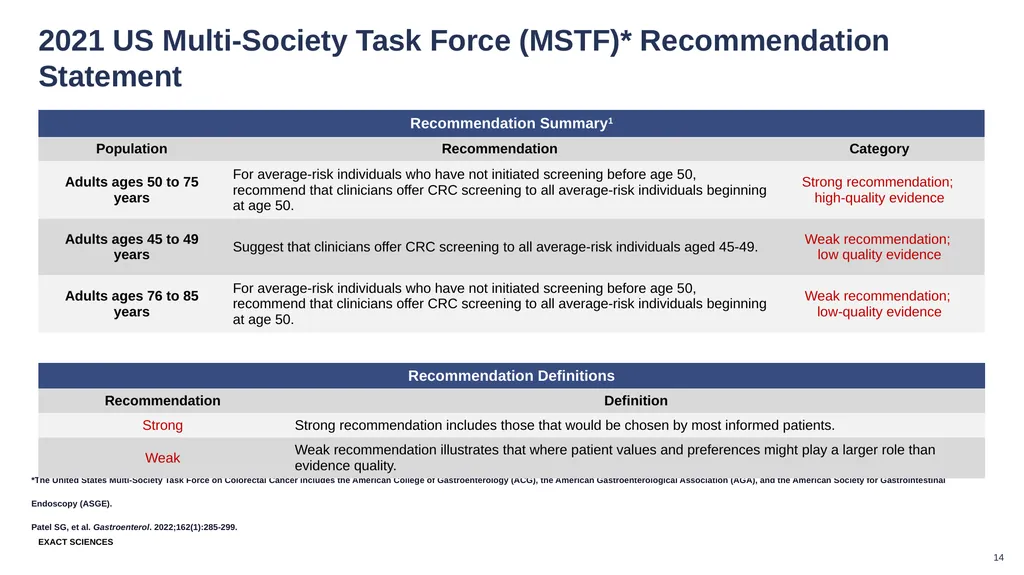
2021 US Multi-Society Task Force (MSTF)* Recommendation Statement *The United States Multi-Society Task Force on Colorectal Cancer includes the American College of Gastroenterology (ACG), the American Gastroenterological Association (AGA), and the American Society for Gastrointestinal Endoscopy (ASGE).
Patel SG, et al. Gastroenterol. 2022;162(1):285-299.<br>
Patel SG, et al. Gastroenterol. 2022;162(1):285-299.<br>
15
ACP 2023: American College of Physicians ACP: American College of Physicians; CRC: colorectal cancer; FIT: fecal immunochemical test; FS: flexible sigmoidoscopy. hs-gFOBT: high-sensitivity guaiac-based fecal occult blood test;
Qaseem A, et al. Ann Intern Med. 2023;176:1092-1100.<br>
Qaseem A, et al. Ann Intern Med. 2023;176:1092-1100.<br>
16
AAFP 2021: American Academy of Family Physicians †A recommendation indicates the AAFP recommends the service. There is high certainty that the net benefit is substantial.
‡C recommendation indicates the AAFP recommends selectively offering or providing this service to individual patients based on professional judgment and patient preferences. There is at least moderate certainty that the net benefit is small.
††D recommendation indicates the AAFP recommends against the service. There is moderate or high certainty that the service has no net benefit or that the harms outweigh the benefits.
§I statement indicates the current evidence is insufficient to assess the balance of benefits and harms of the service. Evidence is lacking, of poor quality, or conflicting, and the balance of benefits and harms cannot be determined.
AAFP: American Academy of Family Physicians; CRC: colorectal cancer; FIT: fecal immunochemical test.
American Academy of Family Physicians. Colorectal Cancer Screening, Adults. Accessed September 30, 2025. https://www.aafp.org/family-physician/patient-care/clinical-recommendations/all-clinical-recommendations/colorectal-cancer-adults.html<br>
‡C recommendation indicates the AAFP recommends selectively offering or providing this service to individual patients based on professional judgment and patient preferences. There is at least moderate certainty that the net benefit is small.
††D recommendation indicates the AAFP recommends against the service. There is moderate or high certainty that the service has no net benefit or that the harms outweigh the benefits.
§I statement indicates the current evidence is insufficient to assess the balance of benefits and harms of the service. Evidence is lacking, of poor quality, or conflicting, and the balance of benefits and harms cannot be determined.
AAFP: American Academy of Family Physicians; CRC: colorectal cancer; FIT: fecal immunochemical test.
American Academy of Family Physicians. Colorectal Cancer Screening, Adults. Accessed September 30, 2025. https://www.aafp.org/family-physician/patient-care/clinical-recommendations/all-clinical-recommendations/colorectal-cancer-adults.html<br>
17
These slides are provided for educational purposes as of March 2026 Note:
These slides are made available to any appropriately requesting individual, regardless of the manner in which they cover, recommend, or participate in the ordering of any Exact Sciences product.
Individuals may use these slides for scientific or educational purposes only.
Exact Sciences does not grant permission to modify the slides or their content and therefore is not responsible for any edits or changes made by a user. This includes, but not limited to, edits or changes to the contents, order, format, and/or incorporation or adoption of these slides or their content into other materials.
The information on these slides may not constitute the most up-to-date data information or data. It is the user’s responsibility to verify the accuracy of these slides for the desired use to comply with applicable rules, laws, or regulations (e.g., event organizer or accrediting body standards/requirements, copyright laws, institutional requirements, etc.).
These slides and their contents are provided: (1) with any faults AS IS AND AS AVAILABLE; and (2) without any assurance, warranty, condition, or duty of or regarding the slides and/or their contents: accuracy, availability, adequacy, validity, reliability, completeness, performance, or compatibility. Exact Sciences disclaims any liability associated with the use of these slides. © 2026 Exact Sciences Corporation. All rights reserved.<br>
These slides are made available to any appropriately requesting individual, regardless of the manner in which they cover, recommend, or participate in the ordering of any Exact Sciences product.
Individuals may use these slides for scientific or educational purposes only.
Exact Sciences does not grant permission to modify the slides or their content and therefore is not responsible for any edits or changes made by a user. This includes, but not limited to, edits or changes to the contents, order, format, and/or incorporation or adoption of these slides or their content into other materials.
The information on these slides may not constitute the most up-to-date data information or data. It is the user’s responsibility to verify the accuracy of these slides for the desired use to comply with applicable rules, laws, or regulations (e.g., event organizer or accrediting body standards/requirements, copyright laws, institutional requirements, etc.).
These slides and their contents are provided: (1) with any faults AS IS AND AS AVAILABLE; and (2) without any assurance, warranty, condition, or duty of or regarding the slides and/or their contents: accuracy, availability, adequacy, validity, reliability, completeness, performance, or compatibility. Exact Sciences disclaims any liability associated with the use of these slides. © 2026 Exact Sciences Corporation. All rights reserved.<br>