Tissue By Imtiaz Dharker What qualities does a piece of tissue paper have? What can you do with it? Lets listen to Dharker reading her poem: http:www.bbc.co.ukeducationguideszwg6nbkrevision1 Imtiaz Dharker is a contemporary poet who
"Tissue By Imtiaz Dharker What qualities does a" is the property of its rightful owner. Permission is granted to
download and print the materials on this website for personal, non-commercial use only, and to display it
on your personal computer provided you do not modify the materials and that you retain all copyright
notices contained in the materials. By downloading content from our website, you accept the terms of this
agreement.
Presentation Transcript
01
Tissue
By Imtiaz Dharker What qualities does a piece of tissue paper have? What can you do with it?<br>
02
Let’s listen to Dharker reading her poem:
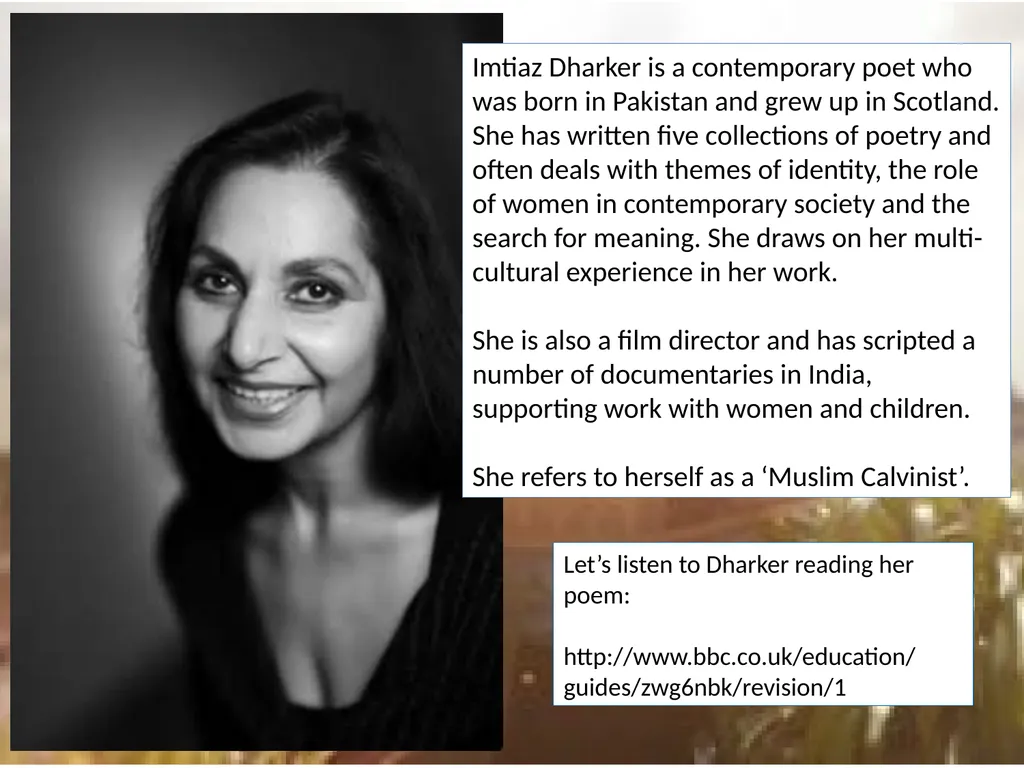
http://www.bbc.co.uk/education/guides/zwg6nbk/revision/1 Imtiaz Dharker is a contemporary poet who was born in Pakistan and grew up in Scotland. She has written five collections of poetry and often deals with themes of identity, the role of women in contemporary society and the search for meaning. She draws on her multi-cultural experience in her work.
She is also a film director and has scripted a number of documentaries in India, supporting work with women and children.
She refers to herself as a ‘Muslim Calvinist’.<br>
03
Tissue
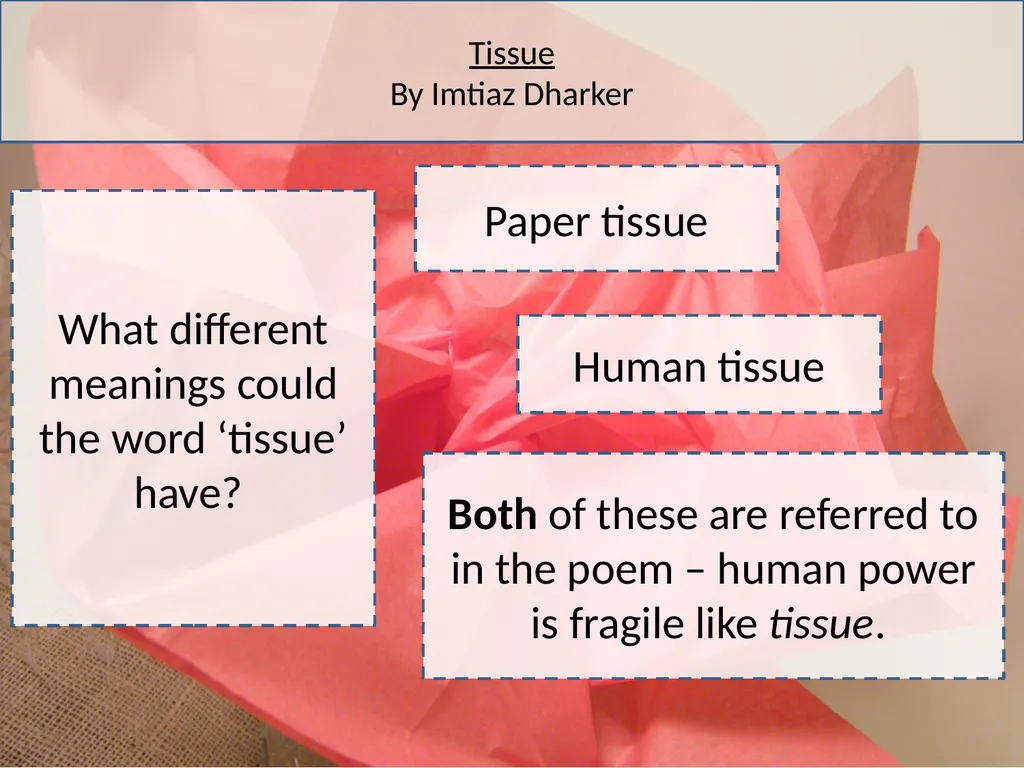
By Imtiaz Dharker What different meanings could the word ‘tissue’ have? Paper tissue Human tissue Both of these are referred to in the poem – human power is fragile like tissue.<br>
04
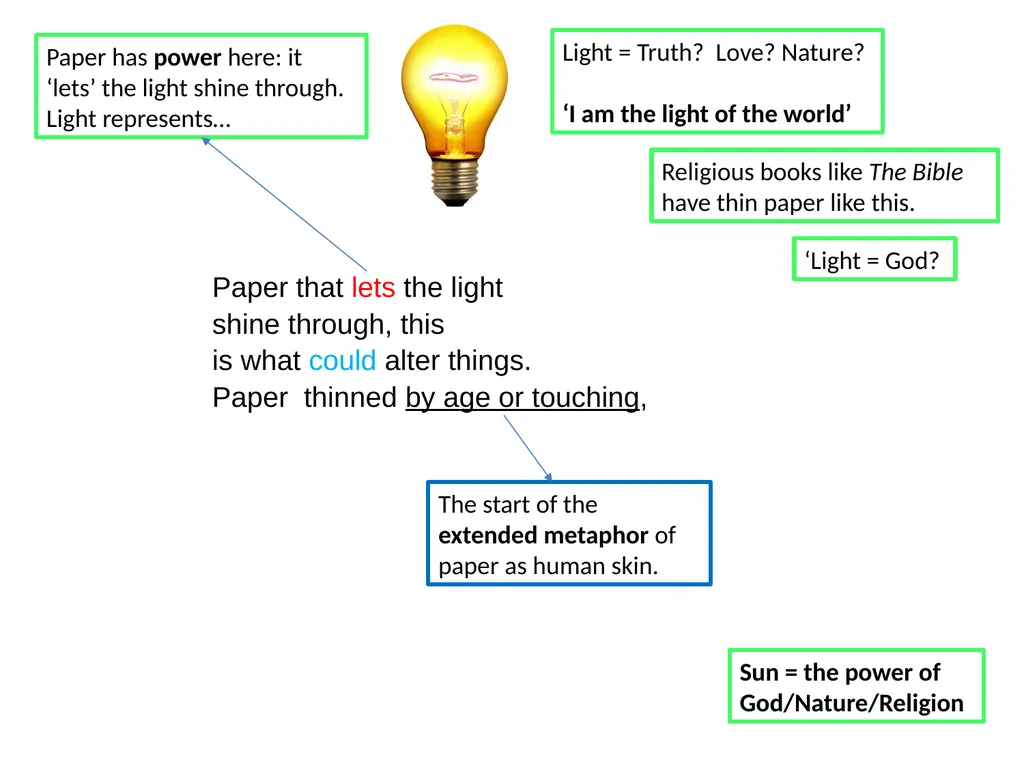
Paper that lets the light shine through, this is what could alter things. Paper thinned by age or touching, Paper has power here: it ‘lets’ the light shine through. Light represents… The start of the extended metaphor of paper as human skin. Light = Truth? Love? Nature?
‘I am the light of the world’ Religious books like The Bible have thin paper like this. ‘Light = God? Sun = the power of God/Nature/Religion<br>
05
the kind you find in well-used books, the back of the Koran, where a hand has written in the names and histories, who was born to whom, Islamic religious text: concepts and morals. How is the Koran powerful? ‘a hand’ = humankind
The Koran is here only a place to record personal history. The height and weight, who died where and how, on which sepia date, pages smoothed and stroked and turned
transparent with attention. Link to light: ‘Allah is the light of the heavens and the earth’ Enjambment: this completes the idea started in Stanza 1. Why is the paper ‘smoothed and stroked’? What do these sibilant verbs suggest about the power they hold? If we follow the extended metaphor of paper as human skin, this suggests that we become more open and honest with age and affection. See-through
Honest and open Humankind rejects the power of God in favour of its own history<br>
06
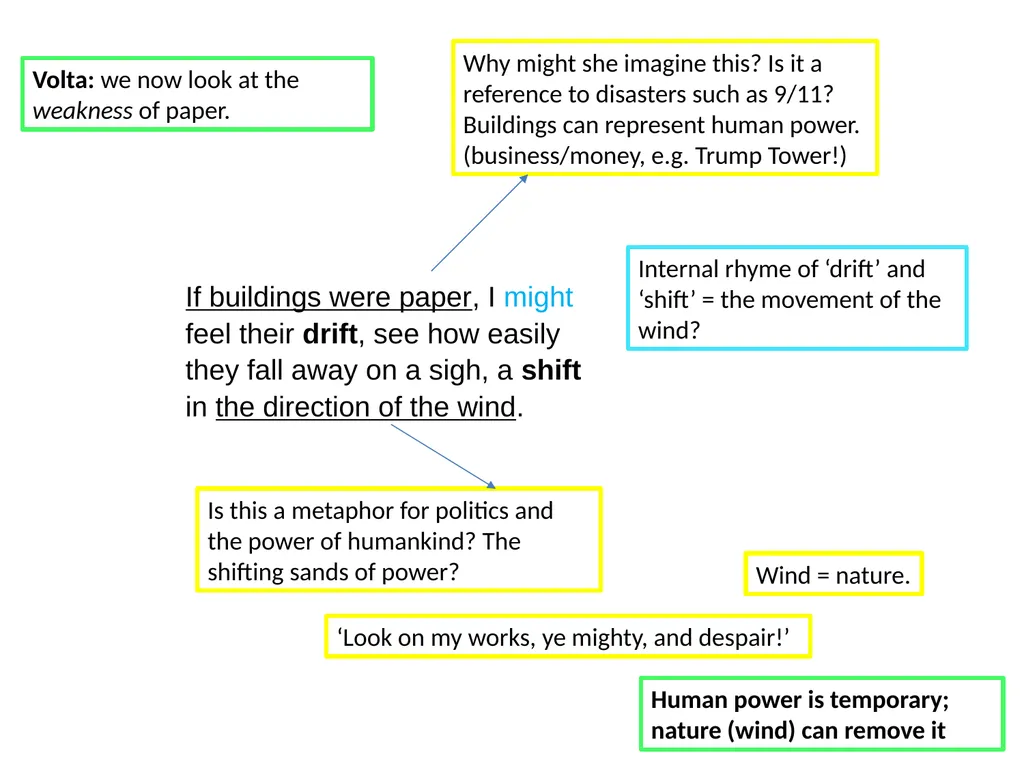
If buildings were paper, I might feel their drift, see how easily they fall away on a sigh, a shift in the direction of the wind. Why might she imagine this? Is it a reference to disasters such as 9/11? Buildings can represent human power. (business/money, e.g. Trump Tower!) Volta: we now look at the weakness of paper. Internal rhyme of ‘drift’ and ‘shift’ = the movement of the wind? Is this a metaphor for politics and the power of humankind? The shifting sands of power? ‘Look on my works, ye mighty, and despair!’ Human power is temporary; nature (wind) can remove it Wind = nature.<br>
07
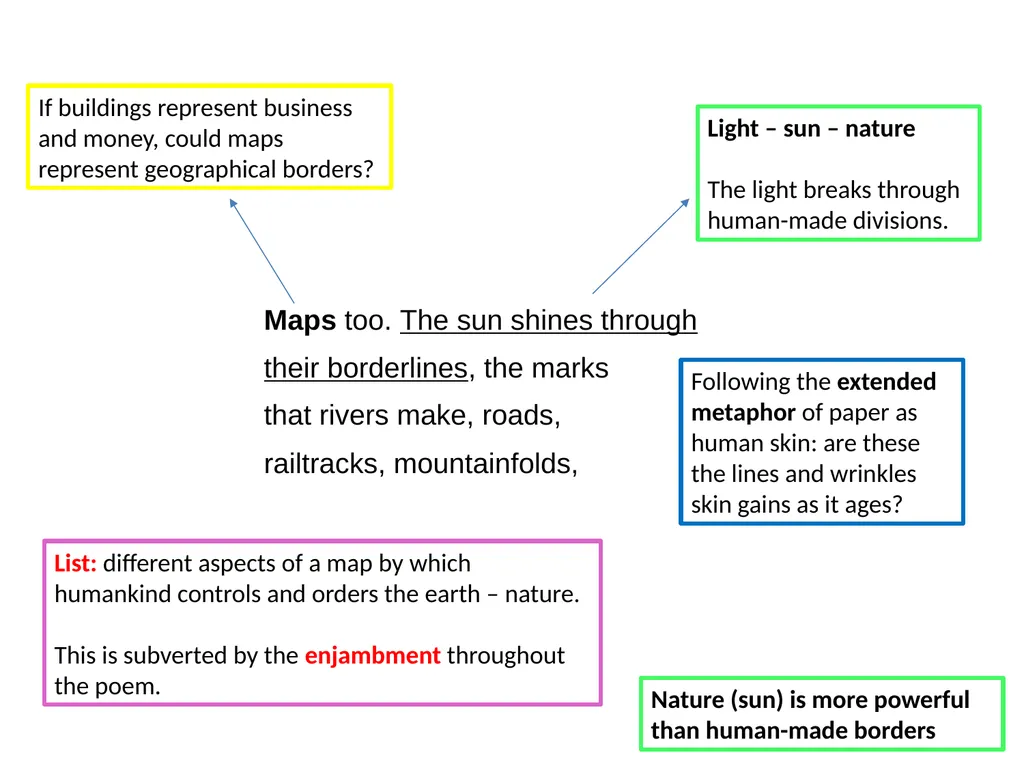
Maps too. The sun shines through
their borderlines, the marks
that rivers make, roads,
railtracks, mountainfolds, If buildings represent business and money, could maps represent geographical borders? Light – sun – nature
The light breaks through human-made divisions. List: different aspects of a map by which humankind controls and orders the earth – nature.
This is subverted by the enjambment throughout the poem. Nature (sun) is more powerful than human-made borders Following the extended metaphor of paper as human skin: are these the lines and wrinkles skin gains as it ages?<br>
08
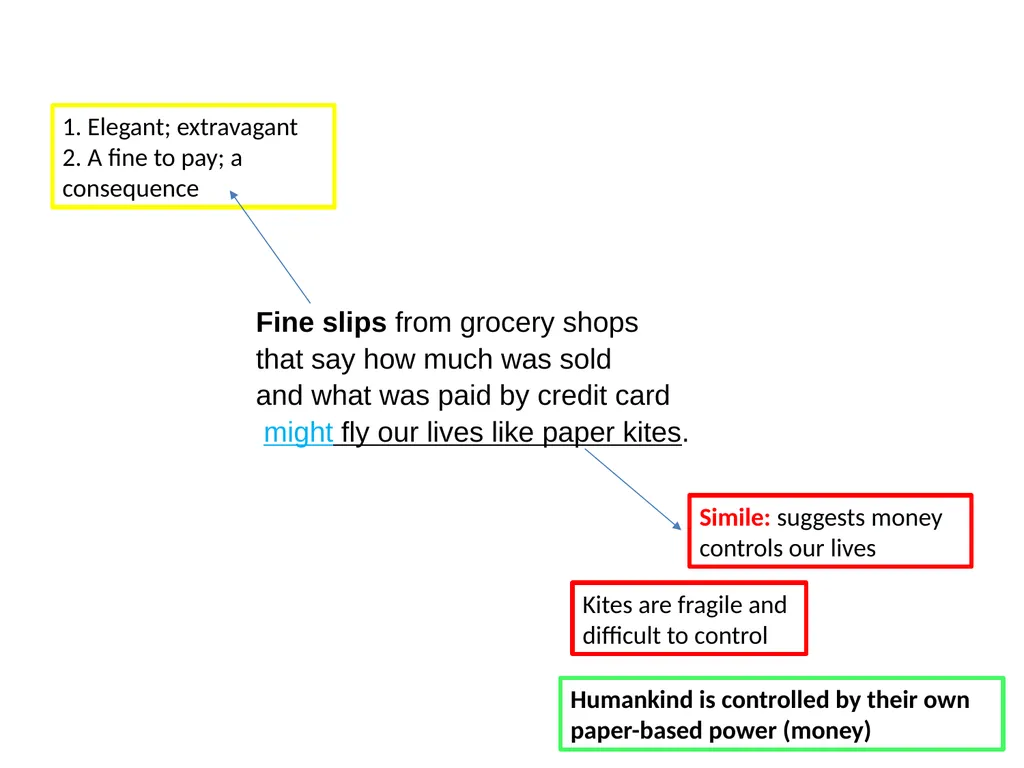
Fine slips from grocery shops that say how much was sold and what was paid by credit card might fly our lives like paper kites. 1. Elegant; extravagant
2. A fine to pay; a consequence Simile: suggests money controls our lives Humankind is controlled by their own paper-based power (money) Kites are fragile and difficult to control<br>
09
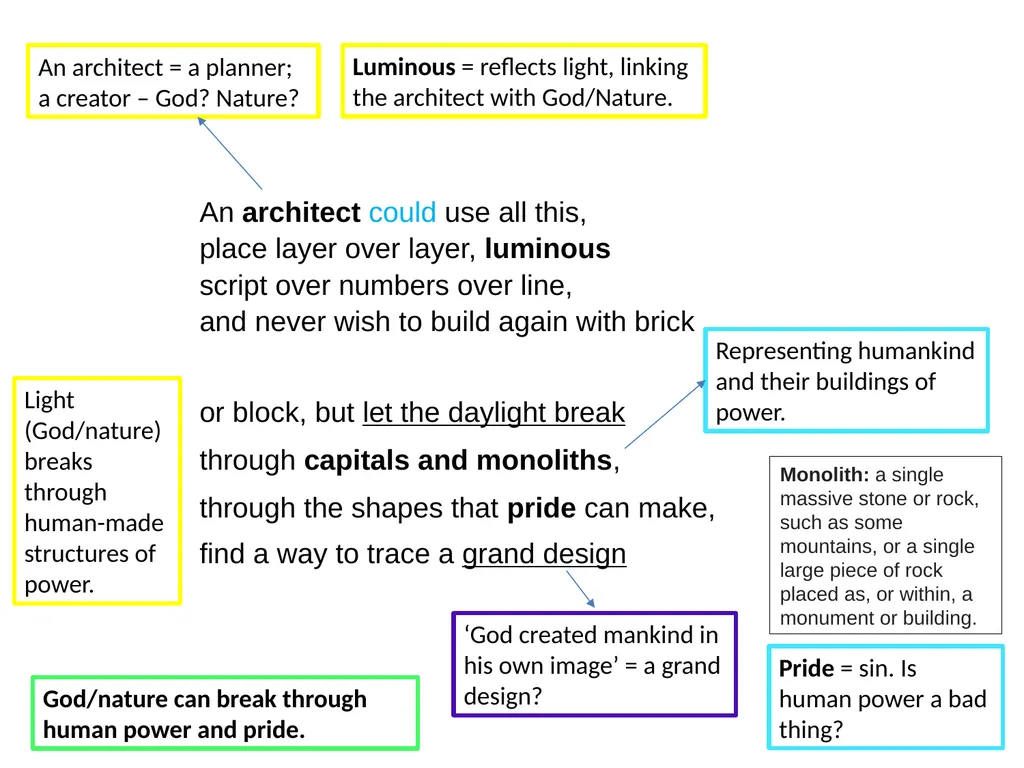
An architect could use all this, place layer over layer, luminous script over numbers over line, and never wish to build again with brick An architect = a planner; a creator – God? Nature? Representing humankind and their buildings of power. ‘God created mankind in his own image’ = a grand design? Luminous = reflects light, linking the architect with God/Nature. or block, but let the daylight break
through capitals and monoliths,
through the shapes that pride can make,
find a way to trace a grand design Monolith: a single massive stone or rock, such as some mountains, or a single large piece of rock placed as, or within, a monument or building. Light (God/nature) breaks through human-made structures of power. God/nature can break through human power and pride. Pride = sin. Is human power a bad thing?<br>
10
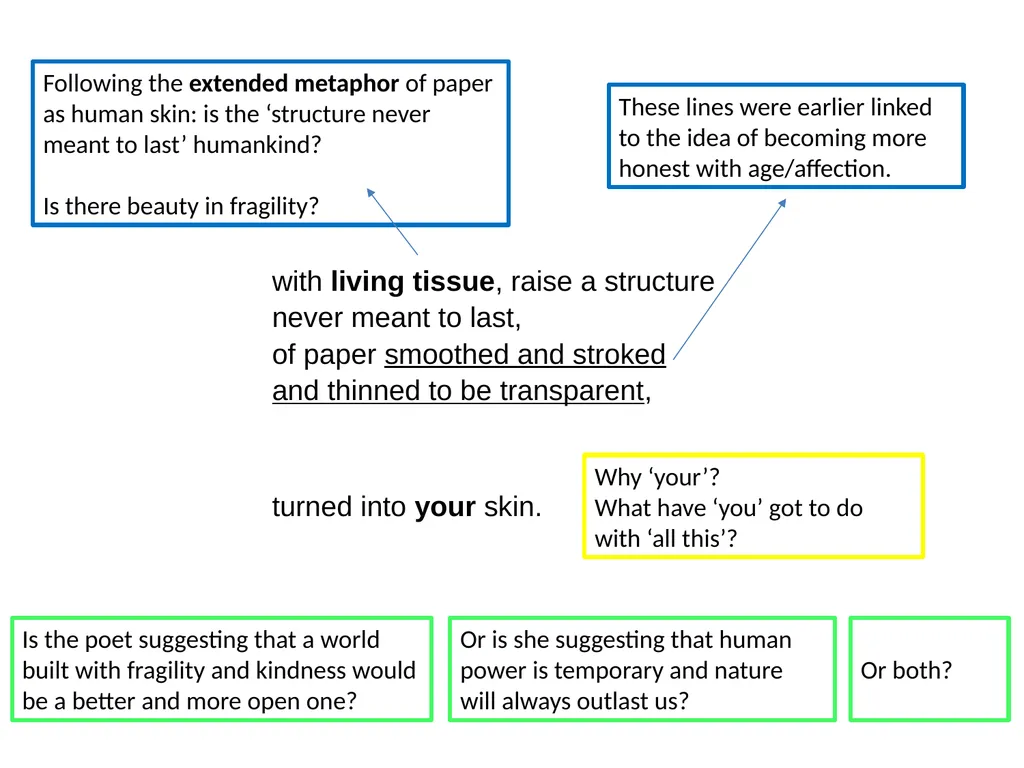
with living tissue, raise a structure never meant to last, of paper smoothed and stroked and thinned to be transparent,
turned into your skin. Following the extended metaphor of paper as human skin: is the ‘structure never meant to last’ humankind?
Is there beauty in fragility? These lines were earlier linked to the idea of becoming more honest with age/affection. Is the poet suggesting that a world built with fragility and kindness would be a better and more open one? Or is she suggesting that human power is temporary and nature will always outlast us? Why ‘your’?
What have ‘you’ got to do with ‘all this’? Or both?<br>
11
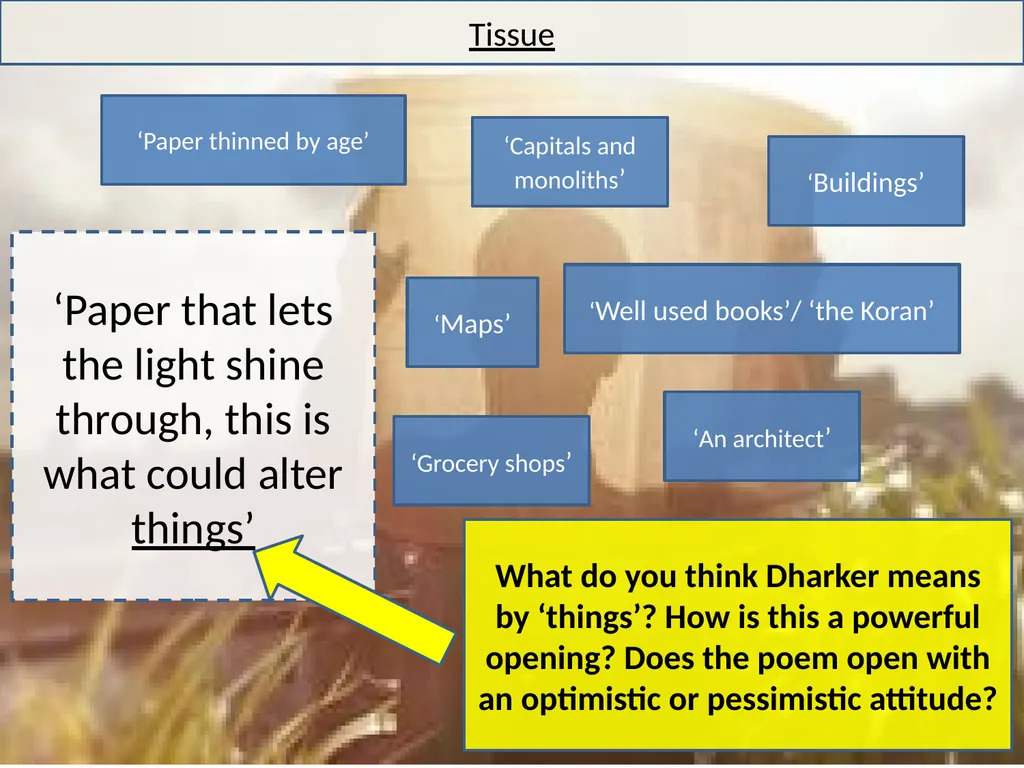
‘Paper that lets the light shine through, this is what could alter things’ ‘Well used books’/ ‘the Koran’ ‘Paper thinned by age’ ‘Buildings’ ‘Maps’ ‘Grocery shops’ ‘An architect’ What do you think Dharker means by ‘things’? How is this a powerful opening? Does the poem open with an optimistic or pessimistic attitude? Tissue ‘Capitals and monoliths’<br>
12
The speaker in this poem uses tissue paper as an extended metaphor for life. She considers how paper can 'alter things' and refers to the soft thin paper of religious books, in particular the Qur'an. There are also real life references to other lasting uses we have for paper in our lives such as maps, receipts and architect drawings. Each of these items is connected to important aspects of life: journeys, money and home. These examples demonstrate how important but also how fragile paper is.
In the final stages of the poem, the poet links the idea of a building being made from paper to human skin, using the words 'living tissue' and then 'your skin'. This is quite a complex idea, and the meaning is open to interpretation. She may be suggesting that the significance of human life will outlast the records we make of it on paper or in buildings. There is also a sense of the fragility of human life, and the fact that not everything can last. GCSE Bitesize:<br>
13
‘Treat the earth well: it was not given to you by your parents, it was loaned to you by your children. We do not inherit the Earth from our ancestors, we borrow it from our Children What does this quote mean?
How does this link with the main meaning/ message of this poem? Tissue<br>