Tool Summary Sheet Note: This hidden slide will
Description: Tool Summary Sheet Note: This hidden slide will not show in a slide presentation. Remove before providing slide deck to sites. 1 Introduction to Site-Level Quality Management for NIMH-Sponsored Studies Clinical Research Education, Support,
Related Topics
Download Presentation
"Tool Summary Sheet Note: This hidden slide will" is the property of its rightful owner. Permission is granted to download and print the materials on this website for personal, non-commercial use only, and to display it on your personal computer provided you do not modify the materials and that you retain all copyright notices contained in the materials. By downloading content from our website, you accept the terms of this agreement.
Presentation Transcript
slide1. Tool Summary Sheet Note: This hidden slide will not show in a slide presentation. Remove before providing slide deck to sites. 1<br>
slide2. Introduction to Site-Level Quality Management for NIMH-Sponsored Studies Clinical Research Education, Support, and Training Program
(CREST) Office of Clinical Research (OCR)
Clinical Trials Operations Branch (CTOB)<br>
slide3. Objectives and Overview To define and describe quality management (QM) as it relates to site-level documentation, processes, and activities
To describe tools that are available to support site-level QM 3<br>
slide4. Quality Management (QM) Definition and Levels of Involvement The sponsor/Investigator should implement a system to manage quality throughout all stages of the trial process (ICH-E6 GCP 5.0.)
The overall process of establishing and ensuring the quality of processes, data, and documentation associated with clinical research activities
QM occurs at multiple levels of the clinical research process: sponsor, external clinical monitoring, study, and individual site levels 4<br>
slide5. Objectives of Quality Management When QM activities are implemented, a standard of data integrity and proper study conduct is established
QM includes BOTH processes aimed at prevention of errors as well as those associated with detection and correction of errors
Proactive prevention of errors means less time and resources are required to correct errors downstream 5<br>
slide6. Objectives of Quality Management Continued Ensuring sufficient quality management activities exist and are being properly executed is even more important than the classification of those efforts
Studies need an overall quality management strategy that includes written procedures, ongoing verification of documentation, and additional review of compliance with written procedures/guidelines/ regulations 6<br>
slide7. Most Common Source of Errors at any Stage of Clinical Research Insufficient written procedures
Written procedures not followed
Training not done or incomplete
Lack of ongoing checks to assess errors
Individual roles and responsibilities are unclear or undefined
Quality Management plans focus on these aspects of research to ensure quality 7<br>
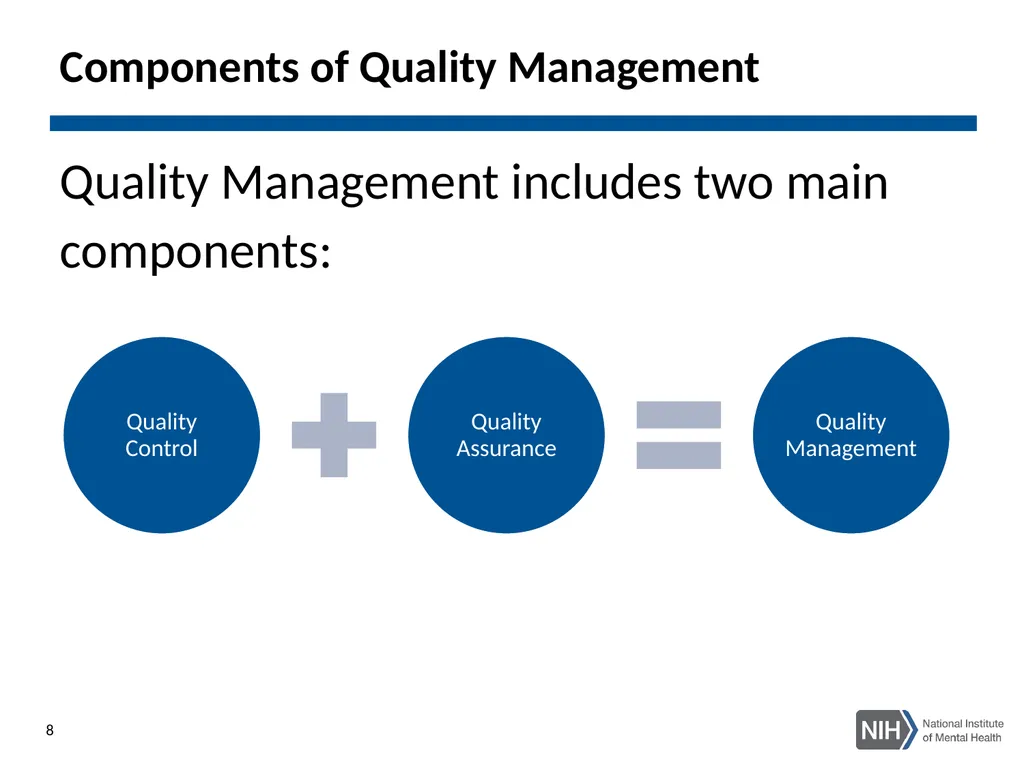
slide8. Components of Quality Management Quality Management includes two main
components: 8<br>
slide9. Quality Assurance and Quality Control The sponsor is responsible for implementing and maintaining quality assurance and quality control systems with written Standard Operating Procedures (SOPs) to ensure that trials are conducted and data are generated, documented (recorded), and reported in compliance with the protocol, GCP, and the applicable regulatory requirement(s) (ICH-E6 GCP 5.1.) 9<br>
slide10. Quality Assurance (QA) Definition Quality Assurance
All those planned and systematic actions that are established to ensure that the trial is performed, and the data are generated, documented (recorded), and reported in compliance with GCP and the applicable regulatory requirement(s)
This includes the generation of procedural documents to guide quality activities and the review of documentation to assess adherence to written procedures, policies, and regulations 10<br>
slide11. QA Examples Relevant site staff activities would include, but not be limited to:
Creation of written Standard Operating Procedures (SOPs)/ Manual of Procedures (MoP) describing step-by-step activities associated with a particular aspect of protocol execution
Review of completed or partially completed checklists of QC activities to confirm that an established quality process is being followed
Review training logs to ensure that sufficient and relevant training has been appropriately completed and documented 11<br>
slide12. Quality Control (QC) Definition Quality Control
The operational techniques and activities undertaken within the quality assurance system to verify that the requirements for quality of the trial-related activities have been fulfilled
It is the ongoing review of data collection forms and other records for completeness and logic 12<br>
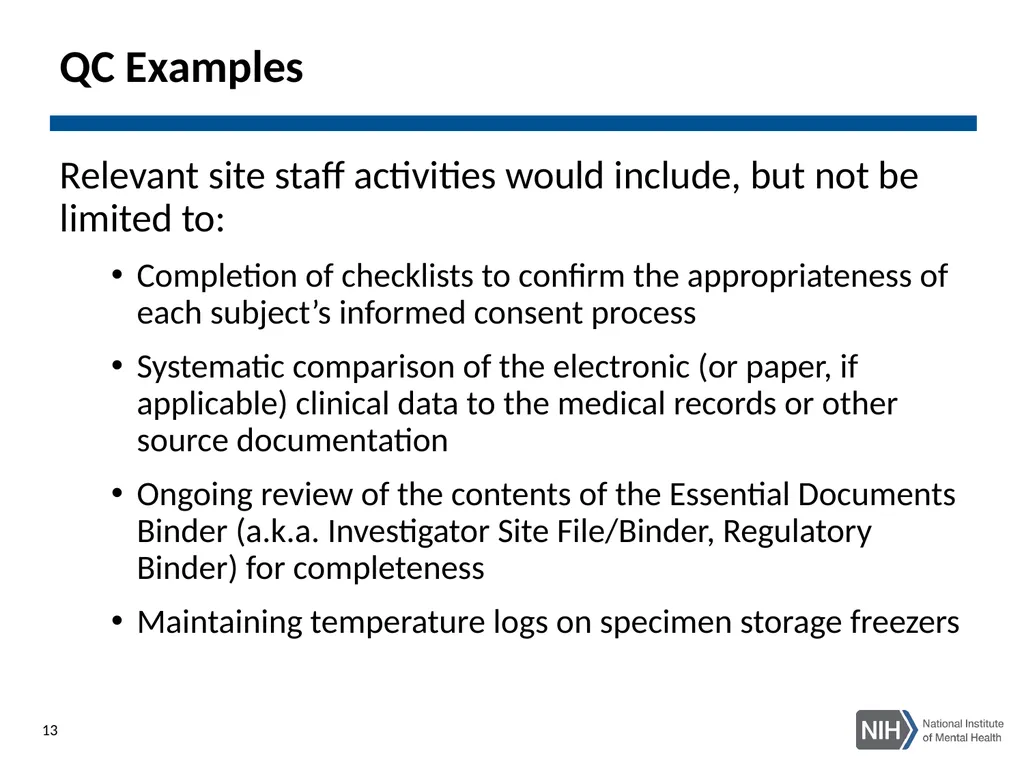
slide13. QC Examples Relevant site staff activities would include, but not be limited to:
Completion of checklists to confirm the appropriateness of each subject’s informed consent process
Systematic comparison of the electronic (or paper, if applicable) clinical data to the medical records or other source documentation
Ongoing review of the contents of the Essential Documents Binder (a.k.a. Investigator Site File/Binder, Regulatory Binder) for completeness
Maintaining temperature logs on specimen storage freezers 13<br>
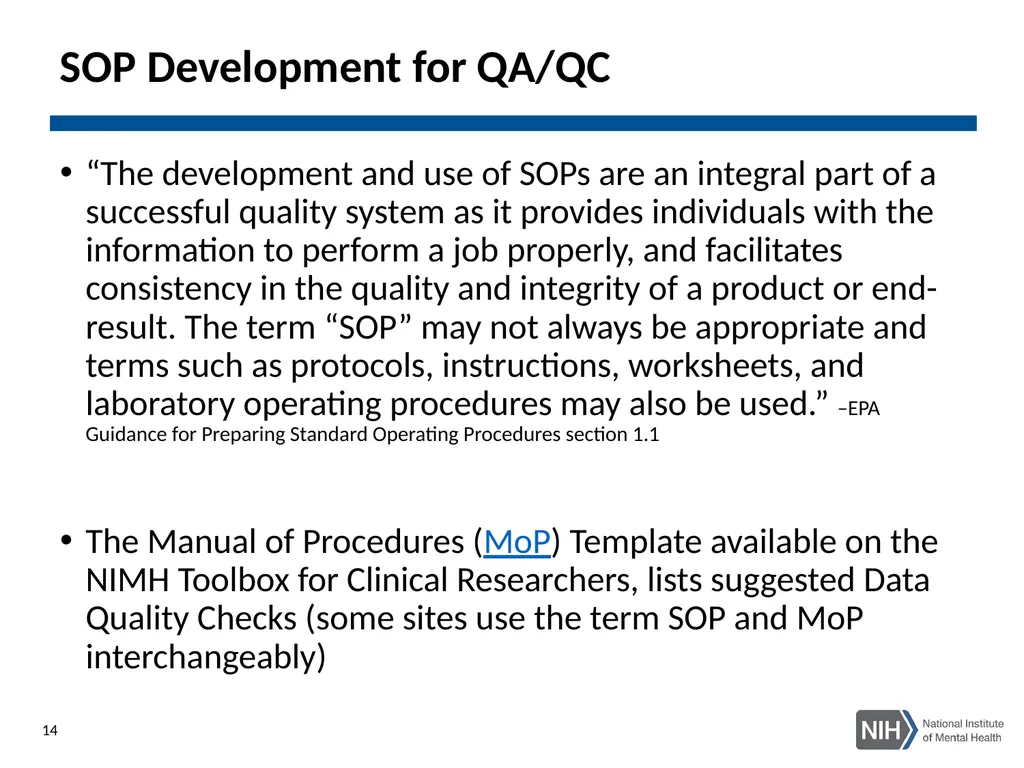
slide14. SOP Development for QA/QC “The development and use of SOPs are an integral part of a successful quality system as it provides individuals with the information to perform a job properly, and facilitates consistency in the quality and integrity of a product or end-result. The term “SOP” may not always be appropriate and terms such as protocols, instructions, worksheets, and laboratory operating procedures may also be used.” –EPA Guidance for Preparing Standard Operating Procedures section 1.1
The Manual of Procedures (MoP) Template available on the NIMH Toolbox for Clinical Researchers, lists suggested Data Quality Checks (some sites use the term SOP and MoP interchangeably) 14<br>
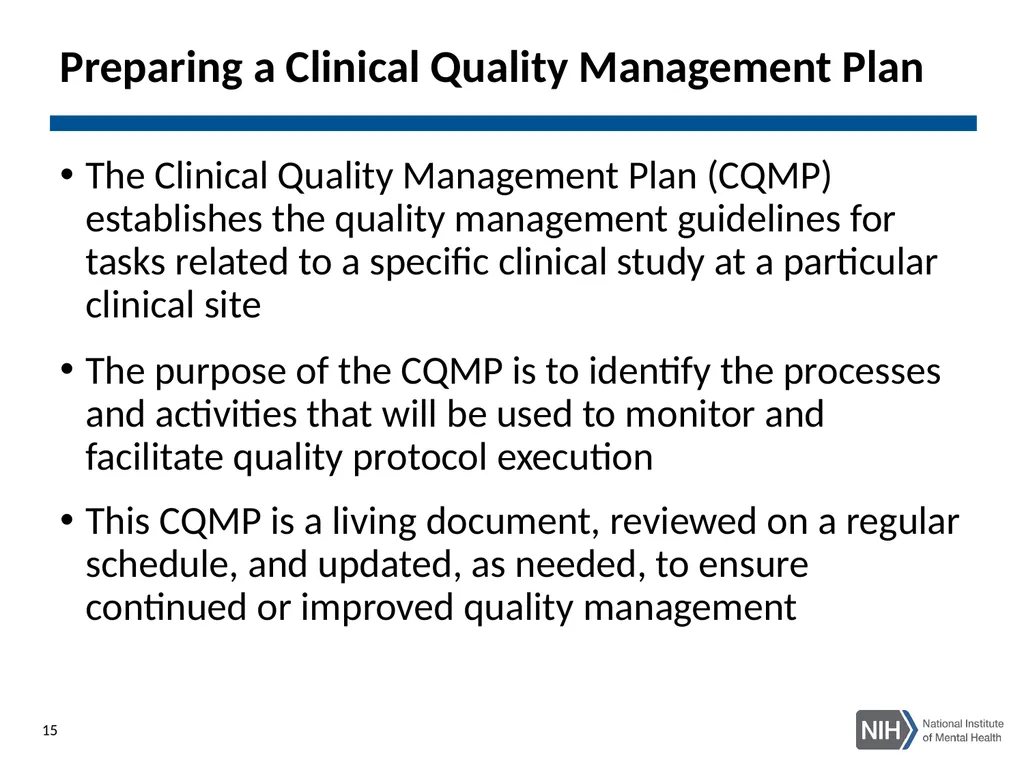
slide15. Preparing a Clinical Quality Management Plan The Clinical Quality Management Plan (CQMP) establishes the quality management guidelines for tasks related to a specific clinical study at a particular clinical site
The purpose of the CQMP is to identify the processes and activities that will be used to monitor and facilitate quality protocol execution
This CQMP is a living document, reviewed on a regular schedule, and updated, as needed, to ensure continued or improved quality management 15<br>
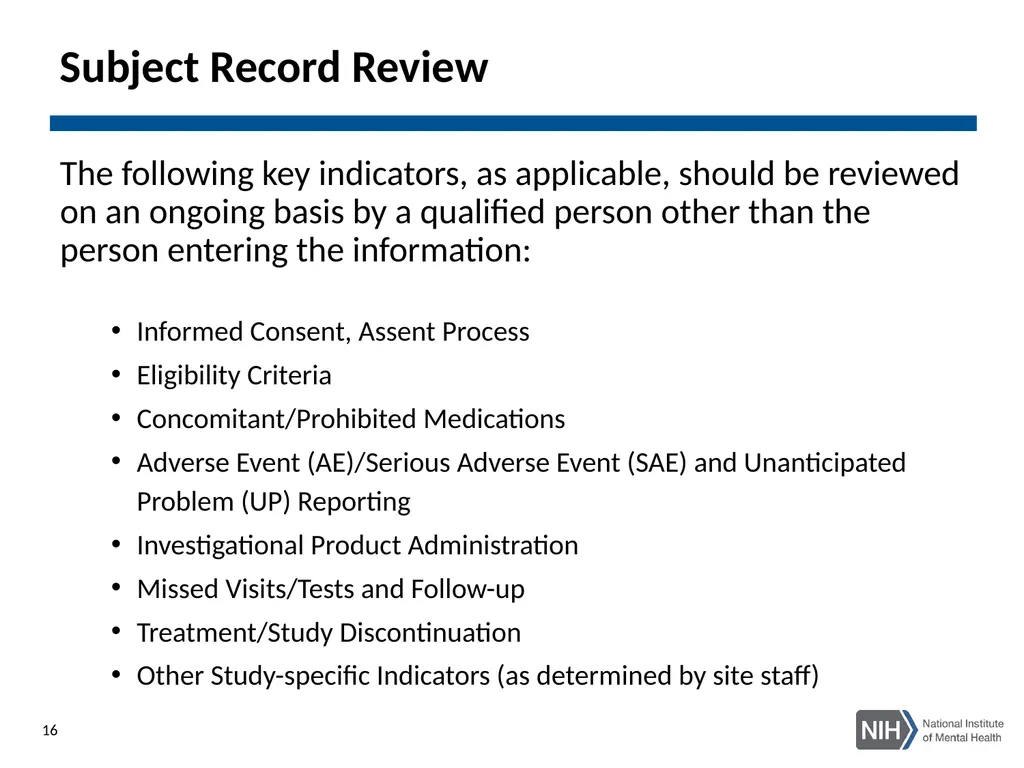
slide16. Subject Record Review The following key indicators, as applicable, should be reviewed on an ongoing basis by a qualified person other than the person entering the information:
Informed Consent, Assent Process
Eligibility Criteria
Concomitant/Prohibited Medications
Adverse Event (AE)/Serious Adverse Event (SAE) and Unanticipated Problem (UP) Reporting
Investigational Product Administration
Missed Visits/Tests and Follow-up
Treatment/Study Discontinuation
Other Study-specific Indicators (as determined by site staff) 16<br>
slide17. Essential Documents Binder Quality Review The quality review of essential documents should include all documents listed in the International Conference on Harmonisation (ICH) Guidelines for Good Clinical Practice (GCP) E6, Section 8, Essential Documents for the Conduct of a Clinical Trial and any study-specific or sponsor-required document
Quality reviews of regulatory files should be conducted at least annually 17<br>
slide18. Storage of QM Materials All quality management checklists, plans, completed tools, and reports should be stored in a quality management binder, which is maintained separately from the essential documents binder 18<br>
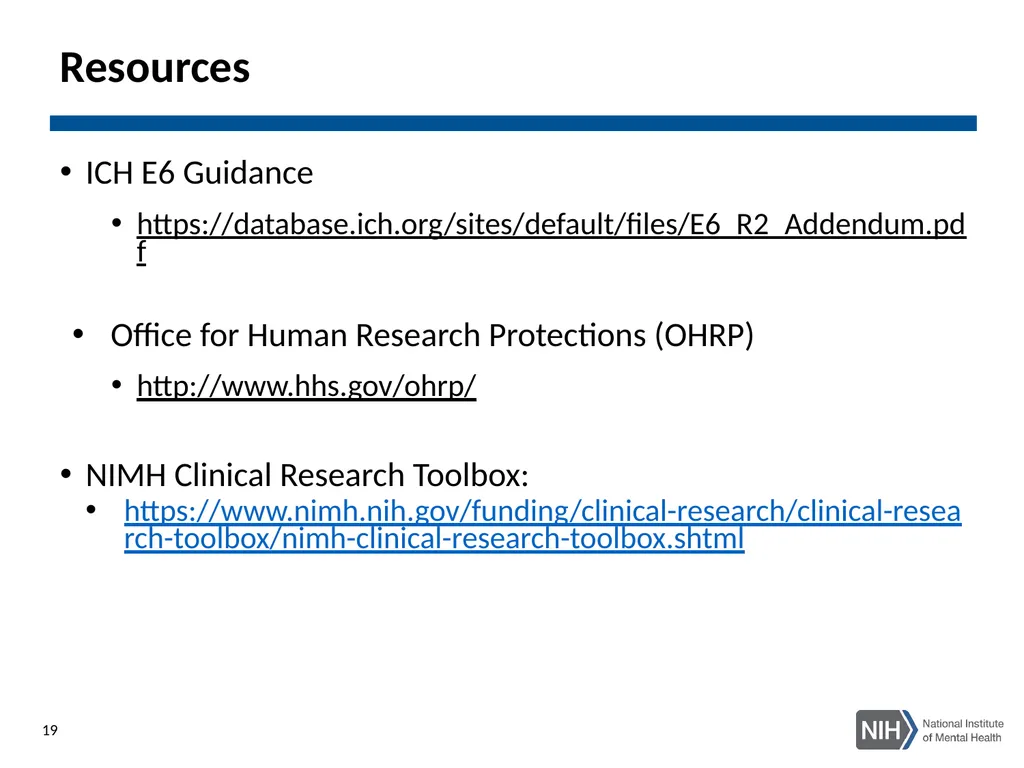
slide19. Resources ICH E6 Guidance
https://database.ich.org/sites/default/files/E6_R2_Addendum.pdf
Office for Human Research Protections (OHRP)
http://www.hhs.gov/ohrp/
NIMH Clinical Research Toolbox:
https://www.nimh.nih.gov/funding/clinical-research/clinical-research-toolbox/nimh-clinical-research-toolbox.shtml 19<br>
slide20. Contact NIMH Office of Clinical Research (OCR)
Clinical Research Education, Support, and Training (CREST) Program
Email: nimhctob_crest@mail.nih.gov 20<br>

slide2. Introduction to Site-Level Quality Management for NIMH-Sponsored Studies Clinical Research Education, Support, and Training Program
(CREST) Office of Clinical Research (OCR)
Clinical Trials Operations Branch (CTOB)<br>
slide3. Objectives and Overview To define and describe quality management (QM) as it relates to site-level documentation, processes, and activities
To describe tools that are available to support site-level QM 3<br>
slide4. Quality Management (QM) Definition and Levels of Involvement The sponsor/Investigator should implement a system to manage quality throughout all stages of the trial process (ICH-E6 GCP 5.0.)
The overall process of establishing and ensuring the quality of processes, data, and documentation associated with clinical research activities
QM occurs at multiple levels of the clinical research process: sponsor, external clinical monitoring, study, and individual site levels 4<br>
slide5. Objectives of Quality Management When QM activities are implemented, a standard of data integrity and proper study conduct is established
QM includes BOTH processes aimed at prevention of errors as well as those associated with detection and correction of errors
Proactive prevention of errors means less time and resources are required to correct errors downstream 5<br>
slide6. Objectives of Quality Management Continued Ensuring sufficient quality management activities exist and are being properly executed is even more important than the classification of those efforts
Studies need an overall quality management strategy that includes written procedures, ongoing verification of documentation, and additional review of compliance with written procedures/guidelines/ regulations 6<br>
slide7. Most Common Source of Errors at any Stage of Clinical Research Insufficient written procedures
Written procedures not followed
Training not done or incomplete
Lack of ongoing checks to assess errors
Individual roles and responsibilities are unclear or undefined
Quality Management plans focus on these aspects of research to ensure quality 7<br>
slide8. Components of Quality Management Quality Management includes two main
components: 8<br>
slide9. Quality Assurance and Quality Control The sponsor is responsible for implementing and maintaining quality assurance and quality control systems with written Standard Operating Procedures (SOPs) to ensure that trials are conducted and data are generated, documented (recorded), and reported in compliance with the protocol, GCP, and the applicable regulatory requirement(s) (ICH-E6 GCP 5.1.) 9<br>
slide10. Quality Assurance (QA) Definition Quality Assurance
All those planned and systematic actions that are established to ensure that the trial is performed, and the data are generated, documented (recorded), and reported in compliance with GCP and the applicable regulatory requirement(s)
This includes the generation of procedural documents to guide quality activities and the review of documentation to assess adherence to written procedures, policies, and regulations 10<br>
slide11. QA Examples Relevant site staff activities would include, but not be limited to:
Creation of written Standard Operating Procedures (SOPs)/ Manual of Procedures (MoP) describing step-by-step activities associated with a particular aspect of protocol execution
Review of completed or partially completed checklists of QC activities to confirm that an established quality process is being followed
Review training logs to ensure that sufficient and relevant training has been appropriately completed and documented 11<br>
slide12. Quality Control (QC) Definition Quality Control
The operational techniques and activities undertaken within the quality assurance system to verify that the requirements for quality of the trial-related activities have been fulfilled
It is the ongoing review of data collection forms and other records for completeness and logic 12<br>
slide13. QC Examples Relevant site staff activities would include, but not be limited to:
Completion of checklists to confirm the appropriateness of each subject’s informed consent process
Systematic comparison of the electronic (or paper, if applicable) clinical data to the medical records or other source documentation
Ongoing review of the contents of the Essential Documents Binder (a.k.a. Investigator Site File/Binder, Regulatory Binder) for completeness
Maintaining temperature logs on specimen storage freezers 13<br>
slide14. SOP Development for QA/QC “The development and use of SOPs are an integral part of a successful quality system as it provides individuals with the information to perform a job properly, and facilitates consistency in the quality and integrity of a product or end-result. The term “SOP” may not always be appropriate and terms such as protocols, instructions, worksheets, and laboratory operating procedures may also be used.” –EPA Guidance for Preparing Standard Operating Procedures section 1.1
The Manual of Procedures (MoP) Template available on the NIMH Toolbox for Clinical Researchers, lists suggested Data Quality Checks (some sites use the term SOP and MoP interchangeably) 14<br>
slide15. Preparing a Clinical Quality Management Plan The Clinical Quality Management Plan (CQMP) establishes the quality management guidelines for tasks related to a specific clinical study at a particular clinical site
The purpose of the CQMP is to identify the processes and activities that will be used to monitor and facilitate quality protocol execution
This CQMP is a living document, reviewed on a regular schedule, and updated, as needed, to ensure continued or improved quality management 15<br>
slide16. Subject Record Review The following key indicators, as applicable, should be reviewed on an ongoing basis by a qualified person other than the person entering the information:
Informed Consent, Assent Process
Eligibility Criteria
Concomitant/Prohibited Medications
Adverse Event (AE)/Serious Adverse Event (SAE) and Unanticipated Problem (UP) Reporting
Investigational Product Administration
Missed Visits/Tests and Follow-up
Treatment/Study Discontinuation
Other Study-specific Indicators (as determined by site staff) 16<br>
slide17. Essential Documents Binder Quality Review The quality review of essential documents should include all documents listed in the International Conference on Harmonisation (ICH) Guidelines for Good Clinical Practice (GCP) E6, Section 8, Essential Documents for the Conduct of a Clinical Trial and any study-specific or sponsor-required document
Quality reviews of regulatory files should be conducted at least annually 17<br>
slide18. Storage of QM Materials All quality management checklists, plans, completed tools, and reports should be stored in a quality management binder, which is maintained separately from the essential documents binder 18<br>
slide19. Resources ICH E6 Guidance
https://database.ich.org/sites/default/files/E6_R2_Addendum.pdf
Office for Human Research Protections (OHRP)
http://www.hhs.gov/ohrp/
NIMH Clinical Research Toolbox:
https://www.nimh.nih.gov/funding/clinical-research/clinical-research-toolbox/nimh-clinical-research-toolbox.shtml 19<br>
slide20. Contact NIMH Office of Clinical Research (OCR)
Clinical Research Education, Support, and Training (CREST) Program
Email: nimhctob_crest@mail.nih.gov 20<br>