
Top-k String Similarity Search with Edit-Distance
JO
Published · 54 slides · 0 views

1 / 1



Description
Top-k String Similarity Search with Edit-Distance Constraints Dong Deng (Tsinghua, Beijing, China) Guoliang Li (Tsinghua, Beijing, China) Jianhua Feng (Tsinghua, Beijing, China) Wen-Syan Li(SAP Labs, Shanghai, China) Outline Motivation
Related Topics
Share
Embed code
Download this presentation From Below
"Top-k String Similarity Search with Edit-Distance" is the property of its rightful owner. Permission is granted to download and print the materials on this website for personal, non-commercial use only, and to display it on your personal computer provided you do not modify the materials and that you retain all copyright notices contained in the materials. By downloading content from our website, you accept the terms of this agreement.
Presentation Transcript
01
Top-k String Similarity Search with Edit-Distance Constraints Dong Deng (Tsinghua, Beijing, China)
Guoliang Li (Tsinghua, Beijing, China)
Jianhua Feng (Tsinghua, Beijing, China)
Wen-Syan Li(SAP Labs, Shanghai, China)<br>
Guoliang Li (Tsinghua, Beijing, China)
Jianhua Feng (Tsinghua, Beijing, China)
Wen-Syan Li(SAP Labs, Shanghai, China)<br>
02
Outline Motivation
Problem Formulation
Progressive Framework
Pivotal Entry-based Method
Range-based Method
Experiment
Conclusion 4/11/2013 TopkSearch @ ICDE2013 2/42<br>
Problem Formulation
Progressive Framework
Pivotal Entry-based Method
Range-based Method
Experiment
Conclusion 4/11/2013 TopkSearch @ ICDE2013 2/42<br>
03
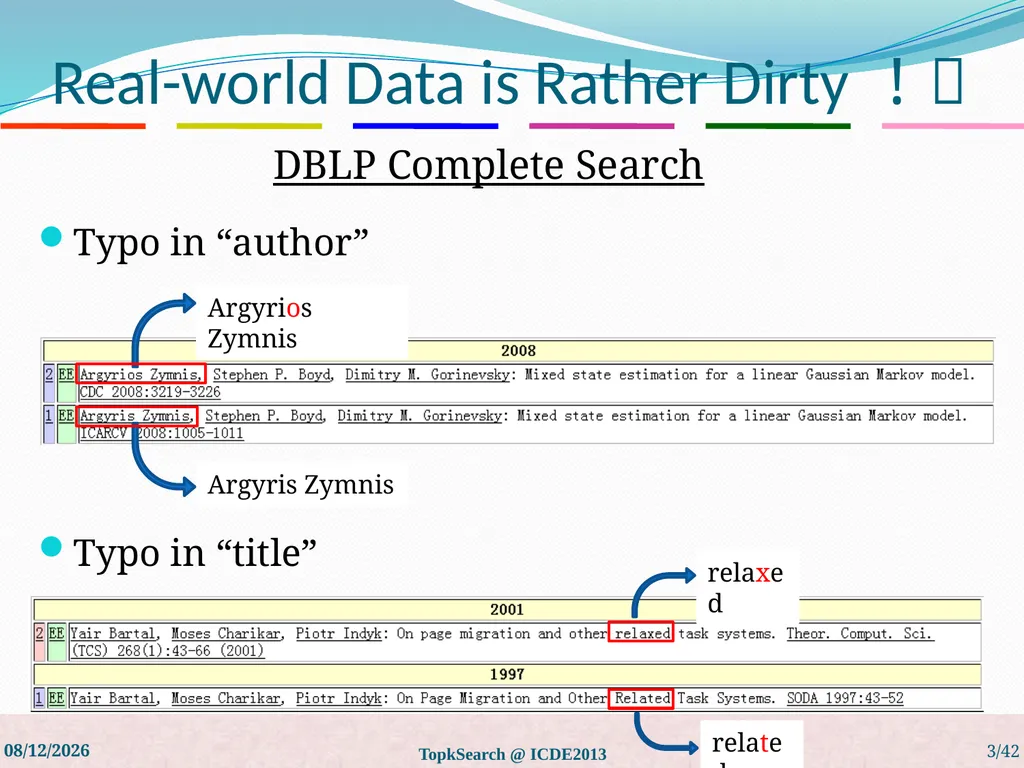
Typo in “author”
Typo in “title” relaxed related Argyrios Zymnis Argyris Zymnis DBLP Complete Search 4/11/2013 Real-world Data is Rather Dirty! TopkSearch @ ICDE2013 3/42<br>
Typo in “title” relaxed related Argyrios Zymnis Argyris Zymnis DBLP Complete Search 4/11/2013 Real-world Data is Rather Dirty! TopkSearch @ ICDE2013 3/42<br>
04
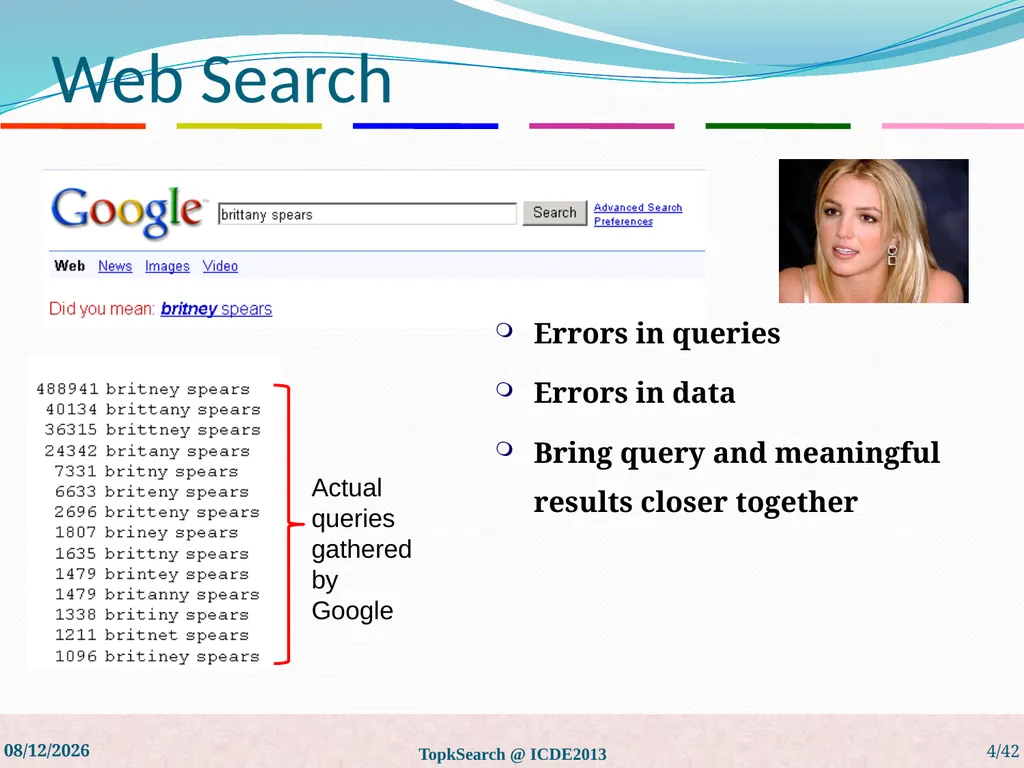
Web Search 4/11/2013 TopkSearch @ ICDE2013 4/42 Errors in queries
Errors in data
Bring query and meaningful results closer together Actual queries gathered by Google<br>
Errors in data
Bring query and meaningful results closer together Actual queries gathered by Google<br>
05
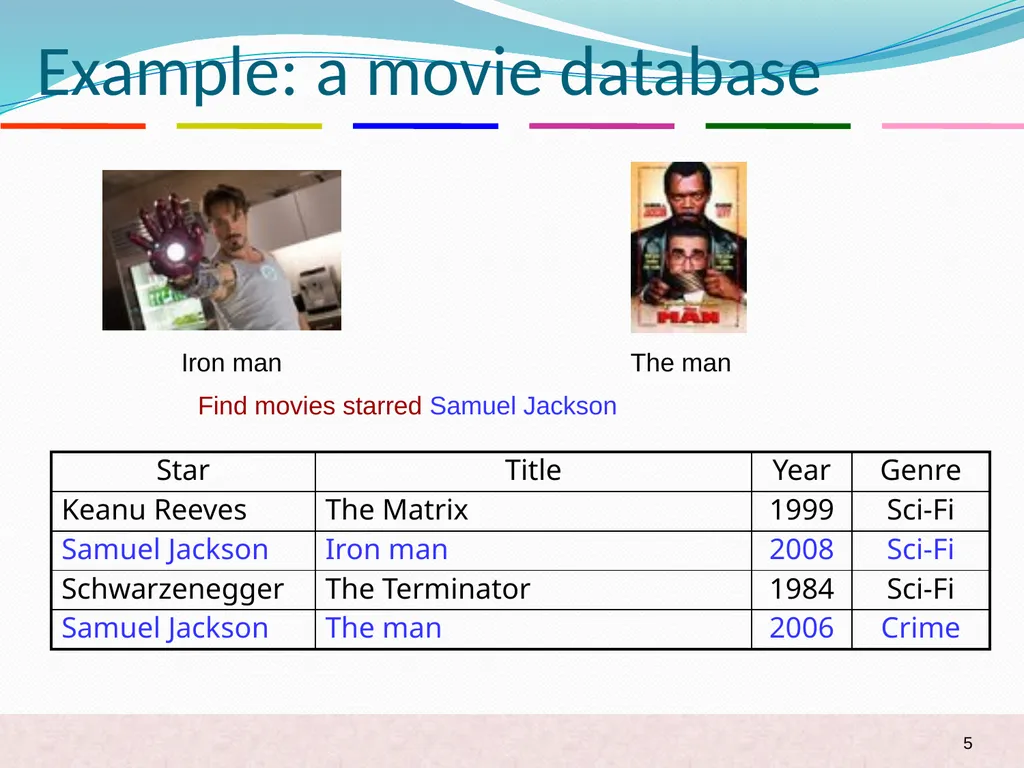
5 Example: a movie database Find movies starred Samuel Jackson Iron man The man<br>
06
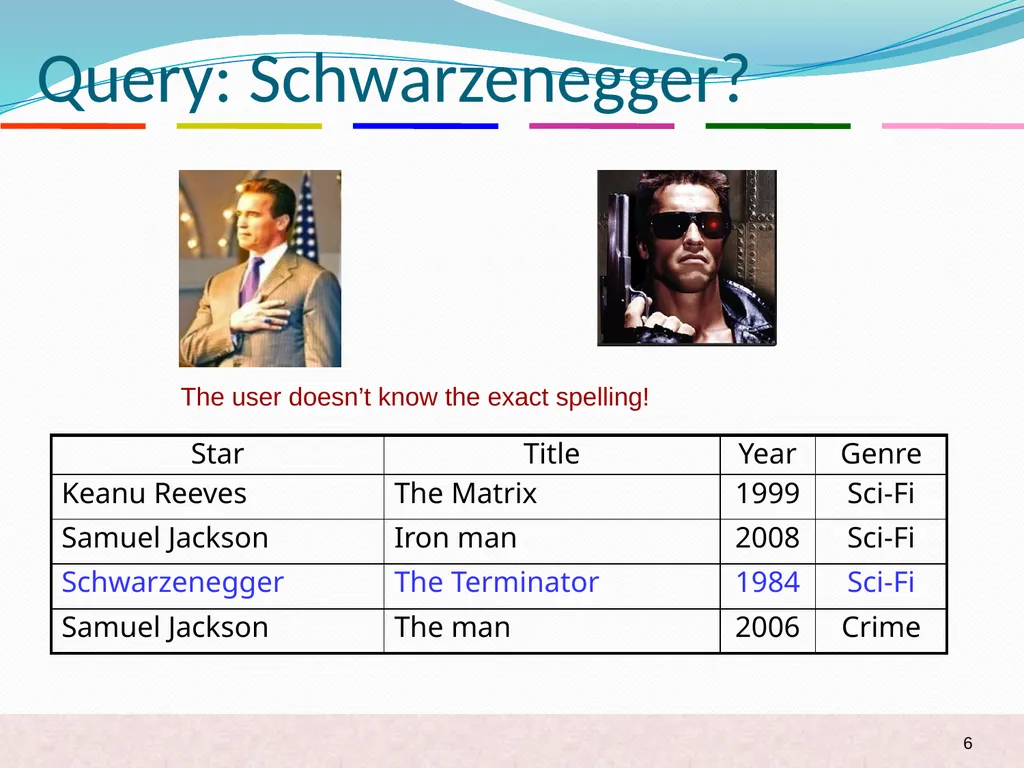
6 Query: Schwarzenegger? The user doesn’t know the exact spelling!<br>
07
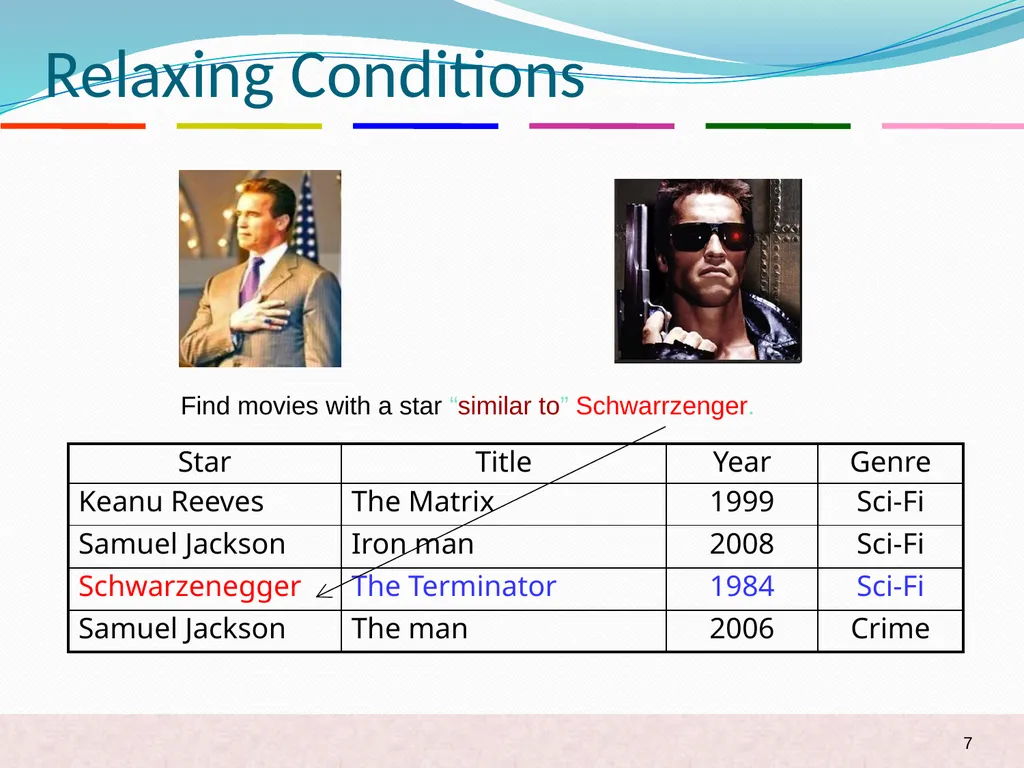
7 Relaxing Conditions Find movies with a star “similar to” Schwarrzenger.<br>
08
String Similarity Search finds all entries from the dictionary that approximately match the query.
Applications:
Biology, Bioinformatics
Information Retrieve
Data Quality, Data Cleaning
…. String Similarity Search 4/11/2013 TopkSearch @ ICDE2013 8/42<br>
Applications:
Biology, Bioinformatics
Information Retrieve
Data Quality, Data Cleaning
…. String Similarity Search 4/11/2013 TopkSearch @ ICDE2013 8/42<br>
09
Outline Motivation
Problem Formulation
Progressive Framework
Pivotal Entry-based Method
Range-based Method
Experiment
Conclusion 4/11/2013 TopkSearch @ ICDE2013 9/42<br>
Problem Formulation
Progressive Framework
Pivotal Entry-based Method
Range-based Method
Experiment
Conclusion 4/11/2013 TopkSearch @ ICDE2013 9/42<br>
10
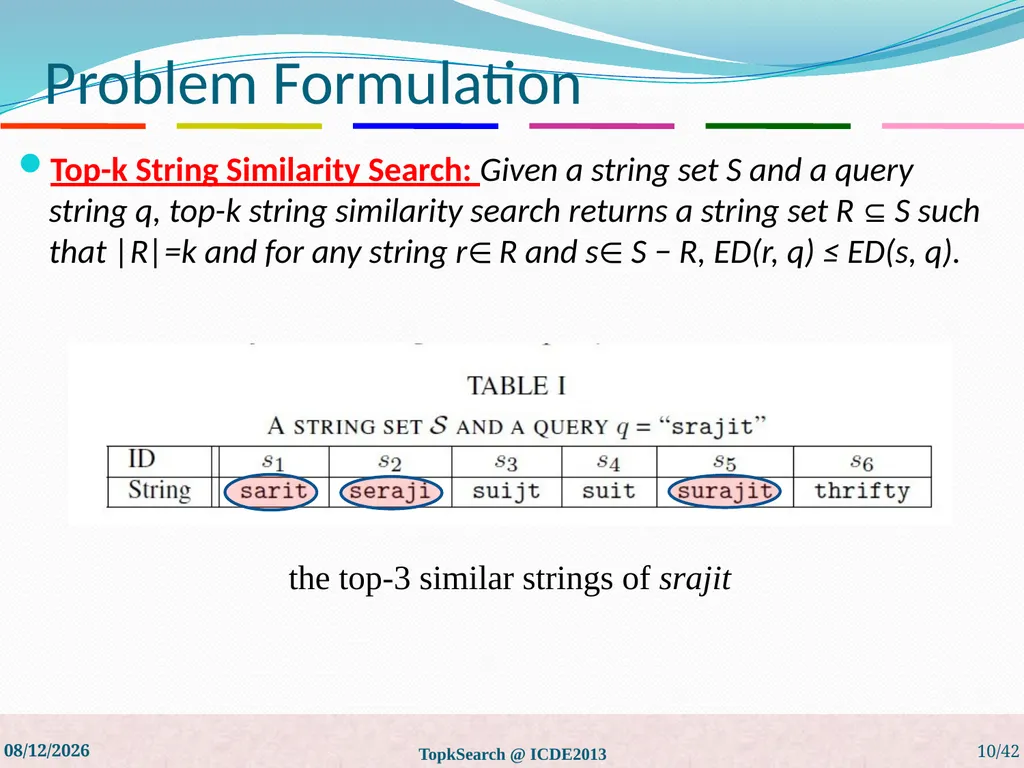
Problem Formulation 4/11/2013 TopkSearch @ ICDE2013 Top-k String Similarity Search: Given a string set S and a query string q, top-k string similarity search returns a string set R ⊆ S such that |R|=k and for any string r∈ R and s∈ S − R, ED(r, q) ≤ ED(s, q). 10/42 the top-3 similar strings of srajit<br>
11
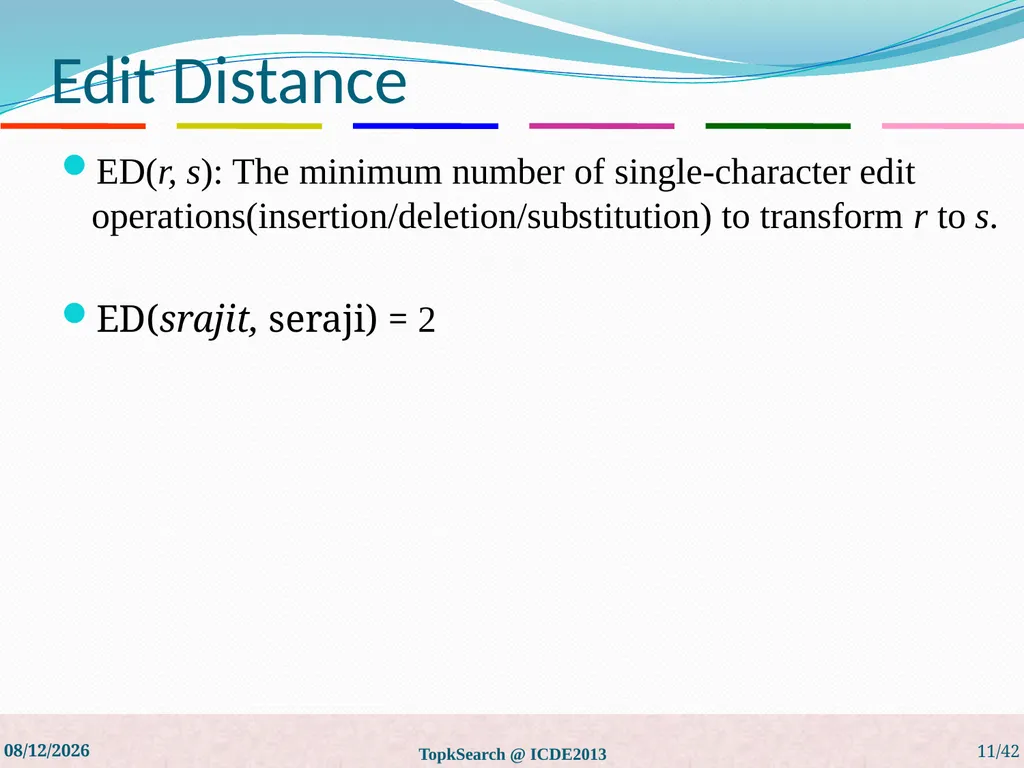
ED(r, s): The minimum number of single-character edit operations(insertion/deletion/substitution) to transform r to s.
ED(srajit, seraji) = 2 Edit Distance 4/11/2013 TopkSearch @ ICDE2013 11/42<br>
ED(srajit, seraji) = 2 Edit Distance 4/11/2013 TopkSearch @ ICDE2013 11/42<br>
12
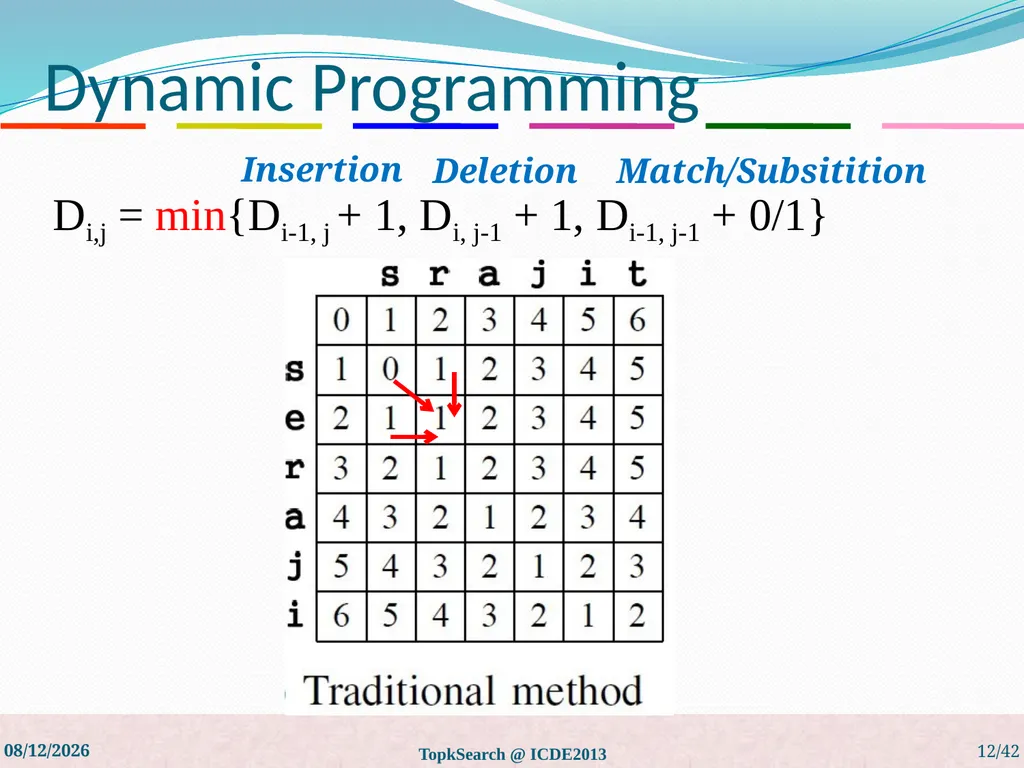
Dynamic Programming 4/11/2013 TopkSearch @ ICDE2013 12/42 Di,j = min{Di-1, j + 1, Di, j-1 + 1, Di-1, j-1 + 0/1} Insertion Deletion Match/Subsitition<br>
13
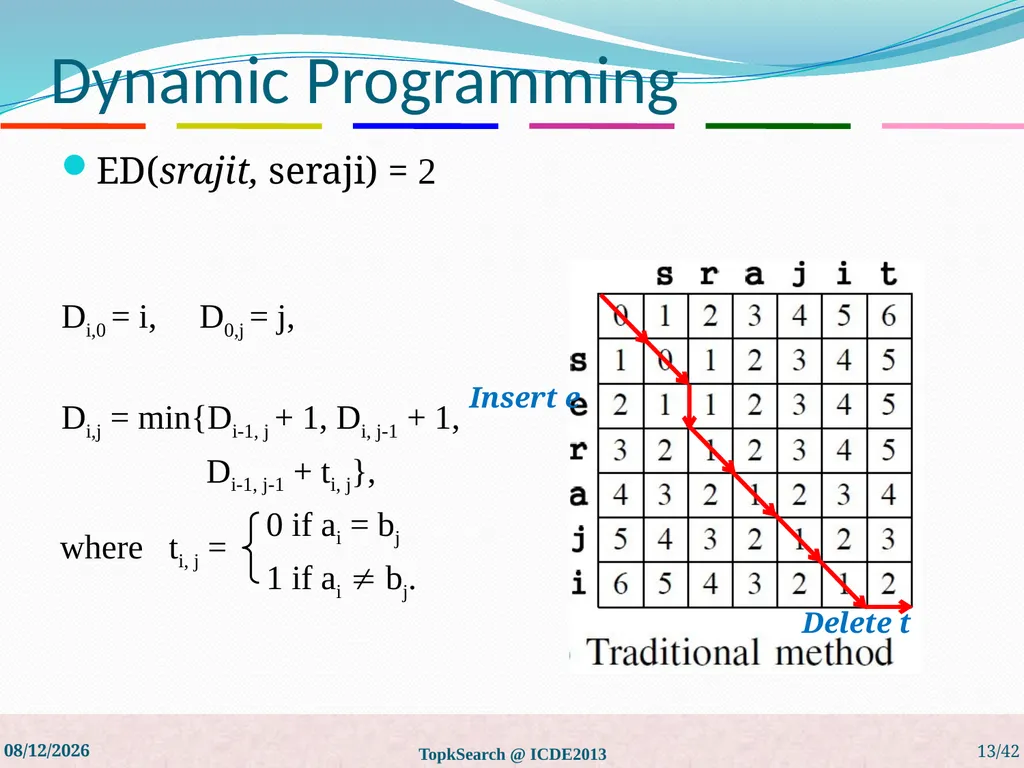
ED(srajit, seraji) = 2
Di,0 = i, D0,j = j,
Di,j = min{Di-1, j + 1, Di, j-1 + 1,
Di-1, j-1 + ti, j},
0 if ai = bj
1 if ai bj. Dynamic Programming 4/11/2013 TopkSearch @ ICDE2013 13/42 where ti, j = Insert e Delete t<br>
Di,0 = i, D0,j = j,
Di,j = min{Di-1, j + 1, Di, j-1 + 1,
Di-1, j-1 + ti, j},
0 if ai = bj
1 if ai bj. Dynamic Programming 4/11/2013 TopkSearch @ ICDE2013 13/42 where ti, j = Insert e Delete t<br>
14
Outline Motivation
Problem Formulation
Progressive Framework
Pivotal Entry-based Method
Range-based Method
Experiment
Conclusion 4/11/2013 TopkSearch @ ICDE2013 14/42<br>
Problem Formulation
Progressive Framework
Pivotal Entry-based Method
Range-based Method
Experiment
Conclusion 4/11/2013 TopkSearch @ ICDE2013 14/42<br>
15
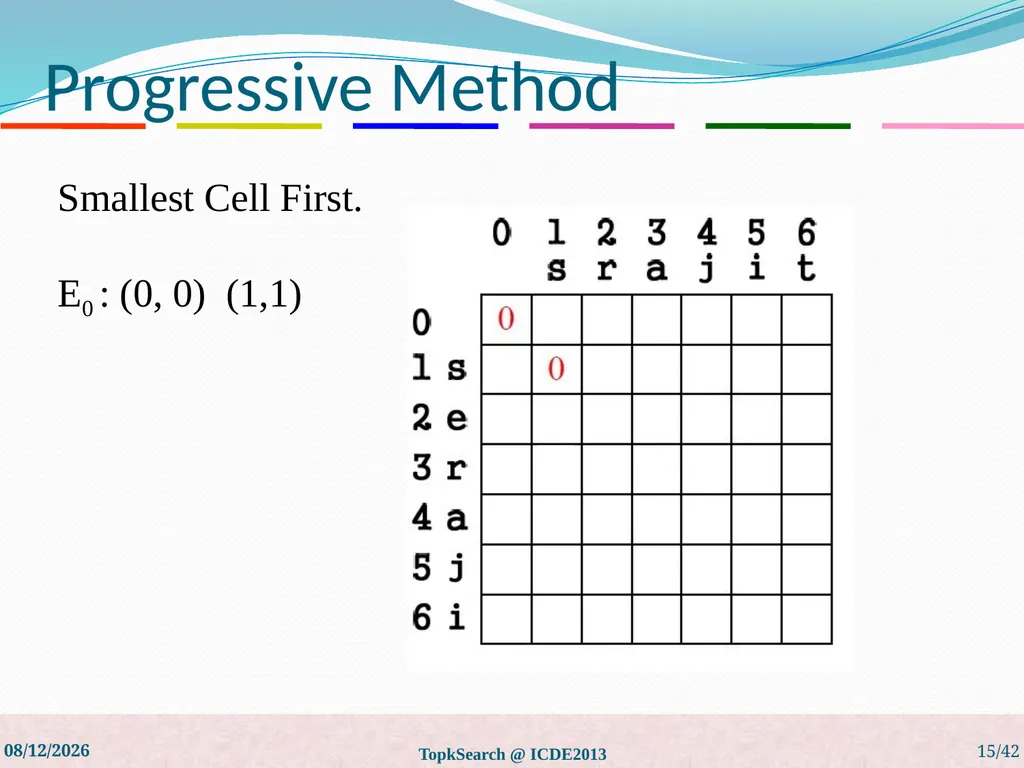
Progressive Method 4/11/2013 TopkSearch @ ICDE2013 15/42 Smallest Cell First.
E0 : (0, 0) (1,1)<br>
E0 : (0, 0) (1,1)<br>
16
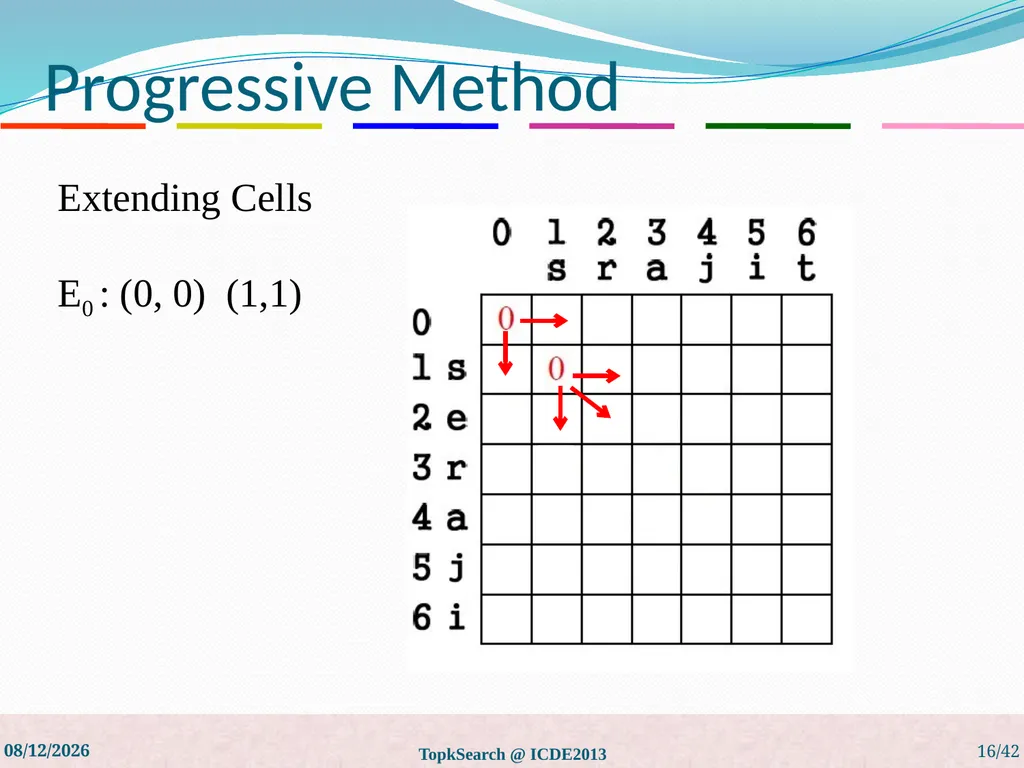
Progressive Method 4/11/2013 TopkSearch @ ICDE2013 16/42 Extending Cells
E0 : (0, 0) (1,1)<br>
E0 : (0, 0) (1,1)<br>
17
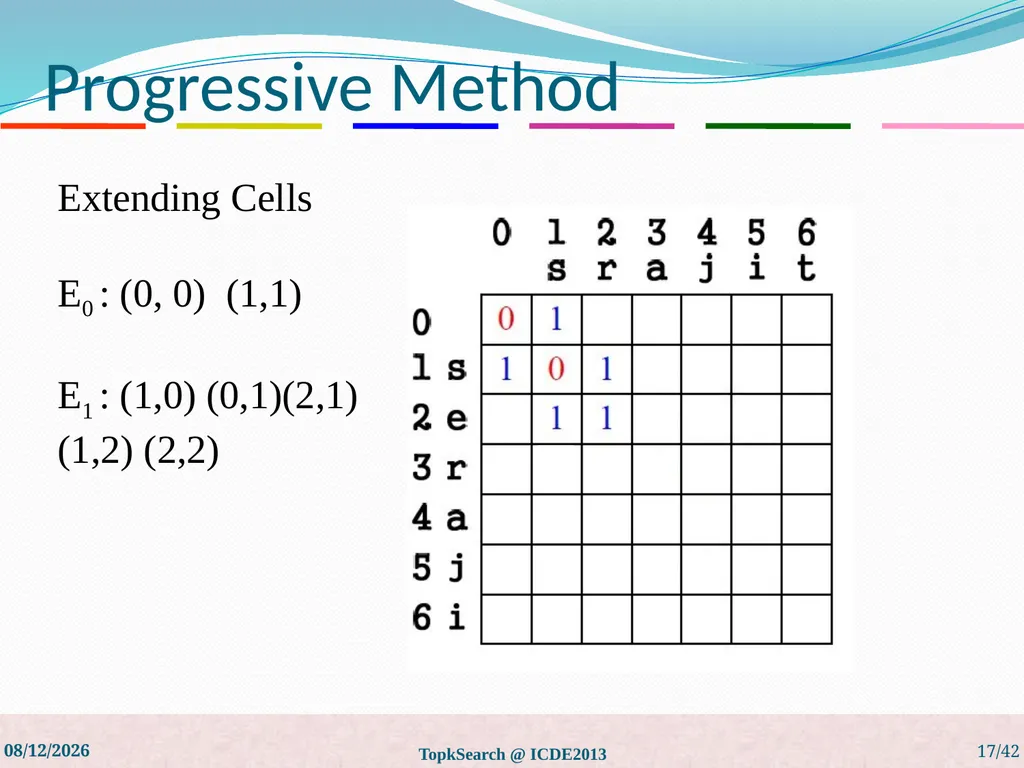
Progressive Method 4/11/2013 TopkSearch @ ICDE2013 17/42 Extending Cells
E0 : (0, 0) (1,1)
E1 : (1,0) (0,1)(2,1)
(1,2) (2,2)<br>
E0 : (0, 0) (1,1)
E1 : (1,0) (0,1)(2,1)
(1,2) (2,2)<br>
18
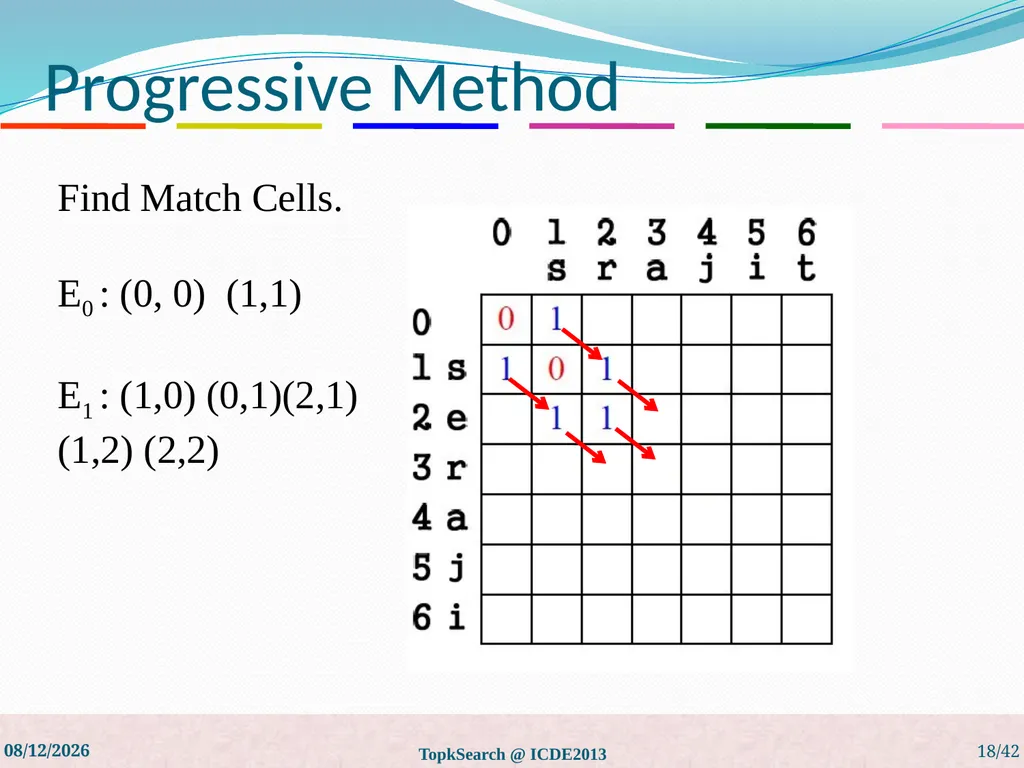
Progressive Method 4/11/2013 TopkSearch @ ICDE2013 18/42 Find Match Cells.
E0 : (0, 0) (1,1)
E1 : (1,0) (0,1)(2,1)
(1,2) (2,2)<br>
E0 : (0, 0) (1,1)
E1 : (1,0) (0,1)(2,1)
(1,2) (2,2)<br>
19
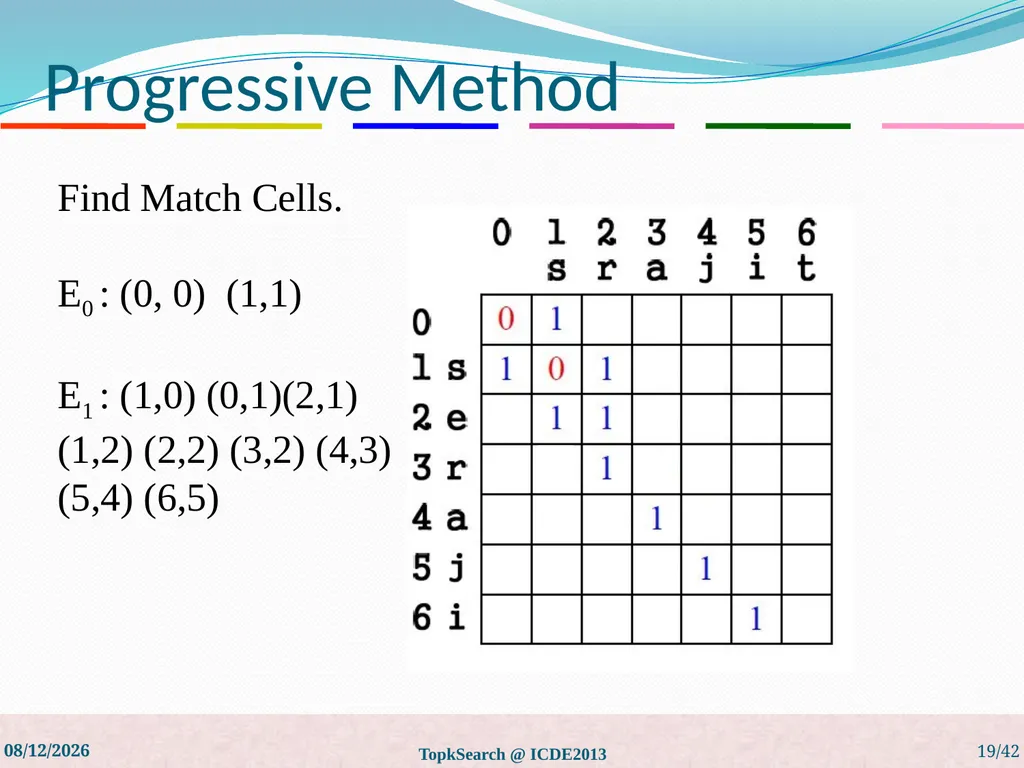
Progressive Method 4/11/2013 TopkSearch @ ICDE2013 19/42 Find Match Cells.
E0 : (0, 0) (1,1)
E1 : (1,0) (0,1)(2,1)
(1,2) (2,2) (3,2) (4,3)
(5,4) (6,5)<br>
E0 : (0, 0) (1,1)
E1 : (1,0) (0,1)(2,1)
(1,2) (2,2) (3,2) (4,3)
(5,4) (6,5)<br>
20
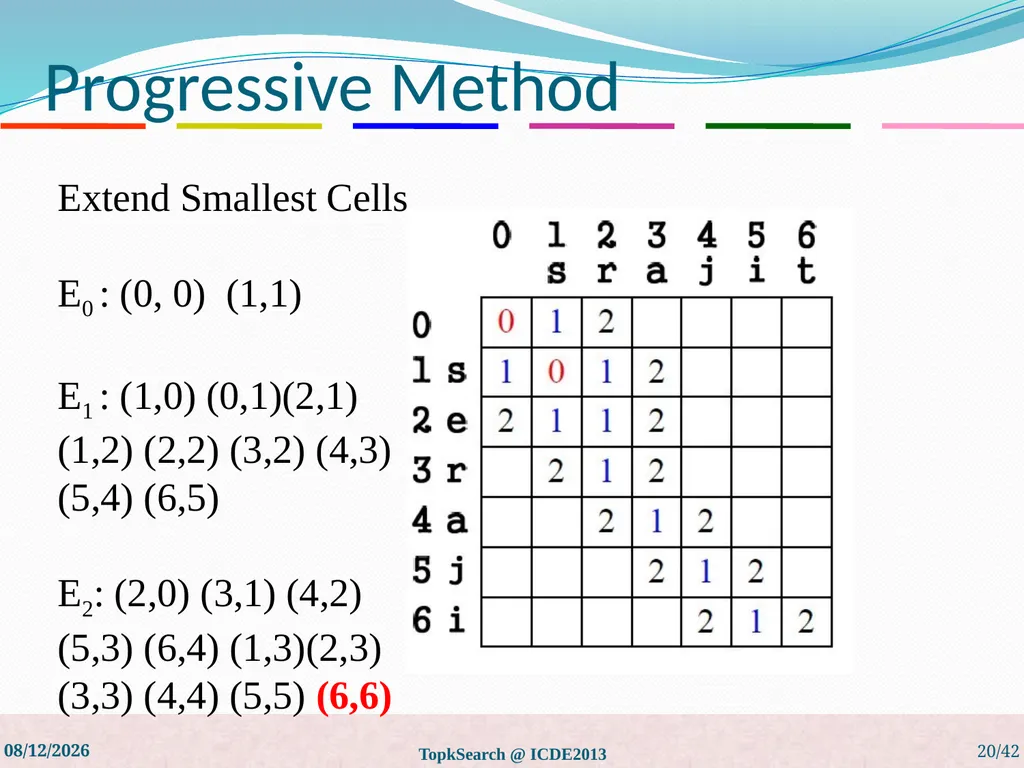
Progressive Method 4/11/2013 TopkSearch @ ICDE2013 20/42 Extend Smallest Cells
E0 : (0, 0) (1,1)
E1 : (1,0) (0,1)(2,1)
(1,2) (2,2) (3,2) (4,3)
(5,4) (6,5)
E2: (2,0) (3,1) (4,2)
(5,3) (6,4) (1,3)(2,3)
(3,3) (4,4) (5,5) (6,6)<br>
E0 : (0, 0) (1,1)
E1 : (1,0) (0,1)(2,1)
(1,2) (2,2) (3,2) (4,3)
(5,4) (6,5)
E2: (2,0) (3,1) (4,2)
(5,3) (6,4) (1,3)(2,3)
(3,3) (4,4) (5,5) (6,6)<br>
21
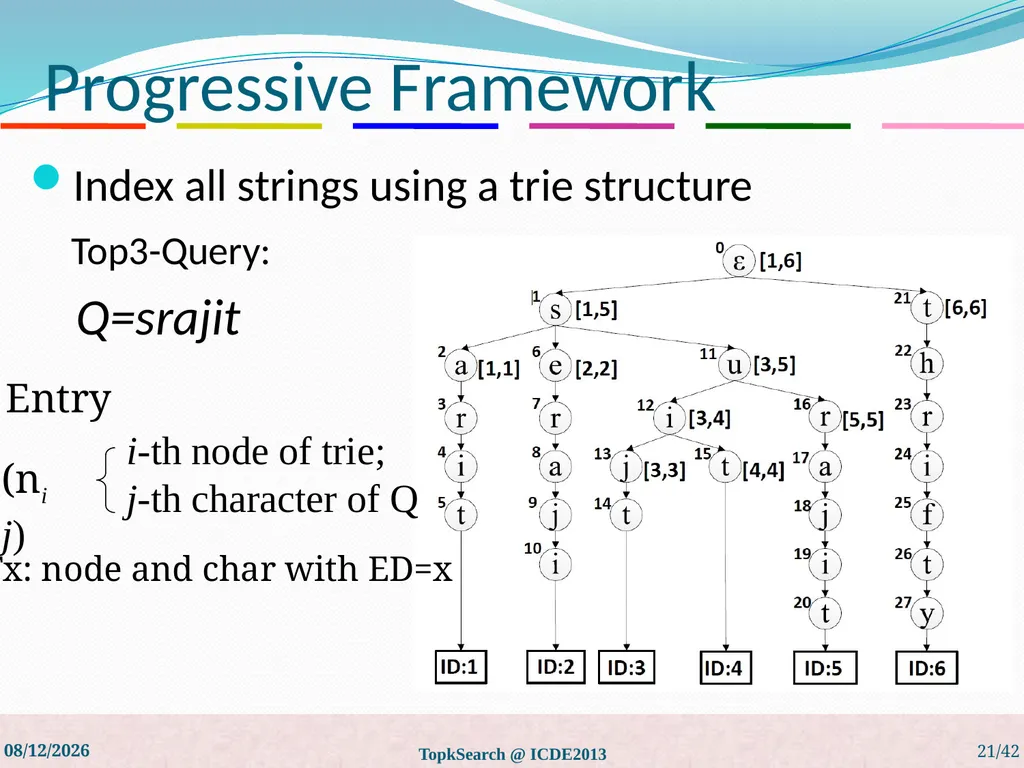
Progressive Framework Index all strings using a trie structure
Top3-Query:
Q=srajit 4/11/2013 TopkSearch @ ICDE2013 21/42 (ni j) Tx: node and char with ED=x i-th node of trie;
j-th character of Q Entry<br>
Top3-Query:
Q=srajit 4/11/2013 TopkSearch @ ICDE2013 21/42 (ni j) Tx: node and char with ED=x i-th node of trie;
j-th character of Q Entry<br>
22
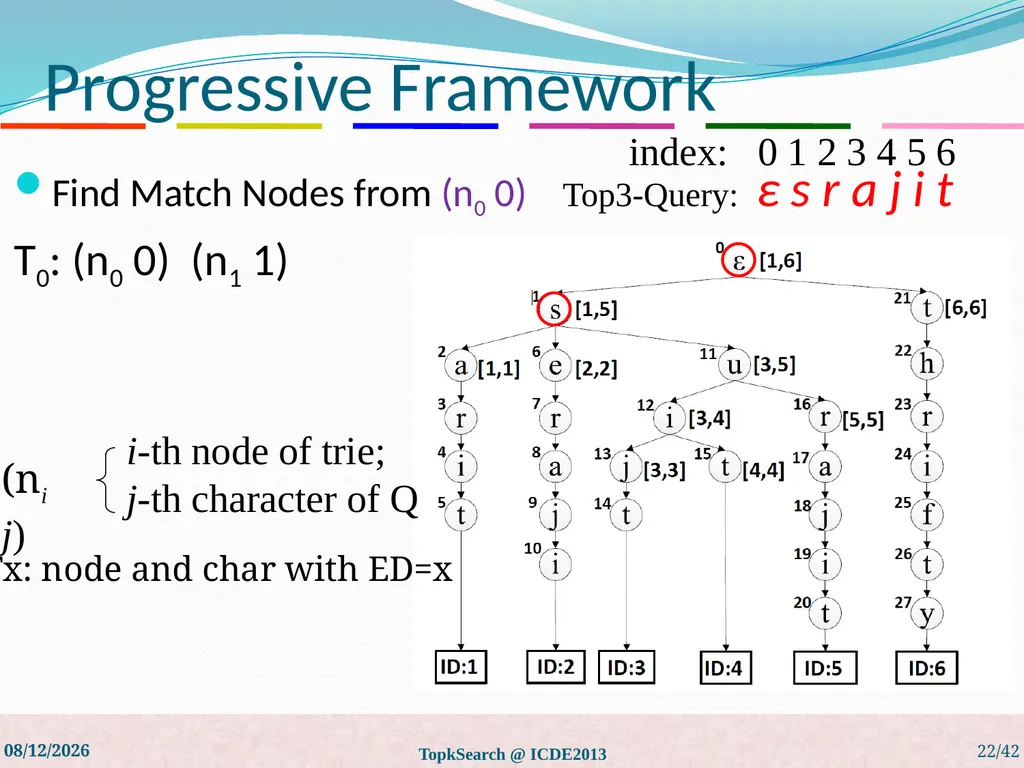
Progressive Framework Find Match Nodes from (n0 0) Top3-Query: ε s r a j i t
T0: (n0 0) (n1 1) 4/11/2013 TopkSearch @ ICDE2013 22/42 (ni j) Tx: node and char with ED=x i-th node of trie;
j-th character of Q index: 0 1 2 3 4 5 6<br>
T0: (n0 0) (n1 1) 4/11/2013 TopkSearch @ ICDE2013 22/42 (ni j) Tx: node and char with ED=x i-th node of trie;
j-th character of Q index: 0 1 2 3 4 5 6<br>
23
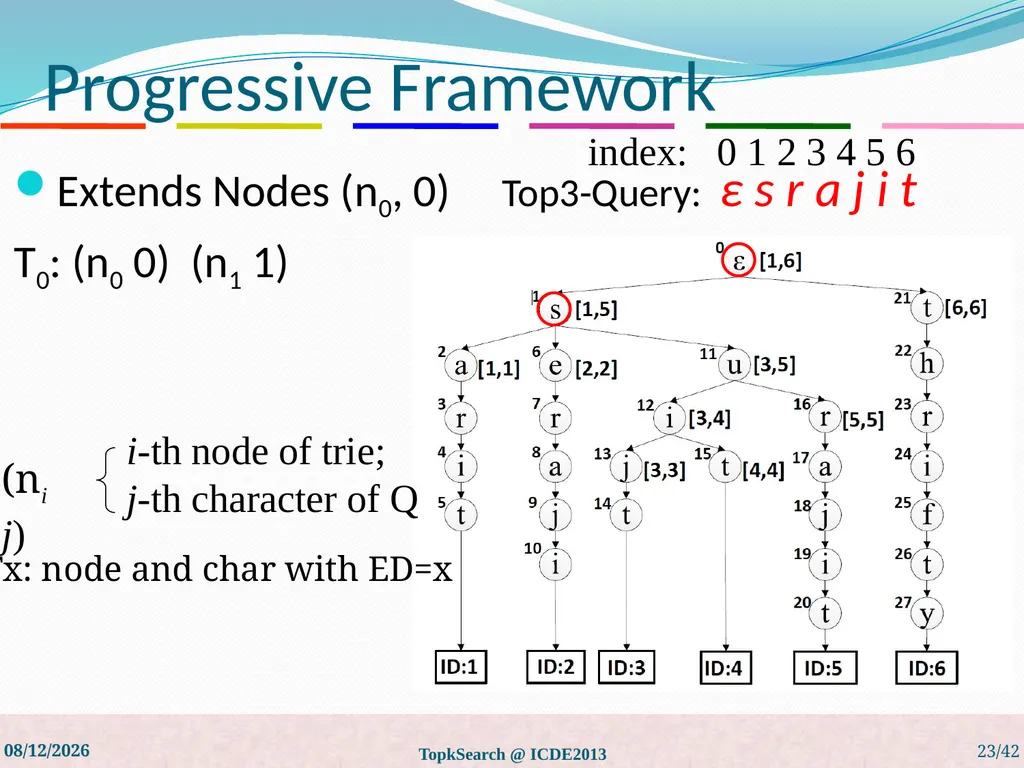
Progressive Framework Extends Nodes (n0, 0) Top3-Query: ε s r a j i t
T0: (n0 0) (n1 1) 4/11/2013 TopkSearch @ ICDE2013 23/42 (ni j) Tx: node and char with ED=x i-th node of trie;
j-th character of Q index: 0 1 2 3 4 5 6<br>
T0: (n0 0) (n1 1) 4/11/2013 TopkSearch @ ICDE2013 23/42 (ni j) Tx: node and char with ED=x i-th node of trie;
j-th character of Q index: 0 1 2 3 4 5 6<br>
24
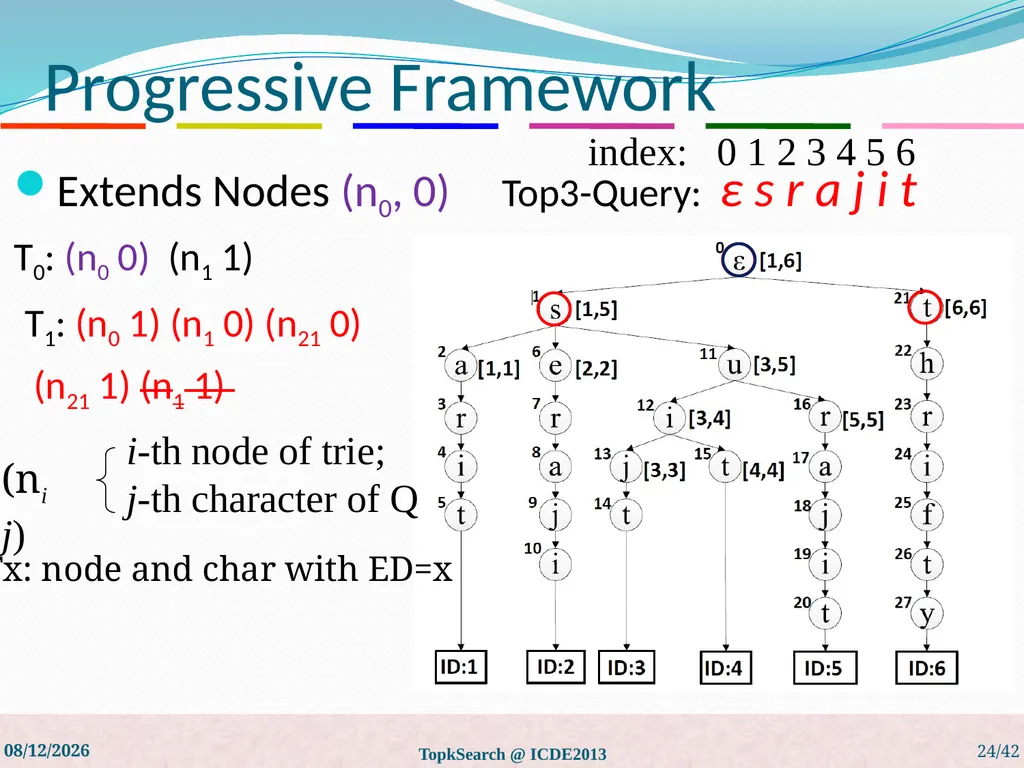
Progressive Framework Extends Nodes (n0, 0) Top3-Query: ε s r a j i t
T0: (n0 0) (n1 1) 4/11/2013 TopkSearch @ ICDE2013 24/42 (ni j) Tx: node and char with ED=x i-th node of trie;
j-th character of Q index: 0 1 2 3 4 5 6 T1: (n0 1) (n1 0) (n21 0)
(n21 1) (n1 1)<br>
T0: (n0 0) (n1 1) 4/11/2013 TopkSearch @ ICDE2013 24/42 (ni j) Tx: node and char with ED=x i-th node of trie;
j-th character of Q index: 0 1 2 3 4 5 6 T1: (n0 1) (n1 0) (n21 0)
(n21 1) (n1 1)<br>
25
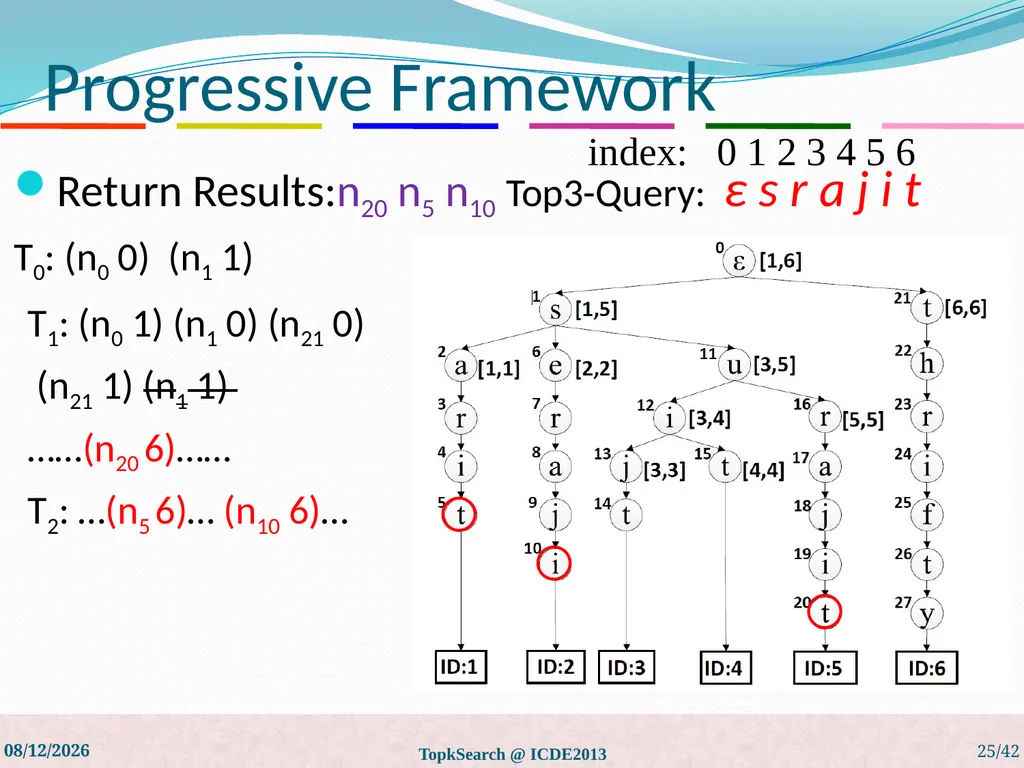
Progressive Framework Return Results:n20 n5 n10 Top3-Query: ε s r a j i t
T0: (n0 0) (n1 1) 4/11/2013 TopkSearch @ ICDE2013 25/42 index: 0 1 2 3 4 5 6 T1: (n0 1) (n1 0) (n21 0)
(n21 1) (n1 1)
……(n20 6)……
T2: …(n5 6)… (n10 6)…<br>
T0: (n0 0) (n1 1) 4/11/2013 TopkSearch @ ICDE2013 25/42 index: 0 1 2 3 4 5 6 T1: (n0 1) (n1 0) (n21 0)
(n21 1) (n1 1)
……(n20 6)……
T2: …(n5 6)… (n10 6)…<br>
26
Outline Motivation
Problem Formulation
Progressive Framework
Pivotal Entry-based Method
Range-based Method
Experiment
Conclusion 4/11/2013 TopkSearch @ ICDE2013 26/42<br>
Problem Formulation
Progressive Framework
Pivotal Entry-based Method
Range-based Method
Experiment
Conclusion 4/11/2013 TopkSearch @ ICDE2013 26/42<br>
27
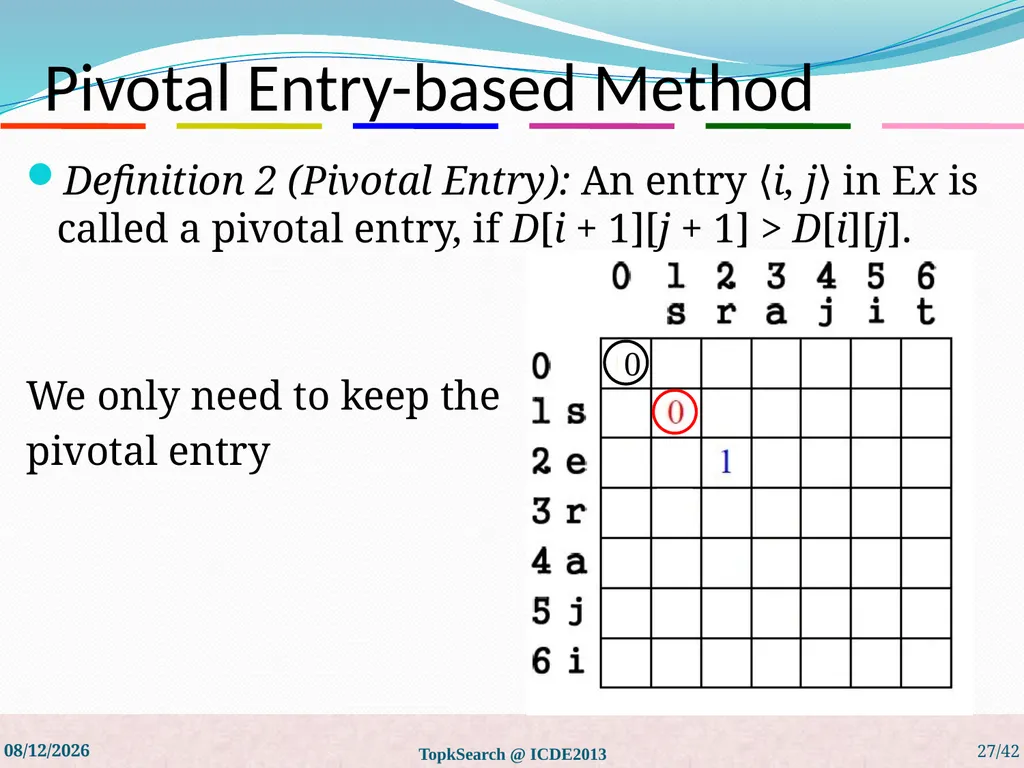
Pivotal Entry-based Method Definition 2 (Pivotal Entry): An entry ⟨i, j⟩ in Ex is called a pivotal entry, if D[i + 1][j + 1] > D[i][j].
We only need to keep the
pivotal entry 4/11/2013 TopkSearch @ ICDE2013 27/42 0<br>
We only need to keep the
pivotal entry 4/11/2013 TopkSearch @ ICDE2013 27/42 0<br>
28
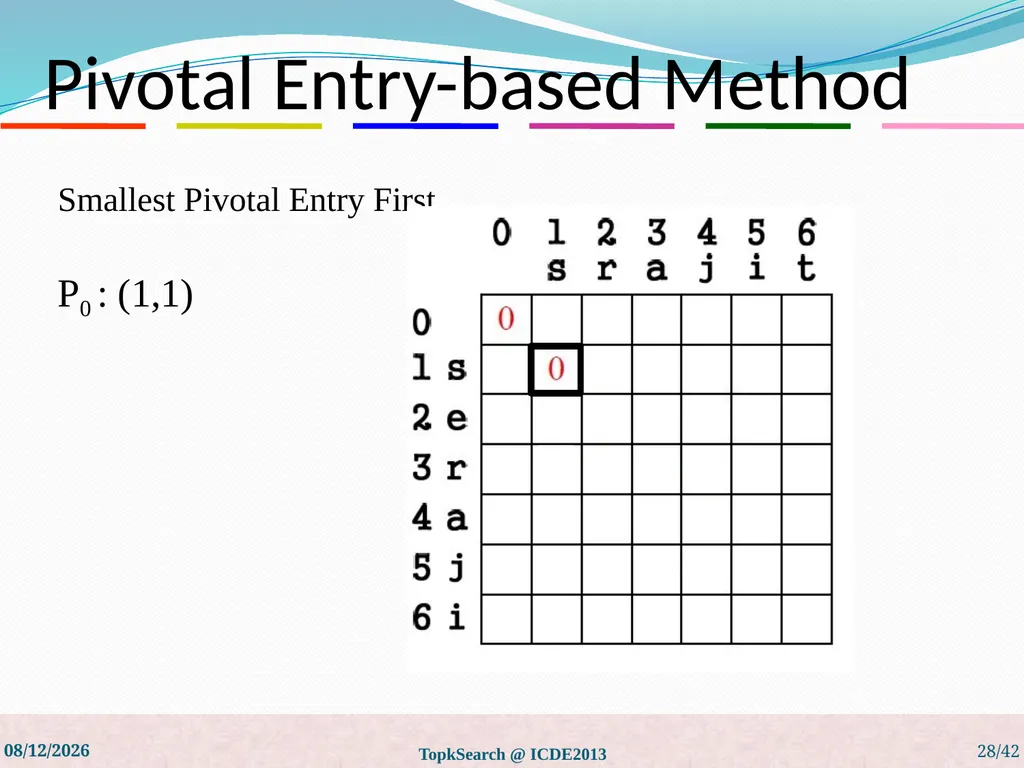
Pivotal Entry-based Method 4/11/2013 TopkSearch @ ICDE2013 28/42 Smallest Pivotal Entry First.
P0 : (1,1)<br>
P0 : (1,1)<br>
29
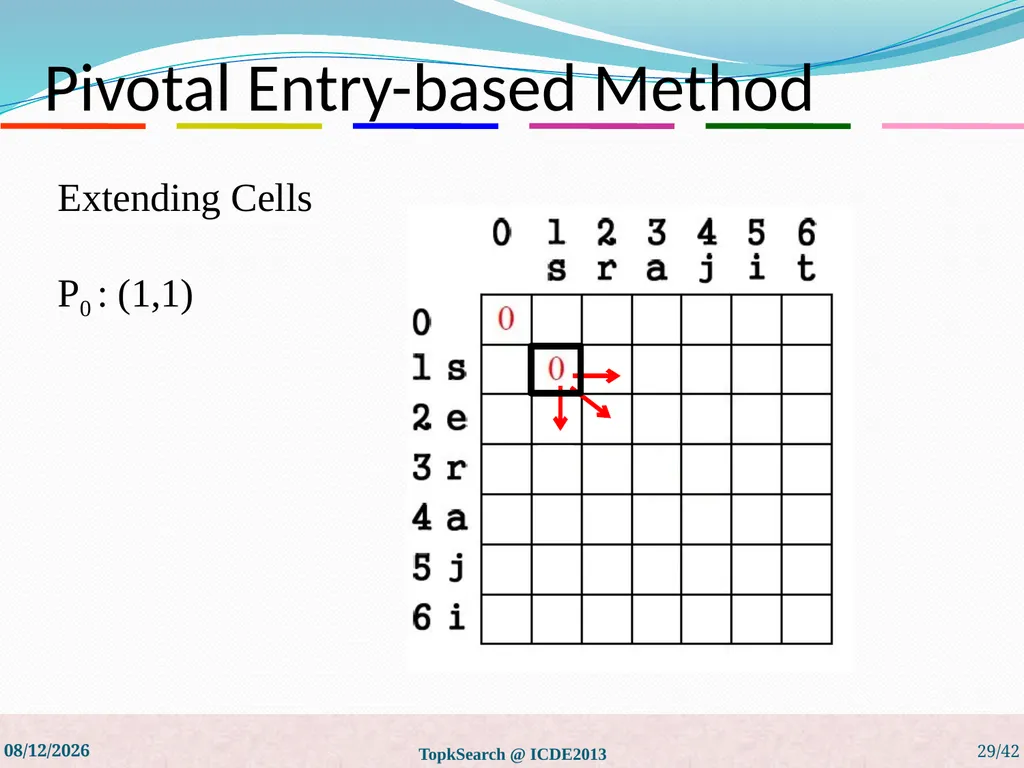
Pivotal Entry-based Method 4/11/2013 TopkSearch @ ICDE2013 29/42 Extending Cells
P0 : (1,1)<br>
P0 : (1,1)<br>
30
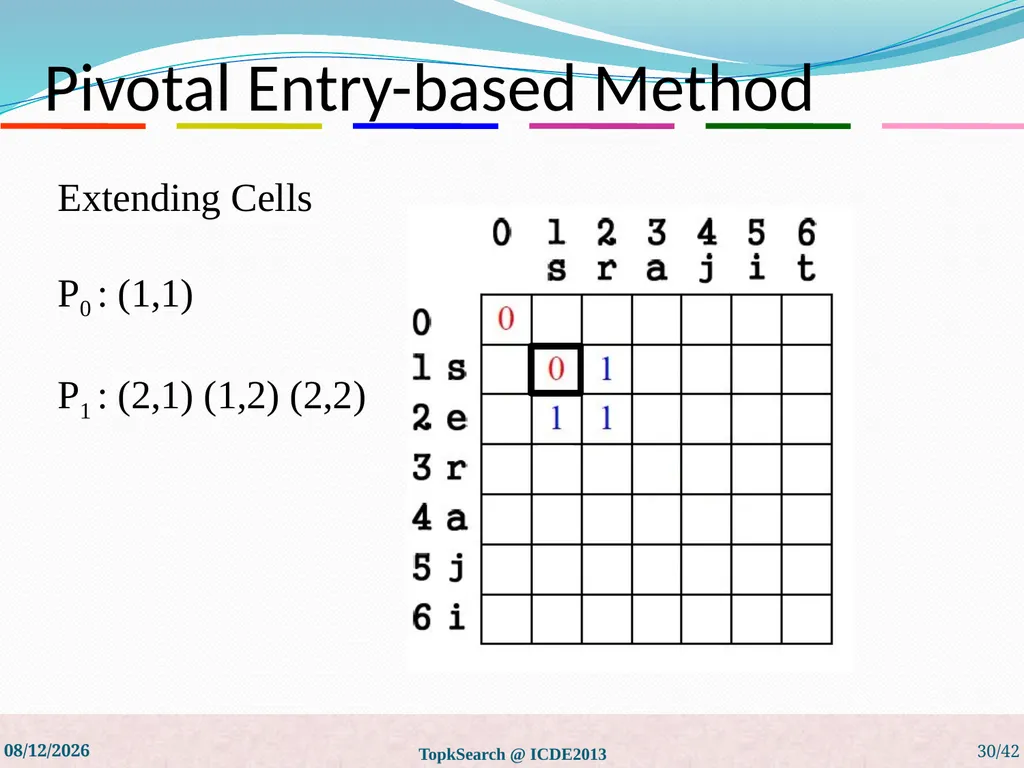
Pivotal Entry-based Method 4/11/2013 TopkSearch @ ICDE2013 30/42 Extending Cells
P0 : (1,1)
P1 : (2,1) (1,2) (2,2)<br>
P0 : (1,1)
P1 : (2,1) (1,2) (2,2)<br>
31
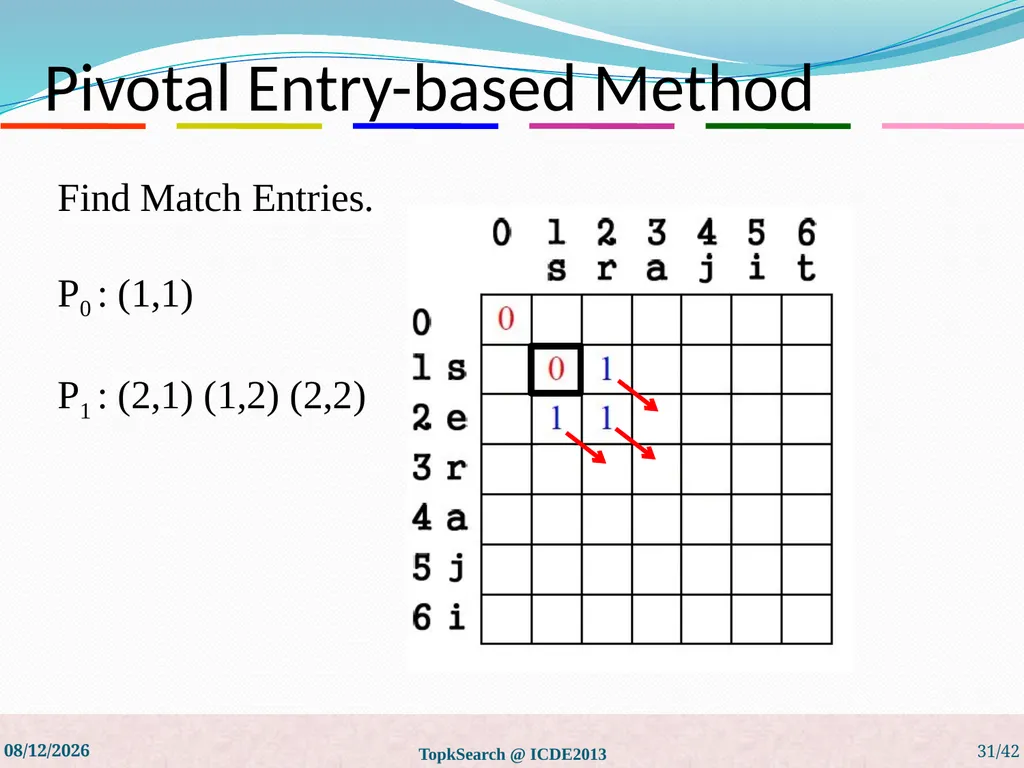
Pivotal Entry-based Method 4/11/2013 TopkSearch @ ICDE2013 31/42 Find Match Entries.
P0 : (1,1)
P1 : (2,1) (1,2) (2,2)<br>
P0 : (1,1)
P1 : (2,1) (1,2) (2,2)<br>
32
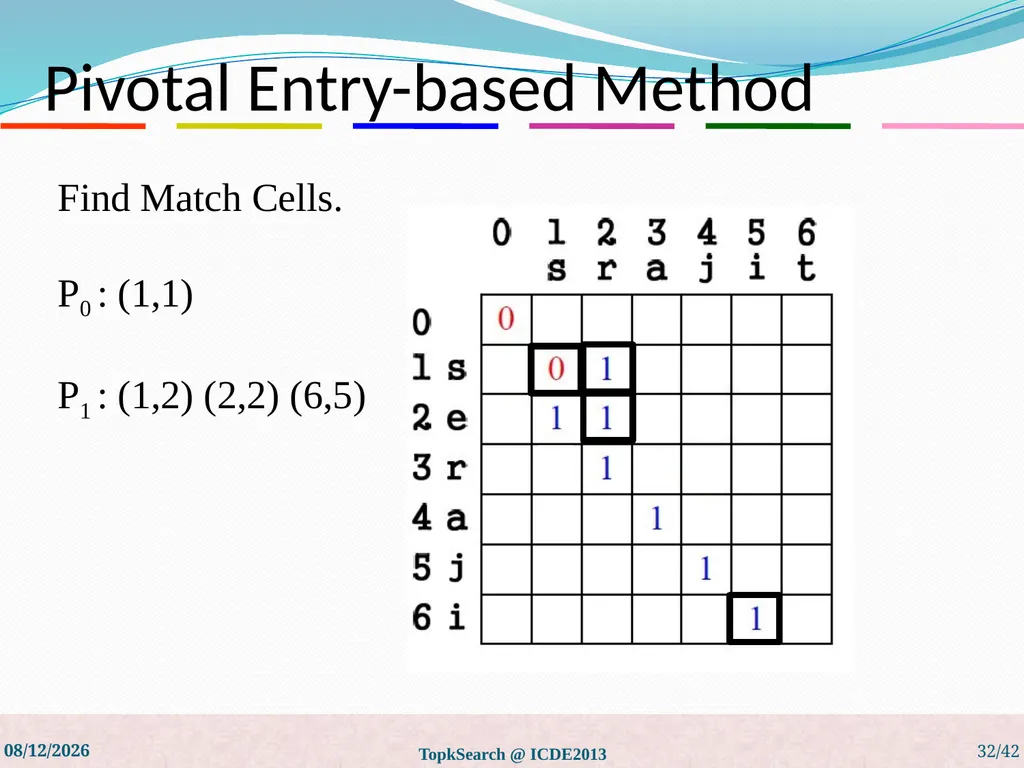
Pivotal Entry-based Method 4/11/2013 TopkSearch @ ICDE2013 32/42 Find Match Cells.
P0 : (1,1)
P1 : (1,2) (2,2) (6,5)<br>
P0 : (1,1)
P1 : (1,2) (2,2) (6,5)<br>
33
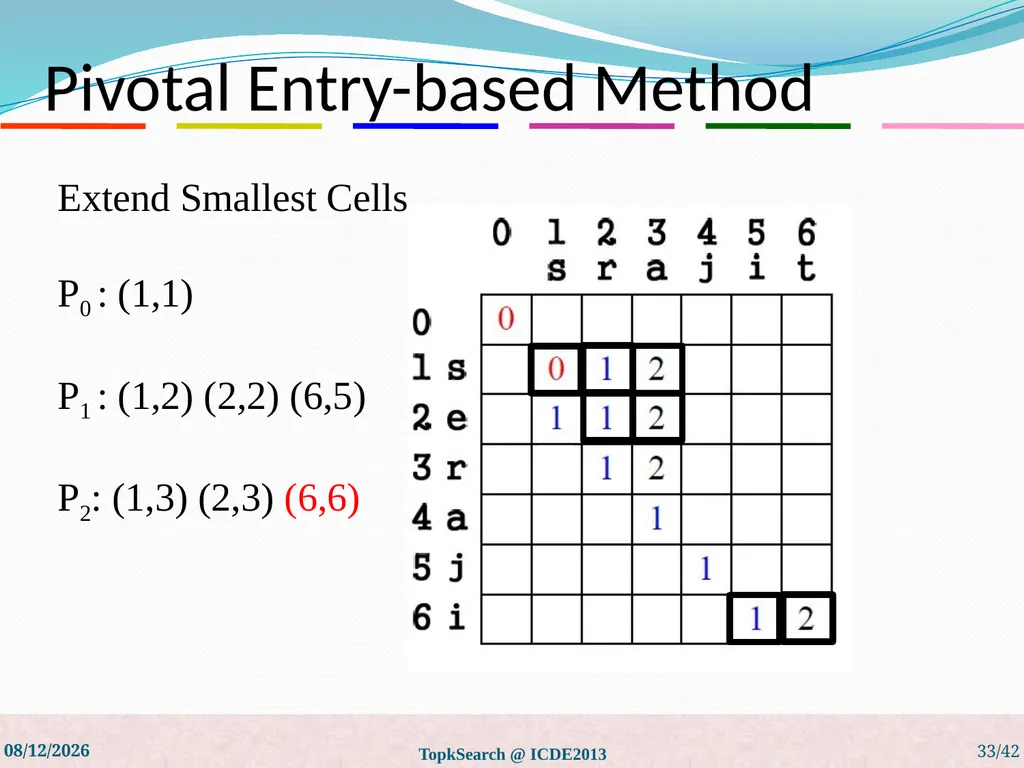
Pivotal Entry-based Method 4/11/2013 TopkSearch @ ICDE2013 33/42 Extend Smallest Cells.
P0 : (1,1)
P1 : (1,2) (2,2) (6,5)
P2: (1,3) (2,3) (6,6)<br>
P0 : (1,1)
P1 : (1,2) (2,2) (6,5)
P2: (1,3) (2,3) (6,6)<br>
34
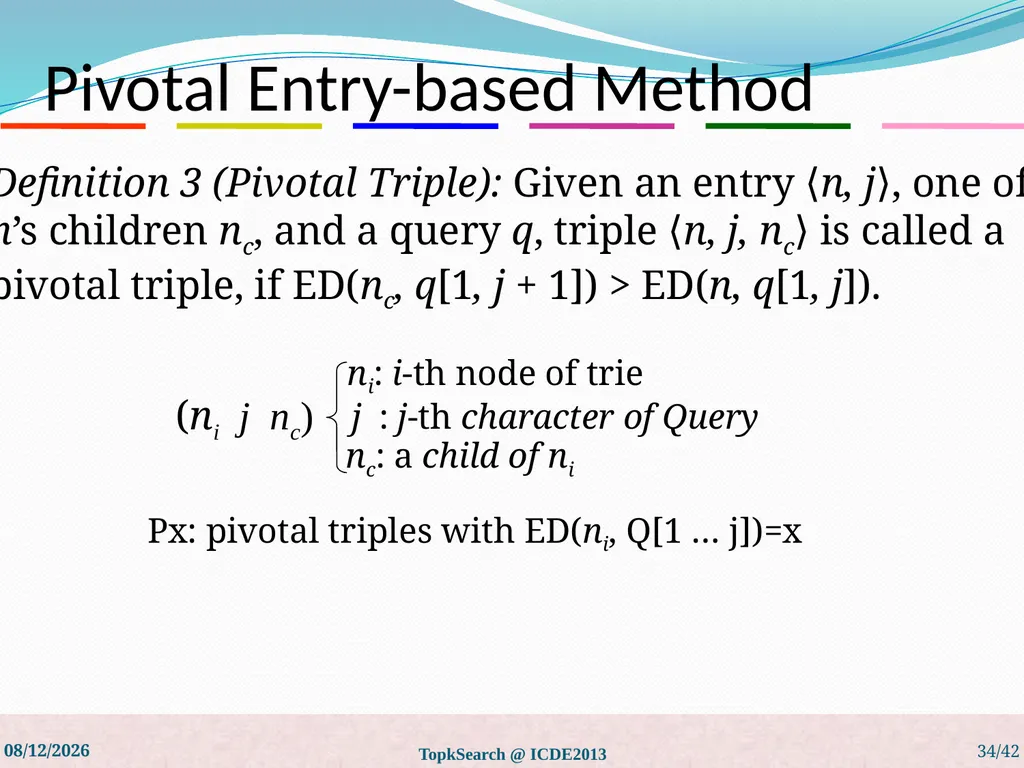
Pivotal Entry-based Method 4/11/2013 TopkSearch @ ICDE2013 34/42 (ni j nc) Px: pivotal triples with ED(ni, Q[1 … j])=x Definition 3 (Pivotal Triple): Given an entry ⟨n, j⟩, one of
n’s children nc, and a query q, triple ⟨n, j, nc⟩ is called a
pivotal triple, if ED(nc, q[1, j + 1]) > ED(n, q[1, j]). ni: i-th node of trie nc: a child of ni j : j-th character of Query<br>
n’s children nc, and a query q, triple ⟨n, j, nc⟩ is called a
pivotal triple, if ED(nc, q[1, j + 1]) > ED(n, q[1, j]). ni: i-th node of trie nc: a child of ni j : j-th character of Query<br>
35
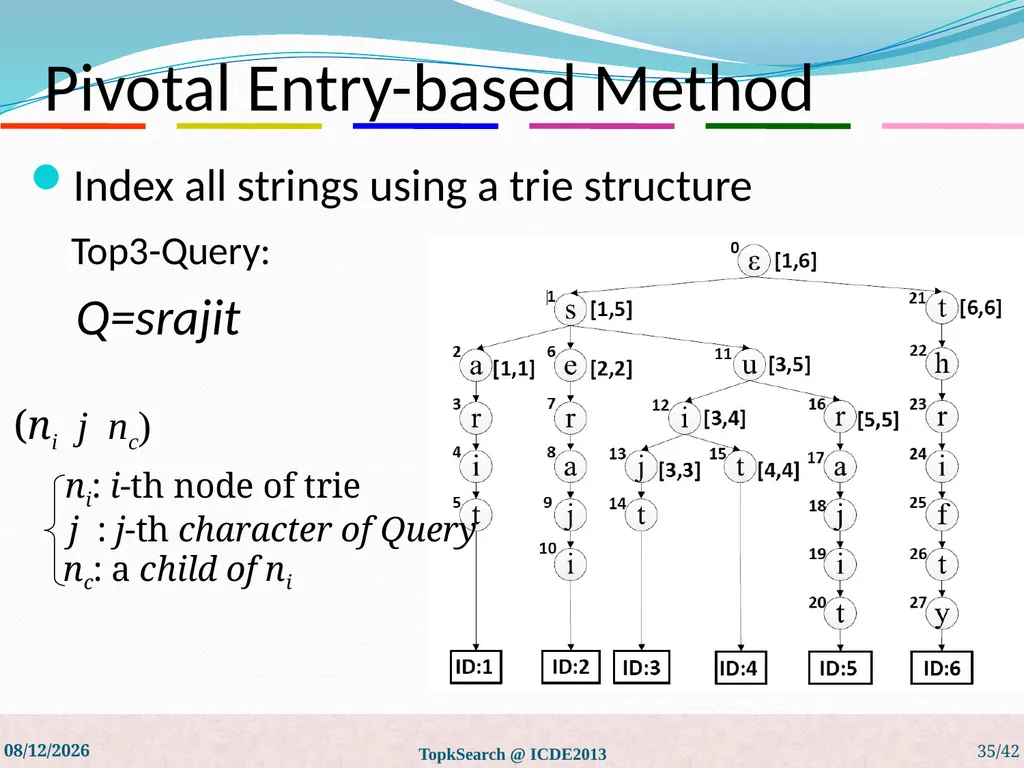
Pivotal Entry-based Method Index all strings using a trie structure
Top3-Query:
Q=srajit 4/11/2013 TopkSearch @ ICDE2013 35/42 (ni j nc) ni: i-th node of trie nc: a child of ni j : j-th character of Query<br>
Top3-Query:
Q=srajit 4/11/2013 TopkSearch @ ICDE2013 35/42 (ni j nc) ni: i-th node of trie nc: a child of ni j : j-th character of Query<br>
36
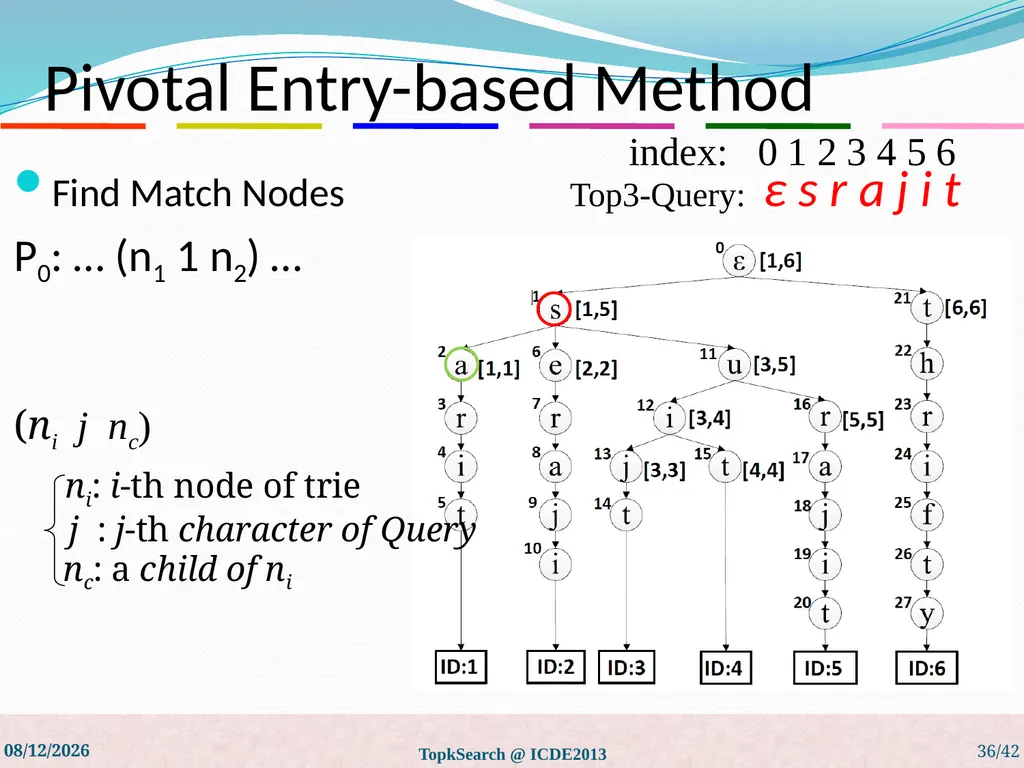
Pivotal Entry-based Method Find Match Nodes Top3-Query: ε s r a j i t
P0: … (n1 1 n2) … 4/11/2013 TopkSearch @ ICDE2013 36/42 index: 0 1 2 3 4 5 6 (ni j nc) ni: i-th node of trie nc: a child of ni j : j-th character of Query<br>
P0: … (n1 1 n2) … 4/11/2013 TopkSearch @ ICDE2013 36/42 index: 0 1 2 3 4 5 6 (ni j nc) ni: i-th node of trie nc: a child of ni j : j-th character of Query<br>
37
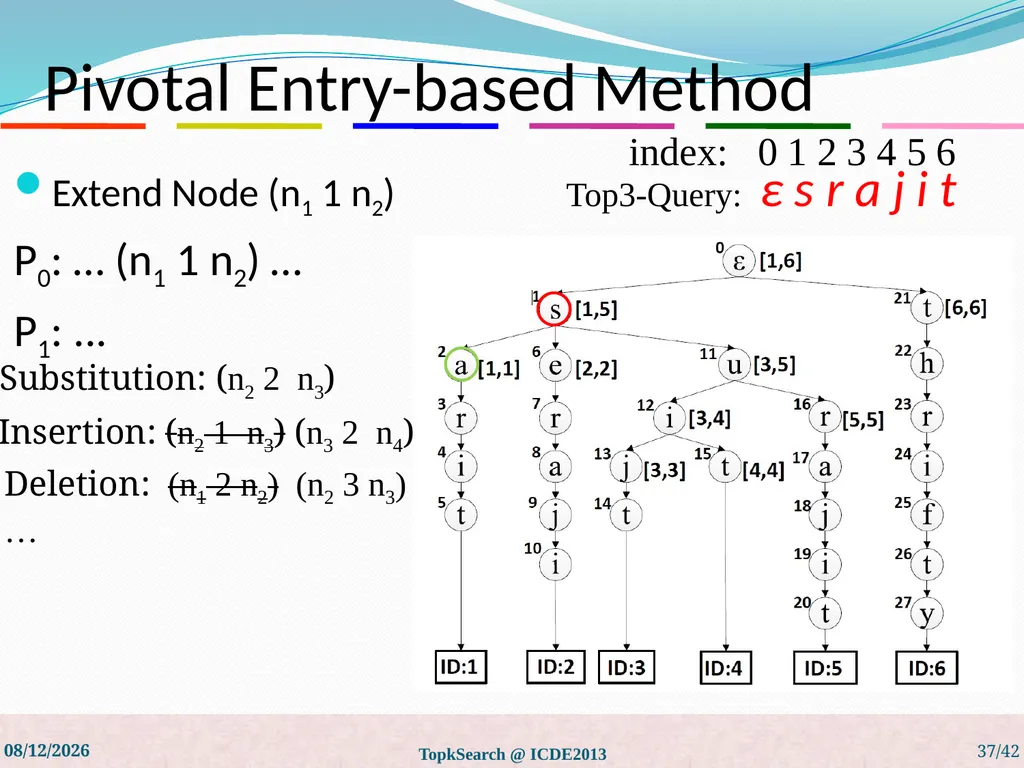
Pivotal Entry-based Method Extend Node (n1 1 n2) Top3-Query: ε s r a j i t
P0: … (n1 1 n2) …
P1: ... 4/11/2013 TopkSearch @ ICDE2013 37/42 index: 0 1 2 3 4 5 6 Substitution: (n2 2 n3) Insertion: (n2 1 n3) (n3 2 n4) Deletion: (n1 2 n2) (n2 3 n3)
…<br>
P0: … (n1 1 n2) …
P1: ... 4/11/2013 TopkSearch @ ICDE2013 37/42 index: 0 1 2 3 4 5 6 Substitution: (n2 2 n3) Insertion: (n2 1 n3) (n3 2 n4) Deletion: (n1 2 n2) (n2 3 n3)
…<br>
38
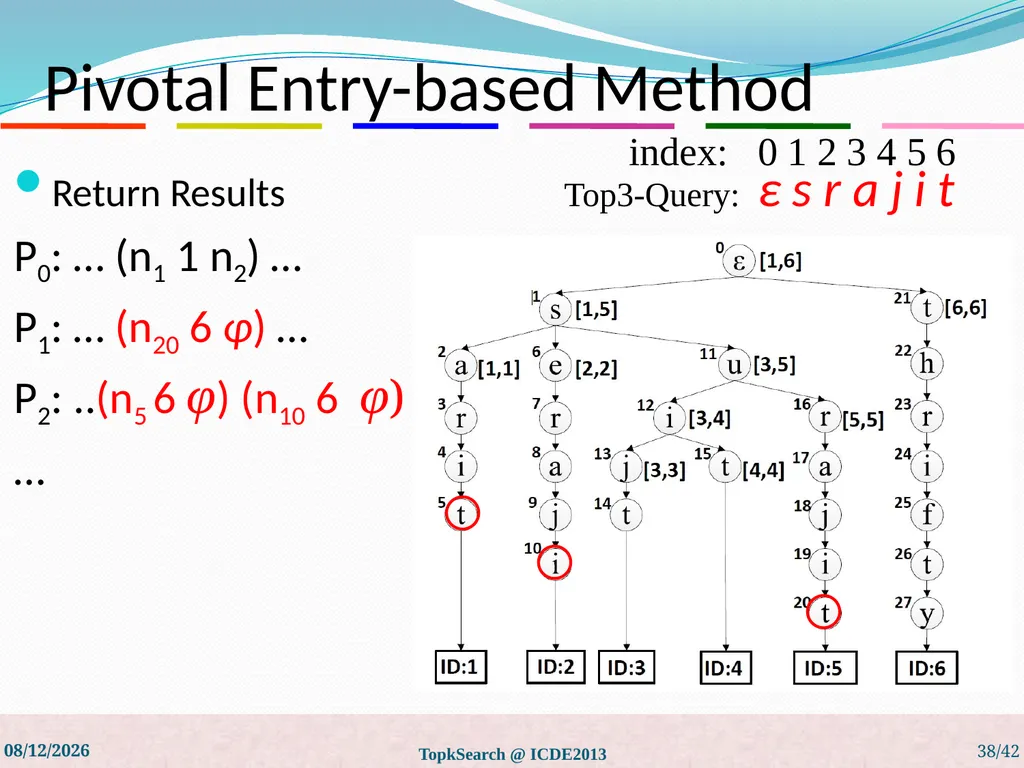
Pivotal Entry-based Method Return Results Top3-Query: ε s r a j i t
P0: … (n1 1 n2) …
P1: … (n20 6 φ) …
P2: ..(n5 6 φ) (n10 6 φ) …
… 4/11/2013 TopkSearch @ ICDE2013 38/42 index: 0 1 2 3 4 5 6<br>
P0: … (n1 1 n2) …
P1: … (n20 6 φ) …
P2: ..(n5 6 φ) (n10 6 φ) …
… 4/11/2013 TopkSearch @ ICDE2013 38/42 index: 0 1 2 3 4 5 6<br>
39
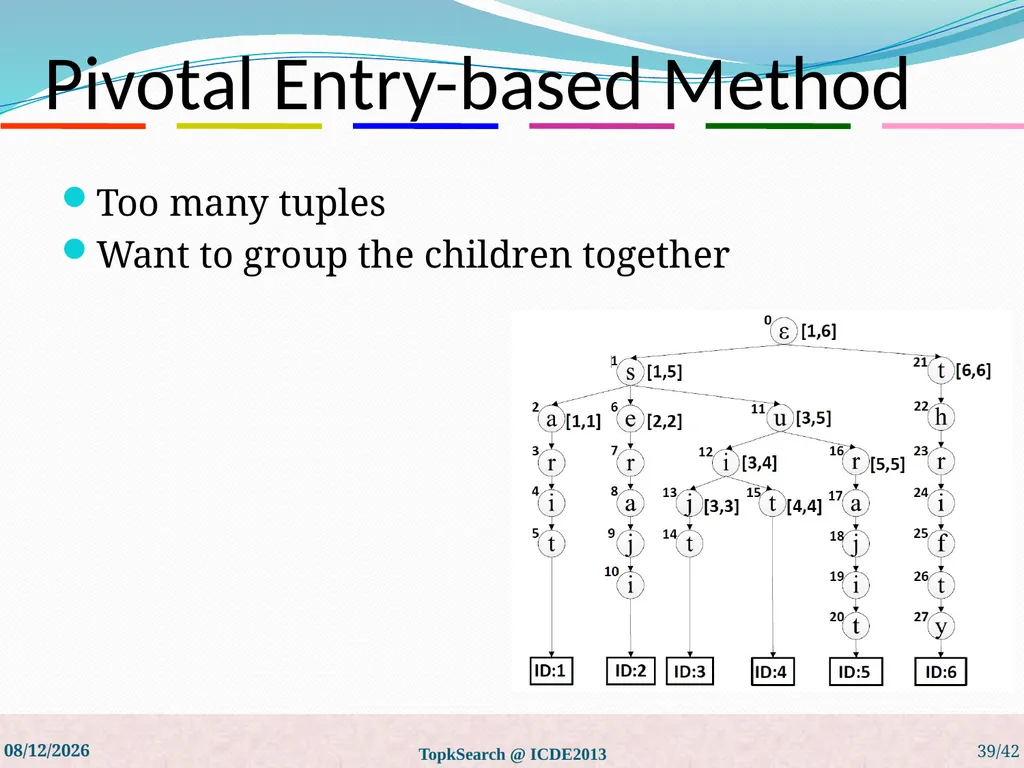
Pivotal Entry-based Method 4/11/2013 TopkSearch @ ICDE2013 39/42 Too many tuples
Want to group the children together<br>
Want to group the children together<br>
40
Outline Motivation
Problem Formulation
Progressive Framework
Pivotal Entry-based Method
Range-based Method
Experiment
Conclusion 4/11/2013 TopkSearch @ ICDE2013 40/42<br>
Problem Formulation
Progressive Framework
Pivotal Entry-based Method
Range-based Method
Experiment
Conclusion 4/11/2013 TopkSearch @ ICDE2013 40/42<br>
41
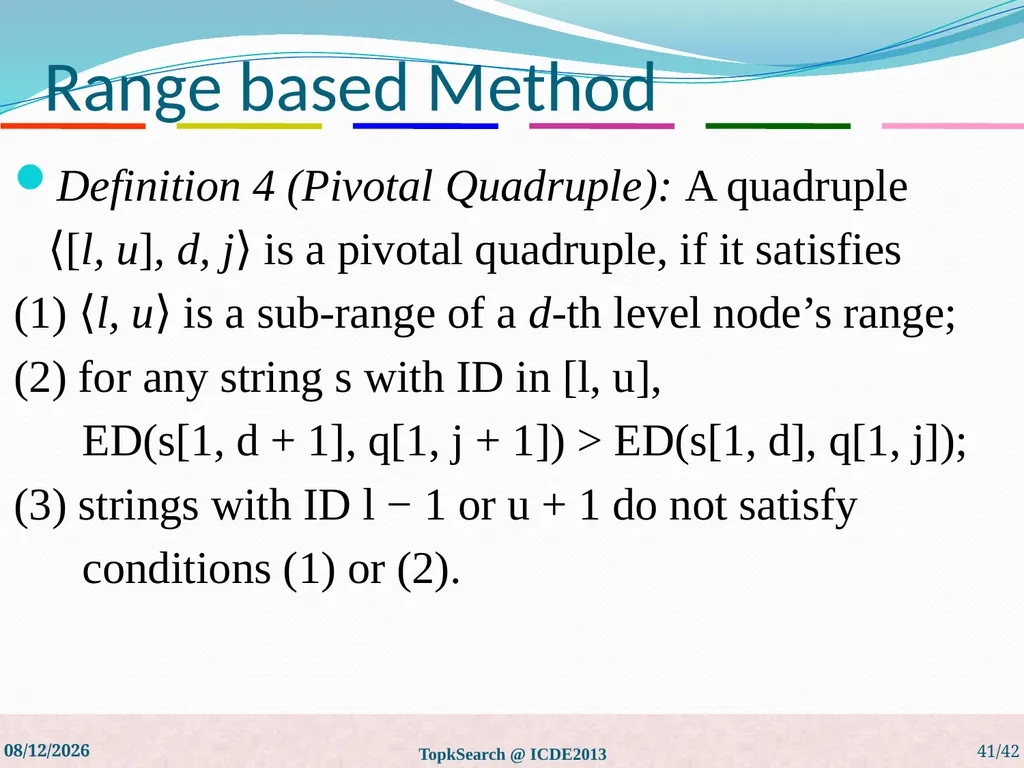
Range based Method Definition 4 (Pivotal Quadruple): A quadruple
⟨[l, u], d, j⟩ is a pivotal quadruple, if it satisfies
(1) ⟨l, u⟩ is a sub-range of a d-th level node’s range;
(2) for any string s with ID in [l, u],
ED(s[1, d + 1], q[1, j + 1]) > ED(s[1, d], q[1, j]);
(3) strings with ID l − 1 or u + 1 do not satisfy
conditions (1) or (2). 4/11/2013 TopkSearch @ ICDE2013 41/42<br>
⟨[l, u], d, j⟩ is a pivotal quadruple, if it satisfies
(1) ⟨l, u⟩ is a sub-range of a d-th level node’s range;
(2) for any string s with ID in [l, u],
ED(s[1, d + 1], q[1, j + 1]) > ED(s[1, d], q[1, j]);
(3) strings with ID l − 1 or u + 1 do not satisfy
conditions (1) or (2). 4/11/2013 TopkSearch @ ICDE2013 41/42<br>
42
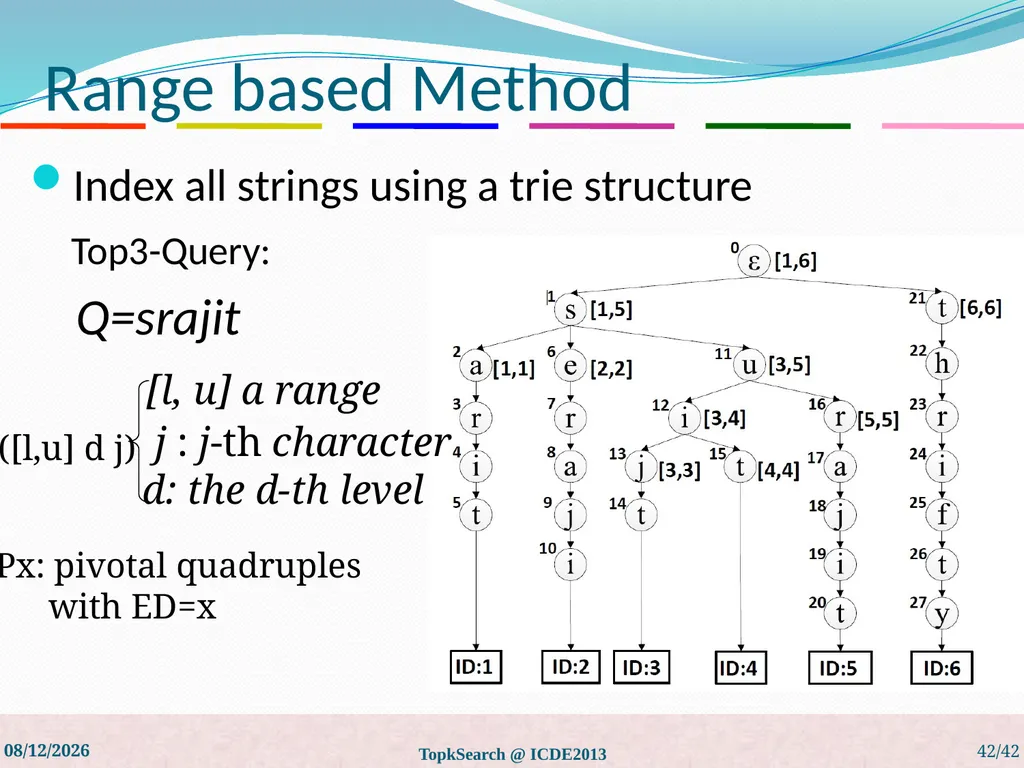
Range based Method Index all strings using a trie structure
Top3-Query:
Q=srajit 4/11/2013 TopkSearch @ ICDE2013 42/42 ([l,u] d j) Px: pivotal quadruples
with ED=x [l, u] a range d: the d-th level j : j-th character<br>
Top3-Query:
Q=srajit 4/11/2013 TopkSearch @ ICDE2013 42/42 ([l,u] d j) Px: pivotal quadruples
with ED=x [l, u] a range d: the d-th level j : j-th character<br>
43
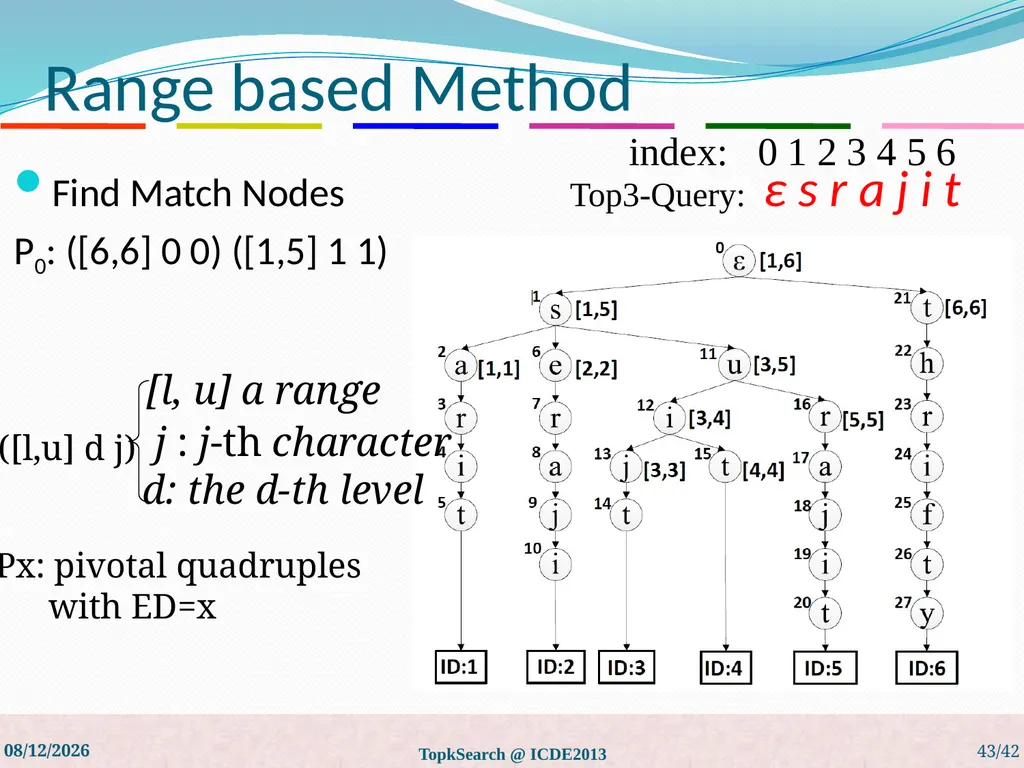
Range based Method Find Match Nodes Top3-Query: ε s r a j i t
P0: ([6,6] 0 0) ([1,5] 1 1) 4/11/2013 TopkSearch @ ICDE2013 43/42 index: 0 1 2 3 4 5 6 ([l,u] d j) Px: pivotal quadruples
with ED=x [l, u] a range d: the d-th level j : j-th character<br>
P0: ([6,6] 0 0) ([1,5] 1 1) 4/11/2013 TopkSearch @ ICDE2013 43/42 index: 0 1 2 3 4 5 6 ([l,u] d j) Px: pivotal quadruples
with ED=x [l, u] a range d: the d-th level j : j-th character<br>
44
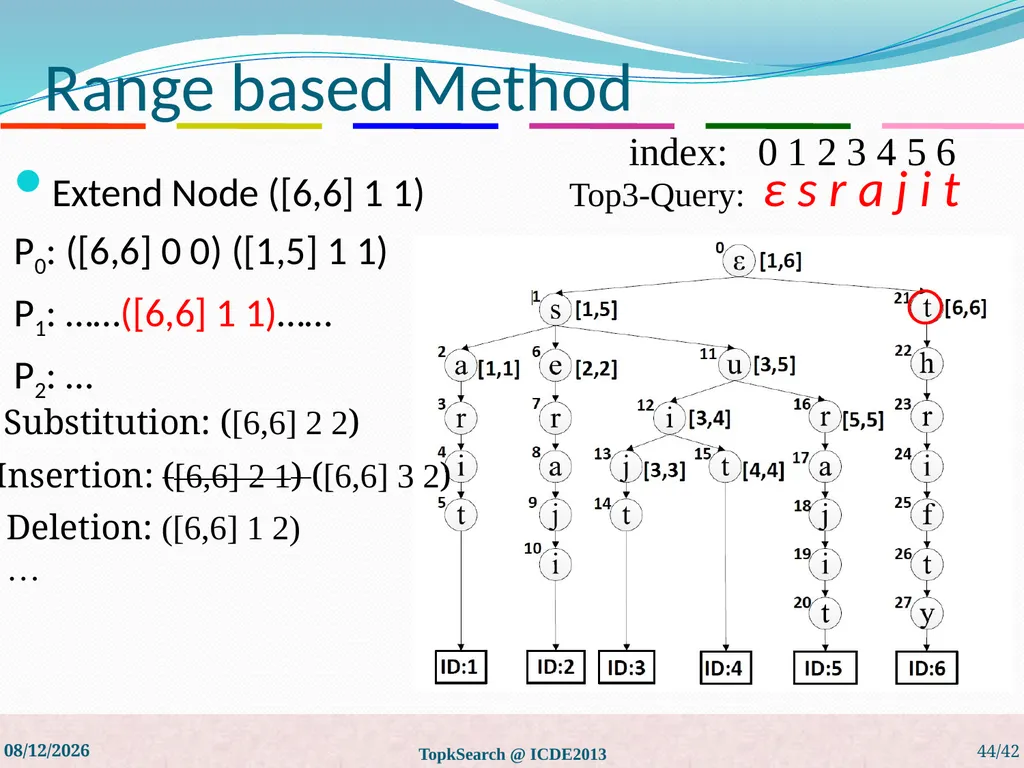
Range based Method Extend Node ([6,6] 1 1) Top3-Query: ε s r a j i t
P0: ([6,6] 0 0) ([1,5] 1 1)
P1: ……([6,6] 1 1)……
P2: … 4/11/2013 TopkSearch @ ICDE2013 44/42 index: 0 1 2 3 4 5 6 Substitution: ([6,6] 2 2) Insertion: ([6,6] 2 1) ([6,6] 3 2) Deletion: ([6,6] 1 2)
…<br>
P0: ([6,6] 0 0) ([1,5] 1 1)
P1: ……([6,6] 1 1)……
P2: … 4/11/2013 TopkSearch @ ICDE2013 44/42 index: 0 1 2 3 4 5 6 Substitution: ([6,6] 2 2) Insertion: ([6,6] 2 1) ([6,6] 3 2) Deletion: ([6,6] 1 2)
…<br>
45
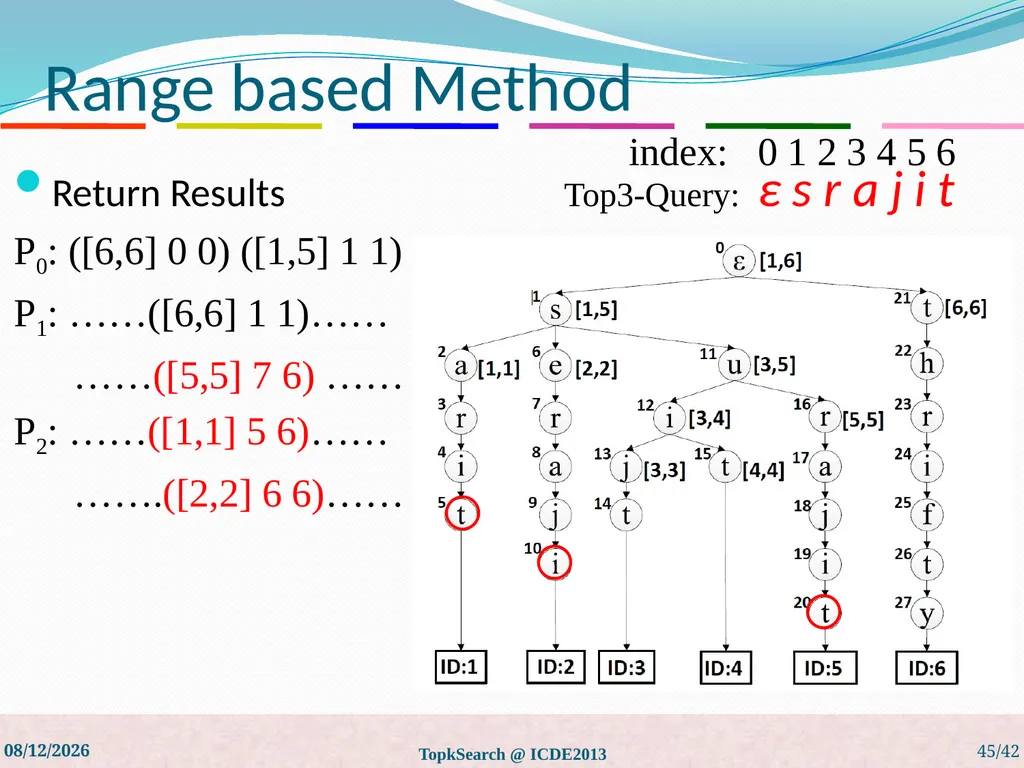
Range based Method Return Results Top3-Query: ε s r a j i t
P0: ([6,6] 0 0) ([1,5] 1 1)
P1: ……([6,6] 1 1)……
……([5,5] 7 6) ……
P2: ……([1,1] 5 6)……
…….([2,2] 6 6)…… 4/11/2013 TopkSearch @ ICDE2013 45/42 index: 0 1 2 3 4 5 6<br>
P0: ([6,6] 0 0) ([1,5] 1 1)
P1: ……([6,6] 1 1)……
……([5,5] 7 6) ……
P2: ……([1,1] 5 6)……
…….([2,2] 6 6)…… 4/11/2013 TopkSearch @ ICDE2013 45/42 index: 0 1 2 3 4 5 6<br>
46
Outline Motivation
Problem Formulation
Progressive Framework
Pivotal Entry-based Method
Range-based Method
Experiment
Conclusion 4/11/2013 TopkSearch @ ICDE2013 46/42<br>
Problem Formulation
Progressive Framework
Pivotal Entry-based Method
Range-based Method
Experiment
Conclusion 4/11/2013 TopkSearch @ ICDE2013 46/42<br>
47
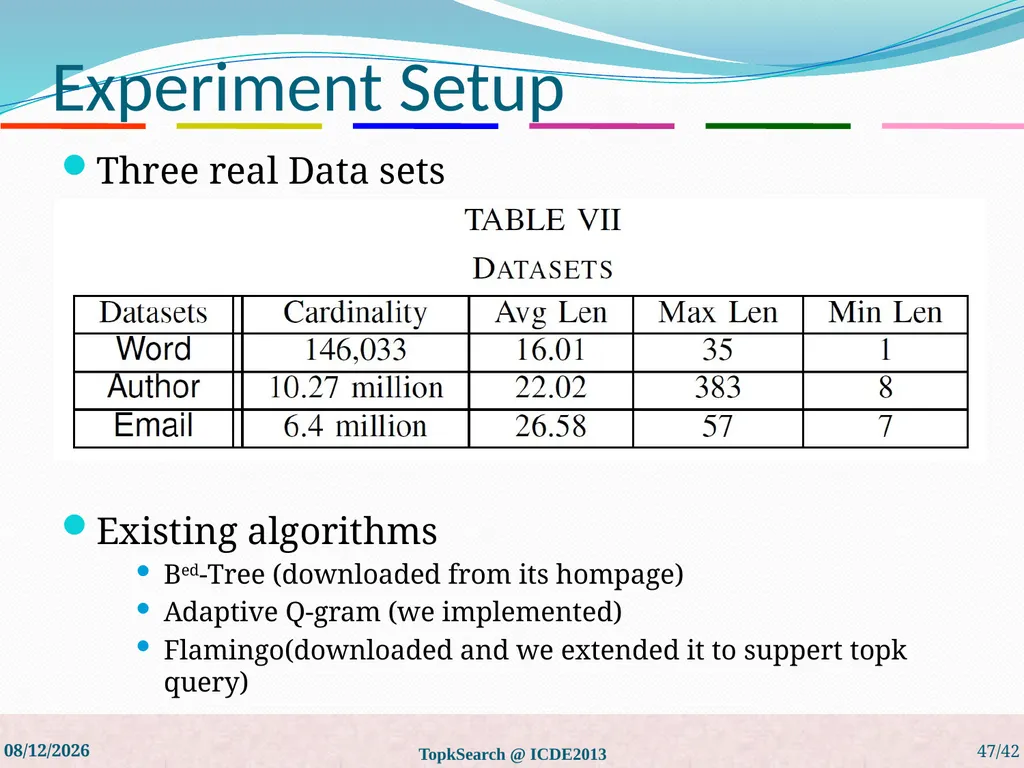
Experiment Setup Three real Data sets
Existing algorithms
Bed-Tree (downloaded from its hompage)
Adaptive Q-gram (we implemented)
Flamingo(downloaded and we extended it to suppert topk query) 4/11/2013 TopkSearch @ ICDE2013 47/42<br>
Existing algorithms
Bed-Tree (downloaded from its hompage)
Adaptive Q-gram (we implemented)
Flamingo(downloaded and we extended it to suppert topk query) 4/11/2013 TopkSearch @ ICDE2013 47/42<br>
48
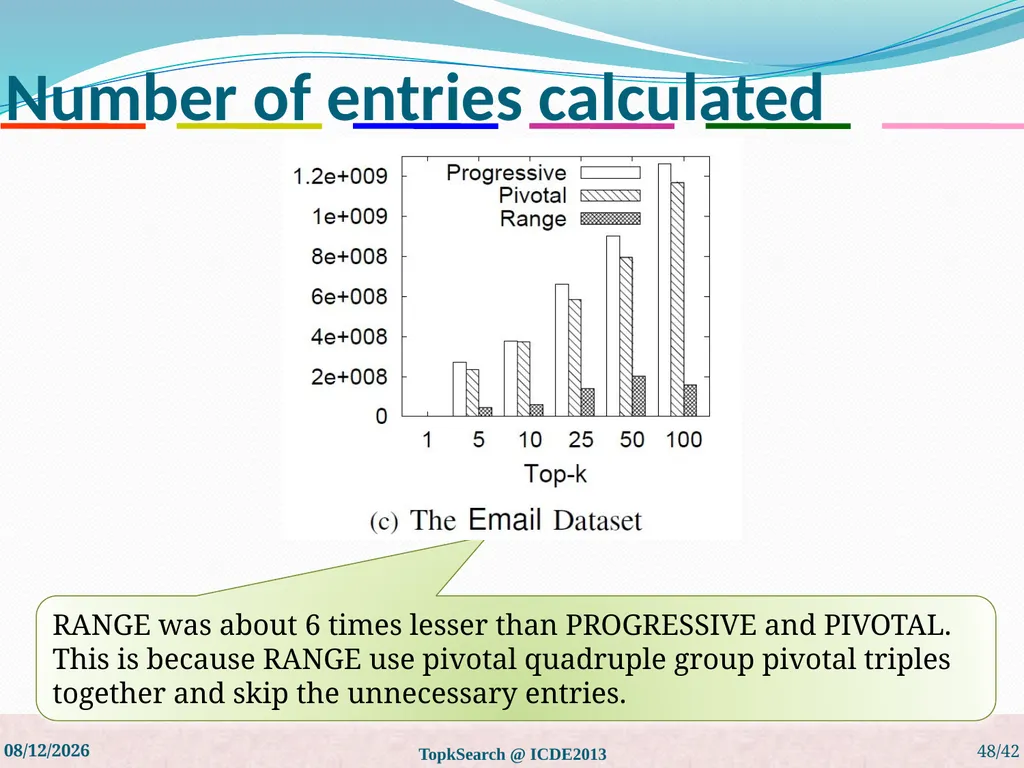
Number of entries calculated 4/11/2013 TopkSearch @ ICDE2013 48/42 RANGE was about 6 times lesser than PROGRESSIVE and PIVOTAL. This is because RANGE use pivotal quadruple group pivotal triples together and skip the unnecessary entries.<br>
49
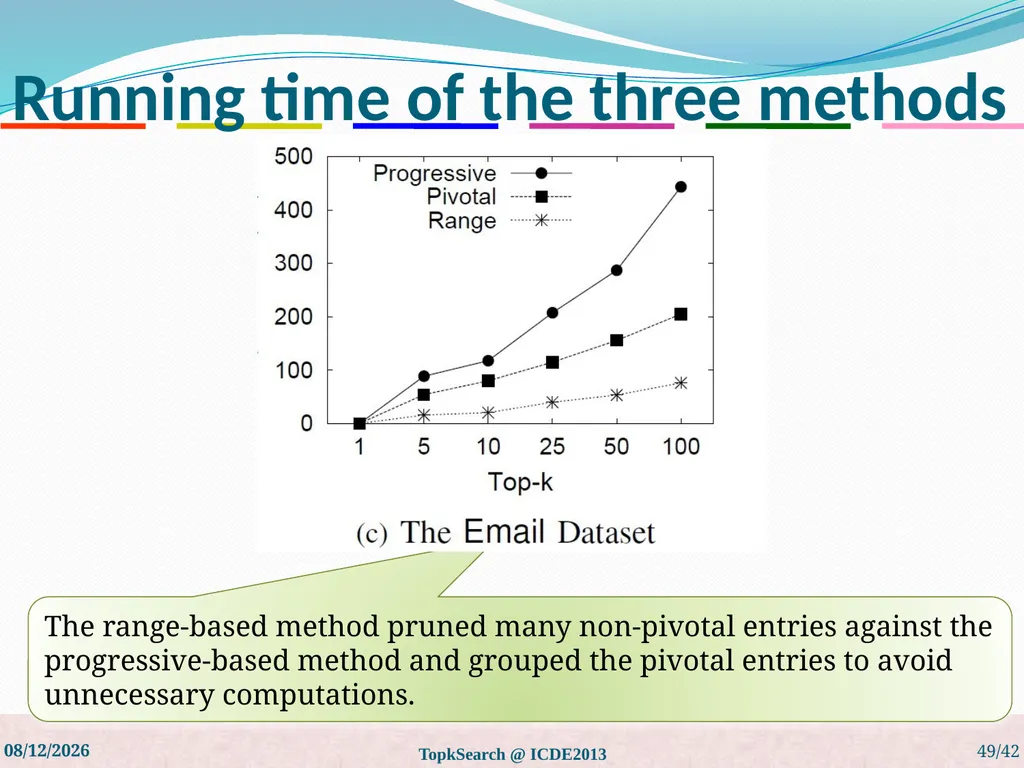
Running time of the three methods 4/11/2013 TopkSearch @ ICDE2013 49/42 The range-based method pruned many non-pivotal entries against the progressive-based method and grouped the pivotal entries to avoid unnecessary computations.<br>
50
Comparison with State-of-the-art Methods 4/11/2013 TopkSearch @ ICDE2013 50/42<br>
51
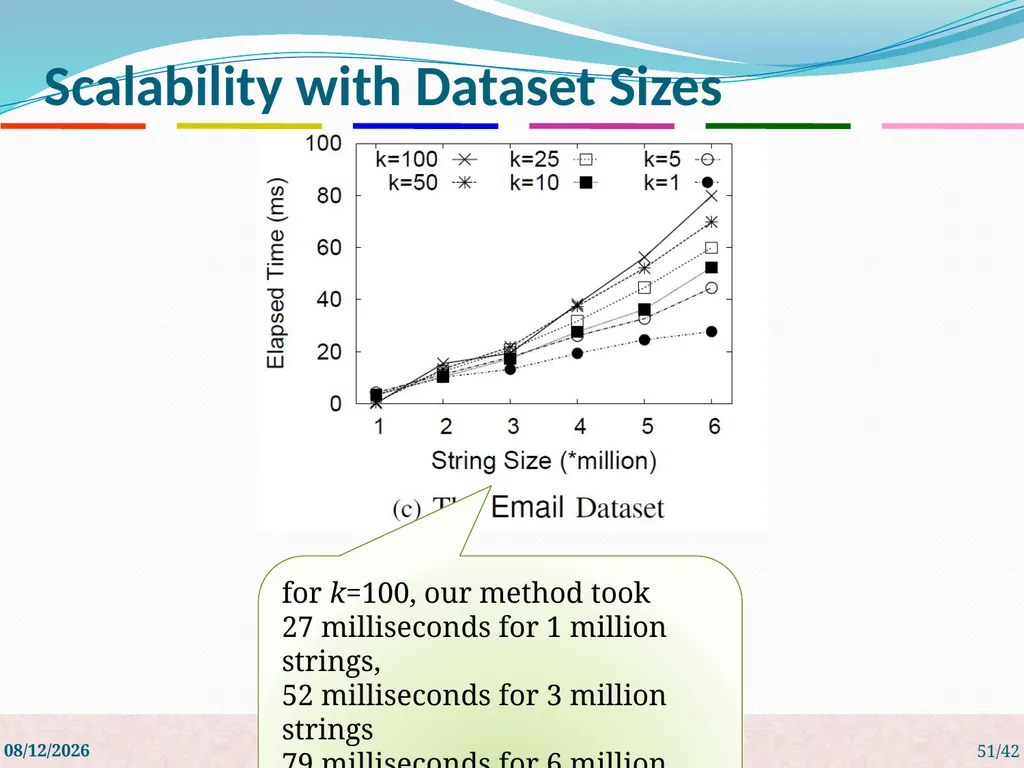
Scalability with Dataset Sizes 4/11/2013 TopkSearch @ ICDE2013 51/42 for k=100, our method took
27 milliseconds for 1 million strings,
52 milliseconds for 3 million strings
79 milliseconds for 6 million strings.<br>
27 milliseconds for 1 million strings,
52 milliseconds for 3 million strings
79 milliseconds for 6 million strings.<br>
52
Outline Motivation
Problem Formulation
Progressive Framework
Pivotal Entry-based Method
Range-based Method
Experiment
Conclusion 4/11/2013 TopkSearch @ ICDE2013 52/42<br>
Problem Formulation
Progressive Framework
Pivotal Entry-based Method
Range-based Method
Experiment
Conclusion 4/11/2013 TopkSearch @ ICDE2013 52/42<br>
53
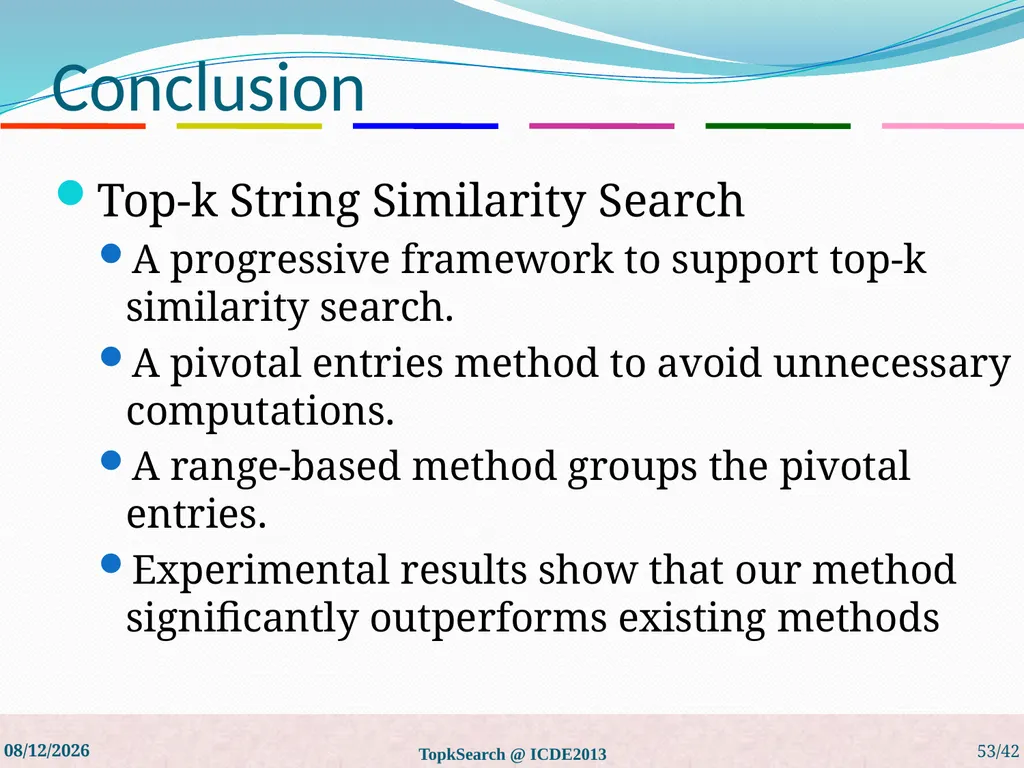
Conclusion Top-k String Similarity Search
A progressive framework to support top-k similarity search.
A pivotal entries method to avoid unnecessary computations.
A range-based method groups the pivotal entries.
Experimental results show that our method significantly outperforms existing methods 4/11/2013 TopkSearch @ ICDE2013 53/42<br>
A progressive framework to support top-k similarity search.
A pivotal entries method to avoid unnecessary computations.
A range-based method groups the pivotal entries.
Experimental results show that our method significantly outperforms existing methods 4/11/2013 TopkSearch @ ICDE2013 53/42<br>
54
Thanks!
Q&A http://dbgroup.cs.tsinghua.edu.cn/dd/projects/topksearch<br>
Q&A http://dbgroup.cs.tsinghua.edu.cn/dd/projects/topksearch<br>