
Top tips for AQA English Language Paper 1 –

Description: Top tips for AQA English Language Paper 1 Question 1 Train students to focus on the appropriate section of the source The examiner is looking for a list no inference or analysis is needed (or desired) Students need to list 4 facts Train
Related Topics
Download Presentation
"Top tips for AQA English Language Paper 1 –" is the property of its rightful owner. Permission is granted to download and print the materials on this website for personal, non-commercial use only, and to display it on your personal computer provided you do not modify the materials and that you retain all copyright notices contained in the materials. By downloading content from our website, you accept the terms of this agreement.
Presentation Transcript
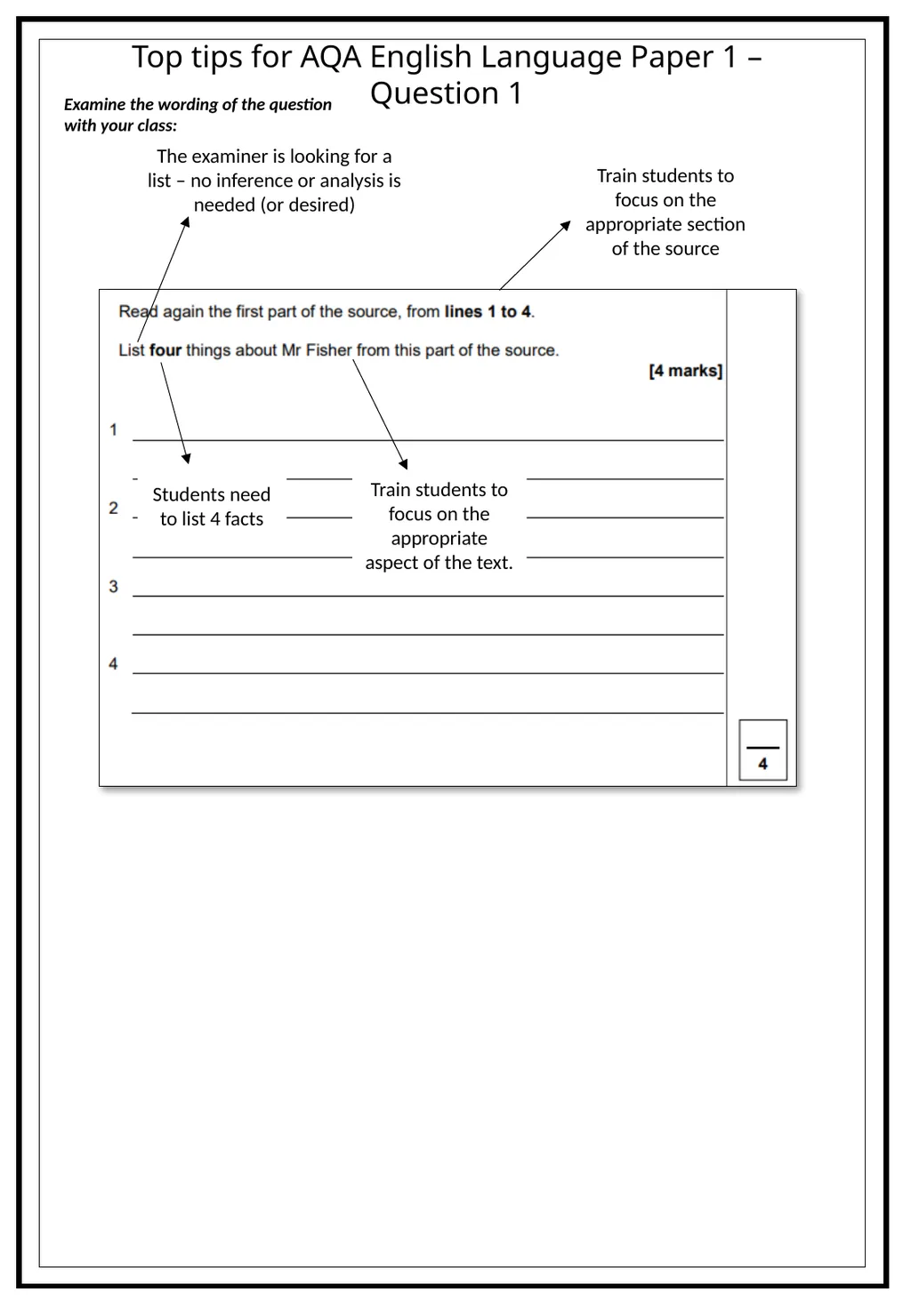
slide1. Top tips for AQA English Language Paper 1 – Question 1 Train students to focus on the appropriate section of the source The examiner is looking for a list – no inference or analysis is needed (or desired) Students need to list 4 facts Train students to focus on the appropriate aspect of the text. Examine the wording of the question with your class:<br>
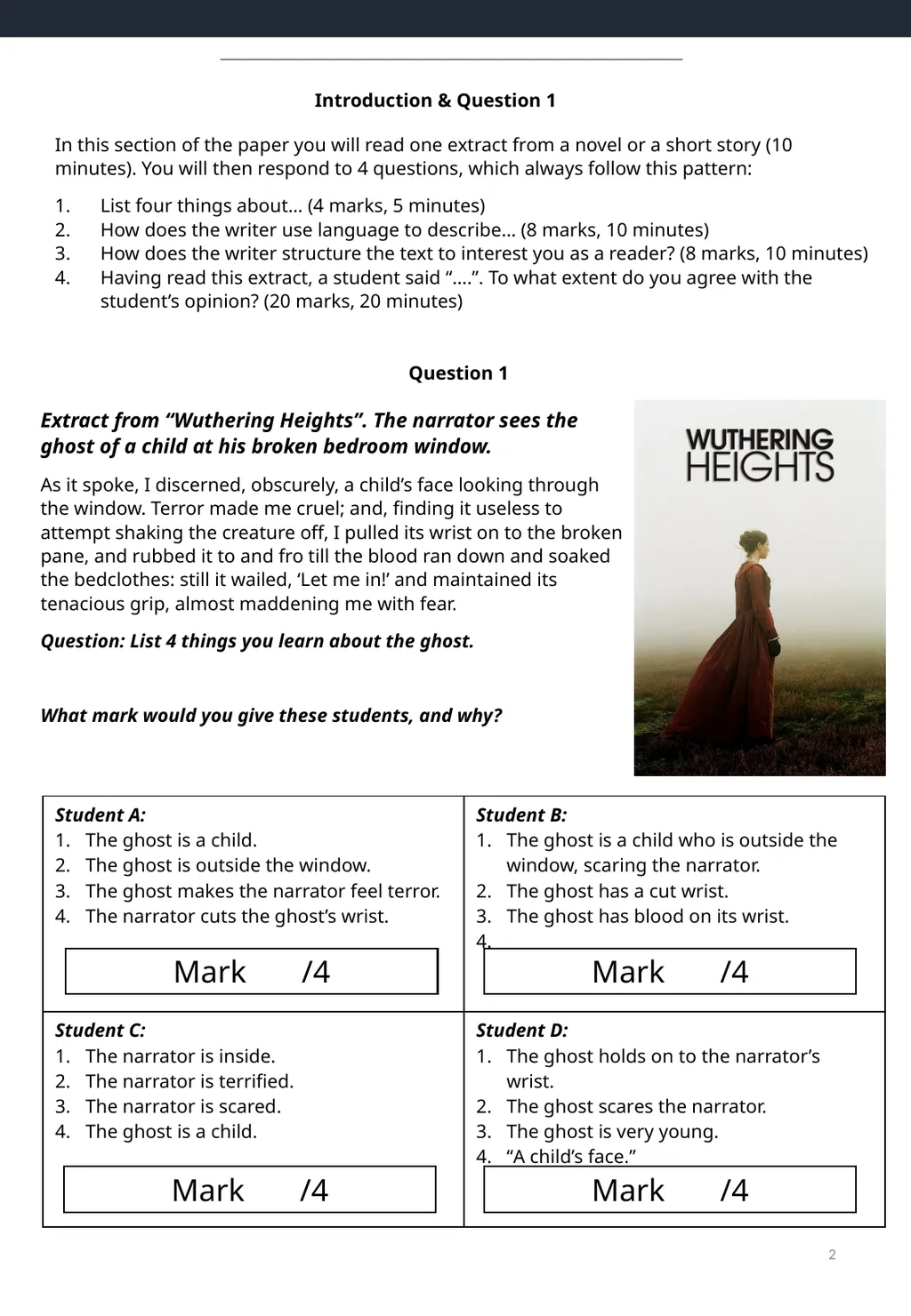
slide2. Introduction & Question 1 2 In this section of the paper you will read one extract from a novel or a short story (10 minutes). You will then respond to 4 questions, which always follow this pattern:
List four things about… (4 marks, 5 minutes)
How does the writer use language to describe… (8 marks, 10 minutes)
How does the writer structure the text to interest you as a reader? (8 marks, 10 minutes)
Having read this extract, a student said “….”. To what extent do you agree with the student’s opinion? (20 marks, 20 minutes) Question 1 Extract from “Wuthering Heights”. The narrator sees the ghost of a child at his broken bedroom window.
As it spoke, I discerned, obscurely, a child’s face looking through the window. Terror made me cruel; and, finding it useless to attempt shaking the creature off, I pulled its wrist on to the broken pane, and rubbed it to and fro till the blood ran down and soaked the bedclothes: still it wailed, ‘Let me in!’ and maintained its tenacious grip, almost maddening me with fear.
Question: List 4 things you learn about the ghost.
What mark would you give these students, and why? Mark /4 Mark /4 Mark /4 Mark /4<br>
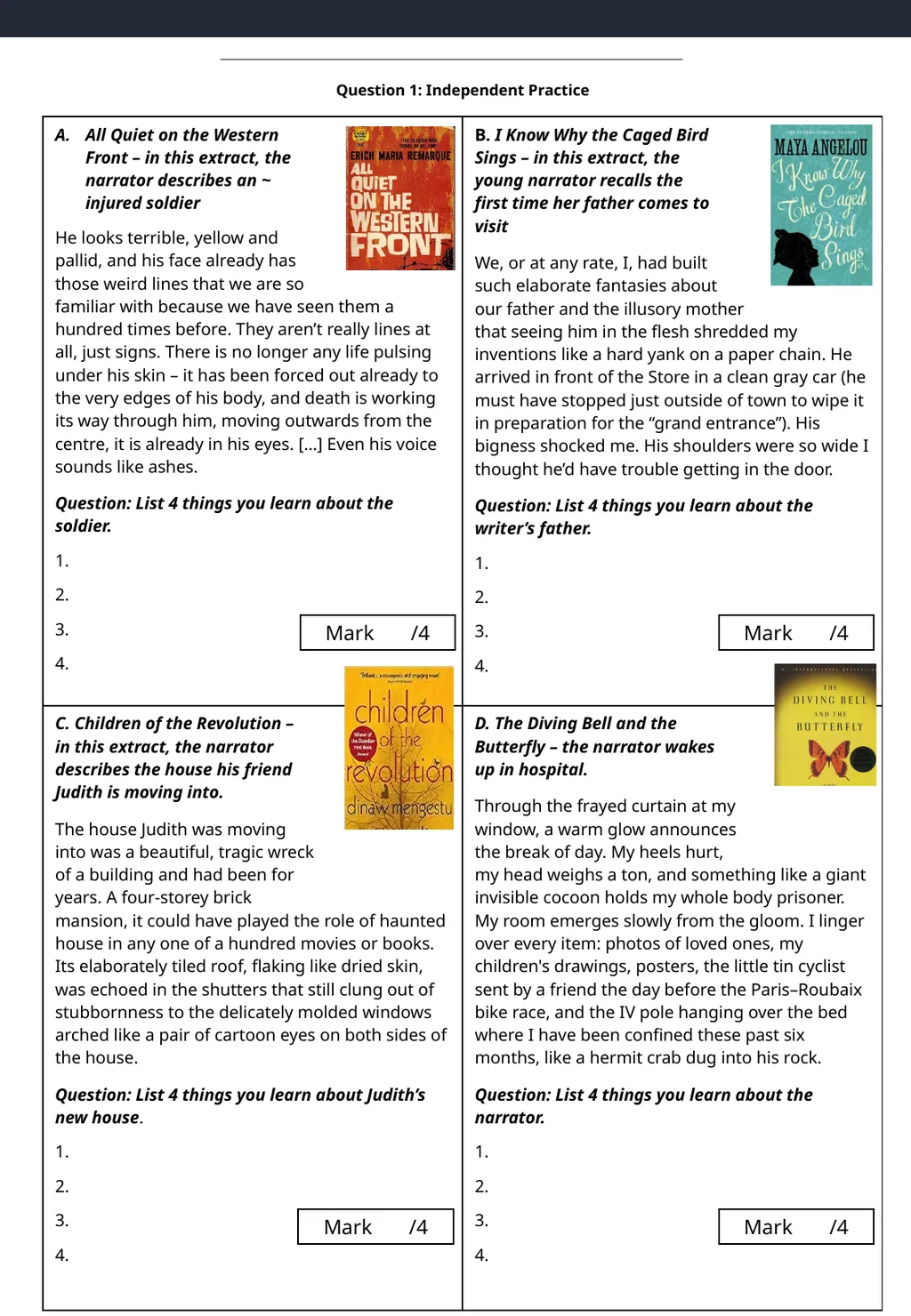
slide3. 3 Question 1: Independent Practice Mark /4 Mark /4 Mark /4 Mark /4<br>
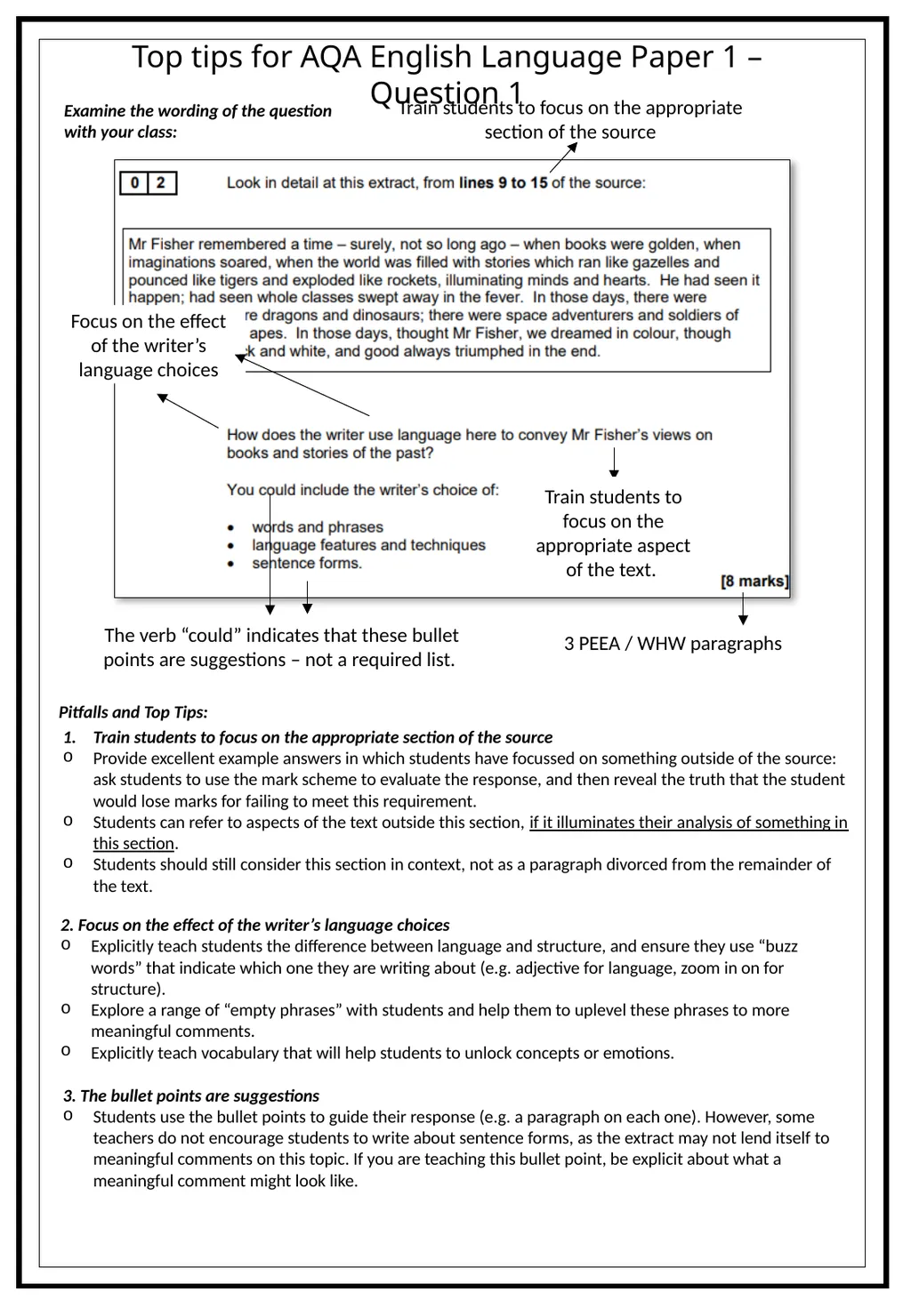
slide4. Top tips for AQA English Language Paper 1 – Question 1 Train students to focus on the appropriate section of the source Focus on the effect of the writer’s language choices Train students to focus on the appropriate aspect of the text. The verb “could” indicates that these bullet points are suggestions – not a required list. 3 PEEA / WHW paragraphs Examine the wording of the question with your class: Pitfalls and Top Tips: Train students to focus on the appropriate section of the source
Provide excellent example answers in which students have focussed on something outside of the source: ask students to use the mark scheme to evaluate the response, and then reveal the truth that the student would lose marks for failing to meet this requirement.
Students can refer to aspects of the text outside this section, if it illuminates their analysis of something in this section.
Students should still consider this section in context, not as a paragraph divorced from the remainder of the text. 2. Focus on the effect of the writer’s language choices
Explicitly teach students the difference between language and structure, and ensure they use “buzz words” that indicate which one they are writing about (e.g. adjective for language, zoom in on for structure).
Explore a range of “empty phrases” with students and help them to uplevel these phrases to more meaningful comments.
Explicitly teach vocabulary that will help students to unlock concepts or emotions. 3. The bullet points are suggestions
Students use the bullet points to guide their response (e.g. a paragraph on each one). However, some teachers do not encourage students to write about sentence forms, as the extract may not lend itself to meaningful comments on this topic. If you are teaching this bullet point, be explicit about what a meaningful comment might look like.<br>
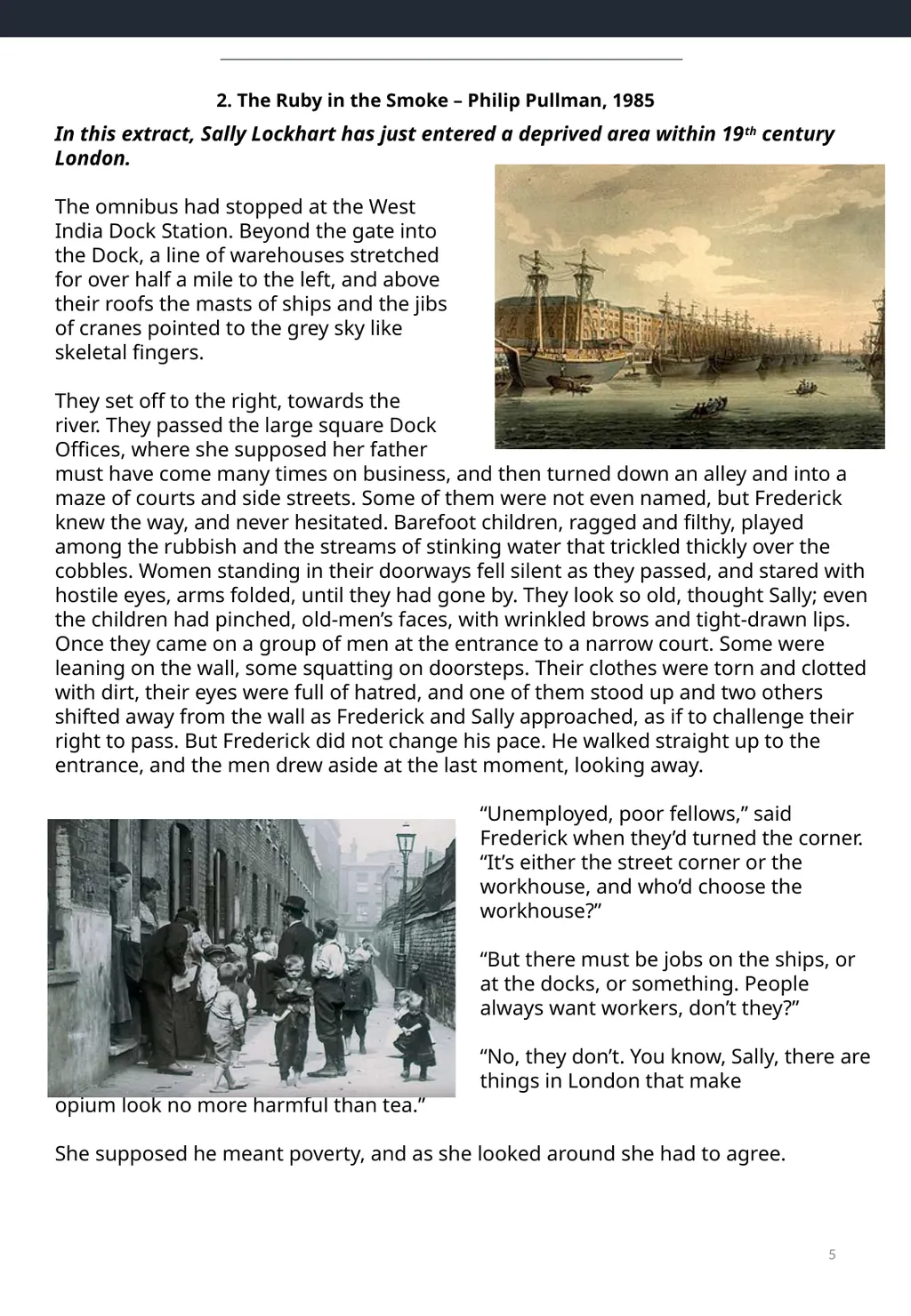
slide5. 2. The Ruby in the Smoke – Philip Pullman, 1985 In this extract, Sally Lockhart has just entered a deprived area within 19th century London.
The omnibus had stopped at the West
India Dock Station. Beyond the gate into
the Dock, a line of warehouses stretched
for over half a mile to the left, and above
their roofs the masts of ships and the jibs
of cranes pointed to the grey sky like
skeletal fingers.
They set off to the right, towards the
river. They passed the large square Dock
Offices, where she supposed her father
must have come many times on business, and then turned down an alley and into a maze of courts and side streets. Some of them were not even named, but Frederick knew the way, and never hesitated. Barefoot children, ragged and filthy, played among the rubbish and the streams of stinking water that trickled thickly over the cobbles. Women standing in their doorways fell silent as they passed, and stared with hostile eyes, arms folded, until they had gone by. They look so old, thought Sally; even the children had pinched, old-men’s faces, with wrinkled brows and tight-drawn lips. Once they came on a group of men at the entrance to a narrow court. Some were leaning on the wall, some squatting on doorsteps. Their clothes were torn and clotted with dirt, their eyes were full of hatred, and one of them stood up and two others shifted away from the wall as Frederick and Sally approached, as if to challenge their right to pass. But Frederick did not change his pace. He walked straight up to the entrance, and the men drew aside at the last moment, looking away.
“Unemployed, poor fellows,” said Frederick when they’d turned the corner. “It’s either the street corner or the workhouse, and who’d choose the workhouse?”
“But there must be jobs on the ships, or at the docks, or something. People always want workers, don’t they?”
“No, they don’t. You know, Sally, there are things in London that make
opium look no more harmful than tea.”
She supposed he meant poverty, and as she looked around she had to agree. 5<br>
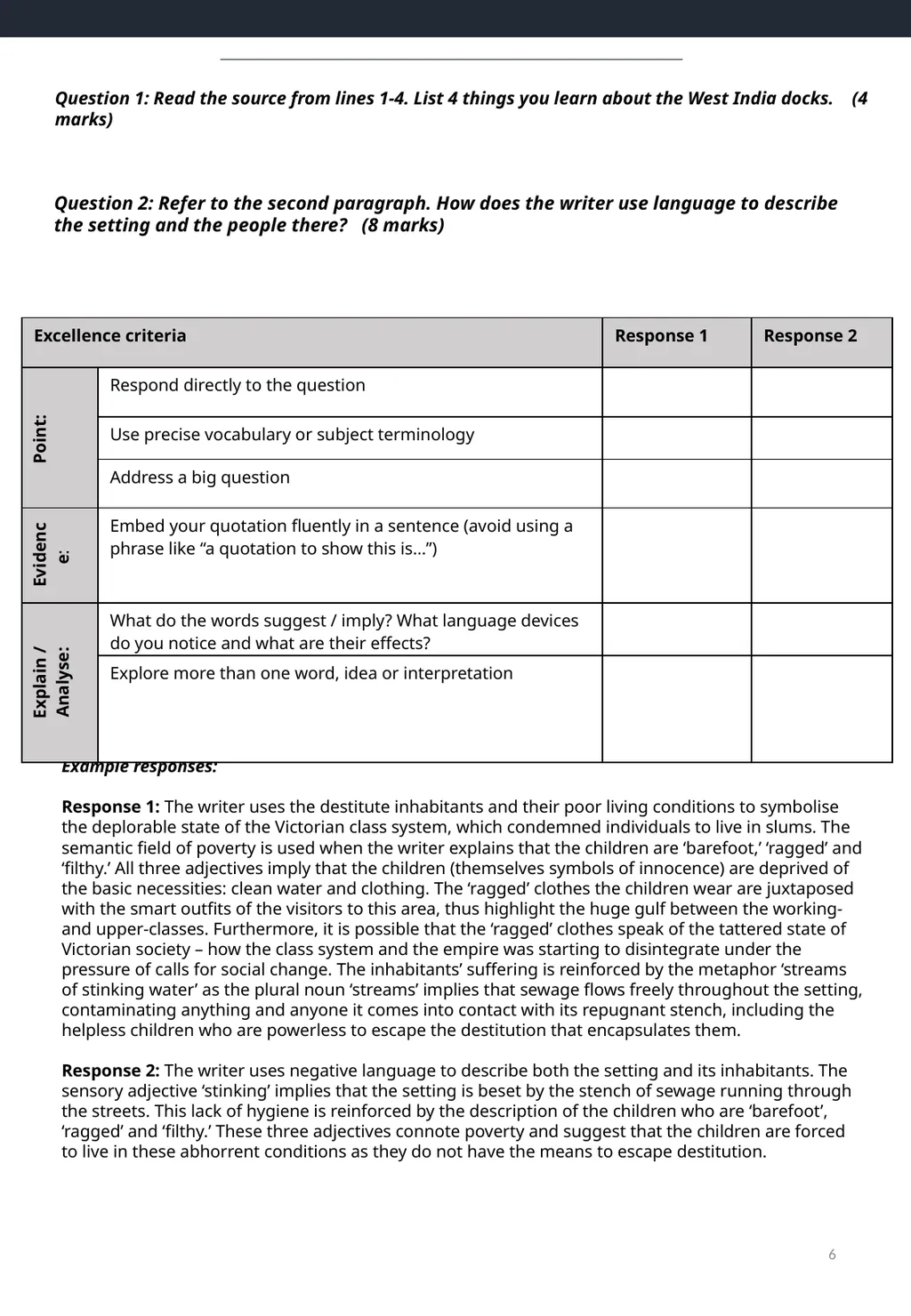
slide6. Question 1: Read the source from lines 1-4. List 4 things you learn about the West India docks. (4 marks) 6 Example responses:
Response 1: The writer uses the destitute inhabitants and their poor living conditions to symbolise the deplorable state of the Victorian class system, which condemned individuals to live in slums. The semantic field of poverty is used when the writer explains that the children are ‘barefoot,’ ‘ragged’ and ‘filthy.’ All three adjectives imply that the children (themselves symbols of innocence) are deprived of the basic necessities: clean water and clothing. The ‘ragged’ clothes the children wear are juxtaposed with the smart outfits of the visitors to this area, thus highlight the huge gulf between the working- and upper-classes. Furthermore, it is possible that the ‘ragged’ clothes speak of the tattered state of Victorian society – how the class system and the empire was starting to disintegrate under the pressure of calls for social change. The inhabitants’ suffering is reinforced by the metaphor ‘streams of stinking water’ as the plural noun ‘streams’ implies that sewage flows freely throughout the setting, contaminating anything and anyone it comes into contact with its repugnant stench, including the helpless children who are powerless to escape the destitution that encapsulates them.
Response 2: The writer uses negative language to describe both the setting and its inhabitants. The sensory adjective ‘stinking’ implies that the setting is beset by the stench of sewage running through the streets. This lack of hygiene is reinforced by the description of the children who are ‘barefoot’, ‘ragged’ and ‘filthy.’ These three adjectives connote poverty and suggest that the children are forced to live in these abhorrent conditions as they do not have the means to escape destitution. Question 2: Refer to the second paragraph. How does the writer use language to describe the setting and the people there? (8 marks)<br>
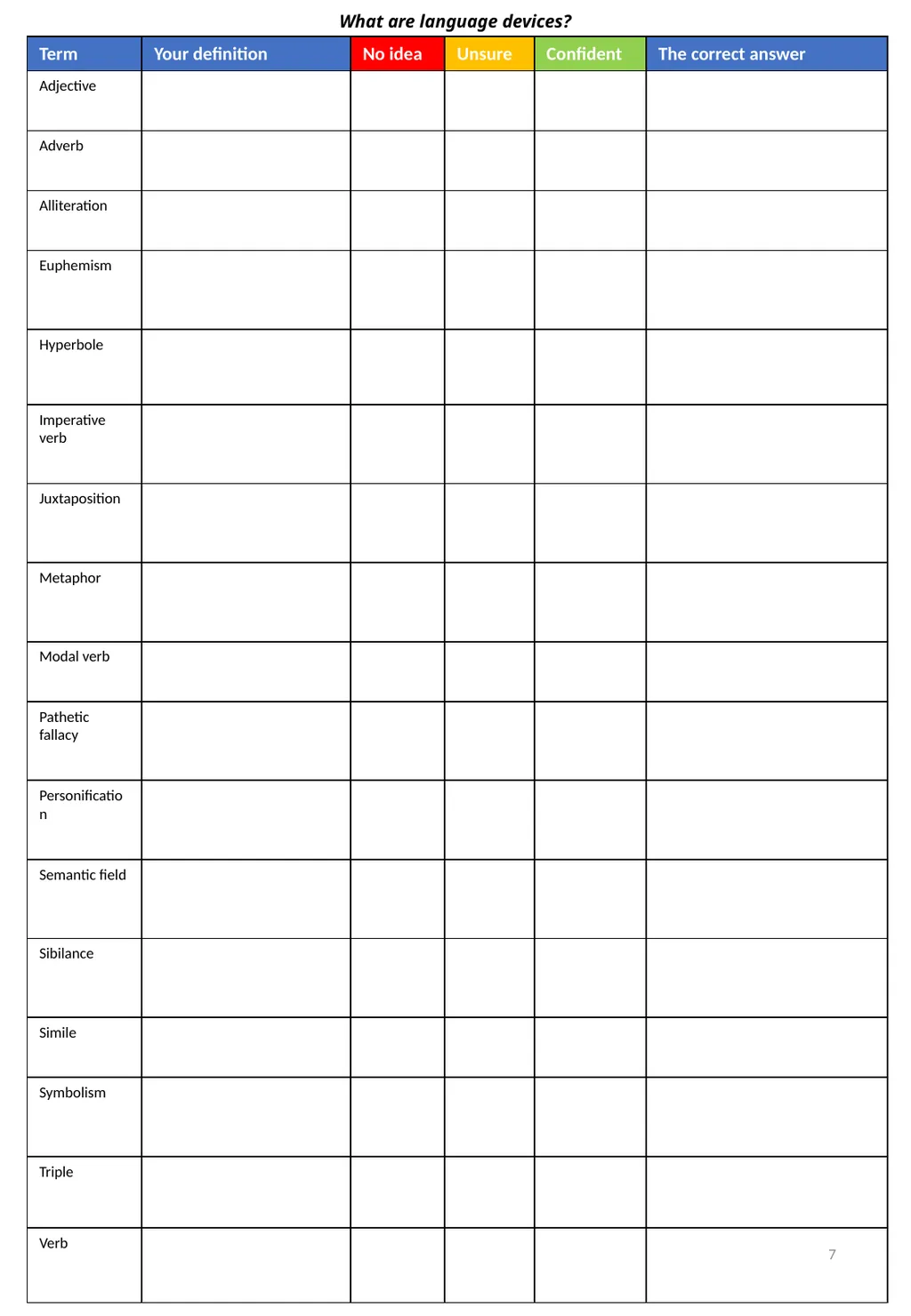
slide7. 7 What are language devices?<br>
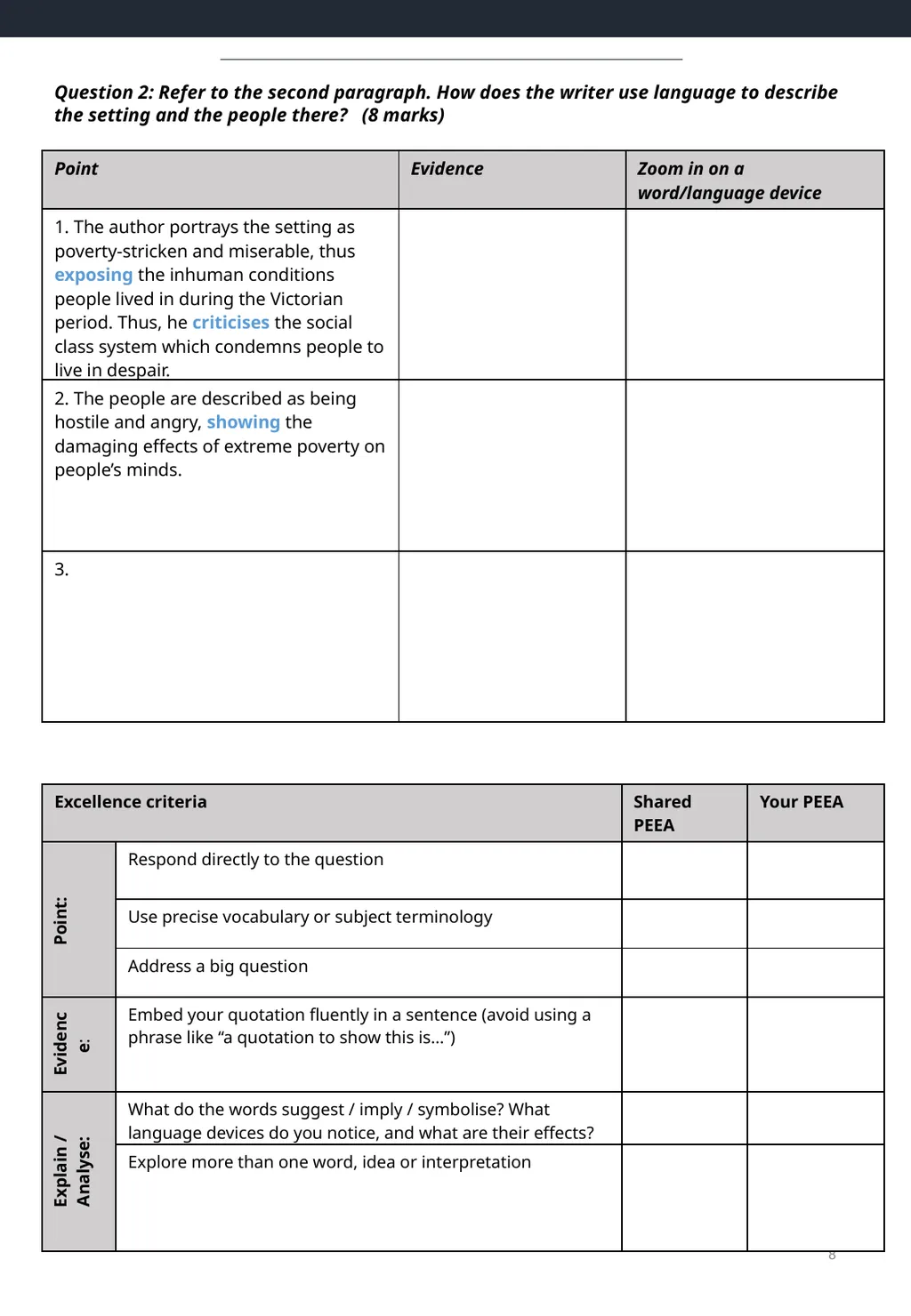
slide8. 8 Question 2: Refer to the second paragraph. How does the writer use language to describe the setting and the people there? (8 marks)<br>
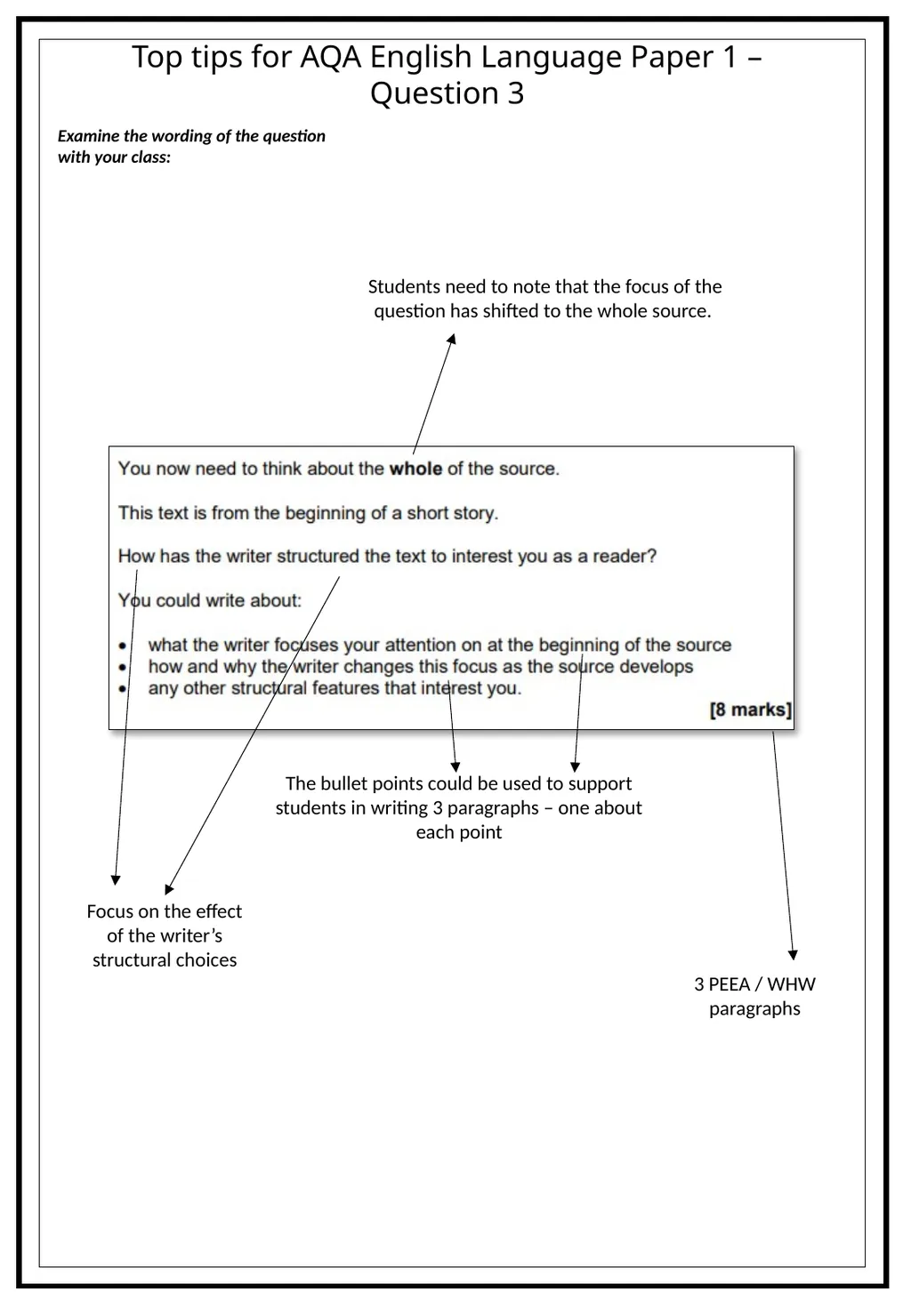
slide9. Top tips for AQA English Language Paper 1 – Question 3 Students need to note that the focus of the question has shifted to the whole source. Examine the wording of the question with your class: Focus on the effect of the writer’s structural choices The bullet points could be used to support students in writing 3 paragraphs – one about each point 3 PEEA / WHW paragraphs<br>
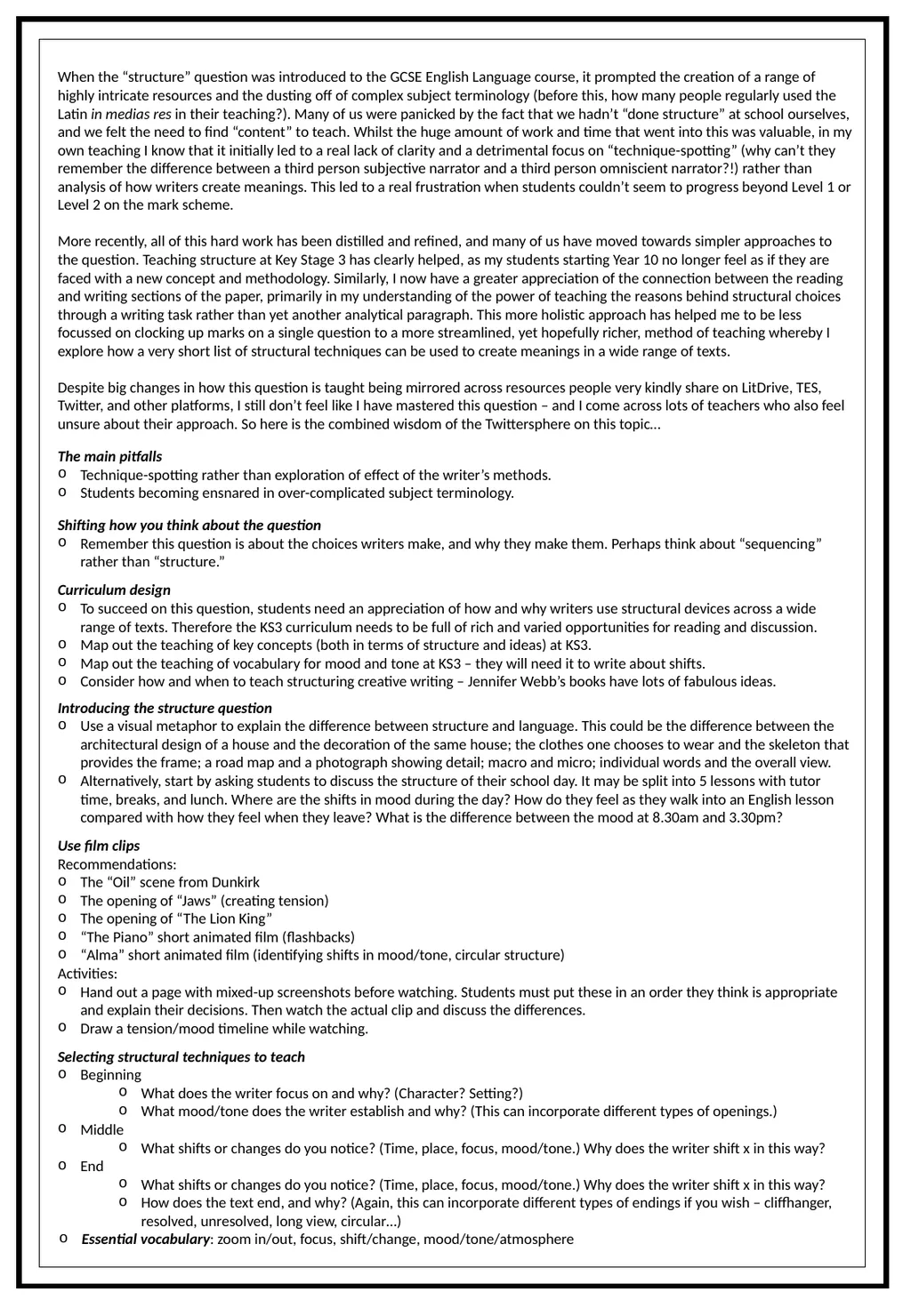
slide10. When the “structure” question was introduced to the GCSE English Language course, it prompted the creation of a range of highly intricate resources and the dusting off of complex subject terminology (before this, how many people regularly used the Latin in medias res in their teaching?). Many of us were panicked by the fact that we hadn’t “done structure” at school ourselves, and we felt the need to find “content” to teach. Whilst the huge amount of work and time that went into this was valuable, in my own teaching I know that it initially led to a real lack of clarity and a detrimental focus on “technique-spotting” (why can’t they remember the difference between a third person subjective narrator and a third person omniscient narrator?!) rather than analysis of how writers create meanings. This led to a real frustration when students couldn’t seem to progress beyond Level 1 or Level 2 on the mark scheme.
More recently, all of this hard work has been distilled and refined, and many of us have moved towards simpler approaches to the question. Teaching structure at Key Stage 3 has clearly helped, as my students starting Year 10 no longer feel as if they are faced with a new concept and methodology. Similarly, I now have a greater appreciation of the connection between the reading and writing sections of the paper, primarily in my understanding of the power of teaching the reasons behind structural choices through a writing task rather than yet another analytical paragraph. This more holistic approach has helped me to be less focussed on clocking up marks on a single question to a more streamlined, yet hopefully richer, method of teaching whereby I explore how a very short list of structural techniques can be used to create meanings in a wide range of texts.
Despite big changes in how this question is taught being mirrored across resources people very kindly share on LitDrive, TES, Twitter, and other platforms, I still don’t feel like I have mastered this question – and I come across lots of teachers who also feel unsure about their approach. So here is the combined wisdom of the Twittersphere on this topic…
The main pitfalls
Technique-spotting rather than exploration of effect of the writer’s methods.
Students becoming ensnared in over-complicated subject terminology.
Shifting how you think about the question
Remember this question is about the choices writers make, and why they make them. Perhaps think about “sequencing” rather than “structure.”
Curriculum design
To succeed on this question, students need an appreciation of how and why writers use structural devices across a wide range of texts. Therefore the KS3 curriculum needs to be full of rich and varied opportunities for reading and discussion.
Map out the teaching of key concepts (both in terms of structure and ideas) at KS3.
Map out the teaching of vocabulary for mood and tone at KS3 – they will need it to write about shifts.
Consider how and when to teach structuring creative writing – Jennifer Webb’s books have lots of fabulous ideas.
Introducing the structure question
Use a visual metaphor to explain the difference between structure and language. This could be the difference between the architectural design of a house and the decoration of the same house; the clothes one chooses to wear and the skeleton that provides the frame; a road map and a photograph showing detail; macro and micro; individual words and the overall view.
Alternatively, start by asking students to discuss the structure of their school day. It may be split into 5 lessons with tutor time, breaks, and lunch. Where are the shifts in mood during the day? How do they feel as they walk into an English lesson compared with how they feel when they leave? What is the difference between the mood at 8.30am and 3.30pm?
Use film clips
Recommendations:
The “Oil” scene from Dunkirk
The opening of “Jaws” (creating tension)
The opening of “The Lion King”
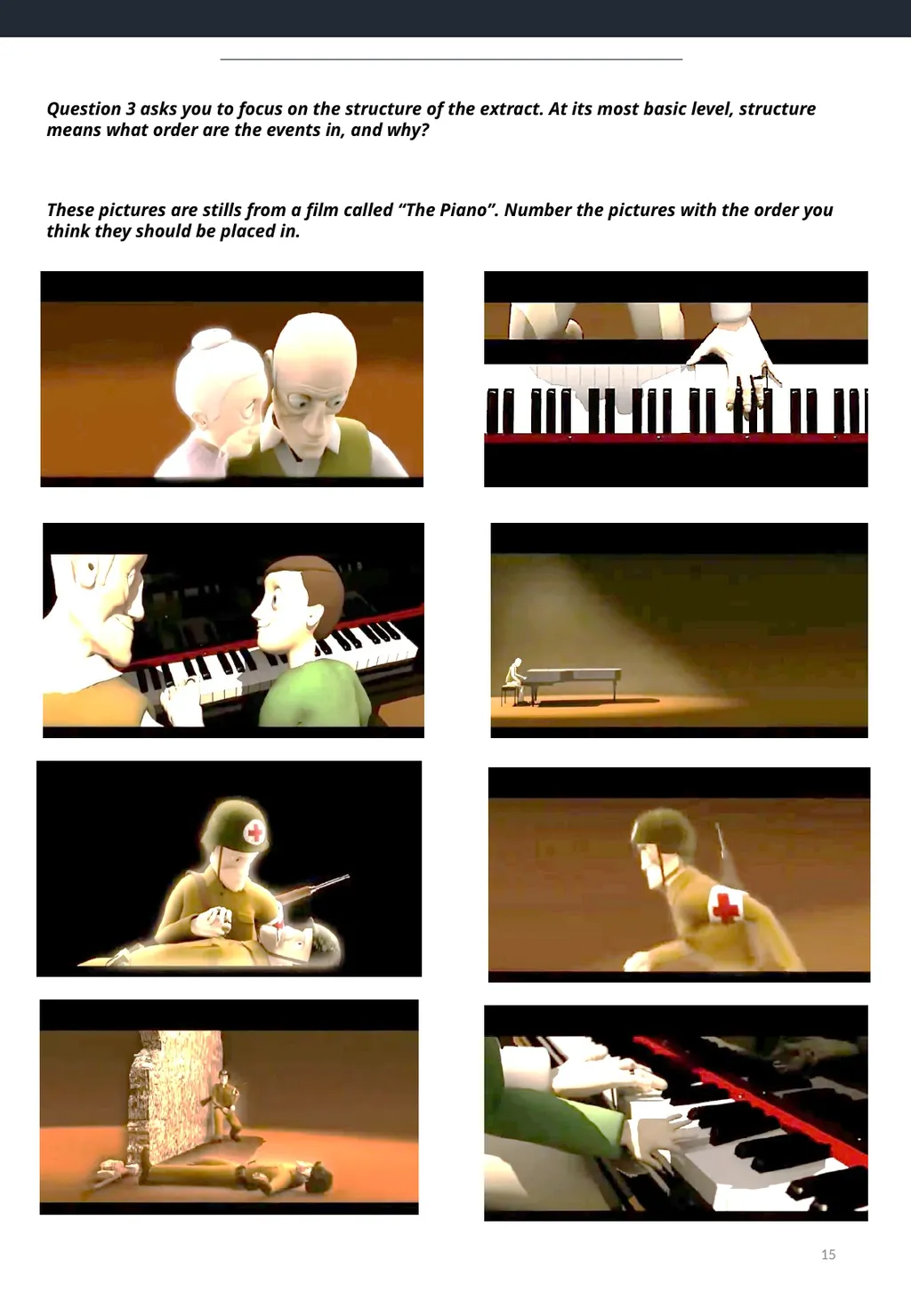
“The Piano” short animated film (flashbacks)
“Alma” short animated film (identifying shifts in mood/tone, circular structure)
Activities:
Hand out a page with mixed-up screenshots before watching. Students must put these in an order they think is appropriate and explain their decisions. Then watch the actual clip and discuss the differences.
Draw a tension/mood timeline while watching.
Selecting structural techniques to teach
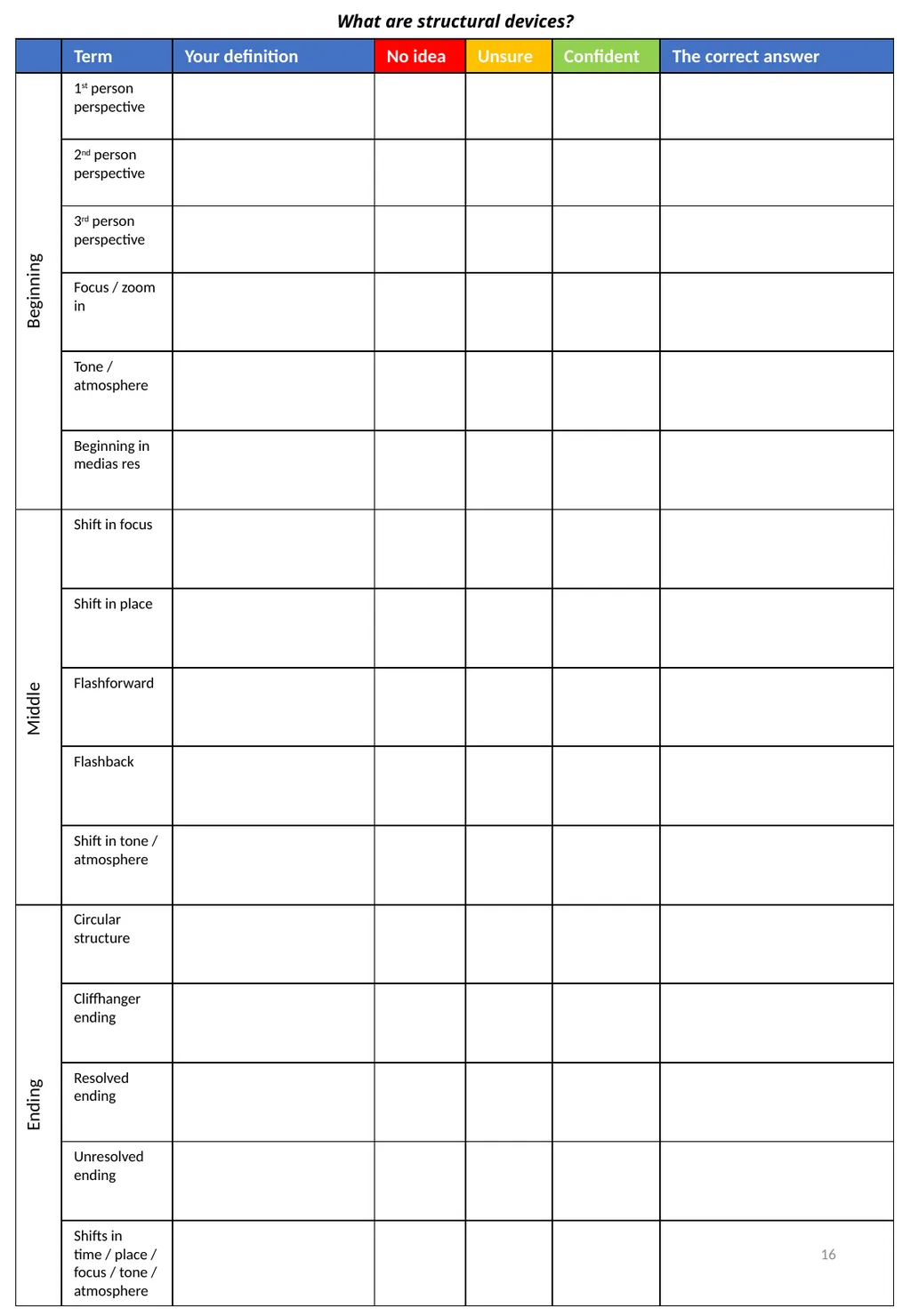
Beginning
What does the writer focus on and why? (Character? Setting?)
What mood/tone does the writer establish and why? (This can incorporate different types of openings.)
Middle
What shifts or changes do you notice? (Time, place, focus, mood/tone.) Why does the writer shift x in this way?
End
What shifts or changes do you notice? (Time, place, focus, mood/tone.) Why does the writer shift x in this way?
How does the text end, and why? (Again, this can incorporate different types of endings if you wish – cliffhanger, resolved, unresolved, long view, circular…)
Essential vocabulary: zoom in/out, focus, shift/change, mood/tone/atmosphere<br>
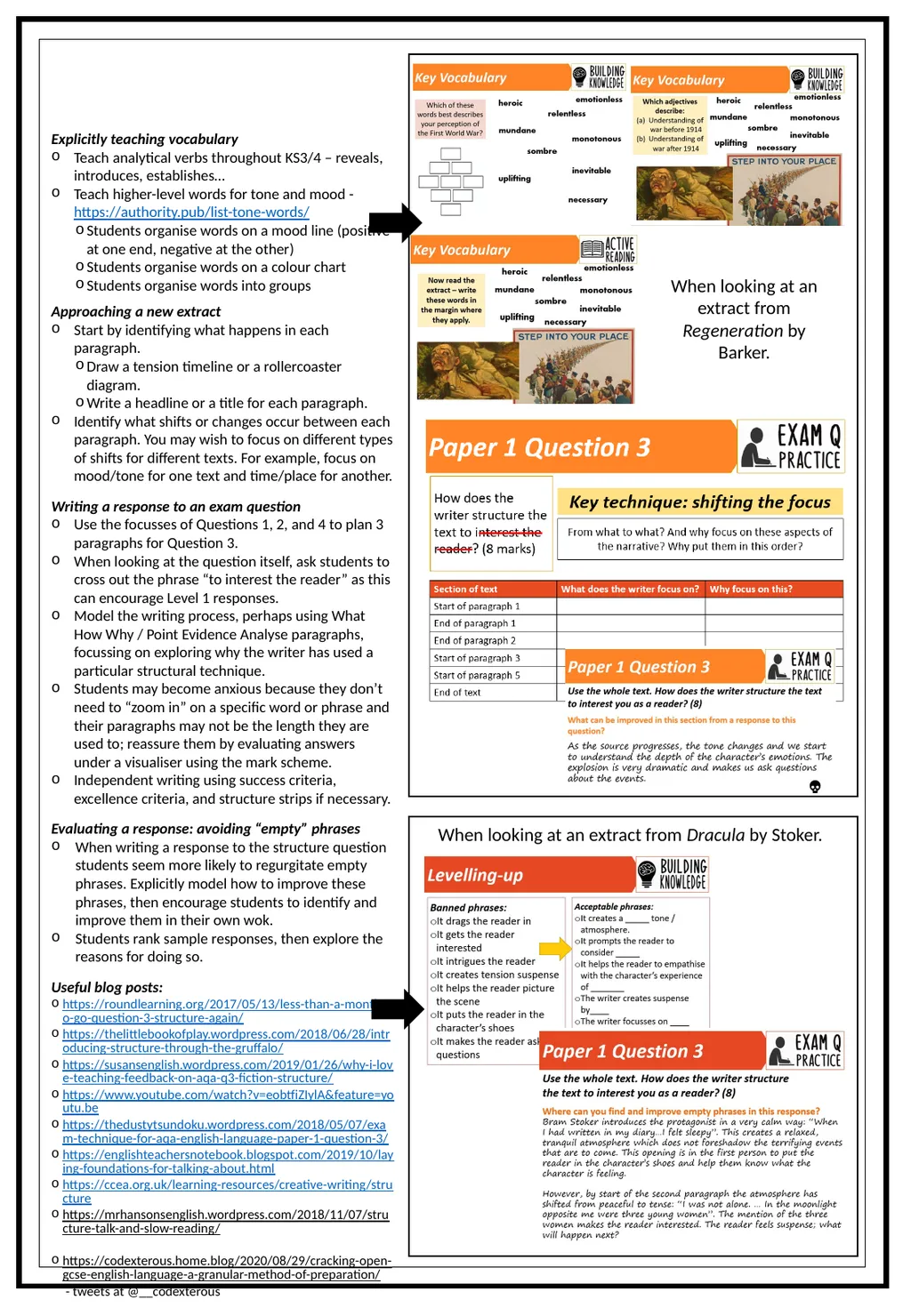
slide11. Explicitly teaching vocabulary
Teach analytical verbs throughout KS3/4 – reveals, introduces, establishes…
Teach higher-level words for tone and mood - https://authority.pub/list-tone-words/
Students organise words on a mood line (positive at one end, negative at the other)
Students organise words on a colour chart
Students organise words into groups
Approaching a new extract
Start by identifying what happens in each paragraph.
Draw a tension timeline or a rollercoaster diagram.
Write a headline or a title for each paragraph.
Identify what shifts or changes occur between each paragraph. You may wish to focus on different types of shifts for different texts. For example, focus on mood/tone for one text and time/place for another.
Writing a response to an exam question
Use the focusses of Questions 1, 2, and 4 to plan 3 paragraphs for Question 3.
When looking at the question itself, ask students to cross out the phrase “to interest the reader” as this can encourage Level 1 responses.
Model the writing process, perhaps using What How Why / Point Evidence Analyse paragraphs, focussing on exploring why the writer has used a particular structural technique.
Students may become anxious because they don’t need to “zoom in” on a specific word or phrase and their paragraphs may not be the length they are used to; reassure them by evaluating answers under a visualiser using the mark scheme.
Independent writing using success criteria, excellence criteria, and structure strips if necessary.
Evaluating a response: avoiding “empty” phrases
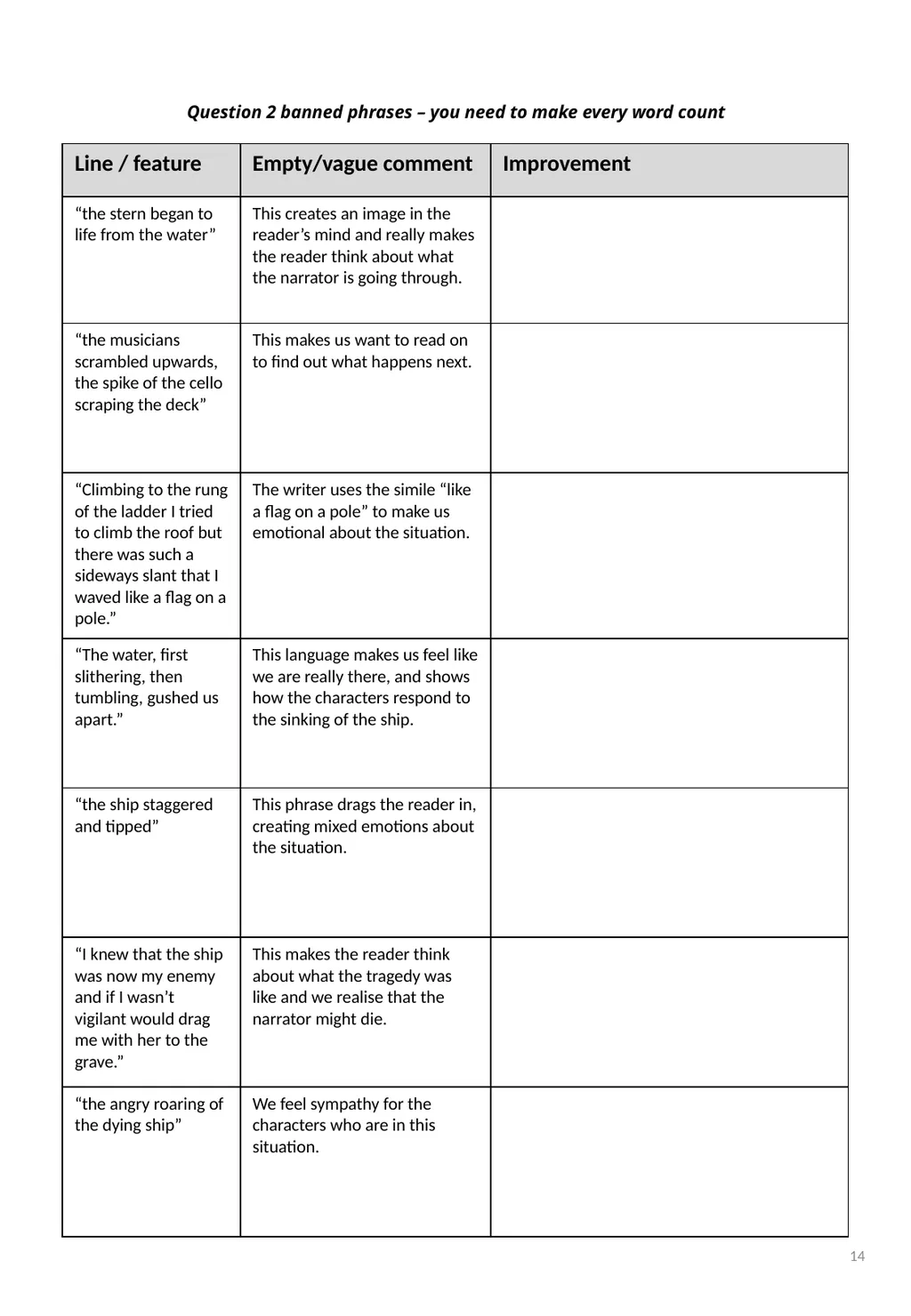
When writing a response to the structure question students seem more likely to regurgitate empty phrases. Explicitly model how to improve these phrases, then encourage students to identify and improve them in their own wok.
Students rank sample responses, then explore the reasons for doing so.
Useful blog posts:
https://roundlearning.org/2017/05/13/less-than-a-month-to-go-question-3-structure-again/
https://thelittlebookofplay.wordpress.com/2018/06/28/introducing-structure-through-the-gruffalo/
https://susansenglish.wordpress.com/2019/01/26/why-i-love-teaching-feedback-on-aqa-q3-fiction-structure/
https://www.youtube.com/watch?v=eobtfiZIylA&feature=youtu.be
https://thedustytsundoku.wordpress.com/2018/05/07/exam-technique-for-aqa-english-language-paper-1-question-3/
https://englishteachersnotebook.blogspot.com/2019/10/laying-foundations-for-talking-about.html
https://ccea.org.uk/learning-resources/creative-writing/structure
https://mrhansonsenglish.wordpress.com/2018/11/07/structure-talk-and-slow-reading/
https://codexterous.home.blog/2020/08/29/cracking-open-gcse-english-language-a-granular-method-of-preparation/ - tweets at @__codexterous When looking at an extract from Regeneration by Barker. When looking at an extract from Dracula by Stoker.<br>
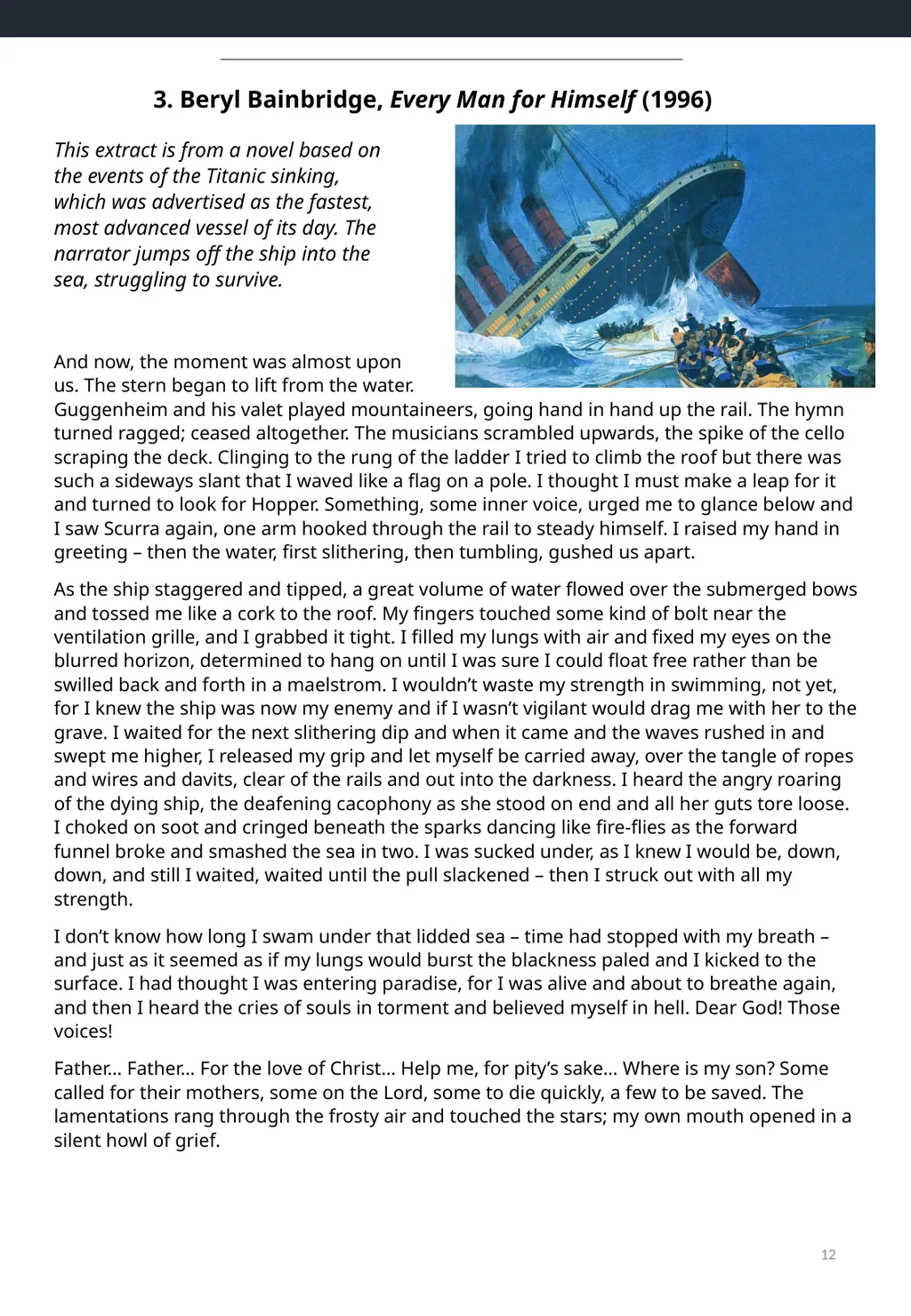
slide12. 3. Beryl Bainbridge, Every Man for Himself (1996) This extract is from a novel based on the events of the Titanic sinking, which was advertised as the fastest, most advanced vessel of its day. The narrator jumps off the ship into the sea, struggling to survive.
And now, the moment was almost upon us. The stern began to lift from the water. Guggenheim and his valet played mountaineers, going hand in hand up the rail. The hymn turned ragged; ceased altogether. The musicians scrambled upwards, the spike of the cello scraping the deck. Clinging to the rung of the ladder I tried to climb the roof but there was such a sideways slant that I waved like a flag on a pole. I thought I must make a leap for it and turned to look for Hopper. Something, some inner voice, urged me to glance below and I saw Scurra again, one arm hooked through the rail to steady himself. I raised my hand in greeting – then the water, first slithering, then tumbling, gushed us apart.
As the ship staggered and tipped, a great volume of water flowed over the submerged bows and tossed me like a cork to the roof. My fingers touched some kind of bolt near the ventilation grille, and I grabbed it tight. I filled my lungs with air and fixed my eyes on the blurred horizon, determined to hang on until I was sure I could float free rather than be swilled back and forth in a maelstrom. I wouldn’t waste my strength in swimming, not yet, for I knew the ship was now my enemy and if I wasn’t vigilant would drag me with her to the grave. I waited for the next slithering dip and when it came and the waves rushed in and swept me higher, I released my grip and let myself be carried away, over the tangle of ropes and wires and davits, clear of the rails and out into the darkness. I heard the angry roaring of the dying ship, the deafening cacophony as she stood on end and all her guts tore loose. I choked on soot and cringed beneath the sparks dancing like fire-flies as the forward funnel broke and smashed the sea in two. I was sucked under, as I knew I would be, down, down, and still I waited, waited until the pull slackened – then I struck out with all my strength.
I don’t know how long I swam under that lidded sea – time had stopped with my breath – and just as it seemed as if my lungs would burst the blackness paled and I kicked to the surface. I had thought I was entering paradise, for I was alive and about to breathe again, and then I heard the cries of souls in torment and believed myself in hell. Dear God! Those voices!
Father… Father… For the love of Christ… Help me, for pity’s sake… Where is my son? Some called for their mothers, some on the Lord, some to die quickly, a few to be saved. The lamentations rang through the frosty air and touched the stars; my own mouth opened in a silent howl of grief. 12<br>
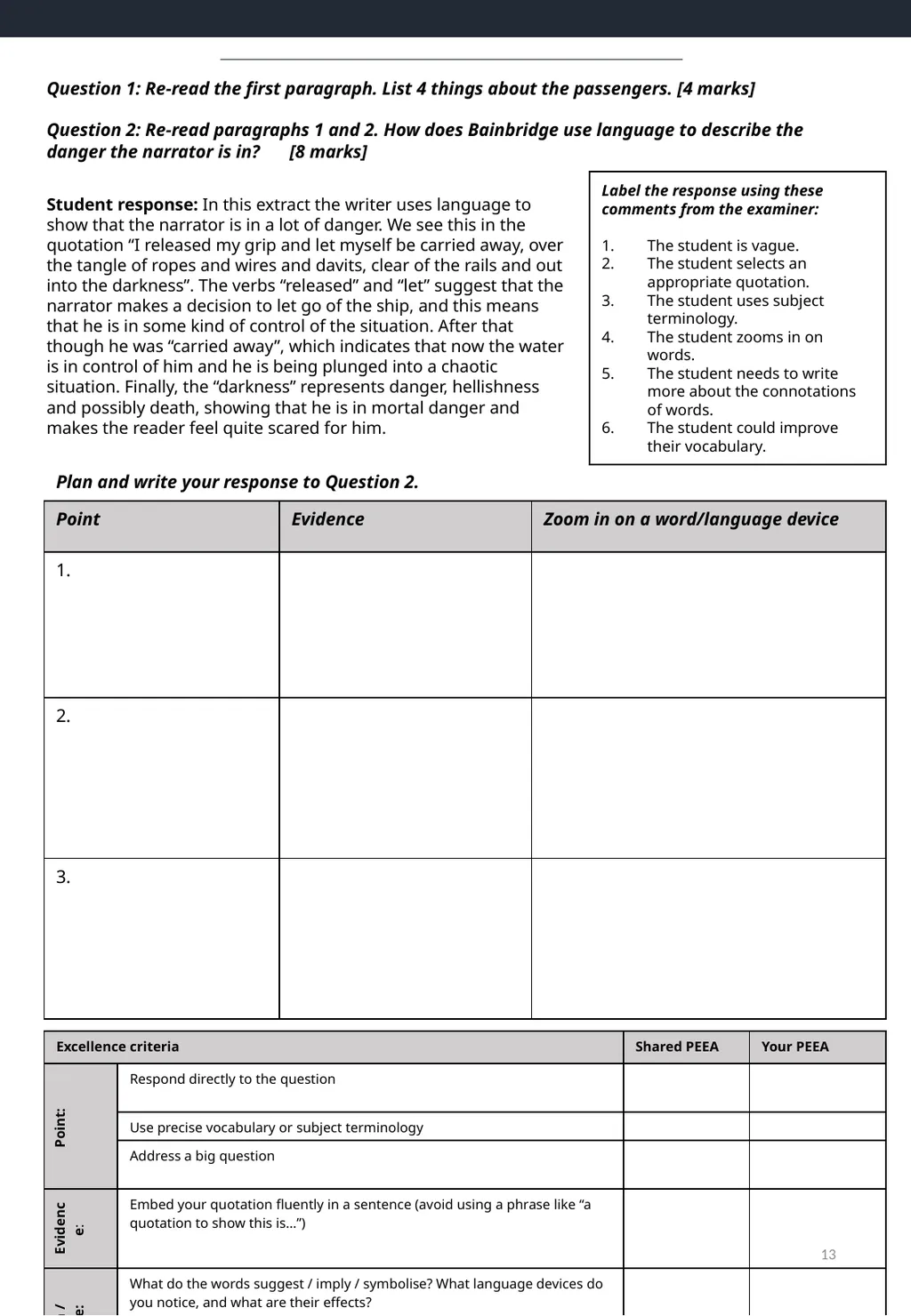
slide13. Question 1: Re-read the first paragraph. List 4 things about the passengers. [4 marks]
Question 2: Re-read paragraphs 1 and 2. How does Bainbridge use language to describe the danger the narrator is in? [8 marks] 13 Student response: In this extract the writer uses language to show that the narrator is in a lot of danger. We see this in the quotation “I released my grip and let myself be carried away, over the tangle of ropes and wires and davits, clear of the rails and out into the darkness”. The verbs “released” and “let” suggest that the narrator makes a decision to let go of the ship, and this means that he is in some kind of control of the situation. After that though he was “carried away”, which indicates that now the water is in control of him and he is being plunged into a chaotic situation. Finally, the “darkness” represents danger, hellishness and possibly death, showing that he is in mortal danger and makes the reader feel quite scared for him. Label the response using these comments from the examiner:
The student is vague.
The student selects an appropriate quotation.
The student uses subject terminology.
The student zooms in on words.
The student needs to write more about the connotations of words.
The student could improve their vocabulary. Plan and write your response to Question 2.<br>
slide14. 14 Question 2 banned phrases – you need to make every word count<br>
slide15. 15 These pictures are stills from a film called “The Piano”. Number the pictures with the order you think they should be placed in. Question 3 asks you to focus on the structure of the extract. At its most basic level, structure means what order are the events in, and why?<br>
slide16. 16 What are structural devices?<br>
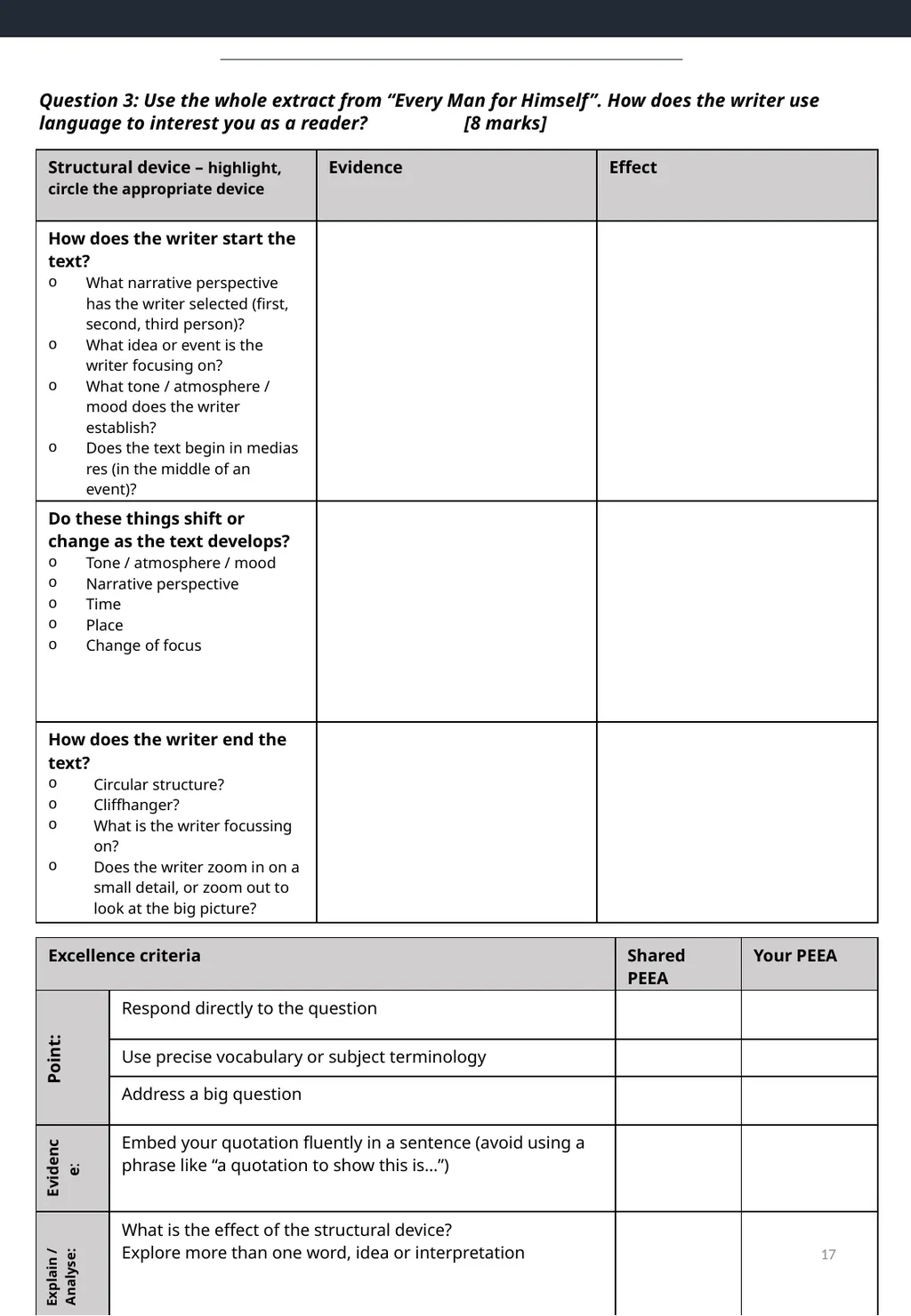
slide17. 17 Question 3: Use the whole extract from “Every Man for Himself”. How does the writer use language to interest you as a reader? [8 marks]<br>
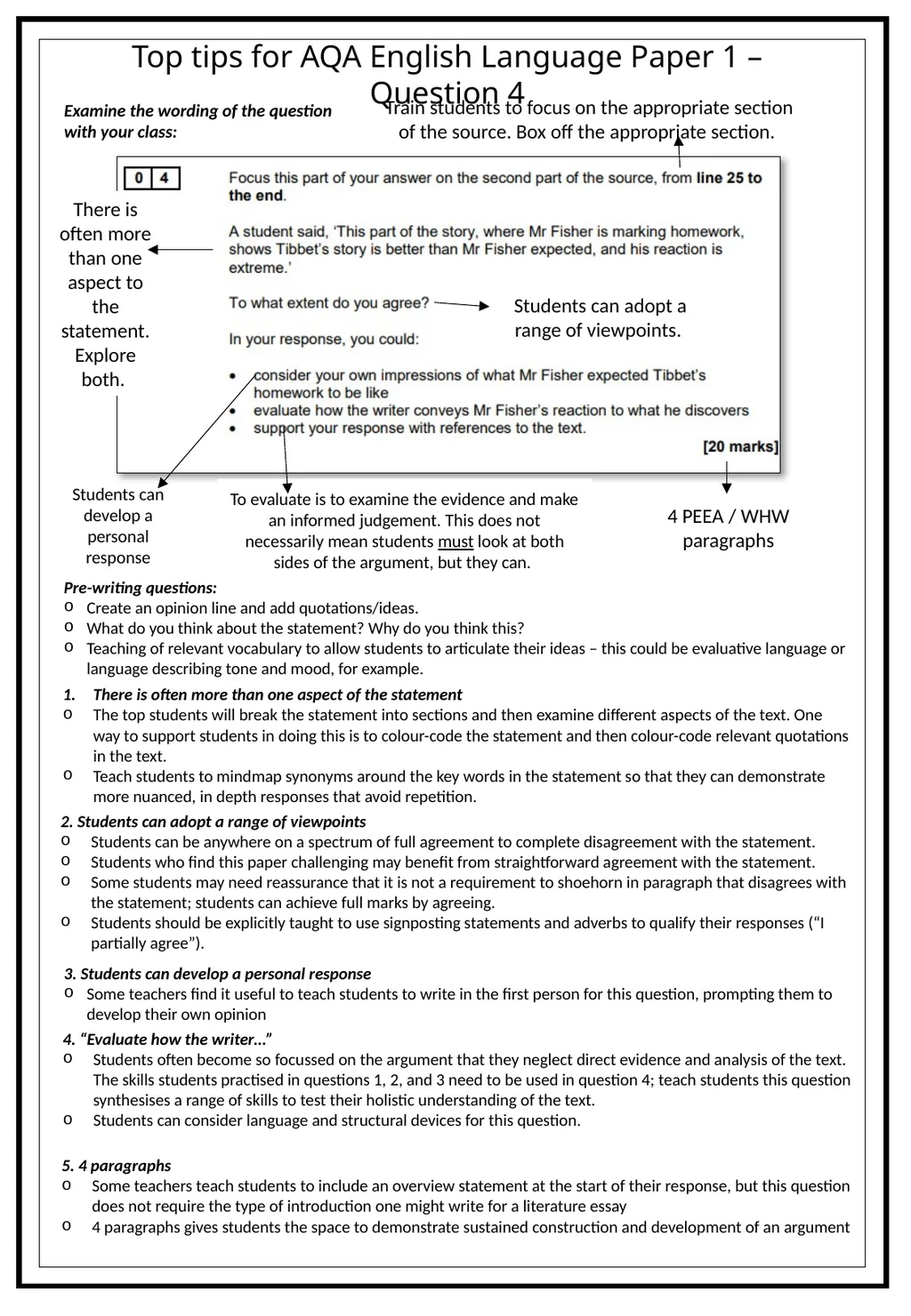
slide18. Top tips for AQA English Language Paper 1 – Question 4 Train students to focus on the appropriate section of the source. Box off the appropriate section. There is often more than one aspect to the statement. Explore both. To evaluate is to examine the evidence and make an informed judgement. This does not necessarily mean students must look at both sides of the argument, but they can. Students can develop a personal response 4 PEEA / WHW paragraphs Examine the wording of the question with your class: There is often more than one aspect of the statement
The top students will break the statement into sections and then examine different aspects of the text. One way to support students in doing this is to colour-code the statement and then colour-code relevant quotations in the text.
Teach students to mindmap synonyms around the key words in the statement so that they can demonstrate more nuanced, in depth responses that avoid repetition. 2. Students can adopt a range of viewpoints
Students can be anywhere on a spectrum of full agreement to complete disagreement with the statement.
Students who find this paper challenging may benefit from straightforward agreement with the statement.
Some students may need reassurance that it is not a requirement to shoehorn in paragraph that disagrees with the statement; students can achieve full marks by agreeing.
Students should be explicitly taught to use signposting statements and adverbs to qualify their responses (“I partially agree”). 4. “Evaluate how the writer…”
Students often become so focussed on the argument that they neglect direct evidence and analysis of the text. The skills students practised in questions 1, 2, and 3 need to be used in question 4; teach students this question synthesises a range of skills to test their holistic understanding of the text.
Students can consider language and structural devices for this question. Students can adopt a range of viewpoints. 3. Students can develop a personal response
Some teachers find it useful to teach students to write in the first person for this question, prompting them to develop their own opinion 5. 4 paragraphs
Some teachers teach students to include an overview statement at the start of their response, but this question does not require the type of introduction one might write for a literature essay
4 paragraphs gives students the space to demonstrate sustained construction and development of an argument Pre-writing questions:
Create an opinion line and add quotations/ideas.
What do you think about the statement? Why do you think this?
Teaching of relevant vocabulary to allow students to articulate their ideas – this could be evaluative language or language describing tone and mood, for example.<br>
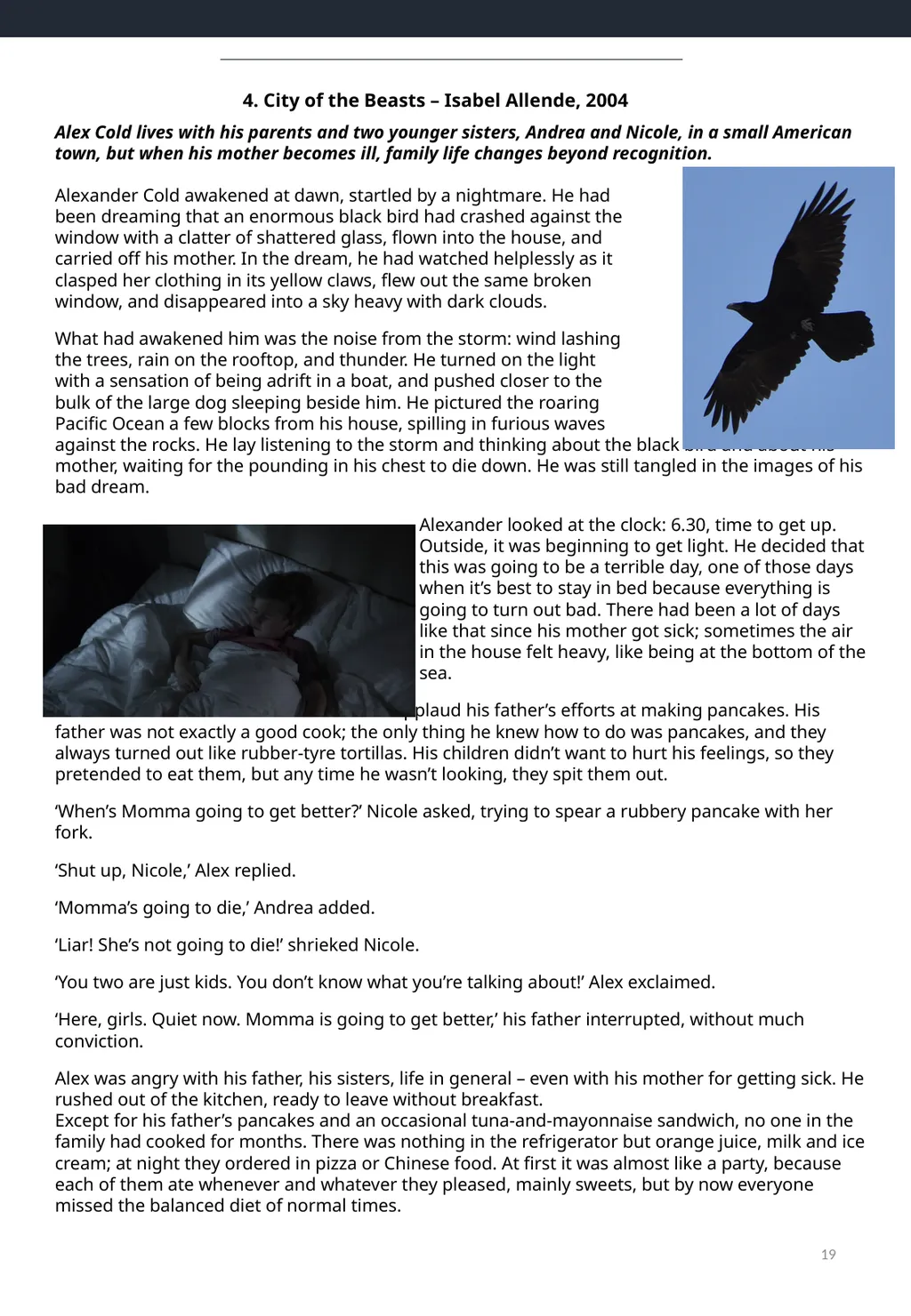
slide19. 4. City of the Beasts – Isabel Allende, 2004 Alex Cold lives with his parents and two younger sisters, Andrea and Nicole, in a small American town, but when his mother becomes ill, family life changes beyond recognition.
Alexander Cold awakened at dawn, startled by a nightmare. He had been dreaming that an enormous black bird had crashed against the window with a clatter of shattered glass, flown into the house, and carried off his mother. In the dream, he had watched helplessly as it clasped her clothing in its yellow claws, flew out the same broken window, and disappeared into a sky heavy with dark clouds.
What had awakened him was the noise from the storm: wind lashing the trees, rain on the rooftop, and thunder. He turned on the light with a sensation of being adrift in a boat, and pushed closer to the bulk of the large dog sleeping beside him. He pictured the roaring Pacific Ocean a few blocks from his house, spilling in furious waves against the rocks. He lay listening to the storm and thinking about the black bird and about his mother, waiting for the pounding in his chest to die down. He was still tangled in the images of his bad dream.
Alexander looked at the clock: 6.30, time to get up. Outside, it was beginning to get light. He decided that this was going to be a terrible day, one of those days when it’s best to stay in bed because everything is going to turn out bad. There had been a lot of days like that since his mother got sick; sometimes the air in the house felt heavy, like being at the bottom of the sea.
At breakfast Alex was not in the mood to applaud his father’s efforts at making pancakes. His father was not exactly a good cook; the only thing he knew how to do was pancakes, and they always turned out like rubber-tyre tortillas. His children didn’t want to hurt his feelings, so they pretended to eat them, but any time he wasn’t looking, they spit them out.
‘When’s Momma going to get better?’ Nicole asked, trying to spear a rubbery pancake with her fork.
‘Shut up, Nicole,’ Alex replied.
‘Momma’s going to die,’ Andrea added.
‘Liar! She’s not going to die!’ shrieked Nicole.
‘You two are just kids. You don’t know what you’re talking about!’ Alex exclaimed.
‘Here, girls. Quiet now. Momma is going to get better,’ his father interrupted, without much conviction.
Alex was angry with his father, his sisters, life in general – even with his mother for getting sick. He rushed out of the kitchen, ready to leave without breakfast.
Except for his father’s pancakes and an occasional tuna-and-mayonnaise sandwich, no one in the family had cooked for months. There was nothing in the refrigerator but orange juice, milk and ice cream; at night they ordered in pizza or Chinese food. At first it was almost like a party, because each of them ate whenever and whatever they pleased, mainly sweets, but by now everyone missed the balanced diet of normal times. 19<br>
slide20. City of the Beasts continued…
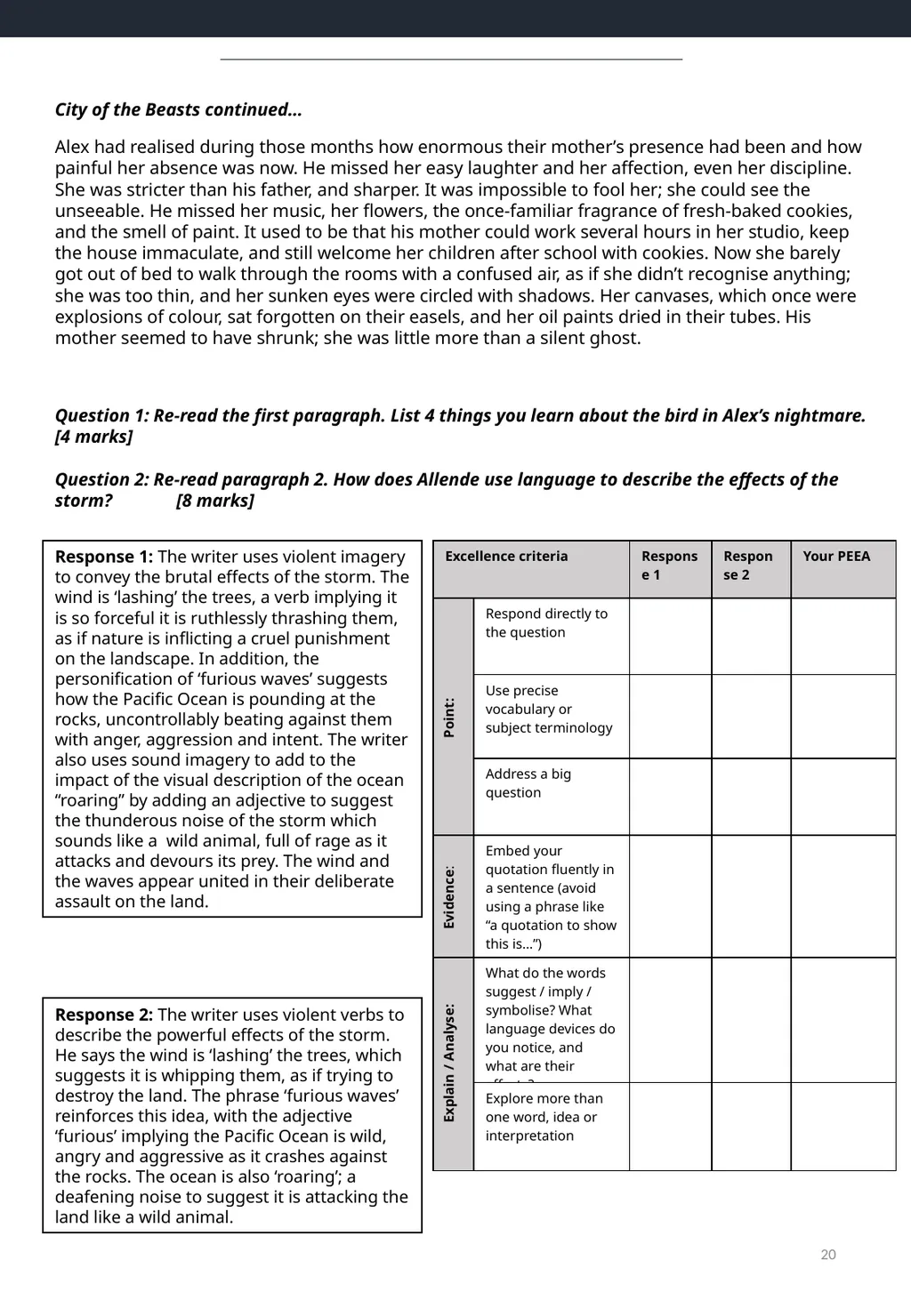
Alex had realised during those months how enormous their mother’s presence had been and how painful her absence was now. He missed her easy laughter and her affection, even her discipline. She was stricter than his father, and sharper. It was impossible to fool her; she could see the unseeable. He missed her music, her flowers, the once-familiar fragrance of fresh-baked cookies, and the smell of paint. It used to be that his mother could work several hours in her studio, keep the house immaculate, and still welcome her children after school with cookies. Now she barely got out of bed to walk through the rooms with a confused air, as if she didn’t recognise anything; she was too thin, and her sunken eyes were circled with shadows. Her canvases, which once were explosions of colour, sat forgotten on their easels, and her oil paints dried in their tubes. His mother seemed to have shrunk; she was little more than a silent ghost. 20 Question 1: Re-read the first paragraph. List 4 things you learn about the bird in Alex’s nightmare. [4 marks]
Question 2: Re-read paragraph 2. How does Allende use language to describe the effects of the storm? [8 marks] Response 1: The writer uses violent imagery to convey the brutal effects of the storm. The wind is ‘lashing’ the trees, a verb implying it is so forceful it is ruthlessly thrashing them, as if nature is inflicting a cruel punishment on the landscape. In addition, the personification of ‘furious waves’ suggests how the Pacific Ocean is pounding at the rocks, uncontrollably beating against them with anger, aggression and intent. The writer also uses sound imagery to add to the impact of the visual description of the ocean “roaring” by adding an adjective to suggest the thunderous noise of the storm which sounds like a wild animal, full of rage as it attacks and devours its prey. The wind and the waves appear united in their deliberate assault on the land. Response 2: The writer uses violent verbs to describe the powerful effects of the storm. He says the wind is ‘lashing’ the trees, which suggests it is whipping them, as if trying to destroy the land. The phrase ‘furious waves’ reinforces this idea, with the adjective ‘furious’ implying the Pacific Ocean is wild, angry and aggressive as it crashes against the rocks. The ocean is also ‘roaring’; a deafening noise to suggest it is attacking the land like a wild animal.<br>
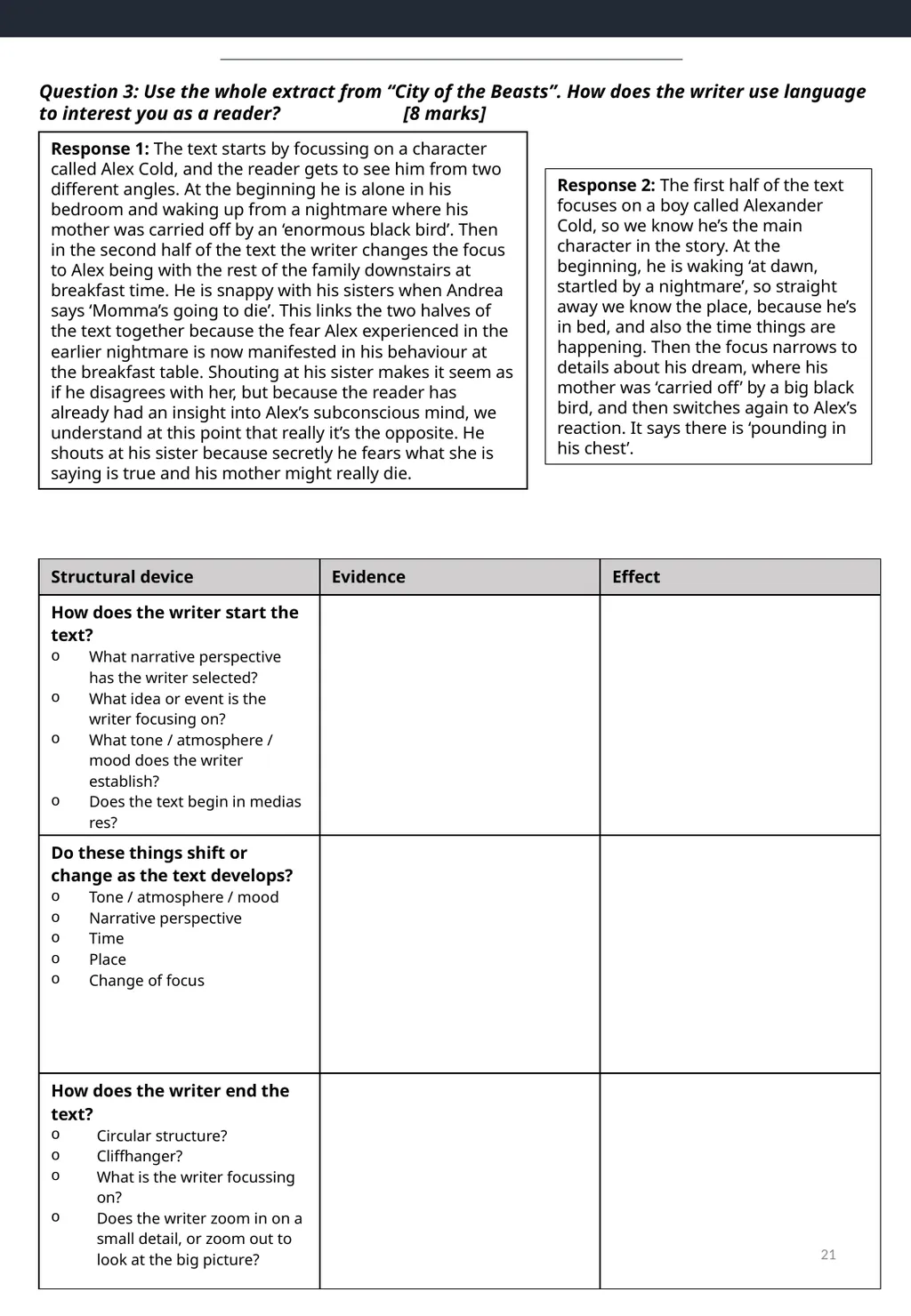
slide21. 21 Question 3: Use the whole extract from “City of the Beasts”. How does the writer use language to interest you as a reader? [8 marks] Response 1: The text starts by focussing on a character called Alex Cold, and the reader gets to see him from two different angles. At the beginning he is alone in his bedroom and waking up from a nightmare where his mother was carried off by an ‘enormous black bird’. Then in the second half of the text the writer changes the focus to Alex being with the rest of the family downstairs at breakfast time. He is snappy with his sisters when Andrea says ‘Momma’s going to die’. This links the two halves of the text together because the fear Alex experienced in the earlier nightmare is now manifested in his behaviour at the breakfast table. Shouting at his sister makes it seem as if he disagrees with her, but because the reader has already had an insight into Alex’s subconscious mind, we understand at this point that really it’s the opposite. He shouts at his sister because secretly he fears what she is saying is true and his mother might really die. Response 2: The first half of the text focuses on a boy called Alexander Cold, so we know he’s the main character in the story. At the beginning, he is waking ‘at dawn, startled by a nightmare’, so straight away we know the place, because he’s in bed, and also the time things are happening. Then the focus narrows to details about his dream, where his mother was ‘carried off’ by a big black bird, and then switches again to Alex’s reaction. It says there is ‘pounding in his chest’.<br>
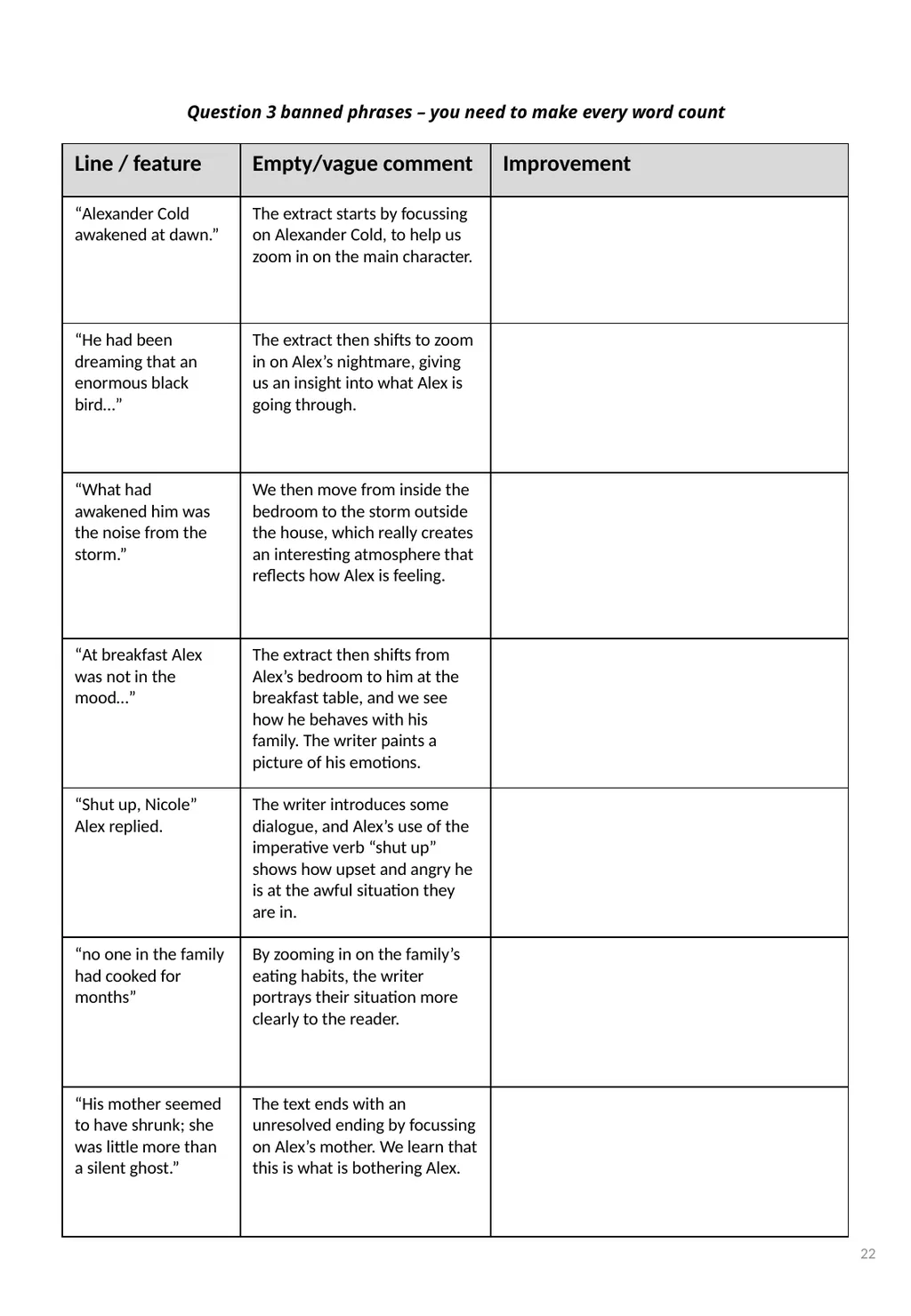
slide22. 22 Question 3 banned phrases – you need to make every word count<br>
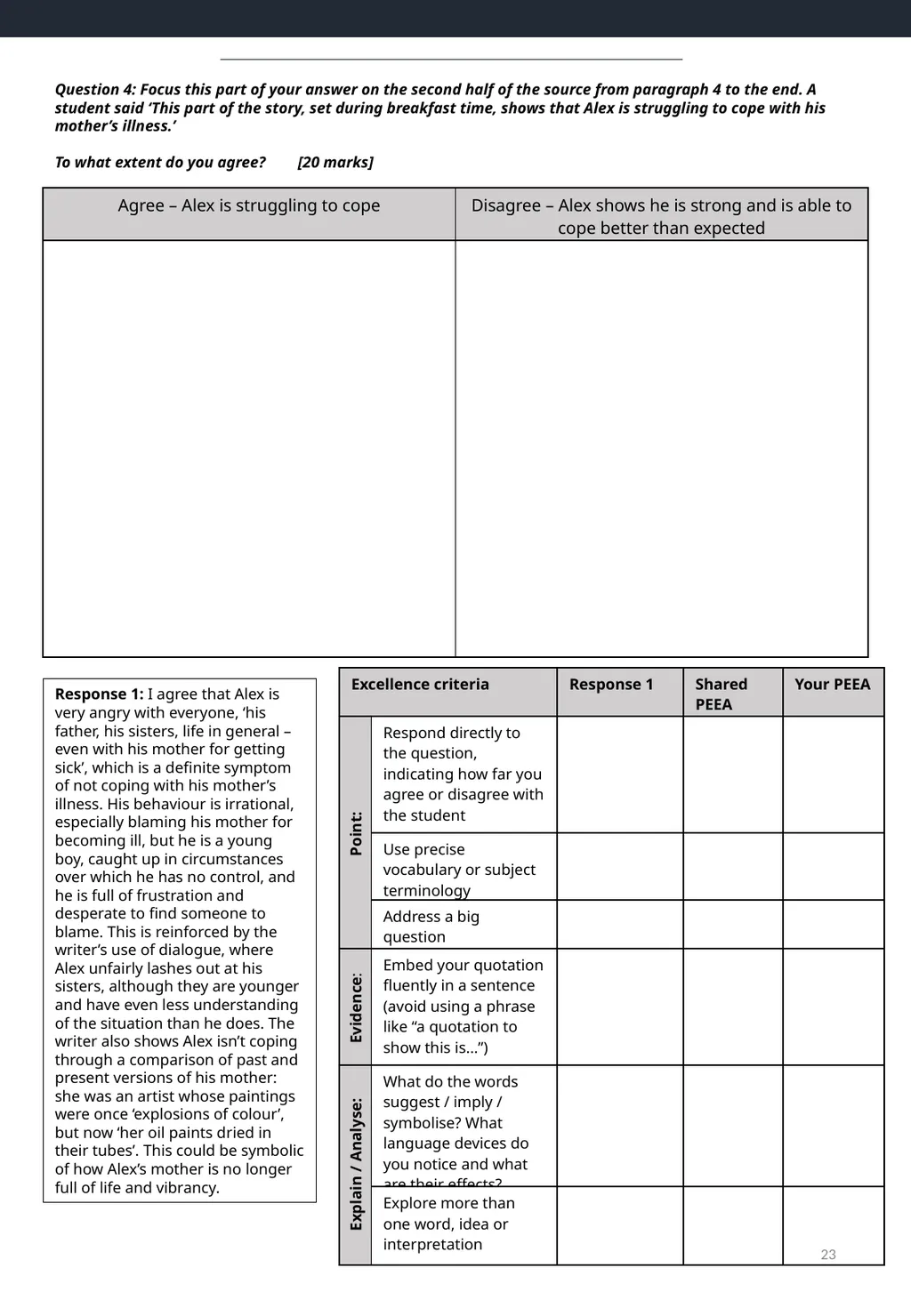
slide23. Question 4: Focus this part of your answer on the second half of the source from paragraph 4 to the end. A student said ‘This part of the story, set during breakfast time, shows that Alex is struggling to cope with his mother’s illness.’
To what extent do you agree? [20 marks] 23 Response 1: I agree that Alex is very angry with everyone, ‘his father, his sisters, life in general – even with his mother for getting sick’, which is a definite symptom of not coping with his mother’s illness. His behaviour is irrational, especially blaming his mother for becoming ill, but he is a young boy, caught up in circumstances over which he has no control, and he is full of frustration and desperate to find someone to blame. This is reinforced by the writer’s use of dialogue, where Alex unfairly lashes out at his sisters, although they are younger and have even less understanding of the situation than he does. The writer also shows Alex isn’t coping through a comparison of past and present versions of his mother: she was an artist whose paintings were once ‘explosions of colour’, but now ‘her oil paints dried in their tubes’. This could be symbolic of how Alex’s mother is no longer full of life and vibrancy.<br>
slide2. Introduction & Question 1 2 In this section of the paper you will read one extract from a novel or a short story (10 minutes). You will then respond to 4 questions, which always follow this pattern:
List four things about… (4 marks, 5 minutes)
How does the writer use language to describe… (8 marks, 10 minutes)
How does the writer structure the text to interest you as a reader? (8 marks, 10 minutes)
Having read this extract, a student said “….”. To what extent do you agree with the student’s opinion? (20 marks, 20 minutes) Question 1 Extract from “Wuthering Heights”. The narrator sees the ghost of a child at his broken bedroom window.
As it spoke, I discerned, obscurely, a child’s face looking through the window. Terror made me cruel; and, finding it useless to attempt shaking the creature off, I pulled its wrist on to the broken pane, and rubbed it to and fro till the blood ran down and soaked the bedclothes: still it wailed, ‘Let me in!’ and maintained its tenacious grip, almost maddening me with fear.
Question: List 4 things you learn about the ghost.
What mark would you give these students, and why? Mark /4 Mark /4 Mark /4 Mark /4<br>
slide3. 3 Question 1: Independent Practice Mark /4 Mark /4 Mark /4 Mark /4<br>
slide4. Top tips for AQA English Language Paper 1 – Question 1 Train students to focus on the appropriate section of the source Focus on the effect of the writer’s language choices Train students to focus on the appropriate aspect of the text. The verb “could” indicates that these bullet points are suggestions – not a required list. 3 PEEA / WHW paragraphs Examine the wording of the question with your class: Pitfalls and Top Tips: Train students to focus on the appropriate section of the source
Provide excellent example answers in which students have focussed on something outside of the source: ask students to use the mark scheme to evaluate the response, and then reveal the truth that the student would lose marks for failing to meet this requirement.
Students can refer to aspects of the text outside this section, if it illuminates their analysis of something in this section.
Students should still consider this section in context, not as a paragraph divorced from the remainder of the text. 2. Focus on the effect of the writer’s language choices
Explicitly teach students the difference between language and structure, and ensure they use “buzz words” that indicate which one they are writing about (e.g. adjective for language, zoom in on for structure).
Explore a range of “empty phrases” with students and help them to uplevel these phrases to more meaningful comments.
Explicitly teach vocabulary that will help students to unlock concepts or emotions. 3. The bullet points are suggestions
Students use the bullet points to guide their response (e.g. a paragraph on each one). However, some teachers do not encourage students to write about sentence forms, as the extract may not lend itself to meaningful comments on this topic. If you are teaching this bullet point, be explicit about what a meaningful comment might look like.<br>
slide5. 2. The Ruby in the Smoke – Philip Pullman, 1985 In this extract, Sally Lockhart has just entered a deprived area within 19th century London.
The omnibus had stopped at the West
India Dock Station. Beyond the gate into
the Dock, a line of warehouses stretched
for over half a mile to the left, and above
their roofs the masts of ships and the jibs
of cranes pointed to the grey sky like
skeletal fingers.
They set off to the right, towards the
river. They passed the large square Dock
Offices, where she supposed her father
must have come many times on business, and then turned down an alley and into a maze of courts and side streets. Some of them were not even named, but Frederick knew the way, and never hesitated. Barefoot children, ragged and filthy, played among the rubbish and the streams of stinking water that trickled thickly over the cobbles. Women standing in their doorways fell silent as they passed, and stared with hostile eyes, arms folded, until they had gone by. They look so old, thought Sally; even the children had pinched, old-men’s faces, with wrinkled brows and tight-drawn lips. Once they came on a group of men at the entrance to a narrow court. Some were leaning on the wall, some squatting on doorsteps. Their clothes were torn and clotted with dirt, their eyes were full of hatred, and one of them stood up and two others shifted away from the wall as Frederick and Sally approached, as if to challenge their right to pass. But Frederick did not change his pace. He walked straight up to the entrance, and the men drew aside at the last moment, looking away.
“Unemployed, poor fellows,” said Frederick when they’d turned the corner. “It’s either the street corner or the workhouse, and who’d choose the workhouse?”
“But there must be jobs on the ships, or at the docks, or something. People always want workers, don’t they?”
“No, they don’t. You know, Sally, there are things in London that make
opium look no more harmful than tea.”
She supposed he meant poverty, and as she looked around she had to agree. 5<br>
slide6. Question 1: Read the source from lines 1-4. List 4 things you learn about the West India docks. (4 marks) 6 Example responses:
Response 1: The writer uses the destitute inhabitants and their poor living conditions to symbolise the deplorable state of the Victorian class system, which condemned individuals to live in slums. The semantic field of poverty is used when the writer explains that the children are ‘barefoot,’ ‘ragged’ and ‘filthy.’ All three adjectives imply that the children (themselves symbols of innocence) are deprived of the basic necessities: clean water and clothing. The ‘ragged’ clothes the children wear are juxtaposed with the smart outfits of the visitors to this area, thus highlight the huge gulf between the working- and upper-classes. Furthermore, it is possible that the ‘ragged’ clothes speak of the tattered state of Victorian society – how the class system and the empire was starting to disintegrate under the pressure of calls for social change. The inhabitants’ suffering is reinforced by the metaphor ‘streams of stinking water’ as the plural noun ‘streams’ implies that sewage flows freely throughout the setting, contaminating anything and anyone it comes into contact with its repugnant stench, including the helpless children who are powerless to escape the destitution that encapsulates them.
Response 2: The writer uses negative language to describe both the setting and its inhabitants. The sensory adjective ‘stinking’ implies that the setting is beset by the stench of sewage running through the streets. This lack of hygiene is reinforced by the description of the children who are ‘barefoot’, ‘ragged’ and ‘filthy.’ These three adjectives connote poverty and suggest that the children are forced to live in these abhorrent conditions as they do not have the means to escape destitution. Question 2: Refer to the second paragraph. How does the writer use language to describe the setting and the people there? (8 marks)<br>
slide7. 7 What are language devices?<br>
slide8. 8 Question 2: Refer to the second paragraph. How does the writer use language to describe the setting and the people there? (8 marks)<br>
slide9. Top tips for AQA English Language Paper 1 – Question 3 Students need to note that the focus of the question has shifted to the whole source. Examine the wording of the question with your class: Focus on the effect of the writer’s structural choices The bullet points could be used to support students in writing 3 paragraphs – one about each point 3 PEEA / WHW paragraphs<br>
slide10. When the “structure” question was introduced to the GCSE English Language course, it prompted the creation of a range of highly intricate resources and the dusting off of complex subject terminology (before this, how many people regularly used the Latin in medias res in their teaching?). Many of us were panicked by the fact that we hadn’t “done structure” at school ourselves, and we felt the need to find “content” to teach. Whilst the huge amount of work and time that went into this was valuable, in my own teaching I know that it initially led to a real lack of clarity and a detrimental focus on “technique-spotting” (why can’t they remember the difference between a third person subjective narrator and a third person omniscient narrator?!) rather than analysis of how writers create meanings. This led to a real frustration when students couldn’t seem to progress beyond Level 1 or Level 2 on the mark scheme.
More recently, all of this hard work has been distilled and refined, and many of us have moved towards simpler approaches to the question. Teaching structure at Key Stage 3 has clearly helped, as my students starting Year 10 no longer feel as if they are faced with a new concept and methodology. Similarly, I now have a greater appreciation of the connection between the reading and writing sections of the paper, primarily in my understanding of the power of teaching the reasons behind structural choices through a writing task rather than yet another analytical paragraph. This more holistic approach has helped me to be less focussed on clocking up marks on a single question to a more streamlined, yet hopefully richer, method of teaching whereby I explore how a very short list of structural techniques can be used to create meanings in a wide range of texts.
Despite big changes in how this question is taught being mirrored across resources people very kindly share on LitDrive, TES, Twitter, and other platforms, I still don’t feel like I have mastered this question – and I come across lots of teachers who also feel unsure about their approach. So here is the combined wisdom of the Twittersphere on this topic…
The main pitfalls
Technique-spotting rather than exploration of effect of the writer’s methods.
Students becoming ensnared in over-complicated subject terminology.
Shifting how you think about the question
Remember this question is about the choices writers make, and why they make them. Perhaps think about “sequencing” rather than “structure.”
Curriculum design
To succeed on this question, students need an appreciation of how and why writers use structural devices across a wide range of texts. Therefore the KS3 curriculum needs to be full of rich and varied opportunities for reading and discussion.
Map out the teaching of key concepts (both in terms of structure and ideas) at KS3.
Map out the teaching of vocabulary for mood and tone at KS3 – they will need it to write about shifts.
Consider how and when to teach structuring creative writing – Jennifer Webb’s books have lots of fabulous ideas.
Introducing the structure question
Use a visual metaphor to explain the difference between structure and language. This could be the difference between the architectural design of a house and the decoration of the same house; the clothes one chooses to wear and the skeleton that provides the frame; a road map and a photograph showing detail; macro and micro; individual words and the overall view.
Alternatively, start by asking students to discuss the structure of their school day. It may be split into 5 lessons with tutor time, breaks, and lunch. Where are the shifts in mood during the day? How do they feel as they walk into an English lesson compared with how they feel when they leave? What is the difference between the mood at 8.30am and 3.30pm?
Use film clips
Recommendations:
The “Oil” scene from Dunkirk
The opening of “Jaws” (creating tension)
The opening of “The Lion King”
“The Piano” short animated film (flashbacks)
“Alma” short animated film (identifying shifts in mood/tone, circular structure)
Activities:
Hand out a page with mixed-up screenshots before watching. Students must put these in an order they think is appropriate and explain their decisions. Then watch the actual clip and discuss the differences.
Draw a tension/mood timeline while watching.
Selecting structural techniques to teach
Beginning
What does the writer focus on and why? (Character? Setting?)
What mood/tone does the writer establish and why? (This can incorporate different types of openings.)
Middle
What shifts or changes do you notice? (Time, place, focus, mood/tone.) Why does the writer shift x in this way?
End
What shifts or changes do you notice? (Time, place, focus, mood/tone.) Why does the writer shift x in this way?
How does the text end, and why? (Again, this can incorporate different types of endings if you wish – cliffhanger, resolved, unresolved, long view, circular…)
Essential vocabulary: zoom in/out, focus, shift/change, mood/tone/atmosphere<br>
slide11. Explicitly teaching vocabulary
Teach analytical verbs throughout KS3/4 – reveals, introduces, establishes…
Teach higher-level words for tone and mood - https://authority.pub/list-tone-words/
Students organise words on a mood line (positive at one end, negative at the other)
Students organise words on a colour chart
Students organise words into groups
Approaching a new extract
Start by identifying what happens in each paragraph.
Draw a tension timeline or a rollercoaster diagram.
Write a headline or a title for each paragraph.
Identify what shifts or changes occur between each paragraph. You may wish to focus on different types of shifts for different texts. For example, focus on mood/tone for one text and time/place for another.
Writing a response to an exam question
Use the focusses of Questions 1, 2, and 4 to plan 3 paragraphs for Question 3.
When looking at the question itself, ask students to cross out the phrase “to interest the reader” as this can encourage Level 1 responses.
Model the writing process, perhaps using What How Why / Point Evidence Analyse paragraphs, focussing on exploring why the writer has used a particular structural technique.
Students may become anxious because they don’t need to “zoom in” on a specific word or phrase and their paragraphs may not be the length they are used to; reassure them by evaluating answers under a visualiser using the mark scheme.
Independent writing using success criteria, excellence criteria, and structure strips if necessary.
Evaluating a response: avoiding “empty” phrases
When writing a response to the structure question students seem more likely to regurgitate empty phrases. Explicitly model how to improve these phrases, then encourage students to identify and improve them in their own wok.
Students rank sample responses, then explore the reasons for doing so.
Useful blog posts:
https://roundlearning.org/2017/05/13/less-than-a-month-to-go-question-3-structure-again/
https://thelittlebookofplay.wordpress.com/2018/06/28/introducing-structure-through-the-gruffalo/
https://susansenglish.wordpress.com/2019/01/26/why-i-love-teaching-feedback-on-aqa-q3-fiction-structure/
https://www.youtube.com/watch?v=eobtfiZIylA&feature=youtu.be
https://thedustytsundoku.wordpress.com/2018/05/07/exam-technique-for-aqa-english-language-paper-1-question-3/
https://englishteachersnotebook.blogspot.com/2019/10/laying-foundations-for-talking-about.html
https://ccea.org.uk/learning-resources/creative-writing/structure
https://mrhansonsenglish.wordpress.com/2018/11/07/structure-talk-and-slow-reading/
https://codexterous.home.blog/2020/08/29/cracking-open-gcse-english-language-a-granular-method-of-preparation/ - tweets at @__codexterous When looking at an extract from Regeneration by Barker. When looking at an extract from Dracula by Stoker.<br>
slide12. 3. Beryl Bainbridge, Every Man for Himself (1996) This extract is from a novel based on the events of the Titanic sinking, which was advertised as the fastest, most advanced vessel of its day. The narrator jumps off the ship into the sea, struggling to survive.
And now, the moment was almost upon us. The stern began to lift from the water. Guggenheim and his valet played mountaineers, going hand in hand up the rail. The hymn turned ragged; ceased altogether. The musicians scrambled upwards, the spike of the cello scraping the deck. Clinging to the rung of the ladder I tried to climb the roof but there was such a sideways slant that I waved like a flag on a pole. I thought I must make a leap for it and turned to look for Hopper. Something, some inner voice, urged me to glance below and I saw Scurra again, one arm hooked through the rail to steady himself. I raised my hand in greeting – then the water, first slithering, then tumbling, gushed us apart.
As the ship staggered and tipped, a great volume of water flowed over the submerged bows and tossed me like a cork to the roof. My fingers touched some kind of bolt near the ventilation grille, and I grabbed it tight. I filled my lungs with air and fixed my eyes on the blurred horizon, determined to hang on until I was sure I could float free rather than be swilled back and forth in a maelstrom. I wouldn’t waste my strength in swimming, not yet, for I knew the ship was now my enemy and if I wasn’t vigilant would drag me with her to the grave. I waited for the next slithering dip and when it came and the waves rushed in and swept me higher, I released my grip and let myself be carried away, over the tangle of ropes and wires and davits, clear of the rails and out into the darkness. I heard the angry roaring of the dying ship, the deafening cacophony as she stood on end and all her guts tore loose. I choked on soot and cringed beneath the sparks dancing like fire-flies as the forward funnel broke and smashed the sea in two. I was sucked under, as I knew I would be, down, down, and still I waited, waited until the pull slackened – then I struck out with all my strength.
I don’t know how long I swam under that lidded sea – time had stopped with my breath – and just as it seemed as if my lungs would burst the blackness paled and I kicked to the surface. I had thought I was entering paradise, for I was alive and about to breathe again, and then I heard the cries of souls in torment and believed myself in hell. Dear God! Those voices!
Father… Father… For the love of Christ… Help me, for pity’s sake… Where is my son? Some called for their mothers, some on the Lord, some to die quickly, a few to be saved. The lamentations rang through the frosty air and touched the stars; my own mouth opened in a silent howl of grief. 12<br>
slide13. Question 1: Re-read the first paragraph. List 4 things about the passengers. [4 marks]
Question 2: Re-read paragraphs 1 and 2. How does Bainbridge use language to describe the danger the narrator is in? [8 marks] 13 Student response: In this extract the writer uses language to show that the narrator is in a lot of danger. We see this in the quotation “I released my grip and let myself be carried away, over the tangle of ropes and wires and davits, clear of the rails and out into the darkness”. The verbs “released” and “let” suggest that the narrator makes a decision to let go of the ship, and this means that he is in some kind of control of the situation. After that though he was “carried away”, which indicates that now the water is in control of him and he is being plunged into a chaotic situation. Finally, the “darkness” represents danger, hellishness and possibly death, showing that he is in mortal danger and makes the reader feel quite scared for him. Label the response using these comments from the examiner:
The student is vague.
The student selects an appropriate quotation.
The student uses subject terminology.
The student zooms in on words.
The student needs to write more about the connotations of words.
The student could improve their vocabulary. Plan and write your response to Question 2.<br>
slide14. 14 Question 2 banned phrases – you need to make every word count<br>
slide15. 15 These pictures are stills from a film called “The Piano”. Number the pictures with the order you think they should be placed in. Question 3 asks you to focus on the structure of the extract. At its most basic level, structure means what order are the events in, and why?<br>
slide16. 16 What are structural devices?<br>
slide17. 17 Question 3: Use the whole extract from “Every Man for Himself”. How does the writer use language to interest you as a reader? [8 marks]<br>
slide18. Top tips for AQA English Language Paper 1 – Question 4 Train students to focus on the appropriate section of the source. Box off the appropriate section. There is often more than one aspect to the statement. Explore both. To evaluate is to examine the evidence and make an informed judgement. This does not necessarily mean students must look at both sides of the argument, but they can. Students can develop a personal response 4 PEEA / WHW paragraphs Examine the wording of the question with your class: There is often more than one aspect of the statement
The top students will break the statement into sections and then examine different aspects of the text. One way to support students in doing this is to colour-code the statement and then colour-code relevant quotations in the text.
Teach students to mindmap synonyms around the key words in the statement so that they can demonstrate more nuanced, in depth responses that avoid repetition. 2. Students can adopt a range of viewpoints
Students can be anywhere on a spectrum of full agreement to complete disagreement with the statement.
Students who find this paper challenging may benefit from straightforward agreement with the statement.
Some students may need reassurance that it is not a requirement to shoehorn in paragraph that disagrees with the statement; students can achieve full marks by agreeing.
Students should be explicitly taught to use signposting statements and adverbs to qualify their responses (“I partially agree”). 4. “Evaluate how the writer…”
Students often become so focussed on the argument that they neglect direct evidence and analysis of the text. The skills students practised in questions 1, 2, and 3 need to be used in question 4; teach students this question synthesises a range of skills to test their holistic understanding of the text.
Students can consider language and structural devices for this question. Students can adopt a range of viewpoints. 3. Students can develop a personal response
Some teachers find it useful to teach students to write in the first person for this question, prompting them to develop their own opinion 5. 4 paragraphs
Some teachers teach students to include an overview statement at the start of their response, but this question does not require the type of introduction one might write for a literature essay
4 paragraphs gives students the space to demonstrate sustained construction and development of an argument Pre-writing questions:
Create an opinion line and add quotations/ideas.
What do you think about the statement? Why do you think this?
Teaching of relevant vocabulary to allow students to articulate their ideas – this could be evaluative language or language describing tone and mood, for example.<br>
slide19. 4. City of the Beasts – Isabel Allende, 2004 Alex Cold lives with his parents and two younger sisters, Andrea and Nicole, in a small American town, but when his mother becomes ill, family life changes beyond recognition.
Alexander Cold awakened at dawn, startled by a nightmare. He had been dreaming that an enormous black bird had crashed against the window with a clatter of shattered glass, flown into the house, and carried off his mother. In the dream, he had watched helplessly as it clasped her clothing in its yellow claws, flew out the same broken window, and disappeared into a sky heavy with dark clouds.
What had awakened him was the noise from the storm: wind lashing the trees, rain on the rooftop, and thunder. He turned on the light with a sensation of being adrift in a boat, and pushed closer to the bulk of the large dog sleeping beside him. He pictured the roaring Pacific Ocean a few blocks from his house, spilling in furious waves against the rocks. He lay listening to the storm and thinking about the black bird and about his mother, waiting for the pounding in his chest to die down. He was still tangled in the images of his bad dream.
Alexander looked at the clock: 6.30, time to get up. Outside, it was beginning to get light. He decided that this was going to be a terrible day, one of those days when it’s best to stay in bed because everything is going to turn out bad. There had been a lot of days like that since his mother got sick; sometimes the air in the house felt heavy, like being at the bottom of the sea.
At breakfast Alex was not in the mood to applaud his father’s efforts at making pancakes. His father was not exactly a good cook; the only thing he knew how to do was pancakes, and they always turned out like rubber-tyre tortillas. His children didn’t want to hurt his feelings, so they pretended to eat them, but any time he wasn’t looking, they spit them out.
‘When’s Momma going to get better?’ Nicole asked, trying to spear a rubbery pancake with her fork.
‘Shut up, Nicole,’ Alex replied.
‘Momma’s going to die,’ Andrea added.
‘Liar! She’s not going to die!’ shrieked Nicole.
‘You two are just kids. You don’t know what you’re talking about!’ Alex exclaimed.
‘Here, girls. Quiet now. Momma is going to get better,’ his father interrupted, without much conviction.
Alex was angry with his father, his sisters, life in general – even with his mother for getting sick. He rushed out of the kitchen, ready to leave without breakfast.
Except for his father’s pancakes and an occasional tuna-and-mayonnaise sandwich, no one in the family had cooked for months. There was nothing in the refrigerator but orange juice, milk and ice cream; at night they ordered in pizza or Chinese food. At first it was almost like a party, because each of them ate whenever and whatever they pleased, mainly sweets, but by now everyone missed the balanced diet of normal times. 19<br>
slide20. City of the Beasts continued…
Alex had realised during those months how enormous their mother’s presence had been and how painful her absence was now. He missed her easy laughter and her affection, even her discipline. She was stricter than his father, and sharper. It was impossible to fool her; she could see the unseeable. He missed her music, her flowers, the once-familiar fragrance of fresh-baked cookies, and the smell of paint. It used to be that his mother could work several hours in her studio, keep the house immaculate, and still welcome her children after school with cookies. Now she barely got out of bed to walk through the rooms with a confused air, as if she didn’t recognise anything; she was too thin, and her sunken eyes were circled with shadows. Her canvases, which once were explosions of colour, sat forgotten on their easels, and her oil paints dried in their tubes. His mother seemed to have shrunk; she was little more than a silent ghost. 20 Question 1: Re-read the first paragraph. List 4 things you learn about the bird in Alex’s nightmare. [4 marks]
Question 2: Re-read paragraph 2. How does Allende use language to describe the effects of the storm? [8 marks] Response 1: The writer uses violent imagery to convey the brutal effects of the storm. The wind is ‘lashing’ the trees, a verb implying it is so forceful it is ruthlessly thrashing them, as if nature is inflicting a cruel punishment on the landscape. In addition, the personification of ‘furious waves’ suggests how the Pacific Ocean is pounding at the rocks, uncontrollably beating against them with anger, aggression and intent. The writer also uses sound imagery to add to the impact of the visual description of the ocean “roaring” by adding an adjective to suggest the thunderous noise of the storm which sounds like a wild animal, full of rage as it attacks and devours its prey. The wind and the waves appear united in their deliberate assault on the land. Response 2: The writer uses violent verbs to describe the powerful effects of the storm. He says the wind is ‘lashing’ the trees, which suggests it is whipping them, as if trying to destroy the land. The phrase ‘furious waves’ reinforces this idea, with the adjective ‘furious’ implying the Pacific Ocean is wild, angry and aggressive as it crashes against the rocks. The ocean is also ‘roaring’; a deafening noise to suggest it is attacking the land like a wild animal.<br>
slide21. 21 Question 3: Use the whole extract from “City of the Beasts”. How does the writer use language to interest you as a reader? [8 marks] Response 1: The text starts by focussing on a character called Alex Cold, and the reader gets to see him from two different angles. At the beginning he is alone in his bedroom and waking up from a nightmare where his mother was carried off by an ‘enormous black bird’. Then in the second half of the text the writer changes the focus to Alex being with the rest of the family downstairs at breakfast time. He is snappy with his sisters when Andrea says ‘Momma’s going to die’. This links the two halves of the text together because the fear Alex experienced in the earlier nightmare is now manifested in his behaviour at the breakfast table. Shouting at his sister makes it seem as if he disagrees with her, but because the reader has already had an insight into Alex’s subconscious mind, we understand at this point that really it’s the opposite. He shouts at his sister because secretly he fears what she is saying is true and his mother might really die. Response 2: The first half of the text focuses on a boy called Alexander Cold, so we know he’s the main character in the story. At the beginning, he is waking ‘at dawn, startled by a nightmare’, so straight away we know the place, because he’s in bed, and also the time things are happening. Then the focus narrows to details about his dream, where his mother was ‘carried off’ by a big black bird, and then switches again to Alex’s reaction. It says there is ‘pounding in his chest’.<br>
slide22. 22 Question 3 banned phrases – you need to make every word count<br>
slide23. Question 4: Focus this part of your answer on the second half of the source from paragraph 4 to the end. A student said ‘This part of the story, set during breakfast time, shows that Alex is struggling to cope with his mother’s illness.’
To what extent do you agree? [20 marks] 23 Response 1: I agree that Alex is very angry with everyone, ‘his father, his sisters, life in general – even with his mother for getting sick’, which is a definite symptom of not coping with his mother’s illness. His behaviour is irrational, especially blaming his mother for becoming ill, but he is a young boy, caught up in circumstances over which he has no control, and he is full of frustration and desperate to find someone to blame. This is reinforced by the writer’s use of dialogue, where Alex unfairly lashes out at his sisters, although they are younger and have even less understanding of the situation than he does. The writer also shows Alex isn’t coping through a comparison of past and present versions of his mother: she was an artist whose paintings were once ‘explosions of colour’, but now ‘her oil paints dried in their tubes’. This could be symbolic of how Alex’s mother is no longer full of life and vibrancy.<br>