
TOTAL IMMERSION How Immersive EXPERIENCES AND THE
TD
Published · 49 slides · 0 views

1 / 1





Description
TOTAL IMMERSION How Immersive EXPERIENCES AND THE metaverse benefit customer experience and operations France INSIGHTS Table of contents Research objectives, methodology, and Definition Immersive experiences have immense potential to
Related Topics
Share
Embed code
Download this presentation From Below
"TOTAL IMMERSION How Immersive EXPERIENCES AND THE" is the property of its rightful owner. Permission is granted to download and print the materials on this website for personal, non-commercial use only, and to display it on your personal computer provided you do not modify the materials and that you retain all copyright notices contained in the materials. By downloading content from our website, you accept the terms of this agreement.
Presentation Transcript
01
TOTAL IMMERSION
How Immersive EXPERIENCES AND THE metaverse benefit customer experience and operations
France INSIGHTS<br>
How Immersive EXPERIENCES AND THE metaverse benefit customer experience and operations
France INSIGHTS<br>
02
Table of contents Research objectives, methodology, and Definition
Immersive experiences have immense potential to enhance consumer experiences
Immersive experiences also benefit organizations’ internal operations
Consumer interest propels the metaverse to the fore
How can immersive technology reimagine the customer journey and internal operations?<br>
Immersive experiences have immense potential to enhance consumer experiences
Immersive experiences also benefit organizations’ internal operations
Consumer interest propels the metaverse to the fore
How can immersive technology reimagine the customer journey and internal operations?<br>
03
Research objectives and methodology 1<br>
04
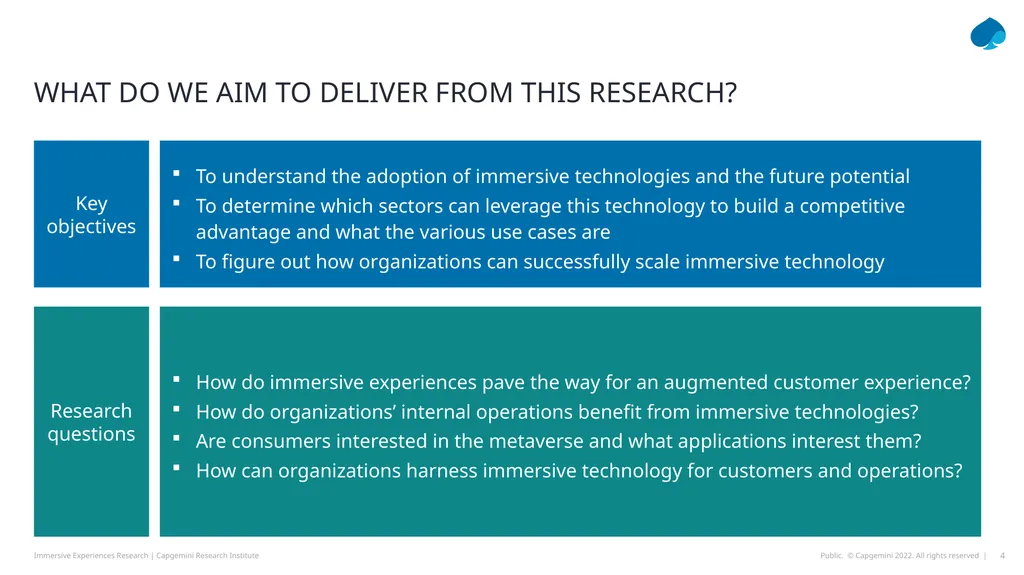
What do we aim to deliver from this research? To understand the adoption of immersive technologies and the future potential
To determine which sectors can leverage this technology to build a competitive advantage and what the various use cases are
To figure out how organizations can successfully scale immersive technology How do immersive experiences pave the way for an augmented customer experience?
How do organizations’ internal operations benefit from immersive technologies?
Are consumers interested in the metaverse and what applications interest them?
How can organizations harness immersive technology for customers and operations? Key objectives Research questions<br>
To determine which sectors can leverage this technology to build a competitive advantage and what the various use cases are
To figure out how organizations can successfully scale immersive technology How do immersive experiences pave the way for an augmented customer experience?
How do organizations’ internal operations benefit from immersive technologies?
Are consumers interested in the metaverse and what applications interest them?
How can organizations harness immersive technology for customers and operations? Key objectives Research questions<br>
05
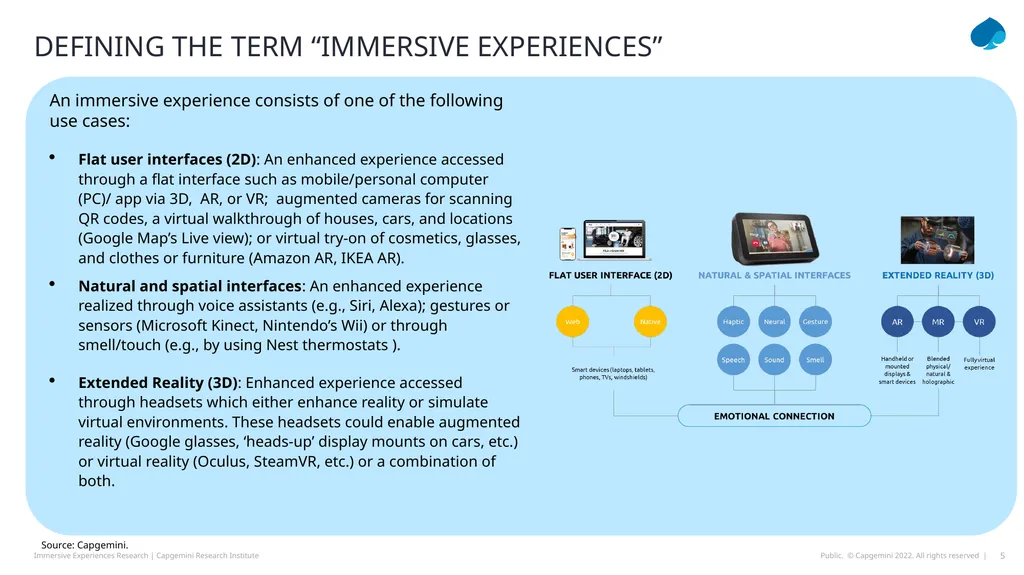
Defining the term “immersive experiences” Source: Capgemini. An immersive experience consists of one of the following use cases:
Flat user interfaces (2D): An enhanced experience accessed through a flat interface such as mobile/personal computer (PC)/ app via 3D, AR, or VR; augmented cameras for scanning QR codes, a virtual walkthrough of houses, cars, and locations (Google Map’s Live view); or virtual try-on of cosmetics, glasses, and clothes or furniture (Amazon AR, IKEA AR).
Natural and spatial interfaces: An enhanced experience realized through voice assistants (e.g., Siri, Alexa); gestures or sensors (Microsoft Kinect, Nintendo’s Wii) or through smell/touch (e.g., by using Nest thermostats ).
Extended Reality (3D): Enhanced experience accessed through headsets which either enhance reality or simulate virtual environments. These headsets could enable augmented reality (Google glasses, ‘heads-up’ display mounts on cars, etc.) or virtual reality (Oculus, SteamVR, etc.) or a combination of both.<br>
Flat user interfaces (2D): An enhanced experience accessed through a flat interface such as mobile/personal computer (PC)/ app via 3D, AR, or VR; augmented cameras for scanning QR codes, a virtual walkthrough of houses, cars, and locations (Google Map’s Live view); or virtual try-on of cosmetics, glasses, and clothes or furniture (Amazon AR, IKEA AR).
Natural and spatial interfaces: An enhanced experience realized through voice assistants (e.g., Siri, Alexa); gestures or sensors (Microsoft Kinect, Nintendo’s Wii) or through smell/touch (e.g., by using Nest thermostats ).
Extended Reality (3D): Enhanced experience accessed through headsets which either enhance reality or simulate virtual environments. These headsets could enable augmented reality (Google glasses, ‘heads-up’ display mounts on cars, etc.) or virtual reality (Oculus, SteamVR, etc.) or a combination of both.<br>
06
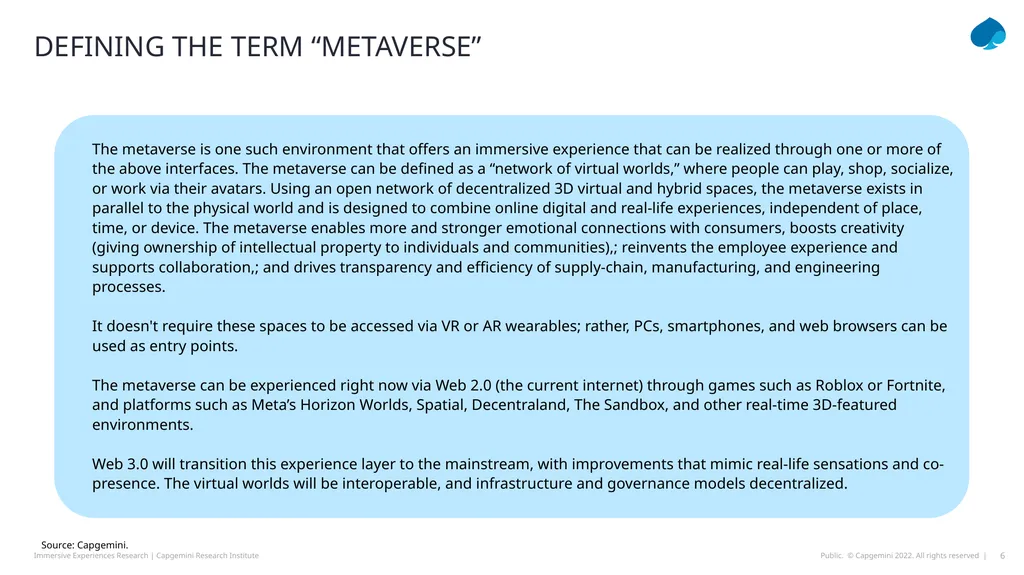
Defining the term “metaverse” The metaverse is one such environment that offers an immersive experience that can be realized through one or more of the above interfaces. The metaverse can be defined as a “network of virtual worlds,” where people can play, shop, socialize, or work via their avatars. Using an open network of decentralized 3D virtual and hybrid spaces, the metaverse exists in parallel to the physical world and is designed to combine online digital and real-life experiences, independent of place, time, or device. The metaverse enables more and stronger emotional connections with consumers, boosts creativity (giving ownership of intellectual property to individuals and communities),; reinvents the employee experience and supports collaboration,; and drives transparency and efficiency of supply-chain, manufacturing, and engineering processes.
It doesn't require these spaces to be accessed via VR or AR wearables; rather, PCs, smartphones, and web browsers can be used as entry points.
The metaverse can be experienced right now via Web 2.0 (the current internet) through games such as Roblox or Fortnite, and platforms such as Meta’s Horizon Worlds, Spatial, Decentraland, The Sandbox, and other real-time 3D-featured environments.
Web 3.0 will transition this experience layer to the mainstream, with improvements that mimic real-life sensations and co-presence. The virtual worlds will be interoperable, and infrastructure and governance models decentralized. Source: Capgemini.<br>
It doesn't require these spaces to be accessed via VR or AR wearables; rather, PCs, smartphones, and web browsers can be used as entry points.
The metaverse can be experienced right now via Web 2.0 (the current internet) through games such as Roblox or Fortnite, and platforms such as Meta’s Horizon Worlds, Spatial, Decentraland, The Sandbox, and other real-time 3D-featured environments.
Web 3.0 will transition this experience layer to the mainstream, with improvements that mimic real-life sensations and co-presence. The virtual worlds will be interoperable, and infrastructure and governance models decentralized. Source: Capgemini.<br>
07
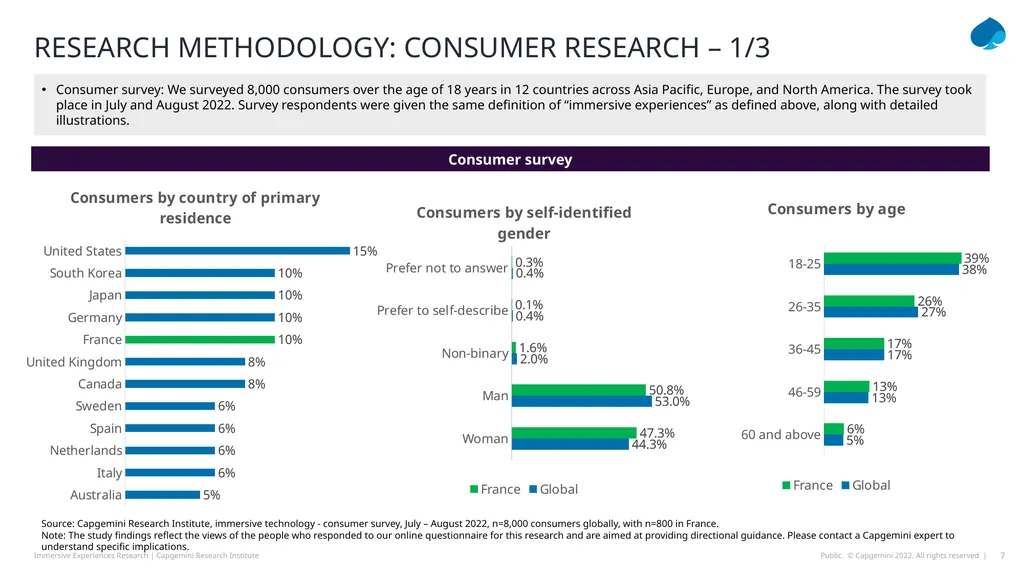
Consumer survey: We surveyed 8,000 consumers over the age of 18 years in 12 countries across Asia Pacific, Europe, and North America. The survey took place in July and August 2022. Survey respondents were given the same definition of “immersive experiences” as defined above, along with detailed illustrations. Source: Capgemini Research Institute, immersive technology - consumer survey, July – August 2022, n=8,000 consumers globally, with n=800 in France.
Note: The study findings reflect the views of the people who responded to our online questionnaire for this research and are aimed at providing directional guidance. Please contact a Capgemini expert to understand specific implications. Research methodology: Consumer Research – 1/3 Consumer survey<br>
Note: The study findings reflect the views of the people who responded to our online questionnaire for this research and are aimed at providing directional guidance. Please contact a Capgemini expert to understand specific implications. Research methodology: Consumer Research – 1/3 Consumer survey<br>
08
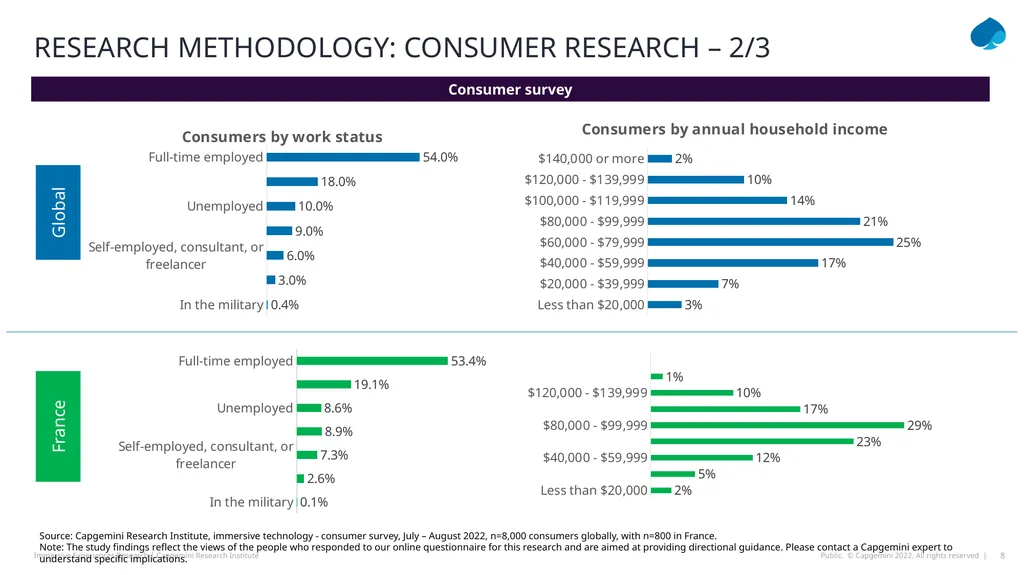
Research methodology: Consumer Research – 2/3 Consumer survey Source: Capgemini Research Institute, immersive technology - consumer survey, July – August 2022, n=8,000 consumers globally, with n=800 in France.
Note: The study findings reflect the views of the people who responded to our online questionnaire for this research and are aimed at providing directional guidance. Please contact a Capgemini expert to understand specific implications. France Global<br>
Note: The study findings reflect the views of the people who responded to our online questionnaire for this research and are aimed at providing directional guidance. Please contact a Capgemini expert to understand specific implications. France Global<br>
09
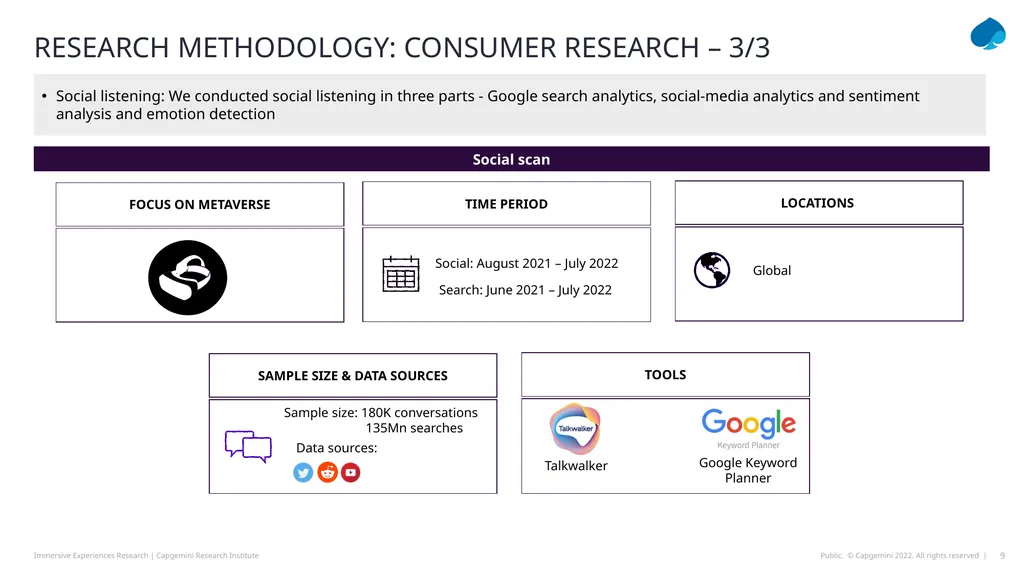
Social listening: We conducted social listening in three parts - Google search analytics, social-media analytics and sentiment analysis and emotion detection Social scan FOCUS ON METAVERSE TIME PERIOD LOCATIONS Global Social: August 2021 – July 2022 Search: June 2021 – July 2022 SAMPLE SIZE & DATA SOURCES TOOLS Talkwalker Data sources: Sample size: 180K conversations
135Mn searches Google Keyword Planner Research methodology: Consumer Research – 3/3<br>
135Mn searches Google Keyword Planner Research methodology: Consumer Research – 3/3<br>
10
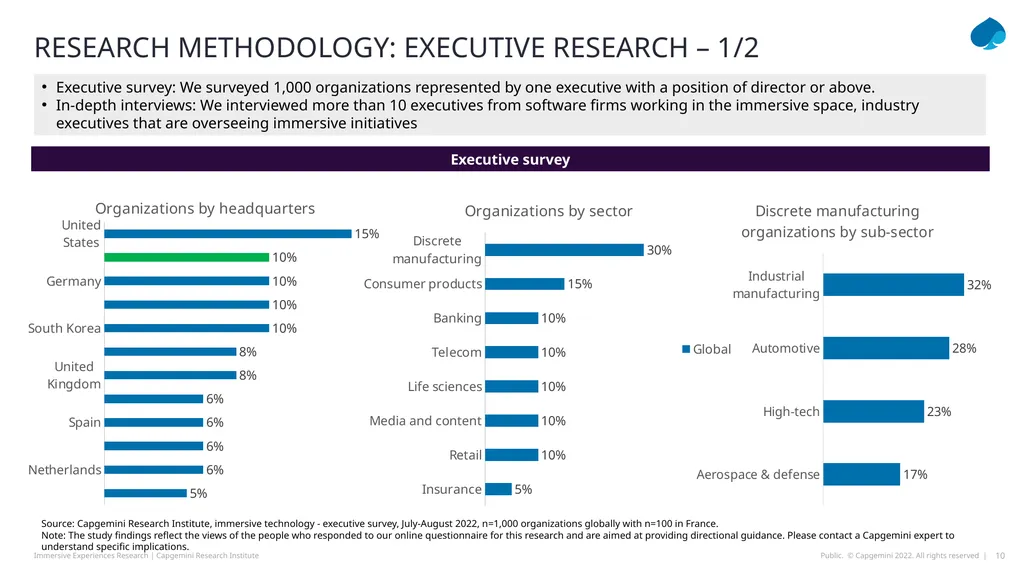
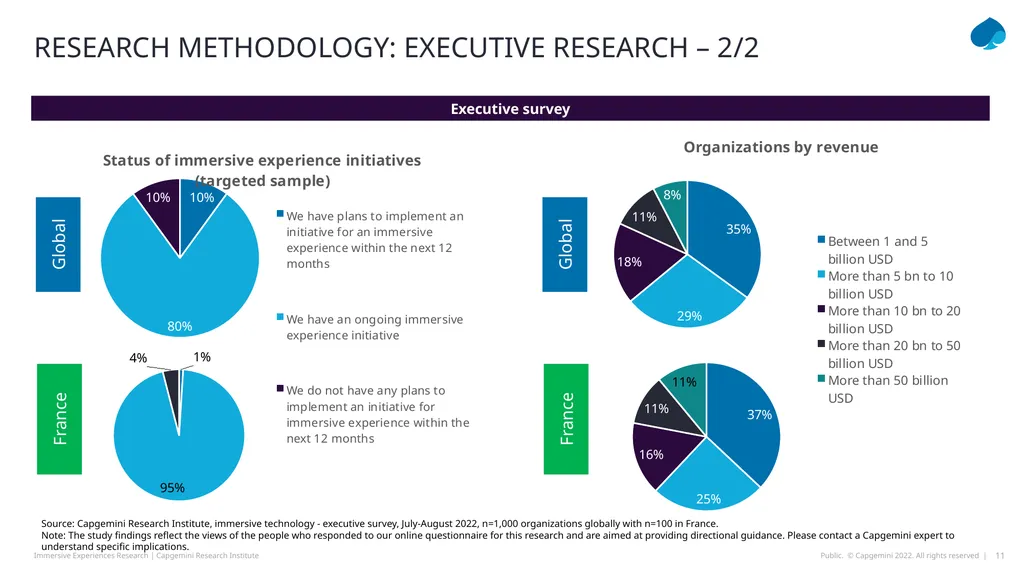
Research methodology: Executive Research – 1/2 Executive survey: We surveyed 1,000 organizations represented by one executive with a position of director or above.
In-depth interviews: We interviewed more than 10 executives from software firms working in the immersive space, industry executives that are overseeing immersive initiatives Source: Capgemini Research Institute, immersive technology - executive survey, July-August 2022, n=1,000 organizations globally with n=100 in France.
Note: The study findings reflect the views of the people who responded to our online questionnaire for this research and are aimed at providing directional guidance. Please contact a Capgemini expert to understand specific implications. Executive survey<br>
In-depth interviews: We interviewed more than 10 executives from software firms working in the immersive space, industry executives that are overseeing immersive initiatives Source: Capgemini Research Institute, immersive technology - executive survey, July-August 2022, n=1,000 organizations globally with n=100 in France.
Note: The study findings reflect the views of the people who responded to our online questionnaire for this research and are aimed at providing directional guidance. Please contact a Capgemini expert to understand specific implications. Executive survey<br>
11
Source: Capgemini Research Institute, immersive technology - executive survey, July-August 2022, n=1,000 organizations globally with n=100 in France.
Note: The study findings reflect the views of the people who responded to our online questionnaire for this research and are aimed at providing directional guidance. Please contact a Capgemini expert to understand specific implications. Research methodology: Executive Research – 2/2 Executive survey France Global France Global<br>
Note: The study findings reflect the views of the people who responded to our online questionnaire for this research and are aimed at providing directional guidance. Please contact a Capgemini expert to understand specific implications. Research methodology: Executive Research – 2/2 Executive survey France Global France Global<br>
12
Immersive experiences have immense potential to enhance consumer experiences 2<br>
13
Al though the degree of familiarity varies with the kind of immersive technology, our research has shown that consumers’ positive affinity is not hugely different (for the first three interfaces shown below) Source: Capgemini Research Institute, immersive technology - consumer survey, July – August 2022, n=8,000 consumers globally, with n=800 in France. Consumers globally and in France have a positive affinity for immersive technologies France Global<br>
14
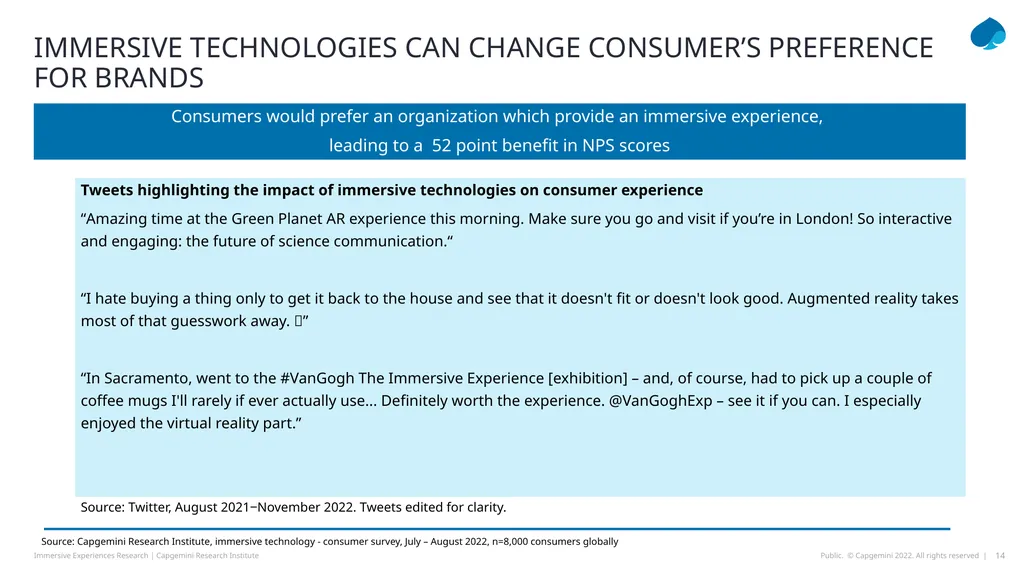
Consumers would prefer an organization which provide an immersive experience,
leading to a 52 point benefit in NPS scores Source: Capgemini Research Institute, immersive technology - consumer survey, July – August 2022, n=8,000 consumers globally Immersive technologies can change consumer’s preference for brands<br>
leading to a 52 point benefit in NPS scores Source: Capgemini Research Institute, immersive technology - consumer survey, July – August 2022, n=8,000 consumers globally Immersive technologies can change consumer’s preference for brands<br>
15
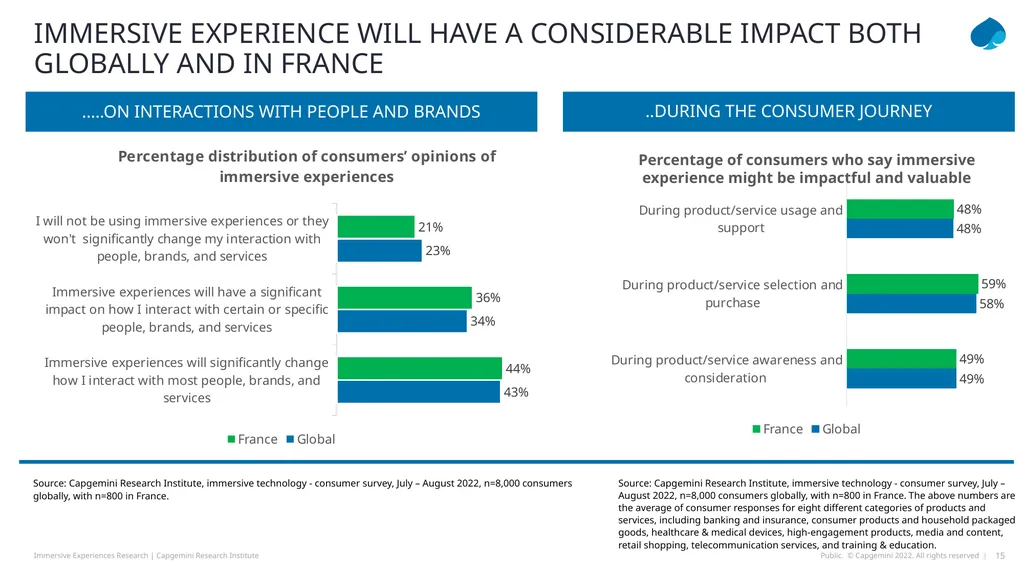
…..ON INTERACTIONS WITH PEOPLE AND BRANDS Source: Capgemini Research Institute, immersive technology - consumer survey, July – August 2022, n=8,000 consumers globally, with n=800 in France. Percentage of consumers who say immersive experience might be impactful and valuable ..DURING THE CONSUMER JOURNEY immersive experience will have a considerable impact both globally and in France Source: Capgemini Research Institute, immersive technology - consumer survey, July – August 2022, n=8,000 consumers globally, with n=800 in France. The above numbers are the average of consumer responses for eight different categories of products and services, including banking and insurance, consumer products and household packaged goods, healthcare & medical devices, high-engagement products, media and content, retail shopping, telecommunication services, and training & education.<br>
16
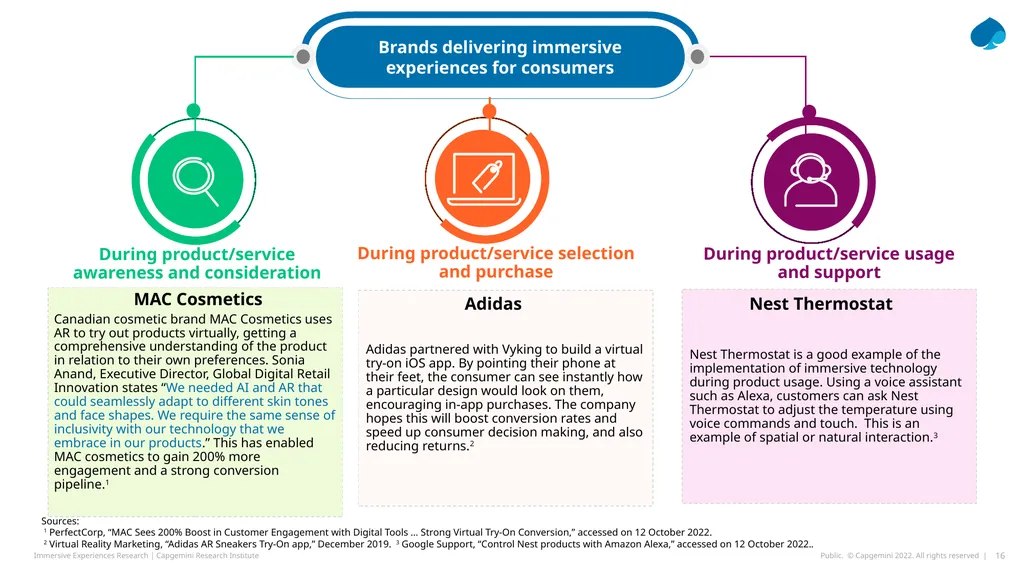
During product/service awareness and consideration Adidas partnered with Vyking to build a virtual try-on iOS app. By pointing their phone at their feet, the consumer can see instantly how a particular design would look on them, encouraging in-app purchases. The company hopes this will boost conversion rates and speed up consumer decision making, and also reducing returns.2 During product/service usage and support Canadian cosmetic brand MAC Cosmetics uses AR to try out products virtually, getting a comprehensive understanding of the product in relation to their own preferences. Sonia Anand, Executive Director, Global Digital Retail Innovation states “We needed AI and AR that could seamlessly adapt to different skin tones and face shapes. We require the same sense of inclusivity with our technology that we embrace in our products.” This has enabled MAC cosmetics to gain 200% more engagement and a strong conversion pipeline.1 During product/service selection and purchase Adidas MAC Cosmetics Sources:
1 PerfectCorp, “MAC Sees 200% Boost in Customer Engagement with Digital Tools … Strong Virtual Try-On Conversion,” accessed on 12 October 2022.
2 Virtual Reality Marketing, “Adidas AR Sneakers Try-On app,” December 2019. 3 Google Support, “Control Nest products with Amazon Alexa,” accessed on 12 October 2022..<br>
1 PerfectCorp, “MAC Sees 200% Boost in Customer Engagement with Digital Tools … Strong Virtual Try-On Conversion,” accessed on 12 October 2022.
2 Virtual Reality Marketing, “Adidas AR Sneakers Try-On app,” December 2019. 3 Google Support, “Control Nest products with Amazon Alexa,” accessed on 12 October 2022..<br>
17
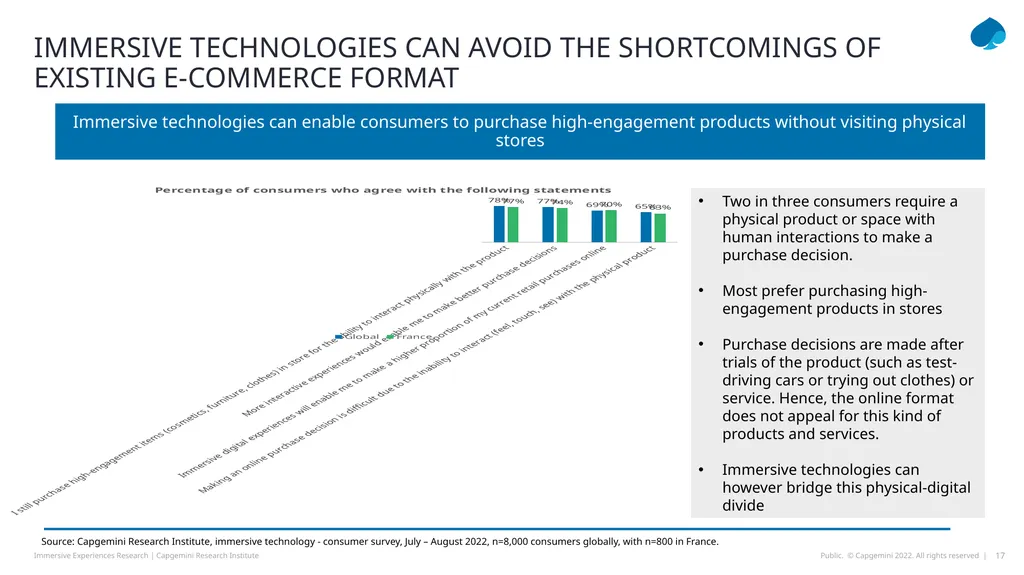
Immersive technologies can enable consumers to purchase high-engagement products without visiting physical stores Two in three consumers require a physical product or space with human interactions to make a purchase decision.
Most prefer purchasing high-engagement products in stores
Purchase decisions are made after trials of the product (such as test-driving cars or trying out clothes) or service. Hence, the online format does not appeal for this kind of products and services.
Immersive technologies can however bridge this physical-digital divide Source: Capgemini Research Institute, immersive technology - consumer survey, July – August 2022, n=8,000 consumers globally, with n=800 in France. Immersive technologies can avoid the shortcomings of existing e-commerce format<br>
Most prefer purchasing high-engagement products in stores
Purchase decisions are made after trials of the product (such as test-driving cars or trying out clothes) or service. Hence, the online format does not appeal for this kind of products and services.
Immersive technologies can however bridge this physical-digital divide Source: Capgemini Research Institute, immersive technology - consumer survey, July – August 2022, n=8,000 consumers globally, with n=800 in France. Immersive technologies can avoid the shortcomings of existing e-commerce format<br>
18
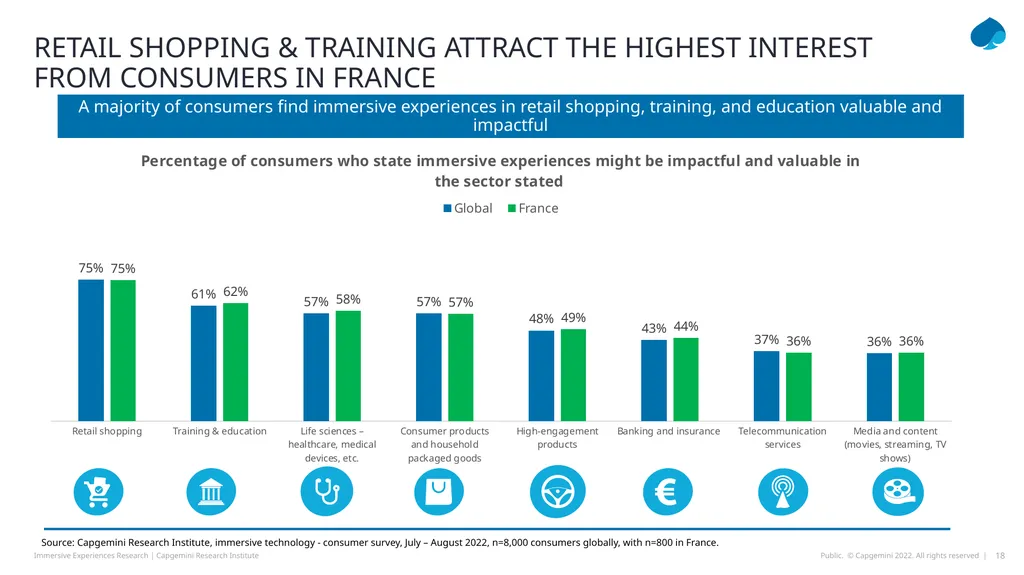
A majority of consumers find immersive experiences in retail shopping, training, and education valuable and impactful Source: Capgemini Research Institute, immersive technology - consumer survey, July – August 2022, n=8,000 consumers globally, with n=800 in France. Retail shopping & training attract the highest interest from consumers in France<br>
19
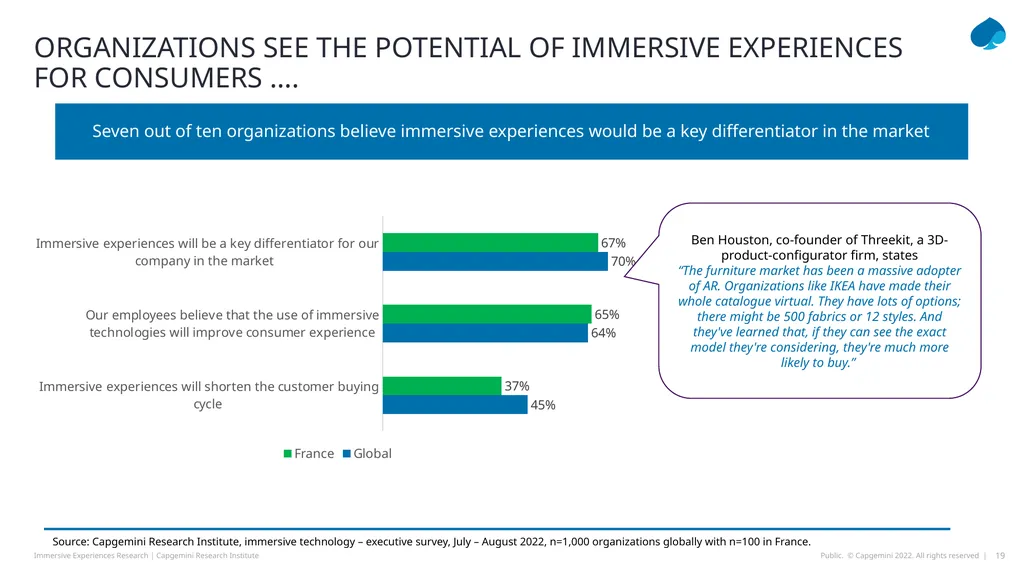
Seven out of ten organizations believe immersive experiences would be a key differentiator in the market Source: Capgemini Research Institute, immersive technology – executive survey, July – August 2022, n=1,000 organizations globally with n=100 in France. Organizations see the potential of immersive experiences for consumers …. Ben Houston, co-founder of Threekit, a 3D-product-configurator firm, states
“The furniture market has been a massive adopter of AR. Organizations like IKEA have made their whole catalogue virtual. They have lots of options; there might be 500 fabrics or 12 styles. And they've learned that, if they can see the exact model they're considering, they're much more likely to buy.”<br>
“The furniture market has been a massive adopter of AR. Organizations like IKEA have made their whole catalogue virtual. They have lots of options; there might be 500 fabrics or 12 styles. And they've learned that, if they can see the exact model they're considering, they're much more likely to buy.”<br>
20
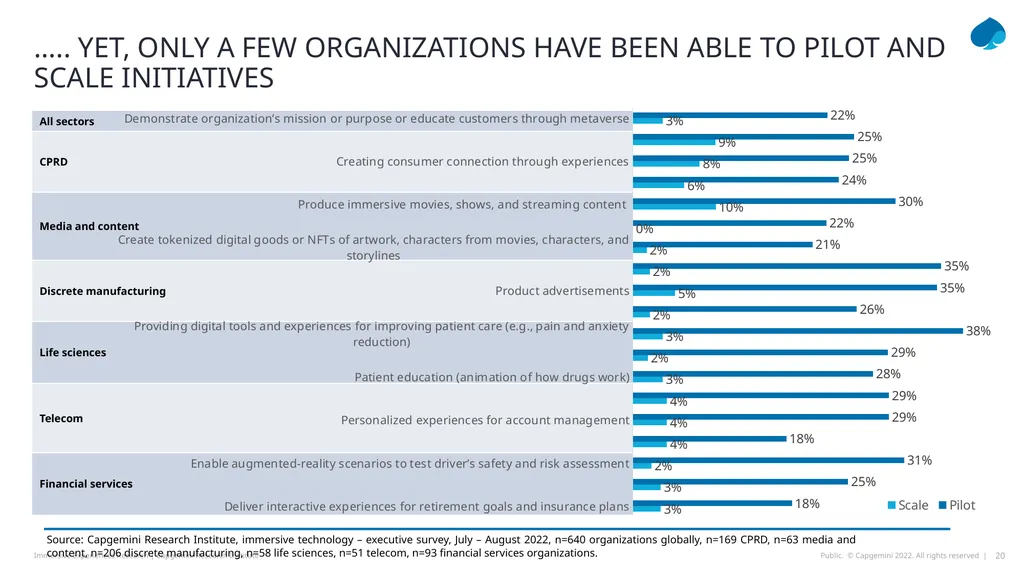
Source: Capgemini Research Institute, immersive technology – executive survey, July – August 2022, n=640 organizations globally, n=169 CPRD, n=63 media and content, n=206 discrete manufacturing, n=58 life sciences, n=51 telecom, n=93 financial services organizations. ….. Yet, Only a few organizations have been able to pilot and scale initiatives<br>
21
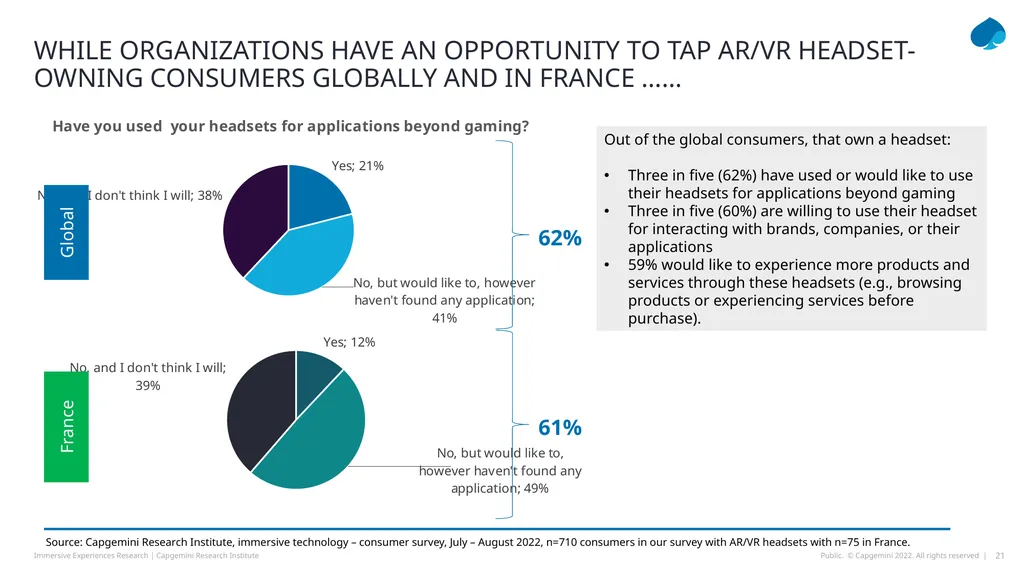
While organizations have an opportunity to tap AR/VR headset-owning consumers globally and in France …… Source: Capgemini Research Institute, immersive technology – consumer survey, July – August 2022, n=710 consumers in our survey with AR/VR headsets with n=75 in France. 62% Out of the global consumers, that own a headset:
Three in five (62%) have used or would like to use their headsets for applications beyond gaming
Three in five (60%) are willing to use their headset for interacting with brands, companies, or their applications
59% would like to experience more products and services through these headsets (e.g., browsing products or experiencing services before purchase). 61% France Global<br>
Three in five (62%) have used or would like to use their headsets for applications beyond gaming
Three in five (60%) are willing to use their headset for interacting with brands, companies, or their applications
59% would like to experience more products and services through these headsets (e.g., browsing products or experiencing services before purchase). 61% France Global<br>
22
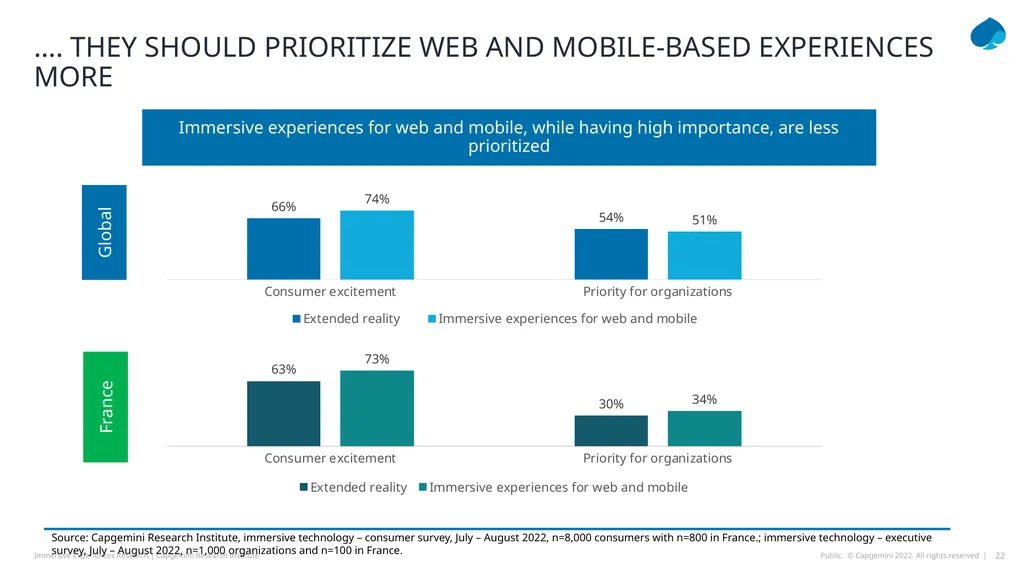
Immersive experiences for web and mobile, while having high importance, are less prioritized Source: Capgemini Research Institute, immersive technology – consumer survey, July – August 2022, n=8,000 consumers with n=800 in France.; immersive technology – executive survey, July – August 2022, n=1,000 organizations and n=100 in France. …. They should prioritize web and mobile-based experiences more France Global<br>
23
Immersive experiences also benefit organizations’ internal operations 3<br>
24
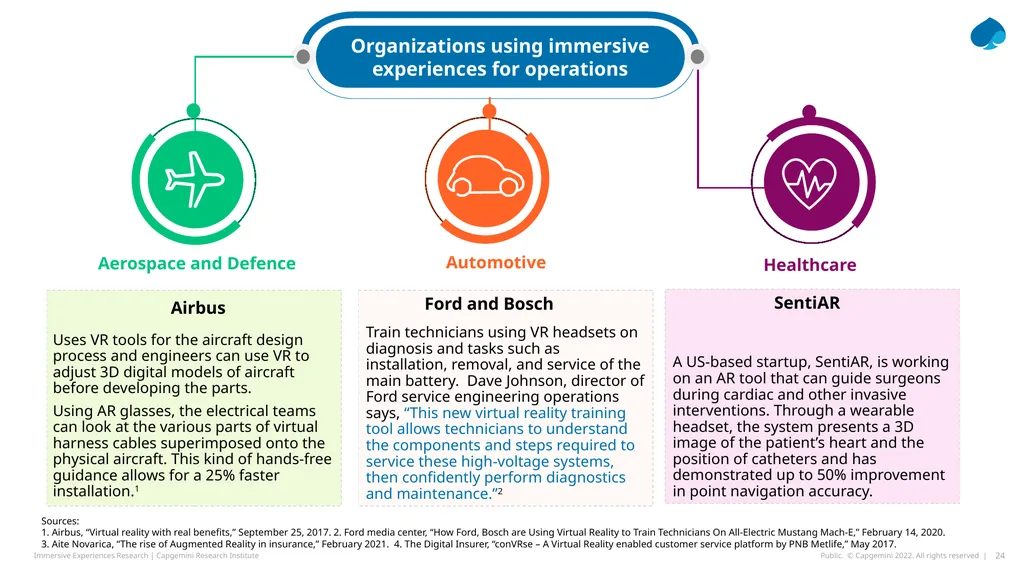
Aerospace and Defence Train technicians using VR headsets on diagnosis and tasks such as installation, removal, and service of the main battery. Dave Johnson, director of Ford service engineering operations says, “This new virtual reality training tool allows technicians to understand the components and steps required to service these high-voltage systems, then confidently perform diagnostics and maintenance.”2 Healthcare Uses VR tools for the aircraft design process and engineers can use VR to adjust 3D digital models of aircraft before developing the parts.
Using AR glasses, the electrical teams can look at the various parts of virtual harness cables superimposed onto the physical aircraft. This kind of hands-free guidance allows for a 25% faster installation.1 Automotive Ford and Bosch Airbus Sources:
1. Airbus, “Virtual reality with real benefits,” September 25, 2017. 2. Ford media center, “How Ford, Bosch are Using Virtual Reality to Train Technicians On All-Electric Mustang Mach-E,” February 14, 2020.
3. Aite Novarica, “The rise of Augmented Reality in insurance,” February 2021. 4. The Digital Insurer, “conVRse – A Virtual Reality enabled customer service platform by PNB Metlife,” May 2017.<br>
Using AR glasses, the electrical teams can look at the various parts of virtual harness cables superimposed onto the physical aircraft. This kind of hands-free guidance allows for a 25% faster installation.1 Automotive Ford and Bosch Airbus Sources:
1. Airbus, “Virtual reality with real benefits,” September 25, 2017. 2. Ford media center, “How Ford, Bosch are Using Virtual Reality to Train Technicians On All-Electric Mustang Mach-E,” February 14, 2020.
3. Aite Novarica, “The rise of Augmented Reality in insurance,” February 2021. 4. The Digital Insurer, “conVRse – A Virtual Reality enabled customer service platform by PNB Metlife,” May 2017.<br>
25
Consumer products, retail and distribution Retail floor planning
By viewing the retail floor virtually, organizations can plan their retail store design without the teams having to travel to the physical stores. Discrete manufacturing Financial services Logistics and operations visualization
Within warehouses, AR can help employees to locate the product/part they want. Similarly, AR markers on packages can help track the packages. Remote operations
Toyota has been able to improve safety and communication across its plants and increase security compliance through augmented remote assistance.1 Testing and digital prototyping
The automotive industry, in particular, has relied on VR for design and engineering reviews. By reducing the number of prototypes built, organizations can save millions of dollars while enabling considerable environmental savings. 2 Financial advising and support
Lercari Group, an Italian claims management organization, saw an increase in its NPS scores from the mid-80s to over 90% through the use of interactive AR solutions.3 Financial data visualization
VR can make the data visualization process more immersive. Financial information can be presented in a 3D visual space, enabling the analysts to draw more intuitive and faster insights.4 the most implemented immersive use cases for internal operations – 1/3<br>
By viewing the retail floor virtually, organizations can plan their retail store design without the teams having to travel to the physical stores. Discrete manufacturing Financial services Logistics and operations visualization
Within warehouses, AR can help employees to locate the product/part they want. Similarly, AR markers on packages can help track the packages. Remote operations
Toyota has been able to improve safety and communication across its plants and increase security compliance through augmented remote assistance.1 Testing and digital prototyping
The automotive industry, in particular, has relied on VR for design and engineering reviews. By reducing the number of prototypes built, organizations can save millions of dollars while enabling considerable environmental savings. 2 Financial advising and support
Lercari Group, an Italian claims management organization, saw an increase in its NPS scores from the mid-80s to over 90% through the use of interactive AR solutions.3 Financial data visualization
VR can make the data visualization process more immersive. Financial information can be presented in a 3D visual space, enabling the analysts to draw more intuitive and faster insights.4 the most implemented immersive use cases for internal operations – 1/3<br>
26
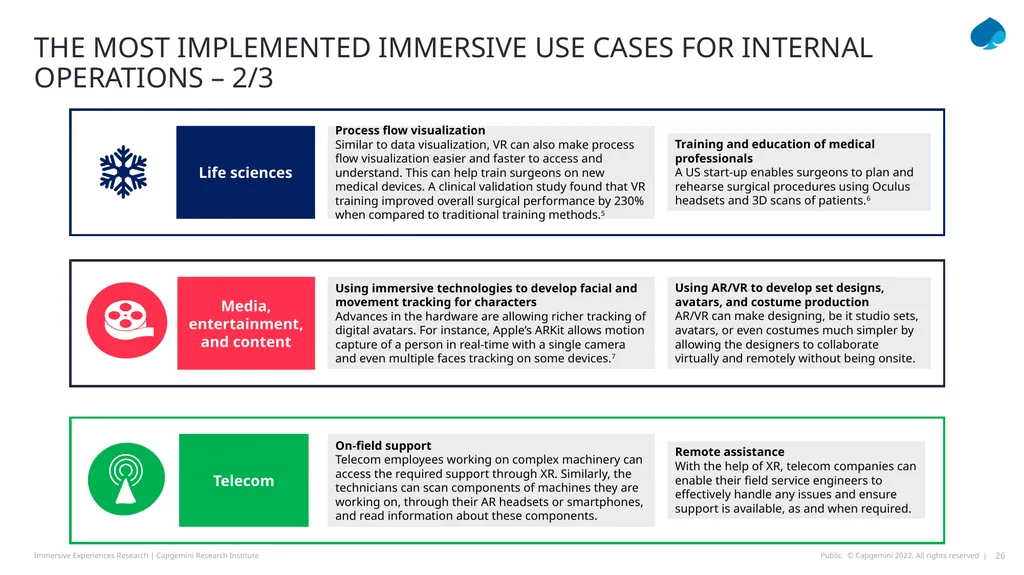
Life sciences Media, entertainment, and content Using immersive technologies to develop facial and movement tracking for characters
Advances in the hardware are allowing richer tracking of digital avatars. For instance, Apple’s ARKit allows motion capture of a person in real-time with a single camera and even multiple faces tracking on some devices.7 Telecom On-field support
Telecom employees working on complex machinery can access the required support through XR. Similarly, the technicians can scan components of machines they are working on, through their AR headsets or smartphones, and read information about these components. Process flow visualization
Similar to data visualization, VR can also make process flow visualization easier and faster to access and understand. This can help train surgeons on new medical devices. A clinical validation study found that VR training improved overall surgical performance by 230% when compared to traditional training methods.5 Training and education of medical professionals
A US start-up enables surgeons to plan and rehearse surgical procedures using Oculus headsets and 3D scans of patients.6 Using AR/VR to develop set designs, avatars, and costume production
AR/VR can make designing, be it studio sets, avatars, or even costumes much simpler by allowing the designers to collaborate virtually and remotely without being onsite. Remote assistance
With the help of XR, telecom companies can enable their field service engineers to effectively handle any issues and ensure support is available, as and when required. the most implemented immersive use cases for internal operations – 2/3<br>
Advances in the hardware are allowing richer tracking of digital avatars. For instance, Apple’s ARKit allows motion capture of a person in real-time with a single camera and even multiple faces tracking on some devices.7 Telecom On-field support
Telecom employees working on complex machinery can access the required support through XR. Similarly, the technicians can scan components of machines they are working on, through their AR headsets or smartphones, and read information about these components. Process flow visualization
Similar to data visualization, VR can also make process flow visualization easier and faster to access and understand. This can help train surgeons on new medical devices. A clinical validation study found that VR training improved overall surgical performance by 230% when compared to traditional training methods.5 Training and education of medical professionals
A US start-up enables surgeons to plan and rehearse surgical procedures using Oculus headsets and 3D scans of patients.6 Using AR/VR to develop set designs, avatars, and costume production
AR/VR can make designing, be it studio sets, avatars, or even costumes much simpler by allowing the designers to collaborate virtually and remotely without being onsite. Remote assistance
With the help of XR, telecom companies can enable their field service engineers to effectively handle any issues and ensure support is available, as and when required. the most implemented immersive use cases for internal operations – 2/3<br>
27
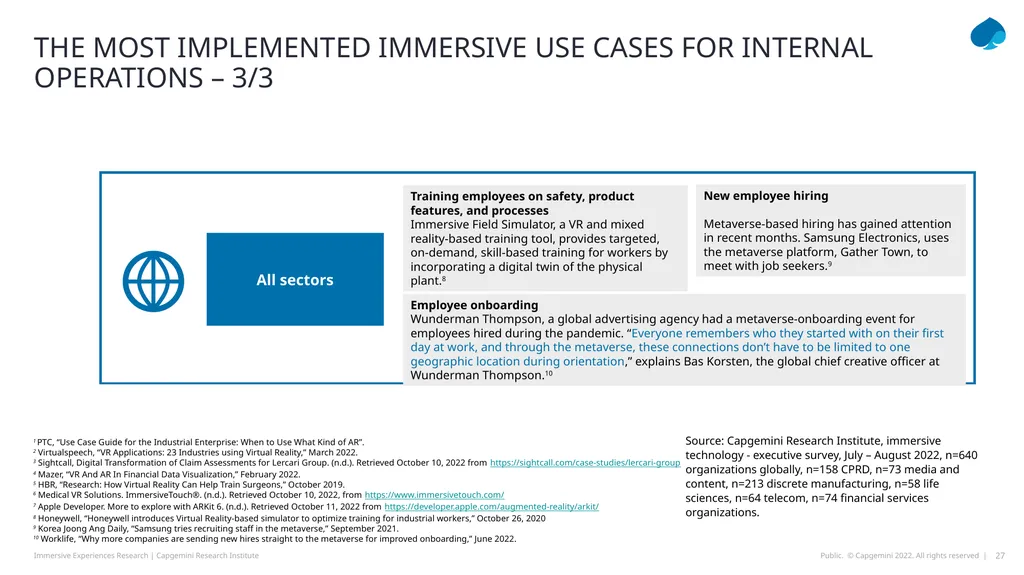
All sectors Training employees on safety, product features, and processes
Immersive Field Simulator, a VR and mixed reality-based training tool, provides targeted, on-demand, skill-based training for workers by incorporating a digital twin of the physical plant.8 New employee hiring
Metaverse-based hiring has gained attention in recent months. Samsung Electronics, uses the metaverse platform, Gather Town, to meet with job seekers.9 Employee onboarding
Wunderman Thompson, a global advertising agency had a metaverse-onboarding event for employees hired during the pandemic. “Everyone remembers who they started with on their first day at work, and through the metaverse, these connections don’t have to be limited to one geographic location during orientation,” explains Bas Korsten, the global chief creative officer at Wunderman Thompson.10 1 PTC, “Use Case Guide for the Industrial Enterprise: When to Use What Kind of AR”.
2 Virtualspeech, “VR Applications: 23 Industries using Virtual Reality,” March 2022.
3 Sightcall, Digital Transformation of Claim Assessments for Lercari Group. (n.d.). Retrieved October 10, 2022 from https://sightcall.com/case-studies/lercari-group
4 Mazer, “VR And AR In Financial Data Visualization,” February 2022.
5 HBR, “Research: How Virtual Reality Can Help Train Surgeons,” October 2019.
6 Medical VR Solutions. ImmersiveTouch®. (n.d.). Retrieved October 10, 2022, from https://www.immersivetouch.com/
7 Apple Developer. More to explore with ARKit 6. (n.d.). Retrieved October 11, 2022 from https://developer.apple.com/augmented-reality/arkit/
8 Honeywell, “Honeywell introduces Virtual Reality-based simulator to optimize training for industrial workers,” October 26, 2020
9 Korea Joong Ang Daily, “Samsung tries recruiting staff in the metaverse,” September 2021.
10 Worklife, “Why more companies are sending new hires straight to the metaverse for improved onboarding,” June 2022. Source: Capgemini Research Institute, immersive technology - executive survey, July – August 2022, n=640 organizations globally, n=158 CPRD, n=73 media and content, n=213 discrete manufacturing, n=58 life sciences, n=64 telecom, n=74 financial services organizations. the most implemented immersive use cases for internal operations – 3/3<br>
Immersive Field Simulator, a VR and mixed reality-based training tool, provides targeted, on-demand, skill-based training for workers by incorporating a digital twin of the physical plant.8 New employee hiring
Metaverse-based hiring has gained attention in recent months. Samsung Electronics, uses the metaverse platform, Gather Town, to meet with job seekers.9 Employee onboarding
Wunderman Thompson, a global advertising agency had a metaverse-onboarding event for employees hired during the pandemic. “Everyone remembers who they started with on their first day at work, and through the metaverse, these connections don’t have to be limited to one geographic location during orientation,” explains Bas Korsten, the global chief creative officer at Wunderman Thompson.10 1 PTC, “Use Case Guide for the Industrial Enterprise: When to Use What Kind of AR”.
2 Virtualspeech, “VR Applications: 23 Industries using Virtual Reality,” March 2022.
3 Sightcall, Digital Transformation of Claim Assessments for Lercari Group. (n.d.). Retrieved October 10, 2022 from https://sightcall.com/case-studies/lercari-group
4 Mazer, “VR And AR In Financial Data Visualization,” February 2022.
5 HBR, “Research: How Virtual Reality Can Help Train Surgeons,” October 2019.
6 Medical VR Solutions. ImmersiveTouch®. (n.d.). Retrieved October 10, 2022, from https://www.immersivetouch.com/
7 Apple Developer. More to explore with ARKit 6. (n.d.). Retrieved October 11, 2022 from https://developer.apple.com/augmented-reality/arkit/
8 Honeywell, “Honeywell introduces Virtual Reality-based simulator to optimize training for industrial workers,” October 26, 2020
9 Korea Joong Ang Daily, “Samsung tries recruiting staff in the metaverse,” September 2021.
10 Worklife, “Why more companies are sending new hires straight to the metaverse for improved onboarding,” June 2022. Source: Capgemini Research Institute, immersive technology - executive survey, July – August 2022, n=640 organizations globally, n=158 CPRD, n=73 media and content, n=213 discrete manufacturing, n=58 life sciences, n=64 telecom, n=74 financial services organizations. the most implemented immersive use cases for internal operations – 3/3<br>
28
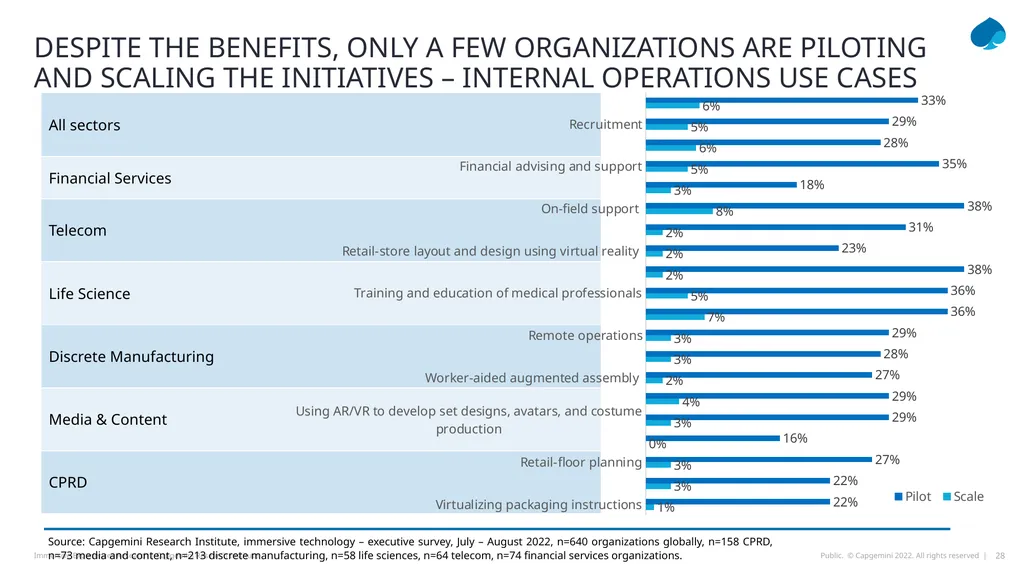
Source: Capgemini Research Institute, immersive technology – executive survey, July – August 2022, n=640 organizations globally, n=158 CPRD, n=73 media and content, n=213 discrete manufacturing, n=58 life sciences, n=64 telecom, n=74 financial services organizations. Despite the benefits, only a few organizations are piloting and scaling the initiatives – Internal operations Use cases<br>
29
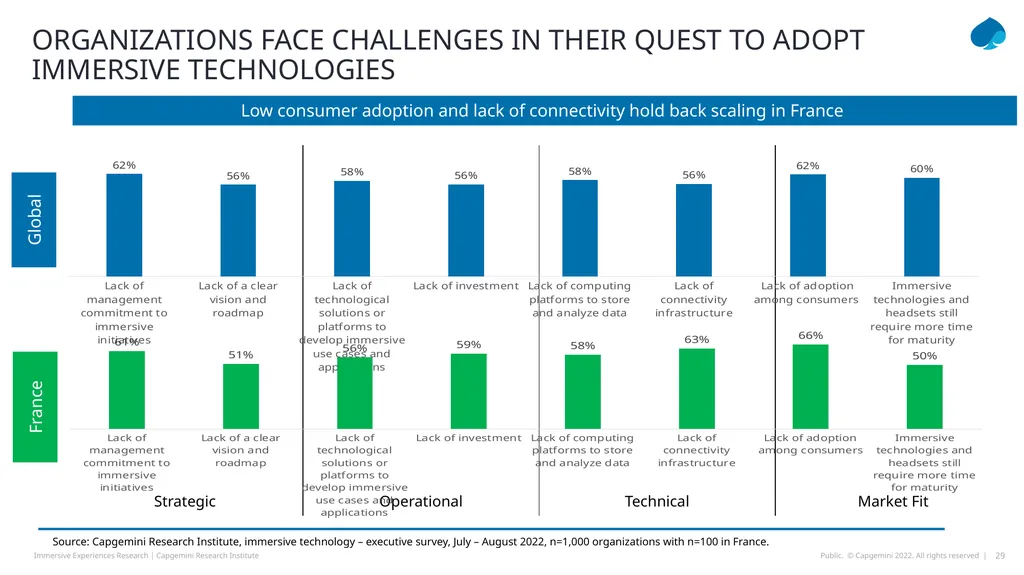
Low consumer adoption and lack of connectivity hold back scaling in France Source: Capgemini Research Institute, immersive technology – executive survey, July – August 2022, n=1,000 organizations with n=100 in France. France Global Organizations face challenges in their quest to adopt immersive technologies<br>
30
4 Consumer interest propels the metaverse to the fore<br>
31
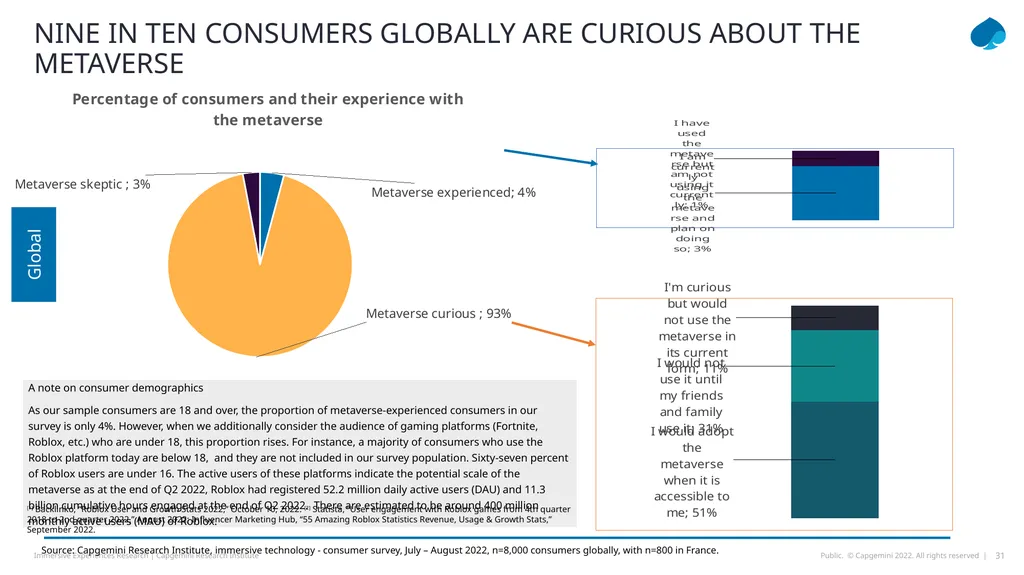
[1] Backlinko, “Roblox User and Growth Stats 2022,” October 10, 2022. [2] Statista, “User engagement with Roblox games from 4th quarter 2018 to 2nd quarter 2022,” August 2022; Influencer Marketing Hub, “55 Amazing Roblox Statistics Revenue, Usage & Growth Stats,” September 2022. Source: Capgemini Research Institute, immersive technology - consumer survey, July – August 2022, n=8,000 consumers globally, with n=800 in France. Nine in ten consumers globally are curious about the metaverse Global<br>
32
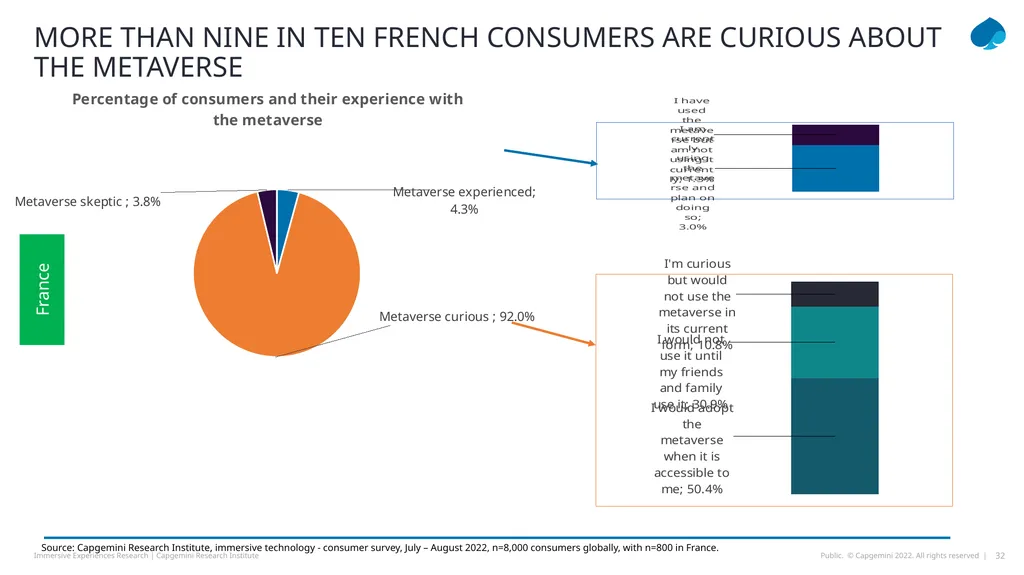
Source: Capgemini Research Institute, immersive technology - consumer survey, July – August 2022, n=8,000 consumers globally, with n=800 in France. More than nine in ten French consumers are curious about the metaverse France<br>
33
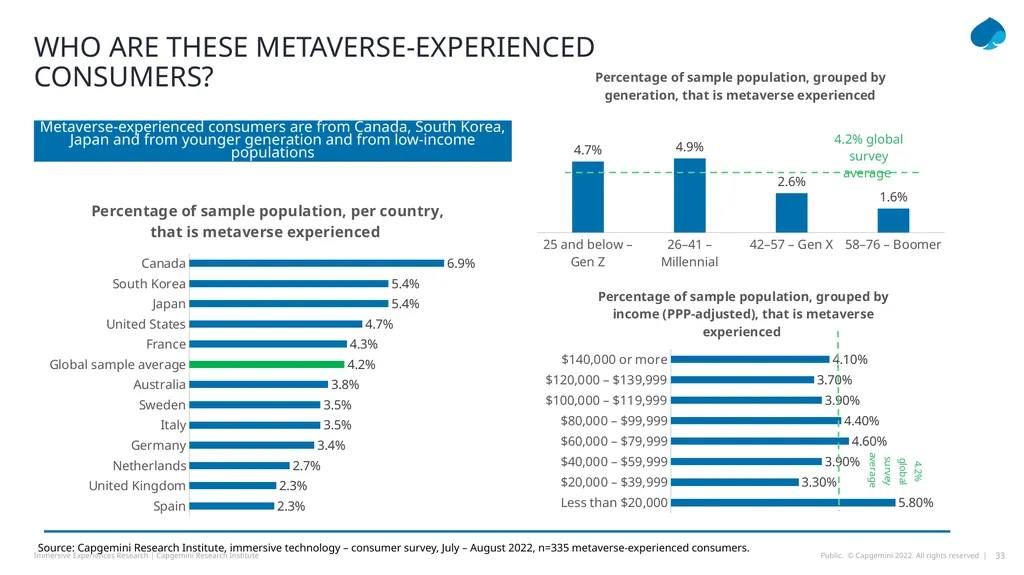
4.2% global survey average Metaverse-experienced consumers are from Canada, South Korea, Japan and from younger generation and from low-income populations Source: Capgemini Research Institute, immersive technology – consumer survey, July – August 2022, n=335 metaverse-experienced consumers. Who are these metaverse-experienced
consumers?<br>
consumers?<br>
34
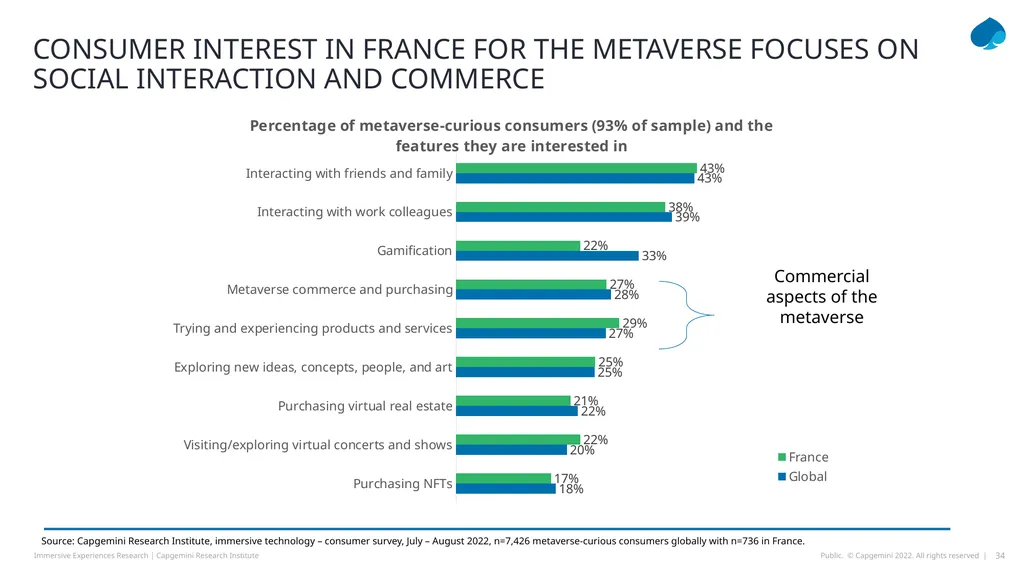
Source: Capgemini Research Institute, immersive technology – consumer survey, July – August 2022, n=7,426 metaverse-curious consumers globally with n=736 in France. Consumer interest in France for the metaverse focuses on social interaction and commerce Commercial aspects of the metaverse<br>
35
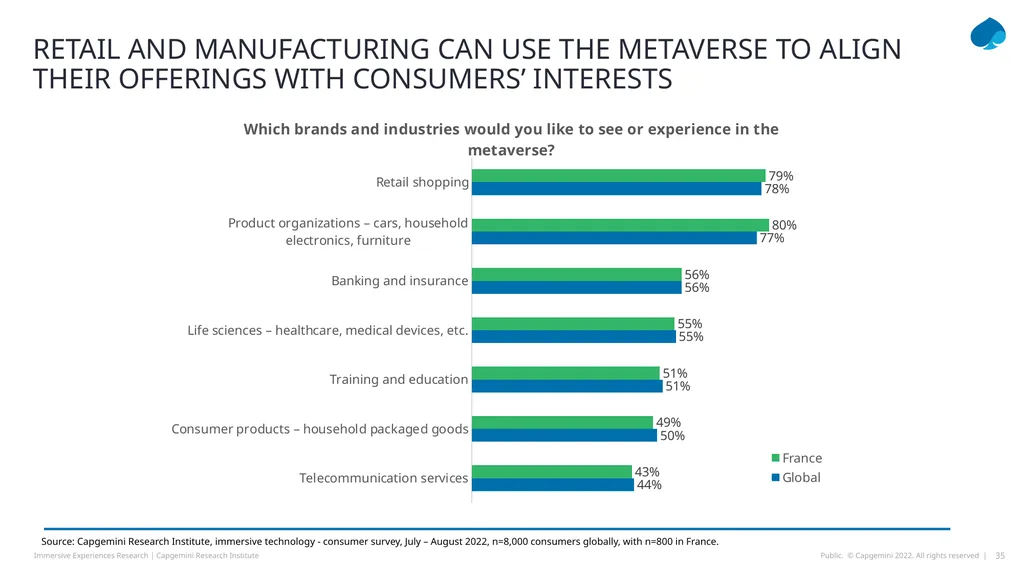
Source: Capgemini Research Institute, immersive technology - consumer survey, July – August 2022, n=8,000 consumers globally, with n=800 in France. Retail and manufacturing can use the metaverse to align their offerings with consumers’ interests<br>
36
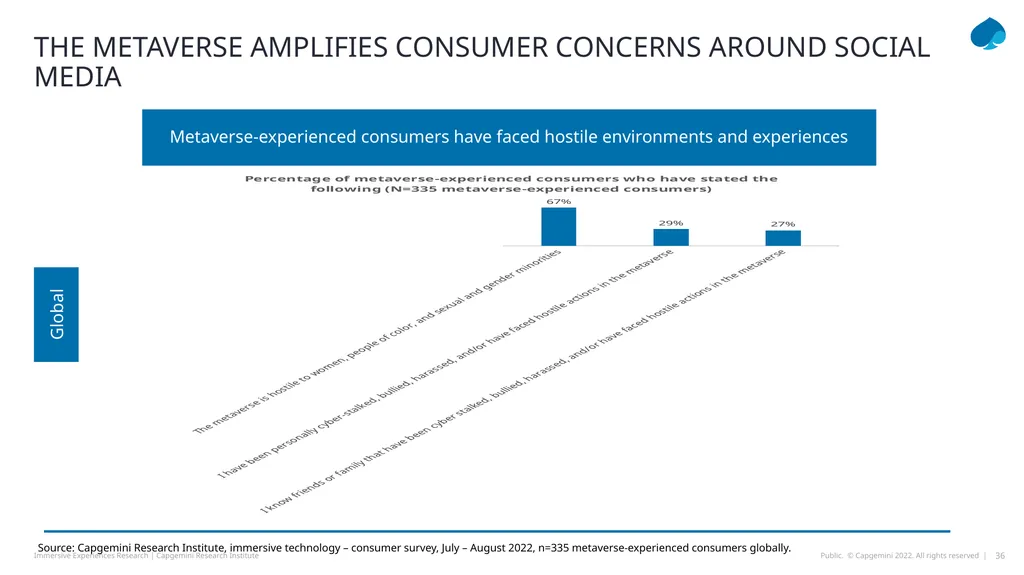
The metaverse amplifies consumer concerns around social media Metaverse-experienced consumers have faced hostile environments and experiences Source: Capgemini Research Institute, immersive technology – consumer survey, July – August 2022, n=335 metaverse-experienced consumers globally. Global<br>
37
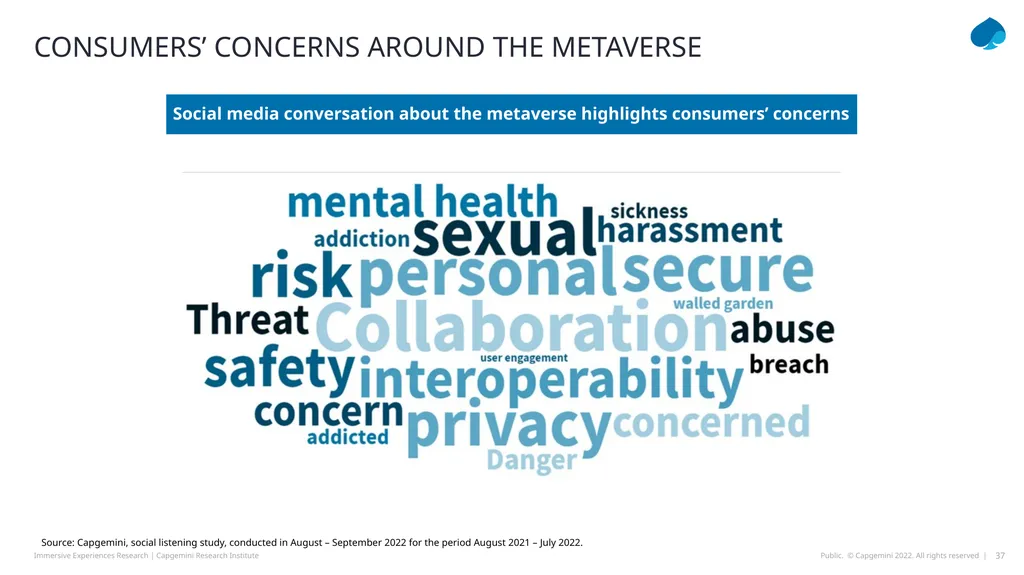
Source: Capgemini, social listening study, conducted in August – September 2022 for the period August 2021 – July 2022. Social media conversation about the metaverse highlights consumers’ concerns consumers’ concerns around the metaverse<br>
38
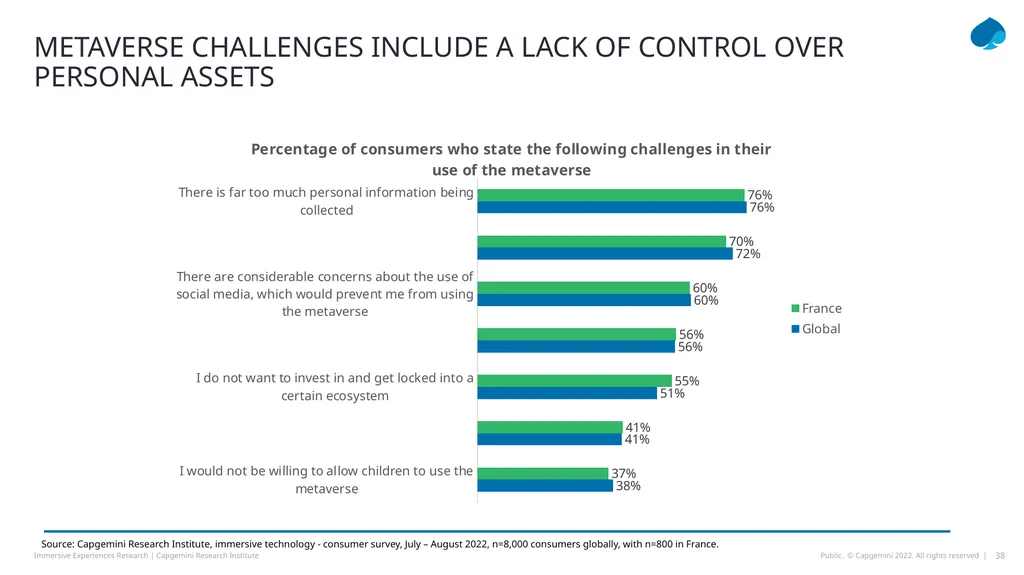
Metaverse challenges include a lack of control over personal assets Source: Capgemini Research Institute, immersive technology - consumer survey, July – August 2022, n=8,000 consumers globally, with n=800 in France.<br>
39
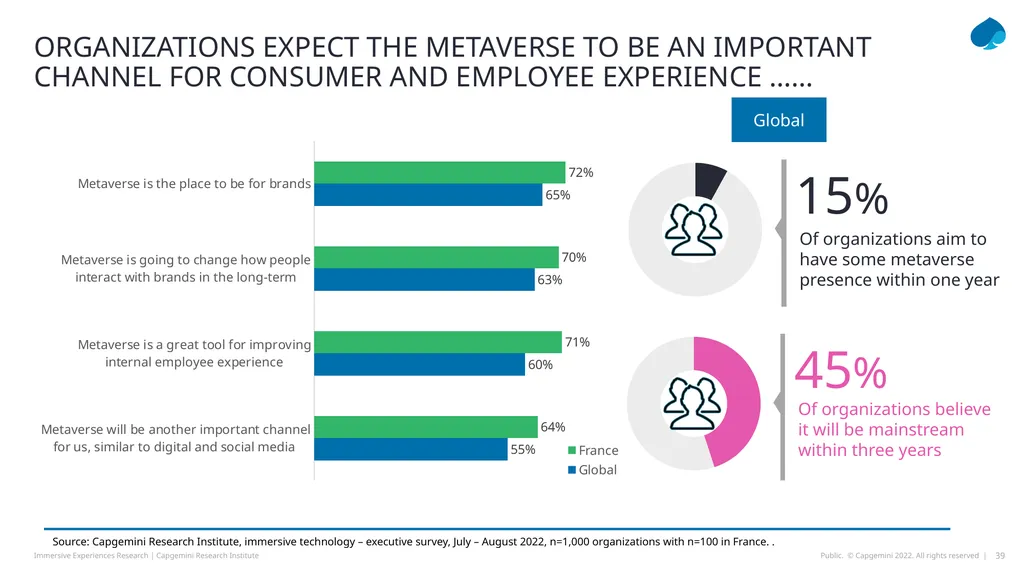
Organizations expect the metaverse to be an important channel for consumer and employee experience …… Of organizations aim to have some metaverse presence within one year 15% Of organizations believe it will be mainstream within three years 45% Source: Capgemini Research Institute, immersive technology – executive survey, July – August 2022, n=1,000 organizations with n=100 in France. . Global<br>
40
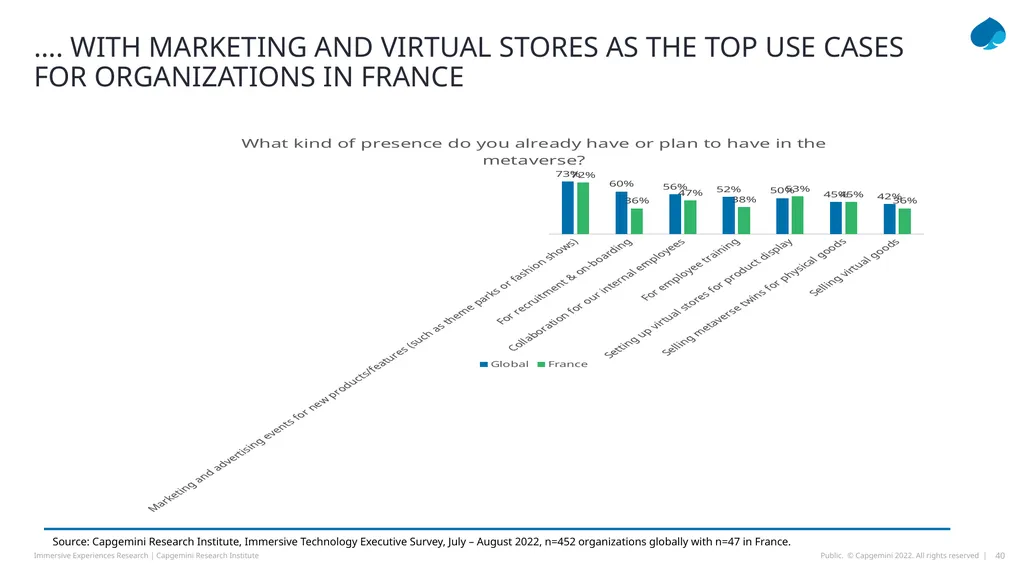
…. With Marketing and virtual stores as the top use cases for organizations in France Source: Capgemini Research Institute, Immersive Technology Executive Survey, July – August 2022, n=452 organizations globally with n=47 in France.<br>
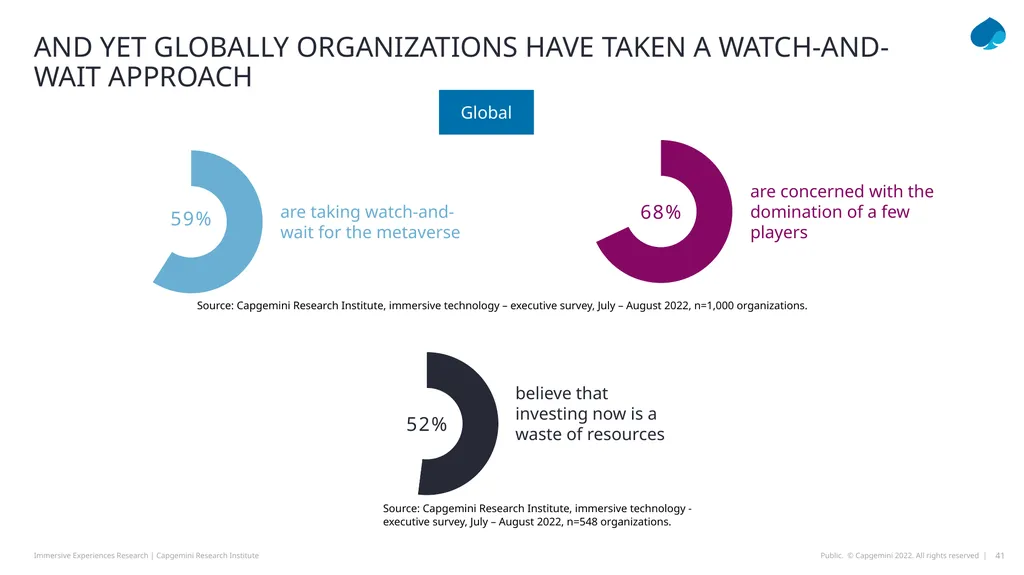
41
And Yet Globally organizations have taken a watch-and-wait approach Source: Capgemini Research Institute, immersive technology – executive survey, July – August 2022, n=1,000 organizations. Global<br>
42
How can immersive technology reimagine the customer journey and internal operations? 4<br>
43
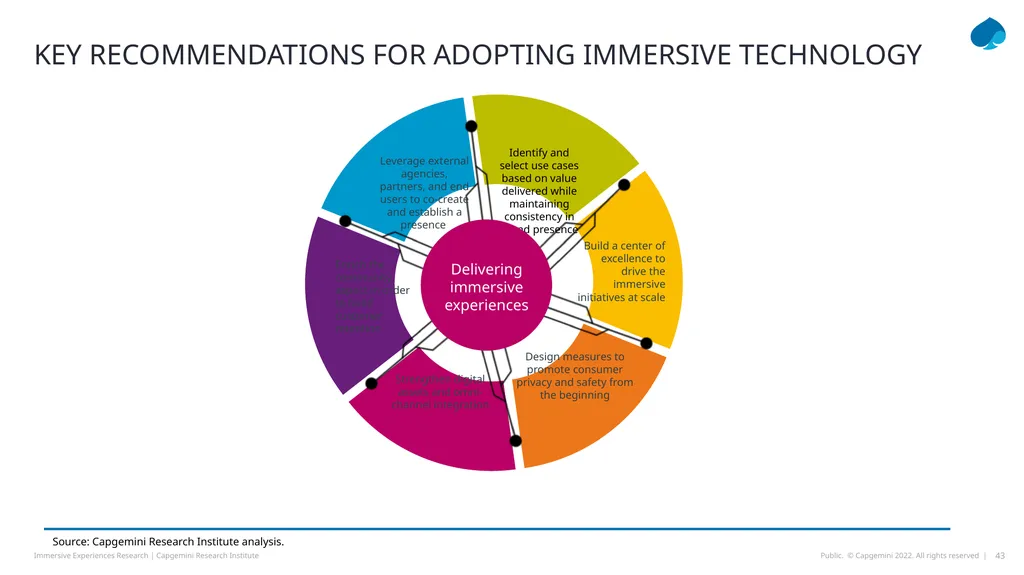
Key recommendations for adopting immersive technology Source: Capgemini Research Institute analysis.<br>
44
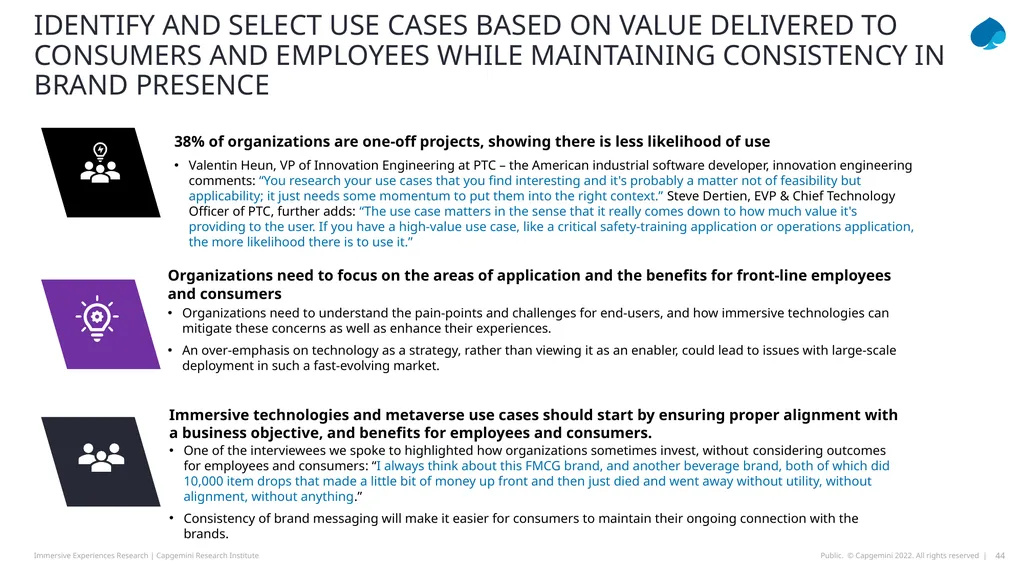
Identify and select use cases based on value delivered to consumers and employees while maintaining consistency in brand presence<br>
45
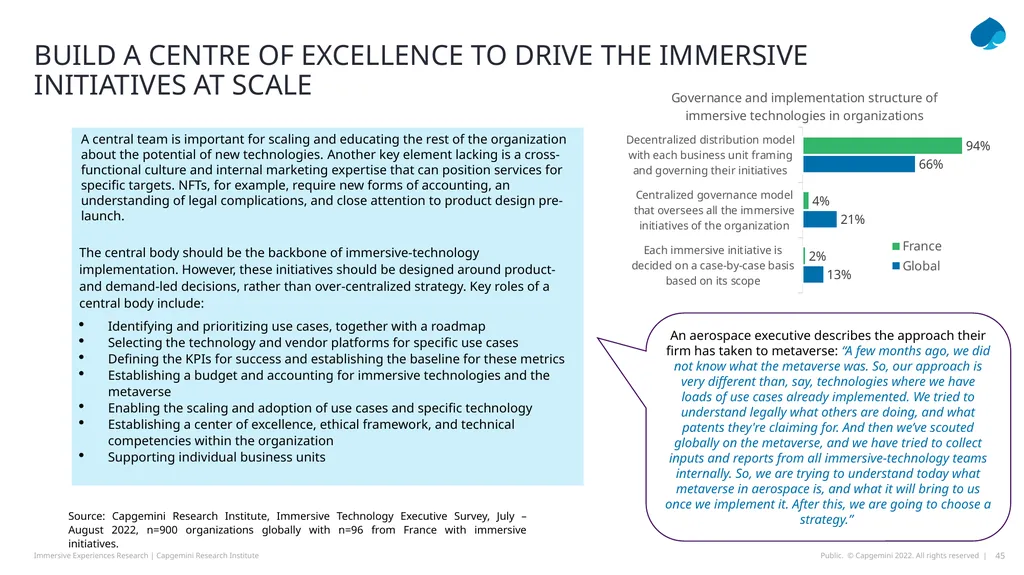
An aerospace executive describes the approach their firm has taken to metaverse: “A few months ago, we did not know what the metaverse was. So, our approach is very different than, say, technologies where we have loads of use cases already implemented. We tried to understand legally what others are doing, and what patents they're claiming for. And then we’ve scouted globally on the metaverse, and we have tried to collect inputs and reports from all immersive-technology teams internally. So, we are trying to understand today what metaverse in aerospace is, and what it will bring to us once we implement it. After this, we are going to choose a strategy.” The central body should be the backbone of immersive-technology implementation. However, these initiatives should be designed around product- and demand-led decisions, rather than over-centralized strategy. Key roles of a central body include:
Identifying and prioritizing use cases, together with a roadmap
Selecting the technology and vendor platforms for specific use cases
Defining the KPIs for success and establishing the baseline for these metrics
Establishing a budget and accounting for immersive technologies and the metaverse
Enabling the scaling and adoption of use cases and specific technology
Establishing a center of excellence, ethical framework, and technical competencies within the organization
Supporting individual business units A central team is important for scaling and educating the rest of the organization about the potential of new technologies. Another key element lacking is a cross-functional culture and internal marketing expertise that can position services for specific targets. NFTs, for example, require new forms of accounting, an understanding of legal complications, and close attention to product design pre-launch. Source: Capgemini Research Institute, Immersive Technology Executive Survey, July – August 2022, n=900 organizations globally with n=96 from France with immersive initiatives. Build a centre of excellence to drive the immersive initiatives at scale<br>
Identifying and prioritizing use cases, together with a roadmap
Selecting the technology and vendor platforms for specific use cases
Defining the KPIs for success and establishing the baseline for these metrics
Establishing a budget and accounting for immersive technologies and the metaverse
Enabling the scaling and adoption of use cases and specific technology
Establishing a center of excellence, ethical framework, and technical competencies within the organization
Supporting individual business units A central team is important for scaling and educating the rest of the organization about the potential of new technologies. Another key element lacking is a cross-functional culture and internal marketing expertise that can position services for specific targets. NFTs, for example, require new forms of accounting, an understanding of legal complications, and close attention to product design pre-launch. Source: Capgemini Research Institute, Immersive Technology Executive Survey, July – August 2022, n=900 organizations globally with n=96 from France with immersive initiatives. Build a centre of excellence to drive the immersive initiatives at scale<br>
46
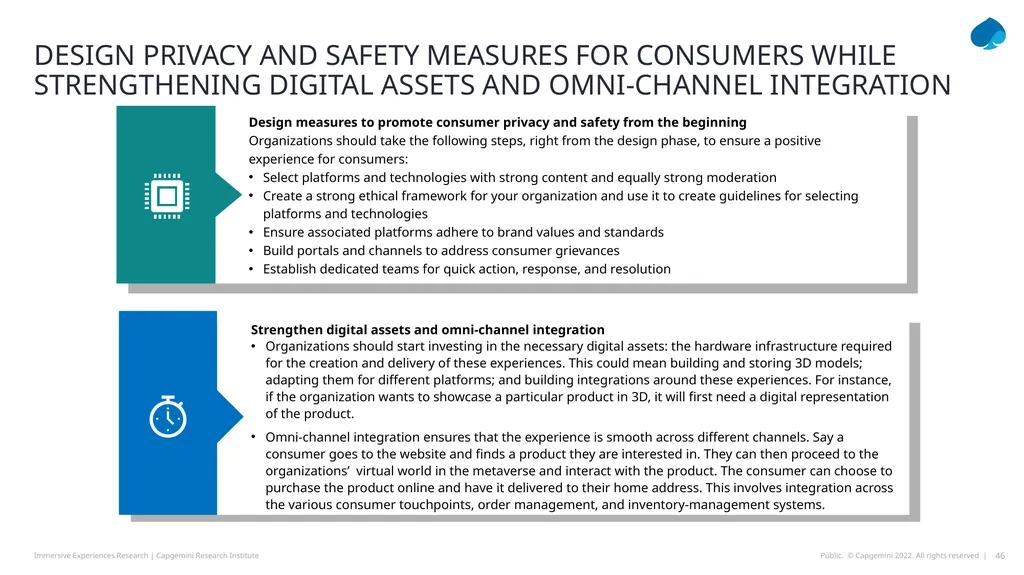
Strengthen digital assets and omni-channel integration
Organizations should start investing in the necessary digital assets: the hardware infrastructure required for the creation and delivery of these experiences. This could mean building and storing 3D models; adapting them for different platforms; and building integrations around these experiences. For instance, if the organization wants to showcase a particular product in 3D, it will first need a digital representation of the product.
Omni-channel integration ensures that the experience is smooth across different channels. Say a consumer goes to the website and finds a product they are interested in. They can then proceed to the organizations’ virtual world in the metaverse and interact with the product. The consumer can choose to purchase the product online and have it delivered to their home address. This involves integration across the various consumer touchpoints, order management, and inventory-management systems. Design measures to promote consumer privacy and safety from the beginning
Organizations should take the following steps, right from the design phase, to ensure a positive experience for consumers:
Select platforms and technologies with strong content and equally strong moderation
Create a strong ethical framework for your organization and use it to create guidelines for selecting platforms and technologies
Ensure associated platforms adhere to brand values and standards
Build portals and channels to address consumer grievances
Establish dedicated teams for quick action, response, and resolution Design privacy and safety measures for consumers while strengthening digital assets and omni-channel integration<br>
Organizations should start investing in the necessary digital assets: the hardware infrastructure required for the creation and delivery of these experiences. This could mean building and storing 3D models; adapting them for different platforms; and building integrations around these experiences. For instance, if the organization wants to showcase a particular product in 3D, it will first need a digital representation of the product.
Omni-channel integration ensures that the experience is smooth across different channels. Say a consumer goes to the website and finds a product they are interested in. They can then proceed to the organizations’ virtual world in the metaverse and interact with the product. The consumer can choose to purchase the product online and have it delivered to their home address. This involves integration across the various consumer touchpoints, order management, and inventory-management systems. Design measures to promote consumer privacy and safety from the beginning
Organizations should take the following steps, right from the design phase, to ensure a positive experience for consumers:
Select platforms and technologies with strong content and equally strong moderation
Create a strong ethical framework for your organization and use it to create guidelines for selecting platforms and technologies
Ensure associated platforms adhere to brand values and standards
Build portals and channels to address consumer grievances
Establish dedicated teams for quick action, response, and resolution Design privacy and safety measures for consumers while strengthening digital assets and omni-channel integration<br>
47
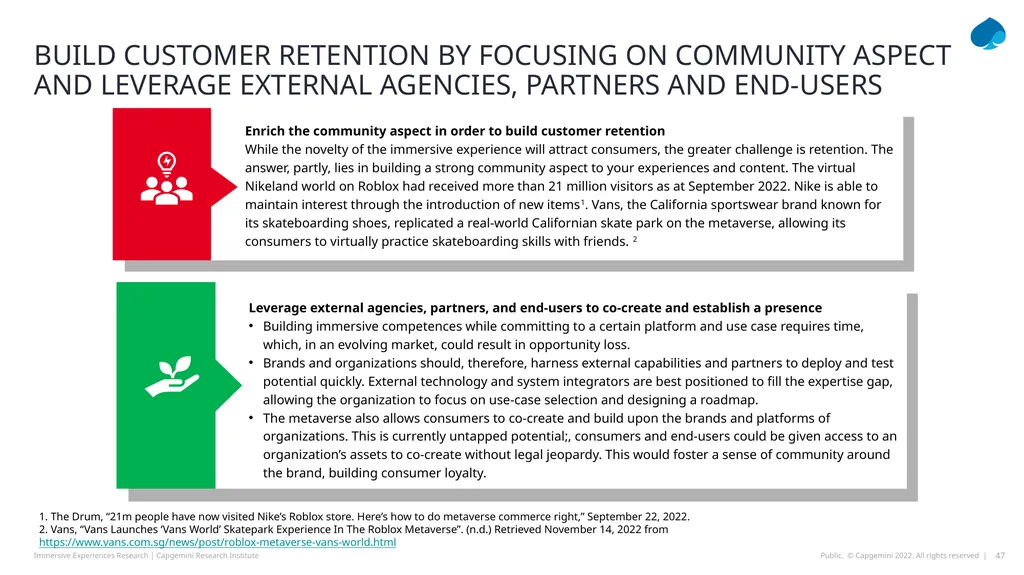
Enrich the community aspect in order to build customer retention
While the novelty of the immersive experience will attract consumers, the greater challenge is retention. The answer, partly, lies in building a strong community aspect to your experiences and content. The virtual Nikeland world on Roblox had received more than 21 million visitors as at September 2022. Nike is able to maintain interest through the introduction of new items1. Vans, the California sportswear brand known for its skateboarding shoes, replicated a real-world Californian skate park on the metaverse, allowing its consumers to virtually practice skateboarding skills with friends. 2 Leverage external agencies, partners, and end-users to co-create and establish a presence
Building immersive competences while committing to a certain platform and use case requires time, which, in an evolving market, could result in opportunity loss.
Brands and organizations should, therefore, harness external capabilities and partners to deploy and test potential quickly. External technology and system integrators are best positioned to fill the expertise gap, allowing the organization to focus on use-case selection and designing a roadmap.
The metaverse also allows consumers to co-create and build upon the brands and platforms of organizations. This is currently untapped potential;, consumers and end-users could be given access to an organization’s assets to co-create without legal jeopardy. This would foster a sense of community around the brand, building consumer loyalty. 1. The Drum, “21m people have now visited Nike’s Roblox store. Here’s how to do metaverse commerce right,” September 22, 2022.
2. Vans, “Vans Launches ‘Vans World’ Skatepark Experience In The Roblox Metaverse”. (n.d.) Retrieved November 14, 2022 from https://www.vans.com.sg/news/post/roblox-metaverse-vans-world.html Build customer retention by focusing on community aspect and leverage external agencies, partners and end-users<br>
While the novelty of the immersive experience will attract consumers, the greater challenge is retention. The answer, partly, lies in building a strong community aspect to your experiences and content. The virtual Nikeland world on Roblox had received more than 21 million visitors as at September 2022. Nike is able to maintain interest through the introduction of new items1. Vans, the California sportswear brand known for its skateboarding shoes, replicated a real-world Californian skate park on the metaverse, allowing its consumers to virtually practice skateboarding skills with friends. 2 Leverage external agencies, partners, and end-users to co-create and establish a presence
Building immersive competences while committing to a certain platform and use case requires time, which, in an evolving market, could result in opportunity loss.
Brands and organizations should, therefore, harness external capabilities and partners to deploy and test potential quickly. External technology and system integrators are best positioned to fill the expertise gap, allowing the organization to focus on use-case selection and designing a roadmap.
The metaverse also allows consumers to co-create and build upon the brands and platforms of organizations. This is currently untapped potential;, consumers and end-users could be given access to an organization’s assets to co-create without legal jeopardy. This would foster a sense of community around the brand, building consumer loyalty. 1. The Drum, “21m people have now visited Nike’s Roblox store. Here’s how to do metaverse commerce right,” September 22, 2022.
2. Vans, “Vans Launches ‘Vans World’ Skatepark Experience In The Roblox Metaverse”. (n.d.) Retrieved November 14, 2022 from https://www.vans.com.sg/news/post/roblox-metaverse-vans-world.html Build customer retention by focusing on community aspect and leverage external agencies, partners and end-users<br>
48
Subscribe to the Capgemini Research Institute Receive advance copies of our reports by scanning the QR code or visiting: https://www.capgemini.com/insights/research-institute/subscribe/<br>
49
About Capgemini Capgemini is a global leader in partnering with companies to transform and manage their business by harnessing the power of technology. The Group is guided everyday by its purpose of unleashing human energy through technology for an inclusive and sustainable future. It is a responsible and diverse organization of over 325,000 team members more than 50 countries. With its strong 55-year heritage and deep industry expertise, Capgemini is trusted by its clients to address the entire breadth of their business needs, from strategy and design to operations, fueled by the fast evolving and innovative world of cloud, data, AI, connectivity, software, digital engineering and platforms. The Group reported in 2021 global revenues of €18 billion. Get The Future You Want | www.capgemini.com<br>