
Train the Trainer Day 1: Plan Opening Staff
TD
Published · 71 slides · 0 views
1 / 1

Description
Train the Trainer Day 1: Plan Opening Staff Personalize this slide with names, lodges, locations Objectives Building great trainers and training teams Developing splendid training courses Spreading best training practices into your lodge
Related Topics
Share
Embed code
Download this presentation From Below
"Train the Trainer Day 1: Plan Opening Staff" is the property of its rightful owner. Permission is granted to download and print the materials on this website for personal, non-commercial use only, and to display it on your personal computer provided you do not modify the materials and that you retain all copyright notices contained in the materials. By downloading content from our website, you accept the terms of this agreement.
Presentation Transcript
01
Train the Trainer Day 1: Plan<br>
02
Opening<br>
03
Staff Personalize this slide with names, lodges, locations<br>
04
Objectives Building great trainers and training teams
Developing splendid training courses
Spreading best training practices into your lodge and section<br>
Developing splendid training courses
Spreading best training practices into your lodge and section<br>
05
Schedule 3-day course
Day 1: Planning Your Training
Day 2: Developing Your Training
Day 3: Delivering Your Training
At end, you’ll have solid resources to take home to your lodge or section to Start Your Ripple<br>
Day 1: Planning Your Training
Day 2: Developing Your Training
Day 3: Delivering Your Training
At end, you’ll have solid resources to take home to your lodge or section to Start Your Ripple<br>
06
Participant Presentations Purpose is concrete practice of techniques
We learn best by doing
Do not let its development detract from your NOAC experience (no all-nighters)
Ideally 5 minutes
Topics<br>
We learn best by doing
Do not let its development detract from your NOAC experience (no all-nighters)
Ideally 5 minutes
Topics<br>
07
Ice Breaker Goals of ice breakers
Learn names
Learn something about people
Find commonality of purpose
Group Meeting Sparklers is a resource
Practice (these or others)
Merge Sort Name Game
Adjective-Noun Name Game<br>
Learn names
Learn something about people
Find commonality of purpose
Group Meeting Sparklers is a resource
Practice (these or others)
Merge Sort Name Game
Adjective-Noun Name Game<br>
08
Day 1: Planning Your Training What is Training?
Deciding on Topics
Evaluation
Group Size and Methods
Building Your Training Team
Identifying Resources
People as well as Materials<br>
Deciding on Topics
Evaluation
Group Size and Methods
Building Your Training Team
Identifying Resources
People as well as Materials<br>
09
What is Training? Brainstorm technique
Record all suggestions
Trim later (or not)
Scribe
good handwriting
written large enough
Go ...<br>
Record all suggestions
Trim later (or not)
Scribe
good handwriting
written large enough
Go ...<br>
10
Deciding on Topics Set topics such as Brotherhood Conversion
Set structure (such as LLD) but choose topics within that structure
Choosing topics can be the hard part
Even if topic is set, you still refine the syllabus and make it your own<br>
Set structure (such as LLD) but choose topics within that structure
Choosing topics can be the hard part
Even if topic is set, you still refine the syllabus and make it your own<br>
11
Things to Consider when
Choosing Topics (1) Audience diversity
What audience wants
What audience needs
What has worked in the past
New items for previous attendees<br>
What audience wants
What audience needs
What has worked in the past
New items for previous attendees<br>
12
Things to Consider when
Choosing Topics (2) Prerequisites
Resources available
Venue
Unique aspects of trainers or venue<br>
Resources available
Venue
Unique aspects of trainers or venue<br>
13
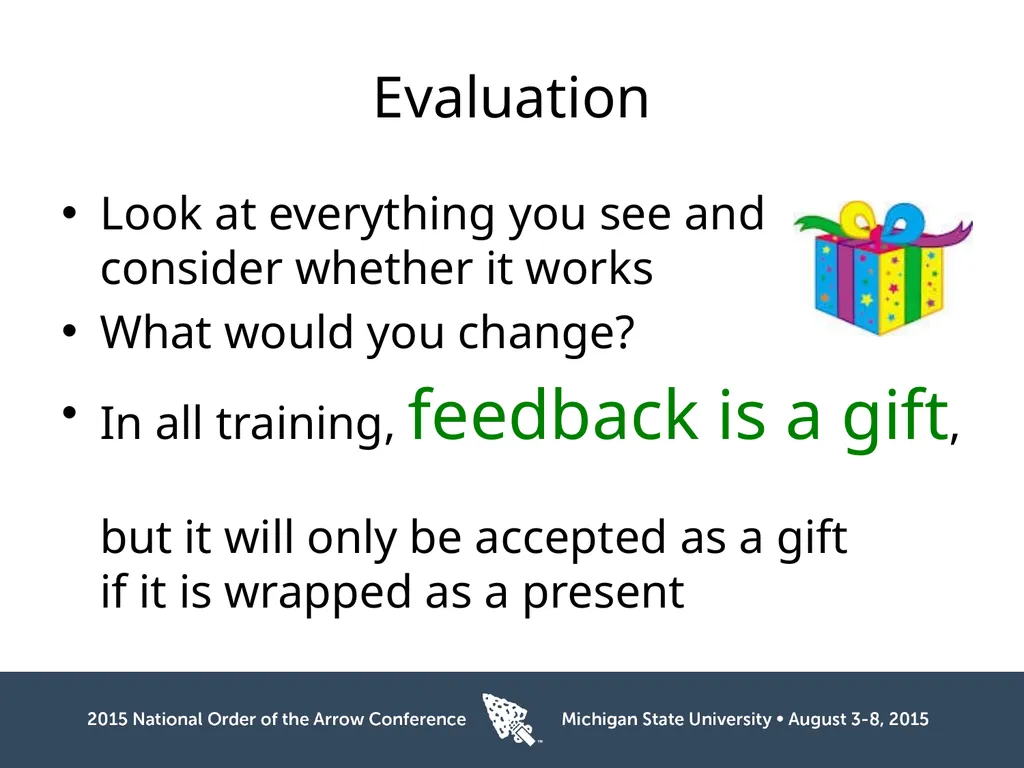
Evaluation Look at everything you see and
consider whether it works
What would you change?
In all training, feedback is a gift, but it will only be accepted as a gift if it is wrapped as a present<br>
What would you change?
In all training, feedback is a gift, but it will only be accepted as a gift if it is wrapped as a present<br>
14
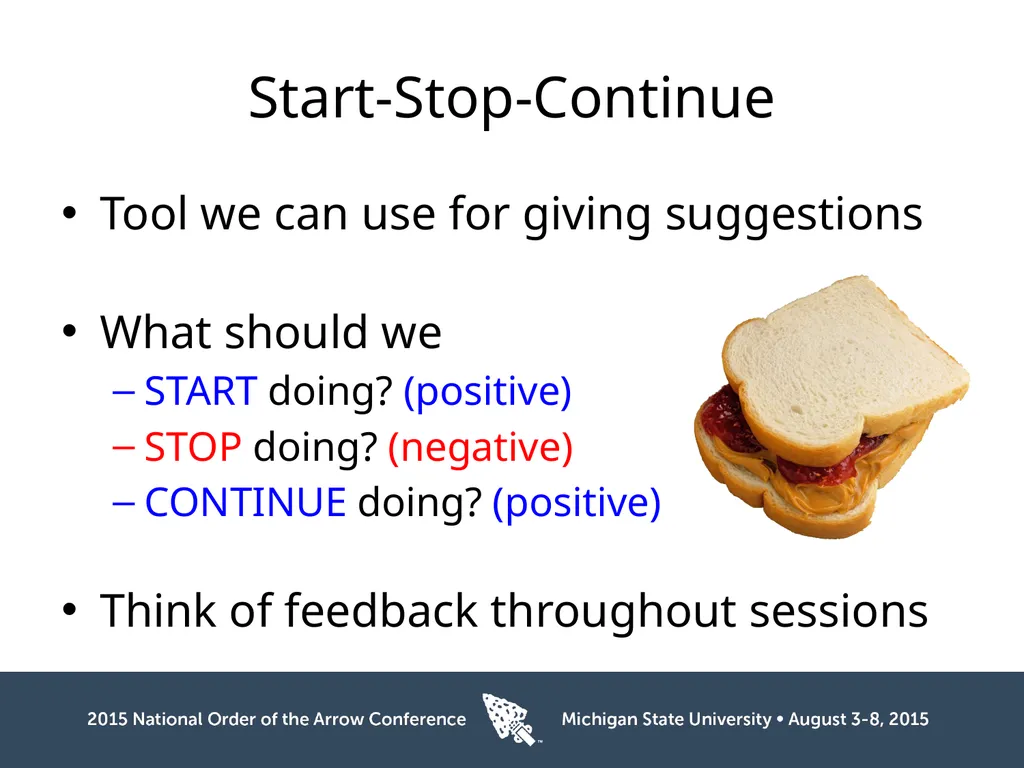
Start-Stop-Continue Tool we can use for giving suggestions
What should we
START doing? (positive)
STOP doing? (negative)
CONTINUE doing? (positive)
Think of feedback throughout sessions<br>
What should we
START doing? (positive)
STOP doing? (negative)
CONTINUE doing? (positive)
Think of feedback throughout sessions<br>
15
Break<br>
16
Group Size and Methods BSA encourages 4 types of training
Small group: one-to-many approach
Personal coaching: one-on-one or two
Self-study: learn on your own
Centers of Excellence: observe good examples<br>
Small group: one-to-many approach
Personal coaching: one-on-one or two
Self-study: learn on your own
Centers of Excellence: observe good examples<br>
17
Group Size Aim to involve everyone
This group probably larger than is good
Break into smaller groups each led by trainer
Most OA training will be “small group”
Split sessions to reduce size
Need additional space and trainers<br>
This group probably larger than is good
Break into smaller groups each led by trainer
Most OA training will be “small group”
Split sessions to reduce size
Need additional space and trainers<br>
18
Methods Lecture
Informal Talk
Demonstration
Case Study
Role-Play
Simulation
Buzz Group<br>
Informal Talk
Demonstration
Case Study
Role-Play
Simulation
Buzz Group<br>
19
Which Method Works Best? People learn best if they are
involved and active
Make content “sticky” through variety
Match methods to kind of topic
More stationary for explaining why
More active for showing how
Include audience as much as possible<br>
Make content “sticky” through variety
Match methods to kind of topic
More stationary for explaining why
More active for showing how
Include audience as much as possible<br>
20
Building Training Team Who are Good Trainers?
Characteristics of Good Trainers
Roles of Trainers in a good Training Team
Recruiting Good Trainers
Ask directly
Let them know they will be mentored
Give them useful and positive feedback
Practice, practice, practice to gain confidence<br>
Characteristics of Good Trainers
Roles of Trainers in a good Training Team
Recruiting Good Trainers
Ask directly
Let them know they will be mentored
Give them useful and positive feedback
Practice, practice, practice to gain confidence<br>
21
Break<br>
22
Identifying Resources Materials and People
Resources abound
People with varying skills
Published course outlines
When using non-BSA resources, check for conflict with BSA values
Check for language and grey areas
Respect copyright
Acknowledge sources<br>
Resources abound
People with varying skills
Published course outlines
When using non-BSA resources, check for conflict with BSA values
Check for language and grey areas
Respect copyright
Acknowledge sources<br>
23
Summary and Wrap-up Review topics
Discuss “homework”
What are expectations for next day?
Do not let prep interfere with NOAC experience<br>
Discuss “homework”
What are expectations for next day?
Do not let prep interfere with NOAC experience<br>
24
Train the Trainer Day 2: Develop Your Training<br>
25
Objectives How people learn
Training tools
Presentation Media
Time Management
Syllabus Development
Preparing and Practicing<br>
Training tools
Presentation Media
Time Management
Syllabus Development
Preparing and Practicing<br>
26
How People Learn People learn best when:
They understand why
They have a variety of ways presented
Experiential – Learn by doing
Timing is right
The process is positive and encouraging<br>
They understand why
They have a variety of ways presented
Experiential – Learn by doing
Timing is right
The process is positive and encouraging<br>
27
Training Tools<br>
28
Types Of Delivery Lecture
Large group
Introductory lesson
Little or no background or experiences
Participants get to listen to an expert
Advantages/disadvantages<br>
Large group
Introductory lesson
Little or no background or experiences
Participants get to listen to an expert
Advantages/disadvantages<br>
29
Types Of Delivery Informal Talk
Less technical
Material relatively new, some experience
Allows some discussion
Preferred method in Scouting
Advantages/ disadvantages<br>
Less technical
Material relatively new, some experience
Allows some discussion
Preferred method in Scouting
Advantages/ disadvantages<br>
30
Types Of Delivery Demonstration
• Step by step instructions
• Show and do
• Instructor prepared and practiced
• Materials for all participants
• Large Training aid
• Advantages / disadvantages<br>
• Step by step instructions
• Show and do
• Instructor prepared and practiced
• Materials for all participants
• Large Training aid
• Advantages / disadvantages<br>
31
Types of Delivery Case Study
Actual events
Real life situations
Advantages/ disadvantages<br>
Actual events
Real life situations
Advantages/ disadvantages<br>
32
Types of Delivery Role-play
• Act out roles
• Own dialog
• Allows to look at multiple points of view
• Outcome not predetermined
• Sets stage for discussion
• Role-play less structured, Case study intentionally guided and structured<br>
• Act out roles
• Own dialog
• Allows to look at multiple points of view
• Outcome not predetermined
• Sets stage for discussion
• Role-play less structured, Case study intentionally guided and structured<br>
33
Simulation
• More complex than Role-play.
• Requires known skills - mimic real life
Advantages/ disadvantages<br>
• More complex than Role-play.
• Requires known skills - mimic real life
Advantages/ disadvantages<br>
34
Presentation Media<br>
35
PowerPoint Self Study
Read by an individual to learn
Often accompanied by audio
Instructor support
Assists learning
Participant overview<br>
Read by an individual to learn
Often accompanied by audio
Instructor support
Assists learning
Participant overview<br>
36
PowerPoint Purposes Help recall information
Supports the material
Identifies key learning points
Provides Interest & Variety
Clarifies points
Particularly for visual learners<br>
Supports the material
Identifies key learning points
Provides Interest & Variety
Clarifies points
Particularly for visual learners<br>
37
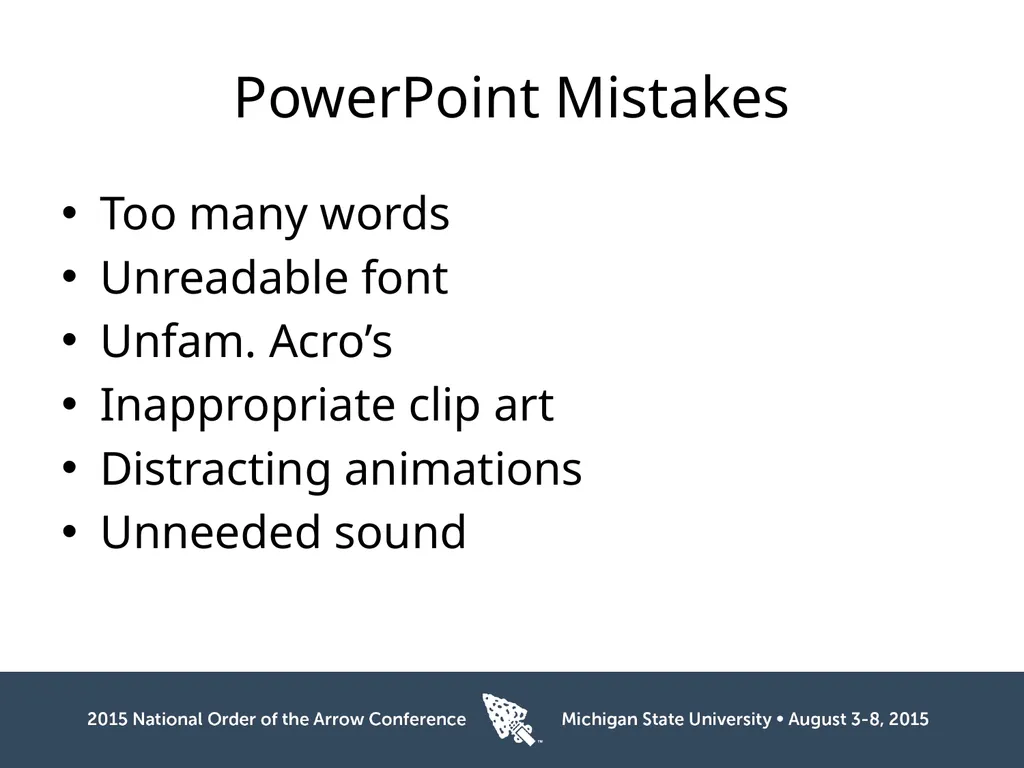
PowerPoint Mistakes Too many words
Unreadable font
Unfam. Acro’s
Inappropriate clip art
Distracting animations
Unneeded sound<br>
Unreadable font
Unfam. Acro’s
Inappropriate clip art
Distracting animations
Unneeded sound<br>
38
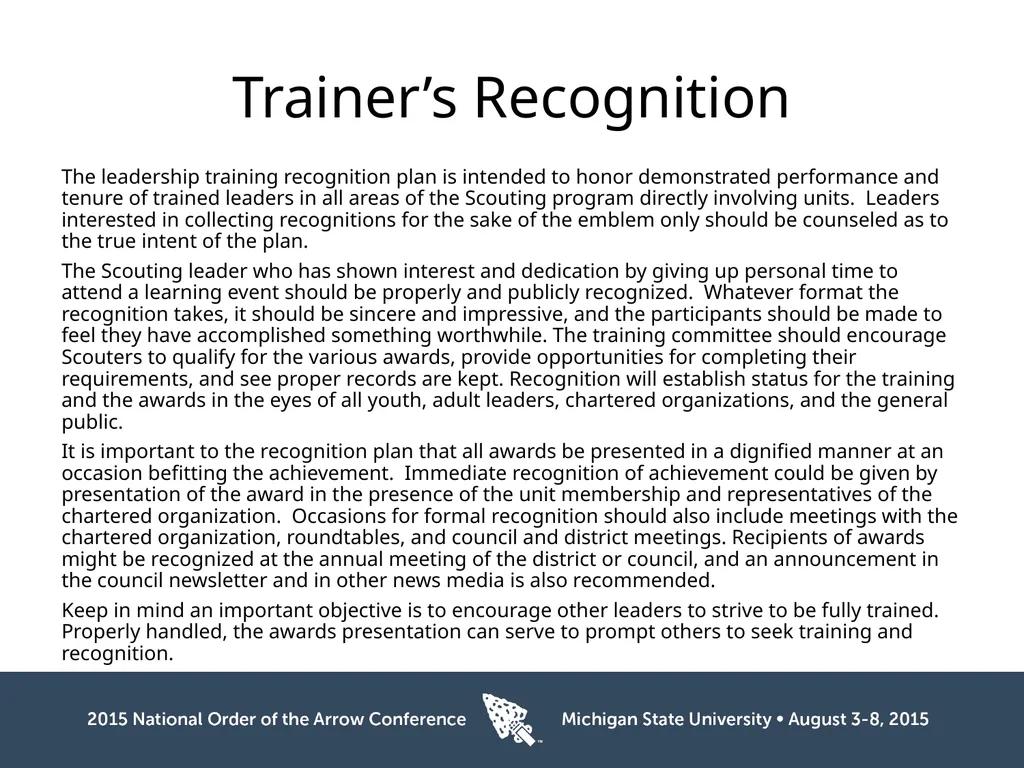
Trainer’s Recognition The leadership training recognition plan is intended to honor demonstrated performance and tenure of trained leaders in all areas of the Scouting program directly involving units. Leaders interested in collecting recognitions for the sake of the emblem only should be counseled as to the true intent of the plan.
The Scouting leader who has shown interest and dedication by giving up personal time to attend a learning event should be properly and publicly recognized. Whatever format the recognition takes, it should be sincere and impressive, and the participants should be made to feel they have accomplished something worthwhile. The training committee should encourage Scouters to qualify for the various awards, provide opportunities for completing their requirements, and see proper records are kept. Recognition will establish status for the training and the awards in the eyes of all youth, adult leaders, chartered organizations, and the general public.
It is important to the recognition plan that all awards be presented in a dignified manner at an occasion befitting the achievement. Immediate recognition of achievement could be given by presentation of the award in the presence of the unit membership and representatives of the chartered organization. Occasions for formal recognition should also include meetings with the chartered organization, roundtables, and council and district meetings. Recipients of awards might be recognized at the annual meeting of the district or council, and an announcement in the council newsletter and in other news media is also recommended.
Keep in mind an important objective is to encourage other leaders to strive to be fully trained. Properly handled, the awards presentation can serve to prompt others to seek training and recognition.<br>
The Scouting leader who has shown interest and dedication by giving up personal time to attend a learning event should be properly and publicly recognized. Whatever format the recognition takes, it should be sincere and impressive, and the participants should be made to feel they have accomplished something worthwhile. The training committee should encourage Scouters to qualify for the various awards, provide opportunities for completing their requirements, and see proper records are kept. Recognition will establish status for the training and the awards in the eyes of all youth, adult leaders, chartered organizations, and the general public.
It is important to the recognition plan that all awards be presented in a dignified manner at an occasion befitting the achievement. Immediate recognition of achievement could be given by presentation of the award in the presence of the unit membership and representatives of the chartered organization. Occasions for formal recognition should also include meetings with the chartered organization, roundtables, and council and district meetings. Recipients of awards might be recognized at the annual meeting of the district or council, and an announcement in the council newsletter and in other news media is also recommended.
Keep in mind an important objective is to encourage other leaders to strive to be fully trained. Properly handled, the awards presentation can serve to prompt others to seek training and recognition.<br>
39
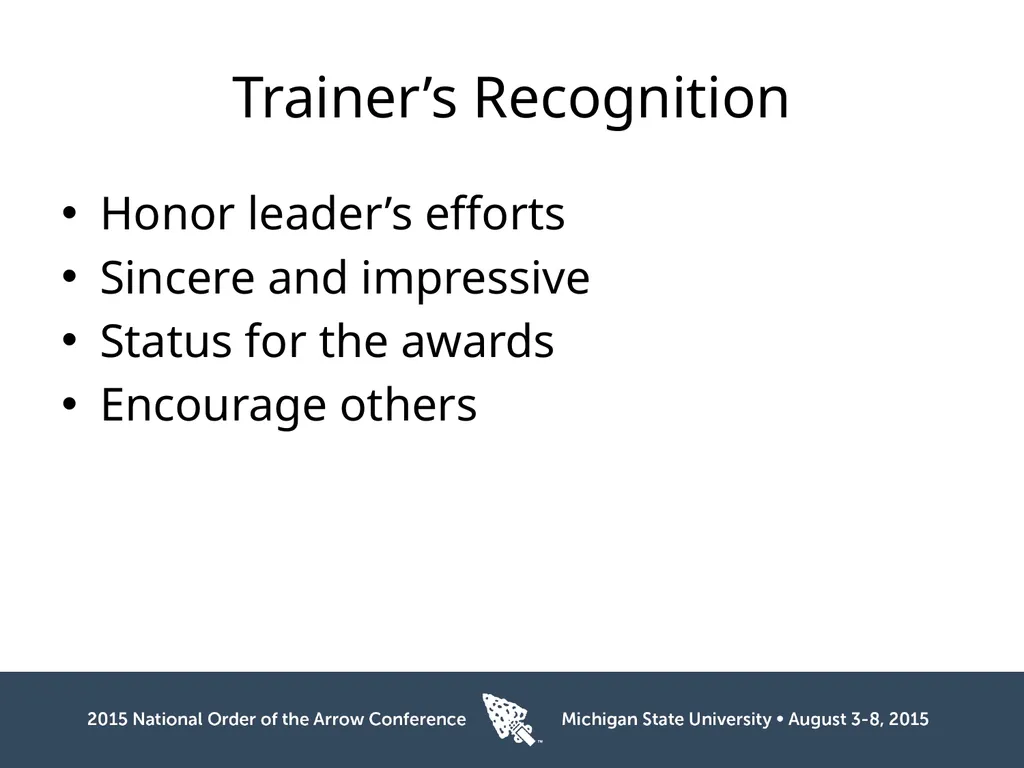
Trainer’s Recognition Honor leader’s efforts
Sincere and impressive
Status for the awards
Encourage others<br>
Sincere and impressive
Status for the awards
Encourage others<br>
40
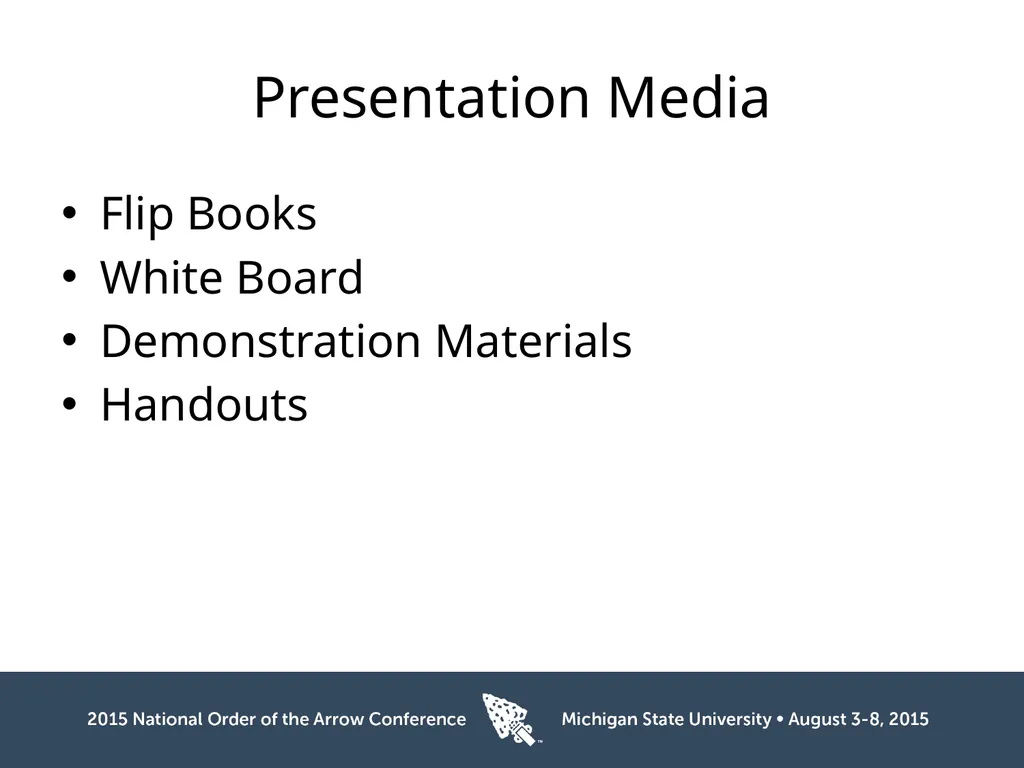
Presentation Media Flip Books
White Board
Demonstration Materials
Handouts<br>
White Board
Demonstration Materials
Handouts<br>
41
Time Management Your Own Methods
Time Keeper
Personal practicing of delivery<br>
Time Keeper
Personal practicing of delivery<br>
42
Syllabus Development<br>
43
Building Your Own Syllabus Decide on course length
Set defined Objectives
Break topic into separate sections
Decide on methods of delivery
Find out anticipated audience size,
Evaluate: Start-Stop-Continue method
Write it out, try it out<br>
Set defined Objectives
Break topic into separate sections
Decide on methods of delivery
Find out anticipated audience size,
Evaluate: Start-Stop-Continue method
Write it out, try it out<br>
44
Finalize The Syllabus Put it into a format you can follow
List resources used
List materials needed
Put together Hand-Out materials<br>
List resources used
List materials needed
Put together Hand-Out materials<br>
45
Buzz Groups<br>
46
Preparing And Practicing List of all items needed
Prepare Presentation Media
Handouts
Materials
Props
Songs
Games<br>
Prepare Presentation Media
Handouts
Materials
Props
Songs
Games<br>
47
Practice With an Audience
Don’t read or memorize
Use of Presentation Media
Be aware of Body Language and Posture
Use video
Check for bad habits<br>
Don’t read or memorize
Use of Presentation Media
Be aware of Body Language and Posture
Use video
Check for bad habits<br>
48
Summary and Assignments<br>
49
Train the Trainer Day 3: Delivering Your Training<br>
50
Managing Group Behavior What factors can affect group behavior and how they respond to your presentation?<br>
51
Types of Disruptive Behavior What types of disruptive behavior are you likely to experience?<br>
52
Changing Group Dynamics As a Presenter, how can you change the group dynamics?<br>
53
Changing Group Dynamics As a Presenter, how can you change the group dynamics?
Take a break<br>
Take a break<br>
54
Changing Group Dynamics As a Presenter, how can you change the group dynamics?
Take a break
Song, cheer or other activity<br>
Take a break
Song, cheer or other activity<br>
55
Changing Group Dynamics As a Presenter, how can you change the group dynamics?
Take a break
Song, cheer or other activity
Change the room layout/format<br>
Take a break
Song, cheer or other activity
Change the room layout/format<br>
56
Changing Group Dynamics As a Presenter, how can you change the group dynamics?
Take a break
Song, cheer or other activity
Change the room layout/format
Change the presentation style<br>
Take a break
Song, cheer or other activity
Change the room layout/format
Change the presentation style<br>
57
Changing Group Dynamics As a Presenter, how can you change the group dynamics?
Take a break
Song, cheer or other activity
Change the room layout/format
Change the presentation style
Call upon the disruptive personality (non-confrontational)<br>
Take a break
Song, cheer or other activity
Change the room layout/format
Change the presentation style
Call upon the disruptive personality (non-confrontational)<br>
58
Changing Group Dynamics As a Presenter, how can you change the group dynamics?
Take a break
Song, cheer or other activity
Change the room layout/format
Change the presentation style
Call upon the disruptive personality (non-confrontational)
Discuss how everyone will participate before others repeat<br>
Take a break
Song, cheer or other activity
Change the room layout/format
Change the presentation style
Call upon the disruptive personality (non-confrontational)
Discuss how everyone will participate before others repeat<br>
59
Changing Group Dynamics As a Presenter, how can you change the group dynamics?
Take a break
Song, cheer or other activity
Change the room layout/format
Change the presentation style
Call upon the disruptive personality (non-confrontational)
Discuss how everyone will participate before others repeat
Call out disruptive personality (directly, last step effort)<br>
Take a break
Song, cheer or other activity
Change the room layout/format
Change the presentation style
Call upon the disruptive personality (non-confrontational)
Discuss how everyone will participate before others repeat
Call out disruptive personality (directly, last step effort)<br>
60
Changing Group Dynamics Other ideas?<br>
61
Break (Start setup for presentations during break)<br>
62
Participant Presentations Everyone gives a 2-3 minute presentation on a topic of their choice<br>
63
Learning from Experience General Observations and Comments?
What was done well?
Constructive feedback?
What didn’t work well? Why?<br>
What was done well?
Constructive feedback?
What didn’t work well? Why?<br>
64
Creating your Ripple Develop your personal action plan
Do or do not, there is no try. - Yoda<br>
Do or do not, there is no try. - Yoda<br>
65
Review and Discussion Day 1: Plan
Day 2: Develop
Day 3: Deliver<br>
Day 2: Develop
Day 3: Deliver<br>
66
Evaluation Please complete the cell evaluation
Thank You, and safe travels home!<br>
Thank You, and safe travels home!<br>
67
For Training Resources and More Information Visit: http://training.oa-bsa.org/noac2015<br>