
Training and mentoring possibilities Maria Rosaria
SN
Published · 18 slides · 0 views

1 / 1

Description
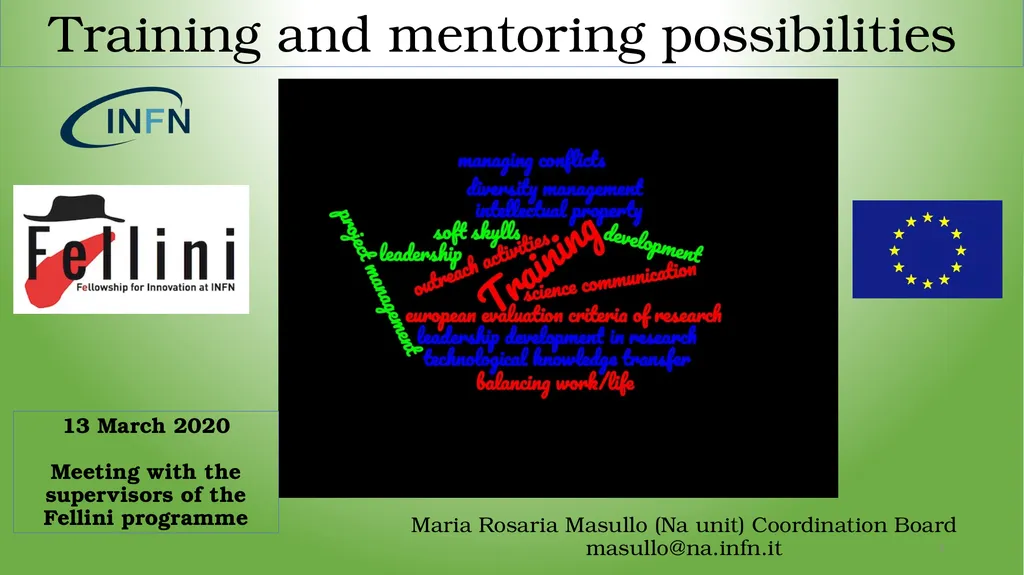
Training and mentoring possibilities Maria Rosaria Masullo (Na unit) Coordination Board masullona.infn.it 13 March 2020 Meeting with the supervisors of the Fellini programme 1 In this context the Personal Career Development Plan (CDP) is
Related Topics
Share
Embed code
Download this presentation From Below
"Training and mentoring possibilities Maria Rosaria" is the property of its rightful owner. Permission is granted to download and print the materials on this website for personal, non-commercial use only, and to display it on your personal computer provided you do not modify the materials and that you retain all copyright notices contained in the materials. By downloading content from our website, you accept the terms of this agreement.
Presentation Transcript
01
Training and mentoring possibilities Maria Rosaria Masullo (Na unit) Coordination Board
masullo@na.infn.it 13 March 2020
Meeting with the supervisors of the Fellini programme 1<br>
masullo@na.infn.it 13 March 2020
Meeting with the supervisors of the Fellini programme 1<br>
02
In this context the Personal Career Development Plan (CDP) is an important tool
Fellows are required to define their CDP at beginning of their programme, with input also from supervisors and the CB, according to their needs. CDPs will be formally updated annually (see Luisa Iacono presentation)
The CDP is a tool for researchers to plan, monitor and evaluate their progress in the acquisition of skills, experiences and advancement in their career.
The CDP will comprise fellows’ scientific objectives and training needs, including complementary skills:
primarily on scientific and technological knowledge through research on individual, personalised projects;
management and financing of research projects and programmes;
intellectual property rights;
entrepreneurship, how to create spin-off companies;
science communication, dissemination skills
soft skills
public engagment Personal Career Development Plans (CDP) 2 Fellini is not only a research programme, but also « provide all Fellows with an
ideal basis for their future careers, preparing them for a wide range
of career options »<br>
Fellows are required to define their CDP at beginning of their programme, with input also from supervisors and the CB, according to their needs. CDPs will be formally updated annually (see Luisa Iacono presentation)
The CDP is a tool for researchers to plan, monitor and evaluate their progress in the acquisition of skills, experiences and advancement in their career.
The CDP will comprise fellows’ scientific objectives and training needs, including complementary skills:
primarily on scientific and technological knowledge through research on individual, personalised projects;
management and financing of research projects and programmes;
intellectual property rights;
entrepreneurship, how to create spin-off companies;
science communication, dissemination skills
soft skills
public engagment Personal Career Development Plans (CDP) 2 Fellini is not only a research programme, but also « provide all Fellows with an
ideal basis for their future careers, preparing them for a wide range
of career options »<br>
03
Desirable competences to be developed for being a researcher in Europe:
Communicate with the wider community, and with society generally, about your areas of expertise
Coach PhD researchers, helping them to be more effective and successful in their R&D trajectory
Understand the value of your research work in the context of products and services from industry and other related employment sectors 3 The training inside FELLINI<br>
Communicate with the wider community, and with society generally, about your areas of expertise
Coach PhD researchers, helping them to be more effective and successful in their R&D trajectory
Understand the value of your research work in the context of products and services from industry and other related employment sectors 3 The training inside FELLINI<br>
04
Train young researchers in their field of research
Provide opportunities for increasing managerial experience:
Improve the young researcher employement perspective
Enhance the multi-disciplinarity of training, increasing the level and quality of interaction with other excellent research centres and with private companies:
Strengthen the creative and innovative potential of researchers through intersectoral mobility
Training on Intellectual Property and Technology Transfer
Interdisciplinary research training
Improve soft skills of the fellows
Provide the researchers with organizational and soft skills necessary for team-based research work
Work-life balance, time management The training inside FELLINI
fellows participation to the existing INFN training programme and/or to ad hoc format 4<br>
Provide opportunities for increasing managerial experience:
Improve the young researcher employement perspective
Enhance the multi-disciplinarity of training, increasing the level and quality of interaction with other excellent research centres and with private companies:
Strengthen the creative and innovative potential of researchers through intersectoral mobility
Training on Intellectual Property and Technology Transfer
Interdisciplinary research training
Improve soft skills of the fellows
Provide the researchers with organizational and soft skills necessary for team-based research work
Work-life balance, time management The training inside FELLINI
fellows participation to the existing INFN training programme and/or to ad hoc format 4<br>
05
According to fellow needs (CDP) and to enhance their professional development, the training funds can be used for the participation to:
schools, ad hoc courses directly related to the execution of the scientific project;
workshops or conferences regarding topics not strictly connected to the research project, but useful to develop complementary skills. 5 The training inside FELLINI
fellows participation to the existing INFN training programme and/or to ad hoc format<br>
schools, ad hoc courses directly related to the execution of the scientific project;
workshops or conferences regarding topics not strictly connected to the research project, but useful to develop complementary skills. 5 The training inside FELLINI
fellows participation to the existing INFN training programme and/or to ad hoc format<br>
06
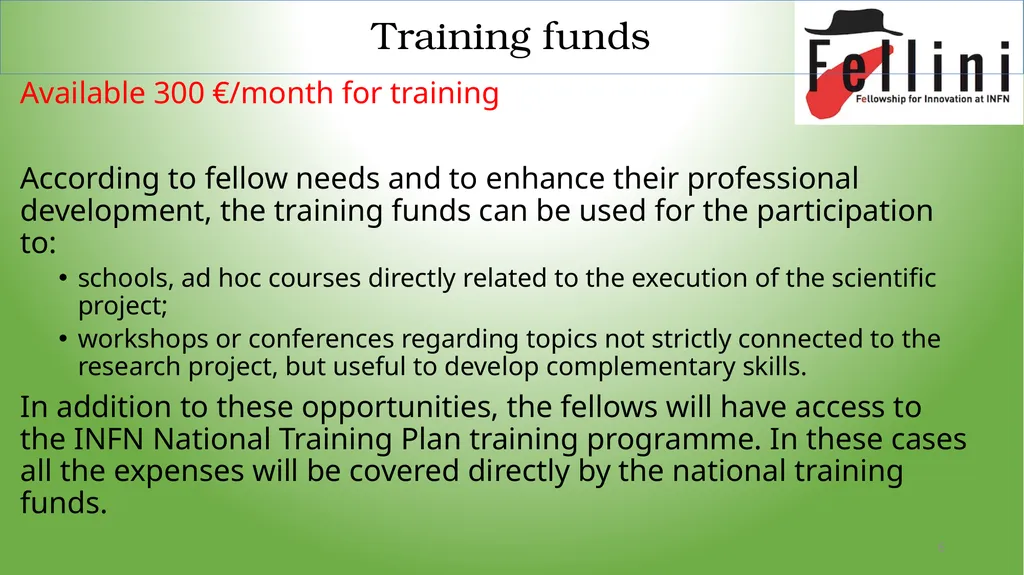
Available 300 €/month for training
According to fellow needs and to enhance their professional development, the training funds can be used for the participation to:
schools, ad hoc courses directly related to the execution of the scientific project;
workshops or conferences regarding topics not strictly connected to the research project, but useful to develop complementary skills.
In addition to these opportunities, the fellows will have access to the INFN National Training Plan training programme. In these cases all the expenses will be covered directly by the national training funds. Training funds 6<br>
According to fellow needs and to enhance their professional development, the training funds can be used for the participation to:
schools, ad hoc courses directly related to the execution of the scientific project;
workshops or conferences regarding topics not strictly connected to the research project, but useful to develop complementary skills.
In addition to these opportunities, the fellows will have access to the INFN National Training Plan training programme. In these cases all the expenses will be covered directly by the national training funds. Training funds 6<br>
07
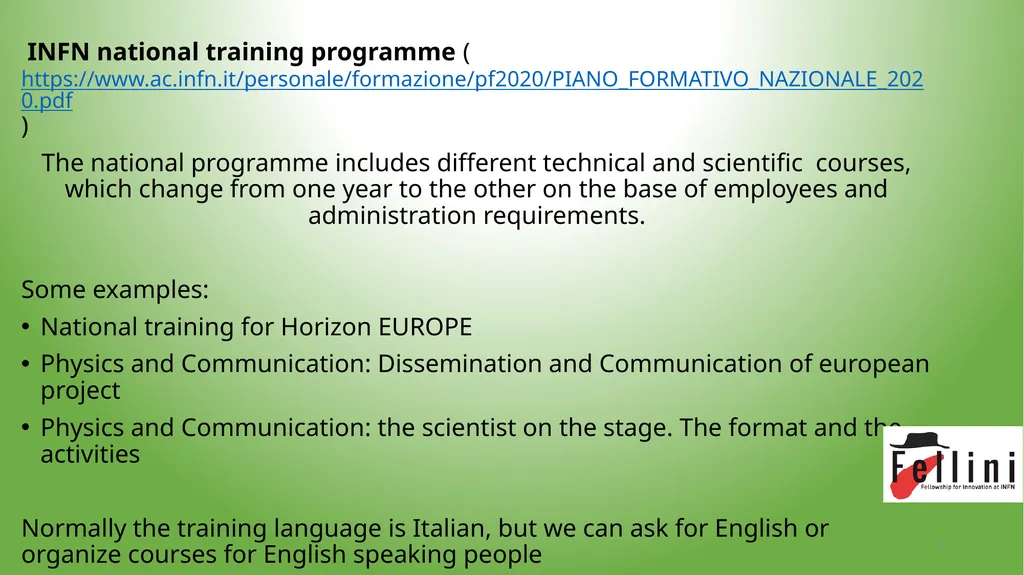
INFN national training programme (https://www.ac.infn.it/personale/formazione/pf2020/PIANO_FORMATIVO_NAZIONALE_2020.pdf)
The national programme includes different technical and scientific courses, which change from one year to the other on the base of employees and administration requirements.
Some examples:
National training for Horizon EUROPE
Physics and Communication: Dissemination and Communication of european project
Physics and Communication: the scientist on the stage. The format and the activities
Normally the training language is Italian, but we can ask for English or organize courses for English speaking people 7<br>
The national programme includes different technical and scientific courses, which change from one year to the other on the base of employees and administration requirements.
Some examples:
National training for Horizon EUROPE
Physics and Communication: Dissemination and Communication of european project
Physics and Communication: the scientist on the stage. The format and the activities
Normally the training language is Italian, but we can ask for English or organize courses for English speaking people 7<br>
08
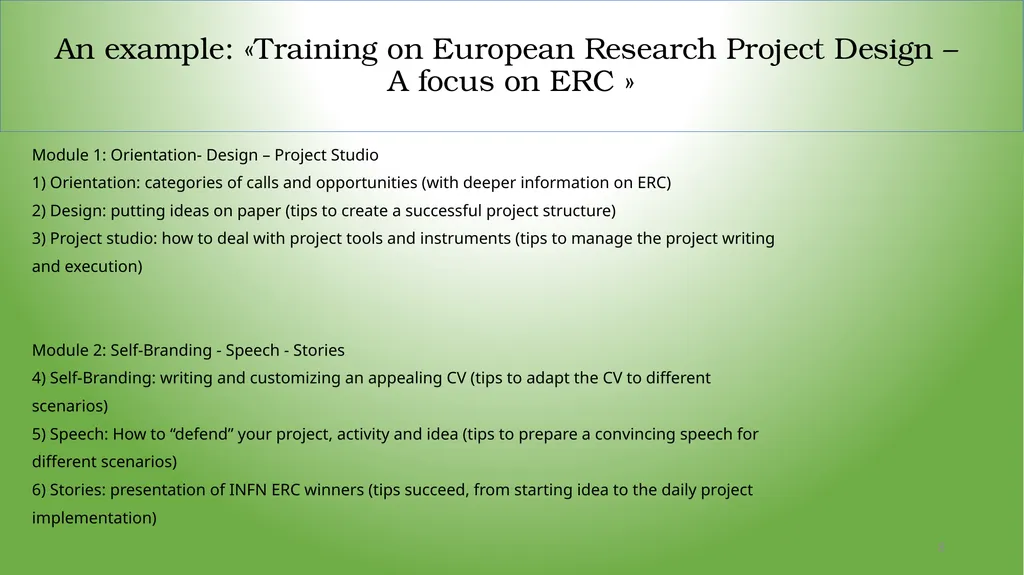
Module 1: Orientation- Design – Project Studio
1) Orientation: categories of calls and opportunities (with deeper information on ERC)
2) Design: putting ideas on paper (tips to create a successful project structure)
3) Project studio: how to deal with project tools and instruments (tips to manage the project writing
and execution)
Module 2: Self-Branding - Speech - Stories
4) Self-Branding: writing and customizing an appealing CV (tips to adapt the CV to different
scenarios)
5) Speech: How to “defend” your project, activity and idea (tips to prepare a convincing speech for
different scenarios)
6) Stories: presentation of INFN ERC winners (tips succeed, from starting idea to the daily project
implementation) An example: «Training on European Research Project Design – A focus on ERC » 8<br>
1) Orientation: categories of calls and opportunities (with deeper information on ERC)
2) Design: putting ideas on paper (tips to create a successful project structure)
3) Project studio: how to deal with project tools and instruments (tips to manage the project writing
and execution)
Module 2: Self-Branding - Speech - Stories
4) Self-Branding: writing and customizing an appealing CV (tips to adapt the CV to different
scenarios)
5) Speech: How to “defend” your project, activity and idea (tips to prepare a convincing speech for
different scenarios)
6) Stories: presentation of INFN ERC winners (tips succeed, from starting idea to the daily project
implementation) An example: «Training on European Research Project Design – A focus on ERC » 8<br>
09
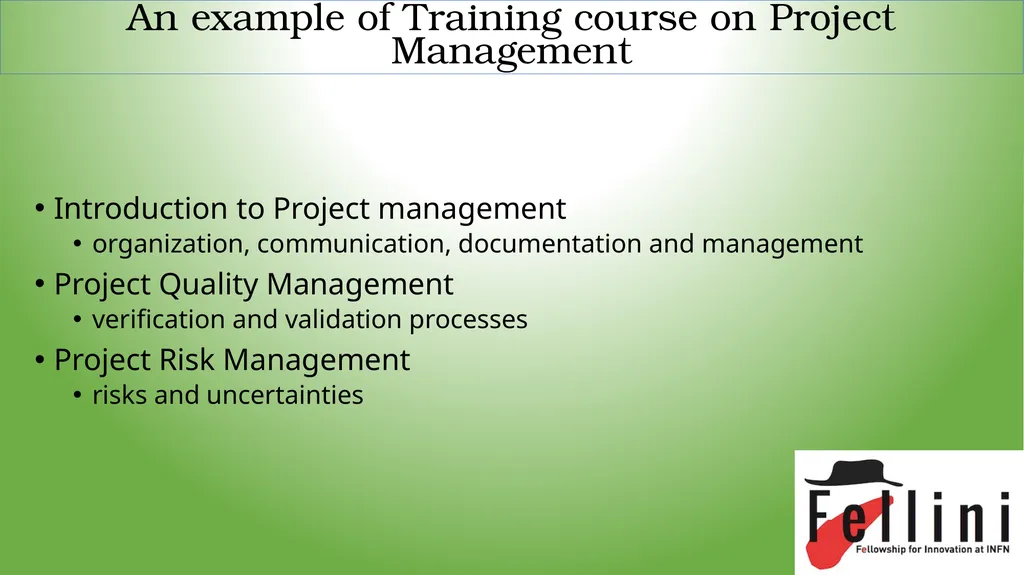
Introduction to Project management
organization, communication, documentation and management
Project Quality Management
verification and validation processes
Project Risk Management
risks and uncertainties An example of Training course on Project Management 9<br>
organization, communication, documentation and management
Project Quality Management
verification and validation processes
Project Risk Management
risks and uncertainties An example of Training course on Project Management 9<br>
10
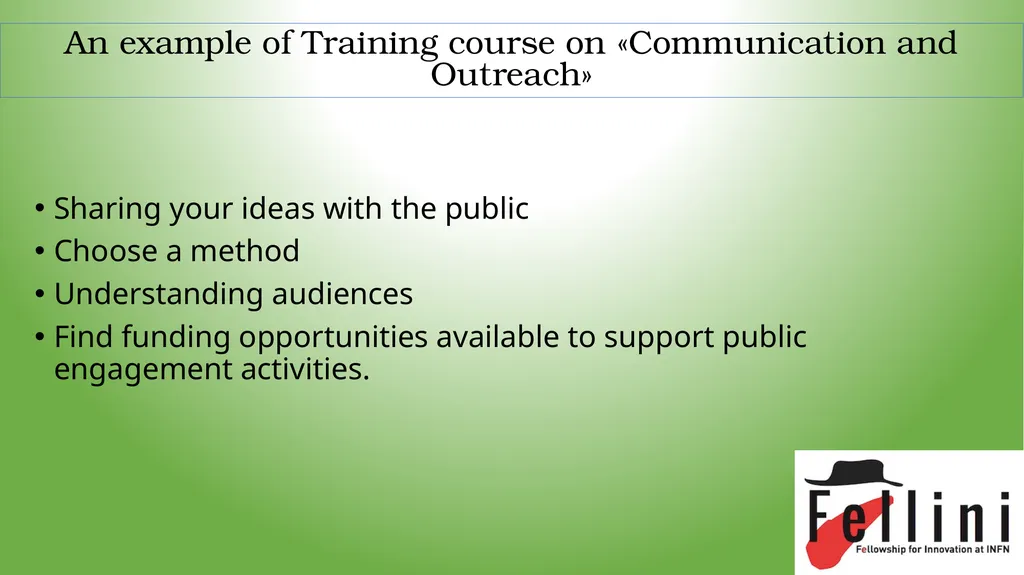
Sharing your ideas with the public
Choose a method
Understanding audiences
Find funding opportunities available to support public engagement activities. An example of Training course on «Communication and Outreach» 10<br>
Choose a method
Understanding audiences
Find funding opportunities available to support public engagement activities. An example of Training course on «Communication and Outreach» 10<br>
11
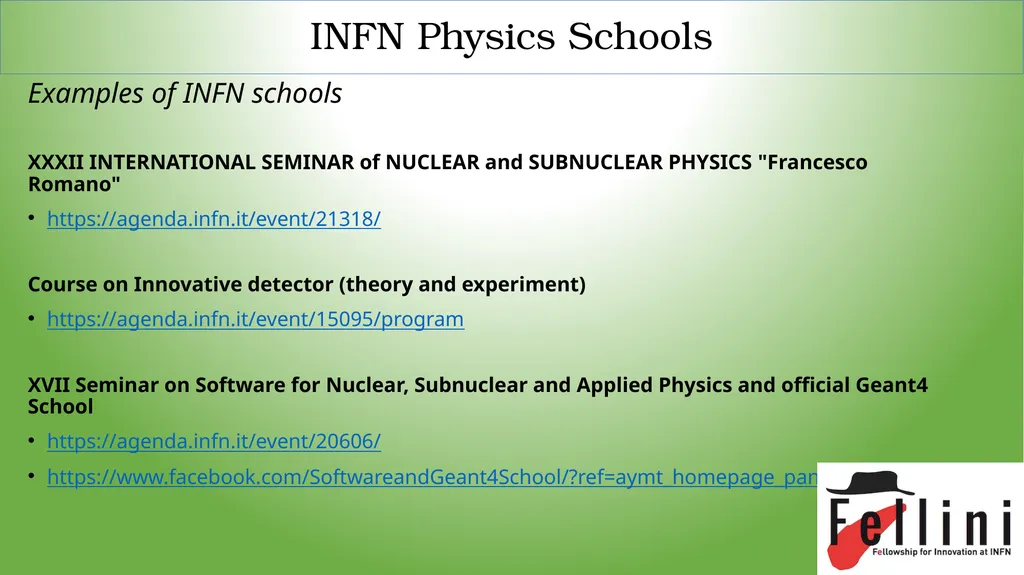
Examples of INFN schools
XXXII INTERNATIONAL SEMINAR of NUCLEAR and SUBNUCLEAR PHYSICS "Francesco Romano"
https://agenda.infn.it/event/21318/
Course on Innovative detector (theory and experiment)
https://agenda.infn.it/event/15095/program
XVII Seminar on Software for Nuclear, Subnuclear and Applied Physics and official Geant4 School
https://agenda.infn.it/event/20606/
https://www.facebook.com/SoftwareandGeant4School/?ref=aymt_homepage_panel INFN Physics Schools 11<br>
XXXII INTERNATIONAL SEMINAR of NUCLEAR and SUBNUCLEAR PHYSICS "Francesco Romano"
https://agenda.infn.it/event/21318/
Course on Innovative detector (theory and experiment)
https://agenda.infn.it/event/15095/program
XVII Seminar on Software for Nuclear, Subnuclear and Applied Physics and official Geant4 School
https://agenda.infn.it/event/20606/
https://www.facebook.com/SoftwareandGeant4School/?ref=aymt_homepage_panel INFN Physics Schools 11<br>
12
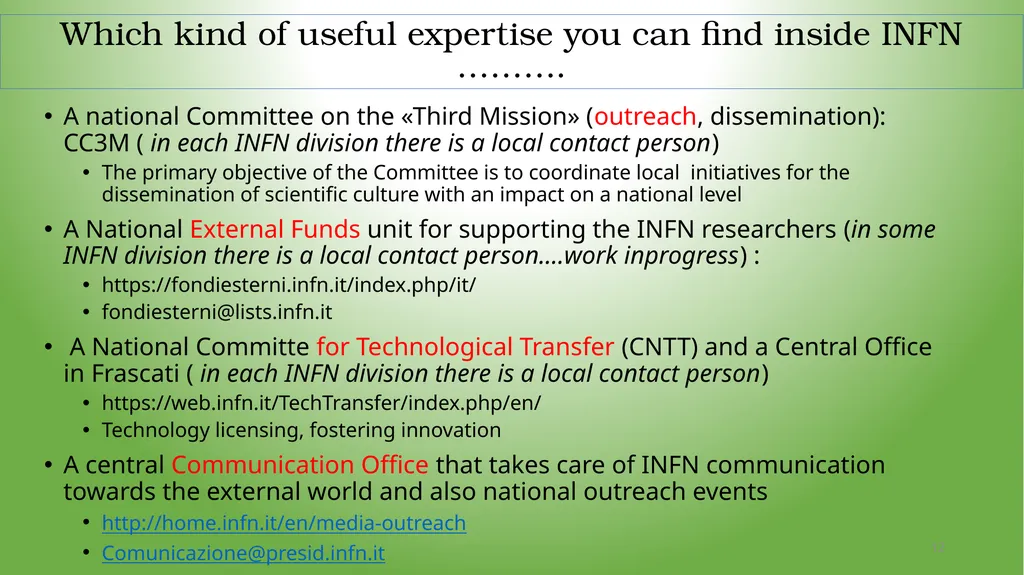
Which kind of useful expertise you can find inside INFN ………. A national Committee on the «Third Mission» (outreach, dissemination): CC3M ( in each INFN division there is a local contact person)
The primary objective of the Committee is to coordinate local initiatives for the dissemination of scientific culture with an impact on a national level
A National External Funds unit for supporting the INFN researchers (in some INFN division there is a local contact person….work inprogress) :
https://fondiesterni.infn.it/index.php/it/
fondiesterni@lists.infn.it
A National Committe for Technological Transfer (CNTT) and a Central Office in Frascati ( in each INFN division there is a local contact person)
https://web.infn.it/TechTransfer/index.php/en/
Technology licensing, fostering innovation
A central Communication Office that takes care of INFN communication towards the external world and also national outreach events
http://home.infn.it/en/media-outreach
Comunicazione@presid.infn.it 12<br>
The primary objective of the Committee is to coordinate local initiatives for the dissemination of scientific culture with an impact on a national level
A National External Funds unit for supporting the INFN researchers (in some INFN division there is a local contact person….work inprogress) :
https://fondiesterni.infn.it/index.php/it/
fondiesterni@lists.infn.it
A National Committe for Technological Transfer (CNTT) and a Central Office in Frascati ( in each INFN division there is a local contact person)
https://web.infn.it/TechTransfer/index.php/en/
Technology licensing, fostering innovation
A central Communication Office that takes care of INFN communication towards the external world and also national outreach events
http://home.infn.it/en/media-outreach
Comunicazione@presid.infn.it 12<br>
13
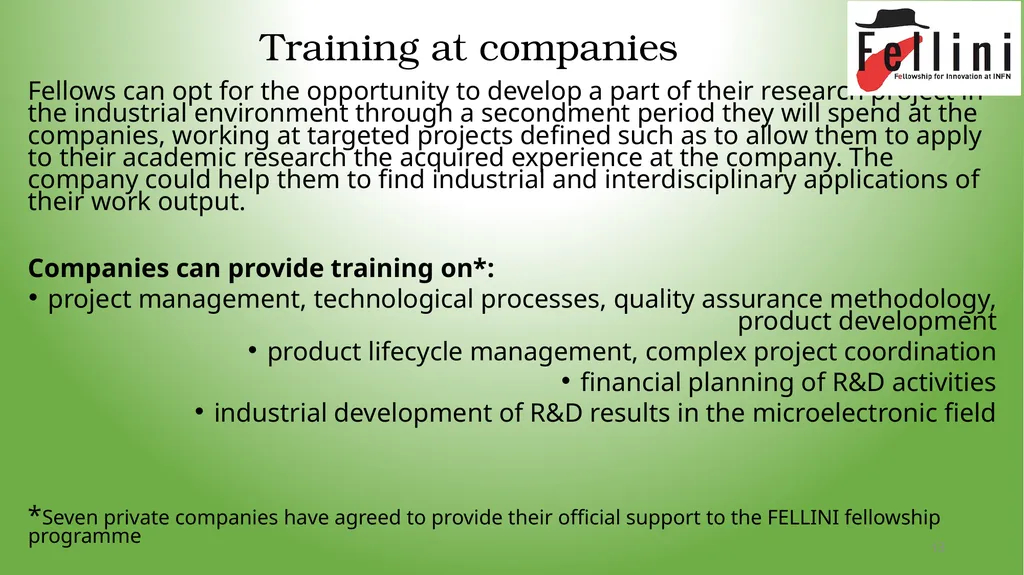
Fellows can opt for the opportunity to develop a part of their research project in the industrial environment through a secondment period they will spend at the companies, working at targeted projects defined such as to allow them to apply to their academic research the acquired experience at the company. The company could help them to find industrial and interdisciplinary applications of their work output.
Companies can provide training on*:
project management, technological processes, quality assurance methodology, product development
product lifecycle management, complex project coordination
financial planning of R&D activities
industrial development of R&D results in the microelectronic field
*Seven private companies have agreed to provide their official support to the FELLINI fellowship programme 13 Training at companies<br>
Companies can provide training on*:
project management, technological processes, quality assurance methodology, product development
product lifecycle management, complex project coordination
financial planning of R&D activities
industrial development of R&D results in the microelectronic field
*Seven private companies have agreed to provide their official support to the FELLINI fellowship programme 13 Training at companies<br>
14
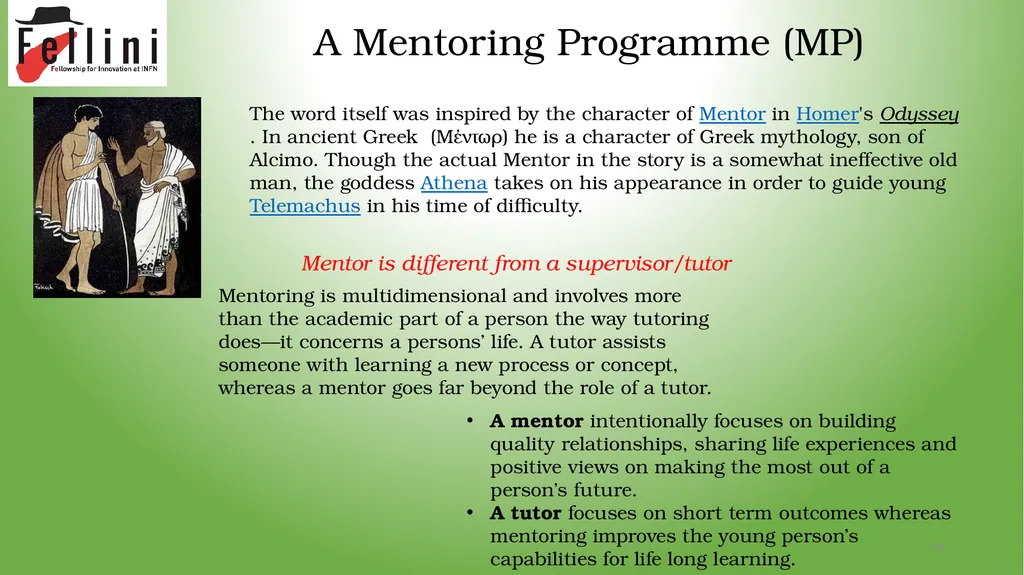
A Mentoring Programme (MP) 14 The word itself was inspired by the character of Mentor in Homer's Odyssey. In ancient Greek (Μέντωρ) he is a character of Greek mythology, son of Alcimo. Though the actual Mentor in the story is a somewhat ineffective old man, the goddess Athena takes on his appearance in order to guide young Telemachus in his time of difficulty. Mentoring is multidimensional and involves more than the academic part of a person the way tutoring does—it concerns a persons’ life. A tutor assists someone with learning a new process or concept, whereas a mentor goes far beyond the role of a tutor. Mentor is different from a supervisor/tutor A mentor intentionally focuses on building quality relationships, sharing life experiences and positive views on making the most out of a person’s future.
A tutor focuses on short term outcomes whereas mentoring improves the young person’s capabilities for life long learning.<br>
A tutor focuses on short term outcomes whereas mentoring improves the young person’s capabilities for life long learning.<br>
15
A Mentoring Programme (MP) The MP will last 10/12 months and will be organised in the second year of the fellowship. It will be a transdisciplinary mentoring program aimed to achieve the own professional development goals of the mentee and to develop their career skills.
The programme will be supported by other activities (such as training seminars, contact with SME, etc.) that will contribute to sustain the programme.
The programme is based on 5/6 meetings (face-to-face or via internet connection) that have to last 2hours each.
A model of relationship centered on mentees 15<br>
The programme will be supported by other activities (such as training seminars, contact with SME, etc.) that will contribute to sustain the programme.
The programme is based on 5/6 meetings (face-to-face or via internet connection) that have to last 2hours each.
A model of relationship centered on mentees 15<br>
16
A Mentoring Programme (MP) The main goal of MP is to transfer to young researchers all the expertise needed:
to achieve leadership positions in research management, both in academia and in other public or private research centres
to develop personal skill and potential.
in addition, in an attempt to make a real impact on the careers of researchers, some training courses will be devoted to gender diversity management.
The mentors will belong to Italian and International research community (University and research centres) involved in research field different from the mentee one (transdisciplinary mentoring)
Our idea is to look for mentors among supervisors, among those who want to volunteer
The role of the mentor is:
to provide advice on career paths,
to help navigate organizational politics,
to be a sounding board about office politics,
to prevent isolation at work,
to help create a culture that better supports gender diversity managment
to take into account fellow CDP 16<br>
to achieve leadership positions in research management, both in academia and in other public or private research centres
to develop personal skill and potential.
in addition, in an attempt to make a real impact on the careers of researchers, some training courses will be devoted to gender diversity management.
The mentors will belong to Italian and International research community (University and research centres) involved in research field different from the mentee one (transdisciplinary mentoring)
Our idea is to look for mentors among supervisors, among those who want to volunteer
The role of the mentor is:
to provide advice on career paths,
to help navigate organizational politics,
to be a sounding board about office politics,
to prevent isolation at work,
to help create a culture that better supports gender diversity managment
to take into account fellow CDP 16<br>
17
The objective of MP is to support young researchers in the acquisition of the following skills:
Leadership development in research
Diversity management
National evaluation criteria of research
European evaluation criteria of research
Ability to apply as leader for funding programmes in research
Liaising between the university and private industry
Balancing work/life and leisure
Inclusive communication
Fundamental concepts of diversity and inclusion 17 A Mentoring Programme (MP)<br>
Leadership development in research
Diversity management
National evaluation criteria of research
European evaluation criteria of research
Ability to apply as leader for funding programmes in research
Liaising between the university and private industry
Balancing work/life and leisure
Inclusive communication
Fundamental concepts of diversity and inclusion 17 A Mentoring Programme (MP)<br>
18
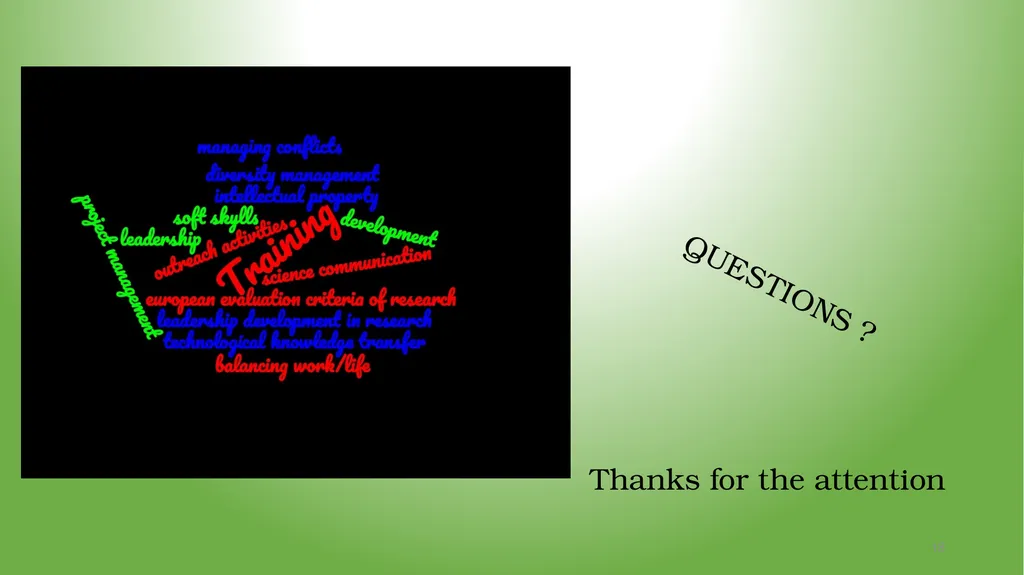
18 QUESTIONS ? Thanks for the attention<br>