04
Documentation Practices (1) In drug safety monitoring and management, the accurate recording of the details of an event and the action taken is crucial
If these details are not documented, then the episode is as good as if it did not happen! The knowledge and lessons learnt will be lost
The details need to be recorded in a standardized manner
Remember they need to be used by someone else
They should be recorded in a way to minimize misunderstandings, allow duplicate reports to be identified, allow pooling …<br>
05
Documentation Practices (2) Source documentation should be “ALCOA”:
Attributable
It should be clear who has documented the data
Legible
Readable and signatures identifiable
Contemporaneous
The information should be documented in the correct time frame along with the flow of events
If a clinical observation cannot be entered when made, chronology should be recorded
Acceptable amount of delay should be defined and justified<br>
06
Documentation Practices (3) Source documentation should be “ALCOA”:
Attributable
Legible
Contemporaneous
Original
Original, if not original should be exact copy; the first record made by the appropriate person
Accurate
Accurate, consistent and real representation of facts<br>
07
Adverse Event Form
TB treatment card, registers, medical records created during treatment
Laboratory results, ECG, audiogram, X-ray, etc.
Medical records supplied by the patient
Informed Consent Forms
Correspondence (email…) Documentation Practices (4)
examples of source documents<br>
08
Missing data/documentation
Missing dates
No attribution
Missing subject identifiers
Non standard recording of variables
Inaccurate/erroneous transcription of values
Corrections (white out, scribbling)
Illegible
Use of checklists (in place of notes) Documentation Practices (5)
common problems<br>
09
ALL records should be:
Dated
Signed/Attributed
Secured
Sign/initial and date entries at the time they are made
Data entries must be dated on the date of entry – contemporaneous
Data entries must be signed or initialed by the person entering the data – attribution
Never sign anybody else’s name – falsification
Do not post- or pre-date Documentation Practices (6)<br>
10
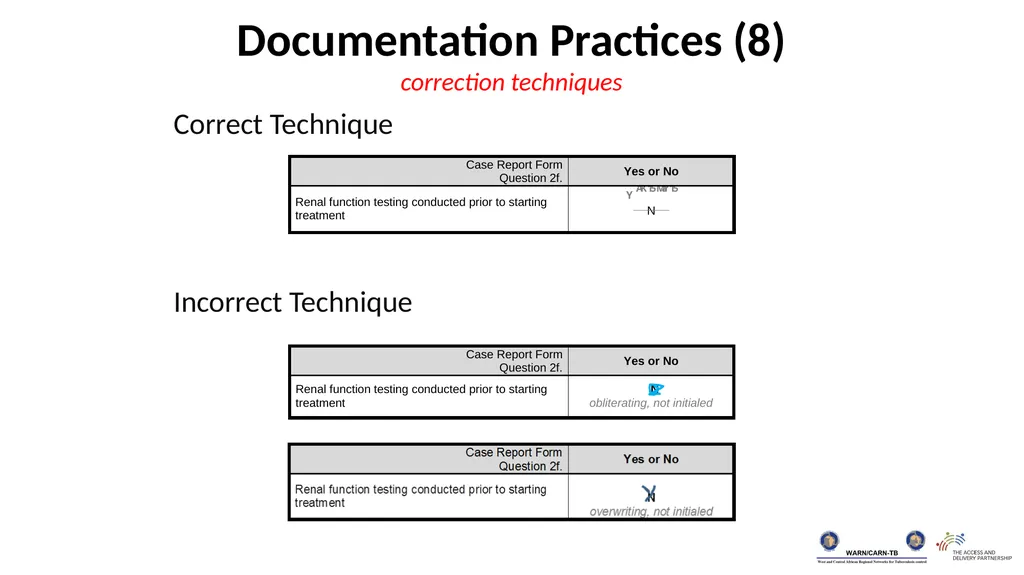
When records need correction…
Do not obliterate previous data
Date the change
Identify the person making the change
State reason for the change
Do not use whiteout
Do not change data without knowledge that the change is correct Documentation Practices (7)<br>
11
Correct Technique Incorrect Technique Documentation Practices (8)
correction techniques<br>
12
Requirements for electronic records
At least as secure as paper records
Paper records: keep safe from fire, water/humidity, theft of hardware…
Maintain data security and integrity
Controlled access
Reliable, validated, adapted software
Ability to copy, backup and retrieve
Time stamped audit trails
Staff training
Standard Operation Procedures Documentation Practices (9)
“Not a problem – we keep everything on computers”!<br>
13
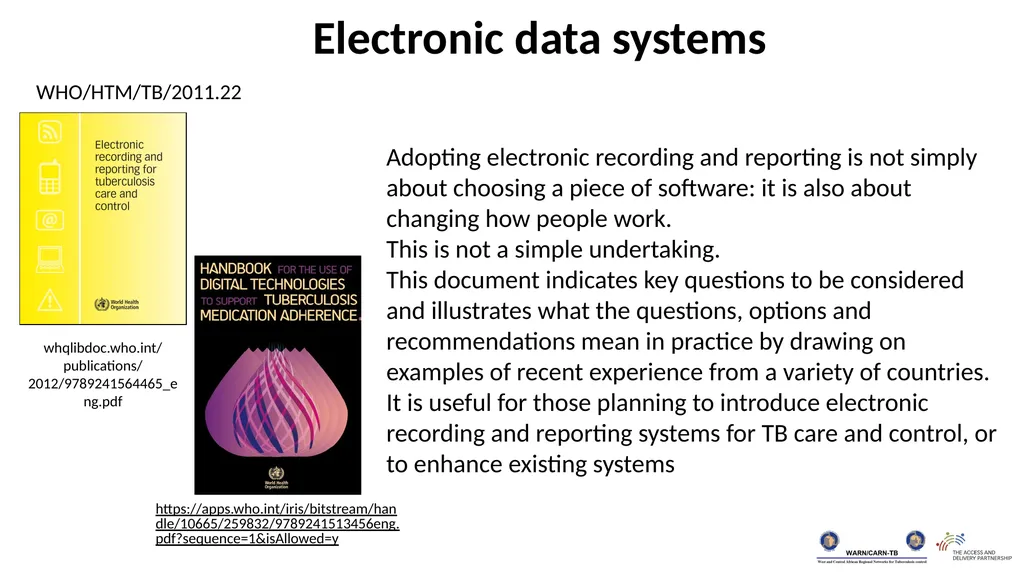
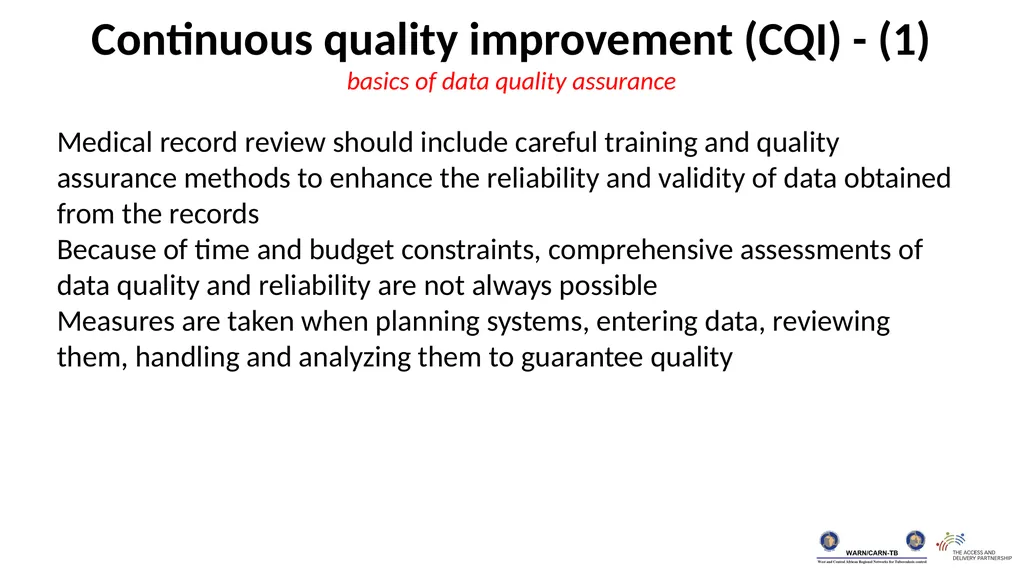
WHO/HTM/TB/2011.22 https://apps.who.int/iris/bitstream/handle/10665/259832/9789241513456eng.pdf?sequence=1&isAllowed=y Adopting electronic recording and reporting is not simply about choosing a piece of software: it is also about changing how people work.
This is not a simple undertaking.
This document indicates key questions to be considered and illustrates what the questions, options and recommendations mean in practice by drawing on examples of recent experience from a variety of countries.
It is useful for those planning to introduce electronic recording and reporting systems for TB care and control, or to enhance existing systems whqlibdoc.who.int/publications/2012/9789241564465_eng.pdf Electronic data systems<br>
14
Medical record review should include careful training and quality assurance methods to enhance the reliability and validity of data obtained from the records
Because of time and budget constraints, comprehensive assessments of data quality and reliability are not always possible
Measures are taken when planning systems, entering data, reviewing them, handling and analyzing them to guarantee quality Continuous quality improvement (CQI) - (1)
basics of data quality assurance<br>
15
A quality management process that encourages all health care team members to continuously ask the questions,
How are we doing? and
Can we do it better?
(Edwards, 2008) Continuous quality improvement (CQI) - (2)<br>
16
Documentation of patient care should be one of the many functions addressed in CQI efforts
CQI efforts in the programmatic management of drug-resistant TB should include the development of quality indicators that can be used to evaluate health care provider documentation practices Continuous quality improvement (CQI) - (3)<br>
17
Other CQI efforts might analyze and improve system-wide policies and procedures for documenting medication use, adverse events and their management
Periodic review of organizational policies and procedures will allow for their revision in response to changes in health care and advances in technology, including the availability of an electronic medical records Continuous quality improvement (CQI) - (4)<br>
18
Conclusion (1) All TB drug safety related documentation - paper and electronic - should be organized, identified and retained so that it can be accurately interpreted without benefit of an interpreter
Can I reconstruct what happened?
Can I identify who did what and when?
Am I confident in the accuracy and authenticity of the data?
Without the documentation, there is no evidence for decision making<br>
19
The documentation should narrate the medical journey of the patient as it happened to an independent observer and thus form a strong foundation for good drug safety monitoring and management practices
Data quality assurance should be a continuous, inbuilt process at different stages to allow users to understand how their performance is doing and how it can be improved Conclusion (2)<br>
20
Acknowledgements
The development of the aDSM training material was funded by TDR as part of the Access and Delivery Partnership (ADP) with funding from the Government of Japan.
These training materials were put together in 2016 the WHO Task Force on aDSM with technical partners KNCV Tuberculosis Foundation, Management Sciences for Health (SIAPS), MSF, WHO GTB, and TDR.
The materials were updated in 2022-23 by Mahamadou Bassirou Souleymane (TDR consultant) with Marie-Eve Raguenaud (TDR), Branwen J Hennig (TDR), and Corinne Merle (TDR), and reviewed by Linh Nhat Nguyen (WHO/GTB), Medea Gegia (WHO/GTB), and Fuad Mirzayev (WHO/GTB).
We thank all members of the WARN/CARN-TB working group on aDSM who contributed to the development of the aDSM generic guidelines as well as the secretariat, particularly Dr Christ Houessinon: Disadidi Ambrioso, Esse Marius, Adomou Jamal Rouamba Ruffine, Haro Sougrimani, Koumbem Boureima, Nsanzerugeze Josélyne, Tollo Tollo Daniel Alphonse Désiré, Mpaba Minkat Théophile Mistral, Julie Abessolo, Ursule IDOKO, Tijan Baldeh , Wandifa Samateh, Tida S Kinteh, Alieu Wurie, Mardemn Yeasuen, Benjamin K. Quenneh, Cheick Oumar Bah, Kane El Hadj Malick, Aw Idriss, Mamoudou Hama Rachida, Gagara I. M. Assiatou, Katambé Balkissa, Seiyabatou Elh Saidou, Liombo Anastasie, Lunganyu Junior, Kitambala Sentime, Lula Yves , Habimana-Mucyo Yves, Migambi Patrick, dos Santos Brigite, Castro Vânia, Wadson Cruz, Gueye Aminata, Mukeh Fahnbulleh, Bailor Samuel, Manjo Lamin, Saleh Mahareb Abdoulaye, Haroun Saleh Naima, Mouhoudine Yerima, Kpelafia Silifa<br>