
Transforming Epic: Ovid’s Metamorphoses and the


Description: Transforming Epic: Ovids Metamorphoses and the Epic Tradition Dr Joe L. Watson Hehimhis Joe.l.watsonwarwick.ac.uk ME Teaching Fellow in Latin Literature and Language Former Latin school teacher in the North East Research Latin epic
Related Topics
Download Presentation
"Transforming Epic: Ovid’s Metamorphoses and the" is the property of its rightful owner. Permission is granted to download and print the materials on this website for personal, non-commercial use only, and to display it on your personal computer provided you do not modify the materials and that you retain all copyright notices contained in the materials. By downloading content from our website, you accept the terms of this agreement.
Presentation Transcript
slide1. Transforming Epic: Ovid’s Metamorphoses and the Epic Tradition Dr Joe L. Watson
He/him/his
Joe.l.watson@warwick.ac.uk<br>
slide2. ME Teaching Fellow in Latin Literature and Language
Former Latin school teacher in the North East
Research
Latin epic (especially Ovid’s Metamorphoses)
Latin love poetry (especially Ovid and Propertius)
Epyllia (esp. the Ciris and the Europa)
Intertextuality
Gender, sex and sexuality
Queer Classical reception<br>
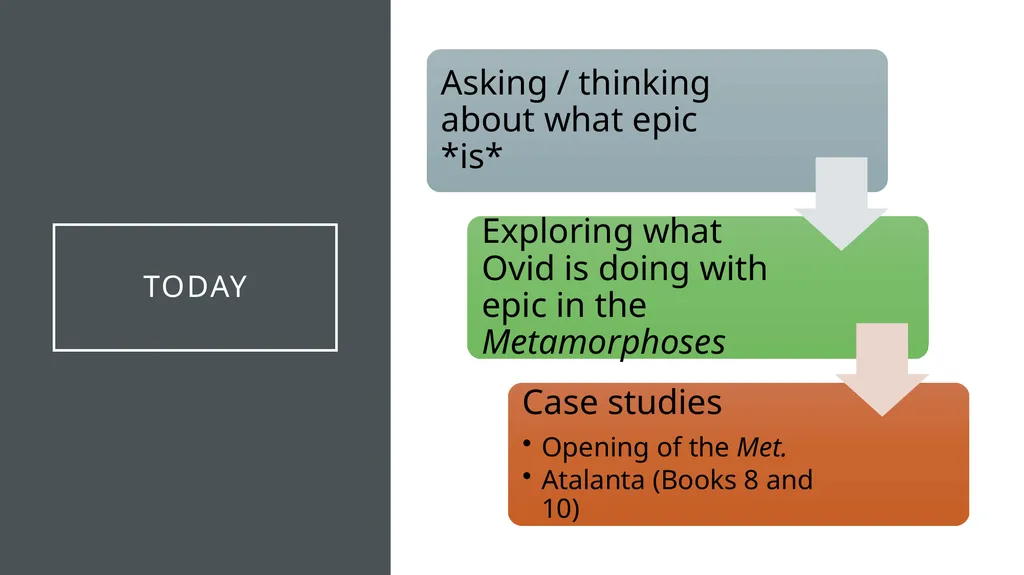
slide3. Today Asking / thinking about what epic *is*<br>
slide4. The Metamorphoses: Ovid’s Epic?<br>
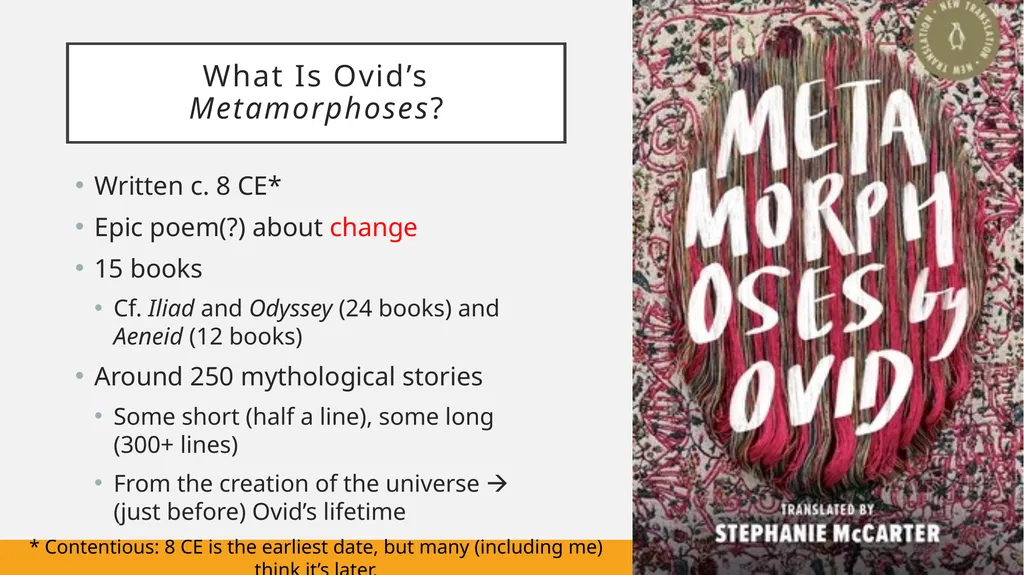
slide5. What Is Ovid’s Metamorphoses? Written c. 8 CE*
Epic poem(?) about change
15 books
Cf. Iliad and Odyssey (24 books) and Aeneid (12 books)
Around 250 mythological stories
Some short (half a line), some long (300+ lines)
From the creation of the universe (just before) Ovid’s lifetime * Contentious: 8 CE is the earliest date, but many (including me) think it’s later.<br>
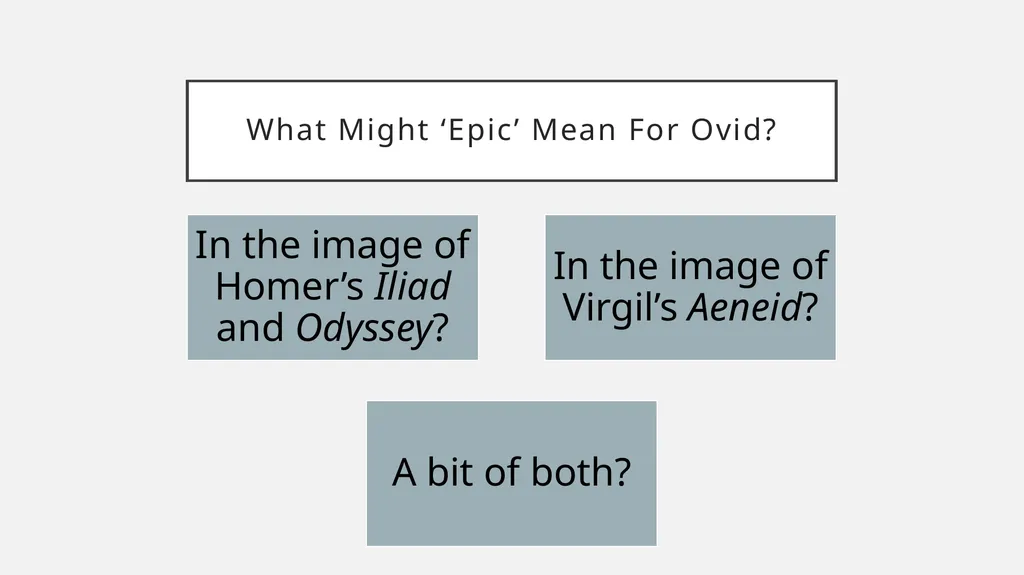
slide6. What Might ‘Epic’ Mean For Ovid? In the image of Homer’s Iliad and Odyssey? In the image of Virgil’s Aeneid? A bit of both?<br>
slide7. How Do Epic Poems Begin? Goddess, sing for me the rage of Achilles, son of Peleus… - Homer Iliad 1.1
Muse, tell me about that tricky man, who many troubles… - Homer Odyssey 1.1
I sing of arms and the man, who first, who first from the shores of Troy… - Virgil Aeneid 1.1<br>
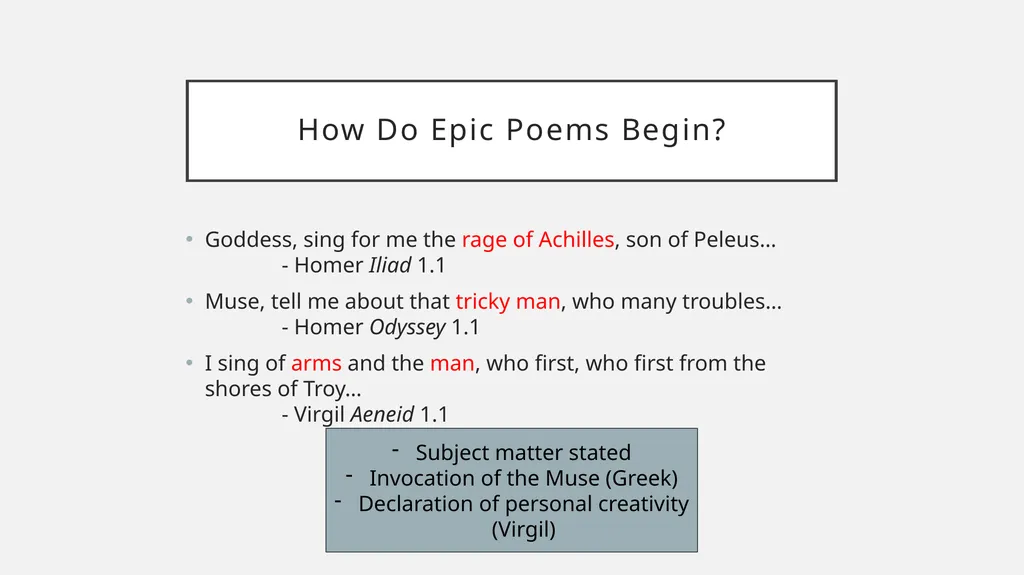
slide8. How Do Epic Poems Begin? Goddess, sing for me the rage of Achilles, son of Peleus… - Homer Iliad 1.1
Muse, tell me about that tricky man, who many troubles… - Homer Odyssey 1.1
I sing of arms and the man, who first, who first from the shores of Troy… - Virgil Aeneid 1.1 Subject matter stated
Invocation of the Muse (Greek)
Declaration of personal creativity (Virgil)<br>
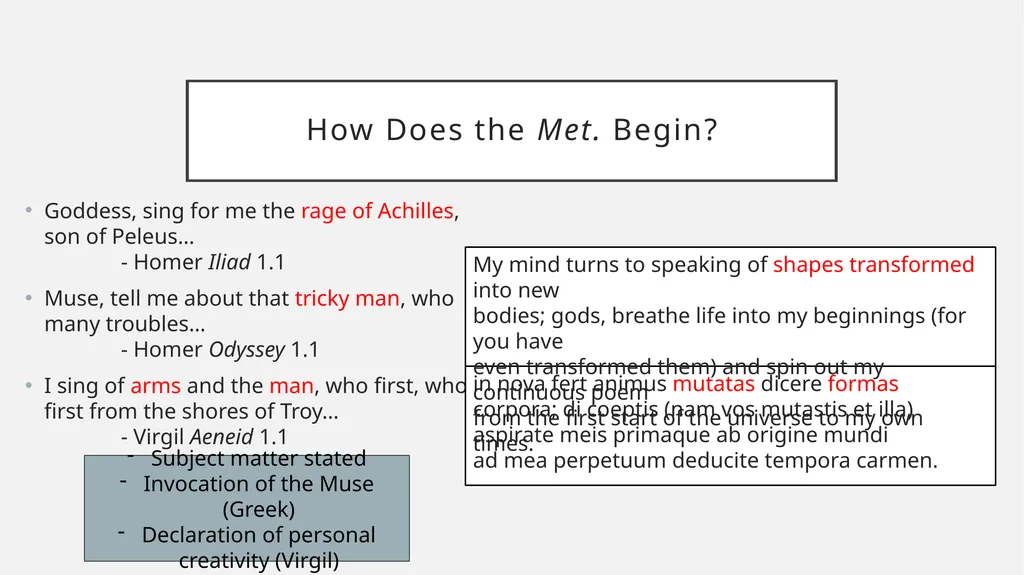
slide9. How Does the Met. Begin? Goddess, sing for me the rage of Achilles, son of Peleus… - Homer Iliad 1.1
Muse, tell me about that tricky man, who many troubles… - Homer Odyssey 1.1
I sing of arms and the man, who first, who first from the shores of Troy… - Virgil Aeneid 1.1 Subject matter stated
Invocation of the Muse (Greek)
Declaration of personal creativity (Virgil) in nova fert animus mutatas dicere formas corpora; di coeptis (nam vos mutastis et illa) aspirate meis primaque ab origine mundi ad mea perpetuum deducite tempora carmen. My mind turns to speaking of shapes transformed into new bodies; gods, breathe life into my beginnings (for you have even transformed them) and spin out my continuous poem from the first start of the universe to my own times.<br>
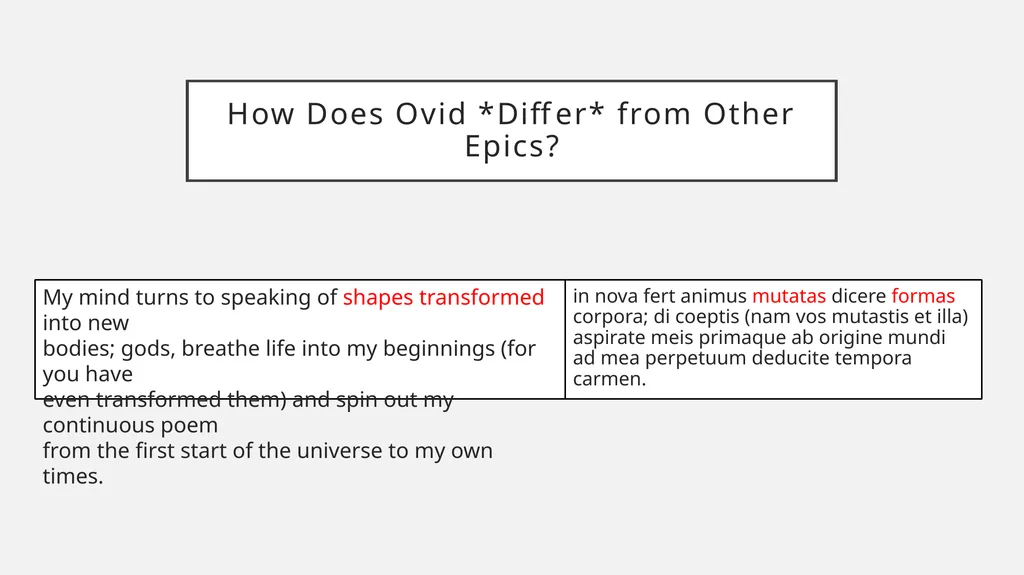
slide10. How Does Ovid *Differ* from Other Epics? in nova fert animus mutatas dicere formas corpora; di coeptis (nam vos mutastis et illa) aspirate meis primaque ab origine mundi ad mea perpetuum deducite tempora carmen. My mind turns to speaking of shapes transformed into new bodies; gods, breathe life into my beginnings (for you have even transformed them) and spin out my continuous poem from the first start of the universe to my own times.<br>
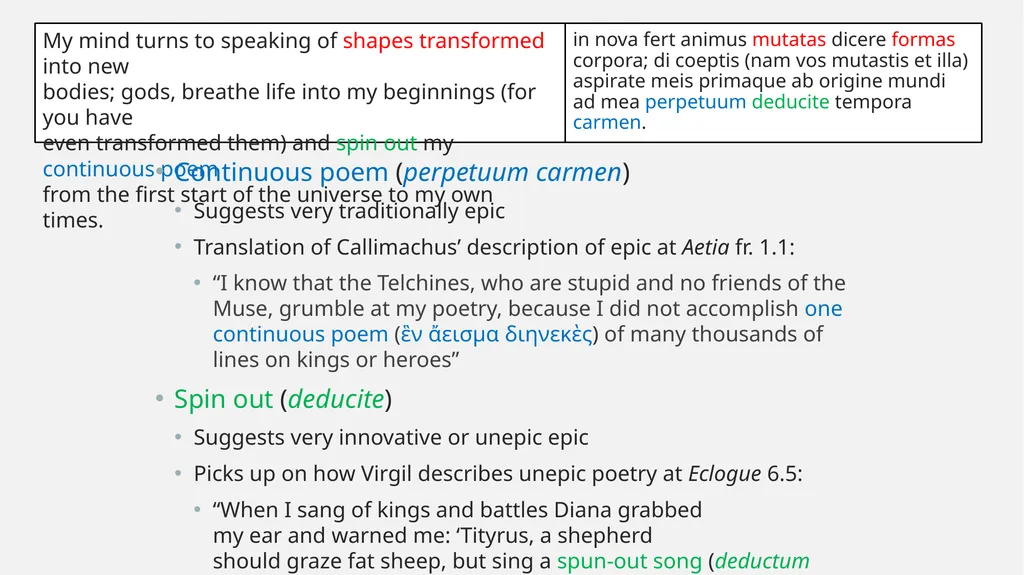
slide11. in nova fert animus mutatas dicere formas corpora; di coeptis (nam vos mutastis et illa) aspirate meis primaque ab origine mundi ad mea perpetuum deducite tempora carmen. My mind turns to speaking of shapes transformed into new bodies; gods, breathe life into my beginnings (for you have even transformed them) and spin out my continuous poem from the first start of the universe to my own times. Continuous poem (perpetuum carmen)
Suggests very traditionally epic
Translation of Callimachus’ description of epic at Aetia fr. 1.1:
“I know that the Telchines, who are stupid and no friends of the Muse, grumble at my poetry, because I did not accomplish one continuous poem (ἓν ἄεισμα διηνεκὲς) of many thousands of lines on kings or heroes”
Spin out (deducite)
Suggests very innovative or unepic epic
Picks up on how Virgil describes unepic poetry at Eclogue 6.5:
“When I sang of kings and battles Diana grabbed my ear and warned me: ‘Tityrus, a shepherd should graze fat sheep, but sing a spun-out song (deductum carmen)”<br>
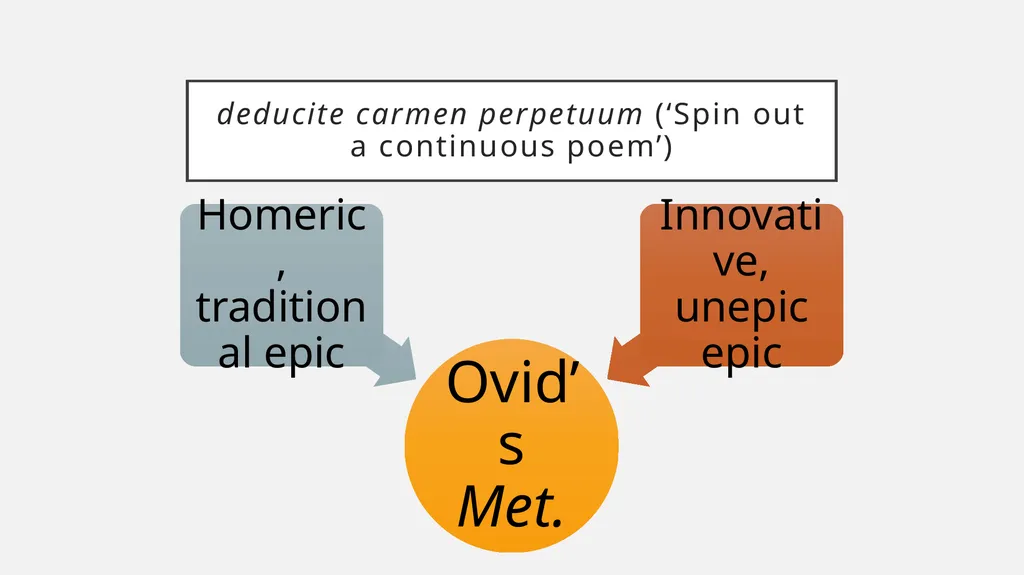
slide12. deducite carmen perpetuum (‘Spin out a continuous poem’)<br>
slide13. Racing against Epic: Ovid’s Atalanta<br>
slide14. Epic And Gender – The Epic Of Man Sing to me of the twisty man, Muse, who many evils - Homer Odyssey 1.1
Arms and the man I sing, who first from the shores of Troy - Virgil Aeneid 1.1
When I was singing of kings and battles - Virgil Eclogues 6.3
Deeds of kings and generals and sad wars - Horace Art of Poetry 73 The genre of epic is very closely associated with men and traditionally masculine activities
Generically speaking, this is not a genre that concerns itself with women or traditionally feminine activities<br>
slide15. But! Epic poetry has women
E.g. Andromache, Hecuba and Helen in the Iliad
But, these women usually stay within their assigned gender roles
E.g. Homer Iliad 6.490-92: “once you’ve entered the house, attend to your own work, the loom and the distaff, and command your handmaidens to carry out their work” Do you know of any women in epic poetry who do not conform to the expectations men have of them?<br>
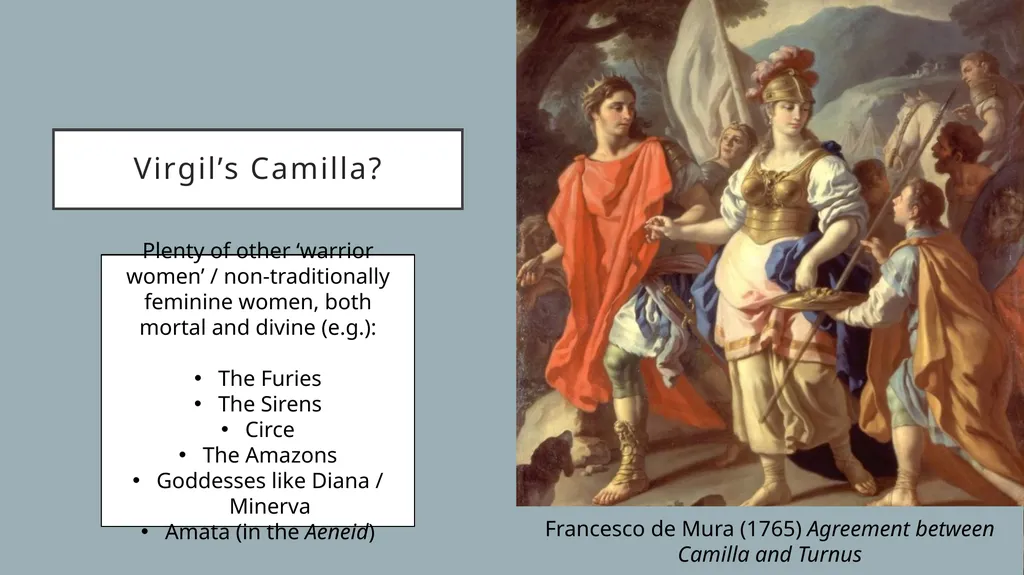
slide16. Virgil’s Camilla? Francesco de Mura (1765) Agreement between Camilla and Turnus Plenty of other ‘warrior women’ / non-traditionally feminine women, both mortal and divine (e.g.):
The Furies
The Sirens
Circe
The Amazons
Goddesses like Diana / Minerva
Amata (in the Aeneid)<br>
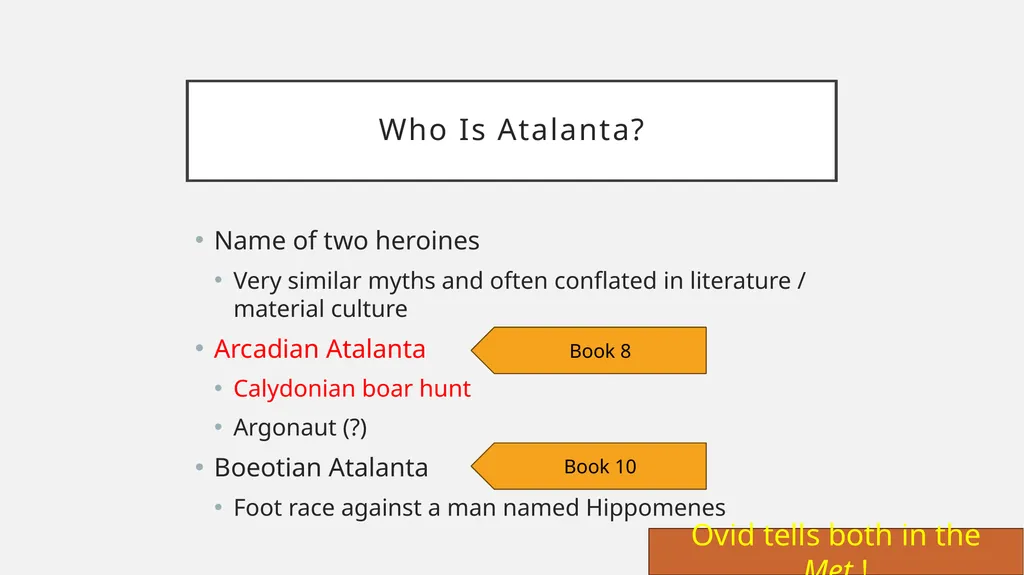
slide17. Who Is Atalanta? Name of two heroines
Very similar myths and often conflated in literature / material culture
Arcadian Atalanta
Calydonian boar hunt
Argonaut (?)
Boeotian Atalanta
Foot race against a man named Hippomenes Ovid tells both in the Met.! Book 8 Book 10<br>
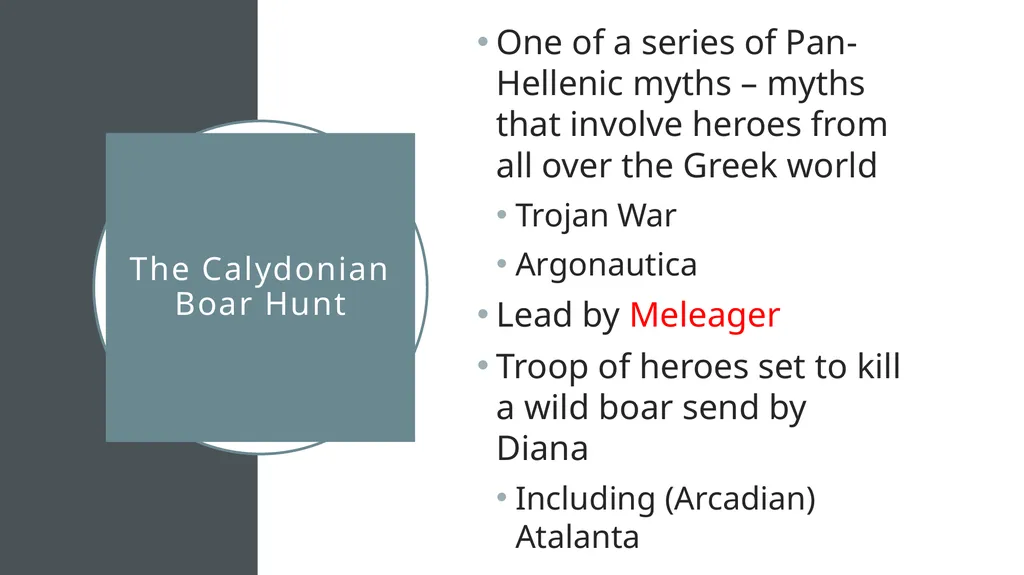
slide18. The Calydonian Boar Hunt One of a series of Pan-Hellenic myths – myths that involve heroes from all over the Greek world
Trojan War
Argonautica
Lead by Meleager
Troop of heroes set to kill a wild boar send by Diana
Including (Arcadian) Atalanta<br>
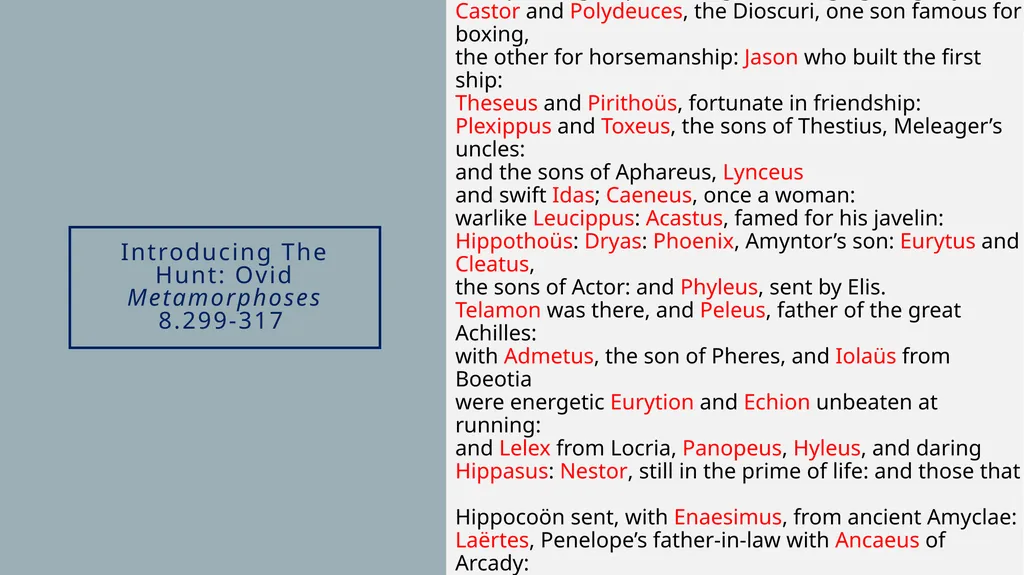
slide19. Introducing The Hunt: Ovid Metamorphoses 8.299-317 At last Meleager and a handpicked group of men gather, longing for glory: Castor and Polydeuces, the Dioscuri, one son famous for boxing, the other for horsemanship: Jason who built the first ship: Theseus and Pirithoüs, fortunate in friendship: Plexippus and Toxeus, the sons of Thestius, Meleager’s uncles: and the sons of Aphareus, Lynceus and swift Idas; Caeneus, once a woman: warlike Leucippus: Acastus, famed for his javelin: Hippothoüs: Dryas: Phoenix, Amyntor’s son: Eurytus and Cleatus, the sons of Actor: and Phyleus, sent by Elis. Telamon was there, and Peleus, father of the great Achilles: with Admetus, the son of Pheres, and Iolaüs from Boeotia were energetic Eurytion and Echion unbeaten at running: and Lelex from Locria, Panopeus, Hyleus, and daring Hippasus: Nestor, still in the prime of life: and those that Hippocoön sent, with Enaesimus, from ancient Amyclae: Laërtes, Penelope’s father-in-law with Ancaeus of Arcady: Mopsus, the shrewd son of Ampyx: and Amphiaraüs, son of Oecleus, not yet betrayed by his wife, Eriphyle.<br>
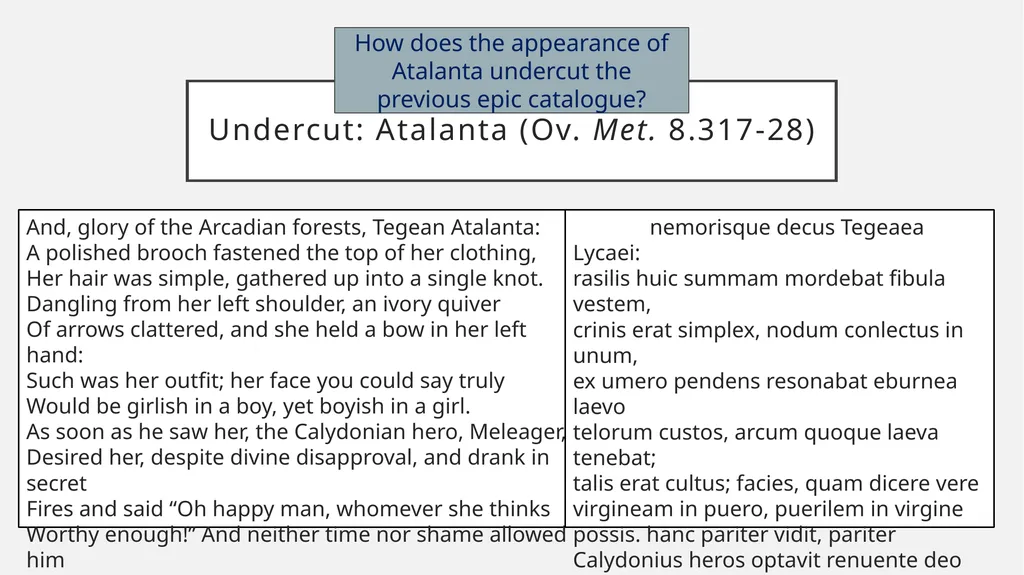
slide20. And, glory of the Arcadian forests, Tegean Atalanta: A polished brooch fastened the top of her clothing, Her hair was simple, gathered up into a single knot. Dangling from her left shoulder, an ivory quiver Of arrows clattered, and she held a bow in her left hand: Such was her outfit; her face you could say truly Would be girlish in a boy, yet boyish in a girl. As soon as he saw her, the Calydonian hero, Meleager, Desired her, despite divine disapproval, and drank in secret Fires and said “Oh happy man, whomever she thinks Worthy enough!” And neither time nor shame allowed him To say more: the greater work of the great contest pushes on. Undercut: Atalanta (Ov. Met. 8.317-28) nemorisque decus Tegeaea Lycaei: rasilis huic summam mordebat fibula vestem, crinis erat simplex, nodum conlectus in unum, ex umero pendens resonabat eburnea laevo telorum custos, arcum quoque laeva tenebat; talis erat cultus; facies, quam dicere vere virgineam in puero, puerilem in virgine possis. hanc pariter vidit, pariter Calydonius heros optavit renuente deo flammasque latentes hausit et “o felix, siquem dignabitur” inquit “ista virum!” nec plura sinit tempusque pudorque dicere: maius opus magni certaminis urget. How does the appearance of Atalanta undercut the previous epic catalogue?<br>
slide21. And, glory of the Arcadian forests, Tegean Atalanta: A polished brooch fastened the top of her clothing, Her hair was simple, gathered up into a single knot. Dangling from her left shoulder, an ivory quiver Of arrows clattered, and she held a bow in her left hand: Such was her outfit; her face you could say truly Would be girlish in a boy, yet boyish in a girl. As soon as he saw her, the Calydonian hero, Meleager, Desired her, despite divine disapproval, and drank in secret Fires and said “Oh happy man, whomever she thinks Worthy enough!” And neither time nor shame allowed him To say more: the greater work of the great contest pushes on. nemorisque decus Tegeaea Lycaei: rasilis huic summam mordebat fibula vestem, crinis erat simplex, nodum conlectus in unum, ex umero pendens resonabat eburnea laevo telorum custos, arcum quoque laeva tenebat; talis erat cultus; facies, quam dicere vere virgineam in puero, puerilem in virgine possis. hanc pariter vidit, pariter Calydonius heros optavit renuente deo flammasque latentes hausit et “o felix, siquem dignabitur” inquit “ista virum!” nec plura sinit tempusque pudorque dicere: maius opus magni certaminis urget. I shall speak of bristling battles, Of battles and kings driven to doom by their spirits, An army from Tyrrhenia and all of Hesperia united by war For me, a greater order of things is now being born, I begin a greater work.
- Virgil Aeneid 7.41-45 dicam horrida bella, dicam acies actosque animis in funera reges, Tyrrhenamque manum totamque sub arma coactam Hesperiam. maior rerum mihi nascitur ordo, maius opus moveo.<br>
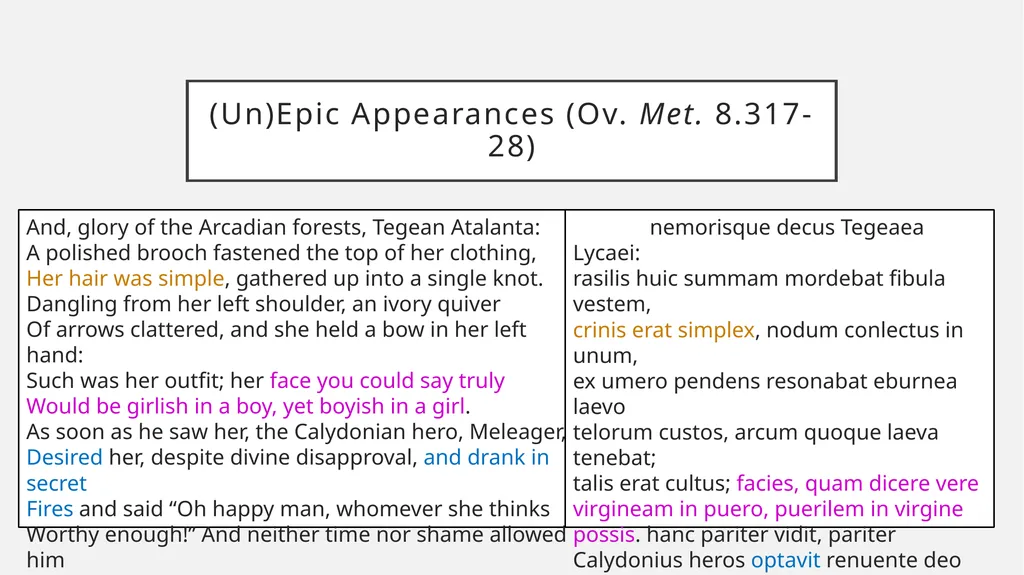
slide22. And, glory of the Arcadian forests, Tegean Atalanta: A polished brooch fastened the top of her clothing, Her hair was simple, gathered up into a single knot. Dangling from her left shoulder, an ivory quiver Of arrows clattered, and she held a bow in her left hand: Such was her outfit; her face you could say truly Would be girlish in a boy, yet boyish in a girl. As soon as he saw her, the Calydonian hero, Meleager, Desired her, despite divine disapproval, and drank in secret Fires and said “Oh happy man, whomever she thinks Worthy enough!” And neither time nor shame allowed him To say more: the greater work of the great contest pushes on. (Un)Epic Appearances (Ov. Met. 8.317-28) nemorisque decus Tegeaea Lycaei: rasilis huic summam mordebat fibula vestem, crinis erat simplex, nodum conlectus in unum, ex umero pendens resonabat eburnea laevo telorum custos, arcum quoque laeva tenebat; talis erat cultus; facies, quam dicere vere virgineam in puero, puerilem in virgine possis. hanc pariter vidit, pariter Calydonius heros optavit renuente deo flammasque latentes hausit et “o felix, siquem dignabitur” inquit “ista virum!” nec plura sinit tempusque pudorque dicere: maius opus magni certaminis urget.<br>
slide23. Food for thought Epic poetry—especially Roman epic poetry—sometimes has unepic elements
Ovid’s Metamorphoses especially shows mixing of genres
What does it mean for our understanding of epic poetry that it can contain elements of other genres?
In the epic poems you know / have read, can you think of any passages that might seem unepic?
Where? What characters / story beats?<br>
He/him/his
Joe.l.watson@warwick.ac.uk<br>
slide2. ME Teaching Fellow in Latin Literature and Language
Former Latin school teacher in the North East
Research
Latin epic (especially Ovid’s Metamorphoses)
Latin love poetry (especially Ovid and Propertius)
Epyllia (esp. the Ciris and the Europa)
Intertextuality
Gender, sex and sexuality
Queer Classical reception<br>
slide3. Today Asking / thinking about what epic *is*<br>
slide4. The Metamorphoses: Ovid’s Epic?<br>
slide5. What Is Ovid’s Metamorphoses? Written c. 8 CE*
Epic poem(?) about change
15 books
Cf. Iliad and Odyssey (24 books) and Aeneid (12 books)
Around 250 mythological stories
Some short (half a line), some long (300+ lines)
From the creation of the universe (just before) Ovid’s lifetime * Contentious: 8 CE is the earliest date, but many (including me) think it’s later.<br>
slide6. What Might ‘Epic’ Mean For Ovid? In the image of Homer’s Iliad and Odyssey? In the image of Virgil’s Aeneid? A bit of both?<br>
slide7. How Do Epic Poems Begin? Goddess, sing for me the rage of Achilles, son of Peleus… - Homer Iliad 1.1
Muse, tell me about that tricky man, who many troubles… - Homer Odyssey 1.1
I sing of arms and the man, who first, who first from the shores of Troy… - Virgil Aeneid 1.1<br>
slide8. How Do Epic Poems Begin? Goddess, sing for me the rage of Achilles, son of Peleus… - Homer Iliad 1.1
Muse, tell me about that tricky man, who many troubles… - Homer Odyssey 1.1
I sing of arms and the man, who first, who first from the shores of Troy… - Virgil Aeneid 1.1 Subject matter stated
Invocation of the Muse (Greek)
Declaration of personal creativity (Virgil)<br>
slide9. How Does the Met. Begin? Goddess, sing for me the rage of Achilles, son of Peleus… - Homer Iliad 1.1
Muse, tell me about that tricky man, who many troubles… - Homer Odyssey 1.1
I sing of arms and the man, who first, who first from the shores of Troy… - Virgil Aeneid 1.1 Subject matter stated
Invocation of the Muse (Greek)
Declaration of personal creativity (Virgil) in nova fert animus mutatas dicere formas corpora; di coeptis (nam vos mutastis et illa) aspirate meis primaque ab origine mundi ad mea perpetuum deducite tempora carmen. My mind turns to speaking of shapes transformed into new bodies; gods, breathe life into my beginnings (for you have even transformed them) and spin out my continuous poem from the first start of the universe to my own times.<br>
slide10. How Does Ovid *Differ* from Other Epics? in nova fert animus mutatas dicere formas corpora; di coeptis (nam vos mutastis et illa) aspirate meis primaque ab origine mundi ad mea perpetuum deducite tempora carmen. My mind turns to speaking of shapes transformed into new bodies; gods, breathe life into my beginnings (for you have even transformed them) and spin out my continuous poem from the first start of the universe to my own times.<br>
slide11. in nova fert animus mutatas dicere formas corpora; di coeptis (nam vos mutastis et illa) aspirate meis primaque ab origine mundi ad mea perpetuum deducite tempora carmen. My mind turns to speaking of shapes transformed into new bodies; gods, breathe life into my beginnings (for you have even transformed them) and spin out my continuous poem from the first start of the universe to my own times. Continuous poem (perpetuum carmen)
Suggests very traditionally epic
Translation of Callimachus’ description of epic at Aetia fr. 1.1:
“I know that the Telchines, who are stupid and no friends of the Muse, grumble at my poetry, because I did not accomplish one continuous poem (ἓν ἄεισμα διηνεκὲς) of many thousands of lines on kings or heroes”
Spin out (deducite)
Suggests very innovative or unepic epic
Picks up on how Virgil describes unepic poetry at Eclogue 6.5:
“When I sang of kings and battles Diana grabbed my ear and warned me: ‘Tityrus, a shepherd should graze fat sheep, but sing a spun-out song (deductum carmen)”<br>
slide12. deducite carmen perpetuum (‘Spin out a continuous poem’)<br>
slide13. Racing against Epic: Ovid’s Atalanta<br>
slide14. Epic And Gender – The Epic Of Man Sing to me of the twisty man, Muse, who many evils - Homer Odyssey 1.1
Arms and the man I sing, who first from the shores of Troy - Virgil Aeneid 1.1
When I was singing of kings and battles - Virgil Eclogues 6.3
Deeds of kings and generals and sad wars - Horace Art of Poetry 73 The genre of epic is very closely associated with men and traditionally masculine activities
Generically speaking, this is not a genre that concerns itself with women or traditionally feminine activities<br>
slide15. But! Epic poetry has women
E.g. Andromache, Hecuba and Helen in the Iliad
But, these women usually stay within their assigned gender roles
E.g. Homer Iliad 6.490-92: “once you’ve entered the house, attend to your own work, the loom and the distaff, and command your handmaidens to carry out their work” Do you know of any women in epic poetry who do not conform to the expectations men have of them?<br>
slide16. Virgil’s Camilla? Francesco de Mura (1765) Agreement between Camilla and Turnus Plenty of other ‘warrior women’ / non-traditionally feminine women, both mortal and divine (e.g.):
The Furies
The Sirens
Circe
The Amazons
Goddesses like Diana / Minerva
Amata (in the Aeneid)<br>
slide17. Who Is Atalanta? Name of two heroines
Very similar myths and often conflated in literature / material culture
Arcadian Atalanta
Calydonian boar hunt
Argonaut (?)
Boeotian Atalanta
Foot race against a man named Hippomenes Ovid tells both in the Met.! Book 8 Book 10<br>
slide18. The Calydonian Boar Hunt One of a series of Pan-Hellenic myths – myths that involve heroes from all over the Greek world
Trojan War
Argonautica
Lead by Meleager
Troop of heroes set to kill a wild boar send by Diana
Including (Arcadian) Atalanta<br>
slide19. Introducing The Hunt: Ovid Metamorphoses 8.299-317 At last Meleager and a handpicked group of men gather, longing for glory: Castor and Polydeuces, the Dioscuri, one son famous for boxing, the other for horsemanship: Jason who built the first ship: Theseus and Pirithoüs, fortunate in friendship: Plexippus and Toxeus, the sons of Thestius, Meleager’s uncles: and the sons of Aphareus, Lynceus and swift Idas; Caeneus, once a woman: warlike Leucippus: Acastus, famed for his javelin: Hippothoüs: Dryas: Phoenix, Amyntor’s son: Eurytus and Cleatus, the sons of Actor: and Phyleus, sent by Elis. Telamon was there, and Peleus, father of the great Achilles: with Admetus, the son of Pheres, and Iolaüs from Boeotia were energetic Eurytion and Echion unbeaten at running: and Lelex from Locria, Panopeus, Hyleus, and daring Hippasus: Nestor, still in the prime of life: and those that Hippocoön sent, with Enaesimus, from ancient Amyclae: Laërtes, Penelope’s father-in-law with Ancaeus of Arcady: Mopsus, the shrewd son of Ampyx: and Amphiaraüs, son of Oecleus, not yet betrayed by his wife, Eriphyle.<br>
slide20. And, glory of the Arcadian forests, Tegean Atalanta: A polished brooch fastened the top of her clothing, Her hair was simple, gathered up into a single knot. Dangling from her left shoulder, an ivory quiver Of arrows clattered, and she held a bow in her left hand: Such was her outfit; her face you could say truly Would be girlish in a boy, yet boyish in a girl. As soon as he saw her, the Calydonian hero, Meleager, Desired her, despite divine disapproval, and drank in secret Fires and said “Oh happy man, whomever she thinks Worthy enough!” And neither time nor shame allowed him To say more: the greater work of the great contest pushes on. Undercut: Atalanta (Ov. Met. 8.317-28) nemorisque decus Tegeaea Lycaei: rasilis huic summam mordebat fibula vestem, crinis erat simplex, nodum conlectus in unum, ex umero pendens resonabat eburnea laevo telorum custos, arcum quoque laeva tenebat; talis erat cultus; facies, quam dicere vere virgineam in puero, puerilem in virgine possis. hanc pariter vidit, pariter Calydonius heros optavit renuente deo flammasque latentes hausit et “o felix, siquem dignabitur” inquit “ista virum!” nec plura sinit tempusque pudorque dicere: maius opus magni certaminis urget. How does the appearance of Atalanta undercut the previous epic catalogue?<br>
slide21. And, glory of the Arcadian forests, Tegean Atalanta: A polished brooch fastened the top of her clothing, Her hair was simple, gathered up into a single knot. Dangling from her left shoulder, an ivory quiver Of arrows clattered, and she held a bow in her left hand: Such was her outfit; her face you could say truly Would be girlish in a boy, yet boyish in a girl. As soon as he saw her, the Calydonian hero, Meleager, Desired her, despite divine disapproval, and drank in secret Fires and said “Oh happy man, whomever she thinks Worthy enough!” And neither time nor shame allowed him To say more: the greater work of the great contest pushes on. nemorisque decus Tegeaea Lycaei: rasilis huic summam mordebat fibula vestem, crinis erat simplex, nodum conlectus in unum, ex umero pendens resonabat eburnea laevo telorum custos, arcum quoque laeva tenebat; talis erat cultus; facies, quam dicere vere virgineam in puero, puerilem in virgine possis. hanc pariter vidit, pariter Calydonius heros optavit renuente deo flammasque latentes hausit et “o felix, siquem dignabitur” inquit “ista virum!” nec plura sinit tempusque pudorque dicere: maius opus magni certaminis urget. I shall speak of bristling battles, Of battles and kings driven to doom by their spirits, An army from Tyrrhenia and all of Hesperia united by war For me, a greater order of things is now being born, I begin a greater work.
- Virgil Aeneid 7.41-45 dicam horrida bella, dicam acies actosque animis in funera reges, Tyrrhenamque manum totamque sub arma coactam Hesperiam. maior rerum mihi nascitur ordo, maius opus moveo.<br>
slide22. And, glory of the Arcadian forests, Tegean Atalanta: A polished brooch fastened the top of her clothing, Her hair was simple, gathered up into a single knot. Dangling from her left shoulder, an ivory quiver Of arrows clattered, and she held a bow in her left hand: Such was her outfit; her face you could say truly Would be girlish in a boy, yet boyish in a girl. As soon as he saw her, the Calydonian hero, Meleager, Desired her, despite divine disapproval, and drank in secret Fires and said “Oh happy man, whomever she thinks Worthy enough!” And neither time nor shame allowed him To say more: the greater work of the great contest pushes on. (Un)Epic Appearances (Ov. Met. 8.317-28) nemorisque decus Tegeaea Lycaei: rasilis huic summam mordebat fibula vestem, crinis erat simplex, nodum conlectus in unum, ex umero pendens resonabat eburnea laevo telorum custos, arcum quoque laeva tenebat; talis erat cultus; facies, quam dicere vere virgineam in puero, puerilem in virgine possis. hanc pariter vidit, pariter Calydonius heros optavit renuente deo flammasque latentes hausit et “o felix, siquem dignabitur” inquit “ista virum!” nec plura sinit tempusque pudorque dicere: maius opus magni certaminis urget.<br>
slide23. Food for thought Epic poetry—especially Roman epic poetry—sometimes has unepic elements
Ovid’s Metamorphoses especially shows mixing of genres
What does it mean for our understanding of epic poetry that it can contain elements of other genres?
In the epic poems you know / have read, can you think of any passages that might seem unepic?
Where? What characters / story beats?<br>