Transition from Primary to Secondary School Maths at Langdon Park School Introduction to Mathematics How is Maths different in secondary school? What will you be learning about in Year 7? In year 7 we explore some brand new ideas in some
"Transition from Primary to Secondary School Maths" is the property of its rightful owner. Permission is granted to
download and print the materials on this website for personal, non-commercial use only, and to display it
on your personal computer provided you do not modify the materials and that you retain all copyright
notices contained in the materials. By downloading content from our website, you accept the terms of this
agreement.
Presentation Transcript
01
Transition from Primary to Secondary School Maths at Langdon Park School<br>
02
Introduction to Mathematics<br>
03
How is Maths different in secondary school?<br>
04
What will you be learning about in Year 7? In year 7 we explore some brand new ideas in some exciting units of work:
We explore new mathematical vocabulary, symbols and mathematical laws
We explore the history of our number system and explore special types of numbers
We channel our inner witches and wizards as we step into Hogwarts and explore the magic of proportion with a little help from Harry Potter and friends
We look at how data is used to collect important information and how it can be represented.
We use software to investigate the properties and patterns created with 2D shapes.
We generalise arithmetic and start looking into the world of the unknown!<br>
05
It’s like solving a puzzle. You just need the right rule to get the answer.
The exploration…starting with 1+1, exploring with maths builds up and up to fractions, geometry, and beyond!
It is same/universal language at all over the world!
Maths lets us make better decisions!
Just as all substances are made up from the building blocks of the basic chemical elements, all whole numbers are built in a similar way from the basic elements of prime numbers. Primes are the elements of number! Here are some reasons why we think Maths is the best…<br>
06
Some fun facts about maths that you may not know…! If you write the famous number Pi to 2 decimal places, it spells Pie backwards! The spiral shapes of sunflowers follow a Fibonacci sequence. 111,111,111 × 111,111,111 = 12,345,678,987,654,321. In a room of just 23 people there’s a 50% chance that two people have the same birthday. Zero is the only number that can't be represented in Roman numerals. From 0 to 1000, the only number that has the letter “a” in it is “one thousand”.<br>
07
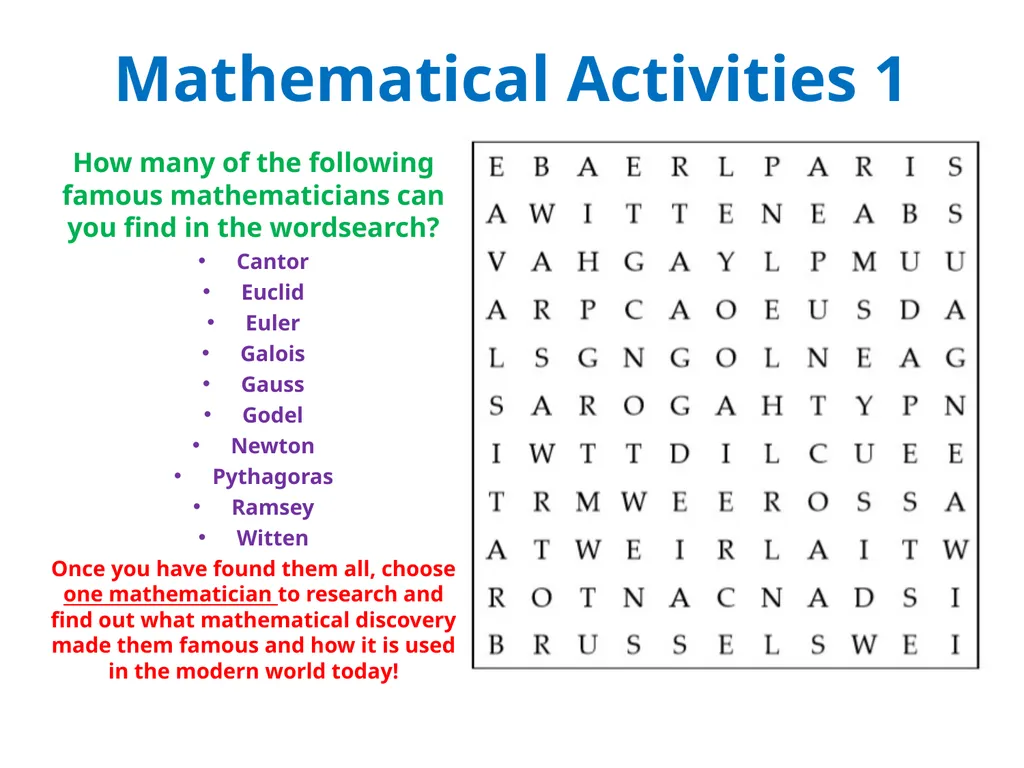
Mathematical Activities 1 How many of the following famous mathematicians can you find in the wordsearch?
Cantor
Euclid
Euler
Galois
Gauss
Godel
Newton
Pythagoras
Ramsey
Witten
Once you have found them all, choose one mathematician to research and find out what mathematical discovery made them famous and how it is used in the modern world today!<br>
08
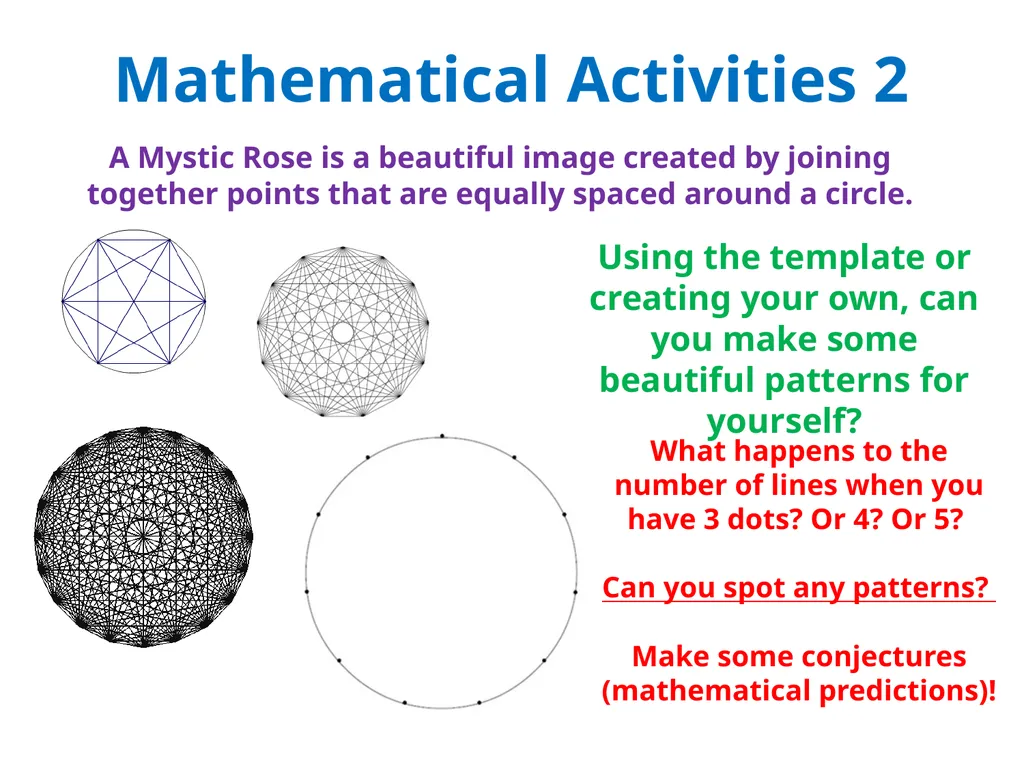
Mathematical Activities 2 A Mystic Rose is a beautiful image created by joining together points that are equally spaced around a circle. Using the template or creating your own, can you make some beautiful patterns for yourself? What happens to the number of lines when you have 3 dots? Or 4? Or 5?
Can you spot any patterns?
Make some conjectures (mathematical predictions)!<br>
09
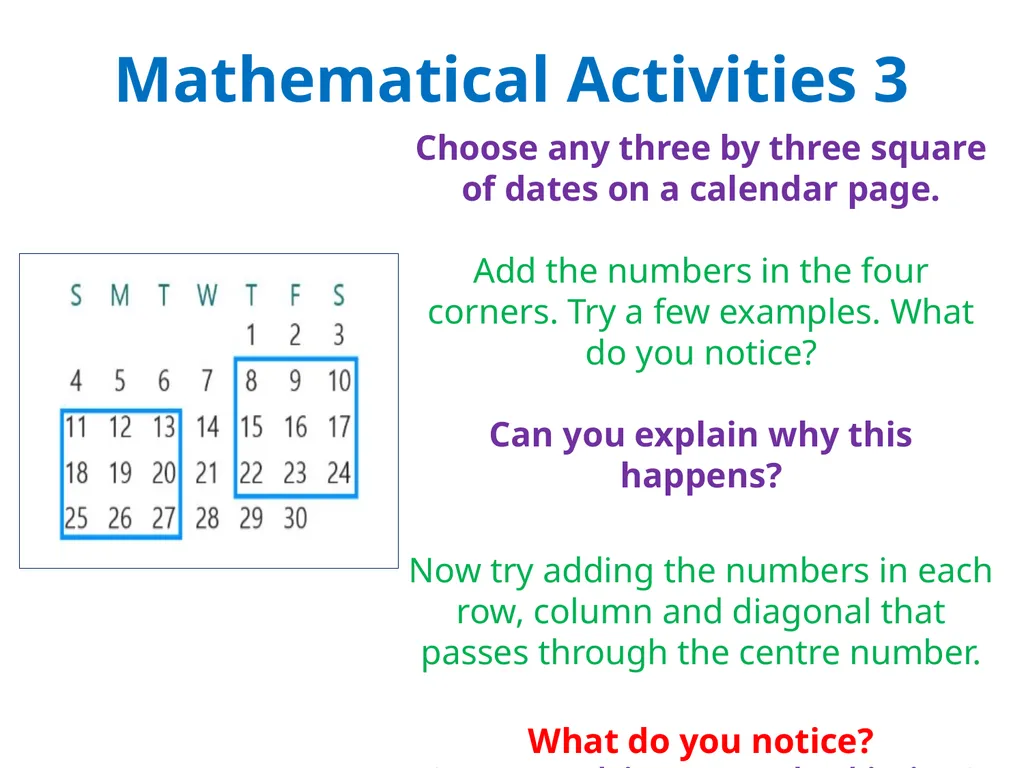
Mathematical Activities 3 Choose any three by three square of dates on a calendar page. Add the numbers in the four corners. Try a few examples. What do you notice? Can you explain why this happens?
Now try adding the numbers in each row, column and diagonal that passes through the centre number.
What do you notice? Can you explain your results this time?<br>
10
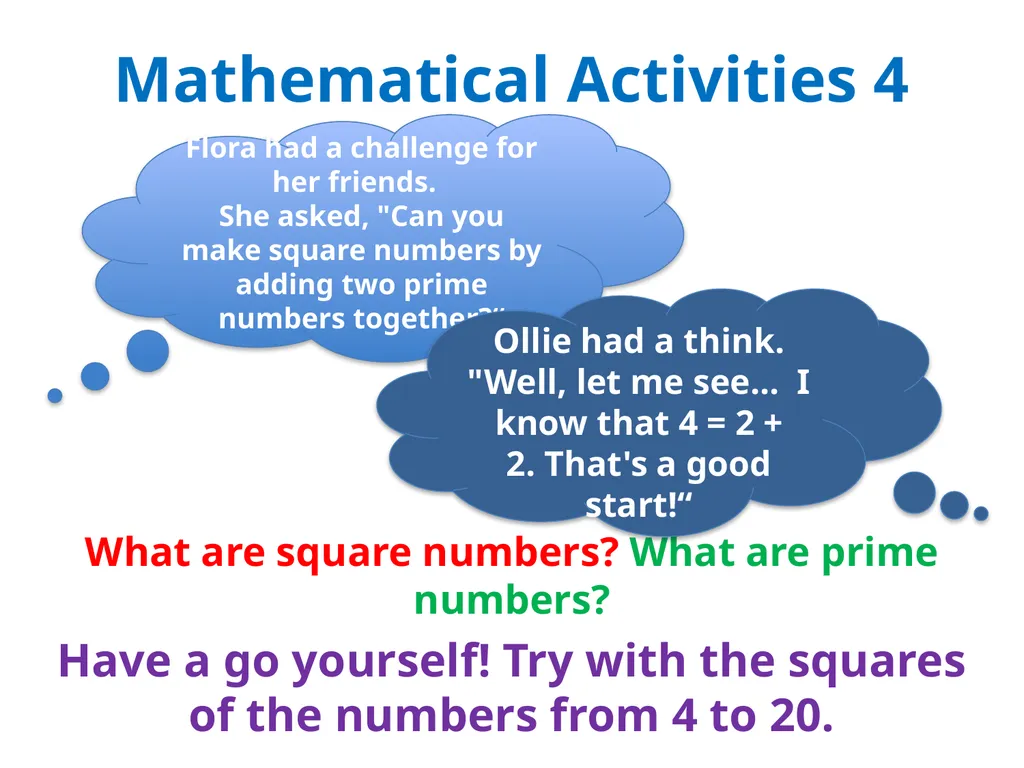
Mathematical Activities 4 What are square numbers? What are prime numbers?
Have a go yourself! Try with the squares of the numbers from 4 to 20. Flora had a challenge for her friends. She asked, "Can you make square numbers by adding two prime numbers together?“ Ollie had a think. "Well, let me see... I know that 4 = 2 + 2. That's a good start!“<br>
11
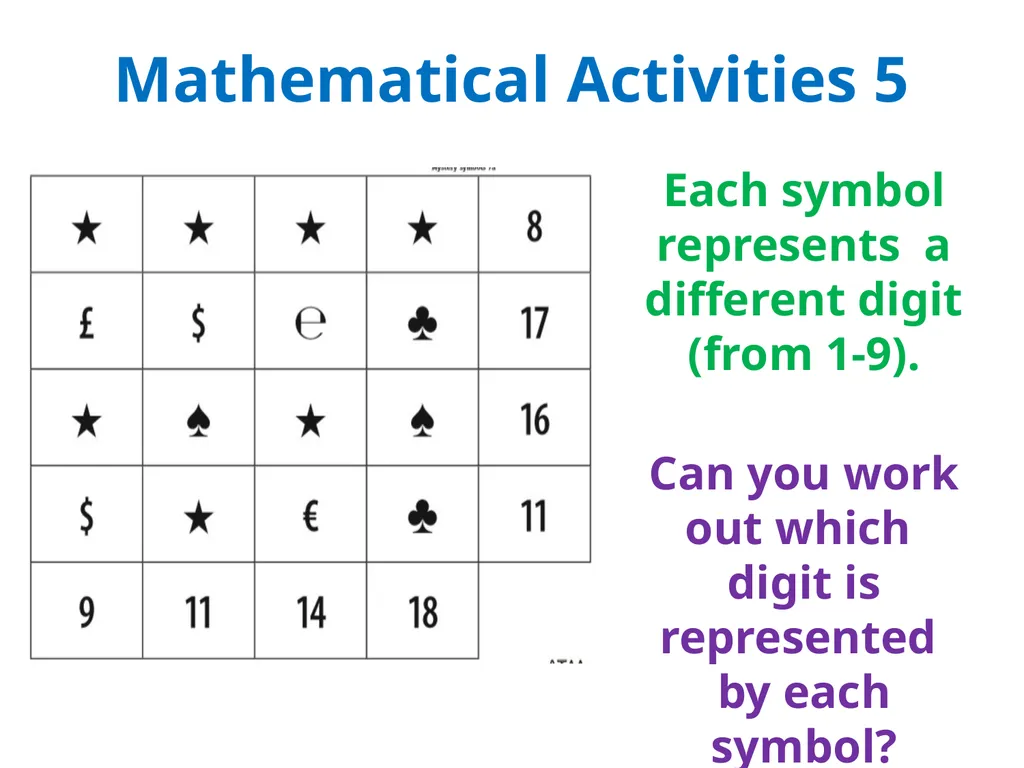
Mathematical Activities 5 Each symbol represents a different digit (from 1-9).
Can you work out which digit is represented by each symbol?<br>
12
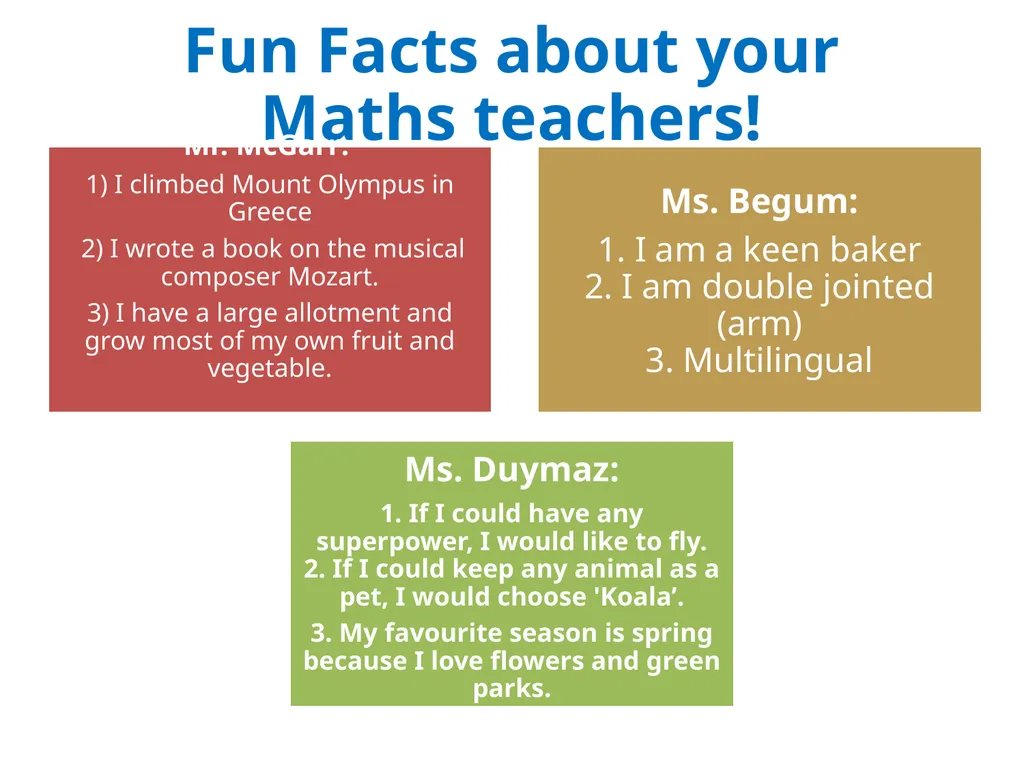
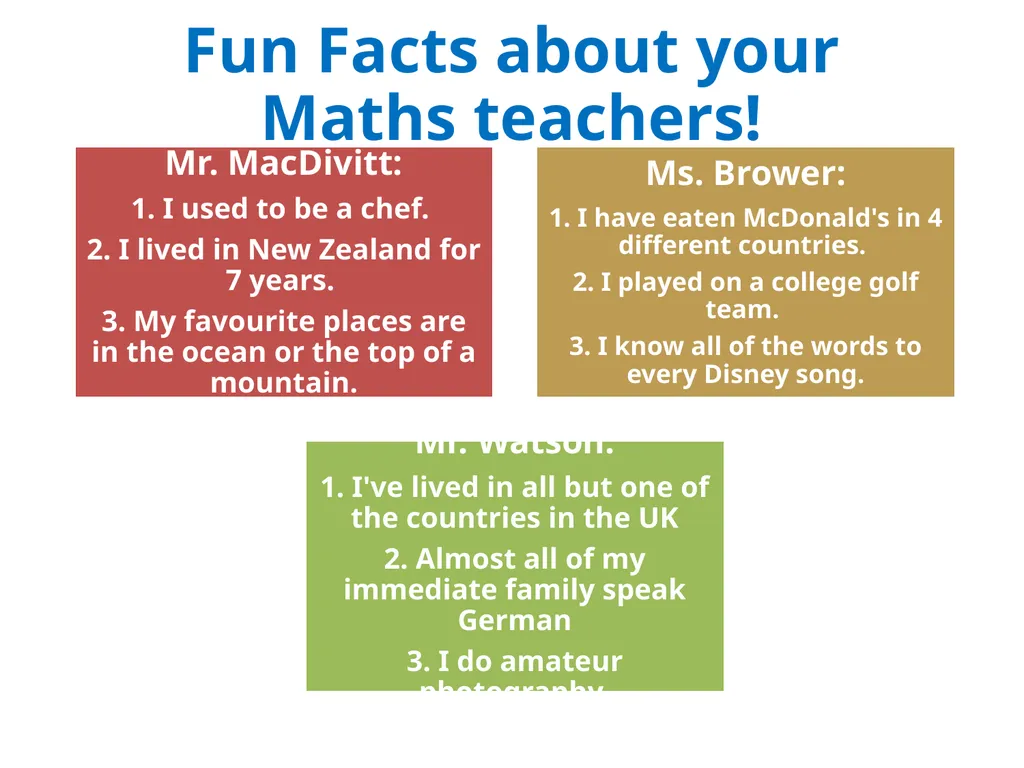
Fun Facts about your Maths teachers!<br>
13
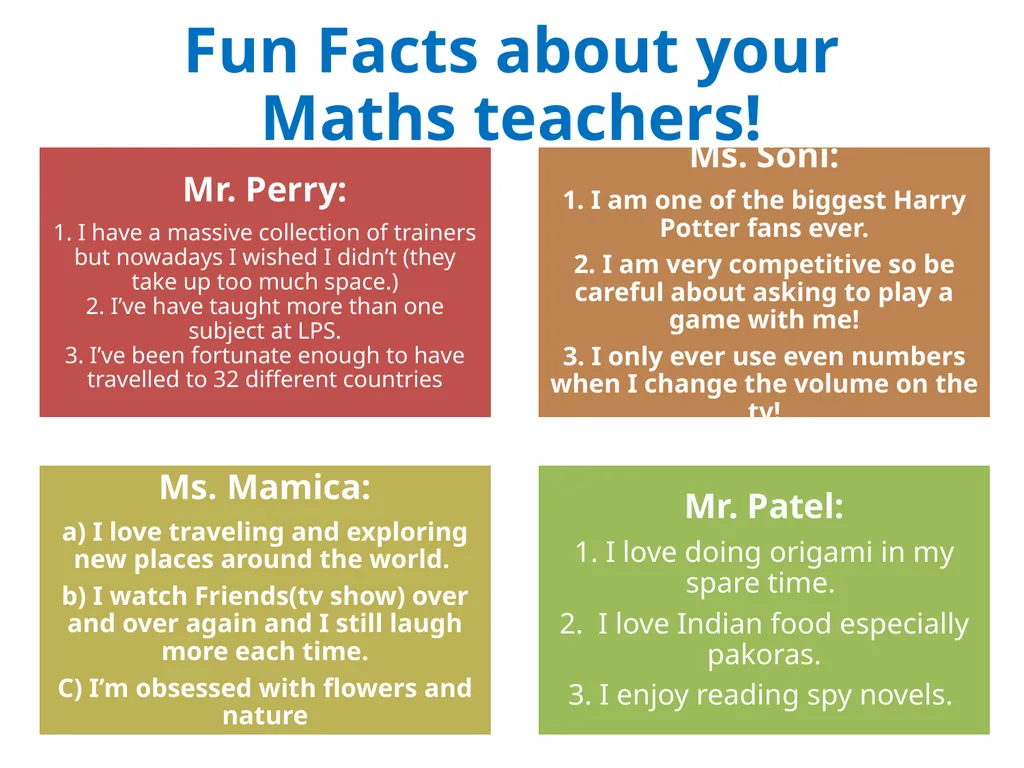
Fun Facts about your Maths teachers!<br>
14
Fun Facts about your Maths teachers!<br>
15
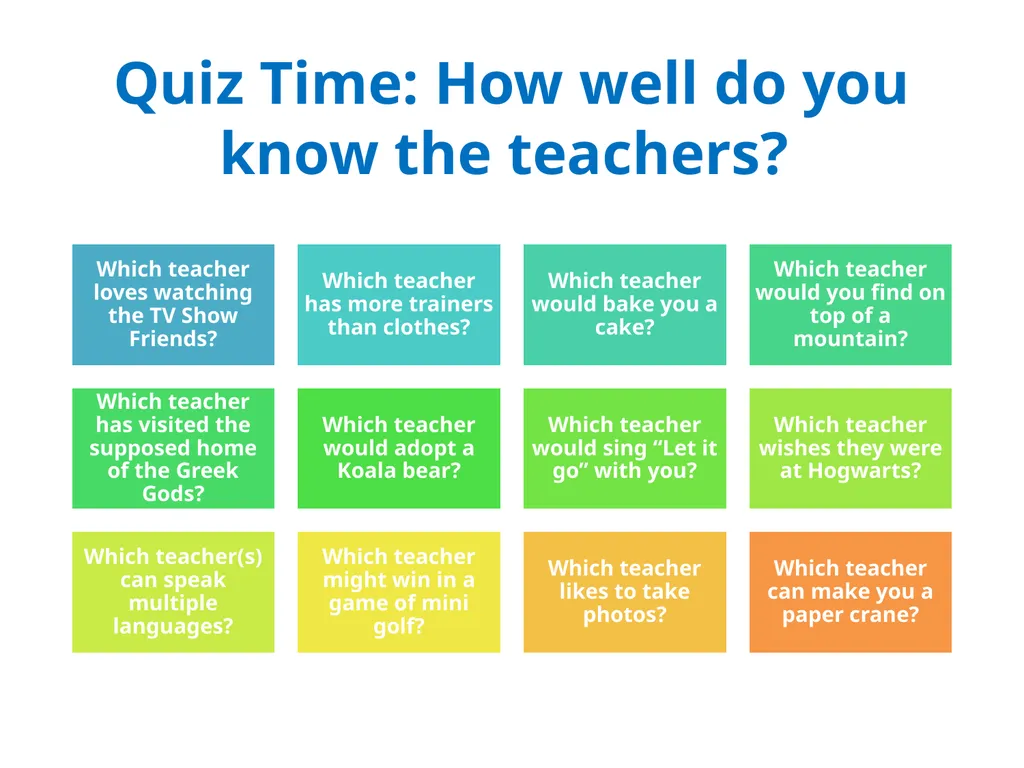
Quiz Time: How well do you know the teachers?<br>
16
The Maths Faculty are looking forward to meeting you all and helping you in your new journey at Langdon Park School and learn some exciting and new mathematics!<br>