
Tropane alkaloids LAB.3 Pharmacognosy 3rd Class,




Description: Tropane alkaloids LAB.3 Pharmacognosy 3rd Class, 2nd Semester They are ester alkaloids resulted from the coupling of organic acids with amino alcohol (Base). Introduction Tropane Alkaloids are classified into: 1- Solanaceous Tropane
Related Topics
Download Presentation
"Tropane alkaloids LAB.3 Pharmacognosy 3rd Class," is the property of its rightful owner. Permission is granted to download and print the materials on this website for personal, non-commercial use only, and to display it on your personal computer provided you do not modify the materials and that you retain all copyright notices contained in the materials. By downloading content from our website, you accept the terms of this agreement.
Presentation Transcript
slide1. Tropane alkaloids LAB.3 Pharmacognosy
3rd Class, 2nd Semester<br>
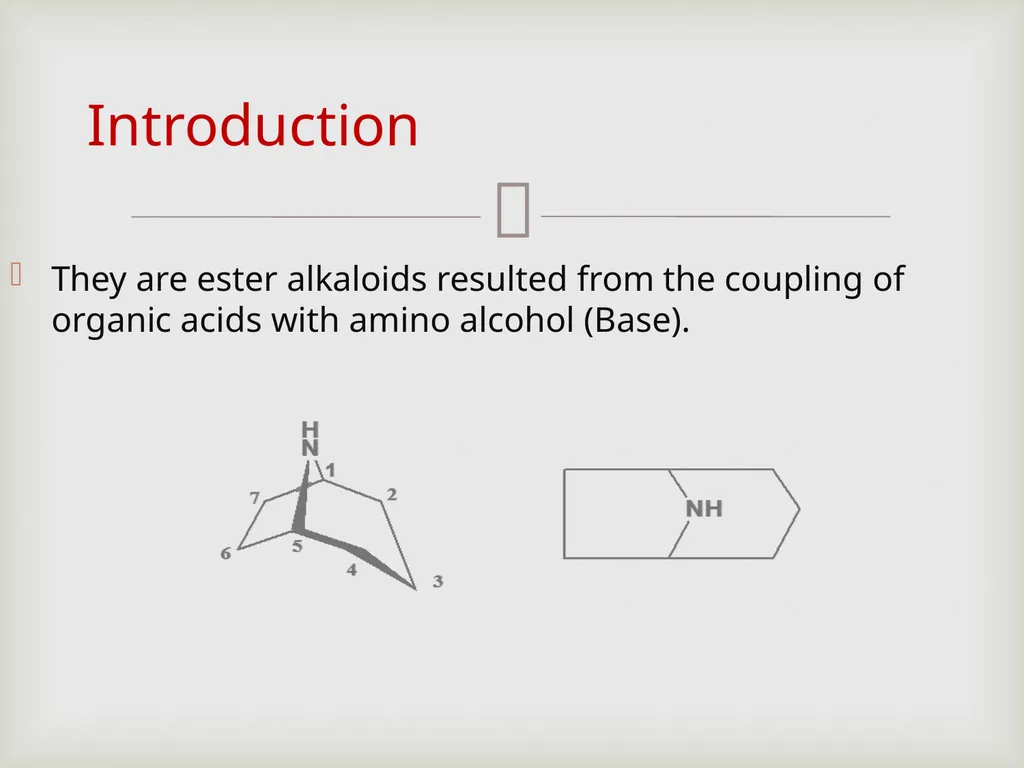
slide2. They are ester alkaloids resulted from the coupling of organic acids with amino alcohol (Base). Introduction<br>
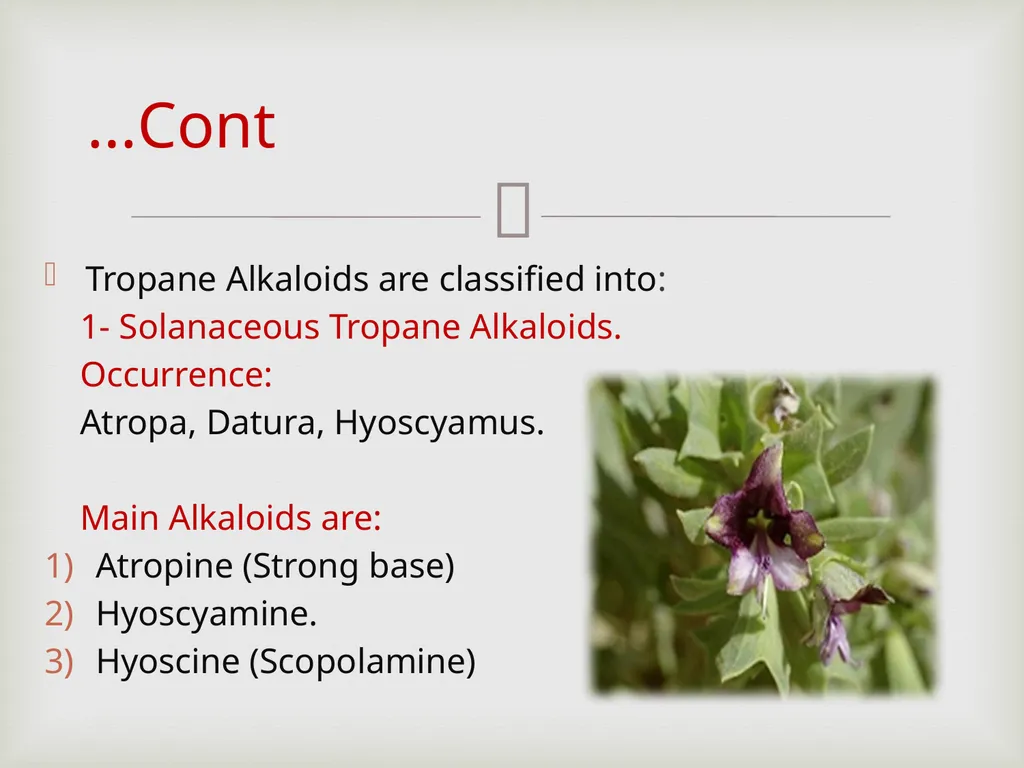
slide3. Tropane Alkaloids are classified into:
1- Solanaceous Tropane Alkaloids.
Occurrence:
Atropa, Datura, Hyoscyamus.
Main Alkaloids are:
Atropine (Strong base)
Hyoscyamine.
Hyoscine (Scopolamine) Cont…<br>
slide4. The three Alkaloids are anticholinergic agents:
Decrease saliva and GIT secretions so used preoperative.
Decrease motility of smooth muscles so used as antispasmodics.
Stimulate respiratory system.
A mydriatic (causes dilatation of the eye pupil).
Atropine is the specific antidote to cholinergic agents by occupying receptor sites at parasympathetic nerve endings.
Hyoscine has more central effect so it is sedative and hypnotic.
Hyoscine is mainly used as antiemetic. Uses<br>
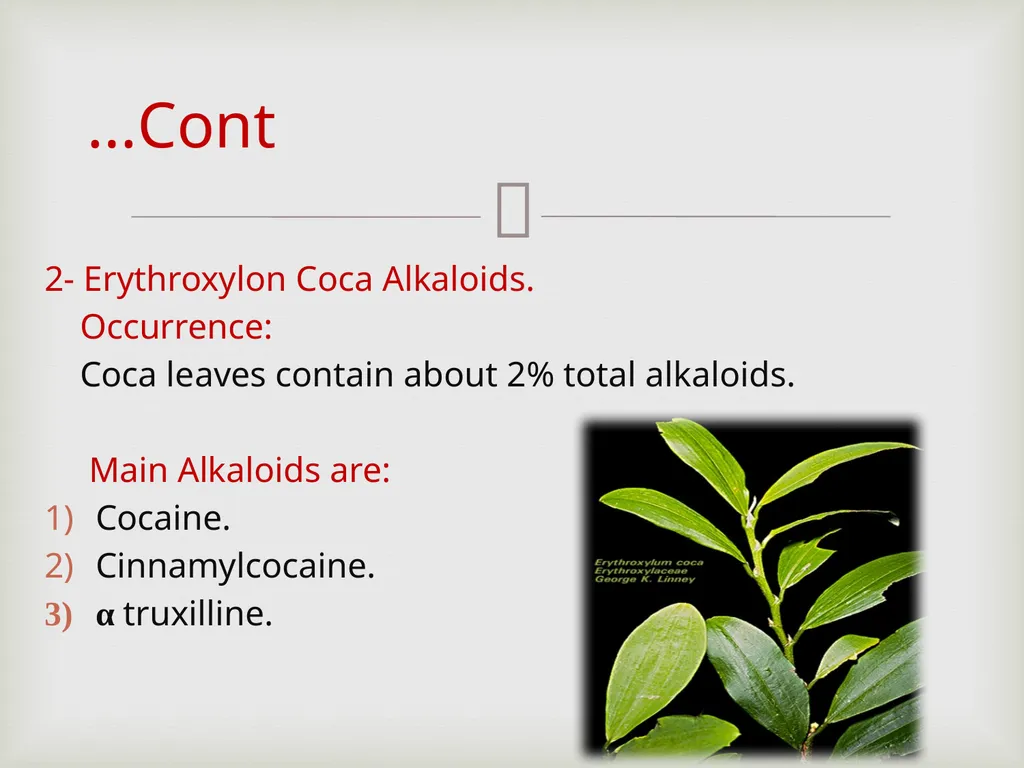
slide5. 2- Erythroxylon Coca Alkaloids.
Occurrence:
Coca leaves contain about 2% total alkaloids.
Main Alkaloids are:
Cocaine.
Cinnamylcocaine.
α truxilline. Cont…<br>
slide6. Cocaine was used as local anesthetic.
Cocaine has a CNS stimulant activity so is one of the widely abused drugs. Uses<br>
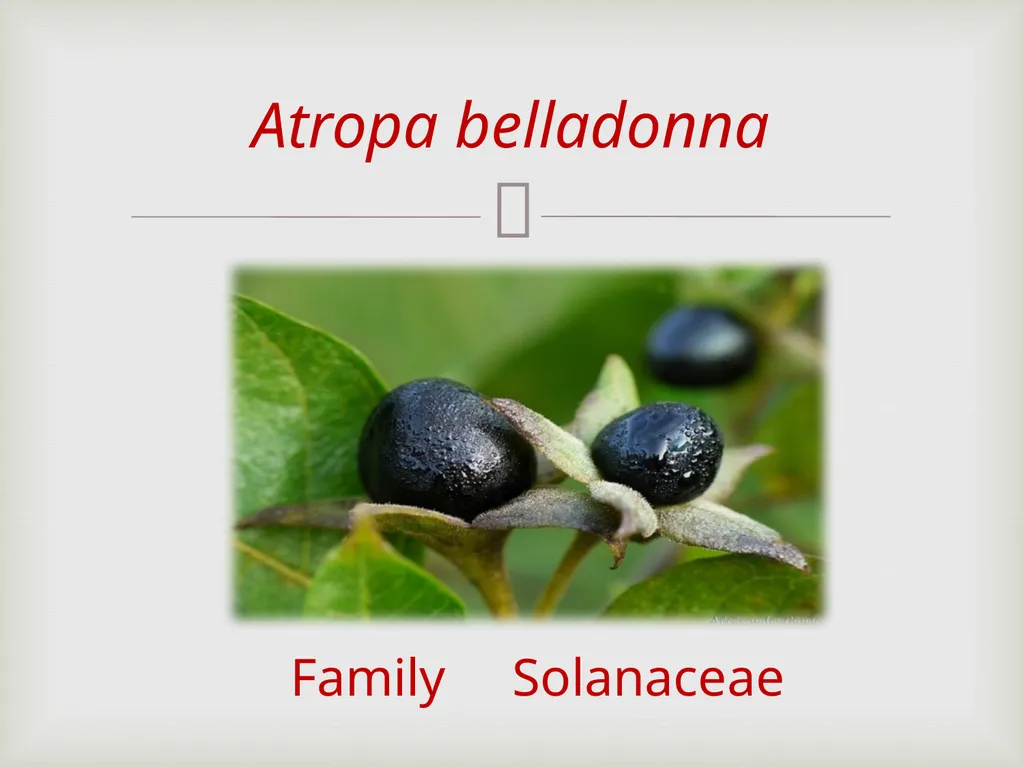
slide7. Atropa belladonna Family Solanaceae<br>
slide8. Belladonna leaf, also known as devils cherries, black cherry.
The belladonna leaf yield not less than 0.35% of alkaloids.
Native to Europe, North Africa, and Western Asia
The name "belladonna" comes from the Italian language, meaning "beautiful lady" Cont…<br>
slide9. Belladonna is one of the most toxic plants.
All parts of the plant contain atropine alkaloids.
The greatest danger to children because they look attractive and have a somewhat sweet taste.
The root of the plant is generally the most toxic part. Toxicity<br>
slide10. Blurred vision.
Loss of balance.
Headache, rash.
Dry mouth.
Slurred speech.
Confusion, hallucinations. The symptoms of belladonna poisoning<br>
slide11. Hyoscyamine and its isomer Atropine, which is formed during extraction procedure.
Also it contains Hyoscine (scopolamine) alkaloid, which is found in trace amounts. Constituents of belladonna are:-<br>
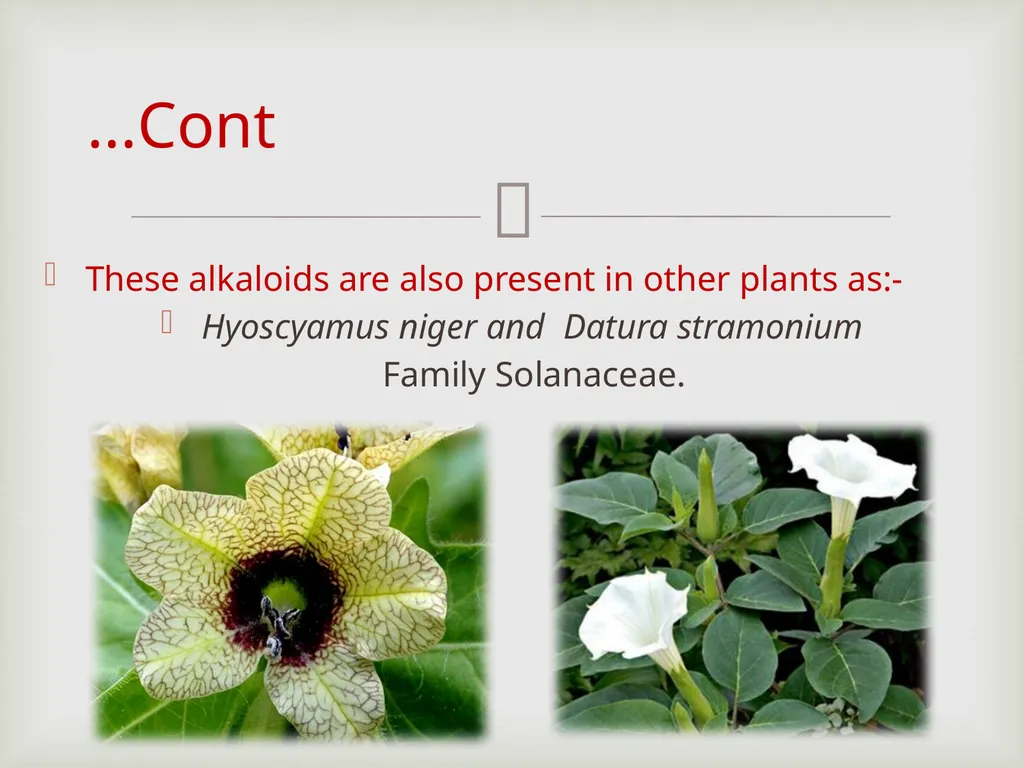
slide12. These alkaloids are also present in other plants as:-
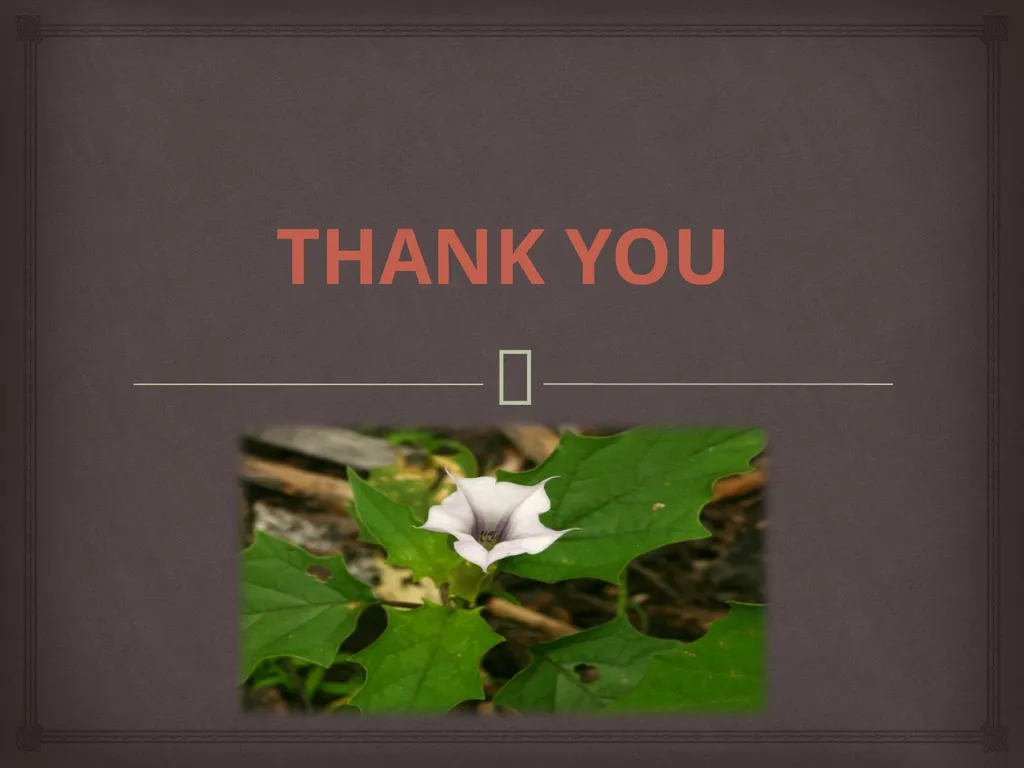
Hyoscyamus niger and Datura stramonium
Family Solanaceae. Cont…<br>
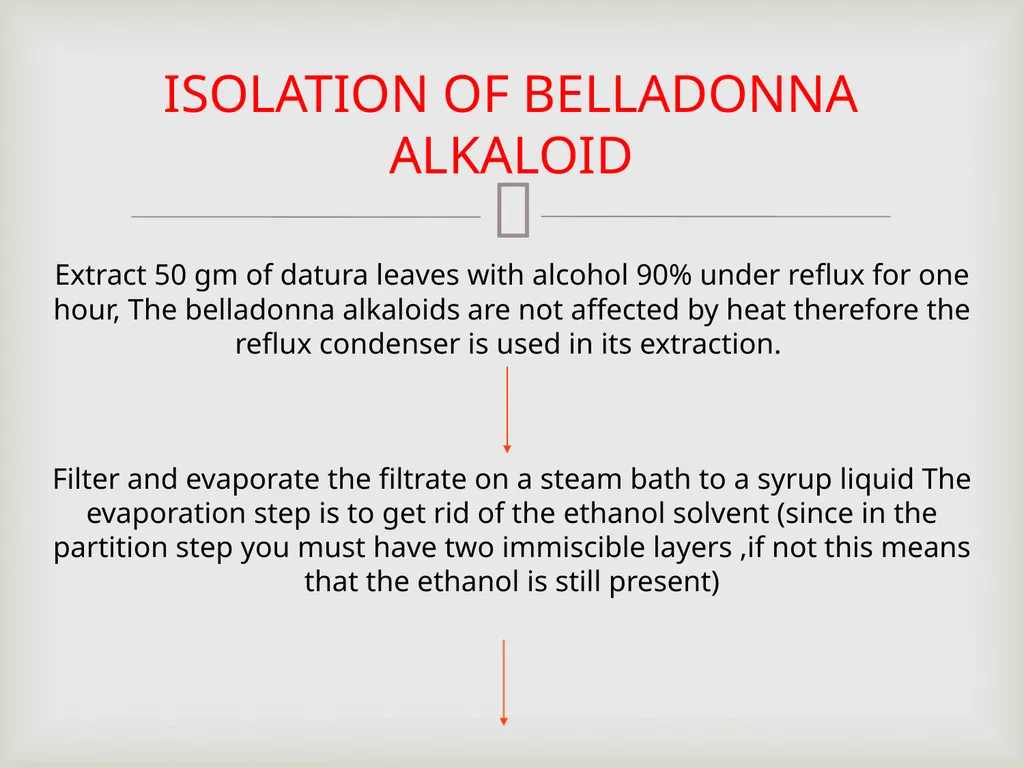
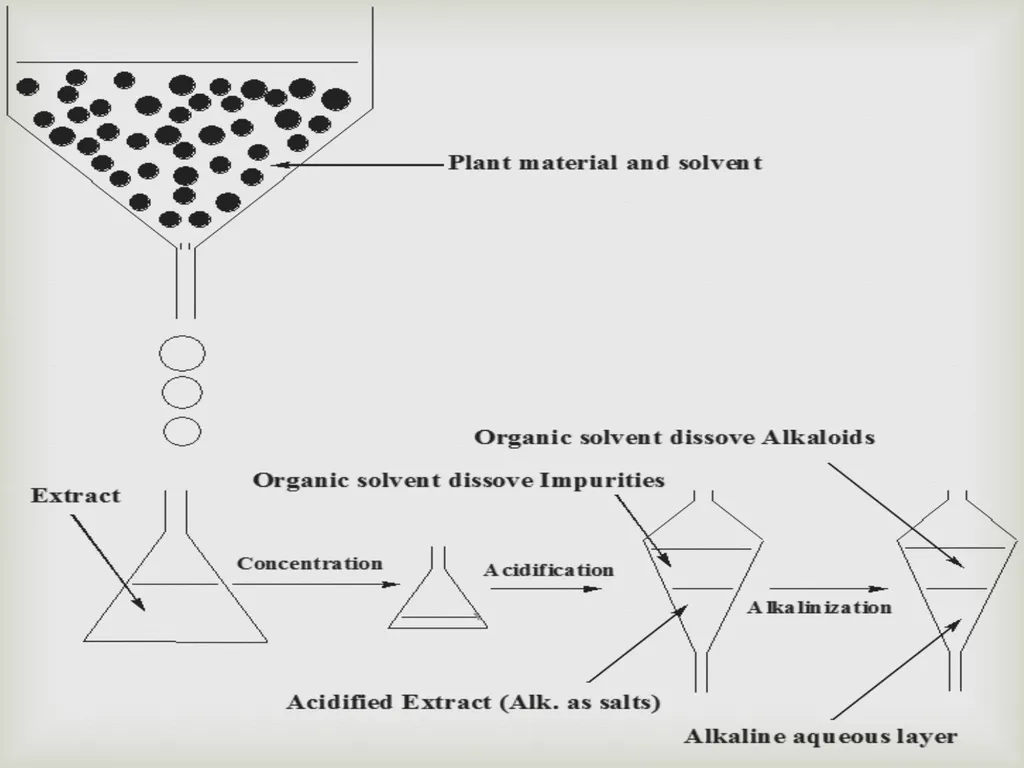
slide13. Extract 50 gm of datura leaves with alcohol 90% under reflux for one hour, The belladonna alkaloids are not affected by heat therefore the reflux condenser is used in its extraction.
Filter and evaporate the filtrate on a steam bath to a syrup liquid The evaporation step is to get rid of the ethanol solvent (since in the partition step you must have two immiscible layers ,if not this means that the ethanol is still present) ISOLATION OF BELLADONNA ALKALOID<br>
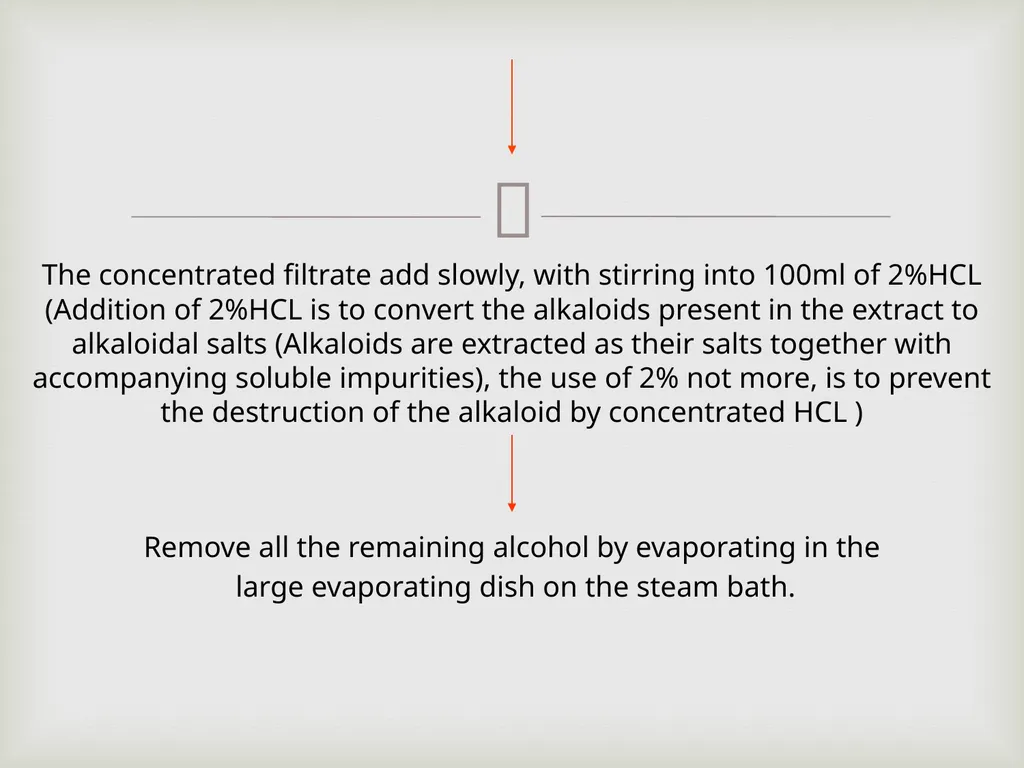
slide14. The concentrated filtrate add slowly, with stirring into 100ml of 2%HCL (Addition of 2%HCL is to convert the alkaloids present in the extract to alkaloidal salts (Alkaloids are extracted as their salts together with accompanying soluble impurities), the use of 2% not more, is to prevent the destruction of the alkaloid by concentrated HCL )
Remove all the remaining alcohol by evaporating in the
large evaporating dish on the steam bath.<br>
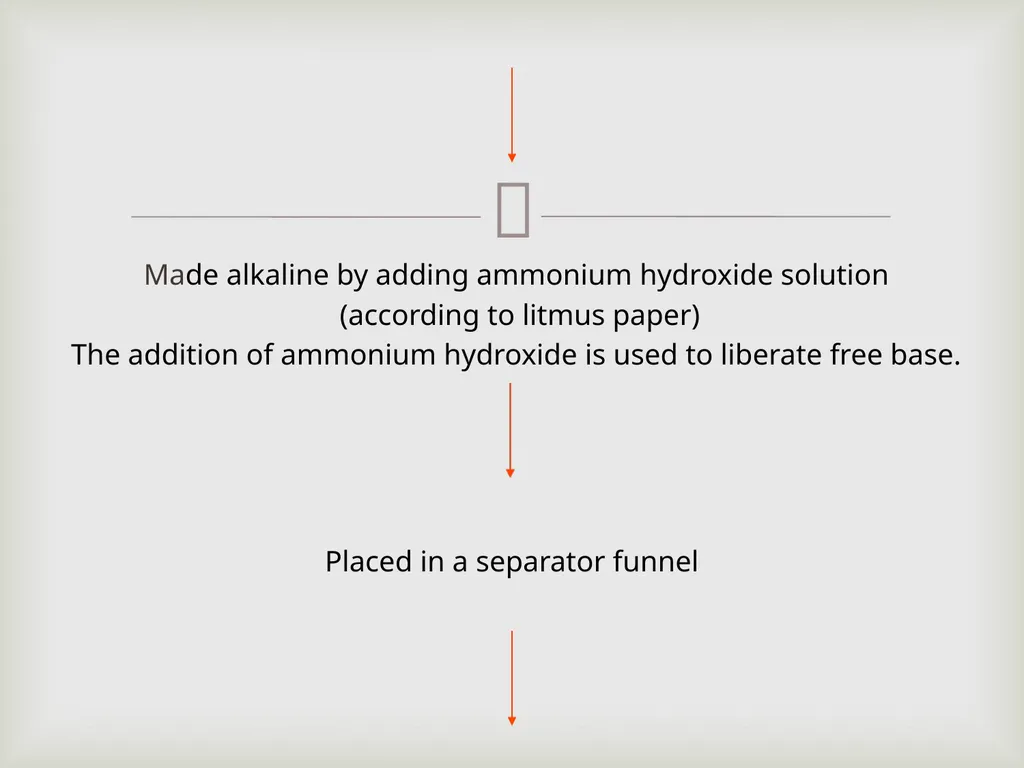
slide15. Made alkaline by adding ammonium hydroxide solution
(according to litmus paper)
The addition of ammonium hydroxide is used to liberate free base. Placed in a separator funnel<br>
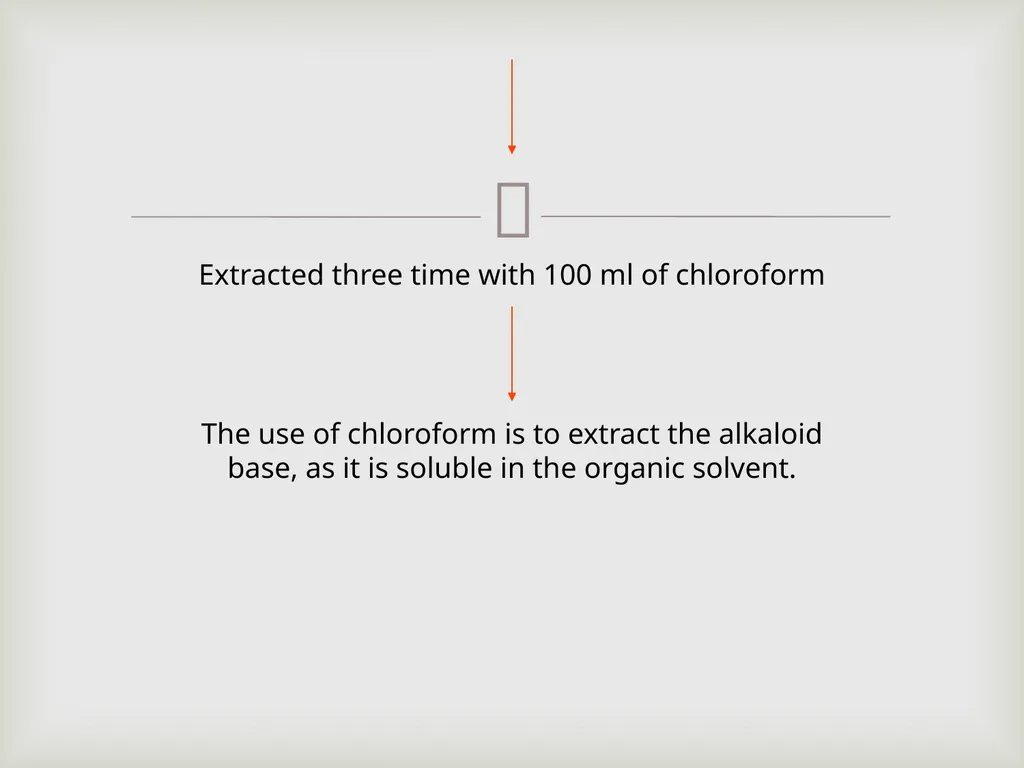
slide16. Extracted three time with 100 ml of chloroform The use of chloroform is to extract the alkaloid base, as it is soluble in the organic solvent.<br>
slide18. THANK YOU<br>
slide2. They are ester alkaloids resulted from the coupling of organic acids with amino alcohol (Base). Introduction<br>
slide3. Tropane Alkaloids are classified into:
1- Solanaceous Tropane Alkaloids.
Occurrence:
Atropa, Datura, Hyoscyamus.
Main Alkaloids are:
Atropine (Strong base)
Hyoscyamine.
Hyoscine (Scopolamine) Cont…<br>
slide4. The three Alkaloids are anticholinergic agents:
Decrease saliva and GIT secretions so used preoperative.
Decrease motility of smooth muscles so used as antispasmodics.
Stimulate respiratory system.
A mydriatic (causes dilatation of the eye pupil).
Atropine is the specific antidote to cholinergic agents by occupying receptor sites at parasympathetic nerve endings.
Hyoscine has more central effect so it is sedative and hypnotic.
Hyoscine is mainly used as antiemetic. Uses<br>
slide5. 2- Erythroxylon Coca Alkaloids.
Occurrence:
Coca leaves contain about 2% total alkaloids.
Main Alkaloids are:
Cocaine.
Cinnamylcocaine.
α truxilline. Cont…<br>
slide6. Cocaine was used as local anesthetic.
Cocaine has a CNS stimulant activity so is one of the widely abused drugs. Uses<br>
slide7. Atropa belladonna Family Solanaceae<br>
slide8. Belladonna leaf, also known as devils cherries, black cherry.
The belladonna leaf yield not less than 0.35% of alkaloids.
Native to Europe, North Africa, and Western Asia
The name "belladonna" comes from the Italian language, meaning "beautiful lady" Cont…<br>
slide9. Belladonna is one of the most toxic plants.
All parts of the plant contain atropine alkaloids.
The greatest danger to children because they look attractive and have a somewhat sweet taste.
The root of the plant is generally the most toxic part. Toxicity<br>
slide10. Blurred vision.
Loss of balance.
Headache, rash.
Dry mouth.
Slurred speech.
Confusion, hallucinations. The symptoms of belladonna poisoning<br>
slide11. Hyoscyamine and its isomer Atropine, which is formed during extraction procedure.
Also it contains Hyoscine (scopolamine) alkaloid, which is found in trace amounts. Constituents of belladonna are:-<br>
slide12. These alkaloids are also present in other plants as:-
Hyoscyamus niger and Datura stramonium
Family Solanaceae. Cont…<br>
slide13. Extract 50 gm of datura leaves with alcohol 90% under reflux for one hour, The belladonna alkaloids are not affected by heat therefore the reflux condenser is used in its extraction.
Filter and evaporate the filtrate on a steam bath to a syrup liquid The evaporation step is to get rid of the ethanol solvent (since in the partition step you must have two immiscible layers ,if not this means that the ethanol is still present) ISOLATION OF BELLADONNA ALKALOID<br>
slide14. The concentrated filtrate add slowly, with stirring into 100ml of 2%HCL (Addition of 2%HCL is to convert the alkaloids present in the extract to alkaloidal salts (Alkaloids are extracted as their salts together with accompanying soluble impurities), the use of 2% not more, is to prevent the destruction of the alkaloid by concentrated HCL )
Remove all the remaining alcohol by evaporating in the
large evaporating dish on the steam bath.<br>
slide15. Made alkaline by adding ammonium hydroxide solution
(according to litmus paper)
The addition of ammonium hydroxide is used to liberate free base. Placed in a separator funnel<br>
slide16. Extracted three time with 100 ml of chloroform The use of chloroform is to extract the alkaloid base, as it is soluble in the organic solvent.<br>
slide18. THANK YOU<br>