Tropical Cyclones General Characteristics Cyclone developed in the region lying between the tropics of Capricorn and Cancer are called tropical cyclone, which are not regular and uniform like extra tropical or temperate cyclones. Size of
"Tropical Cyclones General Characteristics Cyclone" is the property of its rightful owner. Permission is granted to
download and print the materials on this website for personal, non-commercial use only, and to display it
on your personal computer provided you do not modify the materials and that you retain all copyright
notices contained in the materials. By downloading content from our website, you accept the terms of this
agreement.
Presentation Transcript
01
Tropical Cyclones General Characteristics
Cyclone developed in the region lying between the tropics of Capricorn and Cancer are called tropical cyclone, which are not regular and uniform like extra tropical or temperate cyclones.
Size of tropical cyclone: Tropical cyclones varies considerably. On an average, their diameters range between 80km and 300km but some times they become so small to 50km or even less.
Velocities: Weak cyclones move at the speed of about 32km per hour While hurricanes attain the velocity of 180km per hour or more.
Tropical cyclone become more vigorous and move with very high velocity over the ocean and become weak and moving over land areas, and ultimately die when reaching the interior portion of the continents. This is why these cyclones affect only the coastal areas of the continents.<br>
02
Continued The center of the cyclone is characterized by extremely low pressure.
Like temperate cyclones, tropical cyclones are not characterized by temperature variations in their different parts because they have not have different fronts (Warm and cold fronts).
There are no different rainfall cells in the tropical cyclones as is the case of temperate cyclones and hence each part of the cyclones yields rainfall.
Tropical cyclones are not always mobile. But some times, they become stationary over a particular place for several days and yield heavy rainfall causing flood and disaster.
The tracks of tropical cyclone vary considerably in different parts. Normally they move from east to west under the influence of trade winds.<br>
03
Continued Tropical cyclones are confined to a particular period of the year, mainly during summer seasons. The frequency and affected areas of tropical cyclones are far less than those of the temperate cyclones.
Types of Tropical Cyclone
It may be pointed out that tropical cyclones are so varied in size, weather conditions and their general characteristics that no two cyclones are identical and therefore it become very difficult to classify them into certain categories.
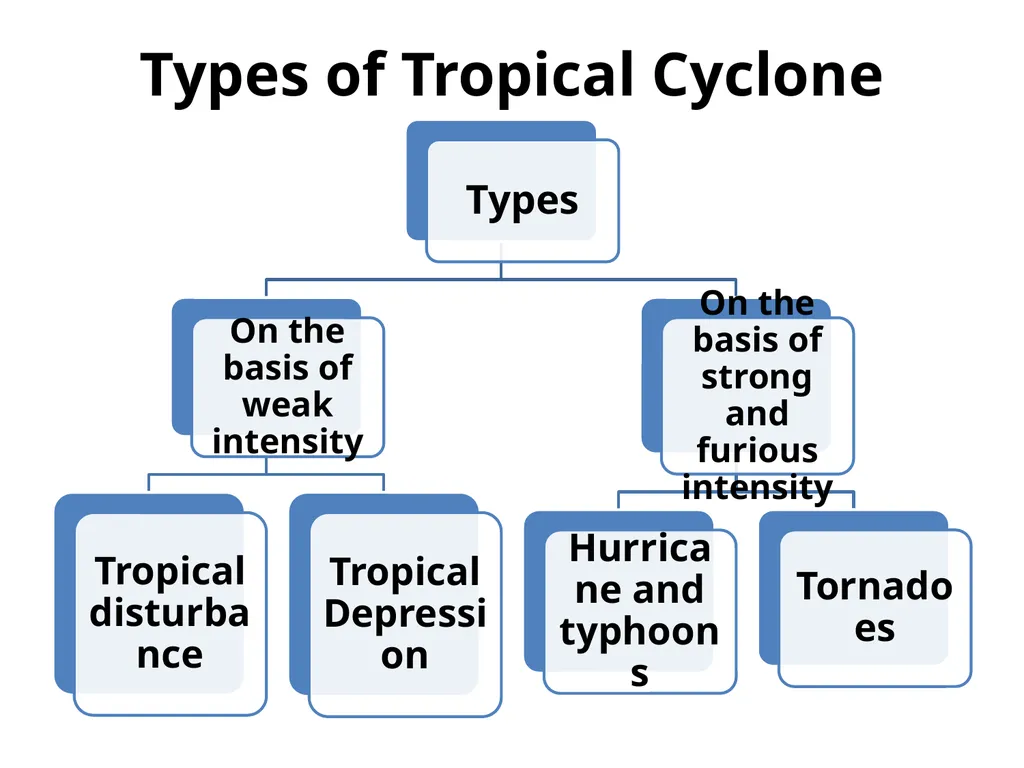
Generally, they are divided into 4 major types on basis of intensity.<br>
04
Types of Tropical Cyclone<br>
05
Origin of tropical cyclone There is no commonly acceptable viewpoint for the origin of tropical cyclones because the exact mechanism of the formation and development of these cyclones could not be properly understood as yet.
According to the advocates of frontal theory all types of cyclones originate because of frontogenesis.
Inspite of the absence of two contrasting air masses in the equatorial region fronts are formed due to meeting of land and sea winds.
The frontal concept of the origin of tropical cyclones is no longer acceptable because tropical cyclone in no case are related to fronts.
In fact, tropical cyclone is like a heat engine which is energized by the latent heat of condensation.
On an average, tropical cyclone are formed due to development of low pressure of thermal origin.
The develop when the following requirements are fulfilled.<br>
06
Continued There should be continuous supply of abundant warm and moist air. Without doubt tropical cyclones originate over warm oceans having surface temperature of 27°C during summer season.
Higher value of coriolis force is required for the origin of these cyclones.
It is apparent that tropical cyclones are practically absent in a belt of 5°-8° wide on both sides of the equator where coriolis force is minimum.
It means that cyclone circulation of air is caused due to deflection in wind direction resulting from coriolis force.
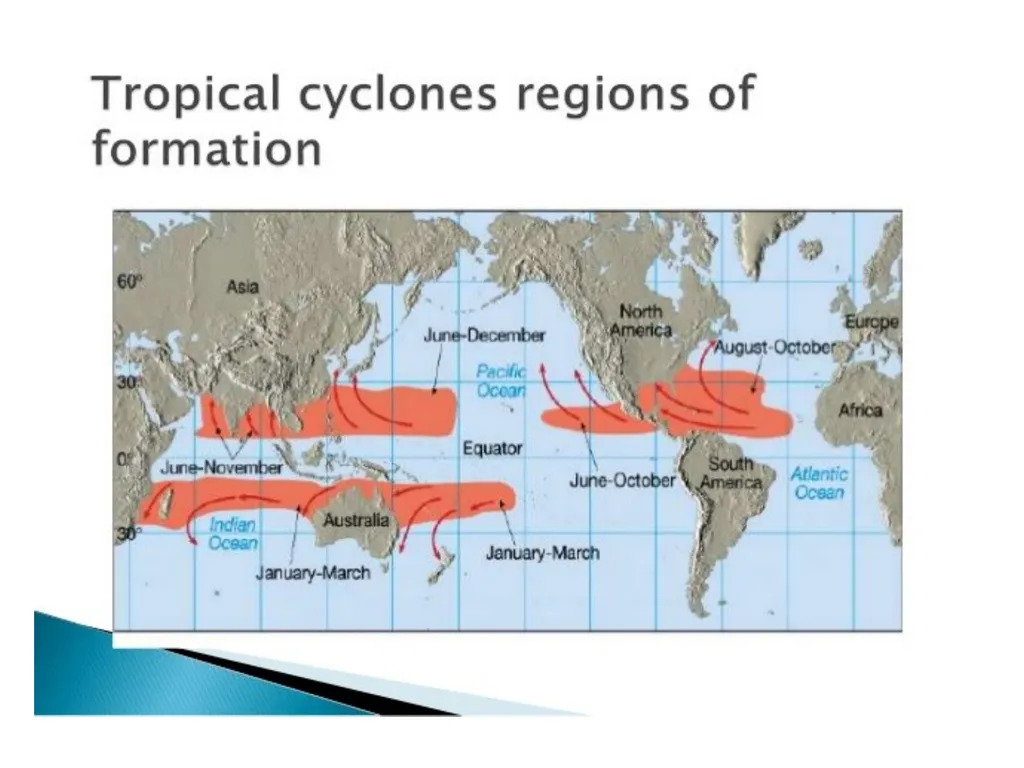
Majority of the tropical cyclones originate within a belt of 5°-20° latitudes in the western part of the oceans.
They are associated with inter-tropical convergence (ITC) which extends from 5°-30° North during summer season.<br>
07
Weather Condition Associated with tropical cyclones The arrival of tropical cyclones at a particular place is heralded by sudden increase in air temperature and wind velocity, marked decrease in air pressure, appearance of cirrus or cirrostratus clouds in the sky, and emergence of high waves in the oceans.
Then the cloud are thickened and become cumulonimbus which yield heavy rains.
The visibility becomes zero because the sky is overcast with thick and dark thunder clouds.<br>
08
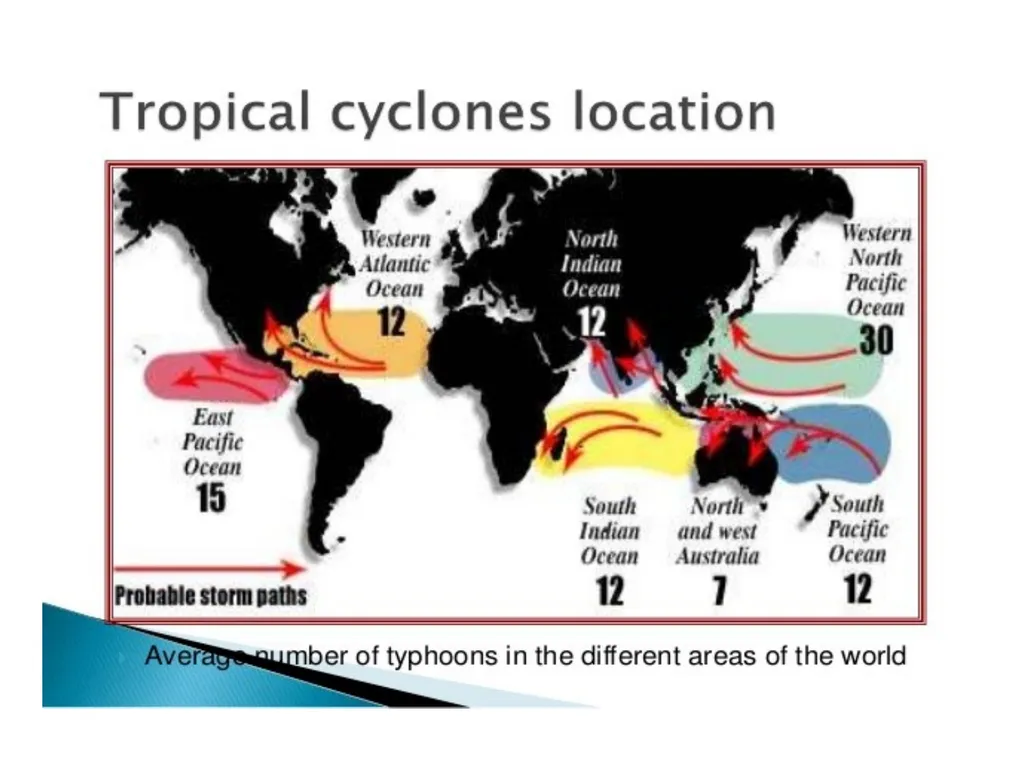
Distribution of tropical cyclone North Atlantic Ocean
North Pacific Ocean
South- West North Pacific Ocean
South Pacific Ocean
North Indian Ocean
South Indian Ocean<br>
09
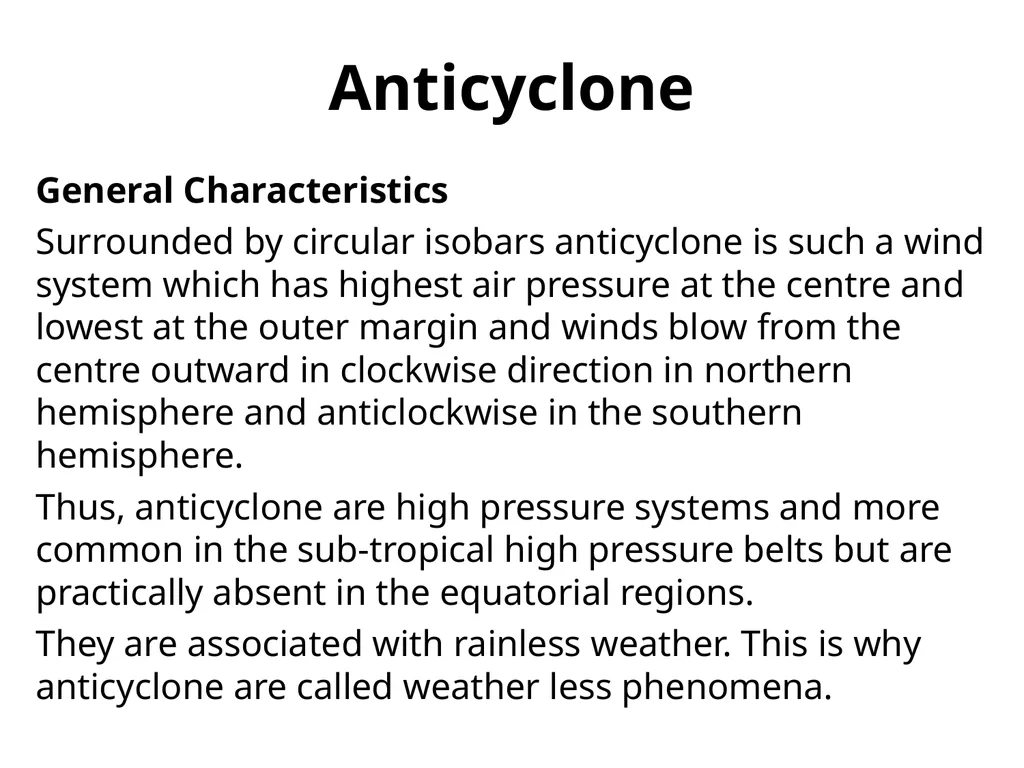
Anticyclone General Characteristics
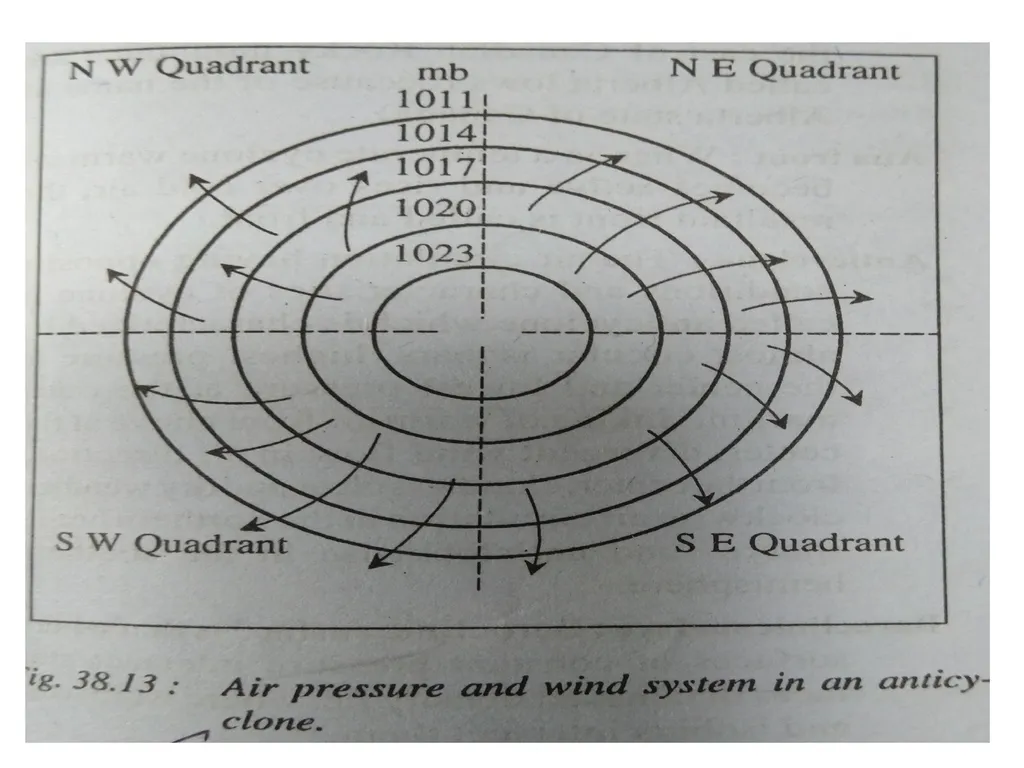
Surrounded by circular isobars anticyclone is such a wind system which has highest air pressure at the centre and lowest at the outer margin and winds blow from the centre outward in clockwise direction in northern hemisphere and anticlockwise in the southern hemisphere.
Thus, anticyclone are high pressure systems and more common in the sub-tropical high pressure belts but are practically absent in the equatorial regions.
They are associated with rainless weather. This is why anticyclone are called weather less phenomena.<br>
10
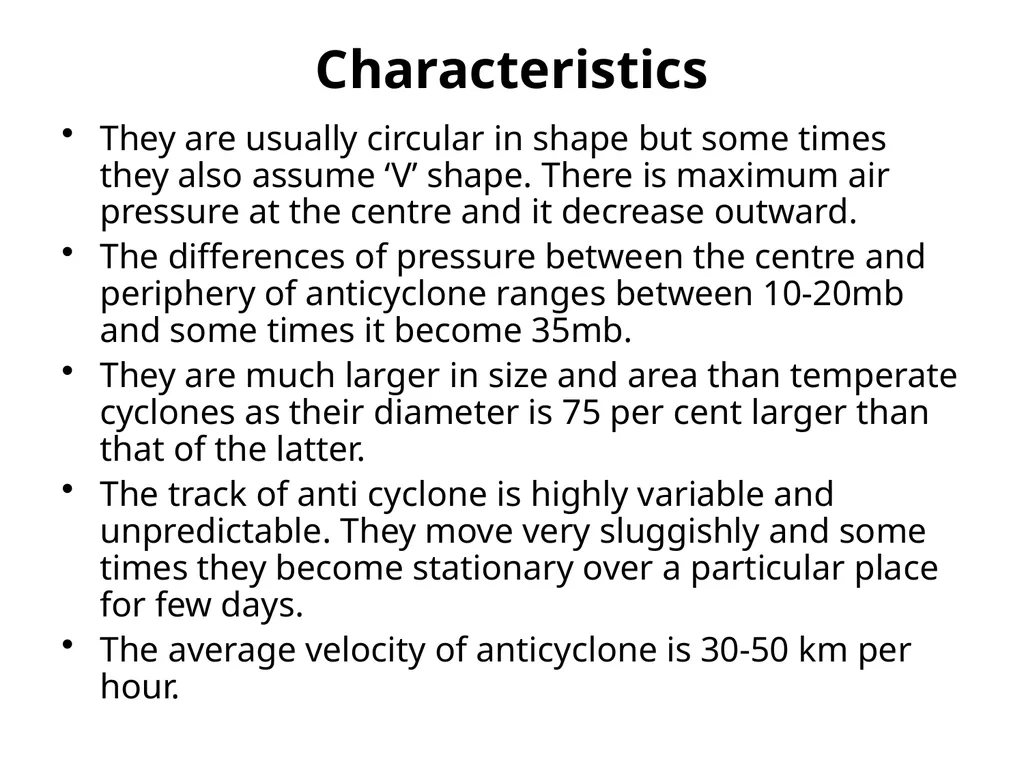
Characteristics They are usually circular in shape but some times they also assume ‘V’ shape. There is maximum air pressure at the centre and it decrease outward.
The differences of pressure between the centre and periphery of anticyclone ranges between 10-20mb and some times it become 35mb.
They are much larger in size and area than temperate cyclones as their diameter is 75 per cent larger than that of the latter.
The track of anti cyclone is highly variable and unpredictable. They move very sluggishly and some times they become stationary over a particular place for few days.
The average velocity of anticyclone is 30-50 km per hour.<br>
11
Wind system
Shape and size
Temperature
Weather condition
Types<br>