04
Blockchain Blockchain could be game-changer, particularly for those industries facing strong regulatory/legal pressures:
By immutably recording these information flows throughout the entire SC process, all participants could track legal title, technical, environmental, social, financial, and regulatory attributes.
Smart contracts, coded to execute automatically, can create additional efficiencies in the blockchain-enabled supply chain.<br>
05
Research Question Many SCM systems depend on 3rd party verifiers such local government officials to validate the origins of raw material resources.
The question is whether the blockchain virtual world actively reflects the actual physical events and conditions in the chain edges and nodes. Provenance of origin could be an issue, even with Blockchain, depending on the context.<br>
06
Objective We develop a BPM of a Blockchain Smart Contract-enabled Supply Chain with IoT as the third-party oracle participant, utilizing Design Science research (DSR). With IoT as one of its blockchain participants, a supply chain may, in many situations, realize complete end-to-end traceability and transparency provenance.<br>
07
Methodology Design Science Research (DSR). The six phases are:
1. Define the Objectives of a solution
2. Development of the Methodology
3. Design and Development of an Artifact which meets the solution objectives
4. Demonstration of the Solution
5. Evaluation of the Solution
6. Communication of the Problem and the Solution<br>
08
Objective of the Solution Supply Chain Issues
The gem and precious metals jewelry supply chains serve as a good example of this complexity. The jewelry industry consists of international supply chains for both gems and metals, both of which are subject to strict regulations as to where and how they were mined.
At many layers of the SC, participants are asked to provide due diligence as to the veracity and origin of the gem/mineral. Participants are also notified that they could be audited at any time regarding any documentation of these referenced gems/minerals.
Clearly, regulatory compliance comprises the bulk of audit effort in the gem industry.<br>
09
Objective of the Solution IoT, Blockchain & Smart Contracts
Blockchain technology was used to develop a digital currency - Bitcoin - via open, peer-to-peer, and cryptographically stamped data sharing.
In this context, blockchain is an enabler of a trackable, transparent, and secure financial transactions without the need for a central bank authority or a controlling intermediary.<br>
10
Objective of the Solution The Oracle Paradox
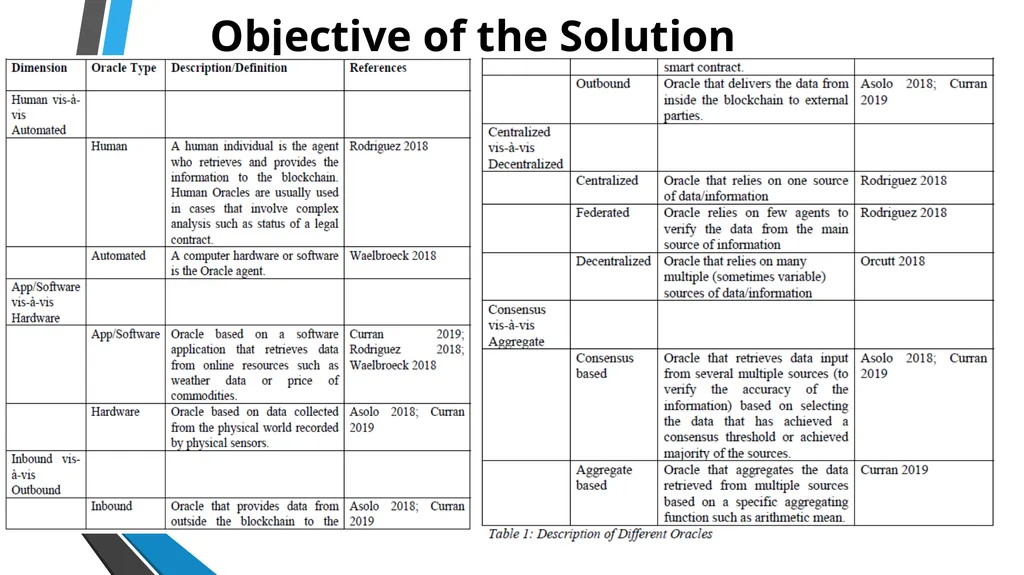
A blockchain oracle is defined as an entity or agent that retrieves and authenticates information, occurrences, or data feeds from the physical real-world and provides them to the blockchain for smart contracts to execute.
The purpose for oracles stems from the need of input for smart contracts to verify the conditions fulfillment to comply with the terms of the contract.
Consequently, blockchain oracles act as third-party gateways for the blockchain to the external world, and they have sole control over input that reaches the smart contracts.<br>
11
Objective of the Solution The Oracle Paradox
Oracles have complete power on the authenticity and accuracy of information needed for the proper execution of smart contracts (in addition to the security and privacy of the information).
Blockchain system which is built on the premise of “trustless agents” has to rely on trusting the oracle gateway.
“Oracle Paradox” or “Oracle Problem” defined as the trust, accuracy, reliability, and security problems that stem from the need to trust oracles to link the physical world and the virtual world, which is based on the trustless use of blockchain nodes and smart contract.
Oracle Paradox is labeled as a critical obstacle to the diffusion and adoption of blockchain systems.<br>
12
DEVELOPMENT OF THE METHODOLOGY IoT devices
IoT is the network of physical assets that are embedded with sensors, tags, electronics, and internet connectivity to record, collect, and relay information about its activities.
IoT enables a physical object to exist virtually or electronically.
For example, an RFID tag may be attached to a box (Thing) and this tag is read by a sensor reader attached to a nearby hovering drone (Thing). The other critical component here would be the network, which receives the signal output by the drone RFID sensor and then records this information to the blockchain. 12<br>
13
DEVELOPMENT OF THE METHODOLOGY IoT, Blockchain & Smart Contracts
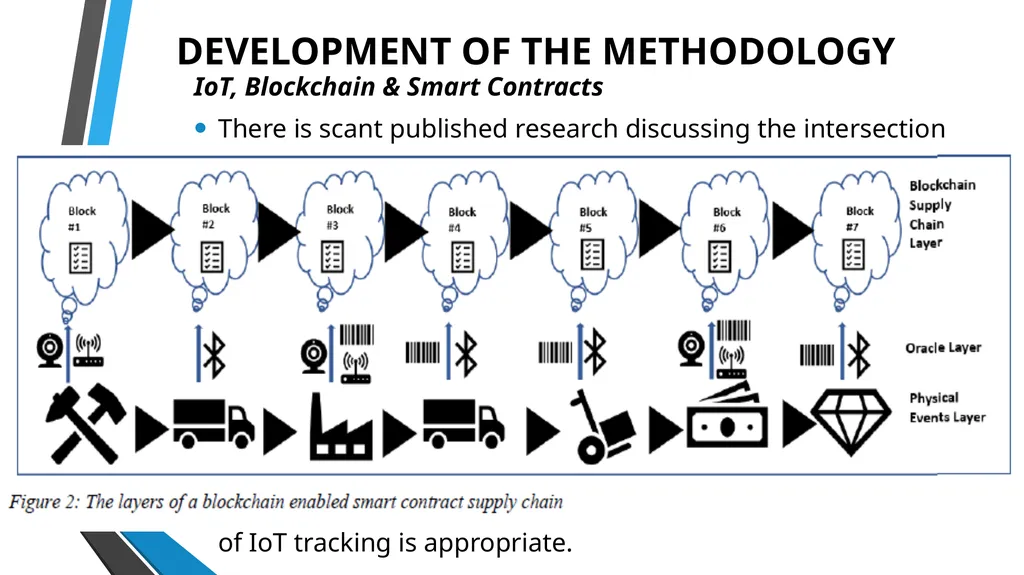
There is scant published research discussing the intersection of IoT and blockchains, let alone their role in smart contracts.
All levels of the supply chain process should be captured by IoT and subsequently recorded on the blockchain. But, the level of recording granularity should be appropriate for the specific use case.
For example, one might want to place a sensor on a case of oranges as opposed to tagging each orange.
One might want to place a sensor or tiny QR tag on all diamonds over 1 carat and record this process using a drone or fixed camera.
Since diamonds are quite high in value, such a granular level of IoT tracking is appropriate. 13<br>
14
DEVELOPMENT OF THE METHODOLOGY IoT, Blockchain & Smart Contracts
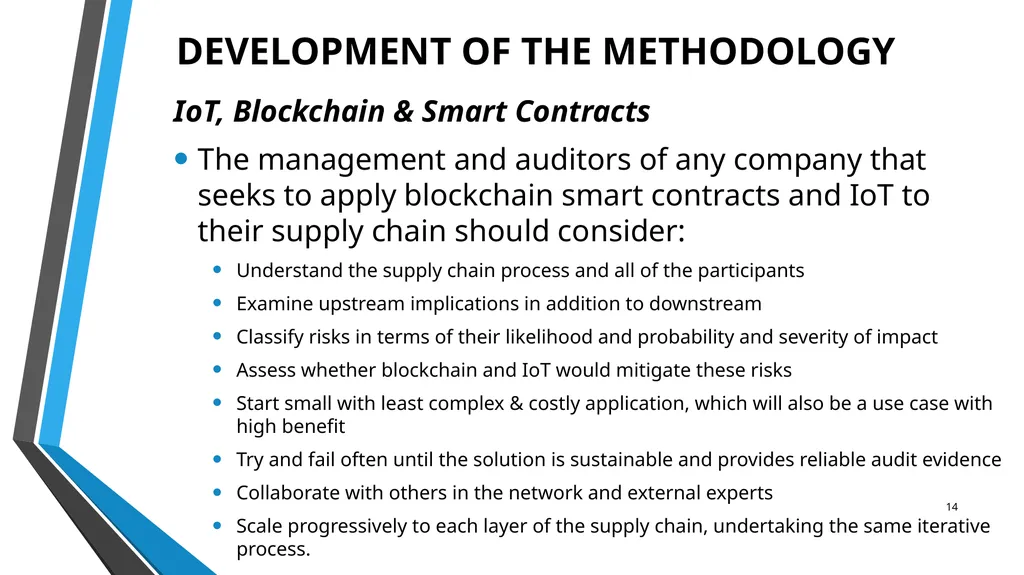
The management and auditors of any company that seeks to apply blockchain smart contracts and IoT to their supply chain should consider:
Understand the supply chain process and all of the participants
Examine upstream implications in addition to downstream
Classify risks in terms of their likelihood and probability and severity of impact
Assess whether blockchain and IoT would mitigate these risks
Start small with least complex & costly application, which will also be a use case with high benefit
Try and fail often until the solution is sustainable and provides reliable audit evidence
Collaborate with others in the network and external experts
Scale progressively to each layer of the supply chain, undertaking the same iterative process. 14<br>
15
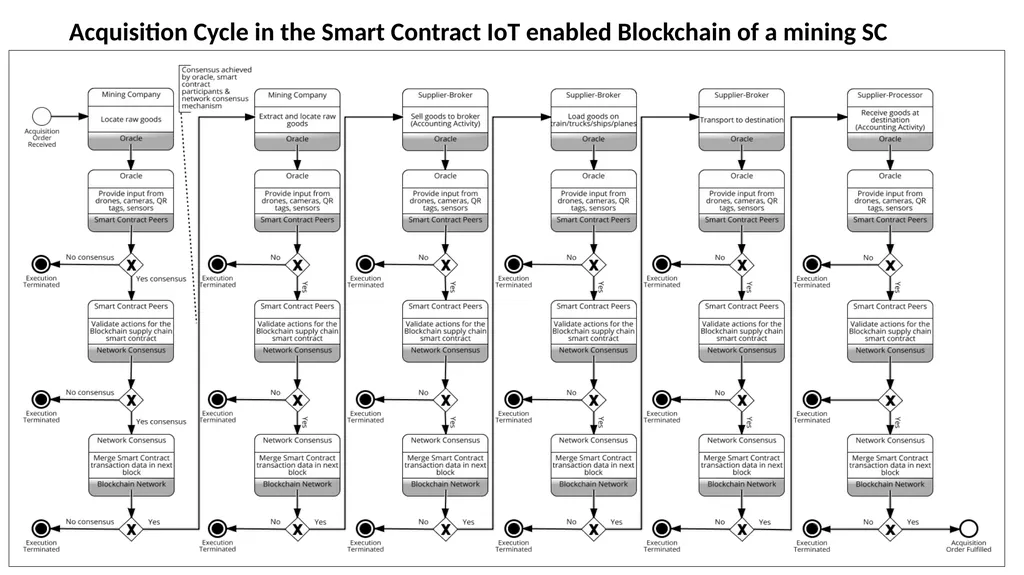
Acquisition Cycle in the Smart Contract IoT enabled Blockchain of a mining SC<br>
16
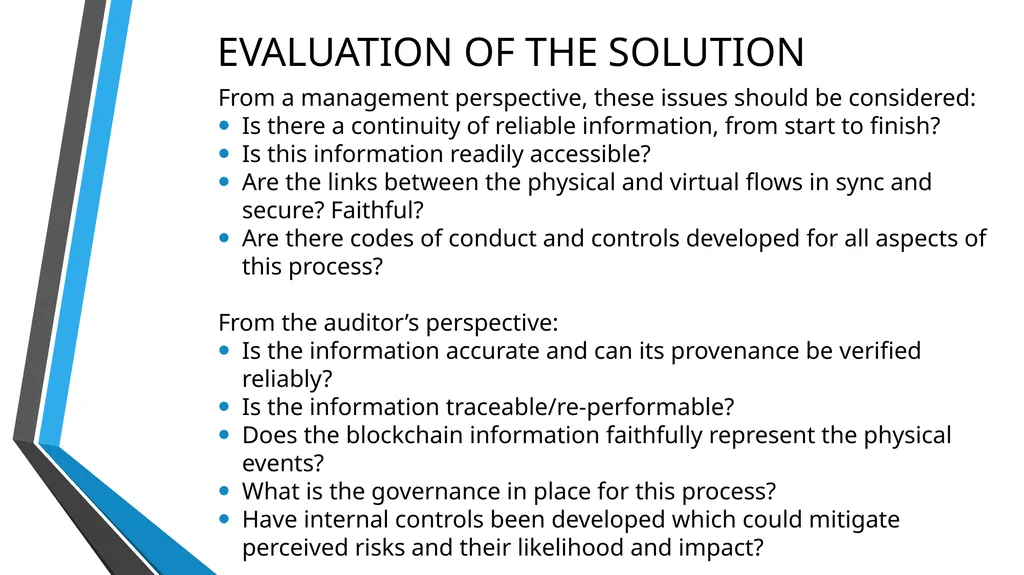
From a management perspective, these issues should be considered:
Is there a continuity of reliable information, from start to finish?
Is this information readily accessible?
Are the links between the physical and virtual flows in sync and secure? Faithful?
Are there codes of conduct and controls developed for all aspects of this process?
From the auditor’s perspective:
Is the information accurate and can its provenance be verified reliably?
Is the information traceable/re-performable?
Does the blockchain information faithfully represent the physical events?
What is the governance in place for this process?
Have internal controls been developed which could mitigate perceived risks and their likelihood and impact? EVALUATION OF THE SOLUTION<br>
17
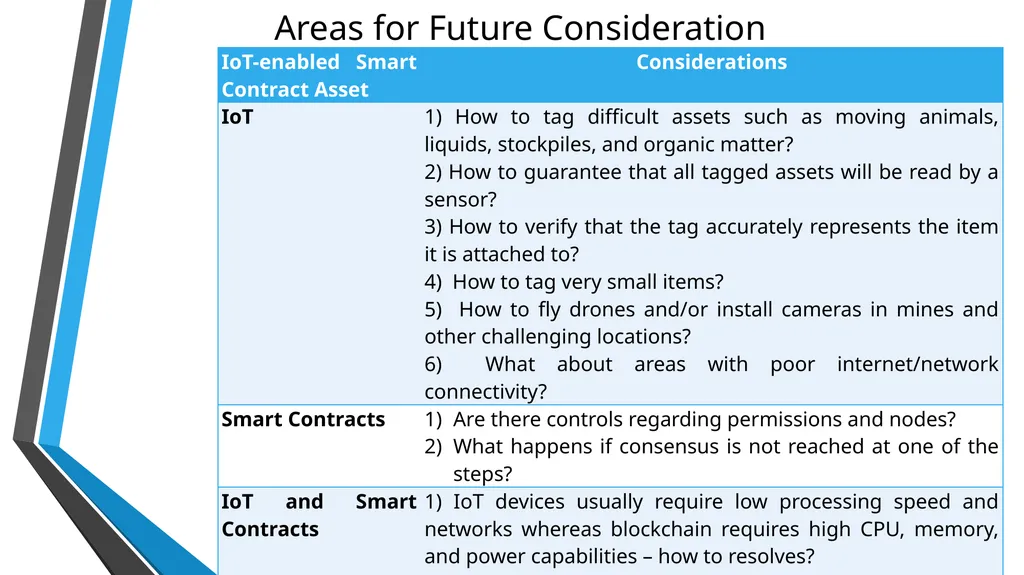
Areas for Future Consideration<br>