Two objections to hard behaviourism Michael Lacewing Does Hempels theory work? What problems can you anticipate that his theory might face? (What problems faced the verification principle?) Rejecting reduction Philosophical behaviourism
"Two objections to hard behaviourism Michael" is the property of its rightful owner. Permission is granted to
download and print the materials on this website for personal, non-commercial use only, and to display it
on your personal computer provided you do not modify the materials and that you retain all copyright
notices contained in the materials. By downloading content from our website, you accept the terms of this
agreement.
Presentation Transcript
01
Two objections to hard behaviourism Michael Lacewing<br>
02
Does Hempel’s theory work? What problems can you anticipate that his theory might face?
(What problems faced the verification principle?)<br>
03
Rejecting reduction Philosophical behaviourism claims not just that we need to verify psychological claims to know if they are true; it says that the meaning of the claim depends on verification
This ‘reduces’ the meaning of the claim to conditions of verification
Just as we can reduce the meaning of ‘bachelor’ to ‘unmarried man’, so we can reduce the meaning of ‘pain’ to the physical and behavioural observations we can make
This is called an ‘analytic reduction’
This is why Hempel’s version is called ‘analytic’ behaviourism or ‘logical’ behaviourism
Can we successfully define mental states in terms of behaviour?<br>
04
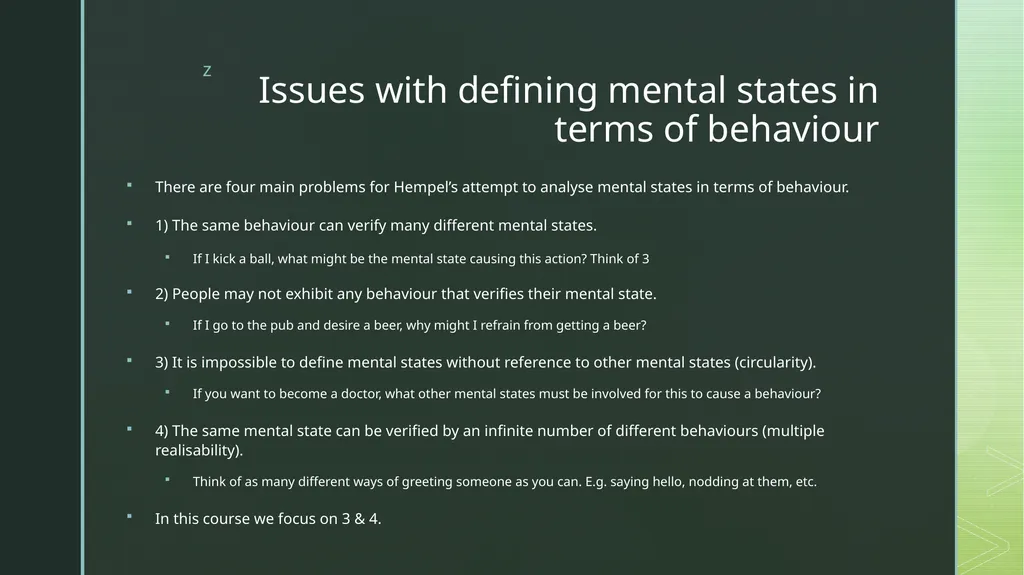
Issues with defining mental states in terms of behaviour There are four main problems for Hempel’s attempt to analyse mental states in terms of behaviour.
1) The same behaviour can verify many different mental states.
If I kick a ball, what might be the mental state causing this action? Think of 3
2) People may not exhibit any behaviour that verifies their mental state.
If I go to the pub and desire a beer, why might I refrain from getting a beer?
3) It is impossible to define mental states without reference to other mental states (circularity).
If you want to become a doctor, what other mental states must be involved for this to cause a behaviour?
4) The same mental state can be verified by an infinite number of different behaviours (multiple realisability).
Think of as many different ways of greeting someone as you can. E.g. saying hello, nodding at them, etc.
In this course we focus on 3 & 4.<br>
05
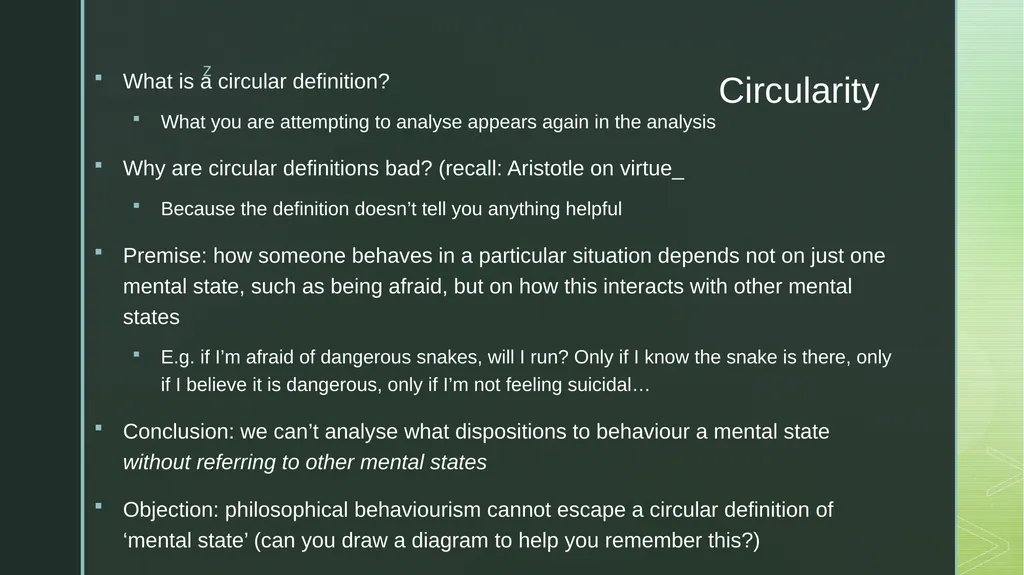
Circularity What is a circular definition?
What you are attempting to analyse appears again in the analysis
Why are circular definitions bad? (recall: Aristotle on virtue_
Because the definition doesn’t tell you anything helpful
Premise: how someone behaves in a particular situation depends not on just one mental state, such as being afraid, but on how this interacts with other mental states
E.g. if I’m afraid of dangerous snakes, will I run? Only if I know the snake is there, only if I believe it is dangerous, only if I’m not feeling suicidal…
Conclusion: we can’t analyse what dispositions to behaviour a mental state without referring to other mental states
Objection: philosophical behaviourism cannot escape a circular definition of ‘mental state’ (can you draw a diagram to help you remember this?)<br>
06
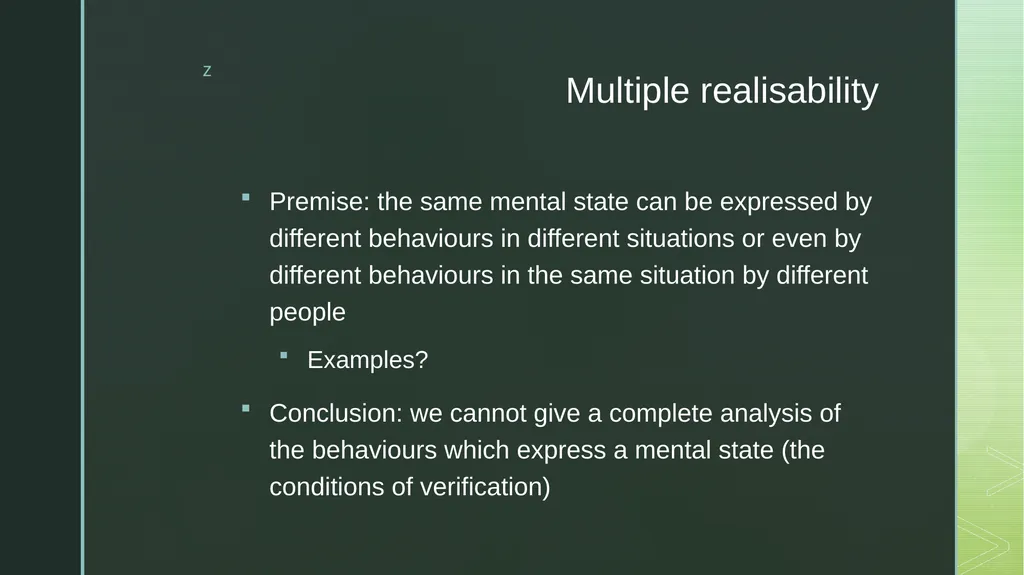
Multiple realisability Premise: the same mental state can be expressed by different behaviours in different situations or even by different behaviours in the same situation by different people
Examples?
Conclusion: we cannot give a complete analysis of the behaviours which express a mental state (the conditions of verification)<br>
07
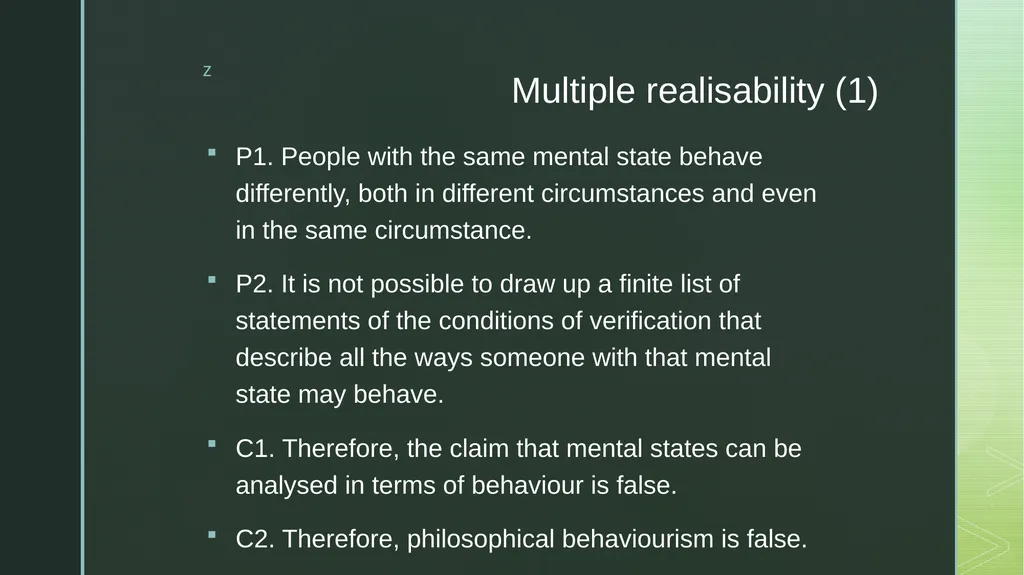
Multiple realisability (1) P1. People with the same mental state behave differently, both in different circumstances and even in the same circumstance.
P2. It is not possible to draw up a finite list of statements of the conditions of verification that describe all the ways someone with that mental state may behave.
C1. Therefore, the claim that mental states can be analysed in terms of behaviour is false.
C2. Therefore, philosophical behaviourism is false.<br>
08
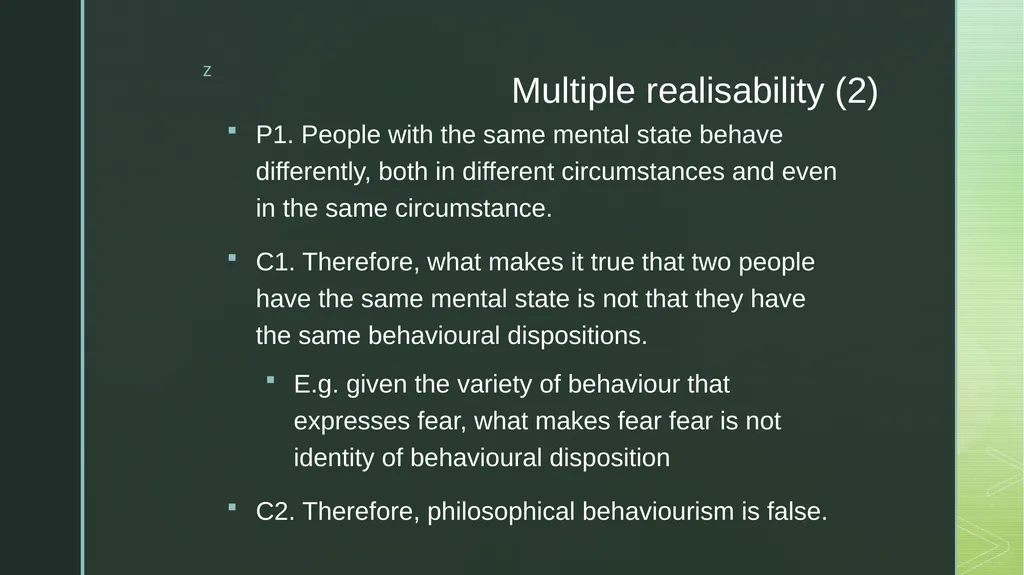
Multiple realisability (2) P1. People with the same mental state behave differently, both in different circumstances and even in the same circumstance.
C1. Therefore, what makes it true that two people have the same mental state is not that they have the same behavioural dispositions.
E.g. given the variety of behaviour that expresses fear, what makes fear fear is not identity of behavioural disposition
C2. Therefore, philosophical behaviourism is false.<br>
09
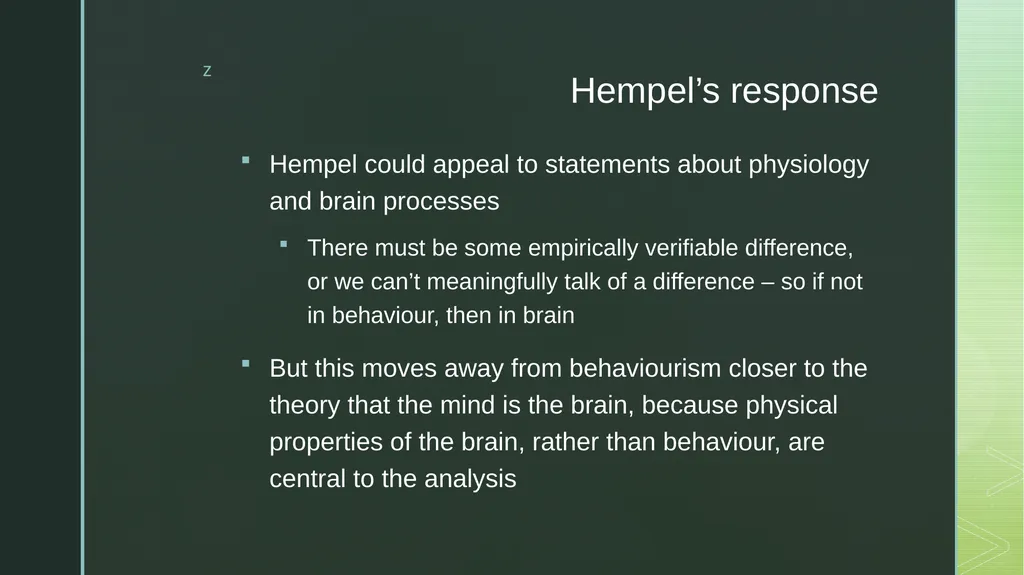
Hempel’s response Hempel could appeal to statements about physiology and brain processes
There must be some empirically verifiable difference, or we can’t meaningfully talk of a difference – so if not in behaviour, then in brain
But this moves away from behaviourism closer to the theory that the mind is the brain, because physical properties of the brain, rather than behaviour, are central to the analysis<br>
10
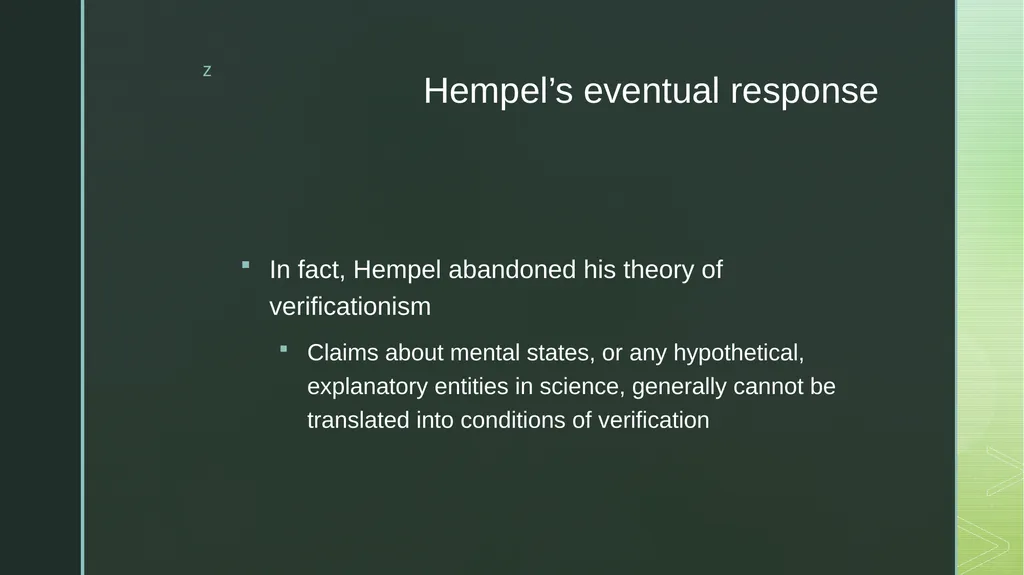
Hempel’s eventual response In fact, Hempel abandoned his theory of verificationism
Claims about mental states, or any hypothetical, explanatory entities in science, generally cannot be translated into conditions of verification<br>