
Unit 14 Social Psychology Module 78 Aggression
DP
Published · 28 slides · 0 views

1 / 1


Description
Unit 14 Social Psychology Module 78 Aggression Learning Targets 78-1 Explain how psychologys definition of aggression differs from everyday usage, and identify the biological factors that make us more prone to hurt one another. 78-2
Related Topics
Share
Embed code
Download this presentation From Below
"Unit 14 Social Psychology Module 78 Aggression" is the property of its rightful owner. Permission is granted to download and print the materials on this website for personal, non-commercial use only, and to display it on your personal computer provided you do not modify the materials and that you retain all copyright notices contained in the materials. By downloading content from our website, you accept the terms of this agreement.
Presentation Transcript
01
Unit 14
Social Psychology<br>
02
Module 78 Aggression Learning Targets 78-1 Explain how psychology’s definition of aggression differs from everyday usage, and identify the biological factors that make us more prone to hurt one another. 78-2 Outline the psychological and social-cultural triggers of aggression.<br>
03
What is psychology’s definition
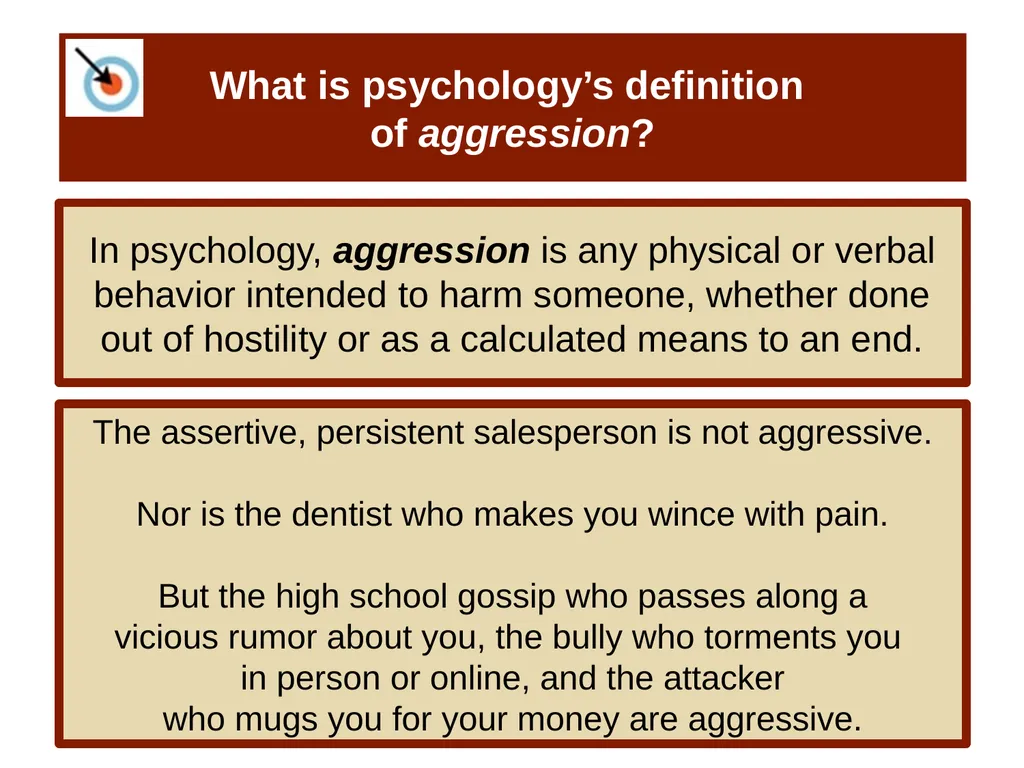
of aggression? In psychology, aggression is any physical or verbal behavior intended to harm someone, whether done out of hostility or as a calculated means to an end. The assertive, persistent salesperson is not aggressive.
Nor is the dentist who makes you wince with pain.
But the high school gossip who passes along a
vicious rumor about you, the bully who torments you
in person or online, and the attacker
who mugs you for your money are aggressive.<br>
Nor is the dentist who makes you wince with pain.
But the high school gossip who passes along a
vicious rumor about you, the bully who torments you
in person or online, and the attacker
who mugs you for your money are aggressive.<br>
04
What are biological factors that
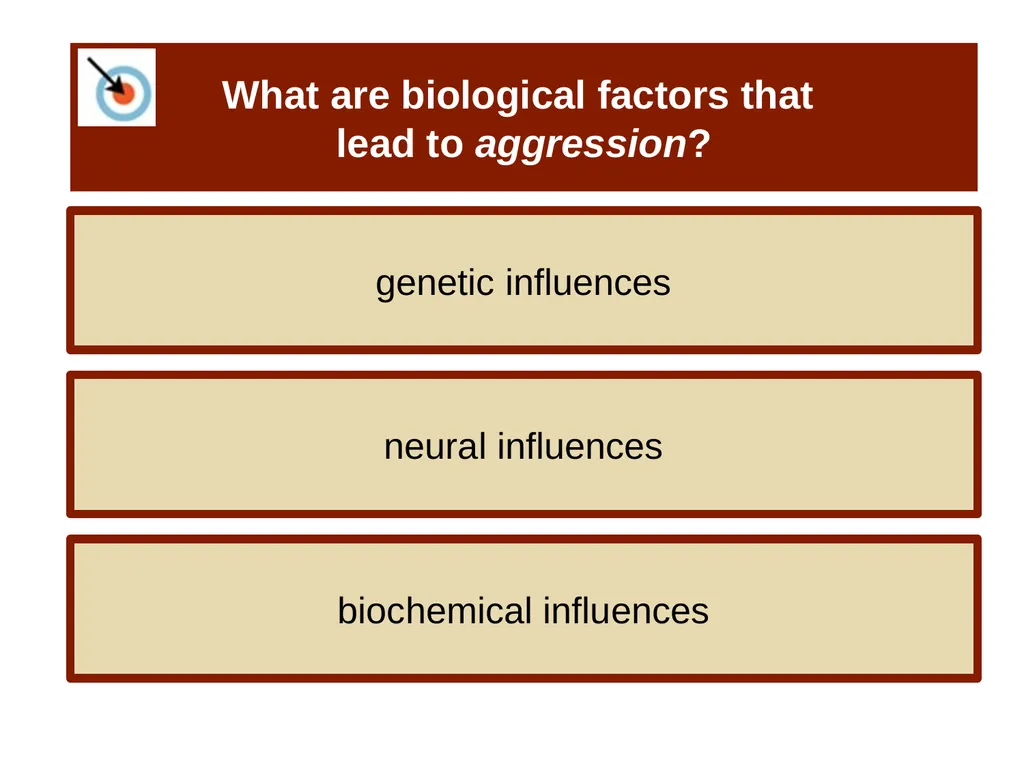
lead to aggression? genetic influences neural influences biochemical influences<br>
05
What do twin studies show about genetic influences on aggression? If one identical twin admits to “having a violent temper,” the other twin will often independently
admit the same.
Fraternal twins are much less likely
to respond similarly.
(Miles & Carey, 1997; Rowe et al., 1999) Two genetic markers in those who commit violent
acts are the Y chromosome and the monoamine oxidase A
(MAOA) gene, which helps break down neurotransmitters
such as dopamine and serotonin.<br>
admit the same.
Fraternal twins are much less likely
to respond similarly.
(Miles & Carey, 1997; Rowe et al., 1999) Two genetic markers in those who commit violent
acts are the Y chromosome and the monoamine oxidase A
(MAOA) gene, which helps break down neurotransmitters
such as dopamine and serotonin.<br>
06
Which brain structures are involved
in aggression? There is no one spot in the brain that controls aggression; it is a complex behavior, and occurs in particular contexts.
Animal and human brains do have neural systems that, given provocation, will either inhibit or facilitate aggression.
(Falkner et al., 2016; Moyer, 1983; Wilkowski et al., 2011)
Two of the structures on which research has been conducted are the amygdala and the frontal lobes.<br>
Animal and human brains do have neural systems that, given provocation, will either inhibit or facilitate aggression.
(Falkner et al., 2016; Moyer, 1983; Wilkowski et al., 2011)
Two of the structures on which research has been conducted are the amygdala and the frontal lobes.<br>
07
What role does the hormone testosterone
play in aggression? Facial width is testosterone-linked. A high facial
width-to-height ratio is a predictor of men’s aggressiveness and prejudicial attitudes.
(Carré et al., 2009; Hehman et al., 2013; Stirrat & Perrett, 2010)
Other high-testosterone-linked traits among males include irritability, assertiveness, impulsiveness, hard drug use, and low tolerance for frustration.
(Dabbs et al., 2001; McAndrew, 2009; Montoya et al., 2012; Olweus et al., 1988)<br>
width-to-height ratio is a predictor of men’s aggressiveness and prejudicial attitudes.
(Carré et al., 2009; Hehman et al., 2013; Stirrat & Perrett, 2010)
Other high-testosterone-linked traits among males include irritability, assertiveness, impulsiveness, hard drug use, and low tolerance for frustration.
(Dabbs et al., 2001; McAndrew, 2009; Montoya et al., 2012; Olweus et al., 1988)<br>
08
What about females with high
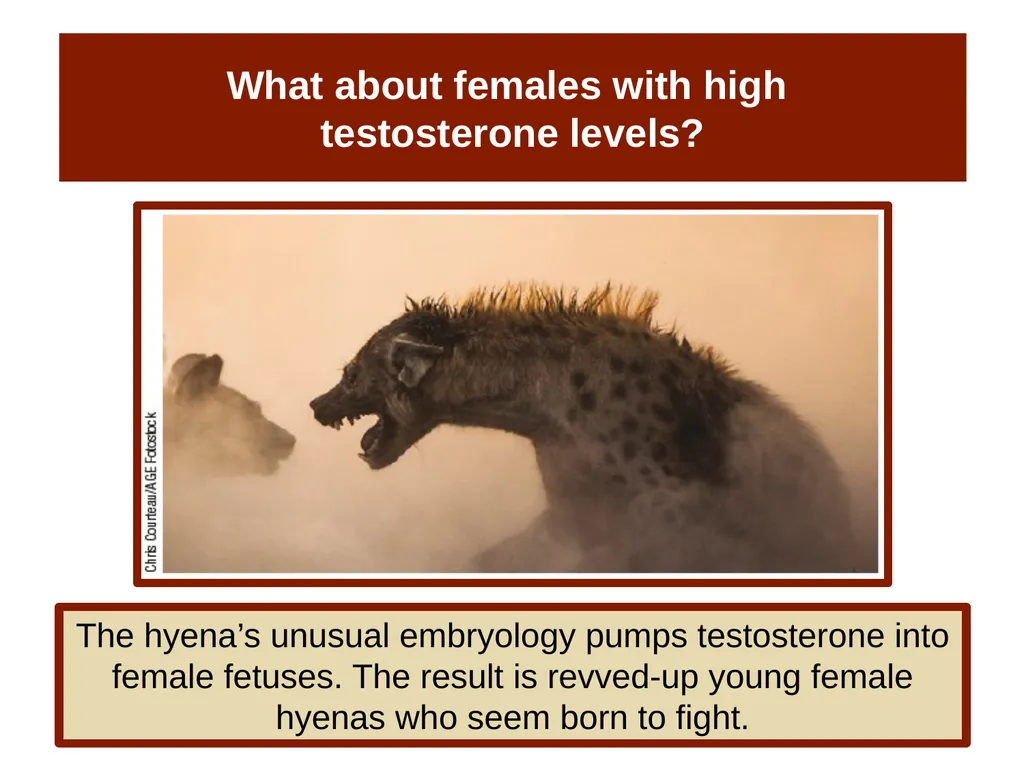
testosterone levels? The hyena’s unusual embryology pumps testosterone into
female fetuses. The result is revved-up young female hyenas who seem born to fight.<br>
female fetuses. The result is revved-up young female hyenas who seem born to fight.<br>
09
AP® Exam Tip Notice that you’re back to a nature and nurture
analysis again.
The biology section is, of course, the nature component.
When you get to the psychological and sociocultural
factors coming up, that’s nurture.<br>
analysis again.
The biology section is, of course, the nature component.
When you get to the psychological and sociocultural
factors coming up, that’s nurture.<br>
10
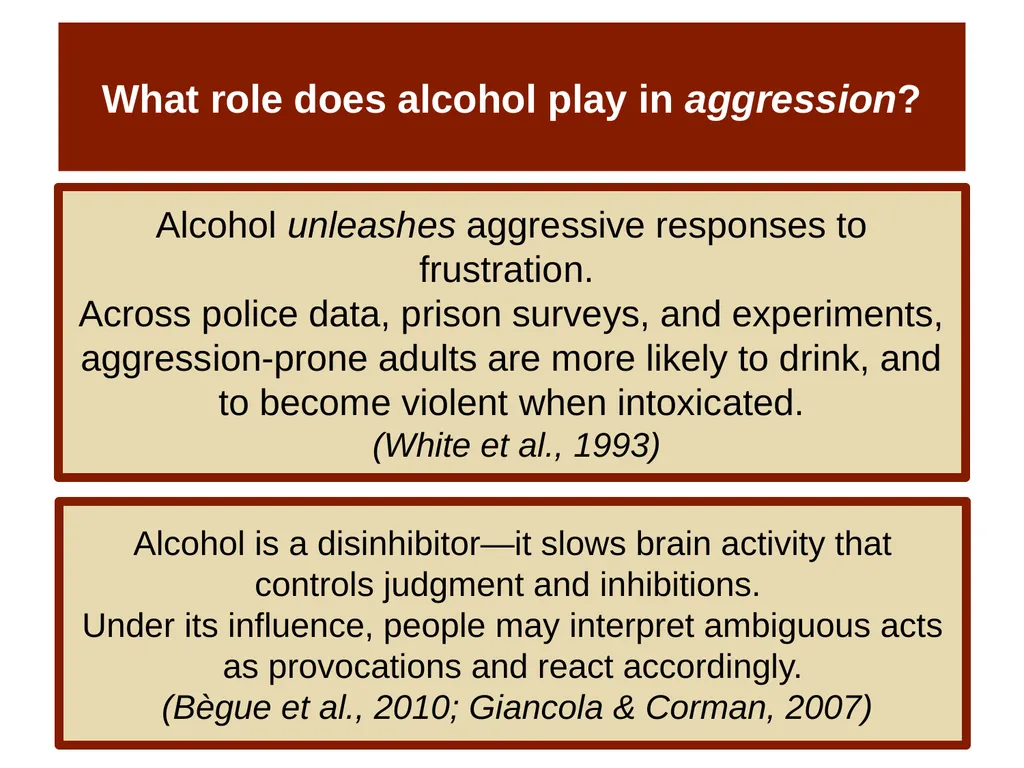
What role does alcohol play in aggression? Alcohol unleashes aggressive responses to frustration.
Across police data, prison surveys, and experiments, aggression-prone adults are more likely to drink, and to become violent when intoxicated.
(White et al., 1993) Alcohol is a disinhibitor—it slows brain activity that controls judgment and inhibitions.
Under its influence, people may interpret ambiguous acts as provocations and react accordingly.
(Bègue et al., 2010; Giancola & Corman, 2007)<br>
Across police data, prison surveys, and experiments, aggression-prone adults are more likely to drink, and to become violent when intoxicated.
(White et al., 1993) Alcohol is a disinhibitor—it slows brain activity that controls judgment and inhibitions.
Under its influence, people may interpret ambiguous acts as provocations and react accordingly.
(Bègue et al., 2010; Giancola & Corman, 2007)<br>
11
What psychological and social-cultural
factors may trigger aggression? aversive events reinforcement, modeling and self-control media models<br>
12
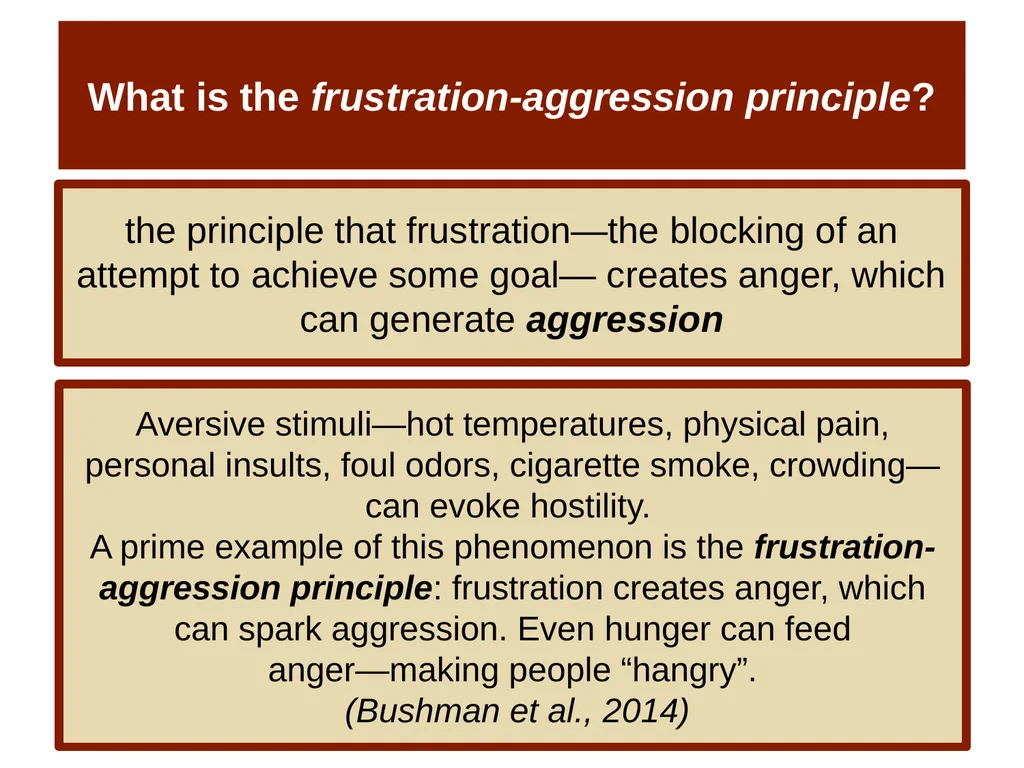
What is the frustration-aggression principle? the principle that frustration—the blocking of an
attempt to achieve some goal— creates anger, which can generate aggression Aversive stimuli—hot temperatures, physical pain, personal insults, foul odors, cigarette smoke, crowding—can evoke hostility.
A prime example of this phenomenon is the frustration-aggression principle: frustration creates anger, which can spark aggression. Even hunger can feed
anger—making people “hangry”.
(Bushman et al., 2014)<br>
attempt to achieve some goal— creates anger, which can generate aggression Aversive stimuli—hot temperatures, physical pain, personal insults, foul odors, cigarette smoke, crowding—can evoke hostility.
A prime example of this phenomenon is the frustration-aggression principle: frustration creates anger, which can spark aggression. Even hunger can feed
anger—making people “hangry”.
(Bushman et al., 2014)<br>
13
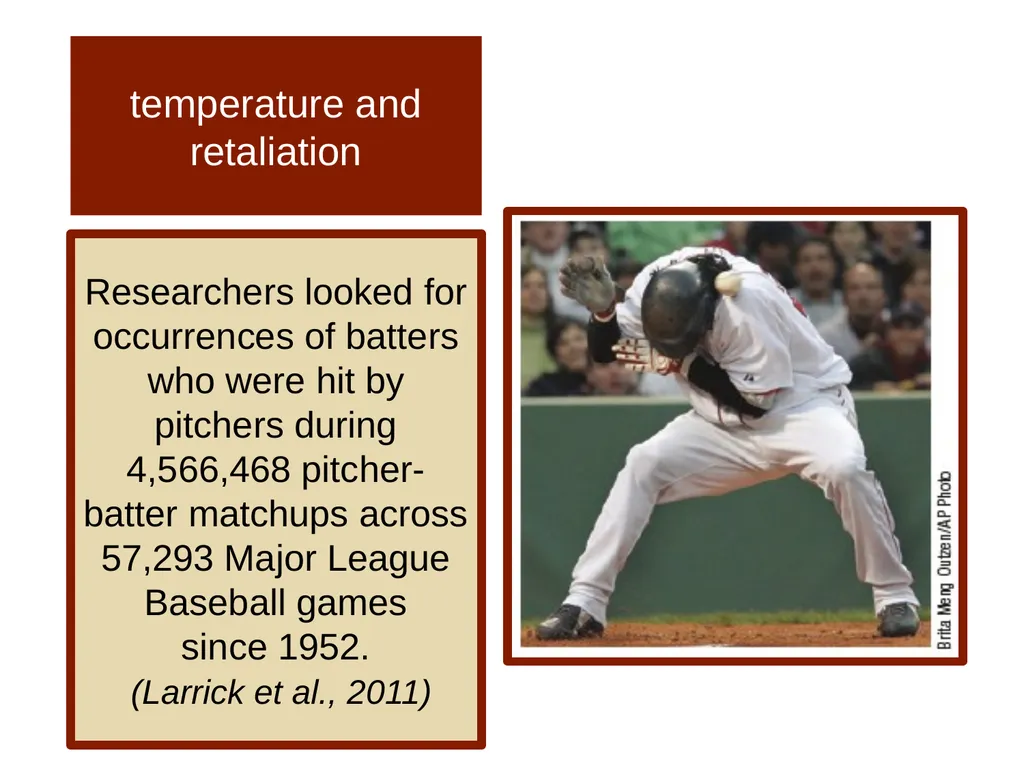
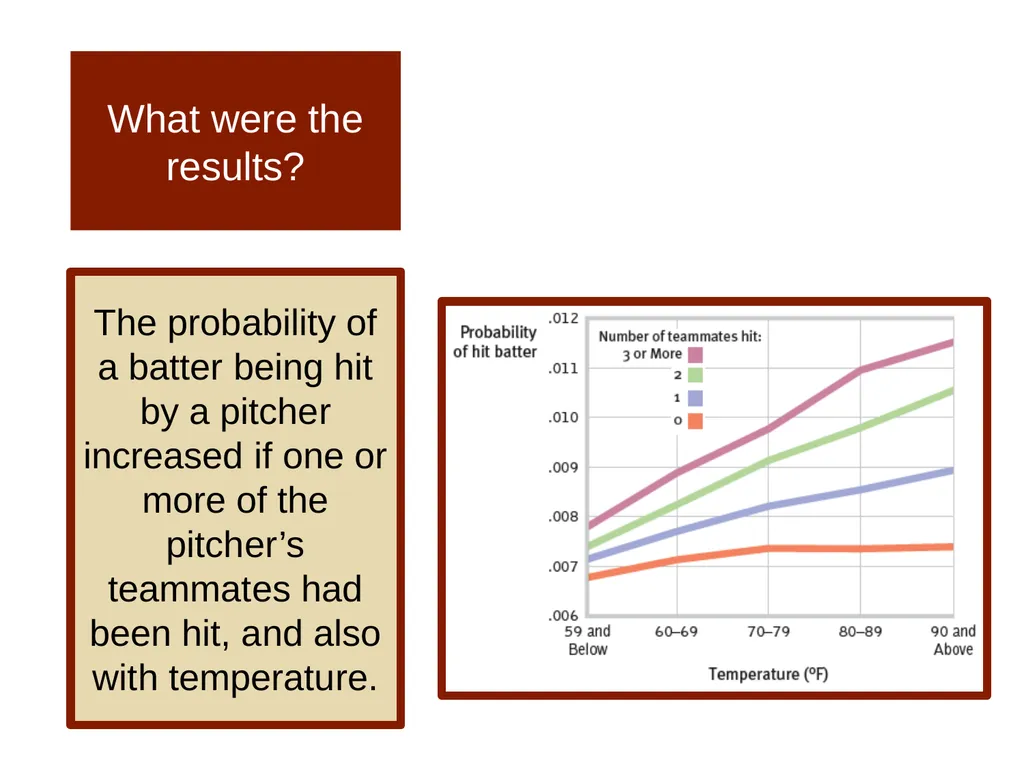
temperature and retaliation Researchers looked for
occurrences of batters who were hit by pitchers during 4,566,468 pitcher-batter matchups across 57,293 Major League Baseball games
since 1952.
(Larrick et al., 2011)<br>
occurrences of batters who were hit by pitchers during 4,566,468 pitcher-batter matchups across 57,293 Major League Baseball games
since 1952.
(Larrick et al., 2011)<br>
14
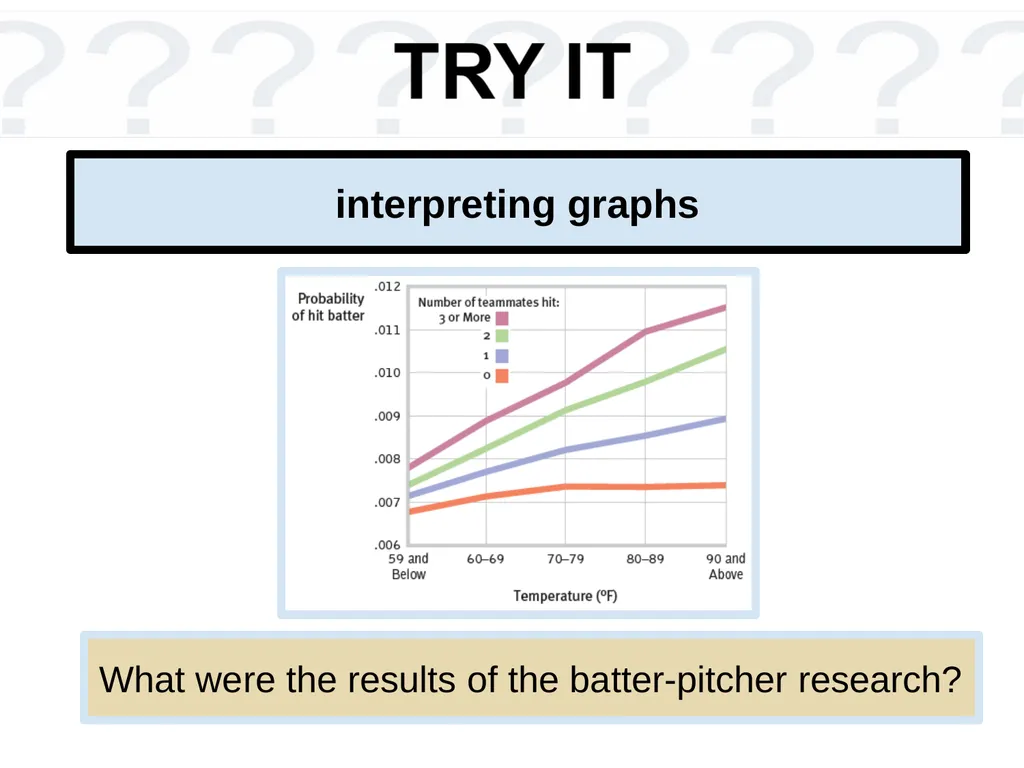
interpreting graphs What were the results of the batter-pitcher research?<br>
15
What were the results? The probability of a batter being hit by a pitcher increased if one or more of the pitcher’s teammates had been hit, and also with temperature.<br>
16
1. What Would You Answer? Brandt’s football team just barely lost the state championship game after a questionable referee call. As a result, Brandt gets angry and starts shouting insults. Which of the following terms best identifies this chain of events?
A. aggression
B. biochemical influences
C. frustration-aggression principle
D. social scripts
E. biopsychosocial model<br>
A. aggression
B. biochemical influences
C. frustration-aggression principle
D. social scripts
E. biopsychosocial model<br>
17
How does reinforcement lead to aggression? In situations where experience has taught us that aggression pays, we are likely to act
aggressively again.
Children whose aggression has successfully intimidated other children may become bullies.
Animals that have successfully fought to get food or mates become increasingly ferocious. If positive reinforcement follows an act of aggression, operant conditioning theory tells us that aggressive behavior is likely to repeat.<br>
aggressively again.
Children whose aggression has successfully intimidated other children may become bullies.
Animals that have successfully fought to get food or mates become increasingly ferocious. If positive reinforcement follows an act of aggression, operant conditioning theory tells us that aggressive behavior is likely to repeat.<br>
18
How does modeling increase aggression? Parents who act aggressively toward their children, screaming, yelling, or hitting them, may serve as models for their children of how to relate to others.
Parent-training programs often advise parents to avoid modeling violence by screaming and hitting. To foster a kinder, gentler world we had best model and reward sensitivity and cooperation from an early age, perhaps by training parents to discipline without
modeling violence.<br>
Parent-training programs often advise parents to avoid modeling violence by screaming and hitting. To foster a kinder, gentler world we had best model and reward sensitivity and cooperation from an early age, perhaps by training parents to discipline without
modeling violence.<br>
19
How does the media model violence? Parents are hardly the only aggression models.
In the United States and elsewhere, TV, films,
video games, and the Internet offer supersized portions of violence. An adolescent boy faced with a real-life challenge may “act like a man”—at least like an action-film man—by
intimidating or eliminating the threat.<br>
In the United States and elsewhere, TV, films,
video games, and the Internet offer supersized portions of violence. An adolescent boy faced with a real-life challenge may “act like a man”—at least like an action-film man—by
intimidating or eliminating the threat.<br>
20
What is a social script? a culturally modeled guide for how to act in
various situations Media violence primes us to respond
aggressively when provoked and teaches us social scripts—culturally provided mental files for how to
act in certain situations.
As more than 100 studies confirm, humans
sometimes imitate what has been viewed.<br>
various situations Media violence primes us to respond
aggressively when provoked and teaches us social scripts—culturally provided mental files for how to
act in certain situations.
As more than 100 studies confirm, humans
sometimes imitate what has been viewed.<br>
21
Do violent video games teach social scripts for violence? In 2002, three young men in Michigan spent part of a night drinking beer and playing Grand Theft Auto III.
Using simulated cars, they ran down pedestrians,
then beat them with fists, leaving a bloody body behind. (Kolker, 2002)
These same young men then went out for a real drive. Spotting a 38-year-old man on a bicycle, they ran him down with their car, got out, stomped and punched him, and returned home to play the game some more.
The victim, a father of three, died six days later.<br>
Using simulated cars, they ran down pedestrians,
then beat them with fists, leaving a bloody body behind. (Kolker, 2002)
These same young men then went out for a real drive. Spotting a 38-year-old man on a bicycle, they ran him down with their car, got out, stomped and punched him, and returned home to play the game some more.
The victim, a father of three, died six days later.<br>
22
What research has been conducted on video game violence? Video games can prime aggressive thoughts, decrease empathy, and increase aggression. University men who spend the most hours playing violent video games have also tended to be the most physically aggressive.
(Anderson & Dill, 2000) Studies of young adolescents reveal that those who play a lot of violent video games become more aggressive and see the world as more hostile.
(Bushman, 2016; Exelmans et al., 2015; Gentile, 2009) Compared with nongaming kids, they get into more arguments and fights and earn poorer grades.<br>
(Anderson & Dill, 2000) Studies of young adolescents reveal that those who play a lot of violent video games become more aggressive and see the world as more hostile.
(Bushman, 2016; Exelmans et al., 2015; Gentile, 2009) Compared with nongaming kids, they get into more arguments and fights and earn poorer grades.<br>
23
What is your opinion? Do you think there should be laws to prevent children’s exposure to violent media?
Why or why not? Share with the class.<br>
Why or why not? Share with the class.<br>
24
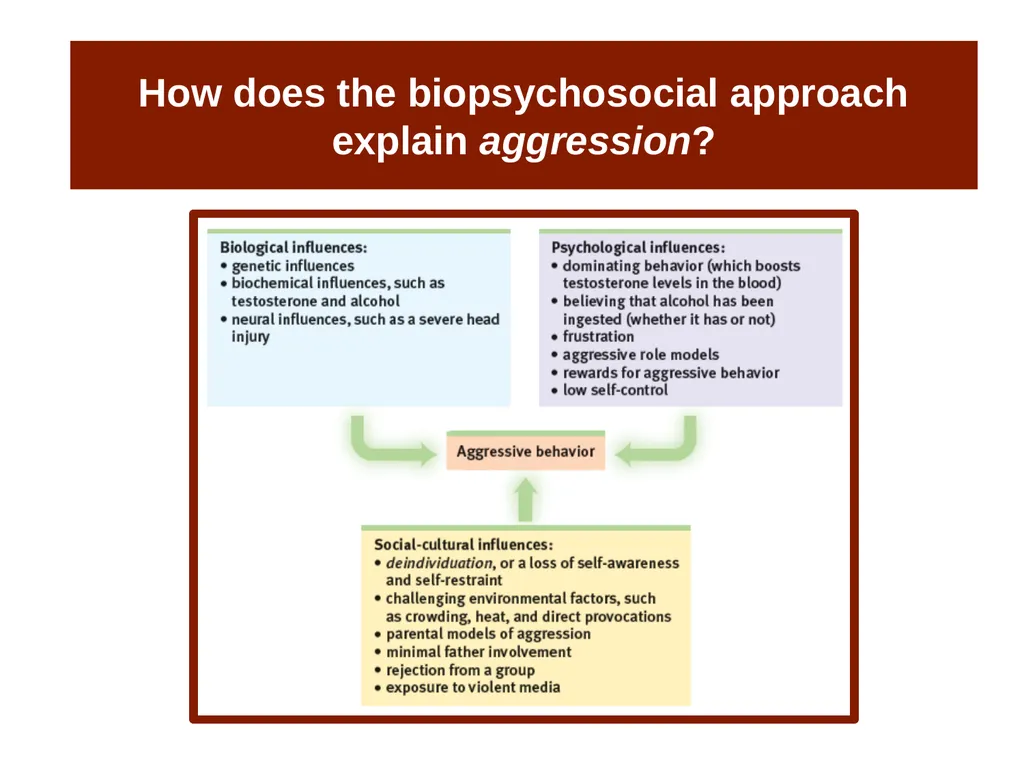
How does the biopsychosocial approach explain aggression?<br>
25
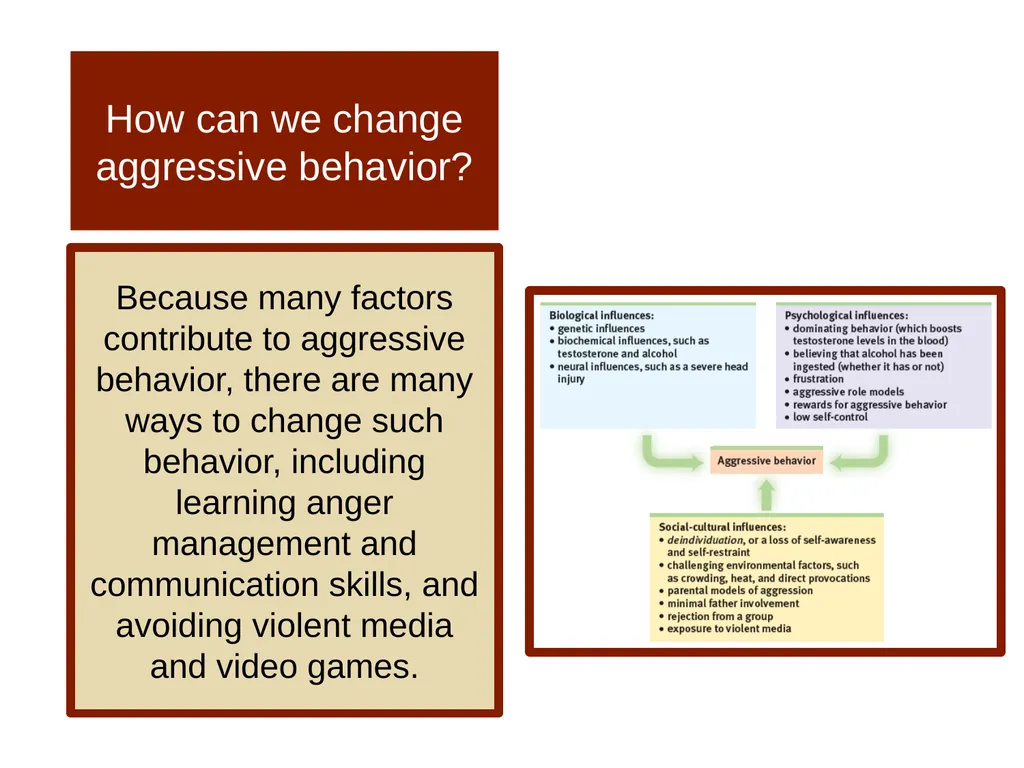
How can we change aggressive behavior? Because many factors contribute to aggressive behavior, there are many ways to change such
behavior, including learning anger
management and communication skills, and avoiding violent media
and video games.<br>
behavior, including learning anger
management and communication skills, and avoiding violent media
and video games.<br>
26
2. What Would You Answer? Using the biopsychosocial model, name a biological
influence, a social-cultural influence, and a psychological influence on aggressive behavior.<br>
influence, a social-cultural influence, and a psychological influence on aggressive behavior.<br>
27
Learning Target 78-1 Review Explain how psychology’s definition of
aggression differs from everyday usage,
and identify the biological factors that
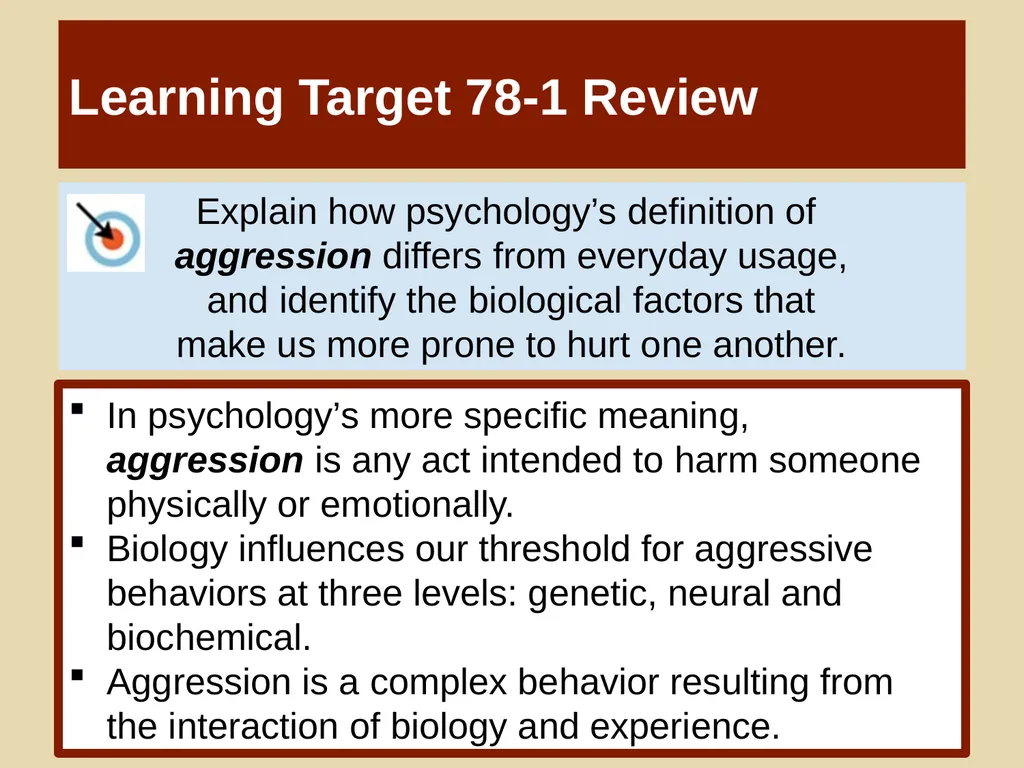
make us more prone to hurt one another. In psychology’s more specific meaning, aggression is any act intended to harm someone physically or emotionally.
Biology influences our threshold for aggressive behaviors at three levels: genetic, neural and biochemical.
Aggression is a complex behavior resulting from the interaction of biology and experience.<br>
aggression differs from everyday usage,
and identify the biological factors that
make us more prone to hurt one another. In psychology’s more specific meaning, aggression is any act intended to harm someone physically or emotionally.
Biology influences our threshold for aggressive behaviors at three levels: genetic, neural and biochemical.
Aggression is a complex behavior resulting from the interaction of biology and experience.<br>
28
Learning Target 78-2 Review Outline the psychological and
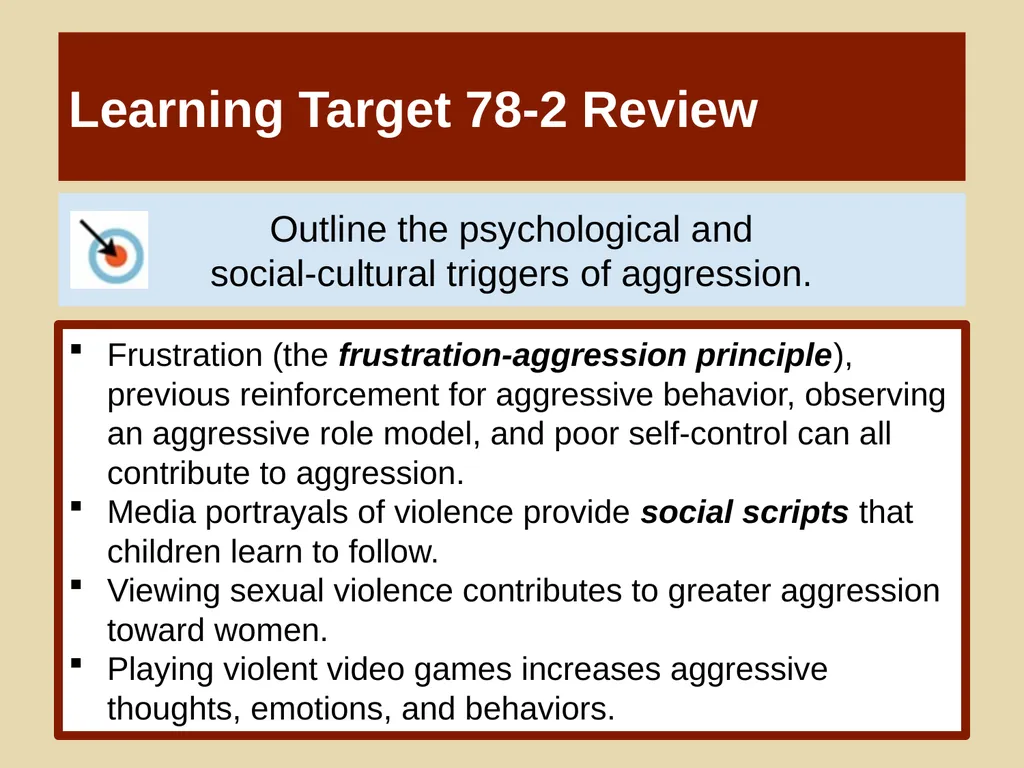
social-cultural triggers of aggression. Frustration (the frustration-aggression principle), previous reinforcement for aggressive behavior, observing an aggressive role model, and poor self-control can all contribute to aggression.
Media portrayals of violence provide social scripts that children learn to follow.
Viewing sexual violence contributes to greater aggression toward women.
Playing violent video games increases aggressive thoughts, emotions, and behaviors.<br>
social-cultural triggers of aggression. Frustration (the frustration-aggression principle), previous reinforcement for aggressive behavior, observing an aggressive role model, and poor self-control can all contribute to aggression.
Media portrayals of violence provide social scripts that children learn to follow.
Viewing sexual violence contributes to greater aggression toward women.
Playing violent video games increases aggressive thoughts, emotions, and behaviors.<br>