
UNIT 7: BUSINESS LAW UNIT CODE: H/617/0736 UNIT 7:
LV
Published · 36 slides · 0 views
1 / 1
Description
UNIT 7: BUSINESS LAW UNIT CODE: H6170736 UNIT 7: BUISNESS LAW LO1: EXPLAIN THE NATURE OF THE LEGAL SYSTEM 2 UNIT 7: BUSINESS LAW P2: EXPLAIN THE ROLE OF GOVERENMENT IN LAW MAKING AND HOW STATUTORY AND COMMON LAW IS APPLIED IN THE JUSITICE
Related Topics
Share
Embed code
Download this presentation From Below
"UNIT 7: BUSINESS LAW UNIT CODE: H/617/0736 UNIT 7:" is the property of its rightful owner. Permission is granted to download and print the materials on this website for personal, non-commercial use only, and to display it on your personal computer provided you do not modify the materials and that you retain all copyright notices contained in the materials. By downloading content from our website, you accept the terms of this agreement.
Presentation Transcript
01
UNIT 7: BUSINESS LAW UNIT CODE: H/617/0736<br>
02
UNIT 7: BUISNESS LAW LO1: EXPLAIN THE NATURE OF THE LEGAL SYSTEM 2<br>
03
UNIT 7: BUSINESS LAW P2: EXPLAIN THE ROLE OF GOVERENMENT IN LAW MAKING AND HOW STATUTORY AND COMMON LAW IS APPLIED IN THE JUSITICE COURTS 3<br>
04
THE ROLE OF GOVERNEMNT IN LAW MAKING AND THE JUSTICE SYSTEM The law-making of the acts of governmental bodies is more organized, not so spontaneous as the law-making of the legal customs. The law-making process consists of several stages. As a rule, an act is prepared, scrutinized, adopted and published. 4<br>
05
THE ROLE OF GOVERNEMNT IN LAW MAKING AND THE JUSTICE SYSTEM The first stage includes preparing of the first version of a project (bill) in which an idea on law is realized. Individual, group of individuals, associations but usual a governmental body, may do this work. 5<br>
06
THE ROLE OF GOVERNEMNT IN LAW MAKING AND THE JUSTICE SYSTEM A governmental body may take official decision concerning elaboration of a project, give the task to its internal structures (committees, departments) to write a bill, make previous analysis of the public interests, of necessity in a law, the correspondence of a possible act to the current legislation and to the constitution. 6<br>
07
THE ROLE OF GOVERNEMNT IN LAW MAKING AND THE JUSTICE SYSTEM The project is discussed by experts, associations, interesting groups. The working commission analyzes the results of the discussion and changes the text. The next stage consists of scrutiny of a project in a governmental body. This law-making process is a complex process. 7<br>
08
THE ROLE OF GOVERNEMNT IN LAW MAKING AND THE JUSTICE SYSTEM A state plays the leading role in it. It gives to the norms the force of law and supports their enforcement by force of its bodies. An adopted act is considered as an act of the state. A state may regulate lawmaking process, plan it and thus influence on the development of the law. But its activity must be legal and is not arbitrary. 8<br>
09
THE ROLE OF GOVERNEMNT IN LAW MAKING AND THE JUSTICE SYSTEM The law-making process as experiments in the adoption of laws does not satisfy a society. In the law-making process the interest of the society and the interest of the state meets. 9<br>
10
THE ROLE OF GOVERNEMNT IN LAW MAKING AND THE JUSTICE SYSTEM Society needs stable legal system, reflected changing demands and interests of the society. Fulfilling this task the lawmaking process must be based on democracy and science in order to reflect and determine the development of the society. 10<br>
11
THE ROLE OF GOVERNEMNT IN LAW MAKING AND THE JUSTICE SYSTEM And the society is interested in the influence on the governmental bodies in law-making and in it control. The mistakes of the state in the law-making process have negative results for the development of the society; otherwise the correct direction of the law-making process has positive result for the development of the state. It is very important in the period of social crisis. 11<br>
12
THE ROLE OF GOVERNEMNT IN LAW MAKING AND THE JUSTICE SYSTEM To some extent the indicator of the effectiveness of the law-making process is the law enforcement. The law-making establishes the model of the behavior – the legal norm
but the changing society often fills it with new content. Law enforcement demonstrates whether a new norm corresponds to the relations. 12<br>
but the changing society often fills it with new content. Law enforcement demonstrates whether a new norm corresponds to the relations. 12<br>
13
THE ROLE OF GOVERNEMNT IN LAW MAKING AND THE JUSTICE SYSTEM This law-making process is a complex process.The state plays the leading role in it. It gives to the norms the force of law and supports their enforcement by force of its bodies. An adopted act is considered as an act of the state. A state may regulate lawmaking process, plan it and thus influence on the development of the law. But its activity must be legal and is not arbitrary. 13<br>
14
THE ROLE OF GOVERNEMNT IN LAW MAKING AND THE JUSTICE SYSTEM Parliaments worldwide perform three core functions: to represent citizens interests, to pass laws and to monitor the actions of the government. They perform a legislative function because, in addition to introducing legislation on their own, they have the power to amend, approve or reject government draft laws. 14<br>
15
THE ROLE OF GOVERNEMNT IN LAW MAKING AND THE JUSTICE SYSTEM This function is strongly linked to the representation function in that it is through the will of the people that the parliament receives its authority in democratic countries. 15<br>
16
THE ROLE OF GOVERNEMNT IN LAW MAKING AND THE JUSTICE SYSTEM The exact means by which a parliament is engaged in the lawmaking process varies depending on the type of parliamentary system. In Westminister systems (i.e. - those that derive from the British system), the executive branch of government develops most draft laws and the main role of parliament is to review, amend and pass laws. 16<br>
17
THE ROLE OF GOVERNEMNT IN LAW MAKING AND THE JUSTICE SYSTEM Individual MPs can introduce draft laws (known as Private Members Bills) but few of these draft laws reach the committee stage and even fewer are ever passed. 17<br>
18
THE ROLE OF GOVERNEMNT IN LAW MAKING AND THE JUSTICE SYSTEM In presidential systems, individual MPs have a greater opportunity to produce draft laws before they are reviewed, amended and passed. Some hybrid systems have developed other methods of developing draft laws, including providing authority to parliamentary committees to develop and introduce draft laws and, in rare cases, some parliaments allow citizen initiatives to introduce draft laws for debate. 18<br>
19
THE ROLE OF GOVERNEMNT IN LAW MAKING AND THE JUSTICE SYSTEM In most parliaments with permanent committees, proposed legislation is introduced formally on the floor of the house, and then referred to one or more committees with jurisdiction over the legislation. 19<br>
20
THE ROLE OF GOVERNEMNT IN LAW MAKING AND THE JUSTICE SYSTEM Westminster systems typically hold draft laws on the floor for a second reading and a debate and vote on the draft law "in principle". After this, draft laws are referred to committees where committee members typically work on technical details and amendments. 20<br>
21
THE ROLE OF GOVERNEMNT IN LAW MAKING AND THE JUSTICE SYSTEM In presidential systems, draft laws introduced are immediately referred to committee, and those draft laws over which more than one committee has jurisdiction may be referred to multiple committees. 21<br>
22
THE ROLE OF GOVERNEMNT IN LAW MAKING AND THE JUSTICE SYSTEM An education draft law with financial implications, for example might be referred to both the education and finance committees. In political systems with a very large volume of legislation (more than 10,000 draft laws are introduced each year in the US Congress, for example), most legislation never gets beyond committee. 22<br>
23
THE ROLE OF GOVERNEMNT IN LAW MAKING AND THE JUSTICE SYSTEM If the parliament has two houses, draft laws may move through each house simultaneously, or through the houses consecutively. Two house parliaments generally devise methods of reconciling different versions of the draft laws. 23<br>
24
THE ROLE OF GOVERNEMNT IN LAW MAKING AND THE JUSTICE SYSTEM If the parliament has two houses, draft laws may move through each house simultaneously, or through the houses consecutively. Two house parliaments generally devise methods of reconciling different versions of the draft laws. 24<br>
25
THE ROLE OF GOVERNEMNT IN LAW MAKING AND THE JUSTICE SYSTEM If the parliament has two houses, draft laws may move through each house simultaneously, or through the houses consecutively. Two house parliaments generally devise methods of reconciling different versions of the draft laws. 25<br>
26
THE ROLE OF GOVERNEMNT IN LAW MAKING AND THE JUSTICE SYSTEM For a parliament to be able to efficiently fulfill its legislative function, MPs must have the capacity to read and review draft legislation and amendments in order to interpret any policy changes and analyse proposed new rules. 26<br>
27
ORGANISATION OF THE JUDICIARY 27<br>
28
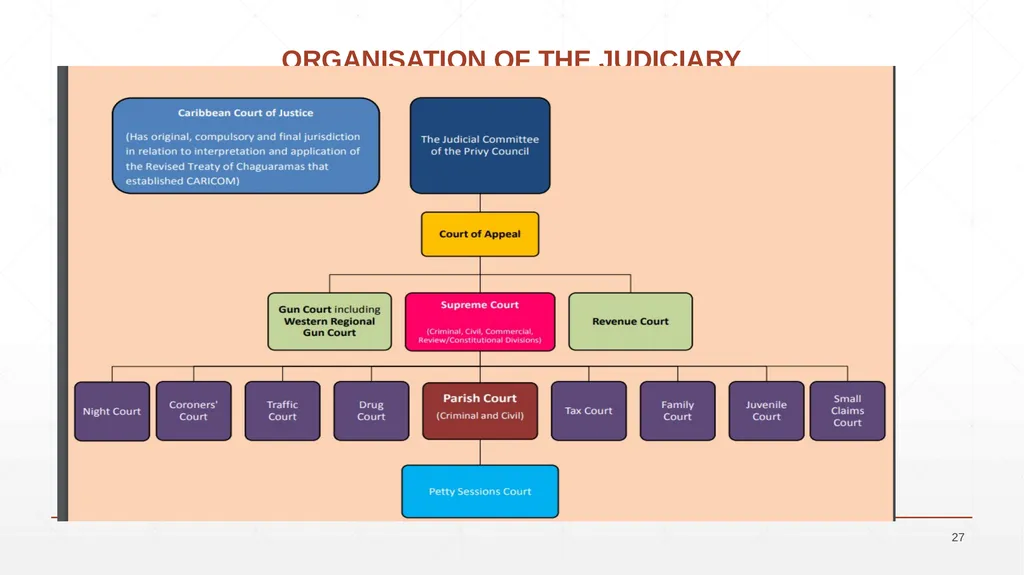
ORGANISATION OF THE JUDICIARY The legal system of Jamaica is based on British common-law. The administration of justice is carried out through a network of courts.
The courts of Jamaica are:
The Judicial Committee of the Privy Council, which is the final court of appeal, is based in London, England. It hears appeals on criminal and civil matters from the Jamaican Court of Appeal. 28<br>
The courts of Jamaica are:
The Judicial Committee of the Privy Council, which is the final court of appeal, is based in London, England. It hears appeals on criminal and civil matters from the Jamaican Court of Appeal. 28<br>
29
ORGANISATION OF THE JUDICIARY The Caribbean Court of Justice (CCJ) is one of the primary institutions of the Caribbean Community (CARICOM). The CCJ has two core functions − to act as the final appellate court for the CARICOM member states and as an international court ruling on matters relating to the foreign policy coordination of the Revised Treaty of Chaguaramas (2001) that outlines terms of economic cooperation among CARICOM members. 29<br>
30
ORGANISATION OF THE JUDICIARY The Court of Appeal consists of the President of the Court of Appeal, the Chief Justice (who sits at the invitation of the President) and six judges of the Court of the Appeal. A person who is dissatisfied with a decision of one of the other courts, except Petty Sessions, can appeal to this court. Petty Sessions appeals are heard by a judge in chambers or by Justices of the Peace. 30<br>
31
ORGANISATION OF THE JUDICIARY The Supreme Court of Jamaica is responsible for hearing serious civil and criminal matters.
At the parish level, the Resident Magistrates’ Courts deal with less serious civil and criminal offences. The Resident Magistrate of a parish is also the Coroner and conducts preliminary inquiries into criminal matters. 31<br>
At the parish level, the Resident Magistrates’ Courts deal with less serious civil and criminal offences. The Resident Magistrate of a parish is also the Coroner and conducts preliminary inquiries into criminal matters. 31<br>
32
ORGANISATION OF THE JUDICIARY There are other special courts such as Traffic, Gun, Family, Revenue, Coroner’s, Juvenile and Civil Courts.
The arms of Government, the Executive, Legislative and Judiciary are supported by Public Services Commissions. These Services Commissions are in place to guide the appointment and dismissal of public officers of the Government of Jamaica. 32<br>
The arms of Government, the Executive, Legislative and Judiciary are supported by Public Services Commissions. These Services Commissions are in place to guide the appointment and dismissal of public officers of the Government of Jamaica. 32<br>
33
ORGANISATION OF THE JUDICIARY The arms of Government are all interconnected and work through agencies, departments and Ministries to maintain stability in the country. 33<br>
34
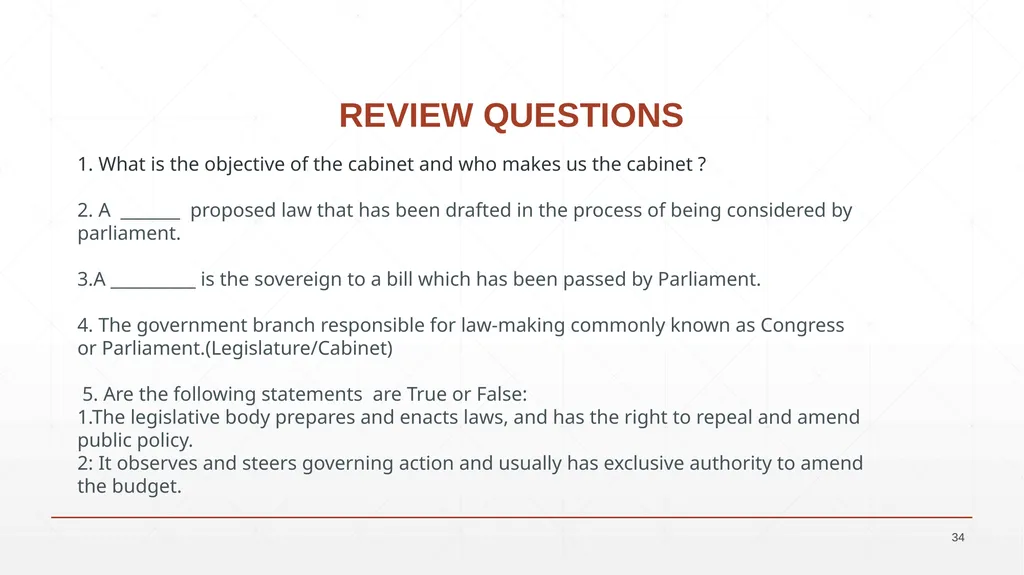
REVIEW QUESTIONS 34 1. What is the objective of the cabinet and who makes us the cabinet ?
2. A _______ proposed law that has been drafted in the process of being considered by parliament.
3.A __________ is the sovereign to a bill which has been passed by Parliament.
4. The government branch responsible for law-making commonly known as Congress or Parliament.(Legislature/Cabinet)
5. Are the following statements are True or False:
1.The legislative body prepares and enacts laws, and has the right to repeal and amend public policy.
2: It observes and steers governing action and usually has exclusive authority to amend the budget.<br>
2. A _______ proposed law that has been drafted in the process of being considered by parliament.
3.A __________ is the sovereign to a bill which has been passed by Parliament.
4. The government branch responsible for law-making commonly known as Congress or Parliament.(Legislature/Cabinet)
5. Are the following statements are True or False:
1.The legislative body prepares and enacts laws, and has the right to repeal and amend public policy.
2: It observes and steers governing action and usually has exclusive authority to amend the budget.<br>
35
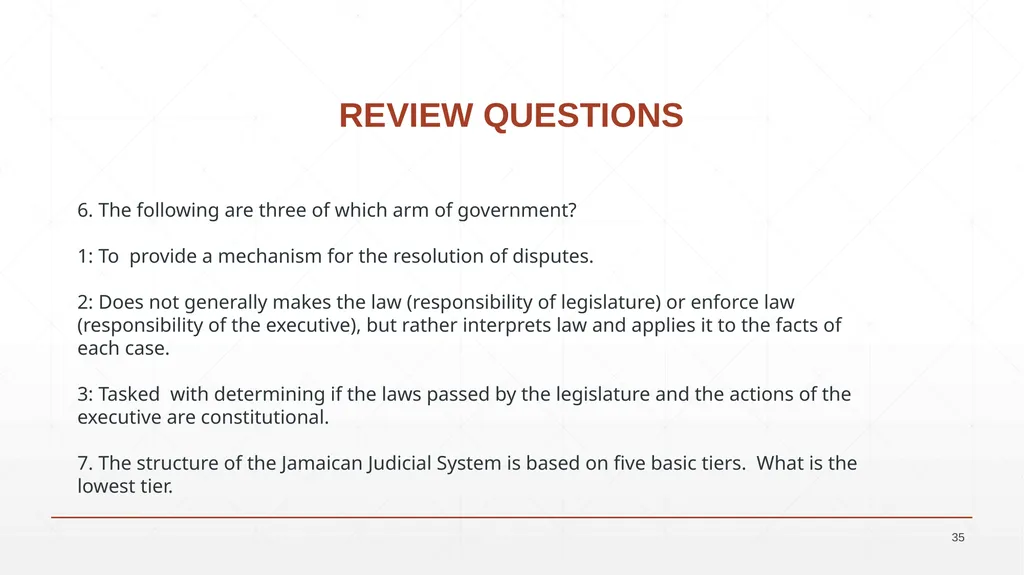
REVIEW QUESTIONS 35 6. The following are three of which arm of government?
1: To provide a mechanism for the resolution of disputes.
2: Does not generally makes the law (responsibility of legislature) or enforce law (responsibility of the executive), but rather interprets law and applies it to the facts of each case.
3: Tasked with determining if the laws passed by the legislature and the actions of the executive are constitutional.
7. The structure of the Jamaican Judicial System is based on five basic tiers. What is the lowest tier.<br>
1: To provide a mechanism for the resolution of disputes.
2: Does not generally makes the law (responsibility of legislature) or enforce law (responsibility of the executive), but rather interprets law and applies it to the facts of each case.
3: Tasked with determining if the laws passed by the legislature and the actions of the executive are constitutional.
7. The structure of the Jamaican Judicial System is based on five basic tiers. What is the lowest tier.<br>
36
REFERENCES Jamaica Information Service. (2019). Overview of the Government of Jamaica - Jamaica Information Service. [online] Available at: https://jis.gov.jm/features/overview-government-jamaica/ [Accessed 13 Jan. 2019].
http://supremecourt.gov.jm/sites/default/files/pdf_documents/Structure-of-the-Jamaican-Court-System.pdf
Agora-parl.org. (2019). Parliamentary Function of Lawmaking | Agora Portal. [online] Available at: https://agora-parl.org/resources/aoe/lawmaking [Accessed 13 Jan. 2019].
Nato.int. (2019). [online] Available at: https://www.nato.int/acad/fellow/97-99/bogdanovskaia.pdf [Accessed 13 Jan. 2019]. 36<br>
http://supremecourt.gov.jm/sites/default/files/pdf_documents/Structure-of-the-Jamaican-Court-System.pdf
Agora-parl.org. (2019). Parliamentary Function of Lawmaking | Agora Portal. [online] Available at: https://agora-parl.org/resources/aoe/lawmaking [Accessed 13 Jan. 2019].
Nato.int. (2019). [online] Available at: https://www.nato.int/acad/fellow/97-99/bogdanovskaia.pdf [Accessed 13 Jan. 2019]. 36<br>