
Unity Adult IP Care Model Session 1, November 5,
SB
Published · 26 slides · 0 views

1 / 1
Description
Unity Adult IP Care Model Session 1, November 5, 2015 Agenda Introductions Project overview Care Model Overview Outcome goals Known outcome measures Break Introduce topic big buckets Brainstorm: fill the buckets with subtasks Context
Related Topics
Share
Embed code
Download this presentation From Below
"Unity Adult IP Care Model Session 1, November 5," is the property of its rightful owner. Permission is granted to download and print the materials on this website for personal, non-commercial use only, and to display it on your personal computer provided you do not modify the materials and that you retain all copyright notices contained in the materials. By downloading content from our website, you accept the terms of this agreement.
Presentation Transcript
01
Unity Adult IP
Care Model Session 1, November 5, 2015<br>
02
Agenda Introductions
Project overview
Care Model Overview
Outcome goals
Known outcome measures
Break
Introduce topic “big buckets”
Brainstorm: “fill the buckets” with subtasks Context
8:00-9:00 Activity
9:00-noon<br>
Project overview
Care Model Overview
Outcome goals
Known outcome measures
Break
Introduce topic “big buckets”
Brainstorm: “fill the buckets” with subtasks Context
8:00-9:00 Activity
9:00-noon<br>
03
A PATHWAY TO OVERCOME COMMUNICATION OBSTACLES AS WE ENTER OUR COLLABORATIVE JOURNEY TO<br>
04
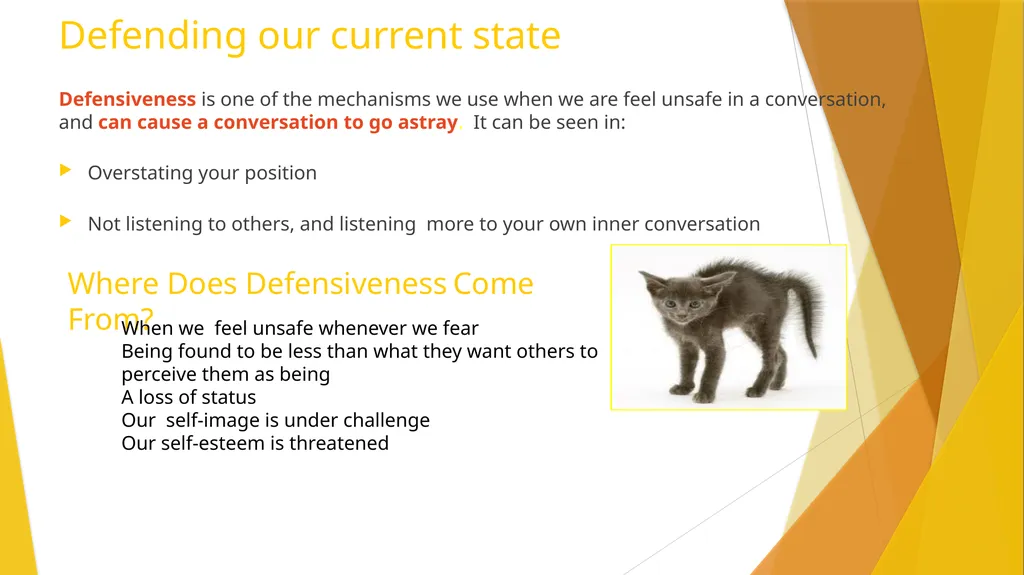
Defending our current state Defensiveness is one of the mechanisms we use when we are feel unsafe in a conversation, and can cause a conversation to go astray. It can be seen in:
Overstating your position
Not listening to others, and listening more to your own inner conversation Where Does Defensiveness Come From? When we feel unsafe whenever we fear
Being found to be less than what they want others to perceive them as being
A loss of status
Our self-image is under challenge
Our self-esteem is threatened<br>
Overstating your position
Not listening to others, and listening more to your own inner conversation Where Does Defensiveness Come From? When we feel unsafe whenever we fear
Being found to be less than what they want others to perceive them as being
A loss of status
Our self-image is under challenge
Our self-esteem is threatened<br>
05
SHIFTING DEFINESIVENESS TO A STATE OF CURIOUSITY AND DISCOVERY Defensiveness only causes you to become more entrenched in your position. Whereas curiosity and discovery enable you to make sense of why you are reacting the way you are, (or why the other person is reacting they way they are, if they have become defensive).
Seek to understand
Curiosity and discovery will cause you to ask better questions of yourself such as "Why am I reacting this way?“, "What is triggering me to feel vulnerable?" Asking these types of questions enables you to shift your thinking.
Lead to opening our minds to new ideas and possibilities<br>
Seek to understand
Curiosity and discovery will cause you to ask better questions of yourself such as "Why am I reacting this way?“, "What is triggering me to feel vulnerable?" Asking these types of questions enables you to shift your thinking.
Lead to opening our minds to new ideas and possibilities<br>
06
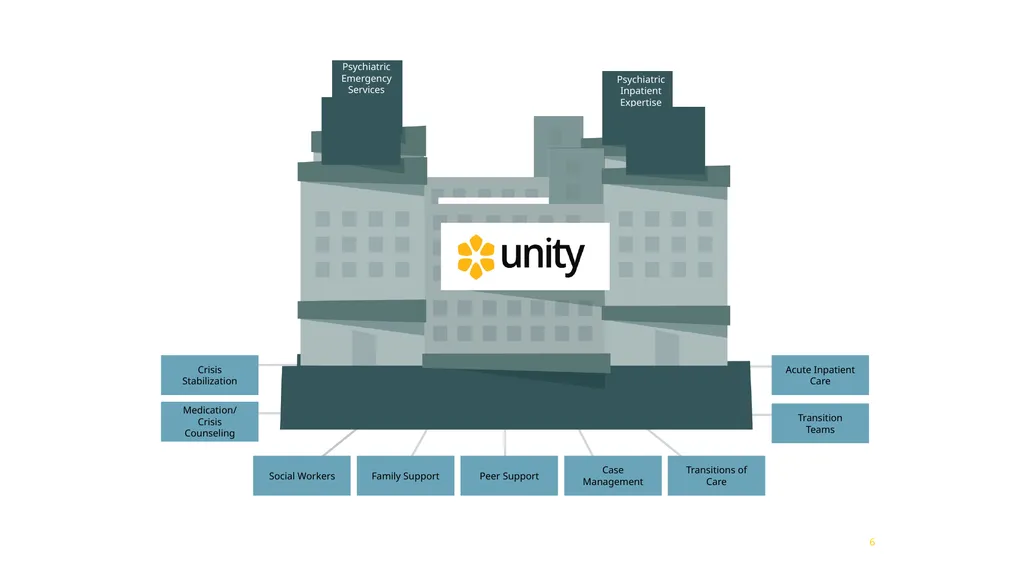
Social Workers Family Support Peer Support Case Management Transitions of Care Acute Inpatient Care Transition Teams Crisis Stabilization Medication/ Crisis Counseling Proven Models Psychiatric
Emergency
Services Psychiatric
Inpatient
Expertise 6<br>
Emergency
Services Psychiatric
Inpatient
Expertise 6<br>
07
Psychiatric
Emergency
Services Psychiatric
Inpatient
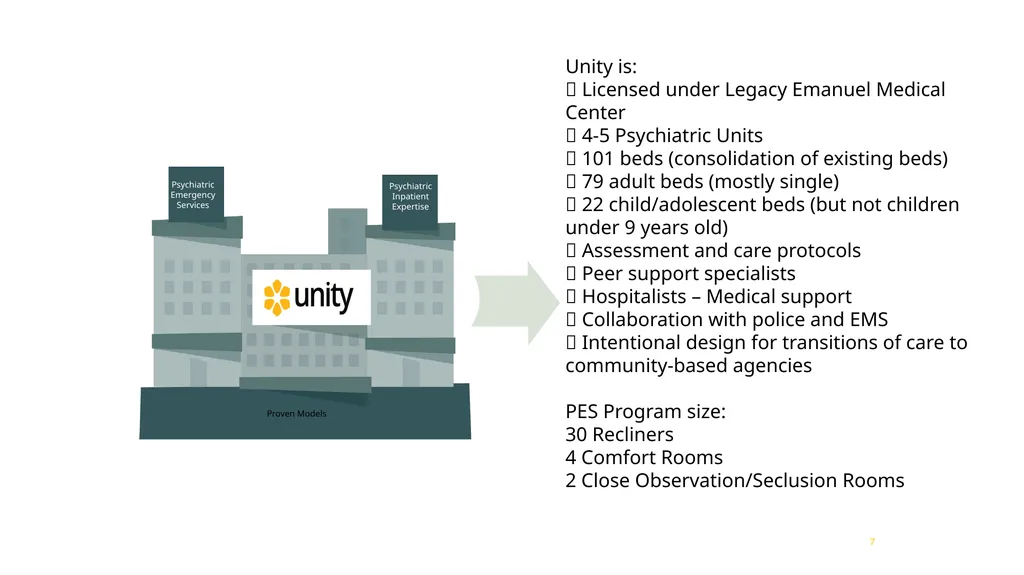
Expertise Proven Models 7 Unity is:
Licensed under Legacy Emanuel Medical Center
4-5 Psychiatric Units
101 beds (consolidation of existing beds)
79 adult beds (mostly single)
22 child/adolescent beds (but not children under 9 years old)
Assessment and care protocols
Peer support specialists
Hospitalists – Medical support
Collaboration with police and EMS
Intentional design for transitions of care to community-based agencies
PES Program size:
30 Recliners
4 Comfort Rooms
2 Close Observation/Seclusion Rooms<br>
Emergency
Services Psychiatric
Inpatient
Expertise Proven Models 7 Unity is:
Licensed under Legacy Emanuel Medical Center
4-5 Psychiatric Units
101 beds (consolidation of existing beds)
79 adult beds (mostly single)
22 child/adolescent beds (but not children under 9 years old)
Assessment and care protocols
Peer support specialists
Hospitalists – Medical support
Collaboration with police and EMS
Intentional design for transitions of care to community-based agencies
PES Program size:
30 Recliners
4 Comfort Rooms
2 Close Observation/Seclusion Rooms<br>
08
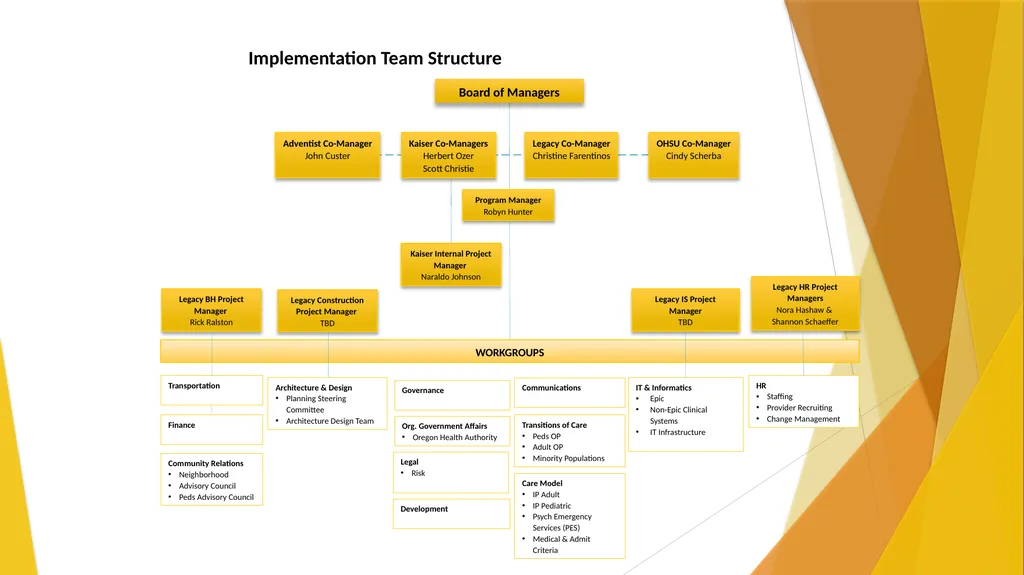
Program Manager
Robyn Hunter OHSU Co-Manager
Cindy Scherba Legacy BH Project Manager
Rick Ralston Legacy Co-Manager
Christine Farentinos WORKGROUPS Board of Managers Implementation Team Structure Community Relations
Neighborhood
Advisory Council
Peds Advisory Council Communications Care Model
IP Adult
IP Pediatric
Psych Emergency Services (PES)
Medical & Admit Criteria Finance Adventist Co-Manager
John Custer Kaiser Co-Managers
Herbert Ozer
Scott Christie HR
Staffing
Provider Recruiting
Change Management IT & Informatics
Epic
Non-Epic Clinical Systems
IT Infrastructure Transitions of Care
Peds OP
Adult OP
Minority Populations Development Legacy HR Project Managers
Nora Hashaw &
Shannon Schaeffer Transportation Kaiser Internal Project Manager
Naraldo Johnson Org. Government Affairs
Oregon Health Authority Governance Legal
Risk Legacy Construction Project Manager
TBD Architecture & Design
Planning Steering Committee
Architecture Design Team Legacy IS Project Manager
TBD<br>
Robyn Hunter OHSU Co-Manager
Cindy Scherba Legacy BH Project Manager
Rick Ralston Legacy Co-Manager
Christine Farentinos WORKGROUPS Board of Managers Implementation Team Structure Community Relations
Neighborhood
Advisory Council
Peds Advisory Council Communications Care Model
IP Adult
IP Pediatric
Psych Emergency Services (PES)
Medical & Admit Criteria Finance Adventist Co-Manager
John Custer Kaiser Co-Managers
Herbert Ozer
Scott Christie HR
Staffing
Provider Recruiting
Change Management IT & Informatics
Epic
Non-Epic Clinical Systems
IT Infrastructure Transitions of Care
Peds OP
Adult OP
Minority Populations Development Legacy HR Project Managers
Nora Hashaw &
Shannon Schaeffer Transportation Kaiser Internal Project Manager
Naraldo Johnson Org. Government Affairs
Oregon Health Authority Governance Legal
Risk Legacy Construction Project Manager
TBD Architecture & Design
Planning Steering Committee
Architecture Design Team Legacy IS Project Manager
TBD<br>
09
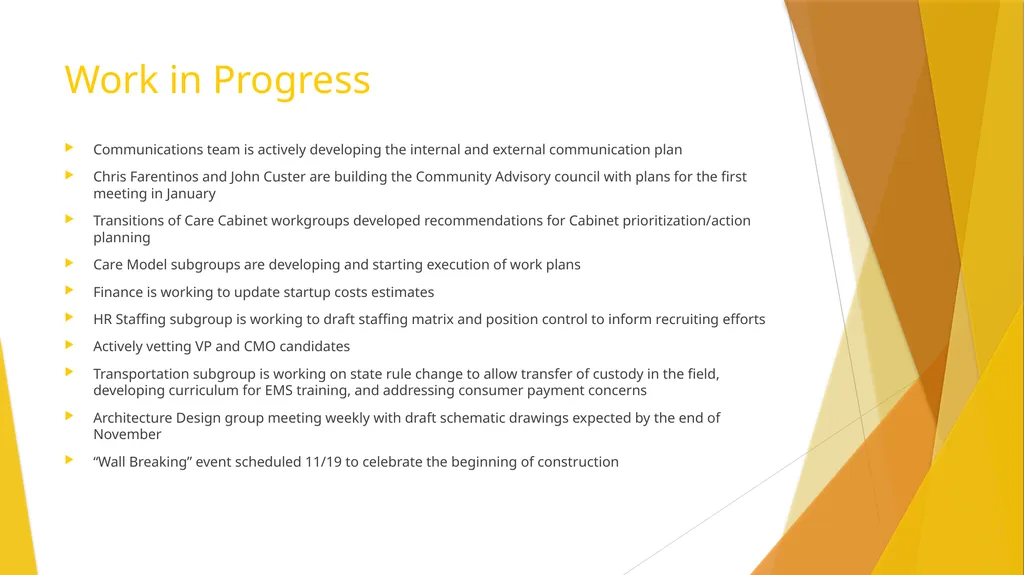
Work in Progress Communications team is actively developing the internal and external communication plan
Chris Farentinos and John Custer are building the Community Advisory council with plans for the first meeting in January
Transitions of Care Cabinet workgroups developed recommendations for Cabinet prioritization/action planning
Care Model subgroups are developing and starting execution of work plans
Finance is working to update startup costs estimates
HR Staffing subgroup is working to draft staffing matrix and position control to inform recruiting efforts
Actively vetting VP and CMO candidates
Transportation subgroup is working on state rule change to allow transfer of custody in the field, developing curriculum for EMS training, and addressing consumer payment concerns
Architecture Design group meeting weekly with draft schematic drawings expected by the end of November
“Wall Breaking” event scheduled 11/19 to celebrate the beginning of construction<br>
Chris Farentinos and John Custer are building the Community Advisory council with plans for the first meeting in January
Transitions of Care Cabinet workgroups developed recommendations for Cabinet prioritization/action planning
Care Model subgroups are developing and starting execution of work plans
Finance is working to update startup costs estimates
HR Staffing subgroup is working to draft staffing matrix and position control to inform recruiting efforts
Actively vetting VP and CMO candidates
Transportation subgroup is working on state rule change to allow transfer of custody in the field, developing curriculum for EMS training, and addressing consumer payment concerns
Architecture Design group meeting weekly with draft schematic drawings expected by the end of November
“Wall Breaking” event scheduled 11/19 to celebrate the beginning of construction<br>
10
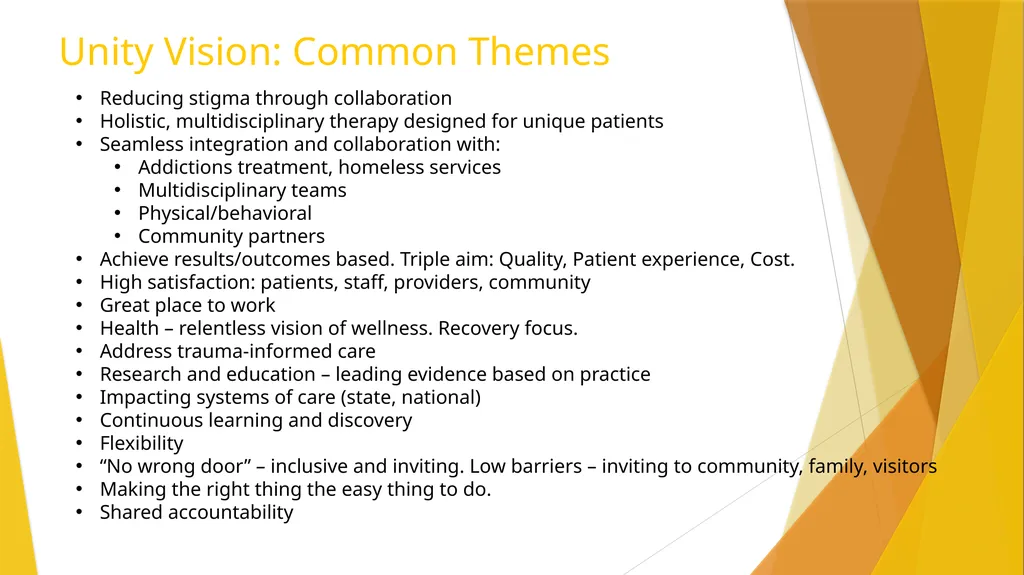
Unity Vision: Common Themes Reducing stigma through collaboration
Holistic, multidisciplinary therapy designed for unique patients
Seamless integration and collaboration with:
Addictions treatment, homeless services
Multidisciplinary teams
Physical/behavioral
Community partners
Achieve results/outcomes based. Triple aim: Quality, Patient experience, Cost.
High satisfaction: patients, staff, providers, community
Great place to work
Health – relentless vision of wellness. Recovery focus.
Address trauma-informed care
Research and education – leading evidence based on practice
Impacting systems of care (state, national)
Continuous learning and discovery
Flexibility
“No wrong door” – inclusive and inviting. Low barriers – inviting to community, family, visitors
Making the right thing the easy thing to do.
Shared accountability<br>
Holistic, multidisciplinary therapy designed for unique patients
Seamless integration and collaboration with:
Addictions treatment, homeless services
Multidisciplinary teams
Physical/behavioral
Community partners
Achieve results/outcomes based. Triple aim: Quality, Patient experience, Cost.
High satisfaction: patients, staff, providers, community
Great place to work
Health – relentless vision of wellness. Recovery focus.
Address trauma-informed care
Research and education – leading evidence based on practice
Impacting systems of care (state, national)
Continuous learning and discovery
Flexibility
“No wrong door” – inclusive and inviting. Low barriers – inviting to community, family, visitors
Making the right thing the easy thing to do.
Shared accountability<br>
11
Unity Sample Vision Statement The relentless pursuit of high quality mental health care that values the collaboration between patients, families and systems of care to find holistic solutions that work for all. That’s Unity.<br>
12
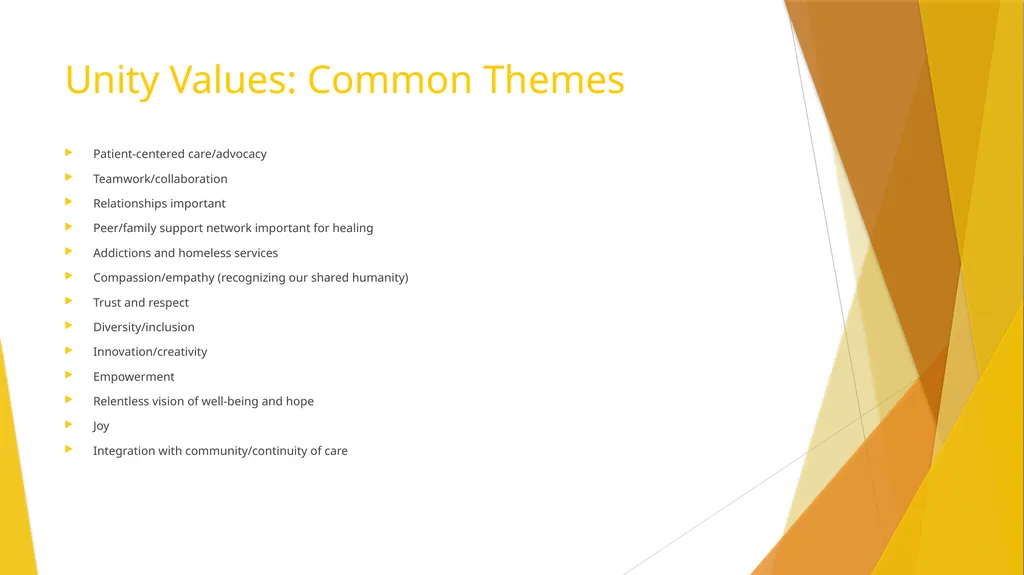
Unity Values: Common Themes Patient-centered care/advocacy
Teamwork/collaboration
Relationships important
Peer/family support network important for healing
Addictions and homeless services
Compassion/empathy (recognizing our shared humanity)
Trust and respect
Diversity/inclusion
Innovation/creativity
Empowerment
Relentless vision of well-being and hope
Joy
Integration with community/continuity of care<br>
Teamwork/collaboration
Relationships important
Peer/family support network important for healing
Addictions and homeless services
Compassion/empathy (recognizing our shared humanity)
Trust and respect
Diversity/inclusion
Innovation/creativity
Empowerment
Relentless vision of well-being and hope
Joy
Integration with community/continuity of care<br>
13
Guiding Principles for Design of Access Points Hospitality
Family is also the patient/customer
Avoid further trauma when patients are accessing the facility
Avoid further trauma when patients are going through treatment<br>
Family is also the patient/customer
Avoid further trauma when patients are accessing the facility
Avoid further trauma when patients are going through treatment<br>
14
What is the Care Model The Care Model is an overarching framework for the culture and care at Unity.
It is a philosophy that will shape the design of Unity:
Direct Care Model and staffing
Programming
Physical space layout
Patient flow
And influence:
Transitions of care processes<br>
It is a philosophy that will shape the design of Unity:
Direct Care Model and staffing
Programming
Physical space layout
Patient flow
And influence:
Transitions of care processes<br>
15
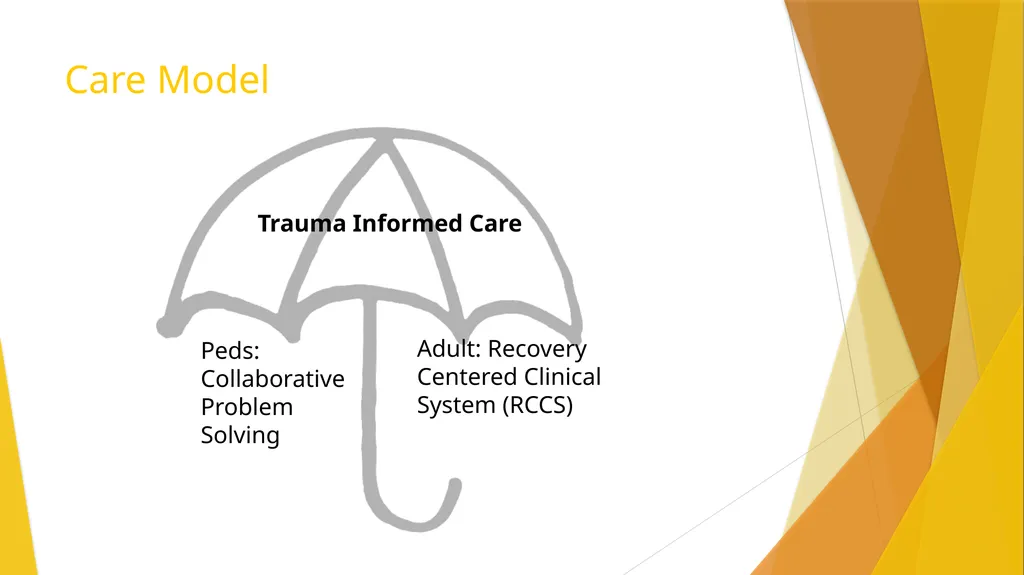
Care Model Trauma Informed Care Peds: Collaborative Problem Solving Adult: Recovery Centered Clinical System (RCCS)<br>
16
Realizes the widespread impact of trauma and understands potential paths for recovery
Recognizes the signs and symptoms of trauma in clients, families, staff, and others involved with the system
Responds by fully integrating knowledge about trauma into policies, procedures and practices
Seeks to actively resist re-traumatization
(SAMHSA) Key Assumptions of the Trauma-Informed approach<br>
Recognizes the signs and symptoms of trauma in clients, families, staff, and others involved with the system
Responds by fully integrating knowledge about trauma into policies, procedures and practices
Seeks to actively resist re-traumatization
(SAMHSA) Key Assumptions of the Trauma-Informed approach<br>
17
Safety
Trustworthiness and transparency
Peer support
Collaboration and mutuality
Empowerment, voice, choice
Cultural, historical and gender issues
(SAMHSA) Six Key principles of a trauma-informed approach<br>
Trustworthiness and transparency
Peer support
Collaboration and mutuality
Empowerment, voice, choice
Cultural, historical and gender issues
(SAMHSA) Six Key principles of a trauma-informed approach<br>
18
Unity Care Model Unity Center will also embrace the concept of integration mental health and substance use disorder treatment, which will be reflected in its policies, procedures and practices.<br>
19
Recovery Model – Telecare<br>
20
Key Points & Benefits
Recovery Centered Clinical Systems RCCS is overlaid with TIC and Sanctuary Model (TIC and Sanctuary target environment and culture)
RCCS strives to create an environment that supports recovery by concentrating in two areas:
Culture – because the environment is the primary therapeutic intervention in a locked environment –
How we treat each other
How we treat the patient
How the patient experiences the treatment
Focus on 5 awarenesses
Conversations – focus on the individual work with patients<br>
RCCS strives to create an environment that supports recovery by concentrating in two areas:
Culture – because the environment is the primary therapeutic intervention in a locked environment –
How we treat each other
How we treat the patient
How the patient experiences the treatment
Focus on 5 awarenesses
Conversations – focus on the individual work with patients<br>
21
Key Points & Benefits
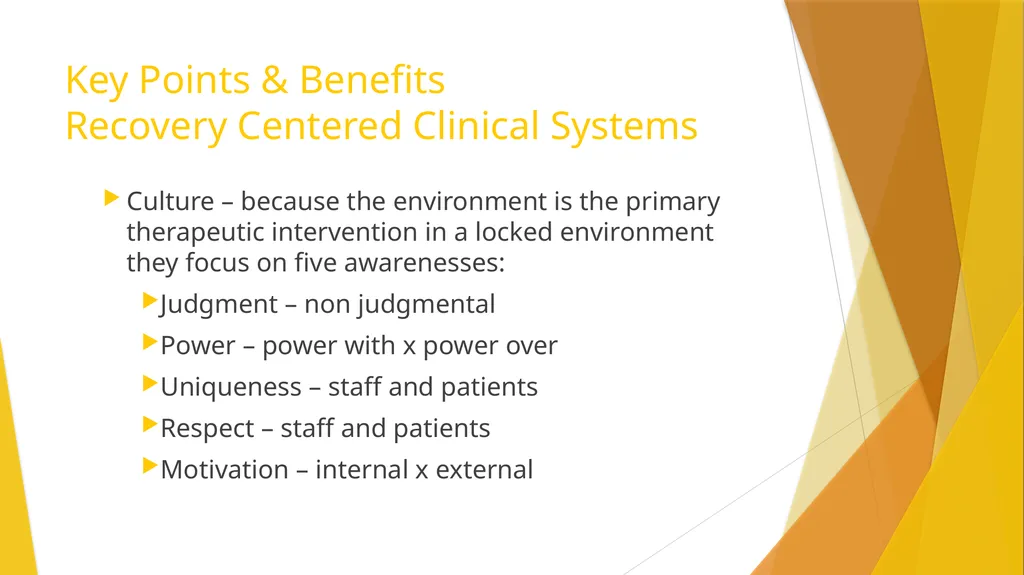
Recovery Centered Clinical Systems Culture – because the environment is the primary therapeutic intervention in a locked environment they focus on five awarenesses:
Judgment – non judgmental
Power – power with x power over
Uniqueness – staff and patients
Respect – staff and patients
Motivation – internal x external<br>
Judgment – non judgmental
Power – power with x power over
Uniqueness – staff and patients
Respect – staff and patients
Motivation – internal x external<br>
22
Key Points & Benefits
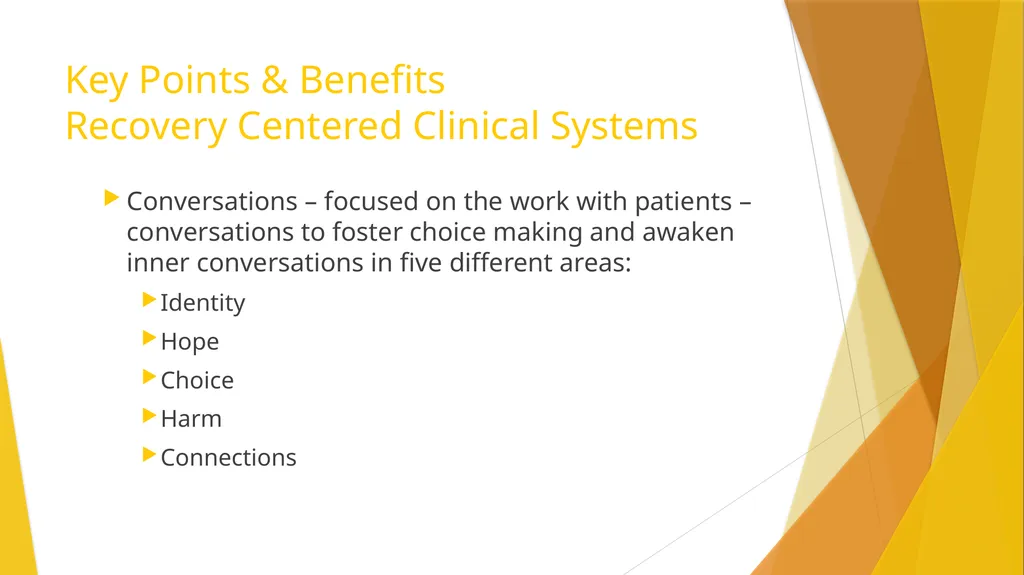
Recovery Centered Clinical Systems Conversations – focused on the work with patients – conversations to foster choice making and awaken inner conversations in five different areas:
Identity
Hope
Choice
Harm
Connections<br>
Identity
Hope
Choice
Harm
Connections<br>
23
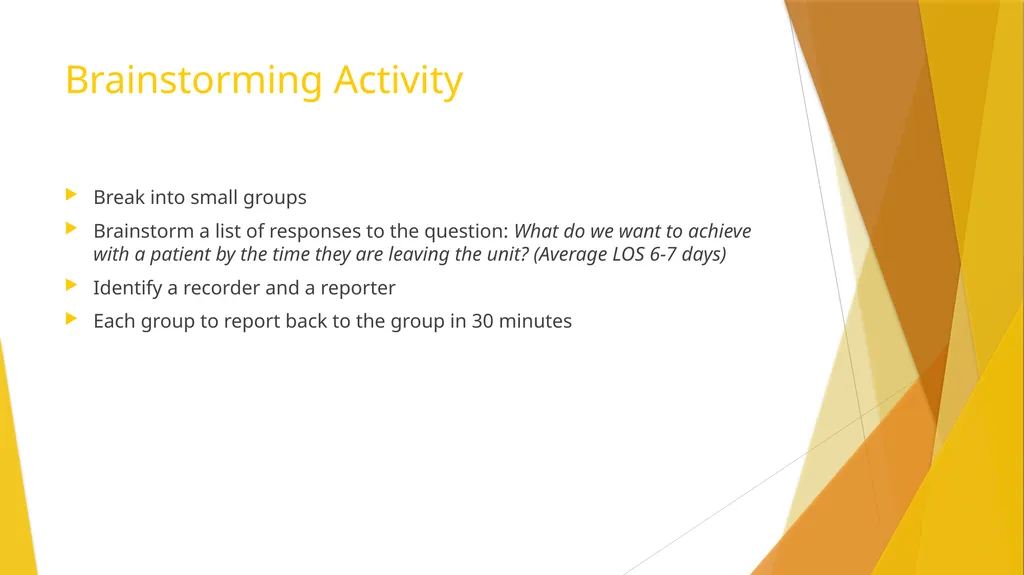
Break into small groups
Brainstorm a list of responses to the question: What do we want to achieve with a patient by the time they are leaving the unit? (Average LOS 6-7 days)
Identify a recorder and a reporter
Each group to report back to the group in 30 minutes Brainstorming Activity<br>
Brainstorm a list of responses to the question: What do we want to achieve with a patient by the time they are leaving the unit? (Average LOS 6-7 days)
Identify a recorder and a reporter
Each group to report back to the group in 30 minutes Brainstorming Activity<br>
24
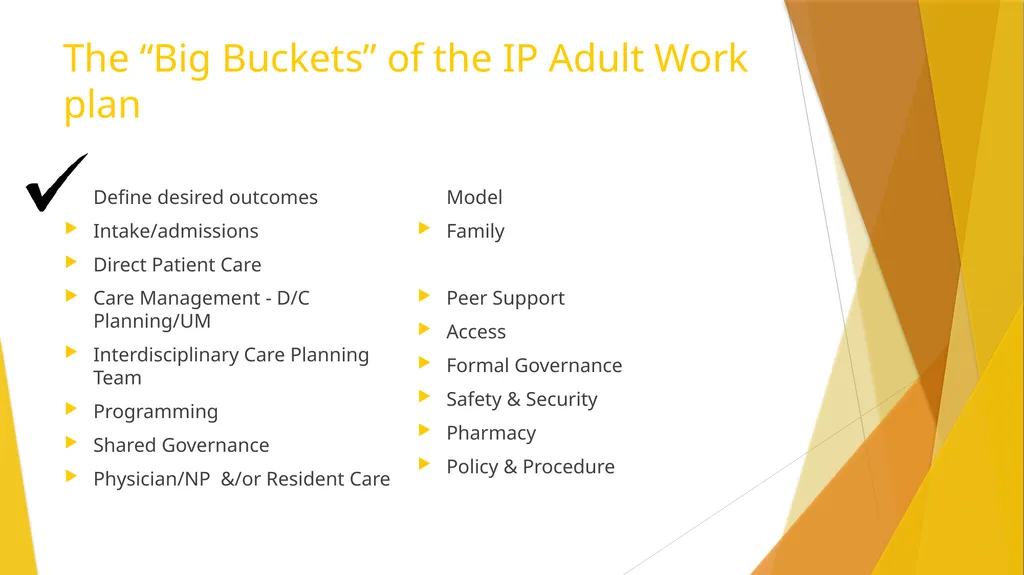
The “Big Buckets” of the IP Adult Work plan Define desired outcomes
Intake/admissions
Direct Patient Care
Care Management - D/C Planning/UM
Interdisciplinary Care Planning Team
Programming
Shared Governance
Physician/NP &/or Resident Care Model
Family
Peer Support
Access
Formal Governance
Safety & Security
Pharmacy
Policy & Procedure<br>
Intake/admissions
Direct Patient Care
Care Management - D/C Planning/UM
Interdisciplinary Care Planning Team
Programming
Shared Governance
Physician/NP &/or Resident Care Model
Family
Peer Support
Access
Formal Governance
Safety & Security
Pharmacy
Policy & Procedure<br>
25
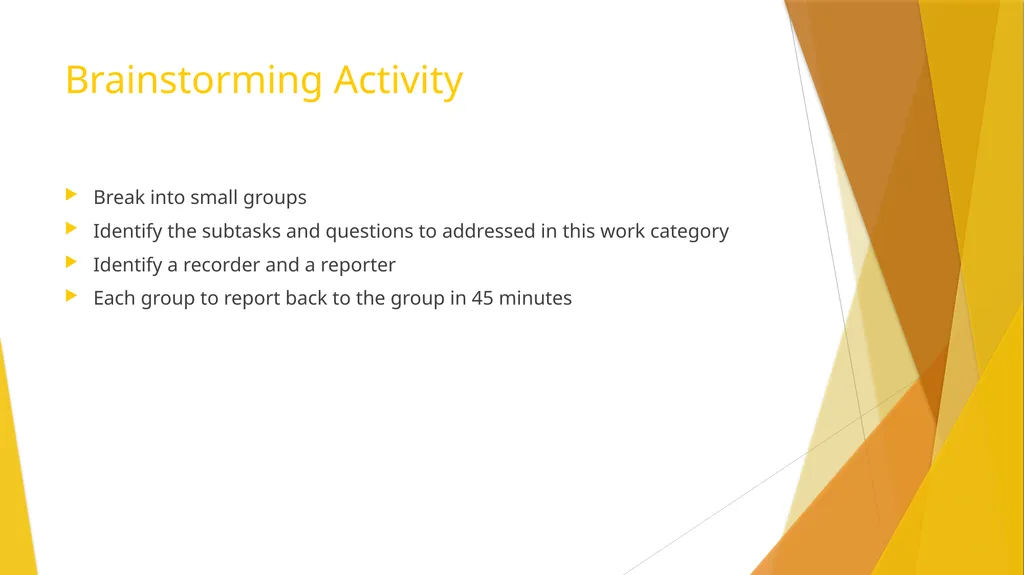
Brainstorming Activity Break into small groups
Identify the subtasks and questions to addressed in this work category
Identify a recorder and a reporter
Each group to report back to the group in 45 minutes<br>
Identify the subtasks and questions to addressed in this work category
Identify a recorder and a reporter
Each group to report back to the group in 45 minutes<br>
26
Thank you!<br>