
Untitled Presentation
FD
Published · 26 slides · 0 views
1 / 1
Description
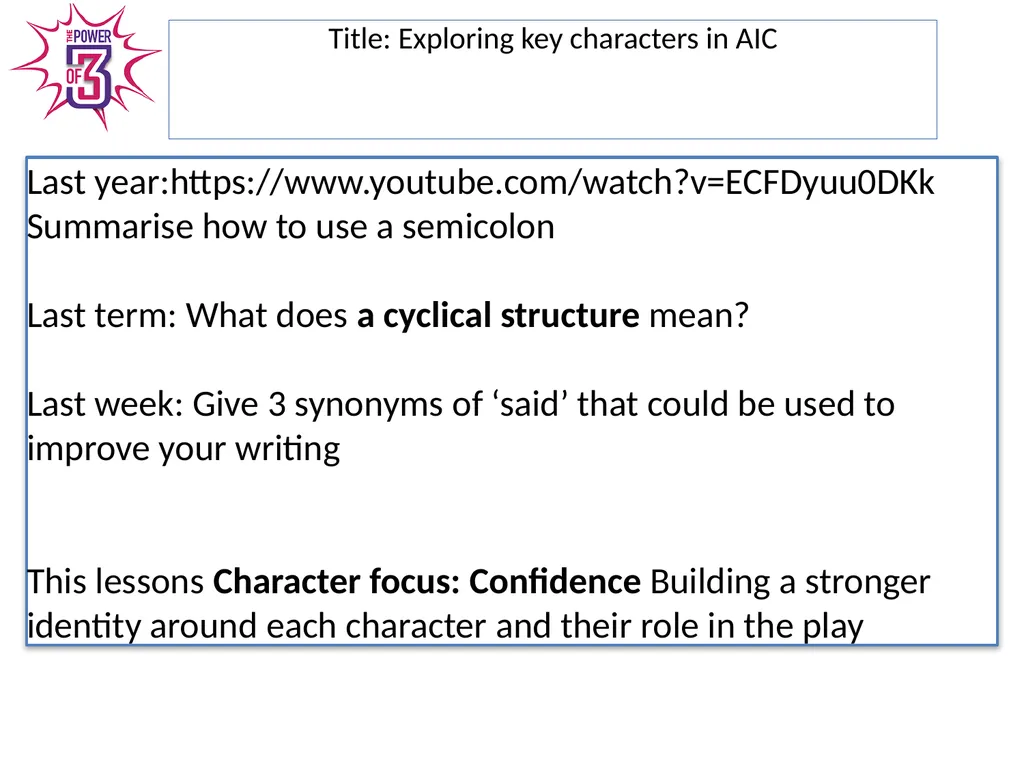
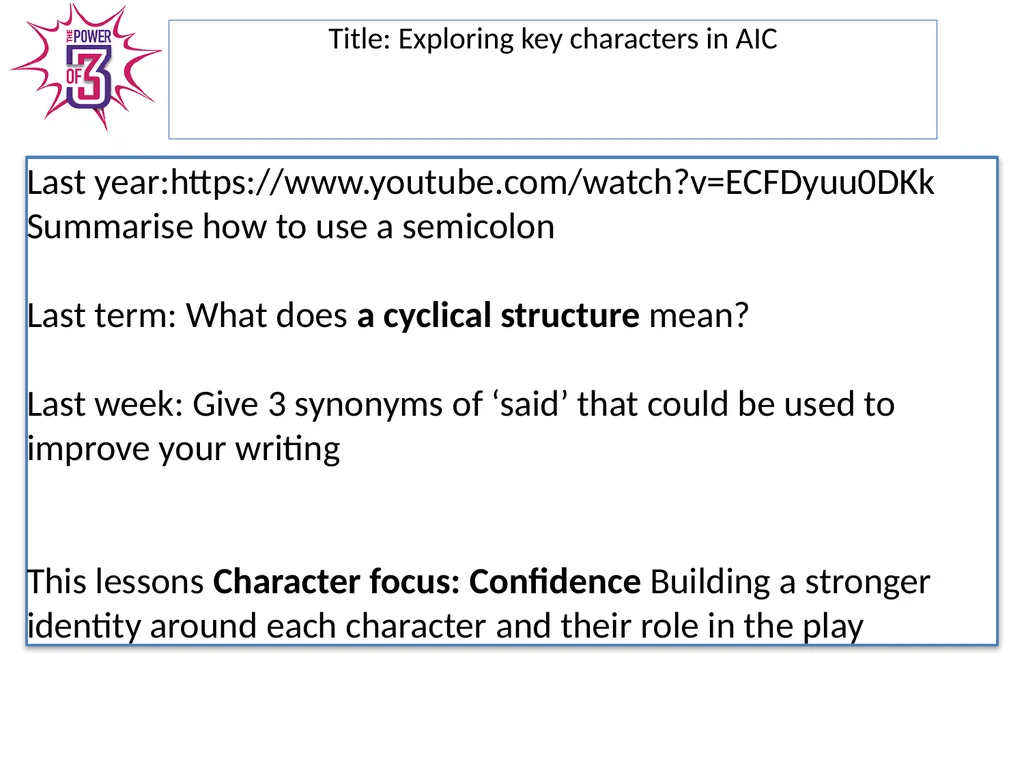
Last year:https:www.youtube.comwatch?vECFDyuu0DKk Summarise how to use a semicolon Last term: What does a cyclical structure mean? Last week: Give 3 synonyms of said that could be used to improve your writing This lessons Character
Related Topics
Share
Embed code
Download this presentation From Below
"Untitled Presentation" is the property of its rightful owner. Permission is granted to download and print the materials on this website for personal, non-commercial use only, and to display it on your personal computer provided you do not modify the materials and that you retain all copyright notices contained in the materials. By downloading content from our website, you accept the terms of this agreement.
Presentation Transcript
01
Last year:https://www.youtube.com/watch?v=ECFDyuu0DKk
Summarise how to use a semicolon
Last term: What does a cyclical structure mean?
Last week: Give 3 synonyms of ‘said’ that could be used to improve your writing
This lessons Character focus: Confidence Building a stronger identity around each character and their role in the play Title: Exploring key characters in AIC<br>
Summarise how to use a semicolon
Last term: What does a cyclical structure mean?
Last week: Give 3 synonyms of ‘said’ that could be used to improve your writing
This lessons Character focus: Confidence Building a stronger identity around each character and their role in the play Title: Exploring key characters in AIC<br>
02
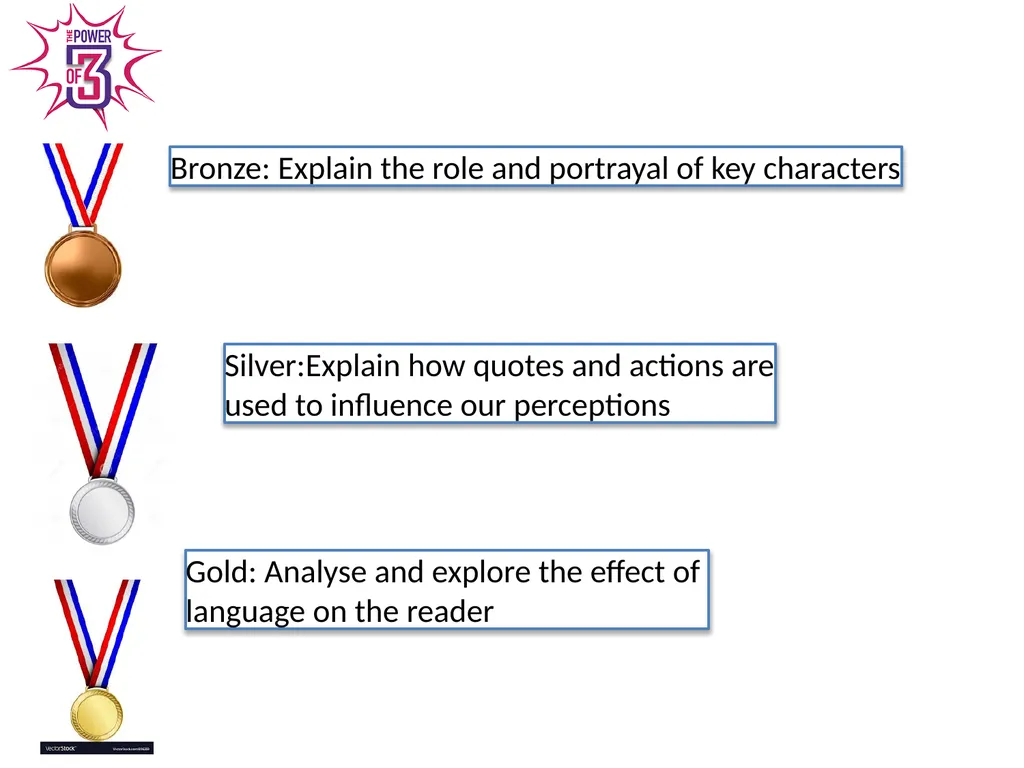
Bronze: Explain the role and portrayal of key characters Silver:Explain how quotes and actions are
used to influence our perceptions Gold: Analyse and explore the effect of
language on the reader<br>
used to influence our perceptions Gold: Analyse and explore the effect of
language on the reader<br>
03
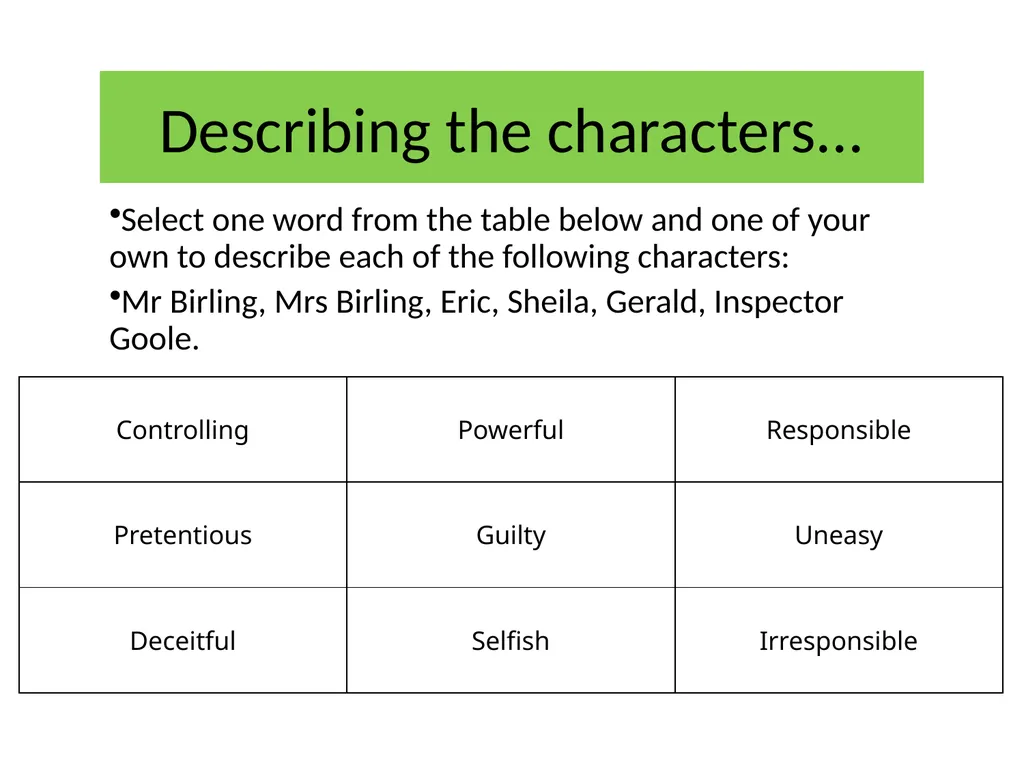
Describing the characters... Select one word from the table below and one of your own to describe each of the following characters:
Mr Birling, Mrs Birling, Eric, Sheila, Gerald, Inspector Goole.<br>
Mr Birling, Mrs Birling, Eric, Sheila, Gerald, Inspector Goole.<br>
04
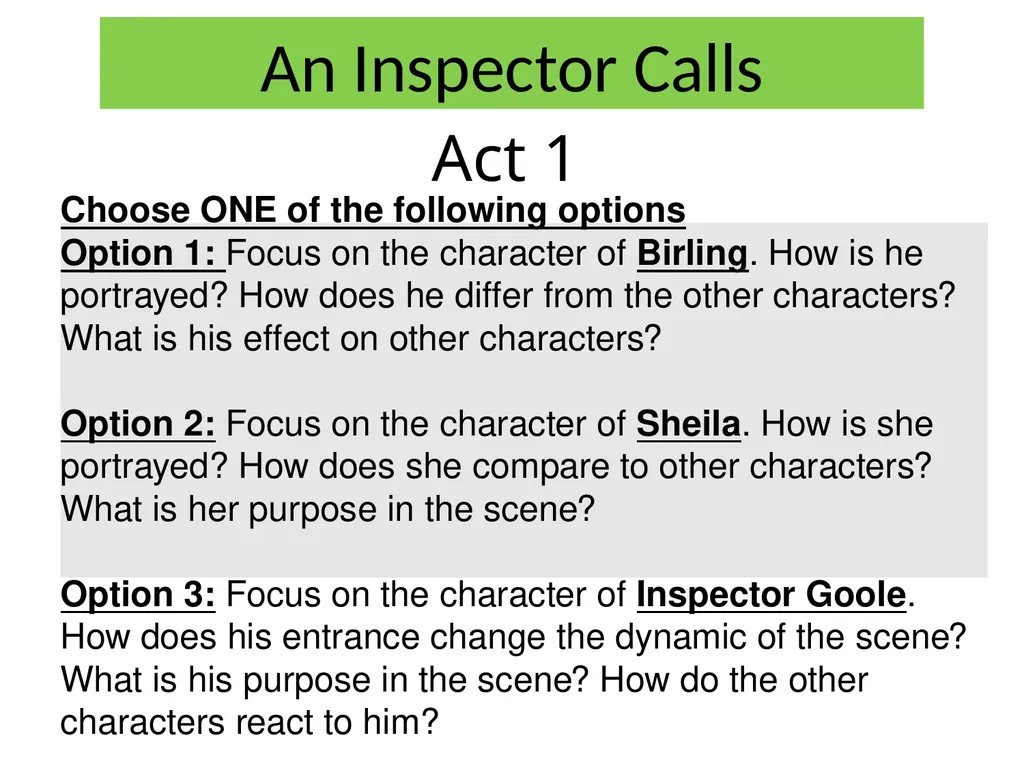
An Inspector Calls Choose ONE of the following options
Option 1: Focus on the character of Birling. How is he portrayed? How does he differ from the other characters? What is his effect on other characters?
Option 2: Focus on the character of Sheila. How is she portrayed? How does she compare to other characters? What is her purpose in the scene?
Option 3: Focus on the character of Inspector Goole. How does his entrance change the dynamic of the scene? What is his purpose in the scene? How do the other characters react to him? Act 1<br>
Option 1: Focus on the character of Birling. How is he portrayed? How does he differ from the other characters? What is his effect on other characters?
Option 2: Focus on the character of Sheila. How is she portrayed? How does she compare to other characters? What is her purpose in the scene?
Option 3: Focus on the character of Inspector Goole. How does his entrance change the dynamic of the scene? What is his purpose in the scene? How do the other characters react to him? Act 1<br>
05
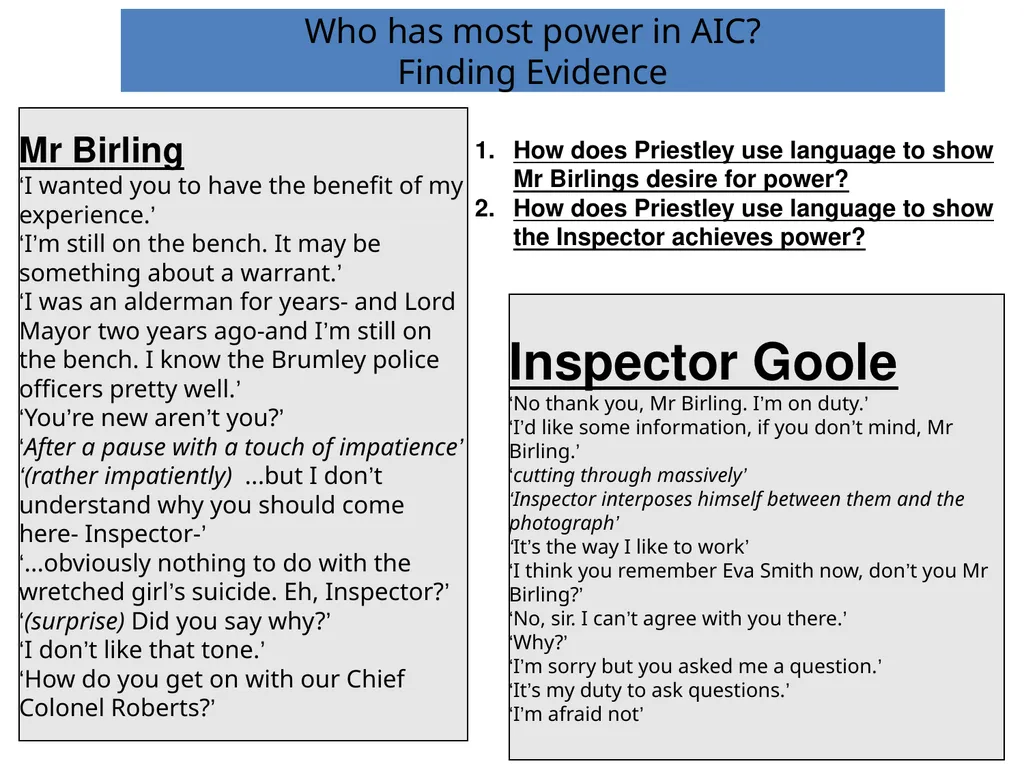
Who has most power in AIC?
Finding Evidence How does Priestley use language to show Mr Birlings desire for power?
How does Priestley use language to show the Inspector achieves power? Mr Birling
‘I wanted you to have the benefit of my experience.’
‘I’m still on the bench. It may be something about a warrant.’
‘I was an alderman for years- and Lord Mayor two years ago-and I’m still on the bench. I know the Brumley police officers pretty well.’
‘You’re new aren’t you?’
‘After a pause with a touch of impatience’
‘(rather impatiently) ...but I don’t understand why you should come here- Inspector-’
‘...obviously nothing to do with the wretched girl’s suicide. Eh, Inspector?’
‘(surprise) Did you say why?’
‘I don’t like that tone.’
‘How do you get on with our Chief Colonel Roberts?’ Inspector Goole
‘No thank you, Mr Birling. I’m on duty.’
‘I’d like some information, if you don’t mind, Mr Birling.’
‘cutting through massively’
‘Inspector interposes himself between them and the photograph’
‘It’s the way I like to work’
‘I think you remember Eva Smith now, don’t you Mr Birling?’
‘No, sir. I can’t agree with you there.’
‘Why?’
‘I’m sorry but you asked me a question.’
‘It’s my duty to ask questions.’
‘I’m afraid not’<br>
How does Priestley use language to show the Inspector achieves power? Mr Birling
‘I wanted you to have the benefit of my experience.’
‘I’m still on the bench. It may be something about a warrant.’
‘I was an alderman for years- and Lord Mayor two years ago-and I’m still on the bench. I know the Brumley police officers pretty well.’
‘You’re new aren’t you?’
‘After a pause with a touch of impatience’
‘(rather impatiently) ...but I don’t understand why you should come here- Inspector-’
‘...obviously nothing to do with the wretched girl’s suicide. Eh, Inspector?’
‘(surprise) Did you say why?’
‘I don’t like that tone.’
‘How do you get on with our Chief Colonel Roberts?’ Inspector Goole
‘No thank you, Mr Birling. I’m on duty.’
‘I’d like some information, if you don’t mind, Mr Birling.’
‘cutting through massively’
‘Inspector interposes himself between them and the photograph’
‘It’s the way I like to work’
‘I think you remember Eva Smith now, don’t you Mr Birling?’
‘No, sir. I can’t agree with you there.’
‘Why?’
‘I’m sorry but you asked me a question.’
‘It’s my duty to ask questions.’
‘I’m afraid not’<br>
06
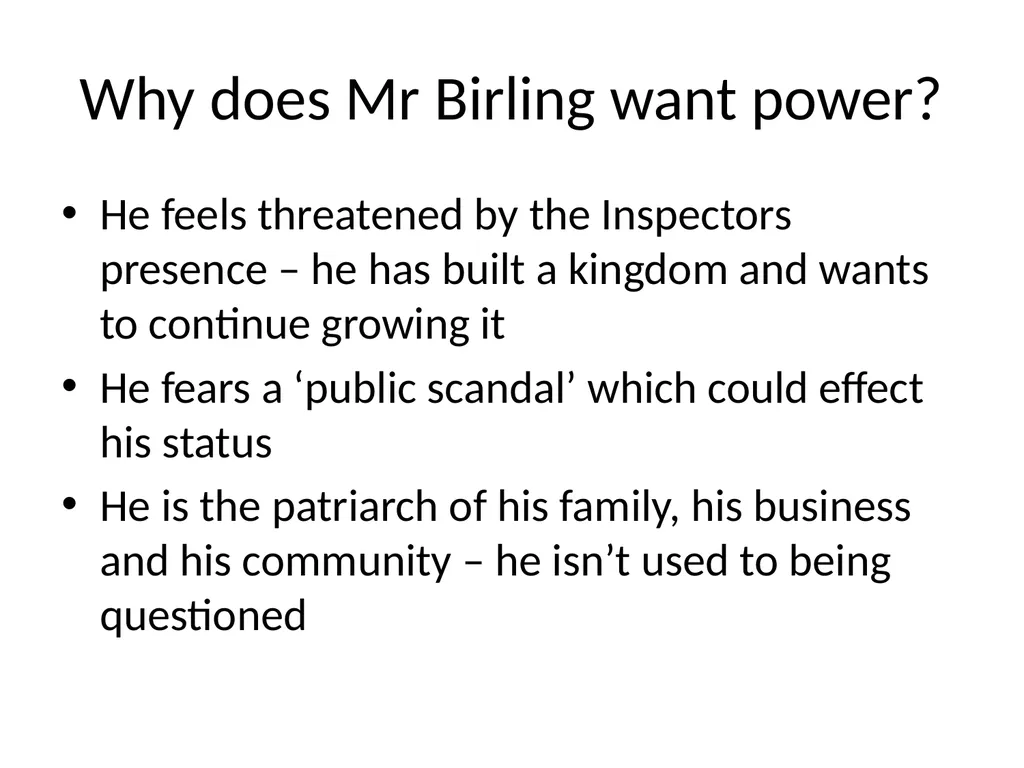
Why does Mr Birling want power? He feels threatened by the Inspectors presence – he has built a kingdom and wants to continue growing it
He fears a ‘public scandal’ which could effect his status
He is the patriarch of his family, his business and his community – he isn’t used to being questioned<br>
He fears a ‘public scandal’ which could effect his status
He is the patriarch of his family, his business and his community – he isn’t used to being questioned<br>
07
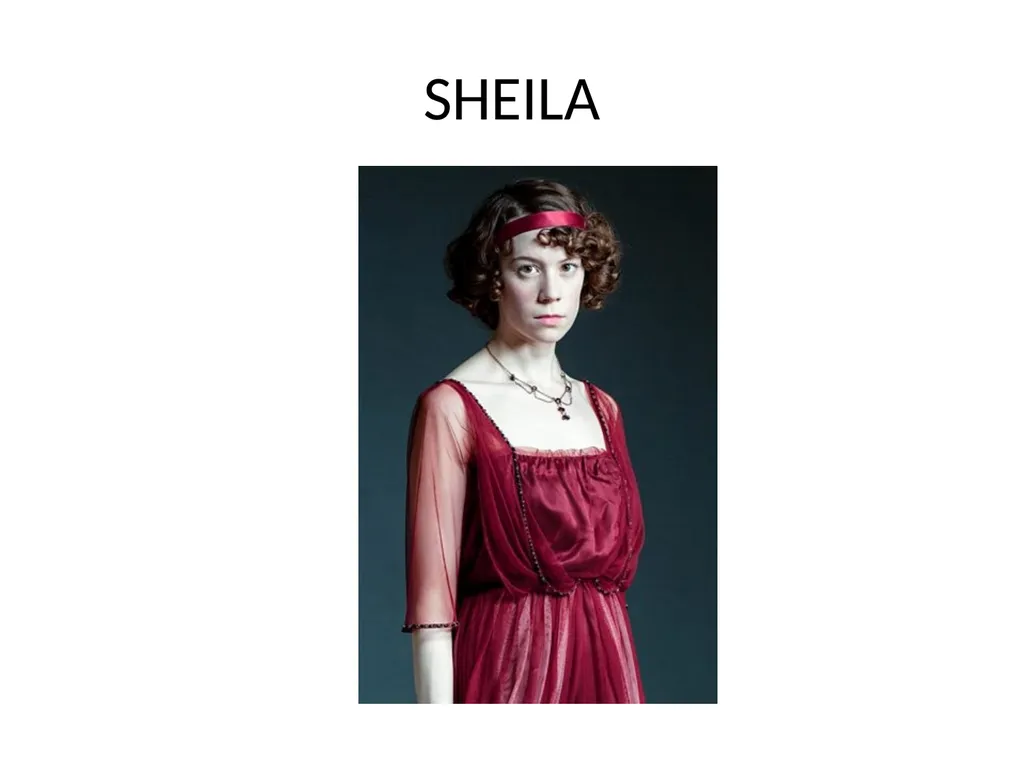
SHEILA<br>
08
How does the audience feel about Sheila Birling in Act One of ‘An Inspector Calls’? Create a mind map of ideas<br>
09
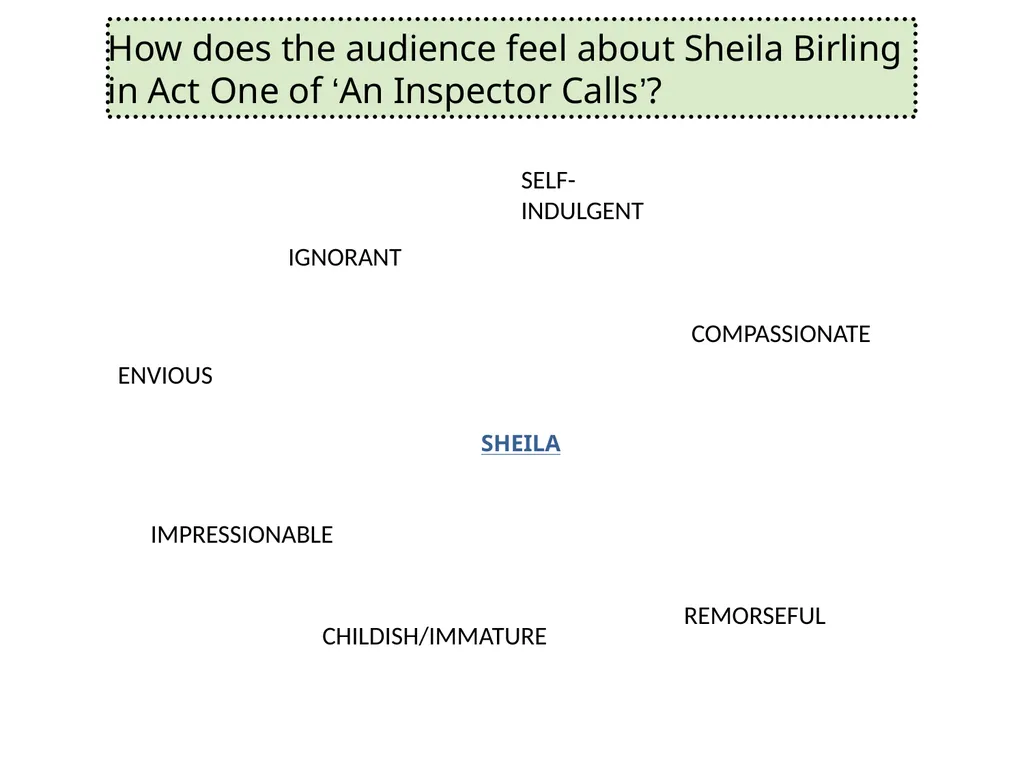
How does the audience feel about Sheila Birling in Act One of ‘An Inspector Calls’? SHEILA IGNORANT SELF-INDULGENT ENVIOUS COMPASSIONATE CHILDISH/IMMATURE REMORSEFUL IMPRESSIONABLE<br>
10
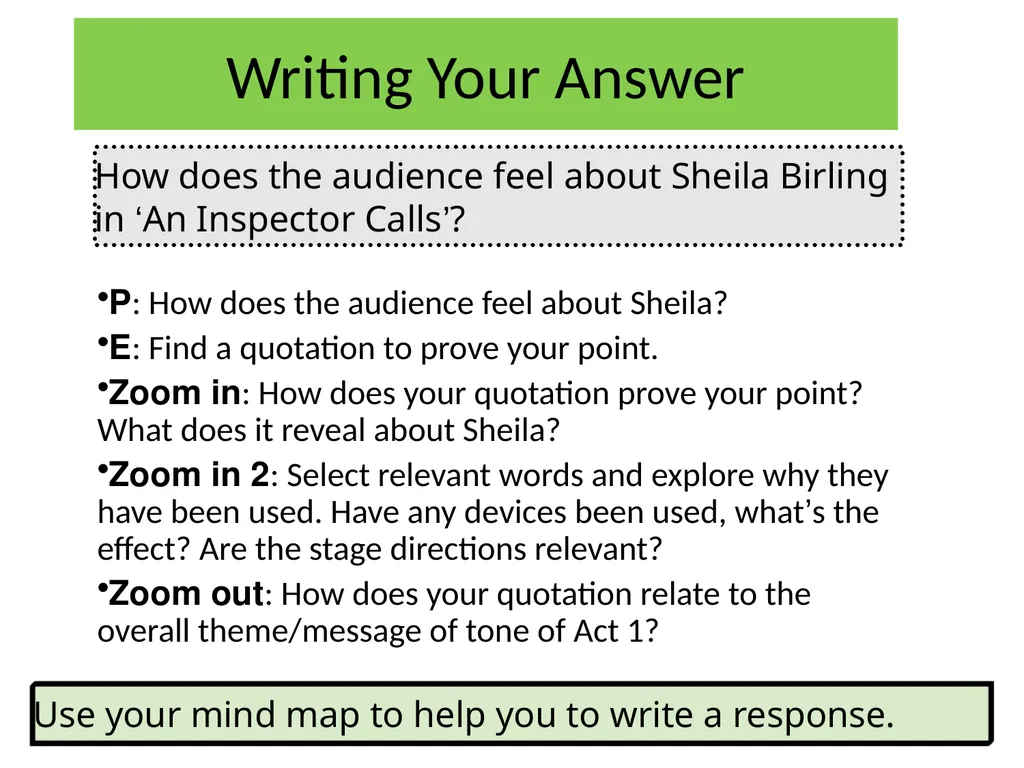
Writing Your Answer P: How does the audience feel about Sheila?
E: Find a quotation to prove your point.
Zoom in: How does your quotation prove your point? What does it reveal about Sheila?
Zoom in 2: Select relevant words and explore why they have been used. Have any devices been used, what’s the effect? Are the stage directions relevant?
Zoom out: How does your quotation relate to the overall theme/message of tone of Act 1? How does the audience feel about Sheila Birling in ‘An Inspector Calls’?<br>
E: Find a quotation to prove your point.
Zoom in: How does your quotation prove your point? What does it reveal about Sheila?
Zoom in 2: Select relevant words and explore why they have been used. Have any devices been used, what’s the effect? Are the stage directions relevant?
Zoom out: How does your quotation relate to the overall theme/message of tone of Act 1? How does the audience feel about Sheila Birling in ‘An Inspector Calls’?<br>
11
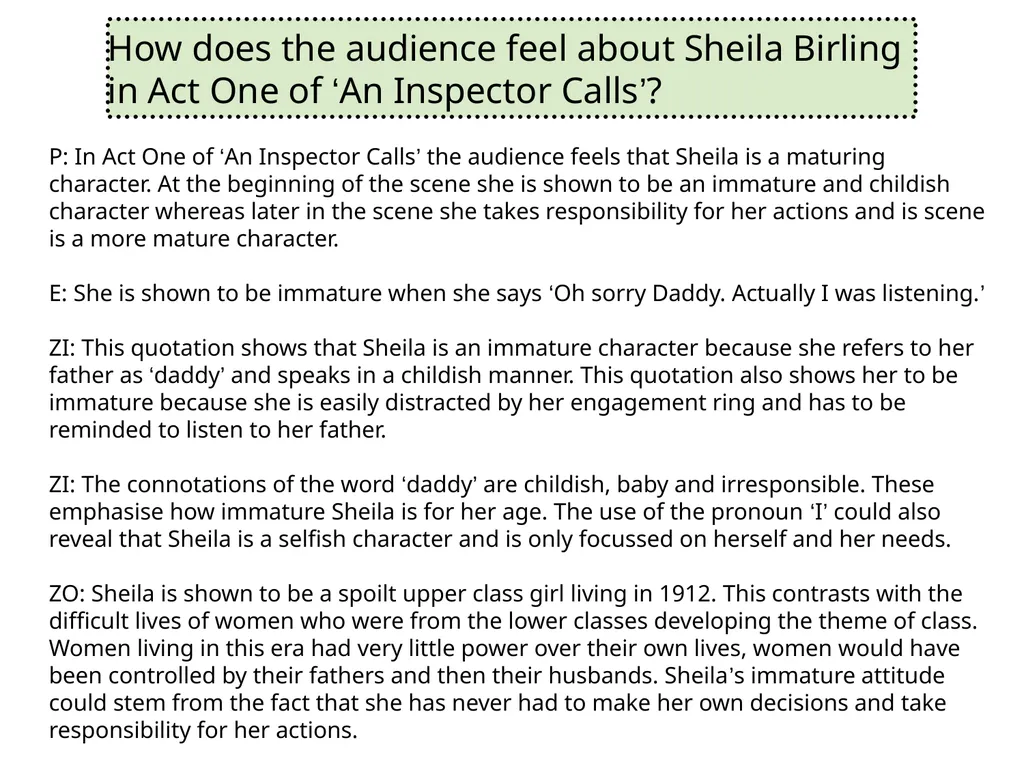
How does the audience feel about Sheila Birling in Act One of ‘An Inspector Calls’? P: In Act One of ‘An Inspector Calls’ the audience feels that Sheila is a maturing character. At the beginning of the scene she is shown to be an immature and childish character whereas later in the scene she takes responsibility for her actions and is scene is a more mature character.
E: She is shown to be immature when she says ‘Oh sorry Daddy. Actually I was listening.’
ZI: This quotation shows that Sheila is an immature character because she refers to her father as ‘daddy’ and speaks in a childish manner. This quotation also shows her to be immature because she is easily distracted by her engagement ring and has to be reminded to listen to her father.
ZI: The connotations of the word ‘daddy’ are childish, baby and irresponsible. These emphasise how immature Sheila is for her age. The use of the pronoun ‘I’ could also reveal that Sheila is a selfish character and is only focussed on herself and her needs.
ZO: Sheila is shown to be a spoilt upper class girl living in 1912. This contrasts with the difficult lives of women who were from the lower classes developing the theme of class. Women living in this era had very little power over their own lives, women would have been controlled by their fathers and then their husbands. Sheila’s immature attitude could stem from the fact that she has never had to make her own decisions and take responsibility for her actions.<br>
E: She is shown to be immature when she says ‘Oh sorry Daddy. Actually I was listening.’
ZI: This quotation shows that Sheila is an immature character because she refers to her father as ‘daddy’ and speaks in a childish manner. This quotation also shows her to be immature because she is easily distracted by her engagement ring and has to be reminded to listen to her father.
ZI: The connotations of the word ‘daddy’ are childish, baby and irresponsible. These emphasise how immature Sheila is for her age. The use of the pronoun ‘I’ could also reveal that Sheila is a selfish character and is only focussed on herself and her needs.
ZO: Sheila is shown to be a spoilt upper class girl living in 1912. This contrasts with the difficult lives of women who were from the lower classes developing the theme of class. Women living in this era had very little power over their own lives, women would have been controlled by their fathers and then their husbands. Sheila’s immature attitude could stem from the fact that she has never had to make her own decisions and take responsibility for her actions.<br>
12
Medal tasks to extend your thinking on Sheila Bronze: Write your own PEZZ paragraph to explain how Sheila is presented
Silver: How is the engagement ring a symbol of how Sheila changes through the play?
Gold: Sheila fits into the conventions of society in 1912: to what extent do you agree?<br>
Silver: How is the engagement ring a symbol of how Sheila changes through the play?
Gold: Sheila fits into the conventions of society in 1912: to what extent do you agree?<br>
13
Exploding a quote “These girls aren’t cheap labour – they’re people” All: What is this quote about? B: What does this show about her character? S: What does the adjective ‘cheap’ suggest about the working girls in the factory? G: How does the use of ‘girls’ contradict the point she is trying to make here?<br>
14
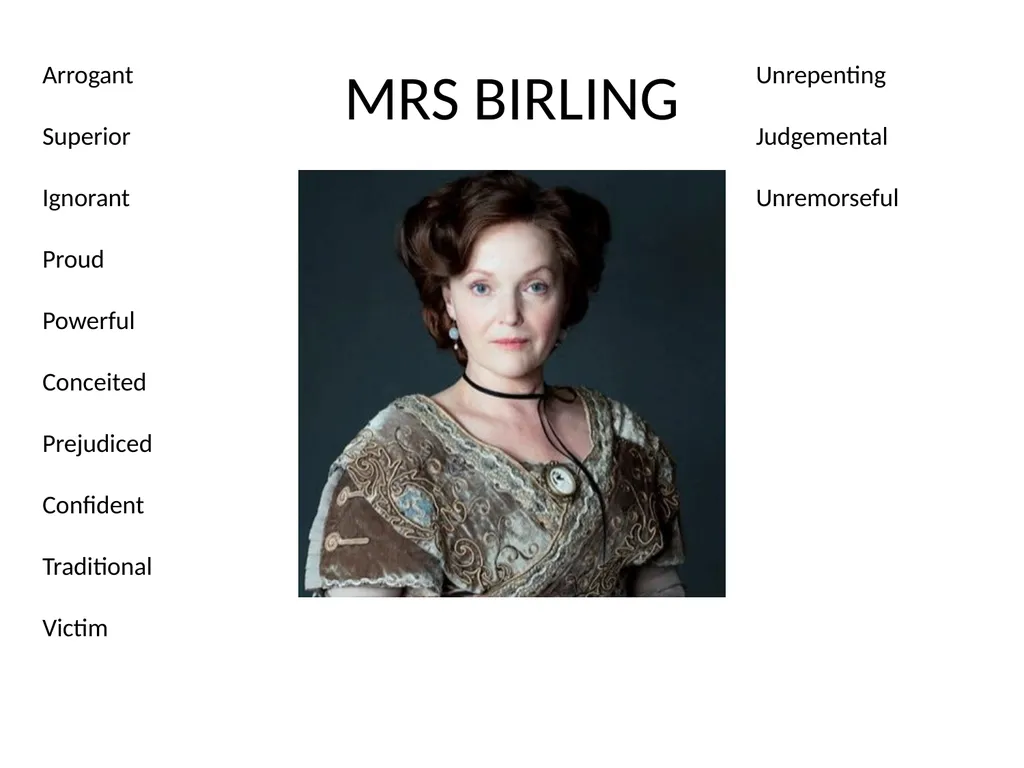
MRS BIRLING Arrogant
Superior
Ignorant
Proud
Powerful
Conceited
Prejudiced
Confident
Traditional
Victim Unrepenting
Judgemental
Unremorseful<br>
Superior
Ignorant
Proud
Powerful
Conceited
Prejudiced
Confident
Traditional
Victim Unrepenting
Judgemental
Unremorseful<br>
15
Explore the audience’s reaction to Mrs Birling. ‘...his social superior pg 1’ ‘Now Sheila don’t tease him. When you’re married you’ll realise that men with important work to do sometimes have to spend nearly all their time and energy on their business.’pg 3 ‘Arthur you’re not supposed to say such things pg2.’ These quotes are all from ACT ONE
Bronze: How is Mrs Birling presented at the start of the play?
Silver: Analyse a quote to show what it reveals about Mrs Birling
Gold: Why did Priestley present Mrs Birling this way? ‘you’ll have to get used to that, just as I had’ pg 3<br>
Bronze: How is Mrs Birling presented at the start of the play?
Silver: Analyse a quote to show what it reveals about Mrs Birling
Gold: Why did Priestley present Mrs Birling this way? ‘you’ll have to get used to that, just as I had’ pg 3<br>
16
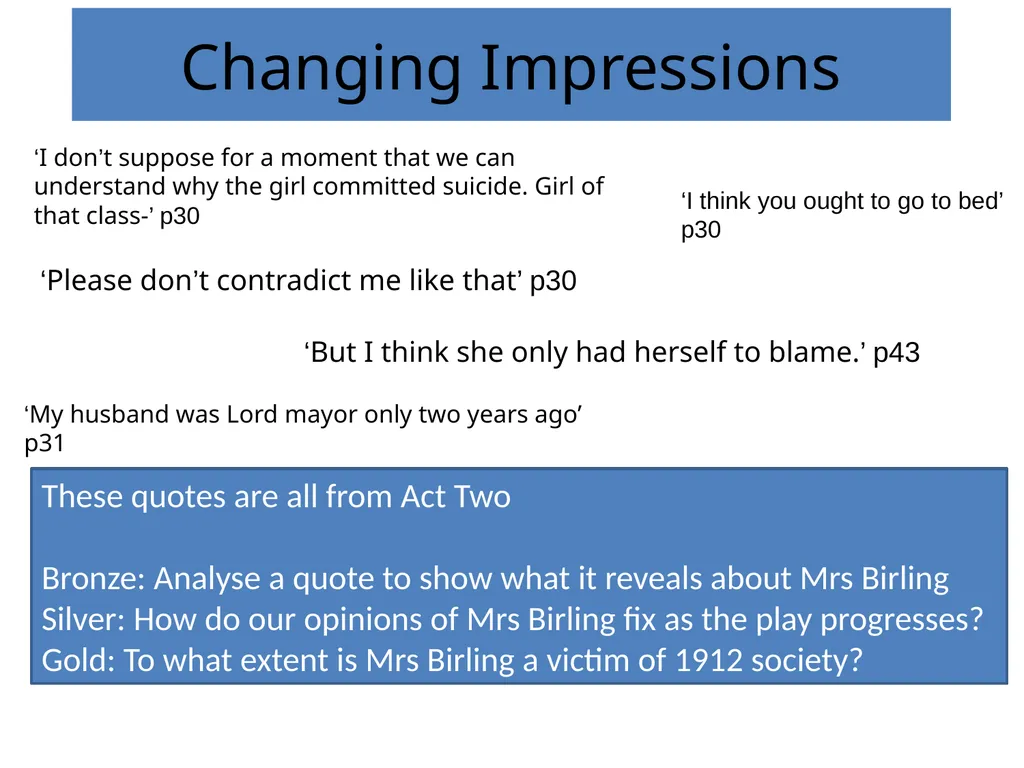
Changing Impressions ‘I don’t suppose for a moment that we can understand why the girl committed suicide. Girl of that class-’ p30 ‘I think you ought to go to bed’ p30 ‘Please don’t contradict me like that’ p30 ‘But I think she only had herself to blame.’ p43 ‘My husband was Lord mayor only two years ago’ p31 These quotes are all from Act Two
Bronze: Analyse a quote to show what it reveals about Mrs Birling
Silver: How do our opinions of Mrs Birling fix as the play progresses?
Gold: To what extent is Mrs Birling a victim of 1912 society?<br>
Bronze: Analyse a quote to show what it reveals about Mrs Birling
Silver: How do our opinions of Mrs Birling fix as the play progresses?
Gold: To what extent is Mrs Birling a victim of 1912 society?<br>
17
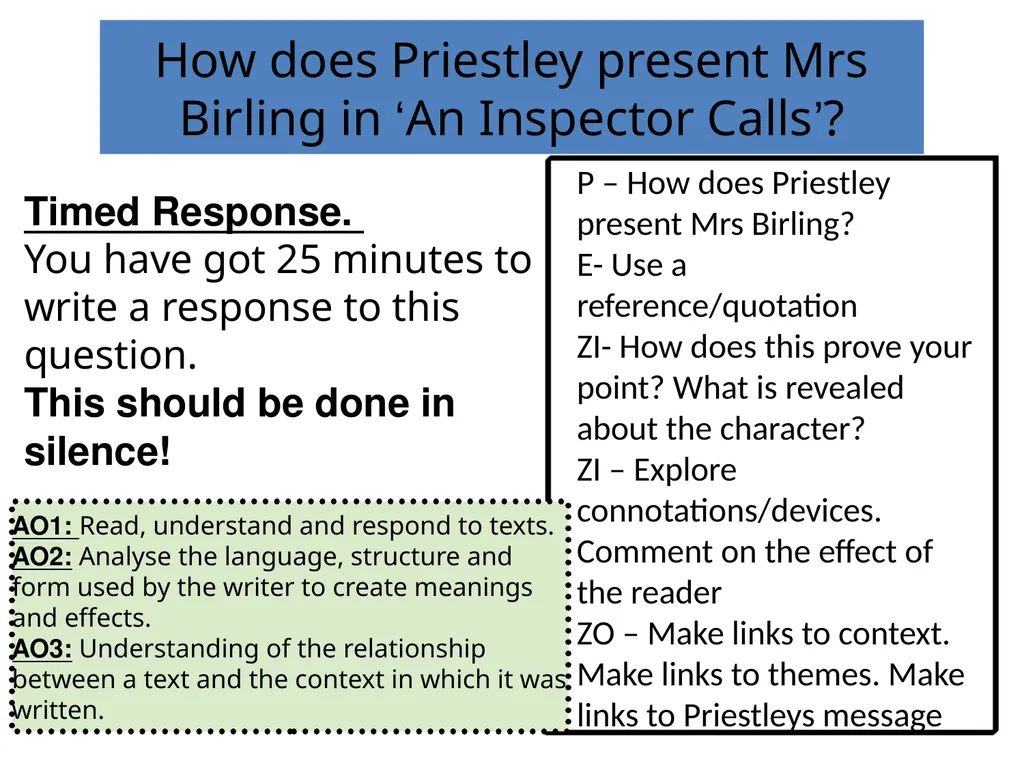
How does Priestley present Mrs Birling in ‘An Inspector Calls’? Timed Response.
You have got 25 minutes to write a response to this question.
This should be done in silence! AO1: Read, understand and respond to texts.
AO2: Analyse the language, structure and form used by the writer to create meanings and effects.
AO3: Understanding of the relationship between a text and the context in which it was written. P – How does Priestley present Mrs Birling?
E- Use a reference/quotation
ZI- How does this prove your point? What is revealed about the character?
ZI – Explore connotations/devices. Comment on the effect of the reader
ZO – Make links to context. Make links to themes. Make links to Priestleys message<br>
You have got 25 minutes to write a response to this question.
This should be done in silence! AO1: Read, understand and respond to texts.
AO2: Analyse the language, structure and form used by the writer to create meanings and effects.
AO3: Understanding of the relationship between a text and the context in which it was written. P – How does Priestley present Mrs Birling?
E- Use a reference/quotation
ZI- How does this prove your point? What is revealed about the character?
ZI – Explore connotations/devices. Comment on the effect of the reader
ZO – Make links to context. Make links to themes. Make links to Priestleys message<br>
18
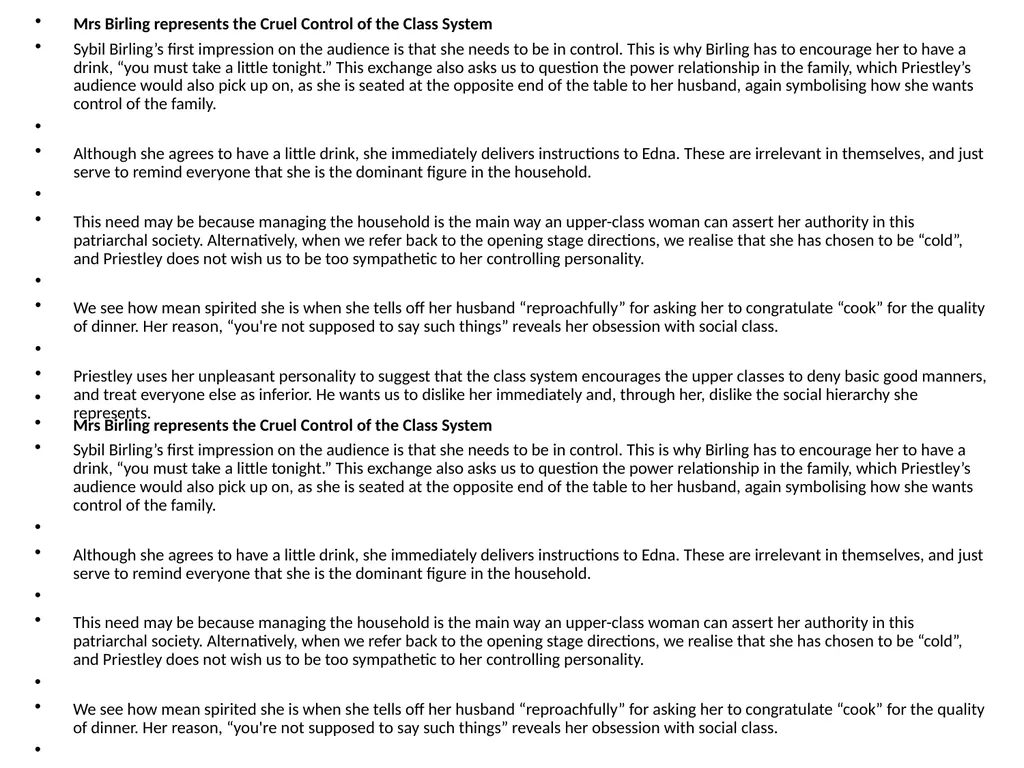
Mrs Birling represents the Cruel Control of the Class System
Sybil Birling’s first impression on the audience is that she needs to be in control. This is why Birling has to encourage her to have a drink, “you must take a little tonight.” This exchange also asks us to question the power relationship in the family, which Priestley’s audience would also pick up on, as she is seated at the opposite end of the table to her husband, again symbolising how she wants control of the family.
Although she agrees to have a little drink, she immediately delivers instructions to Edna. These are irrelevant in themselves, and just serve to remind everyone that she is the dominant figure in the household.
This need may be because managing the household is the main way an upper-class woman can assert her authority in this patriarchal society. Alternatively, when we refer back to the opening stage directions, we realise that she has chosen to be “cold”, and Priestley does not wish us to be too sympathetic to her controlling personality.
We see how mean spirited she is when she tells off her husband “reproachfully” for asking her to congratulate “cook” for the quality of dinner. Her reason, “you're not supposed to say such things” reveals her obsession with social class.
Priestley uses her unpleasant personality to suggest that the class system encourages the upper classes to deny basic good manners, and treat everyone else as inferior. He wants us to dislike her immediately and, through her, dislike the social hierarchy she represents. Mrs Birling represents the Cruel Control of the Class System
Sybil Birling’s first impression on the audience is that she needs to be in control. This is why Birling has to encourage her to have a drink, “you must take a little tonight.” This exchange also asks us to question the power relationship in the family, which Priestley’s audience would also pick up on, as she is seated at the opposite end of the table to her husband, again symbolising how she wants control of the family.
Although she agrees to have a little drink, she immediately delivers instructions to Edna. These are irrelevant in themselves, and just serve to remind everyone that she is the dominant figure in the household.
This need may be because managing the household is the main way an upper-class woman can assert her authority in this patriarchal society. Alternatively, when we refer back to the opening stage directions, we realise that she has chosen to be “cold”, and Priestley does not wish us to be too sympathetic to her controlling personality.
We see how mean spirited she is when she tells off her husband “reproachfully” for asking her to congratulate “cook” for the quality of dinner. Her reason, “you're not supposed to say such things” reveals her obsession with social class.
Priestley uses her unpleasant personality to suggest that the class system encourages the upper classes to deny basic good manners, and treat everyone else as inferior. He wants us to dislike her immediately and, through her, dislike the social hierarchy she represents.<br>
Sybil Birling’s first impression on the audience is that she needs to be in control. This is why Birling has to encourage her to have a drink, “you must take a little tonight.” This exchange also asks us to question the power relationship in the family, which Priestley’s audience would also pick up on, as she is seated at the opposite end of the table to her husband, again symbolising how she wants control of the family.
Although she agrees to have a little drink, she immediately delivers instructions to Edna. These are irrelevant in themselves, and just serve to remind everyone that she is the dominant figure in the household.
This need may be because managing the household is the main way an upper-class woman can assert her authority in this patriarchal society. Alternatively, when we refer back to the opening stage directions, we realise that she has chosen to be “cold”, and Priestley does not wish us to be too sympathetic to her controlling personality.
We see how mean spirited she is when she tells off her husband “reproachfully” for asking her to congratulate “cook” for the quality of dinner. Her reason, “you're not supposed to say such things” reveals her obsession with social class.
Priestley uses her unpleasant personality to suggest that the class system encourages the upper classes to deny basic good manners, and treat everyone else as inferior. He wants us to dislike her immediately and, through her, dislike the social hierarchy she represents. Mrs Birling represents the Cruel Control of the Class System
Sybil Birling’s first impression on the audience is that she needs to be in control. This is why Birling has to encourage her to have a drink, “you must take a little tonight.” This exchange also asks us to question the power relationship in the family, which Priestley’s audience would also pick up on, as she is seated at the opposite end of the table to her husband, again symbolising how she wants control of the family.
Although she agrees to have a little drink, she immediately delivers instructions to Edna. These are irrelevant in themselves, and just serve to remind everyone that she is the dominant figure in the household.
This need may be because managing the household is the main way an upper-class woman can assert her authority in this patriarchal society. Alternatively, when we refer back to the opening stage directions, we realise that she has chosen to be “cold”, and Priestley does not wish us to be too sympathetic to her controlling personality.
We see how mean spirited she is when she tells off her husband “reproachfully” for asking her to congratulate “cook” for the quality of dinner. Her reason, “you're not supposed to say such things” reveals her obsession with social class.
Priestley uses her unpleasant personality to suggest that the class system encourages the upper classes to deny basic good manners, and treat everyone else as inferior. He wants us to dislike her immediately and, through her, dislike the social hierarchy she represents.<br>
19
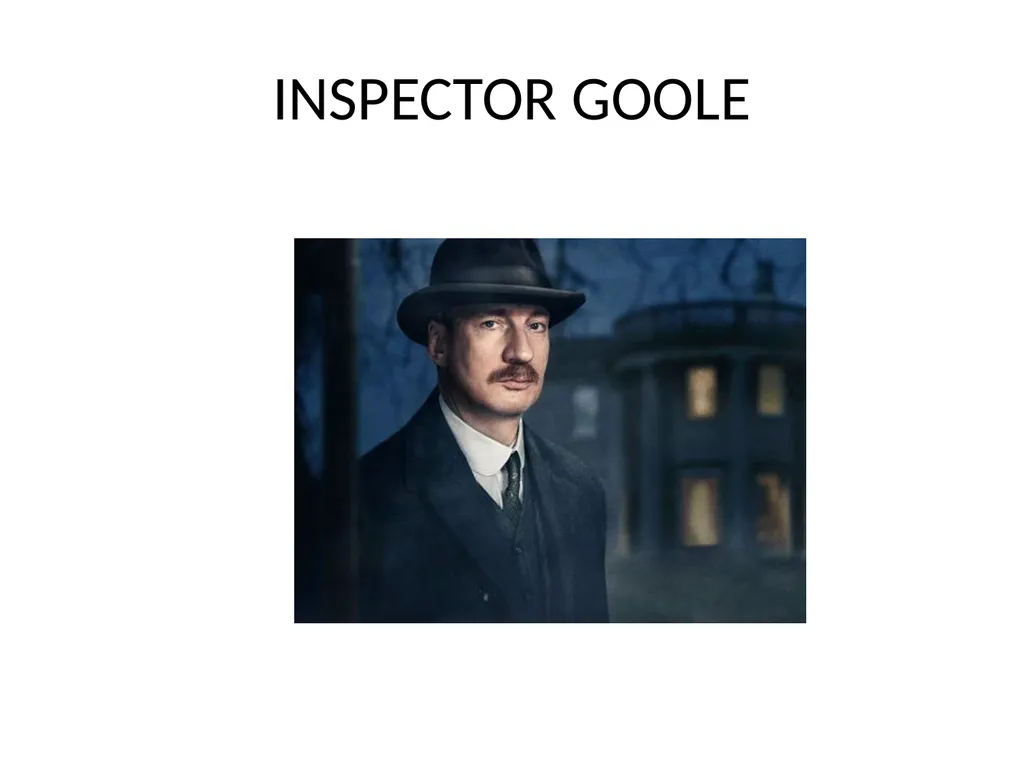
INSPECTOR GOOLE<br>
20
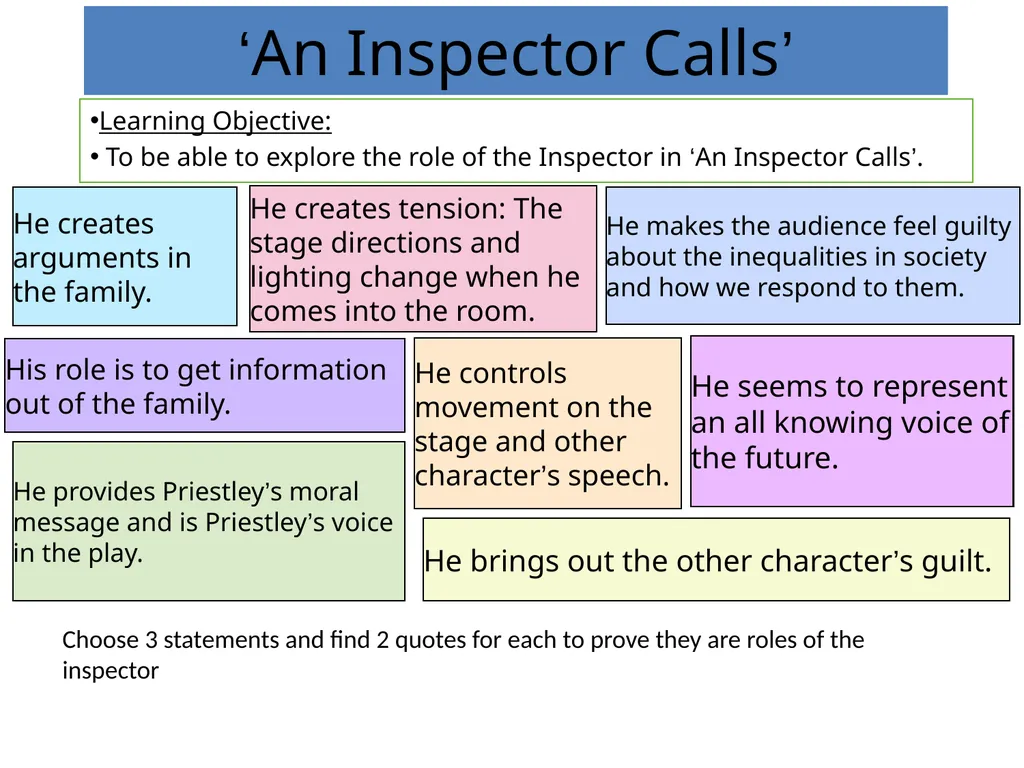
‘An Inspector Calls’ Learning Objective:
To be able to explore the role of the Inspector in ‘An Inspector Calls’. He creates arguments in the family. He makes the audience feel guilty about the inequalities in society and how we respond to them. His role is to get information out of the family. He seems to represent an all knowing voice of the future. He creates tension: The stage directions and lighting change when he comes into the room. He controls movement on the stage and other character’s speech. He brings out the other character’s guilt. He provides Priestley’s moral message and is Priestley’s voice in the play. Choose 3 statements and find 2 quotes for each to prove they are roles of the inspector<br>
To be able to explore the role of the Inspector in ‘An Inspector Calls’. He creates arguments in the family. He makes the audience feel guilty about the inequalities in society and how we respond to them. His role is to get information out of the family. He seems to represent an all knowing voice of the future. He creates tension: The stage directions and lighting change when he comes into the room. He controls movement on the stage and other character’s speech. He brings out the other character’s guilt. He provides Priestley’s moral message and is Priestley’s voice in the play. Choose 3 statements and find 2 quotes for each to prove they are roles of the inspector<br>
21
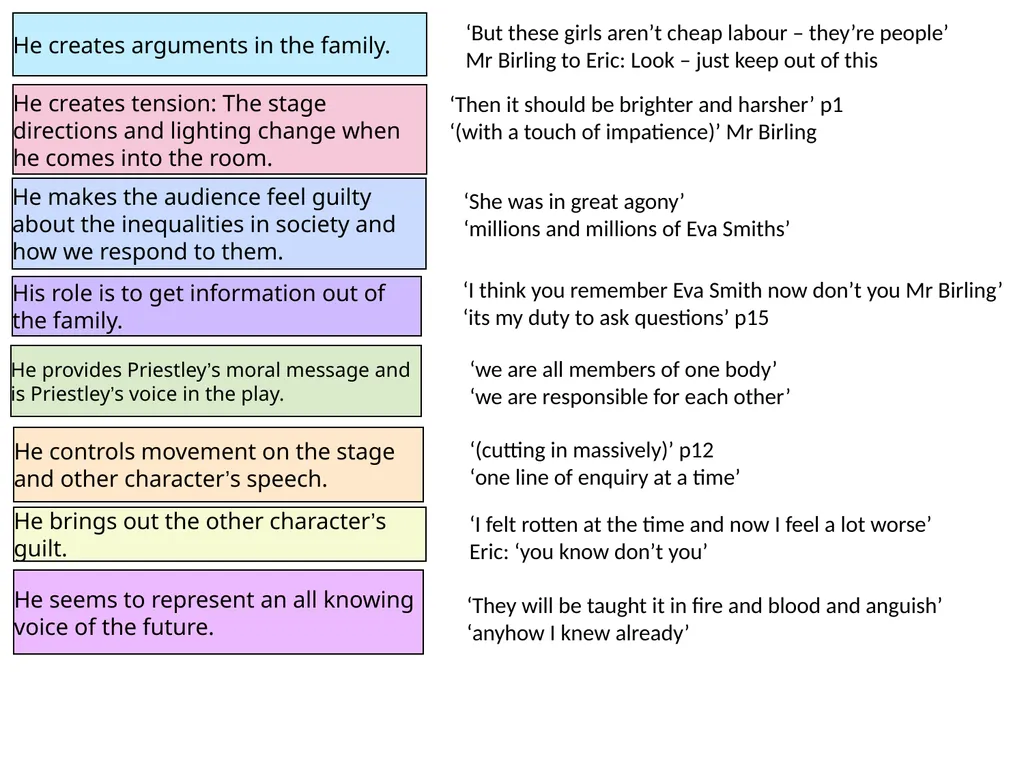
He creates arguments in the family. He makes the audience feel guilty about the inequalities in society and how we respond to them. His role is to get information out of the family. He seems to represent an all knowing voice of the future. He creates tension: The stage directions and lighting change when he comes into the room. He controls movement on the stage and other character’s speech. He brings out the other character’s guilt. He provides Priestley’s moral message and is Priestley’s voice in the play. ‘But these girls aren’t cheap labour – they’re people’
Mr Birling to Eric: Look – just keep out of this ‘Then it should be brighter and harsher’ p1
‘(with a touch of impatience)’ Mr Birling ‘She was in great agony’
‘millions and millions of Eva Smiths’ ‘I think you remember Eva Smith now don’t you Mr Birling’
‘its my duty to ask questions’ p15 ‘we are all members of one body’
‘we are responsible for each other’ ‘(cutting in massively)’ p12
‘one line of enquiry at a time’ ‘I felt rotten at the time and now I feel a lot worse’
Eric: ‘you know don’t you’ ‘They will be taught it in fire and blood and anguish’
‘anyhow I knew already’<br>
Mr Birling to Eric: Look – just keep out of this ‘Then it should be brighter and harsher’ p1
‘(with a touch of impatience)’ Mr Birling ‘She was in great agony’
‘millions and millions of Eva Smiths’ ‘I think you remember Eva Smith now don’t you Mr Birling’
‘its my duty to ask questions’ p15 ‘we are all members of one body’
‘we are responsible for each other’ ‘(cutting in massively)’ p12
‘one line of enquiry at a time’ ‘I felt rotten at the time and now I feel a lot worse’
Eric: ‘you know don’t you’ ‘They will be taught it in fire and blood and anguish’
‘anyhow I knew already’<br>
22
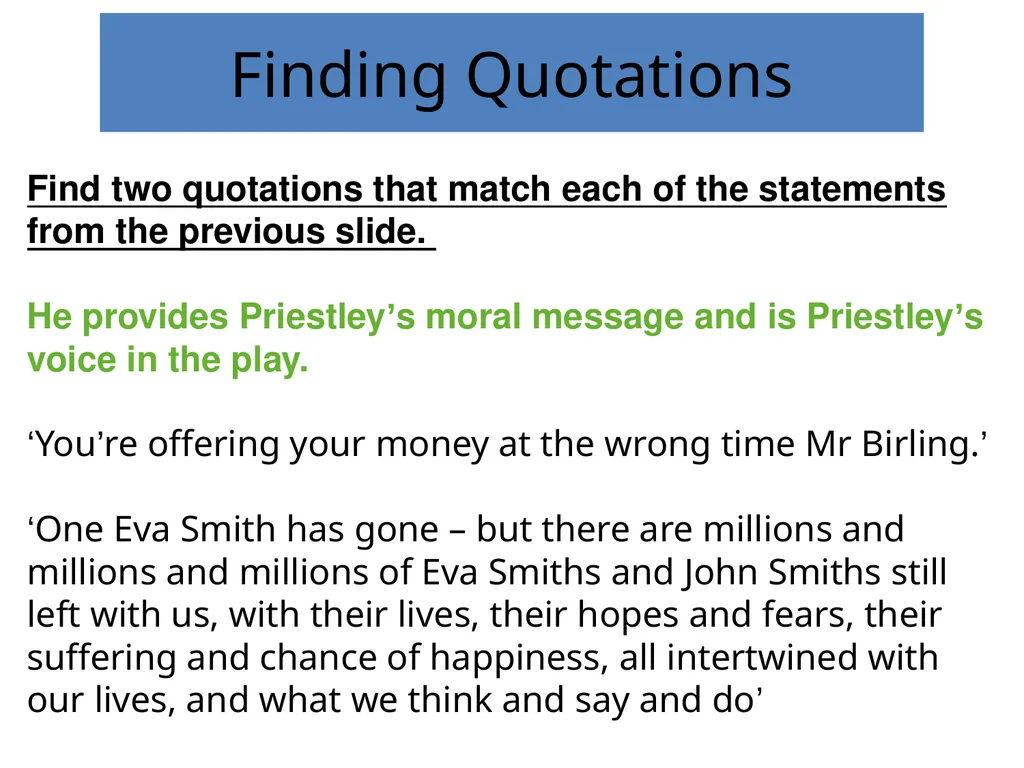
Finding Quotations Find two quotations that match each of the statements from the previous slide.
He provides Priestley’s moral message and is Priestley’s voice in the play.
‘You’re offering your money at the wrong time Mr Birling.’
‘One Eva Smith has gone – but there are millions and millions and millions of Eva Smiths and John Smiths still left with us, with their lives, their hopes and fears, their suffering and chance of happiness, all intertwined with our lives, and what we think and say and do’<br>
He provides Priestley’s moral message and is Priestley’s voice in the play.
‘You’re offering your money at the wrong time Mr Birling.’
‘One Eva Smith has gone – but there are millions and millions and millions of Eva Smiths and John Smiths still left with us, with their lives, their hopes and fears, their suffering and chance of happiness, all intertwined with our lives, and what we think and say and do’<br>
23
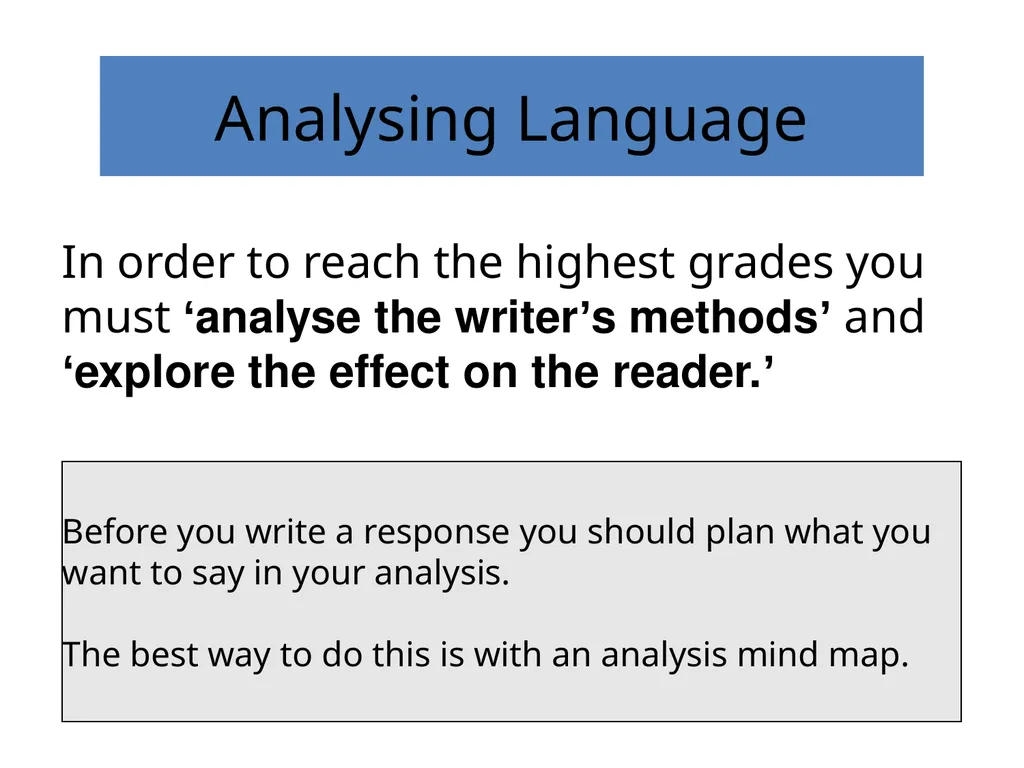
Analysing Language In order to reach the highest grades you must ‘analyse the writer’s methods’ and ‘explore the effect on the reader.’ Before you write a response you should plan what you want to say in your analysis.
The best way to do this is with an analysis mind map.<br>
The best way to do this is with an analysis mind map.<br>
24
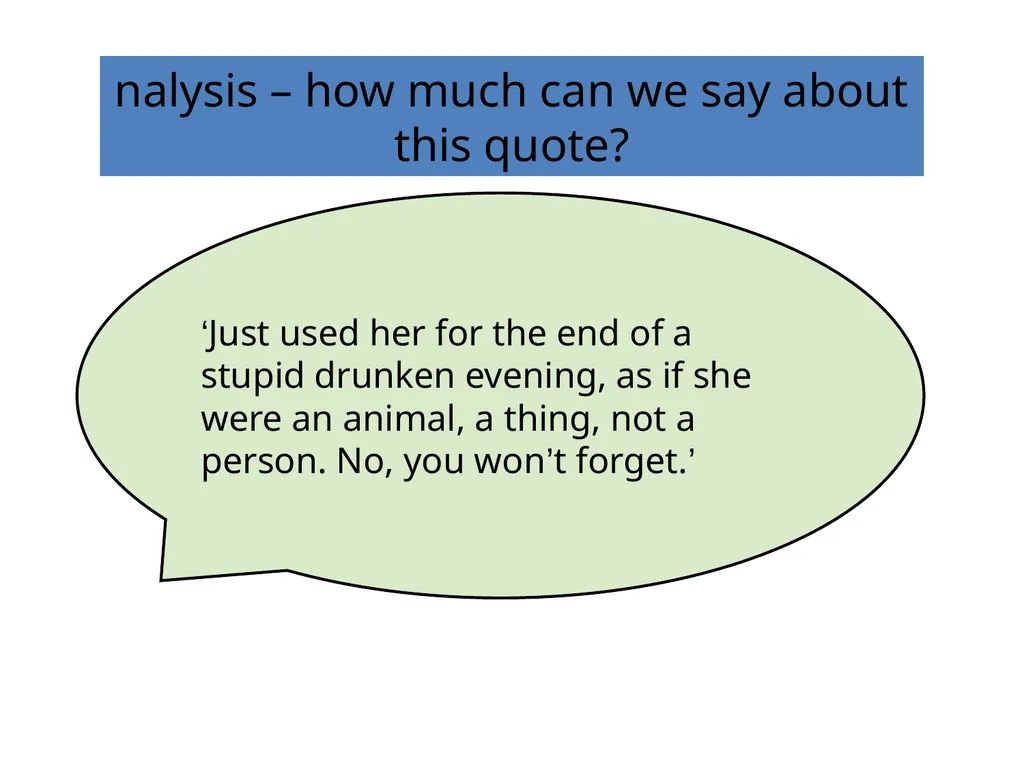
‘Just used her for the end of a stupid drunken evening, as if she were an animal, a thing, not a person. No, you won’t forget.’ nalysis – how much can we say about this quote?<br>
25
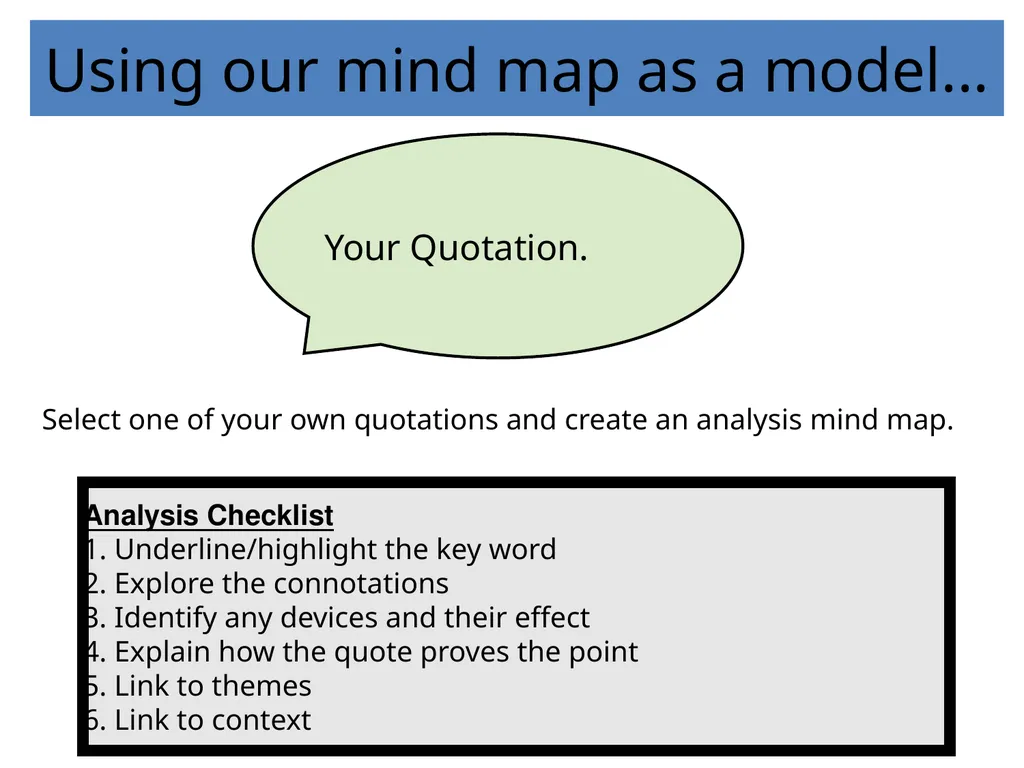
Using our mind map as a model... Your Quotation. Select one of your own quotations and create an analysis mind map. Analysis Checklist
1. Underline/highlight the key word
2. Explore the connotations
3. Identify any devices and their effect
4. Explain how the quote proves the point
5. Link to themes
6. Link to context<br>
1. Underline/highlight the key word
2. Explore the connotations
3. Identify any devices and their effect
4. Explain how the quote proves the point
5. Link to themes
6. Link to context<br>
26
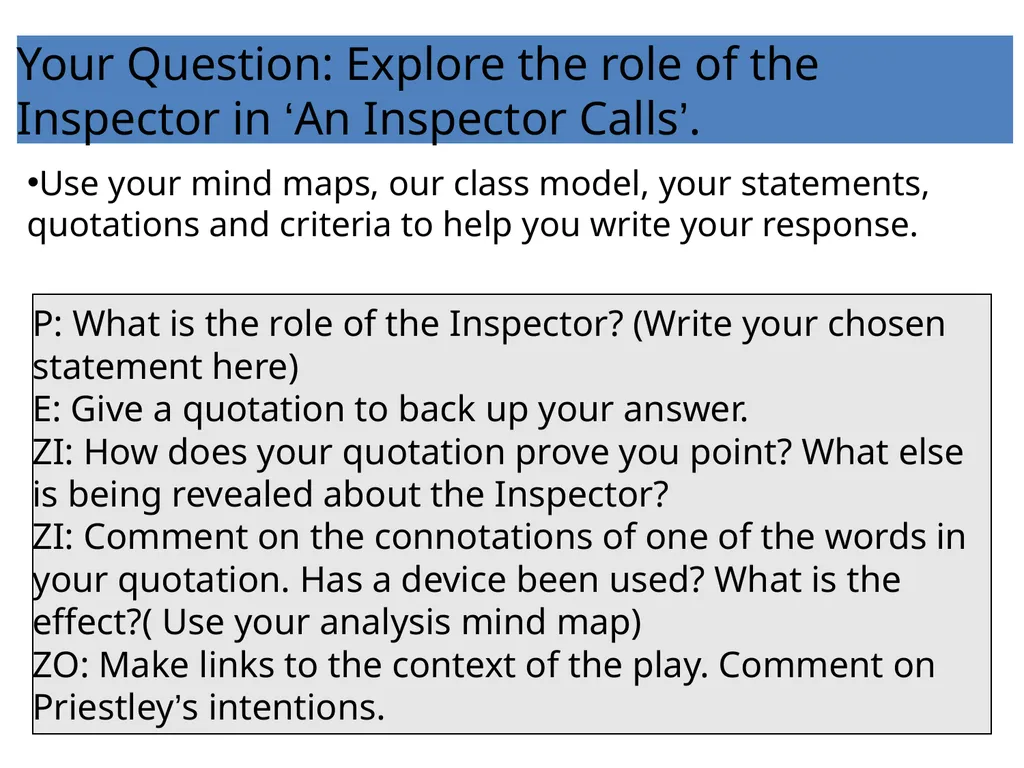
Use your mind maps, our class model, your statements, quotations and criteria to help you write your response. Your Question: Explore the role of the Inspector in ‘An Inspector Calls’. P: What is the role of the Inspector? (Write your chosen statement here)
E: Give a quotation to back up your answer.
ZI: How does your quotation prove you point? What else is being revealed about the Inspector?
ZI: Comment on the connotations of one of the words in your quotation. Has a device been used? What is the effect?( Use your analysis mind map)
ZO: Make links to the context of the play. Comment on Priestley’s intentions.<br>
E: Give a quotation to back up your answer.
ZI: How does your quotation prove you point? What else is being revealed about the Inspector?
ZI: Comment on the connotations of one of the words in your quotation. Has a device been used? What is the effect?( Use your analysis mind map)
ZO: Make links to the context of the play. Comment on Priestley’s intentions.<br>