
Using nouns to establish genre and setting LEAD

Description: Using nouns to establish genre and setting LEAD Principles Genre and Setting What genre is this story? What might the setting be like for this story? What might be the names of places and objects in the story? What might the writer want to
Related Topics
Download Presentation
"Using nouns to establish genre and setting LEAD" is the property of its rightful owner. Permission is granted to download and print the materials on this website for personal, non-commercial use only, and to display it on your personal computer provided you do not modify the materials and that you retain all copyright notices contained in the materials. By downloading content from our website, you accept the terms of this agreement.
Presentation Transcript
slide1. Using nouns to establish genre and setting<br>
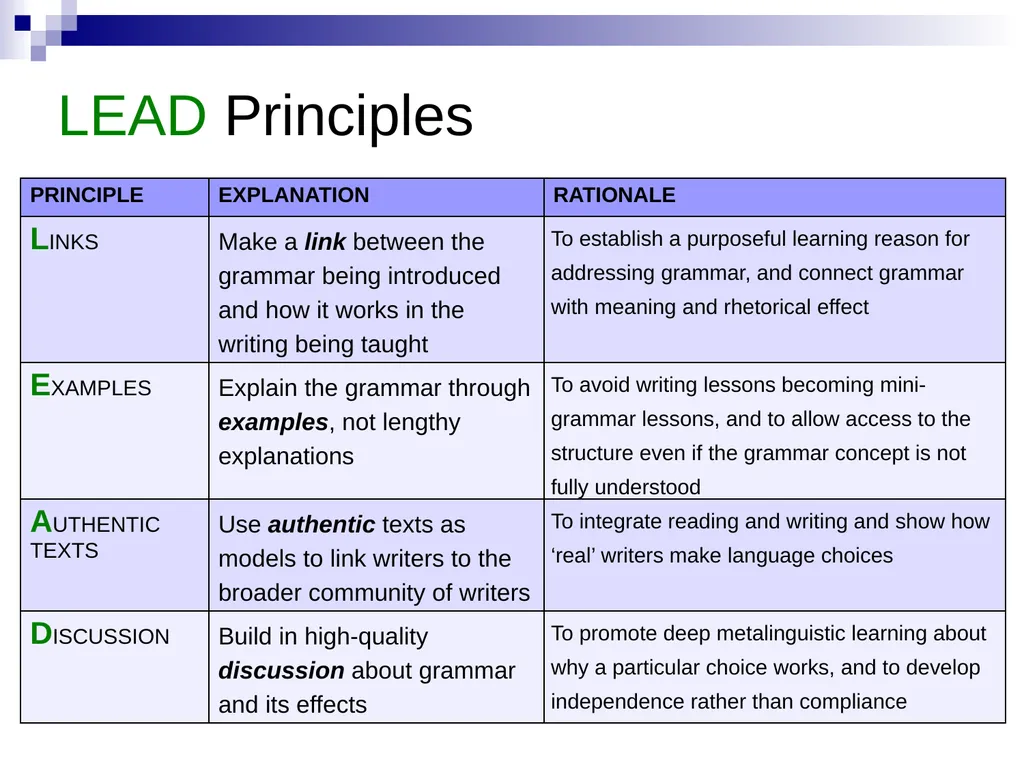
slide2. LEAD Principles<br>
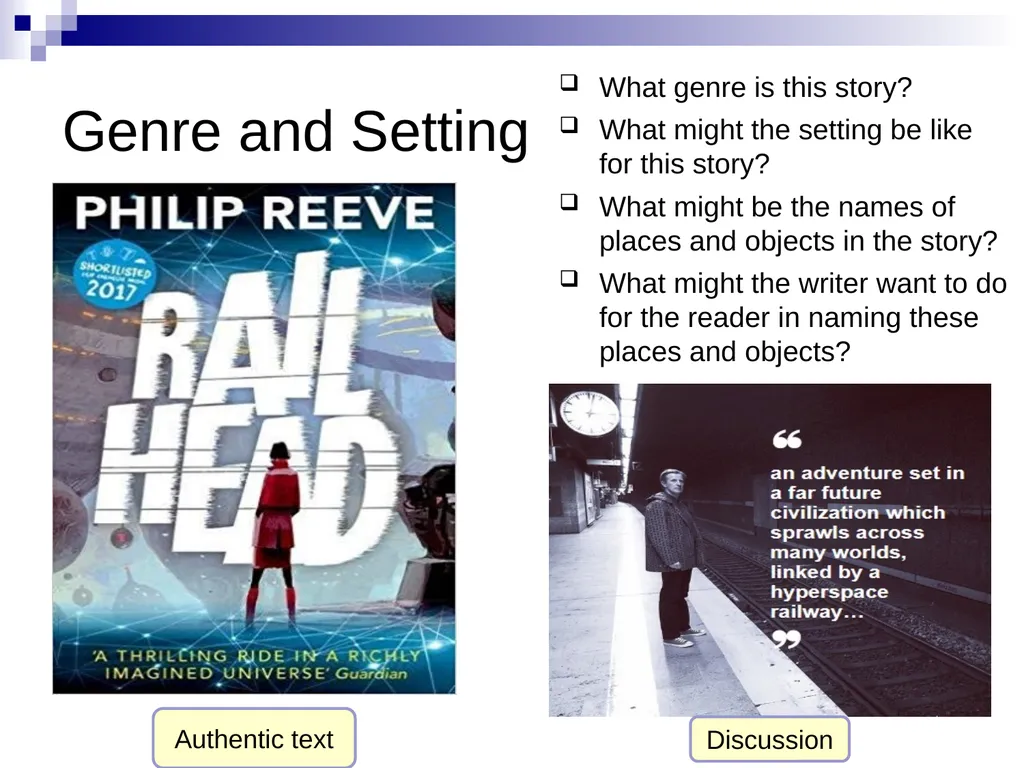
slide3. Genre and Setting What genre is this story?
What might the setting be like for this story?
What might be the names of places and objects in the story?
What might the writer want to do for the reader in naming these places and objects? Authentic text Discussion<br>
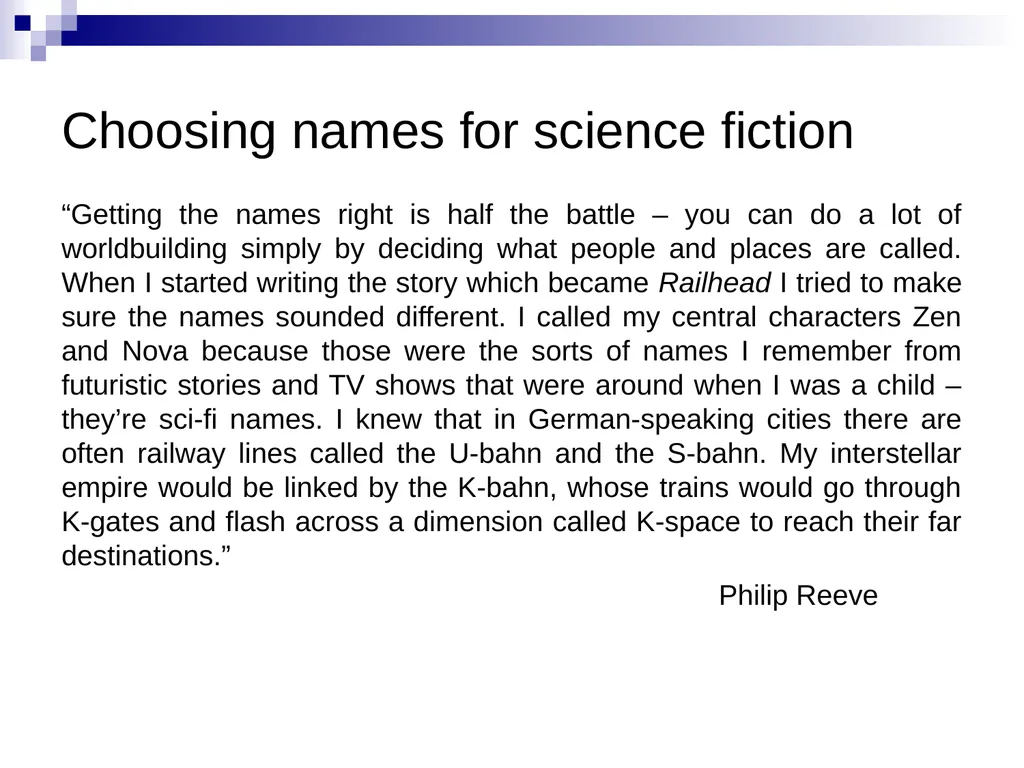
slide4. Choosing names for science fiction “Getting the names right is half the battle – you can do a lot of worldbuilding simply by deciding what people and places are called. When I started writing the story which became Railhead I tried to make sure the names sounded different. I called my central characters Zen and Nova because those were the sorts of names I remember from futuristic stories and TV shows that were around when I was a child – they’re sci-fi names. I knew that in German-speaking cities there are often railway lines called the U-bahn and the S-bahn. My interstellar empire would be linked by the K-bahn, whose trains would go through K-gates and flash across a dimension called K-space to reach their far destinations.”
Philip Reeve<br>
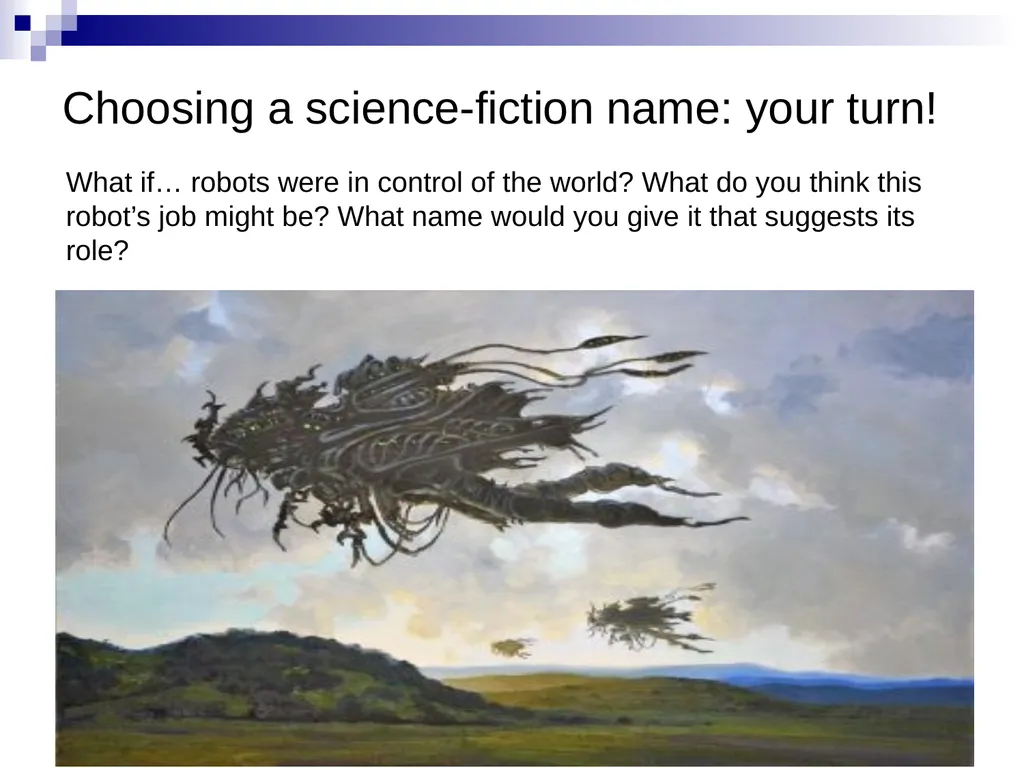
slide5. Choosing a science-fiction name: your turn! What if… robots were in control of the world? What do you think this robot’s job might be? What name would you give it that suggests its role?<br>
slide6. Using Proper Nouns to describe a science fiction setting Examples Zen’s hometown was a sheer-sided ditch of a place. Cleave’s houses and factories were packed like shelved crates up each wall of a mile-deep canyon on a one-gate world called Angkat whose surface was scoured by constant storms. Space was scarce, so the buildings huddled into every available scrap of terracing, and clung to cliff faces, and crowded on the bridges which stretched across the gulf between the canyon walls – a gulf which was filled with sagging cables, dangling neon signage, smog, dirty rain, and the fluttering rotors of air taxis, ferries and corporate transports. Between the steep-stacked buildings a thousand waterfalls went foaming down to join the river far below, adding their own roar to the various dins from the industrial zone. The local name for Cleave was Thunder City.
From Railhead by Philip Reeve Links What impression of this place do you get? Would you want to live there?
What more do the highlighted place names tell you? Discussion<br>
slide7. Using concrete nouns to describe a science fiction setting Zen’s hometown was a sheer-sided ditch of a place. Cleave’s houses and factories were packed like shelved crates up each wall of a mile-deep canyon on a one-gate world called Angkat whose surface was scoured by constant storms. Space was scarce, so the buildings huddled into every available scrap of terracing, and clung to cliff faces, and crowded on the bridges which stretched across the gulf between the canyon walls – a gulf which was filled with sagging cables, dangling neon signage, smog, dirty rain, and the fluttering rotors of air taxis, ferries and corporate transports. Between the steep-stacked buildings a thousand waterfalls went foaming down to join the river far below, adding their own roar to the various dins from the industrial zone. The local name for Cleave was Thunder City. Why do you think there are so many objects listed in this description?
What things are familiar to you? What things are more unusual?
Would you want to live in this place? Why, or why not?<br>
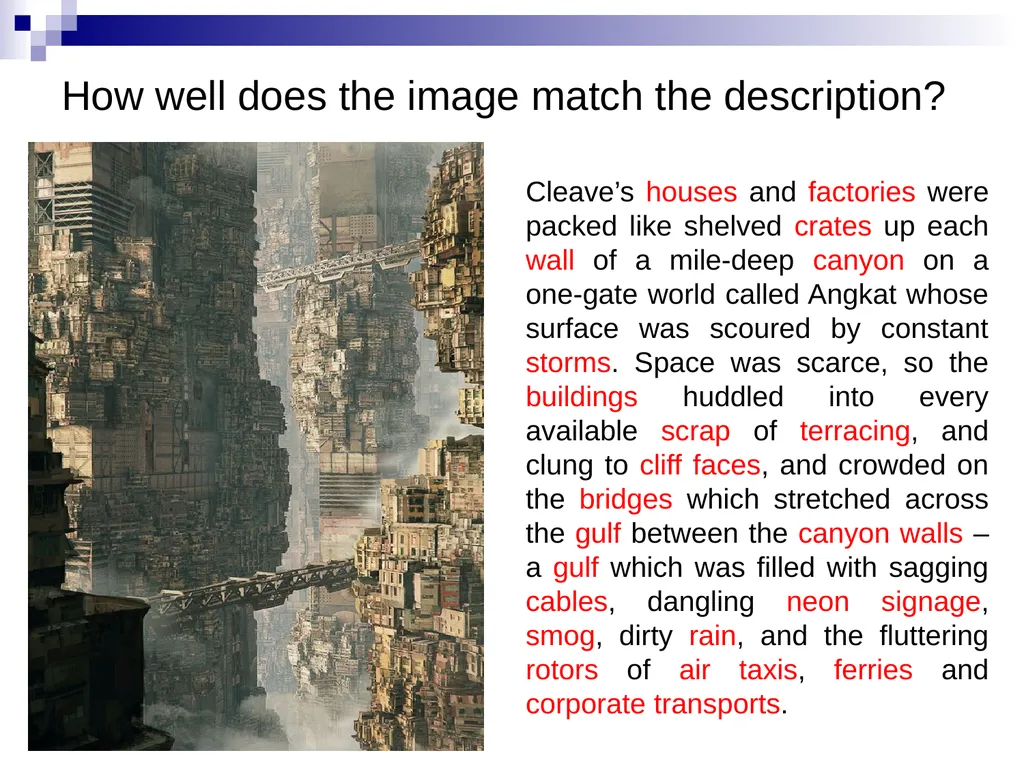
slide8. How well does the image match the description? Cleave’s houses and factories were packed like shelved crates up each wall of a mile-deep canyon on a one-gate world called Angkat whose surface was scoured by constant storms. Space was scarce, so the buildings huddled into every available scrap of terracing, and clung to cliff faces, and crowded on the bridges which stretched across the gulf between the canyon walls – a gulf which was filled with sagging cables, dangling neon signage, smog, dirty rain, and the fluttering rotors of air taxis, ferries and corporate transports.<br>
slide9. Verbalising the Grammar-Writing Link Verbalisation to share with students:
When you are writing narrative, you can help your reader to understand the genre of your story and to visualise important settings within it.
Choose your Proper and concrete nouns carefully! Ask yourself what you want your reader to see, think and feel about the setting that you’re describing. A crucial element of the LEAD principles is helping writers to think explicitly (metalinguistically) about the choices they make. As a teacher, you need to support this by being crystal clear yourself about how you verbalise the link between a grammar choice and its effect in a particular text/context. Then express this in student-friendly language, as below.<br>
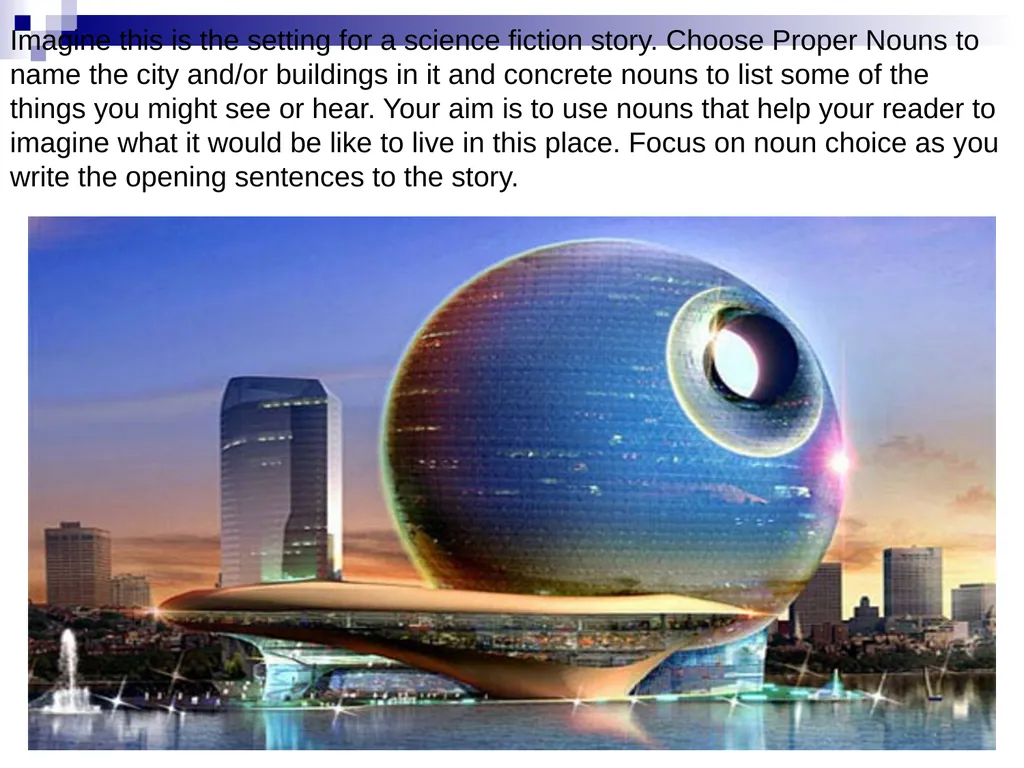
slide10. Imagine this is the setting for a science fiction story. Choose Proper Nouns to name the city and/or buildings in it and concrete nouns to list some of the things you might see or hear. Your aim is to use nouns that help your reader to imagine what it would be like to live in this place. Focus on noun choice as you write the opening sentences to the story.<br>
slide2. LEAD Principles<br>
slide3. Genre and Setting What genre is this story?
What might the setting be like for this story?
What might be the names of places and objects in the story?
What might the writer want to do for the reader in naming these places and objects? Authentic text Discussion<br>
slide4. Choosing names for science fiction “Getting the names right is half the battle – you can do a lot of worldbuilding simply by deciding what people and places are called. When I started writing the story which became Railhead I tried to make sure the names sounded different. I called my central characters Zen and Nova because those were the sorts of names I remember from futuristic stories and TV shows that were around when I was a child – they’re sci-fi names. I knew that in German-speaking cities there are often railway lines called the U-bahn and the S-bahn. My interstellar empire would be linked by the K-bahn, whose trains would go through K-gates and flash across a dimension called K-space to reach their far destinations.”
Philip Reeve<br>
slide5. Choosing a science-fiction name: your turn! What if… robots were in control of the world? What do you think this robot’s job might be? What name would you give it that suggests its role?<br>
slide6. Using Proper Nouns to describe a science fiction setting Examples Zen’s hometown was a sheer-sided ditch of a place. Cleave’s houses and factories were packed like shelved crates up each wall of a mile-deep canyon on a one-gate world called Angkat whose surface was scoured by constant storms. Space was scarce, so the buildings huddled into every available scrap of terracing, and clung to cliff faces, and crowded on the bridges which stretched across the gulf between the canyon walls – a gulf which was filled with sagging cables, dangling neon signage, smog, dirty rain, and the fluttering rotors of air taxis, ferries and corporate transports. Between the steep-stacked buildings a thousand waterfalls went foaming down to join the river far below, adding their own roar to the various dins from the industrial zone. The local name for Cleave was Thunder City.
From Railhead by Philip Reeve Links What impression of this place do you get? Would you want to live there?
What more do the highlighted place names tell you? Discussion<br>
slide7. Using concrete nouns to describe a science fiction setting Zen’s hometown was a sheer-sided ditch of a place. Cleave’s houses and factories were packed like shelved crates up each wall of a mile-deep canyon on a one-gate world called Angkat whose surface was scoured by constant storms. Space was scarce, so the buildings huddled into every available scrap of terracing, and clung to cliff faces, and crowded on the bridges which stretched across the gulf between the canyon walls – a gulf which was filled with sagging cables, dangling neon signage, smog, dirty rain, and the fluttering rotors of air taxis, ferries and corporate transports. Between the steep-stacked buildings a thousand waterfalls went foaming down to join the river far below, adding their own roar to the various dins from the industrial zone. The local name for Cleave was Thunder City. Why do you think there are so many objects listed in this description?
What things are familiar to you? What things are more unusual?
Would you want to live in this place? Why, or why not?<br>
slide8. How well does the image match the description? Cleave’s houses and factories were packed like shelved crates up each wall of a mile-deep canyon on a one-gate world called Angkat whose surface was scoured by constant storms. Space was scarce, so the buildings huddled into every available scrap of terracing, and clung to cliff faces, and crowded on the bridges which stretched across the gulf between the canyon walls – a gulf which was filled with sagging cables, dangling neon signage, smog, dirty rain, and the fluttering rotors of air taxis, ferries and corporate transports.<br>
slide9. Verbalising the Grammar-Writing Link Verbalisation to share with students:
When you are writing narrative, you can help your reader to understand the genre of your story and to visualise important settings within it.
Choose your Proper and concrete nouns carefully! Ask yourself what you want your reader to see, think and feel about the setting that you’re describing. A crucial element of the LEAD principles is helping writers to think explicitly (metalinguistically) about the choices they make. As a teacher, you need to support this by being crystal clear yourself about how you verbalise the link between a grammar choice and its effect in a particular text/context. Then express this in student-friendly language, as below.<br>
slide10. Imagine this is the setting for a science fiction story. Choose Proper Nouns to name the city and/or buildings in it and concrete nouns to list some of the things you might see or hear. Your aim is to use nouns that help your reader to imagine what it would be like to live in this place. Focus on noun choice as you write the opening sentences to the story.<br>