
Using Responsive and Reciprocal Interactions,
Description: Using Responsive and Reciprocal Interactions, Interventions, and Instruction Initial Practice-Based Professional Preparation Standards Early InterventionistsEarly Childhood Special Educators 6.4 Standard 6 Candidates plan and implement
Related Topics
Download Presentation
"Using Responsive and Reciprocal Interactions," is the property of its rightful owner. Permission is granted to download and print the materials on this website for personal, non-commercial use only, and to display it on your personal computer provided you do not modify the materials and that you retain all copyright notices contained in the materials. By downloading content from our website, you accept the terms of this agreement.
Presentation Transcript
slide1. Using Responsive and Reciprocal Interactions, Interventions, and Instruction Initial Practice-Based Professional Preparation Standards Early Interventionists/Early Childhood Special Educators
6.4<br>
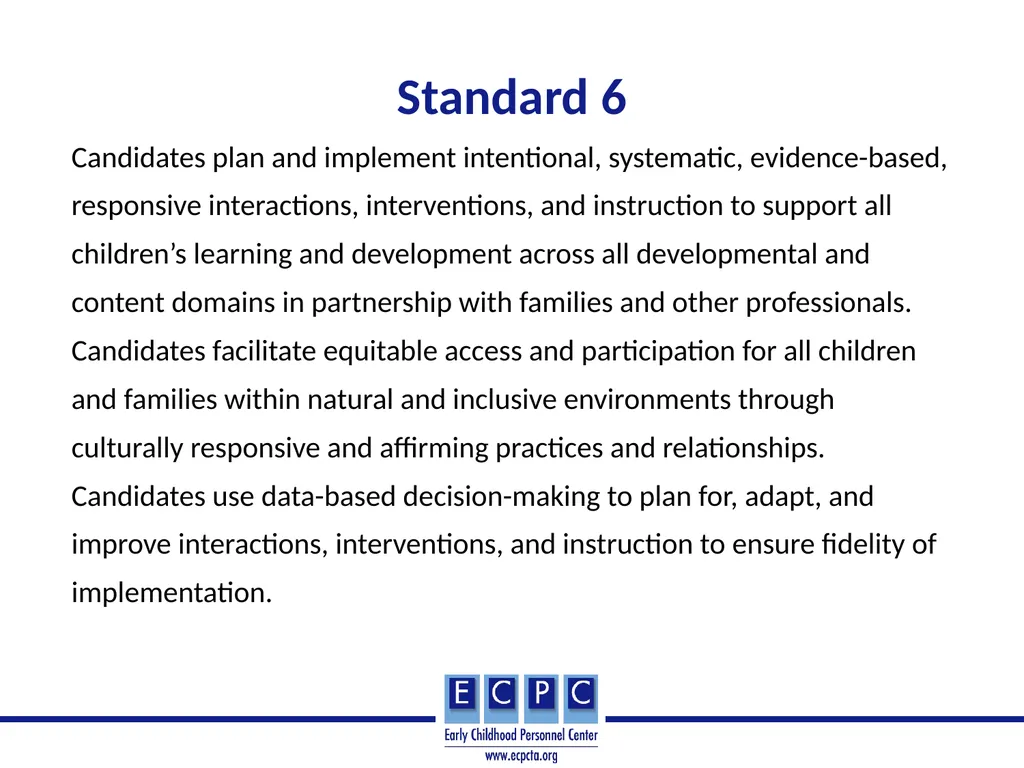
slide2. Standard 6 Candidates plan and implement intentional, systematic, evidence-based, responsive interactions, interventions, and instruction to support all children’s learning and development across all developmental and content domains in partnership with families and other professionals. Candidates facilitate equitable access and participation for all children and families within natural and inclusive environments through culturally responsive and affirming practices and relationships. Candidates use data-based decision-making to plan for, adapt, and improve interactions, interventions, and instruction to ensure fidelity of implementation.<br>
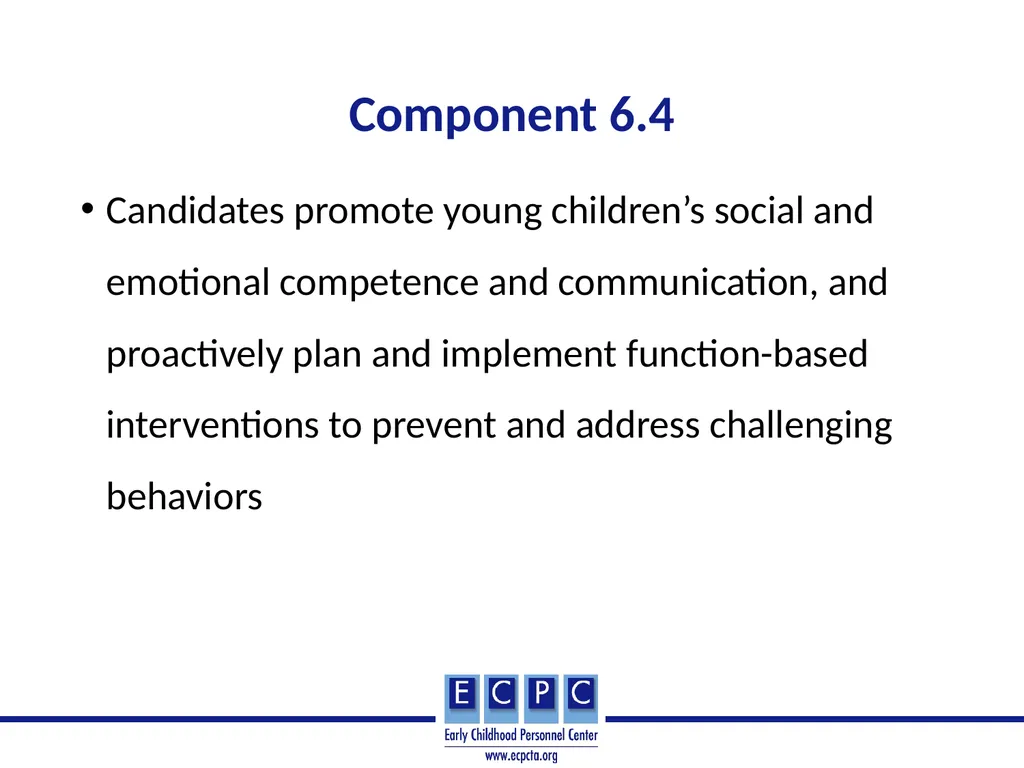
slide3. Component 6.4 Candidates promote young children’s social and emotional competence and communication, and proactively plan and implement function-based interventions to prevent and address challenging behaviors<br>
slide4. Objectives Describe evidence-based strategies for teaching and promoting social and emotional competence in young children.
Describe evidence-based strategies for teaching and promoting communication competence in young children.
Describe using a functional behavioral assessment (FBA) to plan and implement function-based interventions to prevent and address challenging behaviors.<br>
slide5. What is Social Emotional Competence? A child’s developing ability to form close, secure relationships with others
These bonds create the safety that all children need to explore the world and engage in positive interactions with others
These safe, positive relationships support the development of executive functioning<br>
slide6. Executive Functioning and the Development of Social-Emotional Health Working memory: retention and use of newly acquired information to make decisions
Mental Flexibility: sustain/shift attention in response to different demands or to apply different rules in different settings
Self-control: set priorities and resist impulsive actions<br>
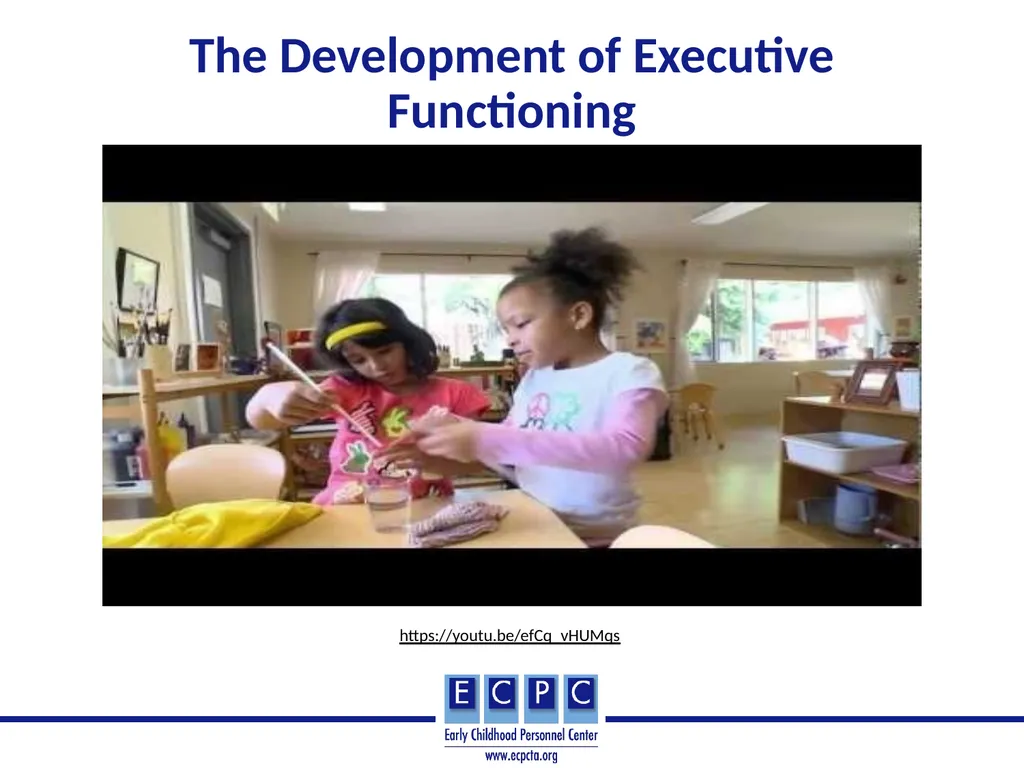
slide7. The Development of Executive Functioning https://youtu.be/efCq_vHUMqs<br>
slide8. Supporting Social-Emotional Development: Tiers of Evidence-Based Practice Foundational
Nurturing and responsive relationships, supportive environments, developmentally appropriate teaching practices, universal screening
Targeted
Social skills teaching, formative assessment, and progress monitoring
Intensive
Intensive, function-based individualized interventions<br>
slide9. Foundations of Social-Emotional Competence Three inter-related areas:
Social interaction: play together, take turns, help friends, cooperate
Emotional awareness: Ability to recognize and understand feelings and actions of self and others
Self-regulation: calming down, using functional communication to express negative emotions, persistence<br>
slide10. Foundational Practices: Social Emotional Development Follow children’s lead: Tune into the unique ways children initiate interactions and respond to their environment
Maintain predictable routines
Provide warm, responsive, and consistent care
Talk/sign, read, and sing together every day<br>
slide11. Foundational Practices, continued Offer choices
Provide opportunities for play with peers/siblings (even in the context of parallel play!)
Encourage and model turn-taking
Help children understand and label emotions
Set limits and model positive behaviors
Use developmentally appropriate practices<br>
slide12. Foundational Practices To Support Social Emotional Development: Preschool Classroom Build positive relationships
Create environments that help children feel safe and connected
Set expectations/classroom rules
Teach emotional literacy
Encourage appropriate behavior
Use EBP to support a child experiencing challenging behavior<br>
slide13. Foundational Practices: Supporting Peer Interactions in the Preschool Classroom Identify tasks that children can do to help: e.g., handing out materials, gathering coats with a peer
Plan and support peer interactions during everyday routines
Provide cues and assistance to support peer interactions when needed
Reinforce social interactions when they occur<br>
slide14. Activity Watch the video “Child Outcomes Step by Step” on the next slide before reflecting on the following question;
How can EI/ECSE providers create environments that help children feel connected and safe?<br>
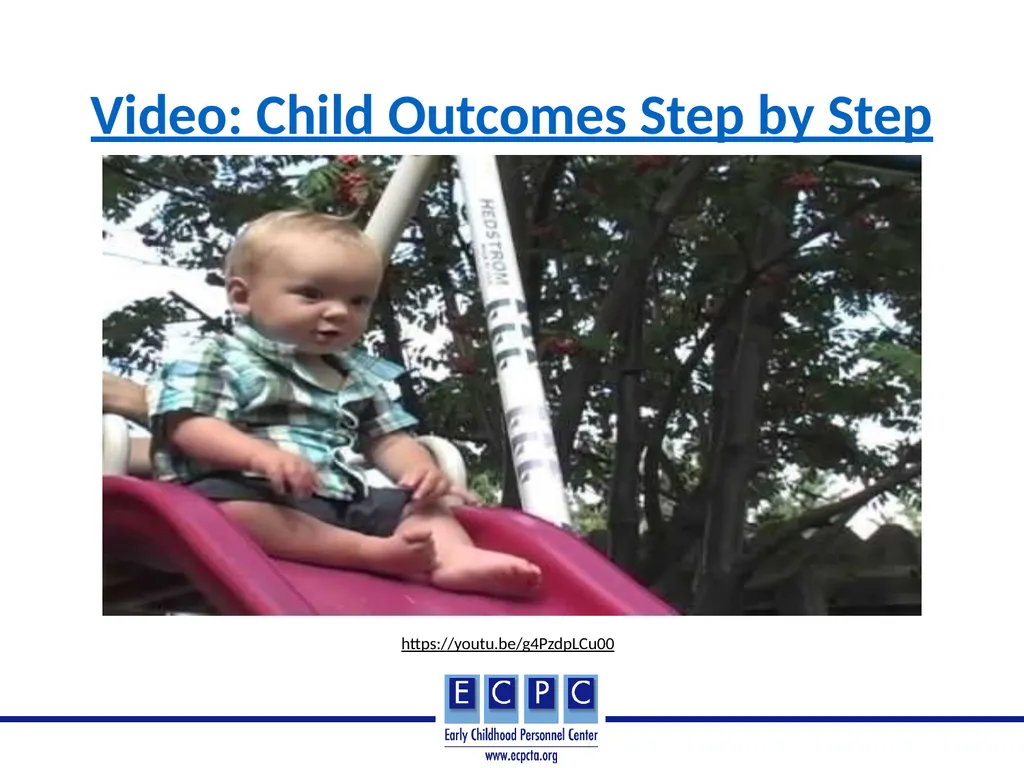
slide15. Video: Child Outcomes Step by Step https://youtu.be/g4PzdpLCu00<br>
slide16. Foundational Practices To Support Social Emotional Development: Culturally Responsive Strategies Learn about children and families
Develop and teach culturally relevant expectations
Take the child’s perspective
Examine personal implicit biases and assumptions
Teach and model empathy
Use group times to discuss conflict<br>
slide17. Individualizing Support: Challenging Behaviors “any repeated pattern of behavior...that interferes with or is at risk of interfering with the child’s optimal learning or engagement in pro-social interactions with peers and adults” (Smith & Fox, 2003, p. 6).
Many ways to decide how any given behavior is a challenging one
Influenced by an adult’s culture, beliefs, and biases<br>
slide18. Targeted Support: Teaching Social Skills Involve family members to develop regulation strategies collaboratively and to identify and use culturally appropriate behavior management skills
Teach social-emotional regulation skills
Example: The Turtle Technique
Strengthen communication skills
Provide ongoing opportunities to practice new skills<br>
slide19. Targeted Interventions To Teach Social Skills Gather ongoing formative assessment to document baseline behaviors and to monitor progress
Individualize modifications to environment and curriculum to address specific areas of concern
Individualize activities to support peer interaction
Peer buddy approach
Create Incentive systems for individual children<br>
slide20. Intensive Intervention: Positive Behavior Support Build a behavior support team
Use child-centered planning
Implement a Functional Behavior Assessment
Develop a hypothesis
Monitor outcomes<br>
slide21. Functional Behavior Assessment (FBA) The behavior support team implements a Functional Behavior Assessment to:
Provide a clear description of problem behaviors
Identify variables that predict the behaviors
Create a hypothesis about the purpose of the behavior
Identify child strengths
Results inform specific interventions/Behavioral Support Plan<br>
slide22. Intensive Intervention: Behavioral Support Plan A Behavioral Support Plan includes:
Strategies for replacing the challenging behavior
Eliminating or decreasing triggers associated with the challenging behavior
Shared with all teaching staff and implemented with fidelity<br>
slide23. Functional Communication Training Tied to the purpose of the behavior as determined by the FBA
Teaches easily-learned new communication behaviors as a replacement for challenging behavior
Strengthens child’s communication skills to reduce the need for challenging behavior
Most effective when the child is given access to preferred objects, activities, people as a result of using the new behavior<br>
slide24. Activity Review Brendan’s child and family description, functional assessment interview, hypothesis statement, and behavior support plan on the linked site
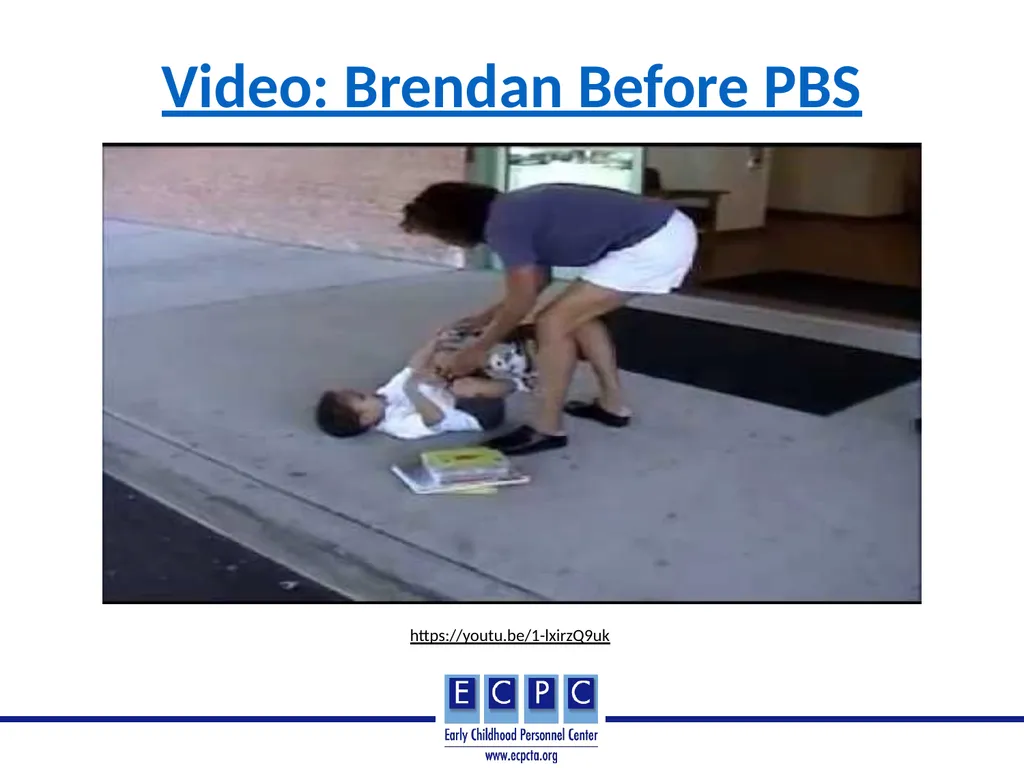
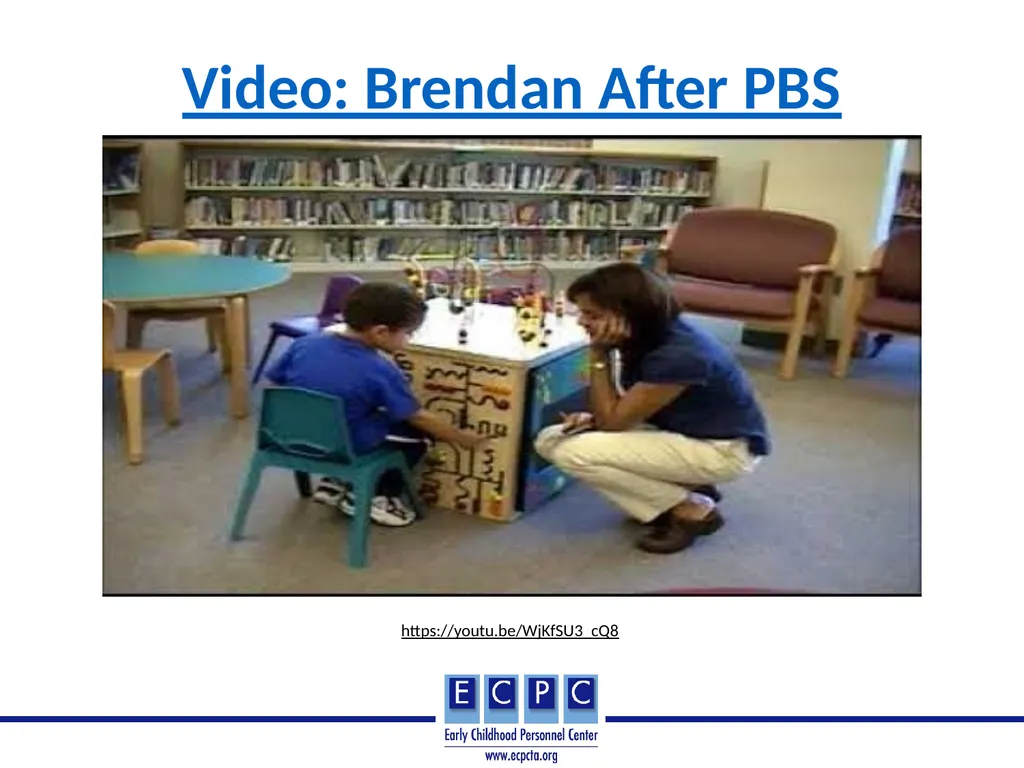
On the next slides watch the videos of Brendan before and after the PBS intervention before discussing the following;
What elements of the behavioral support plan would you say were most active to create positive change for Brendan and his mother? What data should be collected to ensure continued success?<br>
slide25. Video: Brendan Before PBS https://youtu.be/1-lxirzQ9uk<br>
slide26. Video: Brendan After PBS https://youtu.be/WjKfSU3_cQ8<br>
slide27. References and Resources Center for the Social and Emotional Foundations for Early Learning: http://csefel.vanderbilt.edu
CONNECT: The Center to Mobilize Early Childhood Knowledge and the Division for Early Childhood (DEC): https://connectmodules.dec-sped.org/
Eisenberg, N., Valiente, C., & Eggum, N. D. (2010). Self-regulation and school readiness. Early education and development, 21(5), 681-698.<br>
slide28. References and Resources Harvard Center on the Developing Child: In Brief: Executive Function: Skills for Life and Learning
Joseph, G. E., & Strain, P. S. (2003). Comprehensive Evidence-Based Social—Emotional Curricula for Young Children: An Analysis of Efficacious Adoption Potential. Topics in Early Childhood Special Education, 23(2), 62-73. https://doi.org/10.1177/02711214030230020201
National Association for the Education of Young Children (NAEYC): https://www.naeyc.org/
Pyramid Model Consortium: www.pyramidmodel.org
Technical Assistance Center on Social Emotional Intervention: http://challengingbehavior.fmhi.usf.edu<br>
slide29. Disclaimer<br>
6.4<br>
slide2. Standard 6 Candidates plan and implement intentional, systematic, evidence-based, responsive interactions, interventions, and instruction to support all children’s learning and development across all developmental and content domains in partnership with families and other professionals. Candidates facilitate equitable access and participation for all children and families within natural and inclusive environments through culturally responsive and affirming practices and relationships. Candidates use data-based decision-making to plan for, adapt, and improve interactions, interventions, and instruction to ensure fidelity of implementation.<br>
slide3. Component 6.4 Candidates promote young children’s social and emotional competence and communication, and proactively plan and implement function-based interventions to prevent and address challenging behaviors<br>
slide4. Objectives Describe evidence-based strategies for teaching and promoting social and emotional competence in young children.
Describe evidence-based strategies for teaching and promoting communication competence in young children.
Describe using a functional behavioral assessment (FBA) to plan and implement function-based interventions to prevent and address challenging behaviors.<br>
slide5. What is Social Emotional Competence? A child’s developing ability to form close, secure relationships with others
These bonds create the safety that all children need to explore the world and engage in positive interactions with others
These safe, positive relationships support the development of executive functioning<br>
slide6. Executive Functioning and the Development of Social-Emotional Health Working memory: retention and use of newly acquired information to make decisions
Mental Flexibility: sustain/shift attention in response to different demands or to apply different rules in different settings
Self-control: set priorities and resist impulsive actions<br>
slide7. The Development of Executive Functioning https://youtu.be/efCq_vHUMqs<br>
slide8. Supporting Social-Emotional Development: Tiers of Evidence-Based Practice Foundational
Nurturing and responsive relationships, supportive environments, developmentally appropriate teaching practices, universal screening
Targeted
Social skills teaching, formative assessment, and progress monitoring
Intensive
Intensive, function-based individualized interventions<br>
slide9. Foundations of Social-Emotional Competence Three inter-related areas:
Social interaction: play together, take turns, help friends, cooperate
Emotional awareness: Ability to recognize and understand feelings and actions of self and others
Self-regulation: calming down, using functional communication to express negative emotions, persistence<br>
slide10. Foundational Practices: Social Emotional Development Follow children’s lead: Tune into the unique ways children initiate interactions and respond to their environment
Maintain predictable routines
Provide warm, responsive, and consistent care
Talk/sign, read, and sing together every day<br>
slide11. Foundational Practices, continued Offer choices
Provide opportunities for play with peers/siblings (even in the context of parallel play!)
Encourage and model turn-taking
Help children understand and label emotions
Set limits and model positive behaviors
Use developmentally appropriate practices<br>
slide12. Foundational Practices To Support Social Emotional Development: Preschool Classroom Build positive relationships
Create environments that help children feel safe and connected
Set expectations/classroom rules
Teach emotional literacy
Encourage appropriate behavior
Use EBP to support a child experiencing challenging behavior<br>
slide13. Foundational Practices: Supporting Peer Interactions in the Preschool Classroom Identify tasks that children can do to help: e.g., handing out materials, gathering coats with a peer
Plan and support peer interactions during everyday routines
Provide cues and assistance to support peer interactions when needed
Reinforce social interactions when they occur<br>
slide14. Activity Watch the video “Child Outcomes Step by Step” on the next slide before reflecting on the following question;
How can EI/ECSE providers create environments that help children feel connected and safe?<br>
slide15. Video: Child Outcomes Step by Step https://youtu.be/g4PzdpLCu00<br>
slide16. Foundational Practices To Support Social Emotional Development: Culturally Responsive Strategies Learn about children and families
Develop and teach culturally relevant expectations
Take the child’s perspective
Examine personal implicit biases and assumptions
Teach and model empathy
Use group times to discuss conflict<br>
slide17. Individualizing Support: Challenging Behaviors “any repeated pattern of behavior...that interferes with or is at risk of interfering with the child’s optimal learning or engagement in pro-social interactions with peers and adults” (Smith & Fox, 2003, p. 6).
Many ways to decide how any given behavior is a challenging one
Influenced by an adult’s culture, beliefs, and biases<br>
slide18. Targeted Support: Teaching Social Skills Involve family members to develop regulation strategies collaboratively and to identify and use culturally appropriate behavior management skills
Teach social-emotional regulation skills
Example: The Turtle Technique
Strengthen communication skills
Provide ongoing opportunities to practice new skills<br>
slide19. Targeted Interventions To Teach Social Skills Gather ongoing formative assessment to document baseline behaviors and to monitor progress
Individualize modifications to environment and curriculum to address specific areas of concern
Individualize activities to support peer interaction
Peer buddy approach
Create Incentive systems for individual children<br>
slide20. Intensive Intervention: Positive Behavior Support Build a behavior support team
Use child-centered planning
Implement a Functional Behavior Assessment
Develop a hypothesis
Monitor outcomes<br>
slide21. Functional Behavior Assessment (FBA) The behavior support team implements a Functional Behavior Assessment to:
Provide a clear description of problem behaviors
Identify variables that predict the behaviors
Create a hypothesis about the purpose of the behavior
Identify child strengths
Results inform specific interventions/Behavioral Support Plan<br>
slide22. Intensive Intervention: Behavioral Support Plan A Behavioral Support Plan includes:
Strategies for replacing the challenging behavior
Eliminating or decreasing triggers associated with the challenging behavior
Shared with all teaching staff and implemented with fidelity<br>
slide23. Functional Communication Training Tied to the purpose of the behavior as determined by the FBA
Teaches easily-learned new communication behaviors as a replacement for challenging behavior
Strengthens child’s communication skills to reduce the need for challenging behavior
Most effective when the child is given access to preferred objects, activities, people as a result of using the new behavior<br>
slide24. Activity Review Brendan’s child and family description, functional assessment interview, hypothesis statement, and behavior support plan on the linked site
On the next slides watch the videos of Brendan before and after the PBS intervention before discussing the following;
What elements of the behavioral support plan would you say were most active to create positive change for Brendan and his mother? What data should be collected to ensure continued success?<br>
slide25. Video: Brendan Before PBS https://youtu.be/1-lxirzQ9uk<br>
slide26. Video: Brendan After PBS https://youtu.be/WjKfSU3_cQ8<br>
slide27. References and Resources Center for the Social and Emotional Foundations for Early Learning: http://csefel.vanderbilt.edu
CONNECT: The Center to Mobilize Early Childhood Knowledge and the Division for Early Childhood (DEC): https://connectmodules.dec-sped.org/
Eisenberg, N., Valiente, C., & Eggum, N. D. (2010). Self-regulation and school readiness. Early education and development, 21(5), 681-698.<br>
slide28. References and Resources Harvard Center on the Developing Child: In Brief: Executive Function: Skills for Life and Learning
Joseph, G. E., & Strain, P. S. (2003). Comprehensive Evidence-Based Social—Emotional Curricula for Young Children: An Analysis of Efficacious Adoption Potential. Topics in Early Childhood Special Education, 23(2), 62-73. https://doi.org/10.1177/02711214030230020201
National Association for the Education of Young Children (NAEYC): https://www.naeyc.org/
Pyramid Model Consortium: www.pyramidmodel.org
Technical Assistance Center on Social Emotional Intervention: http://challengingbehavior.fmhi.usf.edu<br>
slide29. Disclaimer<br>