Vacuum Distillation Dr. Garima Joshi, Assistant Professor Pharmacy, MLSU III sem Unit operation Vacuum Distillation Assembling of apparatus: It consists of a double-neck distillation flask known as Claisen flask . Thick walled glass
"Vacuum Distillation Dr. Garima Joshi, Assistant" is the property of its rightful owner. Permission is granted to
download and print the materials on this website for personal, non-commercial use only, and to display it
on your personal computer provided you do not modify the materials and that you retain all copyright
notices contained in the materials. By downloading content from our website, you accept the terms of this
agreement.
Presentation Transcript
01
Vacuum Distillation Dr. Garima Joshi, Assistant Professor
Pharmacy, MLSU
III sem Unit operation<br>
02
Vacuum Distillation Assembling of apparatus:
It consists of a double-neck distillation flask known as Claisen flask .
Thick walled glass apparatus with interchangeable standard glass joints are used for
vacuum distillation.
In one of the necks of the Claisen flask, a thermometer is fitted. The second neck prevents
splashing of the violently agitated liquid.
Bumping occurs readily during vacuum distillation. Placing a fine capillary tube in the second neck of the flask can prevent bumping<br>
03
Vacuum distillation The capillary tube is dipped in the boiling liquid, so that a stream of air bubbles is drawn
out.
Water bath or oil bath is used for heating.
The Claisen flask is connected to a receiver through a condenser.
Vacuum pump is attached through an adapter to the receiver. A small pressure gauge
(manometer) should be inserted between the pump and the receiver<br>
04
Applications: Preventing degradation of active constituents (≈ 55◦C)
Enzymes - malt extract, pancreatin
Vitamins - thiamine, ascorbic acid
Glycosides - anthraquinones
Alkaloids - hyocyamine to atropine<br>
05
Disadvantages: In vacuum distillation, persistent foaming occurs. This may be
overcome by adding capryl alcohol to the liquid or by
inserting a fine air capillary tube in the second neck of the
Claisen flask.
The stream of air is drawn in and breaks the rising foam. The
above method is not suitable for the preparation of semisolid
or solid extracts by distillation under vacuum.<br>
06
MOLECULAR DISTILLATION It is defined as a distillation process in which each
molecule in the vapour phase travels mean free path
and gets condensed individually without
intermolecular collisions on application of vacuum.
Molecular distillation is based on the principle of the
simple distillation with some modifications. This is
also called Evaporation distillation or Short path
distillation.<br>
07
Molecular Distillation The substances to be distilled have very low vapour pressures.
examples are viscous liquids, oils, greases, waxy materials and
high molecular weight substances.
These boil at very high temperature. In order to decrease the
boiling point of the liquids, high vacuum must be applied.
The pressure exerted by vapors above the liquid is much
lower. At very low pressure, the distance between the evaporating
surface and the condenser is approximately equal to the mean free
path of the vapour molecules.
Molecules leaving the surface of the liquid are more likely hit the
condenser surface nearby. each molecule is condensed individually.
the distillate is subsequently collected.<br>
08
Applications Molecular distillation is used for the purification and separation of chemicals
of low vapour pressure.
1. Purification of chemicals such as tricresyl phosphate, dibutyl phthalate and
dimethyl phthalate.
2. More frequently used in the refining of fixed oils.
3. Vitamin A is separated from fish liver oil. Vitamin's is concentrated by this
method from fish liver oils and other vegetable oils.
4. Free fatty acids are distilled at 100°C.
5. Steroids can be obtained between 100°C and 200°C,
6. Triglycerides can be obtained from 200°C onwards.
Proteins and gums will remain as nonvolatile residues. Thus, the above
mixture can be separated by molecular distillation.<br>
09
Requirements for design the equipment: • The evaporating surface must be close to the condensing
surface. This ensures the molecules to come in contact with the
condenser as soon as they leave the evaporating surface.
For this reason, this process is also known as short path distillation.
• The molecular collisions should be minimized because they
change the direction of the path of molecules. In other words,
intermolecular distances should be fairly high. It can be
achieved under very high vacuum, usually of the order of 0.1 to
1.0 pascals.
• The liquid surface area must be as large as possible as so that
the vapour is evolved from the surface only, but not by boiling.
Thus this process is also called evaporation distillation.<br>
10
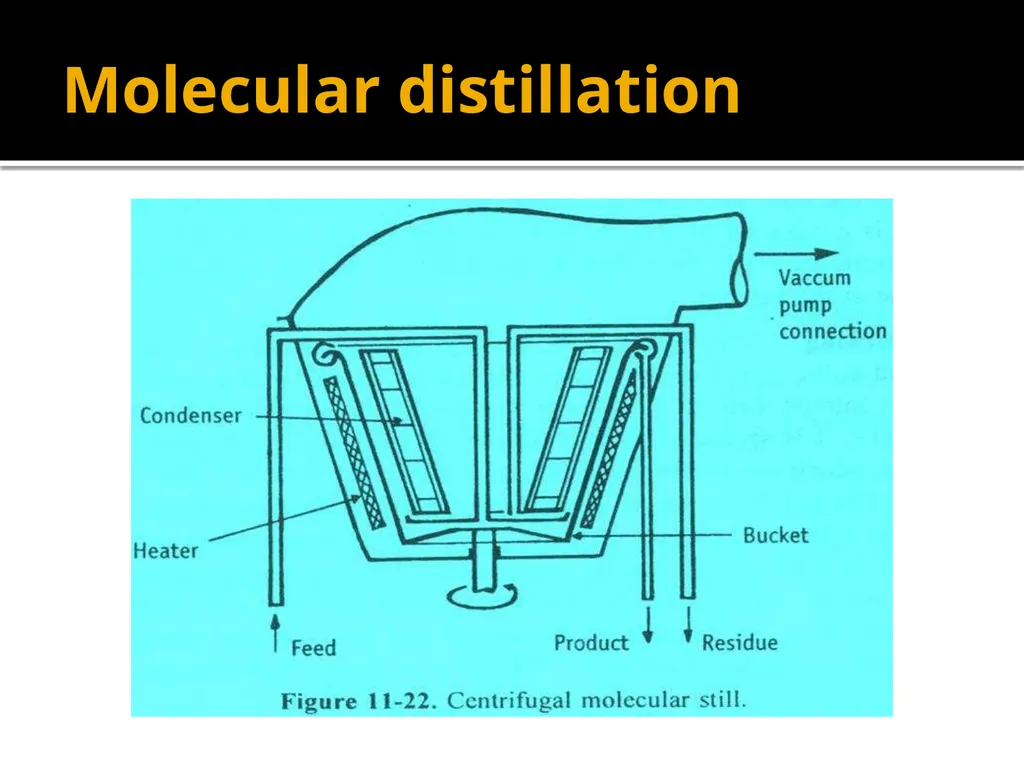
Molecular distillation<br>
11
Centrifugal molecular still Principle:
In this method, liquid feed is introduced into a vessel, which is
rotated at very high speed (centrifugal action).
On account of heating, vaporisation occurs from a film of liquid
on the sides of the vessel.
The vapour (molecules) travels a short distance and gets
condensed on the adjacent condenser.
Each molecule is condensed individually. The distillate is
subsequently collected.<br>
12
WIPED FILM MOLECULAR DISTILLATION STILL Construction:
The vessel has a diameter of 1 m.
The walls of the vessel are provided with suitable means of heating
(jacket).
Wipers are provided adjacent to the vessel wall. Wipers are
connected to a rotating head through a rotor.
The condensers are arranged very close to the wall (evaporating
surface).
Vacuum pump is connected to a large diameter pipe at the
centre of the vessel.
Provisions are made for collecting the distillate and the undistilled
liquid residue at the bottom.<br>
13
Working The vessel is heated by suitable means.
Vacuum is applied at the centre of the vessel and wipers are allowed to rotate.
The feed is entered through the inlet of the vessel.
As the liquid flows down the walls, it is spread to form a film by PTFE
(polytetrafluoroethylene) wipers, which are moving at a rate of 3 m per second.
The velocity of the film is 1.5 m per second.
Since the surface is already heated, the liquid film evaporates directly.
The vapour (molecules) travels its mean free path and strikes the condenser.
The condensate is collected into a vessel.
The residue (undistilled or mean free path not travelled) is collected from the bottom
of the vessel and re-circulated through the feed port for further distillation. Capacity is
about 1000 L / hour.<br>