
Vehicle Extrication, Special Rescue, and Hazardous
LS
Published · 65 slides · 0 views

1 / 1


Description
Vehicle Extrication, Special Rescue, and Hazardous Materials CHAPTER 40: Focused Lecture National EMS Education Standard Competencies (1 of 3) EMS Operations Knowledge of operational roles and responsibilities to ensure patient, public, and
Related Topics
Share
Embed code
Download this presentation From Below
"Vehicle Extrication, Special Rescue, and Hazardous" is the property of its rightful owner. Permission is granted to download and print the materials on this website for personal, non-commercial use only, and to display it on your personal computer provided you do not modify the materials and that you retain all copyright notices contained in the materials. By downloading content from our website, you accept the terms of this agreement.
Presentation Transcript
01
Vehicle Extrication, Special Rescue, and Hazardous Materials CHAPTER 40: Focused Lecture<br>
02
National EMS Education Standard Competencies (1 of 3) EMS Operations
Knowledge of operational roles and responsibilities to ensure patient, public, and personnel safety<br>
Knowledge of operational roles and responsibilities to ensure patient, public, and personnel safety<br>
03
National EMS Education Standard Competencies (2 of 3) Vehicle Extrication
Safe vehicle extrication
Use of simple hand tools<br>
Safe vehicle extrication
Use of simple hand tools<br>
04
National EMS Education Standard Competencies (3 of 3) Hazardous Materials Awareness
Risks and responsibilities of operating in a cold zone at a hazardous material or other special incident<br>
Risks and responsibilities of operating in a cold zone at a hazardous material or other special incident<br>
05
Introduction Rescue involves many different processes and environments.
Requires training beyond the level of the AEMT
Your initial actions may determine how efficiently the rescue is completed.<br>
Requires training beyond the level of the AEMT
Your initial actions may determine how efficiently the rescue is completed.<br>
06
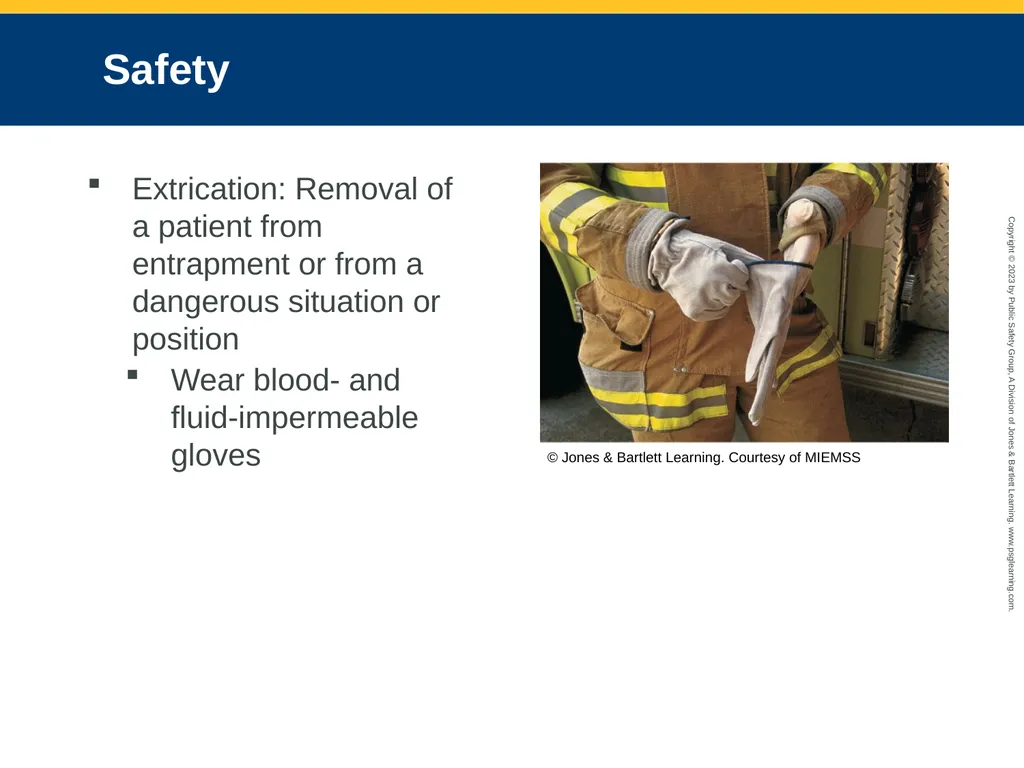
Safety Extrication: Removal of a patient from entrapment or from a dangerous situation or position
Wear blood- and fluid-impermeable gloves © Jones & Bartlett Learning. Courtesy of MIEMSS<br>
Wear blood- and fluid-impermeable gloves © Jones & Bartlett Learning. Courtesy of MIEMSS<br>
07
Fundamentals of Extrication (1 of 21) Your primary concern is always safety.
Primary roles:
Provide emergency medical care.
Prevent further injury to the patient.
Provide care as extrication goes on around you.
Entrapment: Person caught within a closed area with no way out or has a limb or body part trapped<br>
Primary roles:
Provide emergency medical care.
Prevent further injury to the patient.
Provide care as extrication goes on around you.
Entrapment: Person caught within a closed area with no way out or has a limb or body part trapped<br>
08
Fundamentals of Extrication (2 of 21) 10 phases to the extrication process
Preparation
Involves preincident training with rescue personnel for various types of rescue situations
Check extrication tools and response vehicle.
En route to the scene
Use procedures and safety precautions similar to those in the phases of an ambulance call.<br>
Preparation
Involves preincident training with rescue personnel for various types of rescue situations
Check extrication tools and response vehicle.
En route to the scene
Use procedures and safety precautions similar to those in the phases of an ambulance call.<br>
09
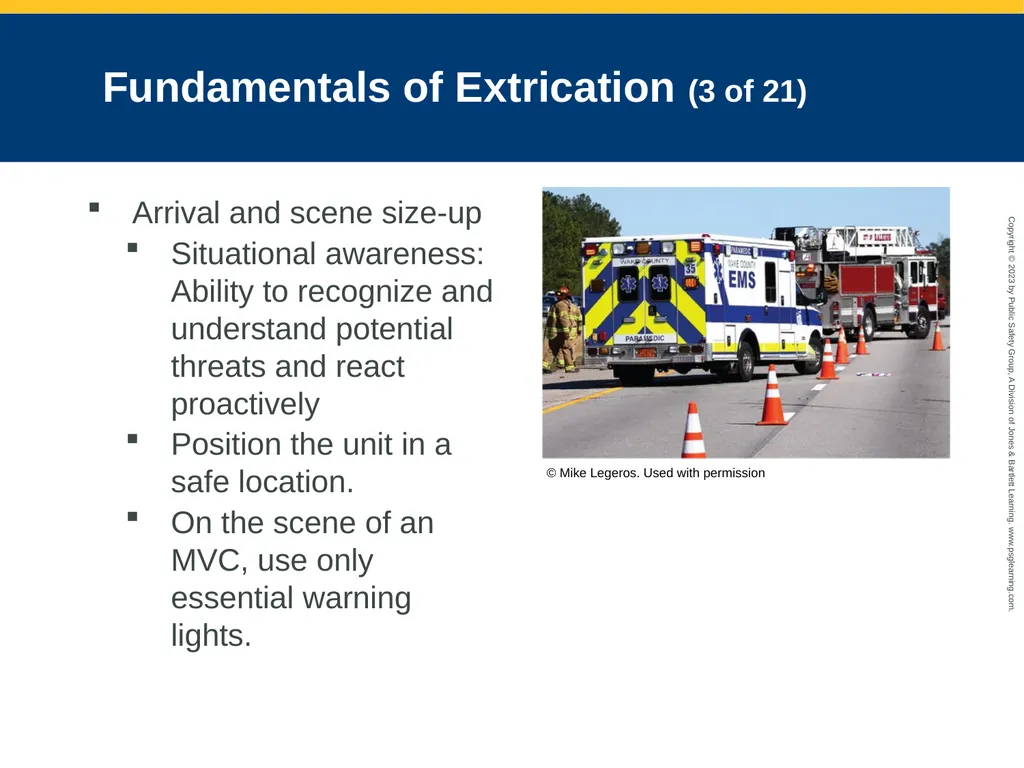
Fundamentals of Extrication (3 of 21) Arrival and scene size-up
Situational awareness: Ability to recognize and understand potential threats and react proactively
Position the unit in a safe location.
On the scene of an MVC, use only essential warning lights. © Mike Legeros. Used with permission<br>
Situational awareness: Ability to recognize and understand potential threats and react proactively
Position the unit in a safe location.
On the scene of an MVC, use only essential warning lights. © Mike Legeros. Used with permission<br>
10
Fundamentals of Extrication (4 of 21) You may need to call for:
Extrication equipment
Fire service personnel and equipment
Law enforcement
Specialized crews
360° walk around the scene allows you to evaluate hazards, consider potential injuries, and determine the number of patients.<br>
Extrication equipment
Fire service personnel and equipment
Law enforcement
Specialized crews
360° walk around the scene allows you to evaluate hazards, consider potential injuries, and determine the number of patients.<br>
11
Fundamentals of Extrication (5 of 21) Report to IC as soon as you arrive on a scene.
Coordinate your efforts with the rescue team and law enforcement.
Rescue team is responsible for:
Properly securing and stabilizing the scene or the vehicle
Providing safe entrance and access to patients
Extricating patients
Ensuring patients are properly protected
Providing adequate room so patients can be removed<br>
12
Fundamentals of Extrication (6 of 21) You are responsible for:
Assessing and providing immediate medical care
Triaging patients
Packaging patients
Providing additional assessment and care as needed
Providing transport<br>
Assessing and providing immediate medical care
Triaging patients
Packaging patients
Providing additional assessment and care as needed
Providing transport<br>
13
Fundamentals of Extrication (7 of 21) Hazard control
Law enforcement is responsible for:
Traffic control and direction
Maintaining order at the scene
Investigating the crash or crime scene
Firefighters are responsible for:
Extinguishing any fire
Preventing additional ignition
Ensuring scene safety
Managing any spilled fuel or other fluids<br>
Law enforcement is responsible for:
Traffic control and direction
Maintaining order at the scene
Investigating the crash or crime scene
Firefighters are responsible for:
Extinguishing any fire
Preventing additional ignition
Ensuring scene safety
Managing any spilled fuel or other fluids<br>
14
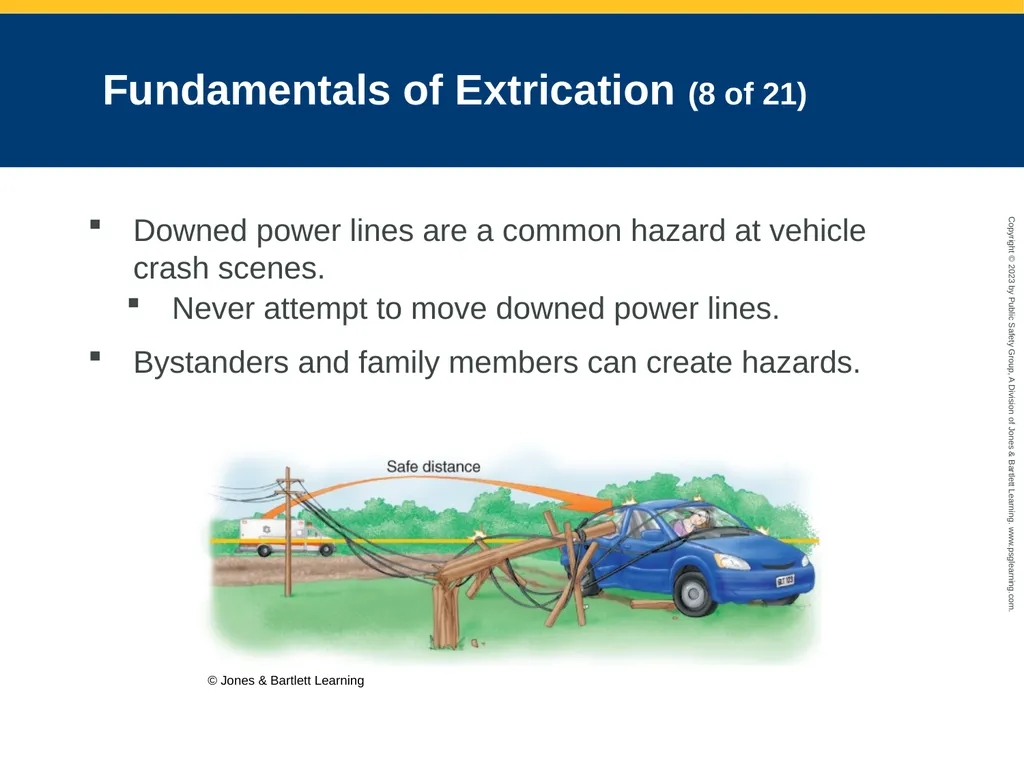
Fundamentals of Extrication (8 of 21) Downed power lines are a common hazard at vehicle crash scenes.
Never attempt to move downed power lines.
Bystanders and family members can create hazards. © Jones & Bartlett Learning<br>
Never attempt to move downed power lines.
Bystanders and family members can create hazards. © Jones & Bartlett Learning<br>
15
Fundamentals of Extrication (9 of 21) Vehicle can be a hazard.
Ensure car is in “park” with parking brake set and ignition turned off.
Disconnect the battery to minimize the possibility of sparks or fire.<br>
Ensure car is in “park” with parking brake set and ignition turned off.
Disconnect the battery to minimize the possibility of sparks or fire.<br>
16
Fundamentals of Extrication (10 of 21) Vehicle safety systems can become hazards.
Shock-absorbing bumpers
Always approach vehicles from the side.
These can release and injure knees and legs.
Airbags
Use caution when working in damaged vehicles in which airbags have not inflated.<br>
Shock-absorbing bumpers
Always approach vehicles from the side.
These can release and injure knees and legs.
Airbags
Use caution when working in damaged vehicles in which airbags have not inflated.<br>
17
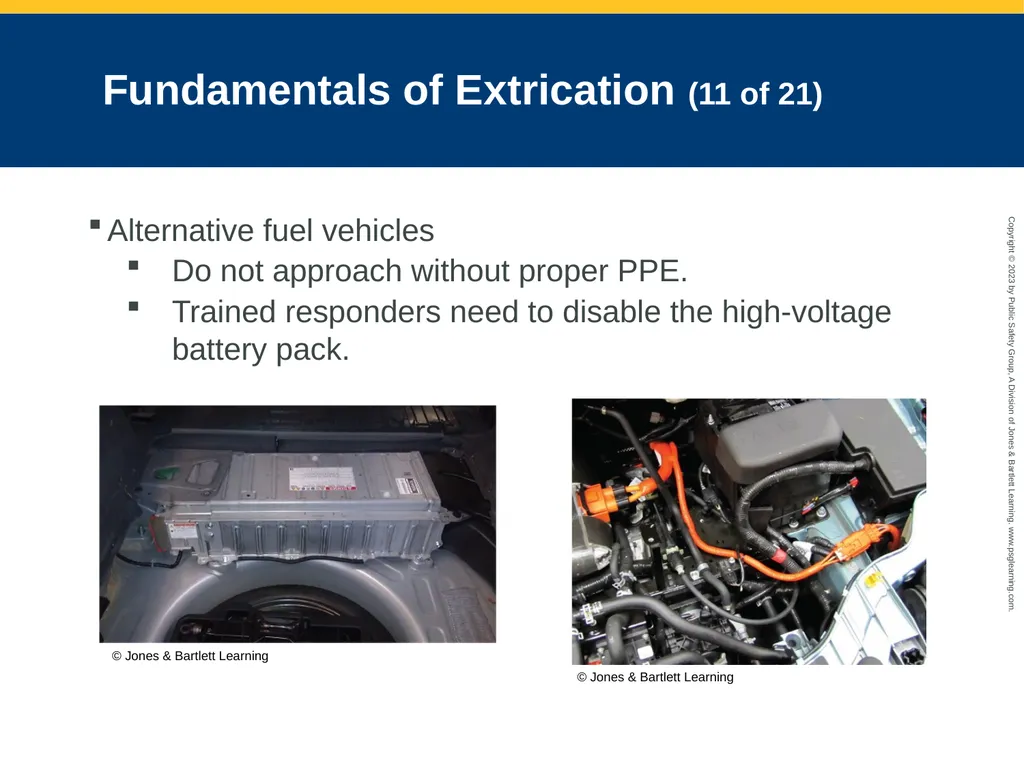
Fundamentals of Extrication (11 of 21) Alternative fuel vehicles
Do not approach without proper PPE.
Trained responders need to disable the high-voltage battery pack. © Jones & Bartlett Learning © Jones & Bartlett Learning<br>
Do not approach without proper PPE.
Trained responders need to disable the high-voltage battery pack. © Jones & Bartlett Learning © Jones & Bartlett Learning<br>
18
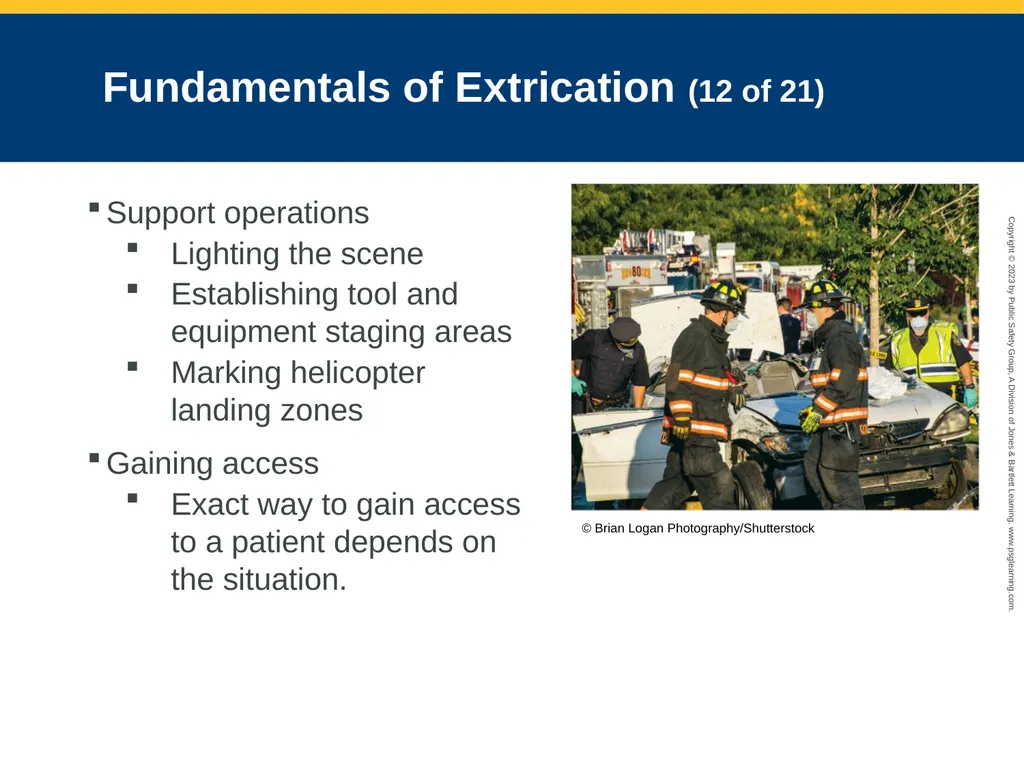
Fundamentals of Extrication (12 of 21) Support operations
Lighting the scene
Establishing tool and equipment staging areas
Marking helicopter landing zones
Gaining access
Exact way to gain access to a patient depends on the situation. © Brian Logan Photography/Shutterstock<br>
Lighting the scene
Establishing tool and equipment staging areas
Marking helicopter landing zones
Gaining access
Exact way to gain access to a patient depends on the situation. © Brian Logan Photography/Shutterstock<br>
19
Fundamentals of Extrication (13 of 21) To determine exact location and position of the patient, consider:
Is the patient in a vehicle or in some other structure?
Is the vehicle or structure severely damaged?
What hazards exist that pose a risk to the patient and rescuers?
In what position is the vehicle? On what type of surface? Is the vehicle stable or is it likely to roll over?<br>
Is the patient in a vehicle or in some other structure?
Is the vehicle or structure severely damaged?
What hazards exist that pose a risk to the patient and rescuers?
In what position is the vehicle? On what type of surface? Is the vehicle stable or is it likely to roll over?<br>
20
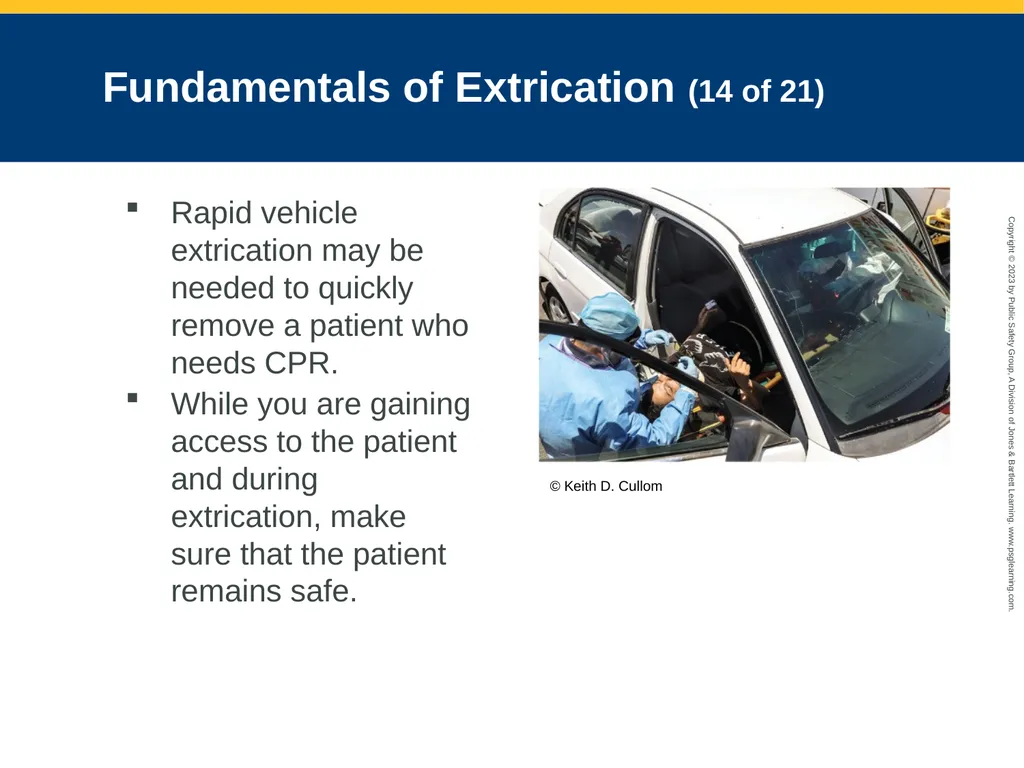
Fundamentals of Extrication (14 of 21) Rapid vehicle extrication may be needed to quickly remove a patient who needs CPR.
While you are gaining access to the patient and during extrication, make sure that the patient remains safe. © Keith D. Cullom<br>
While you are gaining access to the patient and during extrication, make sure that the patient remains safe. © Keith D. Cullom<br>
21
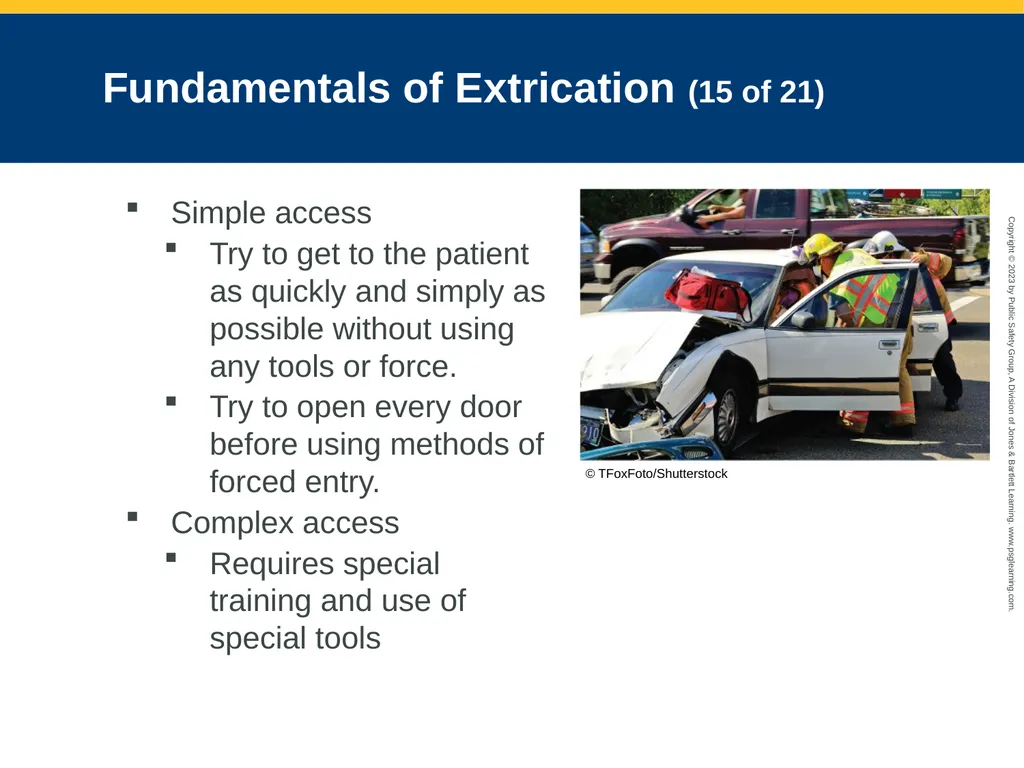
Fundamentals of Extrication (15 of 21) Simple access
Try to get to the patient as quickly and simply as possible without using any tools or force.
Try to open every door before using methods of forced entry.
Complex access
Requires special training and use of special tools © TFoxFoto/Shutterstock<br>
Try to get to the patient as quickly and simply as possible without using any tools or force.
Try to open every door before using methods of forced entry.
Complex access
Requires special training and use of special tools © TFoxFoto/Shutterstock<br>
22
Fundamentals of Extrication (16 of 21) Emergency care
Same as providing care for any other patient
Perform any critical interventions before further extrication begins:
Provide manual stabilization.
Open the airway.
Provide high-flow oxygen.
Assist or provide for adequate ventilation.
Control significant external bleeding.
Treat all critical injuries.<br>
23
Fundamentals of Extrication (17 of 21) Good communication and clear leadership are essential.
One member must be clearly in charge.
Removal of the patient
Work with rescue personnel to coordinate the best route for removal.<br>
One member must be clearly in charge.
Removal of the patient
Work with rescue personnel to coordinate the best route for removal.<br>
24
Fundamentals of Extrication (18 of 21) Participate in the preparation.
Determine how urgently the patient must be extricated.
Determine how best you can move the patient to the backboard and onto the stretcher.
Carefully examine exposed areas of the patient’s body to determine the extent of injury and possibility of internal bleeding.
Your safety and patient’s safety are paramount.<br>
25
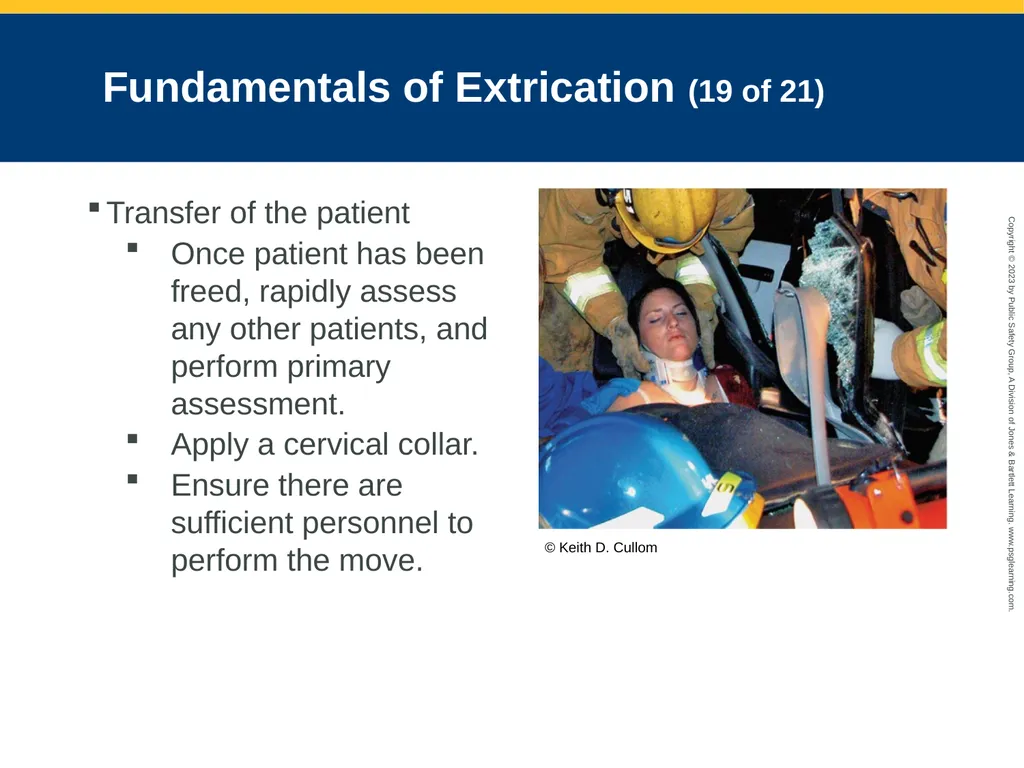
Fundamentals of Extrication (19 of 21) Transfer of the patient
Once patient has been freed, rapidly assess any other patients, and perform primary assessment.
Apply a cervical collar.
Ensure there are sufficient personnel to perform the move. © Keith D. Cullom<br>
Once patient has been freed, rapidly assess any other patients, and perform primary assessment.
Apply a cervical collar.
Ensure there are sufficient personnel to perform the move. © Keith D. Cullom<br>
26
Fundamentals of Extrication (20 of 21) Choose a path that requires the least manipulation of the patient or equipment.
Once the patient has been placed on the stretcher, continue any additional assessment and treatment.<br>
Once the patient has been placed on the stretcher, continue any additional assessment and treatment.<br>
27
Fundamentals of Extrication (21 of 21) Termination
Returning emergency units to service
All equipment must be checked.
Check and decontaminate the unit.
Complete all necessary reports.<br>
Returning emergency units to service
All equipment must be checked.
Check and decontaminate the unit.
Complete all necessary reports.<br>
28
Specialized Rescue Situations (1 of 9) Specialized teams include:
Special weapons and tactics (SWAT)
Missing person search and rescue
Technical rope rescue
Mountain-, rock-, and ice-climbing rescue
Water, white water, and dive rescue
Confined space rescue<br>
Special weapons and tactics (SWAT)
Missing person search and rescue
Technical rope rescue
Mountain-, rock-, and ice-climbing rescue
Water, white water, and dive rescue
Confined space rescue<br>
29
Specialized Rescue Situations (2 of 9) Technical rescue situations
May contain hidden dangers
Technical rescue group: People trained for certain types of technical rescues
As soon as the patient is at the staging area, perform a primary assessment.<br>
May contain hidden dangers
Technical rescue group: People trained for certain types of technical rescues
As soon as the patient is at the staging area, perform a primary assessment.<br>
30
Specialized Rescue Situations (3 of 9) Technical emergency medical support
Tactical situation: Hostage, robbery, or other situation in which armed conflict occurs
EMS providers must prepare, plan, and train for these incidents and know how to stay safe.
Lights and siren should be turned off.
Outside radio speakers should not be used.
Know the difference between cover and concealment.<br>
31
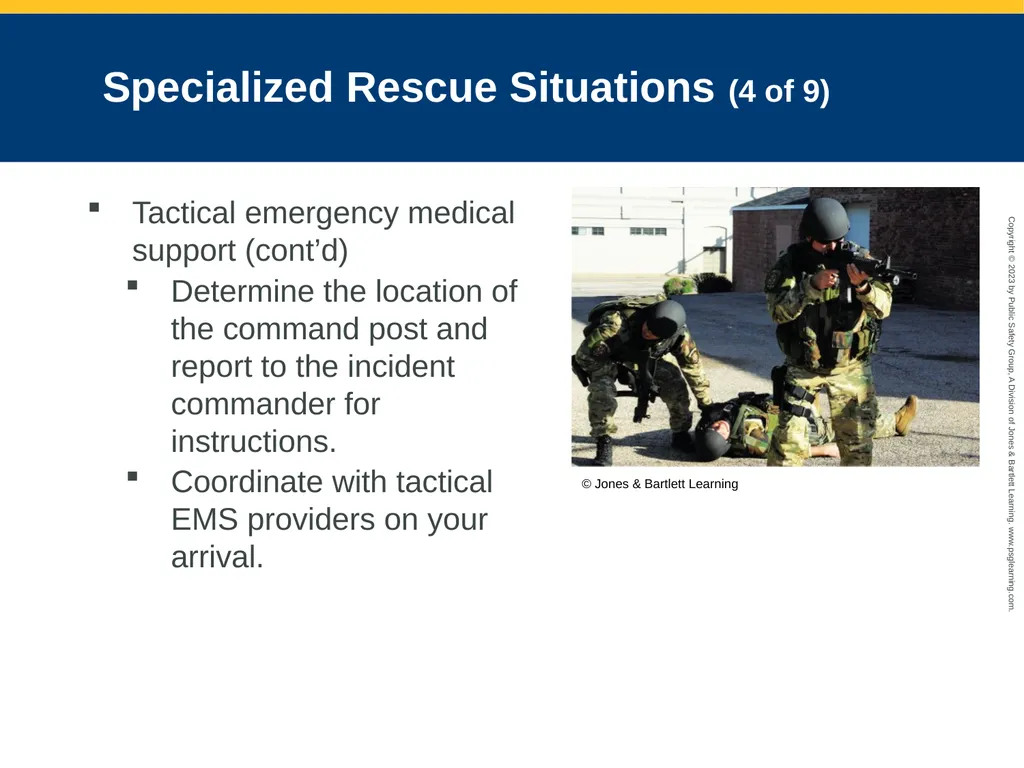
Specialized Rescue Situations (4 of 9) Tactical emergency medical support (cont’d)
Determine the location of the command post and report to the incident commander for instructions.
Coordinate with tactical EMS providers on your arrival. © Jones & Bartlett Learning<br>
Determine the location of the command post and report to the incident commander for instructions.
Coordinate with tactical EMS providers on your arrival. © Jones & Bartlett Learning<br>
32
Specialized Rescue Situations (5 of 9) Search and rescue
Each search team will include a member trained at the EMR, EMT, or AEMT level and carry the essential equipment.
AEMT’s role is to stand by the command post or staging area.
As soon as you are briefed on the situation, isolate and prepare the equipment you will need to carry to the patient’s location.<br>
33
Specialized Rescue Situations (6 of 9) You may be asked to stay with relatives of the lost person.
Once the lost person is found, you will be instructed where and when to meet up with the search team to provide treatment.<br>
Once the lost person is found, you will be instructed where and when to meet up with the search team to provide treatment.<br>
34
Specialized Rescue Situations (7 of 9) Trench rescue
Involves cave-ins and collapses
Risk of a secondary collapse is a concern
Response vehicles should park at least 500 feet from the scene.
All vehicles should be turned off.
All road traffic should be diverted.<br>
Involves cave-ins and collapses
Risk of a secondary collapse is a concern
Response vehicles should park at least 500 feet from the scene.
All vehicles should be turned off.
All road traffic should be diverted.<br>
35
Specialized Rescue Situations (8 of 9) Medical or rescue personnel should not enter a trench deeper than 4 feet without proper shoring in place.
During extrication of any live victims, medical personnel trained in cave-in and trench collapse rescue will provide most medical care.<br>
During extrication of any live victims, medical personnel trained in cave-in and trench collapse rescue will provide most medical care.<br>
36
Specialized Rescue Situations (9 of 9) Structure fires
Ask the incident commander where the ambulance should be parked.
Determine if there are any injured patients or whether you have been called to stand by.
Search and rescue in a burning building requires special training and equipment.<br>
Ask the incident commander where the ambulance should be parked.
Determine if there are any injured patients or whether you have been called to stand by.
Search and rescue in a burning building requires special training and equipment.<br>
37
Introduction to Hazardous Materials
(1 of 2) Hazardous material: Any material that poses an unreasonable risk of damage or injury
Assess the situation first.
Occupational Safety and Health Administration (OSHA) published HAZWOPER regulation.<br>
Assess the situation first.
Occupational Safety and Health Administration (OSHA) published HAZWOPER regulation.<br>
38
Introduction to Hazardous Materials
(2 of 2) First responders should have sufficient training to in the following areas:
Understanding hazardous substances and associated risks
Understanding potential outcomes of an incident
Identifying hazardous substances and recognizing their presence
Understanding the role of the first responder<br>
Understanding hazardous substances and associated risks
Understanding potential outcomes of an incident
Identifying hazardous substances and recognizing their presence
Understanding the role of the first responder<br>
39
Recognizing a Hazardous Material
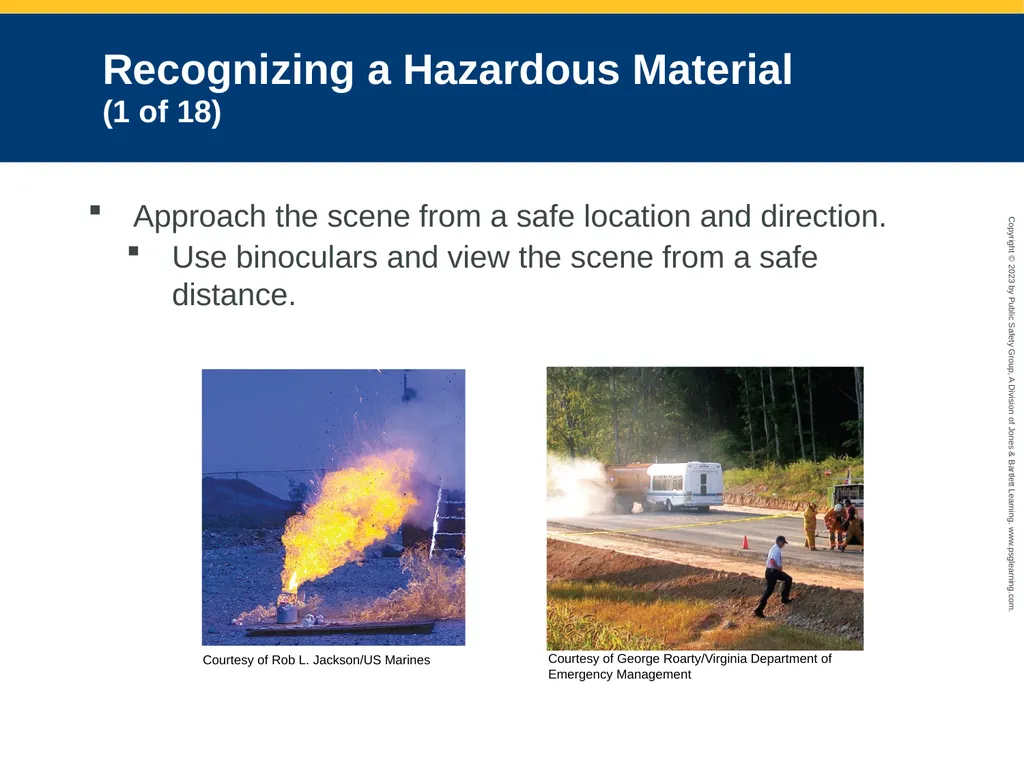
(1 of 18) Approach the scene from a safe location and direction.
Use binoculars and view the scene from a safe distance. Courtesy of Rob L. Jackson/US Marines Courtesy of George Roarty/Virginia Department of Emergency Management<br>
Use binoculars and view the scene from a safe distance. Courtesy of Rob L. Jackson/US Marines Courtesy of George Roarty/Virginia Department of Emergency Management<br>
40
Recognizing a Hazardous Material
(2 of 18) Question anyone involved in the incident.
Formulate a plan for addressing the incident.
Occupancy and location
Chemicals are stored in several facilities or businesses in your response area.
Location and type of building are two good indicators of the possible presence of a hazardous material.<br>
Formulate a plan for addressing the incident.
Occupancy and location
Chemicals are stored in several facilities or businesses in your response area.
Location and type of building are two good indicators of the possible presence of a hazardous material.<br>
41
Recognizing a Hazardous Material
(3 of 18) Senses
Using any of your senses that bring you in proximity to the chemical should be done with caution or avoided.
Presence of vapor clouds or hazmat placards or labels at the scene is a signal to move to a place of safety.<br>
Using any of your senses that bring you in proximity to the chemical should be done with caution or avoided.
Presence of vapor clouds or hazmat placards or labels at the scene is a signal to move to a place of safety.<br>
42
Recognizing a Hazardous Material
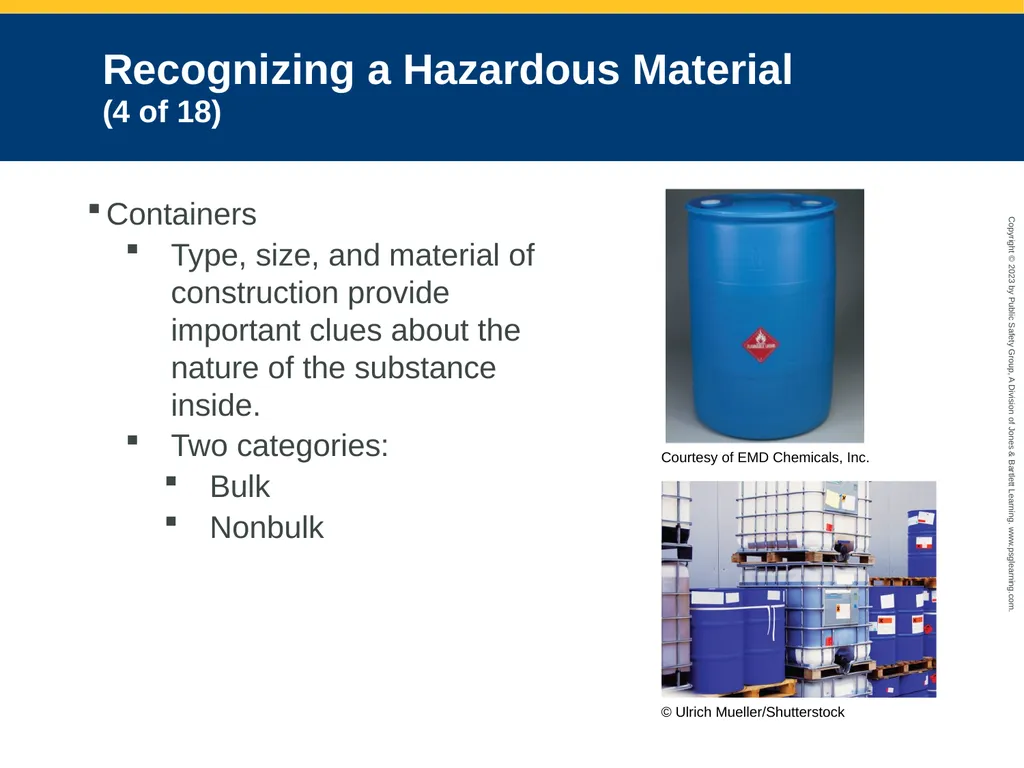
(4 of 18) Containers
Type, size, and material of construction provide important clues about the nature of the substance inside.
Two categories:
Bulk
Nonbulk Courtesy of EMD Chemicals, Inc. © Ulrich Mueller/Shutterstock<br>
Type, size, and material of construction provide important clues about the nature of the substance inside.
Two categories:
Bulk
Nonbulk Courtesy of EMD Chemicals, Inc. © Ulrich Mueller/Shutterstock<br>
43
Recognizing a Hazardous Material
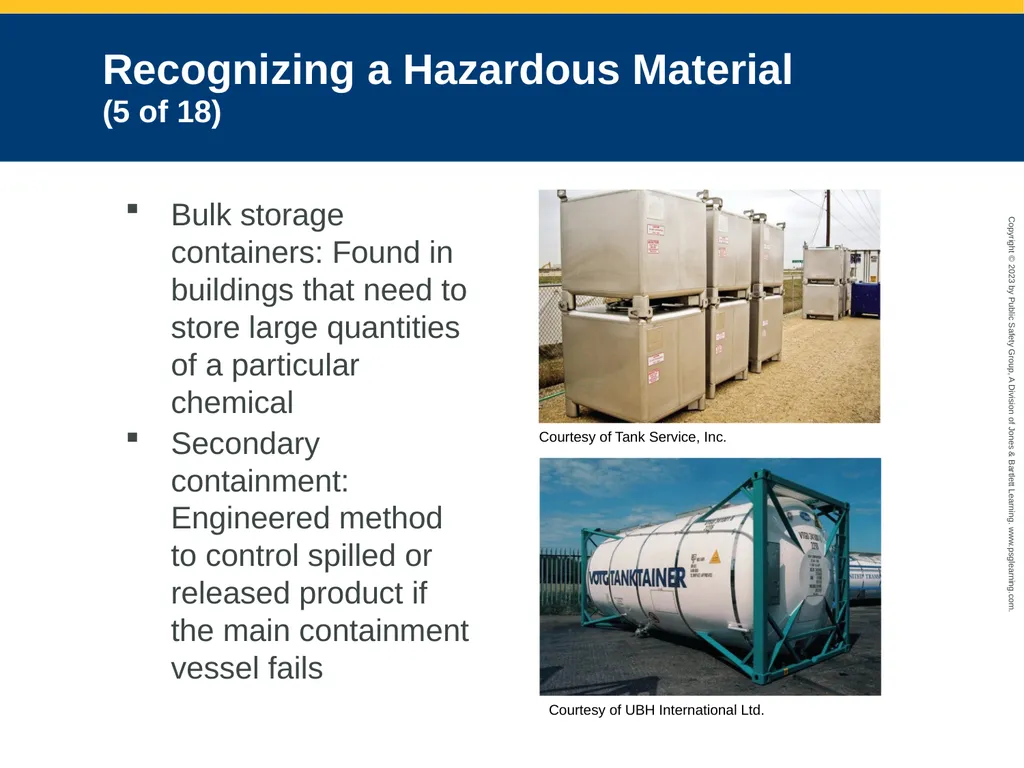
(5 of 18) Bulk storage containers: Found in buildings that need to store large quantities of a particular chemical
Secondary containment: Engineered method to control spilled or released product if the main containment vessel fails Courtesy of Tank Service, Inc. Courtesy of UBH International Ltd.<br>
Secondary containment: Engineered method to control spilled or released product if the main containment vessel fails Courtesy of Tank Service, Inc. Courtesy of UBH International Ltd.<br>
44
Recognizing a Hazardous Material
(6 of 18) Nonbulk storage vessels
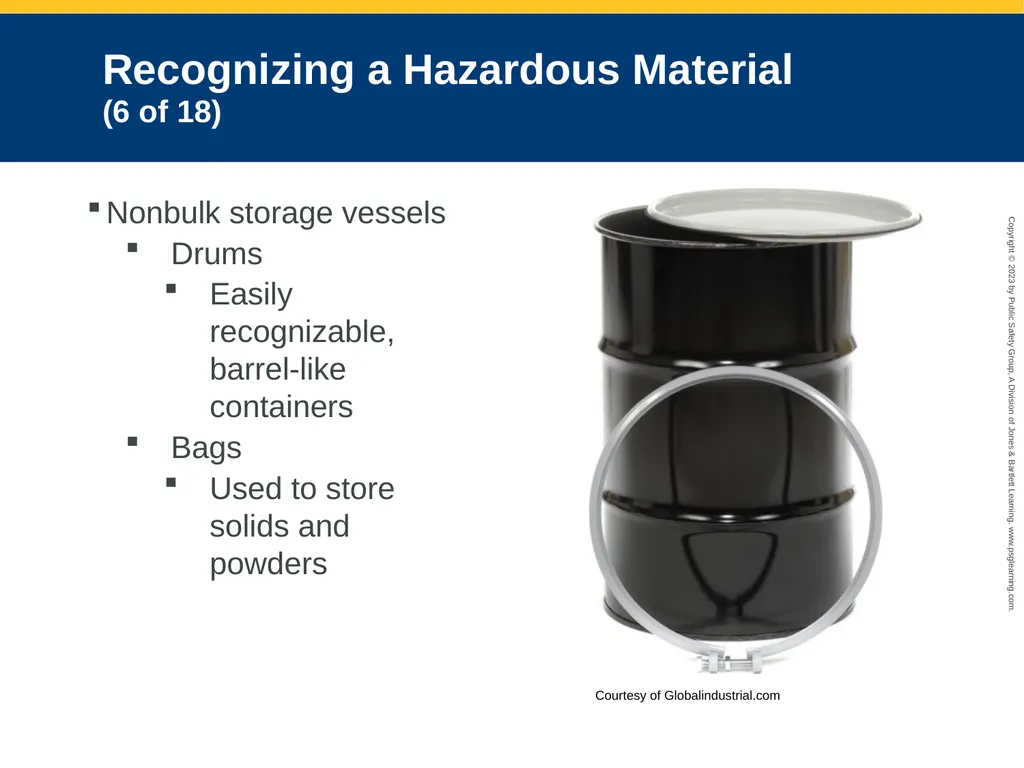
Drums
Easily recognizable, barrel-like containers
Bags
Used to store solids and powders Courtesy of Globalindustrial.com<br>
Drums
Easily recognizable, barrel-like containers
Bags
Used to store solids and powders Courtesy of Globalindustrial.com<br>
45
Recognizing a Hazardous Material
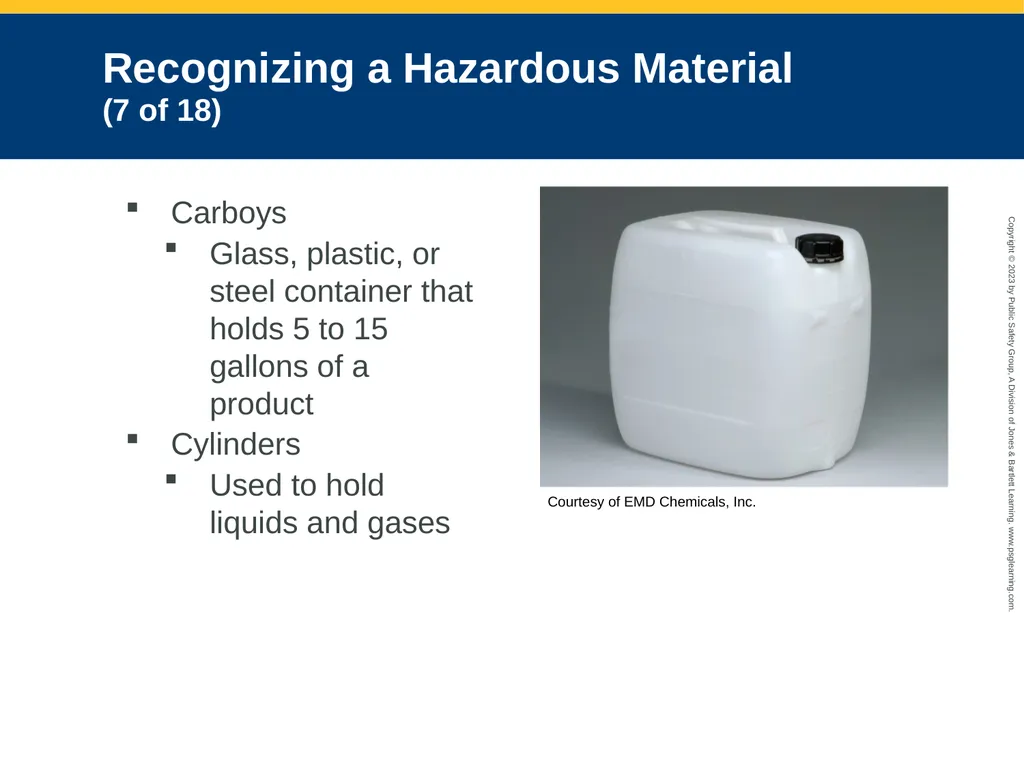
(7 of 18) Carboys
Glass, plastic, or steel container that holds 5 to 15 gallons of a product
Cylinders
Used to hold liquids and gases Courtesy of EMD Chemicals, Inc.<br>
Glass, plastic, or steel container that holds 5 to 15 gallons of a product
Cylinders
Used to hold liquids and gases Courtesy of EMD Chemicals, Inc.<br>
46
Recognizing a Hazardous Material
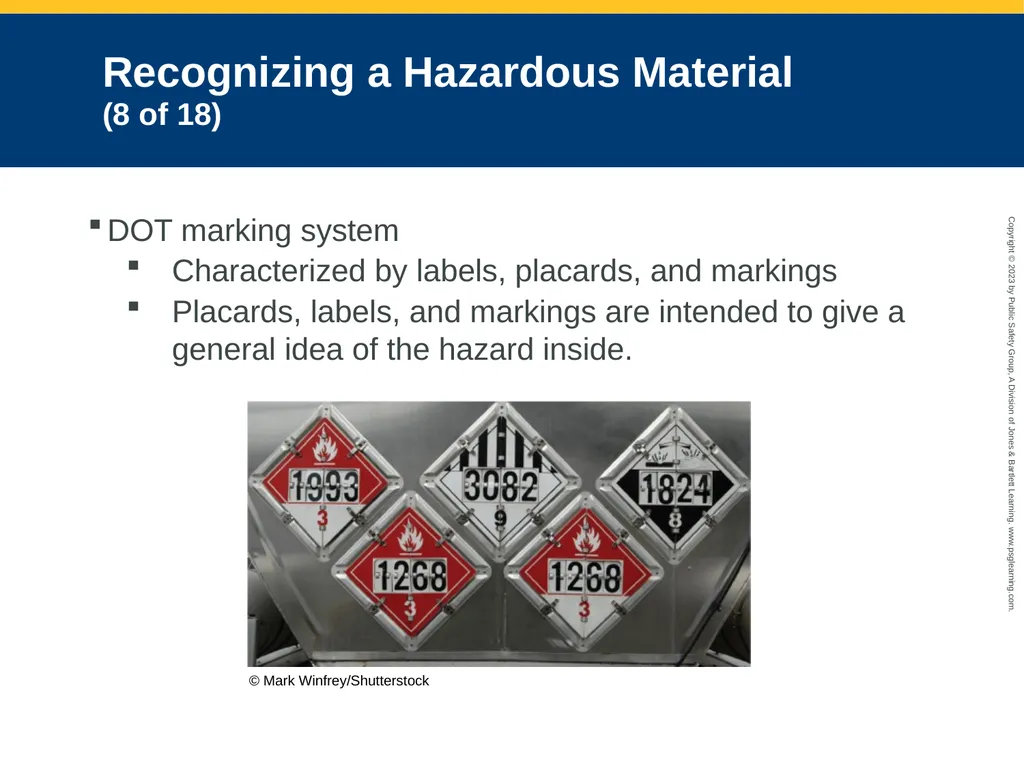
(8 of 18) DOT marking system
Characterized by labels, placards, and markings
Placards, labels, and markings are intended to give a general idea of the hazard inside. © Mark Winfrey/Shutterstock<br>
Characterized by labels, placards, and markings
Placards, labels, and markings are intended to give a general idea of the hazard inside. © Mark Winfrey/Shutterstock<br>
47
Recognizing a Hazardous Material
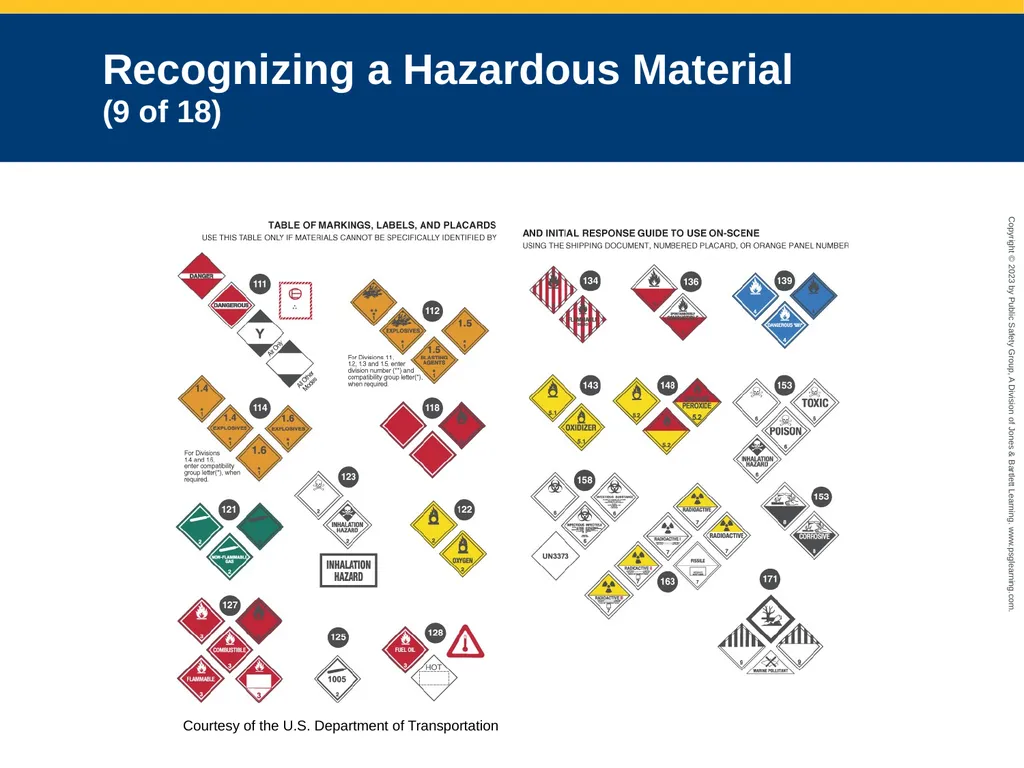
(9 of 18) Courtesy of the U.S. Department of Transportation<br>
48
Recognizing a Hazardous Material
(10 of 18) DOT system does not require all chemical shipments to be marked with placards or labels.
Some chemicals are so hazardous that shipping any amount of them requires the use of labels or placards.
Four-digit United Nations number is required on some placards.<br>
Some chemicals are so hazardous that shipping any amount of them requires the use of labels or placards.
Four-digit United Nations number is required on some placards.<br>
49
Recognizing a Hazardous Material
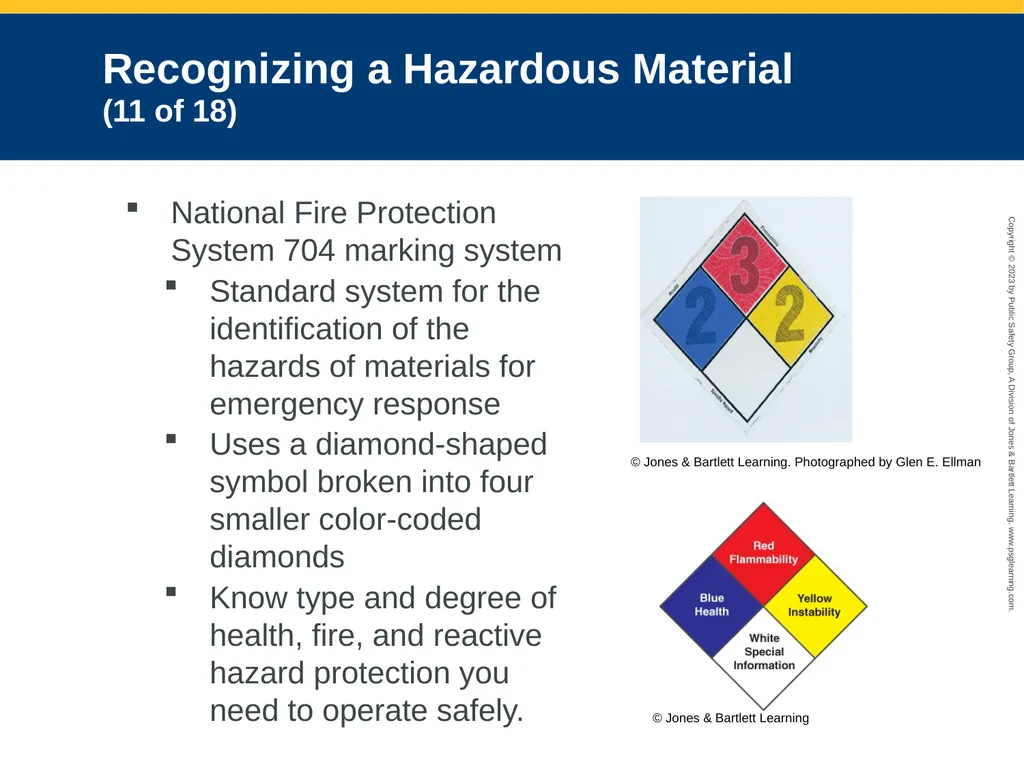
(11 of 18) National Fire Protection System 704 marking system
Standard system for the identification of the hazards of materials for emergency response
Uses a diamond-shaped symbol broken into four smaller color-coded diamonds
Know type and degree of health, fire, and reactive hazard protection you need to operate safely. © Jones & Bartlett Learning. Photographed by Glen E. Ellman © Jones & Bartlett Learning<br>
50
Recognizing a Hazardous Material
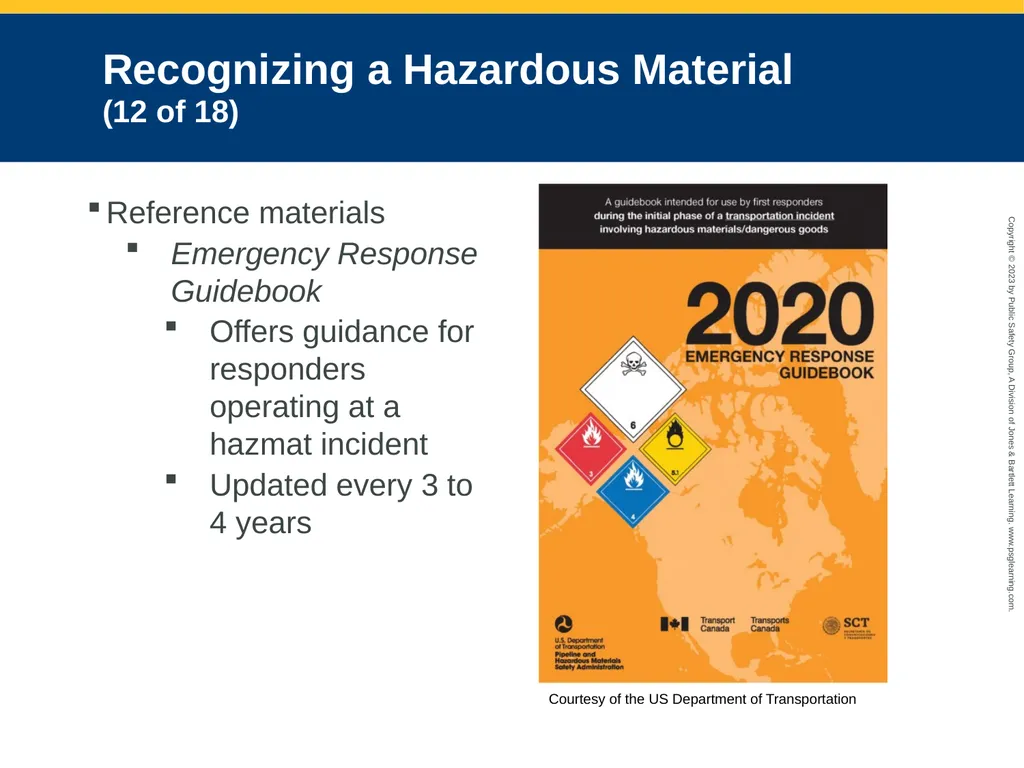
(12 of 18) Reference materials
Emergency Response Guidebook
Offers guidance for responders operating at a hazmat incident
Updated every 3 to 4 years Courtesy of the US Department of Transportation<br>
Emergency Response Guidebook
Offers guidance for responders operating at a hazmat incident
Updated every 3 to 4 years Courtesy of the US Department of Transportation<br>
51
Recognizing a Hazardous Material
(13 of 18) Safety data sheets
Common source of information about a particular chemical
Structured format
Designed to provide basic information about the chemical makeup of a substance<br>
Common source of information about a particular chemical
Structured format
Designed to provide basic information about the chemical makeup of a substance<br>
52
Recognizing a Hazardous Material
(14 of 18) Shipping papers
Required whenever materials are transported from one place to another
Include names and addresses of shipper and receiver
Bills of lading or freight bills: Shipping papers for road and highway transportation<br>
Required whenever materials are transported from one place to another
Include names and addresses of shipper and receiver
Bills of lading or freight bills: Shipping papers for road and highway transportation<br>
53
Recognizing a Hazardous Material
(15 of 18) CHEMTREC
Chemical Transportation Emergency Center
Has ability to provide technical chemical information via telephone, fax, or other electronic media<br>
Chemical Transportation Emergency Center
Has ability to provide technical chemical information via telephone, fax, or other electronic media<br>
54
Recognizing a Hazardous Material
(16 of 18) When you call CHEMTREC, have:
Name of the materials involved in the incident
Name of the caller and callback telephone number
Description of incident and actions taken
Shipper or manufacturer of the chemical (if known)
Container type and number of containers
Railcar or vehicle markings or numbers
Shipping carrier’s name
Recipient of material
Location, time, weather at the scene<br>
55
Recognizing a Hazardous Material
(17 of 18) Identification of hazardous materials
Always maintain a high index of suspicion.
Hazmat incident is often indicated by a(n):
Visible cloud or strange-looking smoke
Leak or spill from a tank, container, truck, or railroad car with or without hazmat placards or labels
Unusual, strong, noxious, harsh odor in the area<br>
Always maintain a high index of suspicion.
Hazmat incident is often indicated by a(n):
Visible cloud or strange-looking smoke
Leak or spill from a tank, container, truck, or railroad car with or without hazmat placards or labels
Unusual, strong, noxious, harsh odor in the area<br>
56
Recognizing a Hazardous Material
(18 of 18) Understand potential danger of hazardous materials and know how to operate safely at a hazmat incident
If you do not recognize the danger until you are too close, leave the area immediately.
No one should enter the area without the proper protective equipment, respiratory protection, or training.<br>
If you do not recognize the danger until you are too close, leave the area immediately.
No one should enter the area without the proper protective equipment, respiratory protection, or training.<br>
57
Hazmat Scene Operations (1 of 9) Once you recognize a hazardous materials incident, call the hazmat team.
Focus your efforts on activities that will ensure the safety and survival of the greatest number of people.
Set up a perimeter to stop traffic and people from entering the area.<br>
Focus your efforts on activities that will ensure the safety and survival of the greatest number of people.
Set up a perimeter to stop traffic and people from entering the area.<br>
58
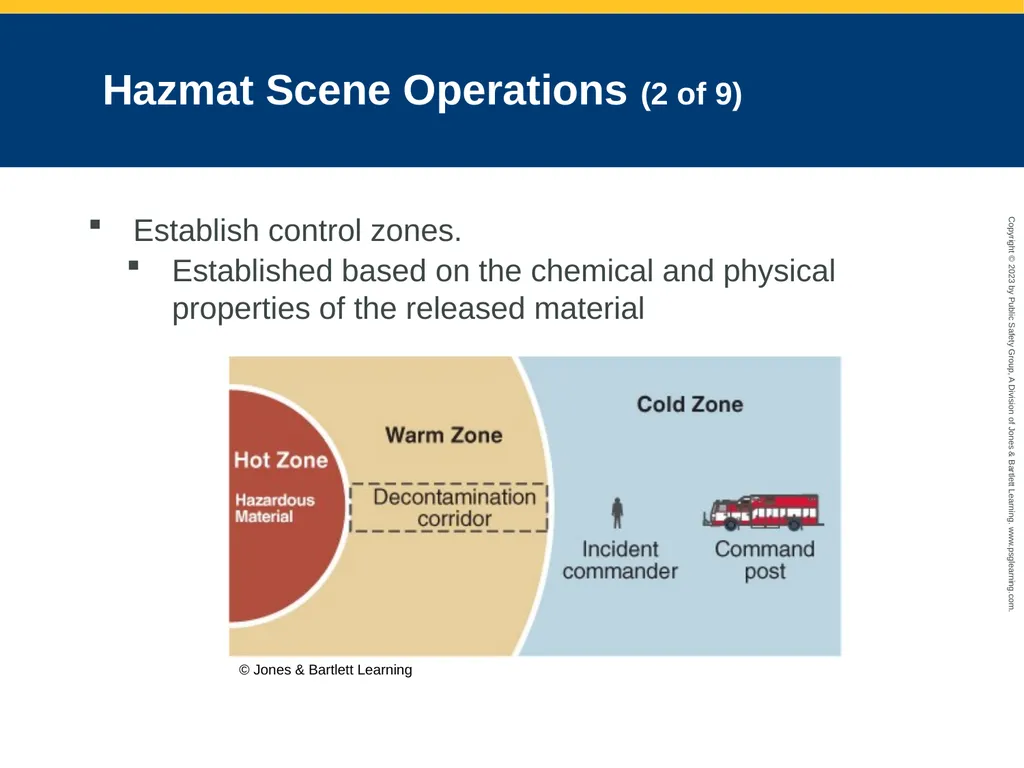
Hazmat Scene Operations (2 of 9) Establish control zones.
Established based on the chemical and physical properties of the released material © Jones & Bartlett Learning<br>
Established based on the chemical and physical properties of the released material © Jones & Bartlett Learning<br>
59
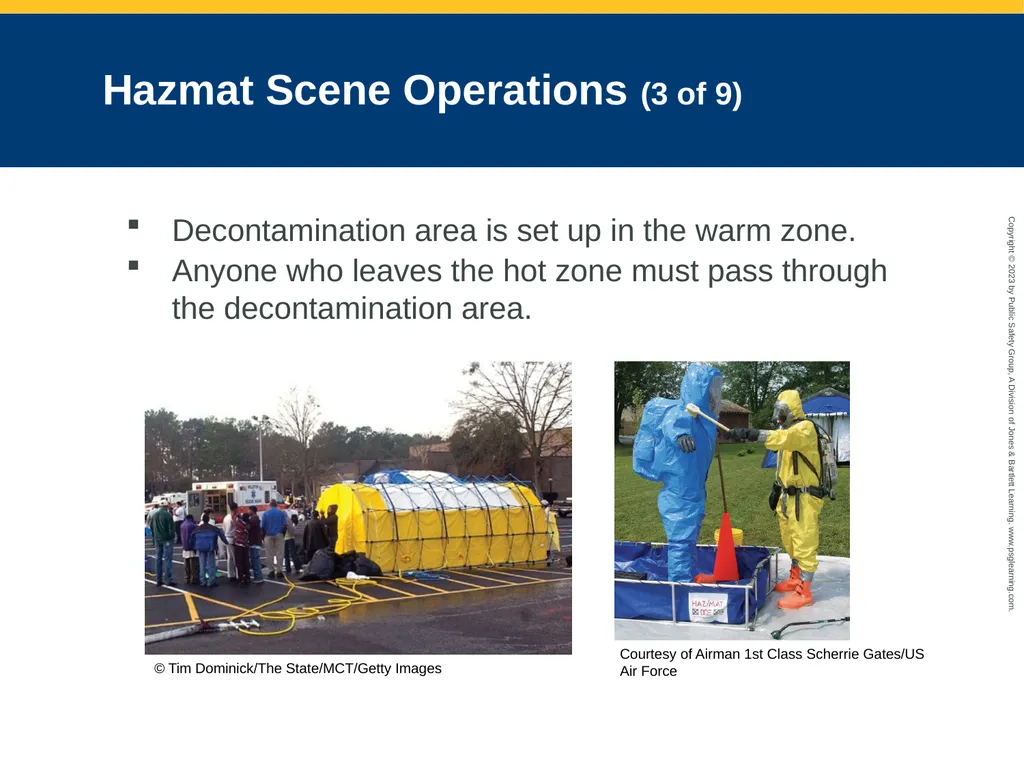
Hazmat Scene Operations (3 of 9) Decontamination area is set up in the warm zone.
Anyone who leaves the hot zone must pass through the decontamination area. © Tim Dominick/The State/MCT/Getty Images Courtesy of Airman 1st Class Scherrie Gates/US Air Force<br>
Anyone who leaves the hot zone must pass through the decontamination area. © Tim Dominick/The State/MCT/Getty Images Courtesy of Airman 1st Class Scherrie Gates/US Air Force<br>
60
Hazmat Scene Operations (4 of 9) Personal protective equipment level
Indicates amount and type of protective gear needed to prevent injury from a particular substance
Rated for its effectiveness<br>
Indicates amount and type of protective gear needed to prevent injury from a particular substance
Rated for its effectiveness<br>
61
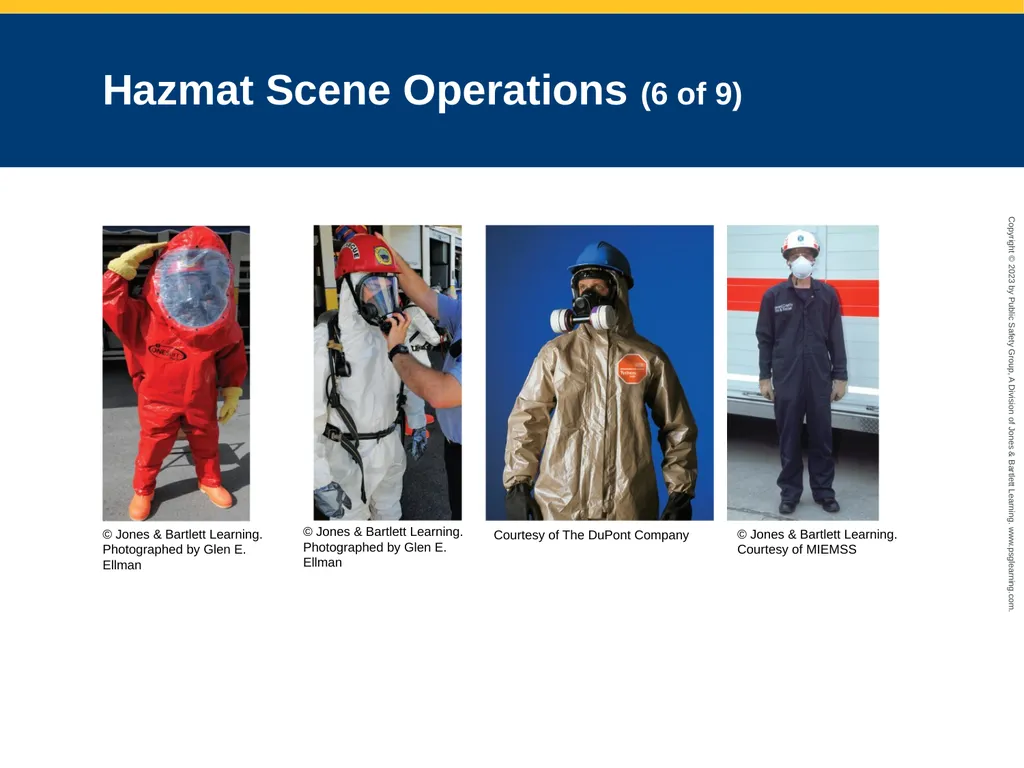
Hazmat Scene Operations (5 of 9) EPA levels of protection
Level A protection: Fully encapsulated chemical-resistant garment
Level B protection: Chemical-resistant clothing, boots, gloves, and SCBA
Level C protection: Standard work clothing plus chemical-protective clothing and gloves
Level D protection: Lowest level of protection; requires coveralls, work shoes, hard hat, gloves, and standard work clothing.<br>
62
Hazmat Scene Operations (6 of 9) © Jones & Bartlett Learning. Photographed by Glen E. Ellman © Jones & Bartlett Learning. Photographed by Glen E. Ellman Courtesy of The DuPont Company © Jones & Bartlett Learning. Courtesy of MIEMSS<br>
63
Hazmat Scene Operations (7 of 9) Caring for patients
Provide simple assessment and essential care in the hazard zone and decontamination area.
Care of patients at a hazmat incident must address:
Any trauma from other related mechanisms
Injury and harm from exposure to the toxic hazardous substance<br>
Provide simple assessment and essential care in the hazard zone and decontamination area.
Care of patients at a hazmat incident must address:
Any trauma from other related mechanisms
Injury and harm from exposure to the toxic hazardous substance<br>
64
Hazmat Scene Operations (8 of 9) Special care:
Cut away all of the patient’s clothing and do a rapid rinse.
Decision to transport even one patient with critical injuries rests with the IC.
To make decontaminating the ambulance easier, tape the cabinet doors shut.<br>
Cut away all of the patient’s clothing and do a rapid rinse.
Decision to transport even one patient with critical injuries rests with the IC.
To make decontaminating the ambulance easier, tape the cabinet doors shut.<br>
65
Hazmat Scene Operations (9 of 9) Inform the hospital that you are transporting a critically injured patient who has not been fully decontaminated.
Ambulance must be decontaminated before transporting another patient.<br>
Ambulance must be decontaminated before transporting another patient.<br>