
Verbal Aspect: An Introduction to the Debate and
YM
Published · 53 slides · 0 views

1 / 1


Description
Verbal Aspect: An Introduction to the Debate and Its Use in One Major Commentary By Noah W. Kelley Syntax and Exegesis, Fall 2017 Part 1: Introduction Verbal aspect has been the most controversial issue within Greek studies in the last
Related Topics
Share
Embed code
Download this presentation From Below
"Verbal Aspect: An Introduction to the Debate and" is the property of its rightful owner. Permission is granted to download and print the materials on this website for personal, non-commercial use only, and to display it on your personal computer provided you do not modify the materials and that you retain all copyright notices contained in the materials. By downloading content from our website, you accept the terms of this agreement.
Presentation Transcript
01
Verbal Aspect: An Introduction to the Debate and Its Use in One Major Commentary By Noah W. Kelley
Syntax and Exegesis, Fall 2017<br>
Syntax and Exegesis, Fall 2017<br>
02
Part 1: Introduction “Verbal aspect has been the most controversial issue within Greek studies in the last twenty-five years” (Campbell, Advances, 105).<br>
03
Introduction: Verbal Aspect Defined Aspect is the “view of the action that the speaker chooses to present to the hearer” (Black).<br>
04
Introduction: Tense, Aspect, and Aktionsart Tense = time of action (past, present or future). Relative to the time of the speaker
Aspect = the author’s viewpoint (or “perspective”) on the action (in process, in summary, completed with continuing effects).
Aktionsart = kind of action occurring (constative vs. ingressive, habitual vs. iterative). The entire meaning of the verb in context.<br>
Aspect = the author’s viewpoint (or “perspective”) on the action (in process, in summary, completed with continuing effects).
Aktionsart = kind of action occurring (constative vs. ingressive, habitual vs. iterative). The entire meaning of the verb in context.<br>
05
Introduction: A Brief History of the Debate Previous generations learned that the primary meaning of the Greek tenses was Aktionsart (kind of action).
The present and imperfect were considered “linear” action, aorist was considered “punctilliar” or “undefined” action, and the perfect tense indicated a “continuous state resulting from a prior act” (Picirilli, 533). The secondary meaning was absolute time in the indicative mood, and relative time in participles.<br>
The present and imperfect were considered “linear” action, aorist was considered “punctilliar” or “undefined” action, and the perfect tense indicated a “continuous state resulting from a prior act” (Picirilli, 533). The secondary meaning was absolute time in the indicative mood, and relative time in participles.<br>
06
Introduction: A Brief History of the Debate K. L. McKay published on the topic from 1965ff.
Bernard Comrie Published Aspect: An Introduction to the Study of Verbal Aspect and Related Problems (1976)
The real debate began with the publication of Stanley E. Porter’s Verbal Aspect in the Greek of the New Testament (Lang, 1989), and Buist M. Fanning’s Verbal Aspect in New Testament Greek (Clarendon, 1990).<br>
07
Introduction: A Brief History of the Debate Fanning describes the differences between himself and Porter as follows:
First, Fanning took the approach that earlier Greek exegetes and linguists were “not so much mistaken or misguided but simplistic and in need of refinement and specification . . . What I thought was needed was not an intellectual revolution but a process of correcting and extending the work of others” (Fanning, p. 9). According to Fanning, Porter’s approach was that “earlier work on ancient Greek aspect [was] seriously flawed and confused. . . . ). The old explanations of the ancient Greek verbal system that had anything to do with temporal location or with Aktionsart distinctions had to be cleared away and forgotten in order to make real progress” (ibid.).<br>
First, Fanning took the approach that earlier Greek exegetes and linguists were “not so much mistaken or misguided but simplistic and in need of refinement and specification . . . What I thought was needed was not an intellectual revolution but a process of correcting and extending the work of others” (Fanning, p. 9). According to Fanning, Porter’s approach was that “earlier work on ancient Greek aspect [was] seriously flawed and confused. . . . ). The old explanations of the ancient Greek verbal system that had anything to do with temporal location or with Aktionsart distinctions had to be cleared away and forgotten in order to make real progress” (ibid.).<br>
08
Introduction: A Brief History of the Debate Fanning describes the differences between himself and Porter as follows:
Second, Porter was more concerned to construct a tight linguistic system with few exceptions. Fanning, on the other hand, was less interested in abstract systems and more interested in explanations of particular texts that took into account contextual features.<br>
Second, Porter was more concerned to construct a tight linguistic system with few exceptions. Fanning, on the other hand, was less interested in abstract systems and more interested in explanations of particular texts that took into account contextual features.<br>
09
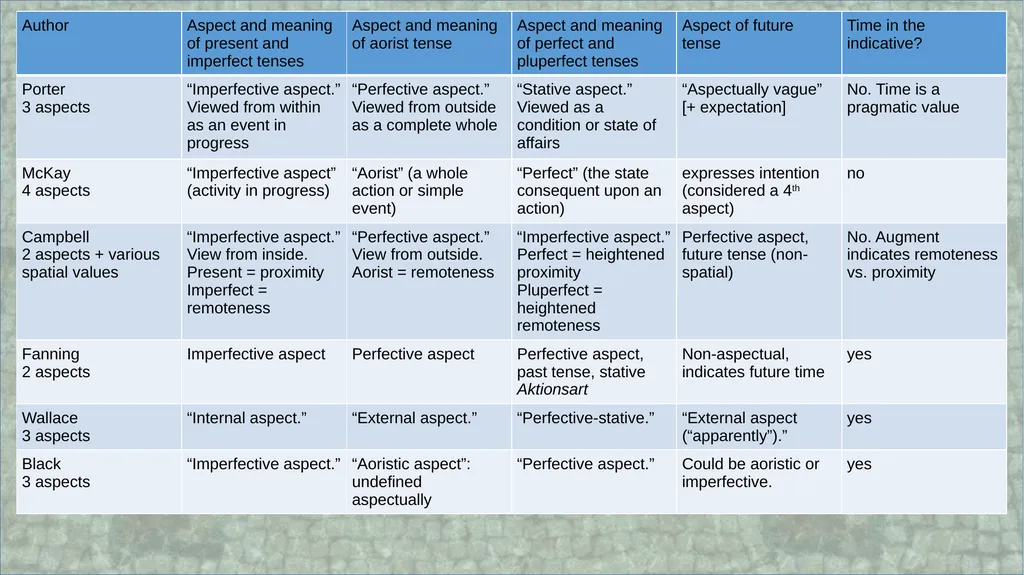
Points of Debate: How many aspects and what are they called?<br>
10
Points of Debate: How many aspects and what are they called?<br>
11
Points of Debate: Does the Greek Verb Convey Time? Porter, McKay, Campbell: no.
Sharp distinction between semantics and pragmatics.<br>
Sharp distinction between semantics and pragmatics.<br>
12
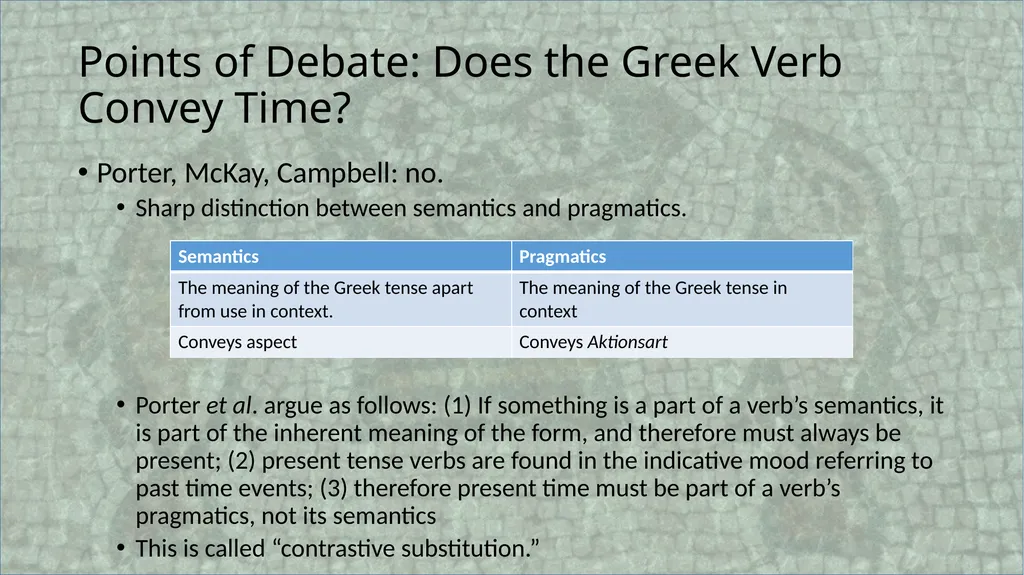
Points of Debate: Does the Greek Verb Convey Time? Porter, McKay, Campbell: no.
Sharp distinction between semantics and pragmatics.
Porter et al. argue as follows: (1) If something is a part of a verb’s semantics, it is part of the inherent meaning of the form, and therefore must always be present; (2) present tense verbs are found in the indicative mood referring to past time events; (3) therefore present time must be part of a verb’s pragmatics, not its semantics
This is called “contrastive substitution.”<br>
13
Points of Debate: Does the Greek Verb Convey Time? Porter, McKay, Campbell: no.
Sharp distinction between semantics and pragmatics.
Time is not morphologically expressed, but indicated by context (adverbs, genre, historical references, etc.).
Campbell adds to this that what is conveyed semantically is the spatial values of remoteness and proximity, and as a result, the frequent pragmatic implicature is that these are expressed in context as temporally near (present time, or stative), or temporally remote (past time).<br>
14
Points of Debate: Does the Greek Verb Convey Time? Fanning, Wallace, Black: yes. Time is almost always involved in the indicative mood, and relative time conveyed by participles. However, time is secondary and aspect is primary.<br>
15
Points of Debate: Does the Greek Verb Convey Time? Morphology:
What about the augment and the secondary endings? If time is not considered in the indicative, there is no need for secondary endings or the augment. There is no need for the imperfect or pluperfect tenses. And there is no explanation for why these tenses exist in the indicative but not in the other moods.<br>
What about the augment and the secondary endings? If time is not considered in the indicative, there is no need for secondary endings or the augment. There is no need for the imperfect or pluperfect tenses. And there is no explanation for why these tenses exist in the indicative but not in the other moods.<br>
16
Points of Debate: Does the Greek Verb Convey Time? On the hard and fast distinction between semantics and pragmatics, and Porter’s contrastive substitution:
Why must we have a rule that can have no exceptions?
Runge has recently pushed back on Porter’s use of contrastive substitution. He says that the linguists Porter cites aren’t saying what Porter says they are saying (NovT 56, 2014).
Runge: Certain pragmatic effects work based on the assumption that tenses have a default temporal meaning. Ex: Historical presents.
Picirilli: ex: “I wish I were you.” He argues that “if English can use a truly past time verb, in certain circumstances, for the present time, without negating that it really is a past time verb, then logically Greek might do the same” (p. 544).<br>
17
Points of Debate: Does the Greek Verb Convey Time? On the hard and fast distinction between semantics and pragmatics, and Porter’s contrastive substitution:
Wallace: “In our view, the unaffected meaning of the tenses in the indicative involves both aspect and time. However, either one of these can be suppressed by lexemic, contextual, or grammatical intrusions” (p. 511).
Thompson: “there is much to be said for the view that grammatical categories can be polysemous, so that there need not be a single core of meaning found in every context.” (p. 17).<br>
18
Points of Debate: Aspect and Discourse There is debate as to how verbal aspect might signal prominence in discourse.
Porter: aorist is the unmarked form, and thus is background; the present and imperfect are more marked and therefore foreground; the perfect is the most marked and is therefore the front-ground. This affects what he considers most salient (or prominent).
Fanning sees aorist as foreground and imperfect as background in narrative<br>
19
Points of Debate: The Use of Aktionsart Categories If verbs by themselves aren’t “constative” or “ingressive,” should we scrap this whole system of labels?
Perhaps it is better to retain the labels but be clear that they aren’t communicated by the verb by itself, but is a result of the interaction between lexeme, aspect, and context.
In other words, instead of saying that something is a “constative aorist,” we might say that a particular aorist verb is a “constative verb” in this context.<br>
20
Part 2: Where the Rubber Meets the Road: What tangible results have the discussions about Verbal Aspect Theory (VAT) yielded for NT exegesis?<br>
21
Where the Rubber Meets the Road: An interaction with Roy E. Ciampa and Brian S. Rosner’s Pillar New Testament Commentary on 1 Corinthians
VAT is given 4 pages in the introduction.<br>
VAT is given 4 pages in the introduction.<br>
22
I. ANALYSIS OF INTRODUCTORY COMMENTS<br>
23
Four Main Ideas: 1. Aktionsart (i.e. kind of action, such as ingressive action, gnomic, constative, etc.) is a legitimate dimension of the text, but it is derived from the interaction between multiple facets of the text, such as the semantics (including aspect), lexeme, and context.<br>
24
Four Main Ideas: Andrew David Naselli:
“Embracing aspect theory . . . does not drastically change translations, exegesis, or doctrine. Its primary significance is that it changes how one expresses (and perhaps more importantly, now one does not express) an exegetical argument with reference to a verb’s tense-form. It is invalid to argue that a certain tense-form necessitates a particular pragmatic meaning. . . . While still reaching many of the same pragmatic distinctions . . . aspect theory adds a perspective to the exegesis of Greek verbs that is more nuanced, subtle, consistent, and genuinely explanatory.”
(Andrew David Naselli, “A Brief Introduction to Verbal Aspect in New Testament Greek,” Detroit Baptist Seminary Journal 12 [2007]: 25.)<br>
25
Four Main Ideas: 2. With regard to time they seem to believe—despite claims that time is not indicated by the tense at all—that there is in fact a “default temporal understanding” to the Greek verbal system unless it is cancelled by some contextual factor.<br>
26
Four Main Ideas: 3. Regarding aorist and present imperatives and subjunctives, they tentatively follow Campbell’s view, in which present imperatives generally indicate “general instruction,” while aorist imperatives generally indicate “specific instruction”<br>
27
Four Main Ideas: 4. Regarding the perfect tense, they tentatively view it as indicating a present state.<br>
28
II. ANALYSIS OF RELEVANT DISCUSSIONS IN THE COMMENTARY<br>
29
1. Aktionsart is attributable to a complex of features. On many occasions, they bring this out in the comments.
Other times, their comments are consistent with this view.
In a handful of cases, their comments are unclear about this, or give the appearance of contradicting it.<br>
Other times, their comments are consistent with this view.
In a handful of cases, their comments are unclear about this, or give the appearance of contradicting it.<br>
30
1. Aktionsart is attributable to a complex of features. An example in which they bring out the nuance (1 Cor 2:14):
ψυχικὸς δὲ ἄνθρωπος οὐ δέχεται τὰ τοῦ πνεύματος τοῦ θεοῦ
“ ‘Does not welcome’ represents a present indicative verb . . . the imperfective aspect of which (in light of the context, which suggests that the nature of spiritual or unspiritual people consistently dictates whether they respond one way or the other) is expressing a gnomic idea here, how things always happen, given their very nature.” (p. 135, n. 65).<br>
31
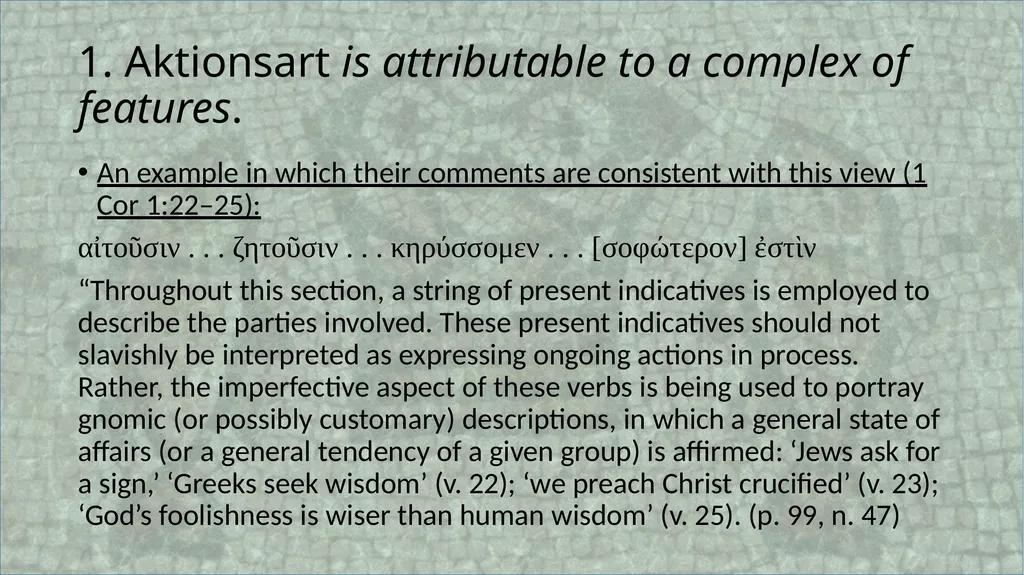
1. Aktionsart is attributable to a complex of features. An example in which their comments are consistent with this view (1 Cor 1:22–25):
αἰτοῦσιν . . . ζητοῦσιν . . . κηρύσσομεν . . . [σοφώτερον] ἐστὶν
“Throughout this section, a string of present indicatives is employed to describe the parties involved. These present indicatives should not slavishly be interpreted as expressing ongoing actions in process. Rather, the imperfective aspect of these verbs is being used to portray gnomic (or possibly customary) descriptions, in which a general state of affairs (or a general tendency of a given group) is affirmed: ‘Jews ask for a sign,’ ‘Greeks seek wisdom’ (v. 22); ‘we preach Christ crucified’ (v. 23); ‘God’s foolishness is wiser than human wisdom’ (v. 25). (p. 99, n. 47)<br>
32
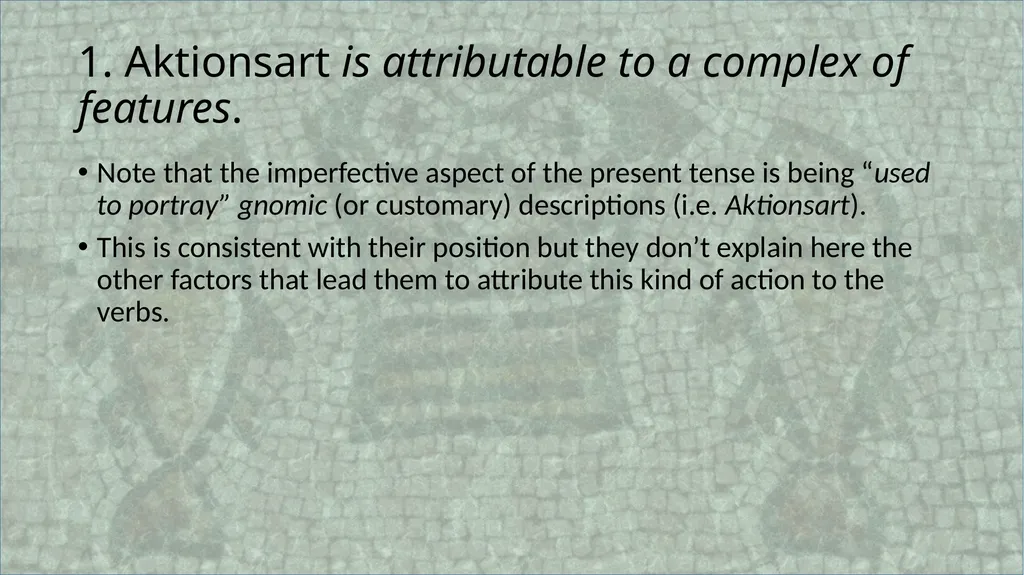
1. Aktionsart is attributable to a complex of features. Note that the imperfective aspect of the present tense is being “used to portray” gnomic (or customary) descriptions (i.e. Aktionsart).
This is consistent with their position but they don’t explain here the other factors that lead them to attribute this kind of action to the verbs.<br>
This is consistent with their position but they don’t explain here the other factors that lead them to attribute this kind of action to the verbs.<br>
33
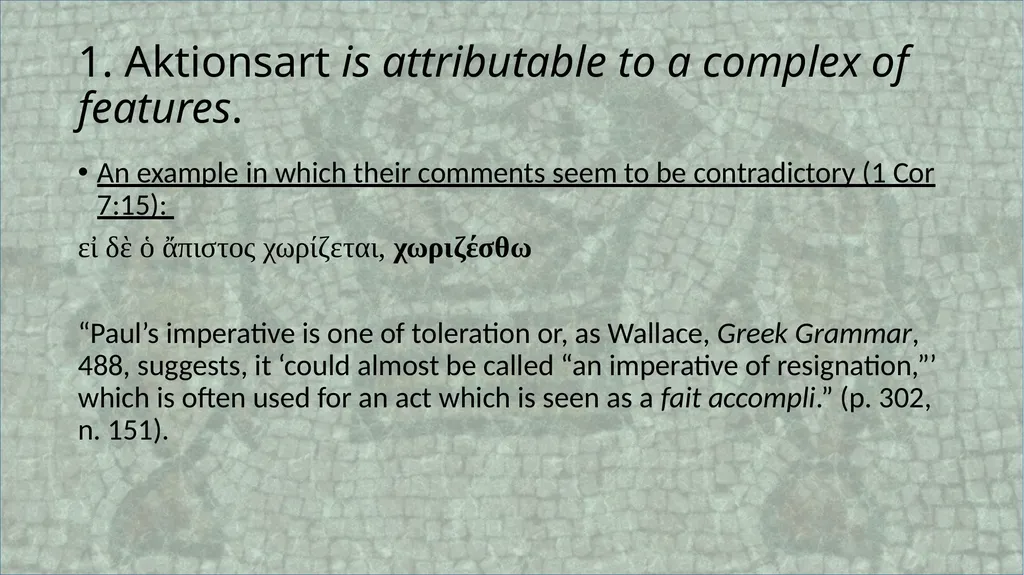
1. Aktionsart is attributable to a complex of features. An example in which their comments seem to be contradictory (1 Cor 7:15):
εἰ δὲ ὁ ἄπιστος χωρίζεται, χωριζέσθω
“Paul’s imperative is one of toleration or, as Wallace, Greek Grammar, 488, suggests, it ‘could almost be called “an imperative of resignation,”’ which is often used for an act which is seen as a fait accompli.” (p. 302, n. 151).<br>
εἰ δὲ ὁ ἄπιστος χωρίζεται, χωριζέσθω
“Paul’s imperative is one of toleration or, as Wallace, Greek Grammar, 488, suggests, it ‘could almost be called “an imperative of resignation,”’ which is often used for an act which is seen as a fait accompli.” (p. 302, n. 151).<br>
34
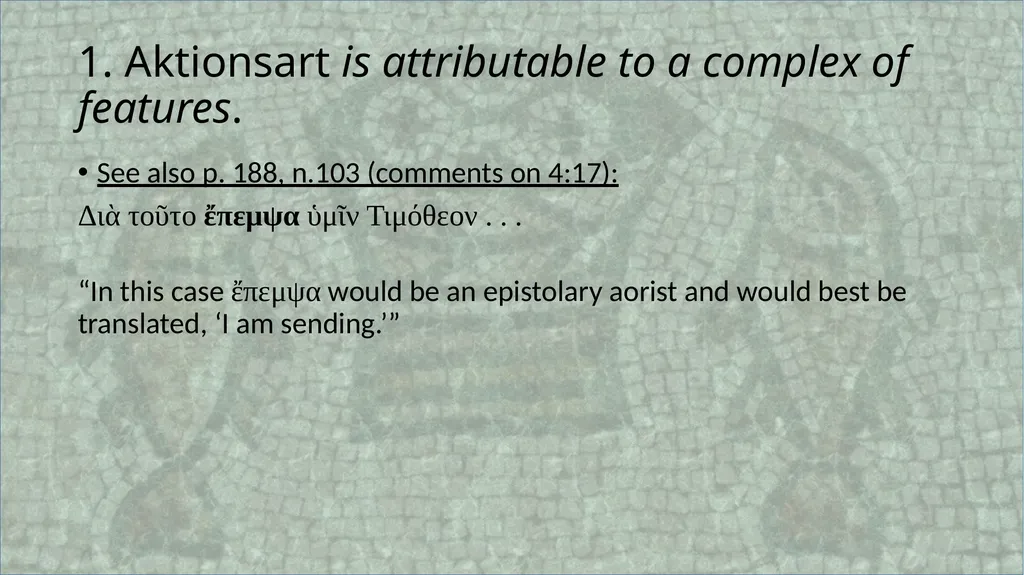
1. Aktionsart is attributable to a complex of features. See also p. 188, n.103 (comments on 4:17):
Διὰ τοῦτο ἔπεμψα ὑμῖν Τιμόθεον . . .
“In this case ἔπεμψα would be an epistolary aorist and would best be translated, ‘I am sending.’”<br>
Διὰ τοῦτο ἔπεμψα ὑμῖν Τιμόθεον . . .
“In this case ἔπεμψα would be an epistolary aorist and would best be translated, ‘I am sending.’”<br>
35
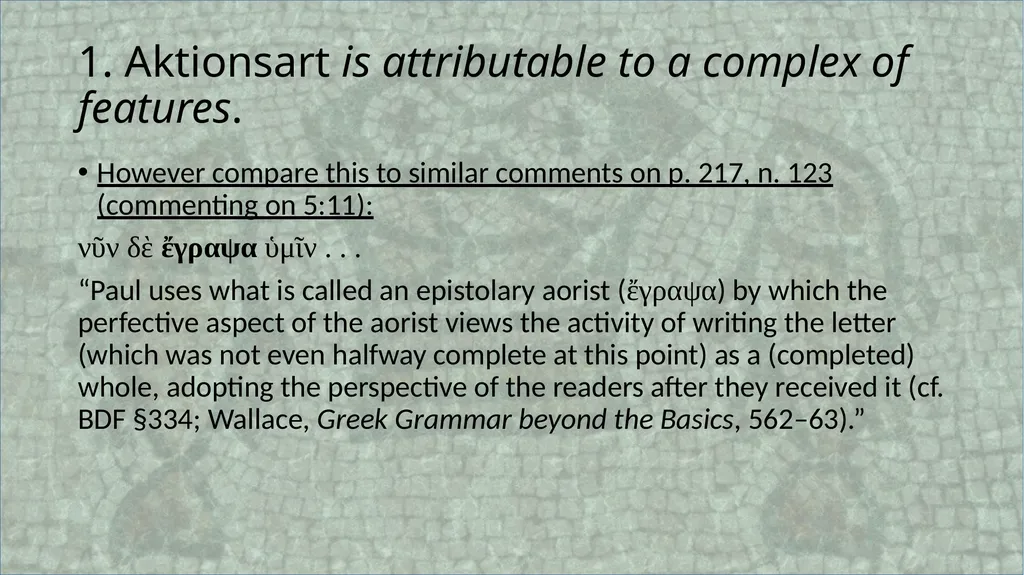
1. Aktionsart is attributable to a complex of features. However compare this to similar comments on p. 217, n. 123 (commenting on 5:11):
νῦν δὲ ἔγραψα ὑμῖν . . .
“Paul uses what is called an epistolary aorist (ἔγραψα) by which the perfective aspect of the aorist views the activity of writing the letter (which was not even halfway complete at this point) as a (completed) whole, adopting the perspective of the readers after they received it (cf. BDF §334; Wallace, Greek Grammar beyond the Basics, 562–63).”<br>
36
1. Aktionsart is attributable to a complex of features. Summary:
On many occasions, they bring this out in the comments.
Other times, their comments are consistent with this view.
In a handful of cases, their comments are unclear about this, or give the appearance of contradicting it.<br>
On many occasions, they bring this out in the comments.
Other times, their comments are consistent with this view.
In a handful of cases, their comments are unclear about this, or give the appearance of contradicting it.<br>
37
2. Default Temporal Understanding of Verb Tense. Their comments fall into two groups:
comments that imply or assume the default temporal understanding of the verb tense
comments that explain the exceptions to the default temporal significance<br>
comments that imply or assume the default temporal understanding of the verb tense
comments that explain the exceptions to the default temporal significance<br>
38
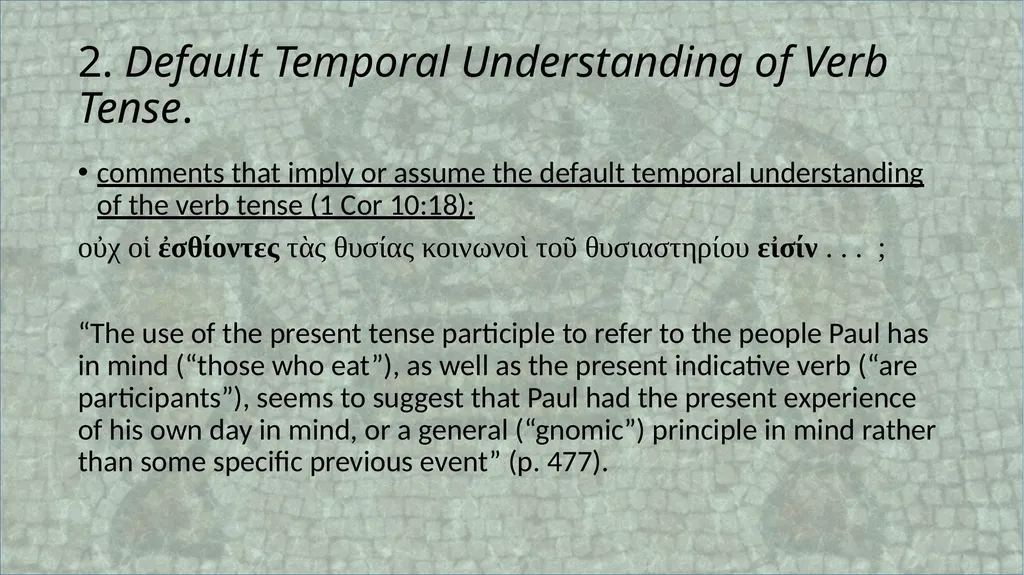
2. Default Temporal Understanding of Verb Tense. comments that imply or assume the default temporal understanding of the verb tense (1 Cor 10:18):
οὐχ οἱ ἐσθίοντες τὰς θυσίας κοινωνοὶ τοῦ θυσιαστηρίου εἰσίν . . . ;
“The use of the present tense participle to refer to the people Paul has in mind (“those who eat”), as well as the present indicative verb (“are participants”), seems to suggest that Paul had the present experience of his own day in mind, or a general (“gnomic”) principle in mind rather than some specific previous event” (p. 477).<br>
39
2. Default Temporal Understanding of Verb Tense. comments that imply or assume the default temporal understanding of the verb tense:
A helpful statement in a footnote on this section:
“Although present time is not the essence of present tense verbs (and the normal temporal significance of indicative verbs is cancelable), there is nothing in the context here to indicate to the reader that the normal temporal understanding is cancelled. Paul’s readers might have expected some such linguistic clue if he expected them to understand his reference to be to something that was no longer the case.” (p. 477, n.227).<br>
40
2. Default Temporal Understanding of Verb Tense. comments that explain the exceptions to the default temporal significance<br>
41
2. Default Temporal Understanding of Verb Tense. comments that explain the exceptions to the default temporal significance (on 3:13):
ἐν πυρὶ ἀποκαλύπτεται . . .
“The verb translated will be revealed (αποκαλύπτεται) is a present indicative set in a future-referring context. Indeed, the indicative verbs surrounding this present are all in the future tense. This present is always translated as though future-referring, and is best taken this way. Present tense verbs are sometimes used with future reference in describing events that are pre-planned or pre-determined (as in those determined by God’s eschatological plan, as here).” (p. 154, n. 44, italics original).<br>
42
2. Default Temporal Understanding of Verb Tense. Summary:
Verbs have a default temporal significance, but it is cancellable.<br>
Verbs have a default temporal significance, but it is cancellable.<br>
43
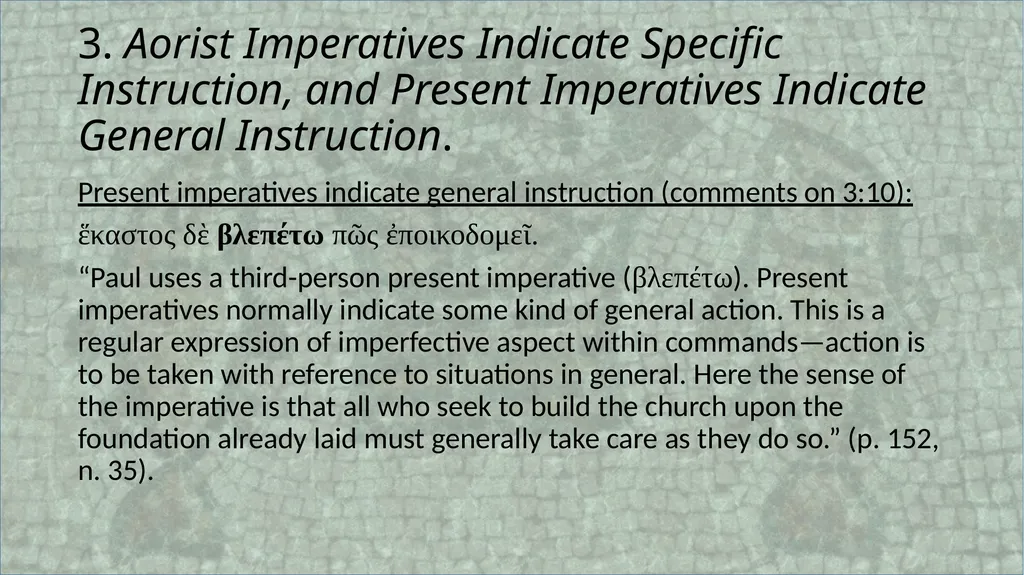
3. Aorist Imperatives Indicate Specific Instruction, and Present Imperatives Indicate General Instruction. Present imperatives indicate general instruction (comments on 3:10):
ἕκαστος δὲ βλεπέτω πῶς ἐποικοδομεῖ.
“Paul uses a third-person present imperative (βλεπέτω). Present imperatives normally indicate some kind of general action. This is a regular expression of imperfective aspect within commands—action is to be taken with reference to situations in general. Here the sense of the imperative is that all who seek to build the church upon the foundation already laid must generally take care as they do so.” (p. 152, n. 35).<br>
44
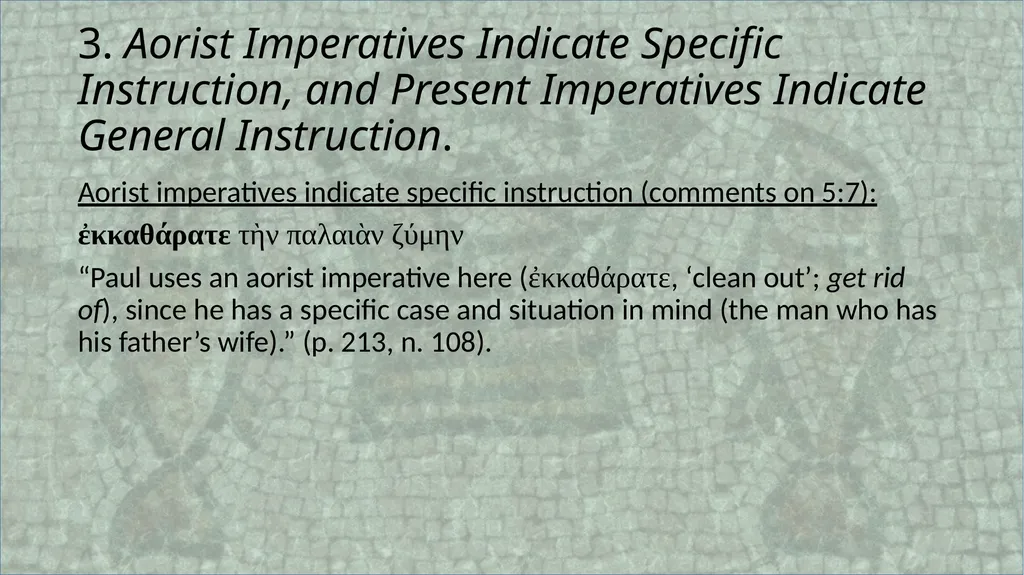
3. Aorist Imperatives Indicate Specific Instruction, and Present Imperatives Indicate General Instruction. Aorist imperatives indicate specific instruction (comments on 5:7):
ἐκκαθάρατε τὴν παλαιὰν ζύμην
“Paul uses an aorist imperative here (ἐκκαθάρατε, ‘clean out’; get rid of), since he has a specific case and situation in mind (the man who has his father’s wife).” (p. 213, n. 108).<br>
ἐκκαθάρατε τὴν παλαιὰν ζύμην
“Paul uses an aorist imperative here (ἐκκαθάρατε, ‘clean out’; get rid of), since he has a specific case and situation in mind (the man who has his father’s wife).” (p. 213, n. 108).<br>
45
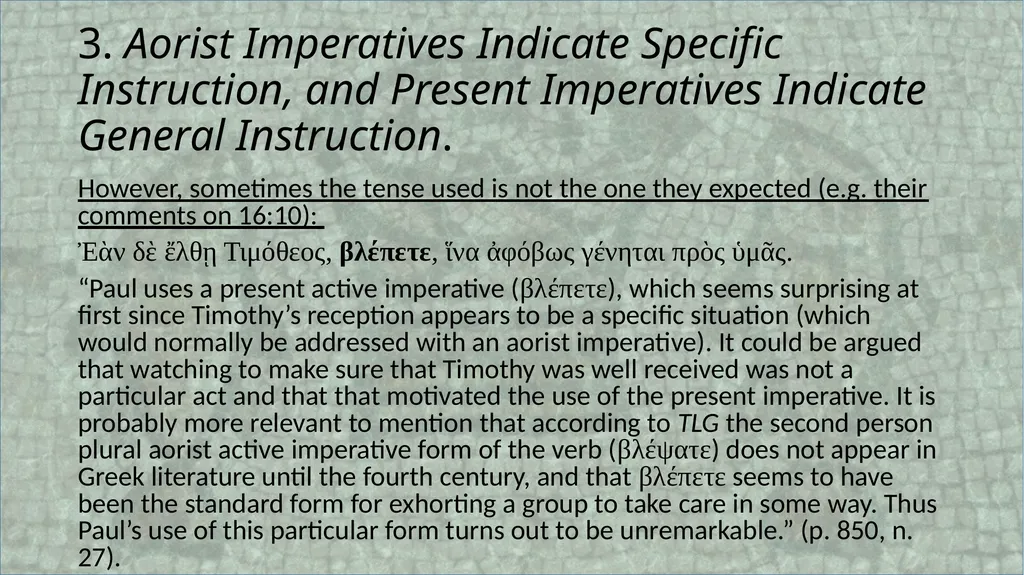
3. Aorist Imperatives Indicate Specific Instruction, and Present Imperatives Indicate General Instruction. However, sometimes the tense used is not the one they expected (e.g. their comments on 16:10):
Ἐὰν δὲ ἔλθῃ Τιμόθεος, βλέπετε, ἵνα ἀφόβως γένηται πρὸς ὑμᾶς.
“Paul uses a present active imperative (βλέπετε), which seems surprising at first since Timothy’s reception appears to be a specific situation (which would normally be addressed with an aorist imperative). It could be argued that watching to make sure that Timothy was well received was not a particular act and that that motivated the use of the present imperative. It is probably more relevant to mention that according to TLG the second person plural aorist active imperative form of the verb (βλέψατε) does not appear in Greek literature until the fourth century, and that βλέπετε seems to have been the standard form for exhorting a group to take care in some way. Thus Paul’s use of this particular form turns out to be unremarkable.” (p. 850, n. 27).<br>
46
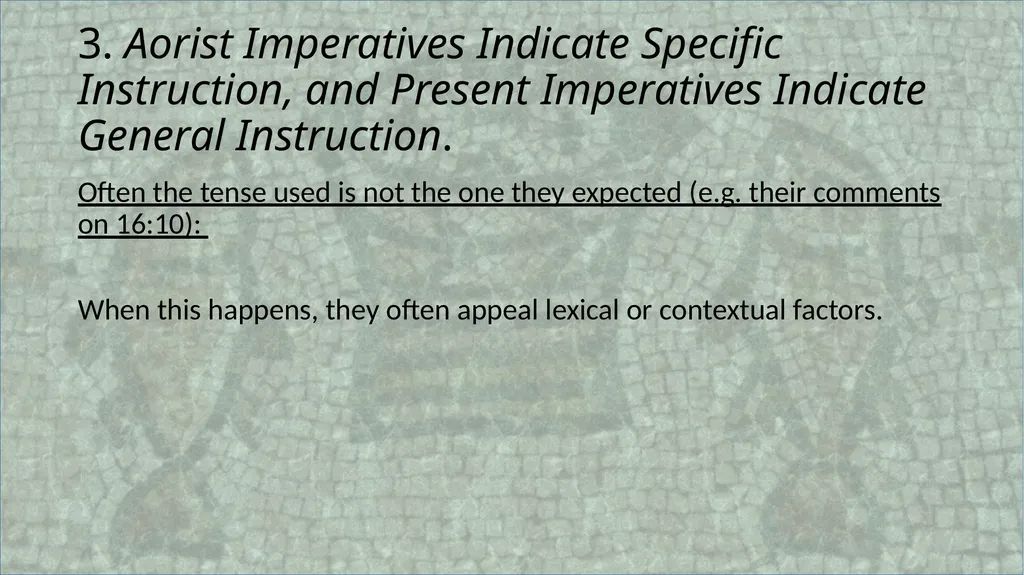
3. Aorist Imperatives Indicate Specific Instruction, and Present Imperatives Indicate General Instruction. Often the tense used is not the one they expected (e.g. their comments on 16:10):
When this happens, they often appeal lexical or contextual factors.<br>
When this happens, they often appeal lexical or contextual factors.<br>
47
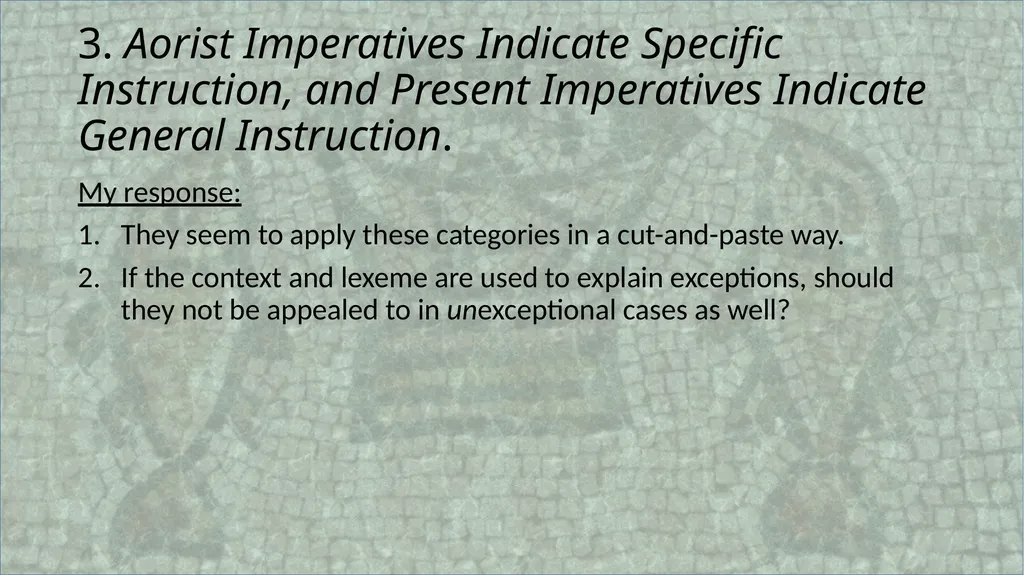
3. Aorist Imperatives Indicate Specific Instruction, and Present Imperatives Indicate General Instruction. My response:
They seem to apply these categories in a cut-and-paste way.
If the context and lexeme are used to explain exceptions, should they not be appealed to in unexceptional cases as well?<br>
They seem to apply these categories in a cut-and-paste way.
If the context and lexeme are used to explain exceptions, should they not be appealed to in unexceptional cases as well?<br>
48
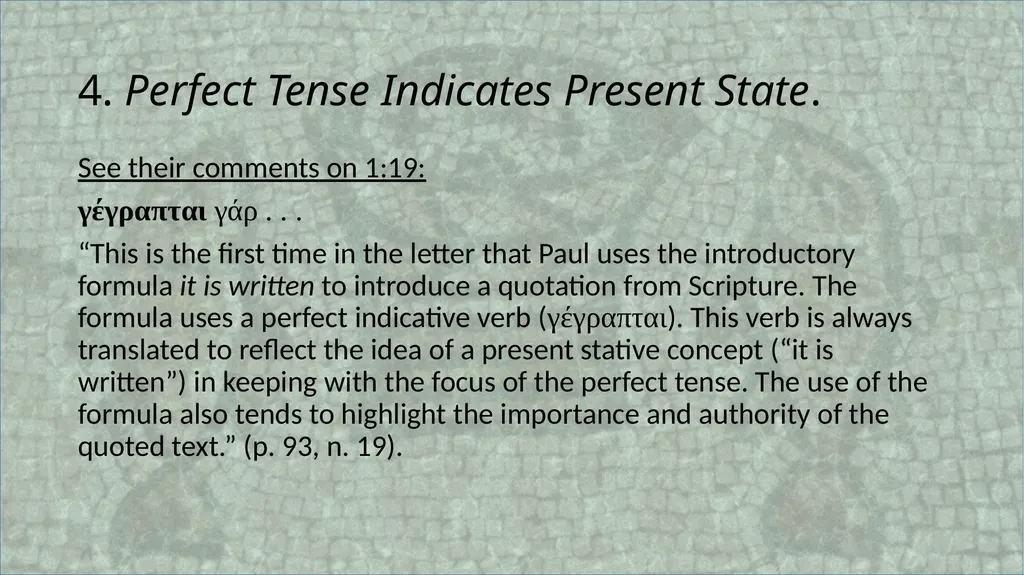
4. Perfect Tense Indicates Present State. See their comments on 1:19:
γέγραπται γάρ . . .
“This is the first time in the letter that Paul uses the introductory formula it is written to introduce a quotation from Scripture. The formula uses a perfect indicative verb (γέγραπται). This verb is always translated to reflect the idea of a present stative concept (“it is written”) in keeping with the focus of the perfect tense. The use of the formula also tends to highlight the importance and authority of the quoted text.” (p. 93, n. 19).<br>
49
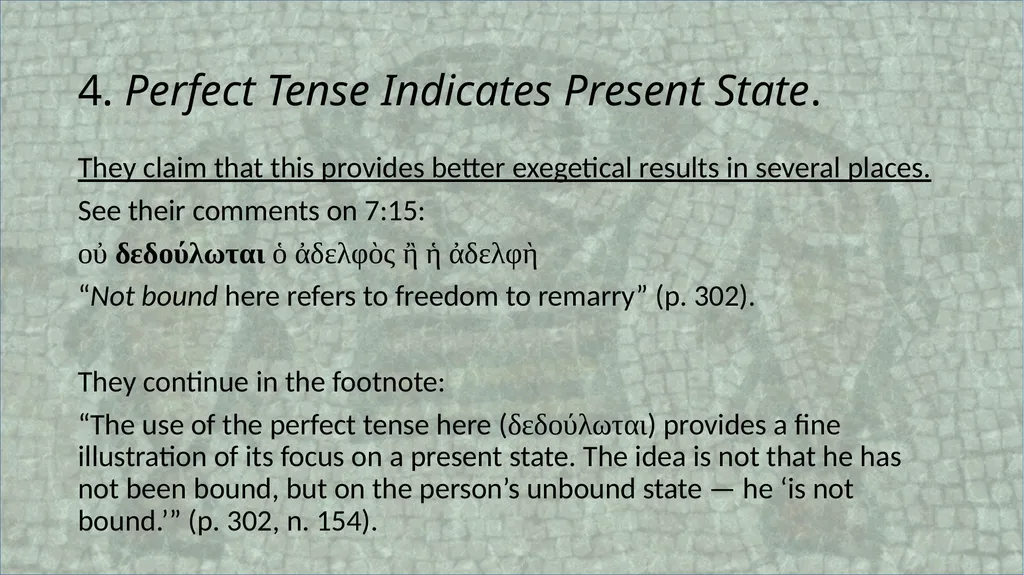
4. Perfect Tense Indicates Present State. They claim that this provides better exegetical results in several places.
See their comments on 7:15:
οὐ δεδούλωται ὁ ἀδελφὸς ἢ ἡ ἀδελφὴ
“Not bound here refers to freedom to remarry” (p. 302).
They continue in the footnote:
“The use of the perfect tense here (δεδούλωται) provides a fine illustration of its focus on a present state. The idea is not that he has not been bound, but on the person’s unbound state — he ‘is not bound.’” (p. 302, n. 154).<br>
50
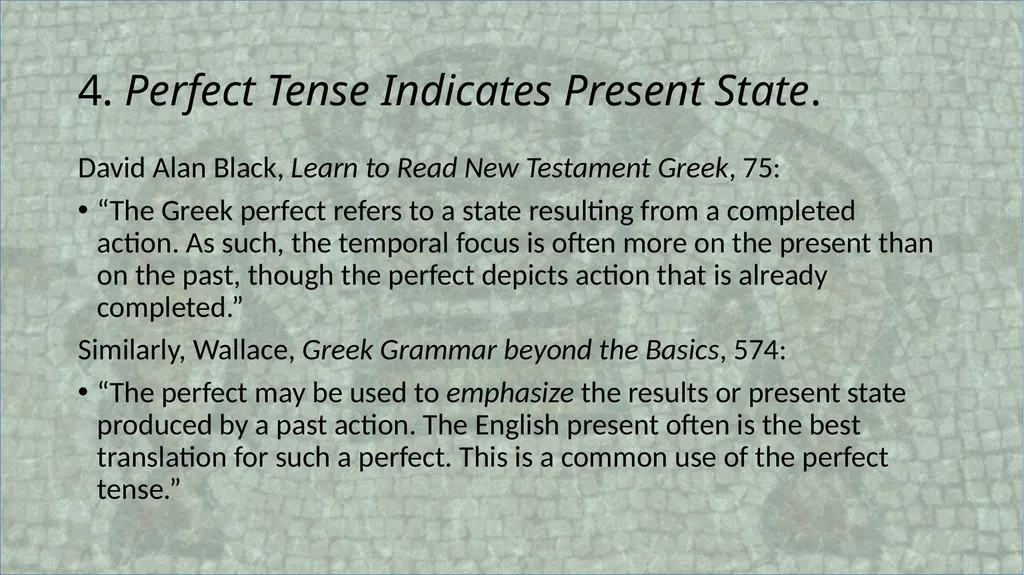
4. Perfect Tense Indicates Present State. David Alan Black, Learn to Read New Testament Greek, 75:
“The Greek perfect refers to a state resulting from a completed action. As such, the temporal focus is often more on the present than on the past, though the perfect depicts action that is already completed.”
Similarly, Wallace, Greek Grammar beyond the Basics, 574:
“The perfect may be used to emphasize the results or present state produced by a past action. The English present often is the best translation for such a perfect. This is a common use of the perfect tense.”<br>
51
4. Perfect Tense Indicates Present State. Ciampa and Rosner’s adoption of VAT seems to lead them to deny that the perfect tense includes a reference to the completed action in the past that brought about the present state. See their comments on 5:3:
“I have… passed judgment is a translation of a perfect indicative verb (κέκρικα). Perfect verbs usually focus on the present state of affairs and not on past actions which brought that state into being. That would suggest that it might be better rendered ‘I am now decided,’ than ‘I have already judged’ (the point not being that Paul previously made a decision, but that his mind is now made up). However, this may be pushing too hard. It appears that the present state to which the verb refers is that of one who has already rendered his judgment (the state a judge enters after giving his verdict, for which a language may or may not have a distinct term). Some present states of affairs may be expressed (in English, at least) only by reference to prior events which define them.” (p. 205, n. 74).<br>
“I have… passed judgment is a translation of a perfect indicative verb (κέκρικα). Perfect verbs usually focus on the present state of affairs and not on past actions which brought that state into being. That would suggest that it might be better rendered ‘I am now decided,’ than ‘I have already judged’ (the point not being that Paul previously made a decision, but that his mind is now made up). However, this may be pushing too hard. It appears that the present state to which the verb refers is that of one who has already rendered his judgment (the state a judge enters after giving his verdict, for which a language may or may not have a distinct term). Some present states of affairs may be expressed (in English, at least) only by reference to prior events which define them.” (p. 205, n. 74).<br>
52
4. Perfect Tense Indicates Present State. Summary:
They see perfect verbs as almost exclusively indicating stative aspect.
This often fits, but their tendency to downplay the “completed action in the past” dimension seems to be problematic at times.<br>
They see perfect verbs as almost exclusively indicating stative aspect.
This often fits, but their tendency to downplay the “completed action in the past” dimension seems to be problematic at times.<br>
53
III. SUMMARY Rosner and Ciampa’s treatment of VAT in 1 Corinthians:
Aktionsart is attributable to a complex of features.
They have varying degrees of consistency when applying this.
Verbs have a default temporal significance, but it is cancellable.
Aorist imperatives indicate specific instruction, and present imperatives indicate general instruction.
They seem to apply these categories in a cut and paste manner
Appeal to context and lexeme seem to be made mostly when an example doesn’t fit
Perfect tense indicates present state.
Their denial of completed action in the past sometimes seems procrustean<br>