
‘Veterinary Epidemiology & Zoonoses’ VPH-321
CM
Published · 24 slides · 0 views

1 / 1




Description
Veterinary Epidemiology Zoonoses VPH-321 (Credit Hours-21) Direct anthropozoonosis, Zooanthroponosis . It is a chronic disease of man animals caused by pathogenic Mycobacterium spp. causing development of tubercle in vital organs.
Related Topics
Share
Embed code
Download this presentation From Below
"‘Veterinary Epidemiology & Zoonoses’ VPH-321" is the property of its rightful owner. Permission is granted to download and print the materials on this website for personal, non-commercial use only, and to display it on your personal computer provided you do not modify the materials and that you retain all copyright notices contained in the materials. By downloading content from our website, you accept the terms of this agreement.
Presentation Transcript
01
‘Veterinary Epidemiology & Zoonoses’
VPH-321
(Credit Hours-2+1)<br>
VPH-321
(Credit Hours-2+1)<br>
02
Direct anthropozoonosis, Zooanthroponosis . It is a chronic disease of man & animals caused by pathogenic Mycobacterium spp. causing development of tubercle in vital organs. The pulmonary tuberculosis is the most common form, characterized by protective cough, fever, fatigue, weight loss, chest pain and night sweat in human beings<br>
03
Rajayakshman - the king of diseases (in Hindu texts),
Yakshma
Acnitis,
Consumption,
Great white plague,
Great white scourge,
Lupus vulgaris,
Pearl disease,
Pott’s disease,
Pthisis,
Scrofula,
Scrofuloderma,
Tuberculous
Caseous pneumonia
caseous L. caseus, cheese. The material formed resembles cheese or curd Synonyms<br>
Yakshma
Acnitis,
Consumption,
Great white plague,
Great white scourge,
Lupus vulgaris,
Pearl disease,
Pott’s disease,
Pthisis,
Scrofula,
Scrofuloderma,
Tuberculous
Caseous pneumonia
caseous L. caseus, cheese. The material formed resembles cheese or curd Synonyms<br>
04
Etiology The *‘tubercle bacilli’ that cause tuberculosis in man belong to the so-called #Mycobacterium tuberculosis complex
Genus - Mycobacterium (Group 1) and has four species namely
M. tuberculosis
M. bovis
M. africanum
M. microti
* tubercle L. tuberculum, a swelling or knob
# mycobacterium Gr. myces, fungus, and bakterion, a smalll rod<br>
Genus - Mycobacterium (Group 1) and has four species namely
M. tuberculosis
M. bovis
M. africanum
M. microti
* tubercle L. tuberculum, a swelling or knob
# mycobacterium Gr. myces, fungus, and bakterion, a smalll rod<br>
05
Etiology Morphology:
Gram +Ve
Long,
Slender,
Straight curved rods
(tendency to be filamentous/branching)
Non capsulated,
Aerobic
Flagella,
Produce spores or exotoxins
Facultative intracellular parasite
Acid fast staining<br>
Gram +Ve
Long,
Slender,
Straight curved rods
(tendency to be filamentous/branching)
Non capsulated,
Aerobic
Flagella,
Produce spores or exotoxins
Facultative intracellular parasite
Acid fast staining<br>
06
history Early as 4000 B.C: An ancient disease:
15 century BC: Described by Hippocrates & Aristotle
As Phthisis (Greek literatures) which was translated in to English as ‘Consumption’
In 1882: Robert Koch cultivated the agent
In 1890: Demonstrated tuberculin testing first in guinea pigs
In 1906: French scientists, Calmette & Guerin (veterinarian) developed vaccine “BCG vaccine”
In 1927: the first human was vaccinated
In 1948: the vaccine was accepted by TB workers
In 1907: Tuberculin test was first discovered by Von Pirquet<br>
15 century BC: Described by Hippocrates & Aristotle
As Phthisis (Greek literatures) which was translated in to English as ‘Consumption’
In 1882: Robert Koch cultivated the agent
In 1890: Demonstrated tuberculin testing first in guinea pigs
In 1906: French scientists, Calmette & Guerin (veterinarian) developed vaccine “BCG vaccine”
In 1927: the first human was vaccinated
In 1948: the vaccine was accepted by TB workers
In 1907: Tuberculin test was first discovered by Von Pirquet<br>
07
Geographic distribution M. tuberculosis & M. bovis: Worldwide
M. africanum: In Africa, Germany, England
M. africanum strains phenotypically related to M. tuberculosis<br>
M. africanum: In Africa, Germany, England
M. africanum strains phenotypically related to M. tuberculosis<br>
08
TB: In India Ranks first in tuberculosis
Falls under MDR-TB zone
One of the biggest public health problems
Annually:
1.8 million people develop TB
4.17 lakhs people die
Loss of an about 83 work-days
More burden: childhood & deaths from tuberculosis by meningitis & disseminated disease
Since 1993, India has successfully implemented
Revised National Tuberculosis Control Programme (RNTCP) using DOTS strategy<br>
Falls under MDR-TB zone
One of the biggest public health problems
Annually:
1.8 million people develop TB
4.17 lakhs people die
Loss of an about 83 work-days
More burden: childhood & deaths from tuberculosis by meningitis & disseminated disease
Since 1993, India has successfully implemented
Revised National Tuberculosis Control Programme (RNTCP) using DOTS strategy<br>
09
Host range Reservoir:
M. tuberculosis: Mainly man
M. bovis: Infected bovines (mainly)
Other host: Man, sheep, goat, buffalo, dog, cat, horse, pig, deer, monkey, chimpanzee, bison, elephant, marsupials, mink, moles, badgers, opossum, cockattoo, ferret, fox, hare & parrot
M. avium: cases of generalized TB<br>
M. tuberculosis: Mainly man
M. bovis: Infected bovines (mainly)
Other host: Man, sheep, goat, buffalo, dog, cat, horse, pig, deer, monkey, chimpanzee, bison, elephant, marsupials, mink, moles, badgers, opossum, cockattoo, ferret, fox, hare & parrot
M. avium: cases of generalized TB<br>
10
About 60 million cases annually globally
Death: 5000 people die daily
One third of the total population of the world is infected (WHO)
Morbidity & mortality rates high: Urbanites, minorities, the poor, the homeless, substance abusers & persons infected with HIV
Global incidence: more in low income countries
South-east Asia region countries:
38% of the global burden of tuberculosis
3 million new cases
Nearly 0.6 million deaths
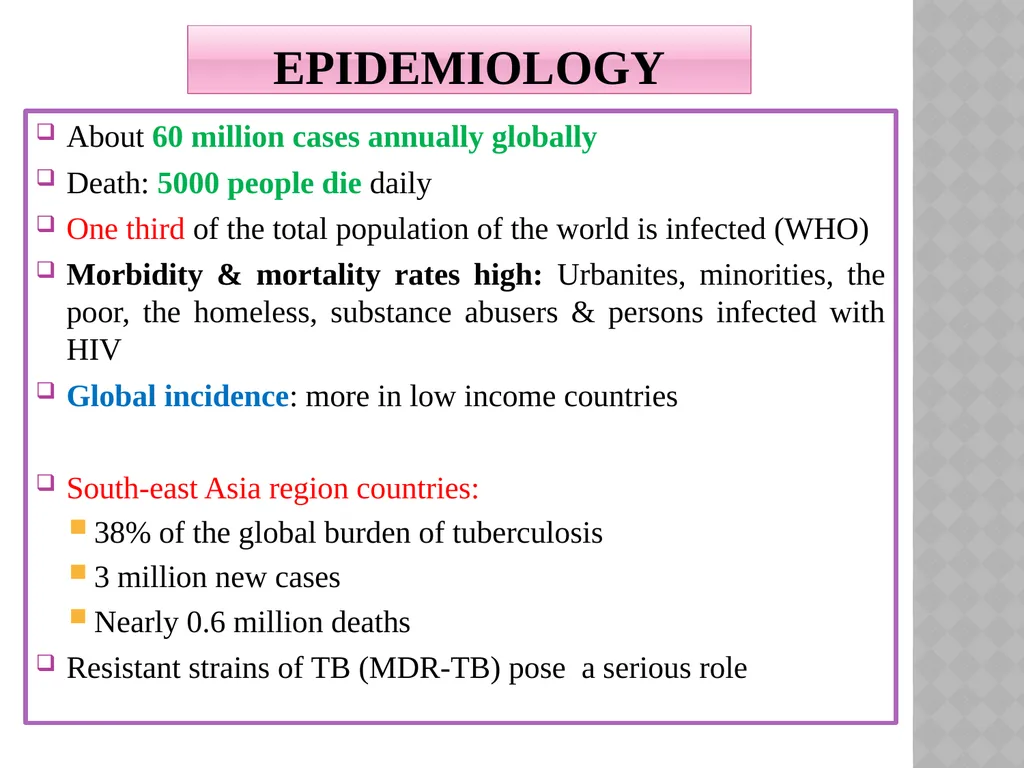
Resistant strains of TB (MDR-TB) pose a serious role Epidemiology<br>
Death: 5000 people die daily
One third of the total population of the world is infected (WHO)
Morbidity & mortality rates high: Urbanites, minorities, the poor, the homeless, substance abusers & persons infected with HIV
Global incidence: more in low income countries
South-east Asia region countries:
38% of the global burden of tuberculosis
3 million new cases
Nearly 0.6 million deaths
Resistant strains of TB (MDR-TB) pose a serious role Epidemiology<br>
11
Epidemiology The incidence is influenced by many factors:
Inadequate health care
Poor standard of living & socioeconomic conditions
Malnutrition
Higher population density
Occupational contraction
Poor personal hygiene
Lack of education & awareness
Various diseases like: HIV/AIDS, Diabetes mellitus
Close confinement of the human population<br>
Inadequate health care
Poor standard of living & socioeconomic conditions
Malnutrition
Higher population density
Occupational contraction
Poor personal hygiene
Lack of education & awareness
Various diseases like: HIV/AIDS, Diabetes mellitus
Close confinement of the human population<br>
12
Sources and transmission Human source: Sputum
Bovine source: Milk & faeces
Environmental source: Water, soil and dust contaminated with human & animal sources
Most common mode of transmission: Ingestion & inhalation
Inhalation: droplet nuclei
Exposure to dusty bedding
Coughing of infected animals
Aerosolization of the organism
Laboratory environment
Ingestion:
Consumption of infected milk &
milk product<br>
Bovine source: Milk & faeces
Environmental source: Water, soil and dust contaminated with human & animal sources
Most common mode of transmission: Ingestion & inhalation
Inhalation: droplet nuclei
Exposure to dusty bedding
Coughing of infected animals
Aerosolization of the organism
Laboratory environment
Ingestion:
Consumption of infected milk &
milk product<br>
13
Disease in man Clinical tuberculosis occurs in 3 stages:
1. Primary tuberculosis:
The lung infection
Formation of the tubercle
Central core : Bacilli & enlarged macrophages
Outer wall: Fibroblasts, lymphocytes & neutrophils
The centers may break down into necrotic, caseous lesions & gradually heal by calcification<br>
1. Primary tuberculosis:
The lung infection
Formation of the tubercle
Central core : Bacilli & enlarged macrophages
Outer wall: Fibroblasts, lymphocytes & neutrophils
The centers may break down into necrotic, caseous lesions & gradually heal by calcification<br>
14
Disease in man 2. Secondary tuberculosis:
Primary case: dormant bacilli from 1O C become reactivated
In chronic: the bacilli drain into the bronchial tubes & upper respiratory tract
The patient shows
Vioalent coughing
Greenish or bloody sputum
Fever
Anorexia
Weight loss
Extreme fatigue
Night sweats
Chest pain<br>
Primary case: dormant bacilli from 1O C become reactivated
In chronic: the bacilli drain into the bronchial tubes & upper respiratory tract
The patient shows
Vioalent coughing
Greenish or bloody sputum
Fever
Anorexia
Weight loss
Extreme fatigue
Night sweats
Chest pain<br>
15
Disease in man 3. Extrapulmonary tuberculosis:
Secondary tuberculosis the bacilli disseminate rapidly
Organ effected:
Regional lymph nodes,
Kidneys,
Long bones,
Genital tract,
Brain
Meninges
Eyes: Miliary TB
Renal TB: necrosis & scarring of renal medulla, pelvis, ureters, bladder
Genital TB: Affects reproductive functions in both sexes
Bones & joints (vertebral column): Paralysis & sensory loss
Meninges: Mental deterioration, permanent retardation, blindness & deafness<br>
Secondary tuberculosis the bacilli disseminate rapidly
Organ effected:
Regional lymph nodes,
Kidneys,
Long bones,
Genital tract,
Brain
Meninges
Eyes: Miliary TB
Renal TB: necrosis & scarring of renal medulla, pelvis, ureters, bladder
Genital TB: Affects reproductive functions in both sexes
Bones & joints (vertebral column): Paralysis & sensory loss
Meninges: Mental deterioration, permanent retardation, blindness & deafness<br>
16
Disease in man Bovine TB: M. bovis
Source: unpasteurized milk
In young ones: as ‘Scrofula’ - a condition
(established in cervical &, less frequently, axillary lymph nodes)
In adults: Post primary pulmonary disease is more common
Infection through skin wound:
lesions in skin
Tendon & localized lymph node lesions (in the persons handling infected carcasses)<br>
Source: unpasteurized milk
In young ones: as ‘Scrofula’ - a condition
(established in cervical &, less frequently, axillary lymph nodes)
In adults: Post primary pulmonary disease is more common
Infection through skin wound:
lesions in skin
Tendon & localized lymph node lesions (in the persons handling infected carcasses)<br>
17
Disease in Animals In cattle:
Superficial lymph nodes will be swollen
Udder: Progressive hardening & swelling
Milk: thin and watery with yellow flakes
The generalized TB cases:
Emaciation (hide bound condition),
Cough, dry & harsh body coat
Dull & sunken eyes
Diarrhoea with capricious appetite
Fluctuating body temperature,
Snoring: involvement of retropharyngeal lymph node
In cutaneous TB: lumpy swelling, sometimes cording (In the lower part of the front legs & rarely on hind legs<br>
Superficial lymph nodes will be swollen
Udder: Progressive hardening & swelling
Milk: thin and watery with yellow flakes
The generalized TB cases:
Emaciation (hide bound condition),
Cough, dry & harsh body coat
Dull & sunken eyes
Diarrhoea with capricious appetite
Fluctuating body temperature,
Snoring: involvement of retropharyngeal lymph node
In cutaneous TB: lumpy swelling, sometimes cording (In the lower part of the front legs & rarely on hind legs<br>
18
Disease in Animals In dogs and cats:
Marked emaciation
Constant discharge from nose
Cough
Pleurisy (pleural cavity may get filled with fluid)
Causing difficulty in breathing
Swelling on chest & abdomen
In poultry:
Severe emaciation
Pale mucous membrane
Intermittent diarrhoea<br>
Marked emaciation
Constant discharge from nose
Cough
Pleurisy (pleural cavity may get filled with fluid)
Causing difficulty in breathing
Swelling on chest & abdomen
In poultry:
Severe emaciation
Pale mucous membrane
Intermittent diarrhoea<br>
19
Diagnosis Microscopic detection of acid-fast bacilli:
From sputum
On histological examination of the tubercle
Delayed type hypersensitivity (DTH) assays
Single intradermal tuberculin test,
Stormont test,
Short thermal test,
Subcutaneous tuberculin test and
Opthalmic test<br>
From sputum
On histological examination of the tubercle
Delayed type hypersensitivity (DTH) assays
Single intradermal tuberculin test,
Stormont test,
Short thermal test,
Subcutaneous tuberculin test and
Opthalmic test<br>
20
Animal inoculation:
Suspected material: milk samples (not heavily infected
Can be inoculated into the thighs of guinea pigs
Typical lesions of tuberculosis of liver, spleen & lymph nodes of infected animals
New techniques:
PCR assays: multiplex PCR
Gamma-interferon (IFN-g) assay: More sensitive than skin test remains costly & inconvenient
Blood test (BT) to monitor: Humoral & cellular responses
by ELISA & lymphocyte transformation tests Diagnosis<br>
Suspected material: milk samples (not heavily infected
Can be inoculated into the thighs of guinea pigs
Typical lesions of tuberculosis of liver, spleen & lymph nodes of infected animals
New techniques:
PCR assays: multiplex PCR
Gamma-interferon (IFN-g) assay: More sensitive than skin test remains costly & inconvenient
Blood test (BT) to monitor: Humoral & cellular responses
by ELISA & lymphocyte transformation tests Diagnosis<br>
21
A combination therapy: Intradermal skin test (ST) & ELISA enhanced sensitivity (95%) in comparison to individual test
Isolation and identification of the pathogen:
Confirmatory test but requires viable bacilli,
Growth of M. bovis may take 6-8 weeks
Roentgenography: Chest x-rays or roentgenographs
Mantoux test: (in huamn)
0.1 ml of PPD is inj. I/D
Forearm: induration after 48 and 72 hours Diagnosis<br>
Isolation and identification of the pathogen:
Confirmatory test but requires viable bacilli,
Growth of M. bovis may take 6-8 weeks
Roentgenography: Chest x-rays or roentgenographs
Mantoux test: (in huamn)
0.1 ml of PPD is inj. I/D
Forearm: induration after 48 and 72 hours Diagnosis<br>
22
In animals: No treatment
In man: To avoid drug resistance
The combined therapy (at least two drugs)
Isoniazid (INH),
Rifampicin
Ethambutol
Streptomycin
Pyrazinamide
Thioacetazone
Para-aminosalicylic acid (PAS)
Immunotherapy:
Purified recombinant cytokines like interleukin-2, (IL-2), IL-12 & IFN-g Treatment<br>
In man: To avoid drug resistance
The combined therapy (at least two drugs)
Isoniazid (INH),
Rifampicin
Ethambutol
Streptomycin
Pyrazinamide
Thioacetazone
Para-aminosalicylic acid (PAS)
Immunotherapy:
Purified recombinant cytokines like interleukin-2, (IL-2), IL-12 & IFN-g Treatment<br>
23
Prevention and Control In animals:
Effective control: Test and slaughter policy
In India: Test & segregations policy
Implementation of elimination program: diagnosis, reporting & movement
Notification of outbreaks of disease
Effective trace back systems
Research on potential role of other domestic and wild animals as disease reservoirs
Maintenance of good hygienic conditions in shed,
Good animal management practices
Vaccination: bovis bacille Calmette-Guérin (BCG) vaccine<br>
Effective control: Test and slaughter policy
In India: Test & segregations policy
Implementation of elimination program: diagnosis, reporting & movement
Notification of outbreaks of disease
Effective trace back systems
Research on potential role of other domestic and wild animals as disease reservoirs
Maintenance of good hygienic conditions in shed,
Good animal management practices
Vaccination: bovis bacille Calmette-Guérin (BCG) vaccine<br>
24
Prevention and Control In humans:
Notification of human cases due M. bovis
Tracing of source
Condemnation of milk from infected herd,
Treatment of meat from infected animal,
Regular health checks for occupational groups at risk
Proper abattoir controls,
Awareness among butchers & farmers
Promotion of milk pasteurization,
Health education, training of health personnels,
Effective implementation of national TB control programmes in India
BCG vaccination and preventive chemotherapy<br>
Notification of human cases due M. bovis
Tracing of source
Condemnation of milk from infected herd,
Treatment of meat from infected animal,
Regular health checks for occupational groups at risk
Proper abattoir controls,
Awareness among butchers & farmers
Promotion of milk pasteurization,
Health education, training of health personnels,
Effective implementation of national TB control programmes in India
BCG vaccination and preventive chemotherapy<br>