
Vitamins (Water Soluble) Dr. Dharmendra Kumar
SB
Published · 34 slides · 0 views
1 / 1


Description
Vitamins (Water Soluble) Dr. Dharmendra Kumar Associate Professor Department of Animal Nutrition, Bihar Veterinary College, Bihar Animal Sciences University, Patna, Bihar, India also known as ascorbic acid Two forms L-ascorbic acid (Reduced
Related Topics
Download this presentation From Below
"Vitamins (Water Soluble) Dr. Dharmendra Kumar" is the property of its rightful owner. Permission is granted to download and print the materials on this website for personal, non-commercial use only, and to display it on your personal computer provided you do not modify the materials and that you retain all copyright notices contained in the materials. By downloading content from our website, you accept the terms of this agreement.
Share
Embed code
Presentation Transcript
01
Vitamins
(Water Soluble) Dr. Dharmendra Kumar
Associate Professor
Department of Animal Nutrition, Bihar Veterinary College,
Bihar Animal Sciences University, Patna, Bihar, India<br>
Associate Professor
Department of Animal Nutrition, Bihar Veterinary College,
Bihar Animal Sciences University, Patna, Bihar, India<br>
02
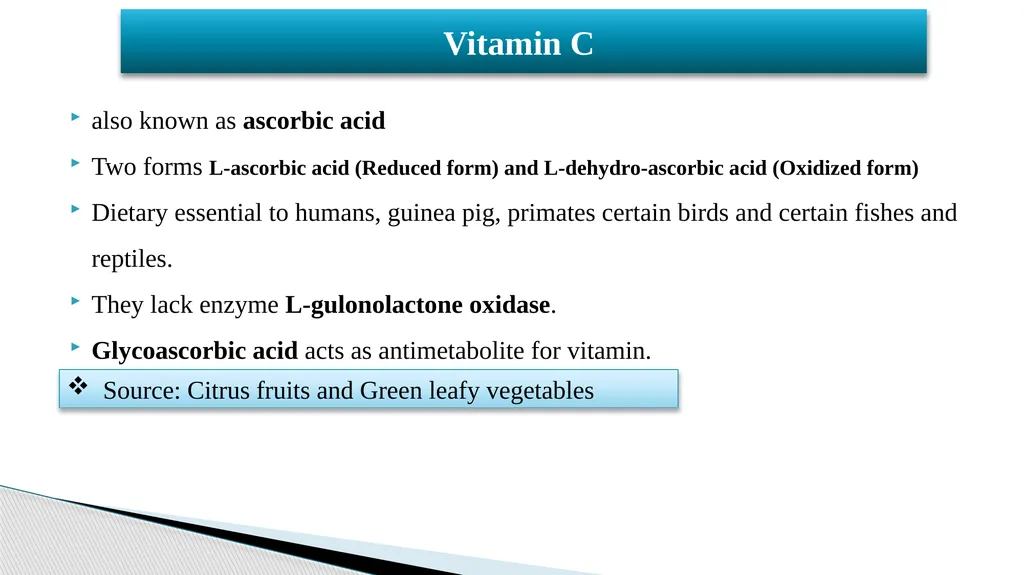
also known as ascorbic acid
Two forms L-ascorbic acid (Reduced form) and L-dehydro-ascorbic acid (Oxidized form)
Dietary essential to humans, guinea pig, primates certain birds and certain fishes and reptiles.
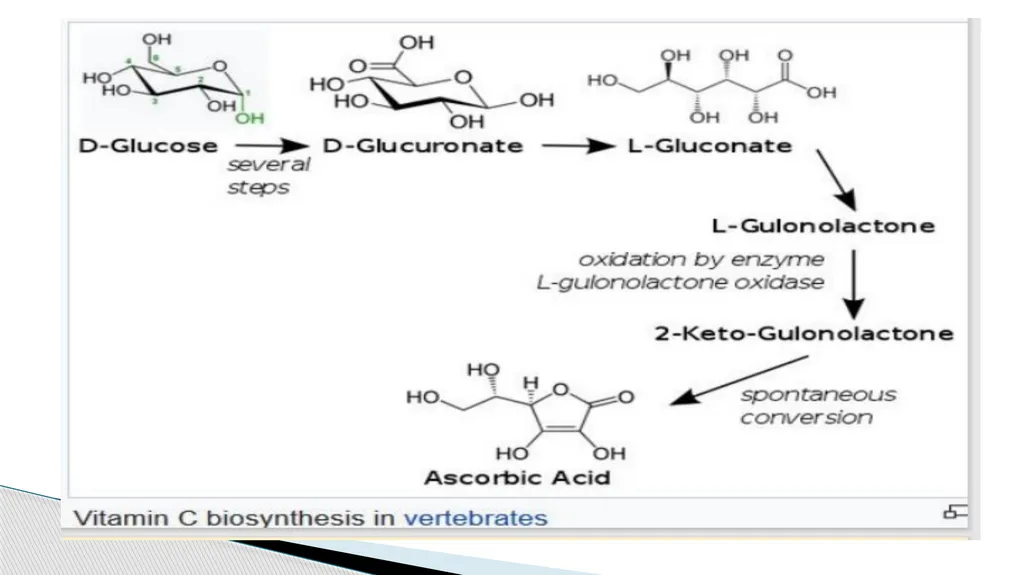
They lack enzyme L-gulonolactone oxidase.
Glycoascorbic acid acts as antimetabolite for vitamin. Vitamin C Source: Citrus fruits and Green leafy vegetables<br>
Two forms L-ascorbic acid (Reduced form) and L-dehydro-ascorbic acid (Oxidized form)
Dietary essential to humans, guinea pig, primates certain birds and certain fishes and reptiles.
They lack enzyme L-gulonolactone oxidase.
Glycoascorbic acid acts as antimetabolite for vitamin. Vitamin C Source: Citrus fruits and Green leafy vegetables<br>
03
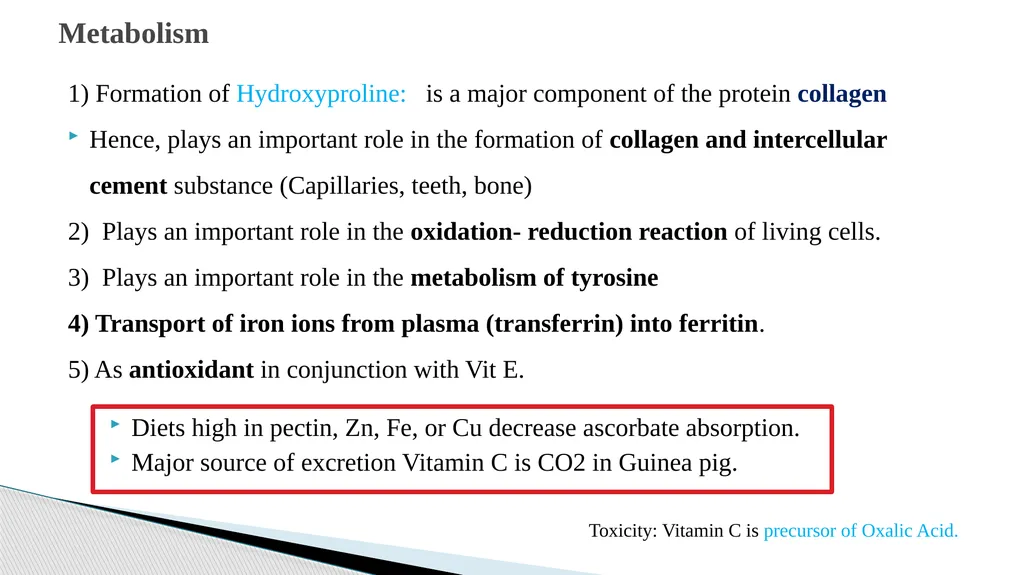
1) Formation of Hydroxyproline: is a major component of the protein collagen
Hence, plays an important role in the formation of collagen and intercellular cement substance (Capillaries, teeth, bone)
2) Plays an important role in the oxidation- reduction reaction of living cells.
3) Plays an important role in the metabolism of tyrosine
4) Transport of iron ions from plasma (transferrin) into ferritin.
5) As antioxidant in conjunction with Vit E. Metabolism Diets high in pectin, Zn, Fe, or Cu decrease ascorbate absorption.
Major source of excretion Vitamin C is CO2 in Guinea pig. Toxicity: Vitamin C is precursor of Oxalic Acid.<br>
Hence, plays an important role in the formation of collagen and intercellular cement substance (Capillaries, teeth, bone)
2) Plays an important role in the oxidation- reduction reaction of living cells.
3) Plays an important role in the metabolism of tyrosine
4) Transport of iron ions from plasma (transferrin) into ferritin.
5) As antioxidant in conjunction with Vit E. Metabolism Diets high in pectin, Zn, Fe, or Cu decrease ascorbate absorption.
Major source of excretion Vitamin C is CO2 in Guinea pig. Toxicity: Vitamin C is precursor of Oxalic Acid.<br>
04
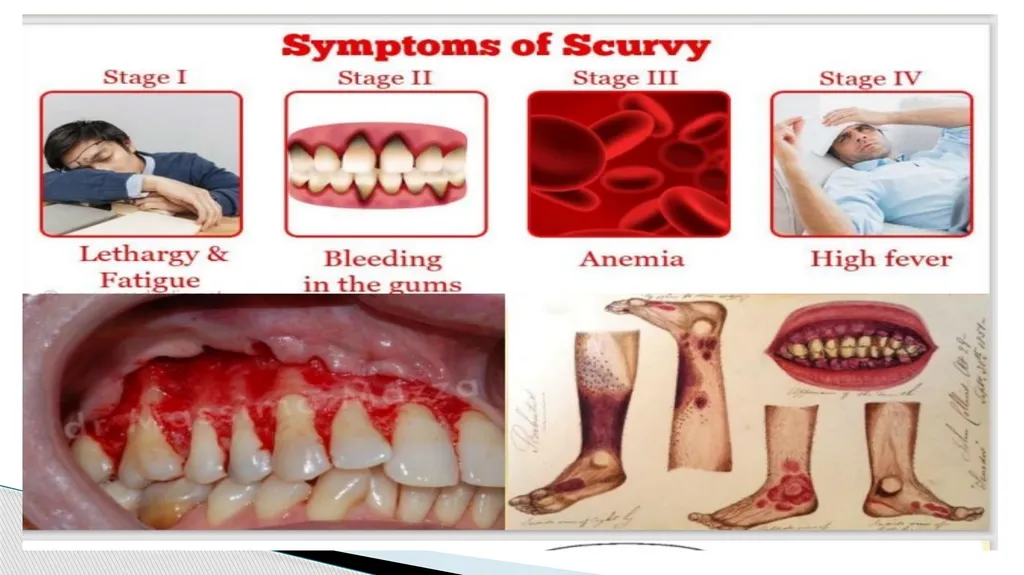
Scurvy in adults:
Swollen, bleeding and ulcerated gums, loosens teeth.
Weak bones and fragility of capillaries resulting into haemorrhages throughout the body.
Infantile scurvy
Anorexia,
Listlessness
Gums swollen,
Dyspnoea
Cyanosis
Convulsions and death if not treated.
Delay in wound healing.
Leg drawn up to abdomen swelling at ends of long bone (pithed frog position). Deficiency: Vit C<br>
Swollen, bleeding and ulcerated gums, loosens teeth.
Weak bones and fragility of capillaries resulting into haemorrhages throughout the body.
Infantile scurvy
Anorexia,
Listlessness
Gums swollen,
Dyspnoea
Cyanosis
Convulsions and death if not treated.
Delay in wound healing.
Leg drawn up to abdomen swelling at ends of long bone (pithed frog position). Deficiency: Vit C<br>
05
Requirement
Vitamin C is dietary essential only in man, guinea pig and other primates, red vented bulbul and fruit eating bat as these species lack the enzyme L-gulonolactone oxidase.
Stress increases the requirement of this vitamin.
Other species can synthesize vitamin C from glucose.
Supplementation
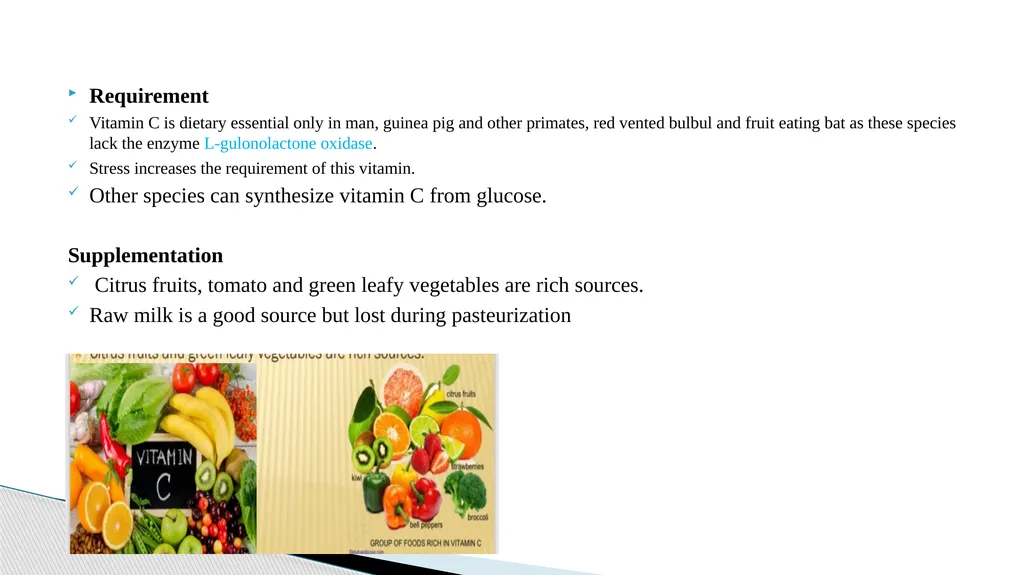
Citrus fruits, tomato and green leafy vegetables are rich sources.
Raw milk is a good source but lost during pasteurization<br>
Vitamin C is dietary essential only in man, guinea pig and other primates, red vented bulbul and fruit eating bat as these species lack the enzyme L-gulonolactone oxidase.
Stress increases the requirement of this vitamin.
Other species can synthesize vitamin C from glucose.
Supplementation
Citrus fruits, tomato and green leafy vegetables are rich sources.
Raw milk is a good source but lost during pasteurization<br>
06
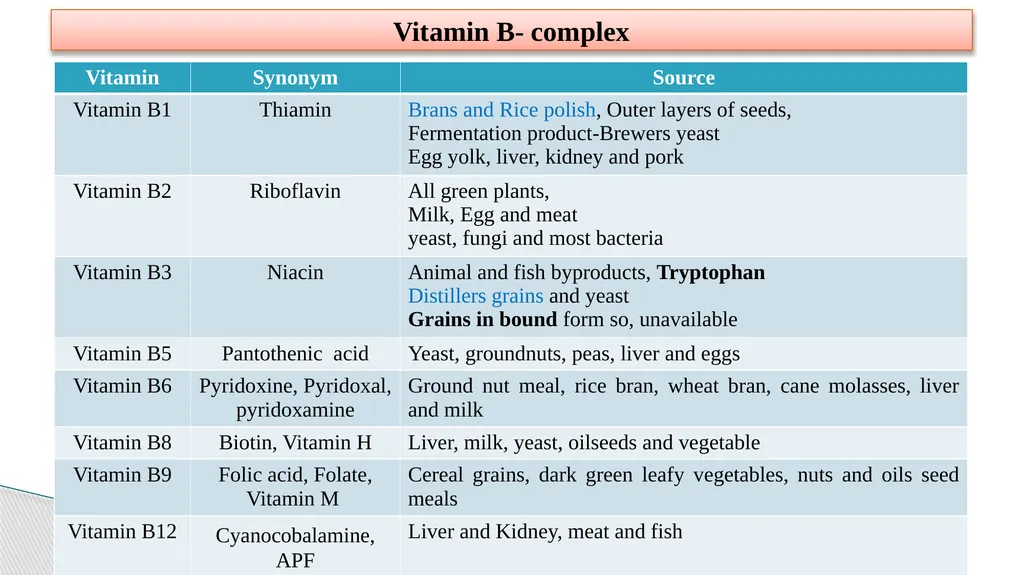
Vitamin B- complex<br>
07
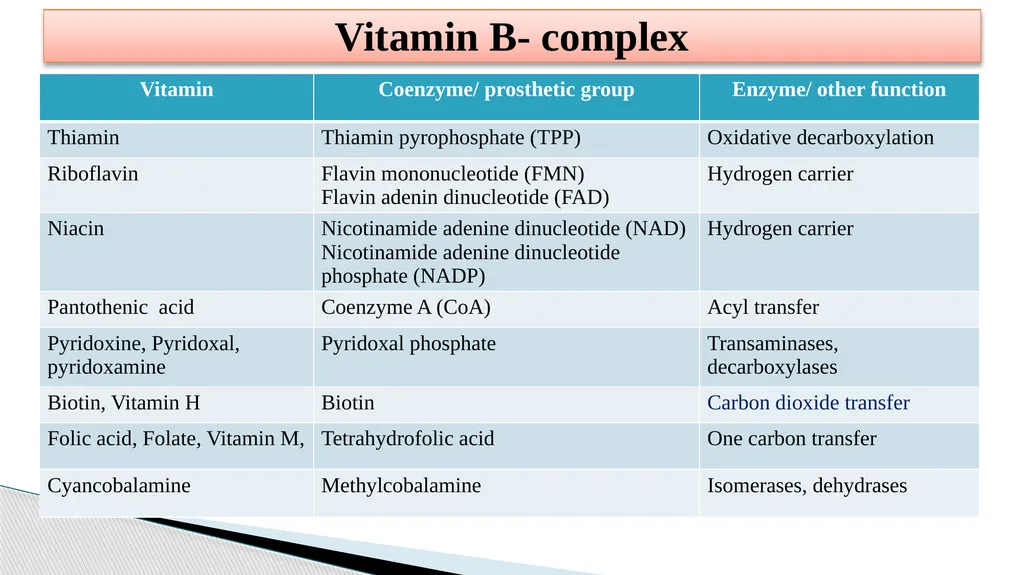
Vitamin B- complex<br>
08
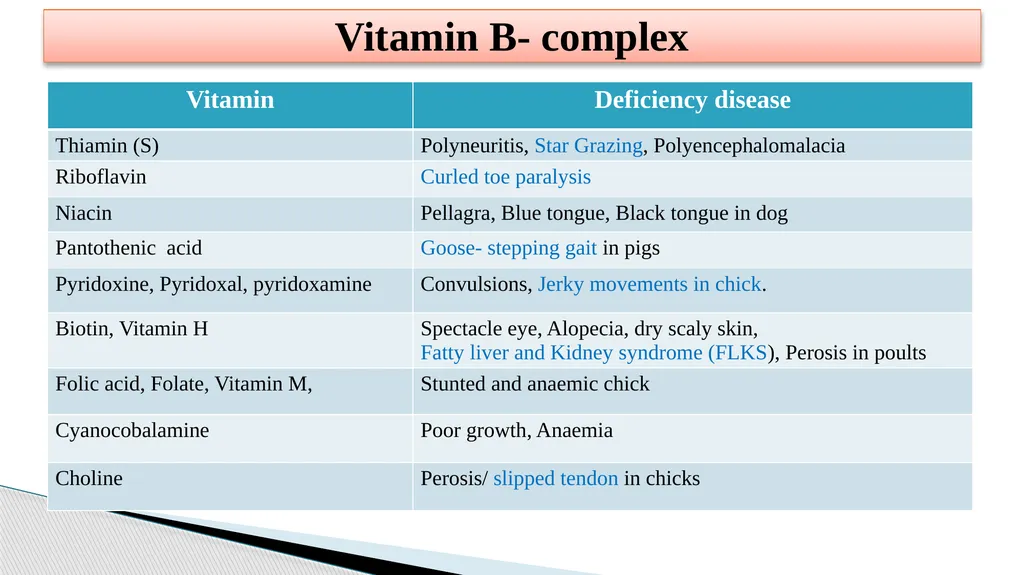
Vitamin B- complex<br>
09
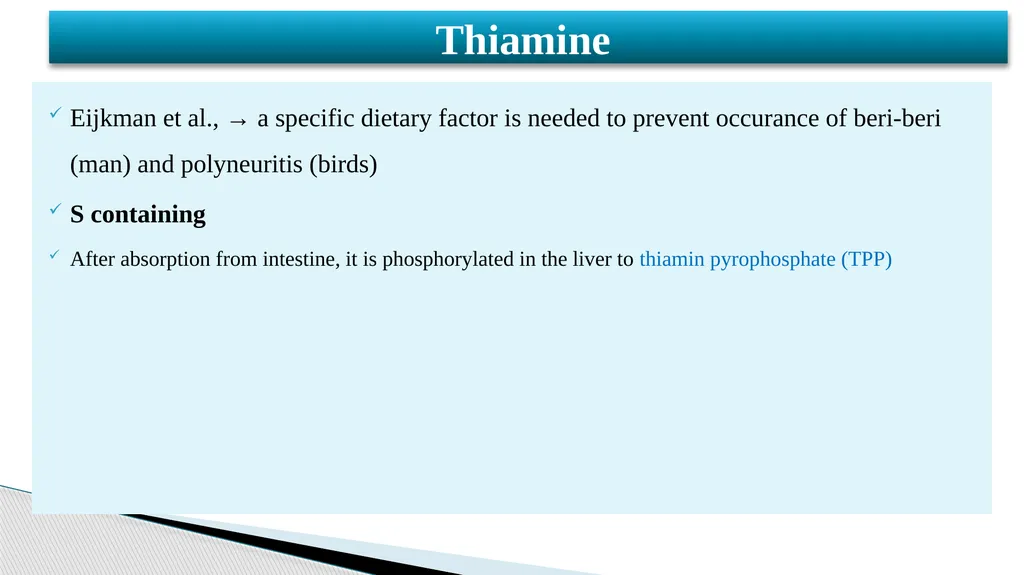
Eijkman et al., → a specific dietary factor is needed to prevent occurance of beri-beri (man) and polyneuritis (birds)
S containing
After absorption from intestine, it is phosphorylated in the liver to thiamin pyrophosphate (TPP) Thiamine<br>
S containing
After absorption from intestine, it is phosphorylated in the liver to thiamin pyrophosphate (TPP) Thiamine<br>
10
Thiamin pyrophosphate (TPP) is a conenzyme involved in:
Essential for the utilization of carbohydrates to provide energy for body processes.
a) Oxidative decarboxylation of pyruvate to acetyl coenzyme A
b) Α keroglutarate to succinyl CoA
c) Pentose phosphate pathway (Transketolase rections )
d) Synrhesis of branched chain amino acids as valine
e) Activation of chloride ion channel in the membrane of nerves.
Req of thiamine decreases with increased fat level in diet (w.r.t. CHO) as TPP is more involved in CHO metabolism than in fat metabolism
Presence of thiaminase enzyme could destroy this vitamin Function<br>
Essential for the utilization of carbohydrates to provide energy for body processes.
a) Oxidative decarboxylation of pyruvate to acetyl coenzyme A
b) Α keroglutarate to succinyl CoA
c) Pentose phosphate pathway (Transketolase rections )
d) Synrhesis of branched chain amino acids as valine
e) Activation of chloride ion channel in the membrane of nerves.
Req of thiamine decreases with increased fat level in diet (w.r.t. CHO) as TPP is more involved in CHO metabolism than in fat metabolism
Presence of thiaminase enzyme could destroy this vitamin Function<br>
11
Loss of appetite, muscular weakness and dysfunction of nervous system
accumulate pyruvic acid and lactic acid in tissues leads to muscular weakness.
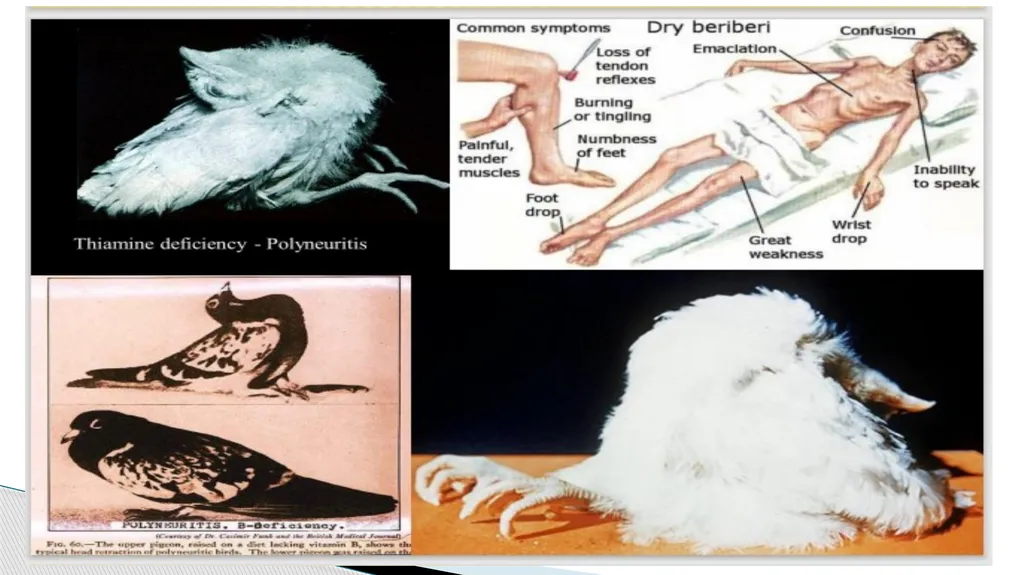
Inhibits CHO metabolism resulting into high blood lactate, pyruvate oxoglutarate leading to peripheral neuritis K/a as polyneuritis in in birds and beri beri in humans
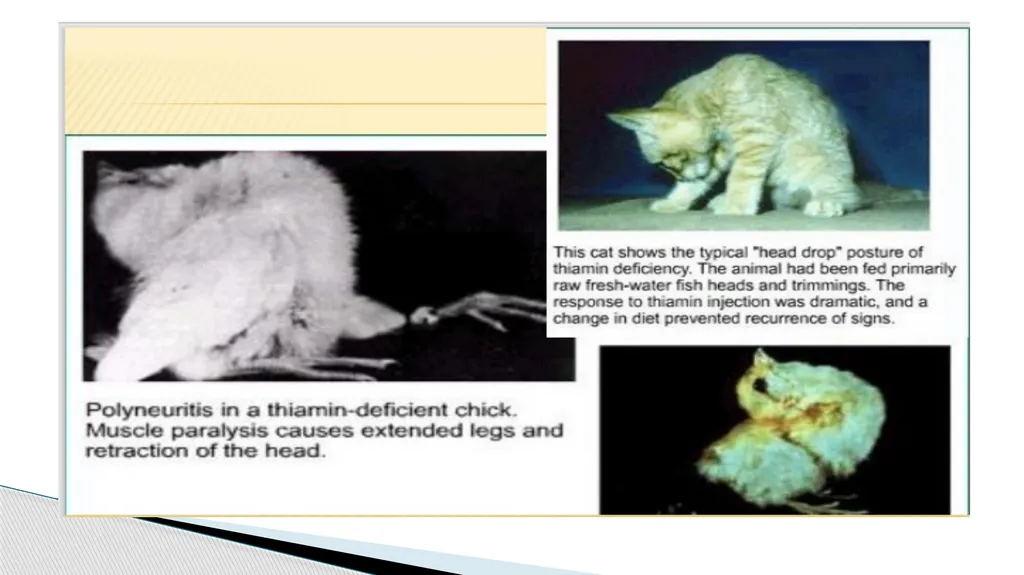
In Chicks: polyneuritis, star gazing posture
leads to anorexia, head retraction, nerve degeneration and paralysis
Bradycardia (slow heart rate) enlarged heart oedema and GIT disturbances.
Thiamine deficiency in foxes causes Chastek paralysis. Deficiency<br>
accumulate pyruvic acid and lactic acid in tissues leads to muscular weakness.
Inhibits CHO metabolism resulting into high blood lactate, pyruvate oxoglutarate leading to peripheral neuritis K/a as polyneuritis in in birds and beri beri in humans
In Chicks: polyneuritis, star gazing posture
leads to anorexia, head retraction, nerve degeneration and paralysis
Bradycardia (slow heart rate) enlarged heart oedema and GIT disturbances.
Thiamine deficiency in foxes causes Chastek paralysis. Deficiency<br>
12
Pigs and poultry unlikely suffer from deficiency because Cereal grains are rich source
In ruminants deficiency occurs due to low synthesis in rumen or due to bacterial thiaminase.
Condition k/a as Polioencephalomamlcia (PEM) in USA and Cerebrocortical necrosis in Europe
Circling movements, head pressing, blindness and muscular tremors.
Rapidly fermentable foods may be an important factor in production of thiaminase.
Thiaminase present in- Raw fish but destroy by cooking.<br>
In ruminants deficiency occurs due to low synthesis in rumen or due to bacterial thiaminase.
Condition k/a as Polioencephalomamlcia (PEM) in USA and Cerebrocortical necrosis in Europe
Circling movements, head pressing, blindness and muscular tremors.
Rapidly fermentable foods may be an important factor in production of thiaminase.
Thiaminase present in- Raw fish but destroy by cooking.<br>
13
Requirement
Lactating Cow : 41 mg / day
Piglet : 0.5- 1.0 mg / kg feed
Pig : 2 - 3 mg / kg feed
Poultry – Broiler : 1.5 mg / kg feed
Poultry – Layer : 0.8 mg / kg feed
Supplementation
Yeast, germ and bran of cereal grains.
Pork is rich in thiamine.
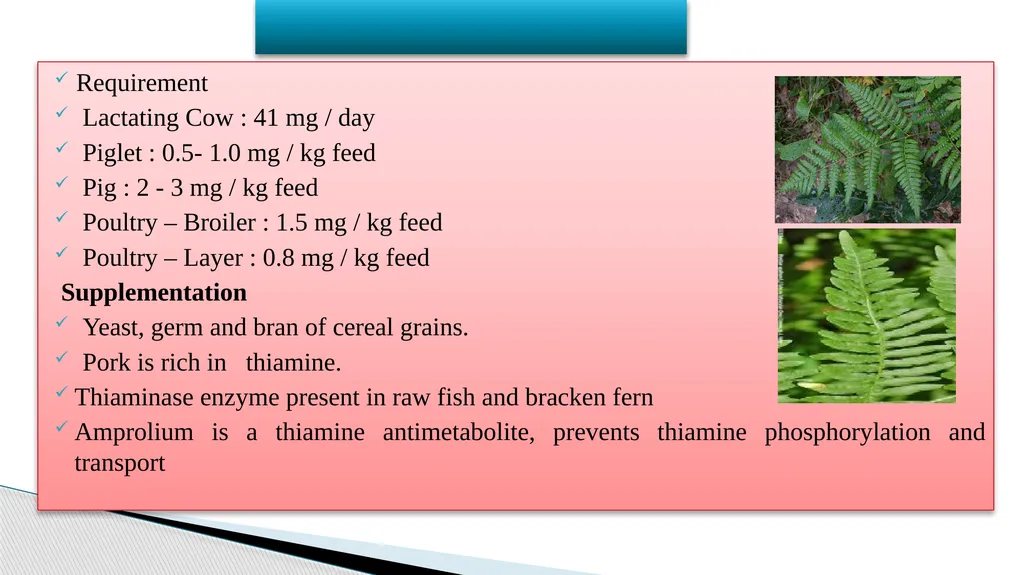
Thiaminase enzyme present in raw fish and bracken fern
Amprolium is a thiamine antimetabolite, prevents thiamine phosphorylation and transport<br>
Lactating Cow : 41 mg / day
Piglet : 0.5- 1.0 mg / kg feed
Pig : 2 - 3 mg / kg feed
Poultry – Broiler : 1.5 mg / kg feed
Poultry – Layer : 0.8 mg / kg feed
Supplementation
Yeast, germ and bran of cereal grains.
Pork is rich in thiamine.
Thiaminase enzyme present in raw fish and bracken fern
Amprolium is a thiamine antimetabolite, prevents thiamine phosphorylation and transport<br>
14
CAUSES OF DEFICIENCY
Raw Fish feeding
Amprolium Salt supplementation
Sulphate content of feed
Inadequate roughage feeding<br>
Raw Fish feeding
Amprolium Salt supplementation
Sulphate content of feed
Inadequate roughage feeding<br>
15
. Sources: Yeast, liver, milk, and green leafy crops.
Synthesized by all green plants, yeasts, fungi and most bacteria
Synthesized in rumen
Metabolism:
It is a constituent of flavoproteins,
Flavin mononucleotide (FMN) and Flavin adenine dinucleotide (FAD).
They are involved in amino acid and carbohydrate metabolism. Riboflavin<br>
Synthesized by all green plants, yeasts, fungi and most bacteria
Synthesized in rumen
Metabolism:
It is a constituent of flavoproteins,
Flavin mononucleotide (FMN) and Flavin adenine dinucleotide (FAD).
They are involved in amino acid and carbohydrate metabolism. Riboflavin<br>
16
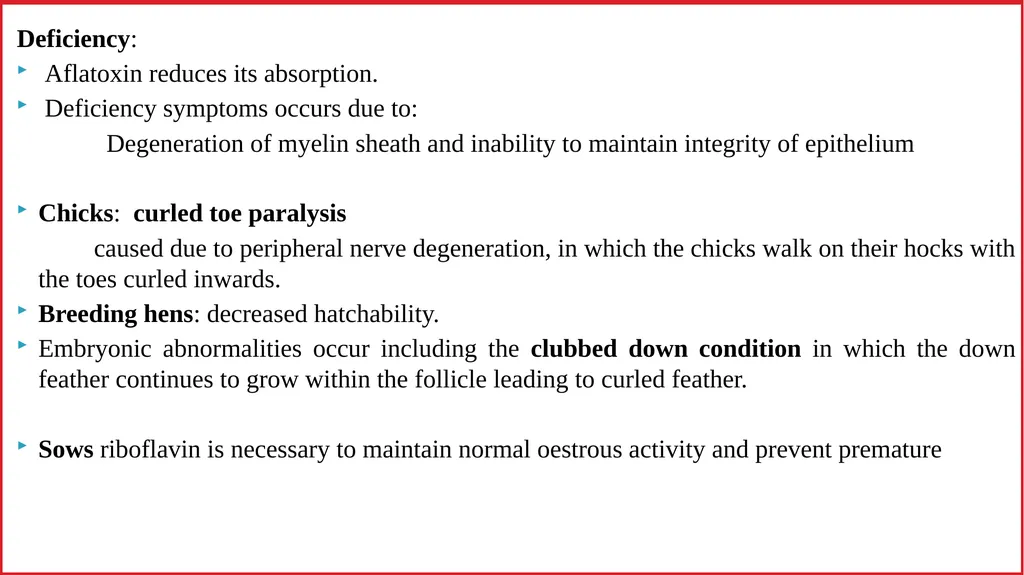
Deficiency:
Aflatoxin reduces its absorption.
Deficiency symptoms occurs due to:
Degeneration of myelin sheath and inability to maintain integrity of epithelium
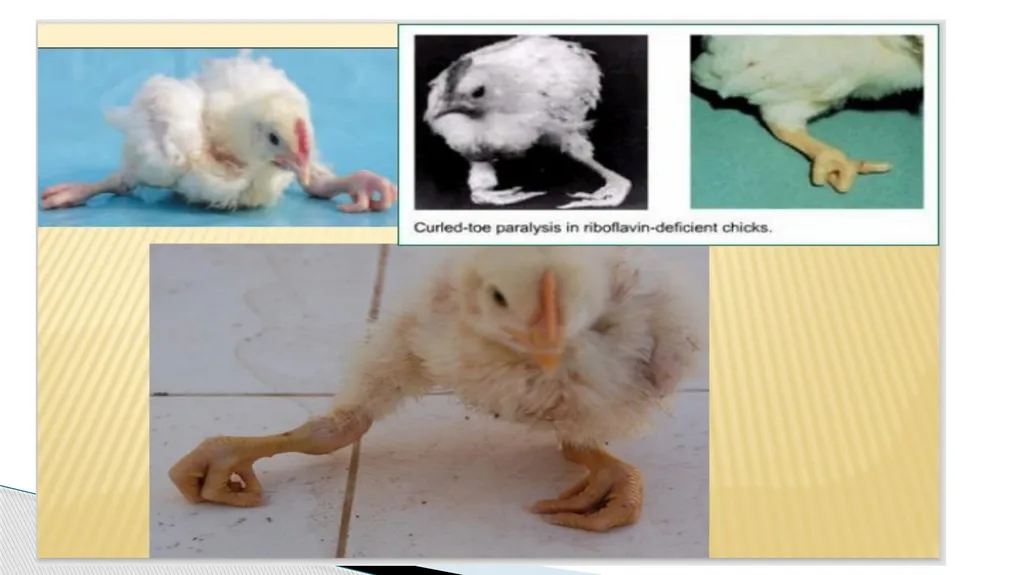
Chicks: curled toe paralysis
caused due to peripheral nerve degeneration, in which the chicks walk on their hocks with the toes curled inwards.
Breeding hens: decreased hatchability.
Embryonic abnormalities occur including the clubbed down condition in which the down feather continues to grow within the follicle leading to curled feather.
Sows riboflavin is necessary to maintain normal oestrous activity and prevent premature<br>
Aflatoxin reduces its absorption.
Deficiency symptoms occurs due to:
Degeneration of myelin sheath and inability to maintain integrity of epithelium
Chicks: curled toe paralysis
caused due to peripheral nerve degeneration, in which the chicks walk on their hocks with the toes curled inwards.
Breeding hens: decreased hatchability.
Embryonic abnormalities occur including the clubbed down condition in which the down feather continues to grow within the follicle leading to curled feather.
Sows riboflavin is necessary to maintain normal oestrous activity and prevent premature<br>
17
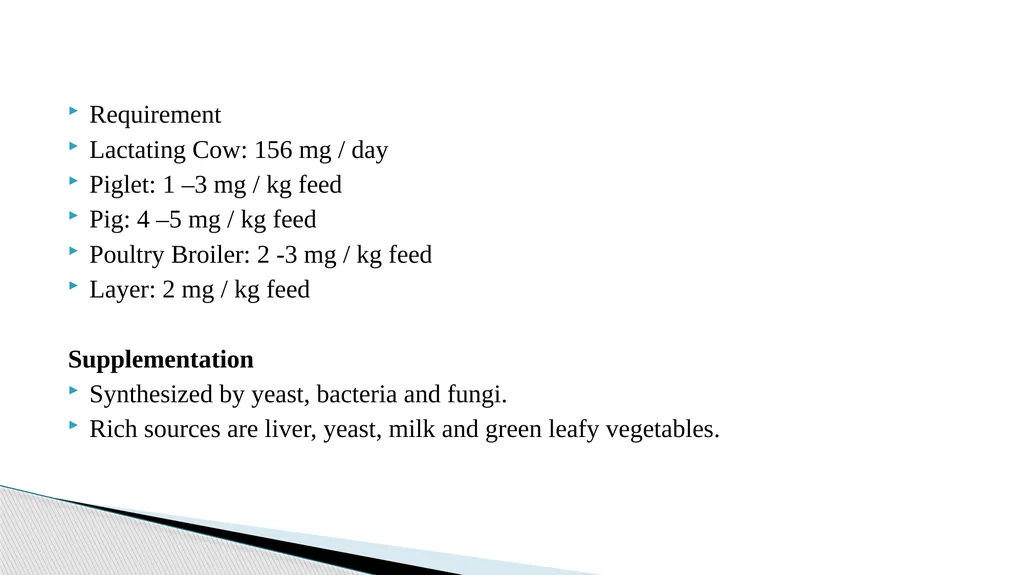
Requirement
Lactating Cow: 156 mg / day
Piglet: 1 –3 mg / kg feed
Pig: 4 –5 mg / kg feed
Poultry Broiler: 2 -3 mg / kg feed
Layer: 2 mg / kg feed
Supplementation
Synthesized by yeast, bacteria and fungi.
Rich sources are liver, yeast, milk and green leafy vegetables.<br>
Lactating Cow: 156 mg / day
Piglet: 1 –3 mg / kg feed
Pig: 4 –5 mg / kg feed
Poultry Broiler: 2 -3 mg / kg feed
Layer: 2 mg / kg feed
Supplementation
Synthesized by yeast, bacteria and fungi.
Rich sources are liver, yeast, milk and green leafy vegetables.<br>
18
Nicotinic acid (plants) and Nicotinamide(animals)
Stable vitamin not easily destroyed by heat, acid and alkali
Sources: Synthesized from Tryptophan in body tissues.
Cat and mink, no ability to convert tryptophan to niacin
Animal and fish byproducts, Distillers grains, yeast
two important coenzymes, nicotinamideadenine dinucleotide (NAD) and nicotinamideadenine dinucleotidephosphate (NADP).
involved in the mechanism of hydrogen transfer
reactions involving CHO, protein and fats.
6-12 g of niacin supplementation reduces incidence of ketosis. Nicotinamide<br>
Stable vitamin not easily destroyed by heat, acid and alkali
Sources: Synthesized from Tryptophan in body tissues.
Cat and mink, no ability to convert tryptophan to niacin
Animal and fish byproducts, Distillers grains, yeast
two important coenzymes, nicotinamideadenine dinucleotide (NAD) and nicotinamideadenine dinucleotidephosphate (NADP).
involved in the mechanism of hydrogen transfer
reactions involving CHO, protein and fats.
6-12 g of niacin supplementation reduces incidence of ketosis. Nicotinamide<br>
19
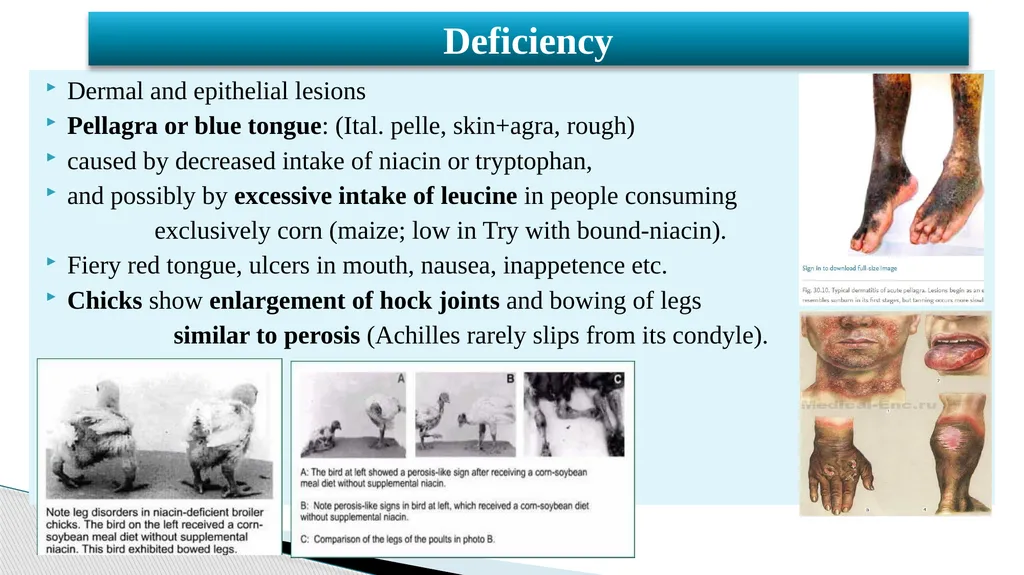
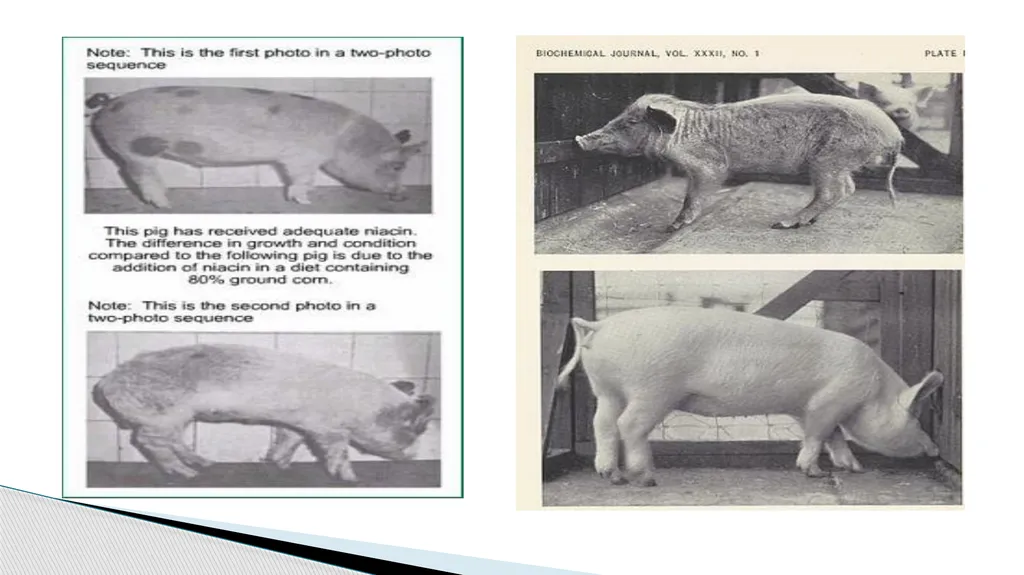
Dermal and epithelial lesions
Pellagra or blue tongue: (Ital. pelle, skin+agra, rough)
caused by decreased intake of niacin or tryptophan,
and possibly by excessive intake of leucine in people consuming
exclusively corn (maize; low in Try with bound-niacin).
Fiery red tongue, ulcers in mouth, nausea, inappetence etc.
Chicks show enlargement of hock joints and bowing of legs
similar to perosis (Achilles rarely slips from its condyle). Deficiency<br>
Pellagra or blue tongue: (Ital. pelle, skin+agra, rough)
caused by decreased intake of niacin or tryptophan,
and possibly by excessive intake of leucine in people consuming
exclusively corn (maize; low in Try with bound-niacin).
Fiery red tongue, ulcers in mouth, nausea, inappetence etc.
Chicks show enlargement of hock joints and bowing of legs
similar to perosis (Achilles rarely slips from its condyle). Deficiency<br>
20
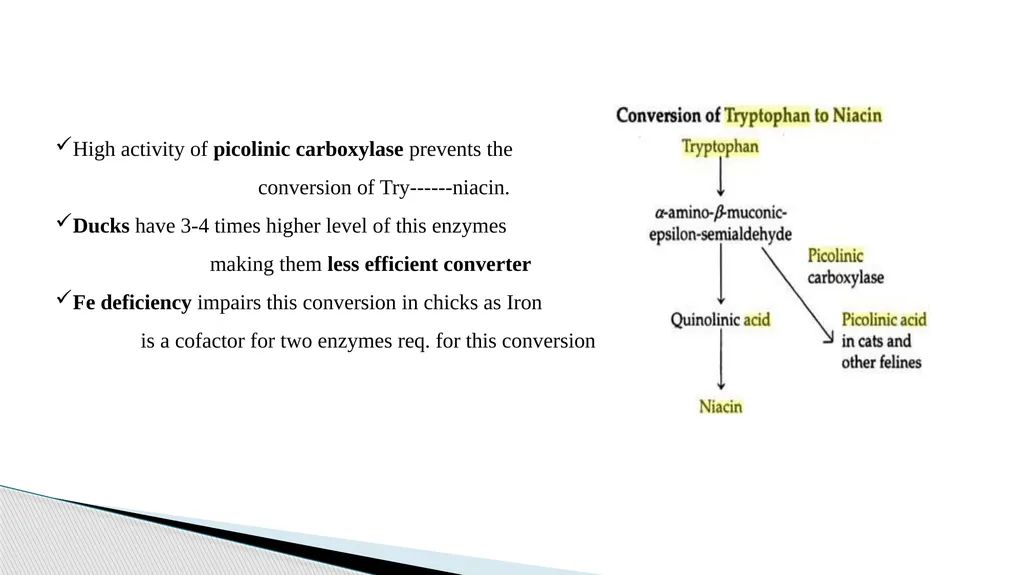
High activity of picolinic carboxylase prevents the
conversion of Try------niacin.
Ducks have 3-4 times higher level of this enzymes
making them less efficient converter
Fe deficiency impairs this conversion in chicks as Iron
is a cofactor for two enzymes req. for this conversion<br>
conversion of Try------niacin.
Ducks have 3-4 times higher level of this enzymes
making them less efficient converter
Fe deficiency impairs this conversion in chicks as Iron
is a cofactor for two enzymes req. for this conversion<br>
21
Requirement
Lactating Cow : 289 mg / day
Piglet : 5 –7 mg / kg feed
Pig : 15 –20 mg / kg feed
Poultry –Broiler : 27 mg / kg feed
Poultry –Layer : 10 mg / kg feed
Supplementation
It can be synthesized from amino acid tryptophan in the body tissues.
If the diet is rich in protein containing tryptophan than dietary requirement of the vitamin is low.
Rich sources of the vitamin are liver, yeast, groundnuts and sunflower meals.
In cereals (Maize) the vitamin is present in the bound form (niacytin; complexes of niacin with polysaccharides and peptides/glycopeptides<br>
Lactating Cow : 289 mg / day
Piglet : 5 –7 mg / kg feed
Pig : 15 –20 mg / kg feed
Poultry –Broiler : 27 mg / kg feed
Poultry –Layer : 10 mg / kg feed
Supplementation
It can be synthesized from amino acid tryptophan in the body tissues.
If the diet is rich in protein containing tryptophan than dietary requirement of the vitamin is low.
Rich sources of the vitamin are liver, yeast, groundnuts and sunflower meals.
In cereals (Maize) the vitamin is present in the bound form (niacytin; complexes of niacin with polysaccharides and peptides/glycopeptides<br>
22
Three forms: pyridoxine, pyridoxal, pyridoxamine
Pyridoxine (in plants)
Pyridoxal phosphatethe most actively functioning.
Pyridoxal phosphate as a coenzyme in the reactions by which a cell transforms
nutrient amino acids into mixtures of amino acids
absorption of amino acids from the intestine.
Req. for complete metabolism of tryptophan
Linatine from linseed is its antagonist Pyridoxine- Vit. B6<br>
Pyridoxine (in plants)
Pyridoxal phosphatethe most actively functioning.
Pyridoxal phosphate as a coenzyme in the reactions by which a cell transforms
nutrient amino acids into mixtures of amino acids
absorption of amino acids from the intestine.
Req. for complete metabolism of tryptophan
Linatine from linseed is its antagonist Pyridoxine- Vit. B6<br>
23
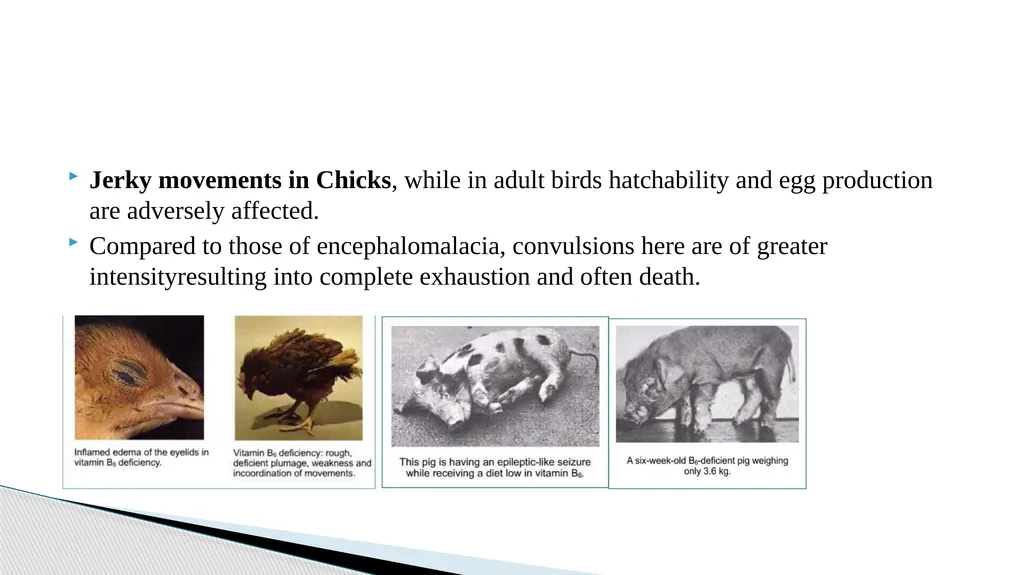
Jerky movements in Chicks, while in adult birds hatchability and egg production are adversely affected.
Compared to those of encephalomalacia, convulsions here are of greater intensityresulting into complete exhaustion and often death.<br>
Compared to those of encephalomalacia, convulsions here are of greater intensityresulting into complete exhaustion and often death.<br>
24
Constituent of Coenzyme A
Important coenzyme in
Fatty acid oxidation
Acetate metabolism
cholesterol and steroid synthesis
Deficiency disease: Goose stepping gait Pantothenic acid<br>
Important coenzyme in
Fatty acid oxidation
Acetate metabolism
cholesterol and steroid synthesis
Deficiency disease: Goose stepping gait Pantothenic acid<br>
25
Folium means leaf---present in large quantities in green leaves Folic Acid<br>
26
1) Physiological and production status of animal
2) Confinement rearing without access to pasture: Vit D from sunlight.
Cage rearing of poultry: feces are rich in many vitamin.
3) Stress, disease or adverse environmental condition:
Intensified production increases stress.
Diseases or parasites affecting gastrointestinal absorption of Vitamins.
Mycotoxin
Coccidiosis increase the Vitamin K requirements
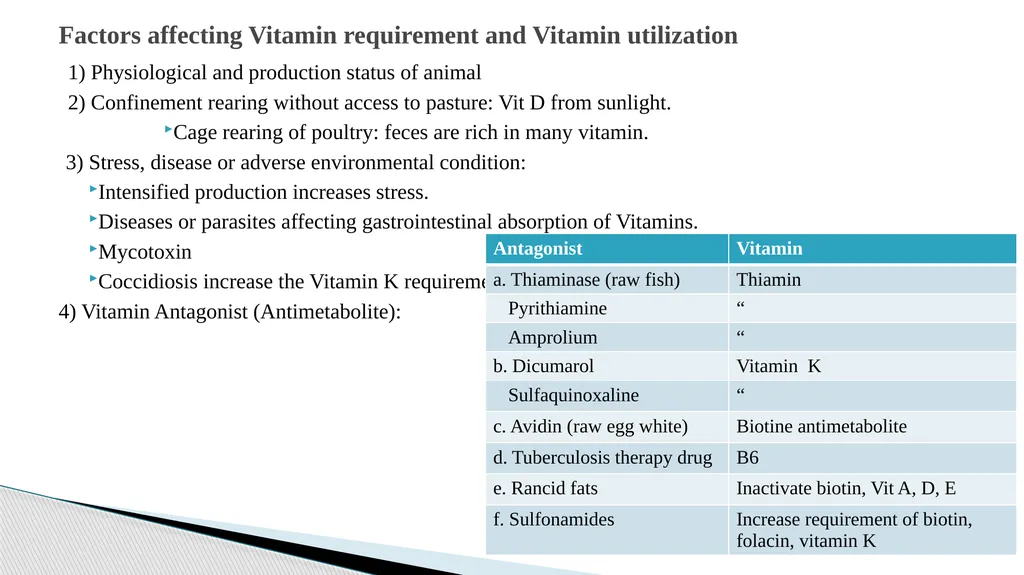
4) Vitamin Antagonist (Antimetabolite): Factors affecting Vitamin requirement and Vitamin utilization<br>
2) Confinement rearing without access to pasture: Vit D from sunlight.
Cage rearing of poultry: feces are rich in many vitamin.
3) Stress, disease or adverse environmental condition:
Intensified production increases stress.
Diseases or parasites affecting gastrointestinal absorption of Vitamins.
Mycotoxin
Coccidiosis increase the Vitamin K requirements
4) Vitamin Antagonist (Antimetabolite): Factors affecting Vitamin requirement and Vitamin utilization<br>
27
5.Levels of other nutrients in the diet: Fat for Fat soluble vitamin.
6. Interrelationships of vitamin with other nutrients: Vit E and Se
Vit D with Ca &P
Choline with methionine
Niacin with tryptophan
7. Body vitamin reserves: Mainly for fat soluble vitamin and Vitamin B12.<br>
6. Interrelationships of vitamin with other nutrients: Vit E and Se
Vit D with Ca &P
Choline with methionine
Niacin with tryptophan
7. Body vitamin reserves: Mainly for fat soluble vitamin and Vitamin B12.<br>