
VPOP – Optimization tool Stakeholders engagement
TD
Published · 17 slides · 0 views
1 / 1
Description
VPOP Optimization tool Stakeholders engagement slide deck Agenda Background and objectives Optimization process Available resources 1 2 3 Strong decrease in global funding (from 30 to 40 between 2023 and 2025) with increased public
Related Topics
Share
Embed code
Download this presentation From Below
"VPOP – Optimization tool Stakeholders engagement" is the property of its rightful owner. Permission is granted to download and print the materials on this website for personal, non-commercial use only, and to display it on your personal computer provided you do not modify the materials and that you retain all copyright notices contained in the materials. By downloading content from our website, you accept the terms of this agreement.
Presentation Transcript
01
VPOP – Optimization tool
Stakeholders engagement slide deck<br>
Stakeholders engagement slide deck<br>
02
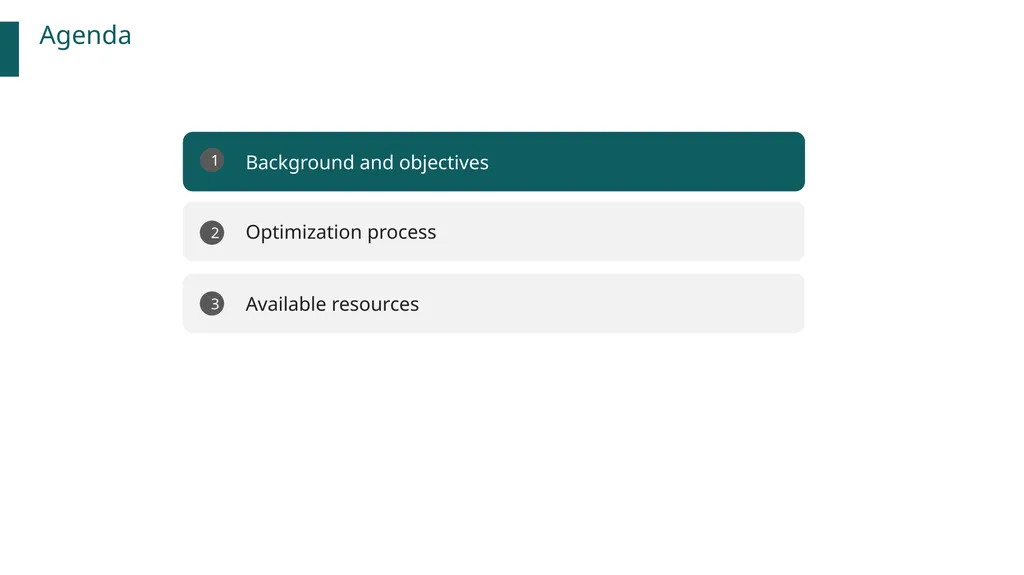
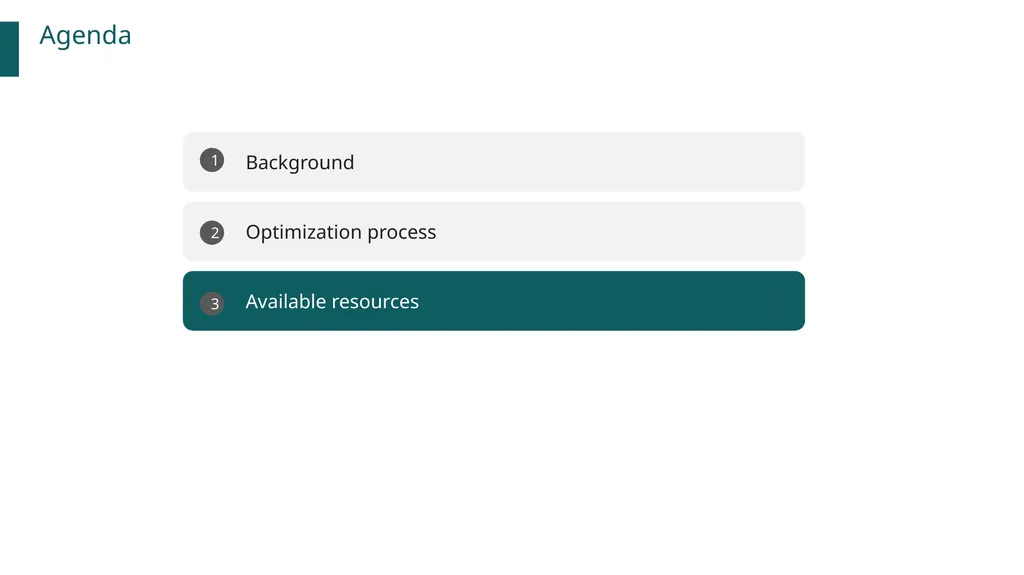
Agenda Background and objectives Optimization process Available resources 1 2 3<br>
03
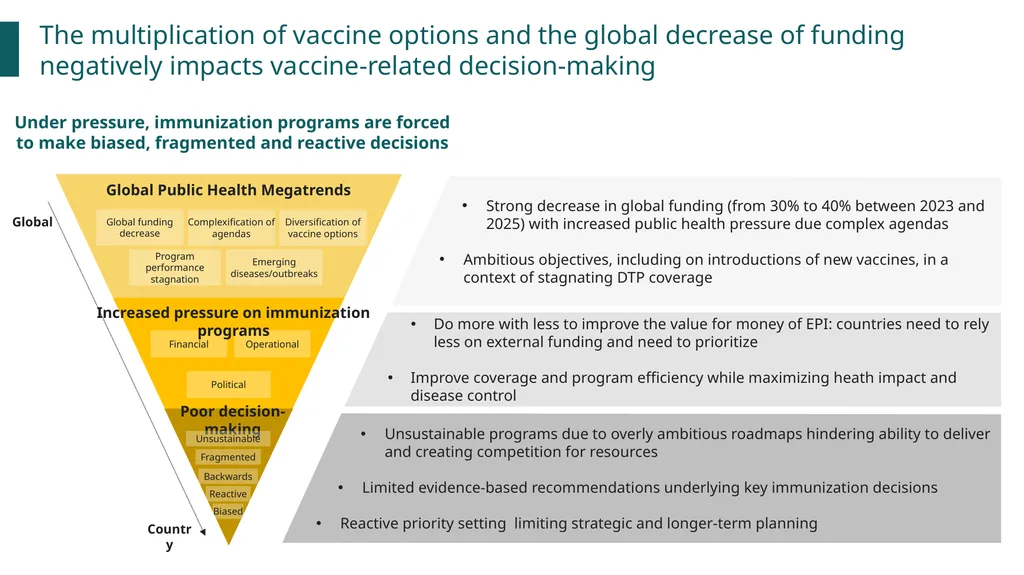
Strong decrease in global funding (from 30% to 40% between 2023 and 2025) with increased public health pressure due complex agendas
Ambitious objectives, including on introductions of new vaccines, in a context of stagnating DTP coverage Do more with less to improve the value for money of EPI: countries need to rely less on external funding and need to prioritize
Improve coverage and program efficiency while maximizing heath impact and disease control Unsustainable programs due to overly ambitious roadmaps hindering ability to deliver and creating competition for resources
Limited evidence-based recommendations underlying key immunization decisions
Reactive priority setting limiting strategic and longer-term planning The multiplication of vaccine options and the global decrease of funding negatively impacts vaccine-related decision-making Under pressure, immunization programs are forced to make biased, fragmented and reactive decisions Global Public Health Megatrends Poor decision-making Global funding decrease Complexification of agendas Program performance stagnation Emerging diseases/outbreaks Diversification of vaccine options Financial Political Operational Unsustainable Biased Fragmented Reactive Backwards Increased pressure on immunization programs Global Country<br>
Ambitious objectives, including on introductions of new vaccines, in a context of stagnating DTP coverage Do more with less to improve the value for money of EPI: countries need to rely less on external funding and need to prioritize
Improve coverage and program efficiency while maximizing heath impact and disease control Unsustainable programs due to overly ambitious roadmaps hindering ability to deliver and creating competition for resources
Limited evidence-based recommendations underlying key immunization decisions
Reactive priority setting limiting strategic and longer-term planning The multiplication of vaccine options and the global decrease of funding negatively impacts vaccine-related decision-making Under pressure, immunization programs are forced to make biased, fragmented and reactive decisions Global Public Health Megatrends Poor decision-making Global funding decrease Complexification of agendas Program performance stagnation Emerging diseases/outbreaks Diversification of vaccine options Financial Political Operational Unsustainable Biased Fragmented Reactive Backwards Increased pressure on immunization programs Global Country<br>
04
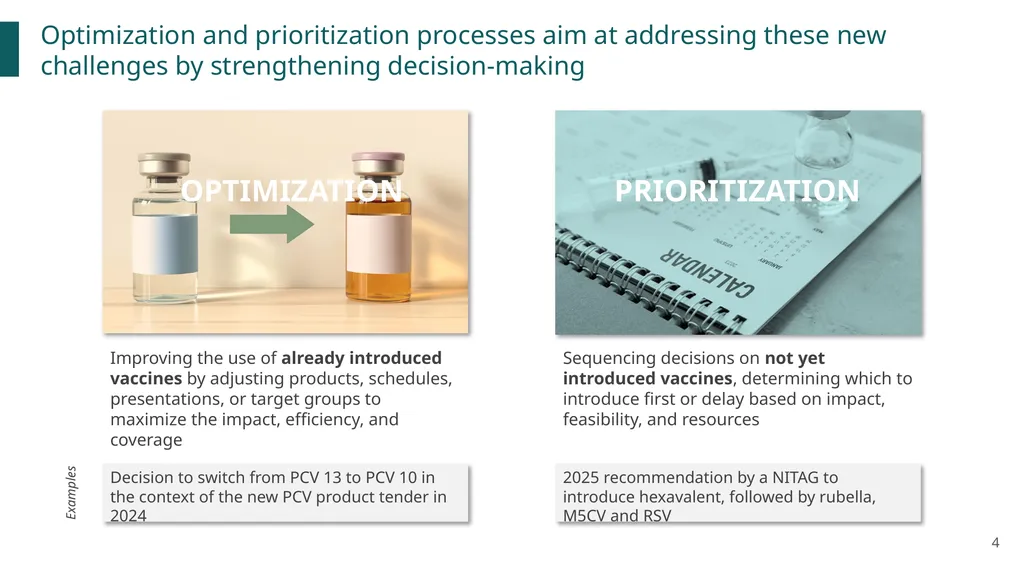
PRIORITIZATION Sequencing decisions on not yet introduced vaccines, determining which to introduce first or delay based on impact, feasibility, and resources 2025 recommendation by a NITAG to introduce hexavalent, followed by rubella, M5CV and RSV Optimization and prioritization processes aim at addressing these new challenges by strengthening decision-making OPTIMIZATION Improving the use of already introduced vaccines by adjusting products, schedules, presentations, or target groups to maximize the impact, efficiency, and coverage Decision to switch from PCV 13 to PCV 10 in the context of the new PCV product tender in 2024 Examples 4<br>
05
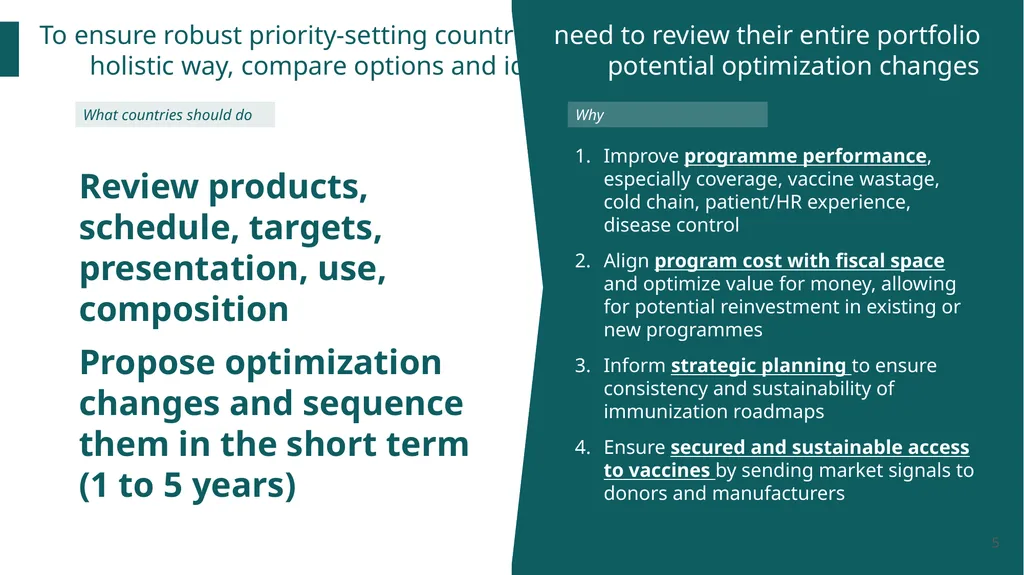
To ensure robust priority-setting countries need to review their entire portfolio in a holistic way, compare options and identify potential optimization changes 5 Improve programme performance, especially coverage, vaccine wastage, cold chain, patient/HR experience, disease control
Align program cost with fiscal space and optimize value for money, allowing for potential reinvestment in existing or new programmes
Inform strategic planning to ensure consistency and sustainability of immunization roadmaps
Ensure secured and sustainable access to vaccines by sending market signals to donors and manufacturers Review products, schedule, targets, presentation, use, composition Propose optimization changes and sequence them in the short term
(1 to 5 years) Why What countries should do<br>
Align program cost with fiscal space and optimize value for money, allowing for potential reinvestment in existing or new programmes
Inform strategic planning to ensure consistency and sustainability of immunization roadmaps
Ensure secured and sustainable access to vaccines by sending market signals to donors and manufacturers Review products, schedule, targets, presentation, use, composition Propose optimization changes and sequence them in the short term
(1 to 5 years) Why What countries should do<br>
06
Agenda Background Optimization process Available resources 1 2 3<br>
07
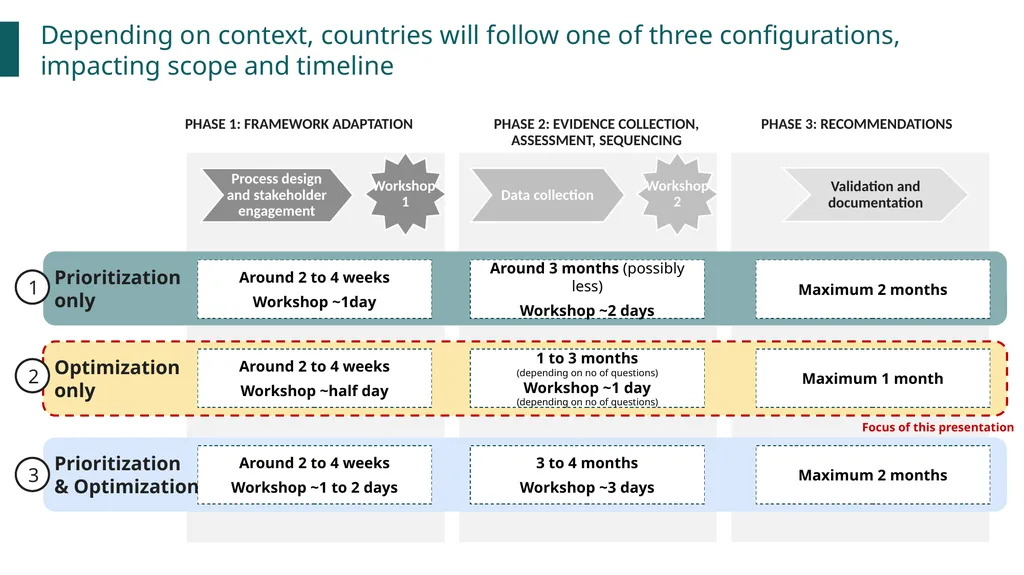
Depending on context, countries will follow one of three configurations, impacting scope and timeline Prioritization
only Optimization
only Prioritization
& Optimization Around 2 to 4 weeks
Workshop ~1day Around 2 to 4 weeks
Workshop ~half day Around 2 to 4 weeks
Workshop ~1 to 2 days Around 3 months (possibly less)
Workshop ~2 days 1 to 3 months
(depending on no of questions)
Workshop ~1 day
(depending on no of questions) 3 to 4 months
Workshop ~3 days Maximum 2 months Maximum 1 month Maximum 2 months 1 2 3 Focus of this presentation<br>
only Optimization
only Prioritization
& Optimization Around 2 to 4 weeks
Workshop ~1day Around 2 to 4 weeks
Workshop ~half day Around 2 to 4 weeks
Workshop ~1 to 2 days Around 3 months (possibly less)
Workshop ~2 days 1 to 3 months
(depending on no of questions)
Workshop ~1 day
(depending on no of questions) 3 to 4 months
Workshop ~3 days Maximum 2 months Maximum 1 month Maximum 2 months 1 2 3 Focus of this presentation<br>
08
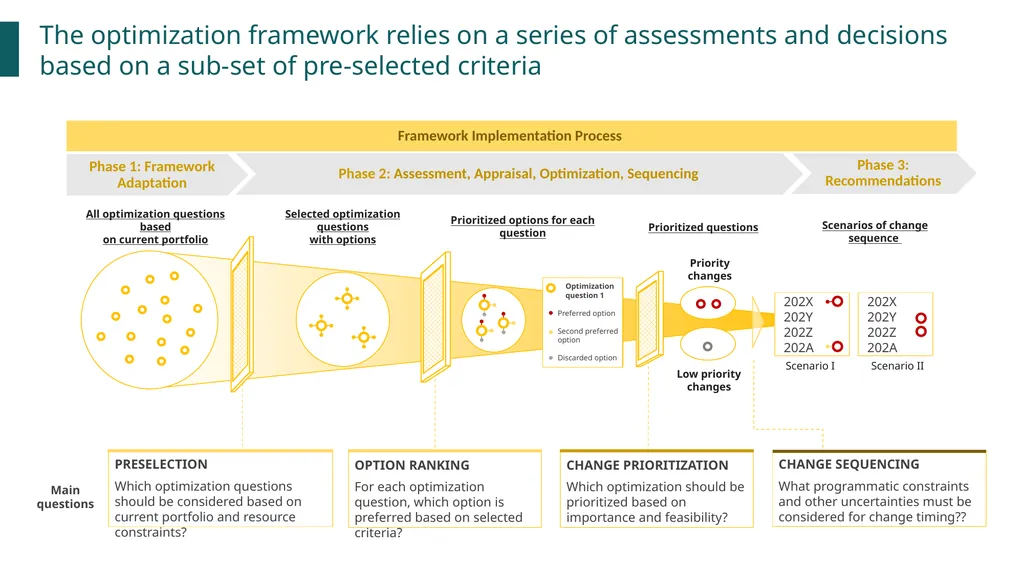
The optimization framework relies on a series of assessments and decisions based on a sub-set of pre-selected criteria All optimization questions based
on current portfolio Prioritized options for each question Selected optimization questions
with options 202X
202Y
202Z
202A 202X
202Y
202Z
202A Scenario I Scenario II Main questions Phase 1: Framework Adaptation Phase 2: Assessment, Appraisal, Optimization, Sequencing Phase 3: Recommendations Framework Implementation Process Scenarios of change sequence Optimization
question 1
Preferred option
Second preferred
option
Discarded option Prioritized questions Priority changes Low priority
changes<br>
on current portfolio Prioritized options for each question Selected optimization questions
with options 202X
202Y
202Z
202A 202X
202Y
202Z
202A Scenario I Scenario II Main questions Phase 1: Framework Adaptation Phase 2: Assessment, Appraisal, Optimization, Sequencing Phase 3: Recommendations Framework Implementation Process Scenarios of change sequence Optimization
question 1
Preferred option
Second preferred
option
Discarded option Prioritized questions Priority changes Low priority
changes<br>
09
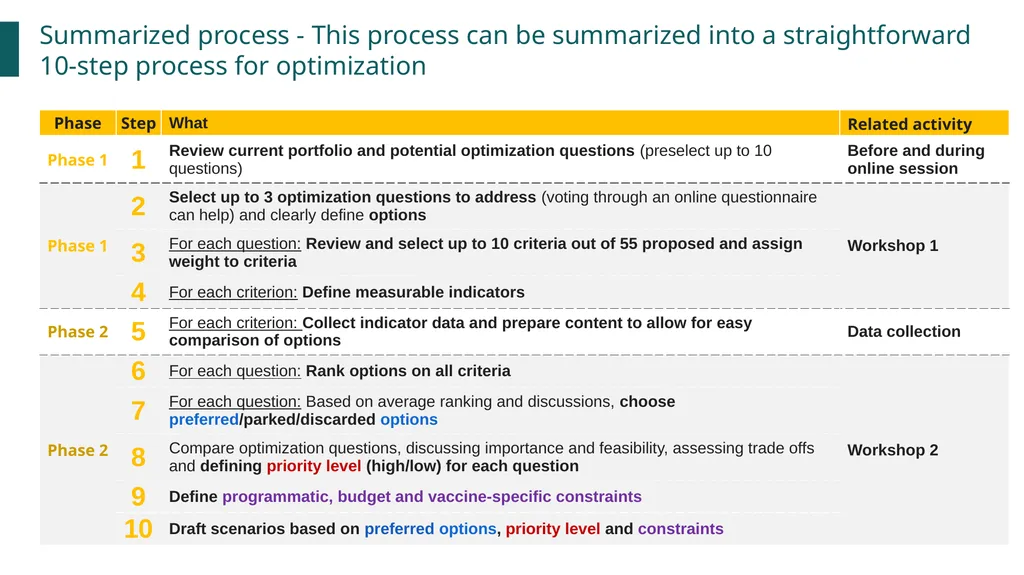
Summarized process - This process can be summarized into a straightforward 10-step process for optimization 9<br>
10
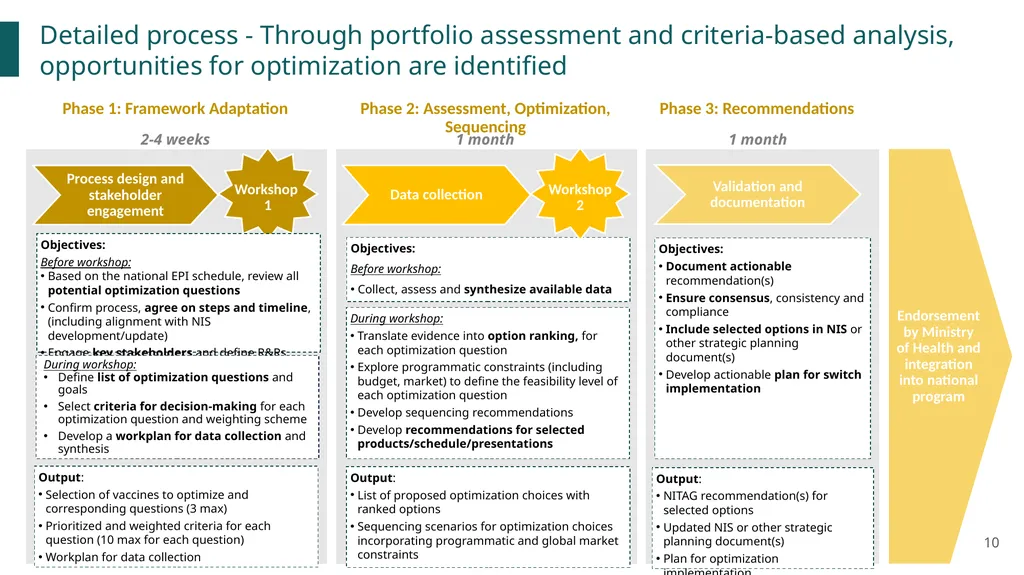
Detailed process - Through portfolio assessment and criteria-based analysis, opportunities for optimization are identified Validation and documentation Objectives:
Document actionable recommendation(s)
Ensure consensus, consistency and compliance
Include selected options in NIS or other strategic planning document(s)
Develop actionable plan for switch implementation Process design and stakeholder engagement Workshop
1 Objectives:
Before workshop:
Based on the national EPI schedule, review all potential optimization questions
Confirm process, agree on steps and timeline, (including alignment with NIS development/update)
Engage key stakeholders and define R&Rs Phase 1: Framework Adaptation Objectives:
Before workshop:
Collect, assess and synthesize available data Data collection Workshop
2 Phase 3: Recommendations Endorsement by Ministry of Health and integration into national program Output:
Selection of vaccines to optimize and corresponding questions (3 max)
Prioritized and weighted criteria for each question (10 max for each question)
Workplan for data collection Output:
List of proposed optimization choices with ranked options
Sequencing scenarios for optimization choices incorporating programmatic and global market constraints Output:
NITAG recommendation(s) for selected options
Updated NIS or other strategic planning document(s)
Plan for optimization implementation 2-4 weeks 1 month Phase 2: Assessment, Optimization, Sequencing 1 month 10 During workshop:
Define list of optimization questions and goals
Select criteria for decision-making for each optimization question and weighting scheme
Develop a workplan for data collection and synthesis During workshop:
Translate evidence into option ranking, for each optimization question
Explore programmatic constraints (including budget, market) to define the feasibility level of each optimization question
Develop sequencing recommendations
Develop recommendations for selected products/schedule/presentations<br>
Document actionable recommendation(s)
Ensure consensus, consistency and compliance
Include selected options in NIS or other strategic planning document(s)
Develop actionable plan for switch implementation Process design and stakeholder engagement Workshop
1 Objectives:
Before workshop:
Based on the national EPI schedule, review all potential optimization questions
Confirm process, agree on steps and timeline, (including alignment with NIS development/update)
Engage key stakeholders and define R&Rs Phase 1: Framework Adaptation Objectives:
Before workshop:
Collect, assess and synthesize available data Data collection Workshop
2 Phase 3: Recommendations Endorsement by Ministry of Health and integration into national program Output:
Selection of vaccines to optimize and corresponding questions (3 max)
Prioritized and weighted criteria for each question (10 max for each question)
Workplan for data collection Output:
List of proposed optimization choices with ranked options
Sequencing scenarios for optimization choices incorporating programmatic and global market constraints Output:
NITAG recommendation(s) for selected options
Updated NIS or other strategic planning document(s)
Plan for optimization implementation 2-4 weeks 1 month Phase 2: Assessment, Optimization, Sequencing 1 month 10 During workshop:
Define list of optimization questions and goals
Select criteria for decision-making for each optimization question and weighting scheme
Develop a workplan for data collection and synthesis During workshop:
Translate evidence into option ranking, for each optimization question
Explore programmatic constraints (including budget, market) to define the feasibility level of each optimization question
Develop sequencing recommendations
Develop recommendations for selected products/schedule/presentations<br>
11
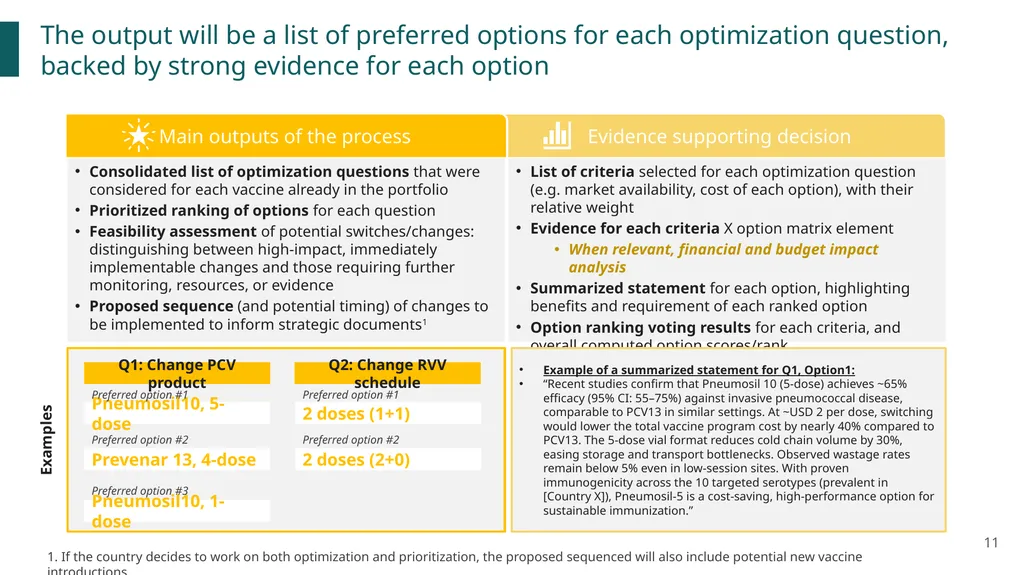
The output will be a list of preferred options for each optimization question, backed by strong evidence for each option Evidence supporting decision Main outputs of the process Consolidated list of optimization questions that were considered for each vaccine already in the portfolio
Prioritized ranking of options for each question
Feasibility assessment of potential switches/changes: distinguishing between high-impact, immediately implementable changes and those requiring further monitoring, resources, or evidence
Proposed sequence (and potential timing) of changes to be implemented to inform strategic documents1 List of criteria selected for each optimization question (e.g. market availability, cost of each option), with their relative weight
Evidence for each criteria X option matrix element
When relevant, financial and budget impact analysis
Summarized statement for each option, highlighting benefits and requirement of each ranked option
Option ranking voting results for each criteria, and overall computed option scores/rank Example of a summarized statement for Q1, Option1:
“Recent studies confirm that Pneumosil 10 (5-dose) achieves ~65% efficacy (95% CI: 55–75%) against invasive pneumococcal disease, comparable to PCV13 in similar settings. At ~USD 2 per dose, switching would lower the total vaccine program cost by nearly 40% compared to PCV13. The 5-dose vial format reduces cold chain volume by 30%, easing storage and transport bottlenecks. Observed wastage rates remain below 5% even in low-session sites. With proven immunogenicity across the 10 targeted serotypes (prevalent in [Country X]), Pneumosil-5 is a cost-saving, high-performance option for sustainable immunization.” Examples Q1: Change PCV product Q2: Change RVV schedule Pneumosil10, 5-dose Prevenar 13, 4-dose Preferred option #1 Preferred option #2 Pneumosil10, 1-dose Preferred option #3 2 doses (1+1) 2 doses (2+0) Preferred option #1 Preferred option #2 1. If the country decides to work on both optimization and prioritization, the proposed sequenced will also include potential new vaccine introductions 11<br>
Prioritized ranking of options for each question
Feasibility assessment of potential switches/changes: distinguishing between high-impact, immediately implementable changes and those requiring further monitoring, resources, or evidence
Proposed sequence (and potential timing) of changes to be implemented to inform strategic documents1 List of criteria selected for each optimization question (e.g. market availability, cost of each option), with their relative weight
Evidence for each criteria X option matrix element
When relevant, financial and budget impact analysis
Summarized statement for each option, highlighting benefits and requirement of each ranked option
Option ranking voting results for each criteria, and overall computed option scores/rank Example of a summarized statement for Q1, Option1:
“Recent studies confirm that Pneumosil 10 (5-dose) achieves ~65% efficacy (95% CI: 55–75%) against invasive pneumococcal disease, comparable to PCV13 in similar settings. At ~USD 2 per dose, switching would lower the total vaccine program cost by nearly 40% compared to PCV13. The 5-dose vial format reduces cold chain volume by 30%, easing storage and transport bottlenecks. Observed wastage rates remain below 5% even in low-session sites. With proven immunogenicity across the 10 targeted serotypes (prevalent in [Country X]), Pneumosil-5 is a cost-saving, high-performance option for sustainable immunization.” Examples Q1: Change PCV product Q2: Change RVV schedule Pneumosil10, 5-dose Prevenar 13, 4-dose Preferred option #1 Preferred option #2 Pneumosil10, 1-dose Preferred option #3 2 doses (1+1) 2 doses (2+0) Preferred option #1 Preferred option #2 1. If the country decides to work on both optimization and prioritization, the proposed sequenced will also include potential new vaccine introductions 11<br>
12
Agenda Background Optimization process Available resources 1 2 3<br>
13
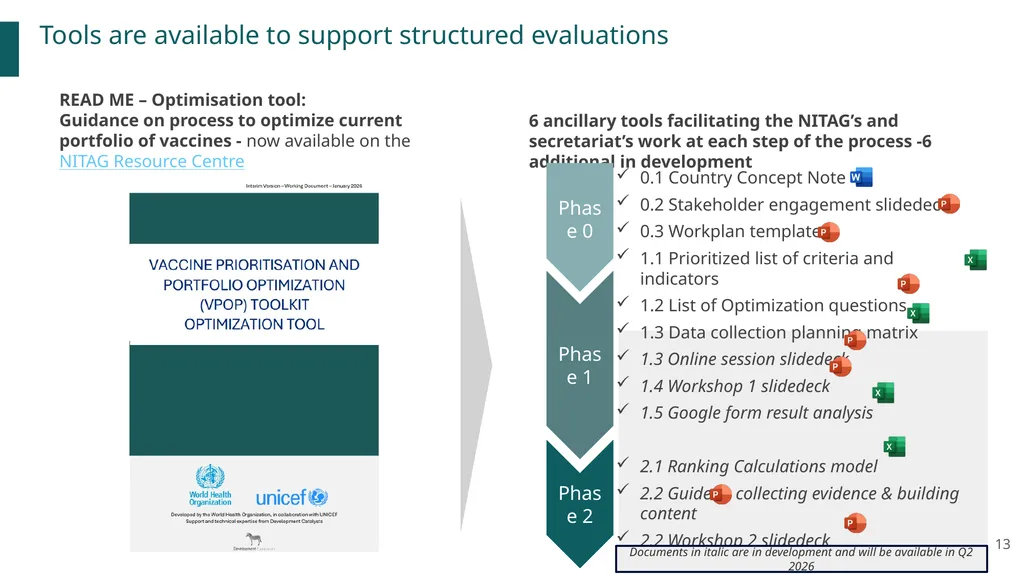
Tools are available to support structured evaluations 13 6 ancillary tools facilitating the NITAG’s and secretariat’s work at each step of the process -6 additional in development Phase 0 Phase 1 Phase 2 0.1 Country Concept Note
0.2 Stakeholder engagement slidedeck
0.3 Workplan template
1.1 Prioritized list of criteria and indicators
1.2 List of Optimization questions
1.3 Data collection planning matrix
1.3 Online session slidedeck
1.4 Workshop 1 slidedeck
1.5 Google form result analysis
2.1 Ranking Calculations model
2.2 Guide to collecting evidence & building content
2.2 Workshop 2 slidedeck READ ME – Optimisation tool:
Guidance on process to optimize current portfolio of vaccines - now available on the NITAG Resource Centre Documents in italic are in development and will be available in Q2 2026<br>
0.2 Stakeholder engagement slidedeck
0.3 Workplan template
1.1 Prioritized list of criteria and indicators
1.2 List of Optimization questions
1.3 Data collection planning matrix
1.3 Online session slidedeck
1.4 Workshop 1 slidedeck
1.5 Google form result analysis
2.1 Ranking Calculations model
2.2 Guide to collecting evidence & building content
2.2 Workshop 2 slidedeck READ ME – Optimisation tool:
Guidance on process to optimize current portfolio of vaccines - now available on the NITAG Resource Centre Documents in italic are in development and will be available in Q2 2026<br>
14
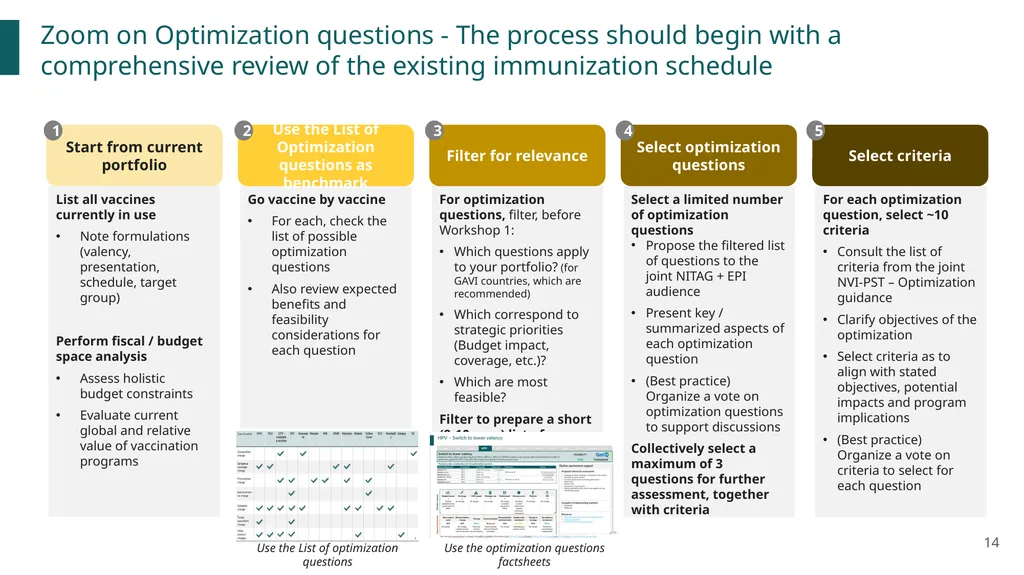
Zoom on Optimization questions - The process should begin with a comprehensive review of the existing immunization schedule 14 Select a limited number of optimization questions
Propose the filtered list of questions to the joint NITAG + EPI audience
Present key / summarized aspects of each optimization question
(Best practice) Organize a vote on optimization questions to support discussions
Collectively select a maximum of 3 questions for further assessment, together with criteria Go vaccine by vaccine
For each, check the list of possible optimization questions
Also review expected benefits and feasibility considerations for each question For optimization questions, filter, before Workshop 1:
Which questions apply to your portfolio? (for GAVI countries, which are recommended)
Which correspond to strategic priorities (Budget impact, coverage, etc.)?
Which are most feasible?
Filter to prepare a short (8-10 max) list of questions List all vaccines currently in use
Note formulations (valency, presentation, schedule, target group)
Perform fiscal / budget space analysis
Assess holistic budget constraints
Evaluate current global and relative value of vaccination programs Start from current portfolio Use the List of Optimization questions as benchmark Filter for relevance Select optimization questions Use the List of optimization questions Use the optimization questions factsheets For each optimization question, select ~10 criteria
Consult the list of criteria from the joint NVI-PST – Optimization guidance
Clarify objectives of the optimization
Select criteria as to align with stated objectives, potential impacts and program implications
(Best practice) Organize a vote on criteria to select for each question Select criteria 1 2 3 4 5<br>
Propose the filtered list of questions to the joint NITAG + EPI audience
Present key / summarized aspects of each optimization question
(Best practice) Organize a vote on optimization questions to support discussions
Collectively select a maximum of 3 questions for further assessment, together with criteria Go vaccine by vaccine
For each, check the list of possible optimization questions
Also review expected benefits and feasibility considerations for each question For optimization questions, filter, before Workshop 1:
Which questions apply to your portfolio? (for GAVI countries, which are recommended)
Which correspond to strategic priorities (Budget impact, coverage, etc.)?
Which are most feasible?
Filter to prepare a short (8-10 max) list of questions List all vaccines currently in use
Note formulations (valency, presentation, schedule, target group)
Perform fiscal / budget space analysis
Assess holistic budget constraints
Evaluate current global and relative value of vaccination programs Start from current portfolio Use the List of Optimization questions as benchmark Filter for relevance Select optimization questions Use the List of optimization questions Use the optimization questions factsheets For each optimization question, select ~10 criteria
Consult the list of criteria from the joint NVI-PST – Optimization guidance
Clarify objectives of the optimization
Select criteria as to align with stated objectives, potential impacts and program implications
(Best practice) Organize a vote on criteria to select for each question Select criteria 1 2 3 4 5<br>
15
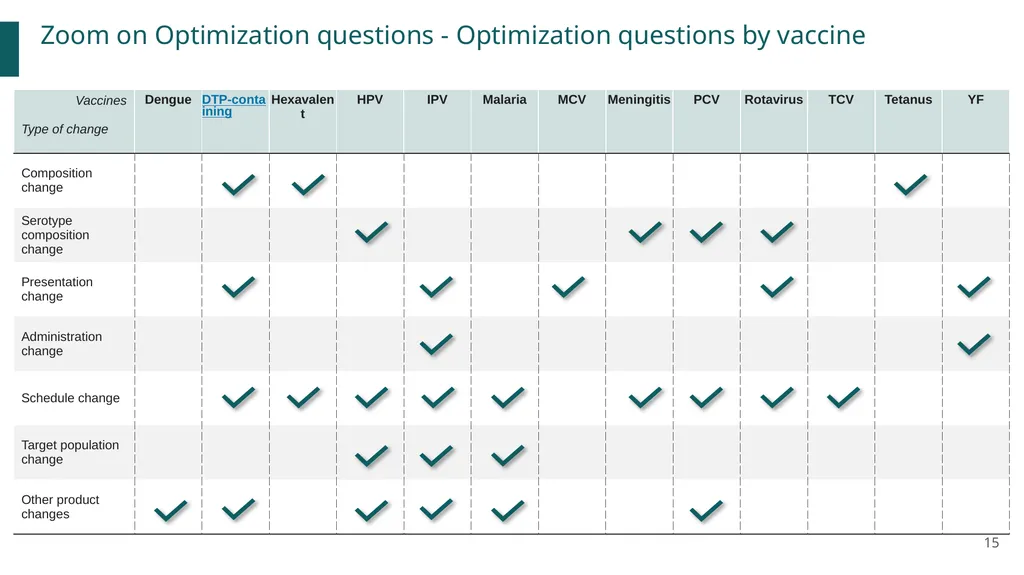
Zoom on Optimization questions - Optimization questions by vaccine 15<br>
16
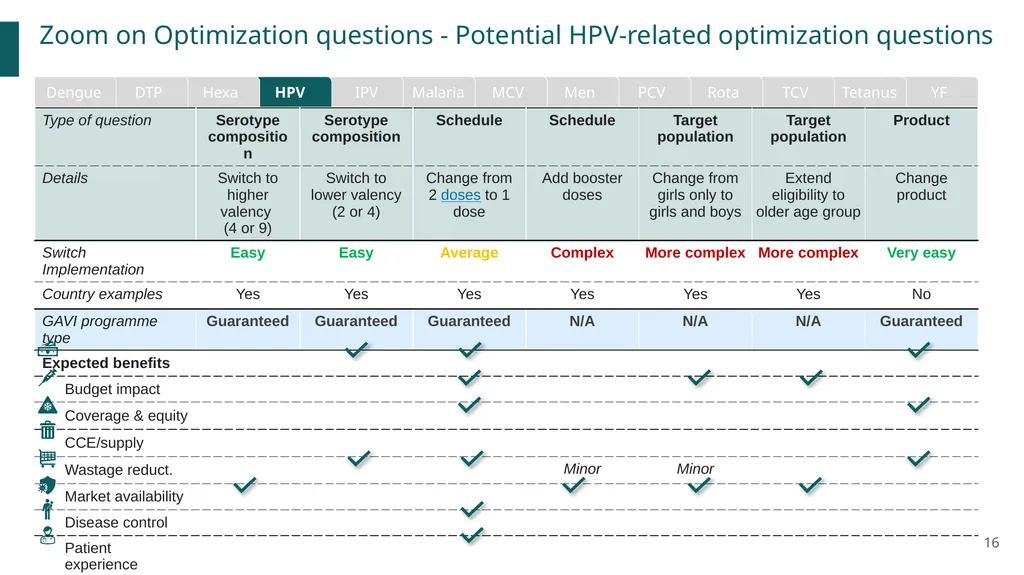
YF Tetanus TCV Rota PCV Men MCV Malaria IPV HPV Hexa DTP Dengue Zoom on Optimization questions - Potential HPV-related optimization questions 16<br>
17
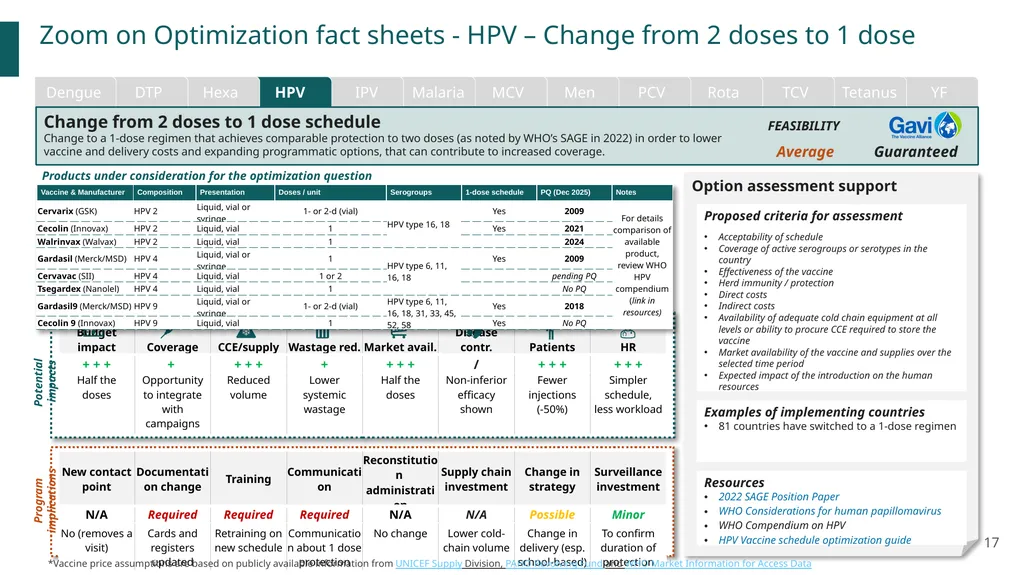
YF Tetanus TCV Rota PCV Men MCV Malaria IPV HPV Hexa DTP Dengue Zoom on Optimization fact sheets - HPV – Change from 2 doses to 1 dose Change from 2 doses to 1 dose schedule
Change to a 1-dose regimen that achieves comparable protection to two doses (as noted by WHO’s SAGE in 2022) in order to lower vaccine and delivery costs and expanding programmatic options, that can contribute to increased coverage. Option assessment support Examples of implementing countries
81 countries have switched to a 1-dose regimen Resources
2022 SAGE Position Paper
WHO Considerations for human papillomavirus
WHO Compendium on HPV
HPV Vaccine schedule optimization guide Proposed criteria for assessment
Acceptability of schedule
Coverage of active serogroups or serotypes in the country
Effectiveness of the vaccine
Herd immunity / protection
Direct costs
Indirect costs
Availability of adequate cold chain equipment at all levels or ability to procure CCE required to store the vaccine
Market availability of the vaccine and supplies over the selected time period
Expected impact of the introduction on the human resources Guaranteed Potential impacts Program implications FEASIBILITY Average 17 Products under consideration for the optimization question *Vaccine price assumptions are based on publicly available information from UNICEF Supply Division, PAHO Revolving Fund and WHO Market Information for Access Data<br>
Change to a 1-dose regimen that achieves comparable protection to two doses (as noted by WHO’s SAGE in 2022) in order to lower vaccine and delivery costs and expanding programmatic options, that can contribute to increased coverage. Option assessment support Examples of implementing countries
81 countries have switched to a 1-dose regimen Resources
2022 SAGE Position Paper
WHO Considerations for human papillomavirus
WHO Compendium on HPV
HPV Vaccine schedule optimization guide Proposed criteria for assessment
Acceptability of schedule
Coverage of active serogroups or serotypes in the country
Effectiveness of the vaccine
Herd immunity / protection
Direct costs
Indirect costs
Availability of adequate cold chain equipment at all levels or ability to procure CCE required to store the vaccine
Market availability of the vaccine and supplies over the selected time period
Expected impact of the introduction on the human resources Guaranteed Potential impacts Program implications FEASIBILITY Average 17 Products under consideration for the optimization question *Vaccine price assumptions are based on publicly available information from UNICEF Supply Division, PAHO Revolving Fund and WHO Market Information for Access Data<br>