Waiving Target Animal Batch Safety Testing for vaccines Ken NODA, DVM PhD National Veterinary Assay Laboratory, Ministry of Agriculture, Forestry and Fisheries, Tokyo, Japan Presented at VICH Training session in ASEAN, April, 2017
"Waiving Target Animal Batch Safety Testing for" is the property of its rightful owner. Permission is granted to
download and print the materials on this website for personal, non-commercial use only, and to display it
on your personal computer provided you do not modify the materials and that you retain all copyright
notices contained in the materials. By downloading content from our website, you accept the terms of this
agreement.
Presentation Transcript
01
Waiving Target Animal Batch Safety Testing for vaccines Ken NODA, DVM PhD
National Veterinary Assay Laboratory, Ministry of Agriculture, Forestry and Fisheries, Tokyo, Japan Presented at VICH Training session in ASEAN, April, 2017<br>
02
Disclaimer These slides have been provided for training purposes only. The presenter has made every attempt to ensure that they are consistent with relevant VICH guideline(s).
As always, the original Guideline(s) should be used as the primary source of information for working with regulators.<br>
03
At its 19th meeting in 2007 in USA, the SC reiterated its ambition to minimise animal testing
Support for the 3Rs principle
replacement, refinement and reduction
[Statement of Principle for VICH - Alternatives to Animal Testing (VICH/07/038-Final; 18/09/2007)] VICH 3Rs Statement<br>
04
Tests in target and/or laboratory animals
For Final product of broad group of vaccines
Considered as general safety tests
Vaccines may change its safety/toxicity batch to batch
Need assurance that a batch will be safe
BST should uncover;
Abnormal local or systemic reactions (EU)
Unfavorable reactions (US)
Abnormal changes (Japan) What is batch safety test (BST) ?<br>
05
Decreased concern on adverse reactions of vaccines Are BSTs for vaccines necessary? Due to the Improvements in
-Quality of raw materials
-Culture / Purification method
-Assay method
-Seed lot system / GMP standard
-Safety testing under GLP standard<br>
06
Formal name:
Harmonisation of criteria to waive target animal batch safety testing for inactivated vaccines for veterinary use
Very exceptional in whole VICH GLs
Usual GLs are test requirement for registration
TABST GL is applied to vaccine already registered in the past
It shows how to discontinue TABST
An administrative guidance
The SC accepted this exception for the 3Rs principle What is TABST GL?<br>
07
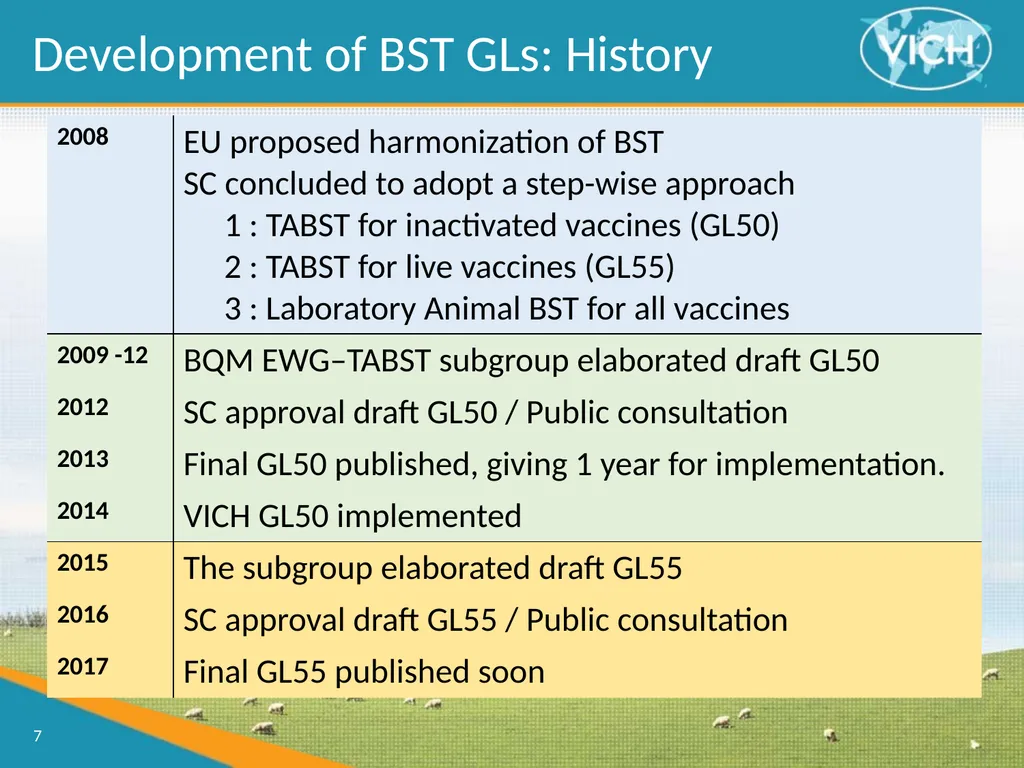
Development of BST GLs: History<br>
08
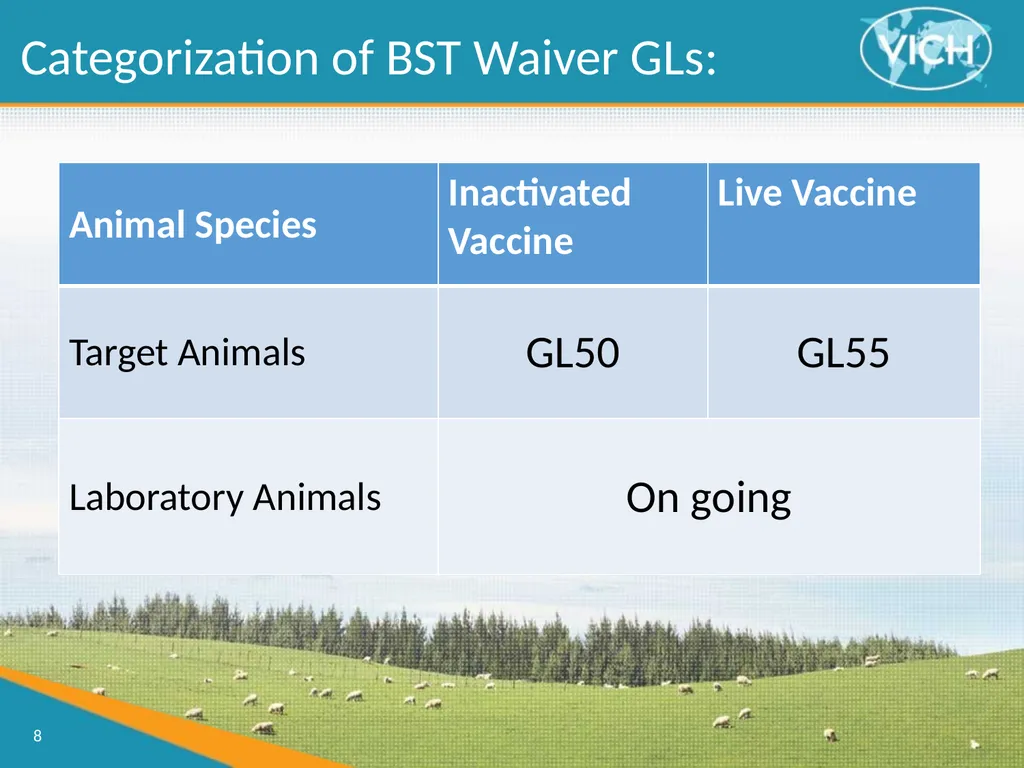
Categorization of BST Waiver GLs:<br>
09
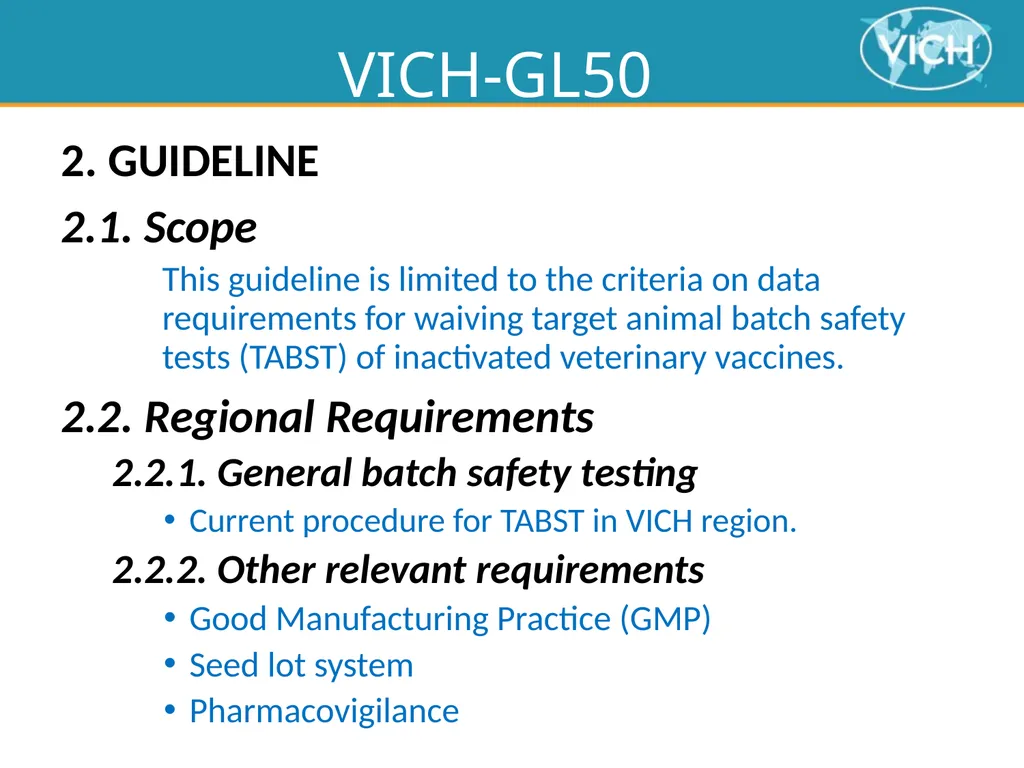
VICH-GL50 2. GUIDELINE
2.1. Scope
This guideline is limited to the criteria on data requirements for waiving target animal batch safety tests (TABST) of inactivated veterinary vaccines.
2.2. Regional Requirements
2.2.1. General batch safety testing
Current procedure for TABST in VICH region.
2.2.2. Other relevant requirements
Good Manufacturing Practice (GMP)
Seed lot system
Pharmacovigilance<br>
10
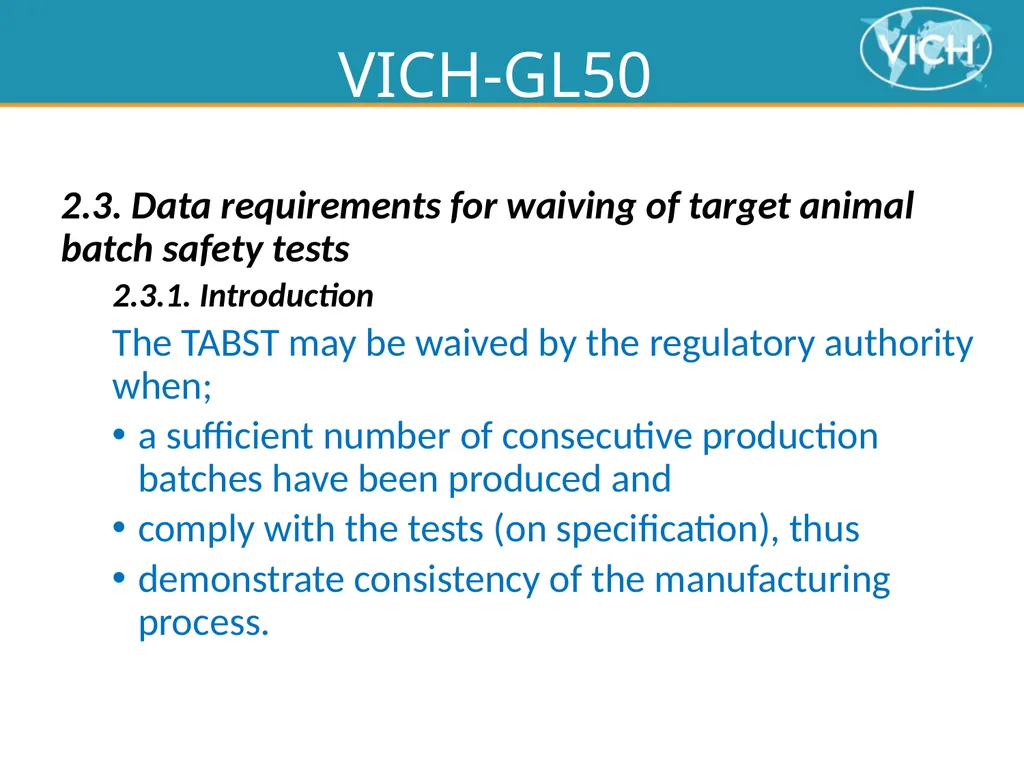
VICH-GL50 2.3. Data requirements for waiving of target animal batch safety tests
2.3.1. Introduction
The TABST may be waived by the regulatory authority when;
a sufficient number of consecutive production batches have been produced and
comply with the tests (on specification), thus
demonstrate consistency of the manufacturing process.<br>
11
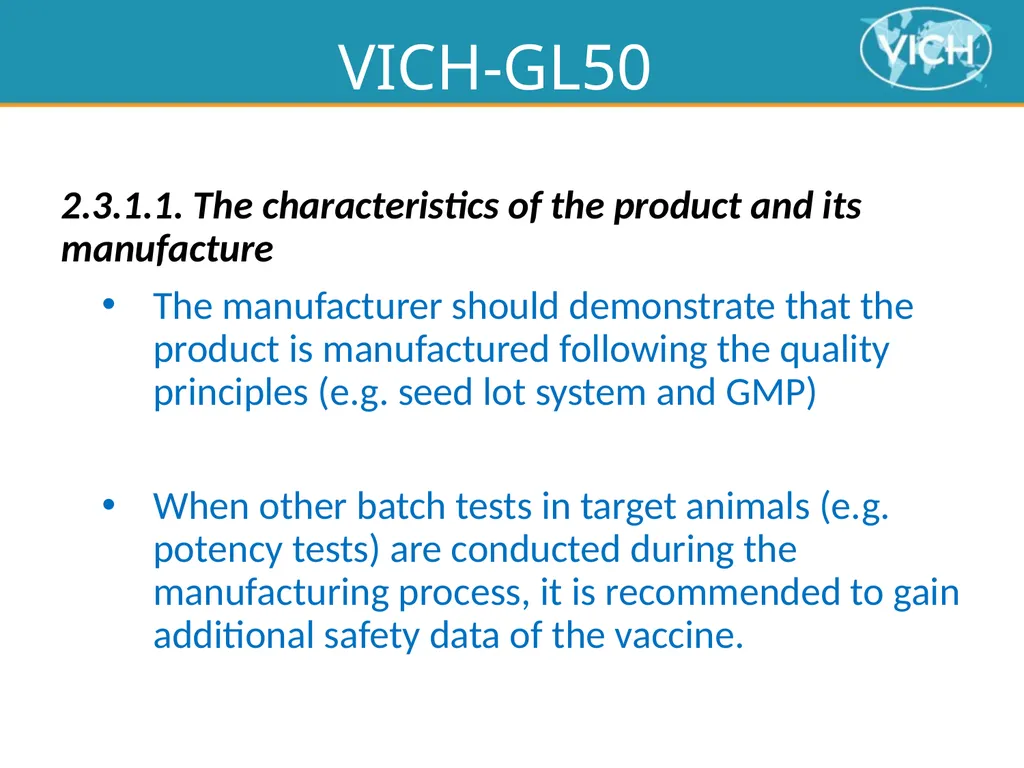
VICH-GL50 2.3.1.1. The characteristics of the product and its manufacture
The manufacturer should demonstrate that the product is manufactured following the quality principles (e.g. seed lot system and GMP)
When other batch tests in target animals (e.g. potency tests) are conducted during the manufacturing process, it is recommended to gain additional safety data of the vaccine.<br>
12
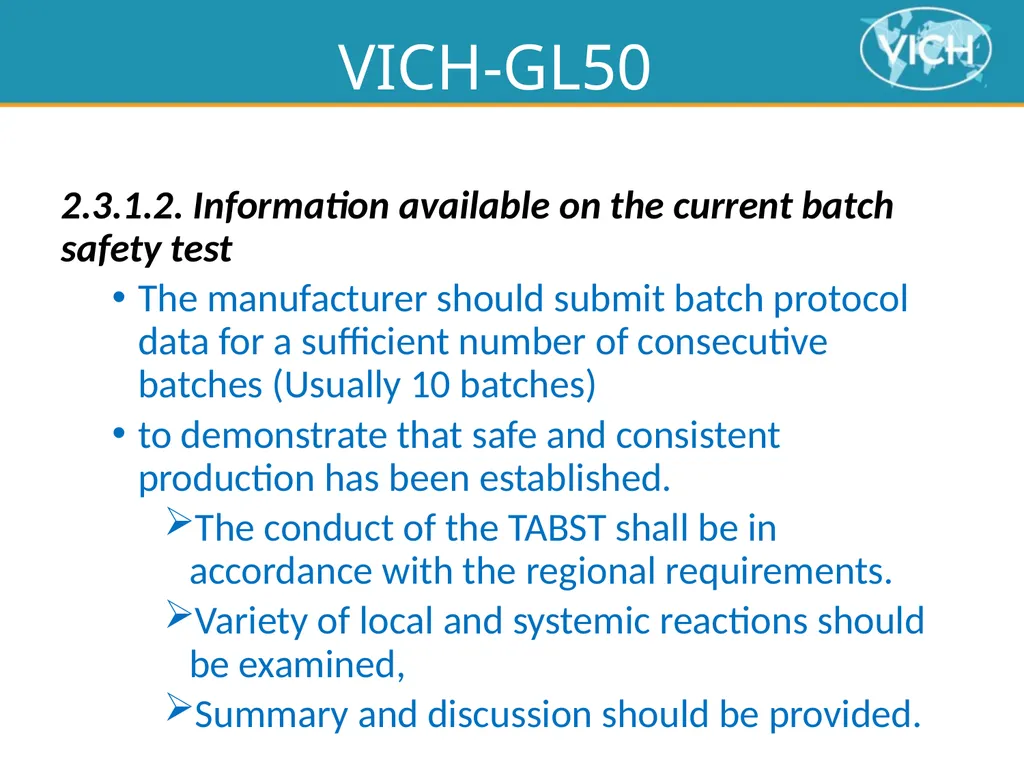
VICH-GL50 2.3.1.2. Information available on the current batch safety test
The manufacturer should submit batch protocol data for a sufficient number of consecutive batches (Usually 10 batches)
to demonstrate that safe and consistent production has been established.
The conduct of the TABST shall be in accordance with the regional requirements.
Variety of local and systemic reactions should be examined,
Summary and discussion should be provided.<br>
13
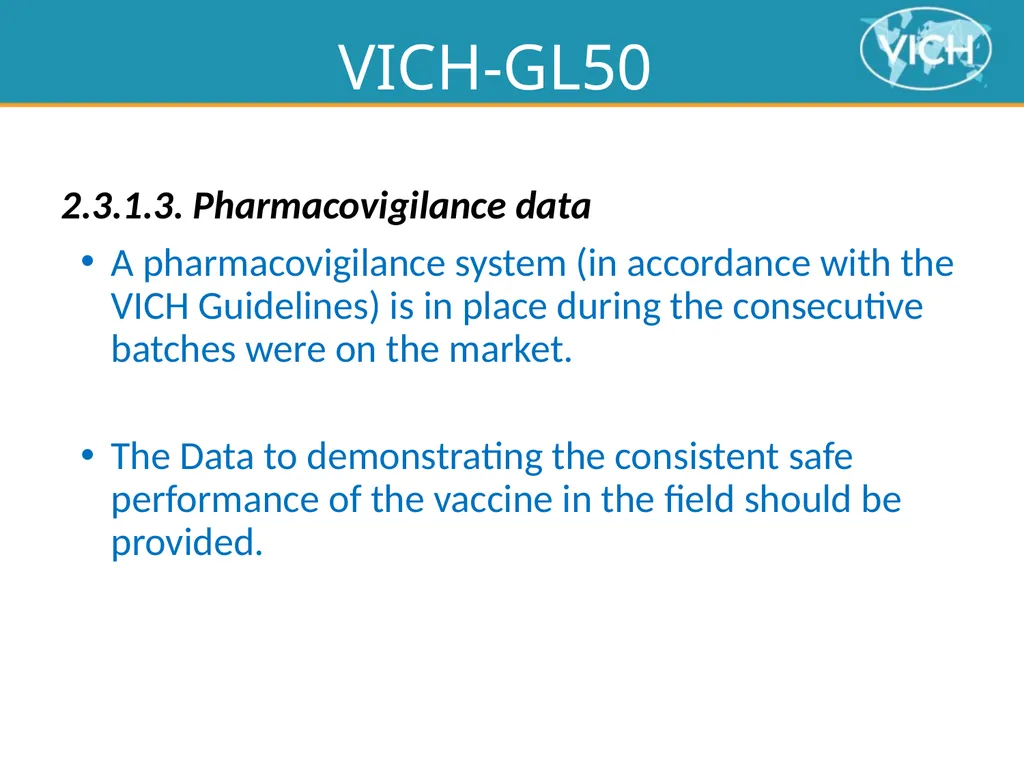
VICH-GL50 2.3.1.3. Pharmacovigilance data
A pharmacovigilance system (in accordance with the VICH Guidelines) is in place during the consecutive batches were on the market.
The Data to demonstrating the consistent safe performance of the vaccine in the field should be provided.<br>
14
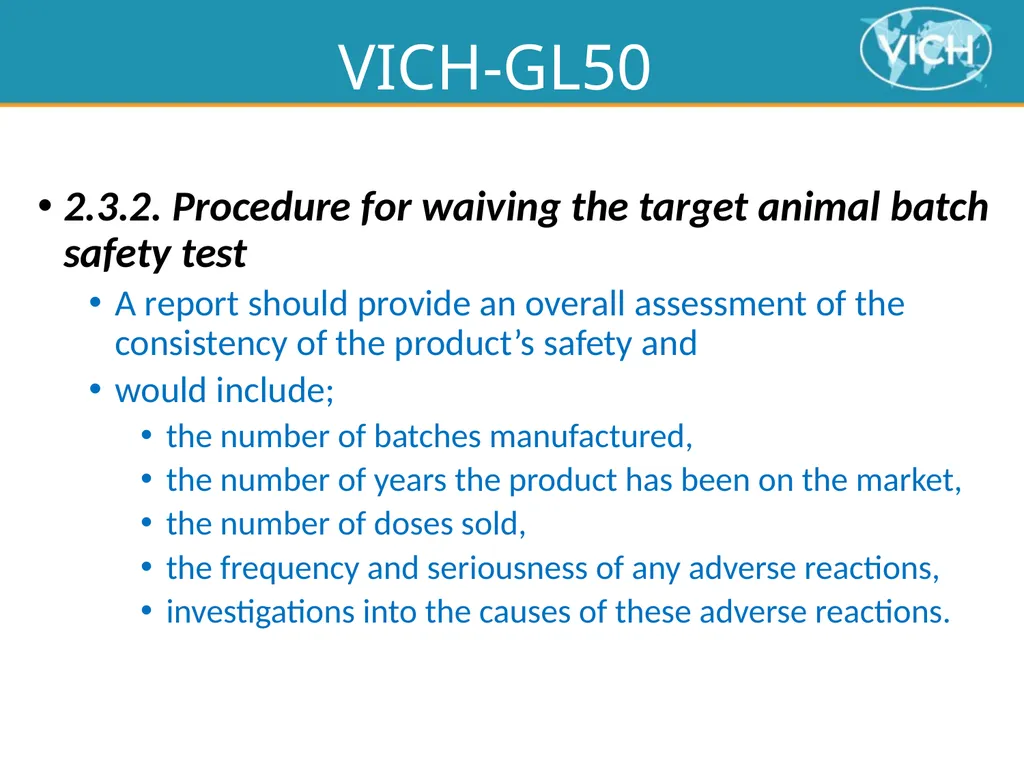
VICH-GL50 2.3.2. Procedure for waiving the target animal batch safety test
A report should provide an overall assessment of the consistency of the product’s safety and
would include;
the number of batches manufactured,
the number of years the product has been on the market,
the number of doses sold,
the frequency and seriousness of any adverse reactions,
investigations into the causes of these adverse reactions.<br>
15
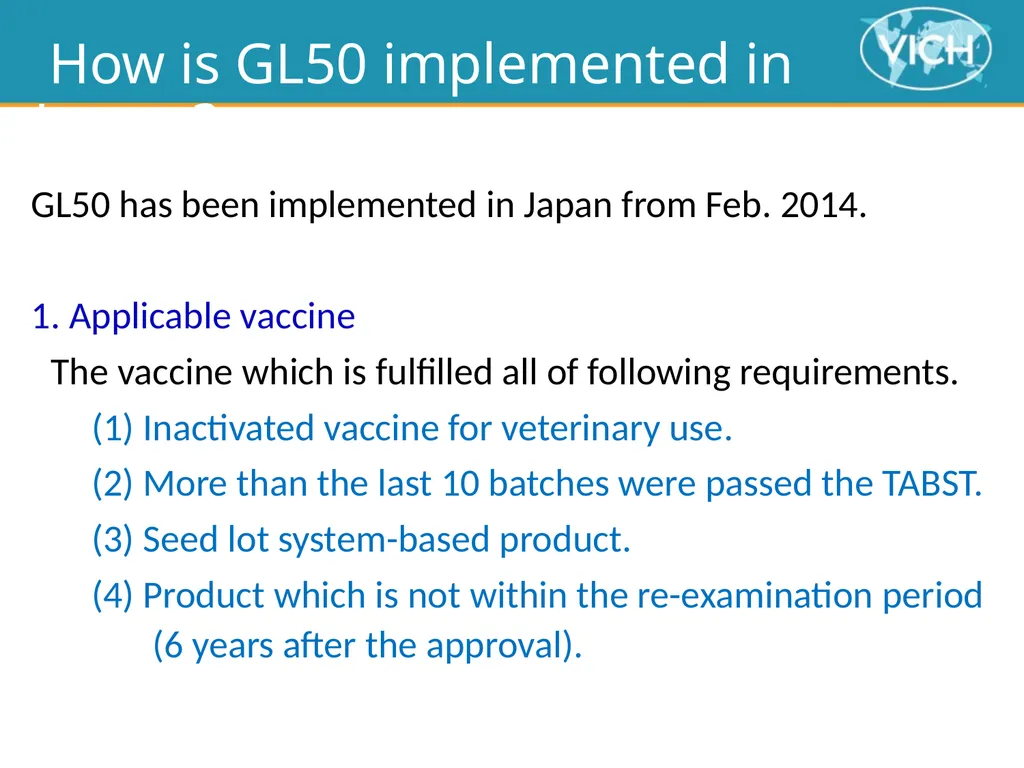
How is GL50 implemented in Japan ? GL50 has been implemented in Japan from Feb. 2014.
1. Applicable vaccine
The vaccine which is fulfilled all of following requirements.
(1) Inactivated vaccine for veterinary use.
(2) More than the last 10 batches were passed the TABST.
(3) Seed lot system-based product.
(4) Product which is not within the re-examination period
(6 years after the approval).<br>
16
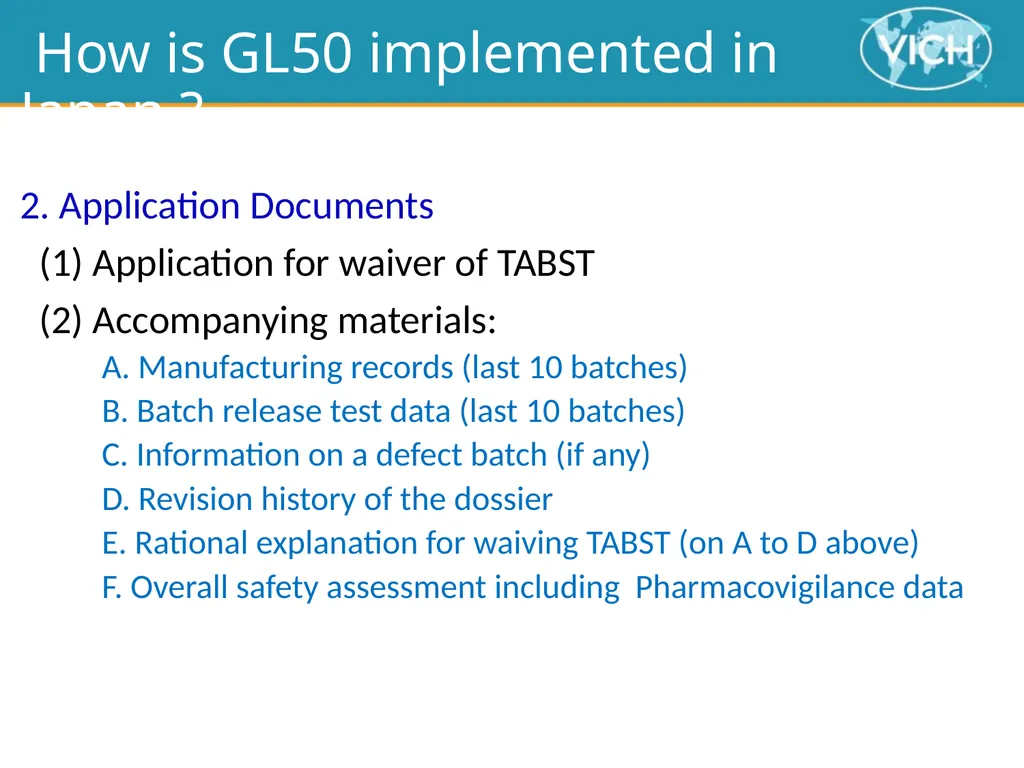
How is GL50 implemented in Japan ? 2. Application Documents
(1) Application for waiver of TABST
(2) Accompanying materials:
A. Manufacturing records (last 10 batches)
B. Batch release test data (last 10 batches)
C. Information on a defect batch (if any)
D. Revision history of the dossier
E. Rational explanation for waiving TABST (on A to D above)
F. Overall safety assessment including Pharmacovigilance data<br>