
We begin to discuss the conceptual revolutions
NS
Published · 21 slides · 0 views

1 / 1
Description
We begin to discuss the conceptual revolutions wrought by Copernicus, Kepler, Galileo, . Readings: (reading assignments listed on the web) Rohrlich, ch. 1-4 Sklar, pp. 1-18 Cushing ch. 4 Homework for Friday Jan. 19: (homework assignments
Related Topics
Share
Embed code
Download this presentation From Below
"We begin to discuss the conceptual revolutions" is the property of its rightful owner. Permission is granted to download and print the materials on this website for personal, non-commercial use only, and to display it on your personal computer provided you do not modify the materials and that you retain all copyright notices contained in the materials. By downloading content from our website, you accept the terms of this agreement.
Presentation Transcript
01
We begin to discuss the conceptual revolutions wrought by Copernicus, Kepler, Galileo, ….
Readings: (reading assignments listed on the web)
Rohrlich, ch. 1-4
Sklar, pp. 1-18
Cushing ch. 4
Homework for Friday Jan. 19: (homework assignments are on the web) 5pm on COMPASS
Does the Earth go around the Sun or does the Sun go around the Earth? How do you know? Give some evidence to support your argument.
Because this is the first assignment (and very rushed!), you do not need to cite reading material. If you remember an argument but cannot recall where you saw it, use it anyway. Later in the course, you will be expected to cite sources for information, and give credit for other’s arguments.
At most 750 words.
Read the homework guidelines, on the homework page. They will give you an idea how to structure your essays.<br>
02
Themes for today • Why did the Earth-centered Ptolemaic system last so long?
Why wasn’t the heliocentric theory popular before 1543?
• What problem was Copernicus trying to solve?
• What makes a “good” theory? What criteria are used to test a theory? Let’s try to see astronomy from a viewpoint of ~1600 A.D.
Keep in mind:
Observational data available then, including
direct astronomical observations
other physical observations on how things move
The general organization of the world view,
including metaphysical assumptions.
Aristotle:
Dialectical: understand the world by thinking hard and arguing opposing viewpoints
Natural: generalize experience of the world<br>
03
Development of Astronomy Early experiment consists of direct observation and measurement of length of shadows (the sun and moon) and angles.
How did they measure the length of the day? What was their operational definition?
Solar Measurements (i.e. sundials or gnomen)
Define noon as the time when the sun’s shadow is the shortest. We can quantitatively measure the change of seasons.
Define the summer and winter solstices as the days on which the minimum and maximum shadows occur.
But measurements depend on location
North-south movements change lengths
East-west movements change times (what does that mean? how could they know?)
Why do we think the earth is a sphere and not flat?
Ships disappear over the horizon
The angle of the north star depends on latitude
The time of an eclipse depends on the longitude
The shadow of the earth on the moon is circular
Spheres are simple (metaphysics)<br>
04
The astronomical data
(remember, no telescopes until after 1600) The positions of all celestial objects (day or night) rotate about the north pole approximately once per day.
The stars move in lock-step (e.g., constellations don’t change shape).
The Sun loses one rotation per year with respect to the “fixed” stars.
The entire disk of the Sun is lit.
The Moon loses one rotation per month w.r.t. the stars.
Only that part of the Moon which faces the Sun is lit. During a solar eclipse it is between the sun and the earth.
The motion of the planets is complicated (more on this later).
A comment about the data:
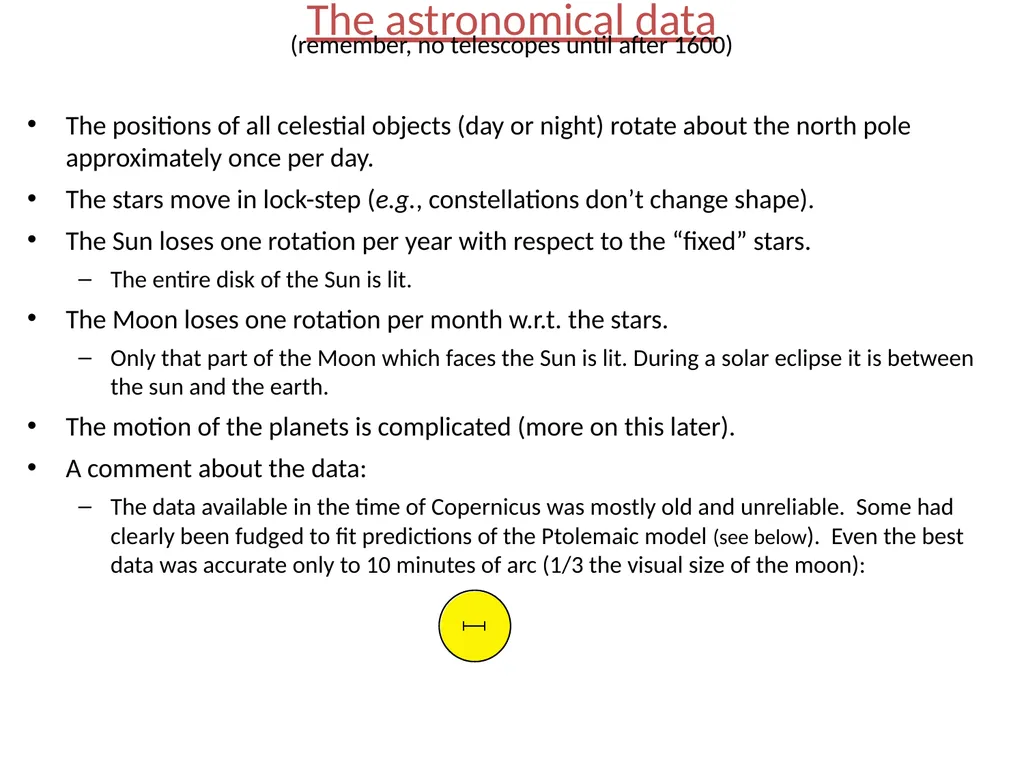
The data available in the time of Copernicus was mostly old and unreliable. Some had clearly been fudged to fit predictions of the Ptolemaic model (see below). Even the best data was accurate only to 10 minutes of arc (1/3 the visual size of the moon):<br>
05
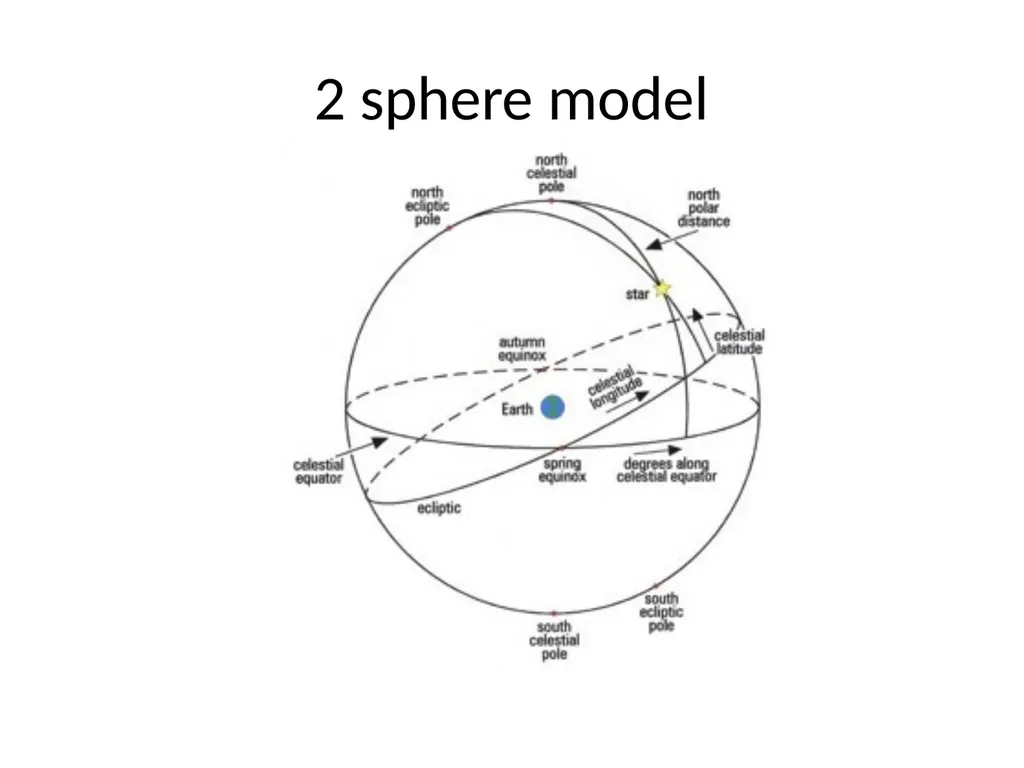
2 sphere model<br>
06
The intuitive picture (Aristotle) On Earth
The Earth doesn’t seem to be moving. It doesn't feel like you're moving.
Objects don't keep moving with respect to the earth, but come to rest on the earth.
Matter resists displacement and tries to regain its natural place:
AIR> FIRE >WATER>EARTH
Explains a spherical earth, with water and air in certain places.
Nature abhors a vacuum. Hence the space between Earth and the stars is filled with aether.
The only motions that are natural are linear and circular.
In the sky (thanks to Aristarchus, about 250 BC) via geometry, using lunar eclipses and half-moons.
the Moon is about 1/3 the diameter of the Earth.
the Sun is much larger than the Earth.<br>
07
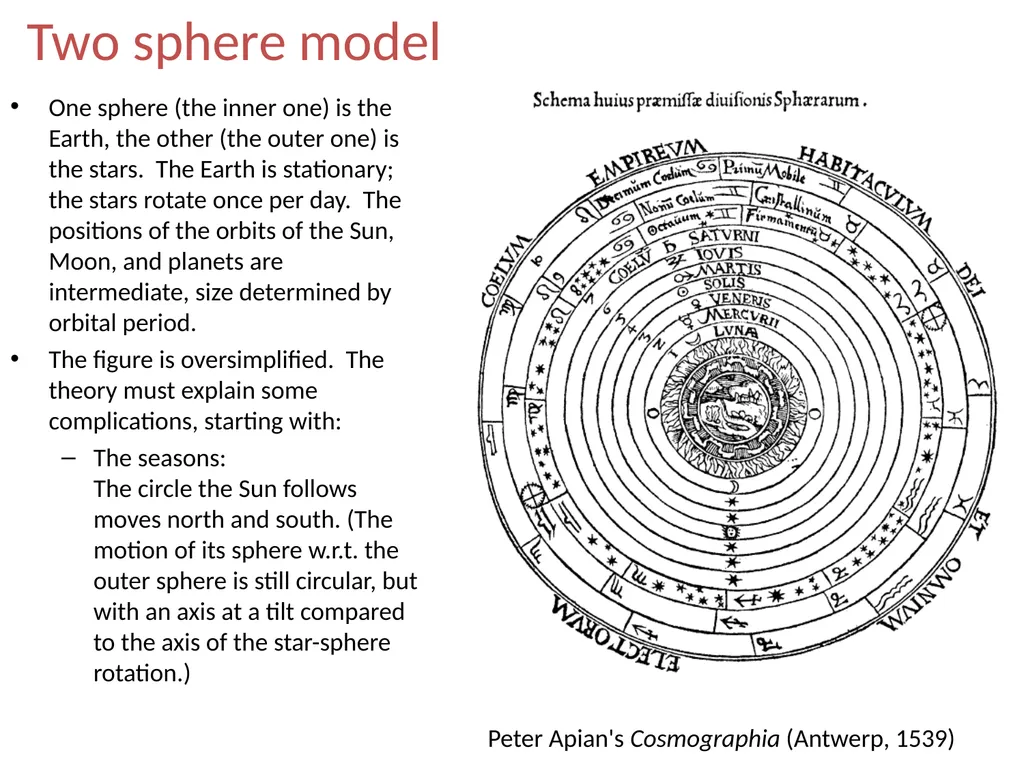
Two sphere model One sphere (the inner one) is the Earth, the other (the outer one) is the stars. The Earth is stationary; the stars rotate once per day. The positions of the orbits of the Sun, Moon, and planets are intermediate, size determined by orbital period.
The figure is oversimplified. The theory must explain some complications, starting with:
The seasons: The circle the Sun follows moves north and south. (The motion of its sphere w.r.t. the outer sphere is still circular, but with an axis at a tilt compared to the axis of the star-sphere rotation.) Peter Apian's Cosmographia (Antwerp, 1539)<br>
08
Further complications The slightly non-uniform motion of the Sun and Moon. Their speed increases and decreases around the circle.
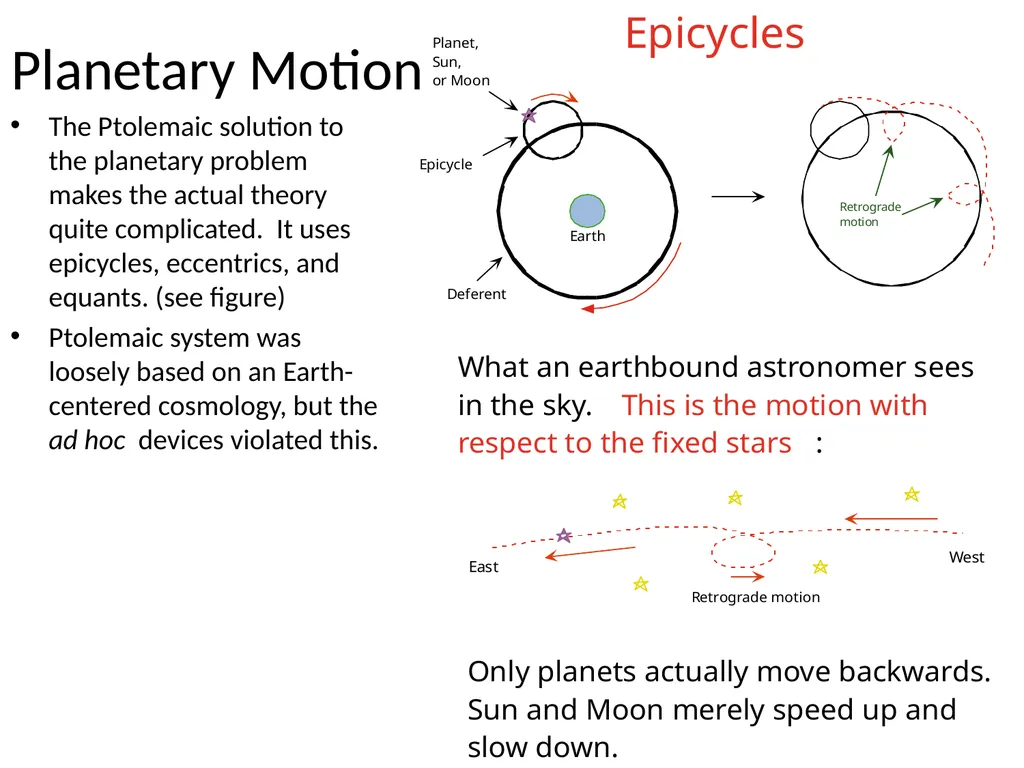
The complicated motion of the planets. Sometimes, they move backwards with respect to the stars (i.e., westward, instead of slipping slowly eastward).<br>
The complicated motion of the planets. Sometimes, they move backwards with respect to the stars (i.e., westward, instead of slipping slowly eastward).<br>
09
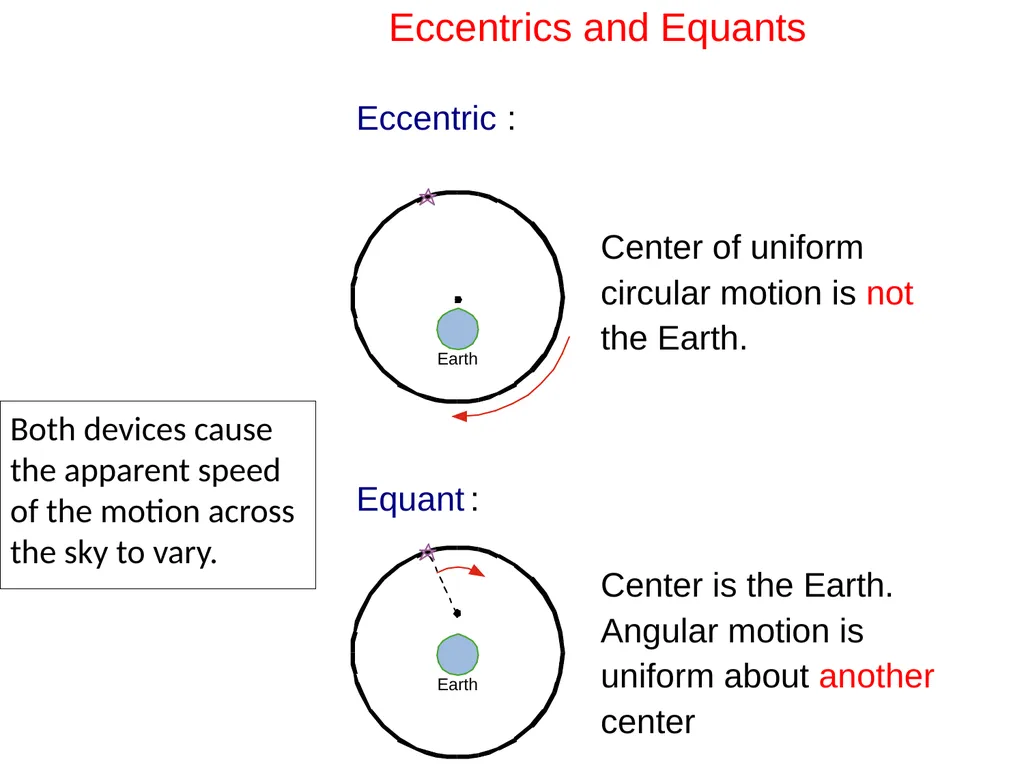
Planetary Motion The Ptolemaic solution to the planetary problem makes the actual theory quite complicated. It uses epicycles, eccentrics, and equants. (see figure)
Ptolemaic system was loosely based on an Earth-centered cosmology, but the ad hoc devices violated this.<br>
Ptolemaic system was loosely based on an Earth-centered cosmology, but the ad hoc devices violated this.<br>
10
Both devices cause the apparent speed
of the motion across the sky to vary.<br>
11
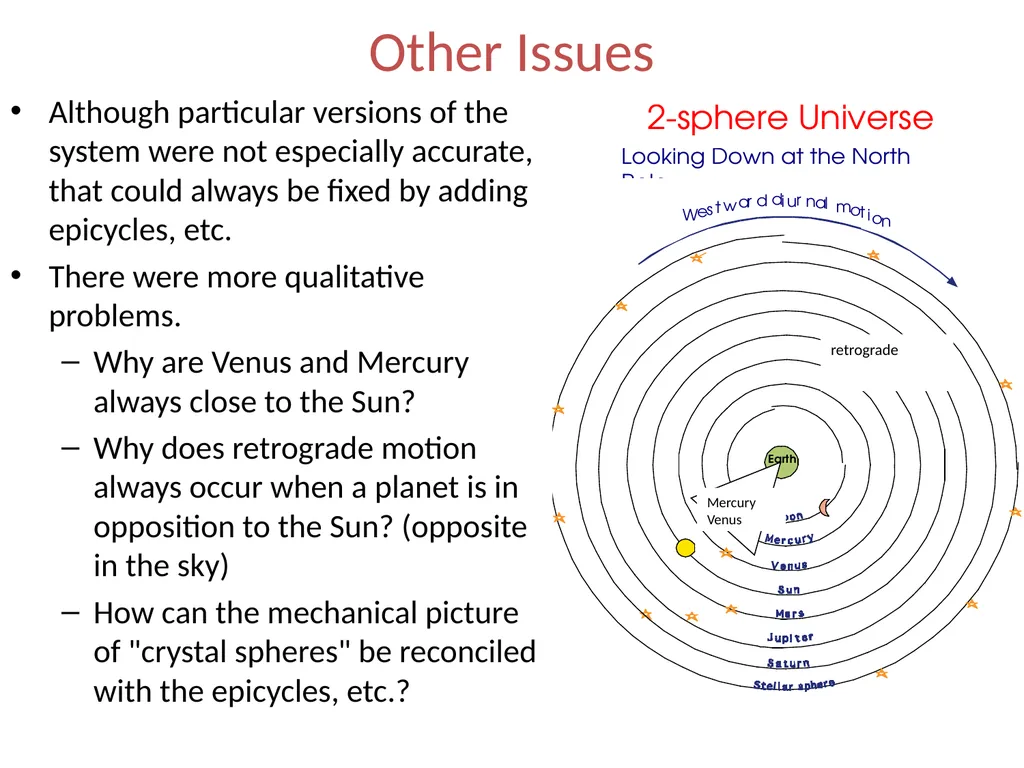
Other Issues Although particular versions of the system were not especially accurate, that could always be fixed by adding epicycles, etc.
There were more qualitative problems.
Why are Venus and Mercury always close to the Sun?
Why does retrograde motion always occur when a planet is in opposition to the Sun? (opposite in the sky)
How can the mechanical picture of "crystal spheres" be reconciled with the epicycles, etc.?<br>
There were more qualitative problems.
Why are Venus and Mercury always close to the Sun?
Why does retrograde motion always occur when a planet is in opposition to the Sun? (opposite in the sky)
How can the mechanical picture of "crystal spheres" be reconciled with the epicycles, etc.?<br>
12
Selling points of two-sphere picture Conceptual economy. It ties together many facts in a simple geometrical model still used today.
It "preserves the phenomena", i.e. describes basic astronomical observations of days, seasons, eclipses ...
The universe is finite. (infinity is a difficult concept)
The Earth stands still.
The Earth is the center of everything
(intuitive, and in accord with most theologies).
Motion increase systematically with distance from the Earth.
Heavy (“earthlike”) objects are at the center. “Firelike” objects are at the outside.
(heavy objects fall and fire rises... so the pattern connects with terrestrial dynamics)<br>
13
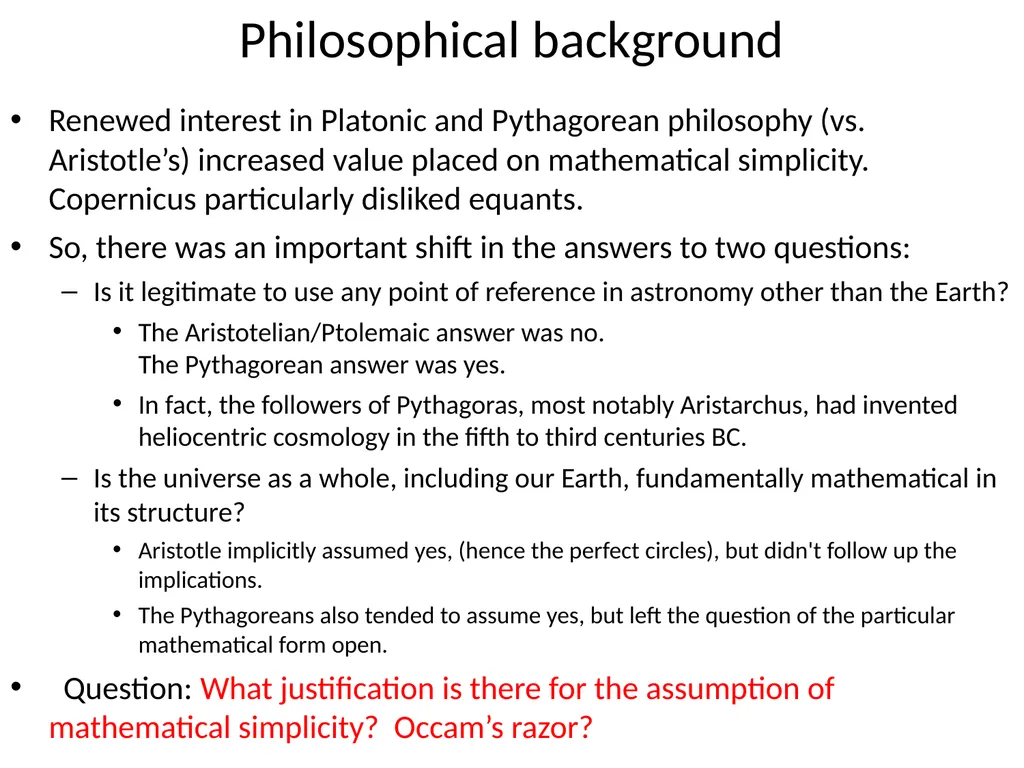
Philosophical background Renewed interest in Platonic and Pythagorean philosophy (vs. Aristotle’s) increased value placed on mathematical simplicity. Copernicus particularly disliked equants.
So, there was an important shift in the answers to two questions:
Is it legitimate to use any point of reference in astronomy other than the Earth?
The Aristotelian/Ptolemaic answer was no. The Pythagorean answer was yes.
In fact, the followers of Pythagoras, most notably Aristarchus, had invented heliocentric cosmology in the fifth to third centuries BC.
Is the universe as a whole, including our Earth, fundamentally mathematical in its structure?
Aristotle implicitly assumed yes, (hence the perfect circles), but didn't follow up the implications.
The Pythagoreans also tended to assume yes, but left the question of the particular mathematical form open.
Question: What justification is there for the assumption of mathematical simplicity? Occam’s razor?<br>
14
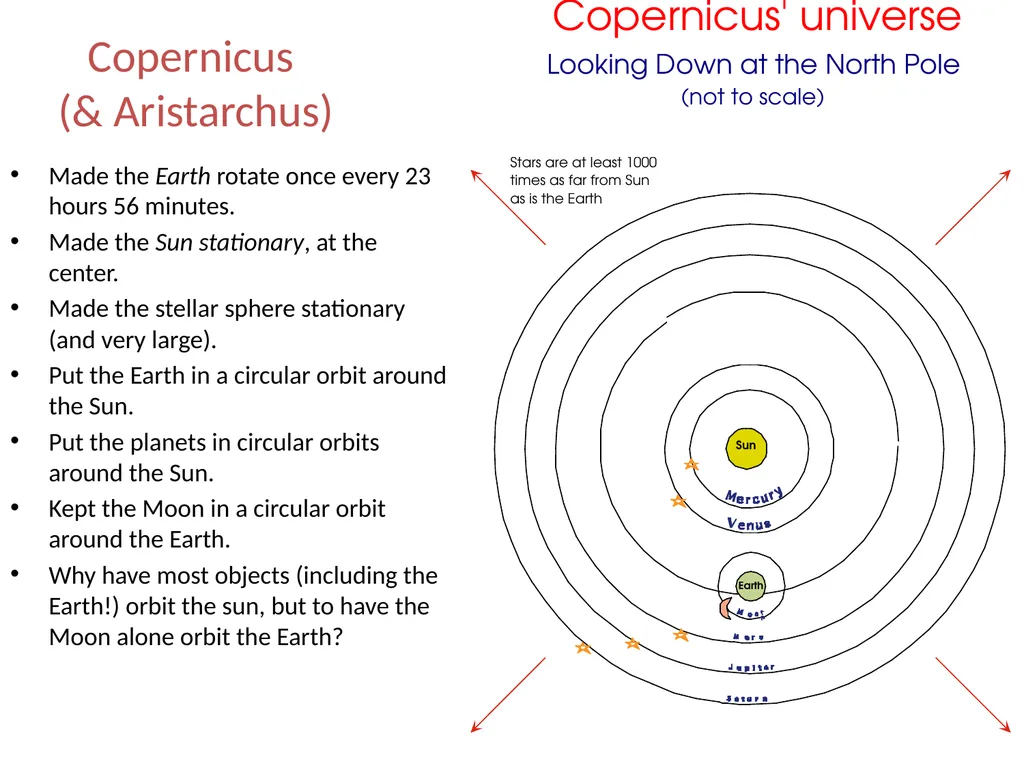
Made the Earth rotate once every 23 hours 56 minutes.
Made the Sun stationary, at the center.
Made the stellar sphere stationary (and very large).
Put the Earth in a circular orbit around the Sun.
Put the planets in circular orbits around the Sun.
Kept the Moon in a circular orbit around the Earth.
Why have most objects (including the Earth!) orbit the sun, but to have the Moon alone orbit the Earth? Copernicus (& Aristarchus)<br>
15
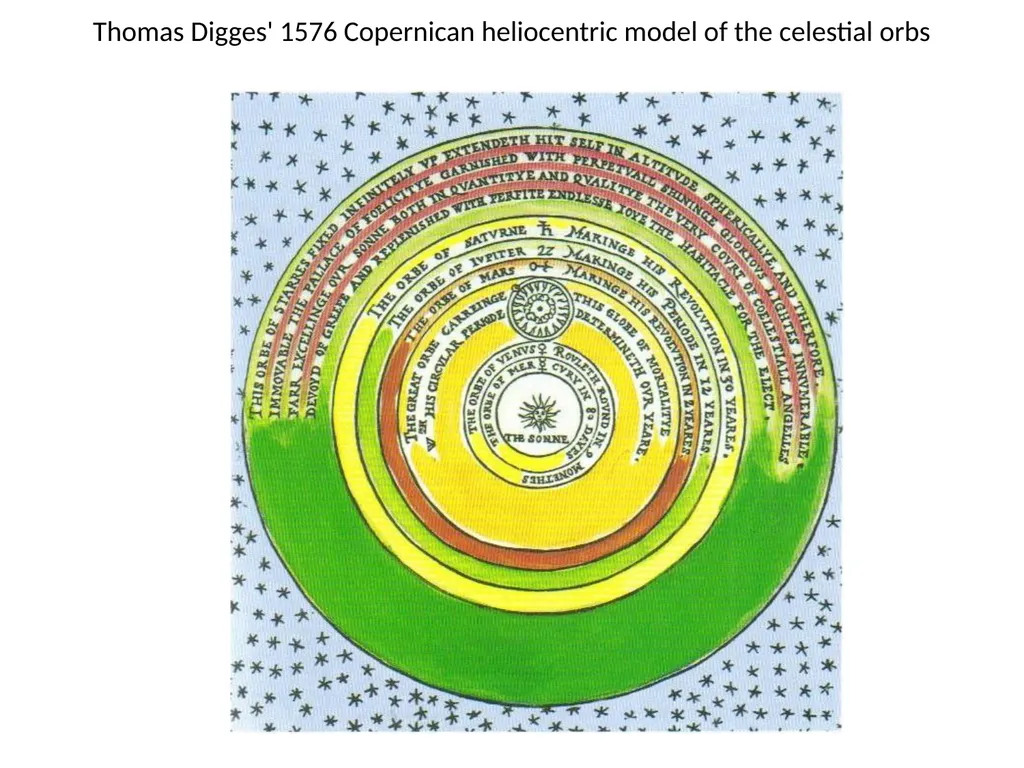
Thomas Digges' 1576 Copernican heliocentric model of the celestial orbs<br>
16
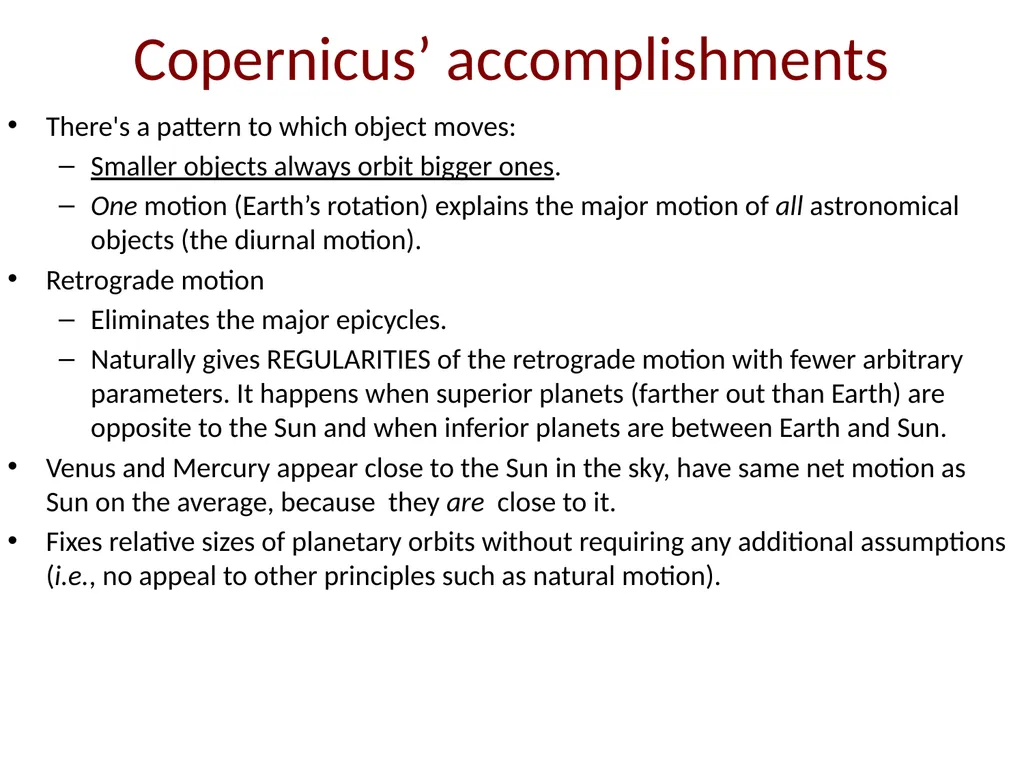
Copernicus’ accomplishments There's a pattern to which object moves:
Smaller objects always orbit bigger ones.
One motion (Earth’s rotation) explains the major motion of all astronomical objects (the diurnal motion).
Retrograde motion
Eliminates the major epicycles.
Naturally gives REGULARITIES of the retrograde motion with fewer arbitrary parameters. It happens when superior planets (farther out than Earth) are opposite to the Sun and when inferior planets are between Earth and Sun.
Venus and Mercury appear close to the Sun in the sky, have same net motion as Sun on the average, because they are close to it.
Fixes relative sizes of planetary orbits without requiring any additional assumptions (i.e., no appeal to other principles such as natural motion).<br>
17
What Copernicus did not accomplish: Any significant improvement in accuracy of predictions.
Elimination of most Ptolemaic devices (minor eccentrics, etc.). Only the biggest features were replaced by the Earth’s motion. Why are we called Copernicans, not Aristarchans?
What was going on for those 1800 years?<br>
Elimination of most Ptolemaic devices (minor eccentrics, etc.). Only the biggest features were replaced by the Earth’s motion. Why are we called Copernicans, not Aristarchans?
What was going on for those 1800 years?<br>
18
Drawbacks of Copernicus’ theory The “second and third motions” of the Earth (see Kuhn p. 165)
The earth is supposed to be carried around the Sun by a crystal sphere. That would make the Earth's axis (which isn't parallel to the rotation axis) also rotate yearly. But the apparent motions are described by keeping the Earth's axis fixed. So Copernicus adds another wobble to the Earth, which has the odd effect of just canceling the effect of the crystal sphere on the Earth's axis.
Notice that we've used two hypotheses (crystal sphere and extra wobble) to explain zero effects (Earth's axis doesn't wobble.) It seems there should be a simpler way. But then we would need some other way (not attachment to a rigid sphere) to explain why the Earth orbits the Sun.
A simpler solution of this problem requires a new dynamics.
The Earth moves!
Doesn't fit with Aristotelian physics, which is strongly based on intuition.
Throw a rock up! A falling body would be left behind
The atmosphere would be left behind—a huge wind (Aristotle)
The earth itself would fly apart owing to force of rotation.
Copernicus does not dispute—his hypothesis is simply to make predictions.
One systematic pattern- the relation between the apparent type of object and its cosmic place- is lost. The earth is just one of several planets—it is not unique.
Stars are far away because parallax is not observed. Why did the creator waste all that space?
Copernicus explicitly used the same criteria for evaluating a scientific explanation that we typically use today: “We find then in this arrangement an admirable harmony of the world, and a dependable, harmonious interconnection of the motion and the size of the paths, such as cannot otherwise be discovered ... And all this results from the same cause, namely the motion of the Earth. “<br>
19
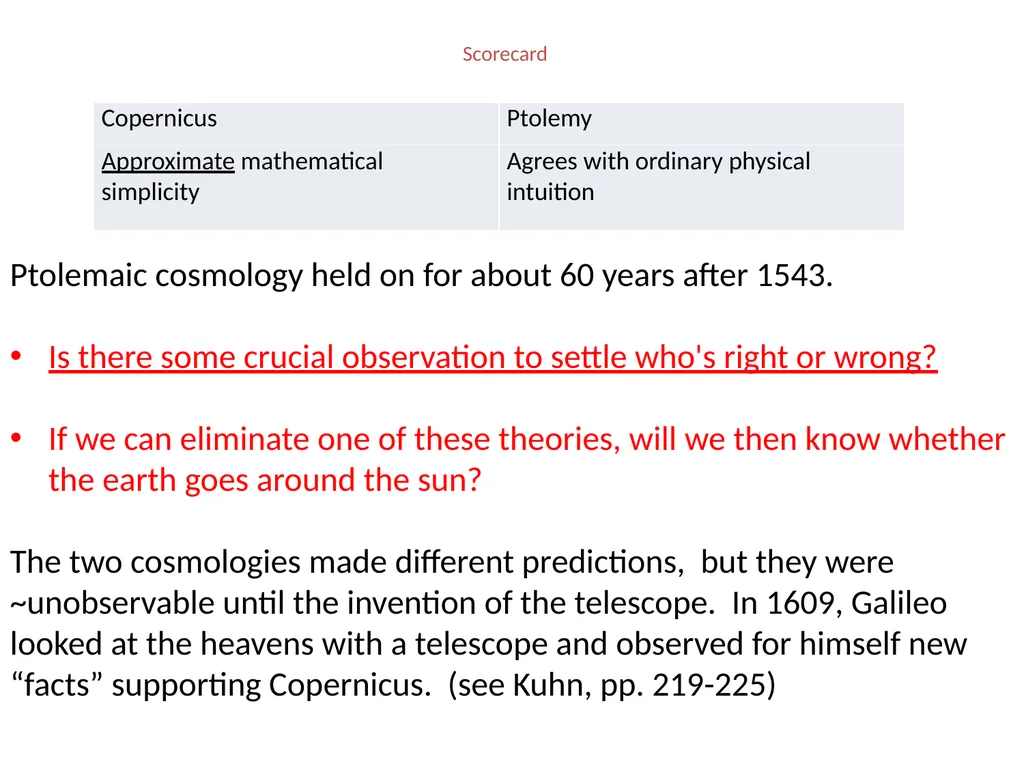
Scorecard Ptolemaic cosmology held on for about 60 years after 1543.
Is there some crucial observation to settle who's right or wrong?
If we can eliminate one of these theories, will we then know whether the earth goes around the sun?
The two cosmologies made different predictions, but they were ~unobservable until the invention of the telescope. In 1609, Galileo looked at the heavens with a telescope and observed for himself new “facts” supporting Copernicus. (see Kuhn, pp. 219-225)<br>
20
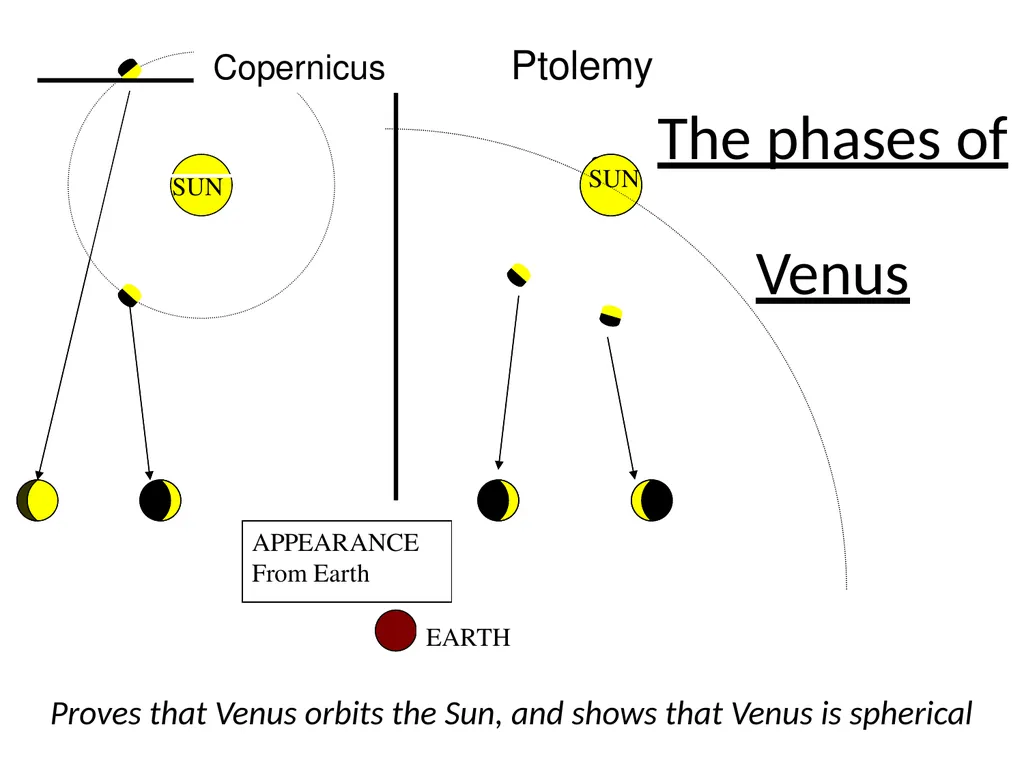
The phases of
Venus Proves that Venus orbits the Sun, and shows that Venus is spherical SUN SUN EARTH APPEARANCE
From Earth Copernicus Ptolemy SUN EARTH APPEARANCE
From Earth Copernicus Ptolemy SUN<br>
From Earth Copernicus Ptolemy SUN EARTH APPEARANCE
From Earth Copernicus Ptolemy SUN<br>
21
Ptolemic model is completely ruled out Other telescopic evidence:
The moons of Jupiter
Shows another center of orbital motion. So why should the Earth be the center of the universe?
The stars have smaller angular size than was thought.
Weakens one argument against their great distance- they might not have to be much larger than the other known source of light, the Sun
First homework is due tomorrow at 5pm
(Friday Jan 22rd) on Compass.<br>