
Webinar: Sustainable and Responsible Critical


Description: Webinar: Sustainable and Responsible Critical Mineral Supply Chains 23 January 2024 To be secure, supply chains must be sustainable and responsible Growing pressure to develop new mines, processing facilities and refineries brings increased
Related Topics
Download Presentation
"Webinar: Sustainable and Responsible Critical" is the property of its rightful owner. Permission is granted to download and print the materials on this website for personal, non-commercial use only, and to display it on your personal computer provided you do not modify the materials and that you retain all copyright notices contained in the materials. By downloading content from our website, you accept the terms of this agreement.
Presentation Transcript
slide1. Webinar: Sustainable and Responsible Critical Mineral Supply Chains 23 January 2024<br>
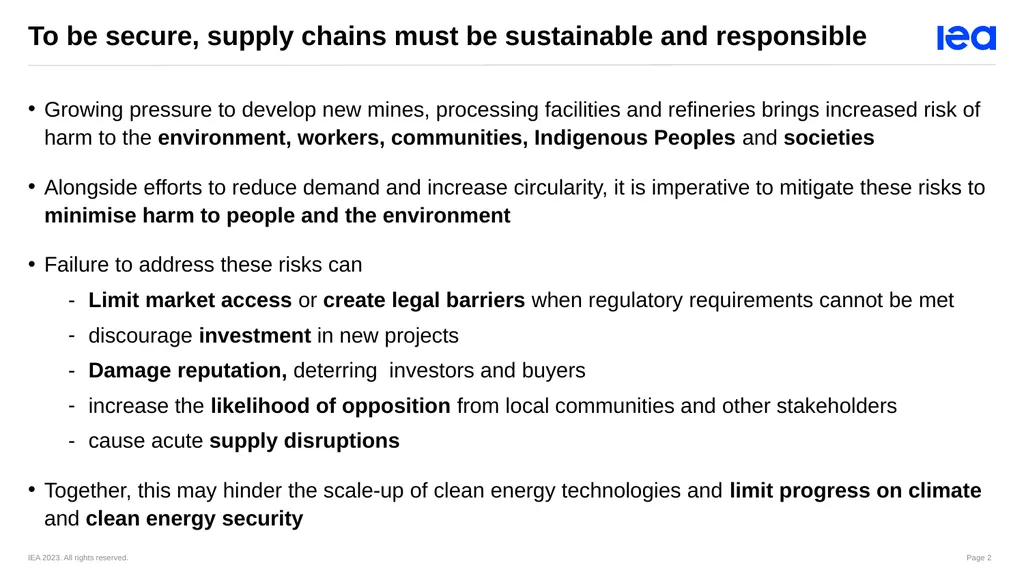
slide2. To be secure, supply chains must be sustainable and responsible Growing pressure to develop new mines, processing facilities and refineries brings increased risk of harm to the environment, workers, communities, Indigenous Peoples and societies
Alongside efforts to reduce demand and increase circularity, it is imperative to mitigate these risks to minimise harm to people and the environment
Failure to address these risks can
Limit market access or create legal barriers when regulatory requirements cannot be met
discourage investment in new projects
Damage reputation, deterring investors and buyers
increase the likelihood of opposition from local communities and other stakeholders
cause acute supply disruptions
Together, this may hinder the scale-up of clean energy technologies and limit progress on climate and clean energy security<br>
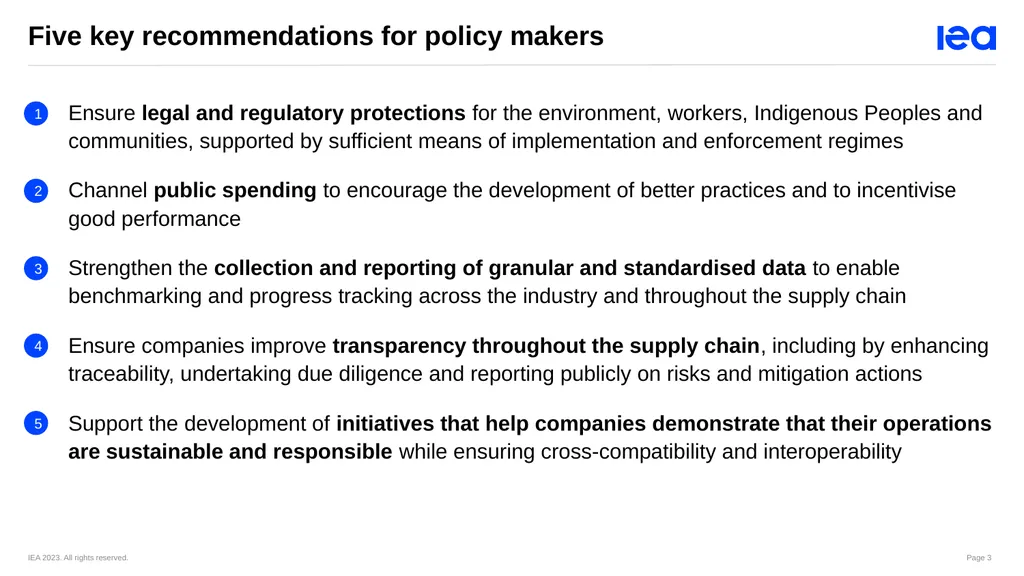
slide3. Five key recommendations for policy makers Ensure legal and regulatory protections for the environment, workers, Indigenous Peoples and communities, supported by sufficient means of implementation and enforcement regimes
Channel public spending to encourage the development of better practices and to incentivise good performance
Strengthen the collection and reporting of granular and standardised data to enable benchmarking and progress tracking across the industry and throughout the supply chain
Ensure companies improve transparency throughout the supply chain, including by enhancing traceability, undertaking due diligence and reporting publicly on risks and mitigation actions
Support the development of initiatives that help companies demonstrate that their operations are sustainable and responsible while ensuring cross-compatibility and interoperability 1 2 3 4 5<br>
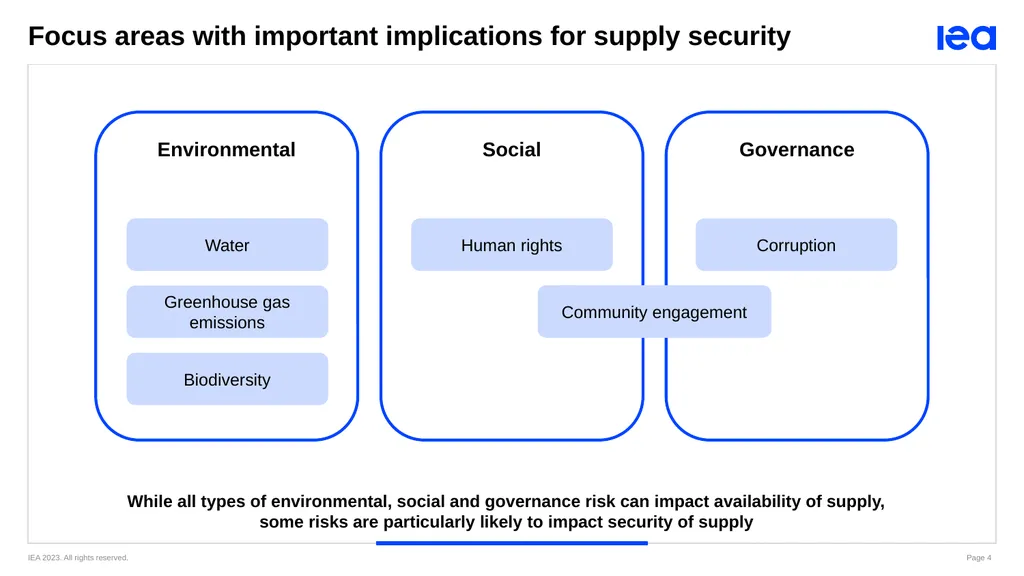
slide4. Focus areas with important implications for supply security While all types of environmental, social and governance risk can impact availability of supply,
some risks are particularly likely to impact security of supply Environmental Water Greenhouse gas emissions Biodiversity Social Human rights Governance Corruption Community engagement<br>
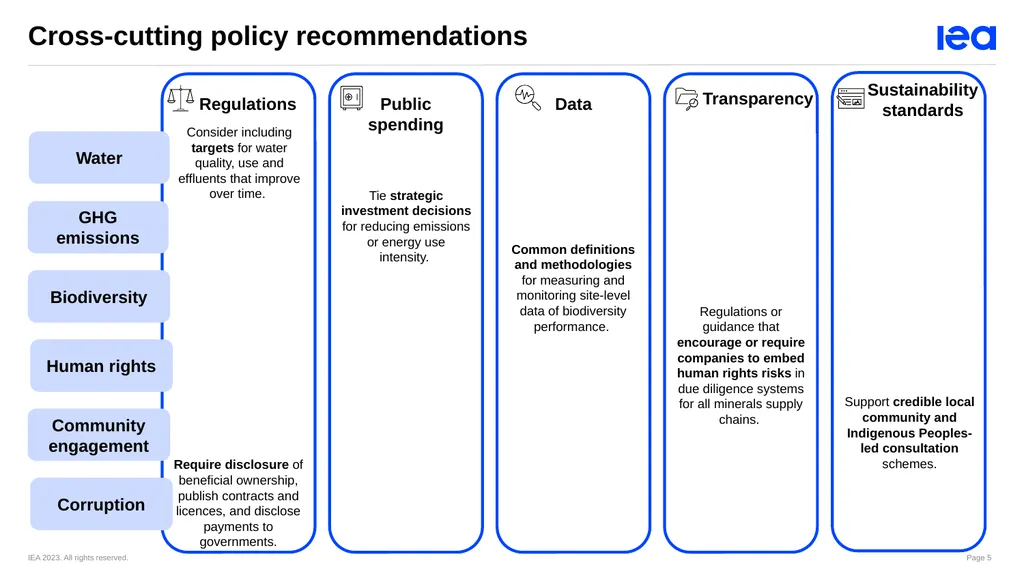
slide5. Cross-cutting policy recommendations Regulations Water GHG emissions Biodiversity Human rights Corruption Community engagement Public spending Data Consider including targets for water quality, use and effluents that improve over time. Tie strategic investment decisions for reducing emissions or energy use intensity. Common definitions and methodologies for measuring and monitoring site-level data of biodiversity performance. Regulations or guidance that encourage or require companies to embed human rights risks in due diligence systems for all minerals supply chains. Support credible local community and Indigenous Peoples-led consultation schemes. Transparency Sustainability standards Require disclosure of beneficial ownership, publish contracts and licences, and disclose payments to governments.<br>
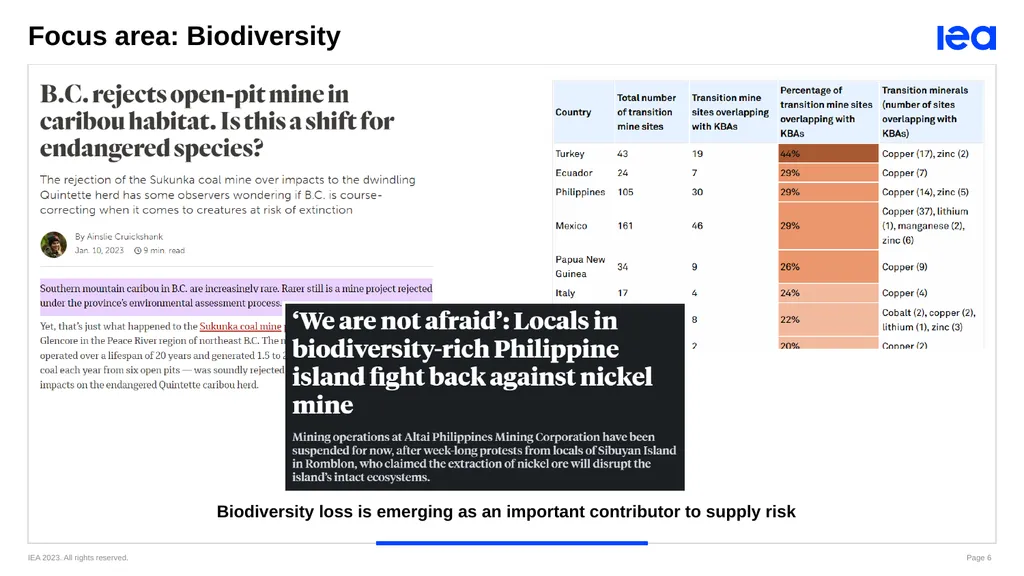
slide6. Focus area: Biodiversity Biodiversity loss is emerging as an important contributor to supply risk<br>
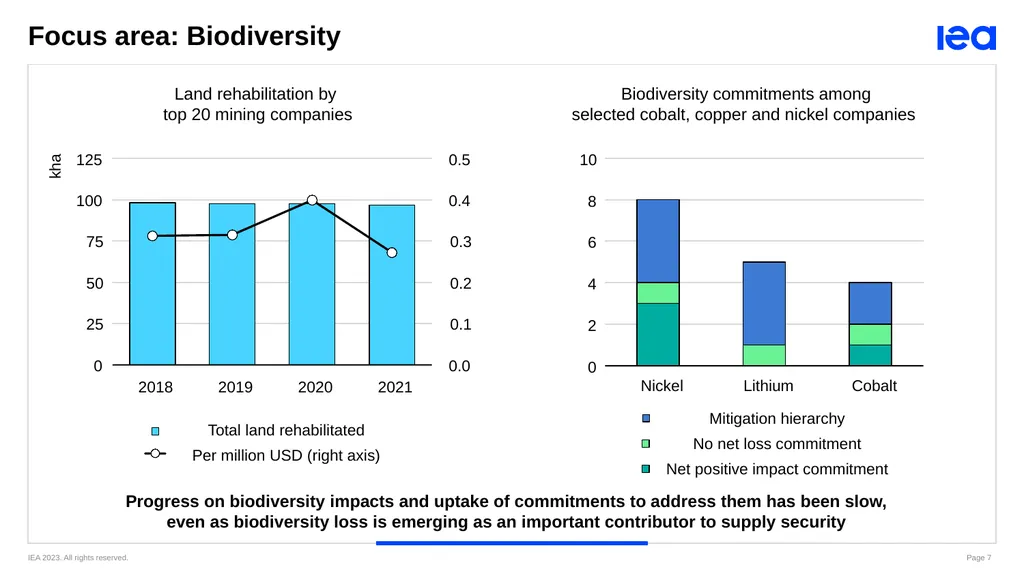
slide7. Focus area: Biodiversity Progress on biodiversity impacts and uptake of commitments to address them has been slow,
even as biodiversity loss is emerging as an important contributor to supply security Land rehabilitation by top 20 mining companies Biodiversity commitments among
selected cobalt, copper and nickel companies 0 2 4 6 8 10 Nickel Lithium Cobalt<br>
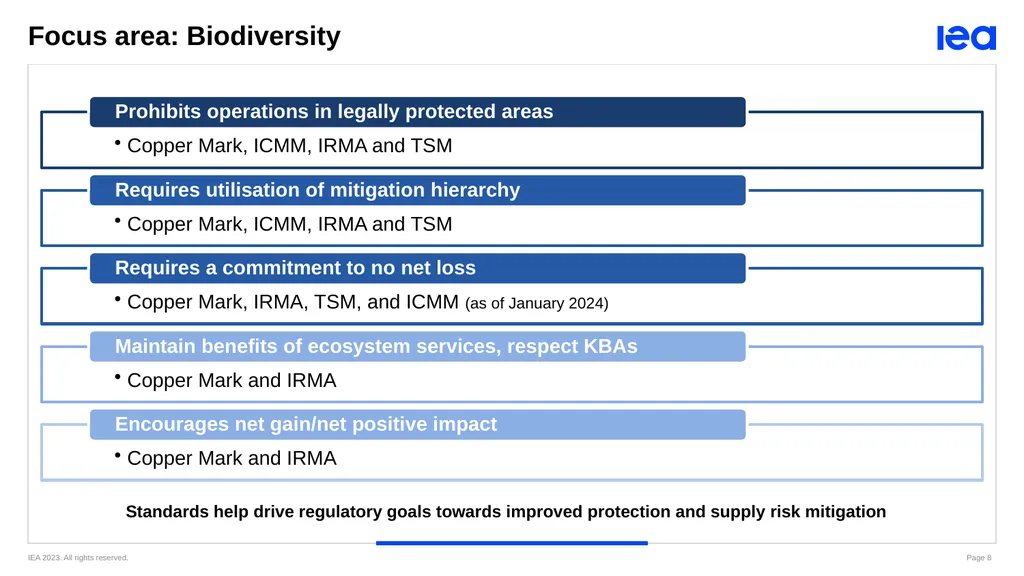
slide8. Focus area: Biodiversity Standards help drive regulatory goals towards improved protection and supply risk mitigation<br>
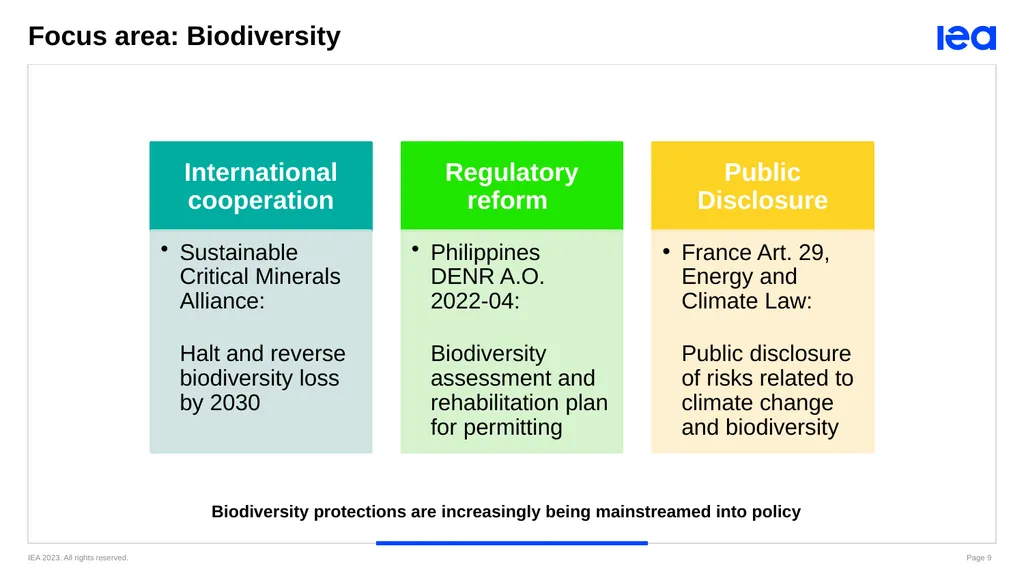
slide9. Focus area: Biodiversity Biodiversity protections are increasingly being mainstreamed into policy<br>
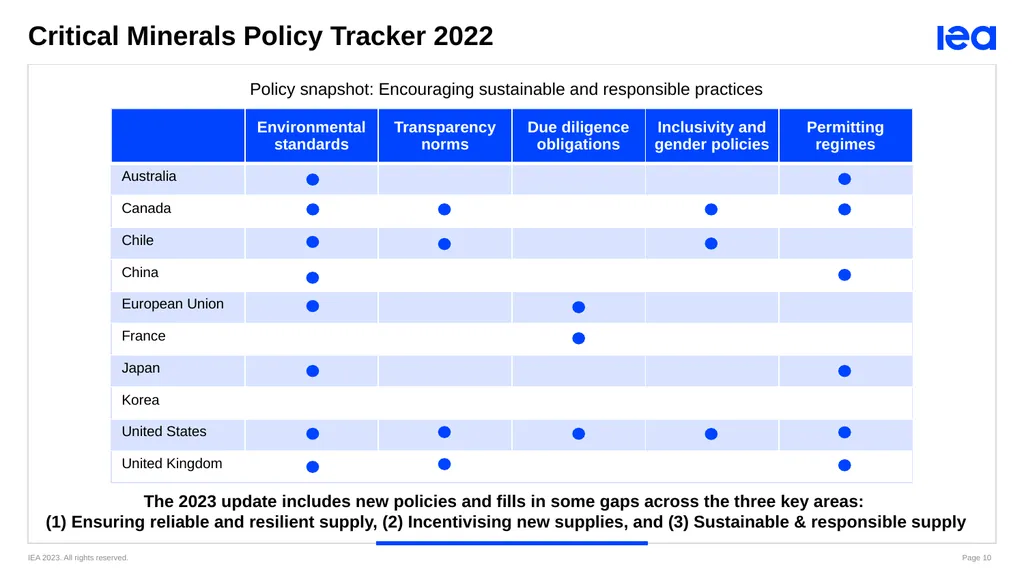
slide10. The 2023 update includes new policies and fills in some gaps across the three key areas: (1) Ensuring reliable and resilient supply, (2) Incentivising new supplies, and (3) Sustainable & responsible supply Policy snapshot: Encouraging sustainable and responsible practices Critical Minerals Policy Tracker 2022<br>
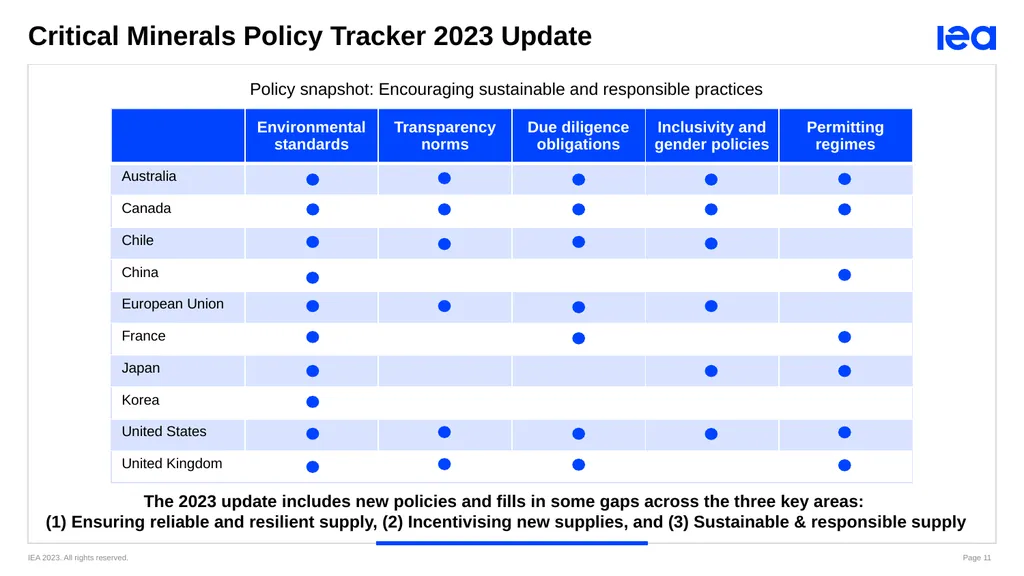
slide11. The 2023 update includes new policies and fills in some gaps across the three key areas: (1) Ensuring reliable and resilient supply, (2) Incentivising new supplies, and (3) Sustainable & responsible supply Policy snapshot: Encouraging sustainable and responsible practices Critical Minerals Policy Tracker 2023 Update<br>
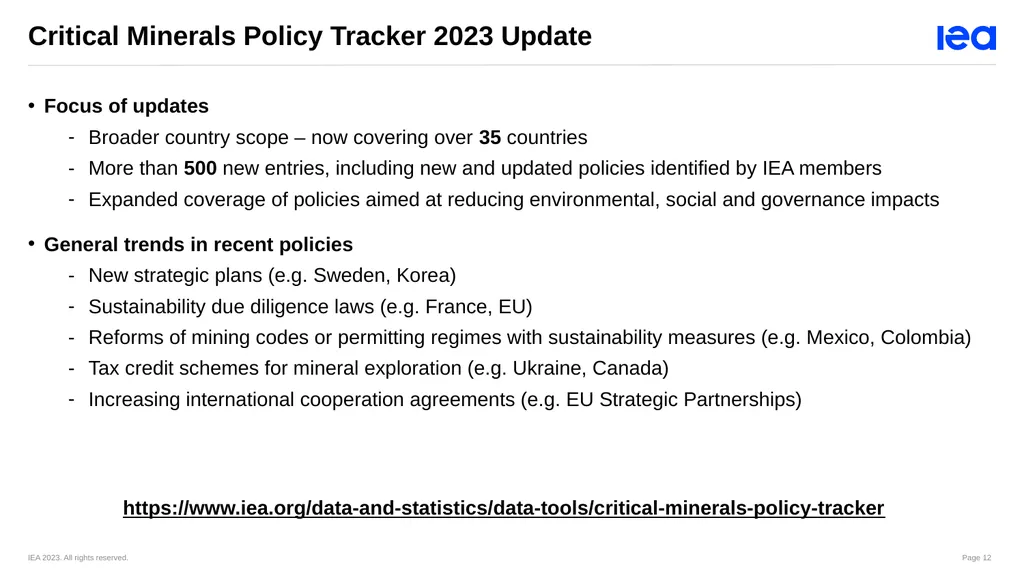
slide12. Critical Minerals Policy Tracker 2023 Update Focus of updates
Broader country scope – now covering over 35 countries
More than 500 new entries, including new and updated policies identified by IEA members
Expanded coverage of policies aimed at reducing environmental, social and governance impacts
General trends in recent policies
New strategic plans (e.g. Sweden, Korea)
Sustainability due diligence laws (e.g. France, EU)
Reforms of mining codes or permitting regimes with sustainability measures (e.g. Mexico, Colombia)
Tax credit schemes for mineral exploration (e.g. Ukraine, Canada)
Increasing international cooperation agreements (e.g. EU Strategic Partnerships) https://www.iea.org/data-and-statistics/data-tools/critical-minerals-policy-tracker<br>
slide2. To be secure, supply chains must be sustainable and responsible Growing pressure to develop new mines, processing facilities and refineries brings increased risk of harm to the environment, workers, communities, Indigenous Peoples and societies
Alongside efforts to reduce demand and increase circularity, it is imperative to mitigate these risks to minimise harm to people and the environment
Failure to address these risks can
Limit market access or create legal barriers when regulatory requirements cannot be met
discourage investment in new projects
Damage reputation, deterring investors and buyers
increase the likelihood of opposition from local communities and other stakeholders
cause acute supply disruptions
Together, this may hinder the scale-up of clean energy technologies and limit progress on climate and clean energy security<br>
slide3. Five key recommendations for policy makers Ensure legal and regulatory protections for the environment, workers, Indigenous Peoples and communities, supported by sufficient means of implementation and enforcement regimes
Channel public spending to encourage the development of better practices and to incentivise good performance
Strengthen the collection and reporting of granular and standardised data to enable benchmarking and progress tracking across the industry and throughout the supply chain
Ensure companies improve transparency throughout the supply chain, including by enhancing traceability, undertaking due diligence and reporting publicly on risks and mitigation actions
Support the development of initiatives that help companies demonstrate that their operations are sustainable and responsible while ensuring cross-compatibility and interoperability 1 2 3 4 5<br>
slide4. Focus areas with important implications for supply security While all types of environmental, social and governance risk can impact availability of supply,
some risks are particularly likely to impact security of supply Environmental Water Greenhouse gas emissions Biodiversity Social Human rights Governance Corruption Community engagement<br>
slide5. Cross-cutting policy recommendations Regulations Water GHG emissions Biodiversity Human rights Corruption Community engagement Public spending Data Consider including targets for water quality, use and effluents that improve over time. Tie strategic investment decisions for reducing emissions or energy use intensity. Common definitions and methodologies for measuring and monitoring site-level data of biodiversity performance. Regulations or guidance that encourage or require companies to embed human rights risks in due diligence systems for all minerals supply chains. Support credible local community and Indigenous Peoples-led consultation schemes. Transparency Sustainability standards Require disclosure of beneficial ownership, publish contracts and licences, and disclose payments to governments.<br>
slide6. Focus area: Biodiversity Biodiversity loss is emerging as an important contributor to supply risk<br>
slide7. Focus area: Biodiversity Progress on biodiversity impacts and uptake of commitments to address them has been slow,
even as biodiversity loss is emerging as an important contributor to supply security Land rehabilitation by top 20 mining companies Biodiversity commitments among
selected cobalt, copper and nickel companies 0 2 4 6 8 10 Nickel Lithium Cobalt<br>
slide8. Focus area: Biodiversity Standards help drive regulatory goals towards improved protection and supply risk mitigation<br>
slide9. Focus area: Biodiversity Biodiversity protections are increasingly being mainstreamed into policy<br>
slide10. The 2023 update includes new policies and fills in some gaps across the three key areas: (1) Ensuring reliable and resilient supply, (2) Incentivising new supplies, and (3) Sustainable & responsible supply Policy snapshot: Encouraging sustainable and responsible practices Critical Minerals Policy Tracker 2022<br>
slide11. The 2023 update includes new policies and fills in some gaps across the three key areas: (1) Ensuring reliable and resilient supply, (2) Incentivising new supplies, and (3) Sustainable & responsible supply Policy snapshot: Encouraging sustainable and responsible practices Critical Minerals Policy Tracker 2023 Update<br>
slide12. Critical Minerals Policy Tracker 2023 Update Focus of updates
Broader country scope – now covering over 35 countries
More than 500 new entries, including new and updated policies identified by IEA members
Expanded coverage of policies aimed at reducing environmental, social and governance impacts
General trends in recent policies
New strategic plans (e.g. Sweden, Korea)
Sustainability due diligence laws (e.g. France, EU)
Reforms of mining codes or permitting regimes with sustainability measures (e.g. Mexico, Colombia)
Tax credit schemes for mineral exploration (e.g. Ukraine, Canada)
Increasing international cooperation agreements (e.g. EU Strategic Partnerships) https://www.iea.org/data-and-statistics/data-tools/critical-minerals-policy-tracker<br>