WELCOME GROUNDED THEORY RESEARCH DESIGN Dr. GEETHA
Description: WELCOME GROUNDED THEORY RESEARCH DESIGN Dr. GEETHA GOPINATH ASSISTANT PROFESSOR DEPARTMENT OF EDUCATION AND EDUCATIONAL TECHNOLOGY SCHOOL OF SOCIAL SCIENCES UNIVERSITY OF HYDERABAD CENTRAL UNIVERSITY CAMPUS HYDERABAD GROUNDED THEORY
Related Topics
Download Presentation
"WELCOME GROUNDED THEORY RESEARCH DESIGN Dr. GEETHA" is the property of its rightful owner. Permission is granted to download and print the materials on this website for personal, non-commercial use only, and to display it on your personal computer provided you do not modify the materials and that you retain all copyright notices contained in the materials. By downloading content from our website, you accept the terms of this agreement.
Presentation Transcript
slide1. WELCOME<br>
slide2. GROUNDED THEORY RESEARCH DESIGN Dr. GEETHA GOPINATH
ASSISTANT PROFESSOR
DEPARTMENT OF EDUCATION AND EDUCATIONAL TECHNOLOGY
SCHOOL OF SOCIAL SCIENCES
UNIVERSITY OF HYDERABAD
CENTRAL UNIVERSITY CAMPUS
HYDERABAD<br>
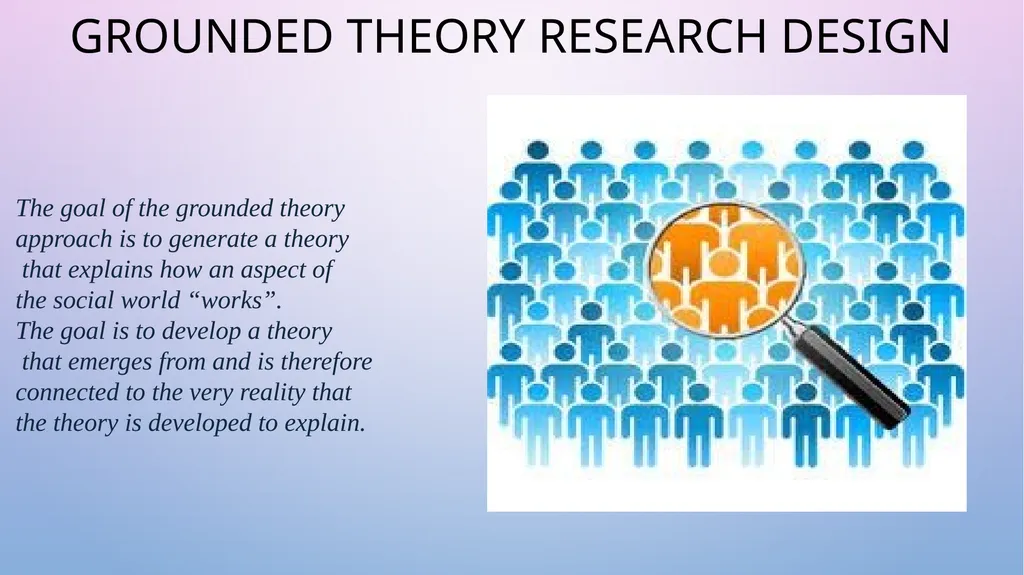
slide3. GROUNDED THEORY RESEARCH DESIGN The goal of the grounded theory
approach is to generate a theory
that explains how an aspect of
the social world “works”.
The goal is to develop a theory
that emerges from and is therefore
connected to the very reality that
the theory is developed to explain.<br>
slide4. CONTENTS Grounded Theory Design-Definitions
Grounded theory Design –Concept
Grounded Theory design-Methodology
Grounded Theory Design-Key Features
Grounded Theory Design-Uses
Grounded Theory Design-Strengths
Grounded Theory Design-Limitations<br>
slide5. LEARNING OBJECTIVES Enable the student teachers to,
define and explain the concept of grounded theory Design
describe the key features of grounded theory Design
explain the methodology of grounded theory
enumerate the uses of grounded theory
analyze the strengths and limitations of grounded theory Design<br>
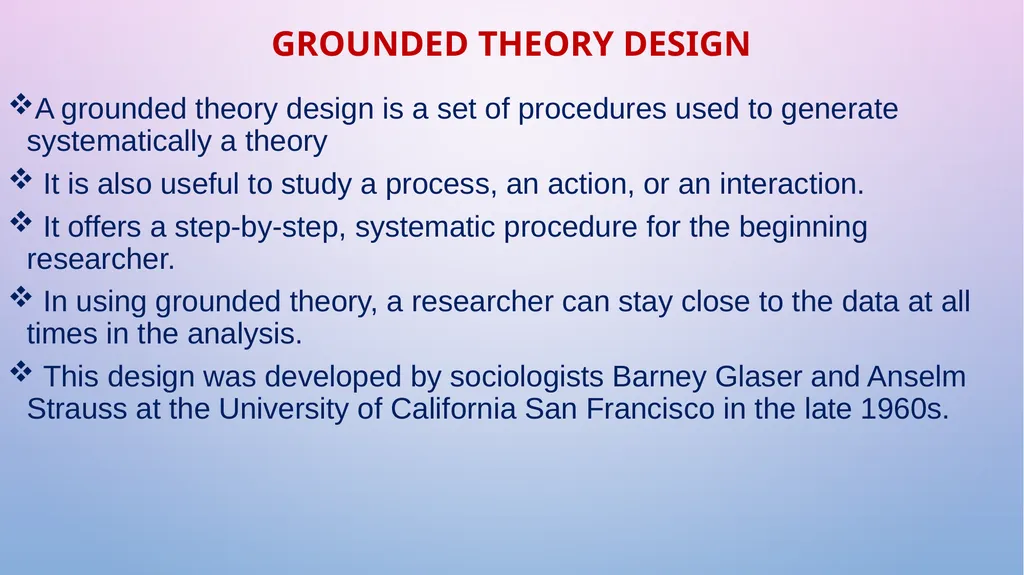
slide6. Grounded theory design A grounded theory design is a set of procedures used to generate systematically a theory
It is also useful to study a process, an action, or an interaction.
It offers a step-by-step, systematic procedure for the beginning researcher.
In using grounded theory, a researcher can stay close to the data at all times in the analysis.
This design was developed by sociologists Barney Glaser and Anselm Strauss at the University of California San Francisco in the late 1960s.<br>
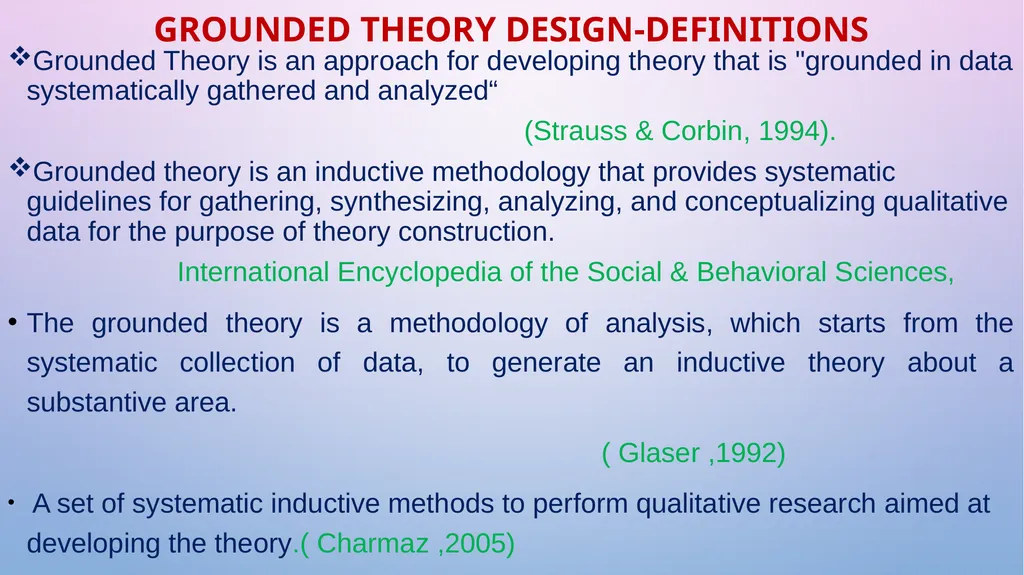
slide7. Grounded theory design-definitions Grounded Theory is an approach for developing theory that is "grounded in data systematically gathered and analyzed“
(Strauss & Corbin, 1994).
Grounded theory is an inductive methodology that provides systematic guidelines for gathering, synthesizing, analyzing, and conceptualizing qualitative data for the purpose of theory construction.
International Encyclopedia of the Social & Behavioral Sciences,
The grounded theory is a methodology of analysis, which starts from the systematic collection of data, to generate an inductive theory about a substantive area.
( Glaser ,1992)
A set of systematic inductive methods to perform qualitative research aimed at developing the theory.( Charmaz ,2005)<br>
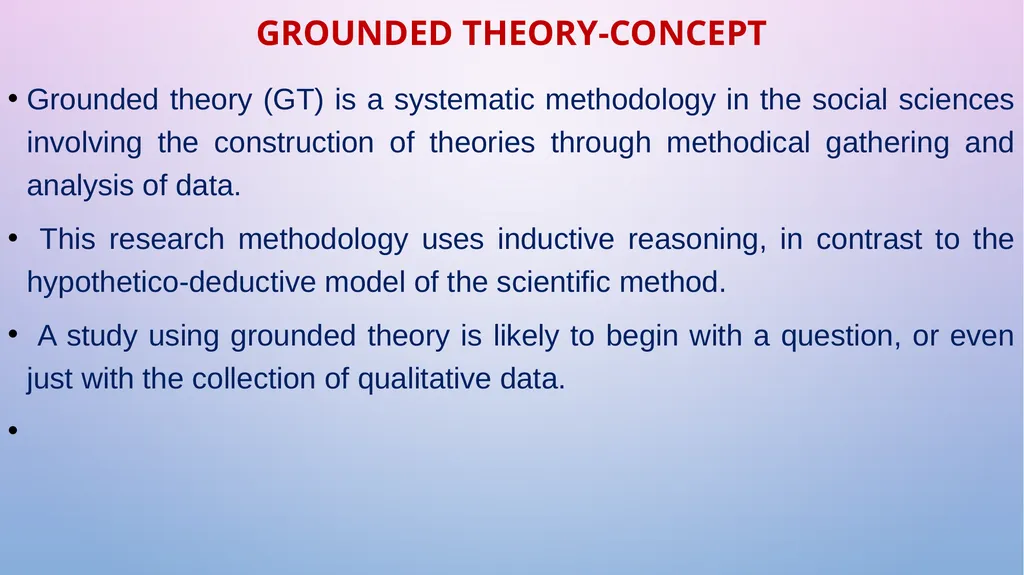
slide8. Grounded theory-concept Grounded theory (GT) is a systematic methodology in the social sciences involving the construction of theories through methodical gathering and analysis of data.
This research methodology uses inductive reasoning, in contrast to the hypothetico-deductive model of the scientific method.
A study using grounded theory is likely to begin with a question, or even just with the collection of qualitative data.<br>
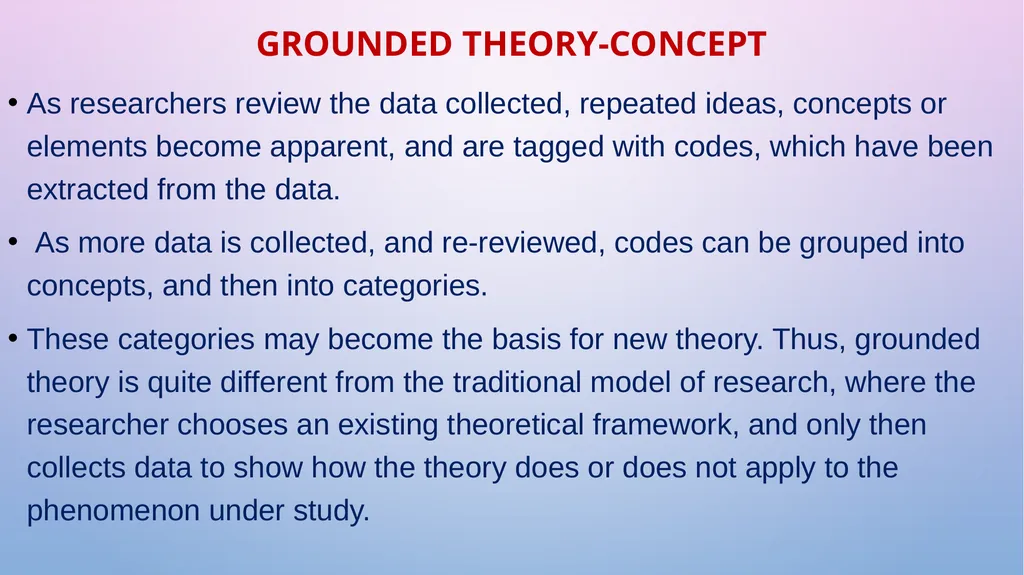
slide9. Grounded theory-concept As researchers review the data collected, repeated ideas, concepts or elements become apparent, and are tagged with codes, which have been extracted from the data.
As more data is collected, and re-reviewed, codes can be grouped into concepts, and then into categories.
These categories may become the basis for new theory. Thus, grounded theory is quite different from the traditional model of research, where the researcher chooses an existing theoretical framework, and only then collects data to show how the theory does or does not apply to the phenomenon under study.<br>
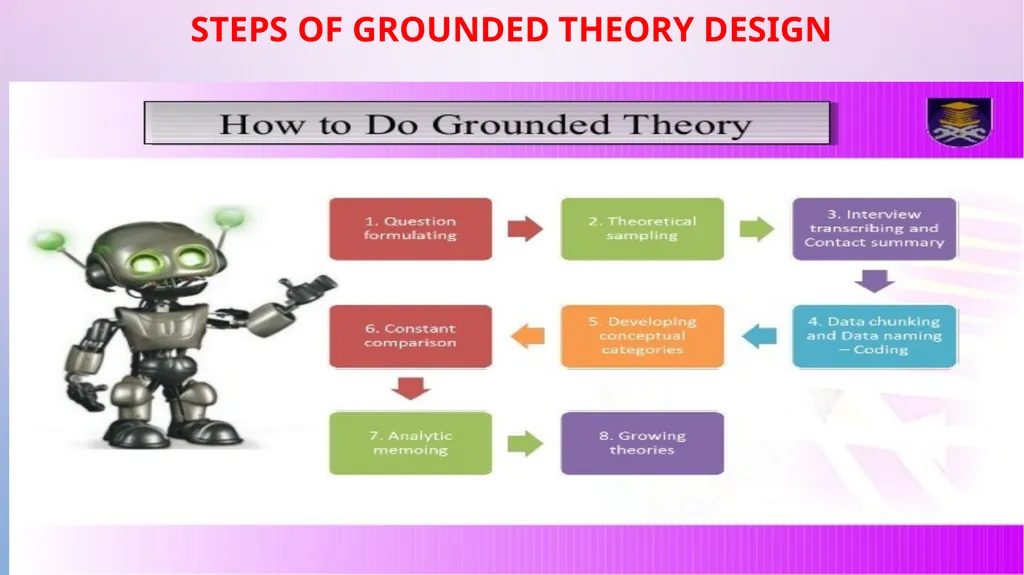
slide10. STEPS OF GROUNDED THEORY DESIGN<br>
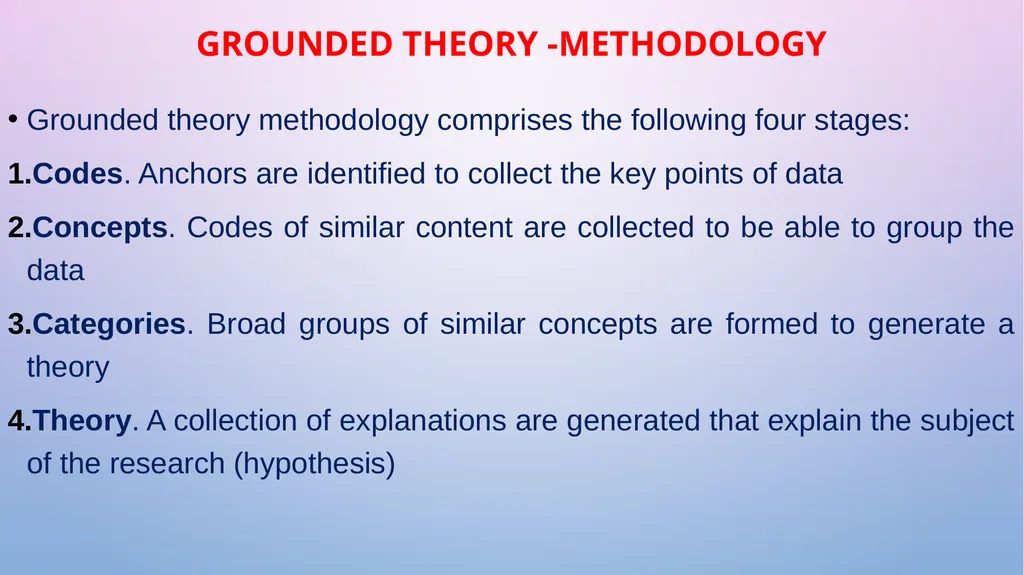
slide11. Grounded theory -methodology Grounded theory methodology comprises the following four stages:
Codes. Anchors are identified to collect the key points of data
Concepts. Codes of similar content are collected to be able to group the data
Categories. Broad groups of similar concepts are formed to generate a theory
Theory. A collection of explanations are generated that explain the subject of the research (hypothesis)<br>
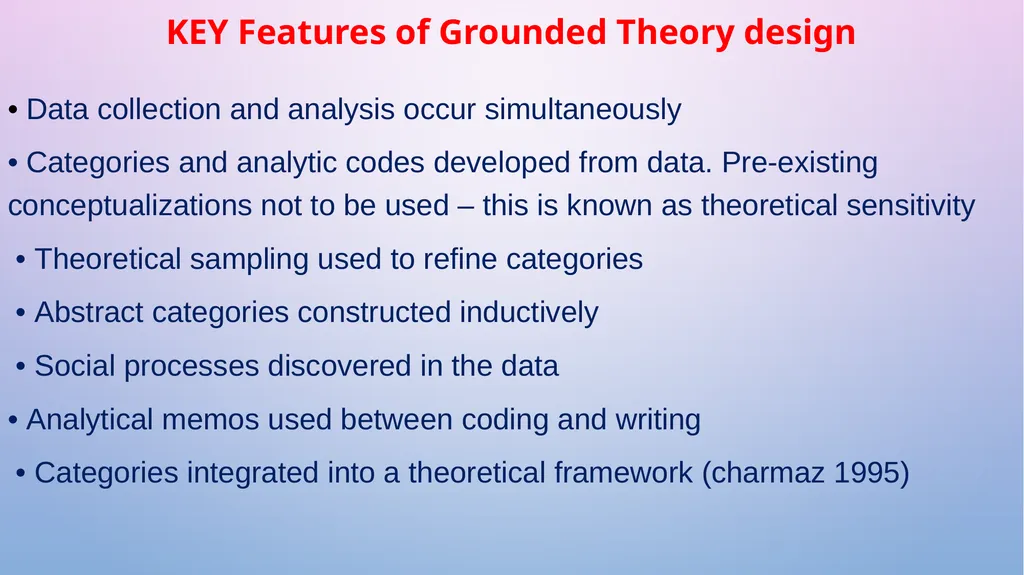
slide13. KEY Features of Grounded Theory design • Data collection and analysis occur simultaneously
• Categories and analytic codes developed from data. Pre-existing conceptualizations not to be used – this is known as theoretical sensitivity
• Theoretical sampling used to refine categories
• Abstract categories constructed inductively
• Social processes discovered in the data
• Analytical memos used between coding and writing
• Categories integrated into a theoretical framework (charmaz 1995)<br>
slide14. analysing the data open coding - where the researcher begins to segment or divide the data into similar groupings and forms preliminary categories of information about the phenomenon being examined
axial coding - following intensive open coding, the researcher begins to bring together the categories he or she has identified into groupings. These groupings resemble themes and are generally new ways of seeing and understanding the phenomenon under study
selective coding - the researcher organizes and integrates the categories and themes in a way that articulates a coherent understanding or theory of the phenomenon of study.<br>
slide15. Current uses of grounded theory Grounded theory is a powerful research method for collecting and analyzing data.
Traditional research designs rely on a literature review leading to the formation of a hypothesis. Then one tests the hypothesis through experimentation in the real world.
Grounded theory investigates the actualities in the real world and analyses the data with no preconceived ideas or hypothesis
Though it can be used in different types of research, grounded theory is often adopted to formulate hypotheses or theories based on existing phenomena, or to discover<br>
slide16. Advantages of Grounded Theory Grounded theory is helpful to develop an understanding phenomena that cannot be explained with existing theories and paradigms
This methodology offers a systematic and rigorous process of data collection and data analysis. Therefore, research problem can be studied in a great level of depth.
Application of this methodology in practice fosters creativity and critical thinking<br>
slide17. Disadvantages of Grounded Theory Grounded theory methodology is time consuming and difficult to conduct.
There is a great room for researcher-induced bias
Presentation of research findings in grounded theory is not straightforward<br>
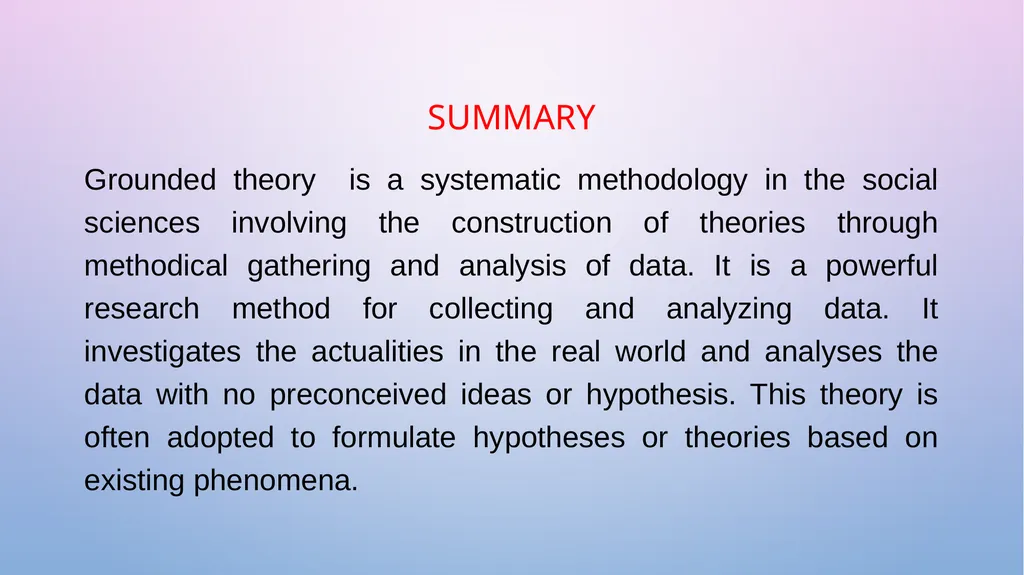
slide18. SUMMARY Grounded theory is a systematic methodology in the social sciences involving the construction of theories through methodical gathering and analysis of data. It is a powerful research method for collecting and analyzing data. It investigates the actualities in the real world and analyses the data with no preconceived ideas or hypothesis. This theory is often adopted to formulate hypotheses or theories based on existing phenomena.<br>
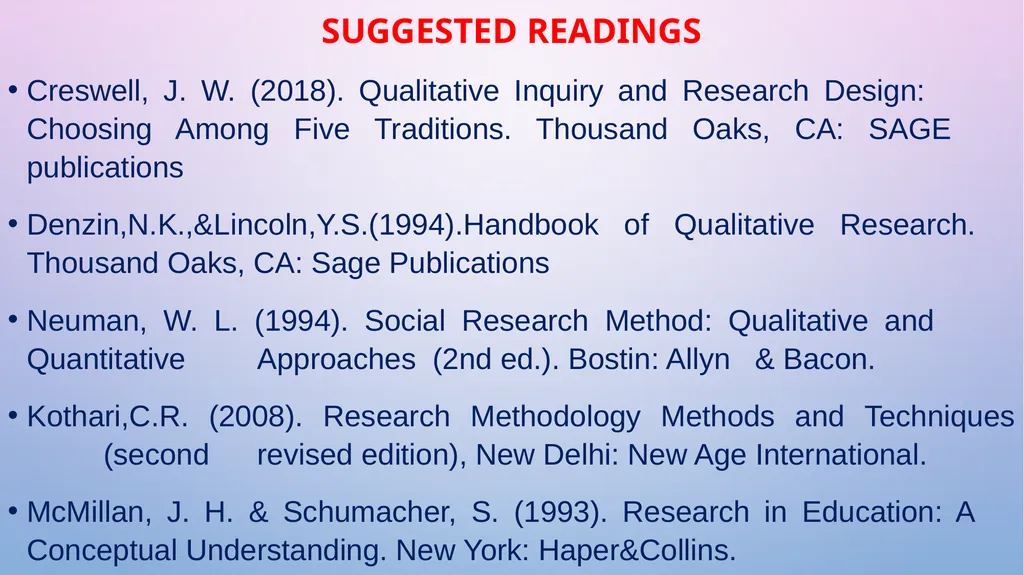
slide19. SUGGESTED READINGS Creswell, J. W. (2018). Qualitative Inquiry and Research Design: Choosing Among Five Traditions. Thousand Oaks, CA: SAGE publications
Denzin,N.K.,&Lincoln,Y.S.(1994).Handbook of Qualitative Research. Thousand Oaks, CA: Sage Publications
Neuman, W. L. (1994). Social Research Method: Qualitative and Quantitative Approaches (2nd ed.). Bostin: Allyn & Bacon.
Kothari,C.R. (2008). Research Methodology Methods and Techniques (second revised edition), New Delhi: New Age International.
McMillan, J. H. & Schumacher, S. (1993). Research in Education: A Conceptual Understanding. New York: Haper&Collins.<br>

slide20. THANK YOU…..<br>
slide2. GROUNDED THEORY RESEARCH DESIGN Dr. GEETHA GOPINATH
ASSISTANT PROFESSOR
DEPARTMENT OF EDUCATION AND EDUCATIONAL TECHNOLOGY
SCHOOL OF SOCIAL SCIENCES
UNIVERSITY OF HYDERABAD
CENTRAL UNIVERSITY CAMPUS
HYDERABAD<br>
slide3. GROUNDED THEORY RESEARCH DESIGN The goal of the grounded theory
approach is to generate a theory
that explains how an aspect of
the social world “works”.
The goal is to develop a theory
that emerges from and is therefore
connected to the very reality that
the theory is developed to explain.<br>
slide4. CONTENTS Grounded Theory Design-Definitions
Grounded theory Design –Concept
Grounded Theory design-Methodology
Grounded Theory Design-Key Features
Grounded Theory Design-Uses
Grounded Theory Design-Strengths
Grounded Theory Design-Limitations<br>
slide5. LEARNING OBJECTIVES Enable the student teachers to,
define and explain the concept of grounded theory Design
describe the key features of grounded theory Design
explain the methodology of grounded theory
enumerate the uses of grounded theory
analyze the strengths and limitations of grounded theory Design<br>
slide6. Grounded theory design A grounded theory design is a set of procedures used to generate systematically a theory
It is also useful to study a process, an action, or an interaction.
It offers a step-by-step, systematic procedure for the beginning researcher.
In using grounded theory, a researcher can stay close to the data at all times in the analysis.
This design was developed by sociologists Barney Glaser and Anselm Strauss at the University of California San Francisco in the late 1960s.<br>
slide7. Grounded theory design-definitions Grounded Theory is an approach for developing theory that is "grounded in data systematically gathered and analyzed“
(Strauss & Corbin, 1994).
Grounded theory is an inductive methodology that provides systematic guidelines for gathering, synthesizing, analyzing, and conceptualizing qualitative data for the purpose of theory construction.
International Encyclopedia of the Social & Behavioral Sciences,
The grounded theory is a methodology of analysis, which starts from the systematic collection of data, to generate an inductive theory about a substantive area.
( Glaser ,1992)
A set of systematic inductive methods to perform qualitative research aimed at developing the theory.( Charmaz ,2005)<br>
slide8. Grounded theory-concept Grounded theory (GT) is a systematic methodology in the social sciences involving the construction of theories through methodical gathering and analysis of data.
This research methodology uses inductive reasoning, in contrast to the hypothetico-deductive model of the scientific method.
A study using grounded theory is likely to begin with a question, or even just with the collection of qualitative data.<br>
slide9. Grounded theory-concept As researchers review the data collected, repeated ideas, concepts or elements become apparent, and are tagged with codes, which have been extracted from the data.
As more data is collected, and re-reviewed, codes can be grouped into concepts, and then into categories.
These categories may become the basis for new theory. Thus, grounded theory is quite different from the traditional model of research, where the researcher chooses an existing theoretical framework, and only then collects data to show how the theory does or does not apply to the phenomenon under study.<br>
slide10. STEPS OF GROUNDED THEORY DESIGN<br>
slide11. Grounded theory -methodology Grounded theory methodology comprises the following four stages:
Codes. Anchors are identified to collect the key points of data
Concepts. Codes of similar content are collected to be able to group the data
Categories. Broad groups of similar concepts are formed to generate a theory
Theory. A collection of explanations are generated that explain the subject of the research (hypothesis)<br>
slide13. KEY Features of Grounded Theory design • Data collection and analysis occur simultaneously
• Categories and analytic codes developed from data. Pre-existing conceptualizations not to be used – this is known as theoretical sensitivity
• Theoretical sampling used to refine categories
• Abstract categories constructed inductively
• Social processes discovered in the data
• Analytical memos used between coding and writing
• Categories integrated into a theoretical framework (charmaz 1995)<br>
slide14. analysing the data open coding - where the researcher begins to segment or divide the data into similar groupings and forms preliminary categories of information about the phenomenon being examined
axial coding - following intensive open coding, the researcher begins to bring together the categories he or she has identified into groupings. These groupings resemble themes and are generally new ways of seeing and understanding the phenomenon under study
selective coding - the researcher organizes and integrates the categories and themes in a way that articulates a coherent understanding or theory of the phenomenon of study.<br>
slide15. Current uses of grounded theory Grounded theory is a powerful research method for collecting and analyzing data.
Traditional research designs rely on a literature review leading to the formation of a hypothesis. Then one tests the hypothesis through experimentation in the real world.
Grounded theory investigates the actualities in the real world and analyses the data with no preconceived ideas or hypothesis
Though it can be used in different types of research, grounded theory is often adopted to formulate hypotheses or theories based on existing phenomena, or to discover<br>
slide16. Advantages of Grounded Theory Grounded theory is helpful to develop an understanding phenomena that cannot be explained with existing theories and paradigms
This methodology offers a systematic and rigorous process of data collection and data analysis. Therefore, research problem can be studied in a great level of depth.
Application of this methodology in practice fosters creativity and critical thinking<br>
slide17. Disadvantages of Grounded Theory Grounded theory methodology is time consuming and difficult to conduct.
There is a great room for researcher-induced bias
Presentation of research findings in grounded theory is not straightforward<br>
slide18. SUMMARY Grounded theory is a systematic methodology in the social sciences involving the construction of theories through methodical gathering and analysis of data. It is a powerful research method for collecting and analyzing data. It investigates the actualities in the real world and analyses the data with no preconceived ideas or hypothesis. This theory is often adopted to formulate hypotheses or theories based on existing phenomena.<br>
slide19. SUGGESTED READINGS Creswell, J. W. (2018). Qualitative Inquiry and Research Design: Choosing Among Five Traditions. Thousand Oaks, CA: SAGE publications
Denzin,N.K.,&Lincoln,Y.S.(1994).Handbook of Qualitative Research. Thousand Oaks, CA: Sage Publications
Neuman, W. L. (1994). Social Research Method: Qualitative and Quantitative Approaches (2nd ed.). Bostin: Allyn & Bacon.
Kothari,C.R. (2008). Research Methodology Methods and Techniques (second revised edition), New Delhi: New Age International.
McMillan, J. H. & Schumacher, S. (1993). Research in Education: A Conceptual Understanding. New York: Haper&Collins.<br>
slide20. THANK YOU…..<br>