
Welcome to Safeguarding Children Level 2 session
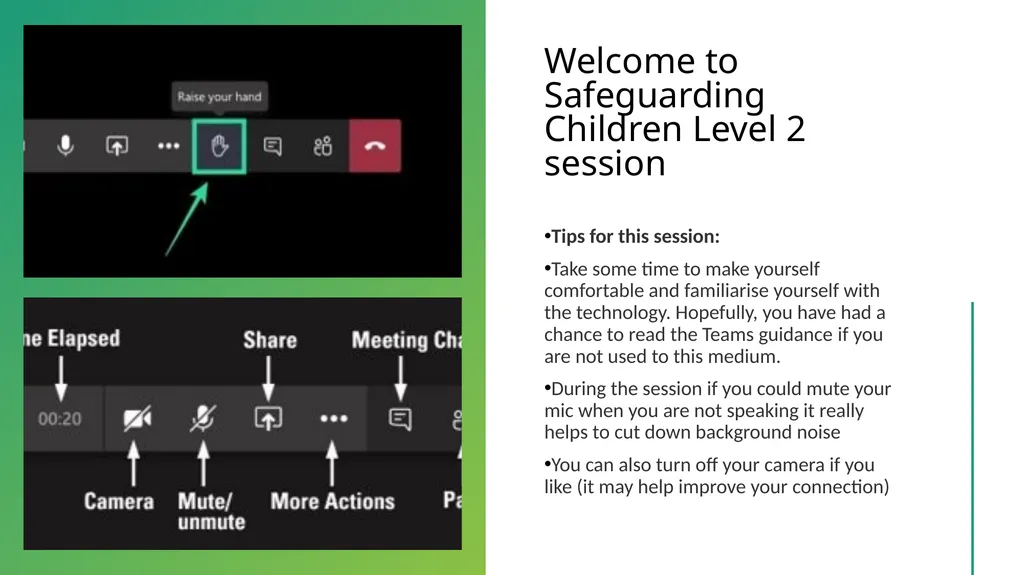
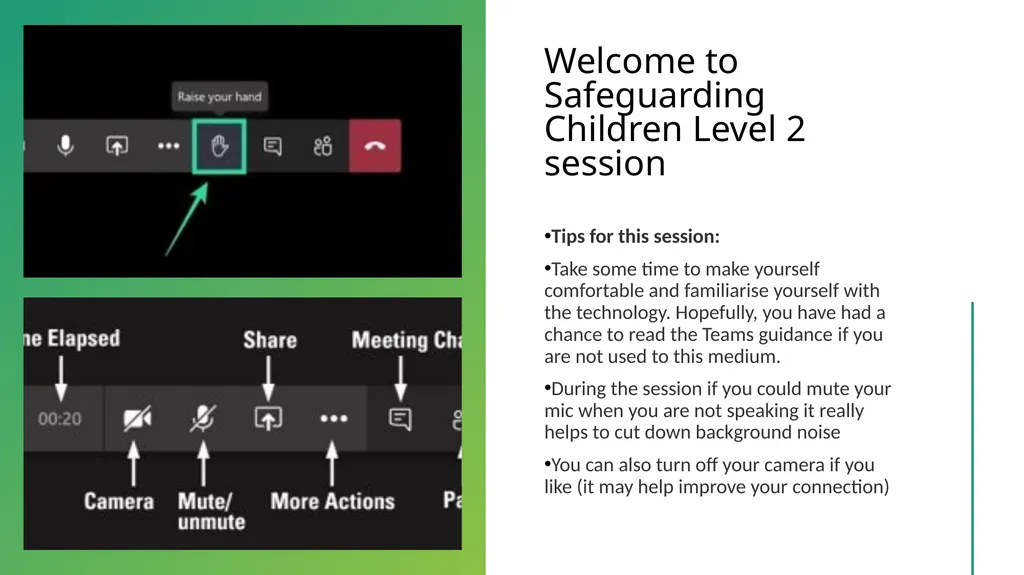







Description: Welcome to Safeguarding Children Level 2 session Tips for this session: Take some time to make yourself comfortable and familiarise yourself with the technology. Hopefully, you have had a chance to read the Teams guidance if you are not
Related Topics
Download Presentation
"Welcome to Safeguarding Children Level 2 session" is the property of its rightful owner. Permission is granted to download and print the materials on this website for personal, non-commercial use only, and to display it on your personal computer provided you do not modify the materials and that you retain all copyright notices contained in the materials. By downloading content from our website, you accept the terms of this agreement.
Presentation Transcript
slide1. Welcome to Safeguarding Children Level 2 session Tips for this session:
Take some time to make yourself comfortable and familiarise yourself with the technology. Hopefully, you have had a chance to read the Teams guidance if you are not used to this medium.
During the session if you could mute your mic when you are not speaking it really helps to cut down background noise
You can also turn off your camera if you like (it may help improve your connection)<br>
slide2. We are Insert facilitator name<br>
slide3. Staying Safe Please note that sometimes people can find the content of some sessions upsetting. If you think this could apply to you, we would like you to think about a strategy for keeping yourself safe, for example having someone you trust available to talk to after the session.
If you want to, you can talk outside the session to a trainer, or seek advice from the NSPCC Helpline 0808 800 5000<br>
slide4. Quick note: A large amount of content is in this presentation and we apologise if some of it is difficult to read. We will be explaining the key points as we go and you can request a copy of the presentation via the evaluation form if you would like to refer back to anything.<br>
slide5. Please maintain utmost confidentiality in relation to cases and service users<br>
slide6. Introductions<br>
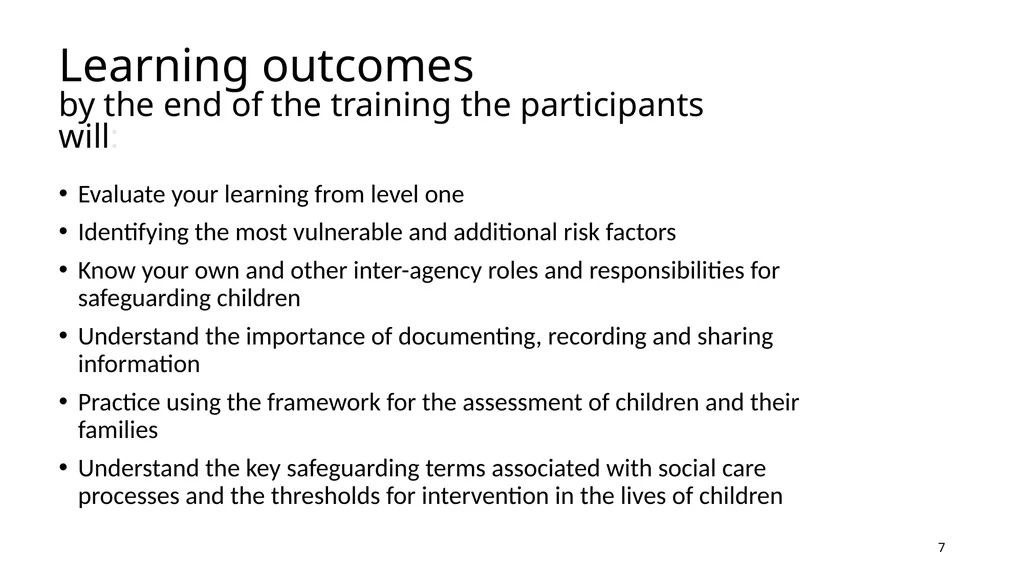
slide7. Learning outcomes by the end of the training the participants will: Evaluate your learning from level one
Identifying the most vulnerable and additional risk factors
Know your own and other inter-agency roles and responsibilities for safeguarding children
Understand the importance of documenting, recording and sharing information
Practice using the framework for the assessment of children and their families
Understand the key safeguarding terms associated with social care processes and the thresholds for intervention in the lives of children 7<br>
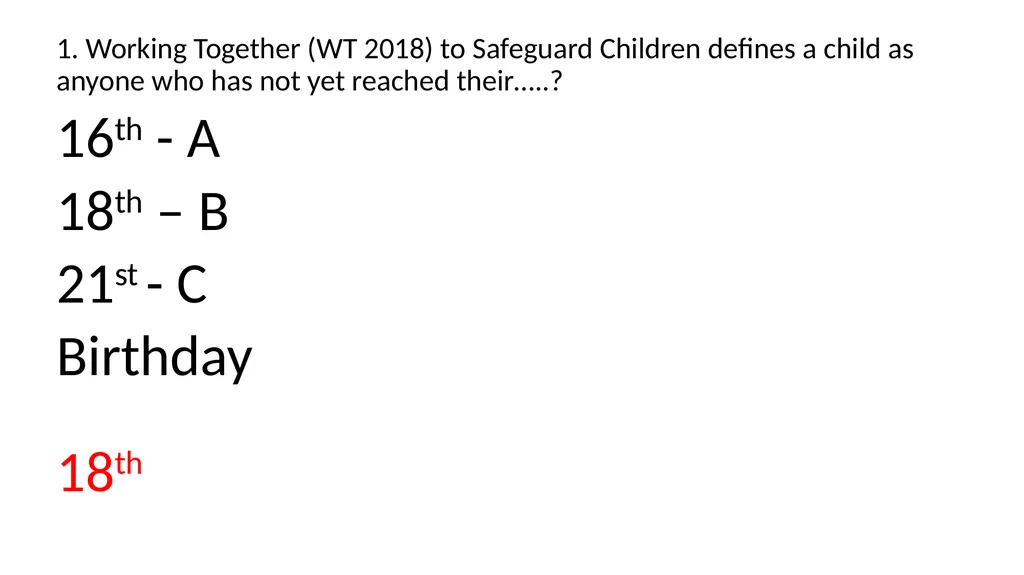
slide9. 1. Working Together (WT 2018) to Safeguard Children defines a child as anyone who has not yet reached their…..?
16th - A
18th – B
21st - C
Birthday
18th<br>
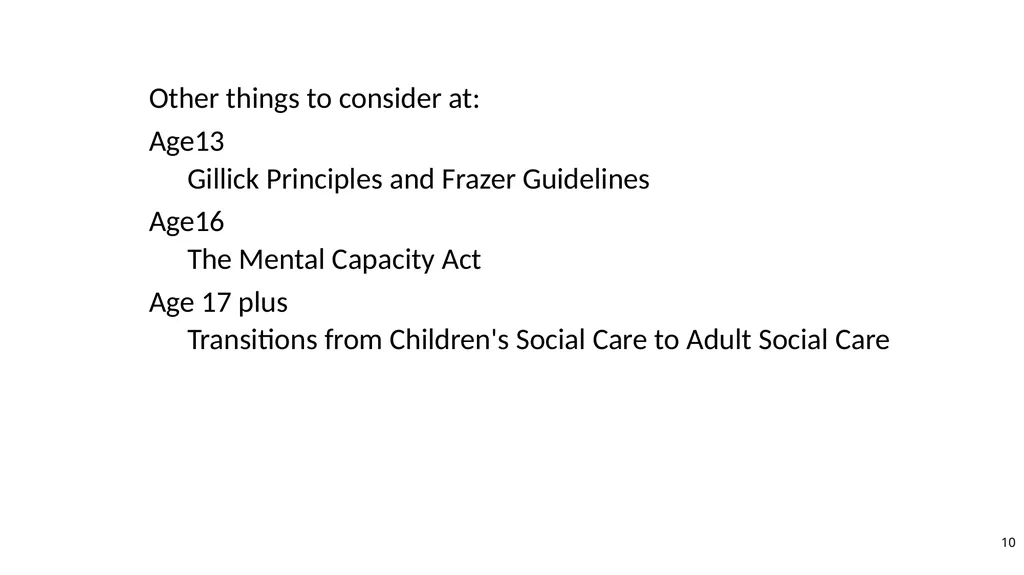
slide10. Other things to consider at:
Age13
Gillick Principles and Frazer Guidelines
Age16
The Mental Capacity Act
Age 17 plus
Transitions from Children's Social Care to Adult Social Care 10<br>
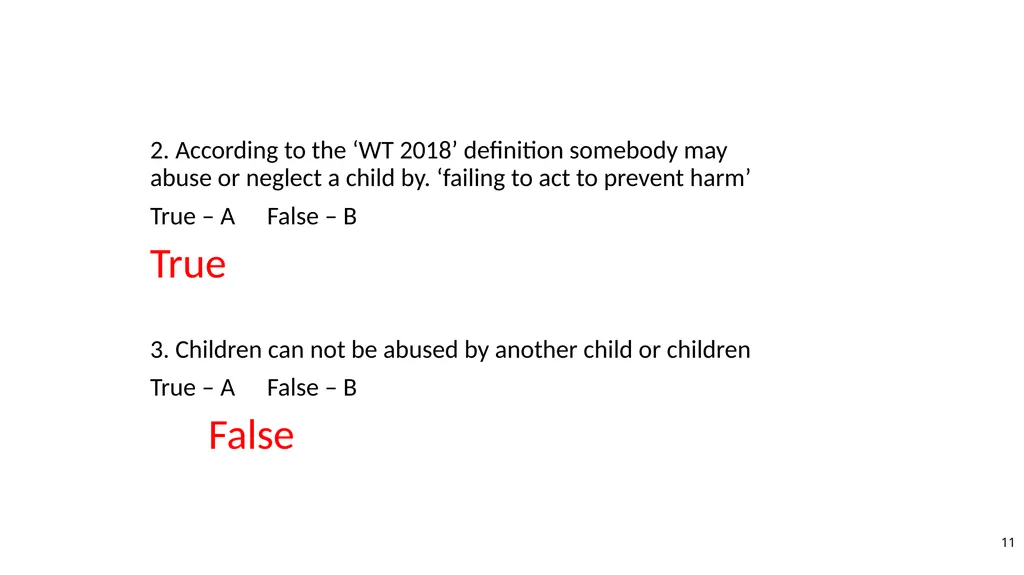
slide11. 2. According to the ‘WT 2018’ definition somebody may abuse or neglect a child by. ‘failing to act to prevent harm’
True – A False – B
True
3. Children can not be abused by another child or children
True – A False – B
False 11<br>
slide12. 4. Which of the following are key pieces of legislation or guidance regarding safeguarding children?
Children Act 1989 - A
Children Act 2004 - B
Working Together to Safeguard Children 2018 – C
All of them – D
All of them<br>
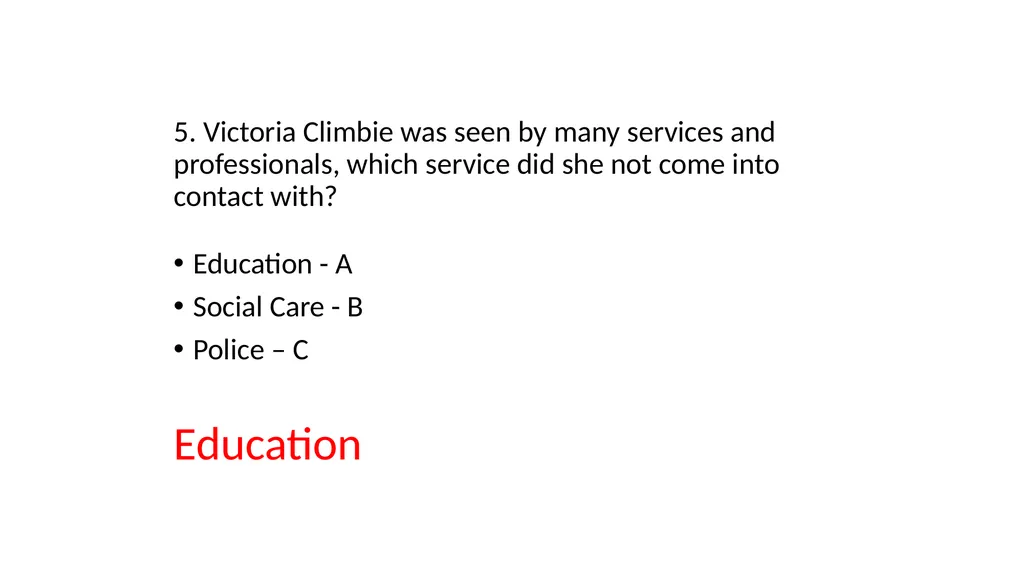
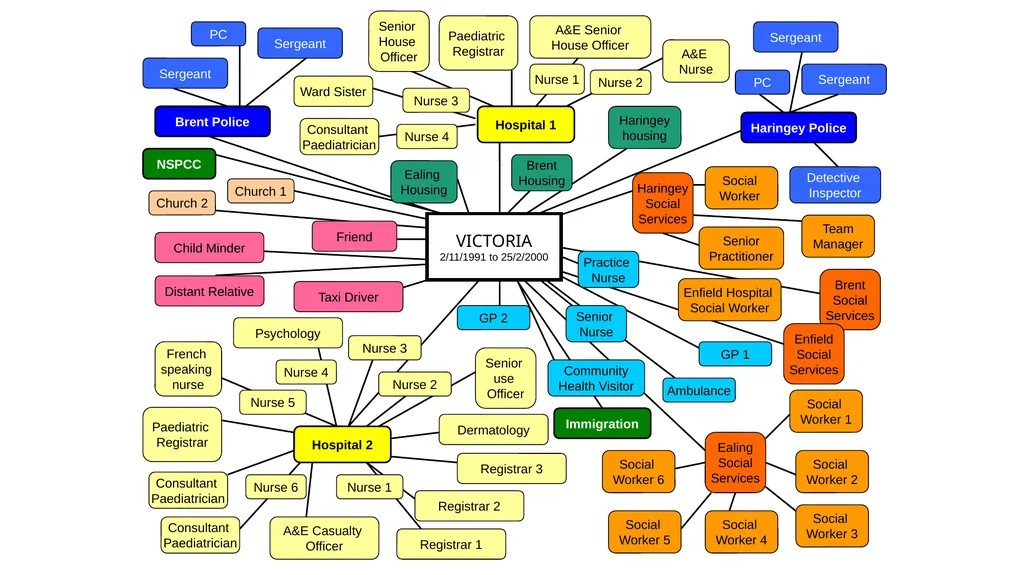
slide13. 5. Victoria Climbie was seen by many services and professionals, which service did she not come into contact with?
Education - A
Social Care - B
Police – C
Education<br>
slide14. Paediatric
Registrar A&E Senior
House Officer Hospital 1 A&E
Nurse Brent Police Hospital 2 Senior
House
Officer Ward Sister French
speaking
nurse Consultant
Paediatrician Senior
use
Officer Consultant
Paediatrician Paediatric
Registrar Consultant
Paediatrician A&E Casualty
Officer Registrar 1 Registrar 3 Registrar 2 Dermatology Psychology Haringey Police Sergeant PC PC Detective
Inspector Sergeant Sergeant Sergeant Ambulance Church 1 Church 2 Distant Relative Nurse 1 Nurse 2 Nurse 6 Child Minder Friend Nurse 3 Nurse 5 Taxi Driver Nurse 4 Nurse 3 Nurse 1 Ealing
Social
Services Social
Worker 2 Social
Worker 6 Social
Worker 1 Social
Worker 3 Social
Worker 4 Social
Worker 5 Haringey
Social
Services Senior
Practitioner Team
Manager Social
Worker Brent
Social
Services Enfield
Social
Services Immigration NSPCC Nurse 4 GP 1 GP 2 Enfield Hospital
Social Worker Senior
Nurse Practice
Nurse Community
Health Visitor Nurse 2 Haringey
housing Ealing
Housing Brent
Housing VICTORIA
2/11/1991 to 25/2/2000<br>
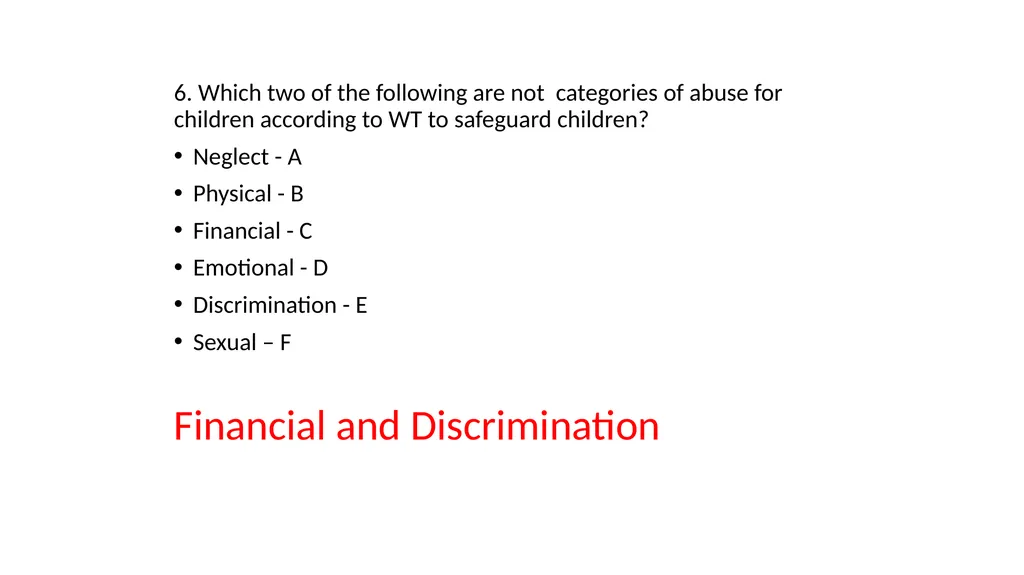
slide15. 6. Which two of the following are not categories of abuse for children according to WT to safeguard children?
Neglect - A
Physical - B
Financial - C
Emotional - D
Discrimination - E
Sexual – F
Financial and Discrimination<br>
slide16. 7. The following policies have been jumbled up. Each one is designed to keep children safe in your organisation. Can you correctly pair them together? E H G B C A D F<br>
slide17. 8. It is the parent /carers responsibility to ensure adequate supervision (including the use of adequate carers) failure to do this could be seen as…..What type of abuse?
Neglect - A
Physical - B
Sexual - C
Emotional - D
Neglect<br>
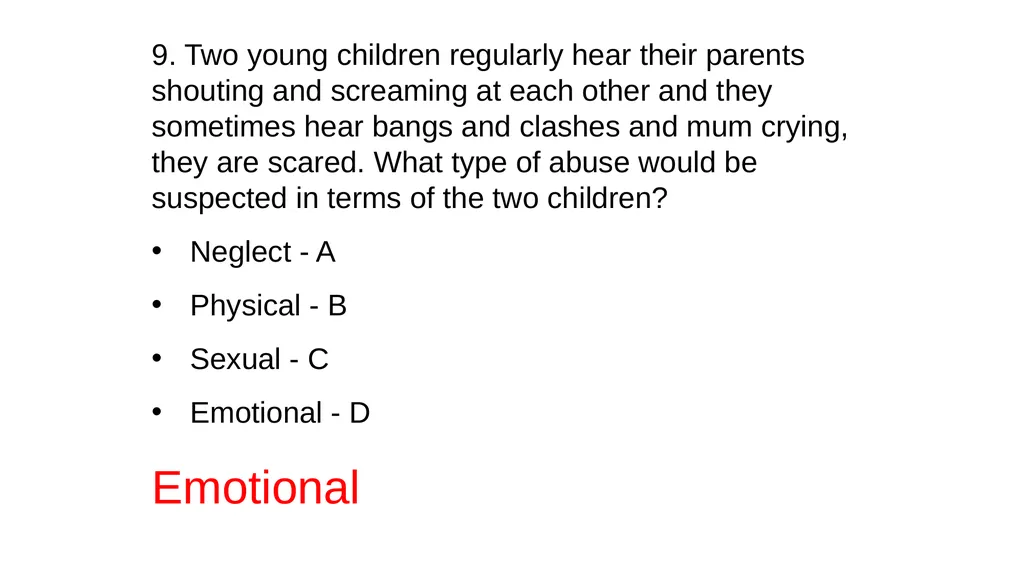
slide18. 9. Two young children regularly hear their parents shouting and screaming at each other and they sometimes hear bangs and clashes and mum crying, they are scared. What type of abuse would be suspected in terms of the two children?
Neglect - A
Physical - B
Sexual - C
Emotional - D
Emotional<br>
slide19. 10. Who are the most vulnerable groups? Please comment in the chat room why these children might be vulnerable. The very young
Children with disabilities
Children who live with domestic abuse
Teenagers 19<br>
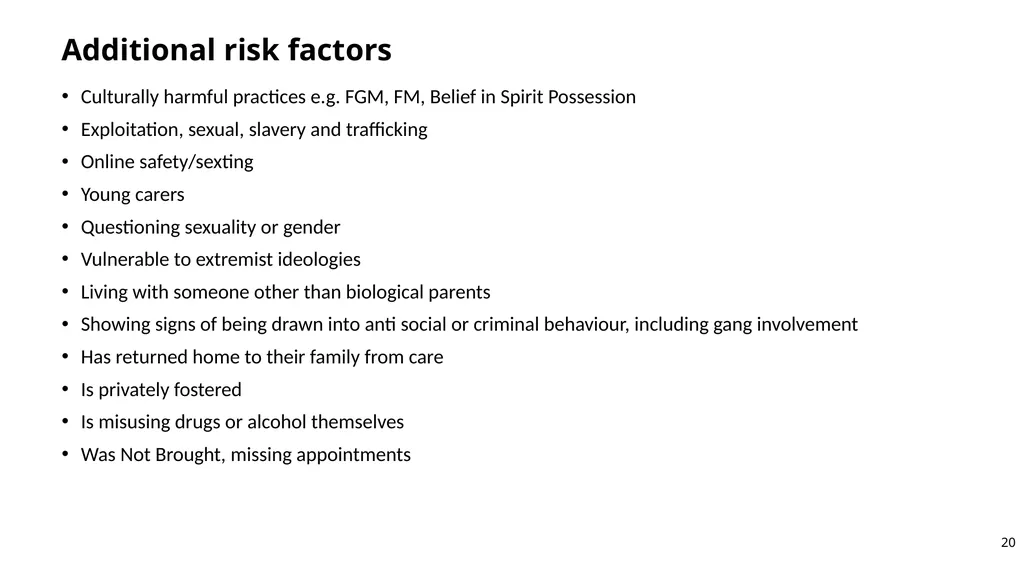
slide20. Additional risk factors Culturally harmful practices e.g. FGM, FM, Belief in Spirit Possession
Exploitation, sexual, slavery and trafficking
Online safety/sexting
Young carers
Questioning sexuality or gender
Vulnerable to extremist ideologies
Living with someone other than biological parents
Showing signs of being drawn into anti social or criminal behaviour, including gang involvement
Has returned home to their family from care
Is privately fostered
Is misusing drugs or alcohol themselves
Was Not Brought, missing appointments 20<br>
slide21. Take a break Please be ready to start again in 10 minutes<br>
slide22. 22<br>
slide23. Roles and responsibilities of key professionals in the safeguarding processes For more detailed information refer to Working Together to Safeguard Children 2018 23<br>
slide24. POLICE Emergency police protection-take children into care for 72 hours
Can access housing
Domestic violence (DV) refer on via Child Concern Notification (CCN) to Children's Social Care (CSC)
Arrest people and question
Take referrals from public
Public protection – Multi agency public protection arrangements (MAPPA)
Attend strategy meetings and conferences to share information
Confiscate alcohol on the streets
Investigate crime
Speak to the child, trained in ‘Achieving Best Evidence’ (ABE)
Representative on Local safeguarding children
partnership (LSCP)
Chair Multi Agency Risk Assessment Conference (MARAC)
Be approachable
Education, School liason
Part of Multi agency safeguarding hub (MASH) 24<br>
slide25. HEALTH Attend strategy meetings and conferences to share information
Remain child focused, speak to the child
Complete document injuries on body charts
Use relevant specialist safeguarding team if concerned – Nurse advisors or child protection (CP) medical doctors
Refer cause for concern
Observations
Follow up care
Identify diagnose cause of injuries
Early Help Assessment and Plan (EHAP)
Support families
Record keeping
Monitor child development and growth
Assessment of family
Healthy child programme
Report writing for conferences
Contribute to MARAC-MASH-MAPPA
Sexual health of young people
Refer to children and young people’s service (CYPS) mental health 25<br>
slide26. CHILDRENS SOCIAL CARE Safety and welfare of children
Information sharing multi agency
Make referrals in and out to health – medicals, second opinions
Accurate record keeping
Multi-Disciplinary Team (MDT) support
Contribute to MARAC-MASH-MAPPA
Responsible for conferences and other meetings
Liaise to support families
Core and initial assessments
Section 17 and 47 assessments
Strategy meetings
Core and Care team meetings
Identify additional support networks- voluntary, family and friends, professionals
Work with and provide training for Foster Carers 26<br>
slide27. EDUCATION Designated officer
School health advisor
All staff have responsibility for safeguarding and complying with “keeping children safe in education and working together”
Monitoring attendance (attendance officers) and academic progress
Talking to parents and carers
Information sharing with other professionals
Remain child focused – make opportunities available to speak to the child alone
Home visits in nursery early indication of problems
Identify changes in behaviour or presentation
Counselling
Drop in sessions
Early Help and Assessment Plans (EHAP) 27<br>
slide28. Other agencies and the wider environment: Who may or may not have a relationship with the child or have information to add to the jigsaw<br>
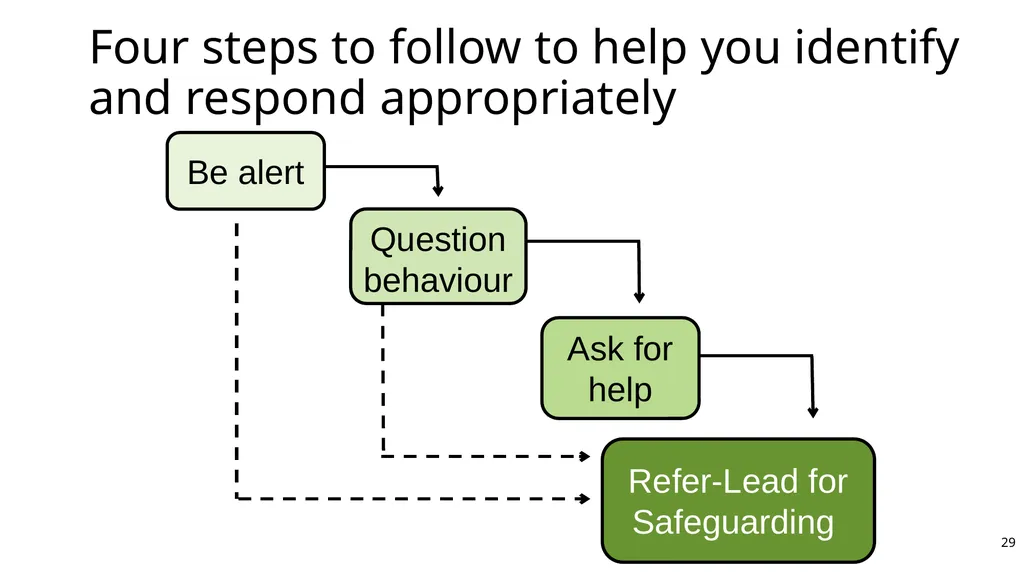
slide29. Four steps to follow to help you identify and respond appropriately 29<br>
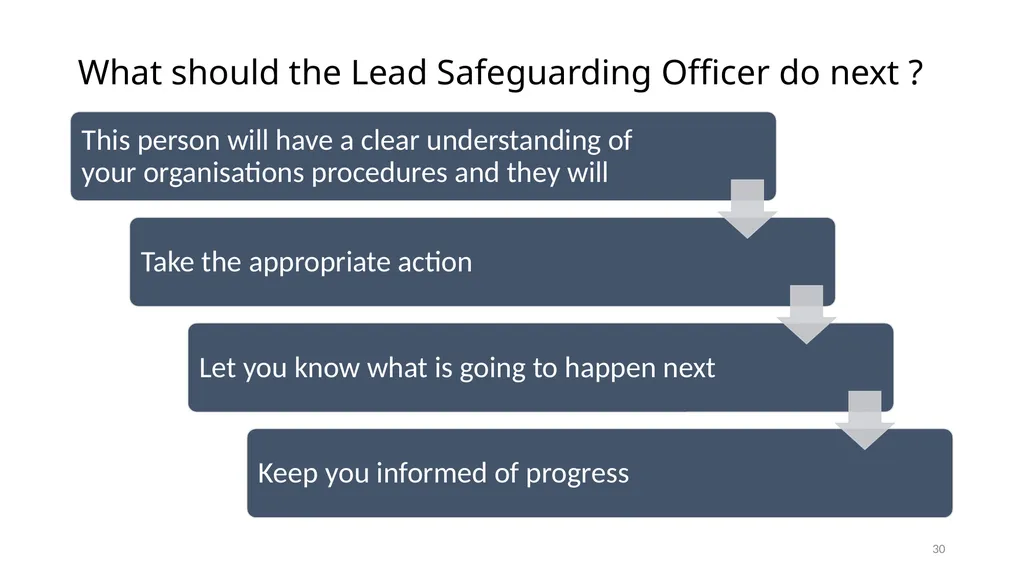
slide30. What should the Lead Safeguarding Officer do next ? 30<br>
slide31. What can you do if you are not satisfied with your lead safeguarding officers action? 31<br>
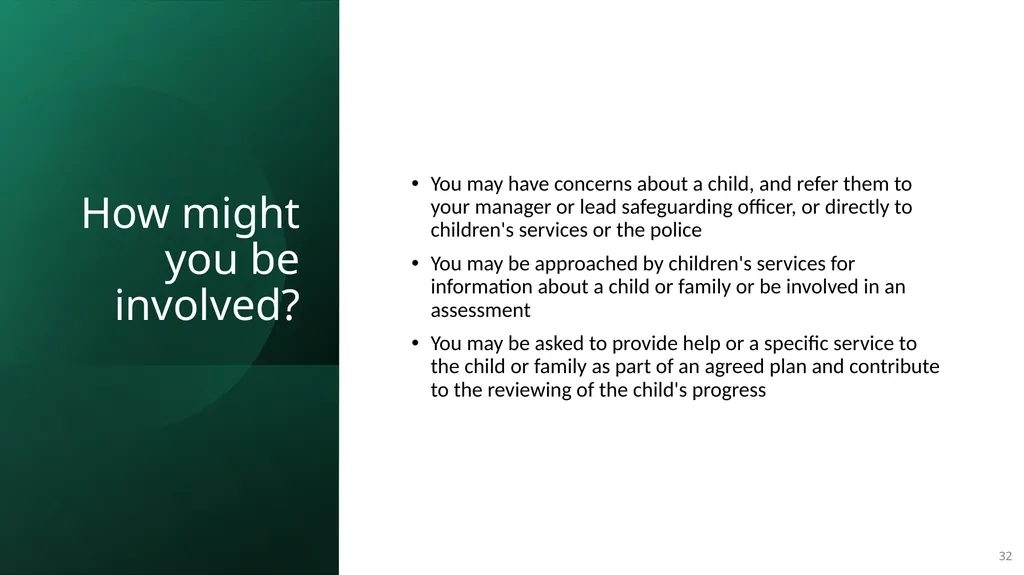
slide32. How might you be involved? You may have concerns about a child, and refer them to your manager or lead safeguarding officer, or directly to children's services or the police
You may be approached by children's services for information about a child or family or be involved in an assessment
You may be asked to provide help or a specific service to the child or family as part of an agreed plan and contribute to the reviewing of the child's progress 32<br>
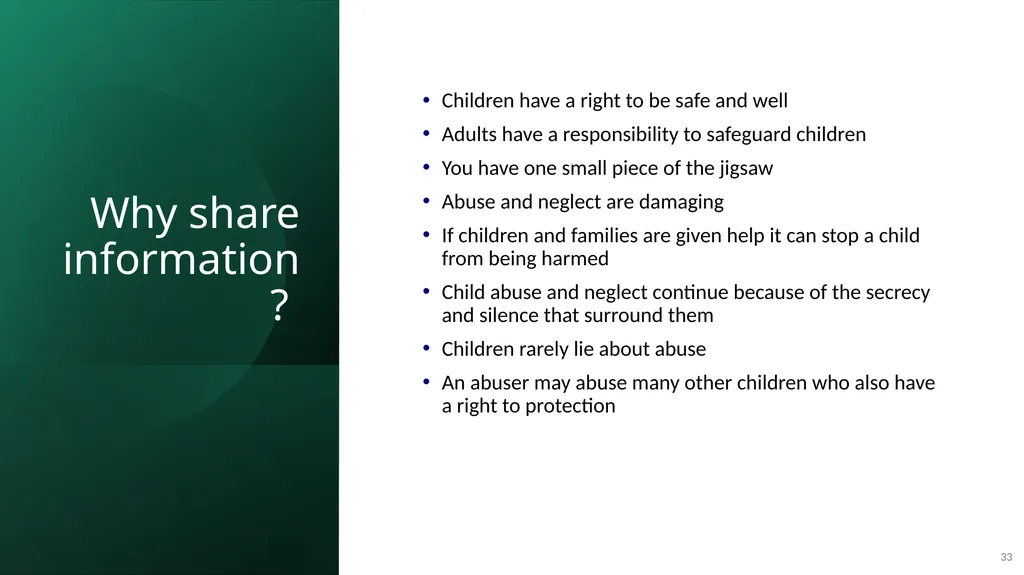
slide33. Why share information? Children have a right to be safe and well
Adults have a responsibility to safeguard children
You have one small piece of the jigsaw
Abuse and neglect are damaging
If children and families are given help it can stop a child from being harmed
Child abuse and neglect continue because of the secrecy and silence that surround them
Children rarely lie about abuse
An abuser may abuse many other children who also have a right to protection 33<br>
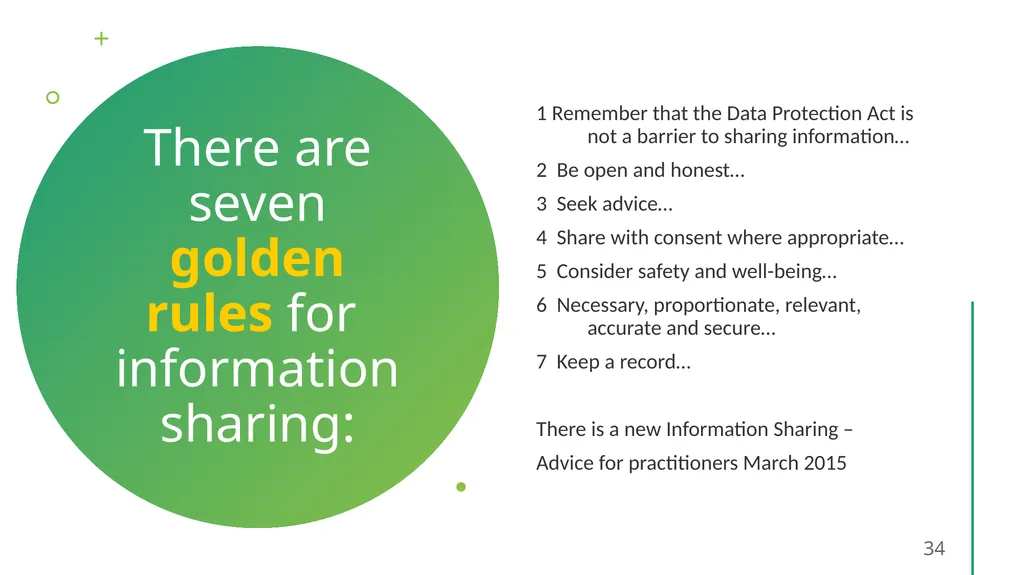
slide34. There are seven golden rules for information sharing: 1 Remember that the Data Protection Act is not a barrier to sharing information…
2 Be open and honest…
3 Seek advice…
4 Share with consent where appropriate…
5 Consider safety and well-being…
6 Necessary, proportionate, relevant, accurate and secure…
7 Keep a record…
There is a new Information Sharing –
Advice for practitioners March 2015 34<br>
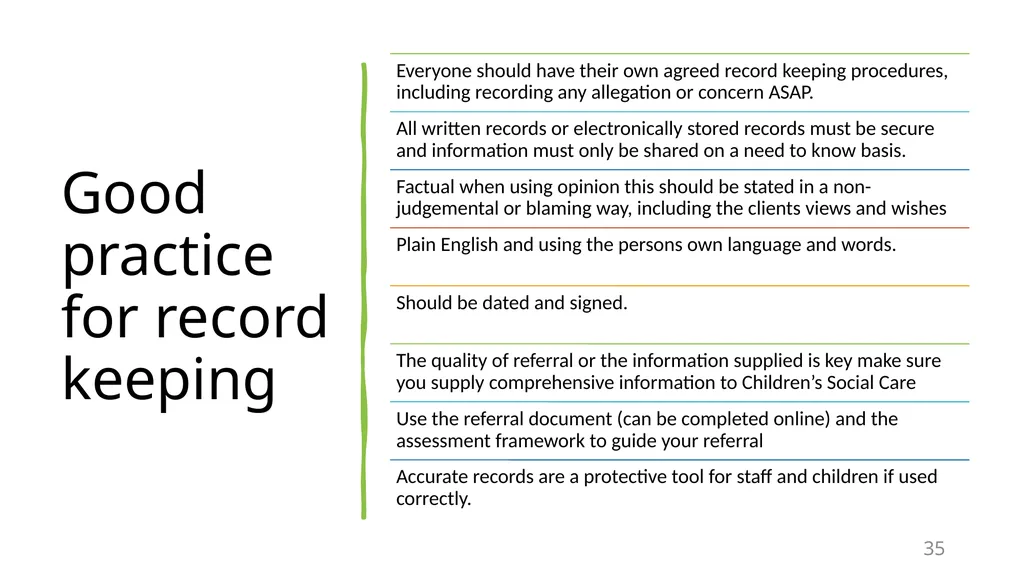
slide35. Good practice for record keeping 35<br>
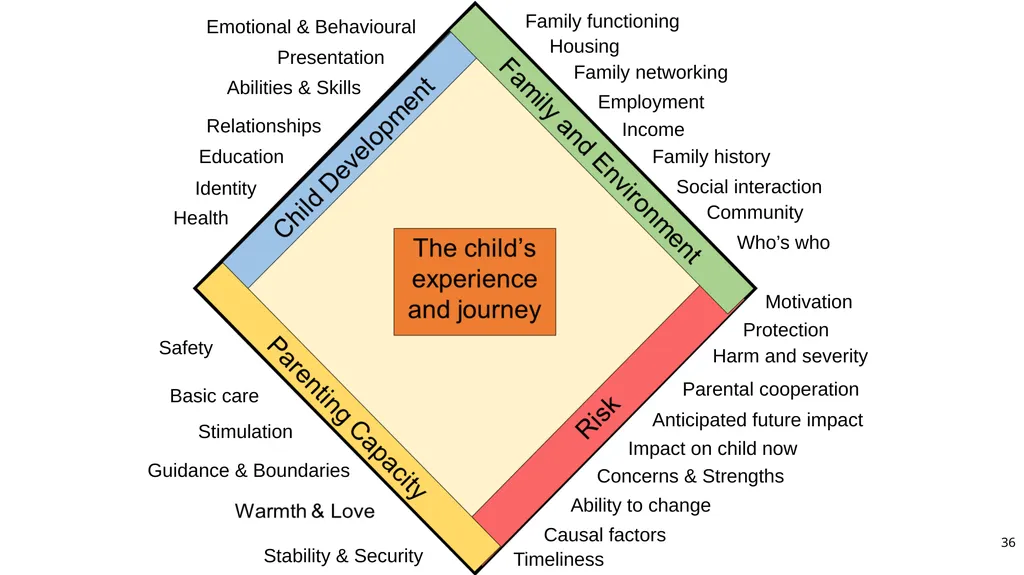
slide36. 36 Presentation Timeliness Guidance & Boundaries Family networking Stimulation Social interaction Family functioning Identity Employment Family history Stability & Security Who’s who Causal factors Community Basic care Emotional & Behavioural Housing Abilities & Skills Education Concerns & Strengths Safety Relationships Health Income Ability to change Parental cooperation Anticipated future impact Harm and severity Impact on child now Motivation Protection<br>
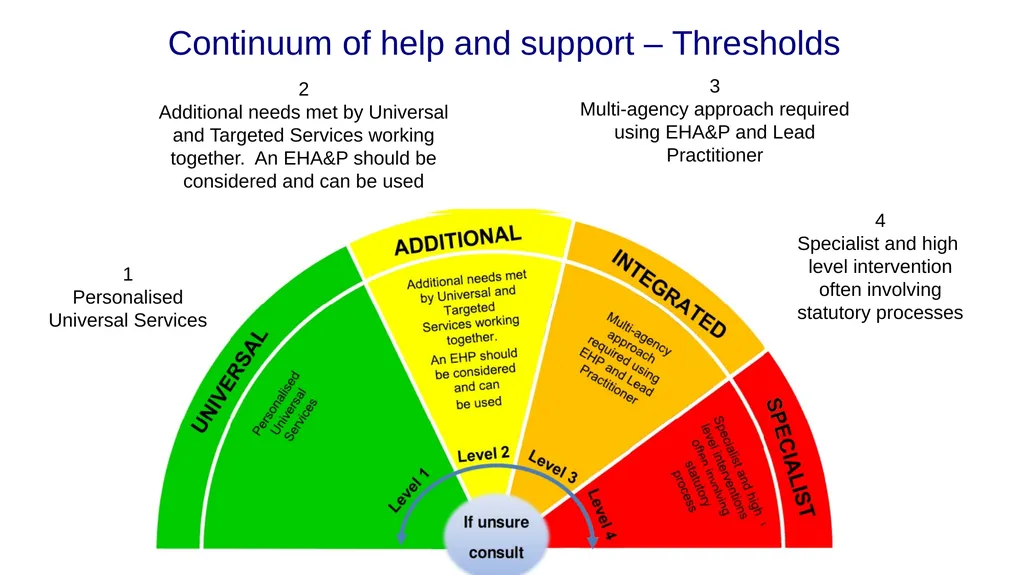
slide37. Continuum of help and support – Thresholds 2
Additional needs met by Universal and Targeted Services working together. An EHA&P should be considered and can be used 3
Multi-agency approach required using EHA&P and Lead Practitioner 1
Personalised
Universal Services 4
Specialist and high
level intervention often involving statutory processes<br>
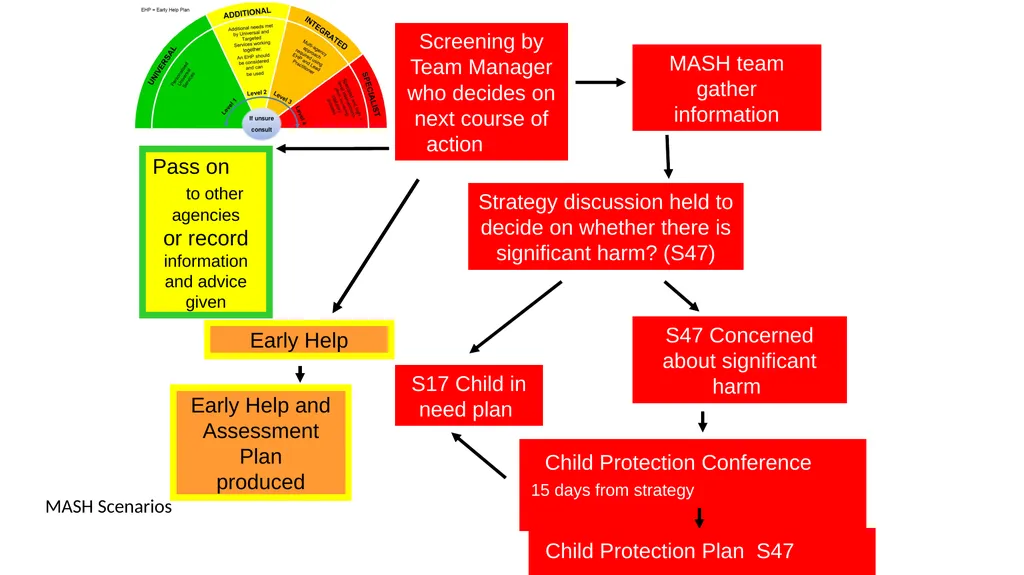
slide38. Screening by Team Manager who decides on next course of action Early Help MASH team gather information S17 Child in need plan Strategy discussion held to decide on whether there is significant harm? (S47) S47 Concerned about significant harm Child Protection Conference 15 days from strategy Early Help and Assessment Plan
produced Pass on to other agencies
or record information and advice given Child Protection Plan S47 MASH Scenarios<br>
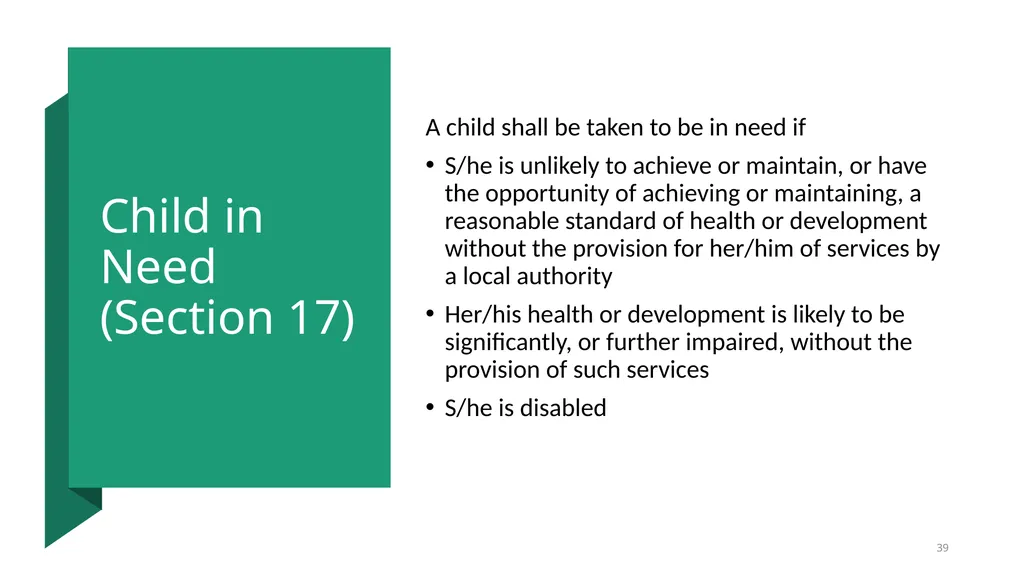
slide39. Child in Need (Section 17) A child shall be taken to be in need if
S/he is unlikely to achieve or maintain, or have the opportunity of achieving or maintaining, a reasonable standard of health or development without the provision for her/him of services by a local authority
Her/his health or development is likely to be significantly, or further impaired, without the provision of such services
S/he is disabled 39<br>
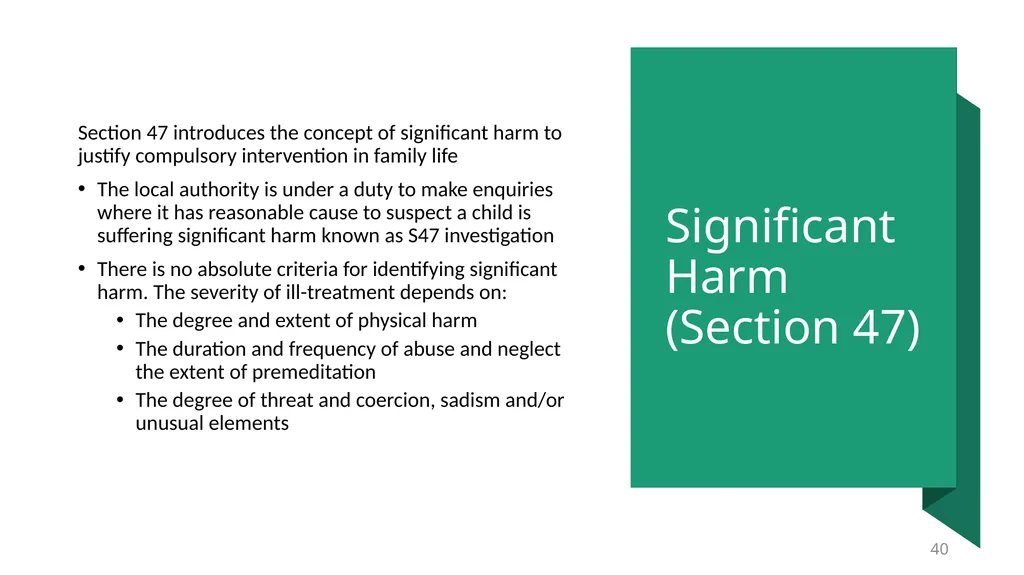
slide40. Significant Harm (Section 47) Section 47 introduces the concept of significant harm to justify compulsory intervention in family life
The local authority is under a duty to make enquiries where it has reasonable cause to suspect a child is suffering significant harm known as S47 investigation
There is no absolute criteria for identifying significant harm. The severity of ill-treatment depends on:
The degree and extent of physical harm
The duration and frequency of abuse and neglect the extent of premeditation
The degree of threat and coercion, sadism and/or unusual elements 40<br>
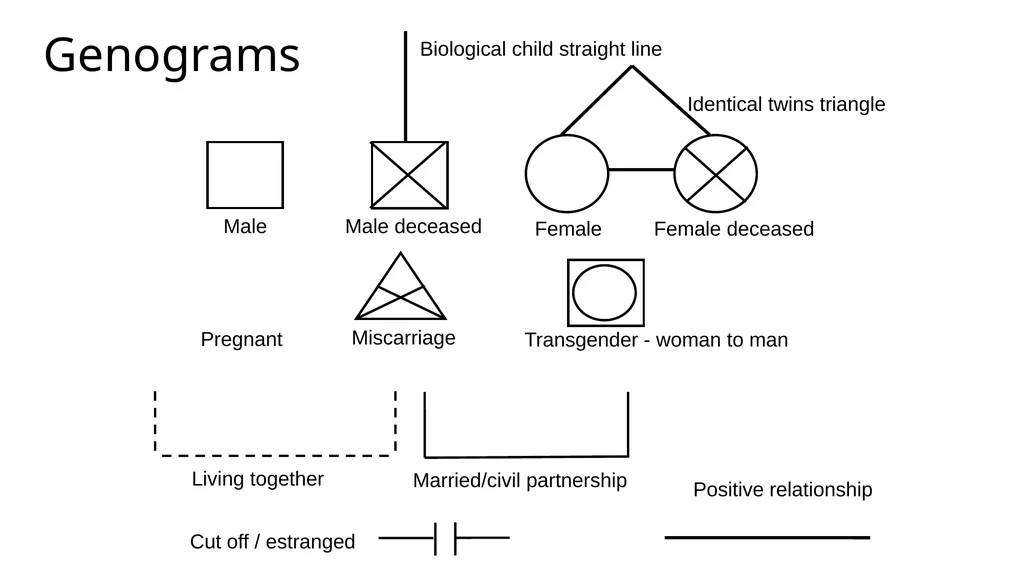
slide41. Genograms Male deceased Male Female Female deceased Miscarriage Pregnant Transgender - woman to man Living together Cut off / estranged Positive relationship Biological child straight line Identical twins triangle Married/civil partnership<br>
slide42. Managing allegations against staff Working Together 2018 says there should be clear policies in line with those from the LSCP for dealing with allegations against people who work with children. An allegation may relate to someone who has:
behaved in a way that has harmed a child, or may have harmed a child
possibly committed a criminal offence against or related to a child
behaved towards a child or children in a way that indicates they may pose a risk of harm to children
Local authorities will have a designated officer (LADO 277 4636). To provide advice and guidance 42<br>
slide43. The new website - www.newcastlesafeguarding.org.uk for training information, resources and referrals<br>
slide44. Questions and Evaluation<br>
slide45. Thank you Please complete the evaluation<br>
Take some time to make yourself comfortable and familiarise yourself with the technology. Hopefully, you have had a chance to read the Teams guidance if you are not used to this medium.
During the session if you could mute your mic when you are not speaking it really helps to cut down background noise
You can also turn off your camera if you like (it may help improve your connection)<br>
slide2. We are Insert facilitator name<br>
slide3. Staying Safe Please note that sometimes people can find the content of some sessions upsetting. If you think this could apply to you, we would like you to think about a strategy for keeping yourself safe, for example having someone you trust available to talk to after the session.
If you want to, you can talk outside the session to a trainer, or seek advice from the NSPCC Helpline 0808 800 5000<br>
slide4. Quick note: A large amount of content is in this presentation and we apologise if some of it is difficult to read. We will be explaining the key points as we go and you can request a copy of the presentation via the evaluation form if you would like to refer back to anything.<br>
slide5. Please maintain utmost confidentiality in relation to cases and service users<br>
slide6. Introductions<br>
slide7. Learning outcomes by the end of the training the participants will: Evaluate your learning from level one
Identifying the most vulnerable and additional risk factors
Know your own and other inter-agency roles and responsibilities for safeguarding children
Understand the importance of documenting, recording and sharing information
Practice using the framework for the assessment of children and their families
Understand the key safeguarding terms associated with social care processes and the thresholds for intervention in the lives of children 7<br>
slide9. 1. Working Together (WT 2018) to Safeguard Children defines a child as anyone who has not yet reached their…..?
16th - A
18th – B
21st - C
Birthday
18th<br>
slide10. Other things to consider at:
Age13
Gillick Principles and Frazer Guidelines
Age16
The Mental Capacity Act
Age 17 plus
Transitions from Children's Social Care to Adult Social Care 10<br>
slide11. 2. According to the ‘WT 2018’ definition somebody may abuse or neglect a child by. ‘failing to act to prevent harm’
True – A False – B
True
3. Children can not be abused by another child or children
True – A False – B
False 11<br>
slide12. 4. Which of the following are key pieces of legislation or guidance regarding safeguarding children?
Children Act 1989 - A
Children Act 2004 - B
Working Together to Safeguard Children 2018 – C
All of them – D
All of them<br>
slide13. 5. Victoria Climbie was seen by many services and professionals, which service did she not come into contact with?
Education - A
Social Care - B
Police – C
Education<br>
slide14. Paediatric
Registrar A&E Senior
House Officer Hospital 1 A&E
Nurse Brent Police Hospital 2 Senior
House
Officer Ward Sister French
speaking
nurse Consultant
Paediatrician Senior
use
Officer Consultant
Paediatrician Paediatric
Registrar Consultant
Paediatrician A&E Casualty
Officer Registrar 1 Registrar 3 Registrar 2 Dermatology Psychology Haringey Police Sergeant PC PC Detective
Inspector Sergeant Sergeant Sergeant Ambulance Church 1 Church 2 Distant Relative Nurse 1 Nurse 2 Nurse 6 Child Minder Friend Nurse 3 Nurse 5 Taxi Driver Nurse 4 Nurse 3 Nurse 1 Ealing
Social
Services Social
Worker 2 Social
Worker 6 Social
Worker 1 Social
Worker 3 Social
Worker 4 Social
Worker 5 Haringey
Social
Services Senior
Practitioner Team
Manager Social
Worker Brent
Social
Services Enfield
Social
Services Immigration NSPCC Nurse 4 GP 1 GP 2 Enfield Hospital
Social Worker Senior
Nurse Practice
Nurse Community
Health Visitor Nurse 2 Haringey
housing Ealing
Housing Brent
Housing VICTORIA
2/11/1991 to 25/2/2000<br>
slide15. 6. Which two of the following are not categories of abuse for children according to WT to safeguard children?
Neglect - A
Physical - B
Financial - C
Emotional - D
Discrimination - E
Sexual – F
Financial and Discrimination<br>
slide16. 7. The following policies have been jumbled up. Each one is designed to keep children safe in your organisation. Can you correctly pair them together? E H G B C A D F<br>
slide17. 8. It is the parent /carers responsibility to ensure adequate supervision (including the use of adequate carers) failure to do this could be seen as…..What type of abuse?
Neglect - A
Physical - B
Sexual - C
Emotional - D
Neglect<br>
slide18. 9. Two young children regularly hear their parents shouting and screaming at each other and they sometimes hear bangs and clashes and mum crying, they are scared. What type of abuse would be suspected in terms of the two children?
Neglect - A
Physical - B
Sexual - C
Emotional - D
Emotional<br>
slide19. 10. Who are the most vulnerable groups? Please comment in the chat room why these children might be vulnerable. The very young
Children with disabilities
Children who live with domestic abuse
Teenagers 19<br>
slide20. Additional risk factors Culturally harmful practices e.g. FGM, FM, Belief in Spirit Possession
Exploitation, sexual, slavery and trafficking
Online safety/sexting
Young carers
Questioning sexuality or gender
Vulnerable to extremist ideologies
Living with someone other than biological parents
Showing signs of being drawn into anti social or criminal behaviour, including gang involvement
Has returned home to their family from care
Is privately fostered
Is misusing drugs or alcohol themselves
Was Not Brought, missing appointments 20<br>
slide21. Take a break Please be ready to start again in 10 minutes<br>
slide22. 22<br>
slide23. Roles and responsibilities of key professionals in the safeguarding processes For more detailed information refer to Working Together to Safeguard Children 2018 23<br>
slide24. POLICE Emergency police protection-take children into care for 72 hours
Can access housing
Domestic violence (DV) refer on via Child Concern Notification (CCN) to Children's Social Care (CSC)
Arrest people and question
Take referrals from public
Public protection – Multi agency public protection arrangements (MAPPA)
Attend strategy meetings and conferences to share information
Confiscate alcohol on the streets
Investigate crime
Speak to the child, trained in ‘Achieving Best Evidence’ (ABE)
Representative on Local safeguarding children
partnership (LSCP)
Chair Multi Agency Risk Assessment Conference (MARAC)
Be approachable
Education, School liason
Part of Multi agency safeguarding hub (MASH) 24<br>
slide25. HEALTH Attend strategy meetings and conferences to share information
Remain child focused, speak to the child
Complete document injuries on body charts
Use relevant specialist safeguarding team if concerned – Nurse advisors or child protection (CP) medical doctors
Refer cause for concern
Observations
Follow up care
Identify diagnose cause of injuries
Early Help Assessment and Plan (EHAP)
Support families
Record keeping
Monitor child development and growth
Assessment of family
Healthy child programme
Report writing for conferences
Contribute to MARAC-MASH-MAPPA
Sexual health of young people
Refer to children and young people’s service (CYPS) mental health 25<br>
slide26. CHILDRENS SOCIAL CARE Safety and welfare of children
Information sharing multi agency
Make referrals in and out to health – medicals, second opinions
Accurate record keeping
Multi-Disciplinary Team (MDT) support
Contribute to MARAC-MASH-MAPPA
Responsible for conferences and other meetings
Liaise to support families
Core and initial assessments
Section 17 and 47 assessments
Strategy meetings
Core and Care team meetings
Identify additional support networks- voluntary, family and friends, professionals
Work with and provide training for Foster Carers 26<br>
slide27. EDUCATION Designated officer
School health advisor
All staff have responsibility for safeguarding and complying with “keeping children safe in education and working together”
Monitoring attendance (attendance officers) and academic progress
Talking to parents and carers
Information sharing with other professionals
Remain child focused – make opportunities available to speak to the child alone
Home visits in nursery early indication of problems
Identify changes in behaviour or presentation
Counselling
Drop in sessions
Early Help and Assessment Plans (EHAP) 27<br>
slide28. Other agencies and the wider environment: Who may or may not have a relationship with the child or have information to add to the jigsaw<br>
slide29. Four steps to follow to help you identify and respond appropriately 29<br>
slide30. What should the Lead Safeguarding Officer do next ? 30<br>
slide31. What can you do if you are not satisfied with your lead safeguarding officers action? 31<br>
slide32. How might you be involved? You may have concerns about a child, and refer them to your manager or lead safeguarding officer, or directly to children's services or the police
You may be approached by children's services for information about a child or family or be involved in an assessment
You may be asked to provide help or a specific service to the child or family as part of an agreed plan and contribute to the reviewing of the child's progress 32<br>
slide33. Why share information? Children have a right to be safe and well
Adults have a responsibility to safeguard children
You have one small piece of the jigsaw
Abuse and neglect are damaging
If children and families are given help it can stop a child from being harmed
Child abuse and neglect continue because of the secrecy and silence that surround them
Children rarely lie about abuse
An abuser may abuse many other children who also have a right to protection 33<br>
slide34. There are seven golden rules for information sharing: 1 Remember that the Data Protection Act is not a barrier to sharing information…
2 Be open and honest…
3 Seek advice…
4 Share with consent where appropriate…
5 Consider safety and well-being…
6 Necessary, proportionate, relevant, accurate and secure…
7 Keep a record…
There is a new Information Sharing –
Advice for practitioners March 2015 34<br>
slide35. Good practice for record keeping 35<br>
slide36. 36 Presentation Timeliness Guidance & Boundaries Family networking Stimulation Social interaction Family functioning Identity Employment Family history Stability & Security Who’s who Causal factors Community Basic care Emotional & Behavioural Housing Abilities & Skills Education Concerns & Strengths Safety Relationships Health Income Ability to change Parental cooperation Anticipated future impact Harm and severity Impact on child now Motivation Protection<br>
slide37. Continuum of help and support – Thresholds 2
Additional needs met by Universal and Targeted Services working together. An EHA&P should be considered and can be used 3
Multi-agency approach required using EHA&P and Lead Practitioner 1
Personalised
Universal Services 4
Specialist and high
level intervention often involving statutory processes<br>
slide38. Screening by Team Manager who decides on next course of action Early Help MASH team gather information S17 Child in need plan Strategy discussion held to decide on whether there is significant harm? (S47) S47 Concerned about significant harm Child Protection Conference 15 days from strategy Early Help and Assessment Plan
produced Pass on to other agencies
or record information and advice given Child Protection Plan S47 MASH Scenarios<br>
slide39. Child in Need (Section 17) A child shall be taken to be in need if
S/he is unlikely to achieve or maintain, or have the opportunity of achieving or maintaining, a reasonable standard of health or development without the provision for her/him of services by a local authority
Her/his health or development is likely to be significantly, or further impaired, without the provision of such services
S/he is disabled 39<br>
slide40. Significant Harm (Section 47) Section 47 introduces the concept of significant harm to justify compulsory intervention in family life
The local authority is under a duty to make enquiries where it has reasonable cause to suspect a child is suffering significant harm known as S47 investigation
There is no absolute criteria for identifying significant harm. The severity of ill-treatment depends on:
The degree and extent of physical harm
The duration and frequency of abuse and neglect the extent of premeditation
The degree of threat and coercion, sadism and/or unusual elements 40<br>
slide41. Genograms Male deceased Male Female Female deceased Miscarriage Pregnant Transgender - woman to man Living together Cut off / estranged Positive relationship Biological child straight line Identical twins triangle Married/civil partnership<br>
slide42. Managing allegations against staff Working Together 2018 says there should be clear policies in line with those from the LSCP for dealing with allegations against people who work with children. An allegation may relate to someone who has:
behaved in a way that has harmed a child, or may have harmed a child
possibly committed a criminal offence against or related to a child
behaved towards a child or children in a way that indicates they may pose a risk of harm to children
Local authorities will have a designated officer (LADO 277 4636). To provide advice and guidance 42<br>
slide43. The new website - www.newcastlesafeguarding.org.uk for training information, resources and referrals<br>
slide44. Questions and Evaluation<br>
slide45. Thank you Please complete the evaluation<br>