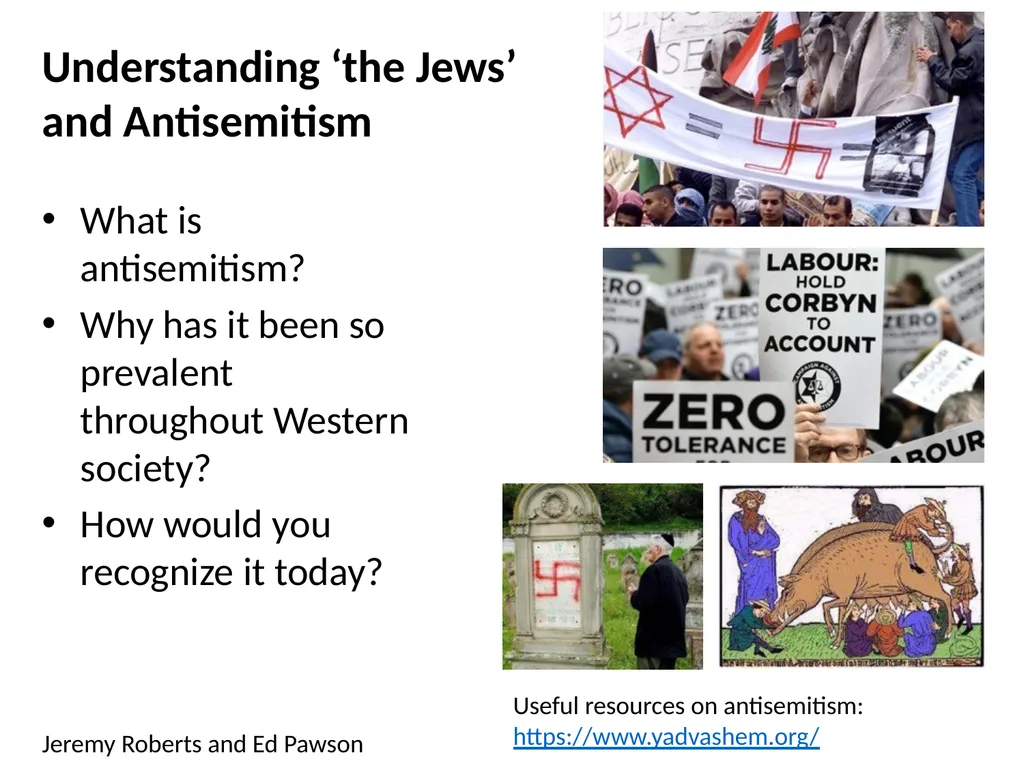
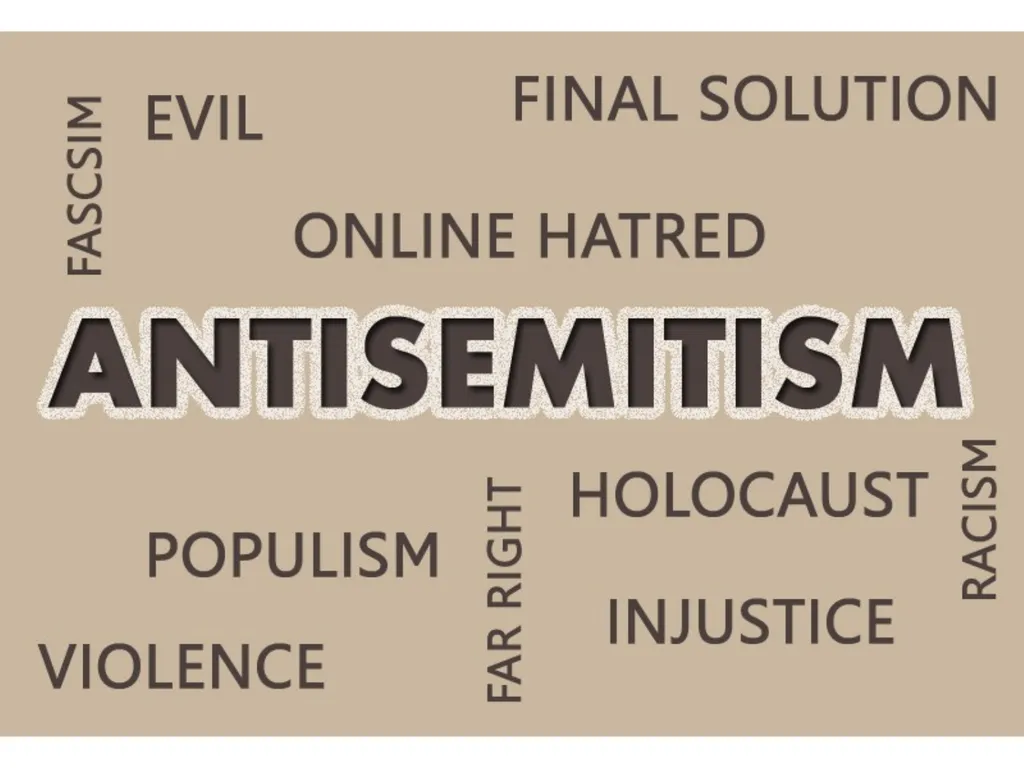
What is antisemitism? Why has it been so prevalent throughout Western society? How would you recognize it today? Jeremy Roberts and Ed Pawson Understanding the Jews and Antisemitism Useful resources on antisemitism:
"What is antisemitism? Why has it been so prevalent" is the property of its rightful owner. Permission is granted to
download and print the materials on this website for personal, non-commercial use only, and to display it
on your personal computer provided you do not modify the materials and that you retain all copyright
notices contained in the materials. By downloading content from our website, you accept the terms of this
agreement.
Presentation Transcript
01
What is antisemitism?
Why has it been so prevalent throughout Western society?
How would you recognize it today? Jeremy Roberts and Ed Pawson Understanding ‘the Jews’ and Antisemitism Useful resources on antisemitism: https://www.yadvashem.org/<br>
02
The term 'antisemitism’ was first coined in the late 1870s
Hebrew and Arabic belong to the Semitic language family
Therefore Jews are ‘Semites’
But, there is no such thing as ‘Semitism’
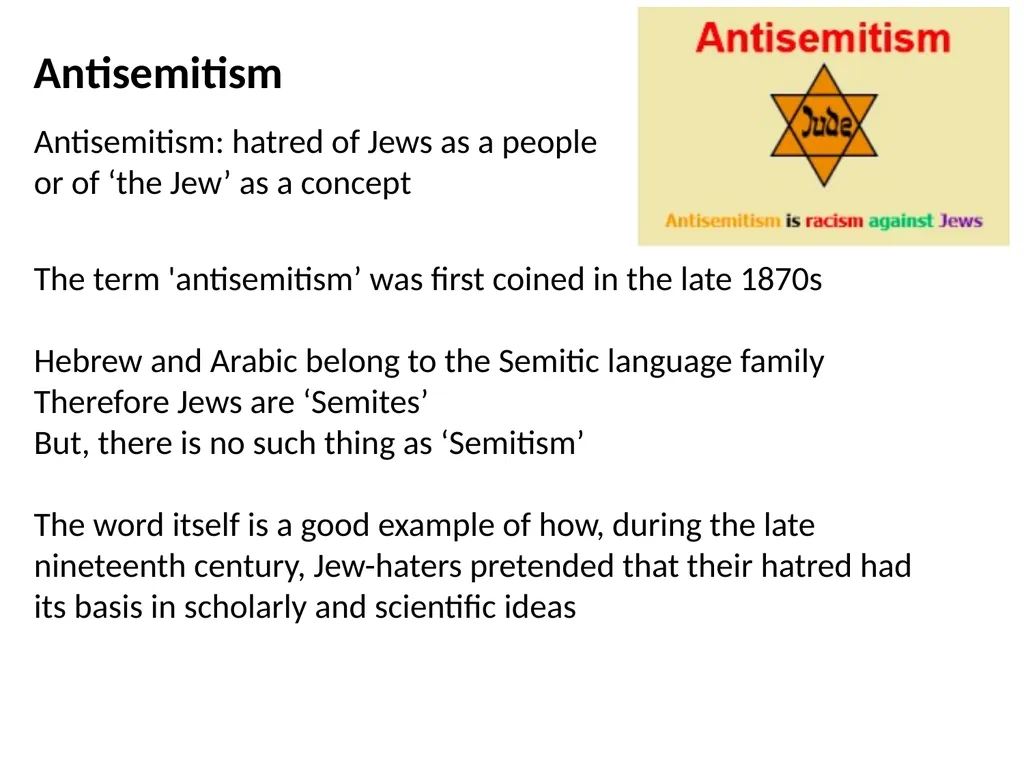
The word itself is a good example of how, during the late nineteenth century, Jew-haters pretended that their hatred had its basis in scholarly and scientific ideas Antisemitism Antisemitism: hatred of Jews as a people or of ‘the Jew’ as a concept<br>
03
Antisemitism today
It is a mistake to equate antisemitism only with yellow badges, concentration camps and gas chambers. Antisemitism takes many other forms today
Contemporary antisemitism is manifested through:
Religious anti-Jewish themes deriving from Christian and Islamic theological supersessionsim and supremacism
Racial antisemitism deriving from far Right ideologies, including Nazi and white supremacist ideologies
Political antisemitism disguised as anti-Zionism and the denial of Jewish peoplehood, history, rights and dignity, emanating from both the far Left and the far Right<br>
04
The origin of Jew-hatred (1)
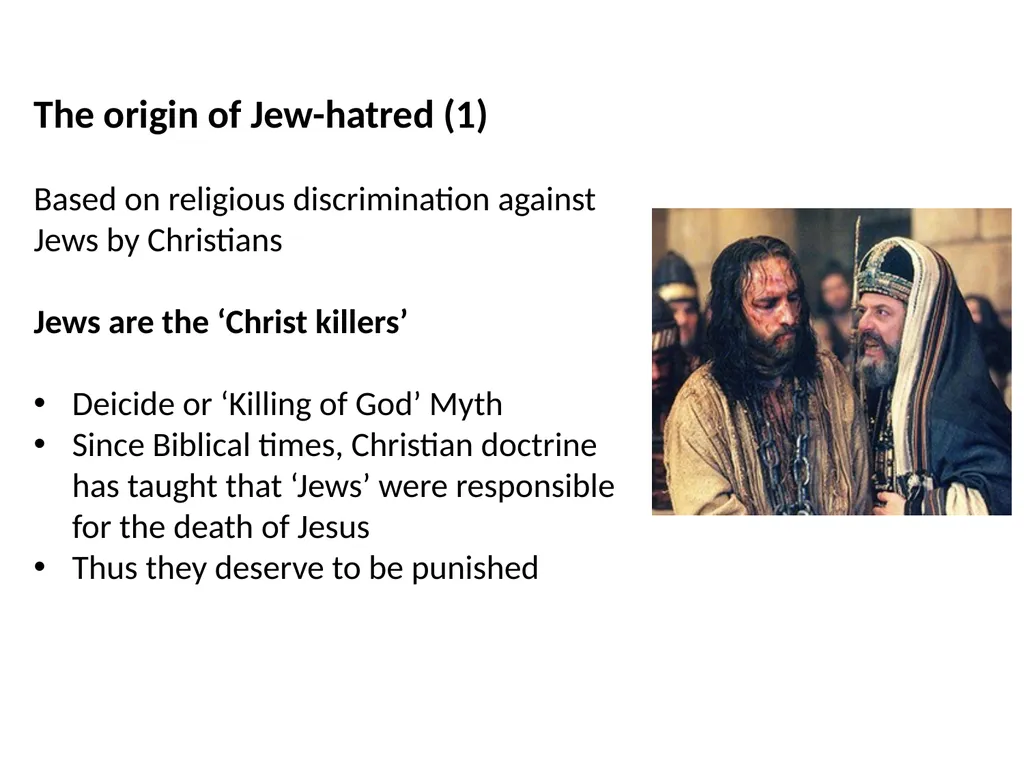
Based on religious discrimination against Jews by Christians
Jews are the ‘Christ killers’
Deicide or ‘Killing of God’ Myth
Since Biblical times, Christian doctrine has taught that ‘Jews’ were responsible for the death of Jesus
Thus they deserve to be punished<br>
05
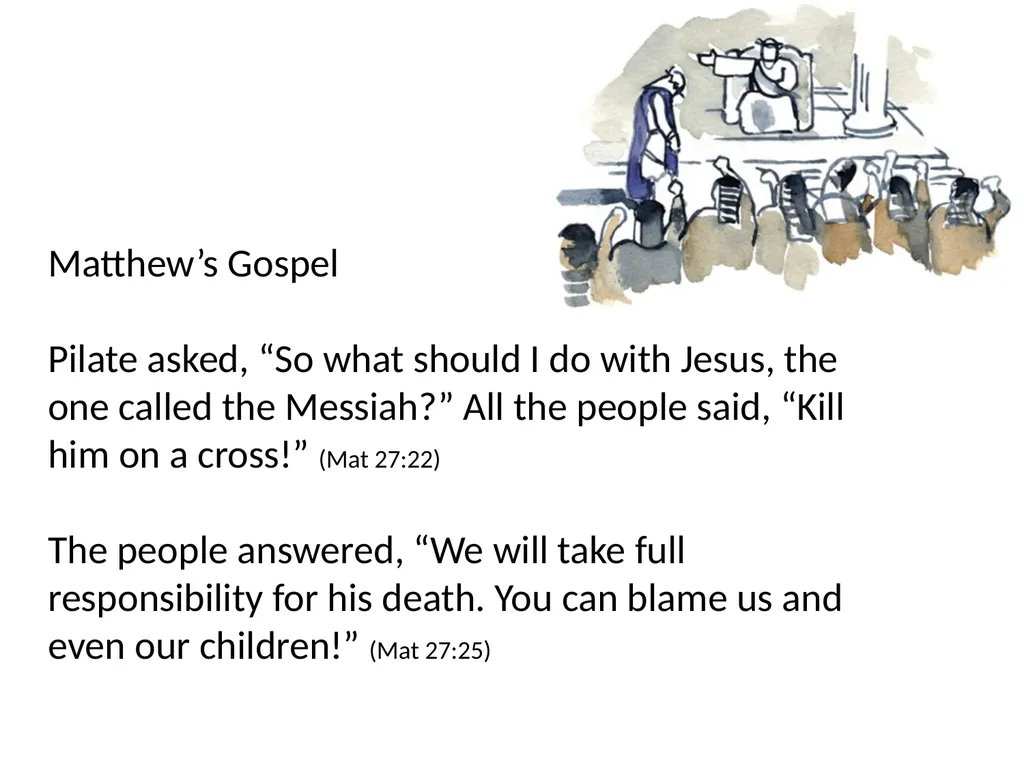
Matthew’s Gospel
Pilate asked, “So what should I do with Jesus, the one called the Messiah?” All the people said, “Kill him on a cross!” (Mat 27:22)
The people answered, “We will take full responsibility for his death. You can blame us and even our children!” (Mat 27:25)<br>
06
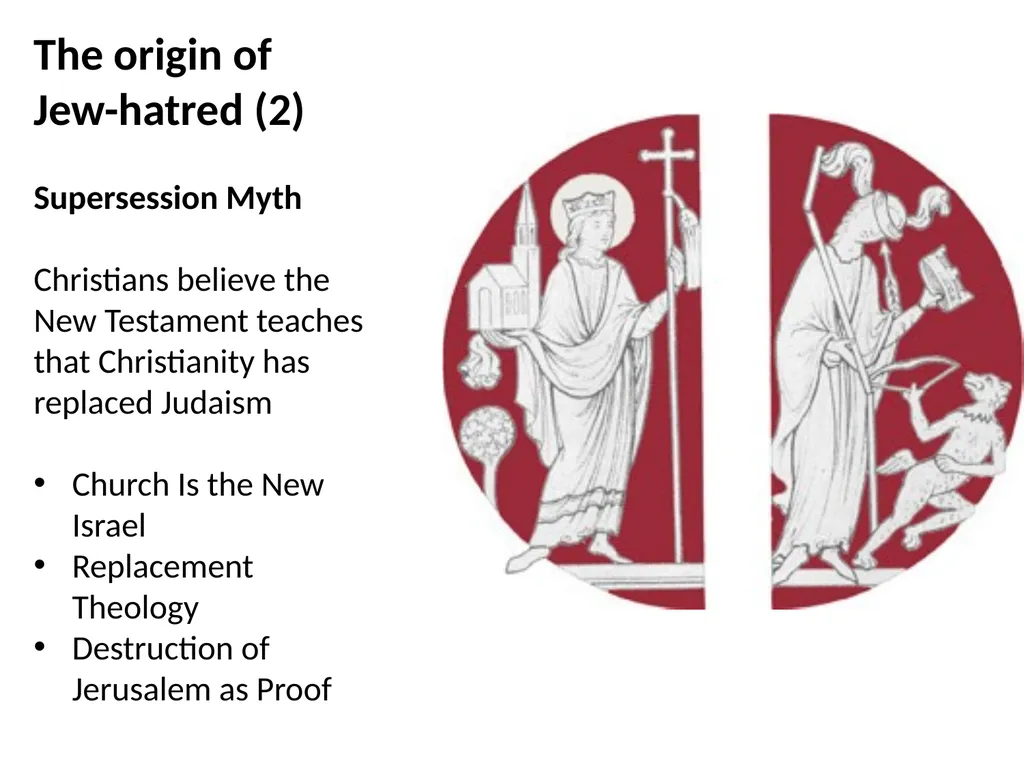
The origin of Jew-hatred (2)
Supersession Myth
Christians believe the New Testament teaches that Christianity has replaced Judaism
Church Is the New Israel
Replacement Theology
Destruction of Jerusalem as Proof<br>
07
If there was nothing wrong with the first covenant, then there would be no need for a second covenant. But God found something wrong with the people. (Hebrews 8:7)
God called this a new covenant, so he has made the first covenant old. And anything that is old and useless is ready to disappear. (Hebrews 8:13) The Book of Hebrews<br>
08
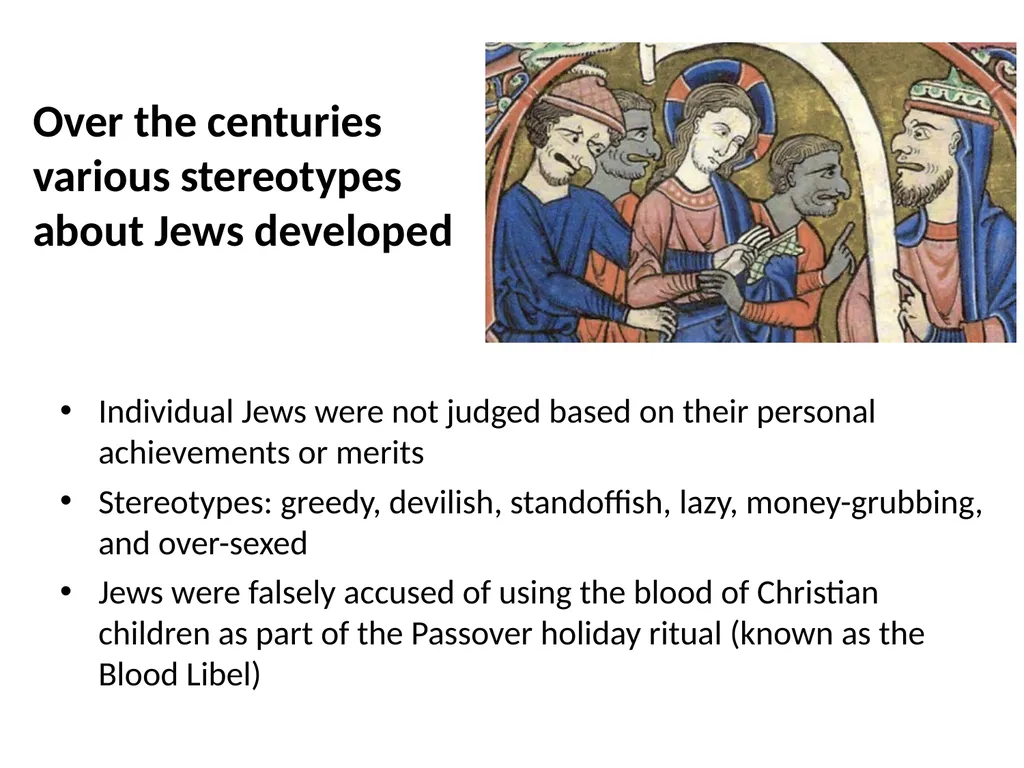
Individual Jews were not judged based on their personal achievements or merits
Stereotypes: greedy, devilish, standoffish, lazy, money-grubbing, and over-sexed
Jews were falsely accused of using the blood of Christian children as part of the Passover holiday ritual (known as the Blood Libel) Over the centuries various stereotypes about Jews developed<br>
09
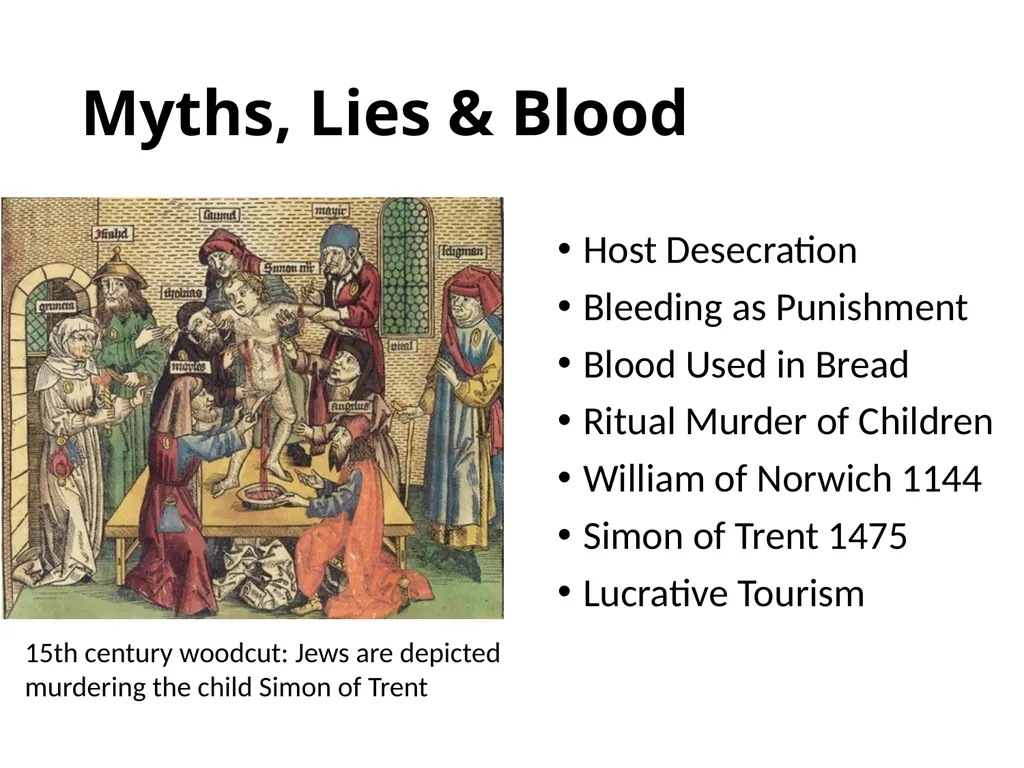
Myths, Lies & Blood Host Desecration
Bleeding as Punishment
Blood Used in Bread
Ritual Murder of Children
William of Norwich 1144
Simon of Trent 1475
Lucrative Tourism 15th century woodcut: Jews are depicted murdering the child Simon of Trent<br>
10
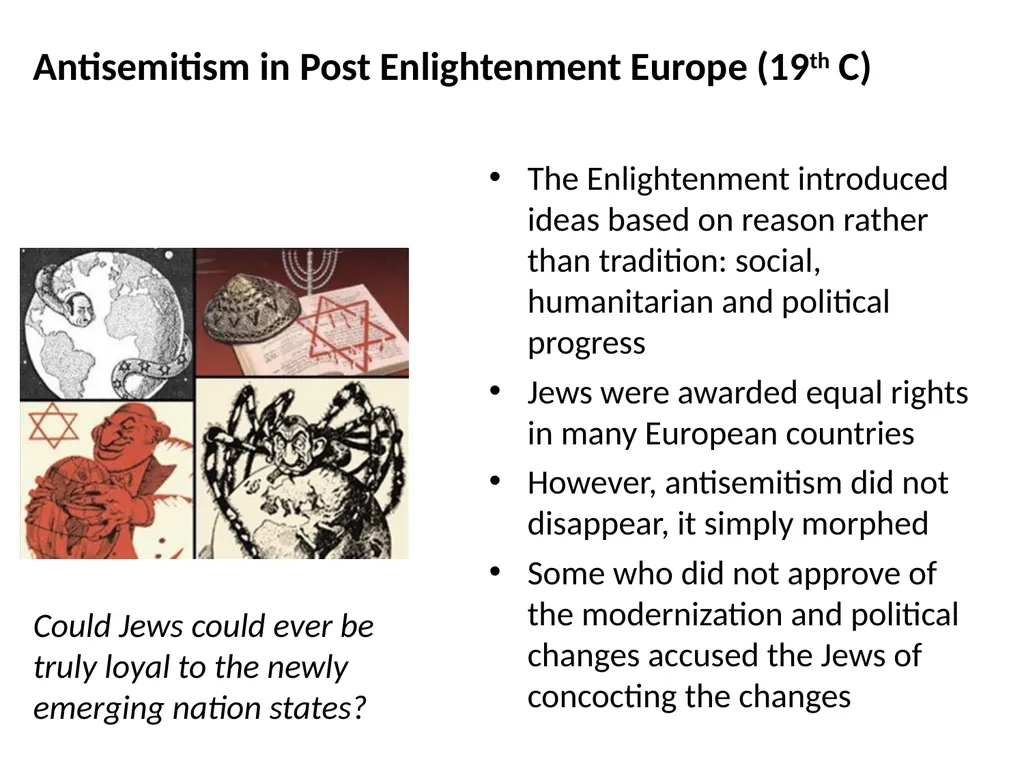
The Enlightenment introduced ideas based on reason rather than tradition: social, humanitarian and political progress
Jews were awarded equal rights in many European countries
However, antisemitism did not disappear, it simply morphed
Some who did not approve of the modernization and political changes accused the Jews of concocting the changes Antisemitism in Post Enlightenment Europe (19th C) Could Jews could ever be truly loyal to the newly emerging nation states?<br>
11
Racial Antisemitism
1870s saw the rise of ‘racial’ antisemitism
A distortion of Darwinist evolutionary theory
Jew haters began declaring that Jews were an inferior ‘race’
Since their problem was physical or genetic, it could never be changed, despite assimilation
Jews were responsible for the world's troubles because of their race and genetic composition<br>
12
France
The Dreyfus Affair (1890s)
Dreyfus was a Jewish army officer who was falsely accused of treason
He was sent to the penal colony of Devil’s Island (S America)
Later exonerated
For Theodor Herzl (founder of Zionism), this seemed to prove that assimilation was no defence against antisemitism. It lead him to the strong view that Zionism and the creation of a Jewish State could be the only solution to the problem of antisemitism<br>
13
Russia
Antisemitism was official government policy under the Czars
This led to numerous bloody pogroms
Many Jews played important roles in the Bolshevik Revolution (1917)
After the revolution Jews in Russia were granted equal rights
This gave antisemites throughout Europe another excuse to hate Jews—because Jews were now associated with the hated Communist enemy<br>
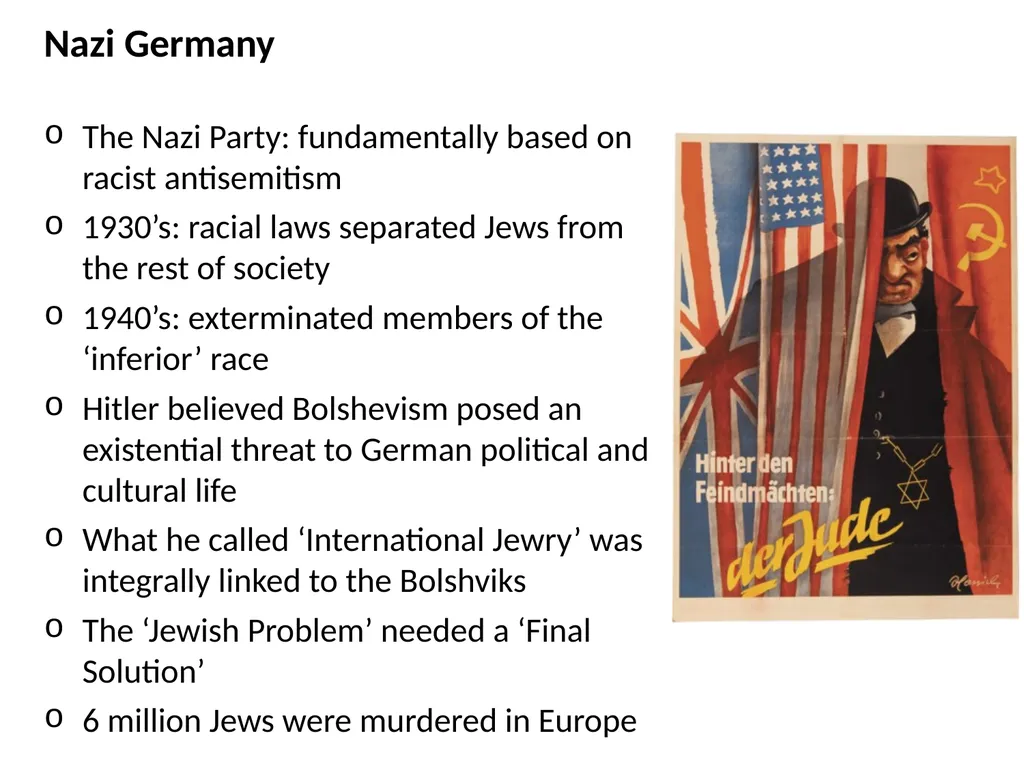
The Nazi Party: fundamentally based on racist antisemitism
1930’s: racial laws separated Jews from the rest of society
1940’s: exterminated members of the ‘inferior’ race
Hitler believed Bolshevism posed an existential threat to German political and cultural life
What he called ‘International Jewry’ was integrally linked to the Bolshviks
The ‘Jewish Problem’ needed a ‘Final Solution’
6 million Jews were murdered in Europe<br>
16
Nazi Collaborators
During WW2 Nazi collaborators in Eastern Europe and USSR (Poland, Baltic States, Belarus and Ukraine) were far more viciously antisemetic than German Nazi soldiers. The Einsatzgruppen troops followed the Nazi invasion of the East, murdering Jews by the 10s of 1000s<br>
17
After World War II
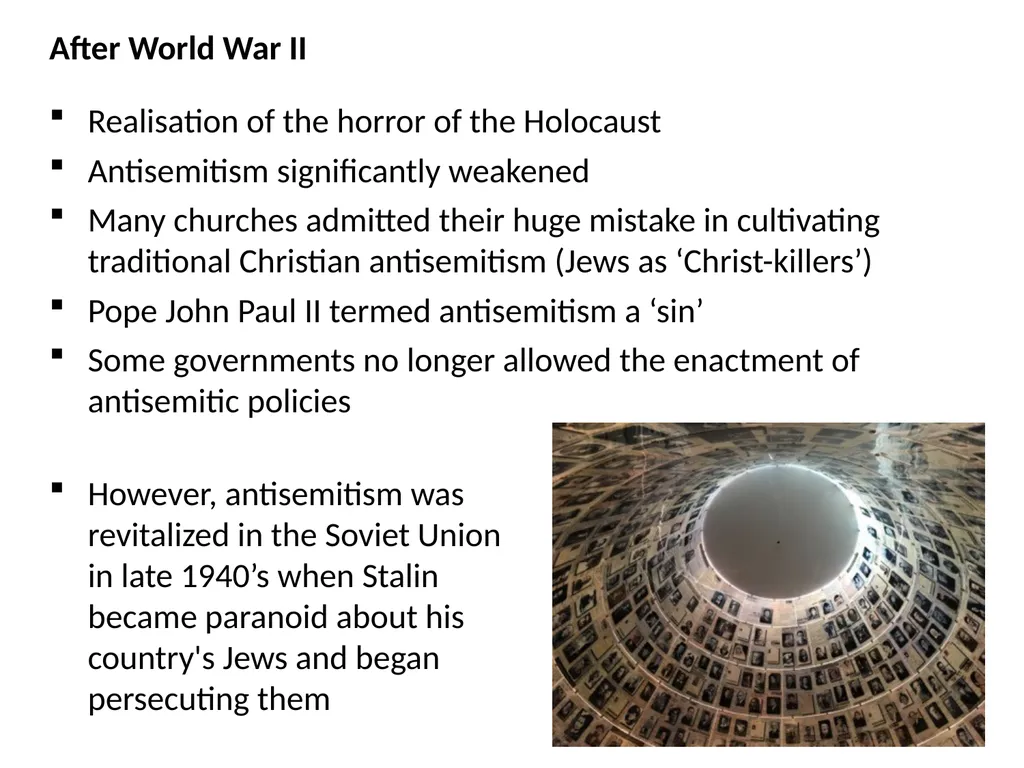
Realisation of the horror of the Holocaust
Antisemitism significantly weakened
Many churches admitted their huge mistake in cultivating traditional Christian antisemitism (Jews as ‘Christ-killers’)
Pope John Paul II termed antisemitism a ‘sin’
Some governments no longer allowed the enactment of antisemitic policies However, antisemitism was revitalized in the Soviet Union in late 1940’s when Stalin became paranoid about his country's Jews and began persecuting them<br>
18
Contemporary responses
Establishment of the State of Israel (1948)
Antisemites often camouflage their Jew-hatred in ‘anti- Zionism’
Muslims and leftists: acceptable to express antisemitic views?
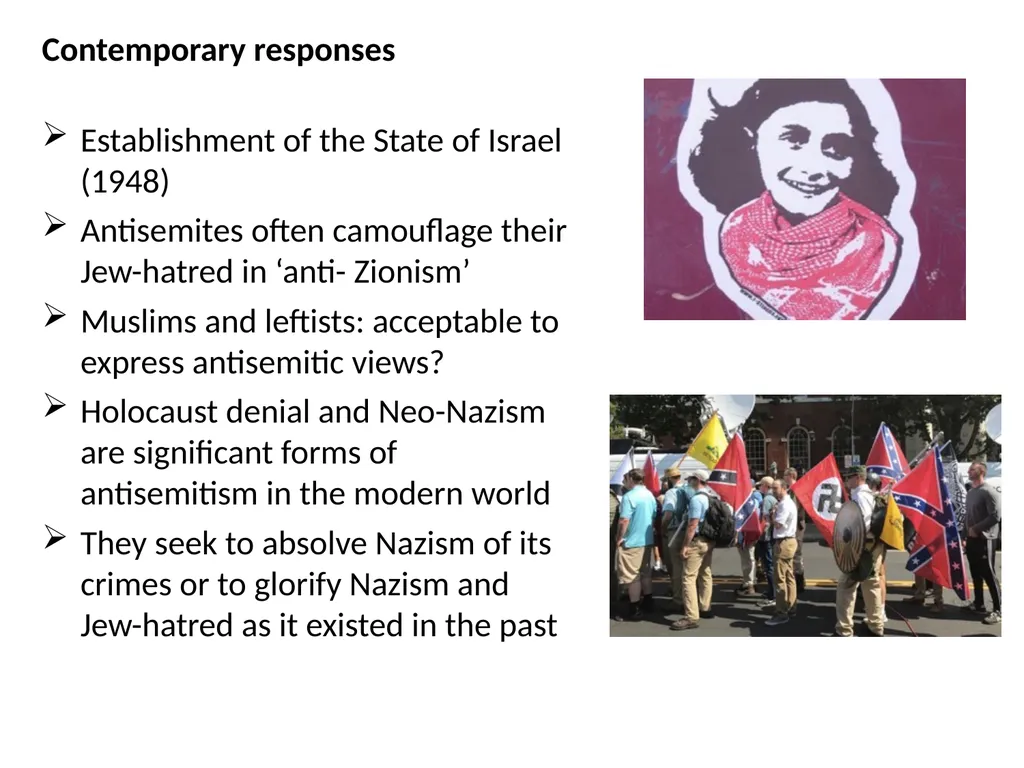
Holocaust denial and Neo-Nazism are significant forms of antisemitism in the modern world
They seek to absolve Nazism of its crimes or to glorify Nazism and Jew-hatred as it existed in the past<br>
19
It is the conspiracy theory perhaps most beloved by antisemitic anoraks the world over. First peddled in the mid 19th century, it's now nearly 200 years and the myth that the Rothschild family – having plotted and profited from wars, caused the Holocaust and arranged the assassination of political opponents – secretly control the global economy is still going strong (Jewish Chronicle 2017)<br>
20
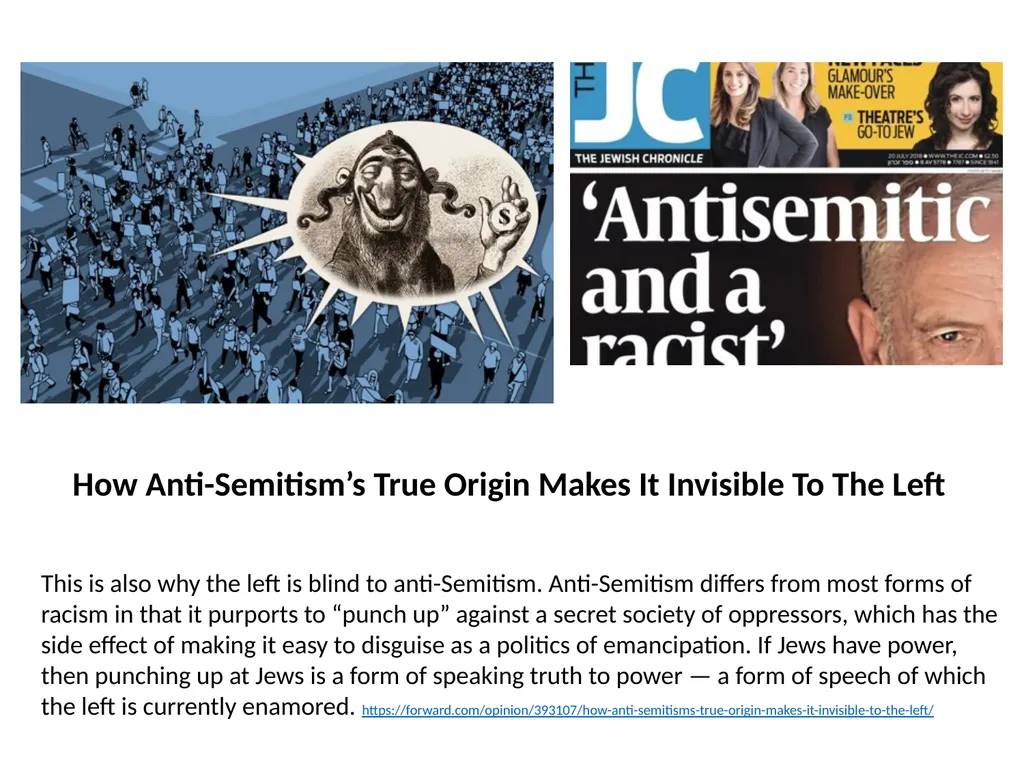
How Anti-Semitism’s True Origin Makes It Invisible To The Left This is also why the left is blind to anti-Semitism. Anti-Semitism differs from most forms of racism in that it purports to “punch up” against a secret society of oppressors, which has the side effect of making it easy to disguise as a politics of emancipation. If Jews have power, then punching up at Jews is a form of speaking truth to power — a form of speech of which the left is currently enamored. https://forward.com/opinion/393107/how-anti-semitisms-true-origin-makes-it-invisible-to-the-left/<br>
21
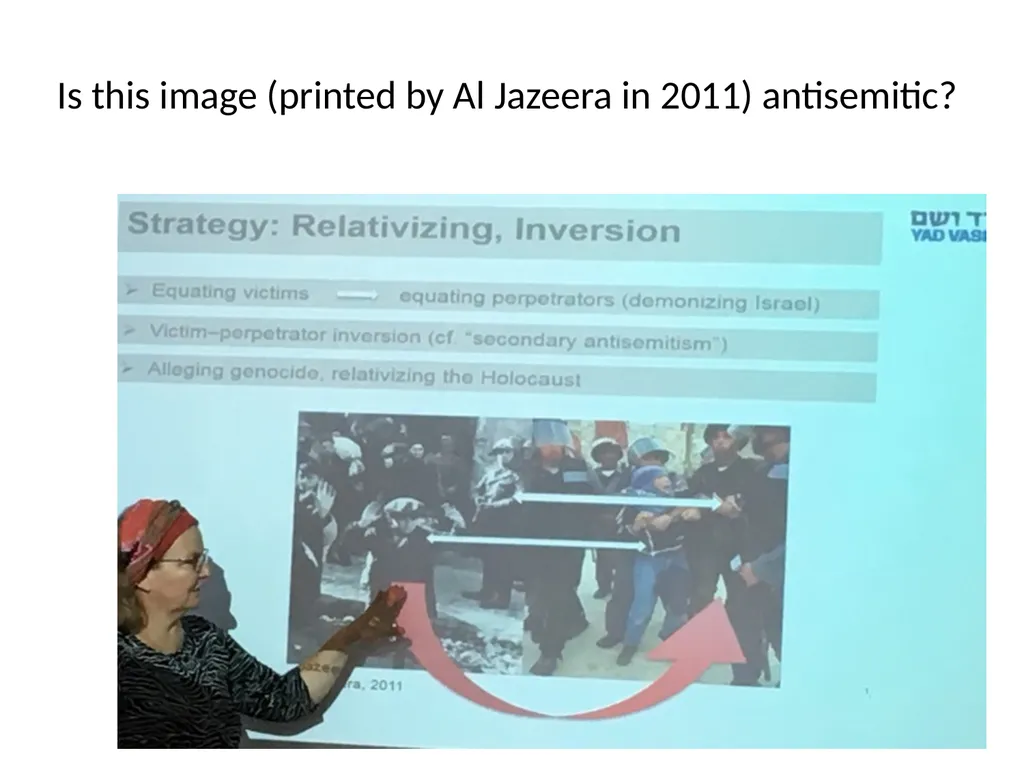
Is this image (printed by Al Jazeera in 2011) antisemitic?<br>
22
Can we equate the suffering of the Palestinian people to the horror of the Holocaust?<br>
23
What is the ‘Jewish problem’?
Is there something unique about antisemitism, or is it just a symptom of a ‘general illness’? (Professor Bauer)<br>