Where weve come so far Animal Behavior Core Concepts: Tinbergens four categories of explanation Proximate and ultimate Individual, kin, and group selection Genes and experience Correlation versus causation Constraints on Evolution Animal
"Where we’ve come so far… Animal Behavior Core" is the property of its rightful owner. Permission is granted to
download and print the materials on this website for personal, non-commercial use only, and to display it
on your personal computer provided you do not modify the materials and that you retain all copyright
notices contained in the materials. By downloading content from our website, you accept the terms of this
agreement.
Presentation Transcript
01
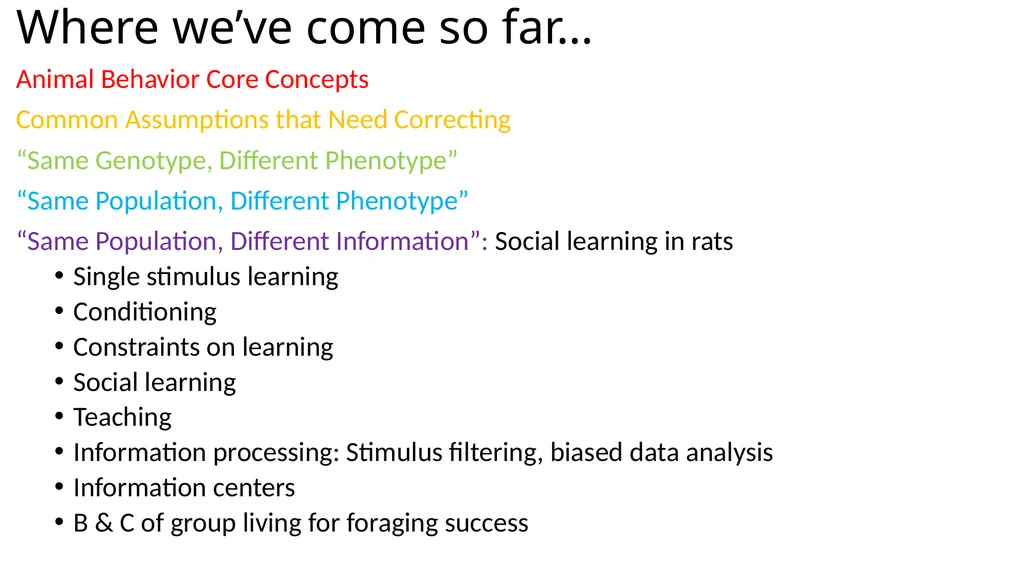
Where we’ve come so far… Animal Behavior Core Concepts:
Tinbergen’s four categories of explanation
Proximate and ultimate
Individual, kin, and group selection
Genes and experience
Correlation versus causation
Constraints on Evolution
Animal Behavior methodologies
Experimental Design; Ethics; Avoiding the Deadly Sins<br>
02
Where we’ve come so far… Animal Behavior Core Concepts
Common Assumptions that Need Correcting:
Assuming evolution and natural selection are directional or purposeful
Assuming we know the purpose of a phenotype (or why it evolved)
Anthropomorphic assumptions and use of metaphors
Assuming animals perceive the world the same way we do (Umwelt)
Assuming animals are not affected by our presence
Assumptions about sex roles<br>
03
Where we’ve come so far… Animal Behavior Core Concepts
Common Assumptions that Need Correcting
“Same Genotype, Different Phenotype”: Epigenetic effects on behavior
Central Dogma
Interactions between gene expression, nervous system, endocrine system, and behavior
Single gene effects (e.g., voles)
Quantitative trait loci (behaviors affected by multiple genes)
Inheritance
Epigenetics
Phenotypic plasticity
Environmental sex determination and sex change<br>
04
Where we’ve come so far… Animal Behavior Core Concepts
Common Assumptions that Need Correcting
“Same Genotype, Different Phenotype”
“Same Population, Different Phenotype”: Ruff male polymorphisms
Mating Systems
B and C in Behavioral Ecology
Polymorphisms
Alternative reproductive strategies
Condition-dependent and genetically determined (e.g., Supergene) alternative strategies
Maintenance of genetically-determined alternative strategies
Developmental flexibility vs. developmental stability
Behavioral syndromes (animal personalities)<br>
05
Where we’ve come so far… Animal Behavior Core Concepts
Common Assumptions that Need Correcting
“Same Genotype, Different Phenotype”
“Same Population, Different Phenotype”
“Same Population, Different Information”: Social learning in rats
Single stimulus learning
Conditioning
Constraints on learning
Social learning
Teaching
Information processing: Stimulus filtering, biased data analysis
Information centers
B & C of group living for foraging success<br>
06
Where we are now: Animal Behavior Core Concepts
Common Assumptions that Need Correcting
“Same Genotype, Different Phenotype”
“Same Population, Different Phenotype”
“Same Population, Different Information”
“Same Population, Different Interests”: Conflict between Conspecifics<br>
07
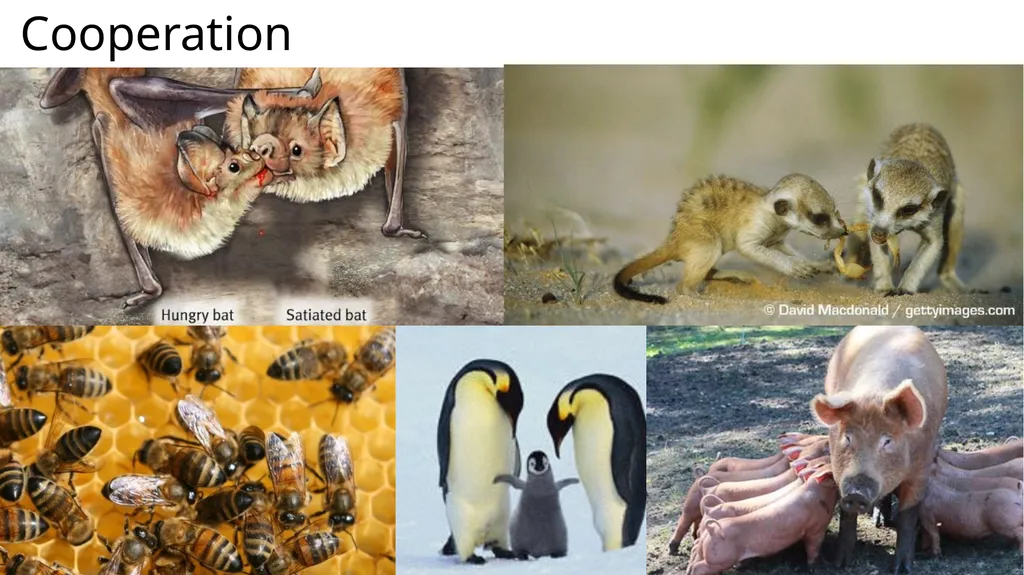
Cooperation<br>
08
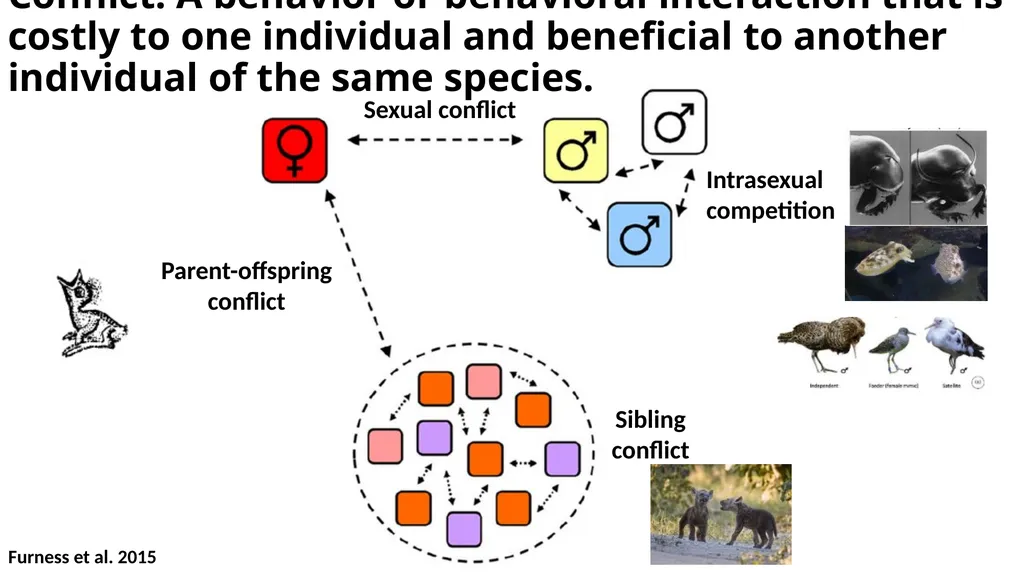
Intrasexual
competition Sexual conflict Parent-offspring
conflict Sibling
conflict Furness et al. 2015 Conflict: A behavior or behavioral interaction that is costly to one individual and beneficial to another individual of the same species. Furness et al. 2015<br>