
. While you are settling in: please turn to
MY
Published · 91 slides · 0 views
1 / 1







Description
. While you are settling in: please turn to section 3 of your workbook, and complete question 1 of the evaluation form. Train the trainer Supporting social workers working with people with care and support needs who are experiencing
Related Topics
Share
Embed code
Download this presentation From Below
". While you are settling in: please turn to" is the property of its rightful owner. Permission is granted to download and print the materials on this website for personal, non-commercial use only, and to display it on your personal computer provided you do not modify the materials and that you retain all copyright notices contained in the materials. By downloading content from our website, you accept the terms of this agreement.
Presentation Transcript
01
. While you are settling in: please turn to section 3 of your workbook, and complete question 1 of the evaluation form. Train the trainer
Supporting social workers working with people with care and support
needs who are experiencing controlling or coercive behaviour Please sign the registration form. Take one of the handbooks on your table and pair up with someone to discuss and complete the 10 multiple choice questions at the beginning of the book.
These will be used to inform a discussion at the start of the training.
Please also complete Q1 only of the evaluation<br>
Supporting social workers working with people with care and support
needs who are experiencing controlling or coercive behaviour Please sign the registration form. Take one of the handbooks on your table and pair up with someone to discuss and complete the 10 multiple choice questions at the beginning of the book.
These will be used to inform a discussion at the start of the training.
Please also complete Q1 only of the evaluation<br>
02
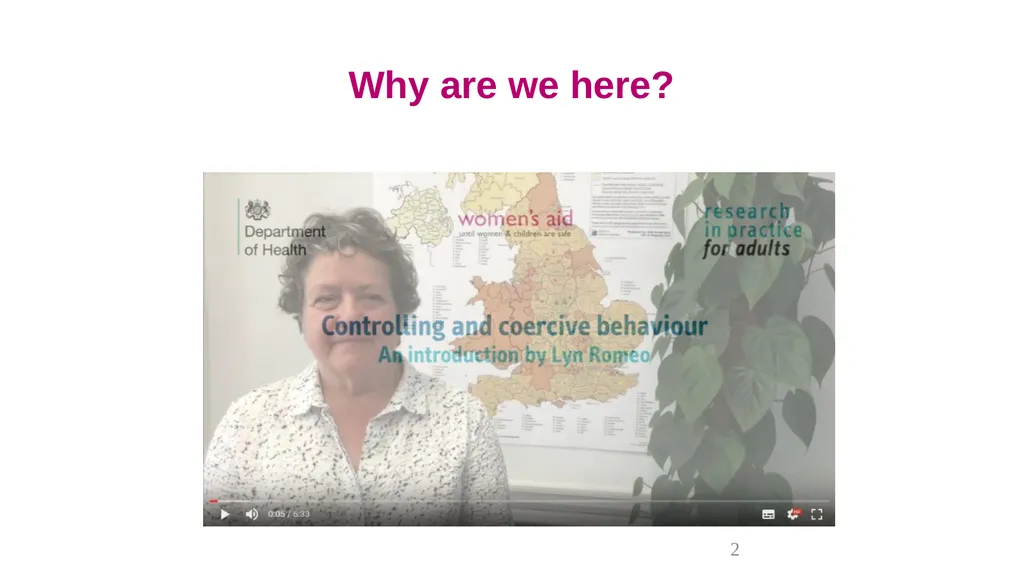
Why are we here? 2<br>
03
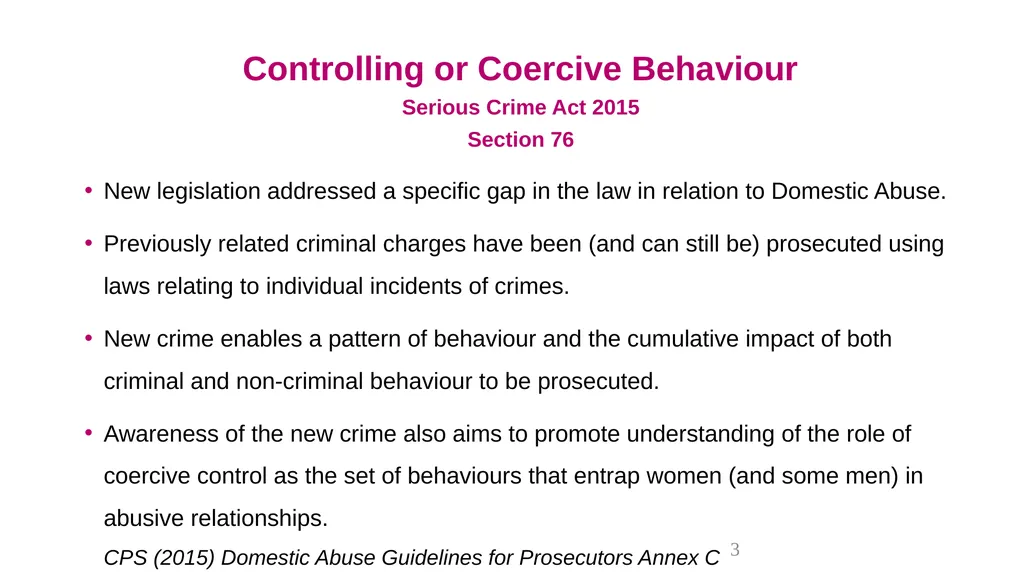
Controlling or Coercive Behaviour
Serious Crime Act 2015
Section 76
New legislation addressed a specific gap in the law in relation to Domestic Abuse.
Previously related criminal charges have been (and can still be) prosecuted using laws relating to individual incidents of crimes.
New crime enables a pattern of behaviour and the cumulative impact of both criminal and non-criminal behaviour to be prosecuted.
Awareness of the new crime also aims to promote understanding of the role of coercive control as the set of behaviours that entrap women (and some men) in abusive relationships. CPS (2015) Domestic Abuse Guidelines for Prosecutors Annex C 3<br>
Serious Crime Act 2015
Section 76
New legislation addressed a specific gap in the law in relation to Domestic Abuse.
Previously related criminal charges have been (and can still be) prosecuted using laws relating to individual incidents of crimes.
New crime enables a pattern of behaviour and the cumulative impact of both criminal and non-criminal behaviour to be prosecuted.
Awareness of the new crime also aims to promote understanding of the role of coercive control as the set of behaviours that entrap women (and some men) in abusive relationships. CPS (2015) Domestic Abuse Guidelines for Prosecutors Annex C 3<br>
04
Where else is coercive control referred to in law? March 2016 statutory guidance in relation to sections 42-46 of the Care Act (2014)
April 2016 guidance in relation to section 7 of the Social Services and Well-Being Act Wales (2014)
This means that a local authority’s duty to make (or ask others to make) safeguarding enquires and determine what action is needed to protect “an adult at risk” are triggered by “reasonable cause to suspect” that an adult with health and social care needs is experiencing coercive control (where their needs prevent them from protecting themselves).
Department of Health (2016) Care Act Statutory Guidance 4<br>
April 2016 guidance in relation to section 7 of the Social Services and Well-Being Act Wales (2014)
This means that a local authority’s duty to make (or ask others to make) safeguarding enquires and determine what action is needed to protect “an adult at risk” are triggered by “reasonable cause to suspect” that an adult with health and social care needs is experiencing coercive control (where their needs prevent them from protecting themselves).
Department of Health (2016) Care Act Statutory Guidance 4<br>
05
What doesn't it cover? The use of coercive control in other relationships that might be referred as safeguarding concerns; for example:
Within institutions such as hospitals or care homes
By care staff working in a person’s own home
“New friends”/mate crime
Bullying at work. 5<br>
Within institutions such as hospitals or care homes
By care staff working in a person’s own home
“New friends”/mate crime
Bullying at work. 5<br>
06
Safeguarding Adults and Coercive Control The statutory guidance in relation to the offence of controlling or coercive behaviour states that it should be dealt with as part of adult and/or child safeguarding and public protection procedures.
Government strategy recognises that tackling domestic abuse is a cross-departmental and multi-agency responsibility 6<br>
Government strategy recognises that tackling domestic abuse is a cross-departmental and multi-agency responsibility 6<br>
07
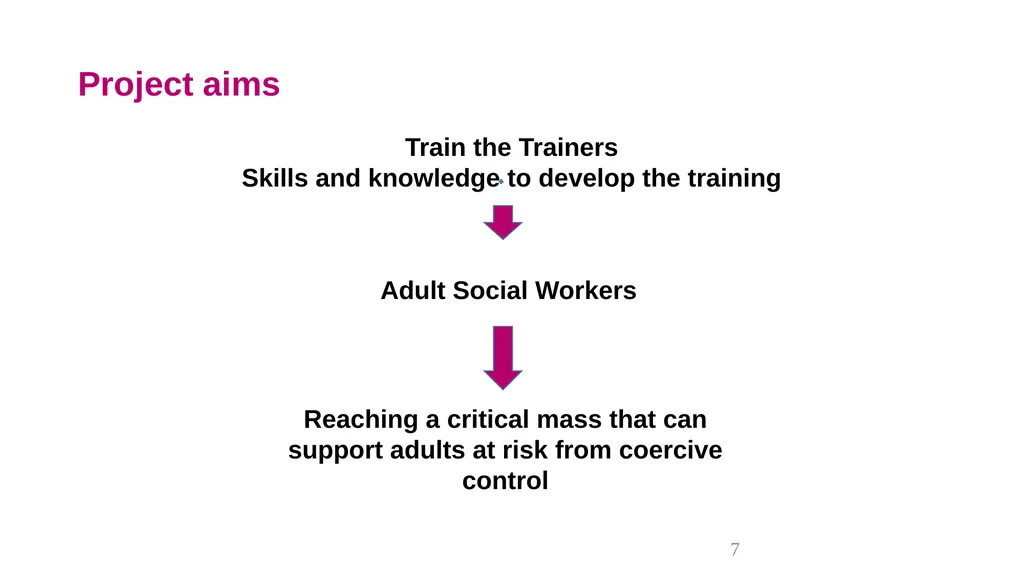
Project aims 7 Train the Trainers
Skills and knowledge to develop the training Reaching a critical mass that can support adults at risk from coercive control Adult Social Workers<br>
Skills and knowledge to develop the training Reaching a critical mass that can support adults at risk from coercive control Adult Social Workers<br>
08
Objectives Following attendance on this training, attendees will be able to:
Describe and critically analyse models of the use of power and control in intimate relationships within a broader social context
Describe the role of coercive control within domestic abuse
Describe the key knowledge and skills that social workers will need to use in working with coercive control of people with social care needs
Describe the theoretical underpinnings of intersectionality of disability, race, sexuality and other protected characteristics in relation to power and control
Use the materials on coercive control hosted on a new web resource/microsite to cascade learning and development to colleagues.
Evaluation Q 1 8<br>
Describe and critically analyse models of the use of power and control in intimate relationships within a broader social context
Describe the role of coercive control within domestic abuse
Describe the key knowledge and skills that social workers will need to use in working with coercive control of people with social care needs
Describe the theoretical underpinnings of intersectionality of disability, race, sexuality and other protected characteristics in relation to power and control
Use the materials on coercive control hosted on a new web resource/microsite to cascade learning and development to colleagues.
Evaluation Q 1 8<br>
09
Today Knowledge and confidence increased - coercive and controlling behaviour
Share the materials
Share experiences
Microsite
Opportunity to plan how you might use them
Find buddies 9<br>
Share the materials
Share experiences
Microsite
Opportunity to plan how you might use them
Find buddies 9<br>
10
What this course can and can't do It can:
Give you a good understanding of coercive control and what the social work response to it should look like
Signpost you to further CPD materials which will support you and colleagues to practice in this area
It can't:
Sign attendees off as competent practitioners in delivering this training.
You will need to:
Use the microsite for further reading
Link with specialist DV providers
Consider co-training with someone with more expertise (specialist trainers) 10<br>
Give you a good understanding of coercive control and what the social work response to it should look like
Signpost you to further CPD materials which will support you and colleagues to practice in this area
It can't:
Sign attendees off as competent practitioners in delivering this training.
You will need to:
Use the microsite for further reading
Link with specialist DV providers
Consider co-training with someone with more expertise (specialist trainers) 10<br>
11
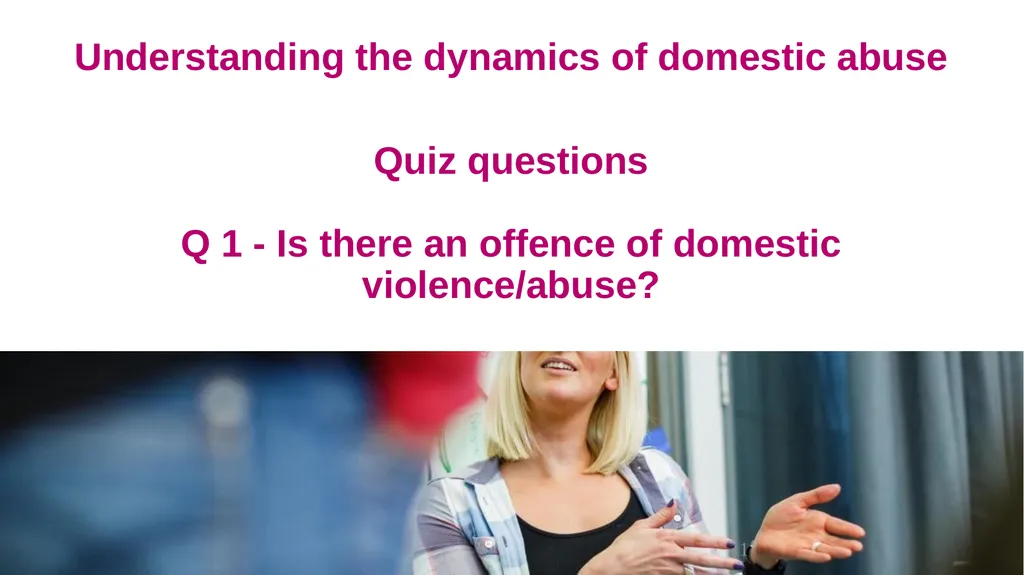
Understanding the dynamics of domestic abuse
Quiz questions
Q 1 - Is there an offence of domestic violence/abuse? 11<br>
12
(Q 2) - What is Lenore Walker's 'cycle of violence'? (C)
Psychologist Lenore Walker's 'Cycle of abuse' (1979) Found that many violent relationships follow a common pattern or cycle. The entire cycle may happen in one day or it may take weeks or months. It is different for every relationship and not all relationships follow the cycle—many report a constant stage of siege with little relief.
Tension building phase
Walking on eggshells/appeasing and pleasing
Acute battering episode
unpredictable and out of abusers control
The honeymoon phase
Apologies, acts of kindness, promises to change
Cycle continues over and over
May help to explain why victims stay in abusive relationships 12<br>
Tension building phase
Walking on eggshells/appeasing and pleasing
Acute battering episode
unpredictable and out of abusers control
The honeymoon phase
Apologies, acts of kindness, promises to change
Cycle continues over and over
May help to explain why victims stay in abusive relationships 12<br>
13
(Q 3) What is the Duluth Power and Control Wheel? (B)
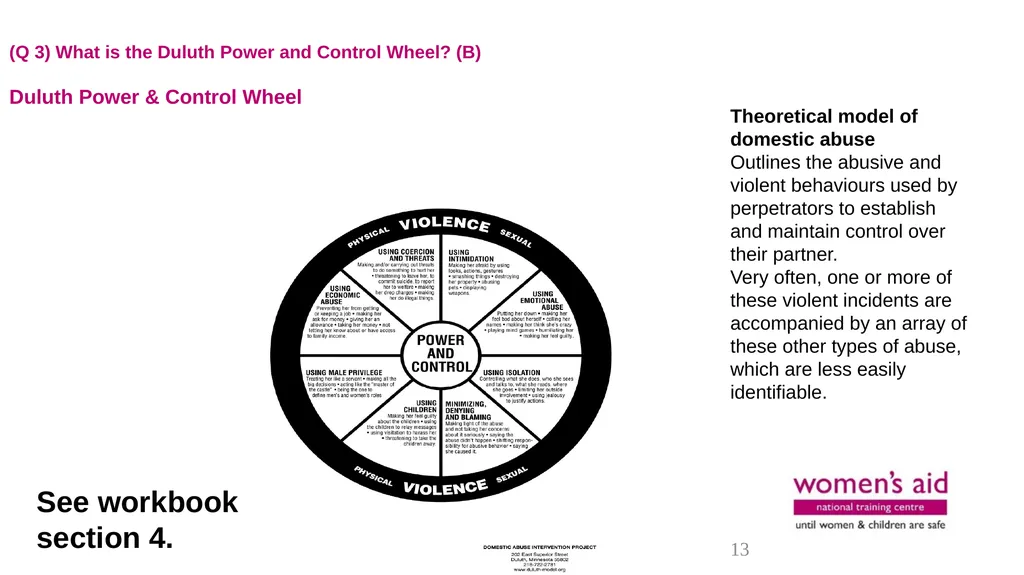
Duluth Power & Control Wheel See workbook section 4. 13 Theoretical model of domestic abuse
Outlines the abusive and violent behaviours used by perpetrators to establish and maintain control over their partner.
Very often, one or more of these violent incidents are accompanied by an array of these other types of abuse, which are less easily identifiable.<br>
Outlines the abusive and violent behaviours used by perpetrators to establish and maintain control over their partner.
Very often, one or more of these violent incidents are accompanied by an array of these other types of abuse, which are less easily identifiable.<br>
14
Criticisms: Doesn’t show how domestic abuse is situated in a broader social & cultural context
Doesn’t show how agencies, organisations and culture tend not to hold perpetrators of abuse accountable
Doesn’t show how we as members of society and as practitioners can be involved in re-victimising survivors of domestic abuse, (i.e. be involved in ‘secondary abuse’). 14<br>
Doesn’t show how agencies, organisations and culture tend not to hold perpetrators of abuse accountable
Doesn’t show how we as members of society and as practitioners can be involved in re-victimising survivors of domestic abuse, (i.e. be involved in ‘secondary abuse’). 14<br>
15
Duluth Abuse Intervention Project (Q 4) What is the extended Power and Control Wheel? (B)
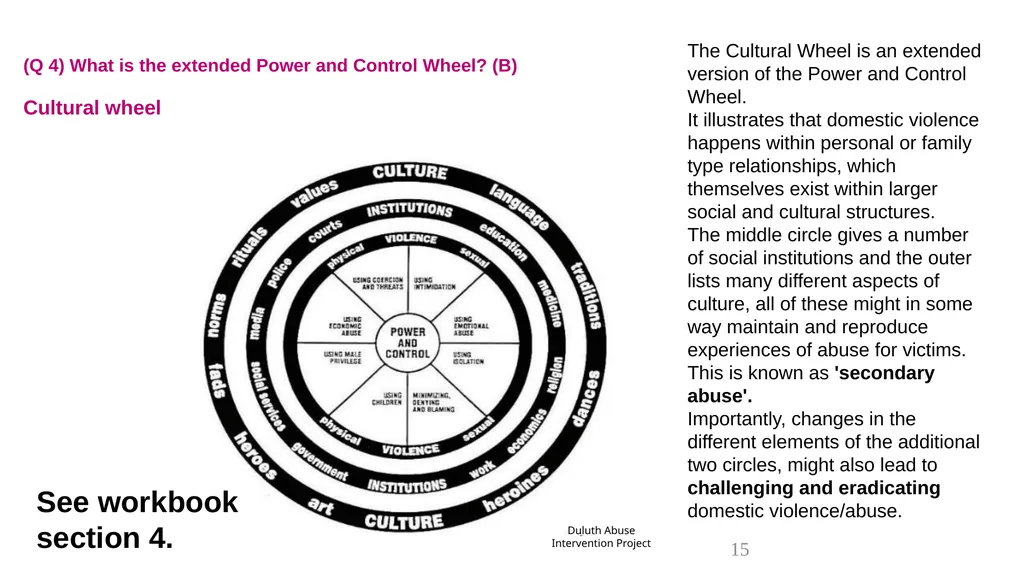
Cultural wheel See workbook section 4. 15 The Cultural Wheel is an extended version of the Power and Control Wheel.
It illustrates that domestic violence happens within personal or family type relationships, which themselves exist within larger social and cultural structures.
The middle circle gives a number of social institutions and the outer lists many different aspects of culture, all of these might in some way maintain and reproduce experiences of abuse for victims.
This is known as 'secondary abuse'.
Importantly, changes in the different elements of the additional two circles, might also lead to challenging and eradicating domestic violence/abuse.<br>
It illustrates that domestic violence happens within personal or family type relationships, which themselves exist within larger social and cultural structures.
The middle circle gives a number of social institutions and the outer lists many different aspects of culture, all of these might in some way maintain and reproduce experiences of abuse for victims.
This is known as 'secondary abuse'.
Importantly, changes in the different elements of the additional two circles, might also lead to challenging and eradicating domestic violence/abuse.<br>
16
Criticism: The power and control wheels, including the extended cultural wheel, do not show sufficiently how gender can be combined with other social sources of power, such as:
‘Race’
Disability
Age
Sexuality
Immigration status etc. 16<br>
‘Race’
Disability
Age
Sexuality
Immigration status etc. 16<br>
17
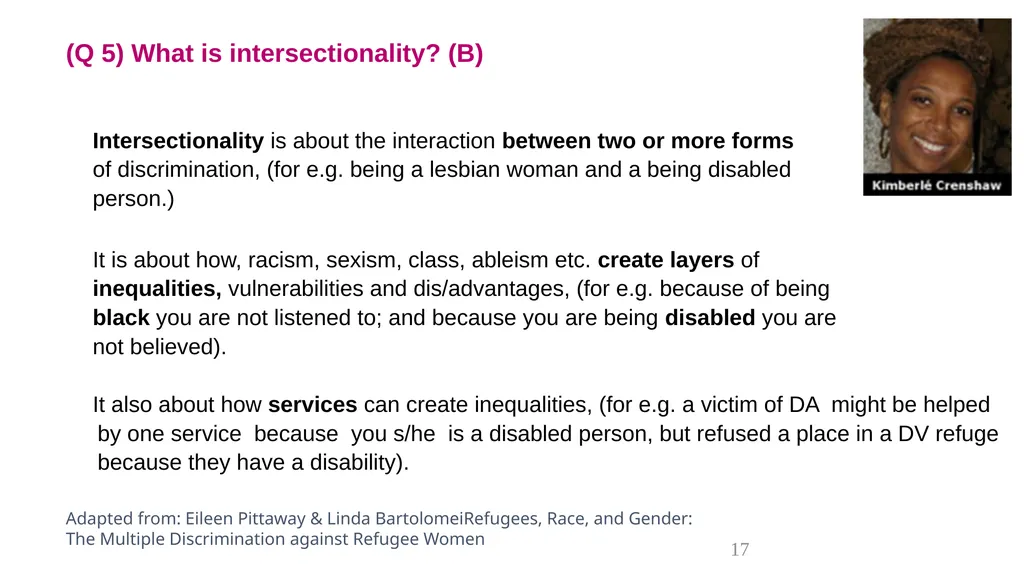
(Q 5) What is intersectionality? (B) Intersectionality is about the interaction between two or more forms
of discrimination, (for e.g. being a lesbian woman and a being disabled
person.)
It is about how, racism, sexism, class, ableism etc. create layers of
inequalities, vulnerabilities and dis/advantages, (for e.g. because of being
black you are not listened to; and because you are being disabled you are
not believed).
It also about how services can create inequalities, (for e.g. a victim of DA might be helped by one service because you s/he is a disabled person, but refused a place in a DV refuge because they have a disability). Adapted from: Eileen Pittaway & Linda BartolomeiRefugees, Race, and Gender:
The Multiple Discrimination against Refugee Women 17<br>
of discrimination, (for e.g. being a lesbian woman and a being disabled
person.)
It is about how, racism, sexism, class, ableism etc. create layers of
inequalities, vulnerabilities and dis/advantages, (for e.g. because of being
black you are not listened to; and because you are being disabled you are
not believed).
It also about how services can create inequalities, (for e.g. a victim of DA might be helped by one service because you s/he is a disabled person, but refused a place in a DV refuge because they have a disability). Adapted from: Eileen Pittaway & Linda BartolomeiRefugees, Race, and Gender:
The Multiple Discrimination against Refugee Women 17<br>
18
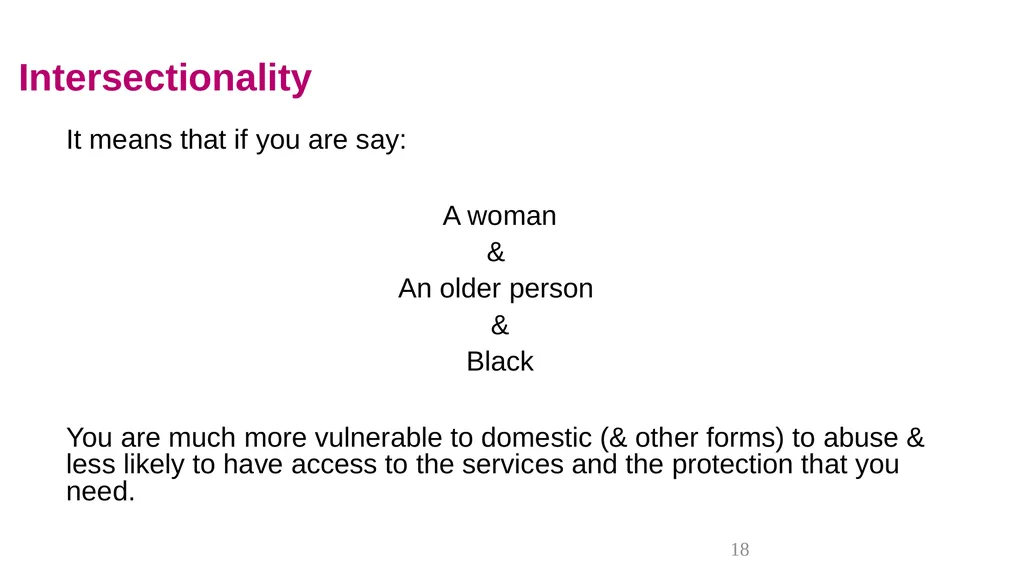
Intersectionality It means that if you are say:
A woman
&
An older person
&
Black
You are much more vulnerable to domestic (& other forms) to abuse & less likely to have access to the services and the protection that you need. 18<br>
A woman
&
An older person
&
Black
You are much more vulnerable to domestic (& other forms) to abuse & less likely to have access to the services and the protection that you need. 18<br>
19
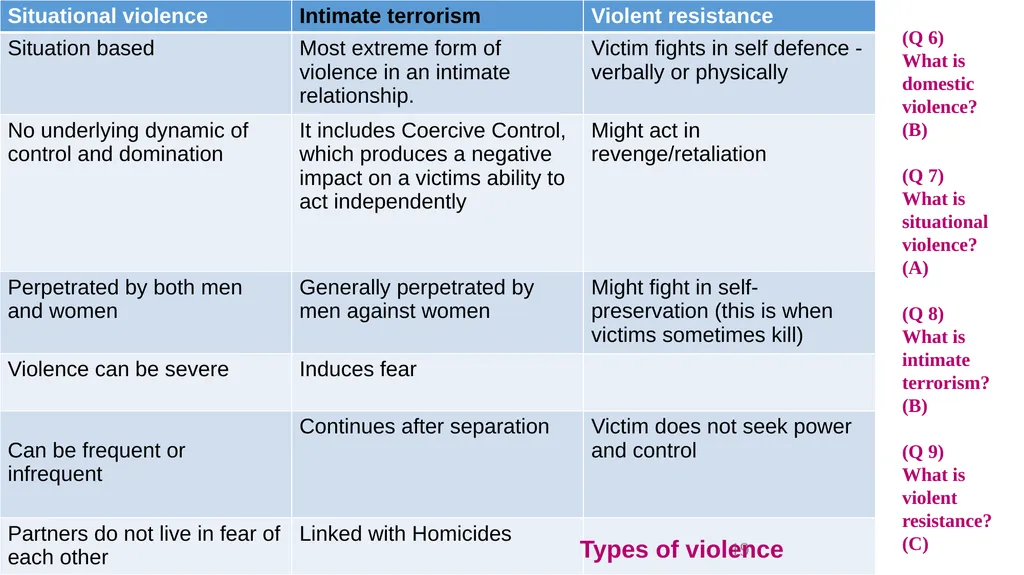
19 Types of violence (Q 6)
What is domestic violence?
(B)
(Q 7)
What is situational violence?
(A)
(Q 8)
What is intimate terrorism?
(B)
(Q 9)
What is violent resistance?
(C)<br>
What is domestic violence?
(B)
(Q 7)
What is situational violence?
(A)
(Q 8)
What is intimate terrorism?
(B)
(Q 9)
What is violent resistance?
(C)<br>
20
'Losing out on both counts',
Disabled women and domestic violence (2016)
Dr. Ravi K. Thiara
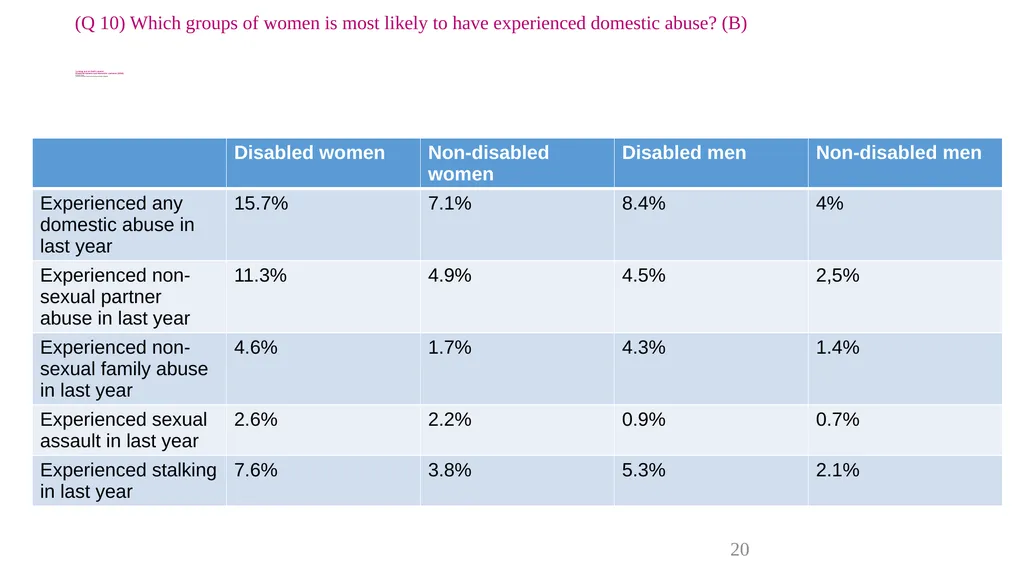
Centre for the study of safety and well-being, University of Warwick 20 (Q 10) Which groups of women is most likely to have experienced domestic abuse? (B)<br>
21
Social Model of Disability
http://www.scope.org.uk/about-us/our-brand/social-model-of-disability Disabled people developed the social model of disability because the traditional medical model did not explain their personal experience of disability or help to develop more inclusive ways of living.
The model says that disability is caused by the way society is organised, rather than by a person’s impairment or difference.
It looks at ways of removing barriers that restrict life choices for disabled people.
Barriers are not just physical. Attitudes found in society based on prejudice or stereotype, or disablism, also disable people from having equal opportunities to be part of society.
When barriers are removed:
disabled people can be independent and equal in society, with choice and control over their own lives. 21<br>
The model says that disability is caused by the way society is organised, rather than by a person’s impairment or difference.
It looks at ways of removing barriers that restrict life choices for disabled people.
Barriers are not just physical. Attitudes found in society based on prejudice or stereotype, or disablism, also disable people from having equal opportunities to be part of society.
When barriers are removed:
disabled people can be independent and equal in society, with choice and control over their own lives. 21<br>
22
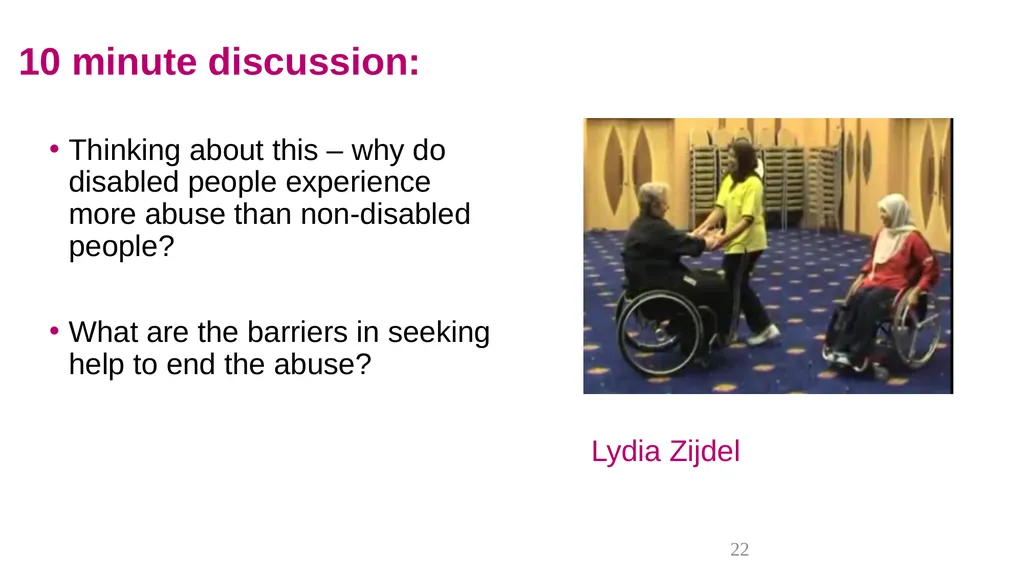
10 minute discussion: Thinking about this – why do disabled people experience more abuse than non-disabled people?
What are the barriers in seeking help to end the abuse? 22 Lydia Zijdel<br>
What are the barriers in seeking help to end the abuse? 22 Lydia Zijdel<br>
23
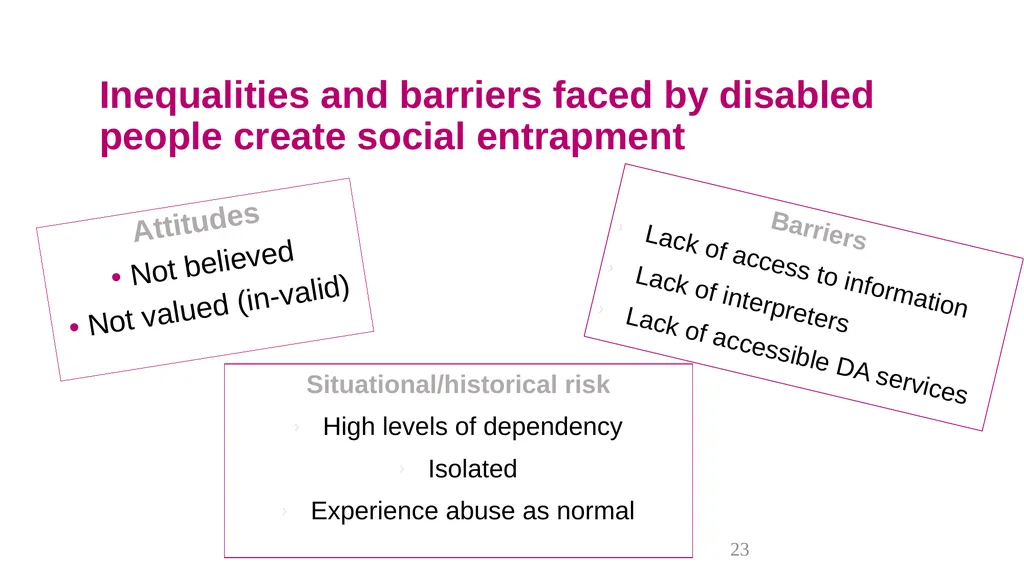
Inequalities and barriers faced by disabled people create social entrapment Attitudes
Not believed
Not valued (in-valid) Situational/historical risk
High levels of dependency
Isolated
Experience abuse as normal Barriers
Lack of access to information
Lack of interpreters
Lack of accessible DA services 23<br>
Not believed
Not valued (in-valid) Situational/historical risk
High levels of dependency
Isolated
Experience abuse as normal Barriers
Lack of access to information
Lack of interpreters
Lack of accessible DA services 23<br>
24
24 When the slapping started, at first I was shocked. No boyfriend ever lifted a hand to me before. But . . .I’ve been through more than that from my doctors
Rich, K., 2014. “My Body Came Between Us” Accounts of Partner-Abused Women With Physical Disabilities. Affilia, p.0886109914522626.<br>
Rich, K., 2014. “My Body Came Between Us” Accounts of Partner-Abused Women With Physical Disabilities. Affilia, p.0886109914522626.<br>
25
Domestic abuse and care and support needs 25<br>
26
Domestic abuse can create care and support needs – physical health Physical impact includes disability, chronic pain, gastro-
intestinal, and gynaecological signs including sexually-transmitted diseases.
Campbell, J.C., 2002. Health consequences of intimate partner violence. The Lancet, 359(9314), pp.1331-1336.
NICE (2014) Domestic violence and abuse: multi-agency working Public health guideline [PH50] National Institute for Health Excellence February 2014 https://www.nice.org.uk/guidance/ph50 26<br>
Campbell, J.C., 2002. Health consequences of intimate partner violence. The Lancet, 359(9314), pp.1331-1336.
NICE (2014) Domestic violence and abuse: multi-agency working Public health guideline [PH50] National Institute for Health Excellence February 2014 https://www.nice.org.uk/guidance/ph50 26<br>
27
Domestic abuse can create care and support needs – physical health He was extremely abusive and he put me into the hospital quite few times. The consequences on my health now [. . .] I have had a major bone problems, and I had to have an operation on my spine, and I am questioning whether that was to do with the beatings. I’ve got arthritis and I had a lots of broken bones when he was doing this, so whether that impacted [. . .] I’m sure that this possibly did impact up on me now [. . .] Like now I can hardly walk, and I have to go in a wheel chair to go about (Participant 1: 63 years).
I’ m waiting for a hearing aid and now [. . .] I got severely bashed on my ear, and I’m told that I can’t hear at all in this ear, and I’ve been told that it is perforated eardrum (Participant 8: 76 years). McGarry J and Simpson C (2011)
McGarry J and Simpson C (2011) Domestic abuse and older women: exploring the opportunities for service development and care delivery. The Journal of Adult Protection, 13 (6) 294-301. 27<br>
I’ m waiting for a hearing aid and now [. . .] I got severely bashed on my ear, and I’m told that I can’t hear at all in this ear, and I’ve been told that it is perforated eardrum (Participant 8: 76 years). McGarry J and Simpson C (2011)
McGarry J and Simpson C (2011) Domestic abuse and older women: exploring the opportunities for service development and care delivery. The Journal of Adult Protection, 13 (6) 294-301. 27<br>
28
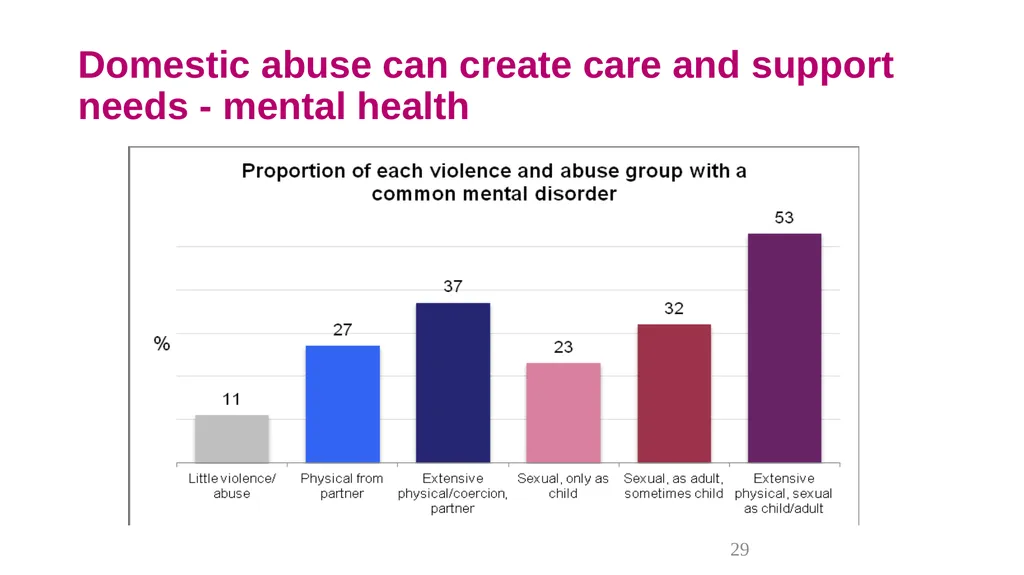
Domestic abuse can create care and support needs - mental health Domestic abuse impacts negatively on Mental Health
People who experience poor mental health are more likely to have experienced domestic abuse (Trevillion et al 2012)
70% per cent of female psychiatric inpatients and 80% of those in secure settings have histories of physical or sexual abuse
abused women are at least three times more likely to experience depression or anxiety disorders than other women
a third of all female suicide attempts and half of those by ethnic minority women can be attributed to past or current experiences of domestic abuse 28<br>
People who experience poor mental health are more likely to have experienced domestic abuse (Trevillion et al 2012)
70% per cent of female psychiatric inpatients and 80% of those in secure settings have histories of physical or sexual abuse
abused women are at least three times more likely to experience depression or anxiety disorders than other women
a third of all female suicide attempts and half of those by ethnic minority women can be attributed to past or current experiences of domestic abuse 28<br>
29
Domestic abuse can create care and support needs - mental health 29<br>
30
Domestic abuse can create care and support needs - people who misuse substances There is a relationship between the use of drugs and alcohol and domestic abuse (Stella Project, 2004)
Some people use substances in order to manage their situation
Substance dependency can be used to create control
To cope/dull feelings
Substance misuse can create care and support needs 30<br>
Some people use substances in order to manage their situation
Substance dependency can be used to create control
To cope/dull feelings
Substance misuse can create care and support needs 30<br>
31
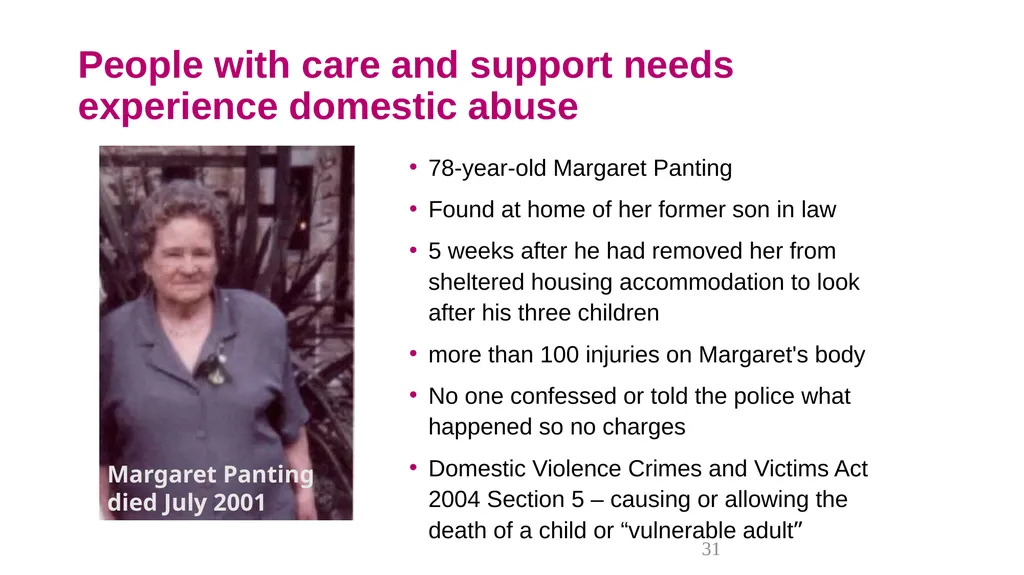
People with care and support needs experience domestic abuse 78-year-old Margaret Panting
Found at home of her former son in law
5 weeks after he had removed her from sheltered housing accommodation to look after his three children
more than 100 injuries on Margaret's body
No one confessed or told the police what happened so no charges
Domestic Violence Crimes and Victims Act 2004 Section 5 – causing or allowing the death of a child or “vulnerable adult” 31 Margaret Panting died July 2001<br>
Found at home of her former son in law
5 weeks after he had removed her from sheltered housing accommodation to look after his three children
more than 100 injuries on Margaret's body
No one confessed or told the police what happened so no charges
Domestic Violence Crimes and Victims Act 2004 Section 5 – causing or allowing the death of a child or “vulnerable adult” 31 Margaret Panting died July 2001<br>
32
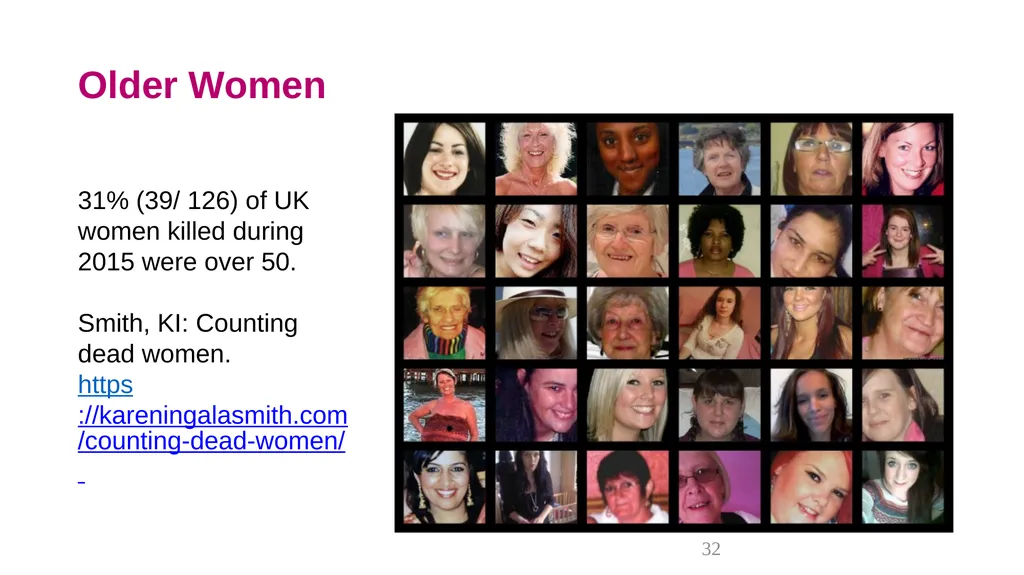
Older Women 32 31% (39/ 126) of UK women killed during 2015 were over 50.
Smith, KI: Counting dead women.
https://kareningalasmith.com/counting-dead-women/<br>
Smith, KI: Counting dead women.
https://kareningalasmith.com/counting-dead-women/<br>
33
National Prevalence study of Elder Abuse 2007 2.6% people over 66 self-reported that they had experienced abuse in their own home in the past 12 months from friends/family or care workers
Women were more likely to say that they had experienced mistreatment than men (3.8% of women and 1.1% of men)
Interpersonal (physical, sexual and psychological) abuse was largely carried out by partners(57%) or other family members (37%)
75% of perpetrators of interpersonal abuse were aged 65-74 and 80% of them were men
The perpetrator lived in the same household in two-thirds of the cases, and in two-fifths of cases the older person was providing care for them.
Example case given by social worker where carer was being abused by the disables person - Homicide case. 33<br>
Women were more likely to say that they had experienced mistreatment than men (3.8% of women and 1.1% of men)
Interpersonal (physical, sexual and psychological) abuse was largely carried out by partners(57%) or other family members (37%)
75% of perpetrators of interpersonal abuse were aged 65-74 and 80% of them were men
The perpetrator lived in the same household in two-thirds of the cases, and in two-fifths of cases the older person was providing care for them.
Example case given by social worker where carer was being abused by the disables person - Homicide case. 33<br>
34
Service responses to domestic abuse amongst older people Domestic violence as a ‘largely hidden phenomenon’ comprising of multiple forms of harm or abuse by people who are or have been intimate partners
A lack of conceptual clarity between domestic violence and elder abuse
The complexity of family dynamics and abusive relationships
Deficit in dedicated service recognition and provision
McGarry et al (2014) 34<br>
A lack of conceptual clarity between domestic violence and elder abuse
The complexity of family dynamics and abusive relationships
Deficit in dedicated service recognition and provision
McGarry et al (2014) 34<br>
35
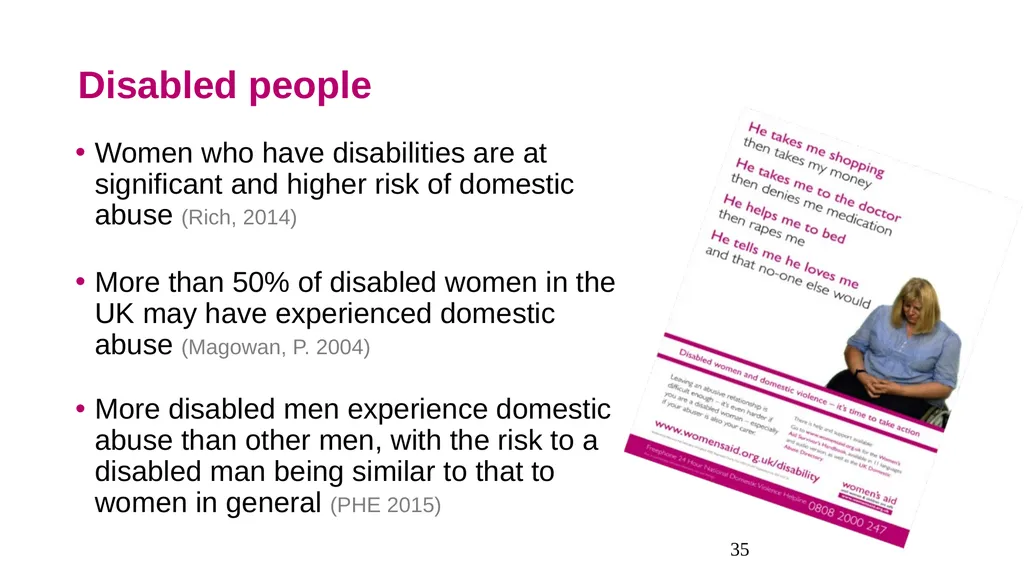
Disabled people Women who have disabilities are at significant and higher risk of domestic abuse (Rich, 2014)
More than 50% of disabled women in the UK may have experienced domestic abuse (Magowan, P. 2004)
More disabled men experience domestic abuse than other men, with the risk to a disabled man being similar to that to women in general (PHE 2015) 35<br>
More than 50% of disabled women in the UK may have experienced domestic abuse (Magowan, P. 2004)
More disabled men experience domestic abuse than other men, with the risk to a disabled man being similar to that to women in general (PHE 2015) 35<br>
36
Disabled people - Forced marriage 12% (141 cases) of cases reported to the Forced Marriage Unit in 2015 involved people who had a physical or learning disability
62% of were men and 38% women;
For non-disabled people only 20% of referrals are for male victims. 36<br>
62% of were men and 38% women;
For non-disabled people only 20% of referrals are for male victims. 36<br>
37
Women with learning disabilities Two small scale studies that interviewed women survivors of domestic abuse in England found that the levels of physical violence they had experienced were particularly high and of high risk (e.g. use of weapons, threats to kill)
Walter-Brice, A Cox, R., Priest, H. and Thompson, F., 2012. What do women with learning disabilities say about their experiences of domestic abuse within the context of their intimate partner relationships?. Disability & Society, 27(4), pp.503-517.
McCarthy, M., Hunt, S. and Milne‐Skillman, K., 2015. ‘I Know it was Every Week, but I Can't be Sure if it was Every Day: Domestic Violence and Women with Learning Disabilities. Journal of applied research in intellectual disabilities. 37<br>
Walter-Brice, A Cox, R., Priest, H. and Thompson, F., 2012. What do women with learning disabilities say about their experiences of domestic abuse within the context of their intimate partner relationships?. Disability & Society, 27(4), pp.503-517.
McCarthy, M., Hunt, S. and Milne‐Skillman, K., 2015. ‘I Know it was Every Week, but I Can't be Sure if it was Every Day: Domestic Violence and Women with Learning Disabilities. Journal of applied research in intellectual disabilities. 37<br>
38
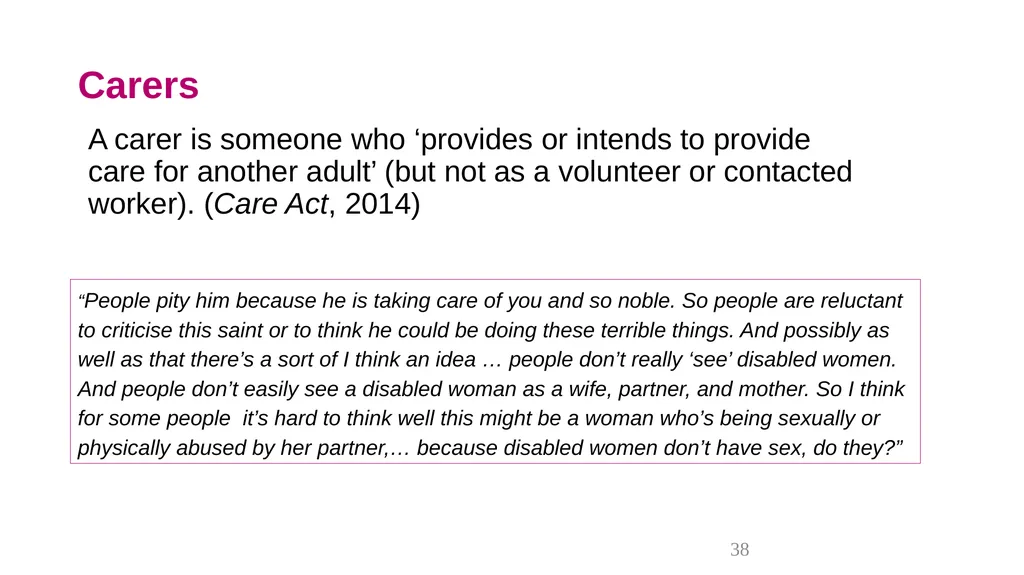
Carers A carer is someone who ‘provides or intends to provide care for another adult’ (but not as a volunteer or contacted worker). (Care Act, 2014) 38 “People pity him because he is taking care of you and so noble. So people are reluctant to criticise this saint or to think he could be doing these terrible things. And possibly as well as that there’s a sort of I think an idea … people don’t really ‘see’ disabled women. And people don’t easily see a disabled woman as a wife, partner, and mother. So I think for some people it’s hard to think well this might be a woman who’s being sexually or physically abused by her partner,… because disabled women don’t have sex, do they?”<br>
39
Domestic Abuse and Dementia; characteristic features and patterns of domestic abuse in the over 65's following the onset of dementia - Knight and Hester (2014). Evidence on the issues is very scant. There is one relevant paper by Knight and Hester (2014)
They found that:
The onset of dementia was likely to lead to an escalation in the severity of the abuse, regardless of whether dementia developed in the victim or perpetrator.
The most dangerous people in their study were men with a history of being domestic violence perpetrators who had developed dementia and who had been physically abusive at some point in the past. In all of these cases, domestic abuse escalated to severe injurious from physical abuse.’ (p12)
This was a small scale study (sample of 22 case records) so findings should be read with caution - but it raises important considerations for practice, especially around how practitioners make safe enquiries and overcome assumptions about who experiences domestic abuse.
Older women themselves have highlighted the importance of raising awareness and providing information (McGarry and Simpson, 2011), and health and social care practitioners have an important role to play in this
Knight and Hester (2014). 39<br>
They found that:
The onset of dementia was likely to lead to an escalation in the severity of the abuse, regardless of whether dementia developed in the victim or perpetrator.
The most dangerous people in their study were men with a history of being domestic violence perpetrators who had developed dementia and who had been physically abusive at some point in the past. In all of these cases, domestic abuse escalated to severe injurious from physical abuse.’ (p12)
This was a small scale study (sample of 22 case records) so findings should be read with caution - but it raises important considerations for practice, especially around how practitioners make safe enquiries and overcome assumptions about who experiences domestic abuse.
Older women themselves have highlighted the importance of raising awareness and providing information (McGarry and Simpson, 2011), and health and social care practitioners have an important role to play in this
Knight and Hester (2014). 39<br>
40
40<br>
41
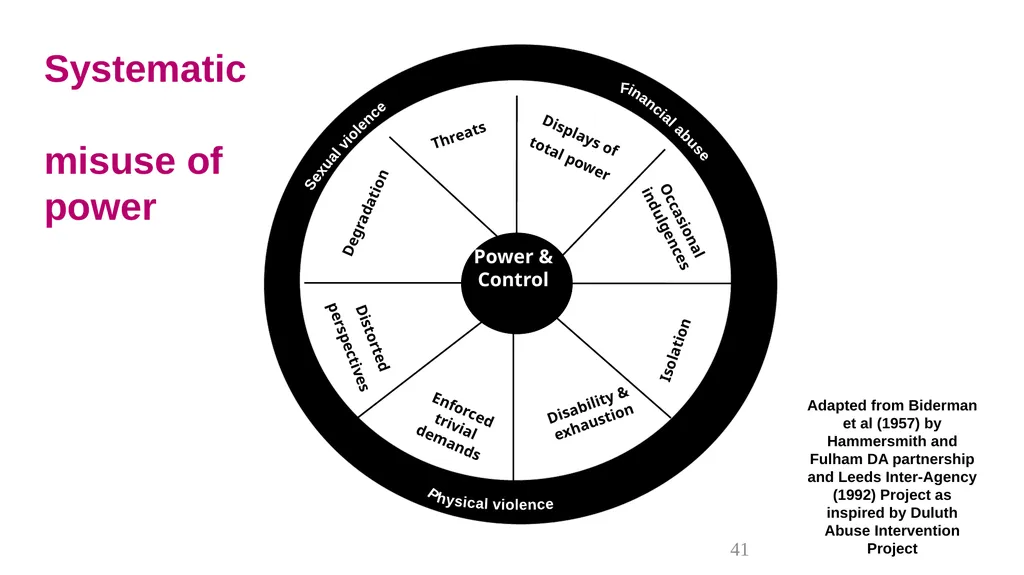
Power & Control Systematic
misuse of
power Adapted from Biderman et al (1957) by Hammersmith and Fulham DA partnership and Leeds Inter-Agency (1992) Project as inspired by Duluth Abuse Intervention Project Threats Displays of
total power Isolation Occasional indulgences Enforced trivial demands Distorted
perspectives Degradation Disability & exhaustion 41<br>
total power Isolation Occasional indulgences Enforced trivial demands Distorted
perspectives Degradation Disability & exhaustion 41<br>
42
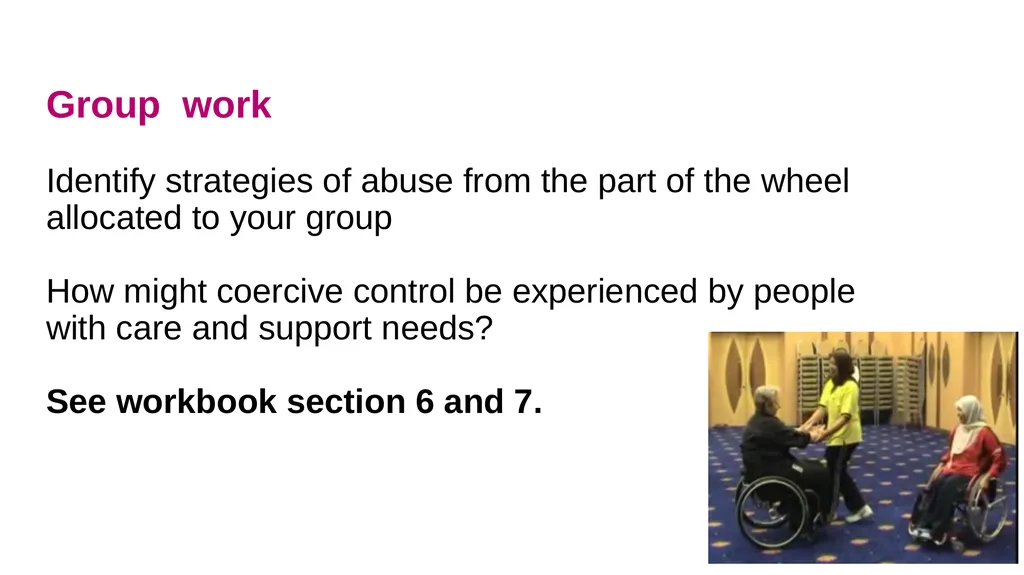
Group work
Identify strategies of abuse from the part of the wheel allocated to your group
How might coercive control be experienced by people with care and support needs?
See workbook section 6 and 7. 42<br>
43
Controlling and coercive behaviour: what is it? 43<br>
44
Evan Stark Susan Schechter coined the term "coercive control“ in the 1980's
Schechter argued that the end of abuse in a relationship is not when the abuser stops physically assaulting a woman - he must also be able to ‘relate in non- coercive ways’.
(WOMEN AND MALE VIOLENCE: THE VISIONS AND STRUGGLES OF THE BATTERED WOMEN'S MOVEMENT 317-319, 1982)
Coercion was conceptualised in psychological fields – Albert Bideman
More recently, Evan Stark expanded upon Schechter's "coercive control“ model of domestic violence
Coercive control is a condition of entrapment that can be hostage-like in the harms it inflicts on dignity, liberty, autonomy and personhood as well as to physical and psychological integrity.
‘A strategic course of conduct in which violence, sexual coercion, intimidation, isolation and control are used to dominate and exploit a partner and deprive her of basic rights and resources.’ 44<br>
Schechter argued that the end of abuse in a relationship is not when the abuser stops physically assaulting a woman - he must also be able to ‘relate in non- coercive ways’.
(WOMEN AND MALE VIOLENCE: THE VISIONS AND STRUGGLES OF THE BATTERED WOMEN'S MOVEMENT 317-319, 1982)
Coercion was conceptualised in psychological fields – Albert Bideman
More recently, Evan Stark expanded upon Schechter's "coercive control“ model of domestic violence
Coercive control is a condition of entrapment that can be hostage-like in the harms it inflicts on dignity, liberty, autonomy and personhood as well as to physical and psychological integrity.
‘A strategic course of conduct in which violence, sexual coercion, intimidation, isolation and control are used to dominate and exploit a partner and deprive her of basic rights and resources.’ 44<br>
45
Professor Evan Stark - Coercive Control 45<br>
46
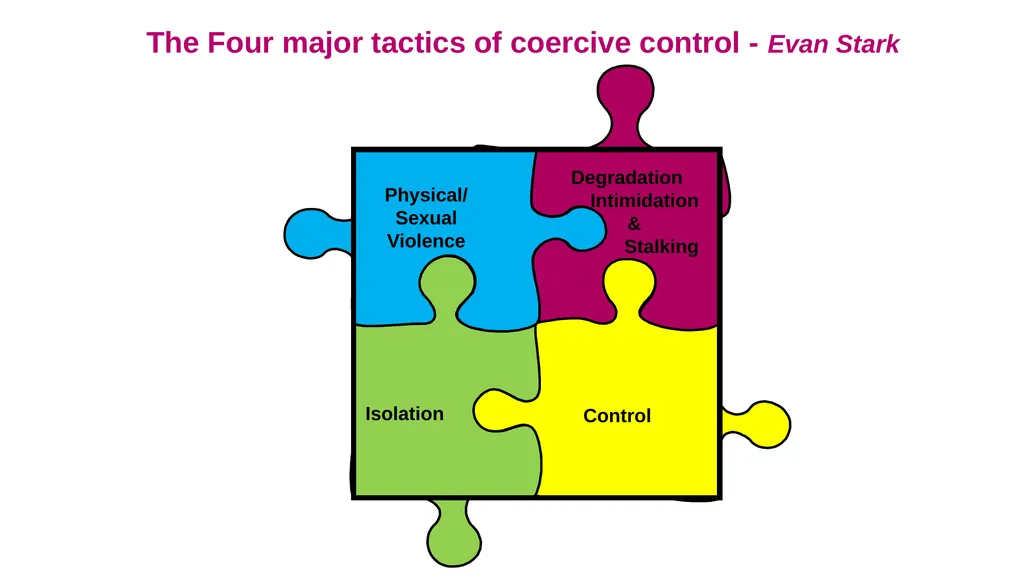
The Four major tactics of coercive control - Evan Stark Physical/ Sexual Violence Degradation Intimidation
&
Stalking Control Isolation<br>
&
Stalking Control Isolation<br>
47
47 Further Sub tactics
Communication - control her channels of communication, going through drawers, diary, phones.
Surveillance - monitoring time, mileage, turning up at work, attending all appointments
Degradation - degrading insults, denying self respect
Sexual control - when, how, where, withholding or rape, threats to get elsewhere
Micromanaging ‘crushes the spirit even more fundamentally than the deprivation of basic necessities because it leaves little space for a person to breathe’. (Stark. E, 2007. P.272)
Ownership - Marking
Tattoos, bite marks, burns, facial scars – marks ‘ownership’ and can become a source of self loathing.<br>
Communication - control her channels of communication, going through drawers, diary, phones.
Surveillance - monitoring time, mileage, turning up at work, attending all appointments
Degradation - degrading insults, denying self respect
Sexual control - when, how, where, withholding or rape, threats to get elsewhere
Micromanaging ‘crushes the spirit even more fundamentally than the deprivation of basic necessities because it leaves little space for a person to breathe’. (Stark. E, 2007. P.272)
Ownership - Marking
Tattoos, bite marks, burns, facial scars – marks ‘ownership’ and can become a source of self loathing.<br>
48
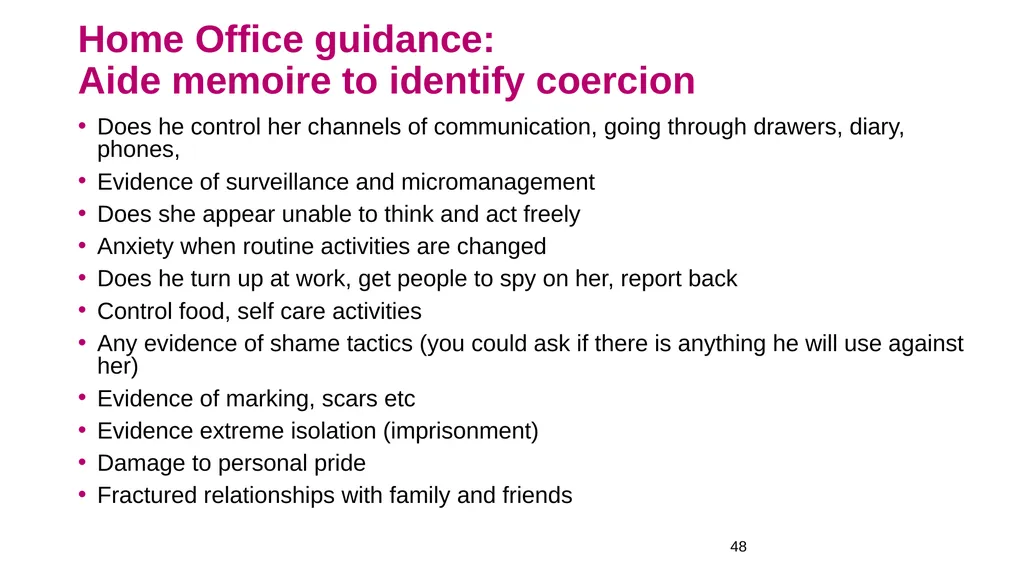
Home Office guidance:
Aide memoire to identify coercion Does he control her channels of communication, going through drawers, diary, phones,
Evidence of surveillance and micromanagement
Does she appear unable to think and act freely
Anxiety when routine activities are changed
Does he turn up at work, get people to spy on her, report back
Control food, self care activities
Any evidence of shame tactics (you could ask if there is anything he will use against her)
Evidence of marking, scars etc
Evidence extreme isolation (imprisonment)
Damage to personal pride
Fractured relationships with family and friends 48<br>
Evidence of surveillance and micromanagement
Does she appear unable to think and act freely
Anxiety when routine activities are changed
Does he turn up at work, get people to spy on her, report back
Control food, self care activities
Any evidence of shame tactics (you could ask if there is anything he will use against her)
Evidence of marking, scars etc
Evidence extreme isolation (imprisonment)
Damage to personal pride
Fractured relationships with family and friends 48<br>
49
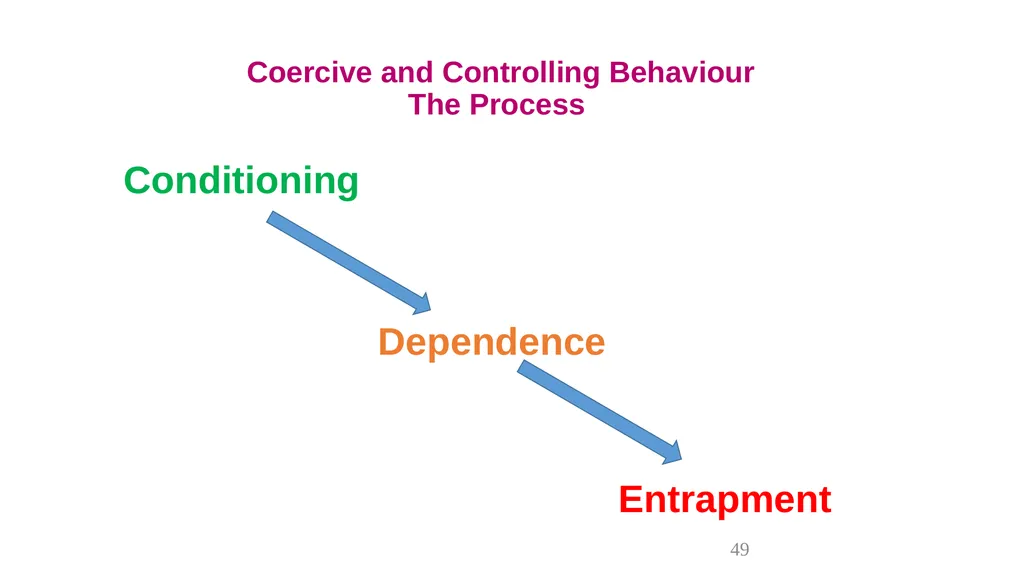
Coercive and Controlling Behaviour
The Process Conditioning Dependence Entrapment 49<br>
50
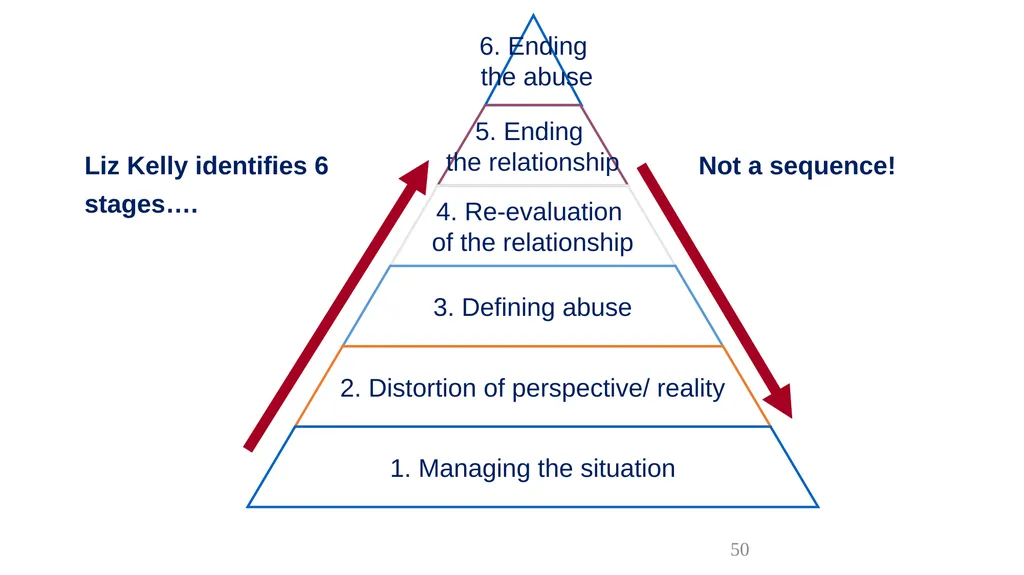
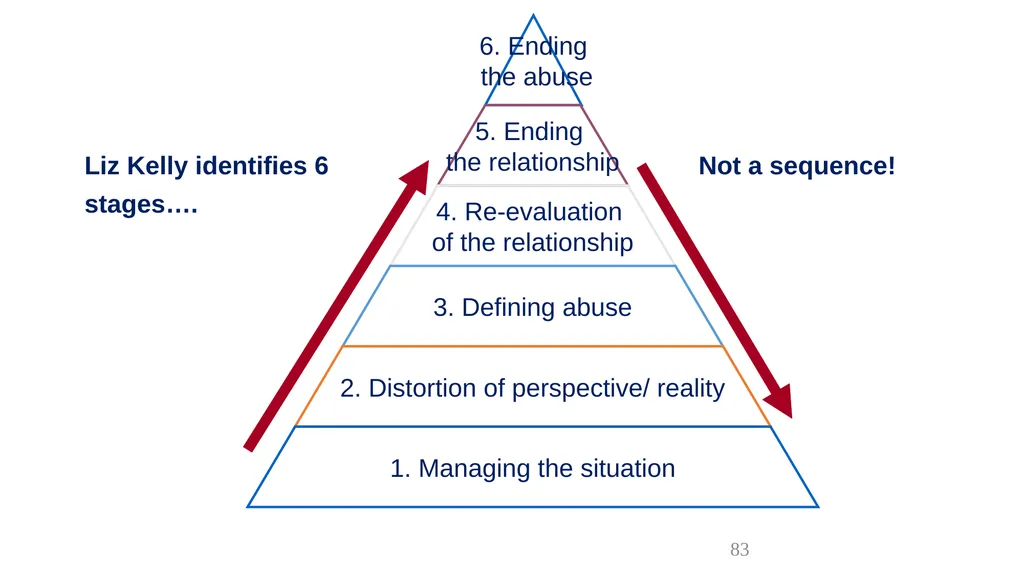
Liz Kelly identifies 6 Not a sequence!
stages…. 50<br>
stages…. 50<br>
51
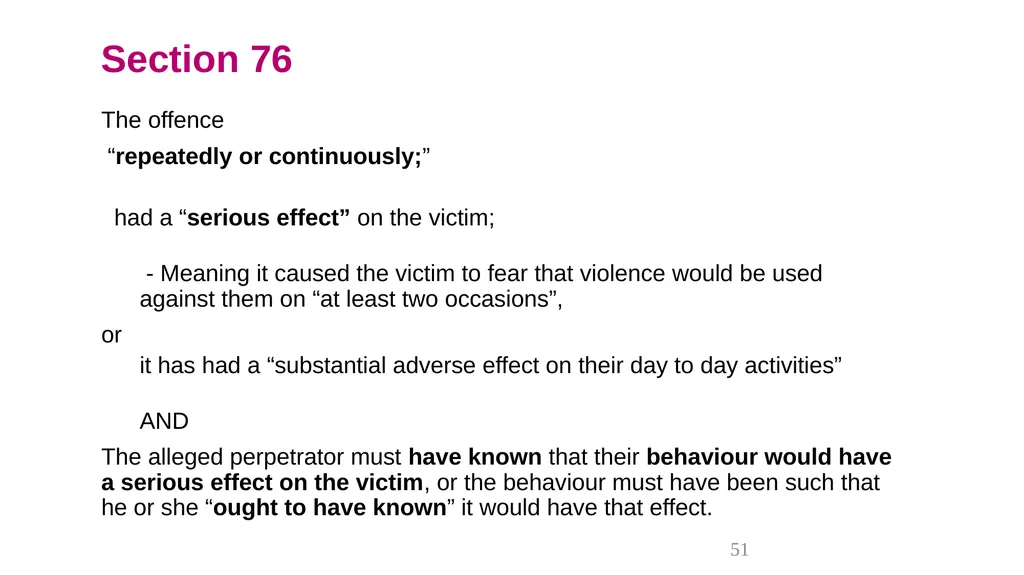
Section 76 The offence
“repeatedly or continuously;”
had a “serious effect” on the victim;
- Meaning it caused the victim to fear that violence would be used against them on “at least two occasions”,
or
it has had a “substantial adverse effect on their day to day activities”
AND
The alleged perpetrator must have known that their behaviour would have a serious effect on the victim, or the behaviour must have been such that he or she “ought to have known” it would have that effect. 51<br>
“repeatedly or continuously;”
had a “serious effect” on the victim;
- Meaning it caused the victim to fear that violence would be used against them on “at least two occasions”,
or
it has had a “substantial adverse effect on their day to day activities”
AND
The alleged perpetrator must have known that their behaviour would have a serious effect on the victim, or the behaviour must have been such that he or she “ought to have known” it would have that effect. 51<br>
52
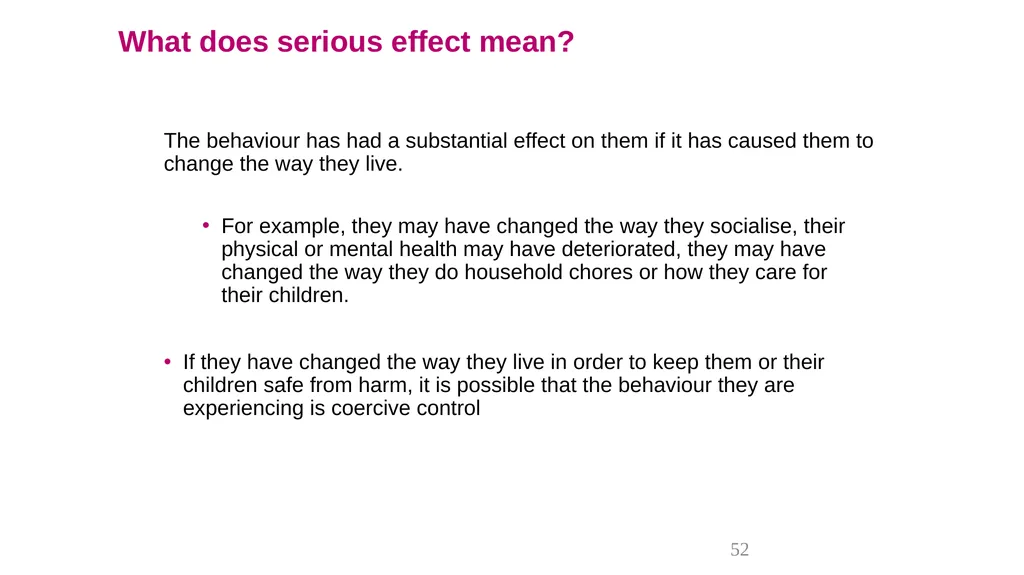
What does serious effect mean? The behaviour has had a substantial effect on them if it has caused them to change the way they live.
For example, they may have changed the way they socialise, their physical or mental health may have deteriorated, they may have changed the way they do household chores or how they care for their children.
If they have changed the way they live in order to keep them or their children safe from harm, it is possible that the behaviour they are experiencing is coercive control 52<br>
For example, they may have changed the way they socialise, their physical or mental health may have deteriorated, they may have changed the way they do household chores or how they care for their children.
If they have changed the way they live in order to keep them or their children safe from harm, it is possible that the behaviour they are experiencing is coercive control 52<br>
53
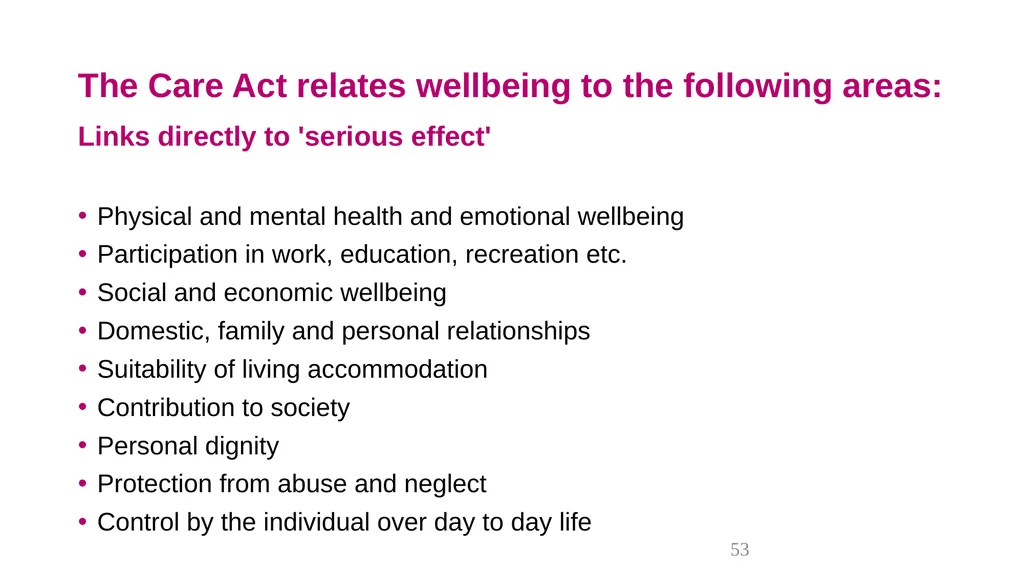
The Care Act relates wellbeing to the following areas: Links directly to 'serious effect'
Physical and mental health and emotional wellbeing
Participation in work, education, recreation etc.
Social and economic wellbeing
Domestic, family and personal relationships
Suitability of living accommodation
Contribution to society
Personal dignity
Protection from abuse and neglect
Control by the individual over day to day life 53<br>
Physical and mental health and emotional wellbeing
Participation in work, education, recreation etc.
Social and economic wellbeing
Domestic, family and personal relationships
Suitability of living accommodation
Contribution to society
Personal dignity
Protection from abuse and neglect
Control by the individual over day to day life 53<br>
54
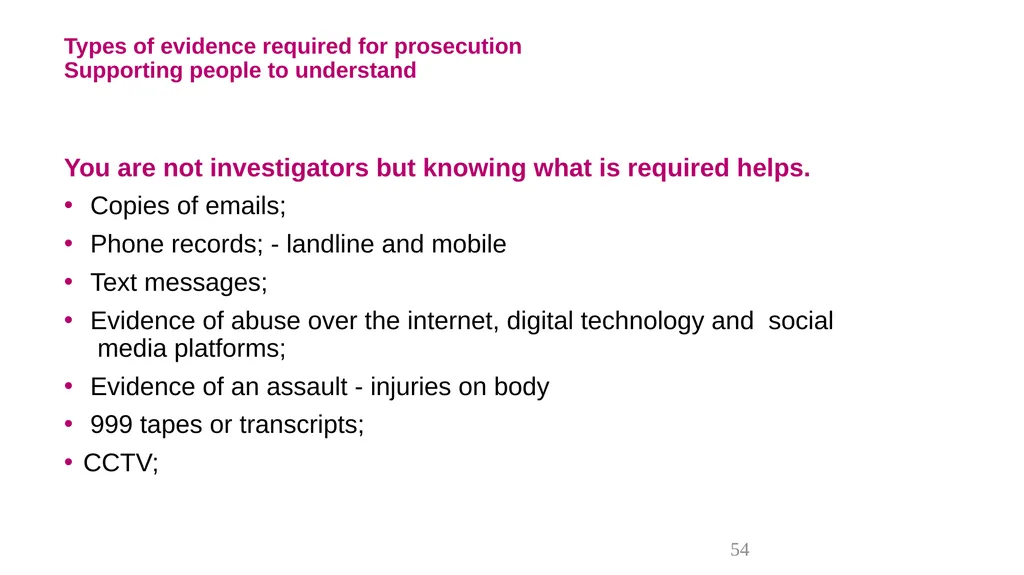
Types of evidence required for prosecution
Supporting people to understand You are not investigators but knowing what is required helps.
Copies of emails;
Phone records; - landline and mobile
Text messages;
Evidence of abuse over the internet, digital technology and social media platforms;
Evidence of an assault - injuries on body
999 tapes or transcripts;
CCTV; 54<br>
Copies of emails;
Phone records; - landline and mobile
Text messages;
Evidence of abuse over the internet, digital technology and social media platforms;
Evidence of an assault - injuries on body
999 tapes or transcripts;
CCTV; 54<br>
55
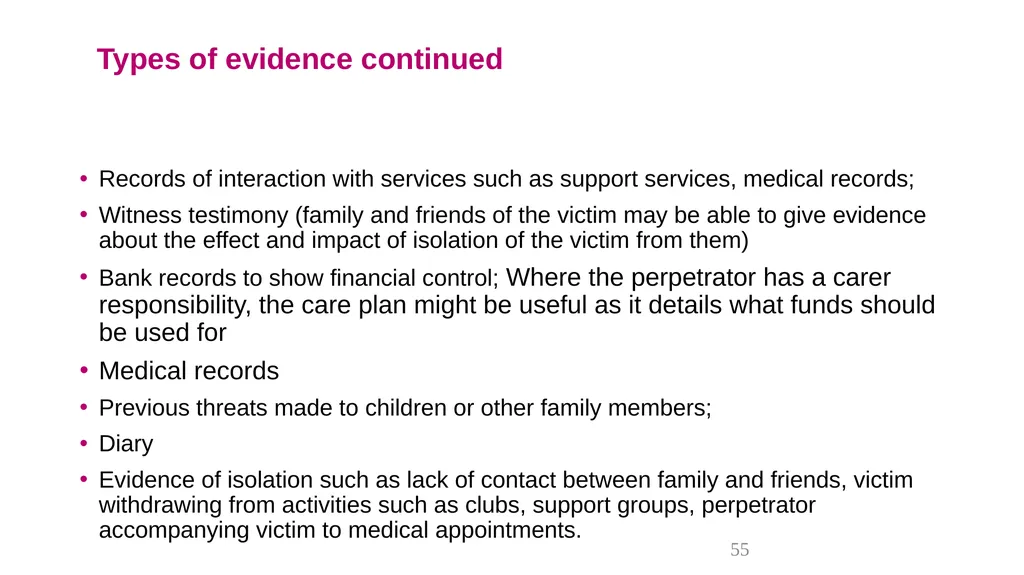
Types of evidence continued Records of interaction with services such as support services, medical records;
Witness testimony (family and friends of the victim may be able to give evidence about the effect and impact of isolation of the victim from them)
Bank records to show financial control; Where the perpetrator has a carer responsibility, the care plan might be useful as it details what funds should be used for
Medical records
Previous threats made to children or other family members;
Diary
Evidence of isolation such as lack of contact between family and friends, victim withdrawing from activities such as clubs, support groups, perpetrator accompanying victim to medical appointments. 55<br>
Witness testimony (family and friends of the victim may be able to give evidence about the effect and impact of isolation of the victim from them)
Bank records to show financial control; Where the perpetrator has a carer responsibility, the care plan might be useful as it details what funds should be used for
Medical records
Previous threats made to children or other family members;
Diary
Evidence of isolation such as lack of contact between family and friends, victim withdrawing from activities such as clubs, support groups, perpetrator accompanying victim to medical appointments. 55<br>
56
Recording Controlling or Coercive behaviour Record the abusive behaviour and then the impact that is has had/or is having
on the person
Have they changed their routine, diet, medication, given up work?
Are they experiencing insomnia, depression, anxiety?
Record demeanour
Never use blaming language
Always write 'verbatim'
Professional judgement is important 56<br>
on the person
Have they changed their routine, diet, medication, given up work?
Are they experiencing insomnia, depression, anxiety?
Record demeanour
Never use blaming language
Always write 'verbatim'
Professional judgement is important 56<br>
57
Services can assist by supporting the victim to: Engage with specialist services that will support the criminal justice process (if wanted)
Provide service records, case records and records
Contact helplines which may act as evidence for the offence.
Obtain case notes from mental health or drug and alcohol services which may provide evidence.
Obtain any evidence from housing services of anti social behaviour, damage to property, complaints from other tenants 57<br>
Provide service records, case records and records
Contact helplines which may act as evidence for the offence.
Obtain case notes from mental health or drug and alcohol services which may provide evidence.
Obtain any evidence from housing services of anti social behaviour, damage to property, complaints from other tenants 57<br>
58
Defence Advocates/Barristers Advocates/Barristers can use records in defence in court. Make sure that
what you write cannot be misinterpreted.
A was being difficult
A refused medication
A refused support with personal care
A refused to engage with the service
A was colluding 58<br>
what you write cannot be misinterpreted.
A was being difficult
A refused medication
A refused support with personal care
A refused to engage with the service
A was colluding 58<br>
59
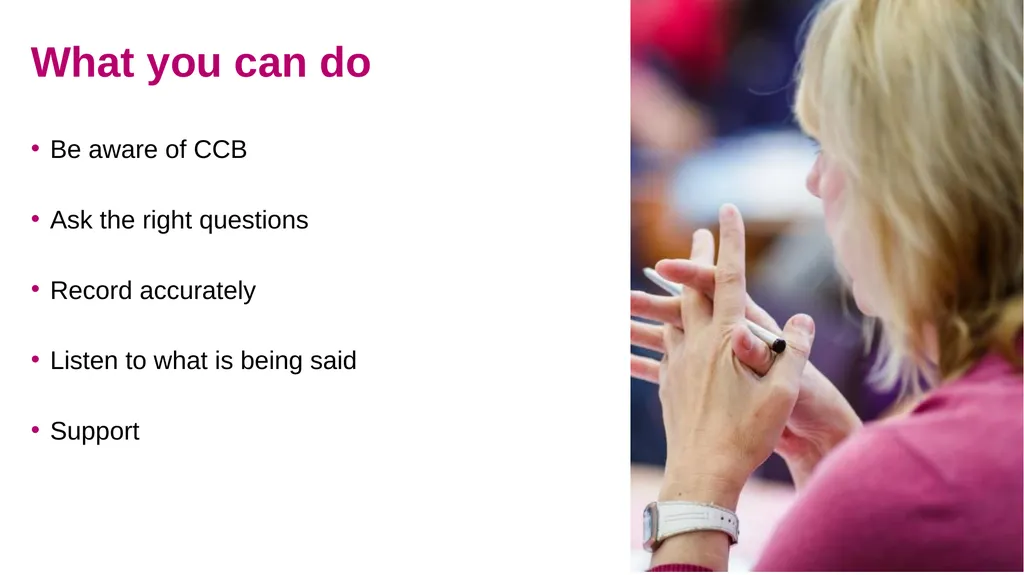
What you can do Be aware of CCB
Ask the right questions
Record accurately
Listen to what is being said
Support 59<br>
Ask the right questions
Record accurately
Listen to what is being said
Support 59<br>
60
60<br>
61
Professional competence Intervention and skills
Social workers engage with individuals, families, groups and communities, working alongside people to assess and intervene
They enable effective relationships and are effective communicators, using appropriate skills. Using their professional judgement, they employ a range of interventions: promoting independence, providing support and protection, taking preventative action and ensuring safety whilst balancing rights and risks
They understand and take account of differentials in power, and are able to use authority appropriately
BASW Professional Capabilities Framework 61<br>
Social workers engage with individuals, families, groups and communities, working alongside people to assess and intervene
They enable effective relationships and are effective communicators, using appropriate skills. Using their professional judgement, they employ a range of interventions: promoting independence, providing support and protection, taking preventative action and ensuring safety whilst balancing rights and risks
They understand and take account of differentials in power, and are able to use authority appropriately
BASW Professional Capabilities Framework 61<br>
62
Safeguarding under the Care Act 2014 Reasonable cause to suspect that an adult is an “adult at risk”
the local authority must make (or cause to be made) whatever enquiries it thinks necessary to enable it to decide whether any action should be taken in the adult’s case and, if so, what and by whom
Wellbeing principle: “Everyone involved in an enquiry must focus on improving the adult’s well-being and work together to that shared aim”
Presumption of mental capacity
Duty to consider whether an independent advocate is required 62<br>
the local authority must make (or cause to be made) whatever enquiries it thinks necessary to enable it to decide whether any action should be taken in the adult’s case and, if so, what and by whom
Wellbeing principle: “Everyone involved in an enquiry must focus on improving the adult’s well-being and work together to that shared aim”
Presumption of mental capacity
Duty to consider whether an independent advocate is required 62<br>
63
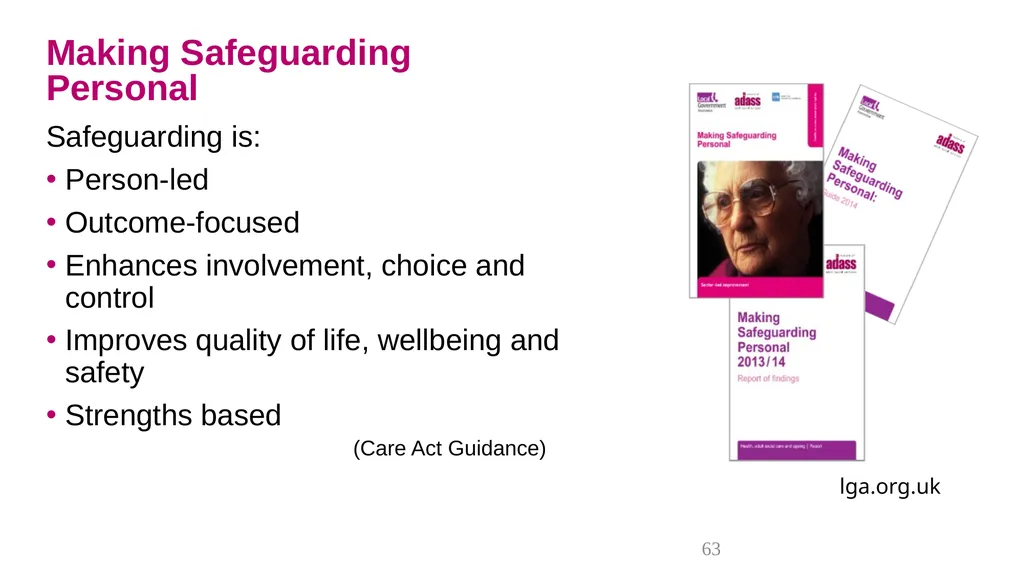
Making Safeguarding Personal Safeguarding is:
Person-led
Outcome-focused
Enhances involvement, choice and control
Improves quality of life, wellbeing and safety
Strengths based
(Care Act Guidance) 63 lga.org.uk<br>
Person-led
Outcome-focused
Enhances involvement, choice and control
Improves quality of life, wellbeing and safety
Strengths based
(Care Act Guidance) 63 lga.org.uk<br>
64
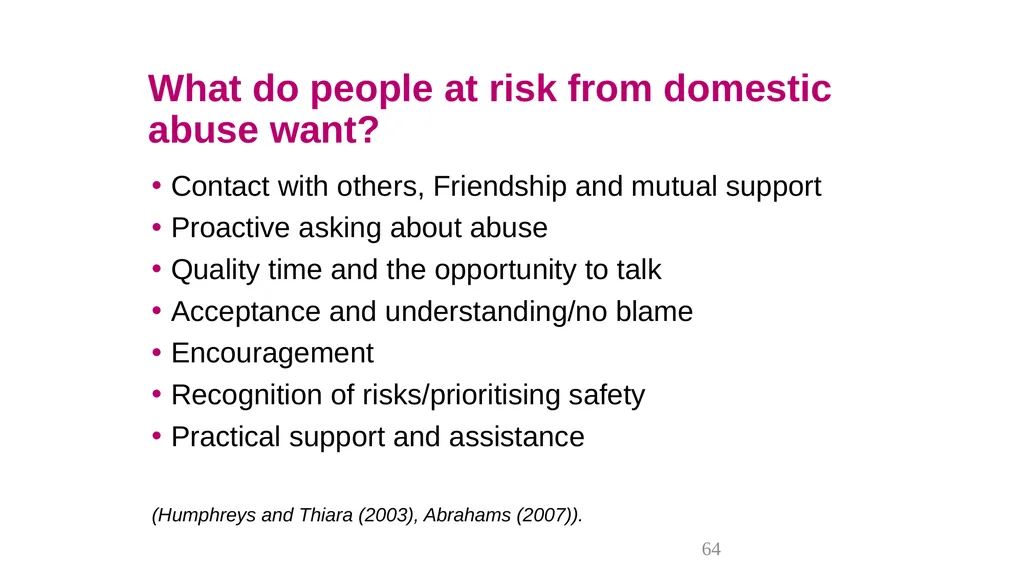
What do people at risk from domestic abuse want? Contact with others, Friendship and mutual support
Proactive asking about abuse
Quality time and the opportunity to talk
Acceptance and understanding/no blame
Encouragement
Recognition of risks/prioritising safety
Practical support and assistance
(Humphreys and Thiara (2003), Abrahams (2007)). 64<br>
Proactive asking about abuse
Quality time and the opportunity to talk
Acceptance and understanding/no blame
Encouragement
Recognition of risks/prioritising safety
Practical support and assistance
(Humphreys and Thiara (2003), Abrahams (2007)). 64<br>
65
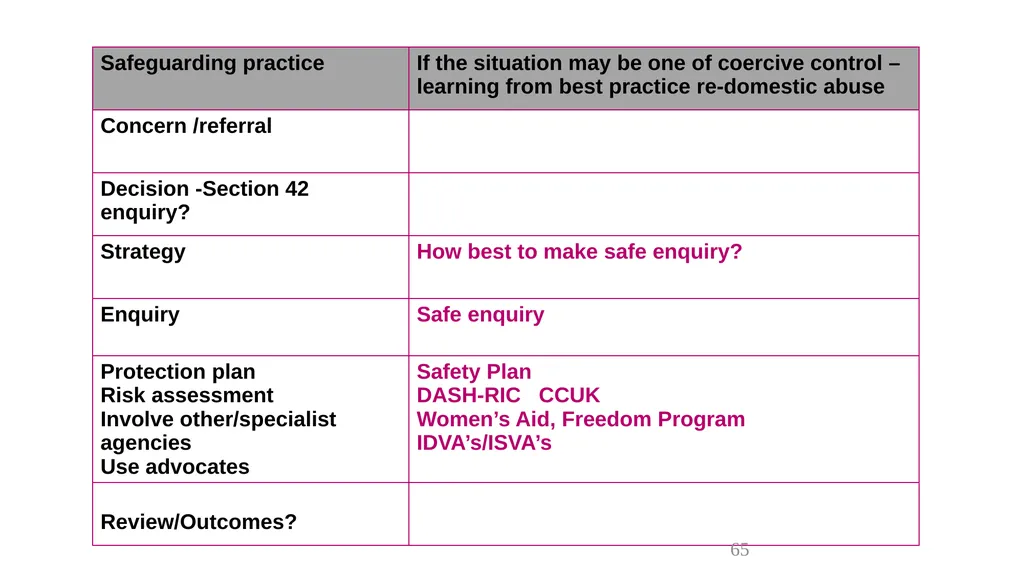
65<br>
66
Activity - consider the vignette you have been given
How would you make a safe enquiry with the person(s) in the case study?
How will you meet with her/him?
Where would you consider meeting?
How will you contact her/him to arrange a meeting? 66<br>
67
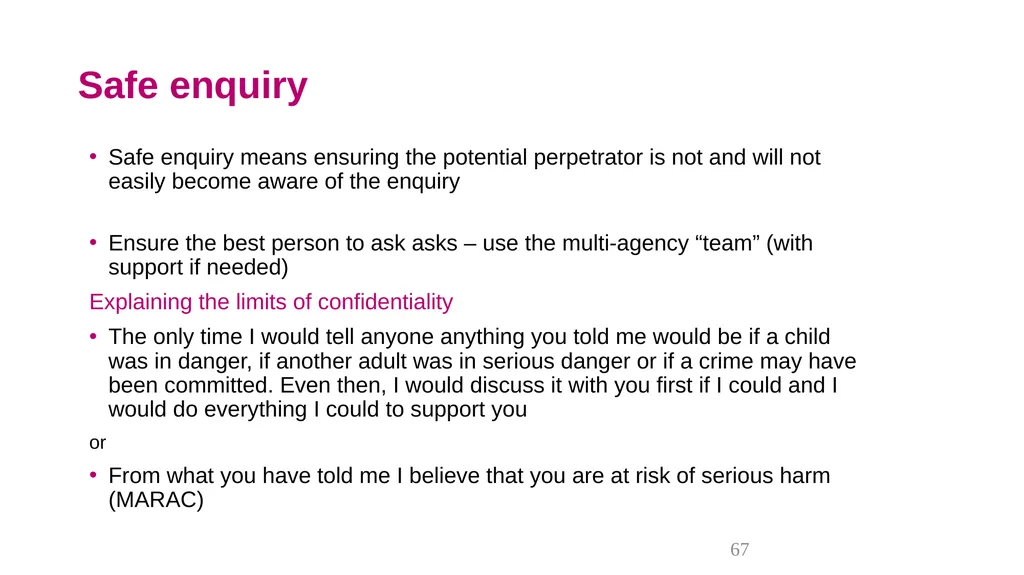
Safe enquiry Safe enquiry means ensuring the potential perpetrator is not and will not easily become aware of the enquiry
Ensure the best person to ask asks – use the multi-agency “team” (with support if needed)
Explaining the limits of confidentiality
The only time I would tell anyone anything you told me would be if a child was in danger, if another adult was in serious danger or if a crime may have been committed. Even then, I would discuss it with you first if I could and I would do everything I could to support you
or
From what you have told me I believe that you are at risk of serious harm (MARAC) 67<br>
Ensure the best person to ask asks – use the multi-agency “team” (with support if needed)
Explaining the limits of confidentiality
The only time I would tell anyone anything you told me would be if a child was in danger, if another adult was in serious danger or if a crime may have been committed. Even then, I would discuss it with you first if I could and I would do everything I could to support you
or
From what you have told me I believe that you are at risk of serious harm (MARAC) 67<br>
68
Ensure safety and confidentiality Always ensure you are alone with the person before enquiring into possible abuse - never ask in front of a partner, friend or child
Make sure that you can’t be interrupted, and that you – and the person – have sufficient time
Only use professional interpreters and advocates (IMCA/IDVA/DAPA)
Do not pursue an enquiry if the person lacks capacity to consent to the interview unless you have already arranged an advocate
Record! (but not in client/patient held records or organisational systems to which the perpetrator may have access) 68<br>
Make sure that you can’t be interrupted, and that you – and the person – have sufficient time
Only use professional interpreters and advocates (IMCA/IDVA/DAPA)
Do not pursue an enquiry if the person lacks capacity to consent to the interview unless you have already arranged an advocate
Record! (but not in client/patient held records or organisational systems to which the perpetrator may have access) 68<br>
69
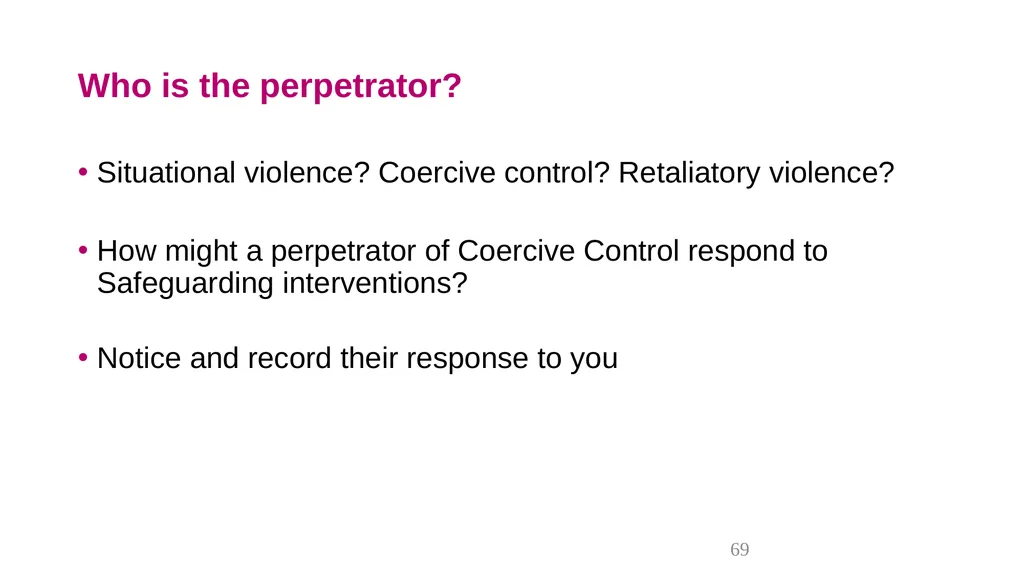
Who is the perpetrator? Situational violence? Coercive control? Retaliatory violence?
How might a perpetrator of Coercive Control respond to Safeguarding interventions?
Notice and record their response to you 69<br>
How might a perpetrator of Coercive Control respond to Safeguarding interventions?
Notice and record their response to you 69<br>
70
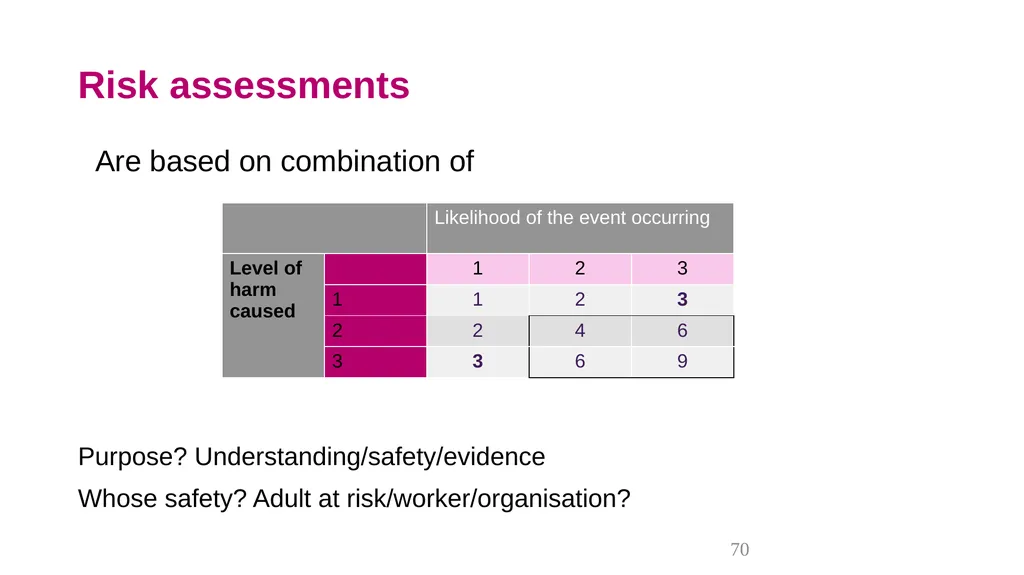
Risk assessments Are based on combination of Purpose? Understanding/safety/evidence
Whose safety? Adult at risk/worker/organisation? 70<br>
Whose safety? Adult at risk/worker/organisation? 70<br>
71
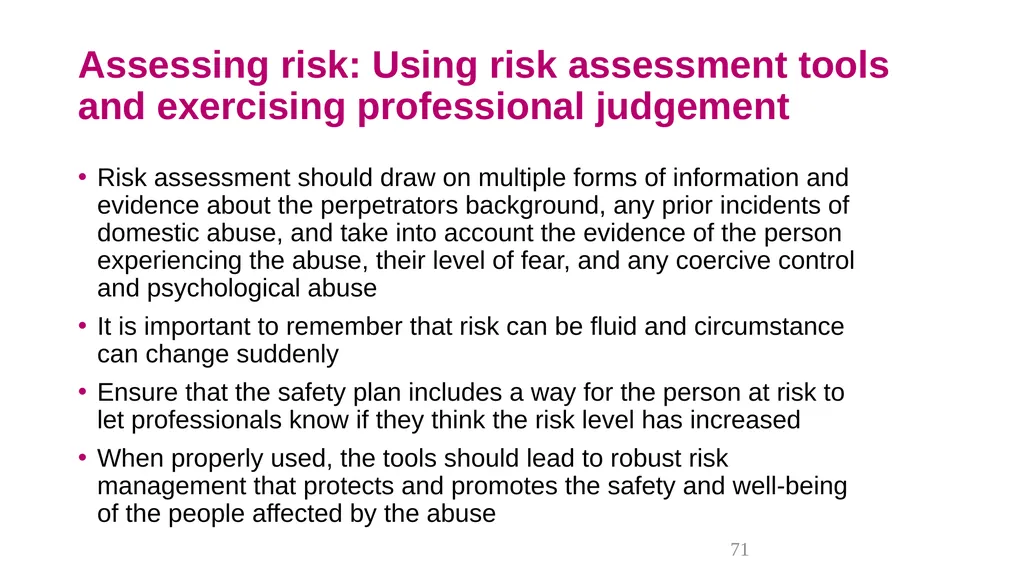
Assessing risk: Using risk assessment tools and exercising professional judgement Risk assessment should draw on multiple forms of information and evidence about the perpetrators background, any prior incidents of domestic abuse, and take into account the evidence of the person experiencing the abuse, their level of fear, and any coercive control and psychological abuse
It is important to remember that risk can be fluid and circumstance can change suddenly
Ensure that the safety plan includes a way for the person at risk to let professionals know if they think the risk level has increased
When properly used, the tools should lead to robust risk management that protects and promotes the safety and well-being of the people affected by the abuse 71<br>
It is important to remember that risk can be fluid and circumstance can change suddenly
Ensure that the safety plan includes a way for the person at risk to let professionals know if they think the risk level has increased
When properly used, the tools should lead to robust risk management that protects and promotes the safety and well-being of the people affected by the abuse 71<br>
72
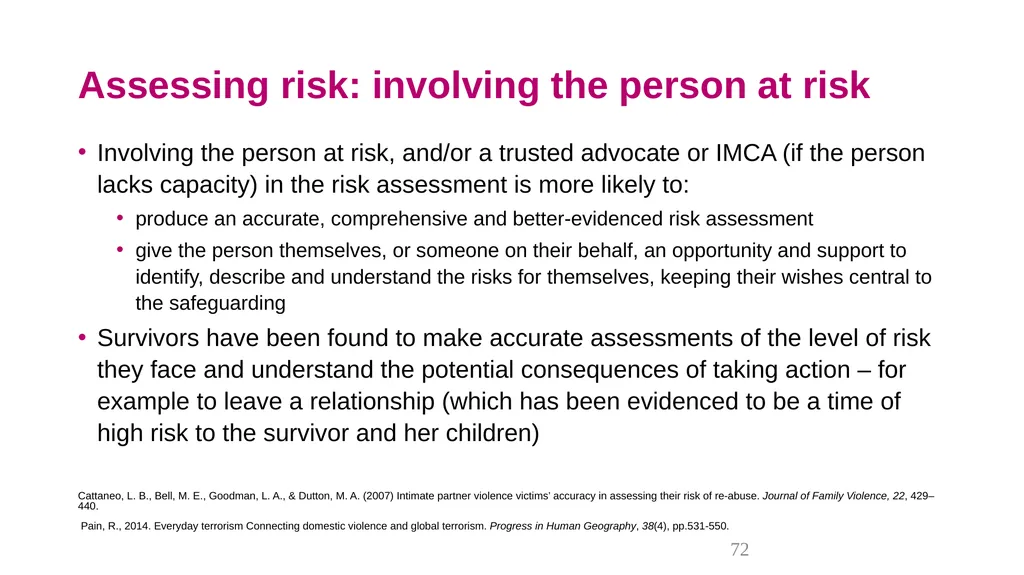
Assessing risk: involving the person at risk Involving the person at risk, and/or a trusted advocate or IMCA (if the person lacks capacity) in the risk assessment is more likely to:
produce an accurate, comprehensive and better-evidenced risk assessment
give the person themselves, or someone on their behalf, an opportunity and support to identify, describe and understand the risks for themselves, keeping their wishes central to the safeguarding
Survivors have been found to make accurate assessments of the level of risk they face and understand the potential consequences of taking action – for example to leave a relationship (which has been evidenced to be a time of high risk to the survivor and her children)
Cattaneo, L. B., Bell, M. E., Goodman, L. A., & Dutton, M. A. (2007) Intimate partner violence victims’ accuracy in assessing their risk of re-abuse. Journal of Family Violence, 22, 429–440.
Pain, R., 2014. Everyday terrorism Connecting domestic violence and global terrorism. Progress in Human Geography, 38(4), pp.531-550. 72<br>
produce an accurate, comprehensive and better-evidenced risk assessment
give the person themselves, or someone on their behalf, an opportunity and support to identify, describe and understand the risks for themselves, keeping their wishes central to the safeguarding
Survivors have been found to make accurate assessments of the level of risk they face and understand the potential consequences of taking action – for example to leave a relationship (which has been evidenced to be a time of high risk to the survivor and her children)
Cattaneo, L. B., Bell, M. E., Goodman, L. A., & Dutton, M. A. (2007) Intimate partner violence victims’ accuracy in assessing their risk of re-abuse. Journal of Family Violence, 22, 429–440.
Pain, R., 2014. Everyday terrorism Connecting domestic violence and global terrorism. Progress in Human Geography, 38(4), pp.531-550. 72<br>
73
Domestic Violence Disclosure Scheme
(Clare’s law) Under the Domestic Violence Disclosure Scheme (‘Clare’s Law’), a person who is experiencing domestic abuse has a ‘right to ask’ - this enables them to ask the police about a partner’s previous history of domestic abuse or violent acts. Police can proactively disclose information about a previous perpetrator of domestic abuse to a current partner in prescribed circumstances 73<br>
74
Child protection 62% of Children exposed to domestic abuse are directly harmed
Amongst other impacts, over half (52%) had behavioural problems, over a third (39%) had difficulties adjusting at school, and nearly two thirds (60%) felt responsible for negative events
CAADA -SafeLives 2014 74<br>
Amongst other impacts, over half (52%) had behavioural problems, over a third (39%) had difficulties adjusting at school, and nearly two thirds (60%) felt responsible for negative events
CAADA -SafeLives 2014 74<br>
75
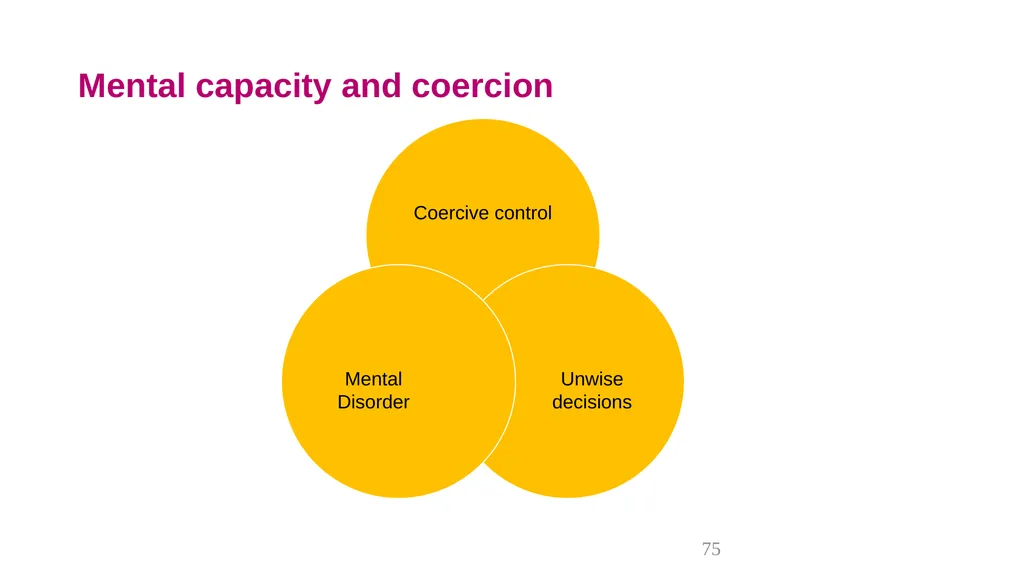
Mental capacity and coercion 75<br>
76
IMCAs
http://www.justice.gov.uk/downloads/protecting-the-vulnerable/mca/making-decisions-opg606-1207.pdf Independent Mental Capacity Advocate
must be used when……
Person does not have capacity in relation to making relevant decision/s about a serious medical condition or where they will live AND they are “unbefriended”
can be used when……
Person does not have capacity in relation to making relevant decision/s about their safety from abuse
Whether or not they are “befriended”/have relatives who say they can speak for the person 76<br>
Person does not have capacity in relation to making relevant decision/s about a serious medical condition or where they will live AND they are “unbefriended”
can be used when……
Person does not have capacity in relation to making relevant decision/s about their safety from abuse
Whether or not they are “befriended”/have relatives who say they can speak for the person 76<br>
77
Inherent jurisdiction of the High Court To cover gaps in the law
Safeguard people who do not lack capacity, but their ability to make decisions has been compromised because of coercion, undue influence or constraints on their circumstances
Make orders to enable a person to make a free and informed decision 77<br>
Safeguard people who do not lack capacity, but their ability to make decisions has been compromised because of coercion, undue influence or constraints on their circumstances
Make orders to enable a person to make a free and informed decision 77<br>
78
Mental capacity and coercion “in my judgment… the inherent jurisdiction can be exercised in relation to a vulnerable adult who, even if not incapacitated by mental disorder or mental illness, is, or is reasonably believed to be, either (i) under constraint or (ii) subject to coercion or undue influence or (iii) for some other reason deprived of the capacity to make the relevant decision, or disabled from making a free choice, or incapacitated or disabled from giving or expressing a real and genuine consent.”
Per Munby J in A Local Authority v (1) MA (2) NA and (3) SA [2005] EWHC 2942, at paragraph 77
The local authority sought to invoke the court’s inherent jurisdiction to protect the parents whom it claimed lacked capacity as a result of duress and undue influence brought to bear by DL. The family court judge granted an interim injunction, restraining his behaviour towards his parents, care staff and other professionals, under the court’s inherent jurisdiction in respect of his mother and under section 48 of the Mental Capacity Act 2005 in respect of his father.
DL v A Local Authority & Others [2012] EWCA Civ 253
High Court Judgement upheld the decision 78<br>
Per Munby J in A Local Authority v (1) MA (2) NA and (3) SA [2005] EWHC 2942, at paragraph 77
The local authority sought to invoke the court’s inherent jurisdiction to protect the parents whom it claimed lacked capacity as a result of duress and undue influence brought to bear by DL. The family court judge granted an interim injunction, restraining his behaviour towards his parents, care staff and other professionals, under the court’s inherent jurisdiction in respect of his mother and under section 48 of the Mental Capacity Act 2005 in respect of his father.
DL v A Local Authority & Others [2012] EWCA Civ 253
High Court Judgement upheld the decision 78<br>
79
Inherent jurisdiction of the High Court Consult your manager and gain legal advice
Work with people used to making applications to CoP (BIAs/DoLS workers?)
Careful documentation as to why you believe i) the person has mental capacity ii) isn’t able to make a capacitated decision due to their circumstances (the abuse) 79<br>
Work with people used to making applications to CoP (BIAs/DoLS workers?)
Careful documentation as to why you believe i) the person has mental capacity ii) isn’t able to make a capacitated decision due to their circumstances (the abuse) 79<br>
80
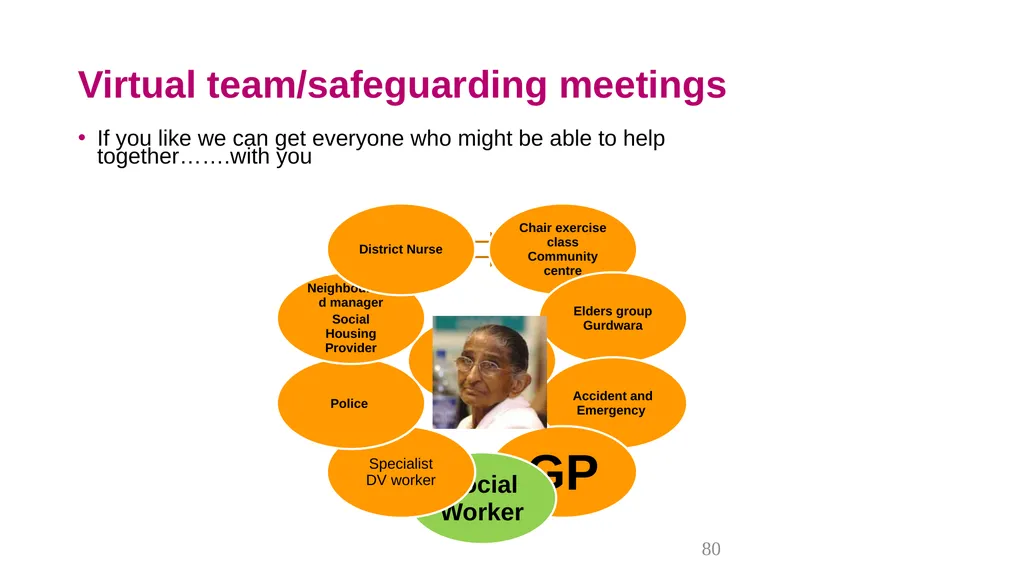
Virtual team/safeguarding meetings If you like we can get everyone who might be able to help together…….with you 80<br>
81
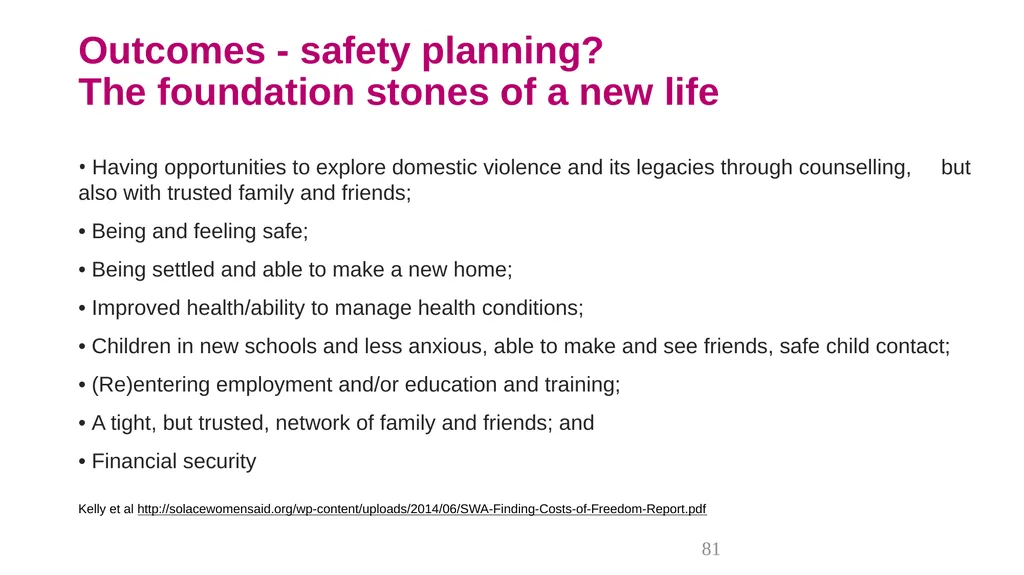
Outcomes - safety planning?
The foundation stones of a new life 81 • Having opportunities to explore domestic violence and its legacies through counselling, but also with trusted family and friends;
• Being and feeling safe;
• Being settled and able to make a new home;
• Improved health/ability to manage health conditions;
• Children in new schools and less anxious, able to make and see friends, safe child contact;
• (Re)entering employment and/or education and training;
• A tight, but trusted, network of family and friends; and
• Financial security Kelly et al http://solacewomensaid.org/wp-content/uploads/2014/06/SWA-Finding-Costs-of-Freedom-Report.pdf<br>
• Being and feeling safe;
• Being settled and able to make a new home;
• Improved health/ability to manage health conditions;
• Children in new schools and less anxious, able to make and see friends, safe child contact;
• (Re)entering employment and/or education and training;
• A tight, but trusted, network of family and friends; and
• Financial security Kelly et al http://solacewomensaid.org/wp-content/uploads/2014/06/SWA-Finding-Costs-of-Freedom-Report.pdf<br>
82
Safety planning Using the case study on your table
Using the cards as prompts build a safety/protection plan for the person at risk
Which agencies would be involved, what would their role be? what information would they need about the risk of abuse?
See section 9 and 10 of the workbook for guidance on safety planning. 82<br>
Which agencies would be involved, what would their role be? what information would they need about the risk of abuse?
See section 9 and 10 of the workbook for guidance on safety planning. 82<br>
83
Liz Kelly identifies 6 Not a sequence!
stages…. 83<br>
stages…. 83<br>
84
Successful interventions with perpetrators of domestic abuse Changing the balance of power
Arrest can work to prevent reoffending
Injunctions or restraining orders can prevent continued harassment
Choosing to stop
Risk can be decreased by attending professionally-run specialist group programmes http://respect.uk.net/
work from the assumption that perpetrators gain from controlling their partners and intentionally use their behaviour to control their partner/can become self-aware as to how they do this https://www.dur.ac.uk/criva/projectmirabal/ 84<br>
Arrest can work to prevent reoffending
Injunctions or restraining orders can prevent continued harassment
Choosing to stop
Risk can be decreased by attending professionally-run specialist group programmes http://respect.uk.net/
work from the assumption that perpetrators gain from controlling their partners and intentionally use their behaviour to control their partner/can become self-aware as to how they do this https://www.dur.ac.uk/criva/projectmirabal/ 84<br>
85
Duty to perpetrators with care and support needs E.g. Men who are living with dementia who have been perpetrators of domestic abuse earlier in their married lives continue to abuse and may increase the level of violence they use against their wives after the onset of dementia.
Knight L and Hester M (2014) Domestic abuse and dementia. What are the characteristic features and patterns of longstanding domestic abuse following the onset of dementia?’ Safe (Winter 2014) 10-14. 85 Some adults with care and support needs may be perpetrators of domestic abuse<br>
86
Duty to perpetrators with care and support needs Specialist training should be undertaken before assessing perpetrators of domestic abuse or providing interventions to address abusive behaviour
If you are working with a perpetrator of coercive control ensure the person at risk receives confidential support
Ensure professionals working with the perpetrator and those working with the victim are part of a ‘virtual team’ and are actively sharing information relevant to risk to the survivor
Ensure risk to others is considered when providing care and support to perpetrators 86<br>
If you are working with a perpetrator of coercive control ensure the person at risk receives confidential support
Ensure professionals working with the perpetrator and those working with the victim are part of a ‘virtual team’ and are actively sharing information relevant to risk to the survivor
Ensure risk to others is considered when providing care and support to perpetrators 86<br>
87
Break 87<br>
88
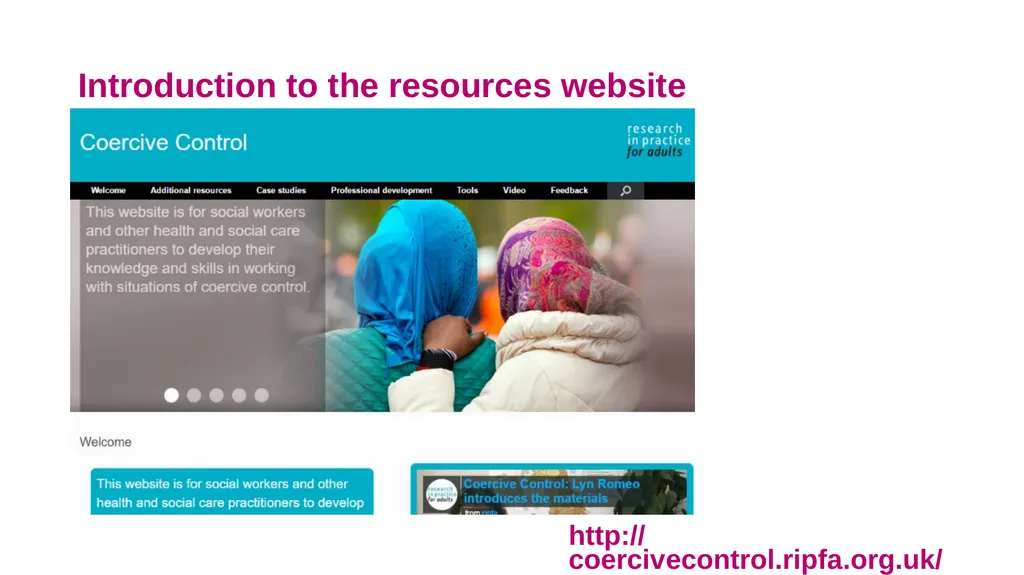
Introduction to the resources website 88 http://coercivecontrol.ripfa.org.uk/<br>
89
Planning and reflection What activities do you plan to deliver, and to whom?
How can you involve people with specialist knowledge of domestic abuse in your CPD activities?
What might the challenges of your training/ CPD sessions be?
How will you integrate survivors’ voices?
See workbook section 11 89<br>
How can you involve people with specialist knowledge of domestic abuse in your CPD activities?
What might the challenges of your training/ CPD sessions be?
How will you integrate survivors’ voices?
See workbook section 11 89<br>
90
Final questions and feedback Evaluation
Please complete your evaluation form on both sides. 90<br>
Please complete your evaluation form on both sides. 90<br>
91
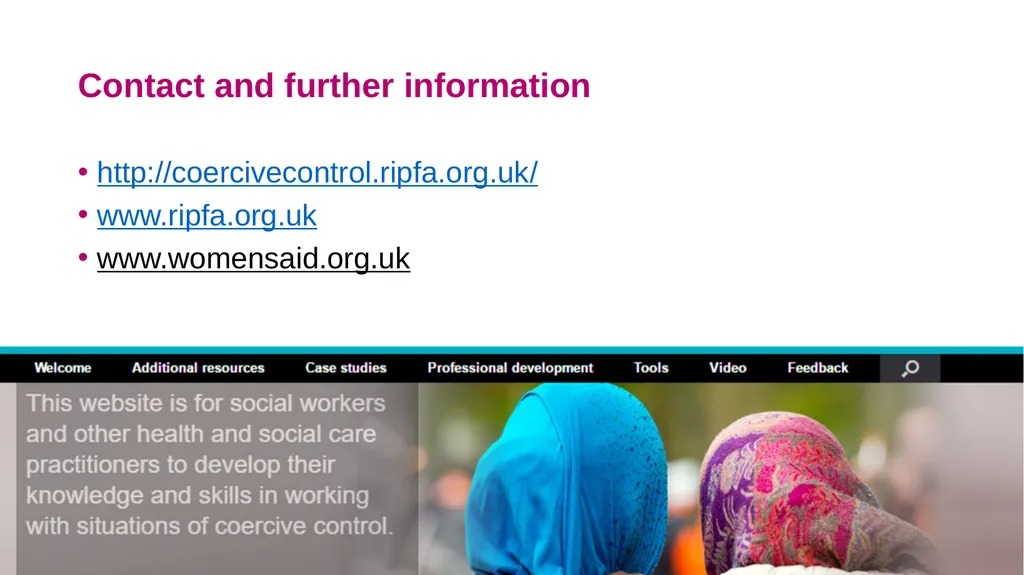
Contact and further information http://coercivecontrol.ripfa.org.uk/
www.ripfa.org.uk
www.womensaid.org.uk 91<br>
www.ripfa.org.uk
www.womensaid.org.uk 91<br>