
Why Accreditation Matters School Name - logo
Description: Why Accreditation Matters School Name - logo Current Accreditation Status and Accreditation Seal (if accredited) 800 Americas 600 EMEA 450 Asia Pacific 600 members accredited 200 members accredited 200 accredited members AACSB
Related Topics
Download Presentation
"Why Accreditation Matters School Name - logo" is the property of its rightful owner. Permission is granted to download and print the materials on this website for personal, non-commercial use only, and to display it on your personal computer provided you do not modify the materials and that you retain all copyright notices contained in the materials. By downloading content from our website, you accept the terms of this agreement.
Presentation Transcript
slide1. Why Accreditation Matters School Name - logo
Current Accreditation Status and Accreditation Seal (if accredited)<br>
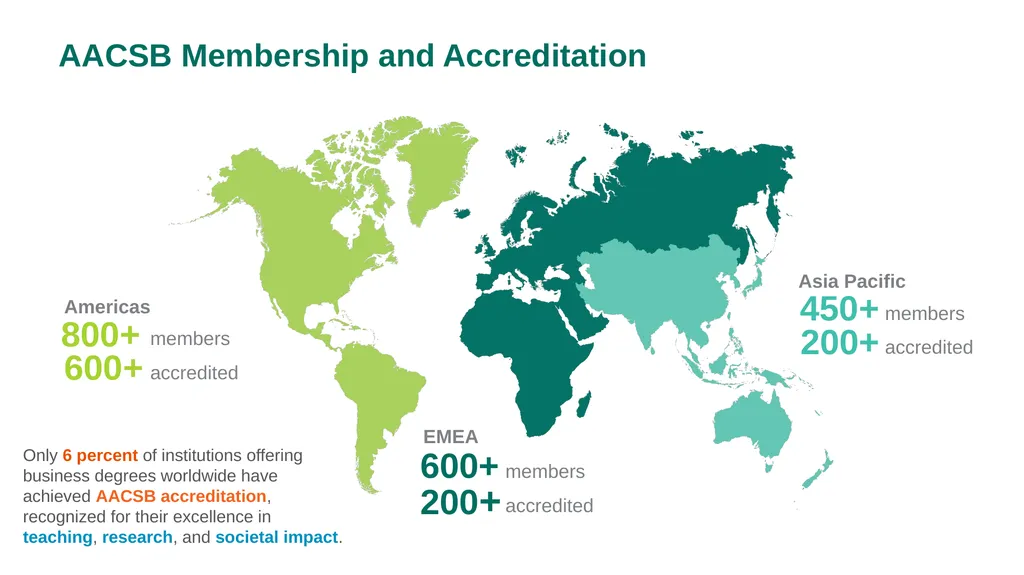
slide2. 800+ Americas 600+ EMEA 450+ Asia Pacific 600+ members accredited 200+ members accredited 200+ accredited members AACSB Membership and Accreditation Only 6 percent of institutions offering business degrees worldwide have achieved AACSB accreditation, recognized for their excellence in teaching, research, and societal impact.<br>
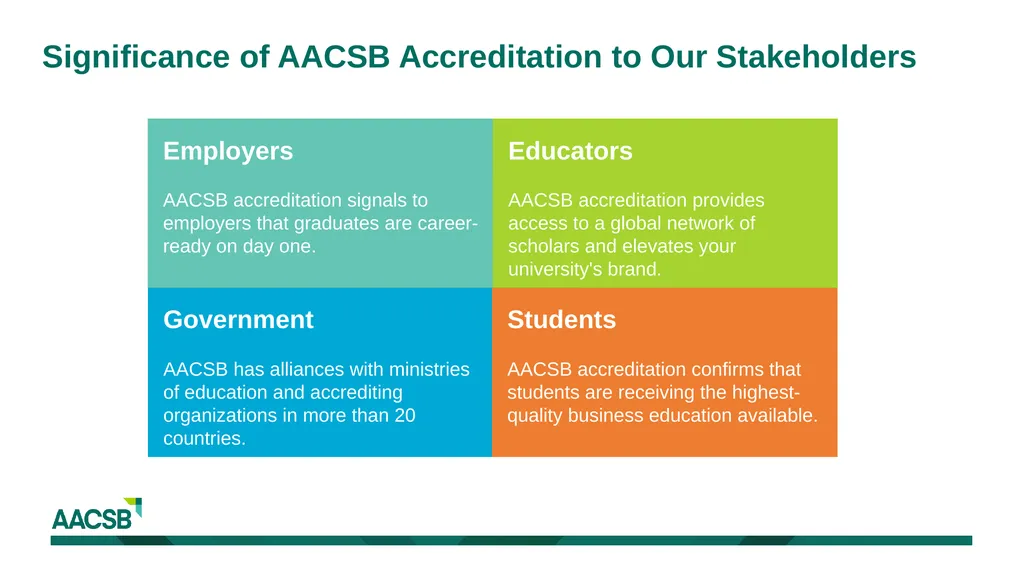
slide3. Significance of AACSB Accreditation to Our Stakeholders Employers
AACSB accreditation signals to employers that graduates are career-ready on day one. Government
AACSB has alliances with ministries of education and accrediting organizations in more than 20 countries. Educators
AACSB accreditation provides access to a global network of scholars and elevates your university's brand. Students
AACSB accreditation confirms that students are receiving the highest-quality business education available.<br>
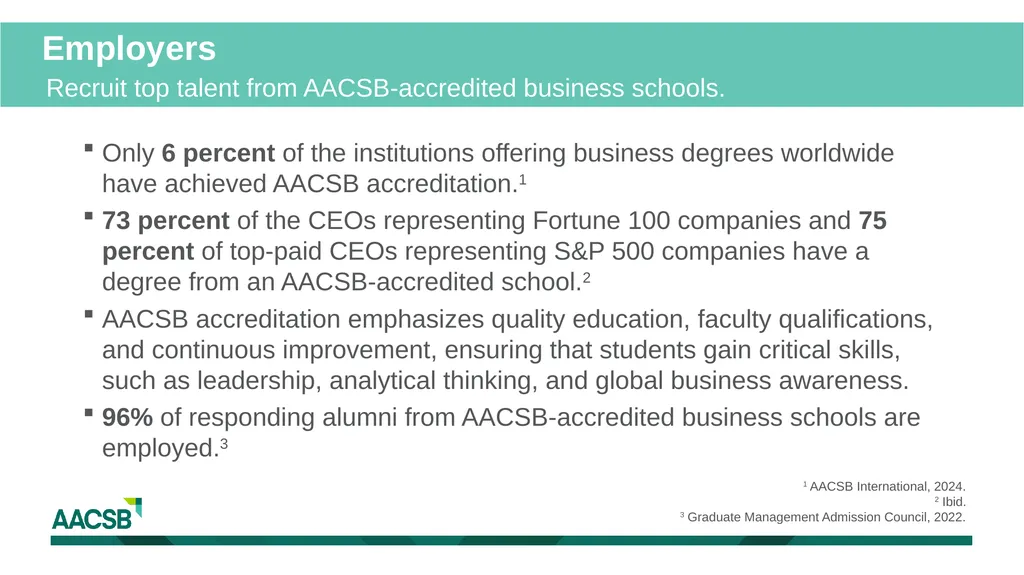
slide4. Only 6 percent of the institutions offering business degrees worldwide have achieved AACSB accreditation.1
73 percent of the CEOs representing Fortune 100 companies and 75 percent of top-paid CEOs representing S&P 500 companies have a degree from an AACSB-accredited school.2
AACSB accreditation emphasizes quality education, faculty qualifications, and continuous improvement, ensuring that students gain critical skills, such as leadership, analytical thinking, and global business awareness.
96% of responding alumni from AACSB-accredited business schools are employed.3 Employers
Recruit top talent from AACSB-accredited business schools. 1 AACSB International, 2024.
2 Ibid.
3 Graduate Management Admission Council, 2022.<br>
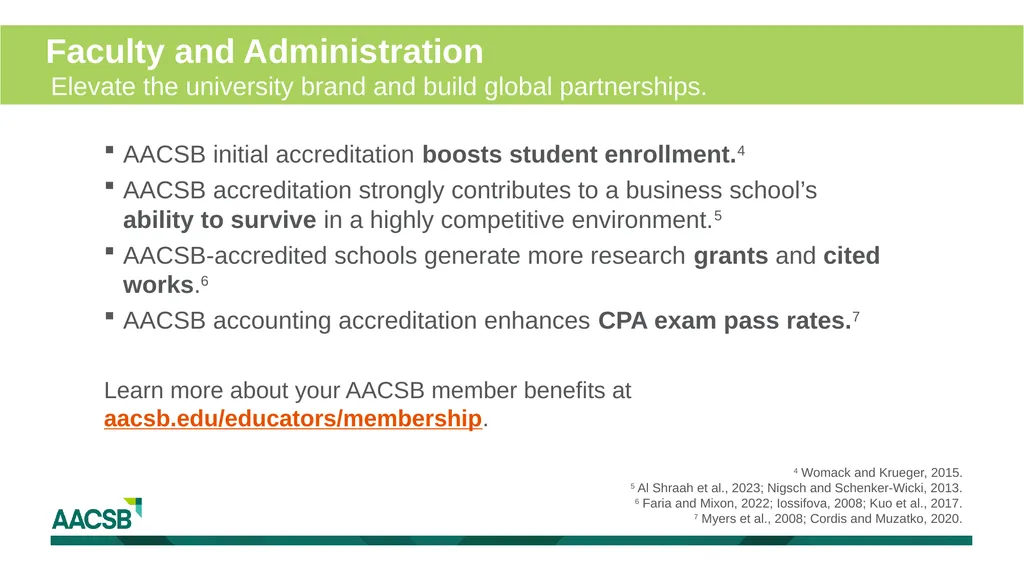
slide5. AACSB initial accreditation boosts student enrollment.4
AACSB accreditation strongly contributes to a business school’s ability to survive in a highly competitive environment.5
AACSB-accredited schools generate more research grants and cited works.6
AACSB accounting accreditation enhances CPA exam pass rates.7
Learn more about your AACSB member benefits at aacsb.edu/educators/membership. Faculty and Administration
Elevate the university brand and build global partnerships. 4 Womack and Krueger, 2015.
5 Al Shraah et al., 2023; Nigsch and Schenker-Wicki, 2013.
6 Faria and Mixon, 2022; Iossifova, 2008; Kuo et al., 2017.
7 Myers et al., 2008; Cordis and Muzatko, 2020.<br>
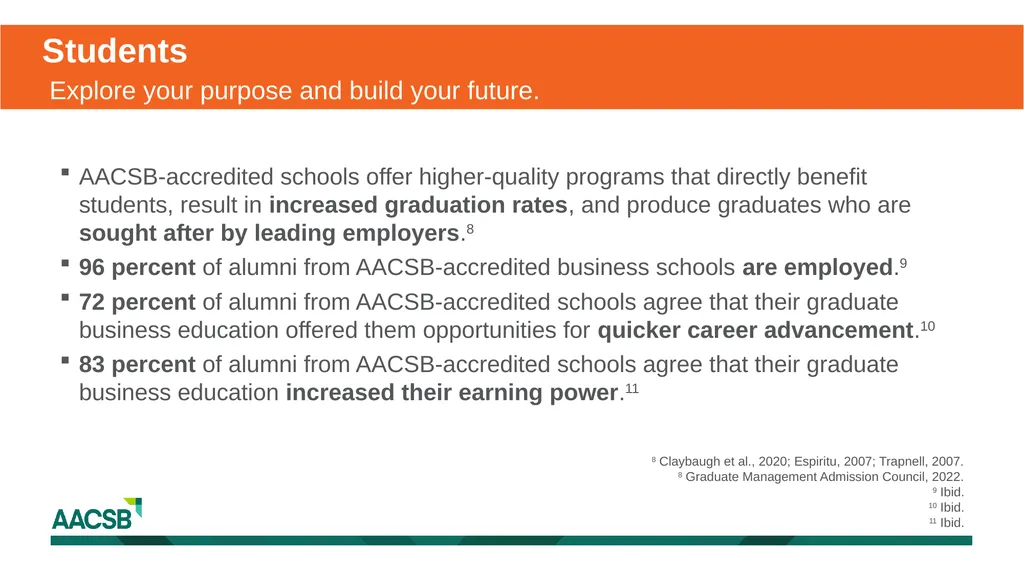
slide6. AACSB-accredited schools offer higher-quality programs that directly benefit students, result in increased graduation rates, and produce graduates who are sought after by leading employers.8
96 percent of alumni from AACSB-accredited business schools are employed.9
72 percent of alumni from AACSB-accredited schools agree that their graduate business education offered them opportunities for quicker career advancement.10
83 percent of alumni from AACSB-accredited schools agree that their graduate business education increased their earning power.11 8 Claybaugh et al., 2020; Espiritu, 2007; Trapnell, 2007.
8 Graduate Management Admission Council, 2022.
9 Ibid.
10 Ibid.
11 Ibid. Students
Explore your purpose and build your future.<br>
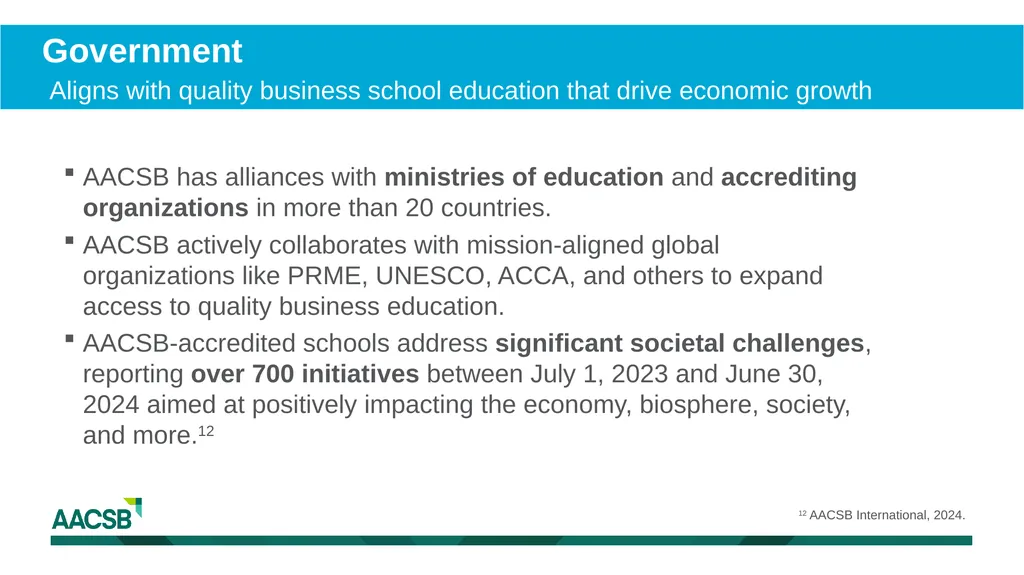
slide7. AACSB has alliances with ministries of education and accrediting organizations in more than 20 countries.
AACSB actively collaborates with mission-aligned global organizations like PRME, UNESCO, ACCA, and others to expand access to quality business education.
AACSB-accredited schools address significant societal challenges, reporting over 700 initiatives between July 1, 2023 and June 30, 2024 aimed at positively impacting the economy, biosphere, society, and more.12 Government
Aligns with quality business school education that drive economic growth 12 AACSB International, 2024.<br>
slide8. Benefits of Accreditation Signal of Quality
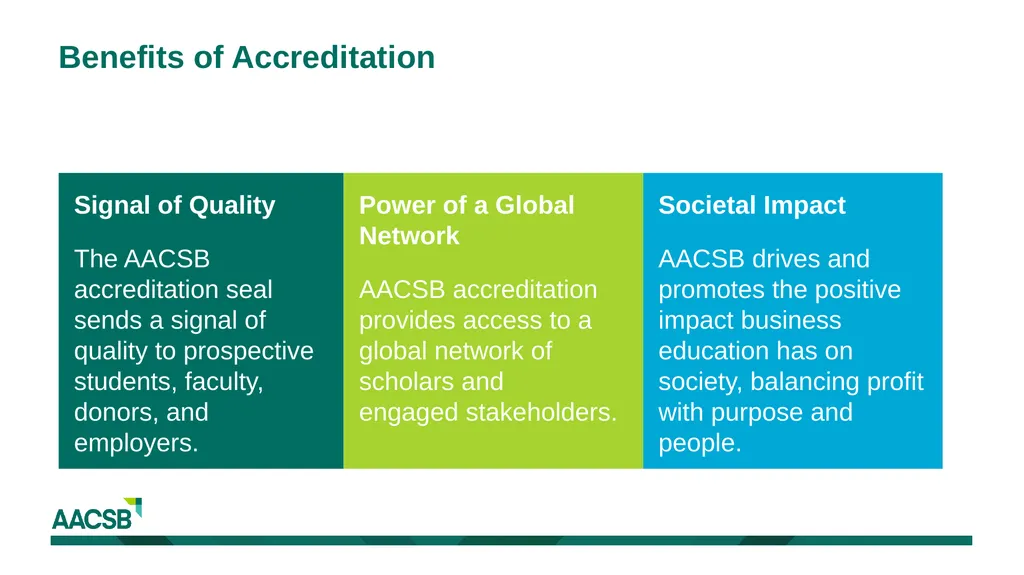
The AACSB accreditation seal sends a signal of quality to prospective students, faculty, donors, and employers. Societal Impact
AACSB drives and promotes the positive impact business education has on society, balancing profit with purpose and people. Power of a Global Network
AACSB accreditation provides access to a global network of scholars and engaged stakeholders.<br>
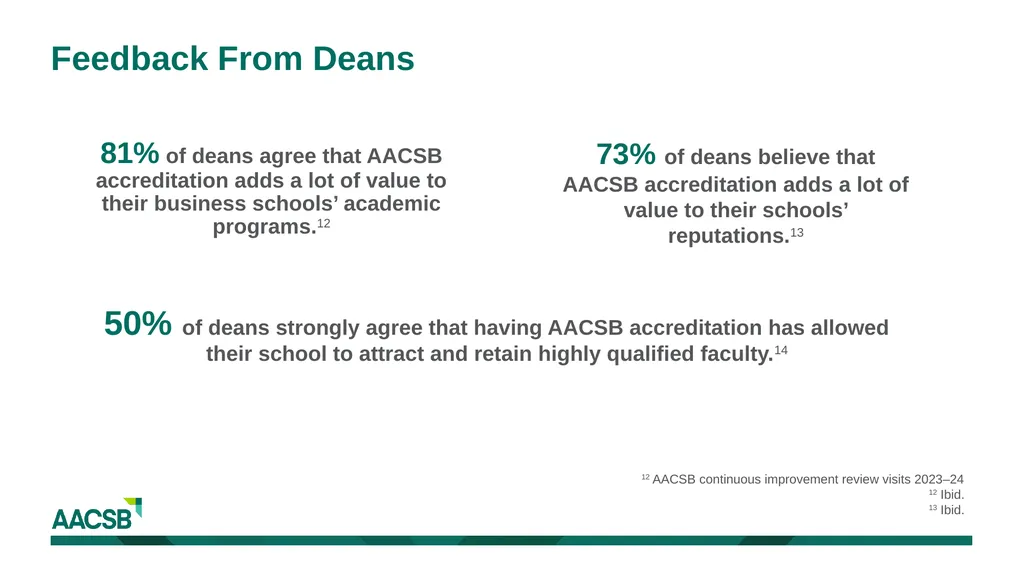
slide9. 81% of deans agree that AACSB accreditation adds a lot of value to their business schools’ academic programs.12 73% of deans believe that AACSB accreditation adds a lot of value to their schools’ reputations.13 12 AACSB continuous improvement review visits 2023–24
12 Ibid.
13 Ibid. 50% of deans strongly agree that having AACSB accreditation has allowed their school to attract and retain highly qualified faculty.14 Feedback From Deans<br>
slide10. Institutional Strategy Development
Insert Relevant School Strategic Action Plan Next Steps<br>
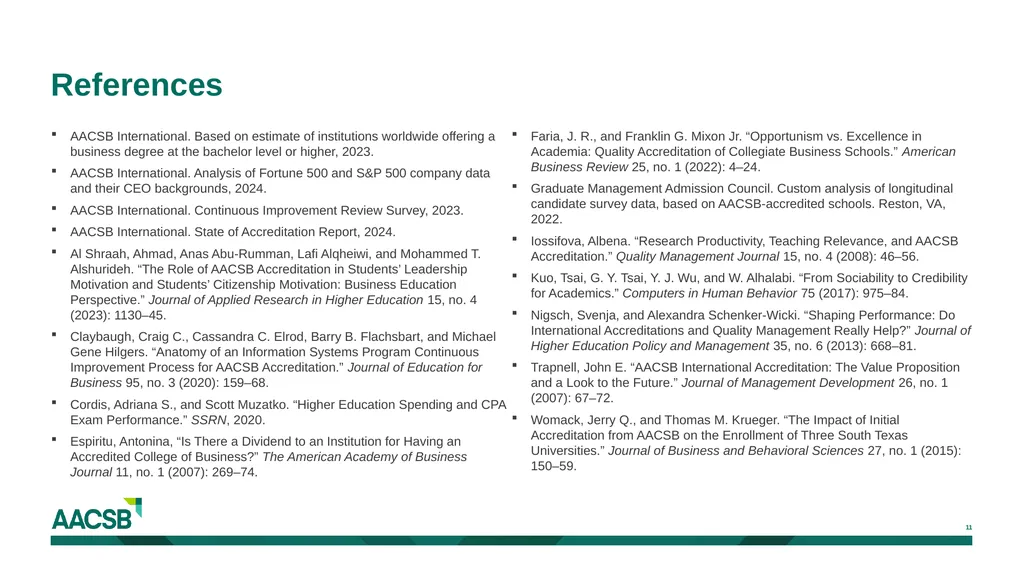
slide11. References AACSB International. Based on estimate of institutions worldwide offering a business degree at the bachelor level or higher, 2023.
AACSB International. Analysis of Fortune 500 and S&P 500 company data and their CEO backgrounds, 2024.
AACSB International. Continuous Improvement Review Survey, 2023.
AACSB International. State of Accreditation Report, 2024.
Al Shraah, Ahmad, Anas Abu-Rumman, Lafi Alqheiwi, and Mohammed T. Alshurideh. “The Role of AACSB Accreditation in Students’ Leadership Motivation and Students’ Citizenship Motivation: Business Education Perspective.” Journal of Applied Research in Higher Education 15, no. 4 (2023): 1130–45.
Claybaugh, Craig C., Cassandra C. Elrod, Barry B. Flachsbart, and Michael Gene Hilgers. “Anatomy of an Information Systems Program Continuous Improvement Process for AACSB Accreditation.” Journal of Education for Business 95, no. 3 (2020): 159–68.
Cordis, Adriana S., and Scott Muzatko. “Higher Education Spending and CPA Exam Performance.” SSRN, 2020.
Espiritu, Antonina, “Is There a Dividend to an Institution for Having an Accredited College of Business?” The American Academy of Business Journal 11, no. 1 (2007): 269–74.
Faria, J. R., and Franklin G. Mixon Jr. “Opportunism vs. Excellence in Academia: Quality Accreditation of Collegiate Business Schools.” American Business Review 25, no. 1 (2022): 4–24.
Graduate Management Admission Council. Custom analysis of longitudinal candidate survey data, based on AACSB-accredited schools. Reston, VA, 2022.
Iossifova, Albena. “Research Productivity, Teaching Relevance, and AACSB Accreditation.” Quality Management Journal 15, no. 4 (2008): 46–56.
Kuo, Tsai, G. Y. Tsai, Y. J. Wu, and W. Alhalabi. “From Sociability to Credibility for Academics.” Computers in Human Behavior 75 (2017): 975–84.
Nigsch, Svenja, and Alexandra Schenker-Wicki. “Shaping Performance: Do International Accreditations and Quality Management Really Help?” Journal of Higher Education Policy and Management 35, no. 6 (2013): 668–81.
Trapnell, John E. “AACSB International Accreditation: The Value Proposition and a Look to the Future.” Journal of Management Development 26, no. 1 (2007): 67–72.
Womack, Jerry Q., and Thomas M. Krueger. “The Impact of Initial Accreditation from AACSB on the Enrollment of Three South Texas Universities.” Journal of Business and Behavioral Sciences 27, no. 1 (2015): 150–59. 11<br>
slide12. Value of Accreditation Learn more about AACSB accreditation at aacsb.edu/educators/accreditation/value-of-accreditation 1<br>
slide2. 800+ Americas 600+ EMEA 450+ Asia Pacific 600+ members accredited 200+ members accredited 200+ accredited members AACSB Membership and Accreditation Only 6 percent of institutions offering business degrees worldwide have achieved AACSB accreditation, recognized for their excellence in teaching, research, and societal impact.<br>
slide3. Significance of AACSB Accreditation to Our Stakeholders Employers
AACSB accreditation signals to employers that graduates are career-ready on day one. Government
AACSB has alliances with ministries of education and accrediting organizations in more than 20 countries. Educators
AACSB accreditation provides access to a global network of scholars and elevates your university's brand. Students
AACSB accreditation confirms that students are receiving the highest-quality business education available.<br>
slide4. Only 6 percent of the institutions offering business degrees worldwide have achieved AACSB accreditation.1
73 percent of the CEOs representing Fortune 100 companies and 75 percent of top-paid CEOs representing S&P 500 companies have a degree from an AACSB-accredited school.2
AACSB accreditation emphasizes quality education, faculty qualifications, and continuous improvement, ensuring that students gain critical skills, such as leadership, analytical thinking, and global business awareness.
96% of responding alumni from AACSB-accredited business schools are employed.3 Employers
Recruit top talent from AACSB-accredited business schools. 1 AACSB International, 2024.
2 Ibid.
3 Graduate Management Admission Council, 2022.<br>
slide5. AACSB initial accreditation boosts student enrollment.4
AACSB accreditation strongly contributes to a business school’s ability to survive in a highly competitive environment.5
AACSB-accredited schools generate more research grants and cited works.6
AACSB accounting accreditation enhances CPA exam pass rates.7
Learn more about your AACSB member benefits at aacsb.edu/educators/membership. Faculty and Administration
Elevate the university brand and build global partnerships. 4 Womack and Krueger, 2015.
5 Al Shraah et al., 2023; Nigsch and Schenker-Wicki, 2013.
6 Faria and Mixon, 2022; Iossifova, 2008; Kuo et al., 2017.
7 Myers et al., 2008; Cordis and Muzatko, 2020.<br>
slide6. AACSB-accredited schools offer higher-quality programs that directly benefit students, result in increased graduation rates, and produce graduates who are sought after by leading employers.8
96 percent of alumni from AACSB-accredited business schools are employed.9
72 percent of alumni from AACSB-accredited schools agree that their graduate business education offered them opportunities for quicker career advancement.10
83 percent of alumni from AACSB-accredited schools agree that their graduate business education increased their earning power.11 8 Claybaugh et al., 2020; Espiritu, 2007; Trapnell, 2007.
8 Graduate Management Admission Council, 2022.
9 Ibid.
10 Ibid.
11 Ibid. Students
Explore your purpose and build your future.<br>
slide7. AACSB has alliances with ministries of education and accrediting organizations in more than 20 countries.
AACSB actively collaborates with mission-aligned global organizations like PRME, UNESCO, ACCA, and others to expand access to quality business education.
AACSB-accredited schools address significant societal challenges, reporting over 700 initiatives between July 1, 2023 and June 30, 2024 aimed at positively impacting the economy, biosphere, society, and more.12 Government
Aligns with quality business school education that drive economic growth 12 AACSB International, 2024.<br>
slide8. Benefits of Accreditation Signal of Quality
The AACSB accreditation seal sends a signal of quality to prospective students, faculty, donors, and employers. Societal Impact
AACSB drives and promotes the positive impact business education has on society, balancing profit with purpose and people. Power of a Global Network
AACSB accreditation provides access to a global network of scholars and engaged stakeholders.<br>
slide9. 81% of deans agree that AACSB accreditation adds a lot of value to their business schools’ academic programs.12 73% of deans believe that AACSB accreditation adds a lot of value to their schools’ reputations.13 12 AACSB continuous improvement review visits 2023–24
12 Ibid.
13 Ibid. 50% of deans strongly agree that having AACSB accreditation has allowed their school to attract and retain highly qualified faculty.14 Feedback From Deans<br>
slide10. Institutional Strategy Development
Insert Relevant School Strategic Action Plan Next Steps<br>
slide11. References AACSB International. Based on estimate of institutions worldwide offering a business degree at the bachelor level or higher, 2023.
AACSB International. Analysis of Fortune 500 and S&P 500 company data and their CEO backgrounds, 2024.
AACSB International. Continuous Improvement Review Survey, 2023.
AACSB International. State of Accreditation Report, 2024.
Al Shraah, Ahmad, Anas Abu-Rumman, Lafi Alqheiwi, and Mohammed T. Alshurideh. “The Role of AACSB Accreditation in Students’ Leadership Motivation and Students’ Citizenship Motivation: Business Education Perspective.” Journal of Applied Research in Higher Education 15, no. 4 (2023): 1130–45.
Claybaugh, Craig C., Cassandra C. Elrod, Barry B. Flachsbart, and Michael Gene Hilgers. “Anatomy of an Information Systems Program Continuous Improvement Process for AACSB Accreditation.” Journal of Education for Business 95, no. 3 (2020): 159–68.
Cordis, Adriana S., and Scott Muzatko. “Higher Education Spending and CPA Exam Performance.” SSRN, 2020.
Espiritu, Antonina, “Is There a Dividend to an Institution for Having an Accredited College of Business?” The American Academy of Business Journal 11, no. 1 (2007): 269–74.
Faria, J. R., and Franklin G. Mixon Jr. “Opportunism vs. Excellence in Academia: Quality Accreditation of Collegiate Business Schools.” American Business Review 25, no. 1 (2022): 4–24.
Graduate Management Admission Council. Custom analysis of longitudinal candidate survey data, based on AACSB-accredited schools. Reston, VA, 2022.
Iossifova, Albena. “Research Productivity, Teaching Relevance, and AACSB Accreditation.” Quality Management Journal 15, no. 4 (2008): 46–56.
Kuo, Tsai, G. Y. Tsai, Y. J. Wu, and W. Alhalabi. “From Sociability to Credibility for Academics.” Computers in Human Behavior 75 (2017): 975–84.
Nigsch, Svenja, and Alexandra Schenker-Wicki. “Shaping Performance: Do International Accreditations and Quality Management Really Help?” Journal of Higher Education Policy and Management 35, no. 6 (2013): 668–81.
Trapnell, John E. “AACSB International Accreditation: The Value Proposition and a Look to the Future.” Journal of Management Development 26, no. 1 (2007): 67–72.
Womack, Jerry Q., and Thomas M. Krueger. “The Impact of Initial Accreditation from AACSB on the Enrollment of Three South Texas Universities.” Journal of Business and Behavioral Sciences 27, no. 1 (2015): 150–59. 11<br>
slide12. Value of Accreditation Learn more about AACSB accreditation at aacsb.edu/educators/accreditation/value-of-accreditation 1<br>